The Project Gutenberg EBook of A Letter to the Right Honorable the Lord
Chancellor, on the Nature and Interpretation of Unsoundness of Mind, and Imbecility of Intellect, by John Haslam
This eBook is for the use of anyone anywhere at no cost and with
almost no restrictions whatsoever. You may copy it, give it away or
re-use it under the terms of the Project Gutenberg License included
with this eBook or online at www.gutenberg.org
Title: A Letter to the Right Honorable the Lord Chancellor, on the Nature and Interpretation of Unsoundness of Mind, and Imbecility of Intellect
Author: John Haslam
Release Date: January 7, 2009 [EBook #27740]
Language: English
Character set encoding: ASCII
*** START OF THIS PROJECT GUTENBERG EBOOK LETTER TO LORD CHANCELLOR ***
Produced by S.D., and The Online Distributed Proofreading
Team at https://www.pgdp.net (This file was produced from
images generously made available by The Internet
Archive/Canadian Libraries)
A LETTER
TO
_THE LORD CHANCELLOR_.
A
LETTER
TO
THE RIGHT HONORABLE
THE
LORD CHANCELLOR,
ON THE
NATURE AND INTERPRETATION
OF
UNSOUNDNESS OF MIND,
AND
_IMBECILITY OF INTELLECT_.
BY
JOHN HASLAM, M.D.
LATE OF PEMBROKE HALL, CAMBRIDGE.
_LONDON:_
PUBLISHED BY R. HUNTER,
ST. PAUL'S CHURCH YARD.
***
1823.
PRINTED BY G. HAYDEN,
Little College Street, Westminster.
A LETTER.
MY LORD,
THE present address originates in an anxious wish for the advancement of
medical knowledge, where it is connected with those maladies of the
human mind, that are referable to the court, wherein your Lordship has
so long administered impartial justice. The disorders which affect the
body are, in general, the exclusive province of the medical
practitioner; but, by a wise provision, that has descended to us from
the enlightened nations of antiquity, the law has considered those
persons, whose intellectual derangement rendered them inadequate to the
governance of themselves in society, or incapable of managing their
affairs, entitled to its special protection. If your Lordship should
feel surprized at this communication, or deem my conduct presumptuous,
the thirst of information on an important subject is my only apology;
and I have sought to allay it in the pure stream that issues from the
fountain-head, rather than from subordinate channels or distant
distributions. Although personally a stranger to your Lordship, nearly
thirty years of my life have been devoted to the investigation and
treatment of insanity: of which more than twenty have been
professionally passed in the largest receptacle for lunatics;--and the
press has diffused, in several publications, my opinions and experience
concerning the human mind, both in its sound state and morbid condition.
The medical profession, of which I am an humble member, entertains very
different notions concerning the nature of UNSOUNDNESS of mind, and
IMBECILITY of intellect;--and this difference of opinion has been
displayed on many solemn occasions, where medical testimony has been
deposed.
If a physician were to attempt to search into the existing records and
procedures on insanity, to collect its legal interpretation, such
investigation would probably be a waste of his time, the source of
abundant, and perhaps of incurable error; but to these inconveniences he
will not be subjected in attentively considering your Lordship's
judgments, of which I have availed myself on the present occasion, and
which, having been taken down at the time they were delivered, may be
presumed not materially incorrect. The documents to which I refer are
the judgments of the 22d April, 1815, and the 17th December, 1822, on
the Portsmouth petitions, together with the minutes of conference
between your Lordship and certain physicians, on the 7th January, 1823.
In the judgment on the petition of 1815, it is stated by your
Lordship,[A] "I have searched, and caused a most careful search to be
made into all the records and procedures on lunacy which are extant. I
believe, and I think I may venture to say, that originally commissions
of this sort were of two kinds; a commission aiming at, and enquiring
whether, the individual had been an idiot ex nativitate, or whether, on
the other hand, he was a lunatic. The question whether he was a
lunatic, being a question, admitting in the solution of it, of a
decision that imputed to him at one time an extremely sound mind, but at
other times, an occurrence of insanity, with reference to which, it was
necessary to guard his person and his property by a commission issuing.
It seems to have been a very long time before those who had the
administration of justice in this department, thought themselves at
liberty to issue a commission, when the person was represented as not
being idiot ex nativitate, as not being lunatic, but as being of UNSOUND
MIND, importing by those words, the notion, that the party was in _some
such state_, as was to be contra-distinguished from idiotcy, and as he
was to be contra-distinguished from lunacy, and yet such as made him a
proper object of a commission, in the nature of a commission to inquire
of idiotcy, or a commission to inquire of lunacy. From the moment that
that had been established, down to this moment, it appears to me to have
been at the same time established, that _whatever_ may be the degree of
weakness or imbecility of the party to manage his own affairs, if the
finding of the jury is only that he was of an extreme imbecility of
mind, that he has an inability to manage his own affairs: if they will
not proceed to _infer_ from _that_, in their finding, upon oath, that he
is of UNSOUND MIND, they have not established, by the result of the
inquiry, a case upon which the Chancellor can make a grant, constituting
a committee, either of the person or estate. All the cases decide that
mere imbecility will not do; that an inability to manage a man's affairs
will not do, unless that inability, and that incapacity to manage his
affairs _amount_ to evidence that he is of unsound mind; and he must be
found to be so. Now there is a great difference between inability to
manage a man's affairs, and imbecility of mind taken as _evidence_ of
unsoundness of mind. The case of Charlton Palmer, in which this was very
much discussed, was the case of a man stricken in years, and whose mind
was the mind of a child;--it was, _therefore_, _in that sense_,
imbecility, and inability to manage his affairs, which _constituted_
unsoundness of mind."
The introduction of the term _unsoundness_, to denote a particular state
of disordered mind, which is supposed to differ from idiotcy and lunacy,
has been the source of considerable perplexity to medical
practitioners; and, in my own opinion, opens an avenue for ignorance and
injustice. The application of figurative terms, especially when imposed
under a loose analogy, and where they might be supplied by words of
direct meaning, always tends to error and confusion.
When medical persons depose that the mind of an individual is unsound,
(which character of intellect, if accredited by the jury, would induce
them to find the commission,) they ought, at the same time, to define
precisely what they mean by such term:--and the jury, when they "proceed
to infer" this unsoundness, ought to be in possession of sufficient and
well-defined premises, to warrant such inference. But where are these
materials to be found? There is a strong presumption that this
unsoundness remains an unsolved problem to the present hour, and it is
exemplified in the difference of sentiment that prevailed on a late
occasion,[B] between the most eminent of the medical profession; where
the same opinions and conduct impressed certain physicians, that this
nobleman was of sound mind, and others that his mind was thoroughly
unsound: so that the jury were to _proceed to make their inference_ from
the opposite testimony, deposed by the medical evidence, or to proceed
to hold such evidence in little esteem from its contrariety on a subject
which these physicians professed to illustrate. The term unsoundness,
applied to designate a certain state of the human mind, hitherto
undescribed, has not originated with medical persons; to them,
therefore, we cannot refer for the solution of its import, and there can
be no analogy between the definite unsoundness of animal and vegetable
substances, and any condition of the intellect. Timber is said to be
unsound, and although we may be little acquainted with the cause by
which it is produced, yet its actual state of rottenness is evident:--a
horse is unsound, in consequence of some morbid affection that can be
pointed out by the veterinarian:--a dentist can detect an unsound
tooth:--a physician, from certain well marked symptoms, concludes that
the lungs or liver of an individual are unsound:--particular doctrines
are held to be unsound, because they deflect from such as are orthodox,
and it is presumed there may be an unsound exposition of the law. The
human mind, however, is not the subject of similar investigation; we
are able to discover no virus by which it is contaminated--no spreading
rottenness--no morbid leaven that ferments, or canker that corrodes it.
Although we may apply the word unsoundness, in a figurative or
metaphorical sense, to the human mind, yet we cannot detect in it any of
the marks or indications that characterize the unsoundness of substances
acknowledged to be in that state: it is, therefore, under this
conviction, and with the view of increasing our knowledge of the human
intellect, that, on the behalf of the members of the medical profession,
I venture to solicit your Lordship, on the first opportunity that may
occur, to elucidate the nature of this UNSOUNDNESS OF MIND, so that
physicians may be enabled thoroughly to ascertain its existence, and
conscientiously depose to that effect, and also that it may be
recognized by the jury, when they "proceed to make their inference," in
order that, by their return, your Lordship may appoint the proper
committees of the person and property.
Respecting the human intellect, two very opposite opinions prevail among
physiologists and metaphysicians. One party strenuously contends that
the phenomena of mind result from the peculiar organization of the
brain, although they confess themselves to be as "entirely ignorant how
the parts of the brain accomplish these purposes, as how the liver
secretes bile, how the muscles contract, or how any other living purpose
is effected."--The other maintains that we become intelligent beings
through the medium of a purer emanation, which they denominate SPIRIT,
diffused over, or united with, this corporeal structure. The former of
these suppositions is held by many grave and pious persons to be
incompatible with the doctrines of the Christian Religion; and if I am
not mistaken, your Lordship, on a late occasion, after having perused a
work attempting to establish such principles, did incline, by "rational
doubts," to suspect that these opinions were "directed against the truth
of Scripture."
It is particularly fortunate that the arguments concerning the nature of
unsoundness of mind and imbecility do not involve either of these
presumptions:--if the most decided victory over their opponents were to
be conceded to the fautors of organization, no advantage could be
derived from their philosophy by lawyer or physician, whose object is
to ascertain the existing state of an individual's mind, and not to
detect the morbid alterations of the cerebral structure by the scrutiny
of dissection: nor is it necessary, for the elucidation of the present
subject, to contend for the pre-eminence of the spiritual doctrine, as
it would be extremely difficult, and perhaps irreverent, to suppose,
that this immaterial property, this divine essence, that confers
perception, reverts into memory, and elaborates thought, can be
susceptible of unsoundness. These high attributes, proudly distinguished
from perishable matter;--this sanctuary, which "neither moth nor rust
doth corrupt," cannot undergo such subordinate changes, without an
obvious degradation.
To the furtherance of that pure and substantial justice, which it has
been the tenor of your Lordship's ministry to award, these metaphysical
disquisitions will in no manner contribute; nor will they assist the
medical practitioner in the attainment of his object, which is to
ascertain the competence of an individual's MIND, to conduct himself in
society, and to manage his affairs. By the abstract term MIND, is to be
understood the aggregate of the intellectual phenomena, which are
manifested or displayed to the observer by conversation and conduct; and
these are the only tests by which we can judge of an individual's mind.
The boasted deciphering of the human capacities or moral propensities,
by the appearances of the physiognomy, or by craniological surveys--the
mysterious pastimes of anatomical prophets, will never be accredited in
a court of justice while your Lordship guides the helm.
By conversation, is of course included the conveyance of thought by
writing, which, on many occasions, is a more accurate criterion of the
state of mind than oral expression.
Your Lordship seems to consider that we have derived some advantages by
the issue of a commission to ascertain this _unsoundness_ of mind, and
without such due consideration, it is presumed you would not have
adopted it; but the citation of your own accurate phraseology, as it
appears in your judgment of 1815, on the Portsmouth petition, will best
illustrate the subject. "It seems to have been a very long time before
those who had the administration of justice in this department thought
themselves at liberty to issue a commission, when the person was
represented as not being idiot ex nativitate, as not being lunatic, but
as being of UNSOUND MIND, importing, by these words, the notion, that
the party was in _some such state_, as was to be contra-distinguished
from idiotcy, and as was to be contra-distinguished from lunacy, and yet
_such_ as made him a proper object of a commission in the nature of a
commission to inquire of idiotcy, or a commission to inquire of lunacy."
These words clearly imply a morbid state of intellect, which is neither
idiotcy nor lunacy, termed _unsound mind_, and yet the legal remedy for
the protection of the person and property of the possessor of this
_unsound mind_ does not differ from that which is applied to idiot and
lunatic. The process of law is the same. This undescribed state of
unsoundness is contra-distinguished from idiotcy and lunacy; but we are
left in the dark concerning the peculiar circumstances by which it is
contra-distinguished, and under such defect the advantages of
introducing a new and undefined term are not apparent. For what purpose
"those who had the administration of justice in this department thought
themselves at liberty" so to act, is not explained: but your Lordship
having adopted such practice, and highly commended the authority from
whence it has been derived, can, doubtless, afford the necessary
elucidation.
For those venerable authorities of the law, who have preceded your
Lordship in this department of the administration of justice, I feel
impressed with the utmost deference and respect; and these grateful
sentiments will be rendered more intense whenever their reasons are
promulgated. Medical practitioners, who have devoted their lives to the
consideration and treatment of insanity, are disposed to doubt
concerning the existence of any intrinsic or positive unsoundness of
mind, as contra-distinguished from idiotcy and lunacy. Those who have
accumulated the largest sum of experience in disorders of the intellect,
have viewed the various forms under which they are manifested, as
equally conducing to render an individual incapable of conducting
himself and managing his affairs, whether the mental affection be termed
madness, melancholy, insanity, mental derangement, non compos mentis,
idiotcy, or lunacy; and, if it were necessary, a more ample catalogue
might be introduced. Physicians may, perhaps, be advantageously
occupied in establishing nice shades of difference in the symptoms of
mental disorder; and, if we do not already possess sufficient, may
create new terms expressive of these modifications: and such extension
of the nosological volume may have its practical utility: but the lawyer
can have no interest in such speculations, he only looks to the medical
evidence to demonstrate the existence of that _morbid_ condition of
intellect that renders the individual incompetent to conduct himself in
society, and to manage his affairs.
Speaking generally, the state of idiotcy is well understood, although
cases of an intricate nature may occasionally occur: but there is
considerable probability, that the interpretation that has adhered to
the term lunacy, more especially in the estimate of the lawyer, has been
the source of considerable error, and has also tended to introduce the
middle and undefined epithet of unsoundness. The old physicians, for
whom modern practitioners entertain less reverence than lawyers feel for
their predecessors, concurred, that lunatics were not only persons of
disordered mind, but that their intellectual aberrations corresponded
with certain changes of the moon: and this lunar hypothesis which had
beguiled the medical profession, will furnish a sufficient apology for
its adoption by the lawyer. It is a necessary consequence, if the moon,
at certain periods, shed a baneful influence on the human intellect,
that the intermediate periods would be exempt from its contamination;
or, speaking more technically, at certain phases of that luminary, a
person would be visited by an insane paroxysm, and at others, experience
a lucid interval. The belief in these alternations of insanity and
reason, is perspicuously stated in your Lordship's judgment of 1815, on
the Portsmouth petition. "The question whether he was a lunatic, being a
question admitting, in the solution of it, of a decision that imputed to
him, at one time, an _extremely sound mind_, but at other times, an
occurrence of insanity, with reference to which it was necessary to
guard his person and his property by a commission issuing."
Notwithstanding it must be admitted that
"There are more things in heaven and earth
Than are dreamt of in our philosophy;"
yet, in the present times, our faith in the influence of the lunar
aspects has considerably abated, and we employ the term lunatic as a
familiar expression, to denote a person of insane mind, without any
reference to its derivation, or supposed ascendency of the moon, which
my own observations have tended to disprove:--but as the phrase lucid
interval is, in its legal sense, connected with lunatic, some
investigation of its meaning becomes absolutely necessary.
If it were the real character of lunacy, after the visitation of the
paroxysm, to leave the patient in the possession of an _extremely sound
mind_, this disorder would be rendered much less formidable than we now
consider it, and might in its effects be compared to those violent
storms of thunder and lightning that purify the atmosphere and dispense
salutary refreshment; and it is not improbable, that some, gifted by
nature with mediocrity of talent, but of a philosophical turn and
aspiring pretensions, might regard the occurrence of such paroxysm as a
desideratum, rather than an evil, on account of the _extreme soundness_
they would experience afterwards: it is moreover evident, that however
degraded the lunatic may be in the estimation of vigorous and
enlightened intellects, yet this depreciated object, by the enjoyment of
occasional periods of bright understanding, has abundant cause for
taunt and triumph over the victim of unsoundness; whose state is
"contra-distinguished from lunacy," and as far as has been hitherto
ascertained, does not revel in the luxury of a lucid interval. But these
vicissitudes of intellectual obscurity and lustre have no real
existence;--they are not the offsprings of observation and experience,
but the abortions of hypothesis and precipitate deduction. Lunatics,
from the excitation of various causes, become at times more violent or
desponding, and these exacerbations are often succeeded by tranquillity
and cheerfulness, they are more tractable, and less impelled to urge the
subjects of their prevailing delusions: but this apparent quietude or
assumed complacency, does not imply a renunciation of their perverted
notions, which will be found predominant whenever they are skilfully
questioned. Inexperienced persons judge of the insane state from the
passions or feelings that usually accompany this disorder, and infer its
aggravation from the display of boisterous emotions or afflicting
apprehensions: the medical practitioner considers these sallies as the
mere concomitants of a perverted intellect. This view of the subject is
justified by a fact, of too much importance to be omitted on the present
occasion. Many lunatics, whose dangerous propensities it has been
prudent to control by a stricter restraint, and for a lengthened period,
eventually become harmless, and are safely permitted to enjoy many
indulgences incompatible with their former state: yet these persons
retain their original delusions, although they have acquired the habit
of arresting the impulses which these delusions prompted. It may
therefore be inferred, that a lucid interval is equivalent to the
complete recovery of the patient, and implies the absolute departure of
_all_ those delusions from his mind, that constituted his
lunacy:--leaving him in a condition to sustain a thorough examination,
not shrinking from particular subjects, nor "blenching," though "tented
to the quick;"--and clearly perceiving by contrast the delusions that
had prevailed, and the reason that has supervened.
The term INTERVAL, by which the duration of rational discourse and
conduct is to be estimated, although of sufficiently precise meaning, is
yet susceptible of the most extended signification; and we speak with
equal correctness when we say the interval of a moment and of a thousand
years. The time necessary to comprise a LUCID interval has not, to the
best of my belief, been limited by medical writers or legal
authorities; it must however comprehend a portion sufficient to satisfy
the inquirer, that the individual, whose intellect had been disordered,
does not any longer retain any of the symptoms that constituted his
malady; and this presumes on the part of the examiner an intimate
knowledge of the unfounded prejudices, delusions, or incapacities with
which the mind of the party had been affected, and also deliberate and
repeated investigations to ascertain that they are wholly effaced.
IMBECILITY.
THERE is another subject connected in a legal point of view with the
nature of the human mind, and with the state of its morbid conditions,
on which I respectfully solicit your Lordship's elucidation. In your
Lordship's judgment of 1815, on the Portsmouth petition, it is laid down
that "from the moment that (meaning this questionable and disputed
unsoundness) had been established, down to this moment, it appears to me
however to have been at the same time established, that _whatever_ may
be the degree of weakness or imbecility of the party,--_whatever_ may be
the degree of incapacity of the party to manage his own affairs, if the
finding of the jury is only that he was of an extreme imbecility of
mind, that he has an inability to manage his own affairs; if they will
not proceed to infer from that, in their finding upon oath, that he is
of _unsound mind_, they have not established by the result of the
inquiry, a case upon which the Chancellor can make a grant, constituting
a committee either of the person or estate. All the cases decide that
mere imbecility will not do: that an inability to manage a man's affairs
will not do, unless that inability and that incapacity to manage his
affairs, AMOUNT to evidence that he is of _unsound mind_: and he must be
found to be so."
A conclusion is here drawn that the establishment of _unsoundness_
necessarily involves, that the extreme degree of imbecility and
incapacity of mind does not constitute this unsoundness: that is,--they
may exist in the extreme degree, (or citing the words employed,) in any
degree WHATEVER, which implies the ne plus ultra, without any resulting
UNSOUNDNESS. This is a dictum, which proceeding from your Lordship, the
highest authority, is intitled to the utmost deference:--but it is not
an inference from any acknowledged premises, nor established by the
intervention of any corroborating argument. The very existence of this
intrinsic unsoundness, is "down to the present moment" unproved, and all
that can be inferred in this state of the question, is the accredited
maxim that
"Nil agit exemplum litem quod lite resolvit."
By the common consent of philosophers and physicians, mental imbecility
in the extreme degree is termed idiotcy; and this state may exist "ex
nativitate," or supervene at various periods of human life. When a child
proceeds from infancy to adolescence, and from that state advances to
maturity, with a capacity of acquiring progressively the knowledge which
will enable him to conduct himself in society and to manage his
affairs,--so that he is viewed as a responsible agent and considered
"inter homines homo," such a being is regarded of _sound_ capacity or
intellect:--but if in his career from infancy to manhood it is clearly
ascertained that education is hopeless,--that the seeds of instruction
take "no root, and wither away,"--that he is deficient in the capacity
to attain the information requisite to pilot himself through the world
and manage his concerns, such a person would be deemed an idiot, and it
might be safely concluded that his intellect was _unsound_, by wanting
those capacities that constitute the sound mind. According to your
Lordship's exposition he could not be pronounced _unsound_, because this
word implies "_some such state_, as is to be _contra-distinguished_ from
idiotcy." In order that a definite signification may be affixed to the
expression "_some such state_," it will not, I trust, be deemed
indecorous to ask, what particular condition of morbid intellect is to
be understood by this "some such state?" The solution of this difficulty
would be most acceptable to the practitioners of medicine, and in my own
humble opinion of great relief to the jury, who are called upon to
"proceed to infer" this state of unsoundness without any other premises
than the words "_some such state_." Although we are distinctly told by
your Lordship, that the extreme degree of imbecility or incapacity will
not constitute this "_some such state_" that may be denominated
unsoundness; yet I feel highly satisfied with the force and precision by
which it is expressed in the words "_whatever degree_," which if a scale
were constructed on which imbecility might be estimated, would imply the
ultimate gradation; and whenever any subject can be regulated by
definite quantity, expressed in numbers, it conveys the most certain
information. Your Lordship may however judge of the surprize and
disappointment I felt when I arrived at the following sentence in the
same judgment, "All the cases decide that mere imbecility will not do;
that an inability to manage a man's affairs will not do, unless that
inability and that incapacity to manage his affairs AMOUNT to evidence
that he is of unsound mind, and he must be found to be so."
This, my Lord, is an ample confession that there is a degree of mental
weakness that _does_ amount to unsoundness, and in this opinion all
philosophers and medical practitioners will unhesitatingly concur: but
at the same time this admission wholly upsets the former doctrine, that
no degree of imbecility "WHATEVER" can constitute this required
unsoundness. In your Lordship's judgment on the Portsmouth petition,
delivered the 11th December, 1822, it is stated, "It may be very
difficult to draw the line between such weakness, which is the proper
object of relief in this court, and such as AMOUNTS to insanity," and in
the next sentence, "This is the doctrine of Lord Hardwicke, and I
follow him in saying it is very difficult to draw the line between such
weakness which is the proper object of relief in this court, and such
as AMOUNTS to insanity." This is a second corroboration of an opinion
that destroys the former doctrine. Finally in the "minutes of conference
between your Lordship and certain physicians, held on the 7th January,
1823, in the Portsmouth case," there is an endeavour to explain the
nature of _unsoundness_, and of imbecility or weakness;--but it is
insufficient to direct the physician to any clue whereby his doubts can
be solved, and unfortunately relapses into the original contradictory
statement. "The commission which is usually termed a commission of
lunacy, and which because it has that name, I observe many persons are
extremely misled with respect to the nature of it, and which produced on
a former occasion, with respect to this nobleman, a great mass of
affidavits, in which they stated he was not an object of a commission of
Lunacy.--I say that these words are not much understood.--The law
acknowledges the state of idiotcy, and the state of lunacy, which
properly understood, is a very different thing from that sort of
unsoundness of mind which renders a man incapable of managing his
affairs or his person.--And it has now been long settled, not that a
commission of lunacy is to be issued; but that a commission is to issue
in the nature of a writ de lunatico inquirendo, and then the object of
the commission is perfectly satisfied, if the jury shall find upon
satisfactory evidence, that the party is of unsound mind, and incapable
of managing his own affairs.--The finding of him incapable of managing
his own affairs, is not sufficient to authorize further proceedings, but
there must be a finding that he is of _unsound_ mind, and unable to
manage his affairs:--incapacity to manage his affairs being considered
as evidence of unsound mind:--yet there may be, (and that every man's
mind will suggest) instances of incapacity to manage a man's affairs,
and yet _no_ unsoundness of mind." That many persons are extremely
misled with respect to a commission of lunacy, and too frequently
concerning all other subjects, is fully admitted: and it is equally
clear that the great mass of affidavits produced in 1814, in favor of
Lord Portsmouth's soundness of intellect (for I have attentively perused
the whole catalogue) did not go into the investigation of the supposed
difference between this hypothetical unsoundness and lunacy; but
attested, as far as his Lordship's conversation and conduct had been
the subject of their observation and judgment, that he was not a man
labouring under any infirmity, or morbid state of mind, that ought, by
any legal restraint, to disqualify him from the management of himself
and his affairs. With such opinions I have no concern; they can only be
regarded as negative evidence, and cannot operate against manifold overt
acts of insanity.
In the progress of this respectful address, after numerous but
unsuccessful endeavours to grapple with this _sort_ of unsoundness,
suspicions have arisen that I have been pursuing a phantom;--at times I
have fondly imagined it within my immediate grasp, but it has always
evaded my seizure with unaccountable dexterity:--it even now appears
that I could "clutch" it, as your Lordship distinctly asserts that,
"lunacy _properly understood_ is a _very different thing_ from that
_sort_ of _unsoundness_ which renders a man incapable of managing his
affairs or his person." This is at once coming manfully to the point;
for the disclosure (whenever it may take place) of the circumstances
that constitute lunacy properly understood, which means as it _ought_ to
be understood, a very different thing from this sort of unsoundness,
will be the solution of this desideratum,--and this development will
impose a considerable weight of obligation on the medical profession.
It now only remains to consider the last material sentence, delivered by
your Lordship at this conference, and which to my limited comprehension,
appears, in the same breath, to affirm and deny the same position. "The
finding of him incapable of managing his own affairs, is not sufficient
to authorize further proceedings, but there must be a finding that he is
of _unsound_ mind, and unable to manage his affairs:--incapacity to
manage his affairs, being considered as EVIDENCE of unsound mind."
With the citation of this memorable sentence,--unadulterated by any
comment, I shall conclude this address to your Lordship, submitting at
the same time my own impressions on the subject:--that, to search for
its correct exposition is reverential to the law: to crave its
elucidation from its exalted minister is an act of respectful
deference:--this solicitude is increased from the consideration that the
written opinion of the medical practitioner is deposed on oath, and
that he is examined by the commissioners and jury under the same awful
responsibility:--therefore, when the solemnity of that obligation is
contemplated, the anxiety for accurate information will scarcely require
an apology.
I am, my Lord,
with the utmost respect,
your Lordship's
very obedient servant,
JOHN HASLAM.
_No. 2, Hart Street, Bloomsbury,
May, 1823._
_Works by the same Author._
OBSERVATIONS on MADNESS and MELANCHOLY.
ILLUSTRATIONS of MADNESS, with a plate.
On the MORAL MANAGEMENT of the INSANE.
MEDICAL JURISPRUDENCE, as it relates to INSANITY.
A LETTER to the GOVERNORS of BETHLEM HOSPITAL.
SOUND MIND, or the Physiology of Intelligent Beings.
***
A new edition of the OBSERVATIONS on MADNESS and MELANCHOLY, with
considerable additions, will shortly appear.
***
Printed by G. Hayden, Little College Street, Westminster.
FOOTNOTES:
[A] The following citation was introduced, with some comments, in my
work on MEDICAL JURISPRUDENCE, as it relates to INSANITY, according to
the Law of England, 1817, which is now out of print.
[B] Lord Portsmouth's Commission.
[Transcriber's Note: Other than one correction (p. 8, 'ideot' to 'idiot'
in 'when the person was represented as not being idiot ex nativitate'),
all archaic and unusual spelling (e.g. idiotcy) has been left as in the
original.]
End of the Project Gutenberg EBook of A Letter to the Right Honorable the
Lord Chancellor, on the Nature and Interpretation of Unsoundness of Mind, and Imbecility of Intellect, by John Haslam
*** END OF THIS PROJECT GUTENBERG EBOOK LETTER TO LORD CHANCELLOR ***
***** This file should be named 27740.txt or 27740.zip *****
This and all associated files of various formats will be found in:
https://www.gutenberg.org/2/7/7/4/27740/
Produced by S.D., and The Online Distributed Proofreading
Team at https://www.pgdp.net (This file was produced from
images generously made available by The Internet
Archive/Canadian Libraries)
Updated editions will replace the previous one--the old editions
will be renamed.
Creating the works from public domain print editions means that no
one owns a United States copyright in these works, so the Foundation
(and you!) can copy and distribute it in the United States without
permission and without paying copyright royalties. Special rules,
set forth in the General Terms of Use part of this license, apply to
copying and distributing Project Gutenberg-tm electronic works to
protect the PROJECT GUTENBERG-tm concept and trademark. Project
Gutenberg is a registered trademark, and may not be used if you
charge for the eBooks, unless you receive specific permission. If you
do not charge anything for copies of this eBook, complying with the
rules is very easy. You may use this eBook for nearly any purpose
such as creation of derivative works, reports, performances and
research. They may be modified and printed and given away--you may do
practically ANYTHING with public domain eBooks. Redistribution is
subject to the trademark license, especially commercial
redistribution.
*** START: FULL LICENSE ***
THE FULL PROJECT GUTENBERG LICENSE
PLEASE READ THIS BEFORE YOU DISTRIBUTE OR USE THIS WORK
To protect the Project Gutenberg-tm mission of promoting the free
distribution of electronic works, by using or distributing this work
(or any other work associated in any way with the phrase "Project
Gutenberg"), you agree to comply with all the terms of the Full Project
Gutenberg-tm License (available with this file or online at
https://gutenberg.org/license).
Section 1. General Terms of Use and Redistributing Project Gutenberg-tm
electronic works
1.A. By reading or using any part of this Project Gutenberg-tm
electronic work, you indicate that you have read, understand, agree to
and accept all the terms of this license and intellectual property
(trademark/copyright) agreement. If you do not agree to abide by all
the terms of this agreement, you must cease using and return or destroy
all copies of Project Gutenberg-tm electronic works in your possession.
If you paid a fee for obtaining a copy of or access to a Project
Gutenberg-tm electronic work and you do not agree to be bound by the
terms of this agreement, you may obtain a refund from the person or
entity to whom you paid the fee as set forth in paragraph 1.E.8.
1.B. "Project Gutenberg" is a registered trademark. It may only be
used on or associated in any way with an electronic work by people who
agree to be bound by the terms of this agreement. There are a few
things that you can do with most Project Gutenberg-tm electronic works
even without complying with the full terms of this agreement. See
paragraph 1.C below. There are a lot of things you can do with Project
Gutenberg-tm electronic works if you follow the terms of this agreement
and help preserve free future access to Project Gutenberg-tm electronic
works. See paragraph 1.E below.
1.C. The Project Gutenberg Literary Archive Foundation ("the Foundation"
or PGLAF), owns a compilation copyright in the collection of Project
Gutenberg-tm electronic works. Nearly all the individual works in the
collection are in the public domain in the United States. If an
individual work is in the public domain in the United States and you are
located in the United States, we do not claim a right to prevent you from
copying, distributing, performing, displaying or creating derivative
works based on the work as long as all references to Project Gutenberg
are removed. Of course, we hope that you will support the Project
Gutenberg-tm mission of promoting free access to electronic works by
freely sharing Project Gutenberg-tm works in compliance with the terms of
this agreement for keeping the Project Gutenberg-tm name associated with
the work. You can easily comply with the terms of this agreement by
keeping this work in the same format with its attached full Project
Gutenberg-tm License when you share it without charge with others.
1.D. The copyright laws of the place where you are located also govern
what you can do with this work. Copyright laws in most countries are in
a constant state of change. If you are outside the United States, check
the laws of your country in addition to the terms of this agreement
before downloading, copying, displaying, performing, distributing or
creating derivative works based on this work or any other Project
Gutenberg-tm work. The Foundation makes no representations concerning
the copyright status of any work in any country outside the United
States.
1.E. Unless you have removed all references to Project Gutenberg:
1.E.1. The following sentence, with active links to, or other immediate
access to, the full Project Gutenberg-tm License must appear prominently
whenever any copy of a Project Gutenberg-tm work (any work on which the
phrase "Project Gutenberg" appears, or with which the phrase "Project
Gutenberg" is associated) is accessed, displayed, performed, viewed,
copied or distributed:
This eBook is for the use of anyone anywhere at no cost and with
almost no restrictions whatsoever. You may copy it, give it away or
re-use it under the terms of the Project Gutenberg License included
with this eBook or online at www.gutenberg.org
1.E.2. If an individual Project Gutenberg-tm electronic work is derived
from the public domain (does not contain a notice indicating that it is
posted with permission of the copyright holder), the work can be copied
and distributed to anyone in the United States without paying any fees
or charges. If you are redistributing or providing access to a work
with the phrase "Project Gutenberg" associated with or appearing on the
work, you must comply either with the requirements of paragraphs 1.E.1
through 1.E.7 or obtain permission for the use of the work and the
Project Gutenberg-tm trademark as set forth in paragraphs 1.E.8 or
1.E.9.
1.E.3. If an individual Project Gutenberg-tm electronic work is posted
with the permission of the copyright holder, your use and distribution
must comply with both paragraphs 1.E.1 through 1.E.7 and any additional
terms imposed by the copyright holder. Additional terms will be linked
to the Project Gutenberg-tm License for all works posted with the
permission of the copyright holder found at the beginning of this work.
1.E.4. Do not unlink or detach or remove the full Project Gutenberg-tm
License terms from this work, or any files containing a part of this
work or any other work associated with Project Gutenberg-tm.
1.E.5. Do not copy, display, perform, distribute or redistribute this
electronic work, or any part of this electronic work, without
prominently displaying the sentence set forth in paragraph 1.E.1 with
active links or immediate access to the full terms of the Project
Gutenberg-tm License.
1.E.6. You may convert to and distribute this work in any binary,
compressed, marked up, nonproprietary or proprietary form, including any
word processing or hypertext form. However, if you provide access to or
distribute copies of a Project Gutenberg-tm work in a format other than
"Plain Vanilla ASCII" or other format used in the official version
posted on the official Project Gutenberg-tm web site (www.gutenberg.org),
you must, at no additional cost, fee or expense to the user, provide a
copy, a means of exporting a copy, or a means of obtaining a copy upon
request, of the work in its original "Plain Vanilla ASCII" or other
form. Any alternate format must include the full Project Gutenberg-tm
License as specified in paragraph 1.E.1.
1.E.7. Do not charge a fee for access to, viewing, displaying,
performing, copying or distributing any Project Gutenberg-tm works
unless you comply with paragraph 1.E.8 or 1.E.9.
1.E.8. You may charge a reasonable fee for copies of or providing
access to or distributing Project Gutenberg-tm electronic works provided
that
- You pay a royalty fee of 20% of the gross profits you derive from
the use of Project Gutenberg-tm works calculated using the method
you already use to calculate your applicable taxes. The fee is
owed to the owner of the Project Gutenberg-tm trademark, but he
has agreed to donate royalties under this paragraph to the
Project Gutenberg Literary Archive Foundation. Royalty payments
must be paid within 60 days following each date on which you
prepare (or are legally required to prepare) your periodic tax
returns. Royalty payments should be clearly marked as such and
sent to the Project Gutenberg Literary Archive Foundation at the
address specified in Section 4, "Information about donations to
the Project Gutenberg Literary Archive Foundation."
- You provide a full refund of any money paid by a user who notifies
you in writing (or by e-mail) within 30 days of receipt that s/he
does not agree to the terms of the full Project Gutenberg-tm
License. You must require such a user to return or
destroy all copies of the works possessed in a physical medium
and discontinue all use of and all access to other copies of
Project Gutenberg-tm works.
- You provide, in accordance with paragraph 1.F.3, a full refund of any
money paid for a work or a replacement copy, if a defect in the
electronic work is discovered and reported to you within 90 days
of receipt of the work.
- You comply with all other terms of this agreement for free
distribution of Project Gutenberg-tm works.
1.E.9. If you wish to charge a fee or distribute a Project Gutenberg-tm
electronic work or group of works on different terms than are set
forth in this agreement, you must obtain permission in writing from
both the Project Gutenberg Literary Archive Foundation and Michael
Hart, the owner of the Project Gutenberg-tm trademark. Contact the
Foundation as set forth in Section 3 below.
1.F.
1.F.1. Project Gutenberg volunteers and employees expend considerable
effort to identify, do copyright research on, transcribe and proofread
public domain works in creating the Project Gutenberg-tm
collection. Despite these efforts, Project Gutenberg-tm electronic
works, and the medium on which they may be stored, may contain
"Defects," such as, but not limited to, incomplete, inaccurate or
corrupt data, transcription errors, a copyright or other intellectual
property infringement, a defective or damaged disk or other medium, a
computer virus, or computer codes that damage or cannot be read by
your equipment.
1.F.2. LIMITED WARRANTY, DISCLAIMER OF DAMAGES - Except for the "Right
of Replacement or Refund" described in paragraph 1.F.3, the Project
Gutenberg Literary Archive Foundation, the owner of the Project
Gutenberg-tm trademark, and any other party distributing a Project
Gutenberg-tm electronic work under this agreement, disclaim all
liability to you for damages, costs and expenses, including legal
fees. YOU AGREE THAT YOU HAVE NO REMEDIES FOR NEGLIGENCE, STRICT
LIABILITY, BREACH OF WARRANTY OR BREACH OF CONTRACT EXCEPT THOSE
PROVIDED IN PARAGRAPH F3. YOU AGREE THAT THE FOUNDATION, THE
TRADEMARK OWNER, AND ANY DISTRIBUTOR UNDER THIS AGREEMENT WILL NOT BE
LIABLE TO YOU FOR ACTUAL, DIRECT, INDIRECT, CONSEQUENTIAL, PUNITIVE OR
INCIDENTAL DAMAGES EVEN IF YOU GIVE NOTICE OF THE POSSIBILITY OF SUCH
DAMAGE.
1.F.3. LIMITED RIGHT OF REPLACEMENT OR REFUND - If you discover a
defect in this electronic work within 90 days of receiving it, you can
receive a refund of the money (if any) you paid for it by sending a
written explanation to the person you received the work from. If you
received the work on a physical medium, you must return the medium with
your written explanation. The person or entity that provided you with
the defective work may elect to provide a replacement copy in lieu of a
refund. If you received the work electronically, the person or entity
providing it to you may choose to give you a second opportunity to
receive the work electronically in lieu of a refund. If the second copy
is also defective, you may demand a refund in writing without further
opportunities to fix the problem.
1.F.4. Except for the limited right of replacement or refund set forth
in paragraph 1.F.3, this work is provided to you 'AS-IS' WITH NO OTHER
WARRANTIES OF ANY KIND, EXPRESS OR IMPLIED, INCLUDING BUT NOT LIMITED TO
WARRANTIES OF MERCHANTIBILITY OR FITNESS FOR ANY PURPOSE.
1.F.5. Some states do not allow disclaimers of certain implied
warranties or the exclusion or limitation of certain types of damages.
If any disclaimer or limitation set forth in this agreement violates the
law of the state applicable to this agreement, the agreement shall be
interpreted to make the maximum disclaimer or limitation permitted by
the applicable state law. The invalidity or unenforceability of any
provision of this agreement shall not void the remaining provisions.
1.F.6. INDEMNITY - You agree to indemnify and hold the Foundation, the
trademark owner, any agent or employee of the Foundation, anyone
providing copies of Project Gutenberg-tm electronic works in accordance
with this agreement, and any volunteers associated with the production,
promotion and distribution of Project Gutenberg-tm electronic works,
harmless from all liability, costs and expenses, including legal fees,
that arise directly or indirectly from any of the following which you do
or cause to occur: (a) distribution of this or any Project Gutenberg-tm
work, (b) alteration, modification, or additions or deletions to any
Project Gutenberg-tm work, and (c) any Defect you cause.
Section 2. Information about the Mission of Project Gutenberg-tm
Project Gutenberg-tm is synonymous with the free distribution of
electronic works in formats readable by the widest variety of computers
including obsolete, old, middle-aged and new computers. It exists
because of the efforts of hundreds of volunteers and donations from
people in all walks of life.
Volunteers and financial support to provide volunteers with the
assistance they need are critical to reaching Project Gutenberg-tm's
goals and ensuring that the Project Gutenberg-tm collection will
remain freely available for generations to come. In 2001, the Project
Gutenberg Literary Archive Foundation was created to provide a secure
and permanent future for Project Gutenberg-tm and future generations.
To learn more about the Project Gutenberg Literary Archive Foundation
and how your efforts and donations can help, see Sections 3 and 4
and the Foundation web page at https://www.pglaf.org.
Section 3. Information about the Project Gutenberg Literary Archive
Foundation
The Project Gutenberg Literary Archive Foundation is a non profit
501(c)(3) educational corporation organized under the laws of the
state of Mississippi and granted tax exempt status by the Internal
Revenue Service. The Foundation's EIN or federal tax identification
number is 64-6221541. Its 501(c)(3) letter is posted at
https://pglaf.org/fundraising. Contributions to the Project Gutenberg
Literary Archive Foundation are tax deductible to the full extent
permitted by U.S. federal laws and your state's laws.
The Foundation's principal office is located at 4557 Melan Dr. S.
Fairbanks, AK, 99712., but its volunteers and employees are scattered
throughout numerous locations. Its business office is located at
809 North 1500 West, Salt Lake City, UT 84116, (801) 596-1887, email
[email protected]. Email contact links and up to date contact
information can be found at the Foundation's web site and official
page at https://pglaf.org
For additional contact information:
Dr. Gregory B. Newby
Chief Executive and Director
[email protected]
Section 4. Information about Donations to the Project Gutenberg
Literary Archive Foundation
Project Gutenberg-tm depends upon and cannot survive without wide
spread public support and donations to carry out its mission of
increasing the number of public domain and licensed works that can be
freely distributed in machine readable form accessible by the widest
array of equipment including outdated equipment. Many small donations
($1 to $5,000) are particularly important to maintaining tax exempt
status with the IRS.
The Foundation is committed to complying with the laws regulating
charities and charitable donations in all 50 states of the United
States. Compliance requirements are not uniform and it takes a
considerable effort, much paperwork and many fees to meet and keep up
with these requirements. We do not solicit donations in locations
where we have not received written confirmation of compliance. To
SEND DONATIONS or determine the status of compliance for any
particular state visit https://pglaf.org
While we cannot and do not solicit contributions from states where we
have not met the solicitation requirements, we know of no prohibition
against accepting unsolicited donations from donors in such states who
approach us with offers to donate.
International donations are gratefully accepted, but we cannot make
any statements concerning tax treatment of donations received from
outside the United States. U.S. laws alone swamp our small staff.
Please check the Project Gutenberg Web pages for current donation
methods and addresses. Donations are accepted in a number of other
ways including including checks, online payments and credit card
donations. To donate, please visit: https://pglaf.org/donate
Section 5. General Information About Project Gutenberg-tm electronic
works.
Professor Michael S. Hart was the originator of the Project Gutenberg-tm
concept of a library of electronic works that could be freely shared
with anyone. For thirty years, he produced and distributed Project
Gutenberg-tm eBooks with only a loose network of volunteer support.
Project Gutenberg-tm eBooks are often created from several printed
editions, all of which are confirmed as Public Domain in the U.S.
unless a copyright notice is included. Thus, we do not necessarily
keep eBooks in compliance with any particular paper edition.
Most people start at our Web site which has the main PG search facility:
https://www.gutenberg.org
This Web site includes information about Project Gutenberg-tm,
including how to make donations to the Project Gutenberg Literary
Archive Foundation, how to help produce our new eBooks, and how to
subscribe to our email newsletter to hear about new eBooks.

A Letter to the Right Honorable the Lord Chancellor, on the Nature and Interpretation of Unsoundness of Mind, and Imbecility of Intellect
by
Haslam, John
Subjects:
Download Formats:
Excerpt
The Project Gutenberg EBook of A Letter to the Right Honorable the Lord
Chancellor, on the Nature and Interpretation of Unsoundness of Mind, and Imbecility of Intellect, by John Haslam
This eBook is for the use of anyone anywhere at no cost and with
almost no restrictions whatsoever. You may copy it, give it away or
re-use it under the terms of the Project Gutenberg License included
with this eBook or online at www.gutenberg.org
Title: A Letter to the Right Honorable the Lord Chancellor,...
Read the Full Text
— End of A Letter to the Right Honorable the Lord Chancellor, on the Nature and Interpretation of Unsoundness of Mind, and Imbecility of Intellect —
Book Information
- Title
- A Letter to the Right Honorable the Lord Chancellor, on the Nature and Interpretation of Unsoundness of Mind, and Imbecility of Intellect
- Author(s)
- Haslam, John
- Language
- English
- Type
- Text
- Release Date
- January 7, 2009
- Word Count
- 8,547 words
- Library of Congress Classification
- RA
- Bookshelves
- Browsing: Health & Medicine, Browsing: Law & Criminology
- Rights
- Public domain in the USA.
Related Books
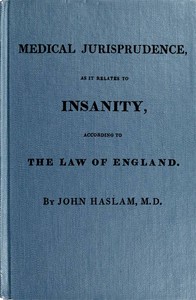
Medical Jurisprudence as it Relates to Insanity, According to the Law of England
by Haslam, John
English
328h 16m read

Observations on Madness and Melancholy - Including Practical Remarks on those Diseases together with Cases and an Account of the Morbid Appearances on Dissection
by Haslam, John
English
896h 20m read
Observations on Insanity - With Practical Remarks on the Disease and an Account of the Morbid Appearances on Dissection
by Haslam, John
English
398h 12m read
Sound Mind - Or, Contributions to the natural history and physiology of the human intellect
by Haslam, John
English
464h 5m read
On the Nature of Thought - Or, The act of thinking and its connexion with a perspicuous sentence
by Haslam, John
English
219h 19m read