*** START OF THE PROJECT GUTENBERG EBOOK 61606 ***
Transcriber’s Notes:
Underscores “_” before and after a word or phrase indicate _italics_
in the original text.
Small capitals have been converted to SOLID capitals.
Typographical errors have been silently corrected.
Footnotes have all been moved to the end of the text.
A MYSTERY PLAY
[Illustration]
Lo! Gentiles in Thy Light shall walk;—
and Kings, all in the splendour bright
Of this Thy rising. Lift Thine eyes and see.
A MYSTERY PLAY
IN HONOUR OF THE
NATIVITY OF OUR LORD
BY
ROBERT HUGH BENSON
WITH ILLUSTRATIONS
LONGMANS, GREEN, AND CO.
39 PATERNOSTER ROW, LONDON
NEW YORK, BOMBAY, AND CALCUTTA
1908
All rights reserved
FILIABVS · AMICIS
CONVENTVS · S · MARIAE · CANTABRIGIENSIS · ALVMNIS
QVARVM
ARDOR · PIETAS · REVERENTIA
INGENERAVIT · FOVIT · ILLVMINAVIT
LIBELLVM
VOTA · IMPLORANS
D · D
SCRIPTOR · INDIGNVS
PREFACE
The following play was produced at Cambridge in December 1907 and
January 1908. It was acted six times altogether, to full houses, upon a
temporary stage in the schoolroom of St. Mary’s Convent, by the girls
of the school, whose ages ran from six to eighteen. The scenery, the
properties, and the costumes were constructed—with the exception of
two simple Eastern dresses and a few weapons—out of materials lent
to the convent or possessed by it. The cost, therefore, was extremely
small; the trouble only was great, and this lay almost entirely in the
learning of the parts and the rehearsals.
It is alleged sometimes, as one reason for fearing such performances,
that the spirit of the age is very different from that in which this
method of bringing the Christian mysteries before the eye was almost
universally practised. This fear, of course, was not absent from the
minds of those responsible for this production, but it proved wholly
illusory. The audience, consisting of Catholics and non-Catholics drawn
from all classes, was begged, by a sentence on the printed programme,
to refrain from all applause and conversation, and loyally responded to
the request. There was practically a dead silence from the first notes
of the first carol to the departure of the audience at the end.
It has been thought worth while, therefore, in this age of Pageants,
to print and publish the text of a play which has for its object the
furthering of devotion to the Nativity of our Blessed Lord, and which
has been put to the test of actual performance before a mixed assembly,
in the hope that others perhaps may venture upon a task which to its
original promoters has appeared at least to justify its inception.
Full directions are given in appendices as to the methods by which the
staging was accomplished and the properties constructed, as well as,
in the text itself, minute stage directions as to the movements of
the actors. Realism and passion have been studiously avoided in the
training of these; and in their place a kind of slow and deliberate
simplicity has been arrived at throughout. There was practically no
attempt made to disguise the faces of the actors, except in the matter
of a brown stain applied to the faces and hands of a few, and of two or
three beards in the cases of old men.
In case, however, that the recommendations given in the book do not
seem sufficient to others, the author will be happy to answer any
questions that he can.
The present edition contains illustrations, appendices, and stage
directions; a cheaper acting edition shortly to be issued will contain
only the words with a few necessary remarks.
The collection from which the carols are taken is one compiled by Dr.
Stainer and the Rev. H. R. Bramley, under the title “Christmas Carols,
New and Old.” It is published with music by Novello. Acknowledgments
are made in the proper places.
An admirable orchestral effect may be produced by the use of a piano
and an American organ played together.
The play as a whole does not aspire to be considered a literary
production; it is only published as a practicable drama.
_DRAMATIS PERSONÆ_
MARY.
JOSEPH.
TOBIAS (_Landlord of Inn at Bethlehem_).
DAVID (_his servant_).
ZACHARY }
EZRA } _Three Shepherds._
BEN-EZRA }
ELIPHAZ }
NADAB } _Three Merchants._
UZZIEL }
MARTHA (_A Child_).
ABEL (_her brother_).
ANGELS (_four_).
HERALD (_An Angel_).
_SCENES_
I. _Road outside Bethlehem._
II. _The Kitchen of the Inn._
III. _Hills outside Bethlehem._
IV. _Interior of the Stable._
V. _The same._
NOTE.—In the stage directions throughout, “R.” = right of actor
who faces the audience, and “L.” = his left.
[Illustration]
PROLOGUE
_Before curtain rises there is sung_—
God rest you merry, gentlemen,[1]
Let nothing you dismay;
Remember Christ our Saviour
Was born on Christmas Day,
To save us all from Satan’s power
When we were gone astray.
_Chorus._ O! tidings of comfort and joy.
2. In Bethlehem, in Jewry,
This blessed Babe was born,
And laid within a manger,
Upon this blessed morn.
The which His mother Mary
Did nothing take in scorn.
_Chorus._ O! tidings ...
3. From God our Heavenly Father
A blessed Angel came,
And unto certain Shepherds
Brought tidings of the same:
How that in Bethlehem was born
The Son of God by name.
_Chorus._ O! tidings ...
4. Now to the Lord sing praises
All you within this place,
And with true love and brotherhood
Each other now embrace;
This holy tide of Christmas
All other doth deface.
_Chorus._ O! tidings ...
_Curtains part—Enter_ HERALD, _closing
curtains behind him. He bows low, slowly, with arms
across his breast; he recovers himself perfectly
upright, and begins in a clear, declaiming voice_—
Good Christians, now the time is near [here]
When long ago our Saviour dear
Came hither from His heavenly hall
To teach and help and save us all.
For born He was, a little Child,
And Mary was His mother mild,
And Joseph guarded both of them
Within the cave of Bethlehem.
Here simple shepherds ran to view
[_He makes a gesture with his right hand._
The Lord alike of them and you:
Here, on their camels, came to see
[_He repeats gesture with his left hand._
Their Lord, wise kings of Araby.
Here Angels sang their praises meet,
And bowed before His little feet,
Whose hands the heavens and earth have wrought
[_He extends his hands slowly, palms uppermost._
And, pierced by nails, our ransom bought.
To this same God the whole world wide
Bows and adores at Christmastide.
[_He bows very slowly as he speaks the line._
We therefore, too, with good intent,
The simple story here present.
Here sheep and shepherds shall you see,
The Holy Child and sweet Mary,
Great angels and good Joseph too,
Merchants, and simple folks like you,
The sturdy landlord of the inn,
Cold snow without and fire within—
All shall be shown as best we can,
In praise of Jesus, God and man.
[_He bows._
We therefore pray you of your grace
To hear in silence and good face.
Mock not, if here or there we fail
To set out well this holy tale.
Keep silence, too, except ye sing,
As we shall do, before our King.
And if we please you, well, why then,
We pray you, hold your peace again.
And so God ☩ bless us all. Amen.
[_He signs himself; bows; and exit backwards through curtains._
[Illustration: _Exeunt the three Merchants._]
SCENE I
_Road outside Bethlehem. Sky, stars, snow. Up, centre,
a little to left, a stump of a tree. As curtain
begins to rise, there is sung by invisible
Choir_....[2]
When Christ was born of Mary free
In Bethlehem, that faire citie,
Angels sang there, with mirth and glee,
In excelsis gloria!
_Chorus (repeat)._ In excelsis ...
2. Herdsmen beheld those angels bright,
To them appearing with great light,
Who said, “God’s Son is born to-night,”
In excelsis gloria. [_Chorus._]
3. The King is come to save mankind,
As in Scripture truths we find,
Therefore this song we have in mind,
In excelsis gloria. [_Chorus._]
4. Then, dear Lord, for Thy great grace,
Grant us in bliss to see Thy face,
That we may sing to Thy solace
In excelsis gloria. [_Chorus._]
_Then, enter_ ZACHARY (L.); _walking with
a stick, carrying a bundle and a lantern. His
shoulders are covered with snow. He walks very
slowly. In centre of stage he halts, looks about
him slowly._
ZACH.
Now, God have mercy! I must rest awhile,
For mile on weary mile, and mile on mile,
I’ve trudged on foot since break of day began,
And, sure, I’m but an old and ancient man.
[_He goes across to stump, and sits on it slowly, disposing
his stick and bundle and lantern. He settles himself
deliberately, folding his arms._
Time was, once, long ago, when I would run
And leap and swim as good as any one.
Aye, aye,—to run a race or climb a wall—
Aye, aye,—I’d beat ’em all, I’d beat ’em all.
[_Shakes his head reminiscently. Then passes his hands
slowly down his knees._
But, sure, I’m stiff, and my poor bones are old,
And night is bitter cold—’tis bitter cold....
Yes, yes [_begins to look about him_]. I’ve come a mighty step
to-day.
Why, but—
[_Stands up suddenly, stares out_ (R.), _under hand_.
Is that the town so far away?
I thought ’twas nearer. But this pesky snow——!
At Rachel’s tomb the neighbours bade me go
A mile or two.... Yes, yes, they told me so....
[_Sits again heavily._
And now I’m wearied out ... and not so near
As I had thought.... (_turns to_ (L.), _stares out_.)
God bless me! who comes here?
[_Enter_ (L.) ELIPHAZ, NADAB, and UZZIEL, _together,
arm-in-arm; richly dressed; muffled up; carrying
bundles, walking with sticks_. NAD. _carries a
lantern. They come across briskly as they reach
stump._ ZACH. _suddenly stands up, pulling his
forelock. They start violently apart._
ZACH.
Good gentlemen——
ELIPH.
Why, murrain take the man
For frighting of us so! I never can
Abide these rustics.
[_He crosses over_ (R.). _Others remain_ (L.).
NAD.
They’ve no sense, I say,
To fright three gentlemen upon their way.
See here, old man! (_Lifts stick threateningly._)
UZZ.
No, no. Let be! let be!
[_He interposes his arm._
See here, old man! I’d have a word with thee.
Are you a native here? (ZACH. _nods_.) Why, then, I’ll lay
You’ll guide us, for, I think, we’ve lost our way.
A piece of gold or so’ll help you tell——
ZACH.
Why, no, good sir; I need no gold——
ELIPH. (_interrupting_).
Well, well——
We’re three good merchants, come, as you can see,
For this enrolling, down from Galilee,
And now we’ve missed our way.
ZACH.
Yes, yes, good friend,
I’ll set you on your way, if you’ll but lend
An arm to my old arm to bear me up;
For sure I’ve never had a bite or sup
Since break of day.
UZZ.
Yes, yes, old man; but tell
Us first our way; and all will then be well.
ZACH. (_pointing_ (R.) _very deliberately_).
Why, down the hill straight on, another mile,
Then to your right, and so beyond the stile
[_He makes gestures of pointing._
To where the vineyards stand—(remember them),
And that’ll bring you straight to Bethlehem.
[_He turns, and gathers stick and bundle._
And now, sir—[_comes forward_]—your good arm.
UZZ. (_avoiding_).
Why, no, no, no,
You’ve given us all we asked. We could not go
With such a bag of bones! That’s not the way
To make a contract. Come, be off, I say!
[_Threatens him as_ ZACH. _approaches again_.
ZACH.
Sir, sir; I’m wearied out! I’m done to death!
I’m old and weak of limb, and short of breath.
I pray you— [_Seizes_ ELIPHAZ’S _arm, who shakes it off_.
ELIPH.
Why, here’s impudence as well!
Is’t so you speak to men of Israel? [_Threatens._
ZACH.
Sir ...for the love of God ...
UZZ.
Why, that’s too good!
“The love of God!”—I’ve always understood
That God was Justice! Eh! good Nadab, eh?
[_He turns to_ NAD.
What do you think? That never was the way
We learned at school! [_Threatens_ ZACHARY.
Hands off! old man! I say!
[ELIPH. _crosses_ (L.).
ZACH.
Sir, for Messias’ sake!...
UZZ.
Why, who is He?
ZACH. (_solemnly_).
Sir, it is He told of in prophecy,
Who surely comes one day to set all right,
And judge in love and justice. Why, this night
Maybe, He’ll come.
UZZ.
Nay, nay! That’s past a joke!
Come, gentlemen; enough of crazy folk!
We must be going on a mile or two
To shelter; and, my friend, good-night to you!
[_Exeunt_ (R.) _three Merchants, saluting_ ZACHARY
_ironically_. ZACHARY _stands looking after them,
hands raised. He totters a step or two, then he
lets hands sink slowly._
ZACH.
Now, God have mercy! But I’m wearied sore.
[_Begins to limp back to stump._
So wearied I have never been before.
[_He sits heavily on ground, leaning against stump.
Then, after a pause._
My limbs that heavy! [_Lifts hands, and lets them drop._
My old eyes, that dim!
[_Stares about, bewildered._
Why—if He came—I could not look at Him....
[_His voice grows weaker._
Dreams, did they say?... And old Isaias too?...
[_He rolls his eyes._
David.... And Balaam ... and the Fleece of Dew
That Gideon saw.... Why, now, how soft the snow....
[_Sleepy voice; closing eyes._
I’ll sleep ... a bit ... a bit ... before ... I ... go.
[_Sinks down. Music begins very softly, and verse of
carol is played through as he falls asleep. Then_
MARTHA _and_ ABEL _begin to sing, off_.
And ... God ... have ... pity on ... all ...
poor folks ... here below.
MAR. AND ABEL.[3]
The Lord at first had Adam made
Out of the dust and clay,
And in his nostrils breathed life....
[_Enter_ (L.) MARTHA _and_ ABEL,
_carrying bundles, with sticks, over shoulders,
hand in hand_. MARTHA _carries a lantern_.
E’en as the Scriptures say.
And then in Eden’s Paradise
He placed him to dwell
That he within— [_Stop abruptly._
MAR.
Why, Abel, what’s that lying by the tree?
[ABEL _clings to her, lets go, tries to run_.
Nay, nay, be quiet! Here, take hold of me.
[_She is staring at_ ZACHARY.
ABEL.
Oh! Martha, Martha, I’m afraid—
[_Tries to pull her away._
MAR.
No, no.
[_She goes closer with him; looks._
’Tis but an old man, sleeping in the snow.
Why—look how white he is! How white and old!
He’ll take his death! The night is bitter cold.
[_Advances close to him with lantern._
Sir, sir! Wake up.... Here, Abel, take the light!
[_Hands him lantern. He shrinks away._
You silly boy! With God nor day nor night
Can harm His children.... Here, sir, wake, awake!
[_Shakes him by arm._
The night is cold. Sir! [_She kneels by him._
For Messias’ sake!
[ZACHARY _moans gently, lifts his head, looks
round, sinks back_.
ZACH. (_sleepily_).
Messias! eh? Messias? Why ... they ... said ...
’Twas dreams ... all dreams. [_She shakes him._
Why ... what is this?... my head ...
Is heavy ... let me sleep.... [_Rolls over a little._
Ah! let me sleep....
And dream Messias’ coming ... lest ... He ... weep ...
To find no welcome.
MAR. (_rapidly_).
Abel, here— [_He is sobbing._
Don’t cry....
Quick, boy, I tell you ... lest the old man die.
[_Together they lift him slowly, first up to tree,
then on his feet. He clings to them. They move
about; finally he sits down on stump, and begins
to recover himself._
ZACH. (_rubbing eyes_).
Why, ’tis but children! And I thought that He
Had sent His angels down to succour me,
And bring me tidings that His Christ was here.
[_Looks round, then drops his head._
No, dreams! All dreams it is.
[MARTHA _takes him by arm_.
MAR.
Sir! can you hear
Me speak, good father? Can you see me plain?
[_He looks at her; recovers further._
ZACH.
Why, yes.... I heard you singing. Sing again
That which you sang. [_Releases his arm._
Nay, nay, child, let me go!
I’m well awake enough. ’Twas but the snow
Bewildered me. What was that song so sweet
I heard so plain?
[MARTHA _comes a little forward,
smiling shyly_.
MAR.
Sir, to beguile our feet
We sang a carol, made—Oh! long ago,
Of times when God walked once with men below
In Eden’s garden; whence all woe began
From Satan’s tempting and the sin of man.
That was the little song you heard so plain
As we were coming.
ZACH.
Sing the song again.
[MARTHA _and_ ABEL
_stand side by side_ (R.).
MAR. AND ABEL.
The Lord at first had Adam made
Out of the dust and clay,
And in his nostrils breathed life,
E’en as the Scriptures say.
And then in Eden’s Paradise
He placed him to dwell,
That he within it should remain
To dress and keep it well.
[_They turn to_ ZACH.
ZACH.
Why—
[_Chorus suddenly begins from behind scene. Children
are terrified._ ZACH. _stands up, frightened. They
cling to him. During the singing they recover
themselves a little. They look about, standing all
together_ (R.) _facing_ (L.). ABEL _leaves the
others and begins to move across stage, looking in
all directions_.
INVISIBLE CHORUS.
Now let good Christians all begin
A holier life to live;
And to rejoice and merry be
For this is Christmas Eve.
4. Now mark the goodness of the Lord
Which He to mankind bore,
His mercy soon He did extend
Lost man for to restore;
And, therefore, to redeem our souls
From death and hell and thrall,
He said His own dear Son should be
The Saviour of us all.
_Chorus._ Now let ...
ABEL (_letting go_).
Why! What was that? Who’s singing there below?...
[_Runs to_ MARTHA, _who is looking_ (L.).
I’m frightened, Martha.... Martha! let us go.
[ZACH., _also staring_ (L.).
ZACH.
Why! Who comes here? [_He goes a step._
An old man and a maid!
Is that their singing?... No ... she seems afraid
And weary. Children! See how slow they wind!
[_Looks intently, under hand._
Children! look closer.... Who comes on behind?...
No ... he is gone again.... I thought I saw
Figures who came and went, behind, before,
As if to keep them.... Children, do you see?
[_A silence._
[Illustration: _Why! Who comes here? An old man and a maid—— See how
slow they wind!_]
MAR. (_looking_).
I see a maiden, and a man like thee.
Old, old and heavy.... Why, sir, look again!
Why ... who is that? Nay ... nay, I saw him plain—
All, all in light—Nay, but he’s gone again.
[_The three shrink together backwards across the stage
to_ (R.) _as_ (L.) _enter_ JOSEPH _and_ MARY, _very
slowly. She leans on him. They come up to tree. She
sinks on to it, in his arms, and drops her head. He
stands behind, holding her. So the tableau remains.
Behind the scenes the Chorus sings, as below.
During the singing_, ABEL _advances step by step,
almost imperceptibly, with_ MARTHA _behind and_
ZACHARY _last_.
CHORUS.
A Virgin unspotted, the Prophet foretold,[4]
Should bring forth a Saviour, which now we behold,
To be our Redeemer from death, hell, and sin,
Which Adam’s transgression had wrappèd us in.
_Chorus._ Aye and therefore be merry; set sorrow aside,
Christ Jesus our Saviour was born on this tide.
2. At Bethlehem city in Jewry it was
That Joseph and Mary together did pass,
All for to be taxed with many one more;
Great Cæsar commanded the same should be so.
_Chorus._ Aye and therefore ...
3. There were they constrained in a stable to lie,
Where horses and asses they used for to tie,
Their lodging so simple they took it no scorn,
But against the next morning our Saviour was born.
_Chorus._ Aye and therefore ...
[_At this point_ ABEL _reaches_ MARY, _and kneels down
before her on his knees, looking, on her right,
and_ MARTHA _on her left_, ZACHARY _in centre.
During the next verses_, MARY _opens her eyes,
sees them, then slowly stretches out her hands on
to their heads; each kisses her hand. Then both_
MARY’S _hands on_ ZACHARY’S _head. He takes them
both and kisses them. All this very slowly during
following verse._
INVISIBLE CHORUS.
Then God sent an angel from heaven so high,
To certain poor shepherds in fields where they lie,
And bade them no longer in sorrow to stay,
Because that our Saviour was born on this day.
_Chorus._ Aye and therefore ...
[_Then_ MARY _is slowly supported by_ JOSEPH _on her
right, with her arm round his shoulders, and, on
the left, in the same way, by_ MARTHA _and_ ABEL.
ZACHARY _slowly gathers up bundles and sticks and
lantern_.
Then presently after the shepherds did spy,
Vast numbers of angels to stand in the sky;
They joyfully talked, and sweetly did sing,
To God be all glory, our heavenly King.
_Chorus._ Aye and therefore ...
[_They begin to go out_ (R.) _in the above order.
As they disappear_ (R.), _enter_ (L.) _two tall
angels bearing swords in right hand and burning
tapers in left, and two small angels bearing
tapers only. These pairs slowly cross stage, and
as curtain comes down they are still passing, and
simultaneously the last chorus ends._
To teach us humility all this was done,
And learn we from thence haughty pride for to shun,
A manger His cradle, who came from above,
The great God of mercy, of peace, and of love.
_Chorus._ Aye and therefore ...
CURTAIN.
[_A quiet piece of music begins and continues until Carol._
[Illustration]
[Illustration: _The three Merchants rise in alarm_—]
SCENE II
_Before curtain rises, invisible Choir sings_—
Come let us all sweet carols sing,[5]
Omni relicto tædio
Of Mary, Mother of our King,
Christoque Jesu Filio.
When she had borne that Holy Thing.
Reponit in præsepio (_bis_).
2. Now Gabriel sweeping from the sky,
Missus a Deo nuntius,
These tidings beareth from on high,
Lætissimis pastoribus,
Behold your God on earth doth lie,
Invenietis protinus.
4. Quickly away the shepherds flew,
Clara Gabrielis voce,
Rejoicing as if filled anew,
Bono Bacchico liquore,
Leaping and dancing nigh they drew,
Simul in Bethlehem Judæ.
6. They entered then the hallowed cave,
Jesum hic adoraverunt,
The best of all they had they gave,
Puerumque oraverunt,
Pardon for that was lacking crave,
Subitoque abierunt.
CURTAIN RISES
SCENE—_Kitchen of inn. In centre a fire: pot over it.
White walls. Two doors_ R. _and_ L., R. _into
street_, L. _into inn. A table_ R. _with three
stools. Discovered_ TOBIAS, _stirring pot, and_
DAVID _busying himself with plates at the table.
After curtain is up_, TOBIAS _leaves spoon in pot,
and comes forward. During all this scene he is
plainly uneasy and indecisive. He relapses into
silence, then rouses himself to speak._
TOB.
And you have heard it, David? [_They speak softly._
DAV.
Yes, all day,
Good master, have I heard them.
TOB.
“Them,” you say?
Why, who are they?
[_He looks steadily at_ DAV.,
_with folded arms_.
DAV.
I know not, but the sound
Was that of singing in the air, and round
[_He makes gesture._
About; and steps, and wings; and everywhere
I heard them plainly.
TOB.
Was it from the air
You heard it?
DAV.
Aye, sir.
TOB.
Nothing have you seen?
DAV.
No, sir. [_A silence._
TOB.
Now, David, what doth all this mean?...
I, too, have heard.... Say not a word of this
To any man.... For these are mysteries.
[_Clamour of voices and stamping._
[TOB. _leaps back to pot and begins stirring
again_. DAV. _turns to plates, &c._
TOB.
Now, boy, make haste.... Hark to the guests below.
[_Shouts._
Coming, sirs, coming.... Yes, boy, take and go.
[_Exit_ DAV. (L.) _with plates and bread_.
I’ll bring this presently. God bless us! Why
[_Murmur without._
I never heard such tumult. No, not I
In all my days. [_Knocking heard on door_ (R.).
Yes, yes, come in, come in.
[_Enter_ (R.) THREE MERCHANTS.
ELIPH.
Well, my good host, and have you room within?
TOB.
What? More of them? Who are you, gentlemen?
ELIPH.
Why, we are merchants three, come back again
To Bethlehem, as all the world doth know,
For our enrolment. Through the frost and snow
We’ve trudged full many a mile. And have you space
For three good gentlemen? [_He sits down heavily._
TOB.
Why, all the place
Is full from roof to garret. [_Tumult breaks out again._
Hark to them!
Why, all mankind seems come to Bethlehem!
NAD.
Well, well! Have you no beds?
TOB.
Not one to spare,
Nor bite nor sup, I think. [_He makes despairing gesture._
UZZ. (_pointing to pot_).
What have you there?
[_Enter_ DAV. (L.).
TOB.
No, no, good sir! First come first served, I say.
_To_ DAV.
Here, lad, make haste. Come! bear the pot away.
[DAV. _takes it and exit_ (L.).
ELIPH.
Why, but you cannot turn us out! ’Tis night
And freezing cold. We must have food and light
And roof above us.
NAD.
Let us have the floor
Here in this kitchen, if you have no more.
TOB.
Well, gentlemen, I tell you, as I live,
I have no better and no more to give.
ELIPH.
Well, we must make a shift to rest and dine.
A loaf of bread you have, at least, and wine,
And skins, I’ll warrant you, to keep the cold
From killing us. The sheep within the fold
Seemed well-nigh frozen as we passed them by.
TOB.
Well, gentlemen, if you can shift, then I
Will do my best to please you. Sit you down.
[NAD. _and_ UZZ.
_sit; unloose wrappings_.
_Enter_ DAV. (L.).
Well, are they served there?
DAV.
Yes, sir. [_He stands waiting._
TOB.
All the town
Is full. I never saw the like before!
_To_ DAV.
Here, lad! make haste! Go, fetch a bottle more,
And bread and meat. These gentlemen must dine.
[_Exit_ DAV. (L.).
(_To_ THREE.) I promise you, a cup of our good wine
Will set you up, sirs. [_He sets out plates and cups._
ELIPH.
Ah! I warrant you
We’ll do good justice to a cup or two.
[_They range themselves. Enter_ DAV. _with bottle,
mugs, bread, and meat, and exit again_ (L.). _They
begin to eat and drink. Landlord stands with arms
akimbo by fire, watching. Now and again he comes to
table, helps them to wine, &c., and goes back, as
conversation continues._
TOB.
And was all quiet as you came?
[_He looks at them curiously._
NAD.
Why, yes.
All was as still as death—a wilderness
Of snow and frost.
TOB.
And did you see no man?
[_Very earnestly, leaning on table._
NAD.
Why, yes, a few. Just as the road began
To come to Rachel’s tomb we passed a maid
And old man, and her arm in his was laid;
[_He pauses to eat during this speech. He is
very cool and self-contained._
And they were walking—walking wondrous slow:
[_He makes a little gesture._
The maid seemed wearied.... And an hour ago
Two children; and then afterwards again
Some old fool of a shepherd-man; and then
None further, till we reached the market-square.
TOB.
Ah! yes. A mighty company was there
Of neighbours, come to see the folk arrive
From all the country.
[_He begins to walk about uneasily, pensively. There
is a long silence. The three eat. Then he suddenly
comes back._
As I am alive,
I could have sworn that more were there than men.
ELIPH.
What, women?
TOB.
Aye, and more. (_He looks darkly._)
ELIPH.
Well, children, then?
TOB.
Aye, more than human-kind.
[_They stare at him, dropping food._
Once and again,
[_He looks at them earnestly, making gestures.
Speaking softly_—
As I looked out upon the folks, it seemed
Something was forward—somewhat—or I dreamed!—
Of more than earthly business. For the air
Seemed full of singing, runnings to and fro,
Then silences again—rushes of sound—
Footsteps, it seemed, moved on the frozen ground,
As if some company, to come and go
Was set, all busy, in the market-square.
ELIPH. (_after pause_).
Bah! You were dreaming, man! The air was keen,
And you were weary.... There was nothing seen?
[_He seems a little disturbed._
TOB.
No; for I asked my lad if aught were there
That he could see——
NAD.
Bah! You and your market-square!
A dreamer! Like the old man on the hill
Who babbled of God’s Love and Justice till
I was all wearied—and Messias’ name,
Who comes one day, he said. Why, but the same
Old tale is past and gone for you and me
Since old Isaias babbled prophecy.
(_Scornfully._) “A Virgin shall conceive,” he said!...
CHOIR _softly sings a line or two_—
“_A Virgin unspotted, the Prophet foretold,
Should bring forth a Saviour whom now we...._”
TOB. (_starting_).
What is that sound?
Do you hear nothing?
[_They stare. Clamour breaks out in room_ (L.),
_and music stops_.
Gone again, and drowned!
But you heard nothing?
[_Enter_ DAVID (L.) _running, excited.
He stops dead._
ELIPH. (_after pause_).
Why, the man is mad!
Singing and footsteps! What next? Here, you lad,
Did you hear aught now?
DAV. (_frightened_).
Sir, what did you say?
ELIPH. (_banging table impatiently_).
Did you hear aught just now? From far away
A sound of singing?
DAV.
Why, sir, yes—all day—
And now again!
[_Silence. They eye one another uneasily._
NAD. (_to_ TOB.).
Bah! Here, a cup of wine
Will clear your hearing. I dare wager mine
’S as good as yours. Some drunken fellow there
Is noisy in his cups.
[_Holds out cup of wine to_ TOB.,
_who takes it hesitatingly_.
TOB. (_after pause_).
Well, sir, I swear
I never heard nor drunk nor sober sing
As fair as this I heard. (_Drinks._)
ELIPH. (_easily_).
Why, anything
May maze a man on such a night, when snow
And cold conspire to starve the senses. Go
And see your other guests. Perhaps.... Maybe
You’ll find them singing.
[TOB. _begins to go out_ (L.) _slowly_.
Aye, come back to me,
[_Exit_ TOB. (L.) _with_ DAV.
_whispering to him_.
And we three’ll join them.
(_To other two._) Did you ever hear
Such madness?
UZZ.
Bah! Why, all the world is mad
Save such as you and I. As for that lad,
I swear he spoke so just to please the man.
NAD.
But to come back to where we first began—
[_Air of “A Virgin” sung by_ CHOIR _with
closed lips; it continues very faintly down to
where_ ELIPH. _opens the door_.
What think you of Messias and that tale
The prophets tell?
ELIPH.
Well, may not prophets fail
As much as any man? I hold such men
No better than this dreamer back again.
Once, as a child, I thought it otherwise,
And deemed that all was holy, and the skies
Crowded with angels, and the earth I trod
All holy as the dwelling-place of God.
And now! Why, I know better.... (_Drinks._)
NAD.
As for me,
I’m with you. (_Drinks._)
UZZ.
So am I. The Sadducee
Seems wisest of the lot.
[_They pledge one another. Knocking heard_ (R.).
Why, who comes here?
[_He pauses. Then he goes to door_ (R.) _impatiently,
and opens it. A burst of music. Silence. He seems
to listen._
No, no! No room! Nor here, nor anywhere!...
[_Listens._
I tell you, No! There’s not a bed to spare.
[_Listens._
NAD.
Who’s that? (UZZ. _begins to stare towards door, listening_.)
ELIPH. (_after pause_).
The landlord’s out.... What’s that?... Why, then
You’d best find shelter as you may.
[_Closes door; comes back. As he comes to seat,
knocking._
Again!
[_Rises angrily; goes to door, flings open. After pause_—
That’s no affair of mine! I tell you, Go.
And find room where you may. Above, below,
The place is packed. Be off! Be off, I say!
[_Half-closes door, listening._
No; not for such as you. The host’s away,
Up in Jerusalem. I’m master here;
That’s my last word.
[_Bangs door; comes to seat. Knocking. He rises furiously._
Here’s impudence, I swear!
[_Opens door once more._
I’ll set the dogs upon you.... I don’t care....
[_Pause._
Yes, to the stable then, with ox and ass.
[_Bangs door; returns growling; sits._
NAD.
Who were the knaves?
ELIPH.
That old man and the lass
We saw up yonder.
UZZ. (_who has been listening intently_).
Was there no one more?
I could have sworn I heard them at the door—
A multitude of footsteps.
ELIPH. (_hands trembling, head jerking_).
Bah! what stuff!
The two were there. No more! And quite enough.
[_He drinks. The two stare._
NAD.
What ails you, friend?
ELIPH. (_furiously_).
Ails me! Why—
[_Enter_ TOB. _and_ DAV. _hurriedly_ (L.).
TOB.
Who came then?
I swear I heard the music once again.
And knocking. Was there no one at the door?
[_He hurries across to_ R., _but stops irresolute_.
ELIPH.
Music? What foolery is this?
NAD. (_coolly_).
Before
You came just now, two folks were here, but now
Gone otherwhere to seek for shelter.
TOB.
How?
[_He hastens to door_ (R.), _followed by_ DAV.
Gone otherwhere! Why, there’s no room to find
In all the place.
[_Opens door; looks out. Very faint music,
“A Virgin unspotted ...;” it continues
down to end of scene._
It surely were unkind
To turn a dog away on such a night. (_Turns from door._)
Where are they gone? Here, David, bring a light.
[DAV. _does so. He looks._
NAD.
Nay, they are gone. Here, drink a cup with me.
DAV. (_crying out, pointing_).
Oh! master, look!
TOB. (_looking eagerly_).
Eh? eh? What is’t you see?
DAV.
There master, there!
[_The_ THREE MERCHANTS _rise in alarm and
stand_ L., _staring_ R.
ELIPH.
What is it? Speak, I say.
TOB. (_staring out_).
No. I see nothing!
DAV.
There, across the way!
All, all in light they move, a countless host.
[_He falls on knee._
ELIPH.
Bah! bah! What foolery! He sees a ghost.
[_Shrinks in fear and anger._
TOB. (_quietly_).
My lad, I can see nothing.... That’s the byre
Where lie the cattle.
DAV. (_suddenly crying out and pointing_).
See! all, all afire
With glory!
ELIPH. (_in terror, as are others_).
Here, man! Shut the door!
[_They continue there._
Well, if you will not, I will.
[_Sidles along wall; shuts door angrily._
One fool more
Or less in such a household matters not.
NAD. (_recovering_).
Why, landlord! your old wits are clean forgot
And wildered.
UZZ.
Drink a cup of wine with me!
There’s no cure for such madness but good company.
[_Slowly_ TOB. _comes across to table, still
listening_. DAV. _slips out_ R. ELIPH. _follows_
TOB. _All fill cups_, TOB. _still listening. Music
swells up; dies again._ TOB., _after pause, touches
his cup with the others. They all drink._
CURTAIN.
_Pastoral symphony begins at once, and continues until the Carol._
[Illustration]
[Illustration: _Angel.—Gloria in Excelsis Deo._—]
SCENE III
_Before curtain rises, invisible choir sings._
The first Nowell the angel did say,[6]
Was to certain poor shepherds in fields as they lay;
In fields where they lay keeping their sheep,
On a cold winter’s night that was so deep.
_Chorus._ Nowell, Nowell, Nowell, Nowell,
Born is the King of Israel.
2. They looked up and saw a Star
Shining in the East, beyond them far;
And to the earth it gave great light,
And so it continued both day and night.
_Chorus._ Nowell ...
3. (4.) This Star drew nigh to the North-West,
O’er Bethlehem it took its rest;
And there it did both stop and stay,
Right over the place where Jesus lay.
_Chorus._ Nowell ...
4. (6.) Then let us all with one accord
Sing praises to our heavenly Lord,
That hath made Heaven and earth of nought,
And with His Blood mankind hath bought.
_Chorus._ Nowell ...
SCENE—_Hills outside Bethlehem. Lights very low.
Starlit sky; rocks on either side; snow on ground,
except round fire and shelter._ R. _A shelter of
hurdles, open side facing audience, with a stool
within it. A fire burning; heaps of skins round
it._ EZRA _discovered_ L., _looking out under his
hand_ L.; _so he continues a while. Enter_ R.,_from
behind shelter_, BEN-EZRA _with lamb_.
BEN.
Well, father, do you see him?
EZ. (_slowly, with pauses_).
No, not I! (_Still looking._)
Nought to be seen but snow and starry sky,
And that great star that hangs above the town.
[_He makes a gesture_ L.
BEN.
Here is a lamb, new-born. (_He shows it._)
EZ. (_without turning_).
Well, lay it down.
[BEN. _goes to shelter_.
An ill night to be born in! Frost and snow,
Cold heaven above, and colder earth below.
I marvel any tender creature should be born
On such a night.
BEN.
I found it all forlorn,
Crying beside its mother.
EZ.
Lay it by
[BEN-EZRA _lays it by fire, wrapped up_.
And warm it.
[_He suddenly takes step or two to_ L., _relieved_.
Here comes Uncle Zachary!
[_Enter_ ZACH. _slowly, on stick. All through this scene
he speaks rather monotonously, as if bewildered._
Why, uncle, we had given you up for dead!
[_Leads him towards shelter._
Now, God be praised who brought you safe.
ZACH.
I said
The same an hour ago. (_He comes towards fire._)
EZ.
Well, what’s the tale
At Bethlehem?
ZACH. (_slowly_).
Nay, my old ears do fail;
For, seems to me, the town was full of song
And lights and music as I came along.
BEN.
Singing and music! Why, good uncle, sure
They all rejoice to-night, both rich and poor,
To see old friends again. No doubt they sing.
We, too, have heard it. Is that anything
So strange?
ZACH.
Nay, nay.... Well, give to me to eat
And drink a bit. (_He goes on into shelter._)
EZ.
Here, uncle, take your seat
Beside the fire, and tell us of the way
You’ve come along. We’ve heard no news to-day.
[ZACH. _sits down, begins to eat. He talks slowly, with
long pauses._ EZRA _sits by_ (L.) _edge of shelter,
cross-legged. He warms his hands at the fire. While
he talks and listens_ BEN-EZRA _keeps walking
gently up and down_ (L.), _now and then pausing to
listen or speak_.
ZACH.
First, then, near Rachel’s tomb, I saw three men;
And then two children succoured me; and then——
BEN.
Succoured you, uncle? Why, what need was there?
ZACH.
My son, sore need there was; for all the air
Turned black and white about me, when those three
Left me alone and would not succour me
There as I swooned.
EZ.
Swooned, uncle!
ZACH.
Yes, my son,
There in the snow, ere the descent began
To fall to Bethlehem. And there I lay,
All frozen, till the children came my way.
EZ.
And they did succour you? God bless them, then.
ZACH.
God bless all children, as I say. For men
[_Music, “Nowell,” soft. It continues for a line or two._
Are cruel hard.... I think that if came He—
Whose coming is most sure by prophecy—
’Tis as a child He’ll come.
BEN.
Whom mean you?
ZACH.
Why,
I mean Messias.... Hark, is that the sky
That’s singing? (_Silent pause; music ends._)
EZ.
Nay, I hear no sound at all.
What mean you, uncle?... Sit you by the wall,
[ZACH. _has finished eating_.
And cover you from cold. For sure the snow
[ZACH. _shifts position_.
’S enough to freeze a body.... Well, and so
You came all safe to Bethlehem with those
That succoured you so kindly.
ZACH.
Aye, God knows
They succoured me!
EZ.
And, as you came below,
Was there no more you met?
[ZACH. _turns and looks at him fixedly_.
Why look you so,
Uncle? Why look so strangely?
ZACH.
Ezra.
EZ.
Well?
What was it that you saw?
ZACH. (_shaking head slowly_).
No man could tell
All that I saw.
EZ. (_eagerly_).
Nay, nay, what was it?
ZACH.
Nay,
’Twas but a man and maid upon the way.
[_Music of “Nowell” begins; it continues down to end
of_ ZACHARY’S _next speech_.
No more than that. But ... Ezra, ... such a man
And such a maid as, since my days began,
I never yet have seen.
BEN.
What! fair to see
Were they?
ZACH. (_very slowly, low voice_).
Ben-Ezra, in old prophecy
I read of one, the Mother undefiled....
“A Virgin shall conceive and bear a child....
[_He pauses now and then, as if to remember._
For unto us,” Isaias sang, “a Son
Is given.” And then I read King Solomon
Speaks of a maiden, fairest of her race,
Among the vineyards, young, and full of grace....
A fountain sealed and holy.... Well, my son,
She whom I saw to-day was such an one. (_Music ends._)
EZ.
Uncle! you jest!
ZACH.
I jest not.
BEN.
And the man
That went with her?
ZACH.
Son, when I first began
To see the couple coming up the height,
I had no eyes for him; for all the night
[_He makes slow, sweeping gesture._
Seemed full of glory from her face who came
So wearily.
EZ.
Who were they? What her name?
ZACH. (_softly_).
Her name is Mary; for he told me so.
And his is Joseph.
[_Discovers bundle by fire; he examines it in silence._
What is this below
The mantle?
BEN.
Nay, ’tis but a lamb.
ZACH.
You say
A lamb? And born to-night? Here far away
Down in the snowy world? [_He strokes its head tenderly._
BEN.
Why, surely so,
’Twas born but hardly half-an-hour ago!
ZACH.
And is it without blemish—fit to die
[_He speaks impressively._
At God’s own altar?
EZ. (_impatiently_).
Yes, yes, yes, but why
Ask you me that? Nay, tell us of the maid
And man you saw to-day. The lamb is laid
Content enough.
ZACH.
Content without its dam?
BEN.
Why, surely so!... Now, uncle, leave the lamb
And tell us what you saw.
ZACH.
I saw but those
I spoke of. Maid and man.
BEN.
But then, who knows
The place they come from, or the place they lie
To-night?
ZACH. (_indignantly_).
Nay, none doth know but God and I,
And all the hosts of heaven, and beasts, maybe,
That give them shelter!
EZ.
Why! what mystery
You make of nothing, uncle!
ZACH. (_still smouldering_).
Aye. Or ’tis
That you make nothing of great mysteries.
BEN.
Why, uncle——
ZACH. (_emphatically_).
Nay, my son, I tell you this:
That when I saw the wondrous maiden fair,
I knelt me down; and lo! she blessed me there!
[_He spreads out his hands._
EZ.
You, uncle! Blessed by her!
ZACH.
Aye, aye; ’twas so.
I think one day that many here below
Will envy me for that! Her hands she laid
Upon my head, and spoke no words, that maid.
EZ.
Why, this is folly.
ZACH. (_indignantly_).
Aye, God’s foolishness,
Wiser than all men’s wisdom.
[_His tone changes to despondency._
Yes, yes, yes!
’Tis nought but foolishness.... And so we came
To Bethlehem.
BEN. (_pensively_).
And Mary was her name?
ZACH. (_slowly_).
Aye. Joseph and Mary; Joseph and Mary.
BEN.
Well,
Uncle, and is that all you have to tell?
ZACH.
Aye, that is all—save that all Bethlehem
Seemed full of glory, all to welcome them.
BEN.
Why, were the folks without to meet them?
ZACH. (_excitedly_).
Nay;
The folks were snug within. And yet I say
’Twas full of glory.
EZ. (_makes soothing gesture_).
Uncle, rest awhile;
You’re wearied. Well I see that. Mile on mile
You’ve trudged to-day.
[BEN-EZRA _crosses front to_ (R.)
_by edge of shelter_.
ZACH.
Aye, lad, and more than space
I’ve travelled since I looked on Mary’s face.
BEN.
Nay, uncle; rest awhile. We’ll talk, maybe,
Of lighter things....
ZACH. (_ironically_).
Of wine and company,
And wherewithal we shall be clothed—aye, speak
Of all such matters as the Gentiles seek.
BEN.
Nay, we will talk of sheep, and lambs, and snow;
And such things as God sends us here below.
ZACH.
Aye, then, of Lambs.... Such as was born to-night.
[_He strokes bundle._
EZ.
Why, very well, if’t please you.
ZACH.
Such a sight
Might teach the simplest!... Have you heard, my son,
How that the ancient prophets speak of one
Who as a lamb is silent, as a sheep
Before his shearers all his peace doth keep?
EZ. (_soothingly_).
Why, uncle, you’re all ’mazed to-night, it seems.
ZACH.
Aye, so they told me. Dreams, they told me, dreams!
BEN. (_cheerfully_).
Well, as for sleep, I’m ready. What say you?
[_He stretches and yawns._
[_At this point Angels begin to come in softly
one by one behind; take places. Music
also—“Nowell”—begins very softly and continues
when Angel speaks._
EZ.
Uncle, you’re weary. Shall we sleep?
ZACH.
Aye, do;
Sleep you, and I’ll keep watch. The wolf, maybe,
Will visit us by dawn.—[_Slowly to left._]—Or if not he,
Perchance another Lamb.
BEN. (_sitting down_ (R.)).
Nay, nay, not so;
It is for us to watch.
ZACH.
I tell you no.
Lest when He come, He find me sleeping. Sleep,
Ben-Ezra; ’tis for me the watch to keep.
[_The two settle themselves for sleep._ ZACHARY
_remains bolt-upright facing audience, seated.
Music continues—a little louder. He starts, then
rises softly. Comes out, and sees the angels, and
stands aghast. Suddenly lights turned up to the
full. Angels all stretch arms up and out._ ZACHARY
_falls on his knees. The two others awaken; rush
out. Then, to the ordinary plainsong melody of
mass_—
ANGEL.
Gloria in Excelsis Deo.
CHORUS (_in simple harmony_).
Et in terra pax, hominibus bonæ voluntatis.
CURTAIN.
[_Immediately after curtain, a piece of music
begins and continues till carol._
[Illustration]
[Illustration: _Lullay, Thou little tiny Child._—]
SCENE IV
_Before curtain rises, invisible Chorus sings._[7]
Like silver lamps in a distant shrine
The stars are sparkling bright,
The bells of the City of God ring out,
For the Son of Mary was born to-night.
The gloom is past, and the morn at last
Is coming with orient light.
_Curtain rises._ SCENE—_Interior of stable. Back,
centre_ (L.), _a manger, with lamp burning in it
above_. JOSEPH _and_ MARY _kneeling before it
motionless. Rest of stage dark._ MARY _kneels
rather in foreground. The_ CHILD _is just visible.
Two angels stand throughout at the head and foot of
the manger. If possible, one plays a violin, the
other a zither._
3. Now a new Power has come on the earth,
A match for the armies of hell,
A Child is born who shall conquer the foe,
And all the spirits of wickedness quell.
For Mary’s Son is the Mighty One
Whom the prophets of God foretell.
4.(5.) Faith sees no longer the stable floor,
The pavement of sapphire is there;
The clear light of Heaven streams out to the world,
And angels of God are crowding the air.
Heaven and Earth through the spotless Birth
Are at peace on this night so fair.
[MARY _slightly changes her position_. JOSEPH
_lays censer down. Music modulates into Coventry Carol._
Lullay, Thou little tiny Child,[8]
By-by, lull-y, lull-lay,
Lullay, Thou little tiny Child,
By-by, lully, lullay.
2. O sisters too, how may we do
For to preserve this day,
This poor youngling for whom we sing
By-by, lully, lullay....
[_Enter softly_ MARTHA _and_ ABEL, _hand in hand_. ABEL
_is holding a toy-horse. They stand motionless,
staring. Standing front_ (L.). _They look the whole
time at the crib._
3. (4.) Then woe is me, poor Child for Thee
And ever mourn and say
For thy parting, nor say nor sing
By-by, lully, lullay.
MARTHA.
Tread softly— [_They advance a step or two._
ABEL.
Oh! but, Martha, is that He,
The King you told me of?
MAR.
Hush, wait and see.
I think so.... Speak to her.
ABEL.
What shall I say?
MAR.
Why, hail her by her name. I think you may.
ABEL.
What is her name?
MAR.
Oh, Mary is her name.
And that old man is Joseph.
ABEL.
And the same
We saw just now?
MAR.
Hush.... Yes.... Look on her face....
[_They come a step nearer crib._
Now speak aloud....
ABEL.
Hail! Mary, full of grace!
The Lord is with thee. Blessed art thou above
All women.—Martha, Martha, may I move
A little nearer?
MAR.
Yes. [_They move a step nearer._
ABEL.
And blest thy Son
Whose name is—Sister, now I have begun
I know not how to end.
MAR.
Call Him the best
Of all the names you know.
ABEL.
Why all the rest
Are not so good as Jesus; for that is
The word for Saviour. Will that do for His?
MAR.
Yes, call him Jesus.
ABEL.
Blest is this thy Child
Whose name is Jesus. Hail, O Mary mild!
[MARY _turns very slowly, smiling; makes the
sign of the Cross, and turns again to adore_.
ABEL.
Oh! Martha, did you see the sign she made?
[_Angels begin to come in and group themselves. They
carry the Instruments of the Passion in humeral
veils. They form group down stage_ (L.).
What did that mean?
MAR.
I know not.
ABEL.
See Him laid
So little, in the manger for His bed.
Oh! Is He truly King of kings? You said
You thought he was!
MAR.
Why, yes, I think so. See
The Angels all about His Majesty.
[_Angels remain motionless, turned towards manger.
During the following carol the children go across,
step by step, nearer and nearer: they kneel down
by_ MARY. ABEL _offers his horse_. MARY _takes it,
and makes him put it by_ CHILD _in Manger_. MARY
_leans over manger and puts arms round_ CHILD.
ANGELS.
When I view the Mother holding[9]
In her arms the heavenly boy,
Thousand blissful thoughts unfolding
Melt my heart with sweetest joy.
With her babe the hours beguiling,
Mary’s soul in transport lives.
God her Son upon her smiling,
Thousand kisses fondly gives.
As the sun his radiance flinging
Shines upon the bright expanse,
So the Child to Mary clinging
Doth her gentle heart entrance.
See the Virgin Mother bearing
[_Enter_ SHEPHERDS, _followed by_ DAV. _These fall
on their knees_, ZACH. _and_ DAV. _together; and
remain till end of singing_. ZACH. _is nearest
audience, then_ DAV., _then_ EZRA, _then_ BEN-EZRA.
Jesus by her arms embraced,
Dew on softest roses gleaming,
Violet with lily chaste.
Each round other fondly twining,
Pours the shafts of mutual love,
Thick as flowers in meadow shining,
Countless as the stars above.
Oh! may one such arrow glowing,
Sweetest Child which Thou dost dart
Through Thy mother’s bosom going,
Blessed Jesus, pierce my heart....
[_Music continues softly until_ MARY _rises.
If possible, the music should be played on the
violin only, which the_ ANGEL _holds. The
air is that of the preceding Carol._
ZACH. (_stretching out his arms_).
Did I not tell you so? Oh! see Him lie!
Dimittis nunc in pace, Domine
Me servum tuum.
UZZ. (_pointing_).
See the angels great
About the manger where He lies in state.
Secundum verbum tuum, oculi
Mei viderunt, quod præparasti
Hoc tuum salutare.
BEN. (_pointing_).
See the maid
And mother undefiled, where He is laid,
To worship Him. Ostende hunc fructum
Ventris tui post hoc exsilium!
[JOSEPH _rises. Then_ MARY _lifts the_ CHILD, _all
others fall on their knees; and all the_ ANGELS.
_All remain absolutely still. Then, if this Scene
is the last, she brings the_ CHILD _to the front of
the stage. Music stops. She lifts the_ CHILD _as
high as she can_.
MARY.
Magnificat anima mea Dominum.
[_With the_ CHILD _she makes the sign of the
Cross over the audience_.
CURTAIN.
[Illustration]
[Illustration: _Mary—Magnificat anima mea Dominum_—]
[Illustration: _Adeste Fideles:_—]
SCENE V
_The Epiphany._
_Handel’s “Largo” is played before curtain rises._
[_If this Scene is acted, in previous Scene_ JOSEPH
_does not cense the manger; and_ MARY _does not
come to front with_ CHILD. _She only lifts_ CHILD,
_says the words set down. After which Curtain
descends._
_Before Curtain rises the first verse of the following
carol is sung._
I.
We three Kings of Orient are;[10]
Bearing gifts we traverse afar
Field and fountain, moor and mountain,
Following yonder star.
_Chorus._ O star of wonder, star of night,
Star with royal beauty bright,
Westward leading, still proceeding,
Guide us to Thy perfect light.
[_Curtain rises again on same scene as before. But
the Manger is not there. In centre back of stage
stands a dais, and upon it a tall chair, bare; two
unlighted candles stand upon dais. Discovered_,
MARTHA _and_ ABEL, _seated upon dais_. ABEL _has
book in his hands, reading_. MARTHA _is sewing a
child’s dress. Lights are high. A silence follows
close of carol._
II. MELCH.
Born a King, on Bethlehem’s plain,
Gold I bring to crown Him again,
King for ever, ceasing never,
Over us all to reign.
_Chorus._ O star of wonder, &c.
III. GASP.
Frankincense to offer have I,
Incense owns a Deity nigh.
Prayer and praising, all men raising,
Worship Him, God most High.
_Chorus._ O star of wonder, &c.
IV. BALTH.
Myrrh is mine, its bitter perfume
Breathes a life of gathering gloom;
Sorrowing, sighing, bleeding, dying,
Sealed in the stone-cold tomb.
_Chorus._ O star of wonder, &c.
V.
Glorious now behold Him arise,
King and God and sacrifice,
Alleluia, Alleluia;
Earth to the heavens replies.
_Chorus._ O star of wonder, &c.
MAR. (_looking up_).
Read it again. (_She listens._)
ABEL (_reading_).
“Lo! Gentiles in Thy Light
Shall walk; and kings, all in the splendour bright
Of this Thy rising. Lift Thine eyes and see!
Lo! they are gathered; lo! they come to Thee!
Behold, Thy sons and daughters come from far” (_pause_).
And then again ... “From Madian and Epha,
From Saba too they come ... a company
Of kings on camels—all shall come to Thee.
And myrrh and gold and incense bring with them
To show God’s glory in Jerusalem.” [_He looks up._
MAR. (_meditatively, sewing_).
Why, ’tis most strange—this ancient prophecy!
Surely it stands as plain as plain can be!
And yet no kings or camels!
ABEL (_clasping his knees_).
Martha, dear,
How I should love to see them!
MAR.
Have no fear.
’Twill come to pass, if God hath spoken so....
Where is our Lady? [_She stands up and comes to front_ (R.).
ABEL (_putting book down_).
Oh! an hour ago
She went with Jesus in her arms, to see
The sheepfolds. Joseph and old Zachary
Went with her.
MAR. (_walking meditatively_).
Twelve full days have gone and past,
And yet no kings or camels.
ABEL (_clasping his knees_).
Why, how fast
’Tis gone.... Why, heaven itself is not more sweet—
To look on Jesus!—kiss His hands and feet
And kneel before our Lady!
MAR.
Silly boy!
Why, this _is_ heaven!... for all is peace and joy
Where Jesus is. Why now— [_Enter_ DAV., _running_ (R.).
DAV.
They’s coming in.
[_Violin begins, off, “Adeste Fideles.”_
Quick, Martha, quick—the lights! [_Signs to music._
Now then, begin.
[_Organ takes up Adeste ... with violin._ ABEL _springs
up at_ DAVID’S _entrance; runs to side, gets tapers
and lights two candles that stand beside chair.
He takes one_, DAV. _takes other_. MAR. _picks up
basket of flowers. All three go to entrance_ (R.)
_and wait, facing audience, looking out. Enter_
(R.) _two_ ANGELS, _playing violin and zither;
then_ ANGELS _bearing instruments of the Passion;
then_ ZACH. _with spear; then two_ SHEPHERDS _with
spears; then, after slight pause_, MARY, _cloaked,
carrying_ CHILD; _then_ JOSEPH, _and two more_
ANGELS _with swords_. MAR. _slips in behind two_
SHEPHERDS, _and walks backwards, strewing flowers_,
ABEL _and_ DAV. _place themselves on either side
of_ MARY _with candles and walk with her. The
procession takes curve to front and comes up to
chair._ MARY _stands at chair, slips off cloak
into_ JOSEPH’S _hands, and sits. Candles placed
by her._ JOSEPH _stands behind_ (R.), ANGELS _group
themselves at back_. SHEPHERDS _pass to_ (L.)
_front_. MAR., ABEL, _and_ DAV. _seat themselves on
dais_; ZACH. _stands by dais_ (L.); JOSEPH _behind
chair_ (R.).
ZACH.
Well, children, here we are—come back, you see—
Jesus and Joseph both, and Queen Mary,
To home in Bethlehem.... How have you sped
Meantime while we were gone?
MAR.
Why, Abel read
A little; and I sewed a little.
ZACH. (_lifting book_).
What is this?
MAR.
Why, we were reading that—the prophecies
Of kings and camels, Uncle, who, they say
Shall come to worship Jesus.... Where are they?
ZACH.
Nay, child, but ask our Lady: she knows best.
[_He signs to her._
MAR.
Show it her, Abel.
[ABEL _jumps up, opens book, steps on dais, and
points out passage, first genuflecting_.
ABEL.
Here! and all the rest
That follows ... here ... and here ... here, do you see?...
[ZACH. _comes and looks over book_.
Now will you tell us, please, your Majesty?
ZACH.
Nay, let me read it. [_He takes book and comes_ (L.) _front_.
“Gentiles in thy light
Shall walk; and kings, all in the splendour bright
Of this thy rising. Lift Thine eyes and see
Lo! they are gathered ... lo! they come to Thee.
Behold Thy sons and daughters come from far.”
[_Looks at_ MARY _and back_.
... Why, that would mean that following the star
They come from Orient and from Araby....
And yet they come not ... will your Majesty.
[_Breaks off as_ MARY _turns and looks out_ (R.).
_Distant jangled murmur._
... Why now, what sound is that? How loud it swells
High on the wind!—Why, sure! ’tis camel-bells.
[MARY _remains passive, smiling. All others
look out eagerly_ (R.). _Sound comes nearer,
footsteps, bells, murmur of voices. Children
spring up._ ANGELS _continually look at_
CHILD.
DAV. (_excitedly, pointing_).
Oh! look! the camels—see how slow they wind.
Look! look! Here are the kings! and there behind
The servants follow ... See, they’re coming ... See!...
Now they are stopping! Oh! I’m glad that we
Were here to see it!... Now they’re kneeling down—
The camels, at the door—and all the town
Is out to see them.
ABEL (_pointing_).
Look! they’re taking out
The bundles and the gold; and all about
The people crowding.... Why! how grand they are!
DAV. (_pointing_).
Oh look! look at that sceptre!... Grander far
Than Herod’s.
ABEL (_pointing_).
And the crowns! Why, that’s the gold
Isaias told us of.
DAV.
Why, look how old
That first one is.
ABEL.
(_A little frightened, taking holding of_ MARTHA.)
Oh, Martha, stand by me.
(_To_ MARY.) They’re coming up the steps, your Majesty.
[MARY _makes gesture to_ ZACH. _to go_ R.
ZACH. _steps_ R. _Knocking._
ZACH.
Yes, sir; and who are you?
GASPAR (_without_).
[_He speaks slowly and gravely._
We come from far,
Led by the shining of a splendid star.
Our names are Gaspar, Melchior, Balthasar.
ZACH.
Whom do ye seek?
GASP.
We seek a new-born King,
To bring Him gold, and every precious thing
That kings should have.
ZACH.
And is that all?
GASP.
Nay, nay;
We bring Him myrrh; for He shall die one day.
ZACH.
What? He shall die?... [He glances at Mary.
And is that all?
GASP.
Why, no,
It is not all; for all men here below
Shall die. But God our Lord shall rise from thence,
And therefore do we bring Him frankincense. [_Pause._
ZACH. (_very slowly and impressively_).
And is that all?
GASP.
Nay. As is meet and right,
We bring our darkness to His Heavenly Light.
Our ignorance to The Wise; our sicknesses
To Him for health; our sins to His Righteousness.
Aye; all our nature, ringed about with Hell
And Heathendom to Him, the King of Israel.
ZACH. (_making gesture of welcome_).
Come in, then, since ye know these mysteries;
For here He dwells, and this His Palace is.
[_He goes across again_ (L.) _genuflecting. Children
stand back, staring. Enter, slowly_, GASPAR,
MELCHIOR, _and_ BALTHASAR, _followed by two
servants with bundles, &c. The three come down_
(R.) _and stand facing towards_ MARY; _they bow
profoundly_. MARY _bows back_.
GASP. (_courteously_).
That is our Lady?
ZACH.
Yes.
MELCH.
And that her Son,
The King of Kings?
ZACH.
Yes, sir.
MELCH. (_clasping his hands_).
Oh! well begun
Was this our journey.
BALT.
And well ended too.
(_To_ MARY.) Hail, Mary, full of grace!
[_He bows to her again._
MELCH.
The Lord in truth
Is with her! In her arms, in very sooth!
[MARY _holds out_ CHILD. ZACH. _makes a sign to them.
They bow again profoundly as “Adeste” begins to be
played, then, one by one, they go up in order. Each
genuflects before dais, then, kneeling on dais,
kiss the_ CHILD’S _foot and_ MARY’S _hand; then
each retires back to_ R. _front and kneels once
more. Music ends._ GASPAR _lifts two crowns from_
SERVANT’S _tray, and holds them out; then sceptre_.
GASP.
Here be two crowns of gold for Him and Thee;
And here a sceptre all of gems.
MELCH. (_leaning forward with censer boat_).
For me
I bring sweet frankincense.
BALT. (_leaning forward with casket_).
And I but myrrh
To offer here.... Lord Joseph, give them her.
[JOSEPH _advances, takes crowns, genuflects, places them
on dais, then the casket, finally the censer, into
which he puts incense; he kneels; all kneel. He
censes throne with three double swings. He stands,
genuflects, and goes back._ GASPAR _turns to tray,
lifts a cope, still kneeling_. MELCHIOR _takes a
little silk robe_.
GASP.
Will not my Lady take a gift or two
Of silk and satin, broidered through and through
With jewels?
MELCH.
And a many-coloured dress
Fit for the Little King of Righteousness.
[JOSEPH _steps forward, takes the gifts,
and lays them at_ MARY’S _feet. Then_
ABEL _steps forward with_ MARTHA.
ABEL (_to_ GASP.).
Will you not speak for us?
MAR.
Some word to tell
To Jesus, for to show we love Him well?
We—and the people here [_Signs to audience._
Who have no gold
Nor myrrh nor frankincense; yet, young and old
Alike, desire to show that for their parts
They love their Infant King with all their hearts.
ZACH.
Aye, speak, King Gaspar, at this holy tide
For us who have no gold—and all poor folks beside.
[GASPAR _rises, looks at audience, then back
to_ MARY. _Then suddenly and fervently
speaks. His voice rises in tone and force as he
speaks, till he ends passionately._
GASP.
Why, yes; the greatest gift is yet ungiven,
For He, who for our sake came down from Heaven,
Has all already. For His glory fills
The earth: the cattle on a thousand hills,
The birds, the beasts, the fishes; gold and gem,
Ivory of Ophir—all are His; for them
He made, and they are His. [_Stretches arms._
So we entreat
To offer here before His holy feet
That which alone He asks of us—the love
For whose poor sake He came here from above,
Since we, as best we can, have played our parts,
[_He kneels, stretches hands. All kneel with him._
Oh! JESUS, MARY, JOSEPH, take our hearts.
To JESUS, MARY, JOSEPH, wondrous three,
All glory, praise, and honour endless be
From men and angels now and through eternity.
[_Music of “Adeste Fideles” instantly begins, ff.; the
curtain comes down; then rises again to show_ MARY
_coped and crowned; then after one chord all begin
to sing—all on their knees. At end of first verse_
GASPAR _rises, then_ MELCHIOR, BALTHASAR, ZACHARY,
TWO SHEPHERDS, ABEL, MARTHA, DAVID, SERVANTS,
ANGELS—_each one by one comes up, genuflects at
dais, and kisses the_ CHILD’S _foot and_ MARY’S
_hand. Meantime_ JOSEPH, _kneeling at side, censes
them. At end of last chorus, as last line begins_,
MARY _stands, and as she makes Sign of Cross with_
CHILD, _all cross themselves_.
CURTAIN.
[Illustration]
APPENDICES
I. THE SCENERY
The stage on which the play was acted was about four feet in height,
twenty-four in width, and twenty-four in depth. It was furnished
temporarily with footlights consisting of gas-tubing pierced by seven
burners shaded with tin head-lights permanently fixed, two side-lights
also permanent, and two incandescent burners behind the back-scene.
As substitutes for all these except the last, oil lamps are suggested,
hung or standing and guarded with wire; for the last, a strong
acetylene light.
The scenery throughout consisted of these things only—a permanent back
scene, hung from a roller, constructed of opaque, dark, grey-blue paper
pierced irregularly with very small holes; six wings, three on a side;
two dark curtains hung on a wire to slide backwards or forwards across
the back-scene, about a dozen dust-sheets and a quantity of brown paper
and cotton-wool. (It must be remembered that the object was not to
produce startling stage effects, but rather a soothing and suggestive
background.)
These extremely simple accessories were employed as follows:
_First Scene._—The curtains were drawn back out of sight altogether
behind the backmost wings. The floor was entirely and irregularly
covered with dust-sheets, and, to aid the appearance of irregularity,
various objects, such as footstools and blocks of wood were placed
beneath them. The wings were managed in this manner. Each of them was
a light framework of about three feet in width and ten in height.
One side of them (that presented to the audience in this scene) was
covered with large sheets of brown paper of all shades, deliberately
crumpled and bulging, and, here and there stained with paint. Upon the
upper side of each irregularity was gummed a flat thick piece of wide
wadding, following the curve of the paper, to represent fallen snow.
These six wings, placed of course not parallel with the back-scene but
slightly towards it, provided three exits on each side, two of which
only were used.
Finally, the back-scene, painted with whitewash at its bottom to
represent a distant line of snow-covered hills, hung full in view. All
lights except the incandescent burners behind were turned extremely
low; and the result of this elementary composition was a really
astonishing effect of a snowy defile between rocks, seen at night time,
with a sky blazing with stars. The light necessary for the seeing of
the actors’ faces was supplied by the lanterns they carried.
_Second Scene._—The curtains were drawn forward so as nearly to meet
in the centre, giving a glimpse only of the back-scene which throughout
the entire play remained in its place. The wings were reversed, showing
their other sides to the audience. These reverse sides were covered
with smooth yellowish paper, painted to represent large blocks of pale
stone. The wings, it must be said, had no attachment at the foot, but
the heads of them turned in iron forks, like the rowlocks of a boat,
reversed and fixed to beams above at the proper intervals. One of the
wings, that nearest the back-scene (R.), was painted to represent a
tall door with iron scrollwork across it. Lights up.
_Third Scene._—This was the same as the first, but the large
properties used in this prevented a sense of monotony. Lights down.
_Fourth Scene._—This was the same again, with other large properties.
Lights half down.
_Fifth Scene._—This was the same again with further properties. Lights
up.
Finally, overhead throughout were hung ordinary “flies,” or long strips
of cotton, as broad as the stage and about two feet deep.
II. THE PROPERTIES
Under this head it is proposed to describe chiefly those properties
that needed actual construction. For all the articles used throughout,
such as the table and stools in the kitchen-scene, it is enough to say
that they should be as simple and rough as possible. They should be
even rather dirty.
In the _first scene_ there is no property used beyond those connected
with costumes (to be described later) except the tree-stump on which
the shepherd sits. This is simply a three-legged stool with a dust-sheet
draped over it.
In the _second scene_, there is the fire over which the inn-keeper is
cooking. A strong black bandbox was taken, and from it were cut out
sections, supported by uprights, making it to resemble a road-mender’s
brazier. On the floor of this stood a cylindrical candle-lantern with a
burning candle within; and round this lantern was wrapped red flannel.
Between the flannel and the bars of the “brazier” were inserted sticks
at irregular intervals. The whole thing was placed on a three-legged
stool, and a brown cooking-dish rested on the top.
In the _third scene_ this fire figured again, standing on the ground.
Most of the stage R. was occupied by the shepherds’ shelter, with
room, however, left to pass both behind and before it. The shelter
was constructed of a three-sided clothes-horse, about six feet high;
and this was hung all over and roofed by pieces of old sacking and
deer-skins. The opening was towards the audience. A hurdle, standing on
end, projected above the roof.
The “lamb” was life-size, ingeniously made out of cotton-wool, with
a cotton skin on which were painted eyes and mouth. It is wrapped
throughout in a piece of sacking, so that no more of it need be
finished than the head and front legs.
In the _fourth scene_ the chief property is the crib. A box was taken
about four feet long, by three by two, and set on one of its long
sides upon a table. The whole of the box and table was then covered
with crumpled and painted brown paper, resembling that fastened to the
wings; straw was laid inside, and a silver lamp hung from the edge to
the upper side. The starry sky at the back was variegated by a large
hurdle projecting from behind the crib. The bambino was supplied by a
well-known firm in London.[11]
In the _fifth scene_, from which the crib is absent, the principal
property is the throne and dais. This needs little comment. The dais
came from a schoolroom; and the chair was a very tall armless one of
yellowish wood. Two tall mahogany candlesticks stood on either side
upon the dais. The book used by the boy was a large leather volume
bound by strings.
III. THE COSTUMES
Before treating these in detail, it is necessary to treat first the
general principles that were followed.
These were:
1. That the drapery should be voluminous.
2. That the colours should be dark and soft.
3. That the dresses should be shaped after Eastern models.
4. That all such things as tinsel and spangles should be
utterly eschewed.
Now the foundations of Eastern dress are the following:
1. The _Tunic_.—This is a long-sleeved garment resembling an alb. It
may be of any colour, or white. In the case of young men and boys it is
drawn through the girdle up to the knees.
2. The _Burnous_ or Mantle.—This is more difficult to describe; but
it may be constructed by taking a large rectangular piece of stuff,
about four feet deep by six feet wide. Imagine this spread out on the
ground. Then take the top corners and fold them in about eighteen
inches along the top edge, folding in at the same time the whole length
of the stuff below. Sew along the top edge only to right and left, thus
making supports for the shoulders. Then cut at either side, near the
top, in the crease of the stuff, two wide arm-holes. Finally, fix about
eighteen inches down the front, on the folded stuff, a strong hook and
eye on either side.
The _Burnous_, then, is generally worn simply as a wide and voluminous
cloak, fastened by the hook and eye; but in the case of one or two the
arms may be put through the holes. It should be made of heavy stuff,
and should hang loosely and even clumsily. It may be variegated with
effect by long strips of stuff or some other colour attached down the
front of the folded wings and straight over the shoulders down the back.
3. The _Girdle_.—This may be of rope in the case of the poor, and of
rich stuffs in the case of the rich. When the girdle is wide weapons
may be thrust into it.
4. The _Head-dress_.—This is of two kinds:
(1) The turban proper, made of voluminous thin material
wound round the head and tucked into the top.
(2) A large thin piece of stuff, made to fit the head
by a ring of elastic on the inner side and flowing
down behind over the shoulders and back.
5. The _Foot-gear_.—This must consist of sandals, with the addition,
in the case of those whose skirts are worn to the knee, of voluminous
stuff wrapped round the leg and tied there by cris-cross bindings of
string or leather, or the material used by gardeners for tying up
plants.
Now, if these principles are followed, the rest is easy. (The “Kings”
and the “Angels” need separate treatment.)
1. _Mary._—She wears a night-dress to her feet. Over this she wears a
tunic of dark-blue muslin, also coming to her feet; a white burnous;
a long white veil; and sandals. In the fifth scene she is, after the
first fall of the curtain, robed in a white cope, and crowned. A
sceptre is also put into her hands.
The _crown_ was an imperial one, constructed of cardboard covered
with crumpled gold paper, with strings of jewels and brooches, over a
crumpled cap of dark-blue velvet. The sceptre can be made in the same
kind of way.
2. _Joseph._—He wears a white tunic to his feet, with heavy white or
yellowish girdle; a dark-red burnous striped with white; and a white
handkerchief over his head and shoulders. He is bearded and browed with
grey over a stained face. [See below.]
3. _Tobias._—He wears a dark-blue tunic with broad brown girdle,
brown burnous and turban of “Rhodian” silk. He is girt to just below
the knee, and wears hose and sandals. His face is stained and eyebrows
darkened.
4. _David._—He wears simply a short-sleeved dark-green tunic and cord
girdle; hose and sandals.
5. _Zachary._—He wears a long yellowish tunic to his feet, a brown
burnous striped with white, a brown handkerchief on his head; and
sandals. He is bearded and browed with grey over a stained face. [See
below.]
6. _Ezra and Ben-Ezra._—These are in short dark-brown tunics and are
wrapped in deer-skins. If skins are not available, burnouses must
be substituted. _Ezra_ wears a red handkerchief on his head, and
_Ben-Ezra_ a white turban. They carry spears.
7. _The Three Merchants._—These are all in long tunic and burnous of
various darkish colours. All wear turbans and sandals, and Eliphaz a
fur wrap. The stuffs used should be of better quality than the others,
each of them wearing at least one piece of silk. Each has a broad
girdle, in which is a knife or two. They may carry or wear beads.
_Martha._—She wears a white tunic, falling half-way between knee and
foot, and dark-blue burnous; hose and sandals.
_Abel._—He wears a white tunic and deer-skin, with hose and sandals.
_Herald._—He is dressed simply in a long girded white tunic and
sandals.
_The Angels._—These, as a foundation, wear night-dresses, girded.
Over this each wears the dress of one of the three Greater Orders. The
“priest-angels” wear crossed stoles; the “deacon-angels” dalmatics, and
the “subdeacon-angels” tunicles. These garments are all made of
voluminous white butter-muslin. They should wear no wings or spangles
or colours of any kind whatsoever. Their hair is combed out at length
over their shoulders. Two “priest-angels” carry drawn swords upright.
_The Three Kings._—These must be dressed as gorgeously as possible,
with any materials available; but the following points may be remembered
with advantage. The colours used should be splendid, but not light or
gaudy. (If, for example, light-blue is used, it is seen at once to be
entirely out of scale with the other figures—heliotrope and purple and
dark-red or green are far more effective.) Each should present one
predominant colour. Each should wear, in addition to tunic and mantle,
a long train pinned to the shoulders, edged with ermine. (Ermine is
produced effectively by long strips of cotton wadding dotted with
black stuff “tails.”) The crowns should be set inside or outside of
voluminous turbans of silk. The jewellery worn by them should be heavy
and effective and barbaric; for example, a twisted serpent of gold
paper turned up the arm, or a heavy collar across the shoulders.
The _Servant_ of the Kings should be dressed on the same lines, but
without mantle or train.
_Gaspar_ should be bearded and browed with grey; all four persons
should be heavily stained on face and hands.
A suitable stain may be obtained from Mr. Peck, chemist, Trumpington
Street, Cambridge, such as is used in the “Greek Play” at the
University.
The beards used should not be the ordinary beards made in a piece. Hair
should be obtained from a theatrical property shop, and affixed piece
by piece with strong spiritgum. For those who wear beards a few lines
upon the face are generally necessary to blend the complexion with the
hair.
IV. THE METHOD OF ACTING
It must be remembered that the play does not attempt realism. It is
full of deliberate anachronisms. To act, then, in a realistic manner
would be to appeal to the eye in one key and to the dramatic perception
in another. It was found therefore necessary during the rehearsals
to insist again and again upon a certain conventionality in gestures
and tones of voices. The actors were encouraged to be slow, to speak
extremely clearly, and to make large deliberate gestures rather than
spontaneous movements—to beckon, for instance, with the arm rather
than the hand. (This method was, of course, that followed in the recent
performances of “Everyman.”) On these lines it was found that the play
occupied slightly over two hours.
Especially necessary was this system in the case of such characters
as those of the “Herald,” “Mary,” “Joseph,” and the “Three Kings.”
The “Herald,” standing outside the curtains, holds himself perfectly
upright for the most part. When he bows, he bows low with both hands
across the breast; when he signs himself with the cross, he slowly
“envelops” himself [as M. Huysmans says] in his movement. The appeal of
“Mary” also depends entirely (since she does not speak) upon extremely
slow, dignified movements. When she swoons she remains motionless, sunk
upon herself; when she moves, she does so with extreme deliberation;
she looks for a long time at the character to whom she directs herself,
before moving in his regard.
In the same manner, “Joseph” is lost always in a contemplation of
“Mary”; his eyes are fixed on her; he keeps the same attitude for long
together.
So, too, with the “Three Kings.” They carry themselves extremely
upright, they make sweeping gestures, they chant rather than speak,
they bow and genuflect slowly and profoundly. The “Children” only are
allowed to be spontaneous, without being abrupt.
The character of “Zachary” is the most difficult of performance.
He has to avoid prosiness on one side and passion on the other;
“deliberateness” must be his watch-word. I am afraid he is rather a
tiresome person; but he is as necessary as the Greek chorus, to whom he
corresponds. He appears less tiresome if he is represented by a very
tall actor who carries himself bent.
Those responsible, then, for rehearsals, must not be afraid of long
silences in which little happens. The play is intended as a series of
meditations rather than of dramatic situations and developments. Again
and again, if the grouping is arranged upon a wide and semi-heroic
scale, the actors will be found to fall into tableaux, which may
well be looked at in silence. During the longer of these involuntary
tableaux, however, music is sung or played.
Printed by BALLANTYNE, HANSON & CO.
Edinburgh & London
FOOTNOTES:
[1] Bramley and Stainer’s “Christmas Carols, New and Old,” 1st Series,
No. 1.
[2] B. & S., 1st Series, No. 19.
[3] B. & S., 2nd Series, No. 21.
[4] B. & S., 1st Series, No. 3.
[5] This carol is printed here by the kind permission of Messrs.
Novello and Co. (B. & S., 3rd Series, No. 49).
[6] B. & S., 1st Series, No. 6.
[7] B. & S., 1st Series, No. 2.
[8] B. & S., 3rd Series, No. 61
[9] B. & S., 1st Series, No. 11.
[10] B. & S., 3rd Series, No. 45.
[11] The “Instruments of the Passion” are as follows: A spear, a sponge
on a reed, a crown of thorns, three nails, a board painted with INRI.
These can easily be bought or made, and are carried visibly in white
humeral veils.
End of the Project Gutenberg EBook of A Mystery Play in Honour of the
Nativity of our Lord, by Robert Hugh Benson
*** END OF THE PROJECT GUTENBERG EBOOK 61606 ***
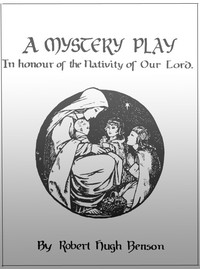
A Mystery Play in Honour of the Nativity of our Lord
Subjects:
Download Formats:
Excerpt
Underscores “_” before and after a word or phrase indicate _italics_
in the original text.
Small capitals have been converted to SOLID capitals.
Typographical errors have been silently corrected.
Footnotes have all been moved to the end of the text.
Lo! Gentiles in Thy Light shall walk;—
and Kings, all in the splendour bright
Of this Thy rising. Lift Thine eyes and see.
A MYSTERY PLAY
IN HONOUR OF THE...
Read the Full Text
— End of A Mystery Play in Honour of the Nativity of our Lord —
Book Information
- Title
- A Mystery Play in Honour of the Nativity of our Lord
- Author(s)
- Benson, Robert Hugh
- Language
- English
- Type
- Text
- Release Date
- March 12, 2020
- Word Count
- 13,467 words
- Library of Congress Classification
- PR
- Bookshelves
- Browsing: Literature, Browsing: Performing Arts/Film
- Rights
- Public domain in the USA.
Related Books

The coming of peace (A family catastrophe)
by Hauptmann, Gerhart
English
360h 27m read
Les confessions d'un converti
by Benson, Robert Hugh
French
778h 46m read
Alias Santa Claus
by Wilde, Percival
English
126h 45m read
The evergreen tree
by MacKaye, Percy
English
275h 32m read
Das Friedensfest
by Hauptmann, Gerhart
German
373h 9m read
Mr. and Mrs. Santa Claus: Musical Christmas play in four scenes
by Brunton, Maud
English
99h 45m read