*** START OF THE PROJECT GUTENBERG EBOOK 10615 ***
An Essay Concerning Humane Understanding
IN FOUR BOOKS
By John Locke
[image]
_Quam bellum est velle confiteri potius nescire quod nescias, quam ista
effutientem nauseare, atque ipsum sibi displicere!_
Cic. de Natur. Deor. _l_. 1.
LONDON:
Printed by Eliz. Holt, for Thomas Basset, at the George in Fleet Street, near
St. Dunstan’s Church.
MDCXC
CONTENTS
THE EPISTLE TO THE READER
ESSAY CONCERNING HUMANE UNDERSTANDING.
BOOK I NEITHER PRINCIPLES NOR IDEAS ARE INNATE
CHAPTER I. INTRODUCTION.
CHAPTER II. NO INNATE SPECULATIVE PRINCIPLES.
CHAPTER III. NO INNATE PRACTICAL PRINCIPLES
CHAPTER IV. OTHER CONSIDERATIONS CONCERNING INNATE PRINCIPLES, BOTH SPECULATIVE AND PRACTICAL.
BOOK II OF IDEAS
CHAPTER I. OF IDEAS IN GENERAL, AND THEIR ORIGINAL.
CHAPTER II. OF SIMPLE IDEAS.
CHAPTER III. OF SIMPLE IDEAS OF SENSE.
CHAPTER IV. IDEA OF SOLIDITY.
CHAPTER V. OF SIMPLE IDEAS OF DIVERS SENSES.
CHAPTER VI. OF SIMPLE IDEAS OF REFLECTION.
CHAPTER VII. OF SIMPLE IDEAS OF BOTH SENSATION AND REFLECTION.
CHAPTER VIII. SOME FURTHER CONSIDERATIONS CONCERNING OUR SIMPLE IDEAS OF SENSATION.
CHAPTER IX. OF PERCEPTION.
CHAPTER X. OF RETENTION.
CHAPTER XI. OF DISCERNING, AND OTHER OPERATIONS OF THE MIND.
CHAPTER XII. OF COMPLEX IDEAS.
CHAPTER XIII. COMPLEX IDEAS OF SIMPLE MODES:—AND FIRST, OF THE SIMPLE MODES OF IDEA OF SPACE.
CHAPTER XIV. IDEA OF DURATION AND ITS SIMPLE MODES.
CHAPTER XV. IDEAS OF DURATION AND EXPANSION, CONSIDERED TOGETHER.
CHAPTER XVI. IDEA OF NUMBER.
CHAPTER XVII. OF INFINITY.
CHAPTER XVIII. OTHER SIMPLE MODES.
CHAPTER XIX. OF THE MODES OF THINKING.
CHAPTER XX. OF MODES OF PLEASURE AND PAIN.
CHAPTER XXI. OF POWER.
CHAPTER XXII. OF MIXED MODES.
CHAPTER XXIII. OF OUR COMPLEX IDEAS OF SUBSTANCES.
CHAPTER XXIV. OF COLLECTIVE IDEAS OF SUBSTANCES.
CHAPTER XXV. OF RELATION.
CHAPTER XXVI. OF CAUSE AND EFFECT, AND OTHER RELATIONS.
CHAPTER XXVII. OF IDENTITY AND DIVERSITY.
CHAPTER XXVIII. OF OTHER RELATIONS.
CHAPTER XXIX. OF CLEAR AND OBSCURE, DISTINCT AND CONFUSED IDEAS.
CHAPTER XXX. OF REAL AND FANTASTICAL IDEAS.
CHAPTER XXXI. OF ADEQUATE AND INADEQUATE IDEAS.
CHAPTER XXXII. OF TRUE AND FALSE IDEAS.
CHAPTER XXXIII. OF THE ASSOCIATION OF IDEAS.
TO THE RIGHT HONOURABLE THOMAS, EARL OF PEMBROKE AND MONTGOMERY, BARON
HERBERT OF CARDIFF LORD ROSS, OF KENDAL, PAR, FITZHUGH, MARMION, ST.
QUINTIN, AND SHURLAND;
LORD PRESIDENT OF HIS MAJESTY’S MOST HONOURABLE PRIVY COUNCIL; AND LORD
LIEUTENANT OF THE COUNTY OF WILTS, AND OF SOUTH WALES.
MY LORD,
This Treatise, which is grown up under your lordship’s eye, and has
ventured into the world by your order, does now, by a natural kind of
right, come to your lordship for that protection which you several
years since promised it. It is not that I think any name, how great
soever, set at the beginning of a book, will be able to cover the
faults that are to be found in it. Things in print must stand and fall
by their own worth, or the reader’s fancy. But there being nothing more
to be desired for truth than a fair unprejudiced hearing, nobody is
more likely to procure me that than your lordship, who are allowed to
have got so intimate an acquaintance with her, in her more retired
recesses. Your lordship is known to have so far advanced your
speculations in the most abstract and general knowledge of things,
beyond the ordinary reach or common methods, that your allowance and
approbation of the design of this Treatise will at least preserve it
from being condemned without reading, and will prevail to have those
parts a little weighed, which might otherwise perhaps be thought to
deserve no consideration, for being somewhat out of the common road.
The imputation of Novelty is a terrible charge amongst those who judge
of men’s heads, as they do of their perukes, by the fashion, and can
allow none to be right but the received doctrines. Truth scarce ever
yet carried it by vote anywhere at its first appearance: new opinions
are always suspected, and usually opposed, without any other reason but
because they are not already common. But truth, like gold, is not the
less so for being newly brought out of the mine. It is trial and
examination must give it price, and not any antique fashion; and though
it be not yet current by the public stamp, yet it may, for all that, be
as old as nature, and is certainly not the less genuine. Your lordship
can give great and convincing instances of this, whenever you please to
oblige the public with some of those large and comprehensive
discoveries you have made of truths hitherto unknown, unless to some
few, from whom your lordship has been pleased not wholly to conceal
them. This alone were a sufficient reason, were there no other, why I
should dedicate this Essay to your lordship; and its having some little
correspondence with some parts of that nobler and vast system of the
sciences your lordship has made so new, exact, and instructive a
draught of, I think it glory enough, if your lordship permit me to
boast, that here and there I have fallen into some thoughts not wholly
different from yours. If your lordship think fit that, by your
encouragement, this should appear in the world, I hope it may be a
reason, some time or other, to lead your lordship further; and you will
allow me to say, that you here give the world an earnest of something
that, if they can bear with this, will be truly worth their
expectation. This, my lord, shows what a present I here make to your
lordship; just such as the poor man does to his rich and great
neighbour, by whom the basket of flowers or fruit is not ill taken,
though he has more plenty of his own growth, and in much greater
perfection. Worthless things receive a value when they are made the
offerings of respect, esteem, and gratitude: these you have given me so
mighty and peculiar reasons to have, in the highest degree, for your
lordship, that if they can add a price to what they go along with,
proportionable to their own greatness, I can with confidence brag, I
here make your lordship the richest present you ever received. This I
am sure, I am under the greatest obligations to seek all occasions to
acknowledge a long train of favours I have received from your lordship;
favours, though great and important in themselves, yet made much more
so by the forwardness, concern, and kindness, and other obliging
circumstances, that never failed to accompany them. To all this you are
pleased to add that which gives yet more weight and relish to all the
rest: you vouchsafe to continue me in some degrees of your esteem, and
allow me a place in your good thoughts, I had almost said friendship.
This, my lord, your words and actions so constantly show on all
occasions, even to others when I am absent, that it is not vanity in me
to mention what everybody knows: but it would be want of good manners
not to acknowledge what so many are witnesses of, and every day tell me
I am indebted to your lordship for. I wish they could as easily assist
my gratitude, as they convince me of the great and growing engagements
it has to your lordship. This I am sure, I should write of the
UNDERSTANDING without having any, if I were not extremely sensible of
them, and did not lay hold on this opportunity to testify to the world
how much I am obliged to be, and how much I am,
MY LORD,
Your Lordship’s most humble and most obedient servant,
JOHN LOCKE
2 Dorset Court, 24th of May, 1689
THE EPISTLE TO THE READER
READER,
I have put into thy hands what has been the diversion of some of my
idle and heavy hours. If it has the good luck to prove so of any of
thine, and thou hast but half so much pleasure in reading as I had in
writing it, thou wilt as little think thy money, as I do my pains, ill
bestowed. Mistake not this for a commendation of my work; nor conclude,
because I was pleased with the doing of it, that therefore I am fondly
taken with it now it is done. He that hawks at larks and sparrows has
no less sport, though a much less considerable quarry, than he that
flies at nobler game: and he is little acquainted with the subject of
this treatise—the UNDERSTANDING—who does not know that, as it is the
most elevated faculty of the soul, so it is employed with a greater and
more constant delight than any of the other. Its searches after truth
are a sort of hawking and hunting, wherein the very pursuit makes a
great part of the pleasure. Every step the mind takes in its progress
towards Knowledge makes some discovery, which is not only new, but the
best too, for the time at least.
For the understanding, like the eye, judging of objects only by its own
sight, cannot but be pleased with what it discovers, having less regret
for what has escaped it, because it is unknown. Thus he who has raised
himself above the alms-basket, and, not content to live lazily on
scraps of begged opinions, sets his own thoughts on work, to find and
follow truth, will (whatever he lights on) not miss the hunter’s
satisfaction; every moment of his pursuit will reward his pains with
some delight; and he will have reason to think his time not ill spent,
even when he cannot much boast of any great acquisition.
This, Reader, is the entertainment of those who let loose their own
thoughts, and follow them in writing; which thou oughtest not to envy
them, since they afford thee an opportunity of the like diversion, if
thou wilt make use of thy own thoughts in reading. It is to them, if
they are thy own, that I refer myself: but if they are taken upon trust
from others, it is no great matter what they are; they are not
following truth, but some meaner consideration; and it is not worth
while to be concerned what he says or thinks, who says or thinks only
as he is directed by another. If thou judgest for thyself I know thou
wilt judge candidly, and then I shall not be harmed or offended,
whatever be thy censure. For though it be certain that there is nothing
in this Treatise of the truth whereof I am not fully persuaded, yet I
consider myself as liable to mistakes as I can think thee, and know
that this book must stand or fall with thee, not by any opinion I have
of it, but thy own. If thou findest little in it new or instructive to
thee, thou art not to blame me for it. It was not meant for those that
had already mastered this subject, and made a thorough acquaintance
with their own understandings; but for my own information, and the
satisfaction of a few friends, who acknowledged themselves not to have
sufficiently considered it.
Were it fit to trouble thee with the history of this Essay, I should
tell thee, that five or six friends meeting at my chamber, and
discoursing on a subject very remote from this, found themselves
quickly at a stand, by the difficulties that rose on every side. After
we had awhile puzzled ourselves, without coming any nearer a resolution
of those doubts which perplexed us, it came into my thoughts that we
took a wrong course; and that before we set ourselves upon inquiries of
that nature, it was necessary to examine our own abilities, and see
what OBJECTS our understandings were, or were not, fitted to deal with.
This I proposed to the company, who all readily assented; and thereupon
it was agreed that this should be our first inquiry. Some hasty and
undigested thoughts, on a subject I had never before considered, which
I set down against our next meeting, gave the first entrance into this
Discourse; which having been thus begun by chance, was continued by
intreaty; written by incoherent parcels; and after long intervals of
neglect, resumed again, as my humour or occasions permitted; and at
last, in a retirement where an attendance on my health gave me leisure,
it was brought into that order thou now seest it.
This discontinued way of writing may have occasioned, besides others,
two contrary faults, viz., that too little and too much may be said in
it. If thou findest anything wanting, I shall be glad that what I have
written gives thee any desire that I should have gone further. If it
seems too much to thee, thou must blame the subject; for when I put pen
to paper, I thought all I should have to say on this matter would have
been contained in one sheet of paper; but the further I went the larger
prospect I had; new discoveries led me still on, and so it grew
insensibly to the bulk it now appears in. I will not deny, but possibly
it might be reduced to a narrower compass than it is, and that some
parts of it might be contracted, the way it has been writ in, by
catches, and many long intervals of interruption, being apt to cause
some repetitions. But to confess the truth, I am now too lazy, or too
busy, to make it shorter. I am not ignorant how little I herein consult
my own reputation, when I knowingly let it go with a fault, so apt to
disgust the most judicious, who are always the nicest readers. But they
who know sloth is apt to content itself with any excuse, will pardon me
if mine has prevailed on me, where I think I have a very good one. I
will not therefore allege in my defence, that the same notion, having
different respects, may be convenient or necessary to prove or
illustrate several parts of the same discourse, and that so it has
happened in many parts of this: but waiving that, I shall frankly avow
that I have sometimes dwelt long upon the same argument, and expressed
it different ways, with a quite different design. I pretend not to
publish this Essay for the information of men of large thoughts and
quick apprehensions; to such masters of knowledge I profess myself a
scholar, and therefore warn them beforehand not to expect anything
here, but what, being spun out of my own coarse thoughts, is fitted to
men of my own size, to whom, perhaps, it will not be unacceptable that
I have taken some pains to make plain and familiar to their thoughts
some truths which established prejudice, or the abstractedness of the
ideas themselves, might render difficult. Some objects had need be
turned on every side; and when the notion is new, as I confess some of
these are to me; or out of the ordinary road, as I suspect they will
appear to others, it is not one simple view of it that will gain it
admittance into every understanding, or fix it there with a clear and
lasting impression. There are few, I believe, who have not observed in
themselves or others, that what in one way of proposing was very
obscure, another way of expressing it has made very clear and
intelligible; though afterwards the mind found little difference in the
phrases, and wondered why one failed to be understood more than the
other. But everything does not hit alike upon every man’s imagination.
We have our understandings no less different than our palates; and he
that thinks the same truth shall be equally relished by every one in
the same dress, may as well hope to feast every one with the same sort
of cookery: the meat may be the same, and the nourishment good, yet
every one not be able to receive it with that seasoning; and it must be
dressed another way, if you will have it go down with some, even of
strong constitutions. The truth is, those who advised me to publish it,
advised me, for this reason, to publish it as it is: and since I have
been brought to let it go abroad, I desire it should be understood by
whoever gives himself the pains to read it. I have so little affection
to be in print, that if I were not flattered this Essay might be of
some use to others, as I think it has been to me, I should have
confined it to the view of some friends, who gave the first occasion to
it. My appearing therefore in print being on purpose to be as useful as
I may, I think it necessary to make what I have to say as easy and
intelligible to all sorts of readers as I can. And I had much rather
the speculative and quick-sighted should complain of my being in some
parts tedious, than that any one, not accustomed to abstract
speculations, or prepossessed with different notions, should mistake or
not comprehend my meaning.
It will possibly be censured as a great piece of vanity or insolence in
me, to pretend to instruct this our knowing age; it amounting to little
less, when I own, that I publish this Essay with hopes it may be useful
to others. But, if it may be permitted to speak freely of those who
with a feigned modesty condemn as useless what they themselves write,
methinks it savours much more of vanity or insolence to publish a book
for any other end; and he fails very much of that respect he owes the
public, who prints, and consequently expects men should read, that
wherein he intends not they should meet with anything of use to
themselves or others: and should nothing else be found allowable in
this Treatise, yet my design will not cease to be so; and the goodness
of my intention ought to be some excuse for the worthlessness of my
present. It is that chiefly which secures me from the fear of censure,
which I expect not to escape more than better writers. Men’s
principles, notions, and relishes are so different, that it is hard to
find a book which pleases or displeases all men. I acknowledge the age
we live in is not the least knowing, and therefore not the most easy to
be satisfied. If I have not the good luck to please, yet nobody ought
to be offended with me. I plainly tell all my readers, except half a
dozen, this Treatise was not at first intended for them; and therefore
they need not be at the trouble to be of that number. But yet if any
one thinks fit to be angry and rail at it, he may do it securely, for I
shall find some better way of spending my time than in such kind of
conversation. I shall always have the satisfaction to have aimed
sincerely at truth and usefulness, though in one of the meanest ways.
The commonwealth of learning is not at this time without
master-builders, whose mighty designs, in advancing the sciences, will
leave lasting monuments to the admiration of posterity: but every one
must not hope to be a Boyle or a Sydenham; and in an age that produces
such masters as the great Huygenius and the incomparable Mr. Newton,
with some others of that strain, it is ambition enough to be employed
as an under-labourer in clearing the ground a little, and removing some
of the rubbish that lies in the way to knowledge;—which certainly had
been very much more advanced in the world, if the endeavours of
ingenious and industrious men had not been much cumbered with the
learned but frivolous use of uncouth, affected, or unintelligible
terms, introduced into the sciences, and there made an art of, to that
degree that Philosophy, which is nothing but the true knowledge of
things, was thought unfit or incapable to be brought into well-bred
company and polite conversation. Vague and insignificant forms of
speech, and abuse of language, have so long passed for mysteries of
science; and hard and misapplied words, with little or no meaning,
have, by prescription, such a right to be mistaken for deep learning
and height of speculation, that it will not be easy to persuade either
those who speak or those who hear them, that they are but the covers of
ignorance, and hindrance of true knowledge. To break in upon the
sanctuary of vanity and ignorance will be, I suppose, some service to
human understanding; though so few are apt to think they deceive or are
deceived in the use of words; or that the language of the sect they are
of has any faults in it which ought to be examined or corrected, that I
hope I shall be pardoned if I have in the Third Book dwelt long on this
subject, and endeavoured to make it so plain, that neither the
inveterateness of the mischief, nor the prevalency of the fashion,
shall be any excuse for those who will not take care about the meaning
of their own words, and will not suffer the significancy of their
expressions to be inquired into.
I have been told that a short Epitome of this Treatise, which was
printed in 1688, was by some condemned without reading, because INNATE
IDEAS were denied in it; they too hastily concluding, that if innate
ideas were not supposed, there would be little left either of the
notion or proof of spirits. If any one take the like offence at the
entrance of this Treatise, I shall desire him to read it through; and
then I hope he will be convinced, that the taking away false
foundations is not to the prejudice but advantage of truth, which is
never injured or endangered so much as when mixed with, or built on,
falsehood. In the Second Edition I added as followeth:—
The bookseller will not forgive me if I say nothing of this New
Edition, which he has promised, by the correctness of it, shall make
amends for the many faults committed in the former. He desires too,
that it should be known that it has one whole new chapter concerning
Identity, and many additions and amendments in other places. These I
must inform my reader are not all new matter, but most of them either
further confirmation of what I had said, or explications, to prevent
others being mistaken in the sense of what was formerly printed, and
not any variation in me from it.
I must only except the alterations I have made in Book II. chap. xxi.
What I had there written concerning Liberty and the Will, I thought
deserved as accurate a view as I am capable of; those subjects having
in all ages exercised the learned part of the world with questions and
difficulties, that have not a little perplexed morality and divinity,
those parts of knowledge that men are most concerned to be clear in.
Upon a closer inspection into the working of men’s minds, and a
stricter examination of those motives and views they are turned by, I
have found reason somewhat to alter the thoughts I formerly had
concerning that which gives the last determination to the Will in all
voluntary actions. This I cannot forbear to acknowledge to the world
with as much freedom and readiness; as I at first published what then
seemed to me to be right; thinking myself more concerned to quit and
renounce any opinion of my own, than oppose that of another, when truth
appears against it. For it is truth alone I seek, and that will always
be welcome to me, when or from whencesoever it comes. But what
forwardness soever I have to resign any opinion I have, or to recede
from anything I have writ, upon the first evidence of any error in it;
yet this I must own, that I have not had the good luck to receive any
light from those exceptions I have met with in print against any part
of my book, nor have, from anything that has been urged against it,
found reason to alter my sense in any of the points that have been
questioned. Whether the subject I have in hand requires often more
thought and attention than cursory readers, at least such as are
prepossessed, are willing to allow; or whether any obscurity in my
expressions casts a cloud over it, and these notions are made difficult
to others’ apprehensions in my way of treating them; so it is, that my
meaning, I find, is often mistaken, and I have not the good luck to be
everywhere rightly understood.
Of this the ingenious author of the Discourse Concerning the Nature of
Man has given me a late instance, to mention no other. For the civility
of his expressions, and the candour that belongs to his order, forbid
me to think that he would have closed his Preface with an insinuation,
as if in what I had said, Book II. ch. xxvii, concerning the third rule
which men refer their actions to, I went about to make virtue vice and
vice virtue, unless he had mistaken my meaning; which he could not have
done if he had given himself the trouble to consider what the argument
was I was then upon, and what was the chief design of that chapter,
plainly enough set down in the fourth section and those following. For
I was there not laying down moral rules, but showing the original and
nature of moral ideas, and enumerating the rules men make use of in
moral relations, whether these rules were true or false: and pursuant
thereto I tell what is everywhere called virtue and vice; which “alters
not the nature of things,” though men generally do judge of and
denominate their actions according to the esteem and fashion of the
place and sect they are of.
If he had been at the pains to reflect on what I had said, Bk. I. ch.
ii. sect. 18, and Bk. II. ch. xxviii. sect. 13, 14, 15 and 20, he would
have known what I think of the eternal and unalterable nature of right
and wrong, and what I call virtue and vice. And if he had observed that
in the place he quotes I only report as a matter of fact what OTHERS
call virtue and vice, he would not have found it liable to any great
exception. For I think I am not much out in saying that one of the
rules made use of in the world for a ground or measure of a moral
relation is—that esteem and reputation which several sorts of actions
find variously in the several societies of men, according to which they
are there called virtues or vices. And whatever authority the learned
Mr. Lowde places in his Old English Dictionary, I daresay it nowhere
tells him (if I should appeal to it) that the same action is not in
credit, called and counted a virtue, in one place, which, being in
disrepute, passes for and under the name of vice in another. The taking
notice that men bestow the names of ‘virtue’ and ‘vice’ according to
this rule of Reputation is all I have done, or can be laid to my charge
to have done, towards the making vice virtue or virtue vice. But the
good man does well, and as becomes his calling, to be watchful in such
points, and to take the alarm even at expressions, which, standing
alone by themselves, might sound ill and be suspected.
‘Tis to this zeal, allowable in his function, that I forgive his citing
as he does these words of mine (ch. xxviii. sect. II): “Even the
exhortations of inspired teachers have not feared to appeal to common
repute, Philip, iv. 8;” without taking notice of those immediately
preceding, which introduce them, and run thus: “Whereby even in the
corruption of manners, the true boundaries of the law of nature, which
ought to be the rule of virtue and vice, were pretty well preserved. So
that even the exhortations of inspired teachers,” &c. By which words,
and the rest of that section, it is plain that I brought that passage
of St. Paul, not to prove that the general measure of what men called
virtue and vice throughout the world was the reputation and fashion of
each particular society within itself; but to show that, though it were
so, yet, for reasons I there give, men, in that way of denominating
their actions, did not for the most part much stray from the Law of
Nature; which is that standing and unalterable rule by which they ought
to judge of the moral rectitude and gravity of their actions, and
accordingly denominate them virtues or vices. Had Mr. Lowde considered
this, he would have found it little to his purpose to have quoted this
passage in a sense I used it not; and would I imagine have spared the
application he subjoins to it, as not very necessary. But I hope this
Second Edition will give him satisfaction on the point, and that this
matter is now so expressed as to show him there was no cause for
scruple.
Though I am forced to differ from him in these apprehensions he has
expressed, in the latter end of his preface, concerning what I had said
about virtue and vice, yet we are better agreed than he thinks in what
he says in his third chapter (p. 78) concerning “natural inscription
and innate notions.” I shall not deny him the privilege he claims (p.
52), to state the question as he pleases, especially when he states it
so as to leave nothing in it contrary to what I have said. For,
according to him, “innate notions, being conditional things, depending
upon the concurrence of several other circumstances in order to the
soul’s exerting them,” all that he says for “innate, imprinted,
impressed notions” (for of innate IDEAS he says nothing at all),
amounts at last only to this—that there are certain propositions which,
though the soul from the beginning, or when a man is born, does not
know, yet “by assistance from the outward senses, and the help of some
previous cultivation,” it may AFTERWARDS come certainly to know the
truth of; which is no more than what I have affirmed in my First Book.
For I suppose by the “soul’s exerting them,” he means its beginning to
know them; or else the soul’s ‘exerting of notions’ will be to me a
very unintelligible expression; and I think at best is a very unfit one
in this, it misleading men’s thoughts by an insinuation, as if these
notions were in the mind before the ‘soul exerts them,’ i. e. before
they are known;—whereas truly before they are known, there is nothing
of them in the mind but a capacity to know them, when the ‘concurrence
of those circumstances,’ which this ingenious author thinks necessary
‘in order to the soul’s exerting them,’ brings them into our knowledge.
P. 52 I find him express it thus: ‘These natural notions are not so
imprinted upon the soul as that they naturally and necessarily exert
themselves (even in children and idiots) without any assistance from
the outward senses, or without the help of some previous cultivation.’
Here, he says, they ‘exert themselves,’ as p. 78, that the ‘soul exerts
them.’ When he has explained to himself or others what he means by ‘the
soul’s exerting innate notions,’ or their ‘exerting themselves;’ and
what that ‘previous cultivation and circumstances’ in order to their
being exerted are—he will I suppose find there is so little of
controversy between him and me on the point, bating that he calls that
‘exerting of notions’ which I in a more vulgar style call ‘knowing,’
that I have reason to think he brought in my name on this occasion only
out of the pleasure he has to speak civilly of me; which I must
gratefully acknowledge he has done everywhere he mentions me, not
without conferring on me, as some others have done, a title I have no
right to.
There are so many instances of this, that I think it justice to my
reader and myself to conclude, that either my book is plainly enough
written to be rightly understood by those who peruse it with that
attention and indifferency, which every one who will give himself the
pains to read ought to employ in reading; or else that I have written
mine so obscurely that it is in vain to go about to mend it. Whichever
of these be the truth, it is myself only am affected thereby; and
therefore I shall be far from troubling my reader with what I think
might be said in answer to those several objections I have met with, to
passages here and there of my book; since I persuade myself that he who
thinks them of moment enough to be concerned whether they are true or
false, will be able to see that what is said is either not well
founded, or else not contrary to my doctrine, when I and my opposer
come both to be well understood.
If any other authors, careful that none of their good thoughts should
be lost, have published their censures of my Essay, with this honour
done to it, that they will not suffer it to be an essay, I leave it to
the public to value the obligation they have to their critical pens,
and shall not waste my reader’s time in so idle or ill-natured an
employment of mine, as to lessen the satisfaction any one has in
himself, or gives to others, in so hasty a confutation of what I have
written.
The booksellers preparing for the Fourth Edition of my Essay, gave me
notice of it, that I might, if I had leisure, make any additions or
alterations I should think fit. Whereupon I thought it convenient to
advertise the reader, that besides several corrections I had made here
and there, there was one alteration which it was necessary to mention,
because it ran through the whole book, and is of consequence to be
rightly understood. What I thereupon said was this:—
CLEAR and DISTINCT ideas are terms which, though familiar and frequent
in men’s mouths, I have reason to think every one who uses does not
perfectly understand. And possibly ‘tis but here and there one who
gives himself the trouble to consider them so far as to know what he
himself or others precisely mean by them. I have therefore in most
places chose to put DETERMINATE or DETERMINED, instead of CLEAR and
DISTINCT, as more likely to direct men’s thoughts to my meaning in this
matter. By those denominations, I mean some object in the mind, and
consequently determined, i. e. such as it is there seen and perceived
to be. This, I think, may fitly be called a determinate or determined
idea, when such as it is at any time objectively in the mind, and so
determined there, it is annexed, and without variation determined, to a
name or articulate sound, which is to be steadily the sign of that very
same object of the mind, or determinate idea.
To explain this a little more particularly. By DETERMINATE, when
applied to a simple idea, I mean that simple appearance which the mind
has in its view, or perceives in itself, when that idea is said to be
in it: by DETERMINED, when applied to a complex idea, I mean such an
one as consists of a determinate number of certain simple or less
complex ideas, joined in such a proportion and situation as the mind
has before its view, and sees in itself, when that idea is present in
it, or should be present in it, when a man gives a name to it. I say
SHOULD be, because it is not every one, nor perhaps any one, who is so
careful of his language as to use no word till he views in his mind the
precise determined idea which he resolves to make it the sign of. The
want of this is the cause of no small obscurity and confusion in men’s
thoughts and discourses.
I know there are not words enough in any language to answer all the
variety of ideas that enter into men’s discourses and reasonings. But
this hinders not but that when any one uses any term, he may have in
his mind a determined idea, which he makes it the sign of, and to which
he should keep it steadily annexed during that present discourse. Where
he does not, or cannot do this, he in vain pretends to clear or
distinct ideas: it is plain his are not so; and therefore there can be
expected nothing but obscurity and confusion, where such terms are made
use of which have not such a precise determination.
Upon this ground I have thought determined ideas a way of speaking less
liable to mistakes, than clear and distinct: and where men have got
such determined ideas of all that they reason, inquire, or argue about,
they will find a great part of their doubts and disputes at an end; the
greatest part of the questions and controversies that perplex mankind
depending on the doubtful and uncertain use of words, or (which is the
same) indetermined ideas, which they are made to stand for. I have made
choice of these terms to signify, (1) Some immediate object of the
mind, which it perceives and has before it, distinct from the sound it
uses as a sign of it. (2) That this idea, thus determined, i.e. which
the mind has in itself, and knows, and sees there, be determined
without any change to that name, and that name determined to that
precise idea. If men had such determined ideas in their inquiries and
discourses, they would both discern how far their own inquiries and
discourses went, and avoid the greatest part of the disputes and
wranglings they have with others.
Besides this, the bookseller will think it necessary I should advertise
the reader that there is an addition of two chapters wholly new; the
one of the Association of Ideas, the other of Enthusiasm. These, with
some other larger additions never before printed, he has engaged to
print by themselves, after the same manner, and for the same purpose,
as was done when this Essay had the second impression.
In the Sixth Edition there is very little added or altered. The
greatest part of what is new is contained in the twenty-first chapter
of the second book, which any one, if he thinks it worth while, may,
with a very little labour, transcribe into the margin of the former
edition.
ESSAY CONCERNING HUMANE UNDERSTANDING.
BOOK I
NEITHER PRINCIPLES NOR IDEAS ARE INNATE
CHAPTER I.
INTRODUCTION.
1. An Inquiry into the Understanding pleasant and useful.
Since it is the UNDERSTANDING that sets man above the rest of sensible
beings, and gives him all the advantage and dominion which he has over
them; it is certainly a subject, even for its nobleness, worth our
labour to inquire into. The understanding, like the eye, whilst it
makes us see and perceive all other things, takes no notice of itself;
and it requires and art and pains to set it at a distance and make it
its own object. But whatever be the difficulties that lie in the way of
this inquiry; whatever it be that keeps us so much in the dark to
ourselves; sure I am that all the light we can let in upon our minds,
all the acquaintance we can make with our own understandings, will not
only be very pleasant, but bring us great advantage, in directing our
thoughts in the search of other things.
2. Design.
This, therefore, being my purpose—to inquire into the original,
certainty, and extent of HUMAN KNOWLEDGE, together with the grounds and
degrees of BELIEF, OPINION, and ASSENT;—I shall not at present meddle
with the physical consideration of the mind; or trouble myself to
examine wherein its essence consists; or by what motions of our spirits
or alterations of our bodies we come to have any SENSATION by our
organs, or any IDEAS in our understandings; and whether those ideas do
in their formation, any or all of them, depend on matter or not. These
are speculations which, however curious and entertaining, I shall
decline, as lying out of my way in the design I am now upon. It shall
suffice to my present purpose, to consider the discerning faculties of
a man, as they are employed about the objects which they have to do
with. And I shall imagine I have not wholly misemployed myself in the
thoughts I shall have on this occasion, if, in this historical, plain
method, I can give any account of the ways whereby our understandings
come to attain those notions of things we have; and can set down any
measures of the certainty of our knowledge; or the grounds of those
persuasions which are to be found amongst men, so various, different,
and wholly contradictory; and yet asserted somewhere or other with such
assurance and confidence, that he that shall take a view of the
opinions of mankind, observe their opposition, and at the same time
consider the fondness and devotion wherewith they are embraced, the
resolution and eagerness wherewith they are maintained, may perhaps
have reason to suspect, that either there is no such thing as truth at
all, or that mankind hath no sufficient means to attain a certain
knowledge of it.
3. Method.
It is therefore worth while to search out the bounds between opinion
and knowledge; and examine by what measures, in things whereof we have
no certain knowledge, we ought to regulate our assent and moderate our
persuasion. In order whereunto I shall pursue this following method:—
First, I shall inquire into the original of those ideas, notions, or
whatever else you please to call them, which a man observes, and is
conscious to himself he has in his mind; and the ways whereby the
understanding comes to be furnished with them.
Secondly, I shall endeavour to show what knowledge the understanding
hath by those ideas; and the certainty, evidence, and extent of it.
Thirdly, I shall make some inquiry into the nature and grounds of FAITH
or OPINION: whereby I mean that assent which we give to any proposition
as true, of whose truth yet we have no certain knowledge. And here we
shall have occasion to examine the reasons and degrees of ASSENT.
4. Useful to know the Extent of our Comprehension.
If by this inquiry into the nature of the understanding, I can discover
the powers thereof; how far they reach; to what things they are in any
degree proportionate; and where they fail us, I suppose it may be of
use to prevail with the busy mind of man to be more cautious in
meddling with things exceeding its comprehension; to stop when it is at
the utmost extent of its tether; and to sit down in a quiet ignorance
of those things which, upon examination, are found to be beyond the
reach of our capacities. We should not then perhaps be so forward, out
of an affectation of an universal knowledge, to raise questions, and
perplex ourselves and others with disputes about things to which our
understandings are not suited; and of which we cannot frame in our
minds any clear or distinct perceptions, or whereof (as it has perhaps
too often happened) we have not any notions at all. If we can find out
how far the understanding can extend its view; how far it has faculties
to attain certainty; and in what cases it can only judge and guess, we
may learn to content ourselves with what is attainable by us in this
state.
5. Our Capacity suited to our State and Concerns.
For though the comprehension of our understandings comes exceeding
short of the vast extent of things, yet we shall have cause enough to
magnify the bountiful Author of our being, for that proportion and
degree of knowledge he has bestowed on us, so far above all the rest of
the inhabitants of this our mansion. Men have reason to be well
satisfied with what God hath thought fit for them, since he hath given
them (as St. Peter says) [words in Greek], whatsoever is necessary for
the conveniences of life and information of virtue; and has put within
the reach of their discovery, the comfortable provision for this life,
and the way that leads to a better. How short soever their knowledge
may come of an universal or perfect comprehension of whatsoever is, it
yet secures their great concernments, that they have light enough to
lead them to the knowledge of their Maker, and the sight of their own
duties. Men may find matter sufficient to busy their heads, and employ
their hands with variety, delight, and satisfaction, if they will not
boldly quarrel with their own constitution, and throw away the
blessings their hands are filled with, because they are not big enough
to grasp everything. We shall not have much reason to complain of the
narrowness of our minds, if we will but employ them about what may be
of use to us; for of that they are very capable. And it will be an
unpardonable, as well as childish peevishness, if we undervalue the
advantages of our knowledge, and neglect to improve it to the ends for
which it was given us, because there are some things that are set out
of the reach of it. It will be no excuse to an idle and untoward
servant, who would not attend his business by candle light, to plead
that he had not broad sunshine. The Candle that is set up in us shines
bright enough for all our purposes. The discoveries we can make with
this ought to satisfy us; and we shall then use our understandings
right, when we entertain all objects in that way and proportion that
they are suited to our faculties, and upon those grounds they are
capable of being proposed to us; and not peremptorily or intemperately
require demonstration, and demand certainty, where probability only is
to be had, and which is sufficient to govern all our concernments. If
we will disbelieve everything, because we cannot certainly know all
things, we shall do much—what as wisely as he who would not use his
legs, but sit still and perish, because he had no wings to fly.
6. Knowledge of our Capacity a Cure of Scepticism and Idleness.
When we know our own strength, we shall the better know what to
undertake with hopes of success; and when we have well surveyed the
POWERS of our own minds, and made some estimate what we may expect from
them, we shall not be inclined either to sit still, and not set our
thoughts on work at all, in despair of knowing anything; nor on the
other side, question everything, and disclaim all knowledge, because
some things are not to be understood. It is of great use to the sailor
to know the length of his line, though he cannot with it fathom all the
depths of the ocean. It is well he knows that it is long enough to
reach the bottom, at such places as are necessary to direct his voyage,
and caution him against running upon shoals that may ruin him. Our
business here is not to know all things, but those which concern our
conduct. If we can find out those measures, whereby a rational
creature, put in that state in which man is in this world, may and
ought to govern his opinions, and actions depending thereon, we need
not to be troubled that some other things escape our knowledge.
7. Occasion of this Essay.
This was that which gave the first rise to this Essay concerning the
understanding. For I thought that the first step towards satisfying
several inquiries the mind of man was very apt to run into, was, to
take a survey of our own understandings, examine our own powers, and
see to what things they were adapted. Till that was done I suspected we
began at the wrong end, and in vain sought for satisfaction in a quiet
and sure possession of truths that most concerned us, whilst we let
loose our thoughts into the vast ocean of Being; as if all that
boundless extent were the natural and undoubted possession of our
understandings, wherein there was nothing exempt from its decisions, or
that escaped its comprehension. Thus men, extending their inquiries
beyond their capacities, and letting their thoughts wander into those
depths where they can find no sure footing, it is no wonder that they
raise questions and multiply disputes, which, never coming to any clear
resolution, are proper only to continue and increase their doubts, and
to confirm them at last in perfect scepticism. Whereas, were the
capacities of our understandings well considered, the extent of our
knowledge once discovered, and the horizon found which sets the bounds
between the enlightened and dark parts of things; between what is and
what is not comprehensible by us, men would perhaps with less scruple
acquiesce in the avowed ignorance of the one, and employ their thoughts
and discourse with more advantage and satisfaction in the other.
8. What Idea stands for.
Thus much I thought necessary to say concerning the occasion of this
inquiry into human Understanding. But, before I proceed on to what I
have thought on this subject, I must here in the entrance beg pardon of
my reader for the frequent use of the word IDEA, which he will find in
the following treatise. It being that term which, I think, serves best
to stand for whatsoever is the OBJECT of the understanding when a man
thinks, I have used it to express whatever is meant by PHANTASM,
NOTION, SPECIES, or WHATEVER IT IS WHICH THE MIND CAN BE EMPLOYED ABOUT
IN THINKING; and I could not avoid frequently using it. I presume it
will be easily granted me, that there are such IDEAS in men’s minds:
every one is conscious of them in himself; and men’s words and actions
will satisfy him that they are in others.
Our first inquiry then shall be,—how they come into the mind.
CHAPTER II.
NO INNATE SPECULATIVE PRINCIPLES.
1. The way shown how we come by any Knowledge, sufficient to prove it
not innate.
It is an established opinion amongst some men, that there are in the
understanding certain INNATE PRINCIPLES; some primary notions, Κοινὰι
εὔνοιαι, characters, as it were stamped upon the mind of man; which the
soul receives in its very first being, and brings into the world with
it. It would be sufficient to convince unprejudiced readers of the
falseness of this supposition, if I should only show (as I hope I shall
in the following parts of this Discourse) how men, barely by the use of
their natural faculties may attain to all the knowledge they have,
without the help of any innate impressions; and may arrive at
certainty, without any such original notions or principles. For I
imagine any one will easily grant that it would be impertinent to
suppose the ideas of colours innate in a creature to whom God hath
given sight, and a power to receive them by the eyes from external
objects: and no less unreasonable would it be to attribute several
truths to the impressions of nature, and innate characters, when we may
observe in ourselves faculties fit to attain as easy and certain
knowledge of them as if they were originally imprinted on the mind.
But because a man is not permitted without censure to follow his own
thoughts in the search of truth, when they lead him ever so little out
of the common road, I shall set down the reasons that made me doubt of
the truth of that opinion, as an excuse for my mistake, if I be in one;
which I leave to be considered by those who, with me, dispose
themselves to embrace truth wherever they find it.
2. General Assent the great Argument.
There is nothing more commonly taken for granted than that there are
certain PRINCIPLES, both SPECULATIVE and PRACTICAL, (for they speak of
both), universally agreed upon by all mankind: which therefore, they
argue, must needs be the constant impressions which the souls of men
receive in their first beings, and which they bring into the world with
them, as necessarily and really as they do any of their inherent
faculties.
3. Universal Consent proves nothing innate.
This argument, drawn from universal consent, has this misfortune in it,
that if it were true in matter of fact, that there were certain truths
wherein all mankind agreed, it would not prove them innate, if there
can be any other way shown how men may come to that universal
agreement, in the things they do consent in, which I presume may be
done.
4. “What is is,” and “It is possible for the same Thing to be and not
to be,” not universally assented to.
But, which is worse, this argument of universal consent, which is made
use of to prove innate principles, seems to me a demonstration that
there are none such: because there are none to which all mankind give
an universal assent. I shall begin with the speculative, and instance
in those magnified principles of demonstration, “Whatsoever is, is,”
and “It is impossible for the same thing to be and not to be”; which,
of all others, I think have the most allowed title to innate. These
have so settled a reputation of maxims universally received, that it
will no doubt be thought strange if any one should seem to question it.
But yet I take liberty to say, that these propositions are so far from
having an universal assent, that there are a great part of mankind to
whom they are not so much as known.
5. Not on Mind naturally imprinted, because not known to Children,
Idiots, &c.
For, first, it is evident, that all children and idiots have not the
least apprehension or thought of them. And the want of that is enough
to destroy that universal assent which must needs be the necessary
concomitant of all innate truths: it seeming to me near a contradiction
to say, that there are truths imprinted on the soul, which it perceives
or understands not: imprinting, if it signify anything, being nothing
else but the making certain truths to be perceived. For to imprint
anything on the mind without the mind’s perceiving it, seems to me
hardly intelligible. If therefore children and idiots have souls, have
minds, with those impressions upon them, THEY must unavoidably perceive
them, and necessarily know and assent to these truths; which since they
do not, it is evident that there are no such impressions. For if they
are not notions naturally imprinted, how can they be innate? and if
they are notions imprinted, how can they be unknown? To say a notion is
imprinted on the mind, and yet at the same time to say, that the mind
is ignorant of it, and never yet took notice of it, is to make this
impression nothing. No proposition can be said to be in the mind which
it never yet knew, which it was never yet conscious of. For if any one
may, then, by the same reason, all propositions that are true, and the
mind is capable ever of assenting to, may be said to be in the mind,
and to be imprinted: since, if any one can be said to be in the mind,
which it never yet knew, it must be only because it is capable of
knowing it; and so the mind is of all truths it ever shall know. Nay,
thus truths may be imprinted on the mind which it never did, nor ever
shall know; for a man may live long, and die at last in ignorance of
many truths which his mind was capable of knowing, and that with
certainty. So that if the capacity of knowing be the natural impression
contended for, all the truths a man ever comes to know will, by this
account, be every one of them innate; and this great point will amount
to no more, but only to a very improper way of speaking; which, whilst
it pretends to assert the contrary, says nothing different from those
who deny innate principles. For nobody, I think, ever denied that the
mind was capable of knowing several truths. The capacity, they say, is
innate; the knowledge acquired. But then to what end such contest for
certain innate maxims? If truths can be imprinted on the understanding
without being perceived, I can see no difference there can be between
any truths the mind is CAPABLE of knowing in respect of their original:
they must all be innate or all adventitious: in vain shall a man go
about to distinguish them. He therefore that talks of innate notions in
the understanding, cannot (if he intend thereby any distinct sort of
truths) mean such truths to be in the understanding as it never
perceived, and is yet wholly ignorant of. For if these words “to be in
the understanding” have any propriety, they signify to be understood.
So that to be in the understanding, and not to be understood; to be in
the mind and never to be perceived, is all one as to say anything is
and is not in the mind or understanding. If therefore these two
propositions, “Whatsoever is, is,” and “It is impossible for the same
thing to be and not to be,” are by nature imprinted, children cannot be
ignorant of them: infants, and all that have souls, must necessarily
have them in their understandings, know the truth of them, and assent
to it.
6. That men know them when they come to the Use of Reason answered.
To avoid this, it is usually answered, that all men know and assent to
them, WHEN THEY COME TO THE USE OF REASON; and this is enough to prove
them innate. I answer:
7. Doubtful expressions, that have scarce any signification, go for
clear reasons to those who, being prepossessed, take not the pains to
examine even what they themselves say. For, to apply this answer with
any tolerable sense to our present purpose, it must signify one of
these two things: either that as soon as men come to the use of reason
these supposed native inscriptions come to be known and observed by
them; or else, that the use and exercise of men’s reason, assists them
in the discovery of these principles, and certainly makes them known to
them.
8. If Reason discovered them, that would not prove them innate.
If they mean, that by the use of reason men may discover these
principles, and that this is sufficient to prove them innate; their way
of arguing will stand thus, viz. that whatever truths reason can
certainly discover to us, and make us firmly assent to, those are all
naturally imprinted on the mind; since that universal assent, which is
made the mark of them, amounts to no more but this,—that by the use of
reason we are capable to come to a certain knowledge of and assent to
them; and, by this means, there will be no difference between the
maxims of the mathematicians, and theorems they deduce from them: all
must be equally allowed innate; they being all discoveries made by the
use of reason, and truths that a rational creature may certainly come
to know, if he apply his thoughts rightly that way.
9. It is false that Reason discovers them.
But how can these men think the use of reason necessary to discover
principles that are supposed innate, when reason (if we may believe
them) is nothing else but the faculty of deducing unknown truths from
principles or propositions that are already known? That certainly can
never be thought innate which we have need of reason to discover;
unless, as I have said, we will have all the certain truths that reason
ever teaches us, to be innate. We may as well think the use of reason
necessary to make our eyes discover visible objects, as that there
should be need of reason, or the exercise thereof, to make the
understanding see what is originally engraven on it, and cannot be in
the understanding before it be perceived by it. So that to make reason
discover those truths thus imprinted, is to say, that the use of reason
discovers to a man what he knew before: and if men have those innate
impressed truths originally, and before the use of reason, and yet are
always ignorant of them till they come to the use of reason, it is in
effect to say, that men know and know them not at the same time.
10. No use made of reasoning in the discovery of these two maxims.
It will here perhaps be said that mathematical demonstrations, and
other truths that are not innate, are not assented to as soon as
proposed, wherein they are distinguished from these maxims and other
innate truths. I shall have occasion to speak of assent upon the first
proposing, more particularly by and by. I shall here only, and that
very readily, allow, that these maxims and mathematical demonstrations
are in this different: that the one have need of reason, using of
proofs, to make them out and to gain our assent; but the other, as soon
as understood, are, without any the least reasoning, embraced and
assented to. But I withal beg leave to observe, that it lays open the
weakness of this subterfuge, which requires the use of reason for the
discovery of these general truths: since it must be confessed that in
their discovery there is no use made of reasoning at all. And I think
those who give this answer will not be forward to affirm that the
knowledge of this maxim, “That it is impossible for the same thing to
be and not to be,” is a deduction of our reason. For this would be to
destroy that bounty of nature they seem so fond of, whilst they make
the knowledge of those principles to depend on the labour of our
thoughts. For all reasoning is search, and casting about, and requires
pains and application. And how can it with any tolerable sense be
supposed, that what was imprinted by nature, as the foundation and
guide of our reason, should need the use of reason to discover it?
11. And if there were this would prove them not innate.
Those who will take the pains to reflect with a little attention on the
operations of the understanding, will find that this ready assent of
the mind to some truths, depends not, either on native inscription, or
the use of reason, but on a faculty of the mind quite distinct from
both of them, as we shall see hereafter. Reason, therefore, having
nothing to do in procuring our assent to these maxims, if by saying,
that “men know and assent to them, when they come to the use of
reason,” be meant, that the use of reason assists us in the knowledge
of these maxims, it is utterly false; and were it true, would prove
them not to be innate.
12. The coming of the Use of Reason not the Time we come to know these
Maxims.
If by knowing and assenting to them “when we come to the use of
reason,” be meant, that this is the time when they come to be taken
notice of by the mind; and that as soon as children come to the use of
reason, they come also to know and assent to these maxims; this also is
false and frivolous. First, it is false; because it is evident these
maxims are not in the mind so early as the use of reason; and therefore
the coming to the use of reason is falsely assigned as the time of
their discovery. How many instances of the use of reason may we observe
in children, a long time before they have any knowledge of this maxim,
“That it is impossible for the same thing to be and not to be?” And a
great part of illiterate people and savages pass many years, even of
their rational age, without ever thinking on this and the like general
propositions. I grant, men come not to the knowledge of these general
and more abstract truths, which are thought innate, till they come to
the use of reason; and I add, nor then neither. Which is so, because,
till after they come to the use of reason, those general abstract ideas
are not framed in the mind, about which those general maxims are, which
are mistaken for innate principles, but are indeed discoveries made and
verities introduced and brought into the mind by the same way, and
discovered by the same steps, as several other propositions, which
nobody was ever so extravagant as to suppose innate. This I hope to
make plain in the sequel of this Discourse. I allow therefore, a
necessity that men should come to the use of reason before they get the
knowledge of those general truths; but deny that men’s coming to the
use of reason is the time of their discovery.
13. By this they are not distinguished from other knowable Truths.
In the mean time it is observable, that this saying that men know and
assent to these maxims “when they come to the use of reason,” amounts
in reality of fact to no more but this,—that they are never known nor
taken notice of before the use of reason, but may possibly be assented
to some time after, during a man’s life; but when is uncertain. And so
may all other knowable truths, as well as these which therefore have no
advantage nor distinction from other by this note of being known when
we come to the use of reason; nor are thereby proved to be innate, but
quite the contrary.
14. If coming to the Use of Reason were the Time of their Discovery, it
would not prove them innate.
But, secondly, were it true that the precise time of their being known
and assented to were, when men come to the use of reason; neither would
that prove them innate. This way of arguing is as frivolous as the
supposition itself is false. For, by what kind of logic will it appear
that any notion is originally by nature imprinted in the mind in its
first constitution, because it comes first to be observed and assented
to when a faculty of the mind, which has quite a distinct province,
begins to exert itself? And therefore the coming to the use of speech,
if it were supposed the time that these maxims are first assented to,
(which it may be with as much truth as the time when men come to the
use of reason,) would be as good a proof that they were innate, as to
say they are innate because men assent to them when they come to the
use of reason. I agree then with these men of innate principles, that
there is no knowledge of these general and self-evident maxims in the
mind, till it comes to the exercise of reason: but I deny that the
coming to the use of reason is the precise time when they are first
taken notice of; and if that were the precise time, I deny that it
would prove them innate. All that can with any truth be meant by this
proposition, that men ‘assent to them when they come to the use of
reason,’ is no more but this,—that the making of general abstract
ideas, and the understanding of general names, being a concomitant of
the rational faculty, and growing up with it, children commonly get not
those general ideas, nor learn the names that stand for them, till,
having for a good while exercised their reason about familiar and more
particular ideas, they are, by their ordinary discourse and actions
with others, acknowledged to be capable of rational conversation. If
assenting to these maxims, when men come to the use of reason, can be
true in any other sense, I desire it may be shown; or at least, how in
this, or any other sense, it proves them innate.
15. The Steps by which the Mind attains several Truths.
The senses at first let in PARTICULAR ideas, and furnish the yet empty
cabinet, and the mind by degrees growing familiar with some of them,
they are lodged in the memory, and names got to them. Afterwards, the
mind proceeding further, abstracts them, and by degrees learns the use
of general names. In this manner the mind comes to be furnished with
ideas and language, the MATERIALS about which to exercise its
discursive faculty. And the use of reason becomes daily more visible,
as these materials that give it employment increase. But though the
having of general ideas and the use of general words and reason usually
grow together, yet I see not how this any way proves them innate. The
knowledge of some truths, I confess, is very early in the mind; but in
a way that shows them not to be innate. For, if we will observe, we
shall find it still to be about ideas, not innate, but acquired; it
being about those first which are imprinted by external things, with
which infants have earliest to do, which make the most frequent
impressions on their senses. In ideas thus got, the mind discovers that
some agree and others differ, probably as soon as it has any use of
memory; as soon as it is able to retain and perceive distinct ideas.
But whether it be then or no, this is certain, it does so long before
it has the use of words; or comes to that which we commonly call “the
use of reason.” For a child knows as certainly before it can speak the
difference between the ideas of sweet and bitter (i.e. that sweet is
not bitter), as it knows afterwards (when it comes to speak) that
wormwood and sugarplums are not the same thing.
16. Assent to supposed innate truths depends on having clear and
distinct ideas of what their terms mean, and not on their innateness.
A child knows not that three and four are equal to seven, till he comes
to be able to count seven, and has got the name and idea of equality;
and then, upon explaining those words, he presently assents to, or
rather perceives the truth of that proposition. But neither does he
then readily assent because it is an innate truth, nor was his assent
wanting till then because he wanted the use of reason; but the truth of
it appears to him as soon as he has settled in his mind the clear and
distinct ideas that these names stand for. And then he knows the truth
of that proposition upon the same ground and by the same means, that he
knew before that a rod and a cherry are not the same thing; and upon
the same ground also that he may come to know afterwards “That it is
impossible for the same thing to be and not to be,” as shall be more
fully shown hereafter. So that the later it is before any one comes to
have those general ideas about which those maxims are; or to know the
signification of those generic terms that stand for them; or to put
together in his mind the ideas they stand for; the later also will it
be before he comes to assent to those maxims;—whose terms, with the
ideas they stand for, being no more innate than those of a cat or a
weasel he must stay till time and observation have acquainted him with
them; and then he will be in a capacity to know the truth of these
maxims, upon the first occasion that shall make him put together those
ideas in his mind, and observe whether they agree or disagree,
according as is expressed in those propositions. And therefore it is
that a man knows that eighteen and nineteen are equal to thirty-seven,
by the same self-evidence that he knows one and two to be equal to
three: yet a child knows this not so soon as the other; not for want of
the use of reason, but because the ideas the words eighteen nineteen,
and thirty-seven stand for, are not so soon got, as those which are
signified by one, two, and three.
17. Assenting as soon as proposed and understood, proves them not
innate.
This evasion therefore of general assent when men come to the use of
reason, failing as it does, and leaving no difference between those
supposed innate and other truths that are afterwards acquired and
learnt, men have endeavoured to secure an universal assent to those
they call maxims, by saying, they are generally assented to as soon as
proposed, and the terms they are proposed in understood: seeing all
men, even children, as soon as they hear and understand the terms,
assent to these propositions, they think it is sufficient to prove them
innate. For, since men never fail after they have once understood the
words, to acknowledge them for undoubted truths, they would infer, that
certainly these propositions were first lodged in the understanding,
which, without any teaching, the mind, at the very first proposal
immediately closes with and assents to, and after that never doubts
again.
18. If such an Assent be a Mark of Innate, then “that one and two are
equal to three, that Sweetness is not Bitterness,” and a thousand the
like, must be innate.
In answer to this, I demand whether ready assent given to a
proposition, upon first hearing and understanding the terms, be a
certain mark of an innate principle? If it be not, such a general
assent is in vain urged as a proof of them: if it be said that it is a
mark of innate, they must then allow all such propositions to be innate
which are generally assented to as soon as heard, whereby they will
find themselves plentifully stored with innate principles. For upon the
same ground, viz. of assent at first hearing and understanding the
terms, that men would have those maxims pass for innate, they must also
admit several propositions about numbers to be innate; and thus, that
one and two are equal to three, that two and two are equal to four, and
a multitude of other the like propositions in numbers, that everybody
assents to at first hearing and understanding the terms, must have a
place amongst these innate axioms. Nor is this the prerogative of
numbers alone, and propositions made about several of them; but even
natural philosophy, and all the other sciences, afford propositions
which are sure to meet with assent as soon as they are understood. That
“two bodies cannot be in the same place” is a truth that nobody any
more sticks at than at these maxims, that “it is impossible for the
same thing to be and not to be,” that “white is not black,” that “a
square is not a circle,” that “bitterness is not sweetness.” These and
a million of such other propositions, as many at least as we have
distinct ideas of, every man in his wits, at first hearing, and
knowing, what the names stand for, must necessarily assent to. If these
men will be true to their own rule, and have assent at first hearing
and understanding the terms to be a mark of innate, they must allow not
only as many innate propositions, as men have distinct ideas; but as
many as men can make propositions wherein, different ideas are denied
one of another. Since every proposition wherein one different idea is
denied of another, will as certainly find assent at first hearing and
understanding the terms as this general one, “It is impossible for the
same thing to be and not to be,” or that which is the foundation of it
and is the easier understood of the two, “The same is not different”;
by which account they will have legions of innate propositions of this
one sort, without mentioning any other. But, since no proposition can
be innate unless the _ideas_ about which it is be innate, this will be
to suppose all our ideas of colours, sounds, tastes, figure, &c.,
innate, than which there cannot be anything more opposite to reason and
experience. Universal and ready assent upon hearing and understanding
the terms is, I grant, a mark of self-evidence; but self-evidence,
depending not on innate impressions, but on something else, (as we
shall show hereafter,) belongs to several propositions which nobody was
yet so extravagant as to pretend to be innate.
19. Such less general Propositions known before these universal Maxims.
Nor let it be said, that those more particular self-evident
propositions, which are assented to at first hearing, as that “one and
two are equal to three,” that “green is not red,” &c., are received as
the consequences of those more universal propositions which are looked
on as innate principles; since any one, who will but take the pains to
observe what passes in the understanding, will certainly find that
these, and the like less general propositions, are certainly known, and
firmly assented to by those who are utterly ignorant of those more
general maxims; and so, being earlier in the mind than those (as they
are called) first principles, cannot owe to them the assent wherewith
they are received at first hearing.
20. One and one equal to Two, &c., not general nor useful answered.
If it be said, that these propositions, viz. “two and two are equal to
four,” “red is not blue,” &c., are not general maxims nor of any great
use, I answer, that makes nothing to the argument of universal assent
upon hearing and understanding. For, if that be the certain mark of
innate, whatever propositions can be found that receives general assent
as soon as heard understood, that must be admitted for an innate
proposition as well as this maxim, “That it is impossible for the same
thing to be and not to be,” they being upon this ground equal. And as
to the difference of being more general, that makes this maxim more
remote from being innate; those general and abstract ideas being more
strangers to our first apprehensions than those of more particular
self-evident propositions; and therefore it is longer before they are
admitted, and assented to by the growing understanding. And as to the
usefulness of these magnified maxims, that perhaps will not be found so
great as is generally conceived, when it comes in its due place to be
more fully considered.
21. These Maxims not being known sometimes till proposed, proves them
not innate.
But we have not yet done with “assenting to propositions at first
hearing and understanding their terms.” It is fit we first take notice
that this, instead of being a mark that they are innate, is a proof of
the contrary; since it supposes that several, who understand and know
other things, are ignorant of these principles till they are proposed
to them; and that one may be unacquainted with these truths till he
hears them from others. For, if they were innate, what need they be
proposed in order to gaining assent, when, by being in the
understanding, by a natural and original impression, (if there were any
such,) they could not but be known before? Or doth the proposing them
print them clearer in the mind than nature did? If so, then the
consequence will be, that a man knows them better after he has been
thus taught them than he did before. Whence it will follow that these
principles may be made more evident to us by others’ teaching than
nature has made them by impression: which will ill agree with the
opinion of innate principles, and give but little authority to them;
but, on the contrary, makes them unfit to be the foundations of all our
other knowledge; as they are pretended to be. This cannot be denied,
that men grow first acquainted with many of these self-evident truths
upon their being proposed: but it is clear that whosoever does so,
finds in himself that he then begins to know a proposition, which he
knew not before, and which from thenceforth he never questions; not
because it was innate, but because the consideration of the nature of
the things contained in those words would not suffer him to think
otherwise, how, or whensoever he is brought to reflect on them. And if
whatever is assented to at first hearing and understanding the terms
must pass for an innate principle, every well-grounded observation,
drawn from particulars into a general rule, must be innate. When yet it
is certain that not all, but only sagacious heads, light at first on
these observations, and reduce them into general propositions: not
innate but collected from a preceding acquaintance and reflection on
particular instances. These, when observing men have made them,
unobserving men, when they are proposed to them cannot refuse their
assent to.
22. Implicitly known before proposing, signifies that the Mind is
capable of understanding them, or else signifies nothing.
If it be said, the understanding hath an IMPLICIT knowledge of these
principles, but not an EXPLICIT, before this first hearing (as they
must who will say “that they are in the understanding before they are
known,”) it will be hard to conceive what is meant by a principle
imprinted on the understanding implicitly, unless it be this,—that the
mind is capable of understanding and assenting firmly to such
propositions. And thus all mathematical demonstrations, as well as
first principles, must be received as native impressions on the mind;
which I fear they will scarce allow them to be, who find it harder to
demonstrate a proposition than assent to it when demonstrated. And few
mathematicians will be forward to believe, that all the diagrams they
have drawn were but copies of those innate characters which nature had
engraven upon their minds.
23. The Argument of assenting on first hearing, is upon a false
supposition of no precedent teaching.
There is, I fear, this further weakness in the foregoing argument,
which would persuade us that therefore those maxims are to be thought
innate, which men admit at first hearing; because they assent to
propositions which they are not taught, nor do receive from the force
of any argument or demonstration, but a bare explication or
understanding of the terms. Under which there seems to me to lie this
fallacy, that men are supposed not to be taught nor to learn anything
_de novo;_ when, in truth, they are taught, and do learn something they
were ignorant of before. For, first, it is evident that they have
learned the terms, and their signification; neither of which was born
with them. But this is not all the acquired knowledge in the case: the
ideas themselves, about which the proposition is, are not born with
them, no more than their names, but got afterwards. So that in all
propositions that are assented to at first hearing, the terms of the
proposition, their standing for such ideas, and the ideas themselves
that they stand for, being neither of them innate, I would fain know
what there is remaining in such propositions that is innate. For I
would gladly have any one name that proposition whose terms or ideas
were either of them innate. We by degrees get ideas and names, and
learn their appropriated connexion one with another; and then to
propositions made in such terms, whose signification we have learnt,
and wherein the agreement or disagreement we can perceive in our ideas
when put together is expressed, we at first hearing assent; though to
other propositions, in themselves as certain and evident, but which are
concerning ideas not so soon or so easily got, we are at the same time
no way capable of assenting. For, though a child quickly assents to
this proposition, “That an apple is not fire,” when by familiar
acquaintance he has got the ideas of those two different things
distinctly imprinted on his mind, and has learnt that the names apple
and fire stand for them; yet it will be some years after, perhaps,
before the same child will assent to this proposition, “That it is
impossible for the same thing to be and not to be”; because that,
though perhaps the words are as easy to be learnt, yet the
signification of them being more large, comprehensive, and abstract
than of the names annexed to those sensible things the child hath to do
with, it is longer before he learns their precise meaning, and it
requires more time plainly to form in his mind those general ideas they
stand for. Till that be done, you will in vain endeavour to make any
child assent to a proposition made up of such general terms; but as
soon as ever he has got those ideas, and learned their names, he
forwardly closes with the one as well as the other of the forementioned
propositions: and with both for the same reason; viz. because he finds
the ideas he has in his mind to agree or disagree, according as the
words standing for them are affirmed or denied one of another in the
proposition. But if propositions be brought to him in words which stand
for ideas he has not yet in his mind, to such propositions, however
evidently true or false in themselves, he affords neither assent nor
dissent, but is ignorant. For words being but empty sounds, any further
than they are signs of our ideas, we cannot but assent to them as they
correspond to those ideas we have, but no further than that. But the
showing by what steps and ways knowledge comes into our minds; and the
grounds of several degrees of assent, being; the business of the
following Discourse, it may suffice to have only touched on it here, as
one reason that made me doubt of those innate principles.
24. Not innate because not universally assented to.
To conclude this argument of universal consent, I agree with these
defenders of innate principles,—that if they are innate, they must
needs have universal assent. For that a truth should be innate and yet
not assented to, is to me as unintelligible as for a man to know a
truth and be ignorant of it at the same time. But then, by these men’s
own confession, they cannot be innate; since they are not assented to
by those who understand not the terms; nor by a great part of those who
do understand them, but have yet never heard nor thought of those
propositions; which, I think, is at least one half of mankind. But were
the number far less, it would be enough to destroy universal assent,
and thereby show these propositions not to be innate, if children alone
were ignorant of them.
25. These Maxims not the first known.
But that I may not be accused to argue from the thoughts of infants,
which are unknown to us, and to conclude from what passes in their
understandings before they express it; I say next, that these two
general propositions are not the truths that first possess the minds of
children, nor are antecedent to all acquired and adventitious notions:
which, if they were innate, they must needs be. Whether we can
determine it or no, it matters not, there is certainly a time when
children begin to think, and their words and actions do assure us that
they do so. When therefore they are capable of thought, of knowledge,
of assent, can it rationally be supposed they can be ignorant of those
notions that nature has imprinted, were there any such? Can it be
imagined, with any appearance of reason, that they perceive the
impressions from things without, and be at the same time ignorant of
those characters which nature itself has taken care to stamp within?
Can they receive and assent to adventitious notions, and be ignorant of
those which are supposed woven into the very principles of their being,
and imprinted there in indelible characters, to be the foundation and
guide of all their acquired knowledge and future reasonings? This would
be to make nature take pains to no purpose; or at least to write very
ill; since its characters could not be read by those eyes which saw
other things very well: and those are very ill supposed the clearest
parts of truth, and the foundations of all our knowledge, which are not
first known, and without which the undoubted knowledge of several other
things may be had. The child certainly knows, that the nurse that feeds
it is neither the cat it plays with, nor the blackmoor it is afraid of:
that the wormseed or mustard it refuses, is not the apple or sugar it
cries for: this it is certainly and undoubtedly assured of: but will
any one say, it is by virtue of this principle, “That it is impossible
for the same thing to be and not to be,” that it so firmly assents to
these and other parts of its knowledge? Or that the child has any
notion or apprehension of that proposition at an age, wherein yet, it
is plain, it knows a great many other truths? He that will say,
children join in these general abstract speculations with their
sucking-bottles and their rattles, may perhaps, with justice, be
thought to have more passion and zeal for his opinion, but less
sincerity and truth, than one of that age.
26. And so not innate.
Though therefore there be several general propositions that meet with
constant and ready assent, as soon as proposed to men grown up, who
have attained the use of more general and abstract ideas, and names
standing for them; yet they not being to be found in those of tender
years, who nevertheless know other things, they cannot pretend to
universal assent of intelligent persons, and so by no means can be
supposed innate;—it being impossible that any truth which is innate (if
there were any such) should be unknown, at least to any one who knows
anything else. Since, if they are innate truths, they must be innate
thoughts: there being nothing a truth in the mind that it has never
thought on. Whereby it is evident, if there be any innate truths, they
must necessarily be the first of any thought on; the first that appear.
27. Not innate, because they appear least, where what is innate shows
itself clearest.
That the general maxims we are discoursing of are not known to
children, idiots, and a great part of mankind, we have already
sufficiently proved: whereby it is evident they have not an universal
assent, nor are general impressions. But there is this further argument
in it against their being innate: that these characters, if they were
native and original impressions, should appear fairest and clearest in
those persons in whom yet we find no footsteps of them; and it is, in
my opinion, a strong presumption that they are not innate, since they
are least known to those in whom, if they were innate, they must needs
exert themselves with most force and vigour. For children, idiots,
savages, and illiterate people, being of all others the least corrupted
by custom, or borrowed opinions; learning and education having not cast
their native thoughts into new moulds; nor by superinducing foreign and
studied doctrines, confounded those fair characters nature had written
there; one might reasonably imagine that in THEIR minds these innate
notions should lie open fairly to every one’s view, as it is certain
the thoughts of children do. It might very well be expected that these
principles should be perfectly known to naturals; which being stamped
immediately on the soul, (as these men suppose,) can have no dependence
on the constitution or organs of the body, the only confessed
difference between them and others. One would think, according to these
men’s principles, that all these native beams of light (were there any
such) should, in those who have no reserves, no arts of concealment,
shine out in their full lustre, and leave us in no more doubt of their
being there, than we are of their love of pleasure and abhorrence of
pain. But alas, amongst children, idiots, savages, and the grossly
illiterate, what general maxims are to be found? what universal
principles of knowledge? Their notions are few and narrow, borrowed
only from those objects they have had most to do with, and which have
made upon their senses the frequentest and strongest impressions. A
child knows his nurse and his cradle, and by degrees the playthings of
a little more advanced age; and a young savage has, perhaps, his head
filled with love and hunting, according to the fashion of his tribe.
But he that from a child untaught, or a wild inhabitant of the woods,
will expect these abstract maxims and reputed principles of science,
will, I fear find himself mistaken. Such kind of general propositions
are seldom mentioned in the huts of Indians: much less are they to be
found in the thoughts of children, or any impressions of them on the
minds of naturals. They are the language and business of the schools
and academies of learned nations accustomed to that sort of
conversation or learning, where disputes are frequent; these maxims
being suited to artificial argumentation and useful for conviction, but
not much conducing to the discovery of truth or advancement of
knowledge. But of their small use for the improvement of knowledge I
shall have occasion to speak more at large, l.4, c. 7.
28. Recapitulation.
I know not how absurd this may seem to the masters of demonstration.
And probably it will hardly go down with anybody at first hearing. I
must therefore beg a little truce with prejudice, and the forbearance
of censure, till I have been heard out in the sequel of this Discourse,
being very willing to submit to better judgments. And since I
impartially search after truth, I shall not be sorry to be convinced,
that I have been too fond of my own notions; which I confess we are all
apt to be, when application and study have warmed our heads with them.
Upon the whole matter, I cannot see any ground to think these two
speculative Maxims innate: since they are not universally assented to;
and the assent they so generally find is no other than what several
propositions, not allowed to be innate, equally partake in with them:
and since the assent that is given them is produced another way, and
comes not from natural inscription, as I doubt not but to make appear
in the following Discourse. And if THESE “first principles” of
knowledge and science are found not to be innate, no OTHER speculative
maxims can (I suppose), with better right pretend to be so.
CHAPTER III.
NO INNATE PRACTICAL PRINCIPLES
1. No moral Principles so clear and so generally received as the
forementioned speculative Maxims.
If those speculative Maxims, whereof we discoursed in the foregoing
chapter, have not an actual universal assent from all mankind, as we
there proved, it is much more visible concerning PRACTICAL Principles,
that they come short of an universal reception: and I think it will be
hard to instance any one moral rule which can pretend to so general and
ready an assent as, “What is, is”; or to be so manifest a truth as
this, that “It is impossible for the same thing to be and not to be.”
Whereby it is evident that they are further removed from a title to be
innate; and the doubt of their being native impressions on the mind is
stronger against those moral principles than the other. Not that it
brings their truth at all in question. They are equally true, though
not equally evident. Those speculative maxims carry their own evidence
with them: but moral principles require reasoning and discourse, and
some exercise of the mind, to discover the certainty of their truth.
They lie not open as natural characters engraved on the mind; which, if
any such were, they must needs be visible by themselves, and by their
own light be certain and known to everybody. But this is no derogation
to their truth and certainty; no more than it is to the truth or
certainty of the three angles of a triangle being equal to two right
ones because it is not so evident as “the whole is bigger than a part,”
nor so apt to be assented to at first hearing. It may suffice that
these moral rules are capable of demonstration: and therefore it is our
own faults if we come not to a certain knowledge of them. But the
ignorance wherein many men are of them, and the slowness of assent
wherewith others receive them, are manifest proofs that they are not
innate, and such as offer themselves to their view without searching.
2. Faith and Justice not owned as Principles by all Men.
Whether there be any such moral principles, wherein all men do agree, I
appeal to any who have been but moderately conversant in the history of
mankind, and looked abroad beyond the smoke of their own chimneys.
Where is that practical truth that is universally received, without
doubt or question, as it must be if innate? JUSTICE, and keeping of
contracts, is that which most men seem to agree in. This is a principle
which is thought to extend itself to the dens of thieves, and the
confederacies of the greatest villains; and they who have gone furthest
towards the putting off of humanity itself, keep faith and rules of
justice one with another. I grant that outlaws themselves do this one
amongst another: but it is without receiving these as the innate laws
of nature. They practise them as rules of convenience within their own
communities: but it is impossible to conceive that he embraces justice
as a practical principle who acts fairly with his fellow-highwayman,
and at the same time plunders or kills the next honest man he meets
with. Justice and truth are the common ties of society; and therefore
even outlaws and robbers, who break with all the world besides, must
keep faith and rules of equity amongst themselves; or else they cannot
hold together. But will any one say, that those that live by fraud or
rapine have innate principles of truth and justice which they allow and
assent to?
3. Objection: though Men deny them in their Practice, yet they admit
them in their Thoughts answered.
Perhaps it will be urged, that the tacit assent of their minds agrees
to what their practice contradicts. I answer, first, I have always
thought the actions of men the best interpreters of their thoughts.
But, since it is certain that most men’s practices, and some men’s open
professions, have either questioned or denied these principles, it is
impossible to establish an universal consent, (though we should look
for it only amongst grown men,) without which it is impossible to
conclude them innate. Secondly, it is very strange and unreasonable to
suppose innate practical principles, that terminate only in
contemplation. Practical principles, derived from nature, are there for
operation, and must produce conformity of action, not barely
speculative assent to their truth, or else they are in vain
distinguished from speculative maxims. Nature, I confess, has put into
man a desire of happiness and an aversion to misery: these indeed are
innate practical principles which (as practical principles ought) DO
continue constantly to operate and influence all our actions without
ceasing: these may be observed in all persons and all ages, steady and
universal; but these are INCLINATIONS OF THE APPETITE to good, not
impressions of truth on the understanding. I deny not that there are
natural tendencies imprinted on the minds of men; and that from the
very first instances of sense and perception, there are some things
that are grateful and others unwelcome to them; some things that they
incline to and others that they fly: but this makes nothing for innate
characters on the mind, which are to be the principles of knowledge
regulating our practice. Such natural impressions on the understanding
are so far from being confirmed hereby, that this is an argument
against them; since, if there were certain characters imprinted by
nature on the understanding, as the principles of knowledge, we could
not but perceive them constantly operate in us and influence our
knowledge, as we do those others on the will and appetite; which never
cease to be the constant springs and motives of all our actions, to
which we perpetually feel them strongly impelling us.
4. Moral Rules need a Proof, _ergo_ not innate.
Another reason that makes me doubt of any innate practical principles
is, that I think _there cannot any one moral Rule be propos’d whereof a
Man may not justly demand a Reason:_ which would be perfectly
ridiculous and absurd if they were innate; or so much as self-evident,
which every innate principle must needs be, and not need any proof to
ascertain its truth, nor want any reason to gain it approbation. He
would be thought void of common sense who asked on the one side, or on
the other side went to give a reason WHY “it is impossible for the same
thing to be and not to be.” It carries its own light and evidence with
it, and needs no other proof: he that understands the terms assents to
it for its own sake or else nothing will ever be able to prevail with
him to do it. But should that most unshaken rule of morality and
foundation of all social virtue, “That one should do as he would be
done unto,” be proposed to one who never heard of it before, but yet is
of capacity to understand its meaning; might he not without any
absurdity ask a reason why? And were not he that proposed it bound to
make out the truth and reasonableness of it to him? Which plainly shows
it not to be innate; for if it were it could neither want nor receive
any proof; but must needs (at least as soon as heard and understood) be
received and assented to as an unquestionable truth, which a man can by
no means doubt of. So that the truth of all these moral rules plainly
depends upon some other antecedent to them, and from which they must be
deduced; which could not be if either they were innate or so much as
self-evident.
5. Instance in keeping Compacts
That men should keep their compacts is certainly a great and undeniable
rule in morality. But yet, if a Christian, who has the view of
happiness and misery in another life, be asked why a man must keep his
word, he will give this as a reason:—Because God, who has the power of
eternal life and death, requires it of us. But if a Hobbist be asked
why? he will answer:—Because the public requires it, and the Leviathan
will punish you if you do not. And if one of the old philosophers had
been asked, he would have answered:—Because it was dishonest, below the
dignity of a man, and opposite to virtue, the highest perfection of
human nature, to do otherwise.
6. Virtue generally approved not because innate, but because
profitable.
Hence naturally flows the great variety of opinions concerning moral
rules which are to be found among men, according to the different sorts
of happiness they have a prospect of, or propose to themselves; which
could not be if practical principles were innate, and imprinted in our
minds immediately by the hand of God. I grant the existence of God is
so many ways manifest, and the obedience we owe him so congruous to the
light of reason, that a great part of mankind give testimony to the law
of nature: but yet I think it must be allowed that several moral rules
may receive from mankind a very general approbation, without either
knowing or admitting the true ground of morality; which can only be the
will and law of a God, who sees men in the dark, has in his hand
rewards and punishments, and power enough to call to account the
proudest offender. For, God having, by an inseparable connexion, joined
virtue and public happiness together, and made the practice thereof
necessary to the preservation of society, and visibly beneficial to all
with whom the virtuous man has to do; it is no wonder that every one
should not only allow, but recommend and magnify those rules to others,
from whose observance of them he is sure to reap advantage to himself.
He may, out of interest as well as conviction, cry up that for sacred,
which, if once trampled on and profaned, he himself cannot be safe nor
secure. This, though it takes nothing from the moral and eternal
obligation which these rules evidently have, yet it shows that the
outward acknowledgment men pay to them in their words proves not that
they are innate principles: nay, it proves not so much as that men
assent to them inwardly in their own minds, as the inviolable rules of
their own practice; since we find that self-interest, and the
conveniences of this life, make many men own an outward profession and
approbation of them, whose actions sufficiently prove that they very
little consider the Lawgiver that prescribed these rules; nor the hell
that he has ordained for the punishment of those that transgress them.
7. Men’s actions convince us, that the Rule of Virtue is not their
internal Principle.
For, if we will not in civility allow too much sincerity to the
professions of most men, but think their actions to be the interpreters
of their thoughts, we shall find that they have no such internal
veneration for these rules, nor so full a persuasion of their certainty
and obligation. The great principle of morality, ‘To do as one would be
done to,’ is more commended than practised. But the breach of this rule
cannot be a greater vice, than to teach others, that it is no moral
rule, nor obligatory, would be thought madness, and contrary to that
interest men sacrifice to, when they break it themselves. Perhaps
CONSCIENCE will be urged as checking us for such breaches, and so the
internal obligation and establishment of the rule be preserved.
8. Conscience no Proof of any innate Moral Rule.
To which I answer, that I doubt not but, without being written on their
hearts, many men may, by the same way that they come to the knowledge
of other things, come to assent to several moral rules, and be
convinced of their obligation. Others also may come to be of the same
mind, from their education, company, and customs of their country;
which persuasion, however got, will serve to set conscience on work;
which is nothing else but our own opinion or judgment of the moral
rectitude or gravity of our own actions; and if conscience be a proof
of innate principles, contraries may be innate principles; since some
men with the same bent of conscience prosecute what others avoid.
9. Instances of Enormities practised without Remorse.
But I cannot see how any men should ever transgress those moral rules,
with confidence and serenity, were they innate, and stamped upon their
minds. View but an army at the sacking of a town, and see what
observation or sense of moral principles, or what touch of conscience
for all the outrages they do. Robberies, murders, rapes, are the sports
of men set at liberty from punishment and censure. Have there not been
whole nations, and those of the most civilized people, amongst whom the
exposing their children, and leaving them in the fields to perish by
want or wild beasts has been the practice; as little condemned or
scrupled as the begetting them? Do they not still, in some countries,
put them into the same graves with their mothers, if they die in
childbirth; or despatch them, if a pretended astrologer declares them
to have unhappy stars? And are there not places where, at a certain
age, they kill or expose their parents, without any remorse at all? In
a part of Asia, the sick, when their case comes to be thought
desperate, are carried out and laid on the earth before they are dead;
and left there, exposed to wind and weather, to perish without
assistance or pity. It is familiar among the Mingrelians, a people
professing Christianity, to bury their children alive without scruple.
There are places where they eat their own children. The Caribbees were
wont to geld their children, on purpose to fat and eat them. And
Garcilasso de la Vega tells us of a people in Peru which were wont to
fat and eat the children they got on their female captives, whom they
kept as concubines for that purpose, and when they were past breeding,
the mothers themselves were killed too and eaten. The virtues whereby
the Tououpinambos believed they merited paradise, were revenge, and
eating abundance of their enemies. They have not so much as a name for
God, and have no religion, no worship. The saints who are canonized
amongst the Turks, lead lives which one cannot with modesty relate. A
remarkable passage to this purpose, out of the voyage of Baumgarten,
which is a book not every day to be met with, I shall set down at
large, in the language it is published in.
Ibi (sc. prope Belbes in Aegypto) vidimus sanctum unum Saracenicum
inter arenarum cumulos, ita ut ex utero matris prodiit nudum sedentem.
Mos est, ut didicimus, Mahometistis, ut eos, qui amentes et sine
ratione sunt, pro sanctis colant et venerentur. Insuper et eos, qui cum
diu vitam egerint inquinatissimam, voluntariam demum poenitentiam et
paupertatem, sanctitate venerandos deputant. Ejusmodi vero genus
hominum libertatem quandam effrenem habent, domos quos volunt intrandi,
edendi, bibendi, et quod majus est, concumbendi; ex quo concubitu, si
proles secuta fuerit, sancta similiter habetur. His ergo hominibus dum
vivunt, magnos exhibent honores; mortuis vero vel templa vel monumenta
extruunt amplissima, eosque contingere ac sepelire maximae fortunae
ducunt loco. Audivimus haec dicta et dicenda per interpretem a Mucrelo
nostro. Insuper sanctum ilium, quern eo loco vidimus, publicitus
apprime commendari, eum esse hominem sanctum, divinum ac integritate
praecipuum; eo quod, nec faminarum unquam esset, nec puerorum, sed
tantummodo asellarum concubitor atque mularum. (Peregr. Baumgarten, 1.
ii. c. i. p. 73.)
Where then are those innate principles of justice, piety, gratitude,
equity, chastity? Or where is that universal consent that assures us
there are such inbred rules? Murders in duels, when fashion has made
them honourable, are committed without remorse of conscience: nay, in
many places innocence in this case is the greatest ignominy. And if we
look abroad to take a view of men as they are, we shall find that they
have remorse, in one place, for doing or omitting that which others, in
another place, think they merit by.
10. Men have contrary practical Principles.
He that will carefully peruse the history of mankind, and look abroad
into the several tribes of men, and with indifferency survey their
actions, will be able to satisfy himself, that there is scarce that
principle of morality to be named, or, rule of virtue to be thought on,
(those only excepted that are absolutely necessary to hold society
together, which commonly too are neglected betwixt distinct societies,)
which is not, somewhere or other, slighted and condemned by the general
fashion of whole societies of men, governed by practical opinions and
rules of living quite opposite to others.
11. Whole Nations reject several Moral Rules.
Here perhaps it will be objected, that it is no argument that the rule
is not known, because it is broken. I grant the objection good where
men, though they transgress, yet disown not the law; where fear of
shame, censure, or punishment, carries the mark of some awe it has upon
them. But it is impossible to conceive that a whole nation of men
should all publicly reject and renounce what every one of them
certainly and infallibly knew to be a law; for so they must who have it
naturally imprinted on their minds. It is possible men may sometimes
own rules of morality which in their private thoughts they do not
believe to be true, only to keep themselves in reputation and esteem
amongst those who are persuaded of their obligation. But it is not to
be imagined that a whole society of men should publicly and professedly
disown and cast off a rule which they could not in their own minds but
be infallibly certain was a law; nor be ignorant that all men they
should have to do with knew it to be such: and therefore must every one
of them apprehend from others all the contempt and abhorrence due to
one who professes himself void of humanity: and one who, confounding
the known and natural measures of right and wrong, cannot but be looked
on as the professed enemy of their peace and happiness. Whatever
practical principle is innate, cannot but be known to every one to be
just and good. It is therefore little less than a contradiction to
suppose, that whole nations of men should, both in their professions
and practice, unanimously and universally give the lie to what, by the
most invincible evidence, every one of them knew to be true, right, and
good. This is enough to satisfy us that no practical rule which is
anywhere universally, and with public approbation or allowance,
transgressed, can be supposed innate.—But I have something further to
add in answer to this objection.
12. The generally allowed breach of a rule proof that it is not innate.
The breaking of a rule, say you, is no argument that it is unknown. I
grant it: but the GENERALLY ALLOWED breach of it anywhere, I say, is a
proof that it is not innate. For example: let us take any of these
rules, which, being the most obvious deductions of human reason, and
conformable to the natural inclination of the greatest part of men,
fewest people have had the impudence to deny or inconsideration to
doubt of. If any can be thought to be naturally imprinted, none, I
think, can have a fairer pretence to be innate than this: “Parents,
preserve and cherish your children.” When, therefore, you say that this
is an innate rule, what do you mean? Either that it is an innate
principle which upon all occasions excites and directs the actions of
all men; or else, that it is a truth which all men have imprinted on
their minds, and which therefore they know and assent to. But in
neither of these senses is it innate. FIRST, that it is not a principle
which influences all men’s actions, is what I have proved by the
examples before cited: nor need we seek so far as the Mingrelia or Peru
to find instances of such as neglect, abuse, nay, and destroy their
children; or look on it only as the more than brutality of some savage
and barbarous nations, when we remember that it was a familiar and
uncondemned practice amongst the Greeks and Romans to expose, without
pity or remorse, their innocent infants. SECONDLY, that it is an innate
truth, known to all men, is also false. For, “Parents preserve your
children,” is so far from an innate truth, that it is no truth at all:
it being a command, and not a proposition, and so not capable of truth
or falsehood. To make it capable of being assented to as true, it must
be reduced to some such proposition as this: “It is the duty of parents
to preserve their children.” But what duty is, cannot be understood
without a law; nor a law be known or supposed without a lawmaker, or
without reward and punishment; so that it is impossible that this, or
any other, practical principle should be innate, i.e. be imprinted on
the mind as a duty, without supposing the ideas of God, of law, of
obligation, of punishment, of a life after this, innate: for that
punishment follows not in this life the breach of this rule, and
consequently that it has not the force of a law in countries where the
generally allowed practice runs counter to it, is in itself evident.
But these ideas (which must be all of them innate, if anything as a
duty be so) are so far from being innate, that it is not every studious
or thinking man, much less every one that is born, in whom they are to
be found clear and distinct; and that one of them, which of all others
seems most likely to be innate, is not so, (I mean the idea of God,) I
think, in the next chapter, will appear very evident to any considering
man.
13. If men can be ignorant of what is innate, certainty is not
described by innate principles.
From what has been said, I think we may safely conclude that whatever
practical rule is in any place generally and with allowance broken,
cannot be supposed innate; it being impossible that men should, without
shame or fear, confidently and serenely, break a rule which they could
not but evidently know that God had set up, and would certainly punish
the breach of, (which they must, if it were innate,) to a degree to
make it a very ill bargain to the transgressor. Without such a
knowledge as this, a man can never be certain that anything is his
duty. Ignorance or doubt of the law, hopes to escape the knowledge or
power of the law-maker, or the like, may make men give way to a present
appetite; but let any one see the fault, and the rod by it, and with
the transgression, a fire ready to punish it; a pleasure tempting, and
the hand of the Almighty visibly held up and prepared to take
vengeance, (for this must be the case where any duty is imprinted on
the mind,) and then tell me whether it be possible for people with such
a prospect, such a certain knowledge as this, wantonly, and without
scruple, to offend against a law which they carry about them in
indelible characters, and that stares them in the face whilst they are
breaking it? Whether men, at the same time that they feel in themselves
the imprinted edicts of an Omnipotent Law-maker, can, with assurance
and gaiety, slight and trample underfoot his most sacred injunctions?
And lastly, whether it be possible that whilst a man thus openly bids
defiance to this innate law and supreme Lawgiver, all the bystanders,
yea, even the governors and rulers of the people, full of the same
sense both of the law and Law-maker, should silently connive, without
testifying their dislike or laying the least blame on it? Principles of
actions indeed there are lodged in men’s appetites; but these are so
far from being innate moral principles, that if they were left to their
full swing they would carry men to the overturning of all morality.
Moral laws are set as a curb and restraint to these exorbitant desires,
which they cannot be but by rewards and punishments that will
overbalance the satisfaction any one shall propose to himself in the
breach of the law. If, therefore, anything be imprinted on the minds of
all men as a law, all men must have a certain and unavoidable knowledge
that certain and unavoidable punishment will attend the breach of it.
For if men can be ignorant or doubtful of what is innate, innate
principles are insisted on, and urged to no purpose; truth and
certainty (the things pretended) are not at all secured by them; but
men are in the same uncertain floating estate with as without them. An
evident indubitable knowledge of unavoidable punishment, great enough
to make the transgression very uneligible, must accompany an innate
law; unless with an innate law they can suppose an innate Gospel too. I
would not here be mistaken, as if, because I deny an innate law I
thought there were none but positive laws. There is a great deal of
difference between an innate law, and a law of nature between something
imprinted on our minds in their very original, and something that we,
being ignorant of, may attain to the knowledge of, by the use and due
application of our natural faculties. And I think they equally forsake
the truth who, running into contrary extremes, either affirm an innate
law, or deny that there is a law knowable by the light of nature, i.e.
without the help of positive revelation.
14. Those who maintain innate practical Principles tell us not what
they are.
The difference there is amongst men in their practical principles is so
evident that I think I need say no more to evince, that it will be
impossible to find any innate moral rules by this mark of general
assent; and it is enough to make one suspect that the supposition of
such innate principles is but an opinion taken up at pleasure; since
those who talk so confidently of them are so sparing to tell us WHICH
THEY ARE. This might with justice be expected from those men who lay
stress upon this opinion; and it gives occasion to distrust either
their knowledge or charity, who, declaring that God has imprinted on
the minds of men the foundations of knowledge and the rules of living,
are yet so little favourable to the information of their neighbours, or
the quiet of mankind, as not to point out to them which they are, in
the variety men are distracted with. But, in truth, were there any such
innate principles there would be no need to teach them. Did men find
such innate propositions stamped on their minds, they would easily be
able to distinguish them from other truths that they afterwards learned
and deduced from them; and there would be nothing more easy than to
know what, and how many, they were. There could be no more doubt about
their number than there is about the number of our fingers; and it is
like then every system would be ready to give them us by tale. But
since nobody, that I know, has ventured yet to give a catalogue of
them, they cannot blame those who doubt of these innate principles;
since even they who require men to believe that there are such innate
propositions, do not tell us what they are. It is easy to foresee, that
if different men of different sects should go about to give us a list
of those innate practical principles, they would set down only such as
suited their distinct hypotheses, and were fit to support the doctrines
of their particular schools or churches; a plain evidence that there
are no such innate truths. Nay, a great part of men are so far from
finding any such innate moral principles in themselves, that, by
denying freedom to mankind, and thereby making men no other than bare
machines, they take away not only innate, but all moral rules
whatsoever, and leave not a possibility to believe any such, to those
who cannot conceive how anything can be capable of a law that is not a
free agent. And upon that ground they must necessarily reject all
principles of virtue, who cannot put MORALITY and MECHANISM together,
which are not very easy to be reconciled or made consistent.
15. Lord Herbert’s innate Principles examined.
When I had written this, being informed that my Lord Herbert had, in
his book De Veritate, assigned these innate principles, I presently
consulted him, hoping to find in a man of so great parts, something
that might satisfy me in this point, and put an end to my inquiry. In
his chapter De Instinctu Naturali, I met with these six marks of his
Notitice Communes:—1. Prioritas. 2. Independentia. 3. Universalitas. 4.
Certitudo. 5. Necessitas, i. e. as he explains it, faciunt ad hominis
conservationem. 6. Modus conformationis, i.e. Assensus nulla
interposita mora. And at the latter end of his little treatise De
Religione Laici, he says this of these innate principles: Adeo ut non
uniuscujusvis religionis confinio arctentur quae ubique vigent
veritates. Sunt enim in ipsa mente caelitus descriptae, nullisque
traditionibus, sive scriptis, sive non scriptis, obnoxiae, p.3 And
Veritates nostrae catholicae, quae tanquam indubia Dei emata in foro
interiori descriptae.
Thus, having given the marks of the innate principles or common
notions, and asserted their being imprinted on the minds of men by the
hand of God, he proceeds to set them down, and they are these:—1. Esse
aliquod supremum numen. 2. Numen illud coli debere. 3. Virtutem cum
pietate conjunctam optimum esse rationem cultus divini. 4.
Resipiscendum esse a peccatis. 5. Dari praemium vel paenam post hanc
vitam transactam. Though I allow these to be clear truths, and such as,
if rightly explained, a rational creature can hardly avoid giving his
assent to, yet I think he is far from proving them innate impressions
in foro interiori descriptae. For I must take leave to observe:—
16. These five either not all, or more than all, if there are any.
First, that these five propositions are either not all, or more than
all, those common notions written on our minds by the finger of God; if
it were reasonable to believe any at all to be so written. Since there
are other propositions which, even by his own rules, have as just a
pretence to such an original, and may be as well admitted for innate
principles, as at least some of these five he enumerates, viz. ‘Do as
thou wouldst be done unto.’ And perhaps some hundreds of others, when
well considered.
17. The supposed marks wanting.
Secondly, that all his marks are not to be found in each of his five
propositions, viz. his first, second, and third marks agree perfectly
to neither of them; and the first, second, third, fourth, and sixth
marks agree but ill to his third, fourth, and fifth propositions. For,
besides that we are assured from history of many men, nay whole
nations, who doubt or disbelieve some or all of them, I cannot see how
the third, viz. “That virtue joined with piety is the best worship of
God,” can be an innate principle, when the name or sound virtue, is so
hard to be understood; liable to so much uncertainty in its
signification; and the thing it stands for so much contended about and
difficult to be known. And therefore this cannot be but a very
uncertain rule of human practice, and serve but very little to the
conduct of our lives, and is therefore very unfit to be assigned as an
innate practical principle.
18. Of little use if they were innate.
For let us consider this proposition as to its meaning, (for it is the
sense, and not sound, that is and must be the principle or common
notion,) viz. “Virtue is the best worship of God,” i.e. is most
acceptable to him; which, if virtue be taken, as most commonly it is,
for those actions which, according to the different opinions of several
countries, are accounted laudable, will be a proposition so far from
being certain, that it will not be true. If virtue be taken for actions
conformable to God’s will, or to the rule prescribed by God—which is
the true and only measure of virtue when virtue is used to signify what
is in its own nature right and good—then this proposition, “That virtue
is the best worship of God,” will be most true and certain, but of very
little use in human life: since it will amount to no more but this,
viz. “That God is pleased with the doing of what he commands”;—which a
man may certainly know to be true, without knowing what it is that God
doth command; and so be as far from any rule or principle of his
actions as he was before. And I think very few will take a proposition
which amounts to no more than this, viz. “That God is pleased with the
doing of what he himself commands,” for an innate moral principle
written on the minds of all men, (however true and certain it may be,)
since it teaches so little. Whosoever does so will have reason to think
hundreds of propositions innate principles; since there are many which
have as good a title as this to be received for such, which nobody yet
ever put into that rank of innate principles.
19. Scarce possible that God should engrave principles in words of
uncertain meaning.
Nor is the fourth proposition (viz. “Men must repent of their sins”)
much more instructive, till what those actions are that are meant by
sins be set down. For the word peccata, or sins, being put, as it
usually is, to signify in general ill actions that will draw punishment
upon the doers, what great principle of morality can that be to tell us
we should be sorry, and cease to do that which will bring mischief upon
us; without knowing what those particular actions are that will do so?
Indeed this is a very true proposition, and fit to be inculcated on and
received by those who are supposed to have been taught WHAT actions in
all kinds ARE sins: but neither this nor the former can be imagined to
be innate principles; nor to be of any use if they were innate, unless
the particular measures and bounds of all virtues and vices were
engraven in men’s minds, and were innate principles also, which I think
is very much to be doubted. And therefore, I imagine, it will scarcely
seem possible that God should engrave principles in men’s minds, in
words of uncertain signification, such as VIRTUES and SINS, which
amongst different men stand for different things: nay, it cannot be
supposed to be in words at all, which, being in most of these
principles very general names, cannot be understood but by knowing the
particulars comprehended under them. And in the practical instances,
the measures must be taken from the knowledge of the actions
themselves, and the rules of them,—abstracted from words, and
antecedent to the knowledge of names; which rules a man must know, what
language soever he chance to learn, whether English or Japan, or if he
should learn no language at all, or never should understand the use of
words, as happens in the case of dumb and deaf men. When it shall be
made out that men ignorant of words, or untaught by the laws and
customs of their country, know that it is part of the worship of God
not to kill another man; not to know more women than one; not to
procure abortion; not to expose their children; not to take from
another what is his, though we want it ourselves, but on the contrary,
relieve and supply his wants; and whenever we have done the contrary we
ought to repent, be sorry, and resolve to do so no more;—when I say,
all men shall be proved actually to know and allow all these and a
thousand other such rules, all of which come under these two general
words made use of above, viz. virtutes et peccata virtues and sins,
there will be more reason for admitting these and the like, for common
notions and practical principles. Yet, after all, universal consent
(were there any in moral principles) to truths, the knowledge whereof
may be attained otherwise, would scarce prove them to be innate; which
is all I contend for.
20. Objection, Innate Principles may be corrupted, answered.
Nor will it be of much moment here to offer that very ready but not
very material answer, viz. that the innate principles of morality may,
by education, and custom, and the general opinion of those amongst whom
we converse, be darkened, and at last quite worn out of the minds of
men. Which assertion of theirs, if true, quite takes away the argument
of universal consent, by which this opinion of innate principles is
endeavoured to be proved; unless those men will think it reasonable
that their private persuasions, or that of their party, should pass for
universal consent;—a thing not unfrequently done, when men, presuming
themselves to be the only masters of right reason, cast by the votes
and opinions of the rest of mankind as not worthy the reckoning. And
then their argument stands thus:—“The principles which all mankind
allow for true, are innate; those that men of right reason admit, are
the principles allowed by all mankind; we, and those of our mind, are
men of reason; therefore, we agreeing, our principles are
innate”;—which is a very pretty way of arguing, and a short cut to
infallibility. For otherwise it will be very hard to understand how
there be some principles which all men do acknowledge and agree in; and
yet there are none of those principles which are not, by depraved
custom and ill education, blotted out of the minds of many men: which
is to say, that all men admit, but yet many men do deny and dissent
from them. And indeed the supposition of SUCH first principles will
serve us to very little purpose; and we shall be as much at a loss with
as without them, if they may, by any human power—such as the will of
our teachers, or opinions of our companions—be altered or lost in us:
and notwithstanding all this boast of first principles and innate
light, we shall be as much in the dark and uncertainty as if there were
no such thing at all: it being all one to have no rule, and one that
will warp any way; or amongst various and contrary rules, not to know
which is the right. But concerning innate principles, I desire these
men to say, whether they can or cannot, by education and custom, be
blurred and blotted out; if they cannot, we must find them in all
mankind alike, and they must be clear in everybody; and if they may
suffer variation from adventitious notions, we must then find them
clearest and most perspicuous nearest the fountain, in children and
illiterate people, who have received least impression from foreign
opinions. Let them take which side they please, they will certainly
find it inconsistent with visible matter of fact and daily observation.
21. Contrary Principles in the World.
I easily grant that there are great numbers of opinions which, by men
of different countries, educations, and tempers, are received and
embraced as first and unquestionable principles; many whereof, both for
their absurdity as well as oppositions to one another, it is impossible
should be true. But yet all those propositions, how remote soever from
reason are so sacred somewhere or other, that men even of good
understanding in other matters, will sooner part with their lives, and
whatever is dearest to them, than suffer themselves to doubt, or others
to question, the truth of them.
22. How men commonly come by their Principles.
This, however strange it may seem, is that which every day’s experience
confirms; and will not, perhaps, appear so wonderful, if we consider
the ways and steps by which it is brought about; and how really it may
come to pass, that doctrines that have been derived from no better
original than the superstition of a nurse, or the authority of an old
woman, may, by length of time and consent of neighbours, grow up to the
dignity of PRINCIPLES in religion or morality. For such, who are
careful (as they call it) to principle children well, (and few there be
who have not a set of those principles for them, which they believe
in,) instil into the unwary, and as yet unprejudiced, understanding,
(for white paper receives any characters,) those doctrines they would
have them retain and profess. These being taught them as soon as they
have any apprehension; and still as they grow up confirmed to them,
either by the open profession or tacit consent of all they have to do
with; or at least by those of whose wisdom, knowledge, and piety they
have an opinion, who never suffer those propositions to be otherwise
mentioned but as the basis and foundation on which they build their
religion and manners, come, by these means, to have the reputation of
unquestionable, self-evident, and innate truths.
23. Principles supposed innate because we do not remember when we began
to hold them.
To which we may add, that when men so instructed are grown up, and
reflect on their own minds, they cannot find anything more ancient
there than those opinions, which were taught them before their memory
began to keep a register of their actions, or date the time when any
new thing appeared to them; and therefore make no scruple to conclude,
that those propositions of whose knowledge they can find in themselves
no original, were certainly the impress of God and nature upon their
minds, and not taught them by any one else. These they entertain and
submit to, as many do to their parents with veneration; not because it
is natural: nor do children do it where they are not so taught; but
because, having been always so educated, and having no remembrance of
the beginning of this respect, they think it is natural.
24. How such principles come to be held.
This will appear very likely, and almost unavoidable to come to pass,
if we consider the nature of mankind and the constitution of human
affairs; wherein most men cannot live without employing their time in
the daily labours of their callings; nor be at quiet in their minds
without SOME foundation or principle to rest their thoughts on. There
is scarcely any one so floating and superficial in his understanding,
who hath not some reverenced propositions, which are to him the
principles on which he bottoms his reasonings, and by which he judgeth
of truth and falsehood, right and wrong; which some, wanting skill and
leisure, and others the inclination, and some being taught that they
ought not to examine, there are few to be found who are not exposed by
their ignorance, laziness, education, or precipitancy, to TAKE THEM
UPON TRUST.
25. Further explained.
This is evidently the case of all children and young folk; and custom,
a greater power than nature, seldom failing to make them worship for
divine what she hath inured them to bow their minds and submit their
understandings to, it is no wonder that grown men, either perplexed in
the necessary affairs of life, or hot in the pursuit of pleasures,
should not seriously sit down to examine their own tenets; especially
when one of their principles is, that principles ought not to be
questioned. And had men leisure, parts, and will, who is there almost
that dare shake the foundations of all his past thoughts and actions,
and endure to bring upon himself the shame of having been a long time
wholly in mistake and error? Who is there hardy enough to contend with
the reproach which is everywhere prepared for those who dare venture to
dissent from the received opinions of their country or party? And where
is the man to be found that can patiently prepare himself to bear the
name of whimsical, sceptical, or atheist; which he is sure to meet
with, who does in the least scruple any of the common opinions? And he
will be much more afraid to question those principles, when he shall
think them, as most men do, the standards set up by God in his mind, to
be the rule and touchstone of all other opinions. And what can hinder
him from thinking them sacred, when he finds them the earliest of all
his own thoughts, and the most reverenced by others?
26. A worship of idols.
It is easy to imagine how, by these means, it comes to pass that men
worship the idols that have been set up in their minds; grow fond of
the notions they have been long acquainted with there; and stamp the
characters of divinity upon absurdities and errors; become zealous
votaries to bulls and monkeys, and contend too, fight, and die in
defence of their opinions. _Dum solos credit habendos esse deos, quos
ipse colit_. For, since the reasoning faculties of the soul, which are
almost constantly, though not always warily nor wisely employed, would
not know how to move, for want of a foundation and footing, in most
men, who through laziness or avocation do not, or for want of time, or
true helps, or for other causes, cannot penetrate into the principles
of knowledge, and trace truth to its fountain and original, it is
natural for them, and almost unavoidable, to take up with some borrowed
principles; which being reputed and presumed to be the evident proofs
of other things, are thought not to need any other proof themselves.
Whoever shall receive any of these into his mind, and entertain them
there with the reverence usually paid to principles, never venturing to
examine them, but accustoming himself to believe them, because they are
to be believed, may take up, from his education and the fashions of his
country, any absurdity for innate principles; and by long poring on the
same objects, so dim his sight as to take monsters lodged in his own
brain for the images of the Deity, and the workmanship of his hands.
27. Principles must be examined.
By this progress, how many there are who arrive at principles which
they believe innate may be easily observed, in the variety of opposite
principles held and contended for by all sorts and degrees of men. And
he that shall deny this to be the method wherein most men proceed to
the assurance they have of the truth and evidence of their principles,
will perhaps find it a hard matter any other way to account for the
contrary tenets, which are firmly believed, confidently asserted, and
which great numbers are ready at any time to seal with their blood.
And, indeed, if it be the privilege of innate principles to be received
upon their own authority, without examination, I know not what may not
be believed, or how any one’s principles can be questioned. If they may
and ought to be examined and tried, I desire to know how first and
innate principles can be tried; or at least it is reasonable to demand
the MARKS and CHARACTERS whereby the genuine innate principles may be
distinguished from others: that so, amidst the great variety of
pretenders, I may be kept from mistakes in so material a point as this.
When this is done, I shall be ready to embrace such welcome and useful
propositions; and till then I may with modesty doubt; since I fear
universal consent, which is the only one produced, will scarcely prove
a sufficient mark to direct my choice, and assure me of any innate
principles.
From what has been said, I think it past doubt, that there are no
practical principles wherein all men agree; and therefore none innate.
CHAPTER IV.
OTHER CONSIDERATIONS CONCERNING INNATE PRINCIPLES, BOTH SPECULATIVE AND
PRACTICAL.
1. Principles not innate, unless their Ideas be innate
Had those who would persuade us that there are innate principles not
taken them together in gross, but considered separately the parts out
of which those propositions are made, they would not, perhaps, have
been so forward to believe they were innate. Since, if the IDEAS which
made up those truths were not, it was impossible that the PROPOSITIONS
made up of them should be innate, or our knowledge of them be born with
us. For, if the ideas be not innate, there was a time when the mind was
without those principles; and then they will not be innate, but be
derived from some other original. For, where the ideas themselves are
not, there can be no knowledge, no assent, no mental or verbal
propositions about them.
2. Ideas, especially those belonging to Principles, not born with
children
If we will attentively consider new-born children, we shall have little
reason to think that they bring many ideas into the world with them.
For, bating perhaps some faint ideas of hunger, and thirst, and warmth,
and some pains, which they may have felt in the womb, there is not the
least appearance of any settled ideas at all in them; especially of
IDEAS ANSWERING THE TERMS WHICH MAKE UP THOSE UNIVERSAL PROPOSITIONS
THAT ARE ESTEEMED INNATE PRINCIPLES. One may perceive how, by degrees,
afterwards, ideas come into their minds; and that they get no more, nor
other, than what experience, and the observation of things that come in
their way, furnish them with; which might be enough to satisfy us that
they are not original characters stamped on the mind.
3. Impossibility and Identity not innate ideas
“It is impossible for the same thing to be, and not to be,” is
certainly (if there be any such) an innate PRINCIPLE. But can any one
think, or will any one say, that “impossibility” and “identity” are two
innate IDEAS? Are they such as all mankind have, and bring into the
world with them? And are they those which are the first in children,
and antecedent to all acquired ones? If they are innate, they must
needs be so. Hath a child an idea of impossibility and identity, before
it has of white or black, sweet or bitter? And is it from the knowledge
of this principle that it concludes, that wormwood rubbed on the nipple
hath not the same taste that it used to receive from thence? Is it the
actual knowledge of IMPOSSIBILE EST IDEM ESSE, ET NON ESSE, that makes
a child distinguish between its mother and a stranger; or that makes it
fond of the one and flee the other? Or does the mind regulate itself
and its assent by ideas that it never yet had? Or the understanding
draw conclusions from principles which it never yet knew or understood?
The names IMPOSSIBILITY and IDENTITY stand for two ideas, so far from
being innate, or born with us, that I think it requires great care and
attention to form them right in our understandings. They are so far
from being brought into the world with us, so remote from the thoughts
of infancy and childhood, that I believe, upon examination it will be
found that many grown men want them.
4. Identity, an Idea not innate.
If IDENTITY (to instance that alone) be a native impression, and
consequently so clear and obvious to us that we must needs know it even
from our cradles, I would gladly be resolved by any one of seven, or
seventy years old, whether a man, being a creature consisting of soul
and body, be the same man when his body is changed? Whether Euphorbus
and Pythagoras, having had the same soul, were the same men, though
they lived several ages asunder? Nay, whether the cock too, which had
the same soul, were not the same, with both of them? Whereby, perhaps,
it will appear that our idea of SAMENESS is not so settled and clear as
to deserve to be thought innate in us. For if those innate ideas are
not clear and distinct, so as to be universally known and naturally
agreed on, they cannot be subjects of universal and undoubted truths,
but will be the unavoidable occasion of perpetual uncertainty. For, I
suppose every one’s idea of identity will not be the same that
Pythagoras and thousands of his followers have. And which then shall be
true? Which innate? Or are there two different ideas of identity, both
innate?
5. What makes the same man?
Nor let any one think that the questions I have here proposed about the
identity of man are bare empty speculations; which, if they were, would
be enough to show, that there was in the understandings of men no
innate idea of identity. He that shall with a little attention reflect
on the resurrection, and consider that divine justice will bring to
judgment, at the last day, the very same persons, to be happy or
miserable in the other, who did well or ill in this life, will find it
perhaps not easy to resolve with himself, what makes the same man, or
wherein identity consists; and will not be forward to think he, and
every one, even children themselves, have naturally a clear idea of it.
6. Whole and Part not innate ideas.
Let us examine that principle of mathematics, viz. THAT THE WHOLE IS
BIGGER THAN A PART. This, I take it, is reckoned amongst innate
principles. I am sure it has as good a title as any to be thought so;
which yet nobody can think it to be, when he considers the ideas it
comprehends in it, WHOLE and PART, are perfectly relative; but the
positive ideas to which they properly and immediately belong are
extension and number, of which alone whole and part are relations. So
that if whole and part are innate ideas, extension and number must be
so too; it being impossible to have an idea of a relation, without
having any at all of the thing to which it belongs, and in which it is
founded. Now, whether the minds of men have naturally imprinted on them
the ideas of extension and number, I leave to be considered by those
who are the patrons of innate principles.
7. Idea of Worship not innate.
That GOD IS TO BE WORSHIPPED, is, without doubt, as great a truth as
any that can enter into the mind of man, and deserves the first place
amongst all practical principles. But yet it can by no means be thought
innate, unless the ideas of GOD and WORSHIP are innate. That the idea
the term worship stands for is not in the understanding of children,
and a character stamped on the mind in its first original, I think will
be easily granted, by any one that considers how few there be amongst
grown men who have a clear and distinct notion of it. And, I suppose,
there cannot be anything more ridiculous than to say, that children
have this practical principle innate, “That God is to be worshipped,”
and yet that they know not what that worship of God is, which is their
duty. But to pass by this.
8. Idea of God not innate.
If any idea can be imagined innate, the idea of GOD may, of all others,
for many reasons, be thought so; since it is hard to conceive how there
should be innate moral principles, without an innate idea of a Deity.
Without a notion of a law-maker, it is impossible to have a notion of a
law, and an obligation to observe it. Besides the atheists taken notice
of amongst the ancients, and left branded upon the records of history,
hath not navigation discovered, in these later ages, whole nations, at
the bay of Soldania, in Brazil, and in the Caribbee islands, &c.,
amongst whom there was to be found no notion of a God, no religion?
Nicholaus del Techo, in Literis ex Paraquaria, de Caiguarum
Conversione, has these words: Reperi eam gentem nullum nomen habere
quod Deum, et hominis animam significet; nulla sacra habet, nulla
idola.
And perhaps, if we should with attention mind the lives and discourses
of people not so far off, we should have too much reason to fear, that
many, in more civilized countries, have no very strong and clear
impressions of a Deity upon their minds, and that the complaints of
atheism made from the pulpit are not without reason. And though only
some profligate wretches own it too barefacedly now; yet perhaps we
should hear more than we do of it from others, did not the fear of the
magistrate’s sword, or their neighbour’s censure, tie up people’s
tongues; which, were the apprehensions of punishment or shame taken
away, would as openly proclaim their atheism as their lives do.
9. The name of God not universal or obscure in meaning.
But had all mankind everywhere a notion of a God, (whereof yet history
tells us the contrary,) it would not from thence follow, that the idea
of him was innate. For, though no nation were to be found without a
name, and some few dark notions of him, yet that would not prove them
to be natural impressions on the mind; no more than the names of fire,
or the sun, heat, or number, do prove the ideas they stand for to be
innate; because the names of those things, and the ideas of them, are
so universally received and known amongst mankind. Nor, on the
contrary, is the want of such a name, or the absence of such a notion
out of men’s minds, any argument against the being of a God; any more
than it would be a proof that there was no loadstone in the world,
because a great part of mankind had neither a notion of any such thing
nor a name for it; or be any show of argument to prove that there are
no distinct and various species of angels, or intelligent beings above
us, because we have no ideas of such distinct species, or names for
them. For, men being furnished with words, by the common language of
their own countries, can scarce avoid having some kind of ideas of
those things whose names those they converse with have occasion
frequently to mention to them. And if they carry with it the notion of
excellency, greatness, or something extraordinary; if apprehension and
concernment accompany it; if the fear of absolute and irresistible
power set it on upon the mind,—the idea is likely to sink the deeper,
and spread the further; especially if it be such an idea as is
agreeable to the common light of reason, and naturally deducible from
every part of our knowledge, as that of a God is. For the visible marks
of extraordinary wisdom and power appear so plainly in all the works of
the creation, that a rational creature, who will but seriously reflect
on them, cannot miss the discovery of a Deity. And the influence that
the discovery of such a Being must necessarily have on the minds of all
that have but once heard of it is so great, and carries such a weight
of thought and communication with it, that it seems stranger to me that
a whole nation of men should be anywhere found so brutish as to want
the notion of a God, than that they should be without any notion of
numbers, or fire.
10. Ideas of God and idea of Fire.
The name of God being once mentioned in any part of the world, to
express a superior, powerful, wise, invisible Being, the suitableness
of such a notion to the principles of common reason, and the interest
men will always have to mention it often, must necessarily spread it
far and wide; and continue it down to all generations: though yet the
general reception of this name, and some imperfect and unsteady notions
conveyed thereby to the unthinking part of mankind, prove not the idea
to be innate; but only that they who made the discovery had made a
right use of their reason, thought maturely of the causes of things,
and traced them to their original; from whom other less considering
people having once received so important a notion, it could not easily
be lost again.
11. Idea of God not innate.
This is all could be inferred from the notion of a God, were it to be
found universally in all the tribes of mankind, and generally
acknowledged, by men grown to maturity in all countries. For the
generality of the acknowledging of a God, as I imagine, is extended no
further than that; which, if it be sufficient to prove the idea of God
innate, will as well prove the idea of fire innate; since I think it
may be truly said, that there is not a person in the world who has a
notion of a God, who has not also the idea of fire. I doubt not but if
a colony of young children should be placed in an island where no fire
was, they would certainly neither have any notion of such a thing, nor
name for it, how generally soever it were received and known in all the
world besides; and perhaps too their apprehensions would be as far
removed from any name, or notion, of a God, till some one amongst them
had employed his thoughts to inquire into the constitution and causes
of things, which would easily lead him to the notion of a God; which
having once taught to others, reason, and the natural propensity of
their own thoughts, would afterwards propagate, and continue amongst
them.
12. Suitable to God’s goodness, that all Men should have an idea of
Him, therefore naturally imprinted by Him, answered.
Indeed it is urged, that it is suitable to the goodness of God, to
imprint upon the minds of men characters and notions of himself, and
not to leave them in the dark and doubt in so grand a concernment; and
also, by that means, to secure to himself the homage and veneration due
from so intelligent a creature as man; and therefore he has done it.
This argument, if it be of any force, will prove much more than those
who use it in this case expect from it. For, if we may conclude that
God hath done for men all that men shall judge is best for them,
because it is suitable to his goodness so to do, it will prove, not
only that God has imprinted on the minds of men an idea of himself, but
that he hath plainly stamped there, in fair characters, all that men
ought to know or believe of him; all that they ought to do in obedience
to his will; and that he hath given them a will and affections
conformable to it. This, no doubt, every one will think better for men,
than that they should, in the dark, grope after knowledge, as St. Paul
tells us all nations did after God (Acts xvii. 27); than that their
wills should clash with their understandings, and their appetites cross
their duty. The Romanists say it is best for men, and so suitable to
the goodness of God, that there should be an infallible judge of
controversies on earth; and therefore there is one. And I, by the same
reason, say it is better for men that every man himself should be
infallible. I leave them to consider, whether, by the force of this
argument, they shall think that every man IS so. I think it a very good
argument to say,—the infinitely wise God hath made it so; and therefore
it is best. But it seems to me a little too much confidence of our own
wisdom to say,—‘I think it best; and therefore God hath made it so.’
And in the matter in hand, it will be in vain to argue from such a
topic, that God hath done so, when certain experience shows us that he
hath not. But the goodness of God hath not been wanting to men, without
such original impressions of knowledge or ideas stamped on the mind;
since he hath furnished man with those faculties which will serve for
the sufficient discovery of all things requisite to the end of such a
being; and I doubt not but to show, that a man, by the right use of his
natural abilities, may, without any innate principles, attain a
knowledge of a God, and other things that concern him. God having
endued man with those faculties of knowledge which he hath, was no more
obliged by his goodness to plant those innate notions in his mind, than
that, having given him reason, hands, and materials, he should build
him bridges or houses,—which some people in the world, however of good
parts, do either totally want, or are but ill provided of, as well as
others are wholly without ideas of God and principles of morality, or
at least have but very ill ones; the reason in both cases being, that
they never employed their parts, faculties, and powers industriously
that way, but contented themselves with the opinions, fashions, and
things of their country, as they found them, without looking any
further. Had you or I been born at the Bay of Soldania, possibly our
thoughts and notions had not exceeded those brutish ones of the
Hottentots that inhabit there. And had the Virginia king Apochancana
been educated in England, he had been perhaps as knowing a divine, and
as good a mathematician as any in it; the difference between him and a
more improved Englishman lying barely in this, that the exercise of his
faculties was bounded within the ways, modes, and notions of his own
country, and never directed to any other or further inquiries. And if
he had not any idea of a God, it was only because he pursued not those
thoughts that would have led him to it.
13. Ideas of God various in different Men.
I grant that if there were any ideas to be found imprinted on the minds
of men, we have reason to expect it should be the notion of his Maker,
as a mark God set on his own workmanship, to mind man of his dependence
and duty; and that herein should appear the first instances of human
knowledge. But how late is it before any such notion is discoverable in
children? And when we find it there, how much more does it resemble the
opinion and notion of the teacher, than represent the true God? He that
shall observe in children the progress whereby their minds attain the
knowledge they have, will think that the objects they do first and most
familiarly converse with are those that make the first impressions on
their understandings; nor will he find the least footsteps of any
other. It is easy to take notice how their thoughts enlarge themselves,
only as they come to be acquainted with a greater variety of sensible
objects; to retain the ideas of them in their memories; and to get the
skill to compound and enlarge them, and several ways put them together.
How, by these means, they come to frame in their minds an idea men have
of a Deity, I shall hereafter show.
14. Contrary and inconsistent ideas of God under the same name.
Can it be thought that the ideas men have of God are the characters and
marks of himself, engraven in their minds by his own finger, when we
see that, in the same country, under one and the same name, men have
far different, nay often contrary and inconsistent ideas and
conceptions of him? Their agreeing in a name, or sound, will scarce
prove an innate notion of him.
15. Gross ideas of God.
What true or tolerable notion of a Deity could they have, who
acknowledged and worshipped hundreds? Every deity that they owned above
one was an infallible evidence of their ignorance of Him, and a proof
that they had no true notion of God, where unity, infinity, and
eternity were excluded. To which, if we add their gross conceptions of
corporeity, expressed in their images and representations of their
deities; the amours, marriages, copulations, lusts, quarrels, and other
mean qualities attributed by them to their gods; we shall have little
reason to think that the heathen world, i.e. the greatest part of
mankind, had such ideas of God in their minds as he himself, out of
care that they should not be mistaken about him, was author of. And
this universality of consent, so much argued, if it prove any native
impressions, it will be only this:—that God imprinted on the minds of
all men speaking the same language, a NAME for himself, but not any
IDEA; since those people who agreed in the name, had, at the same time,
far different apprehensions about the thing signified. If they say that
the variety of deities worshipped by the heathen world were but
figurative ways of expressing the several attributes of that
incomprehensible Being, or several parts of his providence, I answer:
what they might be in the original I will not here inquire; but that
they were so in the thoughts of the vulgar I think nobody will affirm.
And he that will consult the voyage of the Bishop of Beryte, c. 13,
(not to mention other testimonies,) will find that the theology of the
Siamites professedly owns a plurality of gods: or, as the Abbe de
Choisy more judiciously remarks in his Journal du Voyage de Siam,
107/177, it consists properly in acknowledging no God at all.
16. Idea of God not innate although wise men of all nations come to
have it.
If it be said, that wise men of all nations came to have true
conceptions of the unity and infinity of the Deity, I grant it. But
then this,
First, excludes universality of consent in anything but the name; for
those wise men being very few, perhaps one of a thousand, this
universality is very narrow.
Secondly, it seems to me plainly to prove, that the truest and best
notions men have of God were not imprinted, but acquired by thought and
meditation, and a right use of their faculties: since the wise and
considerate men of the world, by a right and careful employment of
their thoughts and reason, attained true notions in this as well as
other things; whilst the lazy and inconsiderate part of men, making far
the greater number, took up their notions by chance, from common
tradition and vulgar conceptions, without much beating their heads
about them. And if it be a reason to think the notion of God innate,
because all wise men had it, virtue too must be thought innate; for
that also wise men have always had.
17. Odd, low, and pitiful ideas of God common among men.
This was evidently the case of all Gentilism. Nor hath even amongst
Jews, Christians, and Mahometans, who acknowledged but one God, this
doctrine, and the care taken in those nations to teach men to have true
notions of a God, prevailed so far as to make men to have the same and
the true ideas of him. How many even amongst us, will be found upon
inquiry to fancy him in the shape of a man sitting in heaven; and to
have many other absurd and unfit conceptions of him? Christians as well
as Turks have had whole sects owning and contending earnestly for
it,—that the Deity was corporeal, and of human shape: and though we
find few now amongst us who profess themselves Anthropomorphites,
(though some I have met with that own it,) yet I believe he that will
make it his business may find amongst the ignorant and uninstructed
Christians many of that opinion. Talk but with country people, almost
of any age, or young people almost of any condition, and you shall find
that, though the name of God be frequently in their mouths, yet the
notions they apply this name to are so odd, low, and pitiful, that
nobody can imagine they were taught by a rational man; much less that
they were characters written by the finger of God himself. Nor do I see
how it derogates more from the goodness of God, that he has given us
minds unfurnished with these ideas of himself, than that he hath sent
us into the world with bodies unclothed; and that there is no art or
skill born with us. For, being fitted with faculties to attain these,
it is want of industry and consideration in us, and not of bounty in
him, if we have them not. It is as certain that there is a God, as that
the opposite angles made by the intersection of two straight lines are
equal. There was never any rational creature that set himself sincerely
to examine the truth of these propositions that could fail to assent to
them; though yet it be past doubt that there are many men, who, having
not applied their thoughts that way, are ignorant both of the one and
the other. If any one think fit to call this (which is the utmost of
its extent) UNIVERSAL CONSENT, such an one I easily allow; but such an
universal consent as this proves not the idea of God, any more than it
does the idea of such angles, innate.
18. If the Idea of God be not innate, no other can be supposed innate.
Since then though the knowledge of a God be the most natural discovery
of human reason, yet the idea of him is not innate, as I think is
evident from what has been said; I imagine there will be scarce any
other idea found that can pretend to it. Since if God hath set any
impression, any character, on the understanding of men, it is most
reasonable to expect it should have been some clear and uniform idea of
Himself; as far as our weak capacities were capable to receive so
incomprehensible and infinite an object. But our minds being at first
void of that idea which we are most concerned to have, it is a strong
presumption against all other innate characters. I must own, as far as
I can observe, I can find none, and would be glad to be informed by any
other.
19. Idea of Substance not innate.
I confess there is another idea which would be of general use for
mankind to have, as it is of general talk as if they had it; and that
is the idea of SUBSTANCE; which we neither have nor can have by
sensation or reflection. If nature took care to provide us any ideas,
we might well expect they should be such as by our own faculties we
cannot procure to ourselves; but we see, on the contrary, that since,
by those ways whereby other ideas are brought into our minds, this is
not, we have no such clear idea at all; and therefore signify nothing
by the word SUBSTANCE but only an uncertain supposition of we know not
what, i. e. of something whereof we have no idea, which we take to be
the substratum, or support, of those ideas we do know.
20. No Propositions can be innate, since no Ideas are innate.
Whatever then we talk of innate, either speculative or practical,
principles, it may with as much probability be said, that a man hath
100 pounds sterling in his pocket, and yet denied that he hath there
either penny, shilling, crown, or other coin out of which the sum is to
be made up; as to think that certain PROPOSITIONS are innate when the
IDEAS about which they are can by no means be supposed to be so. The
general reception and assent that is given doth not at all prove, that
the ideas expressed in them are innate; for in many cases, however the
ideas came there, the assent to words expressing the agreement or
disagreement of such ideas, will necessarily follow. Every one that
hath a true idea of GOD and WORSHIP, will assent to this proposition,
‘That God is to be worshipped,’ when expressed in a language he
understands; and every rational man that hath not thought on it to-day,
may be ready to assent to this proposition to-morrow; and yet millions
of men may be well supposed to want one or both those ideas to-day.
For, if we will allow savages, and most country people, to have ideas
of God and worship, (which conversation with them will not make one
forward to believe,) yet I think few children can be supposed to have
those ideas, which therefore they must begin to have some time or
other; and then they will also begin to assent to that proposition, and
make very little question of it ever after. But such an assent upon
hearing, no more proves the IDEAS to be innate, than it does that one
born blind (with cataracts which will be couched to-morrow) had the
innate ideas of the sun, or light, or saffron, or yellow; because, when
his sight is cleared, he will certainly assent to this proposition,
“That the sun is lucid, or that saffron is yellow.” And therefore, if
such an assent upon hearing cannot prove the ideas innate, it can much
less the PROPOSITIONS made up of those ideas. If they have any innate
ideas, I would be glad to be told what, and how many, they are.
21. No innate Ideas in the Memory.
To which let me add: if there be any innate ideas, any ideas in the
mind which the mind does not actually think on, they must be lodged in
the memory; and from thence must be brought into view by remembrance;
i. e. must be known, when they are remembered, to have been perceptions
in the mind before; unless remembrance can be without remembrance. For,
to remember is to perceive anything with memory, or with a
consciousness that it was perceived or known before. Without this,
whatever idea comes into the mind is new, and not remembered; this
consciousness of its having been in the mind before, being that which
distinguishes remembering from all other ways of thinking. Whatever
idea was never PERCEIVED by the mind was never in the mind. Whatever
idea is in the mind, is, either an actual perception, or else, having
been an actual perception, is so in the mind that, by the memory, it
can be made an actual perception again. Whenever there is the actual
perception of any idea without memory, the idea appears perfectly new
and unknown before to the understanding. Whenever the memory brings any
idea into actual view, it is with a consciousness that it had been
there before, and was not wholly a stranger to the mind. Whether this
be not so, I appeal to every one’s observation. And then I desire an
instance of an idea, pretended to be innate, which (before any
impression of it by ways hereafter to be mentioned) any one could
revive and remember, as an idea he had formerly known; without which
consciousness of a former perception there is no remembrance; and
whatever idea comes into the mind without THAT consciousness is not
remembered, or comes not out of the memory, nor can be said to be in
the mind before that appearance. For what is not either actually in
view or in the memory, is in the mind no way at all, and is all one as
if it had never been there. Suppose a child had the use of his eyes
till he knows and distinguishes colours; but then cataracts shut the
windows, and he is forty or fifty years perfectly in the dark; and in
that time perfectly loses all memory of the ideas of colours he once
had. This was the case of a blind man I once talked with, who lost his
sight by the small-pox when he was a child, and had no more notion of
colours than one born blind. I ask whether any one can say this man had
then any ideas of colours in his mind, any more than one born blind?
And I think nobody will say that either of them had in his mind any
ideas of colours at all. His cataracts are couched, and then he has the
ideas (which he remembers not) of colours, DE NOVO, by his restored
sight, conveyed to his mind, and that without any consciousness of a
former acquaintance. And these now he can revive and call to mind in
the dark. In this case all these ideas of colours which, when out of
view, can be revived with a consciousness of a former acquaintance,
being thus in the memory, are said to be in the mind. The use I make of
this is,—that whatever idea, being not actually in view, is in the
mind, is there only by being in the memory; and if it be not in the
memory, it is not in the mind; and if it be in the memory, it cannot by
the memory be brought into actual view without a perception that it
comes out of the memory; which is this, that it had been known before,
and is now remembered. If therefore there be any innate ideas, they
must be in the memory, or else nowhere in the mind; and if they be in
the memory, they can be revived without any impression from without;
and whenever they are brought into the mind they are remembered, i. e.
they bring with them a perception of their not being wholly new to it.
This being a constant and distinguishing difference between what is,
and what is not in the memory, or in the mind;—that what is not in the
memory, whenever it appears there, appears perfectly new and unknown
before; and what is in the memory, or in the mind, whenever it is
suggested by the memory, appears not to be new, but the mind finds it
in itself, and knows it was there before. By this it may be tried
whether there be any innate ideas in the mind before impression from
sensation or reflection. I would fain meet with the man who, when he
came to the use of reason, or at any other time, remembered any of
them; and to whom, after he was born, they were never new. If any one
will say, there are ideas in the mind that are NOT in the memory, I
desire him to explain himself, and make what he says intelligible.
22. Principles not innate, because of little use or little certainty.
Besides what I have already said, there is another reason why I doubt
that neither these nor any other principles are innate. I that am fully
persuaded that the infinitely wise God made all things in perfect
wisdom, cannot satisfy myself why he should be supposed to print upon
the minds of men some universal principles; whereof those that are
pretended innate, and concern SPECULATION, are of no great use; and
those that concern PRACTICE, not self-evident; and neither of them
distinguishable from some other truths not allowed to be innate. For,
to what purpose should characters be graven on the mind by the finger
of God, which are not clearer there than those which are afterwards
introduced, or cannot be distinguished from them? If any one thinks
there are such innate ideas and propositions, which by their clearness
and usefulness are distinguishable from all that is adventitious in the
mind and acquired, it will not be a hard matter for him to tell us
WHICH THEY ARE; and then every one will be a fit judge whether they be
so or no. Since if there be such innate ideas and impressions, plainly
different from all other perceptions and knowledge, every one will find
it true in himself. Of the evidence of these supposed innate maxims, I
have spoken already: of their usefulness I shall have occasion to speak
more hereafter.
23. Difference of Men’s Discoveries depends upon the different
Application of their Faculties.
To conclude: some ideas forwardly offer themselves to all men’s
understanding; and some sorts of truths result from any ideas, as soon
as the mind puts them into propositions: other truths require a train
of ideas placed in order, a due comparing of them, and deductions made
with attention, before they can be discovered and assented to. Some of
the first sort, because of their general and easy reception, have been
mistaken for innate: but the truth is, ideas and notions are no more
born with us than arts and sciences; though some of them indeed offer
themselves to our faculties more readily than others; and therefore are
more generally received: though that too be according as the organs of
our bodies and powers of our minds happen to be employed; God having
fitted men with faculties and means to discover, receive, and retain
truths, according as they are employed. The great difference that is to
be found in the notions of mankind is, from the different use they put
their faculties to. Whilst some (and those the most) taking things upon
trust, misemploy their power of assent, by lazily enslaving their minds
to the dictates and dominion of others, in doctrines which it is their
duty carefully to examine, and not blindly, with an implicit faith, to
swallow; others, employing their thoughts only about some few things,
grow acquainted sufficiently with them, attain great degrees of
knowledge in them, and are ignorant of all other, having never let
their thoughts loose in the search of other inquiries. Thus, that the
three angles of a triangle are quite equal to two right ones is a truth
as certain as anything can be, and I think more evident than many of
those propositions that go for principles; and yet there are millions,
however expert in other things, who know not this at all, because they
never set their thoughts on work about such angles. And he that
certainly knows this proposition may yet be utterly ignorant of the
truth of other propositions, in mathematics itself, which are as clear
and evident as this; because, in his search of those mathematical
truths, he stopped his thoughts short and went not so far. The same may
happen concerning the notions we have of the being of a Deity. For,
though there be no truth which a man may more evidently make out to
himself than the existence of a God, yet he that shall content himself
with things as he finds them in this world, as they minister to his
pleasures and passions, and not make inquiry a little further into
their causes, ends, and admirable contrivances, and pursue the thoughts
thereof with diligence and attention, may live long without any notion
of such a Being. And if any person hath by talk put such a notion into
his head, he may perhaps believe it; but if he hath never examined it,
his knowledge of it will be no perfecter than his, who having been
told, that the three angles of a triangle are equal to two right ones,
takes it upon trust, without examining the demonstration; and may yield
his assent as a probable opinion, but hath no knowledge of the truth of
it; which yet his faculties, if carefully employed, were able to make
clear and evident to him. But this only, by the by, to show how much
OUR KNOWLEDGE DEPENDS UPON THE RIGHT USE OF THOSE POWERS NATURE HATH
BESTOWED UPON US, and how little upon SUCH INNATE PRINCIPLES AS ARE IN
VAIN SUPPOSED TO BE IN ALL MANKIND FOR THEIR DIRECTION; which all men
could not but know if they were there, or else they would be there to
no purpose. And which since all men do not know, nor can distinguish
from other adventitious truths, we may well conclude there are no such.
24. Men must think and know for themselves.
What censure doubting thus of innate principles may deserve from men,
who will be apt to call it pulling up the old foundations of knowledge
and certainty, I cannot tell;—I persuade myself at least that the way I
have pursued, being conformable to truth, lays those foundations surer.
This I am certain, I have not made it my business either to quit or
follow any authority in the ensuing Discourse. Truth has been my only
aim; and wherever that has appeared to lead, my thoughts have
impartially followed, without minding whether the footsteps of any
other lay that way or not. Not that I want a due respect to other men’s
opinions; but, after all, the greatest reverence is due to truth: and I
hope it will not be thought arrogance to say, that perhaps we should
make greater progress in the discovery of rational and contemplative
knowledge, if we sought it in the fountain, IN THE CONSIDERATION OF
THINGS THEMSELVES; and made use rather of our own thoughts than other
men’s to find it. For I think we may as rationally hope to see with
other men’s eyes, as to know by other men’s understandings. So much as
we ourselves consider and comprehend of truth and reason, so much we
possess of real and true knowledge. The floating of other men’s
opinions in our brains, makes us not one jot the more knowing, though
they happen to be true. What in them was science, is in us but
opiniatrety; whilst we give up our assent only to reverend names, and
do not, as they did, employ our own reason to understand those truths
which gave them reputation. Aristotle was certainly a knowing man, but
nobody ever thought him so because he blindly embraced, and confidently
vented the opinions of another. And if the taking up of another’s
principles, without examining them, made not him a philosopher, I
suppose it will hardly make anybody else so. In the sciences, every one
has so much as he really knows and comprehends. What he believes only,
and takes upon trust, are but shreds; which, however well in the whole
piece, make no considerable addition to his stock who gathers them.
Such borrowed wealth, like fairy money, though it were gold in the hand
from which he received it, will be but leaves and dust when it comes to
use.
25. Whence the Opinion of Innate Principles.
When men have found some general propositions that could not be doubted
of as soon as understood, it was, I know, a short and easy way to
conclude them innate. This being once received, it eased the lazy from
the pains of search, and stopped the inquiry of the doubtful concerning
all that was once styled innate. And it was of no small advantage to
those who affected to be masters and teachers, to make this the
principle of principles,—THAT PRINCIPLES MUST NOT BE QUESTIONED. For,
having once established this tenet,—that there are innate principles,
it put their followers upon a necessity of receiving SOME doctrines as
such; which was to take them off from the use of their own reason and
judgment, and put them on believing and taking them upon trust without
further examination: in which posture of blind credulity, they might be
more easily governed by, and made useful to some sort of men, who had
the skill and office to principle and guide them. Nor is it a small
power it gives one man over another, to have the authority to be the
dictator of principles, and teacher of unquestionable truths; and to
make a man swallow that for an innate principle which may serve to his
purpose who teacheth them. Whereas had they examined the ways whereby
men came to the knowledge of many universal truths, they would have
found them to result in the minds of men from the being of things
themselves, when duly considered; and that they were discovered by the
application of those faculties that were fitted by nature to receive
and judge of them, when duly employed about them.
26. Conclusion.
To show HOW the understanding proceeds herein is the design of the
following Discourse; which I shall proceed to when I have first
premised, that hitherto,—to clear my way to those foundations which I
conceive are the only true ones, whereon to establish those notions we
can have of our own knowledge,—it hath been necessary for me to give an
account of the reasons I had to doubt of innate principles. And since
the arguments which are against them do, some of them, rise from common
received opinions, I have been forced to take several things for
granted; which is hardly avoidable to any one, whose task is to show
the falsehood or improbability of any tenet;—it happening in
controversial discourses as it does in assaulting of towns; where, if
the ground be but firm whereon the batteries are erected, there is no
further inquiry of whom it is borrowed, nor whom it belongs to, so it
affords but a fit rise for the present purpose. But in the future part
of this Discourse, designing to raise an edifice uniform and consistent
with itself, as far as my own experience and observation will assist
me, I hope to erect it on such a basis that I shall not need to shore
it up with props and buttresses, leaning on borrowed or begged
foundations: or at least, if mine prove a castle in the air, I will
endeavour it shall be all of a piece and hang together. Wherein I warn
the reader not to expect undeniable cogent demonstrations, unless I may
be allowed the privilege, not seldom assumed by others, to take my
principles for granted; and then, I doubt not, but I can demonstrate
too. All that I shall say for the principles I proceed on is, that I
can only appeal to men’s own unprejudiced experience and observation
whether they be true or not; and this is enough for a man who professes
no more than to lay down candidly and freely his own conjectures,
concerning a subject lying somewhat in the dark, without any other
design than an unbiassed inquiry after truth.
BOOK II
OF IDEAS
CHAPTER I.
OF IDEAS IN GENERAL, AND THEIR ORIGINAL.
1. Idea is the Object of Thinking.
Every man being conscious to himself that he thinks; and that which his
mind is applied about whilst thinking being the IDEAS that are there,
it is past doubt that men have in their minds several ideas,—such as
are those expressed by the words whiteness, hardness, sweetness,
thinking, motion, man, elephant, army, drunkenness, and others: it is
in the first place then to be inquired, HOW HE COMES BY THEM?
I know it is a received doctrine, that men have native ideas, and
original characters, stamped upon their minds in their very first
being. This opinion I have at large examined already; and, I suppose
what I have said in the foregoing Book will be much more easily
admitted, when I have shown whence the understanding may get all the
ideas it has; and by what ways and degrees they may come into the
mind;—for which I shall appeal to every one’s own observation and
experience.
2. All Ideas come from Sensation or Reflection.
Let us then suppose the mind to be, as we say, white paper, void of all
characters, without any ideas:—How comes it to be furnished? Whence
comes it by that vast store which the busy and boundless fancy of man
has painted on it with an almost endless variety? Whence has it all the
MATERIALS of reason and knowledge? To this I answer, in one word, from
EXPERIENCE. In that all our knowledge is founded; and from that it
ultimately derives itself. Our observation employed either, about
external sensible objects, or about the internal operations of our
minds perceived and reflected on by ourselves, is that which supplies
our understandings with all the MATERIALS of thinking. These two are
the fountains of knowledge, from whence all the ideas we have, or can
naturally have, do spring.
3. The Objects of Sensation one Source of Ideas
First, our Senses, conversant about particular sensible objects, do
convey into the mind several distinct perceptions of things, according
to those various ways wherein those objects do affect them. And thus we
come by those IDEAS we have of yellow, white, heat, cold, soft, hard,
bitter, sweet, and all those which we call sensible qualities; which
when I say the senses convey into the mind, I mean, they from external
objects convey into the mind what produces there those perceptions.
This great source of most of the ideas we have, depending wholly upon
our senses, and derived by them to the understanding, I call SENSATION.
4. The Operations of our Minds, the other Source of them.
Secondly, the other fountain from which experience furnisheth the
understanding with ideas is,—the perception of the operations of our
own mind within us, as it is employed about the ideas it has got;—which
operations, when the soul comes to reflect on and consider, do furnish
the understanding with another set of ideas, which could not be had
from things without. And such are perception, thinking, doubting,
believing, reasoning, knowing, willing, and all the different actings
of our own minds;—which we being conscious of, and observing in
ourselves, do from these receive into our understandings as distinct
ideas as we do from bodies affecting our senses. This source of ideas
every man has wholly in himself; and though it be not sense, as having
nothing to do with external objects, yet it is very like it, and might
properly enough be called INTERNAL SENSE. But as I call the other
Sensation, so I call this REFLECTION, the ideas it affords being such
only as the mind gets by reflecting on its own operations within
itself. By reflection then, in the following part of this discourse, I
would be understood to mean, that notice which the mind takes of its
own operations, and the manner of them, by reason whereof there come to
be ideas of these operations in the understanding. These two, I say,
viz. external material things, as the objects of SENSATION, and the
operations of our own minds within, as the objects of REFLECTION, are
to me the only originals from whence all our ideas take their
beginnings. The term OPERATIONS here I use in a large sense, as
comprehending not barely the actions of the mind about its ideas, but
some sort of passions arising sometimes from them, such as is the
satisfaction or uneasiness arising from any thought.
5. All our Ideas are of the one or of the other of these.
The understanding seems to me not to have the least glimmering of any
ideas which it doth not receive from one of these two. EXTERNAL OBJECTS
furnish the mind with the ideas of sensible qualities, which are all
those different perceptions they produce in us; and THE MIND furnishes
the understanding with ideas of its own operations.
These, when we have taken a full survey of them, and their several
modes, and the compositions made out of them we shall find to contain
all our whole stock of ideas; and that we have nothing in our minds
which did not come in one of these two ways. Let any one examine his
own thoughts, and thoroughly search into his understanding; and then
let him tell me, whether all the original ideas he has there, are any
other than of the objects of his senses, or of the operations of his
mind, considered as objects of his reflection. And how great a mass of
knowledge soever he imagines to be lodged there, he will, upon taking a
strict view, see that he has not any idea in his mind but what one of
these two have imprinted;—though perhaps, with infinite variety
compounded and enlarged by the understanding, as we shall see
hereafter.
6. Observable in Children.
He that attentively considers the state of a child, at his first coming
into the world, will have little reason to think him stored with plenty
of ideas, that are to be the matter of his future knowledge. It is BY
DEGREES he comes to be furnished with them. And though the ideas of
obvious and familiar qualities imprint themselves before the memory
begins to keep a register of time or order, yet it is often so late
before some unusual qualities come in the way, that there are few men
that cannot recollect the beginning of their acquaintance with them.
And if it were worth while, no doubt a child might be so ordered as to
have but a very few, even of the ordinary ideas, till he were grown up
to a man. But all that are born into the world, being surrounded with
bodies that perpetually and diversely affect them, variety of ideas,
whether care be taken of it or not, are imprinted on the minds of
children. Light and colours are busy at hand everywhere, when the eye
is but open; sounds and some tangible qualities fail not to solicit
their proper senses, and force an entrance to the mind;—but yet, I
think, it will be granted easily, that if a child were kept in a place
where he never saw any other but black and white till he were a man, he
would have no more ideas of scarlet or green, than he that from his
childhood never tasted an oyster, or a pine-apple, has of those
particular relishes.
7. Men are differently furnished with these, according to the different
Objects they converse with.
Men then come to be furnished with fewer or more simple ideas from
without, according as the objects they converse with afford greater or
less variety; and from the operations of their minds within, according
as they more or less reflect on them. For, though he that contemplates
the operations of his mind, cannot but have plain and clear ideas of
them; yet, unless he turn his thoughts that way, and considers them
ATTENTIVELY, he will no more have clear and distinct ideas of all the
operations of his mind, and all that may be observed therein, than he
will have all the particular ideas of any landscape, or of the parts
and motions of a clock, who will not turn his eyes to it, and with
attention heed all the parts of it. The picture, or clock may be so
placed, that they may come in his way every day; but yet he will have
but a confused idea of all the parts they are made up of, till he
applies himself with attention, to consider them each in particular.
8. Ideas of Reflection later, because they need Attention.
And hence we see the reason why it is pretty late before most children
get ideas of the operations of their own minds; and some have not any
very clear or perfect ideas of the greatest part of them all their
lives. Because, though they pass there continually, yet, like floating
visions, they make not deep impressions enough to leave in their mind
clear, distinct, lasting ideas, till the understanding turns inward
upon itself, reflects on its own operations, and makes them the objects
of its own contemplation. Children when they come first into it, are
surrounded with a world of new things which, by a constant solicitation
of their senses, draw the mind constantly to them; forward to take
notice of new, and apt to be delighted with the variety of changing
objects. Thus the first years are usually employed and diverted in
looking abroad. Men’s business in them is to acquaint themselves with
what is to be found without; and so growing up in a constant attention
to outward sensations, seldom make any considerable reflection on what
passes within them, till they come to be of riper years; and some
scarce ever at all.
9. The Soul begins to have Ideas when it begins to perceive.
To ask, at what TIME a man has first any ideas, is to ask, when he
begins to perceive;—HAVING IDEAS, and PERCEPTION, being the same thing.
I know it is an opinion, that the soul always thinks, and that it has
the actual perception of ideas in itself constantly, as long as it
exists; and that actual thinking is as inseparable from the soul as
actual extension is from the body; which if true, to inquire after the
beginning of a man’s ideas is the same as to inquire after the
beginning of his soul. For, by this account, soul and its ideas, as
body and its extension, will begin to exist both at the same time.
10. The Soul thinks not always; for this wants Proofs.
But whether the soul be supposed to exist antecedent to, or coeval
with, or some time after the first rudiments of organization, or the
beginnings of life in the body, I leave to be disputed by those who
have better thought of that matter. I confess myself to have one of
those dull souls, that doth not perceive itself always to contemplate
ideas; nor can conceive it any more necessary for the soul always to
think, than for the body always to move: the perception of ideas being
(as I conceive) to the soul, what motion is to the body; not its
essence, but one of its operations. And therefore, though thinking be
supposed never so much the proper action of the soul, yet it is not
necessary to suppose that it should be always thinking, always in
action. That, perhaps, is the privilege of the infinite Author and
Preserver of all things, who “never slumbers nor sleeps”; but is not
competent to any finite being, at least not to the soul of man. We know
certainly, by experience, that we SOMETIMES think; and thence draw this
infallible consequence,—that there is something in us that has a power
to think. But whether that substance PERPETUALLY thinks or no, we can
be no further assured than experience informs us. For, to say that
actual thinking is essential to the soul, and inseparable from it, is
to beg what is in question, and not to prove it by reason;—which is
necessary to be done, if it be not a self-evident proposition. But
whether this, “That the soul always thinks,” be a self-evident
proposition, that everybody assents to at first hearing, I appeal to
mankind. It is doubted whether I thought at all last night or no. The
question being about a matter of fact, it is begging it to bring, as a
proof for it, an hypothesis, which is the very thing in dispute: by
which way one may prove anything, and it is but supposing that all
watches, whilst the balance beats, think, and it is sufficiently
proved, and past doubt, that my watch thought all last night. But he
that would not deceive himself, ought to build his hypothesis on matter
of fact, and make it out by sensible experience, and not presume on
matter of fact, because of his hypothesis, that is, because he supposes
it to be so; which way of proving amounts to this, that I must
necessarily think all last night, because another supposes I always
think, though I myself cannot perceive that I always do so.
But men in love with their opinions may not only suppose what is in
question, but allege wrong matter of fact. How else could any one make
it an inference of mine, that a thing is not, because we are not
sensible of it in our sleep? I do not say there is no SOUL in a man,
because he is not sensible of it in his sleep; but I do say, he cannot
THINK at any time, waking or sleeping, without being sensible of it.
Our being sensible of it is not necessary to anything but to our
thoughts; and to them it is; and to them it always will be necessary,
till we can think without being conscious of it.
11. It is not always conscious of it.
I grant that the soul, in a waking man, is never without thought,
because it is the condition of being awake. But whether sleeping
without dreaming be not an affection of the whole man, mind as well as
body, may be worth a waking man’s consideration; it being hard to
conceive that anything should think and not be conscious of it. If the
soul doth think in a sleeping man without being conscious of it, I ask
whether, during such thinking, it has any pleasure or pain, or be
capable of happiness or misery? I am sure the man is not; no more than
the bed or earth he lies on. For to be happy or miserable without being
conscious of it, seems to me utterly inconsistent and impossible. Or if
it be possible that the SOUL can, whilst the body is sleeping, have its
thinking, enjoyments, and concerns, its pleasures or pain, apart, which
the MAN is not conscious of nor partakes in,—it is certain that
Socrates asleep and Socrates awake is not the same person; but his soul
when he sleeps, and Socrates the man, consisting of body and soul, when
he is waking, are two persons: since waking Socrates has no knowledge
of, or concernment for that happiness or misery of his soul, which it
enjoys alone by itself whilst he sleeps, without perceiving anything of
it; no more than he has for the happiness or misery of a man in the
Indies, whom he knows not. For, if we take wholly away all
consciousness of our actions and sensations, especially of pleasure and
pain, and the concernment that accompanies it, it will be hard to know
wherein to place personal identity.
12. If a sleeping Man thinks without knowing it, the sleeping and
waking Man are two Persons.
The soul, during sound sleep, thinks, say these men. Whilst it thinks
and perceives, it is capable certainly of those of delight or trouble,
as well as any other perceptions; and IT must necessarily be CONSCIOUS
of its own perceptions. But it has all this apart: the sleeping MAN, it
is plain, is conscious of nothing of all this. Let us suppose, then,
the soul of Castor, while he is sleeping, retired from his body; which
is no impossible supposition for the men I have here to do with, who so
liberally allow life, without a thinking soul, to all other animals.
These men cannot then judge it impossible, or a contradiction, that the
body should live without the soul; nor that the soul should subsist and
think, or have perception, even perception of happiness or misery,
without the body. Let us then, I say, suppose the soul of Castor
separated during his sleep from his body, to think apart. Let us
suppose, too, that it chooses for its scene of thinking the body of
another man, v. g. Pollux, who is sleeping without a soul. For, if
Castor’s soul can think, whilst Castor is asleep, what Castor is never
conscious of, it is no matter what PLACE it chooses to think in. We
have here, then, the bodies of two men with only one soul between them,
which we will suppose to sleep and wake by turns; and the soul still
thinking in the waking man, whereof the sleeping man is never
conscious, has never the least perception. I ask, then, whether Castor
and Pollux, thus with only one soul between them, which thinks and
perceives in one what the other is never conscious of, nor is concerned
for, are not two as distinct PERSONS as Castor and Hercules, or as
Socrates and Plato were? And whether one of them might not be very
happy, and the other very miserable? Just by the same reason, they make
the soul and the man two persons, who make the soul think apart what
the man is not conscious of. For, I suppose nobody will make identity
of persons to consist in the soul’s being united to the very same
numerical particles of matter. For if that be necessary to identity, it
will be impossible, in that constant flux of the particles of our
bodies, that any man should be the same person two days, or two
moments, together.
13. Impossible to convince those that sleep without dreaming, that they
think.
Thus, methinks, every drowsy nod shakes their doctrine, who teach that
the soul is always thinking. Those, at least, who do at any time SLEEP
WITHOUT DREAMING, can never be convinced that their thoughts are
sometimes for four hours busy without their knowing of it; and if they
are taken in the very act, waked in the middle of that sleeping
contemplation, can give no manner of account of it.
14. That men dream without remembering it, in vain urged.
It will perhaps be said,—That the soul thinks even in the soundest
sleep, but the MEMORY retains it not. That the soul in a sleeping man
should be this moment busy a thinking, and the next moment in a waking
man not remember nor be able to recollect one jot of all those
thoughts, is very hard to be conceived, and would need some better
proof than bare assertion to make it be believed. For who can without
any more ado, but being barely told so, imagine that the greatest part
of men do, during all their lives, for several hours every day, think
of something, which if they were asked, even in the middle of these
thoughts, they could remember nothing at all of? Most men, I think,
pass a great part of their sleep without dreaming. I once knew a man
that was bred a scholar, and had no bad memory, who told me he had
never dreamed in his life, till he had that fever he was then newly
recovered of, which was about the five or six and twentieth year of his
age. I suppose the world affords more such instances: at least every
one’s acquaintance will furnish him with examples enough of such as
pass most of their nights without dreaming.
15. Upon this Hypothesis, the Thoughts of a sleeping Man ought to be
most rational.
To think often, and never to retain it so much as one moment, is a very
useless sort of thinking; and the soul, in such a state of thinking,
does very little, if at all, excel that of a looking-glass, which
constantly receives variety of images, or ideas, but retains none; they
disappear and vanish, and there remain no footsteps of them; the
looking-glass is never the better for such ideas, nor the soul for such
thoughts. Perhaps it will be said, that in a waking MAN the materials
of the body are employed, and made use of, in thinking; and that the
memory of thoughts is retained by the impressions that are made on the
brain, and the traces there left after such thinking; but that in the
thinking of the SOUL, which is not perceived in a sleeping man, there
the soul thinks apart, and making no use of the organs of the body,
leaves no impressions on it, and consequently no memory of such
thoughts. Not to mention again the absurdity of two distinct persons,
which follows from this supposition, I answer, further,—That whatever
ideas the mind can receive and contemplate without the help of the
body, it is reasonable to conclude it can retain without the help of
the body too; or else the soul, or any separate spirit, will have but
little advantage by thinking. If it has no memory of its own thoughts;
if it cannot lay them up for its own use, and be able to recall them
upon occasion; if it cannot reflect upon what is past, and make use of
its former experiences, reasonings, and contemplations, to what purpose
does it think? They who make the soul a thinking thing, at this rate,
will not make it a much more noble being than those do whom they
condemn, for allowing it to be nothing but the subtilist parts of
matter. Characters drawn on dust, that the first breath of wind
effaces; or impressions made on a heap of atoms, or animal spirits, are
altogether as useful, and render the subject as noble, as the thoughts
of a soul that perish in thinking; that, once out of sight, are gone
for ever, and leave no memory of themselves behind them. Nature never
makes excellent things for mean or no uses: and it is hardly to be
conceived that our infinitely wise Creator should make so admirable a
faculty as the power of thinking, that faculty which comes nearest the
excellency of his own incomprehensible being, to be so idly and
uselessly employed, at least a fourth part of its time here, as to
think constantly, without remembering any of those thoughts, without
doing any good to itself or others, or being any way useful to any
other part of the creation. If we will examine it, we shall not find, I
suppose, the motion of dull and senseless matter, any where in the
universe, made so little use of and so wholly thrown away.
16. On this Hypothesis, the Soul must have Ideas not derived from
Sensation or Reflection, of which there is no Appearance.
It is true, we have sometimes instances of perception whilst we are
asleep, and retain the memory of those thoughts: but how extravagant
and incoherent for the most part they are; how little conformable to
the perfection and order of a rational being, those who are acquainted
with dreams need not be told. This I would willingly be satisfied
in,—whether the soul, when it thinks thus apart, and as it were
separate from the body, acts less rationally than when conjointly with
it, or no. If its separate thoughts be less rational, then these men
must say, that the soul owes the perfection of rational thinking to the
body: if it does not, it is a wonder that our dreams should be, for the
most part, so frivolous and irrational; and that the soul should retain
none of its more rational soliloquies and meditations.
17. If I think when I know it not, nobody else can know it.
Those who so confidently tell us that the soul always actually thinks,
I would they would also tell us, what those ideas are that are in the
soul of a child, before or just at the union with the body, before it
hath received any by sensation. The dreams of sleeping men are, as I
take it, all made up of the waking man’s ideas; though for the most
part oddly put together. It is strange, if the soul has ideas of its
own that it derived not from sensation or reflection, (as it must have,
if it thought before it received any impressions from the body,) that
it should never, in its private thinking, (so private, that the man
himself perceives it not,) retain any of them the very moment it wakes
out of them, and then make the man glad with new discoveries. Who can
find it reason that the soul should, in its retirement during sleep,
have so many hours’ thoughts, and yet never light on any of those ideas
it borrowed not from sensation or reflection; or at least preserve the
memory of none but such, which, being occasioned from the body, must
needs be less natural to a spirit? It is strange the soul should never
once in a man’s whole life recall over any of its pure native thoughts,
and those ideas it had before it borrowed anything from the body; never
bring into the waking man’s view any other ideas but what have a tang
of the cask, and manifestly derive their original from that union. If
it always thinks, and so had ideas before it was united, or before it
received any from the body, it is not to be supposed but that during
sleep it recollects its native ideas; and during that retirement from
communicating with the body, whilst it thinks by itself, the ideas it
is busied about should be, sometimes at least, those more natural and
congenial ones which it had in itself, underived from the body, or its
own operations about them: which, since the waking man never remembers,
we must from this hypothesis conclude either that the soul remembers
something that the man does not; or else that memory belongs only to
such ideas as are derived from the body, or the mind’s operations about
them.
18. How knows any one that the Soul always thinks? For if it be not a
self-evident Proposition, it needs Proof.
I would be glad also to learn from these men who so confidently
pronounce that the human soul, or, which is all one, that a man always
thinks, how they come to know it; nay, how they come to know that they
themselves think, when they themselves do not perceive it. This, I am
afraid, is to be sure without proofs, and to know without perceiving.
It is, I suspect, a confused notion, taken up to serve an hypothesis;
and none of those clear truths, that either their own evidence forces
us to admit, or common experience makes it impudence to deny. For the
most that can be said of it is, that it is possible the soul may always
think, but not always retain it in memory. And I say, it is as possible
that the soul may not always think; and much more probable that it
should sometimes not think, than that it should often think, and that a
long while together, and not be conscious to itself, the next moment
after, that it had thought.
19. That a Man should be busy in Thinking, and yet not retain it the
next moment, very improbable.
To suppose the soul to think, and the man not to perceive it, is, as
has been said, to make two persons in one man. And if one considers
well these men’s way of speaking, one should be led into a suspicion
that they do so. For those who tell us that the SOUL always thinks, do
never, that I remember, say that a MAN always thinks. Can the soul
think, and not the man? Or a man think, and not be conscious of it?
This, perhaps, would be suspected of jargon in others. If they say the
man thinks always, but is not always conscious of it, they may as well
say his body is extended without having parts. For it is altogether as
intelligible to say that a body is extended without parts, as that
anything thinks without being conscious of it, or perceiving that it
does so. They who talk thus may, with as much reason, if it be
necessary to their hypothesis, say that a man is always hungry, but
that he does not always feel it; whereas hunger consists in that very
sensation, as thinking consists in being conscious that one thinks. If
they say that a man is always conscious to himself of thinking, I ask,
How they know it? Consciousness is the perception of what passes in a
man’s own mind. Can another man perceive that I am conscious of
anything, when I perceive it not myself? No man’s knowledge here can go
beyond his experience. Wake a man out of a sound sleep, and ask him
what he was that moment thinking of. If he himself be conscious of
nothing he then thought on, he must be a notable diviner of thoughts
that can assure him that he was thinking. May he not, with more reason,
assure him he was not asleep? This is something beyond philosophy; and
it cannot be less than revelation, that discovers to another thoughts
in my mind, when I can find none there myself. And they must needs have
a penetrating sight who can certainly see that I think, when I cannot
perceive it myself, and when I declare that I do not; and yet can see
that dogs or elephants do not think, when they give all the
demonstration of it imaginable, except only telling us that they do so.
This some may suspect to be a step beyond the Rosicrucians; it seeming
easier to make one’s self invisible to others, than to make another’s
thoughts visible to me, which are not visible to himself. But it is but
defining the soul to be “a substance that always thinks,” and the
business is done. If such definition be of any authority, I know not
what it can serve for but to make many men suspect that they have no
souls at all; since they find a good part of their lives pass away
without thinking. For no definitions that I know, no suppositions of
any sect, are of force enough to destroy constant experience; and
perhaps it is the affectation of knowing beyond what we perceive, that
makes so much useless dispute and noise in the world.
20. No ideas but from Sensation and Reflection, evident, if we observe
Children.
I see no reason, therefore, to believe that the soul thinks before the
senses have furnished it with ideas to think on; and as those are
increased and retained, so it comes, by exercise, to improve its
faculty of thinking in the several parts of it; as well as, afterwards,
by compounding those ideas, and reflecting on its own operations, it
increases its stock, as well as facility in remembering, imagining,
reasoning, and other modes of thinking.
21. State of a child in the mother’s womb.
He that will suffer himself to be informed by observation and
experience, and not make his own hypothesis the rule of nature, will
find few signs of a soul accustomed to much thinking in a new-born
child, and much fewer of any reasoning at all. And yet it is hard to
imagine that the rational soul should think so much, and not reason at
all. And he that will consider that infants newly come into the world
spend the greatest part of their time in sleep, and are seldom awake
but when either hunger calls for the teat, or some pain (the most
importunate of all sensations), or some other violent impression on the
body, forces the mind to perceive and attend to it;—he, I say, who
considers this, will perhaps find reason to imagine that a Fœtus in the
mother’s womb differs not much from the state of a vegetable, but
passes the greatest part of its time without perception or thought;
doing very little but sleep in a place where it needs not seek for
food, and is surrounded with liquor, always equally soft, and near of
the same temper; where the eyes have no light, and the ears so shut up
are not very susceptible of sounds; and where there is little or no
variety, or change of objects, to move the senses.
22. The mind thinks in proportion to the matter it gets from experience
to think about.
Follow a child from its birth, and observe the alterations that time
makes, and you shall find, as the mind by the senses comes more and
more to be furnished with ideas, it comes to be more and more awake;
thinks more, the more it has matter to think on. After some time it
begins to know the objects which, being most familiar with it, have
made lasting impressions. Thus it comes by degrees to know the persons
it daily converses with, and distinguishes them from strangers; which
are instances and effects of its coming to retain and distinguish the
ideas the senses convey to it. And so we may observe how the mind, BY
DEGREES, improves in these; and ADVANCES to the exercise of those other
faculties of enlarging, compounding, and abstracting its ideas, and of
reasoning about them, and reflecting upon all these; of which I shall
have occasion to speak more hereafter.
23. A man begins to have ideas when he first has sensation. What
sensation is.
If it shall be demanded then, WHEN a man BEGINS to have any ideas, I
think the true answer is,—WHEN HE FIRST HAS ANY SENSATION. For, since
there appear not to be any ideas in the mind before the senses have
conveyed any in, I conceive that ideas in the understanding are coeval
with SENSATION; WHICH IS SUCH AN IMPRESSION OR MOTION MADE IN SOME PART
OF THE BODY, AS MAKES IT BE TAKEN NOTICE OF IN THE UNDERSTANDING.
24. The Original of all our Knowledge.
The impressions then that are made on our sense by outward objects that
are extrinsical to the mind; and its own operations about these
impressions, reflected on by itself, as proper objects to be
contemplated by it, are, I conceive, the original of all knowledge.
Thus the first capacity of human intellect is,—that the mind is fitted
to receive the impressions made on it; either through the senses by
outward objects, or by its own operations when it reflects on them.
This is the first step a man makes towards the discovery of anything,
and the groundwork whereon to build all those notions which ever he
shall have naturally in this world. All those sublime thoughts which
tower above the clouds, and reach as high as heaven itself, take their
rise and footing here: in all that great extent wherein the mind
wanders, in those remote speculations it may seem to be elevated with,
it stirs not one jot beyond those ideas which SENSE or REFLECTION have
offered for its contemplation.
25. In the Reception of simple Ideas, the Understanding is for the most
part passive.
In this part the understanding is merely passive; and whether or no it
will have these beginnings, and as it were materials of knowledge, is
not in its own power. For the objects of our senses do, many of them,
obtrude their particular ideas upon our minds whether we will or not;
and the operations of our minds will not let us be without, at least,
some obscure notions of them. No man can be wholly ignorant of what he
does when he thinks. These simple ideas, when offered to the mind, the
understanding can no more refuse to have, nor alter when they are
imprinted, nor blot them out and make new ones itself, than a mirror
can refuse, alter, or obliterate the images or ideas which the objects
set before it do therein produce. As the bodies that surround us do
diversely affect our organs, the mind is forced to receive the
impressions; and cannot avoid the perception of those ideas that are
annexed to them.
CHAPTER II.
OF SIMPLE IDEAS.
1. Uncompounded Appearances.
The better to understand the nature, manner, and extent of our
knowledge, one thing is carefully to be observed concerning the ideas
we have; and that is, that some of them, are SIMPLE and some COMPLEX.
Though the qualities that affect our senses are, in the things
themselves, so united and blended, that there is no separation, no
distance between them; yet it is plain, the ideas they produce in the
mind enter by the senses simple; and unmixed. For, though the sight and
touch often take in from the same object, at the same time, different
ideas;—as a man sees at once motion and colour; the hand feels softness
and warmth in the same piece of wax: yet the simple ideas thus united
in the same subject, are as perfectly distinct as those that come in by
different senses. The coldness and hardness which a man feels in a
piece of ice being as distinct ideas in the mind as the smell and
whiteness of a lily; or as the taste of sugar, and smell of a rose. And
there is nothing can be plainer to a man than the clear and distinct
perception he has of those simple ideas; which, being each in itself
uncompounded, contains in it nothing but ONE UNIFORM APPEARANCE, OR
CONCEPTION IN THE MIND, and is not distinguishable into different
ideas.
2. The Mind can neither make nor destroy them.
These simple ideas, the materials of all our knowledge, are suggested
and furnished to the mind only by those two ways above mentioned, viz.
sensation and reflection. When the understanding is once stored with
these simple ideas, it has the power to repeat, compare, and unite
them, even to an almost infinite variety, and so can make at pleasure
new complex ideas. But it is not in the power of the most exalted wit,
or enlarged understanding, by any quickness or variety of thought, to
INVENT or FRAME one new simple idea in the mind, not taken in by the
ways before mentioned: nor can any force of the understanding DESTROY
those that are there. The dominion of man, in this little world of his
own understanding being much what the same as it is in the great world
of visible things; wherein his power, however managed by art and skill,
reaches no farther than to compound and divide the materials that are
made to his hand; but can do nothing towards the making the least
particle of new matter, or destroying one atom of what is already in
being. The same inability will every one find in himself, who shall go
about to fashion in his understanding one simple idea, not received in
by his senses from external objects, or by reflection from the
operations of his own mind about them. I would have any one try to
fancy any taste which had never affected his palate; or frame the idea
of a scent he had never smelt: and when he can do this, I will also
conclude that a blind man hath ideas of colours, and a deaf man true
distinct notions of sounds.
3. Only the qualities that affect the senses are imaginable.
This is the reason why—though we cannot believe it impossible to God to
make a creature with other organs, and more ways to convey into the
understanding the notice of corporeal things than those five, as they
are usually counted, which he has given to man—yet I think it is not
possible for any MAN to imagine any other qualities in bodies,
howsoever constituted, whereby they can be taken notice of, besides
sounds, tastes, smells, visible and tangible qualities. And had mankind
been made but with four senses, the qualities then which are the
objects of the fifth sense had been as far from our notice,
imagination, and conception, as now any belonging to a sixth, seventh,
or eighth sense can possibly be;—which, whether yet some other
creatures, in some other parts of this vast and stupendous universe,
may not have, will be a great presumption to deny. He that will not set
himself proudly at the top of all things, but will consider the
immensity of this fabric, and the great variety that is to be found in
this little and inconsiderable part of it which he has to do with, may
be apt to think that, in other mansions of it, there may be other and
different intelligent beings, of whose faculties he has as little
knowledge or apprehension as a worm shut up in one drawer of a cabinet
hath of the senses or understanding of a man; such variety and
excellency being suitable to the wisdom and power of the Maker. I have
here followed the common opinion of man’s having but five senses;
though, perhaps, there may be justly counted more;—but either
supposition serves equally to my present purpose.
CHAPTER III.
OF SIMPLE IDEAS OF SENSE.
1. Division of simple ideas.
The better to conceive the ideas we receive from sensation, it may not
be amiss for us to consider them, in reference to the different ways
whereby they make their approaches to our minds, and make themselves
perceivable by us.
FIRST, then, There are some which come into our minds BY ONE SENSE
ONLY.
SECONDLY, There are others that convey themselves into the mind BY MORE
SENSES THAN ONE.
THIRDLY, Others that are had from REFLECTION ONLY.
FOURTHLY, There are some that make themselves way, and are suggested to
the mind BY ALL THE WAYS OF SENSATION AND REFLECTION.
We shall consider them apart under these several heads.
Ideas of one Sense.
There are some ideas which have admittance only through one sense,
which is peculiarly adapted to receive them. Thus light and colours, as
white, red, yellow, blue; with their several degrees or shades and
mixtures, as green, scarlet, purple, sea-green, and the rest, come in
only by the eyes. All kinds of noises, sounds, and tones, only by the
ears. The several tastes and smells, by the nose and palate. And if
these organs, or the nerves which are the conduits to convey them from
without to their audience in the brain,—the mind’s presence-room (as I
may so call it)—are any of them so disordered as not to perform their
functions, they have no postern to be admitted by; no other way to
bring themselves into view, and be perceived by the understanding.
The most considerable of those belonging to the touch, are heat and
cold, and solidity: all the rest, consisting almost wholly in the
sensible configuration, as smooth and rough; or else, more or less firm
adhesion of the parts, as hard and soft, tough and brittle, are obvious
enough.
2. Few simple Ideas have Names.
I think it will be needless to enumerate all the particular simple
ideas belonging to each sense. Nor indeed is it possible if we would;
there being a great many more of them belonging to most of the senses
than we have names for. The variety of smells, which are as many
almost, if not more, than species of bodies in the world, do most of
them want names. Sweet and stinking commonly serve our turn for these
ideas, which in effect is little more than to call them pleasing or
displeasing; though the smell of a rose and violet, both sweet, are
certainly very distinct ideas. Nor are the different tastes, that by
our palates we receive ideas of, much better provided with names.
Sweet, bitter, sour, harsh, and salt are almost all the epithets we
have to denominate that numberless variety of relishes, which are to be
found distinct, not only in almost every sort of creatures, but in the
different parts of the same plant, fruit, or animal. The same may be
said of colours and sounds. I shall, therefore, in the account of
simple ideas I am here giving, content myself to set down only such as
are most material to our present purpose, or are in themselves less apt
to be taken notice of though they are very frequently the ingredients
of our complex ideas; amongst which, I think, I may well account
solidity, which therefore I shall treat of in the next chapter.
CHAPTER IV.
IDEA OF SOLIDITY.
1. We receive this Idea from Touch.
The idea of SOLIDITY we receive by our touch: and it arises from the
resistance which we find in body to the entrance of any other body into
the place it possesses, till it has left it. There is no idea which we
receive more constantly from sensation than solidity. Whether we move
or rest, in what posture soever we are, we always feel something under
us that supports us, and hinders our further sinking downwards; and the
bodies which we daily handle make us perceive that, whilst they remain
between them, they do, by an insurmountable force, hinder the approach
of the parts of our hands that press them. THAT WHICH THUS HINDERS THE
APPROACH OF TWO BODIES, WHEN THEY ARE MOVED ONE TOWARDS ANOTHER, I CALL
SOLIDITY. I will not dispute whether this acceptation of the word solid
be nearer to its original signification than that which mathematicians
use it in. It suffices that I think the common notion of solidity will
allow, if not justify, this use of it; but if any one think it better
to call it IMPENETRABILITY, he has my consent. Only I have thought the
term solidity the more proper to express this idea, not only because of
its vulgar use in that sense, but also because it carries something
more of positive in it than impenetrability; which is negative, and is
perhaps more a consequence of solidity, than solidity itself. This, of
all other, seems the idea most intimately connected with, and essential
to body; so as nowhere else to be found or imagined, but only in
matter. And though our senses take no notice of it, but in masses of
matter, of a bulk sufficient to cause a sensation in us: yet the mind,
having once got this idea from such grosser sensible bodies, traces it
further, and considers it, as well as figure, in the minutest particle
of matter that can exist; and finds it inseparably inherent in body,
wherever or however modified.
2. Solidity fills Space.
This is the idea which belongs to body, whereby we conceive it to fill
space. The idea of which filling of space is,—that where we imagine any
space taken up by a solid substance, we conceive it so to possess it,
that it excludes all other solid substances; and will for ever hinder
any other two bodies, that move towards one another in a straight line,
from coming to touch one another, unless it removes from between them
in a line not parallel to that which they move in. This idea of it, the
bodies which we ordinarily handle sufficiently furnish us with.
3. Distinct from Space.
This resistance, whereby it keeps other bodies out of the space which
it possesses, is so great, that no force, how great soever, can
surmount it. All the bodies in the world, pressing a drop of water on
all sides, will never be able to overcome the resistance which it will
make, soft as it is, to their approaching one another, till it be
removed out of their way: whereby our idea of solidity is distinguished
both from pure space, which is capable neither of resistance nor
motion; and from the ordinary idea of hardness. For a man may conceive
two bodies at a distance, so as they may approach one another, without
touching or displacing any solid thing, till their superficies come to
meet; whereby, I think, we have the clear idea of space without
solidity. For (not to go so far as annihilation of any particular body)
I ask, whether a man cannot have the idea of the motion of one single
body alone, without any other succeeding immediately into its place? I
think it is evident he can: the idea of motion in one body no more
including the idea of motion in another, than the idea of a square
figure in one body includes the idea of a square figure in another. I
do not ask, whether bodies do so EXIST, that the motion of one body
cannot really be without the motion of another. To determine this
either way, is to beg the question for or against a VACUUM. But my
question is,—whether one cannot have the IDEA of one body moved, whilst
others are at rest? And I think this no one will deny. If so, then the
place it deserted gives us the idea of pure space without solidity;
whereinto any other body may enter, without either resistance or
protrusion of anything. When the sucker in a pump is drawn, the space
it filled in the tube is certainly the same whether any other body
follows the motion of the sucker or not: nor does it imply a
contradiction that, upon the motion of one body, another that is only
contiguous to it should not follow it. The necessity of such a motion
is built only on the supposition that the world is full; but not on the
distinct IDEAS of space and solidity, which are as different as
resistance and not resistance, protrusion and not protrusion. And that
men have ideas of space without a body, their very disputes about a
vacuum plainly demonstrate, as is shown in another place.
4. From Hardness.
Solidity is hereby also differenced from hardness, in that solidity
consists in repletion, and so an utter exclusion of other bodies out of
the space it possesses: but hardness, in a firm cohesion of the parts
of matter, making up masses of a sensible bulk, so that the whole does
not easily change its figure. And indeed, hard and soft are names that
we give to things only in relation to the constitutions of our own
bodies; that being generally called hard by us, which will put us to
pain sooner than change figure by the pressure of any part of our
bodies; and that, on the contrary, soft, which changes the situation of
its parts upon an easy and unpainful touch.
But this difficulty of changing the situation of the sensible parts
amongst themselves, or of the figure of the whole, gives no more
solidity to the hardest body in the world than to the softest; nor is
an adamant one jot more solid than water. For, though the two flat
sides of two pieces of marble will more easily approach each other,
between which there is nothing but water or air, than if there be a
diamond between them; yet it is not that the parts of the diamond are
more solid than those of water, or resist more; but because the parts
of water, being more easily separable from each other, they will, by a
side motion, be more easily removed, and give way to the approach of
the two pieces of marble. But if they could be kept from making place
by that side motion, they would eternally hinder the approach of these
two pieces of marble, as much as the diamond; and it would be as
impossible by any force to surmount their resistance, as to surmount
the resistance of the parts of a diamond. The softest body in the world
will as invincibly resist the coming together of any other two bodies,
if it be not put out of the way, but remain between them, as the
hardest that can be found or imagined. He that shall fill a yielding
soft body well with air or water, will quickly find its resistance. And
he that thinks that nothing but bodies that are hard can keep his hands
from approaching one another, may be pleased to make a trial, with the
air inclosed in a football. The experiment, I have been told, was made
at Florence, with a hollow globe of gold filled with water, and exactly
closed; which further shows the solidity of so soft a body as water.
For the golden globe thus filled, being put into a press, which was
driven by the extreme force of screws, the water made itself way
through the pores of that very close metal, and finding no room for a
nearer approach of its particles within, got to the outside, where it
rose like a dew, and so fell in drops, before the sides of the globe
could be made to yield to the violent compression of the engine that
squeezed it.
5. On Solidity depend Impulse, Resistance and Protrusion.
By this idea of solidity is the extension of body distinguished from
the extension of space:—the extension of body being nothing but the
cohesion or continuity of solid, separable, movable parts; and the
extension of space, the continuity of unsolid, inseparable, and
immovable parts. Upon the solidity of bodies also depend their mutual
impulse, resistance, and protrusion. Of pure space then, and solidity,
there are several (amongst which I confess myself one) who persuade
themselves they have clear and distinct ideas; and that they can think
on space, without anything in it that resists or is protruded by body.
This is the idea of pure space, which they think they have as clear as
any idea they can have of the extension of body: the idea of the
distance between the opposite parts of a concave superficies being
equally as clear without as with the idea of any solid parts between:
and on the other side, they persuade themselves that they have,
distinct from that of pure space, the idea of SOMETHING THAT FILLS
SPACE, that can be protruded by the impulse of other bodies, or resist
their motion. If there be others that have not these two ideas
distinct, but confound them, and make but one of them, I know not how
men, who have the same idea under different names, or different ideas
under the same name, can in that case talk with one another; any more
than a man who, not being blind or deaf, has distinct ideas of the
colour of scarlet and the sound of a trumpet, could discourse
concerning scarlet colour with the blind man I mentioned in another
place, who fancied that the idea of scarlet was like the sound of a
trumpet.
6. What Solidity is.
If any one asks me, WHAT THIS SOLIDITY IS, I send him to his senses to
inform him. Let him put a flint or a football between his hands, and
then endeavour to join them, and he will know. If he thinks this not a
sufficient explication of solidity, what it is, and wherein it
consists; I promise to tell him what it is, and wherein it consists,
when he tells me what thinking is, or wherein it consists; or explains
to me what extension or motion is, which perhaps seems much easier. The
simple ideas we have, are such as experience teaches them us; but if,
beyond that, we endeavour by words to make them clearer in the mind, we
shall succeed no better than if we went about to clear up the darkness
of a blind man’s mind by talking; and to discourse into him the ideas
of light and colours. The reason of this I shall show in another place.
CHAPTER V.
OF SIMPLE IDEAS OF DIVERS SENSES.
Ideas received both by seeing and touching.
The ideas we get by more than one sense are, of SPACE or EXTENSION,
FIGURE, REST, and MOTION. For these make perceivable impressions, both
on the eyes and touch; and we can receive and convey into our minds the
ideas of the extension, figure, motion, and rest of bodies, both by
seeing and feeling. But having occasion to speak more at large of these
in another place, I here only enumerate them.
CHAPTER VI.
OF SIMPLE IDEAS OF REFLECTION.
Simple Ideas are the Operations of Mind about its other Ideas.
The mind receiving the ideas mentioned in the foregoing chapters from
without, when it turns its view inward upon itself, and observes its
own actions about those ideas it has, takes from thence other ideas,
which are as capable to be the objects of its contemplation as any of
those it received from foreign things.
The Idea of Perception, and Idea of Willing, we have from Reflection.
The two great and principal actions of the mind, which are most
frequently considered, and which are so frequent that every one that
pleases may take notice of them in himself, are these two:—
PERCEPTION, or THINKING; and VOLITION, or WILLING.
The power of thinking is called the UNDERSTANDING, and the power of
volition is called the WILL; and these two powers or abilities in the
mind are denominated faculties.
Of some of the MODES of these simple ideas of reflection, such as are
REMEMBRANCE, DISCERNING, REASONING, JUDGING, KNOWLEDGE, FAITH, &c., I
shall have occasion to speak hereafter.
CHAPTER VII.
OF SIMPLE IDEAS OF BOTH SENSATION AND REFLECTION.
1. Ideas of Pleasure and Pain.
There be other simple ideas which convey themselves into the mind by
all the ways of sensation and reflection, _viz_.
_Pleasure_ or _Delight_, and its opposite,
_Pain_, or _Uneasiness;_
_Power;_
_Existence;_
_Unity_ mix with almost all our other Ideas.
2. Delight or uneasiness, one or other of them, join themselves to
almost all our ideas both of sensation and reflection: and there is
scarce any affection of our senses from without, any retired thought of
our mind within, which is not able to produce in us pleasure or pain.
By pleasure and pain, I would be understood to signify, whatsoever
delights or molests us; whether it arises from the thoughts of our
minds, or anything operating on our bodies. For, whether we call it;
satisfaction, delight, pleasure, happiness, &c., on the one side, or
uneasiness, trouble, pain, torment, anguish, misery, &c., the other,
they are still but different degrees of the same thing, and belong to
the ideas of pleasure and pain, delight or uneasiness; which are the
names I shall most commonly use for those two sorts of ideas.
3. As motives of our actions.
The infinite wise Author of our being, having given us the power over
several parts of our bodies, to move or keep them at rest as we think
fit; and also, by the motion of them, to move ourselves and other
contiguous bodies, in which consist all the actions of our body: having
also given a power to our minds, in several instances, to choose,
amongst its ideas, which it will think on, and to pursue the inquiry of
this or that subject with consideration and attention, to excite us to
these actions of thinking and motion that we are capable of,—has been
pleased to join to several thoughts, and several sensations a
perception of delight. If this were wholly separated from all our
outward sensations, and inward thoughts, we should have no reason to
prefer one thought or action to another; negligence to attention, or
motion to rest. And so we should neither stir our bodies, nor employ
our minds, but let our thoughts (if I may so call it) run adrift,
without any direction or design, and suffer the ideas of our minds,
like unregarded shadows, to make their appearances there, as it
happened, without attending to them. In which state man, however
furnished with the faculties of understanding and will, would be a very
idle, inactive creature, and pass his time only in a lazy, lethargic
dream. It has therefore pleased our wise Creator to annex to several
objects, and the ideas which we receive from them, as also to several
of our thoughts, a concomitant pleasure, and that in several objects,
to several degrees, that those faculties which he had endowed us with
might not remain wholly idle and unemployed by us.
4. An end and use of pain.
Pain has the same efficacy and use to set us on work that pleasure has,
we being as ready to employ our faculties to avoid that, as to pursue
this: only this is worth our consideration, that pain is often produced
by the same objects and ideas that produce pleasure in us. This their
near conjunction, which makes us often feel pain in the sensations
where we expected pleasure, gives us new occasion of admiring the
wisdom and goodness of our Maker, who, designing the preservation of
our being, has annexed pain to the application of many things to our
bodies, to warn us of the harm that they will do, and as advices to
withdraw from them. But he, not designing our preservation barely, but
the preservation of every part and organ in its perfection, hath in
many cases annexed pain to those very ideas which delight us. Thus
heat, that is very agreeable to us in one degree, by a little greater
increase of it proves no ordinary torment: and the most pleasant of all
sensible objects, light itself, if there be too much of it, if
increased beyond a due proportion to our eyes, causes a very painful
sensation. Which is wisely and favourably so ordered by nature, that
when any object does, by the vehemency of its operation, disorder the
instruments of sensation, whose structures cannot but be very nice and
delicate, we might, by the pain, be warned to withdraw, before the
organ be quite put out of order, and so be unfitted for its proper
function for the future. The consideration of those objects that
produce it may well persuade us, that this is the end or use of pain.
For, though great light be insufferable to our eyes, yet the highest
degree of darkness does not at all disease them: because that, causing
no disorderly motion in it, leaves that curious organ unharmed in its
natural state. But yet excess of cold as well as heat pains us: because
it is equally destructive to that temper which is necessary to the
preservation of life, and the exercise of the several functions of the
body, and which consists in a moderate degree of warmth; or, if you
please, a motion of the insensible parts of our bodies, confined within
certain bounds.
5. Another end.
Beyond all this, we may find another reason why God hath scattered up
and down several degrees of pleasure and pain, in all the things that
environ and affect us; and blended them together in almost all that our
thoughts and senses have to do with;—that we, finding imperfection,
dissatisfaction, and want of complete happiness, in all the enjoyments
which the creatures can afford us, might be led to seek it in the
enjoyment of Him with whom there is fullness of joy, and at whose right
hand are pleasures for evermore.
6. Goodness of God in annexing pleasure and pain to our other ideas.
Though what I have here said may not, perhaps, make the ideas of
pleasure and pain clearer to us than our own experience does, which is
the only way that we are capable of having them; yet the consideration
of the reason why they are annexed to so many other ideas, serving to
give us due sentiments of the wisdom and goodness of the Sovereign
Disposer of all things, may not be unsuitable to the main end of these
inquiries: the knowledge and veneration of him being the chief end of
all our thoughts, and the proper business of all understandings.
7. Ideas of Existence and Unity.
EXISTENCE and UNITY are two other ideas that are suggested to the
understanding by every object without, and every idea within. When
ideas are in our minds, we consider them as being actually there, as
well as we consider things to be actually without us;—which is, that
they exist, or have existence. And whatever we can consider as one
thing, whether a real being or idea, suggests to the understanding the
idea of unity.
8. Idea of Power.
POWER also is another of those simple ideas which we receive from
sensation and reflection. For, observing in ourselves that we do and
can think, and that we can at pleasure move several parts of our bodies
which were at rest; the effects, also, that natural bodies are able to
produce in one another, occurring every moment to our senses,—we both
these ways get the idea of power.
9. Idea of Succession.
Besides these there is another idea, which, though suggested by our
senses, yet is more constantly offered to us by what passes in our
minds; and that is the idea of SUCCESSION. For if we look immediately
into ourselves, and reflect on what is observable there, we shall find
our ideas always, whilst we are awake, or have any thought, passing in
train, one going and another coming, without intermission.
10. Simple Ideas the materials of all our Knowledge.
These, if they are not all, are at least (as I think) the most
considerable of those simple ideas which the mind has, out of which is
made all its other knowledge; all which it receives only by the two
forementioned ways of sensation and reflection.
Nor let any one think these too narrow bounds for the capacious mind of
man to expatiate in, which takes its flight further than the stars, and
cannot be confined by the limits of the world; that extends its
thoughts often even beyond the utmost expansion of Matter, and makes
excursions into that incomprehensible Inane. I grant all this, but
desire any one to assign any SIMPLE IDEA which is not received from one
of those inlets before mentioned, or any COMPLEX IDEA not made out of
those simple ones. Nor will it be so strange to think these few simple
ideas sufficient to employ the quickest thought, or largest capacity;
and to furnish the materials of all that various knowledge, and more
various fancies and opinions of all mankind, if we consider how many
words may be made out of the various composition of twenty-four
letters; or if, going one step further, we will but reflect on the
variety of combinations that may be made with barely one of the
above-mentioned ideas, viz. number, whose stock is inexhaustible and
truly infinite: and what a large and immense field doth extension alone
afford the mathematicians?
CHAPTER VIII.
SOME FURTHER CONSIDERATIONS CONCERNING OUR SIMPLE IDEAS OF SENSATION.
1. Positive Ideas from privative causes.
Concerning the simple ideas of Sensation; it is to be considered,—that
whatsoever is so constituted in nature as to be able, by affecting our
senses, to cause any perception in the mind, doth thereby produce in
the understanding a simple idea; which, whatever be the external cause
of it, when it comes to be taken notice of by our discerning faculty,
it is by the mind looked on and considered there to be a real positive
idea in the understanding, as much as any other whatsoever; though,
perhaps, the cause of it be but a privation of the subject.
2. Ideas in the mind distinguished from that in things which gives rise
to them.
Thus the ideas of heat and cold, light and darkness, white and black,
motion and rest, are equally clear and positive ideas in the mind;
though, perhaps, some of the causes which produce them are barely
privations, in those subjects from whence our senses derive those
ideas. These the understanding, in its view of them, considers all as
distinct positive ideas, without taking notice of the causes that
produce them: which is an inquiry not belonging to the idea, as it is
in the understanding, but to the nature of the things existing without
us. These are two very different things, and carefully to be
distinguished; it being one thing to perceive and know the idea of
white or black, and quite another to examine what kind of particles
they must be, and how ranged in the superficies, to make any object
appear white or black.
3. We may have the ideas when we are ignorant of their physical causes.
A painter or dyer who never inquired into their causes hath the ideas
of white and black, and other colours, as clearly, perfectly, and
distinctly in his understanding, and perhaps more distinctly, than the
philosopher who hath busied himself in considering their natures, and
thinks he knows how far either of them is, in its cause, positive or
privative; and the idea of black is no less positive in his mind than
that of white, however the cause of that colour in the external object
may be only a privation.
4. Why a privative cause in nature may occasion a positive idea.
If it were the design of my present undertaking to inquire into the
natural causes and manner of perception, I should offer this as a
reason why a privative cause might, in some cases at least, produce a
positive idea; viz. that all sensation being produced in us only by
different degrees and modes of motion in our animal spirits, variously
agitated by external objects, the abatement of any former motion must
as necessarily produce a new sensation as the variation or increase of
it; and so introduce a new idea, which depends only on a different
motion of the animal spirits in that organ.
5. Negative names need not be meaningless.
But whether this be so or not I will not here determine, but appeal to
every one’s own experience, whether the shadow of a man, though it
consists of nothing but the absence of light (and the more the absence
of light is, the more discernible is the shadow) does not, when a man
looks on it, cause as clear and positive idea in his mind, as a man
himself, though covered over with clear sunshine? And the picture of a
shadow is a positive thing. Indeed, we have negative names, to which
there be no positive ideas; but they consist wholly in negation of some
certain ideas, as SILENCE, INVISIBLE; but these signify not any ideas
in the mind but their absence.
6. Whether any ideas are due to causes really private.
And thus one may truly be said to see darkness. For, supposing a hole
perfectly dark, from whence no light is reflected, it is certain one
may see the figure of it, or it may be painted; or whether the ink I
write with makes any other idea, is a question. The privative causes I
have here assigned of positive ideas are according to the common
opinion; but, in truth, it will be hard to determine whether there be
really any ideas from a privative cause, till it be determined, whether
rest be any more a privation than motion.
7. Ideas in the Mind, Qualities in Bodies.
To discover the nature of our IDEAS the better, and to discourse of
them intelligibly, it will be convenient to distinguish them AS THEY
ARE IDEAS OR PERCEPTIONS IN OUR MINDS; and AS THEY ARE MODIFICATIONS OF
MATTER IN THE BODIES THAT CAUSE SUCH PERCEPTIONS IN US: that so we may
not think (as perhaps usually is done) that they are exactly the images
and resemblances of something inherent in the subject; most of those of
sensation being in the mind no more the likeness of something existing
without us, than the names that stand for them are the likeness of our
ideas, which yet upon hearing they are apt to excite in us.
8. Our Ideas and the Qualities of Bodies.
Whatsoever the mind perceives IN ITSELF, or is the immediate object of
perception, thought, or understanding, that I call IDEA; and the power
to produce any idea in our mind, I call QUALITY of the subject wherein
that power is. Thus a snowball having the power to produce in us the
ideas of white, cold, and round,—the power to produce those ideas in
us, as they are in the snowball, I call qualities; and as they are
sensations or perceptions in our understandings, I call them ideas;
which IDEAS, if I speak of sometimes as in the things themselves, I
would be understood to mean those qualities in the objects which
produce them in us.
9. Primary Qualities of Bodies.
Concerning these qualities, we, I think, observe these primary ones in
bodies that produce simple ideas in us, viz. SOLIDITY, EXTENSION,
MOTION or REST, NUMBER or FIGURE. These, which I call ORIGINAL or
PRIMARY qualities of body, are wholly inseparable from it; and such as
in all the alterations and changes it suffers, all the force can be
used upon it, it constantly keeps; and such as sense constantly finds
in every particle of matter which has bulk enough to be perceived; and
the mind finds inseparable from every particle of matter, though less
than to make itself singly be perceived by our senses: v.g. Take a
grain of wheat, divide it into two parts; each part has still solidity,
extension, figure, and mobility: divide it again, and it retains still
the same qualities; and so divide it on, till the parts become
insensible; they must retain still each of them all those qualities.
For division (which is all that a mill, or pestle, or any other body,
does upon another, in reducing it to insensible parts) can never take
away either solidity, extension, figure, or mobility from any body, but
only makes two or more distinct separate masses of matter, of that
which was but one before; all which distinct masses, reckoned as so
many distinct bodies, after division, make a certain number.
10. [not in early editions]
11. How Bodies produce Ideas in us.
The next thing to be considered is, how bodies operate one upon
another; and that is manifestly by impulse, and nothing else. It being
impossible to conceive that body should operate on WHAT IT DOES NOT
TOUCH (which is all one as to imagine it can operate where it is not),
or when it does touch, operate any other way than by motion.
12. By motions, external, and in our organism.
If then external objects be not united to our minds when they produce
ideas therein; and yet we perceive these ORIGINAL qualities in such of
them as singly fall under our senses, it is evident that some motion
must be thence continued by our nerves, or animal spirits, by some
parts of our bodies, to the brains or the seat of sensation, there to
produce in our minds the particular ideas we have of them. And since
the extension, figure, number, and motion of bodies of an observable
bigness, may be perceived at a distance by the sight, it is evident
some singly imperceptible bodies must come from them; to the eyes, and
thereby convey to the brain some motion; which produces these ideas
which we have of them in us.
13. How secondary Qualities produce their ideas.
After the same manner that the ideas of these original qualities are
produced in us, we may conceive that the ideas of SECONDARY qualities
are also produced, viz. by the operation of insensible particles on our
senses. For, it being manifest that there are bodies and good store of
bodies, each whereof are so small, that we cannot by any of our senses
discover either their bulk, figure, or motion,—as is evident in the
particles of the air and water, and others extremely smaller than
those; perhaps as much smaller than the particles of air and water, as
the particles of air and water are smaller than peas or
hail-stones;—let us suppose at present that, the different motions and
figures, bulk and number, of such particles, affecting the several
organs of our senses, produce in us those different sensations which we
have from the colours and smells of bodies; v.g. that a violet, by the
impulse of such insensible particles of matter, of peculiar figures and
bulks, and in different degrees and modifications of their motions,
causes the ideas of the blue colour, and sweet scent of that flower to
be produced in our minds. It being no more impossible to conceive that
God should annex such ideas to such motions, with which they have no
similitude, than that he should annex the idea of pain to the motion of
a piece of steel dividing our flesh, with which that idea hath no
resemblance.
14. They depend on the primary Qualities.
What I have said concerning colours and smells may be understood also
of tastes and sounds, and other the like sensible qualities; which,
whatever reality we by mistake attribute to them, are in truth nothing
in the objects themselves, but powers to produce various sensations in
us; and depend on those primary qualities, viz. bulk, figure, texture,
and motion of parts and therefore I call them SECONDARY QUALITIES.
15. Ideas of primary Qualities are Resemblances; of secondary, not.
From whence I think it easy to draw this observation,—that the ideas of
primary qualities of bodies are resemblances of them, and their
patterns do really exist in the bodies themselves, but the ideas
produced in us by these secondary qualities have no resemblance of them
at all. There is nothing like our ideas, existing in the bodies
themselves. They are, in the bodies we denominate from them, only a
power to produce those sensations in us: and what is sweet, blue, or
warm in idea, is but the certain bulk, figure, and motion of the
insensible parts, in the bodies themselves, which we call so.
16. Examples.
Flame is denominated hot and light; snow, white and cold; and manna,
white and sweet, from the ideas they produce in us. Which qualities are
commonly thought to be the same in those bodies that those ideas are in
us, the one the perfect resemblance of the other, as they are in a
mirror, and it would by most men be judged very extravagant if one
should say otherwise. And yet he that will consider that the same fire
that, at one distance produces in us the sensation of warmth, does, at
a nearer approach, produce in us the far different sensation of pain,
ought to bethink himself what reason he has to say—that this idea of
warmth, which was produced in him by the fire, is ACTUALLY IN THE FIRE;
and his idea of pain, which the same fire produced in him the same way,
is NOT in the fire. Why are whiteness and coldness in snow, and pain
not, when it produces the one and the other idea in us; and can do
neither, but by the bulk, figure, number, and motion of its solid
parts?
17. The ideas of the Primary alone really exist.
The particular bulk, number, figure, and motion of the parts of fire or
snow are really in them,—whether any one’s senses perceive them or no:
and therefore they may be called REAL qualities, because they really
exist in those bodies. But light, heat, whiteness, or coldness, are no
more really in them than sickness or pain is in manna. Take away the
sensation of them; let not the eyes see light or colours, nor the ear
hear sounds; let the palate not taste, nor the nose smell, and all
colours, tastes, odours, and sounds, AS THEY ARE SUCH PARTICULAR IDEAS,
vanish and cease, and are reduced to their causes, i.e. bulk, figure,
and motion of parts.
18. The secondary exist in things only as modes of the primary.
A piece of manna of a sensible bulk is able to produce in us the idea
of a round or square figure; and by being removed from one place to
another, the idea of motion. This idea of motion represents it as it
really is in manna moving: a circle or square are the same, whether in
idea or existence, in the mind or in the manna. And this, both motion
and as figure, are really in the manna, whether we take notice of
primary, them or no: this everybody is ready to agree to. Besides,
manna, by the bulk, figure, texture, and motion of its parts, has a
power to produce the sensations of sickness, and sometimes of acute
pains or gripings in us. That these ideas of sickness and pain are NOT
in the manna, but effects of its operations on us, and are nowhere when
we feel them not; this also every one readily agrees to. And yet men
are hardly to be brought to think that sweetness and whiteness are not
really in manna; which are but the effects of the operations of manna,
by the motion, size, and figure of its particles, on the eyes and
palate: as the pain and sickness caused by manna are confessedly
nothing but the effects of its operations on the stomach and guts, by
the size, motion, and figure of its insensible parts, (for by nothing
else can a body operate, as has been proved): as if it could not
operate on the eyes and palate, and thereby produce in the mind
particular distinct ideas, which in itself it has not, as well as we
allow it can operate on the guts and stomach, and thereby produce
distinct ideas, which in itself it has not. These ideas, being all
effects of the operations of manna on several parts of our bodies, by
the size, figure, number, and motion of its parts;—why those produced
by the eyes and palate should rather be thought to be really in the
manna, than those produced by the stomach and guts; or why the pain and
sickness, ideas that are the effect of manna, should be thought to be
nowhere when they are not felt; and yet the sweetness and whiteness,
effects of the same manna on other parts of the body, by ways equally
as unknown, should be thought to exist in the manna, when they are not
seen or tasted, would need some reason to explain.
19. Examples.
Let us consider the red and white colours in porphyry. Hinder light
from striking on it, and its colours vanish; it no longer produces any
such ideas in us: upon the return of light it produces these
appearances on us again. Can any one think any real alterations are
made in the porphyry by the presence or absence of light; and that
those ideas of whiteness and redness are really in porphryry in the
light, when it is plain IT HAS NO COLOUR IN THE DARK? It has, indeed,
such a configuration of particles, both night and day, as are apt, by
the rays of light rebounding from some parts of that hard stone, to
produce in us the idea of redness, and from others the idea of
whiteness; but whiteness or redness are not in it at any time, but such
a texture that hath the power to produce such a sensation in us.
20. Pound an almond, and the clear white colour will be altered into a
dirty one, and the sweet taste into an oily one. What real alteration
can the beating of the pestle make in an body, but an alteration of the
texture of it?
21. Explains how water felt as cold by one hand may be warm to the
other.
Ideas being thus distinguished and understood, we may be able to give
an account how the same water, at the same time, may produce the idea
of cold by one hand and of heat by the other: whereas it is impossible
that the same water, if those ideas were really in it, should at the
same time be both hot and cold. For, if we imagine WARMTH, as it is in
our hands, to be nothing but a certain sort and degree of motion in the
minute particles of our nerves or animal spirits, we may understand how
it is possible that the same water may, at the same time, produce the
sensations of heat in one hand and cold in the other; which yet FIGURE
never does, that never producing the idea of a square by one hand which
has produced the idea of a globe by another. But if the sensation of
heat and cold be nothing but the increase or diminution of the motion
of the minute parts of our bodies, caused by the corpuscles of any
other body, it is easy to be understood, that if that motion be greater
in one hand than in the other; if a body be applied to the two hands,
which has in its minute particles a greater motion than in those of one
of the hands, and a less than in those of the other, it will increase
the motion of the one hand and lessen it in the other; and so cause the
different sensations of heat and cold that depend thereon.
22. An excursion into natural philosophy.
I have in what just goes before been engaged in physical inquiries a
little further than perhaps I intended. But, it being necessary to make
the nature of sensation a little understood; and to make the difference
between the QUALITIES in bodies, and the IDEAS produced by them in the
mind, to be distinctly conceived, without which it were impossible to
discourse intelligibly of them;—I hope I shall be pardoned this little
excursion into natural philosophy; it being necessary in our present
inquiry to distinguish the PRIMARY and REAL qualities of bodies, which
are always in them (viz. solidity, extension, figure, number, and
motion, or rest, and are sometimes perceived by us, viz. when the
bodies they are in are big enough singly to be discerned), from those
SECONDARY and IMPUTED qualities, which are but the powers of several
combinations of those primary ones, when they operate without being
distinctly discerned;—whereby we may also come to know what ideas are,
and what are not, resemblances of something really existing in the
bodies we denominate from them.
23. Three Sorts of Qualities in Bodies.
The qualities, then, that are in bodies, rightly considered are of
three sorts:—
FIRST, The bulk, figure, number, situation, and motion or rest of their
solid parts. Those are in them, whether we perceive them or not; and
when they are of that size that we can discover them, we have by these
an idea of the thing as it is in itself; as is plain in artificial
things. These I call PRIMARY QUALITIES.
SECONDLY, The power that is in any body, by reason of its insensible
primary qualities, to operate after a peculiar manner on any of our
senses, and thereby produce in US the different ideas of several
colours, sounds, smells, tastes, &c. These are usually called SENSIBLE
QUALITIES.
THIRDLY, The power that is in any body, by reason of the particular
constitution of its primary qualities, to make such a change in the
bulk, figure, texture, and motion of ANOTHER BODY, as to make it
operate on our senses differently from what it did before. Thus the sun
has a power to make wax white, and fire to make lead fluid.
The first of these, as has been said, I think may be properly called
real, original, or primary qualities; because they are in the things
themselves, whether they are perceived or not: and upon their different
modifications it is that the secondary qualities depend.
The other two are only powers to act differently upon other things:
which powers result from the different modifications of those primary
qualities.
24. The first are Resemblances; the second thought to be Resemblances,
but are not, the third neither are nor are thought so.
But, though the two latter sorts of qualities are powers barely, and
nothing but powers, relating to several other bodies, and resulting
from the different modifications of the original qualities, yet they
are generally otherwise thought of. For the SECOND sort, viz. the
powers to produce several ideas in us, by our senses, are looked upon
as real qualities in the things thus affecting us: but the THIRD sort
are called and esteemed barely powers, v.g. The idea of heat or light,
which we receive by our eyes, or touch, from the sun, are commonly
thought real qualities existing in the sun, and something more than
mere powers in it. But when we consider the sun in reference to wax,
which it melts or blanches, we look on the whiteness and softness
produced in the wax, not as qualities in the sun, but effects produced
by powers in it. Whereas, if rightly considered, these qualities of
light and warmth, which are perceptions in me when I am warmed or
enlightened by the sun, are no otherwise in the sun, than the changes
made in the wax, when it is blanched or melted, are in the sun. They
are all of them equally POWERS IN THE SUN, DEPENDING ON ITS PRIMARY
QUALITIES; whereby it is able, in the one case, so to alter the bulk,
figure, texture, or motion of some of the insensible parts of my eyes
or hands, as thereby to produce in me the idea of light or heat; and in
the other, it is able so to alter the bulk, figure, texture, or motion
of the insensible parts of the wax, as to make them fit to produce in
me the distinct ideas of white and fluid.
25. Why the secondary are ordinarily taken for real Qualities and not
for bare Powers.
The reason why the one are ordinarily taken for real qualities, and the
other only for bare powers, seems to be because the ideas we have of
distinct colours, sounds, &c. containing nothing at all in them of
bulk, figure, or motion we are not apt to think them the effects of
these primary qualities; which appear not, to our senses, to operate in
their production, and with which they have not any apparent congruity
or conceivable connexion. Hence it is that we are so forward as to
imagine, that those ideas are the resemblances of something really
existing in the objects themselves since sensation discovers nothing of
bulk, figure, or motion of parts in their production; nor can reason
show how bodies BY THEIR BULK, FIGURE, AND MOTION, should produce in
the mind the ideas of blue or yellow, &c. But, in the other case in the
operations of bodies changing the qualities one of another, we plainly
discover that the quality produced hath commonly no resemblance with
anything in the thing producing it; wherefore we look on it as a bare
effect of power. For, through receiving the idea of heat or light from
the sun, we are apt to think IT is a perception and resemblance of such
a quality in the sun; yet when we see wax, or a fair face, receive
change of colour from the sun, we cannot imagine THAT to be the
reception or resemblance of anything in the sun, because we find not
those different colours in the sun itself. For, our senses being able
to observe a likeness or unlikeness of sensible qualities in two
different external objects, we forwardly enough conclude the production
of any sensible quality in any subject to be an effect of bare power,
and not the communication of any quality which was really in the
efficient, when we find no such sensible quality in the thing that
produced it. But our senses, not being able to discover any unlikeness
between the idea produced in us, and the quality of the object
producing it, we are apt to imagine that our ideas are resemblances of
something in the objects, and not the effects of certain powers placed
in the modification of their primary qualities, with which primary
qualities the ideas produced in us have no resemblance.
26. Secondary Qualities twofold; first, immediately perceivable;
secondly, mediately perceivable.
To conclude. Beside those before-mentioned primary qualities in bodies,
viz. bulk, figure, extension, number, and motion of their solid parts;
all the rest, whereby we take notice of bodies, and distinguish them
one from another, are nothing else but several powers in them,
depending on those primary qualities; whereby they are fitted, either
by immediately operating on our bodies to produce several different
ideas in us; or else, by operating on other bodies, so to change their
primary qualities as to render them capable of producing ideas in us
different from what before they did. The former of these, I think, may
be called secondary qualities IMMEDIATELY PERCEIVABLE: the latter,
secondary qualities, MEDIATELY PERCEIVABLE.
CHAPTER IX.
OF PERCEPTION.
1. Perception the first simple Idea of Reflection.
PERCEPTION, as it is the first faculty of the mind exercised about our
ideas; so it is the first and simplest idea we have from reflection,
and is by some called thinking in general. Though thinking, in the
propriety of the English tongue, signifies that sort of operation in
the mind about its ideas, wherein the mind is active; where it, with
some degree of voluntary attention, considers anything. For in bare
naked perception, the mind is, for the most part, only passive; and
what it perceives, it cannot avoid perceiving.
2. Reflection alone can give us the idea of what perception is.
What perception is, every one will know better by reflecting on what he
does himself, when he sees, hears, feels, &c., or thinks, than by any
discourse of mine. Whoever reflects on what passes in his own mind
cannot miss it. And if he does not reflect, all the words in the world
cannot make him have any notion of it.
3. Arises in sensation only when the mind notices the organic
impression.
This is certain, that whatever alterations are made in the body, if
they reach not the mind; whatever impressions are made on the outward
parts, if they are not taken notice of within, there is no perception.
Fire may burn our bodies with no other effect than it does a billet,
unless the motion be continued to the brain, and there the sense of
heat, or idea of pain, be produced in the mind; wherein consists actual
perception.
4. Impulse on the organ insufficient.
How often may a man observe in himself, that whilst his mind is
intently employed in the contemplation of some objects, and curiously
surveying some ideas that are there, it takes no notice of impressions
of sounding bodies made upon the organ of hearing, with the same
alteration that uses to be for the producing the idea of sound? A
sufficient impulse there may be on the organ; but it not reaching the
observation of the mind, there follows no perception: and though the
motion that uses to produce the idea of sound be made in the ear, yet
no sound is heard. Want of sensation, in this case, is not through any
defect in the organ, or that the man’s ears are less affected than at
other times when he does hear but that which uses to produce the idea,
though conveyed in by the usual organ, not being taken notice of in the
understanding, and so imprinting no idea in the mind, there follows no
sensation. So that wherever there is sense of perception, there some
idea is actually produced, and present in the understanding.
5. Children, though they may have Ideas in the Womb, have none innate.
Therefore I doubt not but children, by the exercise of their senses
about objects that affect them in the womb receive some few ideas
before they are born, as the unavoidable effects, either of the bodies
that environ them, or else of those wants or diseases they suffer;
amongst which (if one may conjecture concerning things not very capable
of examination) I think the ideas of hunger and warmth are two: which
probably are some of the first that children have, and which they
scarce ever part with again.
6. The effects of Sensation in the womb.
But though it be reasonable to imagine that children receive some ideas
before they come into the world, yet these simple ideas are far from
those INNATE PRINCIPLES which some contend for, and we, above, have
rejected. These here mentioned, being the effects of sensation, are
only from some affections of the body, which happen to them there, and
so depend on something exterior to the mind; no otherwise differing in
their manner of production from other ideas derived from sense, but
only in the precedency of time. Whereas those innate principles are
supposed to be quite of another nature; not coming into the mind by any
accidental alterations in, or operations on the body; but, as it were,
original characters impressed upon it, in the very first moment of its
being and constitution.
7. Which Ideas appear first is not evident, nor important.
As there are some ideas which we may reasonably suppose may be
introduced into the minds of children in the womb, subservient to the
necessities of their life and being there: so, after they are born,
those ideas are the earliest imprinted which happen to be the sensible
qualities which first occur to them; amongst which light is not the
least considerable, nor of the weakest efficacy. And how covetous the
mind is to be furnished with all such ideas as have no pain
accompanying them, may be a little guessed by what is observable in
children new-born; who always turn their eyes to that part from whence
the light comes, lay them how you please. But the ideas that are most
familiar at first, being various according to the divers circumstances
of children’s first entertainment in the world, the order wherein the
several ideas come at first into the mind is very various, and
uncertain also; neither is it much material to know it.
8. Sensations often changed by the Judgment.
We are further to consider concerning perception, that the ideas we
receive by sensation are often, in grown people, altered by the
judgment, without our taking notice of it. When we set before our eyes
a round globe of any uniform colour, v.g. gold, alabaster, or jet, it
is certain that the idea thereby imprinted on our mind is of a flat
circle, variously shadowed, with several degrees of light and
brightness coming to our eyes. But we having, by use, been accustomed
to perceive what kind of appearance convex bodies are wont to make in
us; what alterations are made in the reflections of light by the
difference of the sensible figures of bodies;—the judgment presently,
by an habitual custom, alters the appearances into their causes. So
that from that which is truly variety of shadow or colour, collecting
the figure, it makes it pass for a mark of figure, and frames to itself
the perception of a convex figure and an uniform colour; when the idea
we receive from thence is only a plane variously coloured, as is
evident in painting. To which purpose I shall here insert a problem of
that very ingenious and studious promoter of real knowledge, the
learned and worthy Mr. Molineux, which he was pleased to send me in a
letter some months since; and it is this:—“Suppose a man BORN blind,
and now adult, and taught by his TOUCH to distinguish between a cube
and a sphere of the same metal, and nighly of the same bigness, so as
to tell, when he felt one and the other, which is the cube, which the
sphere. Suppose then the cube and sphere placed on a table, and the
blind man be made to see: quaere, whether BY HIS SIGHT, BEFORE HE
TOUCHED THEM, he could now distinguish and tell which is the globe,
which the cube?” To which the acute and judicious proposer answers,
“Not. For, though he has obtained the experience of how a globe, how a
cube affects his touch, yet he has not yet obtained the experience,
that what affects his touch so or so, must affect his sight so or so;
or that a protuberant angle in the cube, that pressed his hand
unequally, shall appear to his eye as it does in the cube.”—I agree
with this thinking gentleman, whom I am proud to call my friend, in his
answer to this problem; and am of opinion that the blind man, at first
sight, would not be able with certainty to say which was the globe,
which the cube, whilst he only saw them; though he could unerringly
name them by his touch, and certainly distinguish them by the
difference of their figures felt. This I have set down, and leave with
my reader, as an occasion for him to consider how much he may be
beholden to experience, improvement, and acquired notions, where he
thinks he had not the least use of, or help from them. And the rather,
because this observing gentleman further adds, that “having, upon the
occasion of my book, proposed this to divers very ingenious men, he
hardly ever met with one that at first gave the answer to it which he
thinks true, till by hearing his reasons they were convinced.”
9. This judgement apt to be mistaken for direct perception.
But this is not, I think, usual in any of our ideas, but those received
by sight. Because sight, the most comprehensive of all our senses,
conveying to our minds the ideas of light and colours, which are
peculiar only to that sense; and also the far different ideas of space,
figure, and motion, the several varieties whereof change the
appearances of its proper object, viz. light and colours; we bring
ourselves by use to judge of the one by the other. This, in many cases
by a settled habit,—in things whereof we have frequent experience is
performed so constantly and so quick, that we take that for the
perception of our sensation which is an idea formed by our judgment; so
that one, viz. that of sensation, serves only to excite the other, and
is scarce taken notice of itself;—as a man who reads or hears with
attention and understanding, takes little notice of the characters or
sounds, but of the ideas that are excited in him by them.
10. How, by Habit, ideas of Sensation are unconsciously changed into
ideas of Judgment.
Nor need we wonder that this is done with so little notice, if we
consider how quick the actions of the mind are performed. For, as
itself is thought to take up no space to have no extension; so its
actions seem to require no time but many of them seem to be crowded
into an instant. I speak this in comparison to the actions of the body.
Any one may easily observe this in his own thoughts, who will take the
pains to reflect on them. How, as it were in an instant, do our minds,
with one glance, see all the parts of a demonstration, which may very
well be called a long one, if we consider the time it will require to
put it into words, and step by step show it another? Secondly, we shall
not be so much surprised that this is done in us with so little notice,
if we consider how the facility which we get of doing things, by a
custom of doing, makes them often pass in us without our notice.
Habits, especially such as are begun very early, come at last to
produce actions in us, which often escape our observation. How
frequently do we, in a day, cover our eyes with our eyelids, without
perceiving that we are at all in the dark! Men that, by custom, have
got the use of a by-word, do almost in every sentence pronounce sounds
which, though taken notice of by others, they themselves neither hear
nor observe. And therefore it is not so strange, that our mind should
often change the idea of its sensation into that of its judgment, and
make one serve only to excite the other, without our taking notice of
it.
11. Perception puts the difference between Animals and Vegetables.
This faculty of perception seems to me to be, that which puts the
distinction betwixt the animal kingdom and the inferior parts of
nature. For, however vegetables have, many of them, some degrees of
motion, and upon the different application of other bodies to them, do
very briskly alter their figures and motions, and so have obtained the
name of sensitive plants, from a motion which has some resemblance to
that which in animals follows upon sensation: yet I suppose it is all
bare MECHANISM; and no otherwise produced than the turning of a wild
oat-beard, by the insinuation of the particles of moisture, or the
shortening of a rope, by the affusion of water. All which is done
without any sensation in the subject, or the having or receiving any
ideas.
12. Perception in all animals.
Perception, I believe, is, in some degree, in all sorts of animals;
though in some possibly the avenues provided by nature for the
reception of sensations are so few, and the perception they are
received with so obscure and dull, that it comes extremely short of the
quickness and variety of sensation which is in other animals; but yet
it is sufficient for, and wisely adapted to, the state and condition of
that sort of animals who are thus made. So that the wisdom and goodness
of the Maker plainly appear in all the parts of this stupendous fabric,
and all the several degrees and ranks of creatures in it.
13. According to their condition.
We may, I think, from the make of an oyster or cockle, reasonably
conclude that it has not so many, nor so quick senses as a man, or
several other animals; nor if it had, would it, in that state and
incapacity of transferring itself from one place to another, be
bettered by them. What good would sight and hearing do to a creature
that cannot move itself to or from the objects wherein at a distance it
perceives good or evil? And would not quickness of sensation be an
inconvenience to an animal that must lie still where chance has once
placed it, and there receive the afflux of colder or warmer, clean or
foul water, as it happens to come to it?
14. Decay of perception in old age.
But yet I cannot but think there is some small dull perception, whereby
they are distinguished from perfect insensibility. And that this may be
so, we have plain instances, even in mankind itself. Take one in whom
decrepit old age has blotted out the memory of his past knowledge, and
clearly wiped out the ideas his mind was formerly stored with, and has,
by destroying his sight, hearing, and smell quite, and his taste to a
great degree, stopped up almost all the passages for new ones to enter;
or if there be some of the inlets yet half open, the impressions made
are scarcely perceived, or not at all retained. How far such an one
(notwithstanding all that is boasted of innate principles) is in his
knowledge and intellectual faculties above the condition of a cockle or
an oyster, I leave to be considered. And if a man had passed sixty
years in such a state, as it is possible he might, as well as three
days, I wonder what difference there would be, in any intellectual
perfections, between him and the lowest degree of animals.
15. Perception the Inlet of all materials of Knowledge.
Perception then being the FIRST step and degree towards knowledge, and
the inlet of all the materials of it; the fewer senses any man, as well
as any other creature, hath; and the fewer and duller the impressions
are that are made by them; and the duller the faculties are that are
employed about them,—the more remote are they from that knowledge which
is to be found in some men. But this being in great variety of degrees
(as may be perceived amongst men) cannot certainly be discovered in the
several species of animals, much less in their particular individuals.
It suffices me only to have remarked here,—that perception is the first
operation of all our intellectual faculties, and the inlet of all
knowledge in our minds. And I am apt too to imagine, that it is
perception, in the lowest degree of it, which puts the boundaries
between animals and the inferior ranks of creatures. But this I mention
only as my conjecture by the by; it being indifferent to the matter in
hand which way the learned shall determine of it.
CHAPTER X.
OF RETENTION.
1. Contemplation
The next faculty of the mind, whereby it makes a further progress
towards knowledge, is that which I call RETENTION; or the keeping of
those simple ideas which from sensation or reflection it hath received.
This is done two ways.
First, by keeping the idea which is brought into it, for some time
actually in view, which is called CONTEMPLATION.
2. Memory.
The other way of retention is, the power to revive again in our minds
those ideas which, after imprinting, have disappeared, or have been as
it were laid aside out of sight. And thus we do, when we conceive heat
or light, yellow or sweet,—the object being removed. This is MEMORY,
which is as it were the storehouse of our ideas. For, the narrow mind
of man not being capable of having many ideas under view and
consideration at once, it was necessary to have a repository, to lay up
those ideas which, at another time, it might have use of. But, our
IDEAS being nothing but actual perceptions in the mind, which cease to
be anything; when there is no perception of them; this laying up of our
ideas in the repository of the memory signifies no more but this,—that
the mind has a power in many cases to revive perceptions which it has
once had, with this additional perception annexed to them, that IT HAS
HAD THEM BEFORE. And in this sense it is that our ideas are said to be
in our memories, when indeed they are actually nowhere;—but only there
is an ability in the mind when it will to revive them again, and as it
were paint them anew on itself, though some with more, some with less
difficulty; some more lively, and others more obscurely. And thus it
is, by the assistance of this faculty, that we are said to have all
those ideas in our understandings which, though we do not actually
contemplate yet we CAN bring in sight, and make appear again, and be
the objects of our thoughts, without the help of those sensible
qualities which first imprinted them there.
3. Attention, Repetition, Pleasure and Pain, fix Ideas.
Attention and repetition help much to the fixing any ideas in the
memory. But those which naturally at first make the deepest and most
lasting impressions, are those which are accompanied with pleasure or
pain. The great business of the senses being, to make us take notice of
what hurts or advantages the body, it is wisely ordered by nature, as
has been shown, that pain should accompany the reception of several
ideas; which, supplying the place of consideration and reasoning in
children, and acting quicker than consideration in grown men, makes
both the old and young avoid painful objects with that haste which is
necessary for their preservation; and in both settles in the memory a
caution for the future.
4. Ideas fade in the Memory.
Concerning the several degrees of lasting, wherewith ideas are
imprinted on the memory, we may observe,—that some of them have been
produced in the understanding by an object affecting the senses once
only, and no more than once; others, that have more than once offered
themselves to the senses, have yet been little taken notice of: the
mind, either heedless, as in children, or otherwise employed, as in men
intent only on one thing; not setting the stamp deep into itself. And
in some, where they are set on with care and repeated impressions,
either through the temper of the body, or some other fault, the memory
is very weak. In all these cases, ideas in the mind quickly fade, and
often vanish quite out of the understanding, leaving no more footsteps
or remaining characters of themselves than shadows do flying over
fields of corn, and the mind is as void of them as if they had never
been there.
5. Causes of oblivion.
Thus many of those ideas which were produced in the minds of children,
in the beginning of their sensation, (some of which perhaps, as of some
pleasures and pains, were before they were born, and others in their
infancy,) if in the future course of their lives they are not repeated
again, are quite lost, without the least glimpse remaining of them.
This may be observed in those who by some mischance have lost their
sight when they were very young; in whom the ideas of colours having
been but slightly taken notice of, and ceasing to be repeated, do quite
wear out; so that some years after, there is no more notion nor memory
of colours left in their minds, than in those of people born blind. The
memory of some men, it is true, is very tenacious, even to a miracle.
But yet there seems to be a constant decay of all our ideas, even of
those which are struck deepest, and in minds the most retentive; so
that if they be not sometimes renewed, by repeated exercise of the
senses, or reflection on those kinds of objects which at first
occasioned them, the print wears out, and at last there remains nothing
to be seen. Thus the ideas, as well as children, of our youth, often
die before us: and our minds represent to us those tombs to which we
are approaching; where, though the brass and marble remain, yet the
inscriptions are effaced by time, and the imagery moulders away. The
pictures drawn in our minds are laid in fading colours; and if not
sometimes refreshed, vanish and disappear. How much the constitution of
our bodies are concerned in this; and whether the temper of the brain
makes this difference, that in some it retains the characters drawn on
it like marble, in others like freestone, and in others little better
than sand, I shall here inquire; though it may seem probable that the
constitution of the body does sometimes influence the memory, since we
oftentimes find a disease quite strip the mind of all its ideas, and
the flames of a fever in a few days calcine all those images to dust
and confusion, which seemed to be as lasting as if graved in marble.
6. Constantly repeated Ideas can scarce be lost.
But concerning the ideas themselves, it is easy to remark, that those
that are oftenest refreshed (amongst which are those that are conveyed
into the mind by more ways than one) by a frequent return of the
objects or actions that produce them, fix themselves best in the
memory, and remain clearest and longest there; and therefore those
which are of the original qualities of bodies, viz. solidity,
extension, figure, motion, and rest; and those that almost constantly
affect our bodies, as heat and cold; and those which are the affections
of all kinds of beings, as existence, duration, and number, which
almost every object that affects our senses, every thought which
employs our minds, bring along with them;—these, I say, and the like
ideas, are seldom quite lost, whilst the mind retains any ideas at all.
7. In Remembering, the Mind is often active.
In this secondary perception, as I may so call it, or viewing again the
ideas that are lodged in the memory, the mind is oftentimes more than
barely passive; the appearance of those dormant pictures depending
sometimes on the WILL. The mind very often sets itself on work in
search of some hidden idea, and turns as it were the eye of the soul
upon it; though sometimes too they start up in our minds of their own
accord, and offer themselves to the understanding; and very often are
roused and tumbled out of their dark cells into open daylight, by
turbulent and tempestuous passions; our affections bringing ideas to
our memory, which had otherwise lain quiet and unregarded. This further
is to be observed, concerning ideas lodged in the memory, and upon
occasion revived by the mind, that they are not only (as the word
REVIVE imports) none of them new ones, but also that the mind takes
notice of them as of a former impression, and renews its acquaintance
with them, as with ideas it had known before. So that though ideas
formerly imprinted are not all constantly in view, yet in remembrance
they are constantly known to be such as have been formerly imprinted;
i.e. in view, and taken notice of before, by the understanding.
8. Two defects in the Memory, Oblivion and Slowness.
Memory, in an intellectual creature, is necessary in the next degree to
perception. It is of so great moment, that, where it is wanting, all
the rest of our faculties are in a great measure useless. And we in our
thoughts, reasonings, and knowledge, could not proceed beyond present
objects, were it not for the assistance of our memories; wherein there
may be two defects:—
First, That it loses the idea quite, and so far it produces perfect
ignorance. For, since we can know nothing further than we have the idea
of it, when that is gone, we are in perfect ignorance.
Secondly, That it moves slowly, and retrieves not the ideas that it
has, and are laid up in store, quick enough to serve the mind upon
occasion. This, if it be to a great degree, is stupidity; and he who,
through this default in his memory, has not the ideas that are really
preserved there, ready at hand when need and occasion calls for them,
were almost as good be without them quite, since they serve him to
little purpose. The dull man, who loses the opportunity, whilst he is
seeking in his mind for those ideas that should serve his turn, is not
much more happy in his knowledge than one that is perfectly ignorant.
It is the business therefore of the memory to furnish to the mind those
dormant ideas which it has present occasion for; in the having them
ready at hand on all occasions, consists that which we call invention,
fancy, and quickness of parts.
9. A defect which belongs to the memory of Man, as finite.
These are defects we may observe in the memory of one man compared with
another. There is another defect which we may conceive to be in the
memory of man in general;—compared with some superior created
intellectual beings, which in this faculty may so far excel man, that
they may have CONSTANTLY in view the whole scene of all their former
actions, wherein no one of the thoughts they have ever had may slip out
of their sight. The omniscience of God, who knows all things, past,
present, and to come, and to whom the thoughts of men’s hearts always
lie open, may satisfy us of the possibility of this. For who can doubt
but God may communicate to those glorious spirits, his immediate
attendants, any of his perfections; in what proportions he pleases, as
far as created finite beings can be capable? It is reported of that
prodigy of parts, Monsieur Pascal, that till the decay of his health
had impaired his memory, he forgot nothing of what he had done, read,
or thought, in any part of his rational age. This is a privilege so
little known to most men, that it seems almost incredible to those who,
after the ordinary way, measure all others by themselves; but yet, when
considered, may help us to enlarge our thoughts towards greater
perfections of it, in superior ranks of spirits. For this of Monsieur
Pascal was still with the narrowness that human minds are confined to
here,—of having great variety of ideas only by succession, not all at
once. Whereas the several degrees of angels may probably have larger
views; and some of them be endowed with capacities able to retain
together, and constantly set before them, as in one picture, all their
past knowledge at once. This, we may conceive, would be no small
advantage to the knowledge of a thinking man,—if all his past thoughts
and reasonings could be ALWAYS present to him. And therefore we may
suppose it one of those ways, wherein the knowledge of separate spirits
may exceedingly surpass ours.
10. Brutes have Memory.
This faculty of laying up and retaining the ideas that are brought into
the mind, several other animals seem to have to a great degree, as well
as man. For, to pass by other instances, birds learning of tunes, and
the endeavours one may observe in them to hit the notes right, put it
past doubt with me, that they have perception, and retain ideas in
their memories, and use them for patterns. For it seems to me
impossible that they should endeavour to conform their voices to notes
(as it is plain they do) of which they had no ideas. For, though I
should grant sound may mechanically cause a certain motion of the
animal spirits in the brains of those birds, whilst the tune is
actually playing; and that motion may be continued on to the muscles of
the wings, and so the bird mechanically be driven away by certain
noises, because this may tend to the bird’s preservation; yet that can
never be supposed a reason why it should cause mechanically—either
whilst the tune is playing, much less after it has ceased—such a motion
of the organs in the bird’s voice as should conform it to the notes of
a foreign sound, which imitation can be of no use to the bird’s
preservation. But, which is more, it cannot with any appearance of
reason be supposed (much less proved) that birds, without sense and
memory, can approach their notes nearer and nearer by degrees to a tune
played yesterday; which if they have no idea of in their memory, is now
nowhere, nor can be a pattern for them to imitate, or which any
repeated essays can bring them nearer to. Since there is no reason why
the sound of a pipe should leave traces in their brains, which, not at
first, but by their after-endeavours, should produce the like sounds;
and why the sounds they make themselves, should not make traces which
they should follow, as well as those of the pipe, is impossible to
conceive.
CHAPTER XI.
OF DISCERNING, AND OTHER OPERATIONS OF THE MIND.
1. No Knowledge without Discernment.
Another faculty we may take notice of in our minds is that of
DISCERNING and DISTINGUISHING between the several ideas it has. It is
not enough to have a confused perception of something in general.
Unless the mind had a distinct perception of different objects and
their qualities, it would be capable of very little knowledge, though
the bodies that affect us were as busy about us as they are now, and
the mind were continually employed in thinking. On this faculty of
distinguishing one thing from another depends the evidence and
certainty of several, even very general, propositions, which have
passed for innate truths;—because men, overlooking the true cause why
those propositions find universal assent, impute it wholly to native
uniform impressions; whereas it in truth depends upon this clear
discerning faculty of the mind, whereby it PERCEIVES two ideas to be
the same, or different. But of this more hereafter.
2. The Difference of Wit and Judgment.
How much the imperfection of accurately discriminating ideas one from
another lies, either in the dulness or faults of the organs of sense;
or want of acuteness, exercise, or attention in the understanding; or
hastiness and precipitancy, natural to some tempers, I will not here
examine: it suffices to take notice, that this is one of the operations
that the mind may reflect on and observe in itself. It is of that
consequence to its other knowledge, that so far as this faculty is in
itself dull, or not rightly made use of, for the distinguishing one
thing from another,—so far our notions are confused, and our reason and
judgment disturbed or misled. If in having our ideas in the memory
ready at hand consists quickness of parts; in this, of having them
unconfused, and being able nicely to distinguish one thing from
another, where there is but the least difference, consists, in a great
measure, the exactness of judgment, and clearness of reason, which is
to be observed in one man above another. And hence perhaps may be given
some reason of that common observation,—that men who have a great deal
of wit, and prompt memories, have not always the clearest judgment or
deepest reason. For WIT lying most in the assemblage of ideas, and
putting those together with quickness and variety, wherein can be found
any resemblance or congruity, thereby to make up pleasant pictures and
agreeable visions in the fancy; JUDGMENT, on the contrary, lies quite
on the other side, in separating carefully, one from another, ideas
wherein can be found the least difference, thereby to avoid being
misled by similitude, and by affinity to take one thing for another.
This is a way of proceeding quite contrary to metaphor and allusion;
wherein for the most part lies that entertainment and pleasantry of
wit, which strikes so lively on the fancy, and therefore is so
acceptable to all people, because its beauty appears at first sight,
and there is required no labour of thought to examine what truth or
reason there is in it. The mind, without looking any further, rests
satisfied with the agreeableness of the picture and the gaiety of the
fancy. And it is a kind of affront to go about to examine it, by the
severe rules of truth and good reason; whereby it appears that it
consists in something that is not perfectly conformable to them.
3. Clearness alone hinders Confusion.
To the well distinguishing our ideas, it chiefly contributes that they
be CLEAR and DETERMINATE. And when they are so, it will not breed any
confusion or mistake about them, though the senses should (as sometimes
they do) convey them from the same object differently on different
occasions, and so seem to err. For, though a man in a fever should from
sugar have a bitter taste, which at another time would produce a sweet
one, yet the idea of bitter in that man’s mind would be as clear and
distinct from the idea of sweet as if he had tasted only gall. Nor does
it make any more confusion between the two ideas of sweet and bitter
that the same sort of body produces at one time one, and at another
time another idea by the taste, than it makes a confusion in two ideas
of white and sweet, or white and round, that the same piece of sugar
produces them both in the mind at the same time. And the ideas of
orange-colour and azure, that are produced in the mind by the same
parcel of the infusion of lignum nephritium, are no less distinct ideas
than those of the same colours taken from two very different bodies.
4. Comparing.
The COMPARING them one with another, in respect of extent, degrees,
time, place, or any other circumstances, is another operation of the
mind about its ideas, and is that upon which depends all that large
tribe of ideas comprehended under RELATION; which, of how vast an
extent it is, I shall have occasion to consider hereafter.
5. Brutes compare but imperfectly.
How far brutes partake in this faculty, is not easy to determine. I
imagine they have it not in any great degree, for, though they probably
have several ideas distinct enough, yet it seems to me to be the
prerogative of human understanding, when it has sufficiently
distinguished any ideas, so as to perceive them to be perfectly
different, and so consequently two, to cast about and consider in what
circumstances they are capable to be compared. And therefore, I think,
beasts compare not their ideas further than some sensible circumstances
annexed to the objects themselves. The other power of comparing, which
may be observed in men, belonging to general ideas, and useful only to
abstract reasonings, we may probably conjecture beasts have not.
6. Compounding.
The next operation we may observe in the mind about its ideas is
COMPOSITION; whereby it puts together several of those simple ones it
has received from sensation and reflection, and combines them into
complex ones. Under this of composition may be reckoned also that of
ENLARGING, wherein, though the composition does not so much appear as
in more complex ones, yet it is nevertheless a putting several ideas
together, though of the same kind. Thus, by adding several units
together, we make the idea of a dozen; and putting together the
repeated ideas of several perches, we frame that of a furlong.
7. Brutes compound but little.
In this also, I suppose, brutes come far short of man. For, though they
take in, and retain together, several combinations of simple ideas, as
possibly the shape, smell, and voice of his master make up the complex
idea a dog has of him, or rather are so many distinct marks whereby he
knows him; yet I do not think they do of themselves ever compound them,
and make complex ideas. And perhaps even where we think they have
complex ideas, it is only one simple one that directs them in the
knowledge of several things, which possibly they distinguish less by
their sight than we imagine. For I have been credibly informed that a
bitch will nurse, play with, and be fond of young foxes, as much as,
and in place of her puppies, if you can but get them once to suck her
so long that her milk may go through them. And those animals which have
a numerous brood of young ones at once, appear not to have any
knowledge of their number; for though they are mightily concerned for
any of their young that are taken from them whilst they are in sight or
hearing, yet if one or two of them be stolen from them in their
absence, or without noise, they appear not to miss them, or to have any
sense that their number is lessened.
8. Naming.
When children have, by repeated sensations, got ideas fixed in their
memories, they begin by degrees to learn the use of signs. And when
they have got the skill to apply the organs of speech to the framing of
articulate sounds, they begin to make use of words, to signify their
ideas to others. These verbal signs they sometimes borrow from others,
and sometimes make themselves, as one may observe among the new and
unusual names children often give to things in the first use of
language.
9. Abstraction.
The use of words then being to stand as outward mark of our internal
ideas, and those ideas being taken from particular things, if every
particular idea that we take up should have a distinct name, names must
be endless. To prevent this, the mind makes the particular ideas
received from particular objects to become general; which is done by
considering them as they are in the mind such appearances,—separate
from all other existences, and the circumstances of real existence, as
time, place, or any other concomitant ideas. This is called
ABSTRACTION, whereby ideas taken from particular beings become general
representatives of all of the same kind; and their names general names,
applicable to whatever exists conformable to such abstract ideas. Such
precise, naked appearances in the mind, without considering how,
whence, or with what others they came there, the understanding lays up
(with names commonly annexed to them) as the standards to rank real
existences into sorts, as they agree with these patterns, and to
denominate them accordingly. Thus the same colour being observed to-day
in chalk or snow, which the mind yesterday received from milk, it
considers that appearance alone, makes it a representative of all of
that kind; and having given it the name WHITENESS, it by that sound
signifies the same quality wheresoever to be imagined or met with; and
thus universals, whether ideas or terms, are made.
10. Brutes abstract not.
If it may be doubted whether beasts compound and enlarge their ideas
that way to any degree; this, I think, I may be positive in,—that the
power of abstracting is not at all in them; and that the having of
general ideas is that which puts a perfect distinction betwixt man and
brutes, and is an excellency which the faculties of brutes do by no
means attain to. For it is evident we observe no footsteps in them of
making use of general signs for universal ideas; from which we have
reason to imagine that they have not the faculty of abstracting, or
making general ideas, since they have no use of words, or any other
general signs.
11. Brutes abstract not, yet are not bare machines.
Nor can it be imputed to their want of fit organs to frame articulate
sounds, that they have no use or knowledge of general words; since many
of them, we find, can fashion such sounds, and pronounce words
distinctly enough, but never with any such application. And, on the
other side, men who, through some defect in the organs, want words, yet
fail not to express their universal ideas by signs, which serve them
instead of general words, a faculty which we see beasts come short in.
And, therefore, I think, we may suppose, that it is in this that the
species of brutes are discriminated from man: and it is that proper
difference wherein they are wholly separated, and which at last widens
to so vast a distance. For if they have any ideas at all, and are not
bare machines, (as some would have them,) we cannot deny them to have
some reason. It seems as evident to me, that they do reason, as that
they have sense; but it is only in particular ideas, just as they
received them from their senses. They are the best of them tied up
within those narrow bounds, and have not (as I think) the faculty to
enlarge them by any kind of abstraction.
12. Idiots and Madmen.
How far idiots are concerned in the want or weakness of any, or all of
the foregoing faculties, an exact observation of their several ways of
faultering would no doubt discover. For those who either perceive but
dully, or retain the ideas that come into their minds but ill, who
cannot readily excite or compound them, will have little matter to
think on. Those who cannot distinguish, compare, and abstract, would
hardly be able to understand and make use of language, or judge or
reason to any tolerable degree; but only a little and imperfectly about
things present, and very familiar to their senses. And indeed any of
the forementioned faculties, if wanting, or out of order, produce
suitable defects in men’s understandings and knowledge.
13. Difference between Idiots and Madmen.
In fine, the defect in naturals seems to proceed from want of
quickness, activity, and motion in the intellectual faculties, whereby
they are deprived of reason; whereas madmen, on the other side, seem to
suffer by the other extreme. For they do not appear to me to have lost
the faculty of reasoning, but having joined together some ideas very
wrongly, they mistake them for truths; and they err as men do that
argue right from wrong principles. For, by the violence of their
imaginations, having taken their fancies for realities, they make right
deductions from them. Thus you shall find a distracted man fancying
himself a king, with a right inference require suitable attendance,
respect, and obedience: others who have thought themselves made of
glass, have used the caution necessary to preserve such brittle bodies.
Hence it comes to pass that a man who is very sober, and of a right
understanding in all other things, may in one particular be as frantic
as any in Bedlam; if either by any sudden very strong impression, or
long fixing his fancy upon one sort of thoughts, incoherent ideas have
been cemented together so powerfully, as to remain united. But there
are degrees of madness, as of folly; the disorderly jumbling ideas
together is in some more, and some less. In short, herein seems to lie
the difference between idiots and madmen: that madmen put wrong ideas
together, and so make wrong propositions, but argue and reason right
from them; but idiots make very few or no propositions, and reason
scarce at all.
14. Method followed in this explication of Faculties.
These, I think, are the first faculties and operations of the mind,
which it makes use of in understanding; and though they are exercised
about all its ideas in general, yet the instances I have hitherto given
have been chiefly in simple ideas. And I have subjoined the explication
of these faculties of the mind to that of simple ideas, before I come
to what I have to say concerning complex ones, for these following
reasons:—
First, Because several of these faculties being exercised at first
principally about simple ideas, we might, by following nature in its
ordinary method, trace and discover them, in their rise, progress, and
gradual improvements.
Secondly, Because observing the faculties of the mind, how they operate
about simple ideas,—which are usually, in most men’s minds, much more
clear, precise, and distinct than complex ones,—we may the better
examine and learn how the mind extracts, denominates, compares, and
exercises, in its other operations about those which are complex,
wherein we are much more liable to mistake. Thirdly, Because these very
operations of the mind about ideas received from sensations, are
themselves, when reflected on, another set of ideas, derived from that
other source of our knowledge, which I call reflection; and therefore
fit to be considered in this place after the simple ideas of sensation.
Of compounding, comparing, abstracting, &c., I have but just spoken,
having occasion to treat of them more at large in other places.
15. The true Beginning of Human Knowledge.
And thus I have given a short, and, I think, true HISTORY OF THE FIRST
BEGINNINGS OF HUMAN KNOWLEDGE;—whence the mind has its first objects;
and by what steps it makes its progress to the laying in and storing up
those ideas, out of which is to be framed all the knowledge it is
capable of: wherein I must appeal to experience and observation whether
I am in the right: the best way to come to truth being to examine
things as really they are, and not to conclude they are, as we fancy of
ourselves, or have been taught by others to imagine.
16. Appeal to Experience.
To deal truly, this is the only way that I can discover, whereby the
IDEAS OF THINGS are brought into the understanding. If other men have
either innate ideas or infused principles, they have reason to enjoy
them; and if they are sure of it, it is impossible for others to deny
them the privilege that they have above their neighbours. I can speak
but of what I find in myself, and is agreeable to those notions, which,
if we will examine the whole course of men in their several ages,
countries, and educations, seem to depend on those foundations which I
have laid, and to correspond with this method in all the parts and
degrees thereof.
17. Dark Room.
I pretend not to teach, but to inquire; and therefore cannot but
confess here again,—that external and internal sensation are the only
passages I can find of knowledge to the understanding. These alone, as
far as I can discover, are the windows by which light is let into this
DARK ROOM. For, methinks, the understanding is not much unlike a closet
wholly shut from light, with only some little openings left, to let in
external visible resemblances, or ideas of things without: which, would
they but stay there, and lie so orderly as to be found upon occasion,
it would very much resemble the understanding of a man, in reference to
all objects of sight, and the ideas of them.
These are my guesses concerning the means whereby the understanding
comes to have and retain simple ideas, and the modes of them, with some
other operations about them.
I proceed now to examine some of these simple ideas and their modes a
little more particularly.
CHAPTER XII.
OF COMPLEX IDEAS.
1. Made by the Mind out of simple Ones.
We have hitherto considered those ideas, in the reception whereof the
mind is only passive, which are those simple ones received from
sensation and reflection before mentioned, whereof the mind cannot make
one to itself, nor have any idea which does not wholly consist of them.
As simple ideas are observed to exist in several combinations united
together, so the mind has a power to consider several of them united
together as one idea; and that not only as they are united in external
objects, but as itself has joined them together. Ideas thus made up of
several simple ones put together, I call COMPLEX;—such as are beauty,
gratitude, a man, an army, the universe; which, though complicated of
various simple ideas, or complex ideas made up of simple ones, yet are,
when the mind pleases, considered each by itself, as one entire thing,
signified by one name.
2. Made voluntarily.
In this faculty of repeating and joining together its ideas, the mind
has great power in varying and multiplying the objects of its thoughts,
infinitely beyond what sensation or reflection furnished it with: but
all this still confined to those simple ideas which it received from
those two sources, and which are the ultimate materials of all its
compositions. For simple ideas are all from things themselves, and of
these the mind CAN have no more, nor other than what are suggested to
it. It can have no other ideas of sensible qualities than what come
from without [*dropped word] the senses; nor any ideas of other kind of
operations of a thinking substance, than what it finds in itself. But
when it has once got these simple ideas, it is not confined barely to
observation, and what offers itself from without; it can, by its own
power, put together those ideas it has, and make new complex ones,
which it never received so united.
3. Complex ideas are either of Modes, Substances, or Relations.
COMPLEX IDEAS, however compounded and decompounded, though their number
be infinite, and the variety endless, wherewith they fill and entertain
the thoughts of men; yet I think they may be all reduced under these
three heads:—1. MODES. 2. SUBSTANCES. 3. RELATIONS.
4. Ideas of Modes.
First, MODES I call such complex ideas which, however compounded,
contain not in them the supposition of subsisting by themselves, but
are considered as dependences on, or affections of substances;—such as
are the ideas signified by the words triangle, gratitude, murder, &c.
And if in this I use the word mode in somewhat a different sense from
its ordinary signification, I beg pardon; it being unavoidable in
discourses, differing from the ordinary received notions, either to
make new words, or to use old words in somewhat a new signification;
the later whereof, in our present case, is perhaps the more tolerable
of the two.
5. Simple and mixed Modes of Ideas.
Of these MODES, there are two sorts which deserve distinct
consideration:—
First, there are some which are only variations, or different
combinations of the same simple idea, without the mixture of any
other;—as a dozen, or score; which are nothing but the ideas of so many
distinct units added together, and these I call SIMPLE MODES as being
contained within the bounds of one simple idea.
Secondly, there are others compounded of simple ideas of several kinds,
put together to make one complex one;—v.g. beauty, consisting of a
certain composition of colour and figure, causing delight to the
beholder; theft, which being the concealed change of the possession of
anything, without the consent of the proprietor, contains, as is
visible, a combination of several ideas of several kinds: and these I
call MIXED MODES.
6. Ideas of Substances, single or collective.
Secondly, the ideas of SUBSTANCES are such combinations of simple ideas
as are taken to represent distinct PARTICULAR things subsisting by
themselves; in which the supposed or confused idea of substance, such
as it is, is always the first and chief. Thus if to substance be joined
the simple idea of a certain dull whitish colour, with certain degrees
of weight, hardness, ductility, and fusibility, we have the idea of
lead; and a combination of the ideas of a certain sort of figure, with
the powers of motion, thought and reasoning, joined to substance, make
the ordinary idea of a man. Now of substances also, there are two sorts
of ideas:—one of SINGLE substances, as they exist separately, as of a
man or a sheep; the other of several of those put together, as an army
of men, or flock of sheep—which COLLECTIVE ideas of several substances
thus put together are as much each of them one single idea as that of a
man or an unit.
7. Ideas of Relation.
Thirdly, the last sort of complex ideas is that we call RELATION, which
consists in the consideration and comparing one idea with another.
Of these several kinds we shall treat in their order.
8. The abstrusest Ideas we can have are all from two Sources.
If we trace the progress of our minds, and with attention observe how
it repeats, adds together, and unites its simple ideas received from
sensation or reflection, it will lead us further than at first perhaps
we should have imagined. And, I believe, we shall find, if we warily
observe the originals of our notions, that EVEN THE MOST ABSTRUSE
IDEAS, how remote soever they may seem from sense, or from any
operations of our own minds, are yet only such as the understanding
frames to itself, by repeating and joining together ideas that it had
either from objects of sense, or from its own operations about them: so
that those even large and abstract ideas are derived from sensation or
reflection, being no other than what the mind, by the ordinary use of
its own faculties, employed about ideas received from objects of sense,
or from the operations it observes in itself about them, may, and does,
attain unto.
This I shall endeavour to show in the ideas we have of space, time, and
infinity, and some few others that seem the most remote, from those
originals.
CHAPTER XIII.
COMPLEX IDEAS OF SIMPLE MODES:—AND FIRST, OF THE SIMPLE MODES OF IDEA
OF SPACE.
1. Simple modes of simple ideas.
Though in the foregoing part I have often mentioned simple ideas, which
are truly the materials of all our knowledge; yet having treated of
them there, rather in the way that they come into the mind, than as
distinguished from others more compounded, it will not be perhaps amiss
to take a view of some of them again under this consideration, and
examine those different modifications of the SAME idea; which the mind
either finds in things existing, or is able to make within itself
without the help of any extrinsical object, or any foreign suggestion.
Those modifications of any ONE simple idea (which, as has been said, I
call SIMPLE MODES) are as perfectly different and distinct ideas in the
mind as those of the greatest distance or contrariety. For the idea of
two is as distinct from that of one, as blueness from heat, or either
of them from any number: and yet it is made up only of that simple idea
of an unit repeated; and repetitions of this kind joined together make
those distinct simple modes, of a dozen, a gross, a million. Simple
Modes of Idea of Space.
2. Idea of Space.
I shall begin with the simple idea of SPACE. I have showed above, chap.
4, that we get the idea of space, both by our sight and touch; which, I
think, is so evident, that it would be as needless to go to prove that
men perceive, by their sight, a distance between bodies of different
colours, or between the parts of the same body, as that they see
colours themselves: nor is it less obvious, that they can do so in the
dark by feeling and touch.
3. Space and Extension.
This space, considered barely in length between any two beings, without
considering anything else between them, is called DISTANCE: if
considered in length, breadth, and thickness, I think it may be called
CAPACITY. When considered between the extremities of matter, which
fills the capacity of space with something solid, tangible, and
moveable, it is properly called EXTENSION. And so extension is an idea
belonging to body only; but space may, as is evident, be considered
without it. At least I think it most intelligible, and the best way to
avoid confusion, if we use the word extension for an affection of
matter or the distance of the extremities of particular solid bodies;
and space in the more general signification, for distance, with or
without solid matter possessing it.
4. Immensity.
Each different distance is a different modification of space; and each
idea of any different distance, or space, is a SIMPLE MODE of this
idea. Men having, by accustoming themselves to stated lengths of space,
which they use for measuring other distances—as a foot, a yard or a
fathom, a league, or diameter of the earth—made those ideas familiar to
their thoughts, can, in their minds, repeat them as often as they will,
without mixing or joining to them the idea of body, or anything else;
and frame to themselves the ideas of long, square, or cubic feet, yards
or fathoms, here amongst the bodies of the universe, or else beyond the
utmost bounds of all bodies; and, by adding these still one to another,
enlarge their ideas of space as much as they please. The power of
repeating or doubling any idea we have of any distance, and adding it
to the former as often as we will, without being ever able to come to
any stop or stint, let us enlarge it as much as we will, is that which
gives us the idea of IMMENSITY.
5. Figure.
There is another modification of this idea, which is nothing but the
relation which the parts of the termination of extension, or
circumscribed space, have amongst themselves. This the touch discovers
in sensible bodies, whose extremities come within our reach; and the
eye takes both from bodies and colours, whose boundaries are within its
view: where, observing how the extremities terminate,—either in
straight lines which meet at discernible angles, or in crooked lines
wherein no angles can be perceived; by considering these as they relate
to one another, in all parts of the extremities of any body or space,
it has that idea we call FIGURE, which affords to the mind infinite
variety. For, besides the vast number of different figures that do
really exist in the coherent masses of matter, the stock that the mind
has in its power, by varying the idea of space, and thereby making
still new compositions, by repeating its own ideas, and joining them as
it pleases, is perfectly inexhaustible. And so it can multiply figures
IN INFINITUM.
6. Endless variety of figures.
For the mind having a power to repeat the idea of any length directly
stretched out, and join it to another in the same direction, which is
to double the length of that straight line; or else join another with
what inclination it thinks fit, and so make what sort of angle it
pleases: and being able also to shorten any line it imagines, by taking
from it one half, one fourth, or what part it pleases, without being
able to come to an end of any such divisions, it can make an angle of
any bigness. So also the lines that are its sides, of what length it
pleases, which joining again to other lines, of different lengths, and
at different angles, till it has wholly enclosed any space, it is
evident that it can multiply figures, both in their shape and capacity,
IN INFINITUM; all which are but so many different simple modes of
space.
The same that it can do with straight lines, it can also do with
crooked, or crooked and straight together; and the same it can do in
lines, it can also in superficies; by which we may be led into farther
thoughts of the endless variety of figures that the mind has a power to
make, and thereby to multiply the simple modes of space.
7. Place.
Another idea coming under this head, and belonging to this tribe, is
that we call PLACE. As in simple space, we consider the relation of
distance between any two bodies or points; so in our idea of place, we
consider the relation of distance betwixt anything, and any two or more
points, which are considered as keeping the same distance one with
another, and so considered as at rest. For when we find anything at the
same distance now which it was yesterday, from any two or more points,
which have not since changed their distance one with another, and with
which we then compared it, we say it hath kept the same place: but if
it hath sensibly altered its distance with either of those points, we
say it hath changed its place: though, vulgarly speaking, in the common
notion of place, we do not always exactly observe the distance from
these precise points, but from larger portions of sensible objects, to
which we consider the thing placed to bear relation, and its distance
from which we have some reason to observe.
8. Place relative to particular bodies.
Thus, a company of chess-men, standing on the same squares of the
chess-board where we left them, we say they are all in the SAME place,
or unmoved, though perhaps the chessboard hath been in the mean time
carried out of one room into another; because we compared them only to
the parts of the chess-board, which keep the same distance one with
another. The chess-board, we also say, is in the same place it was, if
it remain in the same part of the cabin, though perhaps the ship which
it is in sails all the while. And the ship is said to be in the same
place, supposing it kept the same distance with the parts of the
neighbouring land; though perhaps the earth hath turned round, and so
both chess-men, and board, and ship, have every one changed place, in
respect of remoter bodies, which have kept the same distance one with
another. But yet the distance from certain parts of the board being
that which determines the place of the chess-men; and the distance from
the fixed parts of the cabin (with which we made the comparison) being
that which determined the place of the chess-board; and the fixed parts
of the earth that by which we determined the place of the ship,—these
things may be said to be in the same place in those respects: though
their distance from some other things, which in this matter we did not
consider, being varied, they have undoubtedly changed place in that
respect; and we ourselves shall think so, when we have occasion to
compare them with those other.
9. Place relative to a present purpose.
But this modification of distance we call place, being made by men for
their common use, that by it they might be able to design the
particular position of things, where they had occasion for such
designation; men consider and determine of this place by reference to
those adjacent things which best served to their present purpose,
without considering other things which, to another purpose, would
better determine the place of the same thing. Thus in the chess-board,
the use of the designation of the place of each chess-man being
determined only within that chequered piece of wood, it would cross
that purpose to measure it by anything else; but when these very
chess-men are put up in a bag, if any one should ask where the black
king is, it would be proper to determine the place by the part of the
room it was in, and not by the chessboard; there being another use of
designing the place it is now in, than when in play it was on the
chessboard, and so must be determined by other bodies. So if any one
should ask, in what place are the verses which report the story of
Nisus and Euryalus, it would be very improper to determine this place,
by saying, they were in such a part of the earth, or in Bodley’s
library: but the right designation of the place would be by the parts
of Virgil’s works; and the proper answer would be, that these verses
were about the middle of the ninth book of his AEneids, and that they
have been always constantly in the same place ever since Virgil was
printed: which is true, though the book itself hath moved a thousand
times, the use of the idea of place here being, to know in what part of
the book that story is, that so, upon occasion, we may know where to
find it, and have recourse to it for use.
10. Place of the universe.
That our idea of place is nothing else but such a relative position of
anything as I have before mentioned, I think is plain, and will be
easily admitted, when we consider that we can have no idea of the place
of the universe, though we can of all the parts of it; because beyond
that we have not the idea of any fixed, distinct, particular beings, in
reference to which we can imagine it to have any relation of distance;
but all beyond it is one uniform space or expansion, wherein the mind
finds no variety, no marks. For to say that the world is somewhere,
means no more than that it does exist; this, though a phrase borrowed
from place, signifying only its existence, not location: and when one
can find out, and frame in his mind, clearly and distinctly the place
of the universe, he will be able to tell us whether it moves or stands
still in the undistinguishable inane of infinite space: though it be
true that the word place has sometimes a more confused sense, and
stands for that space which anybody takes up; and so the universe is in
a place. The idea, therefore, of place we have by the same means that
we get the idea of space, (whereof this is but a particular limited
consideration,) viz. by our sight and touch; by either of which we
receive into our minds the ideas of extension or distance.
11. Extension and Body not the same.
There are some that would persuade us, that body and extension are the
same thing, who either change the signification of words, which I would
not suspect them of,—they having so severely condemned the philosophy
of others, because it hath been too much placed in the uncertain
meaning, or deceitful obscurity of doubtful or insignificant terms. If,
therefore, they mean by body and extension the same that other people
do, viz. by BODY something that is solid and extended, whose parts are
separable and movable different ways; and by EXTENSION, only the space
that lies between the extremities of those solid coherent parts, and
which is possessed by them,—they confound very different ideas one with
another; for I appeal to every man’s own thoughts, whether the idea of
space be not as distinct from that of solidity, as it is from the idea
of scarlet colour? It is true, solidity cannot exist without extension,
neither can scarlet colour exist without extension, but this hinders
not, but that they are distinct ideas. Many ideas require others, as
necessary to their existence or conception, which yet are very distinct
ideas. Motion can neither be, nor be conceived, without space; and yet
motion is not space, nor space motion; space can exist without it, and
they are very distinct ideas; and so, I think, are those of space and
solidity. Solidity is so inseparable an idea from body, that upon that
depends its filling of space, its contact, impulse, and communication
of motion upon impulse. And if it be a reason to prove that spirit is
different from body, because thinking includes not the idea of
extension in it; the same reason will be as valid, I suppose, to prove
that space is not body, because it includes not the idea of solidity in
it; SPACE and SOLIDITY being as distinct ideas as THINKING and
EXTENSION, and as wholly separable in the mind one from another. Body
then and extension, it is evident, are two distinct ideas. For,
12. Extension not solidity.
First, Extension includes no solidity, nor resistance to the motion of
body, as body does.
13. The parts of space inseparable, both really and mentally.
Secondly, The parts of pure space are inseparable one from the other;
so that the continuity cannot be separated, both neither really nor
mentally. For I demand of any one to remove any part of it from
another, with which it is continued, even so much as in thought. To
divide and separate actually is, as I think, by removing the parts one
from another, to make two superficies, where before there was a
continuity: and to divide mentally is, to make in the mind two
superficies, where before there was a continuity, and consider them as
removed one from the other; which can only be done in things considered
by the mind as capable of being separated; and by separation, of
acquiring new distinct superficies, which they then have not, but are
capable of. But neither of these ways of separation, whether real or
mental, is, as I think, compatible to pure space.
It is true, a man may consider so much of such a space as is answerable
or commensurate to a foot, without considering the rest, which is,
indeed, a partial consideration, but not so much as mental separation
or division; since a man can no more mentally divide, without
considering two superficies separate one from the other, than he can
actually divide, without making two superficies disjoined one from the
other: but a partial consideration is not separating. A man may
consider light in the sun without its heat, or mobility in body without
its extension, without thinking of their separation. One is only a
partial consideration, terminating in one alone; and the other is a
consideration of both, as existing separately.
14. The parts of space immovable.
Thirdly, The parts of pure space are immovable, which follows from
their inseparability; motion being nothing but change of distance
between any two things; but this cannot be between parts that are
inseparable, which, therefore, must needs be at perpetual rest one
amongst another.
Thus the determined idea of simple space distinguishes it plainly and
sufficiently from body; since its parts are inseparable, immovable, and
without resistance to the motion of body.
15. The Definition of Extension explains it not.
If any one ask me WHAT this space I speak of IS, I will tell him when
he tells me what his extension is. For to say, as is usually done, that
extension is to have partes extra partes, is to say only, that
extension is extension. For what am I the better informed in the nature
of extension, when I am told that extension is to have parts that are
extended, exterior to parts that are extended, i. e. extension consists
of extended parts? As if one, asking what a fibre was, I should answer
him,—that it was a thing made up of several fibres. Would he thereby be
enabled to understand what a fibre was better than he did before? Or
rather, would he not have reason to think that my design was to make
sport with him, rather than seriously to instruct him?
16. Division of Beings into Bodies and Spirits proves not Space and
Body the same.
Those who contend that space and body are the same, bring this
dilemma:—either this space is something or nothing; if nothing be
between two bodies, they must necessarily touch; if it be allowed to be
something, they ask, Whether it be body or spirit? To which I answer by
another question, Who told them that there was, or could be, nothing;
but SOLID BEINGS, WHICH COULD NOT THINK, and THINKING BEINGS THAT WERE
NOT EXTENDED?—which is all they mean by the terms BODY and SPIRIT.
17. Substance, which we know not, no Proof against Space without Body.
If it be demanded (as usually it is) whether this space, void of body,
be SUBSTANCE or ACCIDENT, I shall readily answer I know not; nor shall
be ashamed to own my ignorance, till they that ask show me a clear
distinct idea of substance.
18. Different meanings of substance.
I endeavour as much as I can to deliver myself from those fallacies
which we are apt to put upon ourselves, by taking words for things. It
helps not our ignorance to feign a knowledge where we have none, by
making a noise with sounds, without clear and distinct significations.
Names made at pleasure, neither alter the nature of things, nor make us
understand them, but as they are signs of and stand for determined
ideas. And I desire those who lay so much stress on the sound of these
two syllables, SUBSTANCE, to consider whether applying it, as they do,
to the infinite, incomprehensible God, to finite spirits, and to body,
it be in the same sense; and whether it stands for the same idea, when
each of those three so different beings are called substances. If so,
whether it will thence follow—that God, spirits, and body, agreeing in
the same common nature of substance, differ not any otherwise than in a
bare different MODIFICATION of that substance; as a tree and a pebble,
being in the same sense body, and agreeing in the common nature of
body, differ only in a bare modification of that common matter, which
will be a very harsh doctrine. If they say, that they apply it to God,
finite spirit, and matter, in three different significations and that
it stands for one idea when God is said to be a substance; for another
when the soul is called substance; and for a third when body is called
so;—if the name substance stands for three several distinct ideas, they
would do well to make known those distinct ideas, or at least to give
three distinct names to them, to prevent in so important a notion the
confusion and errors that will naturally follow from the promiscuous
use of so doubtful a term; which is so far from being suspected to have
three distinct, that in ordinary use it has scarce one clear distinct
signification. And if they can thus make three distinct ideas of
substance, what hinders why another may not make a fourth?
19. Substance and accidents of little use in Philosophy.
They who first ran into the notion of ACCIDENTS, as a sort of real
beings that needed something to inhere in, were forced to find out the
word SUBSTANCE to support them. Had the poor Indian philosopher (who
imagined that the earth also wanted something to bear it up) but
thought of this word substance, he needed not to have been at the
trouble to find an elephant to support it, and a tortoise to support
his elephant: the word substance would have done it effectually. And he
that inquired might have taken it for as good an answer from an Indian
philosopher,—that substance, without knowing what it is, is that which
supports the earth, as take it for a sufficient answer and good
doctrine from our European philosophers,—that substance, without
knowing what it is, is that which supports accidents. So that of
substance, we have no idea of what it is, but only a confused obscure
one of what it does.
20. Sticking on and under-propping.
Whatever a learned man may do here, an intelligent American, who
inquired into the nature of things, would scarce take it for a
satisfactory account, if, desiring to learn our architecture, he should
be told that a pillar is a thing supported by a basis, and a basis
something that supported a pillar. Would he not think himself mocked,
instead of taught, with such an account as this? And a stranger to them
would be very liberally instructed in the nature of books, and the
things they contained, if he should be told that all learned books
consisted of paper and letters, and that letters were things inhering
in paper, and paper a thing that held forth letters: a notable way of
having clear ideas of letters and paper. But were the Latin words,
inhaerentia and substantio, put into the plain English ones that answer
them, and were called STICKING ON and UNDER-PROPPING, they would better
discover to us the very great clearness there is in the doctrine of
substance and accidents, and show of what use they are in deciding of
questions in philosophy.
21. A Vacuum beyond the utmost Bounds of Body.
But to return to our idea of space. If body be not supposed infinite,
(which I think no one will affirm,) I would ask, whether, if God placed
a man at the extremity of corporeal beings, he could not stretch his
hand beyond his body? If he could, then he would put his arm where
there was before space without body; and if there he spread his
fingers, there would still be space between them without body. If he
could not stretch out his hand, it must be because of some external
hindrance; (for we suppose him alive, with such a power of moving the
parts of his body that he hath now, which is not in itself impossible,
if God so pleased to have it; or at least it is not impossible for God
so to move him:) and then I ask,—whether that which hinders his hand
from moving outwards be substance or accident, something or nothing?
And when they have resolved that, they will be able to resolve
themselves,—what that is, which is or may be between two bodies at a
distance, that is not body, and has no solidity. In the mean time, the
argument is at least as good, that, where nothing hinders, (as beyond
the utmost bounds of all bodies,) a body put in motion may move on, as
where there is nothing between, there two bodies must necessarily
touch. For pure space between is sufficient to take away the necessity
of mutual contact; but bare space in the way is not sufficient to stop
motion. The truth is, these men must either own that they think body
infinite, though they are loth to speak it out, or else affirm that
space is not body. For I would fain meet with that thinking man that
can in his thoughts set any bounds to space, more than he can to
duration; or by thinking hope to arrive at the end of either. And
therefore, if his idea of eternity be infinite, so is his idea of
immensity; they are both finite or infinite alike.
22. The Power of Annihilation proves a Vacuum.
Farther, those who assert the impossibility of space existing without
matter, must not only make body infinite, but must also deny a power in
God to annihilate any part of matter. No one, I suppose, will deny that
God can put an end to all motion that is in matter, and fix all the
bodies of the universe in a perfect quiet and rest, and continue them
so long as he pleases. Whoever then will allow that God can, during
such a general rest, ANNIHILATE either this book or the body of him
that reads it, must necessarily admit the possibility of a vacuum. For,
it is evident that the space that was filled by the parts of the
annihilated body will still remain, and be a space without body. For
the circumambient bodies being in perfect rest, are a wall of adamant,
and in that state make it a perfect impossibility for any other body to
get into that space. And indeed the necessary motion of one particle of
matter into the place from whence another particle of matter is
removed, is but a consequence from the supposition of plenitude; which
will therefore need some better proof than a supposed matter of fact,
which experiment can never make out;—our own clear and distinct ideas
plainly satisfying that there is no necessary connexion between space
and solidity, since we can conceive the one without the other. And
those who dispute for or against a vacuum, do thereby confess they have
distinct IDEAS of vacuum and plenum, i. e. that they have an idea of
extension void of solidity, though they deny its EXISTENCE; or else
they dispute about nothing at all. For they who so much alter the
signification of words, as to call extension body, and consequently
make the whole essence of body to be nothing but pure extension without
solidity, must talk absurdly whenever they speak of vacuum; since it is
impossible for extension to be without extension. For vacuum, whether
we affirm or deny its existence, signifies space without body; whose
very existence no one can deny to be possible, who will not make matter
infinite, and take from God a power to annihilate any particle of it.
23. Motion proves a Vacuum.
But not to go so far as beyond the utmost bounds of body in the
universe, nor appeal to God’s omnipotency to find a vacuum, the motion
of bodies that are in our view and neighbourhood seems to me plainly to
evince it. For I desire any one so to divide a solid body, of any
dimension he pleases, as to make it possible for the solid parts to
move up and down freely every way within the bounds of that
superficies, if there be not left in it a void space as big as the
least part into which he has divided the said solid body. And if, where
the least particle of the body divided is as big as a mustard-seed, a
void space equal to the bulk of a mustard-seed be requisite to make
room for the free motion of the parts of the divided body within the
bounds of its superficies, where the particles of matter are
100,000,000 less than a mustard-seed, there must also be a space void
of solid matter as big as 100,000,000 part of a mustard-seed; for if it
hold in the one it will hold in the other, and so on IN INFINITUM. And
let this void space be as little as it will, it destroys the hypothesis
of plenitude. For if there can be a space void of body equal to the
smallest separate particle of matter now existing in nature, it is
still space without body; and makes as great a difference between space
and body as if it were mega chasma, a distance as wide as any in
nature. And therefore, if we suppose not the void space necessary to
motion equal to the least parcel of the divided solid matter, but to
1/10 or 1/1000 of it, the same consequence will always follow of space
without matter.
24. The Ideas of Space and Body distinct.
But the question being here,—Whether the idea of space or extension be
the same with the idea of body? it is not necessary to prove the real
existence of a VACUUM, but the idea of it; which it is plain men have
when they inquire and dispute whether there be a VACUUM or no. For if
they had not the idea of space without body, they could not make a
question about its existence: and if their idea of body did not include
in it something more than the bare idea of space, they could have no
doubt about the plenitude of the world; and it would be as absurd to
demand, whether there were space without body, as whether there were
space without space, or body without body, since these were but
different names of the same idea.
25. Extension being inseparable from Body, proves it not the same.
It is true, the idea of extension joins itself so inseparably with all
visible, and most tangible qualities, that it suffers us to SEE no one,
or FEEL very few external objects, without taking in impressions of
extension too. This readiness of extension to make itself be taken
notice of so constantly with other ideas, has been the occasion, I
guess, that some have made the whole essence of body to consist in
extension; which is not much to be wondered at, since some have had
their minds, by their eyes and touch, (the busiest of all our senses,)
so filled with the idea of extension, and, as it were, wholly possessed
with it, that they allowed no existence to anything that had not
extension. I shall not now argue with those men, who take the measure
and possibility of all being only from their narrow and gross
imaginations: but having here to do only with those who conclude the
essence of body to be extension, because they say they cannot imagine
any sensible quality of any body without extension,—I shall desire them
to consider, that, had they reflected on their ideas of tastes and
smells as much as on those of sight and touch; nay, had they examined
their ideas of hunger and thirst, and several other pains, they would
have found that THEY included in them no idea of extension at all,
which is but an affection of body, as well as the rest, discoverable by
our senses, which are scarce acute enough to look into the pure
essences of things.
26. Essences of Things.
If those ideas which are constantly joined to all others, must
therefore be concluded to be the essence of those things which have
constantly those ideas joined to them, and are inseparable from them;
then unity is without doubt the essence of everything. For there is not
any object of sensation or reflection which does not carry with it the
idea of one: but the weakness of this kind of argument we have already
shown sufficiently.
27. Ideas of Space and Solidity distinct.
To conclude: whatever men shall think concerning the existence of a
VACUUM, this is plain to me—that we have as clear an idea of space
distinct from solidity, as we have of solidity distinct from motion, or
motion from space. We have not any two more distinct ideas; and we can
as easily conceive space without solidity, as we can conceive body or
space without motion, though it be never so certain that neither body
nor motion can exist without space. But whether any one will take space
to be only a RELATION resulting from the existence of other beings at a
distance; or whether they will think the words of the most knowing King
Solomon, ‘The heaven, and the heaven of heavens, cannot contain thee;’
or those more emphatical ones of the inspired philosopher St. Paul, ‘In
him we live, move, and have our being,’ are to be understood in a
literal sense, I leave every one to consider: only our idea of space
is, I think, such as I have mentioned, and distinct from that of body.
For, whether we consider, in matter itself, the distance of its
coherent solid parts, and call it, in respect of those solid parts,
extension; or whether, considering it as lying between the extremities
of any body in its several dimensions, we call it length, breadth, and
thickness; or else, considering it as lying between any two bodies or
positive beings, without any consideration whether there be any matter
or not between, we call it distance;—however named or considered, it is
always the same uniform simple idea of space, taken from objects about
which our senses have been conversant; whereof, having settled ideas in
our minds, we can revive, repeat, and add them one to another as often
as we will, and consider the space or distance so imagined, either as
filled with solid parts, so that another body cannot come there without
displacing and thrusting out the body that was there before; or else as
void of solidity, so that a body of equal dimensions to that empty or
pure space may be placed in it, without the removing or expulsion of
anything that was there.
28. Men differ little in clear, simple ideas.
The knowing precisely what our words stand for, would, I imagine, in
this as well as a great many other cases, quickly end the dispute. For
I am apt to think that men, when they come to examine them, find their
simple ideas all generally to agree, though in discourse with one
another they perhaps confound one another with different names. I
imagine that men who abstract their thoughts, and do well examine the
ideas of their own minds, cannot much differ in thinking; however they
may perplex themselves with words, according to the way of speaking of
the several schools or sects they have been bred up in: though amongst
unthinking men, who examine not scrupulously and carefully their own
ideas, and strip them not from the marks men use for them, but confound
them with words, there must be endless dispute, wrangling, and jargon;
especially if they be learned, bookish men, devoted to some sect, and
accustomed to the language of it, and have learned to talk after
others. But if it should happen that any two thinking men should really
have different ideas, I do not see how they could discourse or argue
one with another. Here I must not be mistaken, to think that every
floating imagination in men’s brains is presently of that sort of ideas
I speak of. It is not easy for the mind to put off those confused
notions and prejudices it has imbibed from custom, inadvertency, and
common conversation. It requires pains and assiduity to examine its
ideas, till it resolves them into those clear and distinct simple ones,
out of which they are compounded; and to see which, amongst its simple
ones, have or have not a NECESSARY connexion and dependence one upon
another. Till a man doth this in the primary and original notions of
things, he builds upon floating and uncertain principles, and will
often find himself at a loss.
CHAPTER XIV.
IDEA OF DURATION AND ITS SIMPLE MODES.
1. Duration is fleeting Extension.
There is another sort of distance, or length, the idea whereof we get
not from the permanent parts of space, but from the fleeting and
perpetually perishing parts of succession. This we call DURATION; the
simple modes whereof are any different lengths of it whereof we have
distinct ideas, as HOURS, DAYS, YEARS, &c., TIME and ETERNITY.
2. Its Idea from Reflection on the Train of our Ideas.
The answer of a great man, to one who asked what time was: Si non rogas
intelligo, (which amounts to this; The more I set myself to think of
it, the less I understand it,) might perhaps persuade one that time,
which reveals all other things, is itself not to be discovered.
Duration, time, and eternity, are, not without reason, thought to have
something very abstruse in their nature. But however remote these may
seem from our comprehension, yet if we trace them right to their
originals, I doubt not but one of those sources of all our knowledge,
viz. sensation and reflection, will be able to furnish us with these
ideas, as clear and distinct as many others which are thought much less
obscure; and we shall find that the idea of eternity itself is derived
from the same common original with the rest of our ideas.
3. Nature and origin of the idea of Duration.
To understand TIME and ETERNITY aright, we ought with attention to
consider what idea it is we have of DURATION, and how we came by it. It
is evident to any one who will but observe what passes in his own mind,
that there is a train of ideas which constantly succeed one another in
his understanding, as long as he is awake. Reflection on these
appearances of several ideas one after another in our minds, is that
which furnishes us with the idea of SUCCESSION: and the distance
between any parts of that succession, or between the appearance of any
two ideas in our minds, is that we call DURATION. For whilst we are
thinking, or whilst we receive successively several ideas in our minds,
we know that we do exist; and so we call the existence, or the
continuation of the existence of ourselves, or anything else,
commensurate to the succession of any ideas in our minds, the duration
of ourselves, or any such other thing co-existent with our thinking.
4. Proof that its idea is got from reflection on the train of our
ideas.
That we have our notion of succession and duration from this original,
viz. from reflection on the train of ideas, which we find to appear one
after another in our own minds, seems plain to me, in that we have no
perception of duration but by considering the train of ideas that take
their turns in our understandings. When that succession of ideas
ceases, our perception of duration ceases with it; which every one
clearly experiments in himself, whilst he sleeps soundly, whether an
hour or a day, a month or a year; of which duration of things, while he
sleeps or thinks not, he has no perception at all, but it is quite lost
to him; and the moment wherein he leaves off to think, till the moment
he begins to think again, seems to him to have no distance. And so I
doubt not it would be to a waking man, if it were possible for him to
keep ONLY ONE idea in his mind, without variation and the succession of
others. And we see, that one who fixes his thoughts very intently on
one thing, so as to take but little notice of the succession of ideas
that pass in his mind whilst he is taken up with that earnest
contemplation, lets slip out of his account a good part of that
duration, and thinks that time shorter than it is. But if sleep
commonly unites the distant parts of duration, it is because during
that time we have no succession of ideas in our minds. For if a man,
during his sleep, dreams, and variety of ideas make themselves
perceptible in his mind one after another, he hath then, during such
dreaming, a sense of duration, and of the length of it. By which it is
to me very clear, that men derive their ideas of duration from their
reflections on the train of the ideas they observe to succeed one
another in their own understandings; without which observation they can
have no notion of duration, whatever may happen in the world.
5. The Idea of Duration applicable to Things whilst we sleep.
Indeed a man having, from reflecting on the succession and number of
his own thoughts, got the notion or idea of duration, he can apply that
notion to things which exist while he does not think; as he that has
got the idea of extension from bodies by his sight or touch, can apply
it to distances, where no body is seen or felt. And therefore, though a
man has no perception of the length of duration which passed whilst he
slept or thought not; yet, having observed the revolution of days and
nights, and found the length of their duration to be in appearance
regular and constant, he can, upon the supposition that that revolution
has proceeded after the same manner whilst he was asleep or thought
not, as it used to do at other times, he can, I say, imagine and make
allowance for the length of duration whilst he slept. But if Adam and
Eve, (when they were alone in the world,) instead of their ordinary
night’s sleep, had passed the whole twenty-four hours in one continued
sleep, the duration of that twenty-four hours had been irrecoverably
lost to them, and been for ever left out of their account of time.
6. The Idea of Succession not from Motion.
Thus by reflecting on the appearing of various ideas one after another
in our understandings, we get the notion of succession; which, if any
one should think we did rather get from our observation of motion by
our senses, he will perhaps be of my mind when he considers, that even
motion produces in his mind an idea of succession no otherwise than as
it produces there a continued train of distinguishable ideas. For a man
looking upon a body really moving, perceives yet no motion at all
unless that motion produces a constant train of successive ideas: v.g.
a man becalmed at sea, out of sight of land, in a fair day, may look on
the sun, or sea, or ship, a whole hour together, and perceive no motion
at all in either; though it be certain that two, and perhaps all of
them, have moved during that time a great way. But as soon as he
perceives either of them to have changed distance with some other body,
as soon as this motion produces any new idea in him, then he perceives
that there has been motion. But wherever a man is, with all things at
rest about him, without perceiving any motion at all,—if during this
hour of quiet he has been thinking, he will perceive the various ideas
of his own thoughts in his own mind, appearing one after another, and
thereby observe and find succession where he could observe no motion.
7. Very slow motions unperceived.
And this, I think, is the reason why motions very slow, though they are
constant, are not perceived by us; because in their remove from one
sensible part towards another, their change of distance is so slow,
that it causes no new ideas in us, but a good while one after another.
And so not causing a constant train of new ideas to follow one another
immediately in our minds, we have no perception of motion; which
consisting in a constant succession, we cannot perceive that succession
without a constant succession of varying ideas arising from it.
8. Very swift motions unperceived.
On the contrary, things that move so swift as not to affect the senses
distinctly with several distinguishable distances of their motion, and
so cause not any train of ideas in the mind, are not also perceived.
For anything that moves round about in a circle, in less times than our
ideas are wont to succeed one another in our minds, is not perceived to
move; but seems to be a perfect entire circle of the matter or colour,
and not a part of a circle in motion.
9. The Train of Ideas has a certain Degree of Quickness.
Hence I leave it to others to judge, whether it be not probable that
our ideas do, whilst we are awake, succeed one another in our minds at
certain distances; not much unlike the images in the inside of a
lantern, turned round by the heat of a candle. This appearance of
theirs in train, though perhaps it may be sometimes faster and
sometimes slower, yet, I guess, varies not very much in a waking man:
there seem to be certain bounds to the quickness and slowness of the
succession of those ideas one to another in our minds, beyond which
they can neither delay nor hasten.
10. Real succession in swift motions without sense of succession.
The reason I have for this odd conjecture is, from observing that, in
the impressions made upon any of our senses, we can but to a certain
degree perceive any succession; which, if exceeding quick, the sense of
succession is lost, even in cases where it is evident that there is a
real succession. Let a cannon-bullet pass through a room, and in its
way take with it any limb, or fleshy parts of a man, it is as clear as
any demonstration can be, that it must strike successively the two
sides of the room: it is also evident, that it must touch one part of
the flesh first, and another after, and so in succession: and yet, I
believe, nobody who ever felt the pain of such a shot, or heard the
blow against the two distant walls, could perceive any succession
either in the pain or sound of so swift a stroke. Such a part of
duration as this, wherein we perceive no succession, is that which we
call an INSTANT, and is that which takes up the time of only one idea
in our minds, without the succession of another; wherein, therefore, we
perceive no succession at all.
11. In slow motions.
This also happens where the motion is so slow as not to supply a
constant train of fresh ideas to the senses, as fast as the mind is
capable of receiving new ones into it; and so other ideas of our own
thoughts, having room to come into our minds between those offered to
our senses by the moving body, there the sense of motion is lost; and
the body, though it really moves, yet, not changing perceivable
distance with some other bodies as fast as the ideas of our own minds
do naturally follow one another in train, the thing seems to stand
still; as is evident in the hands of clocks, and shadows of sun-dials,
and other constant but slow motions, where, though, after certain
intervals, we perceive, by the change of distance, that it hath moved,
yet the motion itself we perceive not.
12. This Train, the Measure of other Successions.
So that to me it seems, that the constant and regular succession of
IDEAS in a waking man, is, as it were, the measure and standard of all
other successions. Whereof if any one either exceeds the pace of our
ideas, as where two sounds or pains, &c., take up in their succession
the duration of but one idea; or else where any motion or succession is
so slow, as that it keeps not pace with the ideas in our minds, or the
quickness in which they take their turns, as when any one or more ideas
in their ordinary course come into our mind, between those which are
offered to the sight by the different perceptible distances of a body
in motion, or between sounds or smells following one another,—there
also the sense of a constant continued succession is lost, and we
perceive it not, but with certain gaps of rest between.
13. The Mind cannot fix long on one invariable Idea.
If it be so, that the ideas of our minds, whilst we have any there, do
constantly change and shift in a continual succession, it would be
impossible, may any one say, for a man to think long of any one thing.
By which, if it be meant that a man may have one self-same single idea
a long time alone in his mind, without any variation at all, I think,
in matter of fact, it is not possible. For which (not knowing how the
ideas of our minds are framed, of what materials they are made, whence
they have their light, and how they come to make their appearances) I
can give no other reason but experience: and I would have any one try,
whether he can keep one unvaried single idea in his mind, without any
other, for any considerable time together.
14. Proof.
For trial, let him take any figure, any degree of light or whiteness,
or what other he pleases, and he will, I suppose, find it difficult to
keep all other ideas out of his mind; but that some, either of another
kind, or various considerations of that idea, (each of which
considerations is a new idea,) will constantly succeed one another in
his thoughts, let him be as wary as he can.
15. The extent of our power over the succession of our ideas.
All that is in a man’s power in this case, I think, is only to mind and
observe what the ideas are that take their turns in his understanding;
or else to direct the sort, and call in such as he hath a desire or use
of: but hinder the constant succession of fresh ones, I think he
cannot, though he may commonly choose whether he will heedfully observe
and consider them.
16. Ideas, however made, include no sense of motion.
Whether these several ideas in a man’s mind be made by certain motions,
I will not here dispute; but this I am sure, that they include no idea
of motion in their appearance; and if a man had not the idea of motion
otherwise, I think he would have none at all, which is enough to my
present purpose; and sufficiently shows that the notice we take of the
ideas of our own minds, appearing there one after another, is that
which gives us the idea of succession and duration, without which we
should have no such ideas at all. It is not then MOTION, but the
constant train of IDEAS in our minds whilst we are waking, that
furnishes us with the idea of duration; whereof motion no otherwise
gives us any perception than as it causes in our minds a constant
succession of ideas, as I have before showed: and we have as clear an
idea of succession and duration, by the train of other ideas succeeding
one another in our minds, without the idea of any motion, as by the
train of ideas caused by the uninterrupted sensible change of distance
between two bodies, which we have from motion; and therefore we should
as well have the idea of duration were there no sense of motion at all.
17. Time is Duration set out by Measures.
Having thus got the idea of duration, the next thing natural for the
mind to do, is to get some measure of this common duration, whereby it
might judge of its different lengths, and consider the distinct order
wherein several things exist; without which a great part of our
knowledge would be confused, and a great part of history be rendered
very useless. This consideration of duration, as set out by certain
periods and marked by certain measures or epochs, is that, I think,
which most properly we call TIME.
18. A good Measure of Time must divide its whole Duration into equal
Periods.
In the measuring of extension, there is nothing more required but the
application of the standard or measure we make use of to the thing of
whose extension we would be informed. But in the measuring of duration
this cannot be done, because no two different parts of succession can
be put together to measure one another. And nothing being a measure of
duration but duration, as nothing is of extension but extension, we
cannot keep by us any standing, unvarying measure of duration, which
consists in a constant fleeting succession, as we can of certain
lengths of extension, as inches, feet, yards, &c., marked out in
permanent parcels of matter. Nothing then could serve well for a
convenient measure of time, but what has divided the whole length of
its duration into apparently equal portions, by constantly repeated
periods. What portions of duration are not distinguished, or considered
as distinguished and measured, by such periods, come not so properly
under the notion of time; as appears by such phrases as these, viz.
‘Before all time,’ and ‘When time shall be no more.’
19. The Revolutions of the Sun and Moon, the properest Measures of Time
for mankind.
The diurnal and annual revolutions of the sun, as having been, from the
beginning of nature, constant, regular, and universally observable by
all mankind, and supposed equal to one another, have been with reason
made use of for the measure of duration. But the distinction of days
and years having depended on the motion of the sun, it has brought this
mistake with it, that it has been thought that motion and duration were
the measure one of another. For men, in the measuring of the length of
time, having been accustomed to the ideas of minutes, hours, days,
months, years, &c., which they found themselves upon any mention of
time or duration presently to think on, all which portions of time were
measured out by the motion of those heavenly bodies, they were apt to
confound time and motion; or at least to think that they had a
necessary connexion one with another. Whereas any constant periodical
appearance, or alteration of ideas, in seemingly equidistant spaces of
duration, if constant and universally observable, would have as well
distinguished the intervals of time, as those that have been made use
of. For, supposing the sun, which some have taken to be a fire, had
been lighted up at the same distance of time that it now every day
comes about to the same meridian, and then gone out again about twelve
hours after, and that in the space of an annual revolution it had
sensibly increased in brightness and heat, and so decreased
again,—would not such regular appearances serve to measure out the
distances of duration to all that could observe it, as well without as
with motion? For if the appearances were constant, universally
observable, in equidistant periods, they would serve mankind for
measure of time as well were the motion away.
20. But not by their Motion, but periodical Appearances.
For the freezing of water, or the blooming of a plant, returning at
equidistant periods in all parts of the earth, would as well serve men
to reckon their years by, as the motions of the sun: and in effect we
see, that some people in America counted their years by the coming of
certain birds amongst them at their certain seasons, and leaving them
at others. For a fit of an ague; the sense of hunger or thirst; a smell
or a taste; or any other idea returning constantly at equidistant
periods, and making itself universally be taken notice of, would not
fail to measure out the course of succession, and distinguish the
distances of time. Thus we see that men born blind count time well
enough by years, whose revolutions yet they cannot distinguish by
motions that they perceive not. And I ask whether a blind man, who
distinguished his years either by the heat of summer, or cold of
winter; by the smell of any flower of the spring, or taste of any fruit
of the autumn, would not have a better measure of time than the Romans
had before the reformation of their calendar by Julius Caesar, or many
other people, whose years, notwithstanding the motion of the sun, which
they pretended to make use of, are very irregular? And it adds no small
difficulty to chronology, that the exact lengths of the years that
several nations counted by, are hard to be known, they differing very
much one from another, and I think I may say all of them from the
precise motion of the sun. And if the sun moved from the creation to
the flood constantly in the equator, and so equally dispersed its light
and heat to all the habitable parts of the earth, in days all of the
same length without its annual variations to the tropics, as a late
ingenious author supposes, I do not think it very easy to imagine, that
(notwithstanding the motion of the sun) men should in the antediluvian
world, from the beginning, count by years, or measure their time by
periods that had no sensible mark very obvious to distinguish them by.
21. No two Parts of Duration can be certainly known to be equal.
But perhaps it will be said,—without a regular motion, such as of the
sun, or some other, how could it ever be known that such periods were
equal? To which I answer,—the equality of any other returning
appearances might be known by the same way that that of days was known,
or presumed to be so at first; which was only by judging of them by the
train of ideas which had passed in men’s minds in the intervals; by
which train of ideas discovering inequality in the natural days, but
none in the artificial days, the artificial days, or nuchthaemera, were
guessed to be equal, which was sufficient to make them serve for a
measure; though exacter search has since discovered inequality in the
diurnal revolutions of the sun, and we know not whether the annual also
be not unequal. These yet, by their presumed and apparent equality,
serve as well to reckon time by (though not to measure the parts of
duration exactly) as if they could be proved to be exactly equal. We
must, therefore, carefully distinguish betwixt duration itself, and the
measures we make use of to judge of its length. Duration, in itself, is
to be considered as going on in one constant, equal, uniform course:
but none of the measures of it which we make use of can be KNOWN to do
so, nor can we be assured that their assigned parts or periods are
equal in duration one to another; for two successive lengths of
duration, however measured, can never be demonstrated to be equal. The
motion of the sun, which the world used so long and so confidently for
an exact measure of duration, has, as I said, been found in its several
parts unequal. And though men have, of late, made use of a pendulum, as
a more steady and regular motion than that of the sun, or, (to speak
more truly,) of the earth;—yet if any one should be asked how he
certainly knows that the two successive swings of a pendulum are equal,
it would be very hard to satisfy him that they are infallibly so; since
we cannot be sure that the cause of that motion, which is unknown to
us, shall always operate equally; and we are sure that the medium in
which the pendulum moves is not constantly the same: either of which
varying, may alter the equality of such periods, and thereby destroy
the certainty and exactness of the measure by motion, as well as any
other periods of other appearances; the notion of duration still
remaining clear, though our measures of it cannot (any of them) be
demonstrated to be exact. Since then no two portions of succession can
be brought together, it is impossible ever certainly to know their
equality. All that we can do for a measure of time is, to take such as
have continual successive appearances at seemingly equidistant periods;
of which seeming equality we have no other measure, but such as the
train of our own ideas have lodged in our memories, with the
concurrence of other PROBABLE reasons, to persuade us of their
equality.
22. Time not the Measure of Motion
One thing seems strange to me,—that whilst all men manifestly measured
time by the motion of the great and visible bodies of the world, time
yet should be defined to be the ‘measure of motion’: whereas it is
obvious to every one who reflects ever so little on it, that to measure
motion, space is as necessary to be considered as time; and those who
look a little farther will find also the bulk of the thing moved
necessary to be taken into the computation, by any one who will
estimate or measure motion so as to judge right of it. Nor indeed does
motion any otherwise conduce to the measuring of duration, than as it
constantly brings about the return of certain sensible ideas, in
seeming equidistant periods. For if the motion of the sun were as
unequal as of a ship driven by unsteady winds, sometimes very slow, and
at others irregularly very swift; or if, being constantly equally
swift, it yet was not circular, and produced not the same
appearances,—it would not at all help us to measure time, any more than
the seeming unequal motion of a comet does.
23. Minutes, hours, days, and years are, then, no more Minutes, Hours,
Days, and Years not necessary Measures of duration, necessary to time
or duration, than inches, feet, yards, and miles, marked out in any
matter, are to extension. For, though we in this part of the universe,
by the constant use of them, as of periods set out by the revolutions
of the sun, or as known parts of such periods, have fixed the ideas of
such lengths of duration in our minds, which we apply to all parts of
time whose lengths we would consider; yet there may be other parts of
the universe, where they no more use these measures of ours, than in
Japan they do our inches, feet, or miles; but yet something analogous
to them there must be. For without some regular periodical returns, we
could not measure ourselves, or signify to others, the length of any
duration; though at the same time the world were as full of motion as
it is now, but no part of it disposed into regular and apparently
equidistant revolutions. But the different measures that may be made
use of for the account of time, do not at all alter the notion of
duration, which is the thing to be measured; no more than the different
standards of a foot and a cubit alter the notion of extension to those
who make use of those different measures.
24. Our Measure of Time applicable to Duration before Time.
The mind having once got such a measure of time as the annual
revolution of the sun, can apply that measure to duration wherein that
measure itself did not exist, and with which, in the reality of its
being, it had nothing to do. For should one say, that Abraham was born
in the two thousand seven hundred and twelfth year of the Julian
period, it is altogether as intelligible as reckoning from the
beginning of the world, though there were so far back no motion of the
sun, nor any motion at all. For, though the Julian period be supposed
to begin several hundred years before there were really either days,
nights, or years, marked out by any revolutions of the sun,—yet we
reckon as right, and thereby measure durations as well, as if really at
that time the sun had existed, and kept the same ordinary motion it
doth now. The idea of duration equal to an annual revolution of the
sun, is as easily APPLICABLE in our thoughts to duration, where no sun
or motion was, as the idea of a foot or yard, taken from bodies here,
can be applied in our thoughts to distances beyond the confines of the
world, where are no bodies at all.
25. As we can measure space in our thoughts where there is no body.
For supposing it were 5639 miles, or millions of miles, from this place
to the remotest body of the universe, (for, being finite, it must be at
a certain distance,) as we suppose it to be 5639 years from this time
to the first existence of any body in the beginning of the world;—we
can, in our thoughts, apply this measure of a year to duration before
the creation, or beyond the duration of bodies or motion, as we can
this measure of a mile to space beyond the utmost bodies; and by the
one measure duration, where there was no motion, as well as by the
other measure space in our thoughts, where there is no body.
26. The assumption that the world is neither boundless nor eternal.
If it be objected to me here, that, in this way of explaining of time,
I have begged what I should not, viz. that the world is neither eternal
nor infinite; I answer, That to my present purpose it is not needful,
in this place, to make use of arguments to evince the world to be
finite both in duration and extension. But it being at least as
conceivable as the contrary, I have certainly the liberty to suppose
it, as well as any one hath to suppose the contrary; and I doubt not,
but that every one that will go about it, may easily conceive in his
mind the beginning of motion, though not of all duration, and so may
come to a step and non ultra in his consideration of motion. So also,
in his thoughts, he may set limits to body, and the extension belonging
to it; but not to space, where no body is, the utmost bounds of space
and duration being beyond the reach of thought, as well as the utmost
bounds of number are beyond the largest comprehension of the mind; and
all for the same reason, as we shall see in another place.
27. Eternity.
By the same means, therefore, and from the same original that we come
to have the idea of time, we have also that idea which we call
Eternity; viz. having got the idea of succession and duration, by
reflecting on the train of our own ideas, caused in us either by the
natural appearances of those ideas coming constantly of themselves into
our waking thoughts, or else caused by external objects successively
affecting our senses; and having from the revolutions of the sun got
the ideas of certain lengths of duration,—we can in our thoughts add
such lengths of duration to one another, as often as we please, and
apply them, so added, to durations past or to come. And this we can
continue to do on, without bounds or limits, and proceed in infinitum,
and apply thus the length of the annual motion of the sun to duration,
supposed before the sun’s or any other motion had its being, which is
no more difficult or absurd, than to apply the notion I have of the
moving of a shadow one hour to-day upon the sun-dial to the duration of
something last night, v. g. the burning of a candle, which is now
absolutely separate from all actual motion; and it is as impossible for
the duration of that flame for an hour last night to co-exist with any
motion that now is, or for ever shall be, as for any part of duration,
that was before the beginning of the world, to co exist with the motion
of the sun now. But yet this hinders not but that, having the IDEA of
the length of the motion of the shadow on a dial between the marks of
two hours, I can as distinctly measure in my thoughts the duration of
that candle-light last night, as I can the duration of anything that
does now exist: and it is no more than to think, that, had the sun
shone then on the dial, and moved after the same rate it doth now, the
shadow on the dial would have passed from one hour-line to another
whilst that flame of the candle lasted.
28. Our measures of Duration dependent on our ideas.
The notion of an hour, day, or year, being only the idea I have of the
length of certain periodical regular motions, neither of which motions
do ever all at once exist, but only in the ideas I have of them in my
memory derived from my senses or reflection; I can with the same ease,
and for the same reason, apply it in my thoughts to duration antecedent
to all manner of motion, as well as to anything that is but a minute or
a day antecedent to the motion that at this very moment the sun is in.
All things past are equally and perfectly at rest; and to this way of
consideration of them are all one, whether they were before the
beginning of the world, or but yesterday: the measuring of any duration
by some motion depending not at all on the REAL co-existence of that
thing to that motion, or any other periods of revolution, but the
having a clear IDEA of the length of some periodical known motion, or
other interval of duration, in my mind, and applying that to the
duration of the thing I would measure.
29. The Duration of anything need not be co-existent with the motion we
measure it by.
Hence we see that some men imagine the duration of of the world, from
its first existence to this present year 1689, to have been 5639 years,
or equal to 5639 annual revolutions of the sun, and others a great deal
more; as the Egyptians of old, who in the time of Alexander counted
23,000 years from the reign of the sun; and the Chinese now, who
account the world 3,269,000 years old, or more; which longer duration
of the world, according to their computation, though I should not
believe to be true, yet I can equally imagine it with them, and as
truly understand, and say one is longer than the other, as I
understand, that Methusalem’s life was longer than Enoch’s. And if the
common reckoning of 5639 should be true, (as it may be as well as any
other assigned,) it hinders not at all my imagining what others mean,
when they make the world one thousand years older, since every one may
with the same facility imagine (I do not say believe) the world to be
50,000 years old, as 5639; and may as well conceive the duration of
50,000 years as 5639. Whereby it appears that, to the measuring the
duration of anything by time, it is not requisite that that thing
should be co-existent to the motion we measure by, or any other
periodical revolution; but it suffices to this purpose, that we have
the idea of the length of ANY regular periodical appearances, which we
can in our minds apply to duration, with which the motion or appearance
never co-existed.
30. Infinity in Duration.
For, as in the history of the creation delivered by Moses, I can
imagine that light existed three days before the sun was, or had any
motion, barely by thinking that the duration of light before the sun
was created was so long as (IF the sun had moved then as it doth now)
would have been equal to three of his diurnal revolutions; so by the
same way I can have an idea of the chaos, or angels, being created
before there was either light or any continued motion, a minute, an
hour, a day, a year, or one thousand years. For, if I can but consider
duration equal to one minute, before either the being or motion of any
body, I can add one minute more till I come to sixty; and by the same
way of adding minutes, hours, or years (i.e. such or such parts of the
sun’s revolutions, or any other period whereof I have the idea) proceed
IN INFINITUM, and suppose a duration exceeding as many such periods as
I can reckon, let me add whilst I will, which I think is the notion we
have of eternity; of whose infinity we have no other notion than we
have of the infinity of number, to which we can add for ever without
end.
31. Origin of our Ideas of Duration, and of the measures of it.
And thus I think it is plain, that from those two fountains of all
knowledge before mentioned, viz. reflection and sensation, we got the
ideas of duration, and the measures of it.
For, First, by observing what passes in our minds, how our ideas there
in train constantly some vanish and others begin to appear, we come by
the idea of SUCCESSION. Secondly, by observing a distance in the parts
of this succession, we get the idea of DURATION.
Thirdly, by sensation observing certain appearances, at certain regular
and seeming equidistant periods, we get the ideas of certain LENGTHS or
MEASURES OF DURATION, as minutes, hours, days, years, &c.
Fourthly, by being able to repeat those measures of time, or ideas of
stated length of duration, in our minds, as often as we will, we can
come to imagine DURATION,—WHERE NOTHING DOES REALLY ENDURE OR EXIST;
and thus we imagine to-morrow, next year, or seven years hence.
Fifthly, by being able to repeat ideas of any length of time, as of a
minute, a year, or an age, as often as we will in our own thoughts, and
adding them one to another, without ever coming to the end of such
addition, any nearer than we can to the end of number, to which we can
always add; we come by the idea of ETERNITY, as the future eternal
duration of our souls, as well as the eternity of that infinite Being
which must necessarily have always existed.
Sixthly, by considering any part of infinite duration, as set out by
periodical measures, we come by the idea of what we call TIME in
general.
CHAPTER XV.
IDEAS OF DURATION AND EXPANSION, CONSIDERED TOGETHER.
1. Both capable of greater and less.
Though we have in the precedent chapters dwelt pretty long on the
considerations of space and duration, yet, they being ideas of general
concernment, that have something very abstruse and peculiar in their
nature, the comparing them one with another may perhaps be of use for
their illustration; and we may have the more clear and distinct
conception of them by taking a view of them together. Distance or
space, in its simple abstract conception, to avoid confusion, I call
EXPANSION, to distinguish it from extension, which by some is used to
express this distance only as it is in the solid parts of matter, and
so includes, or at least intimates, the idea of body: whereas the idea
of pure distance includes no such thing. I prefer also the word
expansion to space, because space is often applied to distance of
fleeting successive parts, which never exist together, as well as to
those which are permanent. In both these (viz. expansion and duration)
the mind has this common idea of continued lengths, capable of greater
or less quantities. For a man has as clear an idea of the difference of
the length of an hour and a day, as of an inch and a foot.
2. Expansion not bounded by Matter.
The mind, having got the idea of the length of any part of expansion,
let it be a span, or a pace, or what length you will, CAN, as has been
said, repeat that idea, and so, adding it to the former, enlarge its
idea of length, and make it equal to two spans, or two paces; and so,
as often as it will, till it equals the distance of any parts of the
earth one from another, and increase thus till it amounts to the
distance of the sun or remotest star. By such a progression as this,
setting out from the place where it is, or any other place, it can
proceed and pass beyond all those lengths, and find nothing to stop its
going on, either in or without body. It is true, we can easily in our
thoughts come to the end of SOLID extension; the extremity and bounds
of all body we have no difficulty to arrive at: but when the mind is
there, it finds nothing to hinder its progress into this endless
expansion; of that it can neither find nor conceive any end. Nor let
any one say, that beyond the bounds of body, there is nothing at all;
unless he will confine God within the limits of matter. Solomon, whose
understanding was filled and enlarged with wisdom, seems to have other
thoughts when he says, ‘Heaven, and the heaven of heavens, cannot
contain thee.’ And he, I think, very much magnifies to himself the
capacity of his own understanding, who persuades himself that he can
extend his thoughts further than God exists, or imagine any expansion
where He is not.
3. Nor Duration by Motion.
Just so is it in duration. The mind having got the idea of any length
of duration, can double, multiply, and enlarge it, not only beyond its
own, but beyond the existence of all corporeal beings, and all the
measures of time, taken from the great bodies of all the world and
their motions. But yet every one easily admits, that, though we make
duration boundless, as certainly it is, we cannot yet extend it beyond
all being. God, every one easily allows, fills eternity; and it is hard
to find a reason why any one should doubt that He likewise fills
immensity. His infinite being is certainly as boundless one way as
another; and methinks it ascribes a little too much to matter to say,
where there is no body, there is nothing.
4. Why Men more easily admit infinite Duration than infinite Expansion.
Hence I think we may learn the reason why every one familiarly and
without the least hesitation speaks of and supposes Eternity, and
sticks not to ascribe INFINITY to DURATION; but it is with more
doubting and reserve that many admit or suppose the INFINITY OF SPACE.
The reason whereof seems to me to be this,—That duration and extension
being used as names of affections belonging to other beings, we easily
conceive in God infinite duration, and we cannot avoid doing so: but,
not attributing to him extension, but only to matter, which is finite,
we are apter to doubt of the existence of expansion without matter; of
which alone we commonly suppose it an attribute. And, therefore, when
men pursue their thoughts of space, they are apt to stop at the
confines of body: as if space were there at an end too, and reached no
further. Or if their ideas, upon consideration, carry them further, yet
they term what is beyond the limits of the universe, imaginary space:
as if IT were nothing, because there is no body existing in it. Whereas
duration, antecedent to all body, and to the motions which it is
measured by, they never term imaginary: because it is never supposed
void of some other real existence. And if the names of things may at
all direct our thoughts towards the original of men’s ideas, (as I am
apt to think they may very much,) one may have occasion to think by the
name DURATION, that the continuation of existence, with a kind of
resistance to any destructive force, and the continuation of solidity
(which is apt to be confounded with, and if we will look into the
minute anatomical parts of matter, is little different from, hardness)
were thought to have some analogy, and gave occasion to words so near
of kin as durare and durum esse. And that durare is applied to the idea
of hardness, as well as that of existence, we see in Horace, Epod. xvi.
ferro duravit secula. But, be that as it will, this is certain, that
whoever pursues his own thoughts, will find them sometimes launch out
beyond the extent of body, into the infinity of space or expansion; the
idea whereof is distinct and separate from body and all other things:
which may, (to those who please,) be a subject of further meditation.
5. Time to Duration is as Place to Expansion.
Time in general is to duration as place to expansion. They are so much
of those boundless oceans of eternity and immensity as is set out and
distinguished from the rest, as it were by landmarks; and so are made
use of to denote the position of FINITE real beings, in respect one to
another, in those uniform infinite oceans of duration and space. These,
rightly considered, are only ideas of determinate distances from
certain known points, fixed in distinguishable sensible things, and
supposed to keep the same distance one from another. From such points
fixed in sensible beings we reckon, and from them we measure our
portions of those infinite quantities; which, so considered, are that
which we call TIME and PLACE. For duration and space being in
themselves uniform and boundless, the order and position of things,
without such known settled points, would be lost in them; and all
things would lie jumbled in an incurable confusion.
6. Time and Place are taken for so much of either as are set out by the
Existence and Motion of Bodies.
Time and place, taken thus for determinate distinguishable portions of
those infinite abysses of space and duration, set out or supposed to be
distinguished from the rest, by marks and known boundaries, have each
of them a twofold acceptation.
FIRST, Time in general is commonly taken for so much of infinite
duration as is measured by, and co-existent with, the existence and
motions of the great bodies of the universe, as far as we know anything
of them: and in this sense time begins and ends with the frame of this
sensible world, as in these phrases before mentioned, ‘Before all
time,’ or, ‘When time shall be no more.’ Place likewise is taken
sometimes for that portion of infinite space which is possessed by and
comprehended within the material world; and is thereby distinguished
from the rest of expansion; though this may be more properly called
extension than place. Within these two are confined, and by the
observable parts of them are measured and determined, the particular
time or duration, and the particular extension and place, of all
corporeal beings.
7. Sometimes for so much of either as we design by Measures taken from
the Bulk or Motion of Bodies.
SECONDLY, sometimes the word time is used in a larger sense, and is
applied to parts of that infinite duration, not that were really
distinguished and measured out by this real existence, and periodical
motions of bodies, that were appointed from the beginning to be for
signs and for seasons and for days and years, and are accordingly our
measures of time; but such other portions too of that infinite uniform
duration, which we upon any occasion do suppose equal to certain
lengths of measured time; and so consider them as bounded and
determined. For, if we should suppose the creation, or fall of the
angels, was at the beginning of the Julian period, we should speak
properly enough, and should be understood if we said, it is a longer
time since the creation of angels than the creation of the world, by
7640 years: whereby we would mark out so much of that undistinguished
duration as we suppose equal to, and would have admitted, 7640 annual
revolutions of the sun, moving at the rate it now does. And thus
likewise we sometimes speak of place, distance, or bulk, in the great
INANE, beyond the confines of the world, when we consider so much of
that space as is equal to, or capable to receive, a body of any
assigned dimensions, as a cubic foot; or do suppose a point in it, at
such a certain distance from any part of the universe.
8. They belong to all finite beings.
WHERE and WHEN are questions belonging to all finite existences, and
are by us always reckoned from some known parts of this sensible world,
and from some certain epochs marked out to us by the motions observable
in it. Without some such fixed parts or periods, the order of things
would be lost, to our finite understandings, in the boundless
invariable oceans of duration and expansion, which comprehend in them
all finite beings, and in their full extent belong only to the Deity.
And therefore we are not to wonder that we comprehend them not, and do
so often find our thoughts at a loss, when we would consider them,
either abstractly in themselves, or as any way attributed to the first
incomprehensible Being. But when applied to any particular finite
beings, the extension of any body is so much of that infinite space as
the bulk of the body takes up. And place is the position of any body,
when considered at a certain distance from some other. As the idea of
the particular duration of anything is, an idea of that portion of
infinite duration which passes during the existence of that thing; so
the time when the thing existed is, the idea of that space of duration
which passed between some known and fixed period of duration, and the
being of that thing. One shows the distance of the extremities of the
bulk or existence of the same thing, as that it is a foot square, or
lasted two years; the other shows the distance of it in place, or
existence from other fixed points of space or duration, as that it was
in the middle of Lincoln’s Inn Fields, or the first degree of Taurus,
and in the year of our Lord 1671, or the 1000th year of the Julian
period. All which distances we measure by preconceived ideas of certain
lengths of space and duration,—as inches, feet, miles, and degrees, and
in the other, minutes, days, and years, &c.
9. All the Parts of Extension are Extension, and all the Parts of
Duration are Duration.
There is one thing more wherein space and duration have a great
conformity, and that is, though they are justly reckoned amongst our
SIMPLE IDEAS, yet none of the distinct ideas we have of either is
without all manner of composition: it is the very nature of both of
them to consist of parts: but their parts being all of the same kind,
and without the mixture of any other idea, hinder them not from having
a place amongst simple ideas. Could the mind, as in number, come to so
small a part of extension or duration as excluded divisibility, THAT
would be, as it were, the indivisible unit or idea; by repetition of
which, it would make its more enlarged ideas of extension and duration.
But, since the mind is not able to frame an idea of ANY space without
parts, instead thereof it makes use of the common measures, which, by
familiar use in each country, have imprinted themselves on the memory
(as inches and feet; or cubits and parasangs; and so seconds, minutes,
hours, days, and years in duration);—the mind makes use, I say, of such
ideas as these, as simple ones: and these are the component parts of
larger ideas, which the mind upon occasion makes by the addition of
such known lengths which it is acquainted with. On the other side, the
ordinary smallest measure we have of either is looked on as an unit in
number, when the mind by division would reduce them into less
fractions. Though on both sides, both in addition and division, either
of space or duration, when the idea under consideration becomes very
big or very small, its precise bulk becomes very obscure and confused;
and it is the NUMBER of its repeated additions or divisions that alone
remains clear and distinct; as will easily appear to any one who will
let his thoughts loose in the vast expansion of space, or divisibility
of matter. Every part of duration is duration too; and every part of
extension is extension, both of them capable of addition or division in
infinitum. But THE LEAST PORTIONS OF EITHER OF THEM, WHEREOF WE HAVE
CLEAR AND DISTINCT IDEAS, may perhaps be fittest to be considered by
us, as the simple ideas of that kind out of which our complex modes of
space, extension, and duration are made up, and into which they can
again be distinctly resolved. Such a small part in duration may be
called a MOMENT, and is the time of one idea in our minds, in the train
of their ordinary succession there. The other, wanting a proper name, I
know not whether I may be allowed to call a SENSIBLE POINT, meaning
thereby the least particle of matter or space we can discern, which is
ordinarily about a minute, and to the sharpest eyes seldom less than
thirty seconds of a circle, whereof the eye is the centre.
10. Their Parts inseparable.
Expansion and duration have this further agreement, that, though they
are both considered by us as having parts, yet their parts are not
separable one from another, no not even in thought: though the parts of
bodies from whence we take our MEASURE of the one; and the parts of
motion, or rather the succession of ideas in our minds, from whence we
take the MEASURE of the other, may be interrupted and separated; as the
one is often by rest, and the other is by sleep, which we call rest
too.
11. Duration is as a Line, Expansion as a Solid.
But there is this manifest difference between them,—That the ideas of
length which we have of expansion are turned every way, and so make
figure, and breadth, and thickness; but duration is but as it were the
length of one straight line, extended in infinitum, not capable of
multiplicity, variation, or figure; but is one common measure of all
existence whatsoever, wherein all things, whilst they exist, equally
partake. For this present moment is common to all things that are now
in being, and equally comprehends that part of their existence, as much
as if they were all but one single being; and we may truly say, they
all exist in the SAME moment of time. Whether angels and spirits have
any analogy to this, in respect to expansion, is beyond my
comprehension: and perhaps for us, who have understandings and
comprehensions suited to our own preservation, and the ends of our own
being, but not to the reality and extent of all other beings, it is
near as hard to conceive any existence, or to have an idea of any real
being, with a perfect negation of all manner of expansion, as it is to
have the idea of any real existence with a perfect negation of all
manner of duration. And therefore, what spirits have to do with space,
or how they communicate in it, we know not. All that we know is, that
bodies do each singly possess its proper portion of it, according to
the extent of solid parts; and thereby exclude all other bodies from
having any share in that particular portion of space, whilst it remains
there.
12. Duration has never two Parts together, Expansion altogether.
DURATION, and TIME which is a part of it, is the idea we have of
PERISHING distance, of which no two parts exist together, but follow
each other in succession; an EXPANSION is the idea of LASTING distance,
all whose parts exist together and are not capable of succession. And
therefore, though we cannot conceive any duration without succession,
nor can put it together in our thoughts that any being does NOW exist
to-morrow, or possess at once more than the present moment of duration;
yet we can conceive the eternal duration of the Almighty far different
from that of man, or any other finite being. Because man comprehends
not in his knowledge or power all past and future things: his thoughts
are but of yesterday, and he knows not what to-morrow will bring forth.
What is once past he can never recall; and what is yet to come he
cannot make present. What I say of man, I say of all finite beings;
who, though they may far exceed man in knowledge and power, yet are no
more than the meanest creature, in comparison with God himself. Finite
or any magnitude holds not any proportion to infinite. God’s infinite
duration, being accompanied with infinite knowledge and infinite power,
he sees all things, past and to come; and they are no more distant from
his knowledge, no further removed from his sight, than the present:
they all lie under the same view: and there is nothing which he cannot
make exist each moment he pleases. For the existence of all things,
depending upon his good pleasure, all things exist every moment that he
thinks fit to have them exist. To conclude: expansion and duration do
mutually embrace and comprehend each other; every part of space being
in every part of duration, and every part of duration in every part of
expansion. Such a combination of two distinct ideas is, I suppose,
scarce to be found in all that great variety we do or can conceive, and
may afford matter to further speculation.
CHAPTER XVI.
IDEA OF NUMBER.
1. Number the simplest and most universal Idea.
Amongst all the ideas we have, as there is none suggested to the mind
by more ways, so there is none more simple, than that of UNITY, or one:
it has no shadow of variety or composition in it: every object our
senses are employed about; every idea in our understandings; every
thought of our minds, brings this idea along with it. And therefore it
is the most intimate to our thoughts, as well as it is, in its
agreement to all other things, the most universal idea we have. For
number applies itself to men, angels, actions, thoughts; everything
that either doth exist or can be imagined.
2. Its Modes made by Addition.
By repeating this idea in our minds, and adding the repetitions
together, we come by the COMPLEX ideas of the MODES of it. Thus, by
adding one to one, we have the complex idea of a couple; by putting
twelve units together we have the complex idea of a dozen; and so of a
score or a million, or any other number.
3. Each Mode distinct.
The SIMPLE MODES of NUMBER are of all other the most distinct; every
the least variation, which is an unit, making each combination as
clearly different from that which approacheth nearest to it, as the
most remote; two being as distinct from one, as two hundred; and the
idea of two as distinct from the idea of three, as the magnitude of the
whole earth is from that of a mite. This is not so in other simple
modes, in which it is not so easy, nor perhaps possible for us to
distinguish betwixt two approaching ideas, which yet are really
different. For who will undertake to find a difference between the
white of this paper and that of the next degree to it: or can form
distinct ideas of every the least excess in extension?
4. Therefore Demonstrations in Numbers the most precise.
The clearness and distinctness of each mode of number from all others,
even those that approach nearest, makes me apt to think that
demonstrations in numbers, if they are not more evident and exact than
in extension, yet they are more general in their use, and more
determinate in their application. Because the ideas of numbers are more
precise and distinguishable than in extension; where every equality and
excess are not so easy to be observed or measured; because our thoughts
cannot in space arrive at any determined smallness beyond which it
cannot go, as an unit; and therefore the quantity or proportion of any
the least excess cannot be discovered; which is clear otherwise in
number, where, as has been said, 91 is as distinguishable from 90 as
from 9000, though 91 be the next immediate excess to 90. But it is not
so in extension, where, whatsoever is more than just a foot or an inch,
is not distinguishable from the standard of a foot or an inch; and in
lines which appear of an equal length, one may be longer than the other
by innumerable parts: nor can any one assign an angle, which shall be
the next biggest to a right one.
5. Names necessary to Numbers.
By the repeating, as has been said, the idea of an unit, and joining it
to another unit, we make thereof one collective idea, marked by the
name two. And whosoever can do this, and proceed on, still adding one
more to the last collective idea which he had of any number, and gave a
name to it, may count, or have ideas, for several collections of units,
distinguished one from another, as far as he hath a series of names for
following numbers, and a memory to retain that series, with their
several names: all numeration being but still the adding of one unit
more, and giving to the whole together, as comprehended in one idea, a
new or distinct name or sign, whereby to know it from those before and
after, and distinguish it from every smaller or greater multitude of
units. So that he that can add one to one, and so to two, and so go on
with his tale, taking still with him the distinct names belonging to
every progression; and so again, by subtracting an unit from each
collection, retreat and lessen them, is capable of all the ideas of
numbers within the compass of his language, or for which he hath names,
though not perhaps of more. For, the several simple modes of numbers
being in our minds but so many combinations of units, which have no
variety, nor are capable of any other difference but more or less,
names or marks for each distinct combination seem more necessary than
in any other sort of ideas. For, without such names or marks, we can
hardly well make use of numbers in reckoning, especially where the
combination is made up of any great multitude of units; which put
together, without a name or mark to distinguish that precise
collection, will hardly be kept from being a heap in confusion.
6. Another reason for the necessity of names to numbers.
This I think to be the reason why some Americans I have spoken with,
(who were otherwise of quick and rational parts enough,) could not, as
we do, by any means count to 1000; nor had any distinct idea of that
number, though they could reckon very well to 20. Because their
language being scanty, and accommodated only to the few necessaries of
a needy, simple life, unacquainted either with trade or mathematics,
had no words in it to stand for 1000; so that when they were discoursed
with of those greater numbers, they would show the hairs of their head,
to express a great multitude, which they could not number; which
inability, I suppose, proceeded from their want of names. The
Tououpinambos had no names for numbers above 5; any number beyond that
they made out by showing their fingers, and the fingers of others who
were present. And I doubt not but we ourselves might distinctly number
in words a great deal further than we usually do, would we find out but
some fit denominations to signify them by; whereas, in the way we take
now to name them, by millions of millions of millions, &c., it is hard
to go beyond eighteen, or at most, four and twenty, decimal
progressions, without confusion. But to show how much distinct names
conduce to our well reckoning, or having useful ideas of numbers, let
us see all these following figures in one continued line, as the marks
of one number: v. g.
Nonillions. 857324
Octillions. 162486
Septillions. 345896
Sextillions. 437918
Quintrillions. 423147
Quartrillions. 248106
Trillions. 235421
Billions. 261734
Millions. 368149
Units. 623137
The ordinary way of naming this number in English, will be the often
repeating of millions, of millions, of millions, of millions, of
millions, of millions, of millions, of millions, (which is the
denomination of the second six figures). In which way, it will be very
hard to have any distinguishing notions of this number. But whether, by
giving every six figures a new and orderly denomination, these, and
perhaps a great many more figures in progression, might not easily be
counted distinctly, and ideas of them both got more easily to
ourselves, and more plainly signified to others, I leave it to be
considered. This I mention only to show how necessary distinct names
are to numbering, without pretending to introduce new ones of my
invention.
7. Why Children number not earlier.
Thus children, either for want of names to mark the several
progressions of numbers, or not having yet the faculty to collect
scattered ideas into complex ones, and range them in a regular order,
and so retain them in their memories, as is necessary to reckoning, do
not begin to number very early, nor proceed in it very far or steadily,
till a good while after they are well furnished with good store of
other ideas: and one may often observe them discourse and reason pretty
well, and have very clear conceptions of several other things, before
they can tell twenty. And some, through the default of their memories,
who cannot retain the several combinations of numbers, with their
names, annexed in their distinct orders, and the dependence of so long
a train of numeral progressions, and their relation one to another, are
not able all their lifetime to reckon, or regularly go over any
moderate series of numbers. For he that will count twenty, or have any
idea of that number, must know that nineteen went before, with the
distinct name or sign of every one of them, as they stand marked in
their order; for wherever this fails, a gap is made, the chain breaks,
and the progress in numbering can go no further. So that to reckon
right, it is required, (1) That the mind distinguish carefully two
ideas, which are different one from another only by the addition or
subtraction of ONE unit: (2) That it retain in memory the names or
marks of the several combinations, from an unit to that number; and
that not confusedly, and at random, but in that exact order that the
numbers follow one another. In either of which, if it trips, the whole
business of numbering will be disturbed, and there will remain only the
confused idea of multitude, but the ideas necessary to distinct
numeration will not be attained to.
8. Number measures all Measurables.
This further is observable in number, that it is that which the mind
makes use of in measuring all things that by us are measurable, which
principally are EXPANSION and DURATION; and our idea of infinity, even
when applied to those, seems to be nothing but the infinity of number.
For what else are our ideas of Eternity and Immensity, but the repeated
additions of certain ideas of imagined parts of duration and expansion,
with the infinity of number; in which we can come to no end of
addition? For such an inexhaustible stock, number (of all other our
ideas) most clearly furnishes us with, as is obvious to every one. For
let a man collect into one sum as great a number as he pleases, this
multitude how great soever, lessens not one jot the power of adding to
it, or brings him any nearer the end of the inexhaustible stock of
number; where still there remains as much to be added, as if none were
taken out. And this ENDLESS ADDITION or ADDIBILITY (if any one like the
word better) of numbers, so apparent to the mind, is that, I think,
which gives us the clearest and most distinct idea of infinity: of
which more in the following chapter.
CHAPTER XVII.
OF INFINITY.
1. Infinity, in its original Intention, attributed to Space, Duration,
and Number.
He that would know what kind of idea it is to which we give the name of
INFINITY, cannot do it better than by considering to what infinity is
by the mind more immediately attributed; and then how the mind comes to
frame it.
FINITE and INFINITE seem to me to be looked upon by the mind as the
MODES OF QUANTITY, and to be attributed primarily in their first
designation only to those things which have parts, and are capable of
increase or diminution by the addition or subtraction of any the least
part: and such are the ideas of space, duration, and number, which we
have considered in the foregoing chapters. It is true, that we cannot
but be assured, that the great God, of whom and from whom are all
things, is incomprehensibly infinite: but yet, when we apply to that
first and supreme Being our idea of infinite, in our weak and narrow
thoughts, we do it primarily in respect to his duration and ubiquity;
and, I think, more figuratively to his power, wisdom, and goodness, and
other attributes which are properly inexhaustible and incomprehensible,
&c. For, when we call THEM infinite, we have no other idea of this
infinity but what carries with it some reflection on, and imitation of,
that number or extent of the acts or objects of God’s power, wisdom,
and goodness, which can never be supposed so great, or so many, which
these attributes will not always surmount and exceed, let us multiply
them in our thoughts as far as we can, with all the infinity of endless
number. I do not pretend to say how these attributes are in God, who is
infinitely beyond the reach of our narrow capacities: they do, without
doubt, contain in them all possible perfection: but this, I say, is our
way of conceiving them, and these our ideas of their infinity.
2. The Idea of Finite easily got.
Finite then, and infinite, being by the mind looked on as MODIFICATIONS
of expansion and duration, the next thing to be considered, is,—HOW THE
MIND COMES BY THEM. As for the idea of finite, there is no great
difficulty. The obvious portions of extension that affect our senses,
carry with them into the mind the idea of finite: and the ordinary
periods of succession, whereby we measure time and duration, as hours,
days, and years, are bounded lengths. The difficulty is, how we come by
those BOUNDLESS IDEAS of eternity and immensity; since the objects we
converse with come so much short of any approach or proportion to that
largeness.
3. How we come by the Idea of Infinity.
Every one that has any idea of any stated lengths of space, as a foot,
finds that he can repeat that idea; and joining it to the former, make
the idea of two feet; and by the addition of a third, three feet; and
so on, without ever coming to an end of his additions, whether of the
same idea of a foot, or, if he pleases, of doubling it, or any other
idea he has of any length, as a mile, or diameter of the earth, or of
the orbis magnus: for whichever of these he takes, and how often soever
he doubles, or any otherwise multiplies it, he finds, that, after he
has continued his doubling in his thoughts, and enlarged his idea as
much as he pleases, he has no more reason to stop, nor is one jot
nearer the end of such addition, than he was at first setting out: the
power of enlarging his idea of space by further additions remaining
still the same, he hence takes the idea of infinite space.
4. Our Idea of Space boundless.
This, I think, is the way whereby the mind gets the IDEA of infinite
space. It is a quite different consideration, to examine whether the
mind has the idea of such a boundless space ACTUALLY EXISTING; since
our ideas are not always proofs of the existence of things: but yet,
since this comes here in our way, I suppose I may say, that we are APT
TO THINK that space in itself is actually boundless, to which
imagination the idea of space or expansion of itself naturally leads
us. For, it being considered by us, either as the extension of body, or
as existing by itself, without any solid matter taking it up, (for of
such a void space we have not only the idea, but I have proved, as I
think, from the motion of body, its necessary existence,) it is
impossible the mind should be ever able to find or suppose any end of
it, or be stopped anywhere in its progress in this space, how far
soever it extends its thoughts. Any bounds made with body, even
adamantine walls, are so far from putting a stop to the mind in its
further progress in space and extension that it rather facilitates and
enlarges it. For so far as that body reaches, so far no one can doubt
of extension; and when we are come to the utmost extremity of body,
what is there that can there put a stop, and satisfy the mind that it
is at the end of space, when it perceives that it is not; nay, when it
is satisfied that body itself can move into it? For, if it be necessary
for the motion of body, that there should be an empty space, though
ever so little, here amongst bodies; and if it be possible for body to
move in or through that empty space;—nay, it is impossible for any
particle of matter to move but into an empty space; the same
possibility of a body’s moving into a void space, beyond the utmost
bounds of body, as well as into a void space interspersed amongst
bodies, will always remain clear and evident: the idea of empty pure
space, whether within or beyond the confines of all bodies, being
exactly the same, differing not in nature, though in bulk; and there
being nothing to hinder body from moving into it. So that wherever the
mind places itself by any thought, either amongst, or remote from all
bodies, it can, in this uniform idea of space, nowhere find any bounds,
any end; and so must necessarily conclude it, by the very nature and
idea of each part of it, to be actually infinite.
5. And so of Duration.
As, by the power we find in ourselves of repeating, as often as we
will, any idea of space, we get the idea of IMMENSITY; so, by being
able to repeat the idea of any length of duration we have in our minds,
with all the endless addition of number, we come by the idea of
ETERNITY. For we find in ourselves, we can no more come to an end of
such repeated ideas than we can come to the end of number; which every
one perceives he cannot. But here again it is another question, quite
different from our having an IDEA of eternity, to know whether there
were ANY REAL BEING, whose duration has been eternal. And as to this, I
say, he that considers something now existing, must necessarily come to
Something eternal. But having spoke of this in another place, I shall
say here no more of it, but proceed on to some other considerations of
our idea of infinity.
6. Why other Ideas are not capable of Infinity.
If it be so, that our idea of infinity be got from the power we observe
in ourselves of repeating, without end, our own ideas, it may be
demanded,—Why we do not attribute infinity to other ideas, as well as
those of space and duration; since they may be as easily, and as often,
repeated in our minds as the other: and yet nobody ever thinks of
infinite sweetness or infinite whiteness, though he can repeat the idea
of sweet or white, as frequently as those of a yard or a day? To which
I answer,—All the ideas that are considered as having parts, and are
capable of increase by the addition of an equal or less parts, afford
us, by their repetition, the idea of infinity; because, with this
endless repetition, there is continued an enlargement of which there
CAN be no end. But for other ideas it is not so. For to the largest
idea of extension or duration that I at present have, the addition of
any the least part makes an increase; but to the perfectest idea I have
of the whitest whiteness, if I add another of a less equal whiteness,
(and of a whiter than I have, I cannot add the idea,) it makes no
increase, and enlarges not my idea at all; and therefore the different
ideas of whiteness, &c. are called degrees. For those ideas that
consist of part are capable of being augmented by every addition of the
least part; but if you take the idea of white, which one parcel of snow
yielded yesterday to our sight, and another idea of white from another
parcel of snow you see to-day, and put them together in your mind, they
embody, as it were, all run into one, and the idea of whiteness is not
at all increased and if we add a less degree of whiteness to a greater,
we are so far from increasing, that we diminish it. Those ideas that
consist not of parts cannot be augmented to what proportion men please,
or be stretched beyond what they have received by their senses; but
space, duration, and number, being capable of increase by repetition,
leave in the mind an idea of endless room for more; nor can we conceive
anywhere a stop to a further addition or progression: and so those
ideas ALONE lead our minds towards the thought of infinity.
7. Difference between infinity of Space, and Space infinite.
Though our idea of infinity arise from the contemplation of quantity,
and the endless increase the mind is able to make in quantity, by the
repeated additions of what portions thereof it pleases; yet I guess we
cause great confusion in our thoughts, when we join infinity to any
supposed idea of quantity the mind can be thought to have, and so
discourse or reason about an infinite quantity, as an infinite space,
or an infinite duration. For, as our idea of infinity being, as I
think, AN ENDLESS GROWING IDEA, but the idea of any quantity the mind
has, being at that time TERMINATED in that idea, (for be it as great as
it will, it can be no greater than it is,)—to join infinity to it, is
to adjust a standing measure to a growing bulk; and therefore I think
it is not an insignificant subtilty, if I say, that we are carefully to
distinguish between the idea of the infinity of space, and the idea of
a space infinite. The first is nothing but a supposed endless
progression of the mind, over what repeated ideas of space it pleases;
but to have actually in the mind the idea of a space infinite, is to
suppose the mind already passed over, and actually to have a view of
ALL those repeated ideas of space which an ENDLESS repetition can never
totally represent to it; which carries in it a plain contradiction.
8. We have no Idea of infinite Space.
This, perhaps, will be a little plainer, if we consider it in numbers.
The infinity of numbers, to the end of whose addition every one
perceives there is no approach, easily appears to any one that reflects
on it. But, how clear soever this idea of the infinity of number be,
there is nothing yet more evident than the absurdity of the actual idea
of an infinite number. Whatsoever POSITIVE ideas we have in our minds
of any space, duration, or number, let them be ever so great, they are
still finite; but when we suppose an inexhaustible remainder, from
which we remove all bounds, and wherein we allow the mind an endless
progression of thought, without ever completing the idea, there we have
our idea of infinity: which, though it seems to be pretty clear when we
consider nothing else in it but the negation of an end, yet, when we
would frame in our minds the idea of an infinite space or duration,
that idea is very obscure and confused, because it is made up of two
parts, very different, if not inconsistent. For, let a man frame in his
mind an idea of any space or number, as great as he will; it is plain
the mind RESTS AND TERMINATES in that idea, which is contrary to the
idea of infinity, which CONSISTS IN A SUPPOSED ENDLESS PROGRESSION. And
therefore I think it is that we are so easily confounded, when we come
to argue and reason about infinite space or duration, &c. Because the
parts of such an idea not being perceived to be, as they are,
inconsistent, the one side or other always perplexes, whatever
consequences we draw from the other; as an idea of motion not passing
on would perplex any one who should argue from such an idea, which is
not better than an idea of motion at rest. And such another seems to me
to be the idea of a space, or (which is the same thing) a number
infinite, i. e. of a space or number which the mind actually has, and
so views and terminates in; and of a space or number, which, in a
constant and endless enlarging and progression, it can in thought never
attain to. For, how large soever an idea of space I have in my mind, it
is no larger than it is that instant that I have it, though I be
capable the next instant to double it, and so on in infinitum; for that
alone is infinite which has no bounds; and that the idea of infinity,
in which our thoughts can find none.
9. Number affords us the clearest Idea of Infinity.
But of all other ideas, it is number, as I have said, which I think
furnishes us with the clearest and most distinct idea of infinity we
are capable of. For, even in space and duration, when the mind pursues
the idea of infinity, it there makes use of the ideas and repetitions
of numbers, as of millions and millions of miles, or years, which are
so many distinct ideas,—kept best by number from running into a
confused heap, wherein the mind loses itself; and when it has added
together as many millions, &c., as it pleases, of known lengths of
space or duration, the clearest idea it can get of infinity, is the
confused incomprehensible remainder of endless addible numbers, which
affords no prospect of stop or boundary.
10. Our different Conceptions of the Infinity of Number contrasted with
those of Duration and Expansion.
It will, perhaps, give us a little further light into the idea we have
of infinity, and discover to us, that it is NOTHING BUT THE INFINITY OF
NUMBER APPLIED TO DETERMINATE PARTS, OF WHICH WE HAVE IN OUR MINDS THE
DISTINCT IDEAS, if we consider that number is not generally thought by
us infinite, whereas duration and extension are apt to be so; which
arises from hence,—that in number we are at one end, as it were: for
there being in number nothing LESS than an unit, we there stop, and are
at an end; but in addition, or increase of number, we can set no
bounds: and so it is like a line, whereof one end terminating with us,
the other is extended still forwards, beyond all that we can conceive.
But in space and duration it is otherwise. For in duration we consider
it as if this line of number were extended BOTH ways—to an
unconceivable, undeterminate, and infinite length; which is evident to
anyone that will but reflect on what consideration he hath of Eternity;
which, I suppose, will find to be nothing else but the turning this
infinity of number both ways, a parte ante and a parte post, as they
speak. For, when we would consider eternity, a parte ante, what do we
but, beginning from ourselves and the present time we are in, repeat in
our minds ideas of years, or ages, or any other assignable portion of
duration past, with a prospect of proceeding in such addition with all
the infinity of number: and when we would consider eternity, a parte
post, we just after the same rate begin from ourselves, and reckon by
multiplied periods yet to come, still extending that line of number as
before. And these two being put together, are that infinite duration we
call ETERNITY which, as we turn our view either way, forwards or
backward appears infinite, because we still turn that way the infinite
end of number, i.e. the power still of adding more.
11. How we conceive the Infinity of Space.
The same happens also in space, wherein, conceiving ourselves to be, as
it were, in the centre, we do on all sides pursue those indeterminable
lines of number; and reckoning any way from ourselves, a yard, mile,
diameter of the earth or orbis magnus,—by the infinity of number, we
add others to them, as often as we will. And having no more reason to
set bounds to those repeated ideas than we have to set bounds to
number, we have that indeterminable idea of immensity.
12. Infinite Divisibility.
And since in any bulk of matter our thoughts can never arrive at the
utmost divisibility, therefore there is an apparent infinity to us also
in that, which has the infinity also of number; but with this
difference,—that, in the former considerations of the infinity of space
and duration, we only use addition of numbers; whereas this is like the
division of an unit into its fractions, wherein the mind also can
proceed in infinitum, as well as in the former additions; it being
indeed but the addition still of new numbers: though in the addition of
the one, we can have no more the POSITIVE idea of a space infinitely
great, than, in the division of the other, we can have the positive
idea of a body infinitely little;—our idea of infinity being, as I may
say, a growing or fugitive idea, still in a boundless progression, that
can stop nowhere.
13. No positive Idea of Infinity.
Though it be hard, I think, to find anyone so absurd as to say he has
the POSITIVE idea of an actual infinite number;—the infinity whereof
lies only in a power still of adding any combination of units to any
former number, and that as long and as much as one will; the like also
being in the infinity of space and duration, which power leaves always
to the mind room for endless additions;—yet there be those who imagine
they have positive ideas of infinite duration and space. It would, I
think, be enough to destroy any such positive idea of infinite, to ask
him that has it,—whether he could add to it or no; which would easily
show the mistake of such a positive idea. We can, I think, have no
positive idea of any space or duration which is not made up of, and
commensurate to, repeated numbers of feet or yards, or days and years;
which are the common measures, whereof we have the ideas in our minds,
and whereby we judge of the greatness of this sort of quantities. And
therefore, since an infinite idea of space or duration must needs be
made up of infinite parts, it can have no other infinity than that of
number CAPABLE still of further addition; but not an actual positive
idea of a number infinite. For, I think it is evident, that the
addition of finite things together (as are all lengths whereof we have
the positive ideas) can never otherwise produce the idea of infinite
than as number does; which consisting of additions of finite units one
to another, suggests the idea of infinite, only by a power we find we
have of still increasing the sum, and adding more of the same kind;
without coming one jot nearer the end of such progression.
14. How we cannot have a positive idea of infinity in Quantity.
They who would prove their idea of infinite to be positive, seem to me
to do it by a pleasant argument, taken from the negation of an end;
which being negative, the negation on it is positive. He that considers
that the end is, in body, but the extremity or superficies of that
body, will not perhaps be forward to grant that the end is a bare
negative: and he that perceives the end of his pen is black or white,
will be apt to think that the end is something more than a pure
negation. Nor is it, when applied to duration, the bare negation of
existence, but more properly the last moment of it. But as they will
have the end to be nothing but the bare negation of existence, I am
sure they cannot deny but the beginning of the first instant of being,
and is not by any body conceived to be a bare negation; and therefore,
by their own argument, the idea of eternal, A PARTE ANTE, or of a
duration without a beginning, is but a negative idea.
15. What is positive, what negative, in our Idea of infinite.
The idea of infinite has, I confess, something of positive in all those
things we apply to it. When we would think of infinite space or
duration, we at first step usually make some very large idea, as
perhaps of millions of ages, or miles, which possibly we double and
multiply several times. All that we thus amass together in our thoughts
is positive, and the assemblage of a great number of positive ideas of
space or duration. But what still remains beyond this we have no more a
positive distinct notion of than a mariner has of the depth of the sea;
where, having let down a large portion of his sounding-line, he reaches
no bottom. Whereby he knows the depth to be so many fathoms, and more;
but how much the more is, he hath no distinct notion at all: and could
he always supply new line, and find the plummet always sink, without
ever stopping, he would be something in the posture of the mind
reaching after a complete and positive idea of infinity. In which case,
let this line be ten, or ten thousand fathoms long, it equally
discovers what is beyond it, and gives only this confused and
comparative idea, that this is not all, but one may yet go farther. So
much as the mind comprehends of any space, it has a positive idea of:
but in endeavouring to make it infinite,—it being always enlarging,
always advancing,—the idea is still imperfect and incomplete. So much
space as the mind takes a view of in its contemplation of greatness, is
a clear picture, and positive in the understanding: but infinite is
still greater. 1. Then the idea of SO MUCH is positive and clear. 2.
The idea of GREATER is also clear; but it is but a comparative idea,
the idea of SO MUCH GREATER AS CANNOT BE COMPREHENDED. 3. And this is
plainly negative: not positive. For he has no positive clear idea of
the largeness of any extension, (which is that sought for in the idea
of infinite), that has not a comprehensive idea of the dimensions of
it: and such, nobody, I think, pretends to in what is infinite. For to
say a man has a positive clear idea of any quantity, without knowing
how great it is, is as reasonable as to say, he has the positive clear
idea of the number of the sands on the sea-shore, who knows not how
many there be, but only that they are more than twenty. For just such a
perfect and positive idea has he of an infinite space or duration, who
says it is LARGER THAN the extent or duration of ten, one hundred, one
thousand, or any other number of miles, or years, whereof he has or can
have a positive idea; which is all the idea, I think, we have of
infinite. So that what lies beyond our positive idea TOWARDS infinity,
lies in obscurity, and has the indeterminate confusion of a negative
idea, wherein I know I neither do nor can comprehend all I would, it
being too large for a finite and narrow capacity. And that cannot but
be very far from a positive complete idea, wherein the greatest part of
what I would comprehend is left out, under the undeterminate intimation
of being still greater. For to say, that, having in any quantity
measured so much, or gone so far, you are not yet at the end, is only
to say that that quantity is greater. So that the negation of an end in
any quantity is, in other words, only to say that it is bigger; and a
total negation of an end is but carrying this bigger still with you, in
all the progressions your thoughts shall make in quantity; and adding
this IDEA OF STILL GREATER to ALL the ideas you have, or can be
supposed to have, of quantity. Now, whether such an idea as that be
positive, I leave any one to consider.
16. We have no positive Idea of an infinite Duration.
I ask those who say they have a positive idea of eternity, whether
their idea of duration includes in it succession, or not? If it does
not, they ought to show the difference of their notion of duration,
when applied to an eternal Being, and to a finite; since, perhaps,
there may be others as well as I, who will own to them their weakness
of understanding in this point, and acknowledge that the notion they
have of duration forces them to conceive, that whatever has duration,
is of a longer continuance to-day than it was yesterday. If, to avoid
succession in external existence, they return to the punctum stans of
the schools, I suppose they will thereby very little mend the matter,
or help us to a more clear and positive idea of infinite duration;
there being nothing more inconceivable to me than duration without
succession. Besides, that punctum stans, if it signify anything, being
not quantum, finite or infinite cannot belong to it. But, if our weak
apprehensions cannot separate succession from any duration whatsoever,
our idea of eternity can be nothing but of INFINITE SUCCESSION OF
MOMENTS OF DURATION WHEREIN ANYTHING DOES EXIST; and whether any one
has, or can have, a positive idea of an actual infinite number, I leave
him to consider, till his infinite number be so great that he himself
can add no more to it; and as long as he can increase it, I doubt he
himself will think the idea he hath of it a little too scanty for
positive infinity.
17. No complete Idea of Eternal Being.
I think it unavoidable for every considering, rational creature, that
will but examine his own or any other existence, to have the notion of
an eternal, wise Being, who had no beginning: and such an idea of
infinite duration I am sure I have. But this negation of a beginning,
being but the negation of a positive thing, scarce gives me a positive
idea of infinity; which, whenever I endeavour to extend my thoughts to,
I confess myself at a loss, and I find I cannot attain any clear
comprehension of it.
18. No positive Idea of infinite Space.
He that thinks he has a positive idea of infinite space, will, when he
considers it, find that he can no more have a positive idea of the
greatest, than he has of the least space. For in this latter, which
seems the easier of the two, and more within our comprehension, we are
capable only of a comparative idea of smallness, which will always be
less than any one whereof we have the positive idea. All our POSITIVE
ideas of any quantity, whether great or little, have always bounds,
though our COMPARATIVE idea, whereby we can always add to the one, and
take from the other, hath no bounds. For that which remains, either
great or little, not being comprehended in that positive idea which we
have, lies in obscurity; and we have no other idea of it, but of the
power of enlarging the one and diminishing the other, WITHOUT CEASING.
A pestle and mortar will as soon bring any particle of matter to
indivisibility, as the acutest thought of a mathematician; and a
surveyor may as soon with his chain measure out infinite space, as a
philosopher by the quickest flight of mind reach it or by thinking
comprehend it; which is to have a positive idea of it. He that thinks
on a cube of an inch diameter, has a clear and positive idea of it in
his mind, and so can frame one of 1/2, 1/4, 1/8, and so on, till he has
the idea in his thoughts of something very little; but yet reaches not
the idea of that incomprehensible littleness which division can
produce. What remains of smallness is as far from his thoughts as when
he first began; and therefore he never comes at all to have a clear and
positive idea of that smallness which is consequent to infinite
divisibility.
19. What is positive, what negative, in our Idea of Infinite.
Every one that looks towards infinity does, as I have said, at first
glance make some very large idea of that which he applies it to, let it
be space or duration; and possibly he wearies his thoughts, by
multiplying in his mind that first large idea: but yet by that he comes
no nearer to the having a positive clear idea of what remains to make
up a positive infinite, than the country fellow had of the water which
was yet to come, and pass the channel of the river where he stood:
‘Rusticus expectat dum defluat amnis, at ille
Labitur, et labetur in omne volubilis ævum.’
20. Some think they have a positive Idea of Eternity, and not of
infinite Space.
There are some I have met that put so much difference between infinite
duration and infinite space, that they persuade themselves that they
have a positive idea of eternity, but that they have not, nor can have
any idea of infinite space. The reason of which mistake I suppose to be
this—that finding, by a due contemplation of causes and effects, that
it is necessary to admit some Eternal Being, and so to consider the
real existence of that Being as taken up and commensurate to their idea
of eternity; but, on the other side, not finding it necessary, but, on
the contrary, apparently absurd, that body should be infinite, they
forwardly conclude that they can have no idea of infinite space,
because they can have no idea of infinite matter. Which consequence, I
conceive, is very ill collected, because the existence of matter is no
ways necessary to the existence of space, no more than the existence of
motion, or the sun, is necessary to duration, though duration uses to
be measured by it. And I doubt not but that a man may have the idea of
ten thousand miles square, without any body so big, as well as the idea
of ten thousand years, without any body so old. It seems as easy to me
to have the idea of space empty of body, as to think of the capacity of
a bushel without corn, or the hollow of a nut-shell without a kernel in
it: it being no more necessary that there should be existing a solid
body, infinitely extended, because we have an idea of the infinity of
space, than it is necessary that the world should be eternal, because
we have an idea of infinite duration. And why should we think our idea
of infinite space requires the real existence of matter to support it,
when we find that we have as clear an idea of an infinite duration to
come, as we have of infinite duration past? Though I suppose nobody
thinks it conceivable that anything does or has existed in that future
duration. Nor is it possible to join our idea of future duration with
present or past existence, any more than it is possible to make the
ideas of yesterday, to-day, and to-morrow to be the same; or bring ages
past and future together, and make them contemporary. But if these men
are of the mind, that they have clearer ideas of infinite duration than
of infinite space, because it is past doubt that God has existed from
all eternity, but there is no real matter co-extended with infinite
space; yet those philosophers who are of opinion that infinite space is
possessed by God’s infinite omnipresence, as well as infinite duration
by his eternal existence, must be allowed to have as clear an idea of
infinite space as of infinite duration; though neither of them, I
think, has any positive idea of infinity in either case. For whatsoever
positive ideas a man has in his mind of any quantity, he can repeat it,
and add it to the former, as easy as he can add together the ideas of
two days, or two paces, which are positive ideas of lengths he has in
his mind, and so on as long as he pleases: whereby, if a man had a
positive idea of infinite, either duration or space, he could add two
infinites together; nay, make one infinite infinitely bigger than
another—absurdities too gross to be confuted.
21. Supposed positive Ideas of Infinity, cause of Mistakes.
But yet if after all this, there be men who persuade themselves that
they have clear positive comprehensive ideas of infinity, it is fit
they enjoy their privilege: and I should be very glad (with some others
that I know, who acknowledge they have none such) to be better informed
by their communication. For I have been hitherto apt to think that the
great and inextricable difficulties which perpetually involve all
discourses concerning infinity,—whether of space, duration, or
divisibility, have been the certain marks of a defect in our ideas of
infinity, and the disproportion the nature thereof has to the
comprehension of our narrow capacities. For, whilst men talk and
dispute of infinite space or duration, as if they had as complete and
positive ideas of them as they have of the names they use for them, or
as they have of a yard, or an hour, or any other determinate quantity;
it is no wonder if the incomprehensible nature of the thing they
discourse of, or reason about, leads them into perplexities and
contradictions, and their minds be overlaid by an object too large and
mighty to be surveyed and managed by them.
22. All these are modes of Ideas got from Sensation and Reflection.
If I have dwelt pretty long on the consideration of duration, space,
and number, and what arises from the contemplation of them,—Infinity,
it is possibly no more than the matter requires; there being few simple
ideas whose MODES give more exercise to the thoughts of men than those
do. I pretend not to treat of them in their full latitude. It suffices
to my design to show how the mind receives them, such as they are, from
sensation and reflection; and how even the idea we have of infinity,
how remote soever it may seem to be from any object of sense, or
operation of our mind, has, nevertheless, as all our other ideas, its
original there. Some mathematicians perhaps, of advanced speculations,
may have other ways to introduce into their minds ideas of infinity.
But this hinders not but that they themselves, as well as all other
men, got the first ideas which they had of infinity from sensation and
reflection, in the method we have here set down.
CHAPTER XVIII.
OTHER SIMPLE MODES.
1. Other simple Modes of simple Ideas of sensation.
Though I have, in the foregoing chapters, shown how from simple ideas
taken in by sensation, the mind comes to extend itself even to
infinity; which, however it may of all others seem most remote from any
sensible perception, yet at last hath nothing in it but what is made
out of simple ideas: received into the mind by the senses, and
afterwards there put together, by the faculty the mind has to repeat
its own ideas; —Though, I say, these might be instances enough of
simple modes of the simple ideas of sensation, and suffice to show how
the mind comes by them, yet I shall, for method’s sake, though briefly,
give an account of some few more, and then proceed to more complex
ideas.
2. Simple modes of motion.
To slide, roll, tumble, walk, creep, run, dance, leap, skip, and
abundance of others that might be named, are words which are no sooner
heard but every one who understands English has presently in his mind
distinct ideas, which are all but the different modifications of
motion. Modes of motion answer those of extension; swift and slow are
two different ideas of motion, the measures whereof are made of the
distances of time and space put together; so they are complex ideas,
comprehending time and space with motion.
3. Modes of Sounds.
The like variety have we in sounds. Every articulate word is a
different modification of sound; by which we see that, from the sense
of hearing, by such modifications, the mind may be furnished with
distinct ideas, to almost an infinite number. Sounds also, besides the
distinct cries of birds and beasts, are modified by diversity of notes
of different length put together, which make that complex idea called a
tune, which a musician may have in his mind when he hears or makes no
sound at all, by reflecting on the ideas of those sounds, so put
together silently in his own fancy.
4. Modes of Colours.
Those of colours are also very various: some we take notice of as the
different degrees, or as they were termed shades, of the same colour.
But since we very seldom make assemblages of colours, either for use or
delight, but figure is taken in also, and has its part in it, as in
painting, weaving, needleworks, &c.;—those which are taken notice of do
most commonly belong to MIXED MODES, as being made up of ideas of
divers kinds, viz. figure and colour, such as beauty, rainbow, &c.
5. Modes of Tastes.
All compounded tastes and smells are also modes, made up of the simple
ideas of those senses. But they, being such as generally we have no
names for, are less taken notice of, and cannot be set down in writing;
and therefore must be left without enumeration to the thoughts and
experience of my reader.
6. Some simple Modes have no Names.
In general it may be observed, that those simple modes which are
considered but as different DEGREES of the same simple idea, though
they are in themselves many of them very distinct ideas, yet have
ordinarily no distinct names, nor are much taken notice of, as distinct
ideas, where the difference is but very small between them. Whether men
have neglected these modes, and given no names to them, as wanting
measures nicely to distinguish them; or because, when they were so
distinguished, that knowledge would not be of general or necessary use,
I leave it to the thoughts of others. It is sufficient to my purpose to
show, that all our simple ideas come to our minds only by sensation and
reflection; and that when the mood has them, it can variously repeat
and compound them, and so make new complex ideas. But, though white,
red, or sweet, &c. have not been modified, or made into complex ideas,
by several combinations, so as to be named, and thereby ranked into
species; yet some others of the simple ideas, viz. those of unity,
duration, and motion, &c., above instanced in, as also power and
thinking, have been thus modified to a great variety of complex ideas,
with names belonging to them.
7. Why some Modes have, and others have not, Names.
The reason whereof, I suppose, has been this,—That the great
concernment of men being with men one amongst another, the knowledge of
men, and their actions, and the signifying of them to one another, was
most necessary; and therefore they made ideas of ACTIONS very nicely
modified, and gave those complex ideas names, that they might the more
easily record and discourse of those things they were daily conversant
in, without long ambages and circumlocutions; and that the things they
were continually to give and receive information about might be the
easier and quicker understood. That this is so, and that men in framing
different complex ideas, and giving them names, have been much governed
by the end of speech in general, (which is a very short and expedite
way of conveying their thoughts one to another), is evident in the
names which in several arts have been found out, and applied to several
complex ideas of modified actions, belonging to their several trades,
for dispatch sake, in their direction or discourses about them. Which
ideas are not generally framed in the minds of men not conversant about
these operations. And thence the words that stand for them, by the
greatest part of men of the same language, are not understood: v. g.
COLTSHIRE, DRILLING, FILTRATION, COHOBATION, are words standing for
certain complex ideas, which being seldom in the minds of any but those
few whose particular employments do at every turn suggest them to their
thoughts, those names of them are not generally understood but by
smiths and chymists; who, having framed the complex ideas which these
words stand for, and having given names to them, or received them from
others, upon hearing of these names in communication, readily conceive
those ideas in their minds;-as by COHOBATION all the simple ideas of
distilling, and the pouring the liquor distilled from anything back
upon the remaining matter, and distilling it again. Thus we see that
there are great varieties of simple ideas, as of tastes and smells,
which have no names; and of modes many more; which either not having
been generally enough observed, or else not being of any great use to
be taken notice of in the affairs and converse of men, they have not
had names given to them, and so pass not for species. This we shall
have occasion hereafter to consider more at large, when we come to
speak of WORDS.
CHAPTER XIX.
OF THE MODES OF THINKING.
1. Sensation, Remembrance, Contemplation, &c., modes of thinking.
When the mind turns its view inwards upon itself, and contemplates its
own actions, THINKING is the first that occurs. In it the mind observes
a great variety of modifications, and from thence receives distinct
ideas. Thus the perception or thought which actually accompanies, and
is annexed to, any impression on the body, made by an external object,
being distinct from all other modifications of thinking, furnishes the
mind with a distinct idea, which we call SENSATION;—which is, as it
were, the actual entrance of any idea into the understanding by the
senses. The same idea, when it again recurs without the operation of
the like object on the external sensory, is REMEMBRANCE: if it be
sought after by the mind, and with pain and endeavour found, and
brought again in view, it is RECOLLECTION: if it be held there long
under attentive consideration, it is CONTEMPLATION: when ideas float in
our mind without any reflection or regard of the understanding, it is
that which the French call REVERIE; our language has scarce a name for
it: when the ideas that offer themselves (for, as I have observed in
another place, whilst we are awake, there will always be a train of
ideas succeeding one another in our minds) are taken notice of, and, as
it were, registered in the memory, it is ATTENTION: when the mind with
great earnestness, and of choice, fixes its view on any idea, considers
it on all sides, and will not be called off by the ordinary
solicitation of other ideas, it is that we call INTENTION or STUDY:
sleep, without dreaming, is rest from all these: and DREAMING itself is
the having of ideas (whilst the outward senses are stopped, so that
they receive not outward objects with their usual quickness) in the
mind, not suggested by any external objects, or known occasion; nor
under any choice or conduct of the understanding at all: and whether
that which we call ECSTASY be not dreaming with the eyes open, I leave
to be examined.
2. Other modes of thinking.
These are some few instances of those various modes of thinking, which
the mind may observe in itself, and so have as distinct ideas of as it
hath of white and red, a square or a circle. I do not pretend to
enumerate them all, nor to treat at large of this set of ideas, which
are got from reflection: that would be to make a volume. It suffices to
my present purpose to have shown here, by some few examples, of what
sort these ideas are, and how the mind comes by them; especially since
I shall have occasion hereafter to treat more at large of REASONING,
JUDGING, VOLITION, and KNOWLEDGE, which are some of the most
considerable operations of the mind, and modes of thinking.
3. The various degrees of Attention in thinking.
But perhaps it may not be an unpardonable digression, nor wholly
impertinent to our present design, if we reflect here upon the
different state of the mind in thinking, which those instances of
attention, reverie, and dreaming, &c., before mentioned, naturally
enough suggest. That there are ideas, some or other, always present in
the mind of a waking man, every one’s experience convinces him; though
the mind employs itself about them with several degrees of attention.
Sometimes the mind fixes itself with so much earnestness on the
contemplation of some objects, that it turns their ideas on all sides;
marks their relations and circumstances; and views every part so nicely
and with such intention, that it shuts out all other thoughts, and
takes no notice of the ordinary impressions made then on the senses,
which at another season would produce very sensible perceptions: at
other times it barely observes the train of ideas that succeed in the
understanding, without directing and pursuing any of them: and at other
times it lets them pass almost quite unregarded, as faint shadows that
make no impression.
4. Hence it is probable that Thinking is the Action, not the Essence of
the Soul.
This difference of intention, and remission of the mind in thinking,
with a great variety of degrees between earnest study and very near
minding nothing at all, every one, I think, has experimented in
himself. Trace it a little further, and you find the mind in sleep
retired as it were from the senses, and out of the reach of those
motions made on the organs of sense, which at other times produce very
vivid and sensible ideas. I need not, for this, instance in those who
sleep out whole stormy nights, without hearing the thunder, or seeing
the lightning, or feeling the shaking of the house, which are sensible
enough to those who are waking. But in this retirement of the mind from
the senses, it often retains a yet more loose and incoherent manner of
thinking, which we call dreaming. And, last of all, sound sleep closes
the scene quite, and puts an end to all appearances. This, I think
almost every one has experience of in himself, and his own observation
without difficulty leads him thus far. That which I would further
conclude from hence is, that since the mind can sensibly put on, at
several times, several degrees of thinking, and be sometimes, even in a
waking man, so remiss, as to have thoughts dim and obscure to that
degree that they are very little removed from none at all; and at last,
in the dark retirements of sound sleep, loses the sight perfectly of
all ideas whatsoever: since, I say, this is evidently so in matter of
fact and constant experience, I ask whether it be not probable, that
thinking is the action and not the essence of the soul? Since the
operations of agents will easily admit of intention and remission: but
the essences of things are not conceived capable of any such variation.
But this by the by.
CHAPTER XX.
OF MODES OF PLEASURE AND PAIN.
1. Pleasure and Pain, simple Ideas.
AMONGST the simple ideas which we receive both from sensation and
reflection, PAIN and PLEASURE are two very considerable ones. For as in
the body there is sensation barely in itself, or accompanied with pain
or pleasure, so the thought or perception of the mind is simply so, or
else accompanied also with pleasure or pain, delight or trouble, call
it how you please. These, like other simple ideas, cannot be described,
nor their names defined; the way of knowing them is, as of the simple
ideas of the senses, only by experience. For, to define them by the
presence of good or evil, is no otherwise to make them known to us than
by making us reflect on what we feel in ourselves, upon the several and
various operations of good and evil upon our minds, as they are
differently applied to or considered by us.
2. Good and evil, what.
Things then are good or evil, only in reference to pleasure or pain.
That we call GOOD, which is apt to cause or increase pleasure, or
diminish pain in us; or else to procure or preserve us the possession
of any other good or absence of any evil. And, on the contrary, we name
that EVIL which is apt to produce or increase any pain, or diminish any
pleasure in us: or else to procure us any evil, or deprive us of any
good. By pleasure and pain, I must be understood to mean of body or
mind, as they are commonly distinguished; though in truth they be only
different constitutions of the MIND, sometimes occasioned by disorder
in the body, sometimes by thoughts of the mind.
3. Our passions moved by Good and Evil.
Pleasure and pain and that which causes them,—good and evil, are the
hinges on which our passions turn. And if we reflect on ourselves, and
observe how these, under various considerations, operate in us; what
modifications or tempers of mind, what internal sensations (if I may so
call them) they produce in us we may thence form to ourselves the ideas
of our passions.
4. Love.
Thus any one reflecting upon the thought he has of the delight which
any present or absent thing is apt to produce in him, has the idea we
call LOVE. For when a man declares in autumn when he is eating them, or
in spring when there are none, that he loves grapes, it is no more but
that the taste of grapes delights him: let an alteration of health or
constitution destroy the delight of their taste, and he then can be
said to love grapes no longer.
5. Hatred.
On the contrary, the thought of the pain which anything present or
absent is apt to produce in us, is what we call HATRED. Were it my
business here to inquire any further than into the bare ideas of our
passions, as they depend on different modifications of pleasure and
pain, I should remark that our love and hatred of inanimate insensible
beings is commonly founded on that pleasure and pain which we receive
from their use and application any way to our senses though with their
destruction. But hatred or love, to beings capable of happiness or
misery, is often the uneasiness of delight which we find in ourselves,
arising from their very being or happiness. Thus the being and welfare
of a man’s children or friends, producing constant delight in him, he
is said constantly to love them. But it suffices to note, that our
ideas of love and hatred are but the dispositions of the mind, in
respect of pleasure and pain in general, however caused in us.
6. Desire.
The uneasiness a man finds in himself upon the absence of anything
whose present enjoyment carries the idea of delight with it, is that we
call DESIRE; which is greater or less as that uneasiness is more or
less vehement. Where, by the by, it may perhaps be of some use to
remark, that the chief, if not only spur to human industry and action
is UNEASINESS. For whatsoever good is proposed, if its absence carries
no displeasure or pain with it, if a man be easy and content without
it, there is no desire of it, nor endeavour after it; there is no more
but a bare velleity, the term used to signify the lowest degree of
desire, and that which is next to none at all, when there is so little
uneasiness in the absence of anything, that it carries a man no further
than some faint wishes for it, without any more effectual or vigorous
use of the means to attain it. Desire also is stopped or abated by the
opinion of the impossibility or unattainableness of the good proposed,
as far as the uneasiness is cured or allayed by that consideration.
This might carry our thoughts further, were it seasonable in this
place.
7. Joy.
JOY is a delight of the mind, from the consideration of the present or
assured approaching possession of a good; and we are then possessed of
any good, when we have it so in our power that we can use it when we
please. Thus a man almost starved has joy at the arrival of relief,
even before he has the pleasure of using it: and a father, in whom the
very well-being of his children causes delight, is always, as long as
his children are in such a state, in the possession of that good; for
he needs but to reflect on it, to have that pleasure.
8. Sorrow.
SORROW is uneasiness in the mind, upon the thought of a good lost,
which might have been enjoyed longer; or the sense of a present evil.
9. Hope.
HOPE is that pleasure in the mind, which every one finds in himself,
upon the thought of a probable future enjoyment of a thing which is apt
to delight him.
10. Fear.
FEAR is an uneasiness of the mind, upon the thought of future evil
likely to befall us.
11. Despair.
DESPAIR is the thought of the unattainableness of any good, which works
differently in men’s minds, sometimes producing uneasiness or pain,
sometimes rest and indolency.
12. Anger.
ANGER is uneasiness or discomposure of the mind, upon the receipt of
any injury, with a present purpose of revenge.
13. Envy.
ENVY is an uneasiness of the mind, caused by the consideration of a
good we desire obtained by one we think should not have had it before
us.
14. What Passions all Men have.
These two last, ENVY and ANGER, not being caused by pain and pleasure
simply in themselves, but having in them some mixed considerations of
ourselves and others, are not therefore to be found in all men, because
those other parts, of valuing their merits, or intending revenge, is
wanting in them. But all the rest, terminating purely in pain and
pleasure, are, I think, to be found in all men. For we love, desire,
rejoice, and hope, only in respect of pleasure; we hate, fear, and
grieve, only in respect of pain ultimately. In fine, all these passions
are moved by things, only as they appear to be the causes of pleasure
and pain, or to have pleasure or pain some way or other annexed to
them. Thus we extend our hatred usually to the subject (at least, if a
sensible or voluntary agent) which has produced pain in us; because the
fear it leaves is a constant pain: but we do not so constantly love
what has done us good; because pleasure operates not so strongly on us
as pain, and because we are not so ready to have hope it will do so
again. But this by the by.
15. Pleasure and Pain, what.
By pleasure and pain, delight and uneasiness, I must all along be
understood (as I have above intimated) to mean not only bodily pain and
pleasure, but whatsoever delight or uneasiness is felt by us, whether
arising from any grateful or unacceptable sensation or reflection.
16. Removal or lessening of either.
It is further to be considered, that, in reference to the passions, the
removal or lessening of a pain is considered, and operates, as a
pleasure: and the loss or diminishing of a pleasure, as a pain.
17. Shame.
The passions too have most of them, in most persons, operations on the
body, and cause various changes in it; which not being always sensible,
do not make a necessary part of the idea of each passion. For SHAME,
which is an uneasiness of the mind upon the thought of having done
something which is indecent, or will lessen the valued esteem which
others have for us, has not always blushing accompanying it.
18. These Instances to show how our Ideas of the Passions are got from
Sensation and Reflection.
I would not be mistaken here, as if I meant this as a Discourse of the
Passions; they are many more than those I have here named: and those I
have taken notice of would each of them require a much larger and more
accurate discourse. I have only mentioned these here, as so many
instances of modes of pleasure and pain resulting in our minds from
various considerations of good and evil. I might perhaps have instanced
in other modes of pleasure and pain, more simple than these; as the
pain of hunger and thirst, and the pleasure of eating and drinking to
remove them: the pain of teeth set on edge; the pleasure of music; pain
from captious uninstructive wrangling, and the pleasure of rational
conversation with a friend, or of well-directed study in the search and
discovery of truth. But the passions being of much more concernment to
us, I rather made choice to instance in them, and show how the ideas we
have of them are derived from sensation or reflection.
CHAPTER XXI.
OF POWER.
1. This Idea how got.
The mind being every day informed, by the senses, of the alteration of
those simple ideas it observes in things without; and taking notice how
one comes to an end, and ceases to be, and another begins to exist
which was not before; reflecting also on what passes within itself, and
observing a constant change of its ideas, sometimes by the impression
of outward objects on the senses, and sometimes by the determination of
its own choice; and concluding from what it has so constantly observed
to have been, that the like changes will for the future be made in the
same things, by like agents, and by the like ways,—considers in one
thing the possibility of having any of its simple ideas changed, and in
another the possibility of making that change; and so comes by that
idea which we call POWER. Thus we say, Fire has a power to melt gold,
i. e. to destroy the consistency of its insensible parts, and
consequently its hardness, and make it fluid; and gold has a power to
be melted; that the sun has a power to blanch wax, and wax a power to
be blanched by the sun, whereby the yellowness is destroyed, and
whiteness made to exist in its room. In which, and the like cases, the
power we consider is in reference to the change of perceivable ideas.
For we cannot observe any alteration to be made in, or operation upon
anything, but by the observable change of its sensible ideas; nor
conceive any alteration to be made, but by conceiving a change of some
of its ideas.
2. Power, active and passive.
Power thus considered is two-fold, viz. as able to make, or able to
receive any change. The one may be called ACTIVE, and the other PASSIVE
power. Whether matter be not wholly destitute of active power, as its
author, God, is truly above all passive power; and whether the
intermediate state of created spirits be not that alone which is
capable of both active and passive power, may be worth consideration. I
shall not now enter into that inquiry, my present business being not to
search into the original of power, but how we come by the IDEA of it.
But since active powers make so great a part of our complex ideas of
natural substances, (as we shall see hereafter,) and I mention them as
such, according to common apprehension; yet they being not, perhaps, so
truly ACTIVE powers as our hasty thoughts are apt to represent them, I
judge it not amiss, by this intimation, to direct our minds to the
consideration of God and spirits, for the clearest idea of ACTIVE
power.
3. Power includes Relation.
I confess power includes in it some kind of RELATION (a relation to
action or change,) as indeed which of our ideas of what kind soever,
when attentively considered, does not. For, our ideas of extension,
duration, and number, do they not all contain in them a secret relation
of the parts? Figure and motion have something relative in them much
more visibly. And sensible qualities, as colours and smells, &c. what
are they but the powers of different bodies, in relation to our
perception, &c.? And, if considered in the things themselves, do they
not depend on the bulk, figure, texture, and motion of the parts? All
which include some kind of relation in them. Our idea therefore of
power, I think, may well have a place amongst other SIMPLE IDEAS, and
be considered as one of them; being one of those that make a principal
ingredient in our complex ideas of substances, as we shall hereafter
have occasion to observe.
4. The clearest Idea of active Power had from Spirit.
Of passive power all sensible things abundantly furnish us with
sensible ideas, whose sensible qualities and beings we find to be in
continual flux. And therefore with reason we look on them as liable
still to the same change. Nor have we of ACTIVE power (which is the
more proper signification of the word power) fewer instances. Since
whatever change is observed, the mind must collect a power somewhere
able to make that change, as well as a possibility in the thing itself
to receive it. But yet, if we will consider it attentively, bodies, by
our senses, do not afford us so clear and distinct an idea of active
power, as we have from reflection on the operations of our minds. For
all power relating to action, and there being but two sorts of action
whereof we have an idea, viz. thinking and motion, let us consider
whence we have the clearest ideas of the powers which produce these
actions. (1) Of thinking, body affords us no idea at all; it is only
from reflection that we have that. (2) Neither have we from body any
idea of the beginning of motion. A body at rest affords us no idea of
any active power to move; and when it is set in motion itself, that
motion is rather a passion than an action in it. For, when the ball
obeys the motion of a billiard-stick, it is not any action of the ball,
but bare passion. Also when by impulse it sets another ball in motion
that lay in its way, it only communicates the motion it had received
from another, and loses in itself so much as the other received: which
gives us but a very obscure idea of an ACTIVE power of moving in body,
whilst we observe it only to TRANSFER, but not PRODUCE any motion. For
it is but a very obscure idea of power which reaches not the production
of the action, but the continuation of the passion. For so is motion in
a body impelled by another; the continuation of the alteration made in
it from rest to motion being little more an action, than the
continuation of the alteration of its figure by the same blow is an
action. The idea of the BEGINNING of motion we have only from
reflection on what passes in ourselves; where we find by experience,
that, barely by willing it, barely by a thought of the mind, we can
move the parts of our bodies, which were before at rest. So that it
seems to me, we have, from the observation of the operation of bodies
by our senses, but a very imperfect obscure idea of ACTIVE power; since
they afford us not any idea in themselves of the power to begin any
action, either motion or thought. But if, from the impulse bodies are
observed to make one upon another, any one thinks he has a clear idea
of power, it serves as well to my purpose; sensation being one of those
ways whereby the mind comes by its ideas: only I thought it worth while
to consider here, by the way, whether the mind doth not receive its
idea of active power clearer from reflection on its own operations,
than it doth from any external sensation.
5. Will and Understanding two Powers in Mind or Spirit.
This, at least, I think evident,—That we find in ourselves a power to
begin or forbear, continue or end several actions of our minds, and
motions of our bodies, barely by a thought or preference of the mind
ordering, or as it were commanding, the doing or not doing such or such
a particular action. This power which the mind has thus to order the
consideration of any idea, or the forbearing to consider it; or to
prefer the motion of any part of the body to its rest, and vice versa,
in any particular instance, is that which we call the WILL. The actual
exercise of that power, by directing any particular action, or its
forbearance, is that which we call VOLITION or WILLING. The forbearance
of that action, consequent to such order or command of the mind, is
called VOLUNTARY. And whatsoever action is performed without such a
thought of the mind, is called INVOLUNTARY. The power of perception is
that which we call the UNDERSTANDING. Perception, which we make the act
of the understanding, is of three sorts:—1. The perception of ideas in
our minds. 2. The perception of the signification of signs. 3. The
perception of the connexion or repugnancy, agreement or disagreement,
that there is between any of our ideas. All these are attributed to the
understanding, or perceptive power, though it be the two latter only
that use allows us to say we understand.
6. Faculties not real beings.
These powers of the mind, viz. of perceiving, and of preferring, are
usually called by another name. And the ordinary way of speaking is,
that the understanding and will are two FACULTIES of the mind; a word
proper enough, if it be used, as all words should be, so as not to
breed any confusion in men’s thoughts, by being supposed (as I suspect
it has been) to stand for some real beings in the soul that performed
those actions of understanding and volition. For when we say the WILL
is the commanding and superior faculty of the soul; that it is or is
not free; that it determines the inferior faculties; that it follows
the dictates of the understanding, &c.,—though these and the like
expressions, by those that carefully attend to their own ideas, and
conduct their thoughts more by the evidence of things than the sound of
words, may be understood in a clear and distinct sense—yet I suspect, I
say, that this way of speaking of FACULTIES has misled many into a
confused notion of so many distinct agents in us, which had their
several provinces and authorities, and did command, obey, and perform
several actions, as so many distinct beings; which has been no small
occasion of wrangling, obscurity, and uncertainty, in questions
relating to them.
7. Whence the Ideas of Liberty and Necessity.
Every one, I think, finds in HIMSELF a power to begin or forbear,
continue or put an end to several actions in himself. From the
consideration of the extent of this power of the mind over the actions
of the man, which everyone finds in himself, arise the IDEAS of LIBERTY
and NECESSITY.
8. Liberty, what.
All the actions that we have any idea of reducing themselves, as has
been said, to these two, viz. thinking and motion; so far as a man has
power to think or not to think, to move or not to move, according to
the preference or direction of his own mind, so far is a man FREE.
Wherever any performance or forbearance are not equally in a man’s
power; wherever doing or not doing will not equally FOLLOW upon the
preference of his mind directing it, there he is not free, though
perhaps the action may be voluntary. So that the idea of LIBERTY is,
the idea of a power in any agent to do or forbear any particular
action, according to the determination or thought of the mind, whereby
either of them is preferred to the other: where either of them is not
in the power of the agent to be produced by him according to his
volition, there he is not at liberty; that agent is under NECESSITY. So
that liberty cannot be where there is no thought, no volition, no will;
but there may be thought, there may be will, there may be volition,
where there is no liberty. A little consideration of an obvious
instance or two may make this clear.
9. Supposes Understanding and Will.
A tennis-ball, whether in motion by the stroke of a racket, or lying
still at rest, is not by any one taken to be a free agent. If we
inquire into the reason, we shall find it is because we conceive not a
tennis-ball to think, and consequently not to have any volition, or
PREFERENCE of motion to rest, or vice versa; and therefore has not
liberty, is not a free agent; but all its both motion and rest come
under our idea of necessary, and are so called. Likewise a man falling
into the water, (a bridge breaking under him,) has not herein liberty,
is not a free agent. For though he has volition, though he prefers his
not falling to falling; yet the forbearance of that motion not being in
his power, the stop or cessation of that motion follows not upon his
volition; and therefore therein he is not free. So a man striking
himself, or his friend, by a convulsive motion of his arm, which it is
not in his power, by volition or the direction of his mind, to stop or
forbear, nobody thinks he has in this liberty; every one pities him, as
acting by necessity and constraint.
10. Belongs not to Volition.
Again: suppose a man be carried, whilst fast asleep, into a room where
is a person he longs to see and speak with; and be there locked fast
in, beyond his power to get out: he awakes, and is glad to find himself
in so desirable company, which he stays willingly in, i. e. prefers his
stay to going away. I ask, is not this stay voluntary? I think nobody
will doubt it: and yet, being locked fast in, it is evident he is not
at liberty not to stay, he has not freedom to be gone. So that liberty
is not an idea belonging to volition, or preferring; but to the person
having the power of doing, or forbearing to do, according as the mind
shall choose or direct. Our idea of liberty reaches as far as that
power, and no farther. For wherever restraint comes to check that
power, or compulsion takes away that indifferency of ability to act, or
to forbear acting, there liberty, and our notion of it, presently
ceases.
11. Voluntary opposed to involuntary.
We have instances enough, and often more than enough, in our own
bodies. A man’s heart beats, and the blood circulates, which it is not
in his power by any thought or volition to stop; and therefore in
respect of these motions, where rest depends not on his choice, nor
would follow the determination of his mind, if it should prefer it, he
is not a free agent. Convulsive motions agitate his legs, so that
though he wills it ever so much, he cannot by any power of his mind
stop their motion, (as in that odd disease called chorea sancti viti),
but he is perpetually dancing; he is not at liberty in this action, but
under as much necessity of moving, as a stone that falls, or a
tennis-ball struck with a racket. On the other side, a palsy or the
stocks hinder his legs from obeying the determination of his mind, if
it would thereby transfer his body to another place. In all these there
is want of freedom; though the sitting still, even of a paralytic,
whilst he prefers it to a removal, is truly voluntary. Voluntary, then,
is not opposed to necessary but to involuntary. For a man may prefer
what he can do, to what he cannot do; the state he is in, to its
absence or change; though necessity has made it in itself unalterable.
12. Liberty, what.
As it is in the motions of the body, so it is in the thoughts of our
minds: where any one is such, that we have power to take it up, or lay
it by, according to the preference of the mind, there we are at
liberty. A waking man, being under the necessity of having some ideas
constantly in his mind, is not at liberty to think or not to think; no
more than he is at liberty, whether his body shall touch any other or
no, but whether he will remove his contemplation from one idea to
another is many times in his choice; and then he is, in respect of his
ideas, as much at liberty as he is in respect of bodies he rests on; he
can at pleasure remove himself from one to another. But yet some ideas
to the mind, like some motions to the body, are such as in certain
circumstances it cannot avoid, nor obtain their absence by the utmost
effort it can use. A man on the rack is not at liberty to lay by the
idea of pain, and divert himself with other contemplations: and
sometimes a boisterous passion hurries our thoughts, as a hurricane
does our bodies, without leaving us the liberty of thinking on other
things, which we would rather choose. But as soon as the mind regains
the power to stop or continue, begin or forbear, any of these motions
of the body without, or thoughts within, according as it thinks fit to
prefer either to the other, we then consider the man as a FREE AGENT
again.
13. Wherever thought is wholly wanting, or the power to act or forbear
according to the direction of thought, there necessity takes place.
This, in an agent capable of volition, when the beginning or
continuation of any action is contrary to that preference of his mind,
is called compulsion; when the hindering or stopping any action is
contrary to his volition, it is called restraint. Agents that have no
thought, no volition at all, are in everything NECESSARY AGENTS.
14. If this be so, (as I imagine it is,) I leave it to be considered,
whether it may not help to put an end to that long agitated, and, I
think, unreasonable, because unintelligible question, viz. WHETHER
MAN’S WILL BE FREE OR NO? For if I mistake not, it follows from what I
have said, that the question itself is altogether improper; and it is
as insignificant to ask whether man’s WILL be free, as to ask whether
his sleep be swift, or his virtue square: liberty being as little
applicable to the will, as swiftness of motion is to sleep, or
squareness to virtue. Every one would laugh at the absurdity of such a
question as either of these: because it is obvious that the
modifications of motion belong not to sleep, nor the difference of
figure to virtue; and when any one well considers it, I think he will
as plainly perceive that liberty, which is but a power, belongs only to
Agents, and cannot be an attribute or modification of the will, which
is also but a power.
15. Volition.
Such is the difficulty of explaining and giving clear notions of
internal actions by sounds, that I must here warn my reader, that
ORDERING, DIRECTING, CHOOSING, PREFERRING, &c. which I have made use
of, will not distinctly enough express volition, unless he will reflect
on what he himself does when he wills. For example, preferring, which
seems perhaps best to express the act of volition, does it not
precisely. For though a man would prefer flying to walking, yet who can
say he ever wills it? Volition, it is plain, is an act of the mind
knowingly exerting that dominion it takes itself to have over any part
of the man, by employing it in, or withholding it from, any particular
action. And what is the will, but the faculty to do this? And is that
faculty anything more in effect than a power; the power of the mind to
determine its thought, to the producing, continuing, or stopping any
action, as far as it depends on us? For can it be denied that whatever
agent has a power to think on its own actions, and to prefer their
doing or omission either to other, has that faculty called will? WILL,
then, is nothing but such a power. LIBERTY, on the other side, is the
power a MAN has to do or forbear doing any particular action according
as its doing or forbearance has the actual preference in the mind;
which is the same thing as to say, according as he himself wills it.
16. Powers belonging to Agents.
It is plain then that the will is nothing but one power or ability, and
FREEDOM another power or ability so that, to ask, whether the will has
freedom, is to ask whether one power has another power, one ability
another ability; a question at first sight too grossly absurd to make a
dispute, or need an answer. For, who is it that sees not that powers
belong only to agents, and are attributes only of substances, and not
of powers themselves? So that this way of putting the question (viz.
whether the will be free) is in effect to ask, whether the will be a
substance, an agent, or at least to suppose it, since freedom can
properly be attributed to nothing else. If freedom can with any
propriety of speech be applied to power, it may be attributed to the
power that is in a man to produce, or forbear producing, motion in
parts of his body, by choice or preference; which is that which
denominates him free, and is freedom itself. But if any one should ask,
whether freedom were free, he would be suspected not to understand well
what he said; and he would be thought to deserve Midas’s ears, who,
knowing that rich was a denomination for the possession of riches,
should demand whether riches themselves were rich.
17. How the will instead of the man is called free.
However, the name FACULTY, which men have given to this power called
the will, and whereby they have been led into a way of talking of the
will as acting, may, by an appropriation that disguises its true sense,
serve a little to palliate the absurdity; yet the will, in truth,
signifies nothing but a power or ability to prefer or choose: and when
the will, under the name of a faculty, is considered as it is, barely
as an ability to do something, the absurdity in saying it is free, or
not free, will easily discover itself. For, if it be reasonable to
suppose and talk of faculties as distinct beings that can act, (as we
do, when we say the will orders, and the will is free,) it is fit that
we should make a speaking faculty, and a walking faculty, and a dancing
faculty, by which these actions are produced, which are but several
modes of motion; as well as we make the will and understanding to be
faculties, by which the actions of choosing and perceiving are
produced, which are but several modes of thinking. And we may as
properly say that it is the singing faculty sings, and the dancing
faculty dances, as that the will chooses, or that the understanding
conceives; or, as is usual, that the will directs the understanding, or
the understanding obeys or obeys not the will: it being altogether as
proper and intelligible to say that the power of speaking directs the
power of singing, or the power of singing obeys or disobeys the power
of speaking.
18. This way of talking causes confusion of thought.
This way of talking, nevertheless, has prevailed, and, as I guess,
produced great confusion. For these being all different powers in the
mind, or in the man, to do several actions, he exerts them as he thinks
fit: but the power to do one action is not operated on by the power of
doing another action. For the power of thinking operates not on the
power of choosing, nor the power of choosing on the power of thinking;
no more than the power of dancing operates on the power of singing, or
the power of singing on the power of dancing, as any one who reflects
on it will easily perceive. And yet this is it which we say when we
thus speak, that the will operates on the understanding, or the
understanding on the will.
19. Powers are relations, not agents.
I grant, that this or that actual thought may be the occasion of
volition, or exercising the power a man has to choose; or the actual
choice of the mind, the cause of actual thinking on this or that thing:
as the actual singing of such a tune may be the cause of dancing such a
dance, and the actual dancing of such a dance the occasion of singing
such a tune. But in all these it is not one POWER that operates on
another: but it is the mind that operates, and exerts these powers; it
is the man that does the action; it is the agent that has power, or is
able to do. For powers are relations, not agents: and that which has
the power or not the power to operate, is that alone which is or is not
free, and not the power itself. For freedom, or not freedom, can belong
to nothing but what has or has not a power to act.
20. Liberty belongs not to the Will.
The attributing to faculties that which belonged not to them, has given
occasion to this way of talking: but the introducing into discourses
concerning the mind, with the name of faculties, a notion of THEIR
operating, has, I suppose, as little advanced our knowledge in that
part of ourselves, as the great use and mention of the like invention
of faculties, in the operations of the body, has helped us in the
knowledge of physic. Not that I deny there are faculties, both in the
body and mind: they both of them have their powers of operating, else
neither the one nor the other could operate. For nothing can operate
that is not able to operate; and that is not able to operate that has
no power to operate. Nor do I deny that those words, and the like, are
to have their place in the common use of languages that have made them
current. It looks like too much affectation wholly to lay them by: and
philosophy itself, though it likes not a gaudy dress, yet, when it
appears in public, must have so much complacency as to be clothed in
the ordinary fashion and language of the country, so far as it can
consist with truth and perspicuity. But the fault has been, that
faculties have been spoken of and represented as so many distinct
agents. For, it being asked, what it was that digested the meat in our
stomachs? it was a ready and very satisfactory answer to say, that it
was the DIGESTIVE FACULTY. What was it that made anything come out of
the body? the EXPULSIVE FACULTY. What moved? the MOTIVE FACULTY. And so
in the mind, the INTELLECTUAL FACULTY, or the understanding,
understood; and the ELECTIVE FACULTY, or the will, willed or commanded.
This is, in short, to say, that the ability to digest, digested; and
the ability to move, moved; and the ability to understand, understood.
For faculty, ability, and power, I think, are but different names of
the same things: which ways of speaking, when put into more
intelligible words, will, I think, amount to thus much;—That digestion
is performed by something that is able to digest, motion by something
able to move, and understanding by something able to understand. And,
in truth, it would be very strange if it should be otherwise; as
strange as it would be for a man to be free without being able to be
free.
21. But to the Agent, or Man.
To return, then, to the inquiry about liberty, I think the question is
not proper, WHETHER THE WILL BE FREE, but WHETHER A MAN BE FREE. Thus,
I think,
First, That so far as any one can, by the direction or choice of his
mind, preferring the existence of any action to the non-existence of
that action, and vice versa, make IT to exist or not exist, so far HE
is free. For if I can, by a thought directing the motion of my finger,
make it move when it was at rest, or vice versa, it is evident, that in
respect of that I am free: and if I can, by a like thought of my mind,
preferring one to the other, produce either words or silence, I am at
liberty to speak or hold my peace: and as far as this power reaches, of
acting or not acting, by the determination of his own thought
preferring either, so far is a man free. For how can we think any one
freer, than to have the power to do what he will? And so far as any one
can, by preferring any action to its not being, or rest to any action,
produce that action or rest, so far can he do what he will. For such a
preferring of action to its absence, is the willing of it: and we can
scarce tell how to imagine any being freer, than to be able to do what
he wills. So that in respect of actions within the reach of such a
power in him, a man seems as free as it is possible for freedom to make
him.
22. In respect of willing, a Man is not free.
But the inquisitive mind of man, willing to shift off from himself, as
far as he can, all thoughts of guilt, though it be by putting himself
into a worse state than that of fatal necessity, is not content with
this: freedom, unless it reaches further than this, will not serve the
turn: and it passes for a good plea, that a man is not free at all, if
he be not as FREE TO WILL as he is to ACT WHAT HE WILLS. Concerning a
man’s liberty, there yet, therefore, is raised this further question,
WHETHER A MAN BE FREE TO WILL? which I think is what is meant, when it
is disputed whether the will be free. And as to that I imagine.
23. How a man cannot be free to will.
Secondly, That willing, or volition, being an action, and freedom
consisting in a power of acting or not acting, a man in respect of
willing or the act of volition, when any action in his power is once
proposed to his thoughts, as presently to be done, cannot be free. The
reason whereof is very manifest. For, it being unavoidable that the
action depending on his will should exist or not exist, and its
existence or not existence following perfectly the determination and
preference of his will, he cannot avoid willing the existence or
non-existence of that action; it is absolutely necessary that he will
the one or the other; i.e. prefer the one to the other: since one of
them must necessarily follow; and that which does follow follows by the
choice and determination of his mind; that is, by his willing it: for
if he did not will it, it would not be. So that, in respect of the act
of willing, a man is not free: liberty consisting in a power to act or
not to act; which, in regard of volition, a man, has not.
24. Liberty is freedom to execute what is willed.
This, then, is evident, That A MAN IS NOT AT LIBERTY TO WILL, OR NOT TO
WILL, ANYTHING IN HIS POWER THAT HE ONCE CONSIDERS OF: liberty
consisting in a power to act or to forbear acting, and in that only.
For a man that sits still is said yet to be at liberty; because he can
walk if he wills it. A man that walks is at liberty also, not because
he walks or moves; but because he can stand still if he wills it. But
if a man sitting still has not a power to remove himself, he is not at
liberty; so likewise a man falling down a precipice, though in motion,
is not at liberty, because he cannot stop that motion if he would. This
being so, it is plain that a man that is walking, to whom it is
proposed to give off walking, is not at liberty, whether he will
determine himself to walk, or give off walking or not: he must
necessarily prefer one or the other of them; walking or not walking.
And so it is in regard of all other actions in our power; they being
once proposed, the mind has not a power to act or not to act, wherein
consists liberty. The mind, in that case, has not a power to forbear
WILLING; it cannot avoid some determination concerning them, let the
consideration be as short, the thought as quick as it will, it either
leaves the man in the state he was before thinking, or changes it;
continues the action, or puts an end to it. Whereby it is manifest,
that IT orders and directs one, in preference to, or with neglect of
the other, and thereby either the continuation or change becomes
UNAVOIDABLY voluntary.
25. The Will determined by something without it.
Since then it is plain that, in most cases, a man is not at liberty,
whether he will or no, (for, when an action in his power is proposed to
his thoughts, he CANNOT forbear volition; he MUST determine one way or
the other;) the next thing demanded is,—WHETHER A MAN BE AT LIBERTY TO
WILL WHICH OF THE TWO HE PLEASES, MOTION OR REST? This question carries
the absurdity of it so manifestly in itself, that one might thereby
sufficiently be convinced that liberty concerns not the will. For, to
ask whether a man be at liberty to will either motion or rest, speaking
or silence, which he pleases, is to ask whether a man can will what he
wills, or be pleased with what he is pleased with? A question which, I
think, needs no answer: and they who can make a question of it must
suppose one will to determine the acts of another, and another to
determine that, and so on in infinitum.
26. The ideas of LIBERTY and VOLITION must be defined.
To avoid these and the like absurdities, nothing can be of greater use
than to establish in our minds determined ideas of the things under
consideration. If the ideas of liberty and volition were well fixed in
our understandings, and carried along with us in our minds, as they
ought, through all the questions that are raised about them, I suppose
a great part of the difficulties that perplex men’s thoughts, and
entangle their understandings, would be much easier resolved; and we
should perceive where the confused signification of terms, or where the
nature of the thing caused the obscurity.
27. Freedom.
First, then, it is carefully to be remembered, That freedom consists in
the dependence of the existence, or not existence of any ACTION, upon
our VOLITION of it; and not in the dependence of any action, or its
contrary, on our PREFERENCE. A man standing on a cliff, is at liberty
to leap twenty yards downwards into the sea, not because he has a power
to do the contrary action, which is to leap twenty yards upwards, for
that he cannot do; but he is therefore free, because he has a power to
leap or not to leap. But if a greater force than his, either holds him
fast, or tumbles him down, he is no longer free in that case; because
the doing or forbearance of that particular action is no longer in his
power. He that is a close prisoner in a room twenty feet square, being
at the north side of his chamber, is at liberty to walk twenty feet
southward, because he can walk or not walk it; but is not, at the same
time, at liberty to do the contrary, i.e. to walk twenty feet
northward.
In this, then, consists FREEDOM, viz. in our being able to act or not
to act, according as we shall choose or will.
28. What Volition and action mean.
Secondly, we must remember, that VOLITION or WILLING is an act of the
mind directing its thought to the production of any action, and thereby
exerting its power to produce it. To avoid multiplying of words, I
would crave leave here, under the word ACTION, to comprehend the
forbearance too of any action proposed: sitting still, or holding one’s
peace, when walking or speaking are proposed, though mere forbearances,
requiring as much the determination of the will, and being as often
weighty in their consequences, as the contrary actions, may, on that
consideration, well enough pass for actions too: but this I say, that I
may not be mistaken, if (for brevity’s sake) I speak thus.
29. What determines the Will.
Thirdly, the will being nothing but a power in the mind to direct the
operative faculties of a man to motion or rest as far as they depend on
such direction; to the question, What is it determines the will? the
true and proper answer is, The mind. For that which determines the
general power of directing, to this or that particular direction, is
nothing but the agent itself exercising the power it has that
particular way. If this answer satisfies not, it is plain the meaning
of the question, What determines the will? is this,—What moves the
mind, in every particular instance, to determine its general power of
directing, to this or that particular motion or rest? And to this I
answer,—The motive for continuing in the same state or action, is only
the present satisfaction in it; the motive to change is always some
uneasiness: nothing setting us upon the change of state, or upon any
new action, but some uneasiness. This is the great motive that works on
the mind to put it upon action, which for shortness’ sake we will call
determining of the will, which I shall more at large explain.
30. Will and Desire must not be confounded.
But, in the way to it, it will be necessary to premise, that, though I
have above endeavoured to express the act of volition, by CHOOSING,
PREFERRING, and the like terms, that signify desire as well as
volition, for want of other words to mark that act of the mind whose
proper name is WILLING or VOLITION; yet, it being a very simple act,
whosoever desires to understand what it is, will better find it by
reflecting on his own mind, and observing what it does when it wills,
than by any variety of articulate sounds whatsoever. This caution of
being careful not to be misled by expressions that do not enough keep
up the difference between the WILL and several acts of the mind that
are quite distinct from it, I think the more necessary, because I find
the will often confounded with several of the affections, especially
DESIRE, and one put for the other; and that by men who would not
willingly be thought not to have had very distinct notions of things,
and not to have writ very clearly about them. This, I imagine, has been
no small occasion of obscurity and mistake in this matter; and
therefore is, as much as may be, to be avoided. For he that shall turn
his thoughts inwards upon what passes in his mind when he wills, shall
see that the will or power of volition is conversant about nothing but
our own ACTIONS; terminates there; and reaches no further; and that
volition is nothing but that particular determination of the mind,
whereby, barely by a thought, the mind endeavours to give rise,
continuation, or stop, to any action which it takes to be in its power.
This, well considered, plainly shows that the will is perfectly
distinguished from desire; which, in the very same action, may have a
quite contrary tendency from that which our will sets us upon. A man,
whom I cannot deny, may oblige me to use persuasions to another, which,
at the same time I am speaking, I may wish may not prevail on him. In
this case, it is plain the will and desire run counter. I will the
action; that tends one way, whilst my desire tends another, and that
the direct contrary way. A man who, by a violent fit of the gout in his
limbs, finds a doziness in his head, or a want of appetite in his
stomach removed, desires to be eased too of the pain of his feet or
hands, (for wherever there is pain, there is a desire to be rid of it,)
though yet, whilst he apprehends that the removal of the pain may
translate the noxious humour to a more vital part, his will is never
determined to any one action that may serve to remove this pain. Whence
it is evident that desiring and willing are two distinct acts of the
mind; and consequently, that the will, which is but the power of
volition, is much more distinct from desire.
31. Uneasiness determines the Will.
To return, then, to the inquiry, what is it that determines the will in
regard to our actions? And that, upon second thoughts, I am apt to
imagine is not, as is generally supposed, the greater good in view; but
some (and for the most part the most pressing) UNEASINESS a man is at
present under. This is that which successively determines the will, and
sets us upon those actions we perform. This uneasiness we may call, as
it is, DESIRE; which is an uneasiness of the mind for want of some
absent good. All pain of the body, of what sort soever, and disquiet of
the mind, is uneasiness: and with this is always joined desire, equal
to the pain or uneasiness felt; and is scarce distinguishable from it.
For desire being nothing but an uneasiness in the want of an absent
good, in reference to any pain felt, ease is that absent good; and till
that ease be attained, we may call it desire; nobody feeling pain that
he wishes not to be eased of, with a desire equal to that pain, and
inseparable from it. Besides this desire of ease from pain, there is
another of absent positive good; and here also the desire and
uneasiness are equal. As much as we desire any absent good, so much are
we in pain for it. But here all absent good does not, according to the
greatness it has, or is acknowledged to have, cause pain equal to that
greatness; as all pain causes desire equal to itself: because the
absence of good is not always a pain, as the presence of pain is. And
therefore absent good may be looked on and considered without desire.
But so much as there is anywhere of desire, so much there is of
uneasiness.
32. Desire is Uneasiness.
That desire is a state of uneasiness, every one who reflects on himself
will quickly find. Who is there that has not felt in desire what the
wise man says of hope, (which is not much different from it,) that it
being ‘deferred makes the heart sick’; and that still proportionable to
the greatness of the desire, which sometimes raises the uneasiness to
that pitch, that it makes people cry out, ‘Give me children,’ give me
the thing desired, ‘or I die.’ Life itself, and all its enjoyments, is
a burden cannot be borne under the lasting and unremoved pressure of
such an uneasiness.
33. The Uneasiness of Desire determines the Will.
Good and evil, present and absent, it is true, work upon the mind. But
that which IMMEDIATELY determines the will from time to time, to every
voluntary action, is the UNEASINESS OF DESIRE, fixed on some absent
good: either negative, as indolence to one in pain; or positive, as
enjoyment of pleasure. That it is this uneasiness that determines the
will to the successive voluntary actions, whereof the greatest part of
our lives is made up, and by which we are conducted through different
courses to different ends, I shall endeavour to show, both from
experience, and the reason of the thing.
34. This is the Spring of Action.
When a man is perfectly content with the state he is in—which is when
he is perfectly without any uneasiness—what industry, what action, what
will is there left, but to continue in it? Of this every man’s
observation will satisfy him. And thus we see our all-wise Maker,
suitably to our constitution and frame, and knowing what it is that
determines the will, has put into man the uneasiness of hunger and
thirst, and other natural desires, that return at their seasons, to
move and determine their wills, for the preservation of themselves, and
the continuation of their species. For I think we may conclude, that,
if the BARE CONTEMPLATION of these good ends to which we are carried by
these several uneasinesses had been sufficient to determine the will,
and set us on work, we should have had none of these natural pains, and
perhaps in this world little or no pain at all. ‘It is better to marry
than to burn,’ says St. Paul, where we may see what it is that chiefly
drives men into the enjoyments of a conjugal life. A little burning
felt pushes us more powerfully than greater pleasure in prospect draw
or allure.
35. The greatest positive Good determines not the Will, but present
Uneasiness alone.
It seems so established and settled a maxim, by the general consent of
all mankind, that good, the greater good, determines the will, that I
do not at all wonder that, when I first published my thoughts on this
subject I took it for granted; and I imagine that, by a great many, I
shall be thought more excusable for having then done so, than that now
I have ventured to recede from so received an opinion. But yet, upon a
stricter inquiry, I am forced to conclude that GOOD, the GREATER GOOD,
though apprehended and acknowledged to be so, does not determine the
will, until our desire, raised proportionably to it, makes us uneasy in
the want of it. Convince a man never so much, that plenty has its
advantages over poverty; make him see and own, that the handsome
conveniences of life are better than nasty penury: yet, as long as he
is content with the latter, and finds no uneasiness in it, he moves
not; his will never is determined to any action that shall bring him
out of it. Let a man be ever so well persuaded of the advantages of
virtue, that it is as necessary to a man who has any great aims in this
world, or hopes in the next, as food to life: yet, till he hungers or
thirsts after righteousness, till he FEELS AN UNEASINESS in the want of
it, his WILL will not be determined to any action in pursuit of this
confessed greater good; but any other uneasiness he feels in himself
shall take place, and carry his will to other actions. On the other
side, let a drunkard see that his health decays, his estate wastes;
discredit and diseases, and the want of all things, even of his beloved
drink, attends him in the course he follows: yet the returns of
uneasiness to miss his companions, the habitual thirst after his cups
at the usual time, drives him to the tavern, though he has in his view
the loss of health and plenty, and perhaps of the joys of another life:
the least of which is no inconsiderable good, but such as he confesses
is far greater than the tickling of his palate with a glass of wine, or
the idle chat of a soaking club. It is not want of viewing the greater
good: for he sees and acknowledges it, and, in the intervals of his
drinking hours, will take resolutions to pursue the greater good; but
when the uneasiness to miss his accustomed delight returns, the greater
acknowledged good loses its hold, and the present uneasiness determines
the will to the accustomed action; which thereby gets stronger footing
to prevail against the next occasion, though he at the same time makes
secret promises to himself that he will do so no more; this is the last
time he will act against the attainment of those greater goods. And
thus he is, from time to time, in the state of that unhappy complainer,
Video meliora, proboque, deteriora sequor: which sentence, allowed for
true, and made good by constant experience, may in this, and possibly
no other way, be easily made intelligible.
36. Because the Removal of Uneasiness is the first Step to Happiness.
If we inquire into the reason of what experience makes so evident in
fact, and examine, why it is uneasiness alone operates on the will, and
determines it in its choice, we shall find that, we being capable but
of one determination of the will to one action at once, the present
uneasiness that we are under does NATURALLY determine the will, in
order to that happiness which we all aim at in all our actions. For, as
much as whilst we are under any uneasiness, we cannot apprehend
ourselves happy, or in the way to it; pain and uneasiness being, by
every one, concluded and felt to be inconsistent with happiness,
spoiling the relish even of those good things which we have: a little
pain serving to mar all the pleasure we rejoiced in. And, therefore,
that which of course determines the choice of our will to the next
action will always be—the removing of pain, as long as we have any
left, as the first and necessary step towards happiness.
37. Because Uneasiness alone is present.
Another reason why it is uneasiness alone determines the will, is this:
because that alone is present and, it is against the nature of things,
that what is absent should operate where it is not. It may be said that
absent good may, by contemplation, be brought home to the mind and made
present. The idea of it indeed may be in the mind and viewed as present
there; but nothing will be in the mind as a present good, able to
counterbalance the removal of any uneasiness which we are under, till
it raises our desire; and the uneasiness of that has the prevalency in
determining the will. Till then, the idea in the mind of whatever is
good is there only, like other ideas, the object of bare unactive
speculation; but operates not on the will, nor sets us on work; the
reason whereof I shall show by and by. How many are to be found that
have had lively representations set before their minds of the
unspeakable joys of heaven, which they acknowledge both possible and
probable too, who yet would be content to take up with their happiness
here? And so the prevailing uneasiness of their desires, let loose
after the enjoyments of this life, take their turns in the determining
their wills; and all that while they take not one step, are not one jot
moved, towards the good things of another life, considered as ever so
great.
38. Because all who allow the Joys of Heaven possible, pursue them not.
Were the will determined by the views of good, as it appears in
contemplation greater or less to the understanding, which is the state
of all absent good, and that which, in the received opinion, the will
is supposed to move to, and to be moved by,—I do not see how it could
ever get loose from the infinite eternal joys of heaven, once proposed
and considered as possible. For, all absent good, by which alone,
barely proposed, and coming in view, the will is thought to be
determined, and so to set us on action, being only possible, but not
infallibly certain, it is unavoidable that the infinitely greater
possible good should regularly and constantly determine the will in all
the successive actions it directs; and then we should keep constantly
and steadily in our course towards heaven, without ever standing still,
or directing our actions to any other end: the eternal condition of a
future state infinitely outweighing the expectation of riches, or
honour, or any other worldly pleasure which we can propose to
ourselves, though we should grant these the more probable to be
obtained: for nothing future is yet in possession, and so the
expectation even of these may deceive us. If it were so that the
greater good in view determines the will, so great a good, once
proposed, could not but seize the will, and hold it fast to the pursuit
of this infinitely greatest good, without ever letting it go again: for
the will having a power over, and directing the thoughts, as well as
other actions, would, if it were so, hold the contemplation of the mind
fixed to that good.
39. But any great Uneasiness is never neglected.
This would be the state of the mind, and regular tendency of the will
in all its determinations, were it determined by that which is
considered and in view the greater good. But that it is not so, is
visible in experience; the infinitely greatest confessed good being
often neglected, to satisfy the successive uneasiness of our desires
pursuing trifles. But, though the greatest allowed, even everlasting
unspeakable, good, which has sometimes moved and affected the mind,
does not stedfastly hold the will, yet we see any very great and
prevailing uneasiness having once laid hold on the will, let it not go;
by which we may be convinced, what it is that determines the will. Thus
any vehement pain of the body; the ungovernable passion of a man
violently in love; or the impatient desire of revenge, keeps the will
steady and intent; and the will, thus determined, never lets the
understanding lay by the object, but all the thoughts of the mind and
powers of the body are uninterruptedly employed that way, by the
determination of the will, influenced by that topping uneasiness, as
long as it lasts; whereby it seems to me evident, that the will, or
power of setting us upon one action in preference to all others, is
determined in us by uneasiness: and whether this be not so, I desire
every one to observe in himself.
40. Desire accompanies all Uneasiness.
I have hitherto chiefly instanced in the UNEASINESS of desire, as that
which determines the will: because that is the chief and most sensible;
and the will seldom orders any action, nor is there any voluntary
action performed, without some desire accompanying it; which I think is
the reason why the will and desire are so often confounded. But yet we
are not to look upon the uneasiness which makes up, or at least
accompanies, most of the other passions, as wholly excluded in the
case. Aversion, fear, anger, envy, shame, &c. have each their
uneasinesses too, and thereby influence the will. These passions are
scarce any of them, in life and practice, simple and alone, and wholly
unmixed with others; though usually, in discourse and contemplation,
that carries the name which operates strongest, and appears most in the
present state of the mind. Nay, there is, I think, scarce any of the
passions to be found without desire joined with it. I am sure wherever
there is uneasiness, there is desire. For we constantly desire
happiness; and whatever we feel of uneasiness, so much it is certain we
want of happiness; even in our own opinion, let our state and condition
otherwise be what it will. Besides, the present moment not being our
eternity, whatever our enjoyment be, we look beyond the present, and
desire goes with our foresight, and that still carries the will with
it. So that even in joy itself, that which keeps up the action whereon
the enjoyment depends, is the desire to continue it, and fear to lose
it: and whenever a greater uneasiness than that takes place in the
mind, the will presently is by that determined to some new action, and
the present delight neglected.
41. The most pressing Uneasiness naturally determines the Will.
But we being in this world beset with sundry uneasinesses, distracted
with different desires, the next inquiry naturally will be,—Which of
them has the precedency in determining the will to the next action? and
to that the answer is,—That ordinarily which is the most pressing of
those that are judged capable of being then removed. For, the will
being the power of directing our operative faculties to some action,
for some end, cannot at any time be moved towards what is judged at
that time unattainable: that would be to suppose an intelligent being
designedly to act for an end, only to lose its labour; for so it is to
act for what is judged not attainable; and therefore very great
uneasinesses move not the will, when they are judged not capable of a
cure: they in that case put us not upon endeavours. But, these set
apart the most important and urgent uneasiness we at that time feel, is
that which ordinarily determines the will, successively, in that train
of voluntary actions which makes up our lives. The greatest present
uneasiness is the spur to action, that is constantly most felt, and for
the most part determines the will in its choice of the next action. For
this we must carry along with us, that the proper and only object of
the will is some action of ours, and nothing else. For we producing
nothing by our willing it, but some action in our power, it is there
the will terminates, and reaches no further.
42. All desire Happiness.
If it be further asked,—What it is moves desire? I answer,—happiness,
and that alone. Happiness and misery are the names of two extremes, the
utmost bounds whereof we know not; it is what be in itself good; and
what is apt to produce any degree of pain be evil; yet it often happens
that we do not call it so when it comes in competition with a greater
of its sort; because, when they come in competition, the degrees also
of pleasure and pain have justly a preference. So that if we will
rightly estimate what we call good and evil, we shall find it lies much
in comparison: for the cause of every less degree of pain, as well as
every greater degree of pleasure, has the nature of good, and vice
versa.
43. [* missing]
44. What Good is desired, what not.
Though this be that which is called good and evil, and all good be the
proper object of desire in general; yet all good, even seen and
confessed to be so, does not necessarily move every particular man’s
desire; but only that part, or so much of it as is considered and taken
to make a necessary part of HIS happiness. All other good, however
great in reality or appearance, excites not a man’s desires who looks
not on it to make a part of that happiness wherewith he, in his present
thoughts, can satisfy himself. Happiness, under this view, every one
constantly pursues, and desires what makes any part of it: other
things, acknowledged to be good, he can look upon without desire, pass
by, and be content without. There is nobody, I think, so senseless as
to deny that there is pleasure in knowledge: and for the pleasures of
sense, they have too many followers to let it be questioned whether men
are taken with them or no. Now, let one man place his satisfaction in
sensual pleasures, another in the delight of knowledge: though each of
them cannot but confess, there is great pleasure in what the other
pursues; yet, neither of them making the other’s delight a part of HIS
happiness, their desires are not moved, but each is satisfied without
what the other enjoys; and so his will is not determined to the pursuit
of it. But yet, as soon as the studious man’s hunger and thirst make
him uneasy, he, whose will was never determined to any pursuit of good
cheer, poignant sauces, delicious wine, by the pleasant taste he has
found in them, is, by the uneasiness of hunger and thirst, presently
determined to eating and drinking, though possibly with great
indifferency, what wholesome food comes in his way. And, on the other
side, the epicure buckles to study, when shame, or the desire to
recommend himself to his mistress, shall make him uneasy in the want of
any sort of knowledge. Thus, how much soever men are in earnest and
constant in pursuit of happiness, yet they may have a clear view of
good, great and confessed good, without being concerned for it, or
moved by it, if they think they can make up their happiness without it.
Though as to pain, THAT they are always concerned for; they can feel no
uneasiness without being moved. And therefore, being uneasy in the want
of whatever is judged necessary to their happiness, as soon as any good
appears to make a part of their portion of happiness, they begin to
desire it.
45. Why the greatest Good is not always desired.
This, I think, any one may observe in himself and others,—That the
greater visible good does not always raise men’s desires in proportion
to the greatness it appears, and is acknowledged, to have: though every
little trouble moves us, and sets us on work to get rid of it. The
reason whereof is evident from the nature of our happiness and misery
itself. All present pain, whatever it be, makes a part of our present
misery: but all absent good does not at any time make a necessary part
of our present happiness, nor the absence of it make a part of our
misery. If it did, we should be constantly and infinitely miserable;
there being infinite degrees of happiness which are not in our
possession. All uneasiness therefore being removed, a moderate portion
of good serve at present to content men; and a few degrees of pleasure
in a succession of ordinary enjoyments, make up a happiness wherein
they can be satisfied. If this were not so, there could be no room for
those indifferent and visibly trifling actions, to which our wills are
so often determined, and wherein we voluntarily waste so much of our
lives; which remissness could by no means consist with a constant
determination of will or desire to the greatest apparent good. That
this is so, I think few people need go far from home to be convinced.
And indeed in this life there are not many whose happiness reaches so
far as to afford them a constant train of moderate mean pleasures,
without any mixture of uneasiness; and yet they could be content to
stay here for ever: though they cannot deny, but that it is possible
there may be a state of eternal durable joys after this life, far
surpassing all the good that is to be found here. Nay, they cannot but
see that it is more possible than the attainment and continuation of
that pittance of honour, riches, or pleasure which they pursue, and for
which they neglect that eternal state. But yet, in full view of this
difference, satisfied of the possibility of a perfect, secure, and
lasting happiness in a future state, and under a clear conviction that
it is not to be had here,—whilst they bound their happiness within some
little enjoyment or aim of this life, and exclude the joys of heaven
from making any necessary part of it,—their desires are not moved by
this greater apparent good, nor their wills determined to any action,
or endeavour for its attainment.
46. Why not being desired, it moves not the Will.
The ordinary necessities of our lives fill a great part of them with
the uneasinesses of hunger, thirst, heat, cold, weariness, with labour,
and sleepiness, in their constant returns, &c. To which, if, besides
accidental harms, we add the fantastical uneasiness (as itch after
honour, power, or riches, &c.) which acquired habits, by fashion,
example, and education, have settled in us, and a thousand other
irregular desires, which custom has made natural to us, we shall find
that a very little part of our life is so vacant from THESE
uneasinesses, as to leave us free to the attraction of remoter absent
good. We are seldom at ease, and free enough from the solicitation of
our natural or adopted desires, but a constant succession of
uneasinesses out of that stock which natural wants or acquired habits
have heaped up, take the will in their turns; and no sooner is one
action dispatched, which by such a determination of the will we are set
upon, but another uneasiness is ready to set us on work. For, the
removing of the pains we feel, and are at present pressed with, being
the getting out of misery, and consequently the first thing to be done
in order to happiness,—absent good, though thought on, confessed, and
appearing to be good, not making any part of this unhappiness in its
absence, is justled out, to make way for the removal of those
uneasinesses we feel; till due and repeated contemplation has brought
it nearer to our mind, given some relish of it, and raised in us some
desire: which then beginning to make a part of our present uneasiness,
stands upon fair terms with the rest to be satisfied, and so, according
to its greatness and pressure, comes in its turn to determine the will.
47. Due Consideration raises Desire.
And thus, by a due consideration, and examining any good proposed, it
is in our power to raise our desires in a due proportion to the value
of that good, whereby in its turn and place it may come to work upon
the will, and be pursued. For good, though appearing and allowed ever
so great, yet till it has raised desires in our minds, and thereby made
us uneasy in its want, it reaches not our wills; we are not within the
sphere of its activity, our wills being under the determination only of
those uneasinesses which are present to us, which (whilst we have any)
are always soliciting, and ready at hand, to give the will its next
determination. The balancing, when there is any in the mind, being
only, which desire shall be next satisfied, which uneasiness first
removed. Whereby it comes to pass that, as long as any uneasiness, any
desire, remains in our mind, there is no room for good, barely as such,
to come at the will, or at all to determine it. Because, as has been
said, the FIRST step in our endeavours after happiness being to get
wholly out of the confines of misery, and to feel no part of it, the
will can be at leisure for nothing else, till every uneasiness we feel
be perfectly removed: which, in the multitude of wants and desires we
are beset with in this imperfect state, we are not like to be ever
freed from in this world.
48. The Power to suspend the Prosecution of any Desire makes way for
consideration.
There being in us a great many uneasinesses, always soliciting and
ready to determine the will, it is natural, as I have said, that the
greatest and most pressing should determine the will to the next
action; and so it does for the most part, but not always. For, the mind
having in most cases, as is evident in experience, a power to SUSPEND
the execution and satisfaction of any of its desires; and so all, one
after another; is at liberty to consider the objects of them, examine
them on all sides, and weigh them with others. In this lies the liberty
man has; and from the not using of it right comes all that variety of
mistakes, errors, and faults which we run into in the conduct of our
lives, and our endeavours after happiness; whilst we precipitate the
determination of our wills, and engage too soon, before due
examination. To prevent this, we have a power to suspend the
prosecution of this or that desire; as every one daily may experiment
in himself. This seems to me the source of all liberty; in this seems
to consist that which is (as I think improperly) called FREE-WILL. For,
during this suspension of any desire, before the will be determined to
action, and the action (which follows that determination) done, we have
opportunity to examine, view, and judge of the good or evil of what we
are going to do; and when, upon due examination, we have judged, we
have done our duty, all that we can, or ought to do, in pursuit of our
happiness; and it is not a fault, but a perfection of our nature, to
desire, will, and act according to the last result of a fair
examination.
49. To be determined by our own Judgment, is no Restraint to Liberty.
This is so far from being a restraint or diminution of freedom, that it
is the very improvement and benefit of it; it is not an abridgment, it
is the end and use of our liberty; and the further we are removed from
such a determination, the nearer we are to misery and slavery. A
perfect indifference in the mind, not determinable by its last judgment
of the good or evil that is thought to attend its choice, would be so
far from being an advantage and excellency of any intellectual nature,
that it would be as great an imperfection, as the want of indifferency
to act, or not to act, till determined by the will, would be an
imperfection on the other side. A man is at liberty to lift up his hand
to his head, or let it rest quiet: he is perfectly indifferent in
either; and it would be an imperfection in him, if he wanted that
power, if he were deprived of that indifferency. But it would be as
great an imperfection, if he had the same indifferency, whether he
would prefer the lifting up his hand, or its remaining in rest, when it
would save his head or eyes from a blow he sees coming: it is as much a
perfection, that desire, or the power of preferring, should be
determined by good, as that the power of acting should be determined by
the will; and the certainer such determination is, the greater is the
perfection. Nay, were we determined by anything but the last result of
our own minds, judging of the good or evil of any action, we were not
free.
50. The freest Agents are so determined.
If we look upon those superior beings above us, who enjoy perfect
happiness, we shall have reason to judge that they are more steadily
determined in their choice of good than we; and yet we have no reason
to think they are less happy, or less free, than we are. And if it were
fit for such poor finite creatures as we are to pronounce what infinite
wisdom and goodness could do, I think we might say, that God himself
CANNOT choose what is not good; the freedom of the Almighty hinders not
his being determined by what is best.
51. A constant Determination to a Pursuit of Happiness no Abridgment of
Liberty.
But to give a right view of this mistaken part of liberty let me
ask,—Would any one be a changeling, because he is less determined by
wise considerations than a wise man? Is it worth the name of freedom to
be at liberty to play the fool, and draw shame and misery upon a man’s
self? If to break loose from the conduct of reason, and to want that
restraint of examination and judgment which keeps us from choosing or
doing the worse, be liberty, true liberty, madmen and fools are the
only freemen: but yet, I think, nobody would choose to be mad for the
sake of such liberty, but he that is mad already. The constant desire
of happiness, and the constraint it puts upon us to act for it, nobody,
I think, accounts an abridgment of liberty, or at least an abridgment
of liberty to be complained of. God Almighty himself is under the
necessity of being happy; and the more any intelligent being is so, the
nearer is its approach to infinite perfection and happiness. That, in
this state of ignorance, we short-sighted creatures might not mistake
true felicity, we are endowed with a power to suspend any particular
desire, and keep it from determining the will, and engaging us in
action. This is standing still, where we are not sufficiently assured
of the way: examination is consulting a guide. The determination of the
will upon inquiry, is following the direction of that guide: and he
that has a power to act or not to act, according as SUCH determination
directs, is a free agent: such determination abridges not that power
wherein liberty consists. He that has his chains knocked off, and the
prison doors set open to him, is perfectly at liberty, because he may
either go or stay, as he best likes, though his preference be
determined to stay, by the darkness of the night, or illness of the
weather, or want of other lodging. He ceases not to be free; though the
desire of some convenience to be had there absolutely determines his
preference, and makes him stay in his prison.
52. The Necessity of pursuing true Happiness the Foundation of Liberty.
As therefore the highest perfection of intellectual nature lies in a
careful and constant pursuit of true and solid happiness; so the care
of ourselves, that we mistake not imaginary for real happiness, is the
necessary foundation of our liberty. The stronger ties we have to an
unalterable pursuit of happiness in general, which is our greatest
good, and which as such, our desires always follow, the more are we
free from any necessary determination of our will to any particular
action, and from a necessary compliance with our desire, so upon any
particular, and then appearing preferable good, till we have duly
examined whether it has a tendency to, or be inconsistent with, our
real happiness: and therefore, till we are as much informed upon this
inquiry as the weight of the matter, and the nature of the case
demands, we are, by the necessity of preferring and pursuing true
happiness as our greatest good, obliged to suspend the satisfaction of
our desires in particular cases.
53. Power to Suspend.
This is the hinge on which turns the LIBERTY of intellectual beings, in
their constant endeavours after, and a steady prosecution of true
felicity,—That they CAN SUSPEND this prosecution in particular cases,
till they have looked before them, and informed themselves whether that
particular thing which is then proposed or desired lie in the way to
their main end, and make a real part of that which is their greatest
good. For, the inclination and tendency of their nature to happiness is
an obligation and motive to them, to take care not to mistake or miss
it; and so necessarily puts them upon caution, deliberation, and
wariness, in the direction of their particular actions, which are the
means to obtain it. Whatever necessity determines to the pursuit of
real bliss, the same necessity, with the same force, establishes
suspense, deliberation, and scrutiny of each successive desire, whether
the satisfaction of it does not interfere with our true happiness, and
mislead us from it. This, as seems to me, is the great privilege of
finite intellectual beings; and I desire it may be well considered,
whether the great inlet and exercise of all the liberty men have, are
capable of, or can be useful to them, and that whereon depends the turn
of their actions, does not lie in this,—That they can suspend their
desires, and stop them from determining their wills to any action, till
they have duly and fairly examined the good and evil of it, as far
forth as the weight of the thing requires. This we are able to do; and
when we have done it, we have done our duty, and all that is in our
power; and indeed all that needs. For, since the will supposes
knowledge to guide its choice, all that we can do is to hold our wills
undetermined, till we have examined the good and evil of what we
desire. What follows after that, follows in a chain of consequences,
linked one to another, all depending on the last determination of the
judgment, which, whether it shall be upon a hasty and precipitate view,
or upon a due and mature examination, is in our power; experience
showing us, that in most cases, we are able to suspend the present
satisfaction of any desire.
54. Government of our Passions the right Improvement of Liberty.
But if any extreme disturbance (as sometimes it happens) possesses our
whole mind, as when the pain of the rack, an impetuous uneasiness, as
of love, anger, or any other violent passion, running away with us,
allows us not the liberty of thought, and we are not masters enough of
our own minds to consider thoroughly and examine fairly;—God, who knows
our frailty, pities our weakness, and requires of us no more than we
are able to do, and sees what was and what was not in our power, will
judge as a kind and merciful Father. But the forbearance of a too hasty
compliance with our desires, the moderation and restraint of our
passions, so that our understandings may be free to examine, and reason
unbiassed, give its judgment, being that whereon a right direction of
our conduct to true happiness depends; it is in this we should employ
our chief care and endeavours. In this we should take pains to suit the
relish of our minds to the true intrinsic good or ill that is in
things; and not permit an allowed or supposed possible great and
weighty good to slip out of our thoughts, without leaving any relish,
any desire of itself there till, by a due consideration of its true
worth, we have formed appetites in our minds suitable to it, and made
ourselves uneasy in the want of it, or in the fear of losing it. And
how much this is in every one’s power, by making resolutions to
himself, such as he may keep, is easy for every one to try. Nor let any
one say, he cannot govern his passions, nor hinder them from breaking
out, and carrying him into action; for what he can do before a prince
or a great man, he can do alone, or in the presence of God, if he will.
55. How Men come to pursue different, and often evil Courses.
From what has been said, it is easy to give an account how it comes to
pass, that, though all men desire happiness, yet their wills carry them
so contrarily; and consequently, some of them to what is evil. And to
this I say, that the various and contrary choices that men make in the
world do not argue that they do not all pursue good; but that the same
thing is not good to every man alike. This variety of pursuits shows,
that every one does not place his happiness in the same thing, or
choose the same way to it. Were all the concerns of man terminated in
this life, why one followed study and knowledge, and another hawking
and hunting: why one chose luxury and debauchery, and another sobriety
and riches, would not be because every one of these did NOT aim at his
own happiness; but because their happiness was placed in different
things. And therefore it was a right answer of the physician to his
patient that had sore eyes:—If you have more pleasure in the taste of
wine than in the use of your sight, wine is good for you; but if the
pleasure of seeing be greater to you than that of drinking, wine is
naught.
56. All men seek happiness, but not of the same sort.
The mind has a different relish, as well as the palate; and you will as
fruitlessly endeavour to delight all men with riches or glory (which
yet some men place their happiness in) as you would to satisfy all
men’s hunger with cheese or lobsters; which, though very agreeable and
delicious fare to some, are to others extremely nauseous and offensive:
and many persons would with reason prefer the griping of an hungry
belly to those dishes which are a feast to others. Hence it was, I
think, that the philosophers of old did in vain inquire, whether summum
bonum consisted in riches, or bodily delights, or virtue, or
contemplation: and they might have as reasonably disputed, whether the
best relish were to be found in apples, plums, or nuts, and have
divided themselves into sects upon it. For, as pleasant tastes depend
not on the things themselves, but on their agreeableness to this or
that particular palate, wherein there is great variety; so the greatest
happiness consists in the having those things which produce the
greatest pleasure, and in the absence of those which cause any
disturbance, any pain. Now these, to different men, are very different
things. If, therefore, men in this life only have hope; if in this life
only they can enjoy, it is not strange nor unreasonable, that they
should seek their happiness by avoiding all things that disease them
here, and by pursuing all that delight them; wherein it will be no
wonder to find variety and difference. For if there be no prospect
beyond the grave, the inference is certainly right—‘Let us eat and
drink,’ let us enjoy what we delight in, ‘for to-morrow we shall die.’
This, I think, may serve to show us the reason, why, though all men’s
desires tend to happiness, yet they are not moved by the same object.
Men may choose different things, and yet all choose right; supposing
them only like a company of poor insects; whereof some are bees,
delighted with flowers and their sweetness; others beetles, delighted
with other kinds of viands, which having enjoyed for a season, they
would cease to be, and exist no more for ever.
57. [not in early editions]
58. Why men choose what makes them miserable.
What has been said may also discover to us the reason why men in this
world prefer different things, and pursue happiness by contrary
courses. But yet, since men are always constant and in earnest in
matters of happiness and misery, the question still remains, How men
come often to prefer the worse to the better; and to choose that,
which, by their own confession, has made them miserable?
59. The causes of this.
To account for the various and contrary ways men take, though all aim
at being happy, we must consider whence the VARIOUS UNEASINESSES that
determine the will, in the preference of each voluntary action, have
their rise:—
1. From bodily pain.
Some of them come from causes not in our power; such as are often the
pains of the body from want, disease, or outward injuries, as the rack,
etc.; which, when present and violent, operate for the most part
forcibly on the will, and turn the courses of men’s lives from virtue,
piety, and religion, and what before they judged to lead to happiness;
every one not endeavouring, or not being able, by the contemplation of
remote and future good, to raise in himself desires of them strong
enough to counterbalance the uneasiness he feels in those bodily
torments, and to keep his will steady in the choice of those actions
which lead to future happiness. A neighbouring country has been of late
a tragical theatre from which we might fetch instances, if there needed
any, and the world did not in all countries and ages furnish examples
enough to confirm that received observation: NECESSITAS COGIT AD
TURPIA; and therefore there is great reason for us to pray, ‘Lead us
not into temptation.’
2. From wrong Desires arising from wrong Judgments.
Other uneasinesses arise from our desires of absent good; which desires
always bear proportion to, and depend on, the judgment we make, and the
relish we have of any absent good; in both which we are apt to be
variously misled, and that by our own fault.
60. Our judgment of present Good or Evil always right.
In the first place, I shall consider the wrong judgments men make of
FUTURE good and evil, whereby their desires are misled. For, as to
PRESENT happiness and misery, when that alone comes into consideration,
and the consequences are quite removed, a man never chooses amiss: he
knows what best pleases him, and that he actually prefers. Things in
their present enjoyment are what they seem: the apparent and real good
are, in this case, always the same. For the pain or pleasure being just
so great and no greater than it is felt, the present good or evil is
really so much as it appears. And therefore were every action of ours
concluded within itself, and drew no consequences after it, we should
undoubtedly never err in our choice of good: we should always
infallibly prefer the best. Were the pains of honest industry, and of
starving with hunger and cold set together before us, nobody would be
in doubt which to choose: were the satisfaction of a lust and the joys
of heaven offered at once to any one’s present possession, he would not
balance, or err in the determination of his choice.
61. Our wrong judgments have regard to future good and evil only.
But since our voluntary actions carry not all the happiness and misery
that depend on them along with them in their present performance, but
are the precedent causes of good and evil, which they draw after them,
and bring upon us, when they themselves are past and cease to be; our
desires look beyond our present enjoyments, and carry the mind out to
ABSENT GOOD, according to the necessity which we think there is of it,
to the making or increase of our happiness. It is our opinion of such a
necessity that gives it its attraction: without that, we are not moved
by absent good. For, in this narrow scantling of capacity which we are
accustomed to and sensible of here, wherein we enjoy but one pleasure
at once, which, when all uneasiness is away, is, whilst it lasts,
sufficient to make us think ourselves happy, it is not all remote and
even apparent good that affects us. Because the indolency and enjoyment
we have, sufficing for our present happiness, we desire not to venture
the change; since we judge that we are happy already, being content,
and that is enough. For who is content is happy. But as soon as any new
uneasiness comes in, this happiness is disturbed, and we are set afresh
on work in the pursuit of happiness.
62. From a wrong Judgment of what makes a necessary Part of their
Happiness.
Their aptness therefore to conclude that they can be happy without it,
is one great occasion that men often are not raised to the desire of
the greatest ABSENT good. For, whilst such thoughts possess them, the
joys of a future state move them not; they have little concern or
uneasiness about them; and the will, free from the determination of
such desires, is left to the pursuit of nearer satisfactions, and to
the removal of those uneasinesses which it then feels, in its want of
any longings after them. Change but a man’s view of these things; let
him see that virtue and religion are necessary to his happiness; let
him look into the future state of bliss or misery, and see there God,
the righteous Judge, ready to ‘render to every man according to his
deeds; to them who by patient continuance in well-doing seek for glory,
and honour, and immortality, eternal life; but unto every soul that
doth evil, indignation and wrath, tribulation and anguish.’ To him, I
say, who hath a prospect of the different state of perfect happiness or
misery that attends all men after this life, depending on their
behaviour here, the measures of good and evil that govern his choice
are mightily changed. For, since nothing of pleasure and pain in this
life can bear any proportion to the endless happiness or exquisite
misery of an immortal soul hereafter, actions in his power will have
their preference, not according to the transient pleasure or pain that
accompanies or follows them here, but as they serve to secure that
perfect durable happiness hereafter.
63. A more particular Account of wrong Judgments.
But, to account more particularly for the misery that men often bring
on themselves, notwithstanding that they do all in earnest pursue
happiness, we must consider how things come to be represented to our
desires under deceitful appearances: and that is by the judgment
pronouncing wrongly concerning them. To see how far this reaches, and
what are the causes of wrong judgment, we must remember that things are
judged good or bad in a double sense:—
First, THAT WHICH IS PROPERLY GOOD OR BAD, IS NOTHING BUT BARELY
PLEASURE OR PAIN.
Secondly, But because not only present pleasure and pain, but that also
which is apt by its efficacy or consequences to bring it upon us at a
distance, is a proper object of our desires, and apt to move a creature
that has foresight; therefore THINGS ALSO THAT DRAW AFTER THEM PLEASURE
AND PAIN, ARE CONSIDERED AS GOOD AND EVIL.
64. No one chooses misery willingly, but only by wrong judgment.
The wrong judgment that misleads us, and makes the will often fasten on
the worse side, lies in misreporting upon the various comparisons of
these. The wrong judgment I am here speaking of is not what one man may
think of the determination of another, but what every man himself must
confess to be wrong. For, since I lay it for a certain ground, that
every intelligent being really seeks happiness, which consists in the
enjoyment of pleasure, without any considerable mixture of uneasiness;
it is impossible any one should willingly put into his own draught any
bitter ingredient, or leave out anything in his power that would tend
to his satisfaction, and the completing of his happiness, but only by a
WRONG JUDGMENT. I shall not here speak of that mistake which is the
consequence of INVINCIBLE error, which scarce deserves the name of
wrong judgment; but of that wrong judgment which every man himself must
confess to be so.
65. Men may err on comparing Present and Future.
(I) Therefore, as to present pleasure and pain, the mind, as has been
said, never mistakes that which is really good or evil; that which is
the greater pleasure, or the greater pain, is really just as it
appears. But, though present pleasure and pain show their difference
and degrees so plainly as not to leave room to mistake; yet, WHEN WE
COMPARE PRESENT PLEASURE OR PAIN WITH FUTURE, (which is usually the
case in most important determinations of the will,) we often make wrong
judgments of them; taking our measures of them in different positions
of distance. Objects near our view are apt to be thought greater than
those of a larger size that are more remote. And so it is with
pleasures and pains: the present is apt to carry it; and those at a
distance have the disadvantage in the comparison. Thus most men, like
spendthrift heirs, are apt to judge a little in hand better than a
great deal to come; and so, for small matters in possession, part with
greater ones in reversion. But that this is a wrong judgment every one
must allow, let his pleasure consist in whatever it will: since that
which is future will certainly come to be present; and then, having the
same advantage of nearness, will show itself in its full dimensions,
and discover his wilful mistake who judged of it by unequal measures.
Were the pleasure of drinking accompanied, the very moment a man takes
off his glass, with that sick stomach and aching head which, in some
men, are sure to follow not many hours after, I think nobody, whatever
pleasure he had in his cups, would, on these conditions, ever let wine
touch his lips; which yet he daily swallows, and the evil side comes to
be chosen only by the fallacy of a little difference in time. But, if
pleasure or pain can be so lessened only by a few hours’ removal, how
much more will it be so by a further distance to a man that will not,
by a right judgment, do what time will, i. e. bring it home upon
himself, and consider it as present, and there take its true
dimensions? This is the way we usually impose on ourselves, in respect
of bare pleasure and pain, or the true degrees of happiness or misery:
the future loses its just proportion, and what is present obtains the
preference as the greater. I mention not here the wrong judgment,
whereby the absent are not only lessened, but reduced to perfect
nothing; when men enjoy what they can in present, and make sure of
that, concluding amiss that no evil will thence follow. For that lies
not in comparing the greatness of future good and evil, which is that
we are here speaking of; but in another sort of wrong judgment, which
is concerning good or evil, as it is considered to be the cause and
procurement of pleasure or pain that will follow from it.
66. Causes of our judging amiss when we compare present pleasure and
pain with future.
The cause of our judging amiss, when we compare our present pleasure or
pain with future, seems to me to be THE WEAK AND NARROW CONSTITUTION OF
OUR MINDS. We cannot well enjoy two pleasures at once; much less any
pleasure almost, whilst pain possesses us. The present pleasure, if it
be not very languid, and almost none at all, fills our narrow souls,
and so takes up the whole mind that it scarce leaves any thought of
things absent: or if among our pleasures there are some which are not
strong enough to exclude the consideration of things at a distance, yet
we have so great an abhorrence of pain, that a little of it
extinguishes all our pleasures. A little bitter mingled in our cup,
leaves no relish of the sweet. Hence it comes that, at any rate, we
desire to be rid of the present evil, which we are apt to think nothing
absent can equal; because, under the present pain, we find not
ourselves capable of any the least degree of happiness. Men’s daily
complaints are a loud proof of this: the pain that any one actually
feels is still of all other the worst; and it is with anguish they cry
out,—‘Any rather than this: nothing can be so intolerable as what I now
suffer.’ And therefore our whole endeavours and thoughts are intent to
get rid of the present evil, before all things, as the first necessary
condition to our happiness; let what will follow. Nothing, as we
passionately think, can exceed, or almost equal, the uneasiness that
sits so heavy upon us. And because the abstinence from a present
pleasure that offers itself is a pain, nay, oftentimes a very great
one, the desire being inflamed by a near and tempting object, it is no
wonder that that operates after the same manner pain does, and lessens
in our thoughts what is future; and so forces us, as it were blindfold,
into its embraces.
67. Absent good unable to counterbalance present uneasiness.
Add to this, that absent good, or, which is the same thing, future
pleasure,—especially if of a sort we are unacquainted with,—seldom is
able to counterbalance any uneasiness, either of pain or desire, which
is present. For, its greatness being no more than what shall be really
tasted when enjoyed, men are apt enough to lessen that; to make it give
place to any present desire; and conclude with themselves that, when it
comes to trial, it may possibly not answer the report or opinion that
generally passes of it: they having often found that, not only what
others have magnified, but even what they themselves have enjoyed with
great pleasure and delight at one time, has proved insipid or nauseous
at another; and therefore they see nothing in it for which they should
forego a present enjoyment. But that this is a false way of judging,
when applied to the happiness of another life, they must confess;
unless they will say, God cannot make those happy he designs to be so.
For that being intended for a state of happiness, it must certainly be
agreeable to every one’s wish and desire: could we suppose their
relishes as different there as they are here, yet the manna in heaven
will suit every one’s palate. Thus much of the wrong judgment we make
of present and future pleasure and pain, when they are compared
together, and so the absent considered as future.
68. Wrong judgment in considering Consequences of Actions.
(II). As to THINGS GOOD OR BAD IN THEIR CONSEQUENCES, and by the
aptness that is in them to procure us good or evil in the future, we
judge amiss several ways.
1. When we judge that so much evil does not really depend on them as in
truth there does.
2. When we judge that, though the consequence be of that moment, yet it
is not of that certainty, but that it may otherwise fall out, or else
by some means be avoided; as by industry, address, change, repentance,
&c.
That these are wrong ways of judging, were easy to show in every
particular, if I would examine them at large singly: but I shall only
mention this in general, viz. that it is a very wrong and irrational
way of proceeding, to venture a greater good for a less, upon uncertain
guesses; and before a due examination be made, proportionable to the
weightiness of the matter, and the concernment it is to us not to
mistake. This I think every one must confess, especially if he
considers the usual cause of this wrong judgment, whereof these
following are some:—
69. Causes of this.
(i) IGNORANCE: He that judges without informing himself to the utmost
that he is capable, cannot acquit himself of judging amiss.
(ii) INADVERTENCY: When a man overlooks even that which he does know.
This is an affected and present ignorance, which misleads our judgments
as much as the other. Judging is, as it were, balancing an account, and
determining on which side the odds lie. If therefore either side be
huddled up in haste, and several of the sums that should have gone into
the reckoning be overlooked and left out, this precipitancy causes as
wrong a judgment as if it were a perfect ignorance. That which most
commonly causes this is, the prevalency of some present pleasure or
pain, heightened by our feeble passionate nature, most strongly wrought
on by what is present. To check this precipitancy, our understanding
and reason were given us, if we will make a right use of them, to
search and see, and then judge thereupon. How much sloth and
negligence, heat and passion, the prevalency of fashion or acquired
indispositions do severally contribute, on occasion, to these wrong
judgments, I shall not here further inquire. I shall only add one other
false judgment, which I think necessary to mention, because perhaps it
is little taken notice of, though of great influence.
70. Wrong judgment of what is necessary to our Happiness.
All men desire happiness, that is past doubt: but, as has been already
observed, when they are rid of pain, they are apt to take up with any
pleasure at hand, or that custom has endeared to them; to rest
satisfied in that; and so being happy, till some new desire, by making
them uneasy, disturbs that happiness, and shows them that they are not
so, they look no further; nor is the will determined to any action in
pursuit of any other known or apparent good. For since we find that we
cannot enjoy all sorts of good, but one excludes another; we do not fix
our desires on every apparent greater good, unless it be judged to be
necessary to our happiness: if we think we can be happy without it, it
moves us not. This is another occasion to men of judging wrong; when
they take not that to be necessary to their happiness which really is
so. This mistake misleads us, both in the choice of the good we aim at,
and very often in the means to it, when it is a remote good. But, which
way ever it be, either by placing it where really it is not, or by
neglecting the means as not necessary to it;—when a man misses his
great end, happiness, he will acknowledge he judged not right. That
which contributes to this mistake is the real or supposed
unpleasantness of the actions which are the way to this end; it seeming
so preposterous a thing to men, to make themselves unhappy in order to
happiness, that they do not easily bring themselves to it.
71. We can change the Agreeableness or Disagreeableness in Things.
The last inquiry, therefore, concerning this matter is,—Whether it be
in a man’s power to change the pleasantness and unpleasantness that
accompanies any sort of action? And as to that, it is plain, in many
cases he can. Men may and should correct their palates, and give relish
to what either has, or they suppose has none. The relish of the mind is
as various as that of the body, and like that too may be altered; and
it is a mistake to think that men cannot change the displeasingness or
indifferency that is in actions into pleasure and desire, if they will
do but what is in their power. A due consideration will do it in some
cases; and practice, application, and custom in most. Bread or tobacco
may be neglected where they are shown to be useful to health, because
of an indifferency or disrelish to them; reason and consideration at
first recommends, and begins their trial, and use finds, or custom
makes them pleasant. That this is so in virtue too, is very certain.
Actions are pleasing or displeasing, either in themselves, or
considered as a means to a greater and more desirable end. The eating
of a well-seasoned dish, suited to a man’s palate, may move the mind by
the delight itself that accompanies the eating, without reference to
any other end; to which the consideration of the pleasure there is in
health and strength (to which that meat is subservient) may add a new
GUSTO, able to make us swallow an ill-relished potion. In the latter of
these, any action is rendered more or less pleasing, only by the
contemplation of the end, and the being more or less persuaded of its
tendency to it, or necessary connexion with it: but the pleasure of the
action itself is best acquired or increased by use and practice. Trials
often reconcile us to that, which at a distance we looked on with
aversion; and by repetitions wear us into a liking of what possibly, in
the first essay, displeased us. Habits have powerful charms, and put so
strong attractions of easiness and pleasure into what we accustom
ourselves to, that we cannot forbear to do, or at least be easy in the
omission of, actions, which habitual practice has suited, and thereby
recommends to us. Though this be very visible, and every one’s
experience shows him he can do so; yet it is a part in the conduct of
men towards their happiness, neglected to a degree, that it will be
possibly entertained as a paradox, if it be said, that men can MAKE
things or actions more or less pleasing to themselves; and thereby
remedy that, to which one may justly impute a great deal of their
wandering. Fashion and the common opinion having settled wrong notions,
and education and custom ill habits, the just values of things are
misplaced, and the palates of men corrupted. Pains should be taken to
rectify these; and contrary habits change our pleasures, and give a
relish to that which is necessary or conducive to our happiness. This
every one must confess he can do; and when happiness is lost, and
misery overtakes him, he will confess he did amiss in neglecting it,
and condemn himself for it; and I ask every one, whether he has not
often done so?
72. Preference of Vice to Virtue a manifest wrong Judgment.
I shall not now enlarge any further on the wrong judgments and neglect
of what is in their power, whereby men mislead themselves. This would
make a volume, and is not my business. But whatever false notions, or
shameful neglect of what is in their power, may put men out of their
way to happiness, and distract them, as we see, into so different
courses of life, this yet is certain, that morality established upon
its true foundations, cannot but determine the choice in any one that
will but consider: and he that will not be so far a rational creature
as to reflect seriously upon INFINITE happiness and misery, must needs
condemn himself as not making that use of his understanding he should.
The rewards and punishments of another life which the Almighty has
established, as the enforcements of his law, are of weight enough to
determine the choice against whatever pleasure or pain this life can
show, where the eternal state is considered but in its bare possibility
which nobody can make any doubt of. He that will allow exquisite and
endless happiness to be but the possible consequence of a good life
here, and the contrary state the possible reward of a bad one, must own
himself to judge very much amiss if he does not conclude,—That a
virtuous life, with the certain expectation of everlasting bliss, which
may come, is to be preferred to a vicious one, with the fear of that
dreadful state of misery, which it is very possible may overtake the
guilty; or, at best, the terrible uncertain hope of annihilation. This
is evidently so, though the virtuous life here had nothing but pain,
and the vicious continual pleasure: which yet is, for the most part,
quite otherwise, and wicked men have not much the odds to brag of, even
in their present possession; nay, all things rightly considered, have,
I think, even the worse part here. But when infinite happiness is put
into one scale, against infinite misery in the other; if the worst that
comes to the pious man, if he mistakes, be the best that the wicked can
attain to, if he be in the right, who can without madness run the
venture? Who in his wits would choose to come within a possibility of
infinite misery; which if he miss, there is yet nothing to be got by
that hazard? Whereas, on the other side, the sober man ventures nothing
against infinite happiness to be got, if his expectation comes not to
pass. If the good man be in the right, he is eternally happy; if he
mistakes, he is not miserable, he feels nothing. On the other side, if
the wicked man be in the right, he is not happy; if he mistakes, he is
infinitely miserable. Must it not be a most manifest wrong judgment
that does not presently see to which side, in this case, the preference
is to be given? I have forborne to mention anything of the certainty or
probability of a future state, designing here to show the wrong
judgment that any one must allow he makes, upon his own principles,
laid how he pleases, who prefers the short pleasures of a vicious life
upon any consideration, whilst he knows, and cannot but be certain,
that a future life is at least possible.
73. Recapitulation—Liberty of indifferency.
To conclude this inquiry into human liberty, which, as it stood before,
I myself from the beginning fearing, and a very judicious friend of
mine, since the publication, suspecting to have some mistake in it,
though he could not particularly show it me, I was put upon a stricter
review of this chapter. Wherein lighting upon a very easy and scarce
observable slip I had made, in putting one seemingly indifferent word
for another that discovery opened to me this present view, which here,
in this second edition, I submit to the learned world, and which, in
short, is this: LIBERTY is a power to act or not to act, according as
the mind directs. A power to direct the operative faculties to motion
or rest in particular instances is that which we call the WILL. That
which in the train of our voluntary actions determines the will to any
change of operation is SOME PRESENT UNEASINESS, which is, or at least
is always accompanied with that of DESIRE. Desire is always moved by
evil, to fly it: because a total freedom from pain always makes a
necessary part of our happiness: but every good, nay, every greater
good, does not constantly move desire, because it may not make, or may
not be taken to make, any necessary part of our happiness. For all that
we desire, is only to be happy. But, though this general desire of
happiness operates constantly and invariably, yet the satisfaction of
any particular desire CAN BE SUSPENDED from determining the will to any
subservient action, till we have maturely examined whether the
particular apparent good which we then desire makes a part of our real
happiness, or be consistent or inconsistent with it. The result of our
judgment upon that examination is what ultimately determines the man;
who could not be FREE if his will were determined by anything but his
own desire, guided by his own judgment.
74. Active and passive power, in motions and in thinking.
True notions concerning the nature and extent of LIBERTY are of so
great importance, that I hope I shall be pardoned this digression,
which my attempt to explain it has led me into. The ideas of will,
volition, liberty, and necessity, in this Chapter of Power, came
naturally in my way. In a former edition of this Treatise I gave an
account of my thoughts concerning them, according to the light I then
had. And now, as a lover of truth, and not a worshipper of my own
doctrines, I own some change of my opinion; which I think I have
discovered ground for. In what I first writ, I with an unbiassed
indifferency followed truth, whither I thought she led me. But neither
being so vain as to fancy infallibility, nor so disingenuous as to
dissemble my mistakes for fear of blemishing my reputation, I have,
with the same sincere design for truth only, not been ashamed to
publish what a severer inquiry has suggested. It is not impossible but
that some may think my former notions right; and some (as I have
already found) these latter; and some neither. I shall not at all
wonder at this variety in men’s opinions: impartial deductions of
reason in controverted points being so rare, and exact ones in abstract
notions not so very easy especially if of any length. And, therefore, I
should think myself not a little beholden to any one, who would, upon
these or any other grounds, fairly clear this subject of LIBERTY from
any difficulties that may yet remain.
75. Summary of our Original ideas.
And thus I have, in a short draught, given a view of OUR ORIGINAL
IDEAS, from whence all the rest are derived, and of which they are made
up; which, if I would consider as a philosopher, and examine on what
causes they depend, and of what they are made, I believe they all might
be reduced to these very few primary and original ones, viz. EXTENSION,
SOLIDITY, MOBILITY, or the power of being moved; which by our senses we
receive from body: PERCEPTIVITY, or the power of perception, or
thinking; MOTIVITY, or the power of moving: which by reflection we
receive from OUR MINDS.
I crave leave to make use of these two new words, to avoid the danger
of being mistaken in the use of those which are equivocal.
To which if we add EXISTENCE, DURATION, NUMBER, which belong both to
the one and the other, we have, perhaps, all the original ideas on
which the rest depend. For by these, I imagine, might be EXPLAINED the
nature of colours, sounds, tastes, smells, and ALL OTHER IDEAS WE HAVE,
if we had but faculties acute enough to perceive the severally modified
extensions and motions of these minute bodies, which produce those
several sensations in us. But my present purpose being only to inquire
into the knowledge the mind has of things, by those ideas and
appearances which God has fitted it to receive from them, and how the
mind comes by that knowledge; rather than into their causes or manner
of Production, I shall not, contrary to the design of this Essay, see
myself to inquire philosophically into the peculiar constitution of
BODIES, and the configuration of parts, whereby THEY have the power to
produce in us the ideas of their sensible qualities. I shall not enter
any further into that disquisition; it sufficing to my purpose to
observe, that gold or saffron has power to produce in us the idea of
yellow, and snow or milk the idea of white, which we can only have by
our sight without examining the texture of the parts of those bodies or
the particular figures or motion of the particles which rebound from
them, to cause in us that particular sensation, though, when we go
beyond the bare ideas in our minds and would inquire into their causes,
we cannot conceive anything else to be in any sensible object, whereby
it produces different ideas in us, but the different bulk, figure,
number, texture, and motion of its insensible parts.
CHAPTER XXII.
OF MIXED MODES.
1. Mixed Modes, what.
Having treated of SIMPLE MODES in the foregoing chapters, and given
several instances of some of the most considerable of them, to show
what they are, and how we come by them; we are now in the next place to
consider those we call MIXED MODES; such are the complex ideas we mark
by the names OBLIGATION, DRUNKENNESS, a LIE, &c.; which consisting of
several combinations of simple ideas of DIFFERENT kinds, I have called
mixed modes, to distinguish them from the more simple modes, which
consist only of simple ideas of the SAME kind. These mixed modes, being
also such combinations of simple ideas as are not looked upon to be
characteristical marks of any real beings that have a steady existence,
but scattered and independent ideas put together by the mind, are
thereby distinguished from the complex ideas of substances.
2. Made by the Mind.
That the mind, in respect of its simple ideas, is wholly passive, and
receives them all from the existence and operations of things, such as
sensation or reflection offers them, without being able to MAKE any one
idea, experience shows us. But if we attentively consider these ideas I
call mixed modes, we are now speaking of, we shall find their origin
quite different. The mind often exercises an ACTIVE power in making
these several combinations. For, it being once furnished with simple
ideas, it can put them together in several compositions, and so make
variety of complex ideas, without examining whether they exist so
together in nature. And hence I think it is that these ideas are called
NOTIONS: as they had their original, and constant existence, more in
the thoughts of men, than in the reality of things; and to form such
ideas, it sufficed that the mind put the parts of them together, and
that they were consistent in the understanding without considering
whether they had any real being: though I do not deny but several of
them might be taken from observation, and the existence of several
simple ideas so combined, as they are put together in the
understanding. For the man who first framed the idea of HYPOCRISY,
might have either taken it at first from the observation of one who
made show of good qualities which he had not; or else have framed that
idea in his mind without having any such pattern to fashion it by. For
it is evident that, in the beginning of languages and societies of men,
several of those complex ideas, which were consequent to the
constitutions established amongst them, must needs have been in the
minds of men before they existed anywhere else; and that many names
that stood for such complex ideas were in use, and so those ideas
framed, before the combinations they stood for ever existed.
3. Sometimes got by the Explication of their Names.
Indeed, now that languages are made, and abound with words standing for
such combinations, an usual way of GETTING these complex ideas is, by
the explication of those terms that stand for them. For, consisting of
a company of simple ideas combined, they may, by words standing for
those simple ideas, be represented to the mind of one who understands
those words, though that complex combination of simple ideas were never
offered to his mind by the real existence of things. Thus a man may
come to have the idea of SACRILEGE or MURDER, by enumerating to him the
simple ideas which these words stand for; without ever seeing either of
them committed.
4. The Name ties the Parts of mixed Modes into one Idea.
Every mixed mode consisting of many distinct simple ideas, it seems
reasonable to inquire, Whence it has its unity; and how such a precise
multitude comes to make but one idea; since that combination does not
always exist together in nature? To which I answer, it is plain it has
its unity from an act of the mind, combining those several simple ideas
together, and considering them as one complex one, consisting of those
parts; and the mark of this union, or that which is looked on generally
to complete it, is one NAME given to that combination. For it is by
their names that men commonly regulate their account of their distinct
species of mixed modes, seldom allowing or considering any number of
simple ideas to make one complex one, but such collections as there be
names for. Thus, though the killing of an old man be as fit in nature
to be united into one complex idea, as the killing a man’s father; yet,
there being no name standing precisely for the one, as there is the
name of PARRICIDE to mark the other, it is not taken for a particular
complex idea, nor a distinct species of actions from that of killing a
young man, or any other man.
5. The Cause of making mixed Modes.
If we should inquire a little further, to see what it is that occasions
men to make several combinations of simple ideas into distinct, and, as
it were, settled modes, and neglect others, which in the nature of
things themselves, have as much an aptness to be combined and make
distinct ideas, we shall find the reason of it to be the end of
language; which being to mark, or communicate men’s thoughts to one
another with all the dispatch that may be, they usually make SUCH
collections of ideas into complex modes, and affix names to them, as
they have frequent use of in their way of living and conversation,
leaving others which they have but seldom an occasion to mention, loose
and without names that tie them together: they rather choosing to
enumerate (when they have need) such ideas as make them up, by the
particular names that stand for them, than to trouble their memories by
multiplying of complex ideas with names to them, which they seldom or
never have any occasion to make use of.
6. Why Words in one Language have none answering in another.
This shows us how it comes to pass that there are in every language
many particular words which cannot be rendered by any one single word
of another. For the several fashions, customs, and manners of one
nation, making several combinations of ideas familiar and necessary in
one, which another people have had never an occasion to make, or
perhaps so much as take notice of, names come of course to be annexed
to them, to avoid long periphrases in things of daily conversation; and
so they become so many distinct complex ideas in their minds. Thus
ostrakismos amongst the Greeks, and proscriptio amongst the Romans,
were words which other languages had no names that exactly answered;
because they stood for complex ideas which were not in the minds of the
men of other nations. Where there was no such custom, there was no
notion of any such actions; no use of such combinations of ideas as
were united, and, as it were, tied together, by those terms: and
therefore in other countries there were no names for them.
7. And Languages change.
Hence also we may see the reason, why languages constantly change, take
up new and lay by old terms. Because change of customs and opinions
bringing with it new combinations of ideas, which it is necessary
frequently to think on and talk about, new names, to avoid long
descriptions, are annexed to them; and so they become new species of
complex modes. What a number of different ideas are by this means
wrapped up in one short sound, and how much of our time and breath is
thereby saved, any one will see, who will but take the pains to
enumerate all the ideas that either REPRIEVE or APPEAL stand for; and
instead of either of those names, use a periphrasis, to make any one
understand their meaning.
8. Mixed Modes
Though I shall have occasion to consider this more at-large when I come
to treat of Words and their use, yet I could not avoid to take thus
much notice here of the NAMES OF MIXED MODES; which being fleeting and
transient combinations of simple ideas, which have but a short
existence anywhere but in the minds of men, and there too have no
longer any existence than whilst they are thought on, have not so much
anywhere the appearance of a constant and lasting existence as in their
names: which are therefore, in this sort of ideas, very apt to be taken
for the ideas themselves. For, if we should inquire where the idea of a
TRIUMPH or APOTHEOSIS exists, it is evident they could neither of them
exist altogether anywhere in the things themselves, being actions that
required time to their performance, and so could never all exist
together; and as to the minds of men, where the ideas of these actions
are supposed to be lodged, they have there too a very uncertain
existence: and therefore we are apt to annex them to the names that
excite them in us.
9. How we get the Ideas of mixed Modes.
There are therefore three ways whereby we get these complex ideas of
mixed modes:—(1) By experience and OBSERVATION of things themselves:
thus, by seeing two men mixed wrestle or fence, we get the idea of
wrestling or fencing. (2) By INVENTION, or voluntary putting together
of several simple ideas in our own minds: so he that first invented
printing or etching, had an idea of it in his mind before it ever
existed. (3) Which is the most usual way, by EXPLAINING THE NAMES of
actions we never saw, or motions we cannot see; and by enumerating, and
thereby, as it were, setting before our imaginations all those ideas
which go to the making them up, and are the constituent parts of them.
For, having by sensation and reflection stored our minds with simple
ideas, and by use got the names that stand for them, we can by those
means represent to another any complex idea we would have him conceive;
so that it has in it no simple ideas but what he knows, and has with us
the same name for. For all our complex ideas are ultimately resolvable
into simple ideas, of which they are compounded and originally made up,
though perhaps their immediate ingredients, as I may so say, are also
complex ideas. Thus, the mixed mode which the word LIE stands for is
made of these simple ideas:—(1) Articulate sounds. (2) Certain ideas in
the mind of the speaker. (3) Those words the signs of those ideas. (4)
Those signs put together, by affirmation or negation, otherwise than
the ideas they stand for are in the mind of the speaker. I think I need
not go any further in the analysis of that complex idea we call a lie:
what I have said is enough to show that it is made up of simple ideas.
And it could not be but an offensive tediousness to my reader, to
trouble him with a more minute enumeration of every particular simple
idea that goes to this complex one; which, from what has been said, he
cannot but be able to make out to himself. The same may be done in all
our complex ideas whatsoever; which, however compounded and
decompounded, may at last be resolved into simple ideas, which are all
the materials of knowledge or thought we have, or can have. Nor shall
we have reason to fear that the mind is hereby stinted to too scanty a
number of ideas, if we consider what an inexhaustible stock of simple
modes number and figure alone afford us. How far then mixed modes,
which admit of the various combinations of different simple ideas, and
their infinite modes, are from being few and scanty, we may easily
imagine. So that, before we have done, we shall see that nobody need be
afraid he shall not have scope and compass enough for his thoughts to
range in, though they be, as I pretend, confined only to simple ideas,
received from sensation or reflection, and their several combinations.
10. Motion, Thinking, and Power have been most modified.
It is worth our observing, which of all our simple ideas have been MOST
modified, and had most mixed ideas made out of them, with names given
to them. And those have been these three:—THINKING and MOTION (which
are the two ideas which comprehend in them all action,) and POWER, from
whence these actions are conceived to flow. These simple ideas, I say,
of thinking, motion, and power, have been those which have been most
modified; and out of whose modifications have been made most complex
modes, with names to them. For ACTION being the great business of
mankind, and the whole matter about which all laws are conversant, it
is no wonder that the several modes of thinking and motion should be
taken notice of, the ideas of them observed, and laid up in the memory,
and have names assigned to them; without which laws could be but ill
made, or vice and disorders repressed. Nor could any communication be
well had amongst men without such complex ideas, with names to them:
and therefore men have settled names, and supposed settled ideas in
their minds, of modes of actions, distinguished by their causes, means,
objects, ends, instruments, time, place, and other circumstances; and
also of their powers fitted for those actions: v.g. BOLDNESS is the
power to speak or do what we intend, before others, without fear or
disorder; and the Greeks call the confidence of speaking by a peculiar
name, [word in Greek]: which power or ability in man of doing anything,
when it has been acquired by frequent doing the same thing, is that
idea we name HABIT; when it is forward, and ready upon every occasion
to break into action, we call it DISPOSITION. Thus, TESTINESS is a
disposition or aptness to be angry.
To conclude: Let us examine any modes of action, v.g. CONSIDERATION and
ASSENT, which are actions of the mind; RUNNING and SPEAKING, which are
actions of the body; REVENGE and MURDER, which are actions of both
together, and we shall find them but so many collections of simple
ideas, which, together, make up the complex ones signified by those
names.
11. Several Words seeming to signify Action, signify but the effect.
POWER being the source from whence all action proceeds, the substances
wherein these powers are, when they *[lost line??] exert this power
into act, are called CAUSES, and the substances which thereupon are
produced, or the simple ideas which are introduced into any subject by
the exerting of that power, are called EFFECTS. The EFFICACY whereby
the new substance or idea is produced is called, in the subject
exerting that power, ACTION; but in the subject wherein any simple idea
is changed or produced, it is called PASSION: which efficacy, however
various, and the effects almost infinite, yet we can, I think, conceive
it, in intellectual agents, to be nothing else but modes of thinking
and willing; in corporeal agents, nothing else but modifications of
motion. I say I think we cannot conceive it to be any other but these
two. For whatever sort of action besides these produces any effects, I
confess myself to have no notion nor idea of; and so it is quite remote
from my thoughts, apprehensions, and knowledge; and as much in the dark
to me as five other senses, or as the ideas of colours to a blind man.
And therefore many words which seem to express some action, signify
nothing of the action or MODUS OPERANDI at all, but barely the effect,
with some circumstances of the subject wrought on, or cause operating:
v.g. CREATION, ANNIHILATION, contain in them no idea of the action or
manner whereby they are produced, but barely of the cause, and the
thing done. And when a countryman says the cold freezes water, though
the word freezing seems to import some action, yet truly it signifies
nothing but the effect, viz. that water that was before fluid is become
hard and consistent, without containing any idea of the action whereby
it is done.
12. Mixed Modes made also of other Ideas than those of Power and
Action.
I think I shall not need to remark here that, though power and action
make the greatest part of mixed modes, marked by names, and familiar in
the minds and mouths of men, yet other simple ideas, and their several
combinations, are not excluded: much less, I think, will it be
necessary for me to enumerate all the mixed modes which have been
settled, with names to them. That would be to make a dictionary of the
greatest part of the words made use of in divinity, ethics, law, and
politics, and several other sciences. All that is requisite to my
present design, is to show what sort of ideas those are which I call
mixed modes; how the mind comes by them; and that they are compositions
made up of simple ideas got from sensation and reflection; which I
suppose I have done.
CHAPTER XXIII.
OF OUR COMPLEX IDEAS OF SUBSTANCES.
The mind being, as I have declared, furnished with a great number of
the simple ideas, conveyed in by the senses as they are found in
exterior things, or by reflection on its own operations, takes notice
also that a certain number of these simple ideas go constantly
together; which being presumed to belong to one thing, and words being
suited to common apprehensions, and made use of for quick dispatch are
called, so united in one subject, by one name; which, by inadvertency,
we are apt afterward to talk of and consider as one simple idea, which
indeed is a complication of many ideas together: because, as I have
said, not imagining how these simple ideas CAN subsist by themselves,
we accustom ourselves to suppose some SUBSTRATUM wherein they do
subsist, and from which they do result, which therefore we call
SUBSTANCE.
2. Our obscure Idea of Substance in general.
So that if any one will examine himself concerning his notion of pure
substance in general, he will find he has no other idea of it at all,
but only a supposition of he knows not what SUPPORT of such qualities
which are capable of producing simple ideas in us; which qualities are
commonly called accidents. If any one should be asked, what is the
subject wherein colour or weight inheres, he would have nothing to say,
but the solid extended parts; and if he were demanded, what is it that
solidity and extension adhere in, he would not be in a much better case
than the Indian before mentioned who, saying that the world was
supported by a great elephant, was asked what the elephant rested on;
to which his answer was—a great tortoise: but being again pressed to
know what gave support to the broad-backed tortoise, replied—SOMETHING,
HE KNEW NOT WHAT. And thus here, as in all other cases where we use
words without having clear and distinct ideas, we talk like children:
who, being questioned what such a thing is, which they know not,
readily give this satisfactory answer, that it is SOMETHING: which in
truth signifies no more, when so used, either by children or men, but
that they know not what; and that the thing they pretend to know, and
talk of, is what they have no distinct idea of at all, and so are
perfectly ignorant of it, and in the dark. The idea then we have, to
which we give the GENERAL name substance, being nothing but the
supposed, but unknown, support of those qualities we find existing,
which we imagine cannot subsist SINE RE SUBSTANTE, without something to
support them, we call that support SUBSTANTIA; which, according to the
true import of the word, is, in plain English, standing under or
upholding.
3. Of the Sorts of Substances.
An obscure and relative idea of SUBSTANCE IN GENERAL being thus made we
come to have the ideas of PARTICULAR SORTS OF SUBSTANCES, by collecting
SUCH combinations of simple ideas as are, by experience and observation
of men’s senses, taken notice of to exist together; and are therefore
supposed to flow from the particular internal constitution, or unknown
essence of that substance. Thus we come to have the ideas of a man,
horse, gold, water, &c.; of which substances, whether any one has any
other CLEAR idea, further than of certain simple ideas co-existent
together, I appeal to every one’s own experience. It is the ordinary
qualities observable in iron, or a diamond, put together, that make the
true complex idea of those substances, which a smith or a jeweller
commonly knows better than a philosopher; who, whatever SUBSTANTIAL
FORMS he may talk of, has no other idea of those substances, than what
is framed by a collection of those simple ideas which are to be found
in them: only we must take notice, that our complex ideas of
substances, besides all those simple ideas they are made up of, have
always the confused idea of something to which they belong, and in
which they subsist: and therefore when we speak of any sort of
substance, we say it is a thing having such or such qualities; as body
is a thing that is extended, figured, and capable of motion; spirit, a
thing capable of thinking; and so hardness, friability, and power to
draw iron, we say, are qualities to be found in a loadstone. These, and
the like fashions of speaking, intimate that the substance is supposed
always SOMETHING BESIDES the extension, figure, solidity, motion,
thinking, or other observable ideas, though we know not what it is.
4. No clear or distinct idea of Substance in general.
Hence, when we talk or think of any particular sort of corporeal
substances, as horse, stone, &c., though the idea we have of either of
them be but the complication or collection of those several simple
ideas of sensible qualities, which we used to find united in the thing
called horse or stone; yet, BECAUSE WE CANNOT CONCEIVE HOW THEY SHOULD
SUBSIST ALONE, NOR ONE IN ANOTHER, we suppose them existing in and
supported by some common subject; which support we denote by the name
substance, though it be certain we have no clear or distinct idea of
that thing we suppose a support.
5. As clear an Idea of spiritual substance as of corporeal substance.
The same happens concerning the operations of the mind, viz. thinking,
reasoning, fearing, &c., which we concluding not to subsist of
themselves, nor apprehending how they can belong to body, or be
produced by it, we are apt to think these the actions of some other
SUBSTANCE, which we call SPIRIT; whereby yet it is evident that, having
no other idea or notion of matter, but something wherein those many
sensible qualities which affect our senses do subsist; by supposing a
substance wherein thinking, knowing, doubting, and a power of moving,
&c., do subsist, we have as clear a notion of the substance of spirit,
as we have of body; the one being supposed to be (without knowing what
it is) the SUBSTRATUM to those simple ideas we have from without; and
the other supposed (with a like ignorance of what it is) to be the
SUBSTRATUM to those operations we experiment in ourselves within. It is
plain then, that the idea of CORPOREAL SUBSTANCE in matter is as remote
from our conceptions and apprehensions, as that of SPIRITUAL SUBSTANCE,
or spirit: and therefore, from our not having any notion of the
substance of spirit, we can no more conclude its non-existence, than we
can, for the same reason, deny the existence of body; it being as
rational to affirm there is no body, because we have no clear and
distinct idea of the substance of matter, as to say there is no spirit,
because we have no clear and distinct idea of the substance of a
spirit.
6. Our ideas of particular Sorts of Substances.
Whatever therefore be the secret abstract nature of substance in
general, all the ideas we have of particular distinct sorts of
substances are nothing but several combinations of simple ideas,
co-existing in such, though unknown, cause of their union, as makes the
whole subsist of itself. It is by such combinations of simple ideas,
and nothing else, that we represent particular sorts of substances to
ourselves; such are the ideas we have of their several species in our
minds; and such only do we, by their specific names, signify to others,
v.g. man, horse, sun, water, iron: upon hearing which words, every one
who understands the language, frames in his mind a combination of those
several simple ideas which he has usually observed, or fancied to exist
together under that denomination; all which he supposes to rest in and
be, as it were, adherent to that unknown common subject, which inheres
not in anything else. Though, in the meantime, it be manifest, and
every one, upon inquiry into his own thoughts, will find, that he has
no other idea of any substance, v.g. let it be gold, horse, iron, man,
vitriol, bread, but what he has barely of those sensible qualities,
which he supposes to inhere; with a supposition of such a substratum as
gives, as it were, a support to those qualities or simple ideas, which
he has observed to exist united together. Thus, the idea of the
sun,—what is it but an aggregate of those several simple ideas, bright,
hot, roundish, having a constant regular motion, at a certain distance
from us, and perhaps some other: as he who thinks and discourses of the
sun has been more or less accurate in observing those sensible
qualities, ideas, or properties, which are in that thing which he calls
the sun.
7. Their active and passive Powers a great part of our complex Ideas of
Substances.
For he has the perfectest idea of any of the particular sorts of
substances, who has gathered, and put together, most of those simple
ideas which do exist in it; among which are to be reckoned its active
powers, and passive capacities, which, though not simple ideas, yet in
this respect, for brevity’s sake, may conveniently enough be reckoned
amongst them. Thus, the power of drawing iron is one of the ideas of
the complex one of that substance we call a loadstone; and a power to
be so drawn is a part of the complex one we call iron: which powers
pass for inherent qualities in those subjects. Because every substance,
being as apt, by the powers we observe in it, to change some sensible
qualities in other subjects, as it is to produce in us those simple
ideas which we receive immediately from it, does, by those new sensible
qualities introduced into other subjects, discover to us those powers
which do thereby mediately affect our senses, as regularly as its
sensible qualities do it immediately: v. g. we immediately by our
senses perceive in fire its heat and colour; which are, if rightly
considered, nothing but powers in it to produce those ideas in US: we
also by our senses perceive the colour and brittleness of charcoal,
whereby we come by the knowledge of another power in fire, which it has
to change the colour and consistency of WOOD. By the former, fire
immediately, by the latter, it mediately discovers to us these several
powers; which therefore we look upon to be a part of the qualities of
fire, and so make them a part of the complex idea of it. For all those
powers that we take cognizance of, terminating only in the alteration
of some sensible qualities in those subjects on which they operate, and
so making them exhibit to us new sensible ideas, therefore it is that I
have reckoned these powers amongst the simple ideas which make the
complex ones of the sorts of substances; though these powers considered
in themselves, are truly complex ideas. And in this looser sense I
crave leave to be understood, when I name any of these POTENTIALITIES
among the simple ideas which we recollect in our minds when we think of
PARTICULAR SUBSTANCES. For the powers that are severally in them are
necessary to be considered, if we will have true distinct notions of
the several sorts of substances.
8. And why.
Nor are we to wonder that powers make a great part of our complex ideas
of substances; since their secondary qualities are those which in most
of them serve principally to distinguish substances one from another,
and commonly make a considerable part of the complex idea of the
several sorts of them. For, our senses failing us in the discovery of
the bulk, texture, and figure of the minute parts of bodies, on which
their real constitutions and differences depend, we are fain to make
use of their secondary qualities as the characteristical notes and
marks whereby to frame ideas of them in our minds, and distinguish them
one from another: all which secondary qualities, as has been shown, are
nothing but bare powers. For the colour and taste of opium are, as well
as its soporific or anodyne virtues, mere powers, depending on its
primary qualities, whereby it is fitted to produce different operations
on different parts of our bodies.
9. Three sorts of Ideas make our complex ones of Corporeal Substances.
The ideas that make our complex ones of corporeal substances, are of
these three sorts. First, the ideas of the primary qualities of things,
which are discovered by our senses, and are in them even when we
perceive them not; such are the bulk, figure, number, situation, and
motion of the parts of bodies; which are really in them, whether we
take notice of them or not. Secondly, the sensible secondary qualities,
which, depending on these, are nothing but the powers those substances
have to produce several ideas in us by our senses; which ideas are not
in the things themselves, otherwise than as anything is in its cause.
Thirdly, the aptness we consider in any substance, to give or receive
such alterations of primary qualities, as that the substance so altered
should produce in us different ideas from what it did before; these are
called active and passive powers: all which powers, as far as we have
any notice or notion of them, terminate only in sensible simple ideas.
For whatever alteration a loadstone has the power to make in the minute
particles of iron, we should have no notion of any power it had at all
to operate on iron, did not its sensible motion discover it: and I
doubt not, but there are a thousand changes, that bodies we daily
handle have a power to cause in one another, which we never suspect,
because they never appear in sensible effects.
10. Powers thus make a great Part of our complex Ideas of particular
Substances.
POWERS therefore justly make a great part of our complex ideas of
substances. He that will examine his complex idea of gold, will find
several of its ideas that make it up to be only powers; as the power of
being melted, but of not spending itself in the fire; of being
dissolved in AQUA REGIA, are ideas as necessary to make up our complex
idea of gold, as its colour and weight: which, if duly considered, are
also nothing but different powers. For, to speak truly, yellowness is
not actually in gold, but is a power in gold to produce that idea in us
by our eyes, when placed in a due light: and the heat, which we cannot
leave out of our ideas of the sun, is no more really in the sun, than
the white colour it introduces into wax. These are both equally powers
in the sun, operating, by the motion and figure of its sensible parts,
so on a man, as to make him have the idea of heat; and so on wax, as to
make it capable to produce in a man the idea of white.
11. The now secondary Qualities of Bodies would disappear, if we could
discover the primary ones of their minute Parts.
Had we senses acute enough to discern the minute particles of bodies,
and the real constitution on which their sensible qualities depend, I
doubt not but they would produce quite different ideas in us: and that
which is now the yellow colour of gold, would then disappear, and
instead of it we should see an admirable texture of parts, of a certain
size and figure. This microscopes plainly discover to us; for what to
our naked eyes produces a certain colour, is, by thus augmenting the
acuteness of our senses, discovered to be quite a different thing; and
the thus altering, as it were, the proportion of the bulk of the minute
parts of a coloured object to our usual sight, produces different ideas
from what it did before. Thus, sand or pounded glass, which is opaque,
and white to the naked eye, is pellucid in a microscope; and a hair
seen in this way, loses its former colour, and is, in a great measure,
pellucid, with a mixture of some bright sparkling colours, such as
appear from the refraction of diamonds, and other pellucid bodies.
Blood, to the naked eye, appears all red; but by a good microscope,
wherein its lesser parts appear, shows only some few globules of red,
swimming in a pellucid liquor, and how these red globules would appear,
if glasses could be found that could yet magnify them a thousand or ten
thousand times more, is uncertain.
12. Our Faculties for Discovery of the Qualities and powers of
Substances suited to our State.
The infinite wise Contriver of us, and all things about us, hath fitted
our senses, faculties, and organs, to the conveniences of life, and the
business we have to do here. We are able, by our senses, to know and
distinguish things: and to examine them so far as to apply them to our
uses, and several ways to accommodate the exigences of this life. We
have insight enough into their admirable contrivances and wonderful
effects, to admire and magnify the wisdom, power and goodness of their
Author. Such a knowledge as this which is suited to our present
condition, we want not faculties to attain. But it appears not that God
intended we should have a perfect, clear, and adequate knowledge of
them: that perhaps is not in the comprehension of any finite being. We
are furnished with faculties (dull and weak as they are) to discover
enough in the creatures to lead us to the knowledge of the Creator, and
the knowledge of our duty; and we are fitted well enough with abilities
to provide for the conveniences of living: these are our business in
this world. But were our senses altered, and made much quicker and
acuter, the appearance and outward scheme of things would have quite
another face to us; and, I am apt to think, would be inconsistent with
our being, or at least wellbeing, in the part of the universe which we
inhabit. He that considers how little our constitution is able to bear
a remove into part of this air, not much higher than that we commonly
breathe in, will have reason to be satisfied, that in this globe of
earth allotted for our mansion, the all-wise Architect has suited our
organs, and the bodies that are to affect them, one to another. If our
sense of hearing were but a thousand times quicker than it is, how
would a perpetual noise distract us. And we should in the quietest
retirement be less able to sleep or meditate than in the middle of a
sea-fight. Nay, if that most instructive of our senses, seeing, were in
any man a thousand or a hundred thousand times more acute than it is by
the best microscope, things several millions of times less than the
smallest object of his sight now would then be visible to his naked
eyes, and so he would come nearer to the discovery of the texture and
motion of the minute parts of corporeal things; and in many of them,
probably get ideas of their internal constitutions: but then he would
be in a quite different world from other people: nothing would appear
the same to him and others: the visible ideas of everything would be
different. So that I doubt, whether he and the rest of men could
discourse concerning the objects of sight, or have any communication
about colours, their appearances being so wholly different. And perhaps
such a quickness and tenderness of sight could not endure bright
sunshine, or so much as open daylight; nor take in but a very small
part of any object at once, and that too only at a very near distance.
And if by the help of such MICROSCOPICAL EYES (if I may so call them) a
man could penetrate further than ordinary into the secret composition
and radical texture of bodies, he would not make any great advantage by
the change, if such an acute sight would not serve to conduct him to
the market and exchange; if he could not see things he was to avoid, at
a convenient distance; nor distinguish things he had to do with by
those sensible qualities others do. He that was sharp-sighted enough to
see the configuration of the minute particles of the spring of a clock,
and observe upon what peculiar structure and impulse its elastic motion
depends, would no doubt discover something very admirable: but if eyes
so framed could not view at once the hand, and the characters of the
hour-plate, and thereby at a distance see what o’clock it was, their
owner could not be much benefited by that acuteness; which, whilst it
discovered the secret contrivance of the parts of the machine, made him
lose its use.
13. Conjecture about the corporeal organs of some Spirits.
And here give me leave to propose an extravagant conjecture of mine,
viz. That since we have some reason (if there be any credit to be given
to the report of things that our philosophy cannot account for) to
imagine, that Spirits can assume to themselves bodies of different
bulk, figure, and conformation of parts—whether one great advantage
some of them have over us may not lie in this, that they can so frame
and shape to themselves organs of sensation or perception, as to suit
them to their present design, and the circumstances of the object they
would consider. For how much would that man exceed all others in
knowledge, who had but the faculty so to alter the structure of his
eyes, that one sense, as to make it capable of all the several degrees
of vision which the assistance of glasses (casually at first lighted
on) has taught us to conceive? What wonders would he discover, who
could so fit his eyes to all sorts of objects, as to see when he
pleased the figure and motion of the minute particles in the blood, and
other juices of animals, as distinctly as he does, at other times, the
shape and motion of the animals themselves? But to us, in our present
state, unalterable organs, so contrived as to discover the figure and
motion of the minute parts of bodies, whereon depend those sensible
qualities we now observe in them, would perhaps be of no advantage. God
has no doubt made them so as is best for us in our present condition.
He hath fitted us for the neighbourhood of the bodies that surround us,
and we have to do with; and though we cannot, by the faculties we have,
attain to a perfect knowledge of things, yet they will serve us well
enough for those ends above-mentioned, which are our great concernment.
I beg my reader’s pardon for laying before him so wild a fancy
concerning the ways of perception of beings above us; but how
extravagant soever it be, I doubt whether we can imagine anything about
the knowledge of angels but after this manner, some way or other in
proportion to what we find and observe in ourselves. And though we
cannot but allow that the infinite power and wisdom of God may frame
creatures with a thousand other faculties and ways of perceiving things
without them than what we have, yet our thoughts can go no further than
our own: so impossible it is for us to enlarge our very guesses beyond
the ideas received from our own sensation and reflection. The
supposition, at least, that angels do sometimes assume bodies, needs
not startle us; since some of the most ancient and most learned Fathers
of the church seemed to believe that they had bodies: and this is
certain, that their state and way of existence is unknown to us.
14. Our specific Ideas of Substances.
But to return to the matter in hand,—the ideas we have of substances,
and the ways we come by them. I say, our SPECIFIC ideas of substances
are nothing else but A COLLECTION OF CERTAIN NUMBER OF SIMPLE IDEAS,
CONSIDERED AS UNITED IN ONE THING. These ideas of substances, though
they are commonly simple apprehensions, and the names of them simple
terms, yet in effect are complex and compounded. Thus the idea which an
Englishman signifies by the name swan, is white colour, long neck, red
beak, black legs, and whole feet, and all these of a certain size, with
a power of swimming in the water, and making a certain kind of noise,
and perhaps, to a man who has long observed this kind of birds, some
other properties: which all terminate in sensible simple ideas, all
united in one common subject.
15. Our Ideas of spiritual Substances, as clear as of bodily
Substances.
Besides the complex ideas we have of material sensible substances, of
which I have last spoken,—by the simple ideas we have taken from those
operations of our own minds, which we experiment daily in ourselves, as
thinking, understanding, willing, knowing, and power of beginning
motion, &c., co-existing in some substance, we are able to frame the
COMPLEX IDEA OF AN IMMATERIAL SPIRIT. And thus, by putting together the
ideas of thinking, perceiving, liberty, and power of moving themselves
and other things, we have as clear a perception and notion of
immaterial substances as we have of material. For putting together the
ideas of thinking and willing, or the power of moving or quieting
corporeal motion, joined to substance, of which we have no distinct
idea, we have the idea of an immaterial spirit; and by putting together
the ideas of coherent solid parts, and a power of being moved joined
with substance, of which likewise we have no positive idea, we have the
idea of matter. The one is as clear and distinct an idea as the other:
the idea of thinking, and moving a body, being as clear and distinct
ideas as the ideas of extension, solidity, and being moved. For our
idea of substance is equally obscure, or none at all, in both: it is
but a supposed I know not what, to support those ideas we call
accidents. It is for want of reflection that we are apt to think that
our senses show us nothing but material things. Every act of sensation,
when duly considered, gives us an equal view of both parts of nature,
the corporeal and spiritual. For whilst I know, by seeing or hearing,
&c., that there is some corporeal being without me, the object of that
sensation, I do more certainly know, that there is some spiritual being
within me that sees and hears. This, I must be convinced, cannot be the
action of bare insensible matter; nor ever could be, without an
immaterial thinking being.
16. No Idea of abstract Substance either in Body or Spirit.
By the complex idea of extended, figured, coloured, and all other
sensible qualities, which is all that we know of it, we are as far from
the idea of the substance of body, as if we knew nothing at all: nor
after all the acquaintance and familiarity which we imagine we have
with matter, and the many qualities men assure themselves they perceive
and know in bodies, will it perhaps upon examination be found, that
they have any more or clearer primary ideas belonging to body, than
they have belonging to immaterial spirit.
17. Cohesion of solid parts and Impulse, the primary ideas peculiar to
Body.
The primary ideas we have PECULIAR TO BODY, as contradistinguished to
spirit, are the COHESION OF SOLID, AND CONSEQUENTLY SEPARABLE, PARTS,
and a POWER OF COMMUNICATING MOTION BY IMPULSE. These, I think, are the
original ideas proper and peculiar to body; for figure is but the
consequence of finite extension.
18. Thinking and Motivity
The ideas we have belonging and PECULIAR TO SPIRIT, are THINKING, and
WILL, or A POWER OF PUTTING BODY INTO MOTION BY THOUGHT, AND, WHICH IS
CONSEQUENT TO IT, LIBERTY. For, as body cannot but communicate its
motion by impulse to another body, which it meets with at rest, so the
mind can put bodies into motion, or forbear to do so, as it pleases.
The ideas of EXISTENCE, DURATION, and MOBILITY, are common to them
both.
19. Spirits capable of Motion.
There is no reason why it should be thought strange that I make
mobility belong to spirit; for having no other idea of motion, but
change of distance with other beings that are considered as at rest;
and finding that spirits, as well as bodies, cannot operate but where
they are; and that spirits do operate at several times in several
places, I cannot but attribute change of place to all finite spirits:
(for of the Infinite Spirit I speak not here). For my soul, being a
real being as well as my body, is certainly as capable of changing
distance with any other body, or being, as body itself; and so is
capable of motion. And if a mathematician can consider a certain
distance, or a change of that distance between two points, one may
certainly conceive a distance and a change of distance, between two
spirits; and so conceive their motion, their approach or removal, one
from another.
20. Proof of this.
Every one finds in himself that his soul can think, will, and operate
on his body in the place where that is, but cannot operate on a body,
or in a place, an hundred miles distant from it. Nobody can imagine
that his soul can think or move a body at Oxford, whilst he is at
London; and cannot but know, that, being united to his body, it
constantly changes place all the whole journey between Oxford and
London, as the coach or horse does that carries him, and I think may be
said to be truly all that while in motion or if that will not be
allowed to afford us a clear idea enough of its motion, its being
separated from the body in death, I think, will; for to consider it as
going out of the body, or leaving it, and yet to have no idea of its
motion, seems to me impossible.
21. God immoveable because infinite.
If it be said by any one that it cannot change place, because it hath
none, for the spirits are not IN LOCO, but UBI; I suppose that way of
talking will not now be of much weight to many, in an age that is not
much disposed to admire, or suffer themselves to be deceived by such
unintelligible ways of speaking. But if any one thinks there is any
sense in that distinction, and that it is applicable to our present
purpose, I desire him to put it into intelligible English; and then
from thence draw a reason to show that immaterial spirits are not
capable of motion. Indeed motion cannot be attributed to God; not
because he is an immaterial, but because he is an infinite spirit.
22. Our complex idea of an immaterial Spirit and our complex idea of
Body compared.
Let us compare, then, our complex idea of an immaterial spirit with our
complex idea of body, and see whether there be any more obscurity in
one than in the other, and in which most. Our idea of BODY, as I think,
is AN EXTENDED SOLID SUBSTANCE, CAPABLE OF COMMUNICATING MOTION BY
IMPULSE: and our idea of SOUL, AS AN IMMATERIAL SPIRIT, is of A
SUBSTANCE THAT THINKS, AND HAS A POWER OF EXCITING MOTION IN BODY, BY
WILLING, OR THOUGHT. These, I think, are our complex ideas of soul and
body, as contradistinguished; and now let us examine which has most
obscurity in it, and difficulty to be apprehended. I know that people
whose thoughts are immersed in matter, and have so subjected their
minds to their senses that they seldom reflect on anything beyond them,
are apt to say, they cannot comprehend a THINKING thing which perhaps
is true: but I affirm, when they consider it well, they can no more
comprehend an EXTENDED thing.
23. Cohesion of solid Parts in Body as hard to be conceived as thinking
in a Soul.
If any one says he knows not what it is thinks in him, he means he
knows not what the substance is of that thinking thing: No more, say I,
knows he what the substance is of that solid thing. Further, if he says
he knows not how he thinks, I answer, Neither knows he how he is
extended, how the solid parts of body are united or cohere together to
make extension. For though the pressure of the particles of air may
account for the cohesion of several parts of matter that are grosser
than the particles of air, and have pores less than the corpuscles of
air, yet the weight or pressure of the air will not explain, nor can be
a cause of the coherence of the particles of air themselves. And if the
pressure of the aether, or any subtiler matter than the air, may unite,
and hold fast together, the parts of a particle of air, as well as
other bodies, yet it cannot make bonds for ITSELF, and hold together
the parts that make up every the least corpuscle of that MATERIA
SUBTILIS. So that that hypothesis, how ingeniously soever explained, by
showing that the parts of sensible bodies are held together by the
pressure of other external insensible bodies, reaches not the parts of
the aether itself; and by how much the more evident it proves, that the
parts of other bodies are held together by the external pressure of the
aether, and can have no other conceivable cause of their cohesion and
union, by so much the more it leaves us in the dark concerning the
cohesion of the parts of the corpuscles of the aether itself: which we
can neither conceive without parts, they being bodies, and divisible,
nor yet how their parts cohere, they wanting that cause of cohesion
which is given of the cohesion of the parts of all other bodies.
24. Not explained by an ambient fluid.
But, in truth, the pressure of any ambient fluid, how great soever, can
be no intelligible cause of the cohesion of the solid parts of matter.
For, though such a pressure may hinder the avulsion of two polished
superficies, one from another, in a line perpendicular to them, as in
the experiment of two polished marbles; yet it can never in the least
hinder the separation by a motion, in a line parallel to those
surfaces. Because the ambient fluid, having a full liberty to succeed
in each point of space, deserted by a lateral motion, resists such a
motion of bodies, so joined, no more than it would resist the motion of
that body were it on all sides environed by that fluid, and touched no
other body; and therefore, if there were no other cause of cohesion,
all parts of bodies must be easily separable by such a lateral sliding
motion. For if the pressure of the aether be the adequate cause of
cohesion, wherever that cause operates not, there can be no cohesion.
And since it cannot operate against a lateral separation, (as has been
shown,) therefore in every imaginary plane, intersecting any mass of
matter, there could be no more cohesion than of two polished surfaces,
which will always, notwithstanding any imaginable pressure of a fluid,
easily slide one from another. So that perhaps, how clear an idea
soever we think we have of the extension of body, which is nothing but
the cohesion of solid parts, he that shall well consider it in his
mind, may have reason to conclude, That it is as easy for him to have a
clear idea how the soul thinks as how body is extended. For, since body
is no further, nor otherwise, extended, than by the union and cohesion
of its solid parts, we shall very ill comprehend the extension of body,
without understanding wherein consists the union and cohesion of its
parts; which seems to me as incomprehensible as the manner of thinking,
and how it is performed.
We can as little understand how the parts cohere in extension as how
our spirits perceive or move.
25. I allow it is usual for most people to wonder how any one should
find a difficulty in what they think they every day observe. Do we not
see (will they be ready to say) the parts of bodies stick firmly
together? Is there anything more common? And what doubt can there be
made of it? And the like, I say, concerning thinking and voluntary
motion. Do we not every moment experiment it in ourselves, and
therefore can it be doubted? The matter of fact is clear, I confess;
but when we would a little nearer look into it, both in the one and the
other; and can as little understand how the parts of body cohere, as
how we ourselves perceive or move. I would have any one intelligibly
explain to me how the parts of gold, or brass, (that but now in fusion
were as loose from one another as the particles of water, or the sands
of an hour-glass,) come in a few moments to be so united, and adhere so
strongly one to another, that the utmost force of men’s arms cannot
separate them? A considering man will, I suppose, be here at a loss to
satisfy his own, or another man’s understanding.
26. The cause of coherence of atoms in extended substances
incomprehensible.
The little bodies that compose that fluid we call water are so
extremely small, that I have never heard of any one who, by a
microscope, (and yet I have heard of some that have magnified to ten
thousand; nay, to much above a hundred thousand times,) pretended to
perceive their distinct bulk, figure, or motion; and the particles of
water are also so perfectly loose one from another, that the least
force sensibly separates them. Nay, if we consider their perpetual
motion, we must allow them to have no cohesion one with another; and
yet let but a sharp cold come, and they unite, they consolidate; these
little atoms cohere, and are not, without great force, separable. He
that could find the bonds that tie these heaps of loose little bodies
together so firmly; he that could make known the cement that makes them
stick so fast one to another, would discover a great and yet unknown
secret: and yet when that was done, would he be far enough from making
the extension of body (which is the cohesion of its solid parts)
intelligible, till he could show wherein consisted the union, or
consolidation of the parts of those bonds or of that cement, or of the
least particle of matter that exists. Whereby it appears that this
primary and supposed obvious quality of body will be found, when
examined, to be as incomprehensible as anything belonging to our minds,
and a solid extended substance as hard to be conceived as a thinking
immaterial one, whatever difficulties some would raise against it.
27. The supposed pressure [*dropped word] explain cohesion is
unintelligible.
For, to extend our thoughts a little further, the pressure which is
brought to explain the cohesion of bodies [*dropped line] considered,
as no doubt it is, finite, let any one send his contemplation to the
extremities of the universe, and there see what conceivable hoops, what
bond he can imagine to hold this mass of matter in so close a pressure
together; from whence steel has its firmness, and the parts of a
diamond their hardness and indissolubility. If matter be finite, it
must have its extremes; and there must be something to hinder it from
scattering asunder. If, to avoid this difficulty, any one will throw
himself into the supposition and abyss of infinite matter, let him
consider what light he thereby brings to the cohesion of body, and
whether he be ever the nearer making it intelligible, by resolving it
into a supposition the most absurd and most incomprehensible of all
other: so far is our extension of body (which is nothing but the
cohesion of solid parts) from being clearer, or more distinct, when we
would inquire into the nature, cause, or manner of it, than the idea of
thinking.
28. Communication of Motion by Impulse, or by Thought, equally
unintelligible.
Another idea we have of body is, THE POWER OF COMMUNICATION OF MOTION
BY IMPULSE; and of our souls, THE POWER OF EXCITING MOTION BY THOUGHT.
These ideas, the one of body, the other of our minds, every day’s
experience clearly furnishes us with: but if here again we inquire how
this is done, we are equally in the dark. For, in the communication of
motion by impulse, wherein as much motion is lost to one body as is got
to the other, which is the ordinariest case, we can have no other
conception, but of the passing of motion out of one body into another;
which, I think, is as obscure and inconceivable as how our minds move
or stop our bodies by thought, which we every moment find they do. The
increase of motion by impulse, which is observed or believed sometimes
to happen, is yet harder to be understood. We have by daily experience
clear evidence of motion produced both by impulse and by thought; but
the manner how, hardly comes within our comprehension: we are equally
at a loss in both. So that, however we consider motion, and its
communication, either from body or spirit, the idea which belongs to
spirit is at least as clear as that which belongs to body. And if we
consider the active power of moving, or, as I may call it, motivity, it
is much clearer in spirit than body; since two bodies, placed by one
another at rest, will never afford us the idea of a power in the one to
move the other, but by a borrowed motion: whereas the mind every day
affords us ideas of an active power of moving of bodies; and therefore
it is worth our consideration, whether active power be not the proper
attribute of spirits, and passive power of matter. Hence may be
conjectured that created spirits are not totally separate from matter,
because they are both active and passive. Pure spirit, viz. God, is
only active; pure matter is only passive; those beings that are both
active and passive, we may judge to partake of both. But be that as it
will, I think, we have as many and as clear ideas belonging to spirit
as we have belonging to body, the substance of each being equally
unknown to us; and the idea of thinking in spirit, as clear as of
extension in body; and the communication of motion by thought, which we
attribute to spirit, is as evident as that by impulse, which we ascribe
to body. Constant experience makes us sensible of both these, though
our narrow understandings can comprehend neither. For, when the mind
would look beyond those original ideas we have from sensation or
reflection, and penetrate into their causes, and manner of production,
we find still it discovers nothing but its own short-sightedness.
29. Summary.
To conclude. Sensation convinces us that there are solid extended
substances; and reflection, that there are thinking ones: experience
assures us of the existence of such beings, and that the one hath a
power to move body by impulse, the other by thought; this we cannot
doubt of. Experience, I say, every moment furnishes us with the clear
ideas both of the one and the other. But beyond these ideas, as
received from their proper sources, our faculties will not reach. If we
would inquire further into their nature, causes, and manner, we
perceive not the nature of extension clearer than we do of thinking. If
we would explain them any further, one is as easy as the other; and
there is no more difficulty to conceive how A SUBSTANCE WE KNOW NOT
should, by thought, set body into motion, than how A SUBSTANCE WE KNOW
NOT should, by impulse, set body into motion. So that we are no more
able to discover wherein the ideas belonging to body consist, than
those belonging to spirit. From whence it seems probable to me, that
the simple ideas we receive from sensation and reflection are the
boundaries of our thoughts; beyond which the mind, whatever efforts it
would make, is not able to advance one jot; nor can it make any
discoveries, when it would pry into the nature and hidden causes of
those ideas.
30. Our idea of Spirit and our idea of Body compared.
So that, in short, the idea we have of spirit, compared with the idea
we have of body, stands thus: the substance of spirits is unknown to
us; and so is the substance of body equally unknown to us. Two primary
qualities or properties of body, viz. solid coherent parts and impulse,
we have distinct clear ideas of: so likewise we know, and have distinct
clear ideas, of two primary qualities or properties of spirit, viz.
thinking, and a power of action; i.e. a power of beginning or stopping
several thoughts or motions. We have also the ideas of several
qualities inherent in bodies, and have the clear distinct ideas of
them; which qualities are but the various modifications of the
extension of cohering solid parts, and their motion. We have likewise
the ideas of the several modes of thinking viz. believing, doubting,
intending, fearing, hoping; all which are but the several modes of
thinking. We have also the ideas of willing, and moving the body
consequent to it, and with the body itself too; for, as has been shown,
spirit is capable of motion.
31. The Notion of Spirit involves no more Difficulty in it than that of
Body.
Lastly, if this notion of immaterial spirit may have, perhaps, some
difficulties in it not easily to be explained, we have therefore no
more reason to deny or doubt the existence of such spirits, than we
have to deny or doubt the existence of body; because the notion of body
is cumbered with some difficulties very hard, and perhaps impossible to
be explained or understood by us. For I would fain have instanced
anything in our notion of spirit more perplexed, or nearer a
contradiction, than the very notion of body includes in it; the
divisibility IN INFINITUM of any finite extension involving us, whether
we grant or deny it, in consequences impossible to be explicated or
made in our apprehensions consistent; consequences that carry greater
difficulty, and more apparent absurdity, than anything can follow from
the notion of an immaterial knowing substance.
32. We know nothing of things beyond our simple Ideas of them.
Which we are not at all to wonder at, since we having but some few
superficial ideas of things, discovered to us only by the senses from
without, or by the mind, reflecting on what it experiments in itself
within, have no knowledge beyond that, much less of the internal
constitution, and true nature of things, being destitute of faculties
to attain it. And therefore experimenting and discovering in ourselves
knowledge, and the power of voluntary motion, as certainly as we
experiment, or discover in things without us, the cohesion and
separation of solid parts, which is the extension and motion of bodies;
we have as much reason to be satisfied with our notion of immaterial
spirit, as with our notion of body, and the existence of the one as
well as the other. For it being no more a contradiction that thinking
should exist separate and independent from solidity, than it is a
contradiction that solidity should exist separate and independent from
thinking, they being both but simple ideas, independent one from
another and having as clear and distinct ideas in us of thinking as of
solidity, I know not why we may not as well allow a thinking thing
without solidity, i.e. immaterial, to exist, as a solid thing without
thinking, i.e. matter, to exist; especially since it is not harder to
conceive how thinking should exist without matter, than how matter
should think. For whensoever we would proceed beyond these simple ideas
we have from sensation and reflection and dive further into the nature
of things, we fall presently into darkness and obscurity, perplexedness
and difficulties, and can discover nothing further but our own
blindness and ignorance. But whichever of these complex ideas be
clearest, that of body, or immaterial spirit, this is evident, that the
simple ideas that make them up are no other than what we have received
from sensation or reflection: and so is it of all our other ideas of
substances, even of God himself.
33. Our complex idea of God.
For if we examine the idea we have of the incomprehensible Supreme
Being, we shall find that we come by it the same way; and that the
complex ideas we have both of God, and separate spirits, are made of
the simple ideas we receive from reflection; v.g. having, from what we
experiment in ourselves, got the ideas of existence and duration; of
knowledge and power; of pleasure and happiness; and of several other
qualities and powers, which it is better to have than to be without;
when we would frame an idea the most suitable we can to the Supreme
Being, we enlarge every one of these with our idea of infinity; and so
putting them together, make our complex idea of God. For that the mind
has such a power of enlarging some of its ideas, received from
sensation and reflection, has been already shown.
34. Our complex idea of God as infinite.
If I find that I know some few things, and some of them, or all,
perhaps imperfectly, I can frame an idea of knowing twice as many;
which I can double again, as often as I can add to number; and thus
enlarge my idea of knowledge, by extending its comprehension to all
things existing, or possible. The same also I can do of knowing them
more perfectly; i.e. all their qualities, powers, causes, consequences,
and relations, &c., till all be perfectly known that is in them, or can
any way relate to them: and thus frame the idea of infinite or
boundless knowledge. The same may also be done of power, till we come
to that we call infinite; and also of the duration of existence,
without beginning or end, and so frame the idea of an eternal being.
The degrees or extent wherein we ascribe existence, power, wisdom, and
all other perfections (which we can have any ideas of) to that
sovereign Being, which we call G-d, being all boundless and infinite,
we frame the best idea of him our minds are capable of: all which is
done, I say, by enlarging those simple ideas we have taken from the
operations of our own minds, by reflection; or by our senses, from
exterior things, to that vastness to which infinity can extend them.
35. God in his own essence incognisable.
For it is infinity, which, joined to our ideas of existence, power,
knowledge, &c., makes that complex idea, whereby we represent to
ourselves, the best we can, the Supreme Being. For, though in his own
essence (which certainly we do not know, not knowing the real essence
of a pebble, or a fly, or of our own selves) God be simple and
uncompounded; yet I think I may say we have no other idea of him, but a
complex one of existence, knowledge, power, happiness, &c., infinite
and eternal: which are all distinct ideas, and some of them, being
relative, are again compounded of others: all which being, as has been
shown, originally got from sensation and reflection, go to make up the
idea or notion we have of God.
36. No Ideas in our complex ideas of Spirits, but those got from
Sensation or Reflection.
This further is to be observed, that there is no idea we attribute to
God, bating infinity, which is not also a part of our complex idea of
other spirits. Because, being capable of no other simple ideas,
belonging to anything but body, but those which by reflection we
receive from the operation of our own minds, we can attribute to
spirits no other but what we receive from thence: and all the
difference we can put between them, in our contemplation of spirits, is
only in the several extents and degrees of their knowledge, power,
duration, happiness, &c. For that in our ideas, as well of spirits as
of other things, we are restrained to THOSE WE RECEIVE FROM SENSATION
AND REFLECTION, is evident from hence,—That, in our ideas of spirits,
how much soever advanced in perfection beyond those of bodies, even to
that of infinite, we cannot yet have any idea of the manner wherein
they discover their thoughts one to another: though we must necessarily
conclude that separate spirits, which are beings that have perfecter
knowledge and greater happiness than we, must needs have also a
perfecter way of communicating their thoughts than we have, who are
fain to make use of corporeal signs, and particular sounds; which are
therefore of most general use, as being the best and quickest we are
capable of. But of immediate communication having no experiment in
ourselves, and consequently no notion of it at all, we have no idea how
spirits, which use not words, can with quickness; or much less how
spirits that have no bodies can be masters of their own thoughts, and
communicate or conceal them at pleasure, though we cannot but
necessarily suppose they have such a power.
37. Recapitulation.
And thus we have seen what kind of ideas we have of SUBSTANCES OF ALL
KINDS, wherein they consist, and how we came by them. From whence, I
think, it is very evident,
First, That all our ideas of the several SORTS of substances are
nothing but collections of simple ideas: with a supposition of
SOMETHING to which they belong, and in which they subsist; though of
this supposed something we have no clear distinct idea at all.
Secondly, That all the simple ideas, that thus united in one common
SUBSTRATUM, make up our complex ideas of several SORTS of substances,
are no other but such as we have received from sensation or reflection.
So that even in those which we think we are most intimately acquainted
with, and that come nearest the comprehension of our most enlarged
conceptions, we cannot go beyond those simple ideas. And even in those
which seem most remote from all we have to do with, and do infinitely
surpass anything we can perceive in ourselves by reflection; or
discover by sensation in other things, we can attain to nothing but
those simple ideas, which we originally received from sensation or
reflection; as is evident in the complex ideas we have of angels, and
particularly of God himself.
Thirdly, That most of the simple ideas that make up our complex ideas
of substances, when truly considered, are only POWERS, however we are
apt to take them for positive qualities; v.g. the greatest part of the
ideas that make our complex idea of GOLD are yellowness, great weight,
ductility, fusibility, and solubility in AQUA REGIA, &c., all united
together in an unknown SUBSTRATUM: all which ideas are nothing else but
so many relations to other substances; and are not really in the gold,
considered barely in itself, though they depend on those real and
primary qualities of its internal constitution, whereby it has a
fitness differently to operate, and be operated on by several other
substances.
CHAPTER XXIV.
OF COLLECTIVE IDEAS OF SUBSTANCES.
1. A collective idea is one Idea.
Besides these complex ideas of several SINGLE substances, as of man,
horse, gold, violet, apple, &c., the mind hath also complex COLLECTIVE
ideas of substances; which I so call, because such ideas are made up of
many particular substances considered together, as united into one
idea, and which so joined; are looked on as one; v. g. the idea of such
a collection of men as make an ARMY, though consisting of a great
number of distinct substances, is as much one idea as the idea of a
man: and the great collective idea of all bodies whatsoever, signified
by the name WORLD, is as much one idea as the idea of any the least
particle of matter in it; it sufficing to the unity of any idea, that
it be considered as one representation or picture, though made up of
ever so many particulars.
2. Made by the Power of composing in the Mind.
These collective ideas of substances the mind makes, by its power of
composition, and uniting severally either simple or complex ideas into
one, as it does, by the same faculty, make the complex ideas of
particular substances, consisting of an aggregate of divers simple
ideas, united in one substance. And as the mind, by putting together
the repeated ideas of unity, makes the collective mode, or complex
idea, of any number, as a score, or a gross, &c.,—so, by putting
together several particular substances, it makes collective ideas of
substances, as a troop, an army, a swarm, a city, a fleet; each of
which every one finds that he represents to his own mind by one idea,
in one view; and so under that notion considers those several things as
perfectly one, as one ship, or one atom. Nor is it harder to conceive
how an army of ten thousand men should make one idea than how a man
should make one idea; it being as easy to the mind to unite into one
the idea of a great number of men, and consider it as one as it is to
unite into one particular all the distinct ideas that make up the
composition of a man, and consider them all together as one.
3. Artificial things that are made up of distinct substances are our
collective Ideas.
Amongst such kind of collective ideas are to be counted most part of
artificial things, at least such of them as are made up of distinct
substances: and, in truth, if we consider all these collective ideas
aright, as ARMY, CONSTELLATION, UNIVERSE, as they are united into so
many single ideas, they are but the artificial draughts of the mind;
bringing things very remote, and independent on one another, into one
view, the better to contemplate and discourse on them, united into one
conception, and signified by one name. For there are no things so
remote, nor so contrary, which the mind cannot, by this art of
composition, bring into one idea; as is visible in that signified by
the name UNIVERSE.
CHAPTER XXV.
OF RELATION.
1. Relation, what.
BESIDES the ideas, whether simple or complex, that the mind has of
things as they are in themselves, there are others it gets from their
comparison one with another. The understanding, in the consideration of
anything, is not confined to that precise object: it can carry any idea
as it were beyond itself, or at least look beyond it, to see how it
stands in conformity to any other. When the mind so considers one
thing, that it does as it were bring it to, and set it by another, and
carries its view from one to the other—this is, as the words import,
RELATION and RESPECT; and the denominations given to positive things,
intimating that respect, and serving as marks to lead the thoughts
beyond the subject itself denominated, to something distinct from it,
are what we call RELATIVES; and the things so brought together,
RELATED. Thus, when the mind considers Caius as such a positive being,
it takes nothing into that idea but what really exists in Caius; v.g.
when I consider him as a man, I have nothing in my mind but the complex
idea of the species, man. So likewise, when I say Caius is a white man,
I have nothing but the bare consideration of a man who hath that white
colour. But when I give Caius the name HUSBAND, I intimate some other
person; and when I give him the name WHITER, I intimate some other
thing: in both cases my thought is led to something beyond Caius, and
there are two things brought into consideration. And since any idea,
whether simple or complex, may be the occasion why the mind thus brings
two things together, and as it were takes a view of them at once,
though still considered as distinct: therefore any of our ideas may be
the foundation of relation. As in the above-mentioned instance, the
contract and ceremony of marriage with Sempronia is the occasion of the
denomination and relation of husband; and the colour white the occasion
why he is said to be whiter than free-stone.
2. Ideas of relations without correlative Terms, not easily
apprehended.
These and the like relations, expressed by relative terms that have
others answering them, with a reciprocal intimation, as father and son,
bigger and less, cause and effect, are very obvious to every one, and
everybody at first sight perceives the relation. For father and son,
husband and wife, and such other correlative terms, seem so nearly to
belong one to another, and, through custom, do so readily chime and
answer one another in people’s memories, that, upon the naming of
either of them, the thoughts are presently carried beyond the thing so
named; and nobody overlooks or doubts of a relation, where it is so
plainly intimated. But where languages have failed to give correlative
names, there the relation is not always so easily taken notice of.
CONCUBINE is, no doubt, a relative name, as well as wife: but in
languages where this and the like words have not a correlative term,
there people are not so apt to take them to be so, as wanting that
evident mark of relation which is between correlatives, which seem to
explain one another, and not to be able to exist, but together. Hence
it is, that many of those names, which, duly considered, do include
evident relations, have been called EXTERNAL DENOMINATIONS. But all
names that are more than empty sounds must signify some idea, which is
either in the thing to which the name is applied, and then it is
positive, and is looked on as united to and existing in the thing to
which the denomination is given; or else it arises from the respect the
mind finds in it to something distinct from it, with which it considers
it, and then it includes a relation.
3. Some seemingly absolute Terms contain Relations.
Another sort of relative terms there is, which are not looked on to be
either relative, or so much as external denominations: which yet, under
the form and appearance of signifying something absolute in the
subject, do conceal a tacit, though less observable, relation. Such are
the seemingly positive terms of OLD, GREAT, IMPERFECT, &c., whereof I
shall have occasion to speak more at large in the following chapters.
4. Relation different from the Things related.
This further may be observed, That the ideas of relations may be the
same in men who have far different ideas of the things that are
related, or that are thus compared: v. g. those who have far different
ideas of a man, may yet agree in the notion of a father; which is a
notion superinduced to the substance, or man, and refers only to an act
of that thing called man whereby he contributed to the generation of
one of his own kind, let man be what it will.
5. Change of Relation may be without any Change in the things related.
The nature therefore of relation consists in the referring or comparing
two things one to another; from which comparison one or both comes to
be denominated. And if either of those things be removed, or cease to
be, the relation ceases, and the denomination consequent to it, though
the other receive in itself no alteration at all; v.g. Caius, whom I
consider to-day as a father, ceases to be so to-morrow, only by the
death of his son, without any alteration made in himself. Nay, barely
by the mind’s changing the object to which it compares anything, the
same thing is capable of having contrary denominations at the same
time: v.g. Caius, compared to several persons, may truly be said to be
older and younger, stronger and weaker, &c.
6. Relation only betwixt two things.
Whatsoever doth or can exist, or be considered as one thing is
positive: and so not only simple ideas and substances, but modes also,
are positive beings: though the parts of which they consist are very
often relative one to another: but the whole together considered as one
thing, and producing in us the complex idea of one thing, which idea is
in our minds, as one picture, though an aggregate of divers parts, and
under one name, it is a positive or absolute thing, or idea. Thus a
triangle, though the parts thereof compared one to another be relative,
yet the idea of the whole is a positive absolute idea. The same may be
said of a family, a tune, &c.; for there can be no relation but betwixt
two things considered as two things. There must always be in relation
two ideas or things, either in themselves really separate, or
considered as distinct, and then a ground or occasion for their
comparison.
7. All Things capable of Relation.
Concerning relation in general, these things may be considered:
First, That there is no one thing, whether simple idea, substance,
mode, or relation, or name of either of them, which is not capable of
almost an infinite number of considerations in reference to other
things: and therefore this makes no small part of men’s thoughts and
words: v.g. one single man may at once be concerned in, and sustain all
these following relations, and many more, viz. father, brother, son,
grandfather, grandson, father-in-law, son-in-law, husband, friend,
enemy, subject, general, judge, patron, client, professor, European,
Englishman, islander, servant, master, possessor, captain, superior,
inferior, bigger, less, older, younger, contemporary, like, unlike,
&c., to an almost infinite number: he being capable of as many
relations as there can be occasions of comparing him to other things,
in any manner of agreement, disagreement, or respect whatsoever. For,
as I said, relation is a way of comparing or considering two things
[*dropped line] from that comparison; and sometimes giving even the
relation itself a name.
8. Our Ideas of Relations often clearer than of the Subjects related.
Secondly, This further may be considered concerning relation, that
though it be not contained in the real existence of things, but
something extraneous and superinduced, yet the ideas which relative
words stand for are often clearer and more distinct than of those
substances to which they do belong. The notion we have of a father or
brother is a great deal clearer and more distinct than that we have of
a man; or, if you will, PATERNITY is a thing whereof it is easier to
have a clear idea, than of HUMANITY; and I can much easier conceive
what a friend is, than what God; because the knowledge of one action,
or one simple idea, is oftentimes sufficient to give me the notion of a
relation; but to the knowing of any substantial being, an accurate
collection of sundry ideas is necessary. A man, if he compares two
things together, can hardly be supposed not to know what it is wherein
he compares them: so that when he compares any things together, he
cannot but have a very clear idea of that relation. THE IDEAS, THEN, OF
RELATIONS, ARE CAPABLE AT LEAST OF BEING MORE PERFECT AND DISTINCT IN
OUR MINDS THAN THOSE OF SUBSTANCES. Because it is commonly hard to know
all the simple ideas which are really in any substance, but for the
most part easy enough to know the simple ideas that make up any
relation I think on, or have a name for: v.g. comparing two men in
reference to one common parent, it is very easy to frame the ideas of
brothers, without having yet the perfect idea of a man. For significant
relative words, as well as others, standing only for ideas; and those
being all either simple, or made up of simple ones, it suffices for the
knowing the precise idea the relative term stands for, to have a clear
conception of that which is the foundation of the relation; which may
be done without having a perfect and clear idea of the thing it is
attributed to. Thus, having the notion that one laid the egg out of
which the other was hatched, I have a clear idea of the relation of DAM
and CHICK between the two cassiowaries in St. James’s Park; though
perhaps I have but a very obscure and imperfect idea of those birds
themselves.
9. Relations all terminate in simple Ideas.
Thirdly, Though there be a great number of considerations wherein
things may be compared one with another, and so a multitude of
relations, yet they all terminate in, and are concerned about those
simple ideas, either of sensation or reflection, which I think to be
the whole materials of all our knowledge. To clear this, I shall show
it in the most considerable relations that we have any notion of; and
in some that seem to be the most remote from sense or reflection: which
yet will appear to have their ideas from thence, and leave it past
doubt that the notions we have of them are but certain simple ideas,
and so originally derived from sense or reflection.
10. Terms leading the Mind beyond the Subject denominated, are
relative.
Fourthly, That relation being the considering of one thing with another
which is extrinsical to it, it is evident that all words that
necessarily lead the mind to any other ideas than are supposed really
to exist in that thing to which the words are applied are relative
words: v.g.a MAN, BLACK, MERRY, THOUGHTFUL, THIRSTY, ANGRY, EXTENDED;
these and the like are all absolute, because they neither signify nor
intimate anything but what does or is supposed really to exist in the
man thus denominated; but FATHER, BROTHER, KING, HUSBAND, BLACKER,
MERRIER, &c., are words which, together with the thing they denominate,
imply also something else separate and exterior to the existence of
that thing.
11. All relatives made up of simple ideas.
Having laid down these premises concerning relation in general, I shall
now proceed to show, in some instances, how all the ideas we have of
relation are made up, as the others are, only of simple ideas; and that
they all, how refined or remote from sense soever they seem, terminate
at last in simple ideas. I shall begin with the most comprehensive
relation, wherein all things that do, or can exist, are concerned, and
that is the relation of CAUSE and EFFECT: the idea whereof, how derived
from the two fountains of all our knowledge, sensation and reflection,
I shall in the next place consider.
CHAPTER XXVI.
OF CAUSE AND EFFECT, AND OTHER RELATIONS.
1. Whence the Ideas of cause and effect got.
In the notice that our senses take of the constant vicissitude of
things, we cannot but observe that several particular, both qualities
and substances, begin to exist; and that they receive this their
existence from the due application and operation of some other being.
From this observation we get our ideas of CAUSE and EFFECT. THAT WHICH
PRODUCES ANY SIMPLE OR COMPLEX IDEA we denote by the general name,
CAUSE, and THAT WHICH IS PRODUCED, EFFECT. Thus, finding that in that
substance which we call wax, fluidity, which is a simple idea that was
not in it before, is constantly produced by the application of a
certain degree of heat we call the simple idea of heat, in relation to
fluidity in wax, the cause of it, and fluidity the effect. So also,
finding that the substance, wood, which is a certain collection of
simple ideas so called, by the application of fire, is turned into
another substance, called ashes; i. e., another complex idea,
consisting of a collection of simple ideas, quite different from that
complex idea which we call wood; we consider fire, in relation to
ashes, as cause, and the ashes, as effect. So that whatever is
considered by us to conduce or operate to the producing any particular
simple idea, or collection of simple ideas, whether substance or mode,
which did not before exist, hath thereby in our minds the relation of a
cause, and so is denominated by us.
2. Creation Generation, making Alteration.
Having thus, from what our senses are able to discover in the
operations of bodies on one another, got the notion of cause and
effect, viz. that a cause is that which makes any other thing, either
simple idea, substance, or mode, begin to be; and an effect is that
which had its beginning from some other thing; the mind finds no great
difficulty to distinguish the several originals of things into two
sorts:—
First, When the thing is wholly made new, so that no part thereof did
ever exist before; as when a new particle of matter doth begin to
exist, IN RERUM NATURA, which had before no being, and this we call
CREATION.
Secondly, When a thing is made up of particles, which did all of them
before exist; but that very thing, so constituted of pre-existing
particles, which, considered all together, make up such a collection of
simple ideas, had not any existence before, as this man, this egg,
rose, or cherry, &c. And this, when referred to a substance, produced
in the ordinary course of nature by internal principle, but set on work
by, and received from, some external agent, or cause, and working by
insensible ways which we perceive not, we call GENERATION. When the
cause is extrinsical, and the effect produced by a sensible separation,
or juxta-position of discernible parts, we call it MAKING; and such are
all artificial things. When any simple idea is produced, which was not
in that subject before, we call it ALTERATION. Thus a man is generated,
a picture made; and either of them altered, when any new sensible
quality or simple idea is produced in either of them, which was not
there before: and the things thus made to exist, which were not there
before, are effects; and those things which operated to the existence,
causes. In which, and all other cases, we may observe, that the notion
of cause and effect has its rise from ideas received by sensation or
reflection; and that this relation, how comprehensive soever,
terminates at last in them. For to have the idea of cause and effect,
it suffices to consider any simple idea or substance, as beginning to
exist, by the operation of some other, without knowing the manner of
that operation.
3. Relations of Time.
Time and place are also the foundations of very large relations; and
all finite beings at least are concerned in them. But having already
shown in another place how we get those ideas, it may suffice here to
intimate, that most of the denominations of things received from TIME
are only relations. Thus, when any one says that Queen Elizabeth lived
sixty-nine, and reigned forty-five years, these words import only the
relation of that duration to some other, and mean no more but this,
That the duration of her existence was equal to sixty-nine, and the
duration of her government to forty-five annual revolutions of the sun;
and so are all words, answering, HOW LONG? Again, William the Conqueror
invaded England about the year 1066; which means this, That, taking the
duration from our Saviour’s time till now for one entire great length
of time, it shows at what distance this invasion was from the two
extremes; and so do all words of time answering to the question, WHEN,
which show only the distance of any point of time from the period of a
longer duration, from which we measure, and to which we thereby
consider it as related.
4. Some ideas of Time supposed positive and found to be relative.
There are yet, besides those, other words of time, that ordinarily are
thought to stand for positive ideas, which yet will, when considered,
be found to be relative; such as are, young, old, &c., which include
and intimate the relation anything has to a certain length of duration,
whereof we have the idea in our minds. Thus, having settled in our
thoughts the idea of the ordinary duration of a man to be seventy
years, when we say a man is YOUNG, we mean that his age is yet but a
small part of that which usually men attain to; and when we denominate
him OLD, we mean that his duration is run out almost to the end of that
which men do not usually exceed. And so it is but comparing the
particular age or duration of this or that man, to the idea of that
duration which we have in our minds, as ordinarily belonging to that
sort of animals: which is plain in the application of these names to
other things; for a man is called young at twenty years, and very young
at seven years old: but yet a horse we call old at twenty, and a dog at
seven years, because in each of these we compare their age to different
ideas of duration, which are settled in our minds as belonging to these
several sorts of animals, in the ordinary course of nature. But the sun
and stars, though they have outlasted several generations of men, we
call not old, because we do not know what period God hath set to that
sort of beings. This term belonging properly to those things which we
can observe in the ordinary course of things, by a natural decay, to
come to an end in a certain period of time; and so have in our minds,
as it were, a standard to which we can compare the several parts of
their duration; and, by the relation they bear thereunto, call them
young or old; which we cannot, therefore, do to a ruby or a diamond,
things whose usual periods we know not.
5. Relations of Place and Extension.
The relation also that things have to one another in their PLACES and
distances is very obvious to observe; as above, below, a mile distant
from Charing-cross, in England, and in London. But as in duration, so
in extension and bulk, there are some ideas that are relative which we
signify by names that are thought positive; as GREAT and LITTLE are
truly relations. For here also, having, by observation, settled in our
minds the ideas of the bigness of several species of things from those
we have been most accustomed to, we make them as it were the standards,
whereby to denominate the bulk of others. Thus we call a great apple,
such a one as is bigger than the ordinary sort of those we have been
used to; and a little horse, such a one as comes not up to the size of
that idea which we have in our minds to belong ordinarily to horses;
and that will be a great horse to a Welchman, which is but a little one
to a Fleming; they two having, from the different breed of their
countries, taken several-sized ideas to which they compare, and in
relation to which they denominate their great and their little.
6. Absolute Terms often stand for Relations.
So likewise weak and strong are but relative denominations of power,
compared to some ideas we have at that time of greater or less power.
Thus, when we say a weak man, we mean one that has not so much strength
or power to move as usually men have, or usually those of his size
have; which is a comparing his strength to the idea we have of the
usual strength of men, or men of such a size. The like when we say the
creatures are all weak things; weak there is but a relative term,
signifying the disproportion there is in the power of God and the
creatures. And so abundance of words, in ordinary speech, stand only
for relations (and perhaps the greatest part) which at first sight seem
to have no such signification: v.g. the ship has necessary stores.
NECESSARY and STORES are both relative words; one having a relation to
the accomplishing the voyage intended, and the other to future use. All
which relations, how they are confined to, and terminate in ideas
derived from sensation or reflection, is too obvious to need any
explication.
CHAPTER XXVII.
OF IDENTITY AND DIVERSITY.
1. Wherein Identity consists.
ANOTHER occasion the mind often takes of comparing, is the very being
of things, when, considering ANYTHING AS EXISTING AT ANY DETERMINED
TIME AND PLACE, we compare it with ITSELF EXISTING AT ANOTHER TIME, and
thereon form the ideas of IDENTITY and DIVERSITY. When we see anything
to be in any place in any instant of time, we are sure (be it what it
will) that it is that very thing, and not another which at that same
time exists in another place, how like and undistinguishable soever it
may be in all other respects: and in this consists IDENTITY, when the
ideas it is attributed to vary not at all from what they were that
moment wherein we consider their former existence, and to which we
compare the present. For we never finding, nor conceiving it possible,
that two things of the same kind should exist in the same place at the
same time, we rightly conclude, that, whatever exists anywhere at any
time, excludes all of the same kind, and is there itself alone. When
therefore we demand whether anything be the SAME or no, it refers
always to something that existed such a time in such a place, which it
was certain, at that instant, was the same with itself, and no other.
From whence it follows, that one thing cannot have two beginnings of
existence, nor two things one beginning; it being impossible for two
things of the same kind to be or exist in the same instant, in the very
same place; or one and the same thing in different places. That,
therefore, that had one beginning, is the same thing; and that which
had a different beginning in time and place from that, is not the same,
but diverse. That which has made the difficulty about this relation has
been the little care and attention used in having precise notions of
the things to which it is attributed.
2. Identity of Substances.
We have the ideas but of three sorts of substances: 1. GOD. 2. FINITE
INTELLIGENCES. 3. BODIES.
First, GOD is without beginning, eternal, unalterable, and everywhere,
and therefore concerning his identity there can be no doubt.
Secondly, FINITE SPIRITS having had each its determinated time and
place of beginning to exist, the relation to that time and place will
always determine to each of them its identity, as long as it exists.
Thirdly, The same will hold of every PARTICLE OF MATTER, to which no
addition or subtraction of matter being made, it is the same. For,
though these three sorts of substances, as we term them, do not exclude
one another out of the same place, yet we cannot conceive but that they
must necessarily each of them exclude any of the same kind out of the
same place: or else the notions and names of identity and diversity
would be in vain, and there could be no such distinctions of
substances, or anything else one from another. For example: could two
bodies be in the same place at the same time; then those two parcels of
matter must be one and the same, take them great or little; nay, all
bodies must be one and the same. For, by the same reason that two
particles of matter may be in one place, all bodies may be in one
place: which, when it can be supposed, takes away the distinction of
identity and diversity of one and more, and renders it ridiculous. But
it being a contradiction that two or more should be one, identity and
diversity are relations and ways of comparing well founded, and of use
to the understanding.
3. Identity of modes and relations.
All other things being but modes or relations ultimately terminated in
substances, the identity and diversity of each particular existence of
them too will be by the same way determined: only as to things whose
existence is in succession, such as are the actions of finite beings,
v. g. MOTION and THOUGHT, both which consist in a continued train of
succession, concerning THEIR diversity there can be no question:
because each perishing the moment it begins, they cannot exist in
different times, or in different places, as permanent beings can at
different times exist in distant places; and therefore no motion or
thought, considered as at different times, can be the same, each part
thereof having a different beginning of existence.
4. Principium Individuationis.
From what has been said, it is easy to discover what is so much
inquired after, the PRINCIPIUM INDIVIDUATIONIS; and that, it is plain,
is existence itself; which determines a being of any sort to a
particular time and place, incommunicable to two beings of the same
kind. This, though it seems easier to conceive in simple substances or
modes; yet, when reflected on, is not more difficult in compound ones,
if care be taken to what it is applied: v.g. let us suppose an atom,
i.e. a continued body under one immutable superficies, existing in a
determined time and place; it is evident, that, considered in any
instant of its existence, it is in that instant the same with itself.
For, being at that instant what it is, and nothing else, it is the
same, and so must continue as long as its existence is continued; for
so long it will be the same, and no other. In like manner, if two or
more atoms be joined together into the same mass, every one of those
atoms will be the same, by the foregoing rule: and whilst they exist
united together, the mass, consisting of the same atoms, must be the
same mass, or the same body, let the parts be ever so differently
jumbled. But if one of these atoms be taken away, or one new one added,
it is no longer the same mass or the same body. In the state of living
creatures, their identity depends not on a mass of the same particles,
but on something else. For in them the variation of great parcels of
matter alters not the identity: an oak growing from a plant to a great
tree, and then lopped, is still the same oak; and a colt grown up to a
horse, sometimes fat, sometimes lean, is all the while the same horse:
though, in both these cases, there may be a manifest change of the
parts; so that truly they are not either of them the same masses of
matter, though they be truly one of them the same oak, and the other
the same horse. The reason whereof is, that, in these two cases—a MASS
OF MATTER and a LIVING BODY—identity is not applied to the same thing.
5. Identity of Vegetables.
We must therefore consider wherein an oak differs from a mass of
matter, and that seems to me to be in this, that the one is only the
cohesion of particles of matter any how united, the other such a
disposition of them as constitutes the parts of an oak; and such an
organization of those parts as is fit to receive and distribute
nourishment, so as to continue and frame the wood, bark, and leaves,
&c., of an oak, in which consists the vegetable life. That being then
one plant which has such an organization of parts in one coherent body,
partaking of one common life, it continues to be the same plant as long
as it partakes of the same life, though that life be communicated to
new particles of matter vitally united to the living plant, in a like
continued organization conformable to that sort of plants. For this
organization, being at any one instant in any one collection of matter,
is in that particular concrete distinguished from all other, and IS
that individual life, which existing constantly from that moment both
forwards and backwards, in the same continuity of insensibly succeeding
parts united to the living body of the plant, it has that identity
which makes the same plant, and all the parts of it, parts of the same
plant, during all the time that they exist united in that continued
organization, which is fit to convey that common life to all the parts
so united.
6. Identity of Animals.
The case is not so much different in BRUTES but that any one may hence
see what makes an animal and continues it the same. Something we have
like this in machines, and may serve to illustrate it. For example,
what is a watch? It is plain it is nothing but a fit organization or
construction of parts to a certain end, which, when a sufficient force
is added to it, it is capable to attain. If we would suppose this
machine one continued body, all whose organized parts were repaired,
increased, or diminished by a constant addition or separation of
insensible parts, with one common life, we should have something very
much like the body of an animal; with this difference, That, in an
animal the fitness of the organization, and the motion wherein life
consists, begin together, the motion coming from within; but in
machines the force coming sensibly from without, is often away when the
organ is in order, and well fitted to receive it.
7. The Identity of Man.
This also shows wherein the identity of the same MAN consists; viz. in
nothing but a participation of the same continued life, by constantly
fleeting particles of matter, in succession vitally united to the same
organized body. He that shall place the identity of man in anything
else, but, like that of other animals, in one fitly organized body,
taken in any one instant, and from thence continued, under one
organization of life, in several successively fleeting particles of
matter united to it, will find it hard to make an embryo, one of years,
mad and sober, the SAME man, by any supposition, that will not make it
possible for Seth, Ismael, Socrates, Pilate, St. Austin, and Caesar
Borgia, to be the same man. For if the identity of SOUL ALONE makes the
same MAN; and there be nothing in the nature of matter why the same
individual spirit may not be united to different bodies, it will be
possible that those men, living in distant ages, and of different
tempers, may have been the same man: which way of speaking must be from
a very strange use of the word man, applied to an idea out of which
body and shape are excluded. And that way of speaking would agree yet
worse with the notions of those philosophers who allow of
transmigration, and are of opinion that the souls of men may, for their
miscarriages, be detruded into the bodies of beasts, as fit
habitations, with organs suited to the satisfaction of their brutal
inclinations. But yet I think nobody, could he be sure that the SOUL of
Heliogabalus were in one of his hogs, would yet say that hog were a MAN
or Heliogabalus.
8. Idea of Identity suited to the Idea it is applied to.
It is not therefore unity of substance that comprehends all sorts of
identity, or will determine it in every case; but to conceive and judge
of it aright, we must consider what idea the word it is applied to
stands for: it being one thing to be the same SUBSTANCE, another the
same MAN, and a third the same PERSON, if PERSON, MAN, and SUBSTANCE,
are three names standing for three different ideas;—for such as is the
idea belonging to that name, such must be the identity; which, if it
had been a little more carefully attended to, would possibly have
prevented a great deal of that confusion which often occurs about this
matter, with no small seeming difficulties, especially concerning
PERSONAL identity, which therefore we shall in the next place a little
consider.
9. Same man.
An animal is a living organized body; and consequently the same animal,
as we have observed, is the same continued LIFE communicated to
different particles of matter, as they happen successively to be united
to that organized living body. And whatever is talked of other
definitions, ingenious observation puts it past doubt, that the idea in
our minds, of which the sound man in our mouths is the sign, is nothing
else but of an animal of such a certain form. Since I think I may be
confident, that, whoever should see a creature of his own shape or
make, though it had no more reason all its life than a cat or a parrot,
would call him still a MAN; or whoever should hear a cat or a parrot
discourse, reason, and philosophize, would call or think it nothing but
a CAT or a PARROT; and say, the one was a dull irrational man, and the
other a very intelligent rational parrot.
10. Same man.
For I presume it is not the idea of a thinking or rational being alone
that makes the IDEA OF A MAN in most people’s sense: but of a body, so
and so shaped, joined to it; and if that be the idea of a man, the same
successive body not shifted all at once, must, as well as the same
immaterial spirit, go to the making of the same man.
11. Personal Identity.
This being premised, to find wherein personal identity consists, we
must consider what PERSON stands for;—which, I think, is a thinking
intelligent being, that has reason and reflection, and can consider
itself as itself, the same thinking thing, in different times and
places; which it does only by that consciousness which is inseparable
from thinking, and, as it seems to me, essential to it: it being
impossible for any one to perceive without PERCEIVING that he does
perceive. When we see, hear, smell, taste, feel, meditate, or will
anything, we know that we do so. Thus it is always as to our present
sensations and perceptions: and by this every one is to himself that
which he calls SELF:—it not being considered, in this case, whether the
same self be continued in the same or divers substances. For, since
consciousness always accompanies thinking, and it is that which makes
every one to be what he calls self, and thereby distinguishes himself
from all other thinking things, in this alone consists personal
identity, i.e. the sameness of a rational being: and as far as this
consciousness can be extended backwards to any past action or thought,
so far reaches the identity of that person; it is the same self now it
was then; and it is by the same self with this present one that now
reflects on it, that that action was done.
12. Consciousness makes personal Identity.
But it is further inquired, whether it be the same identical substance.
This few would think they had reason to doubt of, if these perceptions,
with their consciousness, always remained present in the mind, whereby
the same thinking thing would be always consciously present, and, as
would be thought, evidently the same to itself. But that which seems to
make the difficulty is this, that this consciousness being interrupted
always by forgetfulness, there being no moment of our lives wherein we
have the whole train of all our past actions before our eyes in one
view, but even the best memories losing the sight of one part whilst
they are viewing another; and we sometimes, and that the greatest part
of our lives, not reflecting on our past selves, being intent on our
present thoughts, and in sound sleep having no thoughts at all, or at
least none with that consciousness which remarks our waking thoughts,—I
say, in all these cases, our consciousness being interrupted, and we
losing the sight of our past selves, doubts are raised whether we are
the same thinking thing, i.e. the same SUBSTANCE or no. Which, however
reasonable or unreasonable, concerns not PERSONAL identity at all. The
question being what makes the same person; and not whether it be the
same identical substance, which always thinks in the same person,
which, in this case, matters not at all: different substances, by the
same consciousness (where they do partake in it) being united into one
person, as well as different bodies by the same life are united into
one animal, whose identity is preserved in that change of substances by
the unity of one continued life. For, it being the same consciousness
that makes a man be himself to himself, personal identity depends on
that only, whether it be annexed solely to one individual substance, or
can be continued in a succession of several substances. For as far as
any intelligent being CAN repeat the idea of any past action with the
same consciousness it had of it at first, and with the same
consciousness it has of any present action; so far it is the same
personal self. For it is by the consciousness it has of its present
thoughts and actions, that it is SELF TO ITSELF now, and so will be the
same self, as far as the same consciousness can extend to actions past
or to come; and would be by distance of time, or change of substance,
no more two persons, than a man be two men by wearing other clothes
to-day than he did yesterday, with a long or a short sleep between: the
same consciousness uniting those distant actions into the same person,
whatever substances contributed to their production.
13. Personal Identity in Change of Substance.
That this is so, we have some kind of evidence in our very bodies, all
whose particles, whilst vitally united to this same thinking conscious
self, so that WE FEEL when they are touched, and are affected by, and
conscious of good or harm that happens to them, are a part of
ourselves; i.e. of our thinking conscious self. Thus, the limbs of his
body are to every one a part of himself; he sympathizes and is
concerned for them. Cut off a hand, and thereby separate it from that
consciousness he had of its heat, cold, and other affections, and it is
then no longer a part of that which is himself, any more than the
remotest part of matter. Thus, we see the SUBSTANCE whereof personal
self consisted at one time may be varied at another, without the change
of personal identity; there being no question about the same person,
though the limbs which but now were a part of it, be cut off.
14. Personality in Change of Substance.
But the question is, Whether if the same substance which thinks be
changed, it can be the same person; or, remaining the same, it can be
different persons?
And to this I answer: First, This can be no question at all to those
who place thought in a purely material animal constitution, void of an
immaterial substance. For, whether their supposition be true or no, it
is plain they conceive personal identity preserved in something else
than identity of substance; as animal identity is preserved in identity
of life, and not of substance. And therefore those who place thinking
in an immaterial substance only, before they can come to deal with
these men, must show why personal identity cannot be preserved in the
change of immaterial substances, or variety of particular immaterial
substances, as well as animal identity is preserved in the change of
material substances, or variety of particular bodies: unless they will
say, it is one immaterial spirit that makes the same life in brutes, as
it is one immaterial spirit that makes the same person in men; which
the Cartesians at least will not admit, for fear of making brutes
thinking things too.
15. Whether in Change of thinking Substances there can be one Person.
But next, as to the first part of the question, Whether, if the same
thinking substance (supposing immaterial substances only to think) be
changed, it can be the same person? I answer, that cannot be resolved
but by those who know there can what kind of substances they are that
do think; and whether the consciousness of past actions can be
transferred from one thinking substance to another. I grant were the
same consciousness the same individual action it could not: but it
being a present representation of a past action, why it may not be
possible, that that may be represented to the mind to have been which
really never was, will remain to be shown. And therefore how far the
consciousness of past actions is annexed to any individual agent, so
that another cannot possibly have it, will be hard for us to determine,
till we know what kind of action it is that cannot be done without a
reflex act of perception accompanying it, and how performed by thinking
substances, who cannot think without being conscious of it. But that
which we call the same consciousness, not being the same individual
act, why one intellectual substance may not have represented to it, as
done by itself, what IT never did, and was perhaps done by some other
agent—why, I say, such a representation may not possibly be without
reality of matter of fact, as well as several representations in dreams
are, which yet whilst dreaming we take for true—will be difficult to
conclude from the nature of things. And that it never is so, will by
us, till we have clearer views of the nature of thinking substances, be
best resolved into the goodness of God; who, as far as the happiness or
misery of any of his sensible creatures is concerned in it, will not,
by a fatal error of theirs, transfer from one to another that
consciousness which draws reward or punishment with it. How far this
may be an argument against those who would place thinking in a system
of fleeting animal spirits, I leave to be considered. But yet, to
return to the question before us, it must be allowed, that, if the same
consciousness (which, as has been shown, is quite a different thing
from the same numerical figure or motion in body) can be transferred
from one thinking substance to another, it will be possible that two
thinking substances may make but one person. For the same consciousness
being preserved, whether in the same or different substances, the
personal identity is preserved.
16. Whether, the same immaterial Substance remaining, there can be two
Persons.
As to the second part of the question, Whether the same immaterial
substance remaining, there may be two distinct persons; which question
seems to me to be built on this,—Whether the same immaterial being,
being conscious of the action of its past duration, may be wholly
stripped of all the consciousness of its past existence, and lose it
beyond the power of ever retrieving it again: and so as it were
beginning a new account from a new period, have a consciousness that
CANNOT reach beyond this new state. All those who hold pre-existence
are evidently of this mind; since they allow the soul to have no
remaining consciousness of what it did in that pre-existent state,
either wholly separate from body, or informing any other body; and if
they should not, it is plain experience would be against them. So that
personal identity, reaching no further than consciousness reaches, a
pre-existent spirit not having continued so many ages in a state of
silence, must needs make different persons. Suppose a Christian
Platonist or a Pythagorean should, upon God’s having ended all his
works of creation the seventh day, think his soul hath existed ever
since; and should imagine it has revolved in several human bodies; as I
once met with one, who was persuaded his had been the SOUL of Socrates
(how reasonably I will not dispute; this I know, that in the post he
filled, which was no inconsiderable one, he passed for a very rational
man, and the press has shown that he wanted not parts or
learning;)—would any one say, that he, being not conscious of any of
Socrates’s actions or thoughts, could be the same PERSON with Socrates?
Let any one reflect upon himself, and conclude that he has in himself
an immaterial spirit, which is that which thinks in him, and, in the
constant change of his body keeps him the same: and is that which he
calls HIMSELF: let him also suppose it to be the same soul that was in
Nestor or Thersites, at the siege of Troy, (for souls being, as far as
we know anything of them, in their nature indifferent to any parcel of
matter, the supposition has no apparent absurdity in it,) which it may
have been, as well as it is now the soul of any other man: but he now
having no consciousness of any of the actions either of Nestor or
Thersites, does or can he conceive himself the same person with either
of them? Can he be concerned in either of their actions? attribute them
to himself, or think them his own more than the actions of any other
men that ever existed? So that this consciousness, not reaching to any
of the actions of either of those men, he is no more one SELF with
either of them than of the soul of immaterial spirit that now informs
him had been created, and began to exist, when it began to inform his
present body; though it were never so true, that the same SPIRIT that
informed Nestor’s or Thersites’ body were numerically the same that now
informs his. For this would no more make him the same person with
Nestor, than if some of the particles of smaller that were once a part
of Nestor were now a part of this man the same immaterial substance,
without the same consciousness, no more making the same person, by
being united to any body, than the same particle of matter, without
consciousness, united to any body, makes the same person. But let him
once find himself conscious of any of the actions of Nestor, he then
finds himself the same person with Nestor.
17. The body, as well as the soul, goes to the making of a Man.
And thus may we be able, without any difficulty, to conceive the same
person at the resurrection, though in a body not exactly in make or
parts the same which he had here,—the same consciousness going along
with the soul that inhabits it. But yet the soul alone, in the change
of bodies, would scarce to any one but to him that makes the soul the
man, be enough to make the same man. For should the soul of a prince,
carrying with it the consciousness of the prince’s past life, enter and
inform the body of a cobbler, as soon as deserted by his own soul,
every one sees he would be the same PERSON with the prince, accountable
only for the prince’s actions: but who would say it was the same MAN?
The body too goes to the making the man, and would, I guess, to
everybody determine the man in this case, wherein the soul, with all
its princely thoughts about it, would not make another man: but he
would be the same cobbler to every one besides himself. I know that, in
the ordinary way of speaking, the same person, and the same man, stand
for one and the same thing. And indeed every one will always have a
liberty to speak as he pleases, and to apply what articulate sounds to
what ideas he thinks fit, and change them as often as he pleases. But
yet, when we will inquire what makes the same SPIRIT, MAN, or PERSON,
we must fix the ideas of spirit, man, or person in our minds; and
having resolved with ourselves what we mean by them, it will not be
hard to determine, in either of them, or the like, when it is the same,
and when not.
18. Consciousness alone unites actions into the same Person.
But though the same immaterial substance or soul does not alone,
wherever it be, and in whatsoever state, make the same MAN; yet it is
plain, consciousness, as far as ever it can be extended—should it be to
ages past—unites existences and actions very remote in time into the
same PERSON, as well as it does the existences and actions of the
immediately preceding moment: so that whatever has the consciousness of
present and past actions, is the same person to whom they both belong.
Had I the same consciousness that I saw the ark and Noah’s flood, as
that I saw an overflowing of the Thames last winter, or as that I write
now, I could no more doubt that I who write this now, that saw the
Thames overflowed last winter, and that viewed the flood at the general
deluge, was the same SELF,—place that self in what SUBSTANCE you
please—than that I who write this am the same MYSELF now whilst I write
(whether I consist of all the same substance material or immaterial, or
no) that I was yesterday. For as to this point of being the same self,
it matters not whether this present self be made up of the same or
other substances—I being as much concerned, and as justly accountable
for any action that was done a thousand years since, appropriated to me
now by this self-consciousness, as I am for what I did the last moment.
19. Self depends on Consciousness, not on Substance.
SELF is that conscious thinking thing,—whatever substance made up of,
(whether spiritual or material, simple or compounded, it matters
not)—which is sensible or conscious of pleasure and pain, capable of
happiness or misery, and so is concerned for itself, as far as that
consciousness extends. Thus every one finds that, whilst comprehended
under that consciousness, the little finger is as much a part of
himself as what is most so. Upon separation of this little finger,
should this consciousness go along with the little finger, and leave
the rest of the body, it is evident the little finger would be the
person, the same person; and self then would have nothing to do with
the rest of the body. As in this case it is the consciousness that goes
along with the substance, when one part is separate from another, which
makes the same person, and constitutes this inseparable self: so it is
in reference to substances remote in time. That with which the
consciousness of this present thinking thing CAN join itself, makes the
same person, and is one self with it, and with nothing else; and so
attributes to itself, and owns all the actions of that thing, as its
own, as far as that consciousness reaches, and no further; as every one
who reflects will perceive.
20. Persons, not Substances, the Objects of Reward and Punishment.
In this personal identity is founded all the right and justice of
reward and punishment; happiness and misery being that for which every
one is concerned for HIMSELF, and not mattering what becomes of any
SUBSTANCE, not joined to, or affected with that consciousness. For, as
it is evident in the instance I gave but now, if the consciousness went
along with the little finger when it was cut off, that would be the
same self which was concerned for the whole body yesterday, as making
part of itself, whose actions then it cannot but admit as its own now.
Though, if the same body should still live, and immediately from the
separation of the little finger have its own peculiar consciousness,
whereof the little finger knew nothing, it would not at all be
concerned for it, as a part of itself, or could own any of its actions,
or have any of them imputed to him.
21. Which shows wherein Personal identity consists.
This may show us wherein personal identity consists: not in the
identity of substance, but, as I have said, in the identity of
consciousness, wherein if Socrates and the present mayor of
Queenborough agree, they are the same person: if the same Socrates
waking and sleeping do not partake of the same consciousness, Socrates
waking and sleeping is not the same person. And to punish Socrates
waking for what sleeping Socrates thought, and waking Socrates was
never conscious of, would be no more of right, than to punish one twin
for what his brother-twin did, whereof he knew nothing, because their
outsides were so like, that they could not be distinguished; for such
twins have been seen.
22. Absolute oblivion separates what is thus forgotten from the person,
but not from the man.
But yet possibly it will still be objected,—Suppose I wholly lose the
memory of some parts of my life, beyond a possibility of retrieving
them, so that perhaps I shall never be conscious of them again; yet am
I not the same person that did those actions, had those thoughts that I
once was conscious of, though I have now forgot them? To which I
answer, that we must here take notice what the word _I_ is applied to;
which, in this case, is the MAN only. And the same man being presumed
to be the same person, I is easily here supposed to stand also for the
same person. But if it be possible for the same man to have distinct
incommunicable consciousness at different times, it is past doubt the
same man would at different times make different persons; which, we
see, is the sense of mankind in the solemnest declaration of their
opinions, human laws not punishing the mad man for the sober man’s
actions, nor the sober man for what the mad man did,—thereby making
them two persons: which is somewhat explained by our way of speaking in
English when we say such an one is ‘not himself,’ or is ‘beside
himself’; in which phrases it is insinuated, as if those who now, or at
least first used them, thought that self was changed; the selfsame
person was no longer in that man.
23. Difference between Identity of Man and of Person.
But yet it is hard to conceive that Socrates, the same individual man,
should be two persons. To help us a little in this, we must consider
what is meant by Socrates, or the same individual MAN.
First, it must be either the same individual, immaterial, thinking
substance; in short, the same numerical soul, and nothing else.
Secondly, or the same animal, without any regard to an immaterial soul.
Thirdly, or the same immaterial spirit united to the same animal.
Now, take which of these suppositions you please, it is impossible to
make personal identity to consist in anything but consciousness; or
reach any further than that does.
For, by the first of them, it must be allowed possible that a man born
of different women, and in distant times, may be the same man. A way of
speaking which, whoever admits, must allow it possible for the same man
to be two distinct persons, as any two that have lived in different
ages without the knowledge of one another’s thoughts.
By the second and third, Socrates, in this life and after it, cannot be
the same man any way, but by the same consciousness; and so making
human identity to consist in the same thing wherein we place personal
identity, there will be difficulty to allow the same man to be the same
person. But then they who place human identity in consciousness only,
and not in something else, must consider how they will make the infant
Socrates the same man with Socrates after the resurrection. But
whatsoever to some men makes a man, and consequently the same
individual man, wherein perhaps few are agreed, personal identity can
by us be placed in nothing but consciousness, (which is that alone
which makes what we call SELF,) without involving us in great
absurdities.
24.
But is not a man drunk and sober the same person? why else is he
punished for the fact he commits when drunk, though he be never
afterwards conscious of it? Just as much the same person as a man that
walks, and does other things in his sleep, is the same person, and is
answerable for any mischief he shall do in it. Human laws punish both,
with a justice suitable to THEIR way of knowledge;—because, in these
cases, they cannot distinguish certainly what is real, what
counterfeit: and so the ignorance in drunkenness or sleep is not
admitted as a plea. But in the Great Day, wherein the secrets of all
hearts shall be laid open, it may be reasonable to think, no one shall
be made to answer for what he knows nothing of; but shall receive his
doom, his conscience accusing or excusing him.
25. Consciousness alone unites remote existences into one Person.
Nothing but consciousness can unite remote existences into the same
person: the identity of substance will not do it; for whatever
substance there is, however framed, without consciousness there is no
person: and a carcass may be a person, as well as any sort of substance
be so, without consciousness.
Could we suppose two distinct incommunicable consciousnesses acting the
same body, the one constantly by day, the other by night; and, on the
other side, the same consciousness, acting by intervals, two distinct
bodies: I ask, in the first case, whether the day and the night—man
would not be two as distinct persons as Socrates and Plato? And
whether, in the second case, there would not be one person in two
distinct bodies, as much as one man is the same in two distinct
clothings? Nor is it at all material to say, that this same, and this
distinct consciousness, in the cases above mentioned, is owing to the
same and distinct immaterial substances, bringing it with them to those
bodies; which, whether true or no, alters not the case: since it is
evident the personal identity would equally be determined by the
consciousness, whether that consciousness were annexed to some
individual immaterial substance or no. For, granting that the thinking
substance in man must be necessarily supposed immaterial, it is evident
that immaterial thinking thing may sometimes part with its past
consciousness, and be restored to it again: as appears in the
forgetfulness men often have of their past actions; and the mind many
times recovers the memory of a past consciousness, which it had lost
for twenty years together. Make these intervals of memory and
forgetfulness to take their turns regularly by day and night, and you
have two persons with the same immaterial spirit, as much as in the
former instance two persons with the same body. So that self is not
determined by identity or diversity of substance, which it cannot be
sure of, but only by identity of consciousness.
26. Not the substance with which the consciousness may be united.
Indeed it may conceive the substance whereof it is now made up to have
existed formerly, united in the same conscious being: but,
consciousness removed, that substance is no more itself, or makes no
more a part of it, than any other substance; as is evident in the
instance we have already given of a limb cut off, of whose heat, or
cold, or other affections, having no longer any consciousness, it is no
more of a man’s self than any other matter of the universe. In like
manner it will be in reference to any immaterial substance, which is
void of that consciousness whereby I am myself to myself: so that I
cannot upon recollection join with that present consciousness whereby I
am now myself, it is, in that part of its existence, no more MYSELF
than any other immaterial being. For, whatsoever any substance has
thought or done, which I cannot recollect, and by my consciousness make
my own thought and action, it will no more belong to me, whether a part
of me thought or did it, than if it had been thought or done by any
other immaterial being anywhere existing.
27. Consciousness unites substances, material or spiritual, with the
same personality.
I agree, the more probable opinion is, that this consciousness is
annexed to, and the affection of, one individual immaterial substance.
But let men, according to their diverse hypotheses, resolve of that as
they please. This every intelligent being, sensible of happiness or
misery, must grant—that there is something that is HIMSELF, that he is
concerned for, and would have happy; that this self has existed in a
continued duration more than one instant, and therefore it is possible
may exist, as it has done, months and years to come, without any
certain bounds to be set to its duration; and may be the same self, by
the same consciousness continued on for the future. And thus, by this
consciousness he finds himself to be the same self which did such and
such an action some years since, by which he comes to be happy or
miserable now. In all which account of self, the same numerical
SUBSTANCE is not considered a making the same self; but the same
continued CONSCIOUSNESS, in which several substances may have been
united, and again separated from it, which, whilst they continued in a
vital union with that wherein this consciousness then resided, made a
part of that same self. Thus any part of our bodies, vitally united to
that which is conscious in us, makes a part of ourselves: but upon
separation from the vital union by which that consciousness is
communicated, that which a moment since was part of ourselves, is now
no more so than a part of another man’s self is a part of me: and it is
not impossible but in a little time may become a real part of another
person. And so we have the same numerical substance become a part of
two different persons; and the same person preserved under the change
of various substances. Could we suppose any spirit wholly stripped of
all its memory of consciousness of past actions, as we find our minds
always are of a great part of ours, and sometimes of them all; the
union or separation of such a spiritual substance would make no
variation of personal identity, any more than that of any particle of
matter does. Any substance vitally united to the present thinking being
is a part of that very same self which now is; anything united to it by
a consciousness of former actions, makes also a part of the same self,
which is the same both then and now.
28. Person a forensic Term.
PERSON, as I take it, is the name for this self. Wherever a man finds
what he calls himself, there, I think, another may say is the same
person. It is a forensic term, appropriating actions and their merit;
and so belongs only to intelligent agents, capable of a law, and
happiness, and misery. This personality extends itself beyond present
existence to what is past, only by consciousness,—whereby it becomes
concerned and accountable; owns and imputes to itself past actions,
just upon the same ground and for the same reason as it does the
present. All which is founded in a concern for happiness, the
unavoidable concomitant of consciousness; that which is conscious of
pleasure and pain, desiring that that self that is conscious should be
happy. And therefore whatever past actions it cannot reconcile or
APPROPRIATE to that present self by consciousness, it can be no more
concerned in than if they had never been done: and to receive pleasure
or pain, i.e. reward or punishment, on the account of any such action,
is all one as to be made happy or miserable in its first being, without
any demerit at all. For, supposing a MAN punished now for what he had
done in another life, whereof he could be made to have no consciousness
at all, what difference is there between that punishment and being
CREATED miserable? And therefore, conformable to this, the apostle
tells us, that, at the great day, when every one shall ‘receive
according to his doings, the secrets of all hearts shall be laid open.’
The sentence shall be justified by the consciousness all persons shall
have, that THEY THEMSELVES, in what bodies soever they appear, or what
substances soever that consciousness adheres to, are the SAME that
committed those actions, and deserve that punishment for them.
29. Suppositions that look strange are pardonable in our ignorance.
I am apt enough to think I have, in treating of this subject, made some
suppositions that will look strange to some readers, and possibly they
are so in themselves. But yet, I think they are such as are pardonable,
in this ignorance we are in of the nature of that thinking thing that
is in us, and which we look on as OURSELVES. Did we know what it was;
or how it was tied to a certain system of fleeting animal spirits; or
whether it could or could not perform its operations of thinking and
memory out of a body organized as ours is; and whether it has pleased
God that no one such spirit shall ever be united to any but one such
body, upon the right constitution of whose organs its memory should
depend; we might see the absurdity of some of those suppositions I have
made. But taking, as we ordinarily now do (in the dark concerning these
matters,) the soul of a man for an immaterial substance, independent
from matter, and indifferent alike to it all; there can, from the
nature of things, be no absurdity at all to suppose that the same SOUL
may at different times be united to different BODIES, and with them
make up for that time one MAN: as well as we suppose a part of a
sheep’s body yesterday should be a part of a man’s body to-morrow, and
in that union make a vital part of Meliboeus himself, as well as it did
of his ram.
30. The Difficulty from ill Use of Names.
To conclude: Whatever substance begins to exist, it must, during its
existence, necessarily be the same: whatever compositions of substances
begin to exist, during the union of those substances, the concrete must
be the same: whatsoever mode begins to exist, during its existence it
is the same: and so if the composition be of distinct substances and
different modes, the same rule holds. Whereby it will appear, that the
difficulty or obscurity that has been about this matter rather rises
from the names ill-used, than from any obscurity in things themselves.
For whatever makes the specific idea to which the name is applied, if
that idea be steadily kept to, the distinction of anything into the
same and divers will easily be conceived, and there can arise no doubt
about it.
31. Continuance of that which we have made to be our complex idea of
man makes the same man.
For, supposing a rational spirit be the idea of a MAN, it is easy to
know what is the same man, viz. the same spirit—whether separate or in
a body—will be the SAME MAN. Supposing a rational spirit vitally united
to a body of a certain conformation of parts to make a man; whilst that
rational spirit, with that vital conformation of parts, though
continued in a fleeting successive body, remains, it will be the SAME
MAN. But if to any one the idea of a man be but the vital union of
parts in a certain shape; as long as that vital union and shape remain
in a concrete, no otherwise the same but by a continued succession of
fleeting particles, it will be the SAME MAN. For, whatever be the
composition whereof the complex idea is made, whenever existence makes
it one particular thing under any denomination, THE SAME EXISTENCE
CONTINUED preserves it the SAME individual under the same denomination.
CHAPTER XXVIII.
OF OTHER RELATIONS.
1. Ideas of Proportional relations.
BESIDES the before-mentioned occasions of time, place, and causality of
comparing or referring things one to another, there are, as I have
said, infinite others, some whereof I shall mention.
First, The first I shall name is some one simple idea, which, being
capable of parts or degrees, affords an occasion of comparing the
subjects wherein it is to one another, in respect of that simple idea,
v.g. whiter, sweeter, equal, more, &c. These relations depending on the
equality and excess of the same simple idea, in several subjects, may
be called, if one will, PROPORTIONAL; and that these are only
conversant about those simple ideas received from sensation or
reflection is so evident that nothing need be said to evince it.
2. Natural relation.
Secondly, Another occasion of comparing things together, or considering
one thing, so as to include in that consideration some other thing, is
the circumstances of their origin or beginning; which being not
afterwards to be altered, make the relations depending thereon as
lasting as the subjects to which they belong, v.g. father and son,
brothers, cousin-germans, &c., which have their relations by one
community of blood, wherein they partake in several degrees:
countrymen, i.e. those who were born in the same country or tract of
ground; and these I call NATURAL RELATIONS: wherein we may observe,
that mankind have fitted their notions and words to the use of common
life, and not to the truth and extent of things. For it is certain,
that, in reality, the relation is the same betwixt the begetter and the
begotten, in the several races of other animals as well as men; but yet
it is seldom said, this bull is the grandfather of such a calf, or that
two pigeons are cousin-germans. It is very convenient that, by distinct
names, these relations should be observed and marked out in mankind,
there being occasion, both in laws and other communications one with
another, to mention and take notice of men under these relations: from
whence also arise the obligations of several duties amongst men:
whereas, in brutes, men having very little or no cause to mind these
relations, they have not thought fit to give them distinct and peculiar
names. This, by the way, may give us some light into the different
state and growth of languages; which being suited only to the
convenience of communication, are proportioned to the notions men have,
and the commerce of thoughts familiar amongst them; and not to the
reality or extent of things, nor to the various respects might be found
among them; nor the different abstract considerations might be framed
about them. Where they had no philosophical notions, there they had no
terms to express them: and it is no wonder men should have framed no
names for those things they found no occasion to discourse of. From
whence it is easy to imagine why, as in some countries, they may have
not so much as the name for a horse; and in others, where they are more
careful of the pedigrees of their horses, than of their own, that there
they may have not only names for particular horses, but also of their
several relations of kindred one to another.
3. Ideas of Instituted or Voluntary relations.
Thirdly, Sometimes the foundation of considering things with reference
to one another, is some act whereby any one comes by a moral right,
power, or obligation to do something. Thus, a general is one that hath
power to command an army, and an army under a general is a collection
of armed men obliged to obey one man. A citizen, or a burgher, is one
who has a right to certain privileges in this or that place. All this
sort depending upon men’s wills, or agreement in society, I call
INSTITUTED, or VOLUNTARY; and may be distinguished from the natural, in
that they are most, if not all of them, some way or other alterable,
and separable from the persons to whom they have sometimes belonged,
though neither of the substances, so related, be destroyed. Now, though
these are all reciprocal, as well as the rest, and contain in them a
reference of two things one to the other; yet, because one of the two
things often wants a relative name, importing that reference, men
usually take no notice of it, and the relation is commonly overlooked:
v. g. a patron and client are easily allowed to be relations, but a
constable or dictator are not so readily at first hearing considered as
such. Because there is no peculiar name for those who are under the
command of a dictator or constable, expressing a relation to either of
them; though it be certain that either of them hath a certain power
over some others, and so is so far related to them, as well as a patron
is to his client, or general to his army.
4. Ideas of Moral relations.
Fourthly, There is another sort of relation, which is the conformity or
disagreement men’s VOLUNTARY ACTIONS have to a RULE to which they are
referred, and by which they are judged of; which, I think, may be
called MORAL RELATION, as being that which denominates our moral
actions, and deserves well to be examined; there being no part of
knowledge wherein we should be more careful to get determined ideas,
and avoid, as much as may be, obscurity and confusion. Human actions,
when with their various ends, objects, manners, and circumstances, they
are framed into distinct complex ideas, are, as has been shown, so many
MIXED MODES, a great part whereof have names annexed to them. Thus,
supposing gratitude to be a readiness to acknowledge and return
kindness received; polygamy to be the having more wives than one at
once: when we frame these notions thus in our minds, we have there so
many determined ideas of mixed modes. But this is not all that concerns
our actions: it is not enough to have determined ideas of them, and to
know what names belong to such and such combinations of ideas. We have
a further and greater concernment, and that is, to know whether such
actions, so made up, are morally good or bad.
5. Moral Good and Evil.
Good and evil, as hath been shown, (B. II. chap. xx. Section 2, and
chap. xxi. Section 43,) are nothing but pleasure or pain, or that which
occasions or procures pleasure or pain to us. MORAL GOOD AND EVIL,
then, is only THE CONFORMITY OR DISAGREEMENT OF OUR VOLUNTARY ACTIONS
TO SOME LAW, WHEREBY GOOD OR EVIL IS DRAWN ON US, FROM THE WILL AND
POWER OF THE LAW-MAKER; which good and evil, pleasure or pain,
attending our observance or breach of the law by the decree of the
law-maker, is that we call REWARD and PUNISHMENT.
6. Moral Rules.
Of these moral rules or laws, to which men generally refer, and by
which they judge of the rectitude or gravity of their actions, there
seem to me to be THREE SORTS, with their three different enforcements,
or rewards and punishments. For, since it would be utterly in vain to
suppose a rule set to the free actions of men, without annexing to it
some enforcement of good and evil to determine his will, we must,
wherever we suppose a law, suppose also some reward or punishment
annexed to that law. It would be in vain for one intelligent being to
set a rule to the actions of another, if he had it not in his power to
reward the compliance with, and punish deviation from his rule, by some
good and evil, that is not the natural product and consequence of the
action itself. For that, being a natural convenience or inconvenience,
would operate of itself, without a law. This, if I mistake not, is the
true nature of all law, properly so called.
7. Laws.
The laws that men generally refer their actions to, to judge of their
rectitude or obliquity, seem to me to be these three:—1. The DIVINE
law. 2. The CIVIL law. 3. The law of OPINION or REPUTATION, if I may so
call it. By the relation they bear to the first of these, men judge
whether their actions are sins or duties; by the second, whether they
be criminal or innocent; and by the third, whether they be virtues or
vices.
8. Divine Law the Measure of Sin and Duty.
First, the DIVINE LAW, whereby that law which God has set to the
actions of men,—whether promulgated to them by the light of nature, or
the voice of revelation. That God has given a rule whereby men should
govern themselves, I think there is nobody so brutish as to deny. He
has a right to do it; we are his creatures: he has goodness and wisdom
to direct our actions to that which is best: and he has power to
enforce it by rewards and punishments of infinite weight and duration
in another life; for nobody can take us out of his hands. This is the
only true touchstone of moral rectitude; and, by comparing them to this
law, it is that men judge of the most considerable moral good or evil
of their actions; that is, whether, as duties or sins, they are like to
procure them happiness or misery from the hands of the ALMIGHTY.
9. Civil Law the Measure of Crimes and Innocence.
Secondly, the CIVIL LAW—the rule set by the commonwealth to the actions
of those who belong to it—is another rule to which men refer their
actions; to judge whether they be criminal or no. This law nobody
overlooks: the rewards and punishments that enforce it being ready at
hand, and suitable to the power that makes it: which is the force of
the Commonwealth, engaged to protect the lives, liberties, and
possessions of those who live according to its laws, and has power to
take away life, liberty, or goods, from him who disobeys; which is the
punishment of offences committed against his law.
10. Philosophical Law the Measure of Virtue and Vice.
Thirdly, the LAW OF OPINION OR REPUTATION. Virtue and vice are names
pretended and supposed everywhere to stand for actions in their own
nature right and wrong: and as far as they really are so applied, they
so far are coincident with the divine law above mentioned. But yet,
whatever is pretended, this is visible, that these names, virtue and
vice, in the particular instances of their application, through the
several nations and societies of men in the world, are constantly
attributed only to such actions as in each country and society are in
reputation or discredit. Nor is it to be thought strange, that men
everywhere should give the name of virtue to those actions, which
amongst them are judged praiseworthy; and call that vice, which they
account blamable: since otherwise they would condemn themselves, if
they should think anything right, to which they allowed not
commendation, anything wrong, which they let pass without blame. Thus
the measure of what is everywhere called and esteemed virtue and vice
is this approbation or dislike, praise or blame, which, by a secret and
tacit consent, establishes itself in the several societies, tribes, and
clubs of men in the world: whereby several actions come to find credit
or disgrace amongst them, according to the judgment, maxims, or fashion
of that place. For, though men uniting into politic societies, have
resigned up to the public the disposing of all their force, so that
they cannot employ it against any fellow-citizens any further than the
law of the country directs: yet they retain still the power of thinking
well or ill, approving or disapproving of the actions of those whom
they live amongst, and converse with: and by this approbation and
dislike they establish amongst themselves what they will call virtue
and vice.
11. The Measure that Man commonly apply to determine what they call
Virtue and Vice.
That this is the common MEASURE of virtue and vice, will appear to any
one who considers, that, though that passes for vice in one country
which is counted a virtue, or at least not vice, in another, yet
everywhere virtue and praise, vice and blame, go together. Virtue is
everywhere, that which is thought praiseworthy; and nothing else but
that which has the allowance of public esteem is called virtue. Virtue
and praise are so united, that they are called often by the same name.
Sunt sua praemia laudi, says Virgil; and so Cicero, Nihil habet natura
praestantius, quam honestatem, quam laudem, quam dignitatem, quam
decus, which he tells you are all names for the same thing. This is the
language of the heathen philosophers, who well understood wherein their
notions of virtue and vice consisted. And though perhaps, by the
different temper, education, fashion, maxims, or interest of different
sorts of men, it fell out, that what was thought praiseworthy in one
place, escaped not censure in another; and so in different societies,
virtues and vices were changed; yet, as to the main, they for the most
part kept the same everywhere. For, since nothing can be more natural
than to encourage with esteem and reputation that wherein every one
finds his advantage, and to blame and discountenance the contrary; it
is no wonder that esteem and discredit, virtue and vice, should, in a
great measure, everywhere correspond with the unchangeable rule of
right and wrong, which the law of God hath established; there being
nothing that so directly and visibly secures and advances the general
good of mankind in this world, as obedience to the laws he had set
them, and nothing that breeds such mischiefs and confusion, as the
neglect of them. And therefore men, without renouncing all sense and
reason, and their own interest, which they are so constantly true to,
could not generally mistake, in placing their commendation and blame on
that side that really deserved it not. Nay, even those men whose
practice was otherwise, failed not to give their approbation right, few
being depraved to that degree as not to condemn, at least in others,
the faults they themselves were guilty of; whereby, even in the
corruption of manners, the true boundaries of the law of nature, which
ought to be the rule of virtue and vice, were pretty well preferred. So
that even the exhortations of inspired teachers, have not feared to
appeal to common repute: ‘Whatsoever is lovely, whatsoever is of good
report, if there be any virtue, if there be any praise,’ &c. (Phil. iv.
8.)
12. Its Inforcement is Commendation and Discredit.
If any one shall imagine that I have forgot my own notion of a law,
when I make the law, whereby men judge of virtue and vice, to be
nothing else but the consent of private men, who have not authority
enough to make a law: especially wanting that which is so necessary and
essential to a law, a power to enforce it: I think I may say, that he
who imagines commendation and disgrace not to be strong motives to men
to accommodate themselves to the opinions and rules of those with whom
they converse, seems little skilled in the nature or history of
mankind: the greatest part whereof we shall find to govern themselves
chiefly, if not solely, by this LAW OF FASHION; and so they do that
which keeps them in reputation with their company, little regard the
laws of God, or the magistrate. The penalties that attend the breach of
God’s laws some, nay perhaps most men, seldom seriously reflect on: and
amongst those that do, many, whilst they break the law, entertain
thoughts of future reconciliation, and making their peace for such
breaches. And as to the punishments due from the laws of the
commonwealth, they frequently flatter themselves with the hopes of
impunity. But no man escapes the punishment of their censure and
dislike, who offends against the fashion and opinion of the company he
keeps, and would recommend himself to. Nor is there one of ten
thousand, who is stiff and insensible enough, to bear up under the
constant dislike and condemnation of his own club. He must be of a
strange and unusual constitution, who can content himself to live in
constant disgrace and disrepute with his own particular society.
Solitude many men have sought, and been reconciled to: but nobody that
has the least thought or sense of a man about him, can live in society
under the constant dislike and ill opinion of his familiars, and those
he converses with. This is a burden too heavy for human sufferance: and
he must be made up of irreconcileable contradictions, who can take
pleasure in company, and yet be insensible of contempt and disgrace
from his companions.
13. These three Laws the Rules of moral Good and Evil.
These three then, first, the law of God; secondly, the law of politic
societies; thirdly, the law of fashion, or private censure, are those
to which men variously compare their actions: and it is by their
conformity to one of these laws that they take their measures, when
they would judge of their moral rectitude, and denominate their actions
good or bad.
14. Morality is the Relation of Voluntary Actions to these Rules.
Whether the rule to which, as to a touchstone, we bring our voluntary
actions, to examine them by, and try their goodness, and accordingly to
name them, which is, as it were, the mark of the value we set upon
them: whether, I say, we take that rule from the fashion of the
country, or the will of a law-maker, the mind is easily able to observe
the relation any action hath to it, and to judge whether the action
agrees or disagrees with the rule; and so hath a notion of moral
goodness or evil, which is either conformity or not conformity of any
action to that rule: and therefore is often called moral rectitude.
This rule being nothing but a collection of several simple ideas, the
conformity thereto is but so ordering the action, that the simple ideas
belonging to it may correspond to those which the law requires. And
thus we see how moral beings and notions are founded on, and terminated
in, these simple ideas we have received from sensation or reflection.
For example: let us consider the complex idea we signify by the word
murder: and when we have taken it asunder, and examined all the
particulars, we shall find them to amount to a collection of simple
ideas derived from reflection or sensation, viz. First, from REFLECTION
on the operations of our own minds, we have the ideas of willing,
considering, purposing beforehand, malice, or wishing ill to another;
and also of life, or perception, and self-motion. Secondly, from
SENSATION we have the collection of those simple sensible ideas which
are to be found in a man, and of some action, whereby we put an end to
perception and motion in the man; all which simple ideas are
comprehended in the word murder. This collection of simple ideas, being
found by me to agree or disagree with the esteem of the country I have
been bred in, and to be held by most men there worthy praise or blame,
I call the action virtuous or vicious: if I have the will of a supreme
invisible Lawgiver for my rule, then, as I supposed the action
commanded or forbidden by God, I call it good or evil, sin or duty: and
if I compare it to the civil law, the rule made by the legislative
power of the country, I call it lawful or unlawful, a crime or no
crime. So that whencesoever we take the rule of moral actions; or by
what standard soever we frame in our minds the ideas of virtues or
vices, they consist only, and are made up of collections of simple
ideas, which we originally received from sense or reflection: and their
rectitude or obliquity consists in the agreement or disagreement with
those patterns prescribed by some law.
15. Moral actions may be regarded either absolutely, or as ideas of
relation.
To conceive rightly of moral actions, we must take notice of them under
this two-fold consideration. First, as they are in themselves, each
made up of such a collection of simple ideas. Thus drunkenness, or
lying, signify such or such a collection of simple ideas, which I call
mixed modes: and in this sense they are as much POSITIVE ABSOLUTE
ideas, as the drinking of a horse, or speaking of a parrot. Secondly,
our actions are considered as good, bad, or indifferent; and in this
respect they are RELATIVE, it being their conformity to, or
disagreement with some rule that makes them to be regular or irregular,
good or bad; and so, as far as they are compared with a rule, and
thereupon denominated, they come under relation. Thus the challenging
and fighting with a man, as it is a certain positive mode, or
particular sort of action, by particular ideas, distinguished from all
others, is called DUELLING: which, when considered in relation to the
law of God, will deserve the name of sin; to the law of fashion, in
some countries, valour and virtue; and to the municipal laws of some
governments, a capital crime. In this case, when the positive mode has
one name, and another name as it stands in relation to the law, the
distinction may as easily be observed as it is in substances, where one
name, v.g. MAN, is used to signify the thing; another, v.g. FATHER, to
signify the relation.
16. The Denominations of Actions often mislead us.
But because very frequently the positive idea of the action, and its
moral relation, are comprehended together under one name, and the same
word made use of to express both the mode or action, and its moral
rectitude or obliquity: therefore the relation itself is less taken
notice of; and there is often no distinction made between the positive
idea of the action, and the reference it has to a rule. By which
confusion of these two distinct considerations under one term, those
who yield too easily to the impressions of sounds, and are forward to
take names for things, are often misled in their judgment of actions.
Thus, the taking from another what is his, without his knowledge or
allowance, is properly called STEALING: but that name, being commonly
understood to signify also the moral gravity of the action, and to
denote its contrariety to the law, men are apt to condemn whatever they
hear called stealing, as an ill action, disagreeing with the rule of
right. And yet the private taking away his sword from a madman, to
prevent his doing mischief, though it be properly denominated stealing,
as the name of such a mixed mode; yet when compared to the law of God,
and considered in its relation to that supreme rule, it is no sin or
transgression, though the name stealing ordinarily carries such an
intimation with it.
17. Relations innumerable, and only the most considerable here
mentioned.
And thus much for the relation of human actions to a law, which,
therefore, I call MORAL RELATIONS.
It would make a volume to go over all sorts of RELATIONS: it is not,
therefore, to be expected that I should here mention them all. It
suffices to our present purpose to show by these, what the ideas are we
have of this comprehensive consideration called RELATION. Which is so
various, and the occasions of it so many, (as many as there can be of
comparing things one to another,) that it is not very easy to reduce it
to rules, or under just heads. Those I have mentioned, I think, are
some of the most considerable; and such as may serve to let us see from
whence we get our ideas of relations, and wherein they are founded. But
before I quit this argument, from what has been said give me leave to
observe:
18. All Relations terminate in simple Ideas.
First, That it is evident, that all relation terminates in, and is
ultimately founded on, those simple ideas we have got from sensation or
reflection: so that all we have in our thoughts ourselves, (if we think
of anything, or have any meaning,) or would signify to others, when we
use words standing for relations, is nothing but some simple ideas, or
collections of simple ideas, compared one with another. This is so
manifest in that sort called proportional, that nothing can be more.
For when a man says ‘honey is sweeter than wax,’ it is plain that his
thoughts in this relation terminate in this simple idea, sweetness;
which is equally true of all the rest: though, where they are
compounded, or decompounded, the simple ideas they are made up of, are,
perhaps, seldom taken notice of: v.g. when the word father is
mentioned: first, there is meant that particular species, or collective
idea, signified by the word man; secondly, those sensible simple ideas,
signified by the word generation; and, thirdly, the effects of it, and
all the simple ideas signified by the word child. So the word friend,
being taken for a man who loves and is ready to do good to another, has
all these following ideas to the making of it up: first, all the simple
ideas, comprehended in the word man, or intelligent being; secondly,
the idea of love; thirdly, the idea of readiness or disposition;
fourthly, the idea of action, which is any kind of thought or motion;
fifthly, the idea of good, which signifies anything that may advance
his happiness, and terminates at last, if examined, in particular
simple ideas, of which the word good in general signifies any one; but,
if removed from all simple ideas quite, it signifies nothing at all.
And thus also all moral words terminate at last, though perhaps more
remotely, in a collection of simple ideas: the immediate signification
of relative words, being very often other supposed known relations;
which, if traced one to another, still end in simple ideas.
19. We have ordinarily as clear a Notion of the Relation, as of the
simple ideas in things on which it is founded.
Secondly, That in relations, we have for the most part, if not always,
as clear a notion of THE RELATION as we have of THOSE SIMPLE IDEAS
WHEREIN IT IS FOUNDED: agreement or disagreement, whereon relation
depends, being things whereof we have commonly as clear ideas as of any
other whatsoever; it being but the distinguishing simple ideas, or
their degrees one from another, without which we could have no distinct
knowledge at all. For, if I have a clear idea of sweetness, light, or
extension, I have, too, of equal, or more, or less, of each of these:
if I know what it is for one man to be born of a woman, viz. Sempronia,
I know what it is for another man to be born of the same woman
Sempronia; and so have as clear a notion of brothers as of births, and
perhaps clearer. For if I believed that Sempronia digged Titus out of
the parsley-bed, (as they used to tell children,) and thereby became
his mother; and that afterwards, in the same manner, she digged Caius
out of the parsley-bed, I had as clear a notion of the relation of
brothers between them, as if I had all the skill of a midwife: the
notion that the same woman contributed, as mother, equally to their
births, (though I were ignorant or mistaken in the manner of it,) being
that on which I grounded the relation; and that they agreed in the
circumstance of birth, let it be what it will. The comparing them then
in their descent from the same person, without knowing the particular
circumstances of that descent, is enough to found my notion of their
having, or not having, the relation of brothers. But though the ideas
of PARTICULAR RELATIONS are capable of being as clear and distinct in
the minds of those who will duly consider them as those of mixed modes,
and more determinate than those of substances: yet the names belonging
to relation are often of as doubtful and uncertain signification as
those of substances or mixed modes; and much more than those of simple
ideas. Because relative words, being the marks of this comparison,
which is made only by men’s thoughts, and is an idea only in men’s
minds, men frequently apply them to different comparisons of things,
according to their own imaginations; which do not always correspond
with those of others using the same name.
20. The Notion of Relation is the same, whether the Rule any Action is
compared to be true or false.
Thirdly, That in these I call MORAL RELATIONS, I have a true notion of
relation, by comparing the action with the rule, whether the rule be
true or false. For if I measure anything by a yard, I know whether the
thing I measure be longer or shorter than that supposed yard, though
perhaps the yard I measure by be not exactly the standard: which indeed
is another inquiry. For though the rule be erroneous, and I mistaken in
it; yet the agreement or disagreement observable in that which I
compare with, makes me perceive the relation. Though, measuring by a
wrong rule, I shall thereby be brought to judge amiss of its moral
rectitude; because I have tried it by that which is not the true rule:
yet I am not mistaken in the relation which that action bears to that
rule I compare it to, which is agreement or disagreement.
CHAPTER XXIX.
OF CLEAR AND OBSCURE, DISTINCT AND CONFUSED IDEAS.
1. Ideas, some clear and distinct, others obscure and confused.
Having shown the original of our ideas, and taken a view of their
several sorts; considered the difference between the simple and the
complex; and observed how the complex ones are divided into those of
modes, substances, and relations—all which, I think, is necessary to be
done by any one who would acquaint himself thoroughly with the progress
of the mind, in its apprehension and knowledge of things—it will,
perhaps, be thought I have dwelt long enough upon the examination of
IDEAS. I must, nevertheless, crave leave to offer some few other
considerations concerning them.
The first is, that some are CLEAR and others OBSCURE; some DISTINCT and
others CONFUSED.
2. Clear and obscure explained by Sight.
The perception of the mind being most aptly explained by words relating
to the sight, we shall best understand what is meant by CLEAR and
OBSCURE in our ideas, by reflecting on what we call clear and obscure
in the objects of sight. Light being that which discovers to us visible
objects, we give the name of OBSCURE to that which is not placed in a
light sufficient to discover minutely to us the figure and colours
which are observable in it, and which, in a better light, would be
discernible. In like manner, our simple ideas are CLEAR, when they are
such as the objects themselves from whence they were taken did or
might, in a well-ordered sensation or perception, present them. Whilst
the memory retains them thus, and can produce them to the mind whenever
it has occasion to consider them, they are clear ideas. So far as they
either want anything of the original exactness, or have lost any of
their first freshness, and are, as it were, faded or tarnished by time,
so far are they obscure. Complex ideas, as they are made up of simple
ones, so they are clear, when the ideas that go to their composition
are clear, and the number and order of those simple ideas that are the
ingredients of any complex one is determinate and certain.
3. Causes of Obscurity.
The causes of obscurity, in simple ideas, seem to be either dull
organs; or very slight and transient impressions made by the objects;
or else a weakness in the memory, not able to retain them as received.
For to return again to visible objects, to help us to apprehend this
matter. If the organs, or faculties of perception, like wax
over-hardened with cold, will not receive the impression of the seal,
from the usual impulse wont to imprint it; or, like wax of a temper too
soft, will not hold it well, when well imprinted; or else supposing the
wax of a temper fit, but the seal not applied with a sufficient force
to make a clear impression: in any of these cases, the print left by
the seal will be obscure. This, I suppose, needs no application to make
it plainer.
4. Distinct and confused, what.
As a clear idea is that whereof the mind has such a full and evident
perception, as it does receive from an outward object operating duly on
a well-disposed organ, so a DISTINCT idea is that wherein the mind
perceives a difference from all other; and a CONFUSED idea is such an
one as is not sufficiently distinguishable from another, from which it
ought to be different.
5. Objection.
If no idea be confused, but such as is not sufficiently distinguishable
from another from which it should be different, it will be hard, may
any one say, to find anywhere a CONFUSED idea. For, let any idea be as
it will, it can be no other but such as the mind perceives it to be;
and that very perception sufficiently distinguishes it from all other
ideas, which cannot be other, i.e. different, without being perceived
to be so. No idea, therefore, can be undistinguishable from another
from which it ought to be different, unless you would have it different
from itself: for from all other it is evidently different.
6. Confusion of Ideas is in Reference to their Names.
To remove this difficulty, and to help us to conceive aright what it is
that makes the confusion ideas are at any time chargeable with, we must
consider, that things ranked under distinct names are supposed
different enough to be distinguished, that so each sort by its peculiar
name may be marked, and discoursed of apart upon any occasion: and
there is nothing more evident, than that the greatest part of different
names are supposed to stand for different things. Now every idea a man
has, being visibly what it is, and distinct from all other ideas but
itself; that which makes it confused, is, when it is such that it may
as well be called by another name as that which it is expressed by; the
difference which keeps the things (to be ranked under those two
different names) distinct, and makes some of them belong rather to the
one and some of them to the other of those names, being left out; and
so the distinction, which was intended to be kept up by those different
names, is quite lost.
7. Defaults which make this Confusion.
The defaults which usually occasion this confusion, I think, are
chiefly these following:
First, complex ideas made up of too few simple ones.
First, when any complex idea (for it is complex ideas that are most
liable to confusion) is made up of too small a number of simple ideas,
and such only as are common to other things, whereby the differences
that make it deserve a different name, are left out. Thus, he that has
an idea made up of barely the simple ones of a beast with spots, has
but a confused idea of a leopard; it not being thereby sufficiently
distinguished from a lynx, and several other sorts of beasts that are
spotted. So that such an idea, though it hath the peculiar name
leopard, is not distinguishable from those designed by the names lynx
or panther, and may as well come under the name lynx as leopard. How
much the custom of defining of words by general terms contributes to
make the ideas we would express by them confused and undetermined, I
leave others to consider. This is evident, that confused ideas are such
as render the use of words uncertain, and take away the benefit of
distinct names. When the ideas, for which we use different terms, have
not a difference answerable to their distinct names, and so cannot be
distinguished by them, there it is that they are truly confused.
8. Secondly, or their simple ones jumbled disorderly together.
Secondly, Another fault which makes our ideas confused is, when, though
the particulars that make up any idea are in number enough, yet they
are so jumbled together, that it is not easily discernible whether it
more belongs to the name that is given it than to any other. There is
nothing properer to make us conceive this confusion than a sort of
pictures, usually shown as surprising pieces of art, wherein the
colours, as they are laid by the pencil on the table itself, mark out
very odd and unusual figures, and have no discernible order in their
position. This draught, thus made up of parts wherein no symmetry nor
order appears, is in itself no more a confused thing, than the picture
of a cloudy sky; wherein, though there be as little order of colours or
figures to be found, yet nobody thinks it a confused picture. What is
it, then, that makes it be thought confused, since the want of symmetry
does not? As it is plain it does not: for another draught made barely
in imitation of this could not be called confused. I answer, That which
makes it be thought confused is, the applying it to some name to which
it does no more discernibly belong than to some other: v.g. when it is
said to be the picture of a man, or Caesar, then any one with reason
counts it confused; because it is not discernible in that state to
belong more to the name man, or Caesar, than to the name baboon, or
Pompey: which are supposed to stand for different ideas from those
signified by man, or Caesar. But when a cylindrical mirror, placed
right, had reduced those irregular lines on the table into their due
order and proportion, then the confusion ceases, and the eye presently
sees that it is a man, or Caesar; i.e. that it belongs to those names;
and that it is sufficiently distinguishable from a baboon, or Pompey;
i.e. from the ideas signified by those names. Just thus it is with our
ideas, which are as it were the pictures of things. No one of these
mental draughts, however the parts are put together, can be called
confused (for they are plainly discernible as they are) till it be
ranked under some ordinary name to which it cannot be discerned to
belong, any more than it does to some other name of an allowed
different signification.
9. Thirdly, or their simple ones mutable and undetermined.
Thirdly, A third defect that frequently gives the name of confused to
our ideas, is, when any one of them is uncertain and undetermined. Thus
we may observe men who, not forbearing to use the ordinary words of
their language till they have learned their precise signification,
change the idea they make this or that term stand for, almost as often
as they use it. He that does this out of uncertainty of what he should
leave out, or put into his idea of CHURCH, or IDOLATRY, every time he
thinks of either, and holds not steady to any one precise combination
of ideas that makes it up, is said to have a confused idea of idolatry
or the church: though this be still for the same reason as the former,
viz. because a mutable idea (if we will allow it to be one idea) cannot
belong to one name rather than another, and so loses the distinction
that distinct names are designed for.
10. Confusion without Reference to Names, hardly conceivable.
By what has been said, we may observe how much NAMES, as supposed
steady signs of things, and by their difference to stand for, and keep
things distinct that in themselves are different, are the occasion of
denominating ideas distinct or confused, by a secret and unobserved
reference the mind makes of its ideas to such names. This perhaps will
be fuller understood, after what I say of Words in the third Book has
been read and considered. But without taking notice of such a reference
of ideas to distinct names, as the signs of distinct things, it will be
hard to say what a confused idea is. And therefore when a man designs,
by any name, a sort of things, or any one particular thing, distinct
from all others, the complex idea he annexes to that name is the more
distinct, the more particular the ideas are, and the greater and more
determinate the number and order of them is, whereof it is made up.
For, the more it has of these, the more it has still of the perceivable
differences, whereby it is kept separate and distinct from all ideas
belonging to other names, even those that approach nearest to it, and
thereby all confusion with them is avoided.
11. Confusion concerns always two Ideas.
Confusion making it a difficulty to separate two things that should be
separated, concerns always two ideas; and those most which most
approach one another. Whenever, therefore, we suspect any idea to be
confused, we must examine what other it is in danger to be confounded
with, or which it cannot easily be separated from; and that will always
be found an idea belonging to another name, and so should be a
different thing, from which yet it is not sufficiently distinct: being
either the same with it, or making a part of it, or at least as
properly called by that name as the other it is ranked under; and so
keeps not that difference from that other idea which the different
names import.
12. Causes of confused Ideas.
This, I think, is the confusion proper to ideas; which still carries
with it a secret reference to names. At least, if there be any other
confusion of ideas, this is that which most of all disorders men’s
thoughts and discourses: ideas, as ranked under names, being those that
for the most part men reason of within themselves, and always those
which they commune about with others. And therefore where there are
supposed two different ideas, marked by two different names, which are
not as distinguishable as the sounds that stand for them, there never
fails to be confusion; and where any ideas are distinct as the ideas of
those two sounds they are marked by, there can be between them no
confusion. The way to prevent it is to collect and unite into one
complex idea, as precisely as is possible, all those ingredients
whereby it is differenced from others; and to them, so united in a
determinate number and order, apply steadily the same name. But this
neither accommodating men’s ease or vanity, nor serving any design but
that of naked truth, which is not always the thing aimed at, such
exactness is rather to be wished than hoped for. And since the loose
application of names, to undetermined, variable, and almost no ideas,
serves both to cover our own ignorance, as well as to perplex and
confound others, which goes for learning and superiority in knowledge,
it is no wonder that most men should use it themselves, whilst they
complain of it in others. Though I think no small part of the confusion
to be found in the notions of men might, by care and ingenuity, be
avoided, yet I am far from concluding it everywhere wilful. Some ideas
are so complex, and made up of so many parts, that the memory does not
easily retain the very same precise combination of simple ideas under
one name: much less are we able constantly to divine for what precise
complex idea such a name stands in another man’s use of it. From the
first of these, follows confusion in a man’s own reasonings and
opinions within himself; from the latter, frequent confusion in
discoursing and arguing with others. But having more at large treated
of Words, their defects, and abuses, in the following Book, I shall
here say no more of it.
13. Complex Ideas may be distinct in one Part, and confused in another.
Our complex ideas, being made up of collections, and so variety of
simple ones, may accordingly be very clear and distinct in one part,
and very obscure and confused in another. In a man who speaks of a
chiliaedron, or a body of a thousand sides, the ideas of the figure may
be very confused, though that of the number be very distinct; so that
he being able to discourse and demonstrate concerning that part of his
complex idea which depends upon the number of thousand, he is apt to
think he has a distinct idea of a chiliaedron; though it be plain he
has no precise idea of its figure, so as to distinguish it, by that,
from one that has but 999 sides: the not observing whereof causes no
small error in men’s thoughts, and confusion in their discourses.
14. This, if not heeded, causes Confusion in our Arguings.
He that thinks he has a distinct idea of the figure of a chiliaedron,
let him for trial sake take another parcel of the same uniform matter,
viz. gold or wax of an equal bulk, and make it into a figure of 999
sides. He will, I doubt not, be able to distinguish these two ideas one
from another, by the number of sides; and reason and argue distinctly
about them, whilst he keeps his thoughts and reasoning to that part
only of these ideas which is contained in their numbers; as that the
sides of the one could be divided into two equal numbers, and of the
others not, &c. But when he goes about to distinguish them by their
figure, he will there be presently at a loss, and not be able, I think,
to frame in his mind two ideas, one of them distinct from the other, by
the bare figure of these two pieces of gold; as he could, if the same
parcels of gold were made one into a cube, the other a figure of five
sides. In which incomplete ideas, we are very apt to impose on
ourselves, and wrangle with others, especially where they have
particular and familiar names. For, being satisfied in that part of the
idea which we have clear; and the name which is familiar to us, being
applied to the whole, containing that part also which is imperfect and
obscure, we are apt to use it for that confused part, and draw
deductions from it in the obscure part of its signification, as
confidently as we do from the other.
15. Instance in Eternity.
Having frequently in our mouths the name Eternity, we are apt to think
we have a positive comprehensive idea of it, which is as much as to
say, that there is no part of that duration which is not clearly
contained in our idea. It is true that he that thinks so may have a
clear idea of duration; he may also have a clear idea of a very great
length of duration; he may also have a clear idea of the comparison of
that great one with still a greater: but it not being possible for him
to include in his idea of any duration, let it be as great as it will,
the WHOLE EXTENT TOGETHER OF A DURATION, WHERE HE SUPPOSES NO END, that
part of his idea, which is still beyond the bounds of that large
duration he represents to his own thoughts, is very obscure and
undetermined. And hence it is that in disputes and reasonings
concerning eternity, or any other infinite, we are very apt to blunder,
and involve ourselves in manifest absurdities.
16. Infinite Divisibility of Matter.
In matter, we have no clear ideas of the smallness of parts much beyond
the smallest that occur to any of our senses: and therefore, when we
talk of the divisibility of matter IN INFINITUM, though we have clear
ideas of division and divisibility, and have also clear ideas of parts
made out of a whole by division; yet we have but very obscure and
confused ideas of corpuscles, or minute bodies, so to be divided, when,
by former divisions, they are reduced to a smallness much exceeding the
perception of any of our senses; and so all that we have clear and
distinct ideas of is of what division in general or abstractedly is,
and the relation of TOTUM and PARS: but of the bulk of the body, to be
thus infinitely divided after certain progressions, I think, we have no
clear nor distinct idea at all. For I ask any one, whether, taking the
smallest atom of dust he ever saw, he has any distinct idea (bating
still the number, which concerns not extension) betwixt the 100,000th
and the 1,000,000th part of it. Or if he think he can refine his ideas
to that degree, without losing sight of them, let him add ten cyphers
to each of those numbers. Such a degree of smallness is not
unreasonable to be supposed; since a division carried on so far brings
it no nearer the end of infinite division, than the first division into
two halves does. I must confess, for my part, I have no clear distinct
ideas of the different bulk or extension of those bodies, having but a
very obscure one of either of them. So that, I think, when we talk of
division of bodies in infinitum, our idea of their distinct bulks,
which is the subject and foundation of division, comes, after a little
progression, to be confounded, and almost lost in obscurity. For that
idea which is to represent only bigness must be very obscure and
confused, which we cannot distinguish from one ten times as big, but
only by number: so that we have clear distinct ideas, we may say, of
ten and one, but no distinct ideas of two such extensions. It is plain
from hence, that, when we talk of infinite divisibility of body or
extension, our distinct and clear ideas are only of numbers: but the
clear distinct ideas of extension, after some progress of division, are
quite lost; and of such minute parts we have no distinct ideas at all;
but it returns, as all our ideas of infinite do, at last to that of
NUMBER ALWAYS TO BE ADDED; but thereby never amounts to any distinct
idea of ACTUAL INFINITE PARTS. We have, it is true, a clear idea of
division, as often as we think of it; but thereby we have no more a
clear idea of infinite parts in matter, than we have a clear idea of an
infinite number, by being able still to add new numbers to any assigned
numbers we have: endless divisibility giving us no more a clear and
distinct idea of actually infinite parts, than endless addibility (if I
may so speak) gives us a clear and distinct idea of an actually
infinite number: they both being only in a power still of increasing
the number, be it already as great as it will. So that of what remains
to be added (WHEREIN CONSISTS THE INFINITY) we have but an obscure,
imperfect, and confused idea; from or about which we can argue or
reason with no certainty or clearness, no more than we can in
arithmetic, about a number of which we have no such distinct idea as we
have of 4 or 100; but only this relative obscure one, that, compared to
any other, it is still bigger: and we have no more a clear positive
idea of it, when we [dropped line*] than if we should say it is bigger
than 40 or 4: 400,000,000 having no nearer a proportion to the end of
addition or number than 4. For he that adds only 4 to 4, and so
proceeds, shall as soon come to the end of all addition, as he that
adds 400,000,000 to 400,000,000. And so likewise in eternity; he that
has an idea of but four years, has as much a positive complete idea of
eternity, as he that has one of 400,000,000 of years: for what remains
of eternity beyond either of these two numbers of years, is as clear to
the one as the other; i.e. neither of them has any clear positive idea
of it at all. For he that adds only 4 years to 4, and so on, shall as
soon reach eternity as he that adds 400,000,000 of years, and so on;
or, if he please, doubles the increase as often as he will: the
remaining abyss being still as far beyond the end of all these
progressions as it is from the length of a day or an hour. For nothing
finite bears any proportion to infinite; and therefore our ideas, which
are all finite, cannot bear any. Thus it is also in our idea of
extension, when we increase it by addition, as well as when we diminish
it by division, and would enlarge our thoughts to infinite space. After
a few doublings of those ideas of extension, which are the largest we
are accustomed to have, we lose the clear distinct idea of that space:
it becomes a confusedly great one, with a surplus of still greater;
about which, when we would argue or reason, we shall always find
ourselves at a loss; confused ideas, in our arguings and deductions
from that part of them which is confused, always leading us into
confusion.
CHAPTER XXX.
OF REAL AND FANTASTICAL IDEAS.
1. Ideas considered in reference to their Archetypes.
Besides what we have already mentioned concerning ideas, other
considerations belong to them, in reference to THINGS FROM WHENCE THEY
ARE TAKEN, or WHICH THEY MAY BE SUPPOSED TO REPRESENT; and thus, I
think, they may come under a threefold distinction, and are:—First,
either real or fantastical; Secondly, adequate or inadequate; Thirdly,
true or false.
First, by REAL IDEAS, I mean such as have a foundation in nature; such
as have a conformity with the real being and existence of things, or
with their archetypes. FANTASTICAL or CHIMERICAL, I call such as have
no foundation in nature, nor have any conformity with that reality of
being to which they are tacitly referred, as to their archetypes. If we
examine the several sorts of ideas before mentioned, we shall find
that,
2. Simple Ideas are all real appearances of things.
First, Our SIMPLE IDEAS are all real, all agree to the reality of
things: not that they are all of them the images or representations of
what does exist; the contrary whereof, in all but the primary qualities
of bodies, hath been already shown. But, though whiteness and coldness
are no more in snow than pain is; yet those ideas of whiteness and
coldness, pain, &c., being in us the effects of powers in things
without us, ordained by our Maker to produce in us such sensations;
they are real ideas in us, whereby we distinguish the qualities that
are really in things themselves. For, these several appearances being
designed to be the mark whereby we are to know and distinguish things
which we have to do with, our ideas do as well serve us to that
purpose, and are as real distinguishing characters, whether they be
only CONSTANT EFFECTS, or else EXACT RESEMBLANCES of something in the
things themselves: the reality lying in that steady correspondence they
have with the distinct constitutions of real beings. But whether they
answer to those constitutions, as to causes or patterns, it matters
not; it suffices that they are constantly produced by them. And thus
our simple ideas are all real and true, because they answer and agree
to those powers of things which produce them on our minds; that being
all that is requisite to make them real, and not fictions at pleasure.
For in simple ideas (as has been shown) the mind is wholly confined to
the operation of things upon it, and can make to itself no simple idea,
more than what it was received.
3. Complex Ideas are voluntary Combinations.
Though the mind be wholly passive in respect of its simple ideas; yet,
I think, we may say it is not so in respect of its complex ideas. For
those being combinations of simple ideas put together, and united under
one general name, it is plain that the mind of man uses some kind of
liberty in forming those complex ideas: how else comes it to pass that
one man’s idea of gold, or justice, is different from another’s, but
because he has put in, or left out of his, some simple idea which the
other has not? The question then is, Which of these are real, and which
barely imaginary combinations? What collections agree to the reality of
things, and what not? And to this I say that,
4. Mixed Modes and Relations, made of consistent Ideas, are real.
Secondly, MIXED MODES and RELATIONS, having no other reality but what
they have in the minds of men, there is nothing more required to this
kind of ideas to make them real, but that they be so framed, that there
be a possibility of existing conformable to them. These ideas
themselves, being archetypes, cannot differ from their archetypes, and
so cannot be chimerical, unless any one will jumble together in them
inconsistent ideas. Indeed, as any of them have the names of a known
language assigned to them, by which he that has them in his mind would
signify them to others, so bare possibility of existing is not enough;
they must have a conformity to the ordinary signification of the name
that is given them, that they may not be thought fantastical: as if a
man would give the name of justice to that idea which common use calls
liberality. But this fantasticalness relates more to propriety of
speech, than reality of ideas. For a man to be undisturbed in danger,
sedately to consider what is fittest to be done, and to execute it
steadily, is a mixed mode, or a complex idea of an action which may
exist. But to be undisturbed in danger, without using one’s reason or
industry, is what is also possible to be; and so is as real an idea as
the other. Though the first of these, having the name COURAGE given to
it, may, in respect of that name, be a right or wrong idea; but the
other, whilst it has not a common received name of any known language
assigned to it, is not capable of any deformity, being made with no
reference to anything but itself.
5. Complex Ideas of Substances are real, when they agree with the
existence of Things.
Thirdly, Our complex ideas of SUBSTANCES, being made all of them in
reference to things existing without us, and intended to be
representations of substances as they really are, are no further real
than as they are such combinations of simple ideas as are really
united, and co-exist in things without us. On the contrary, those are
fantastical which are made up of such collections of simple ideas as
were really never united, never were found together in any substance:
v. g. a rational creature, consisting of a horse’s head, joined to a
body of human shape, or such as the CENTAURS are described: or, a body
yellow, very malleable, fusible, and fixed, but lighter than common
water: or an uniform, unorganized body, consisting, as to sense, all of
similar parts, with perception and voluntary motion joined to it.
Whether such substances as these can possibly exist or no, it is
probable we do not know: but be that as it will, these ideas of
substances, being made conformable to no pattern existing that we know;
and consisting of such collections of ideas as no substance ever showed
us united together, they ought to pass with us for barely imaginary:
but much more are those complex ideas so, which contain in them any
inconsistency or contradiction of their parts.
CHAPTER XXXI.
OF ADEQUATE AND INADEQUATE IDEAS.
1. Adequate Ideas are such as perfectly represent their Archetypes.
Of our real ideas, some are adequate, and some are inadequate. Those I
call ADEQUATE, which perfectly represent those archetypes which the
mind supposes them taken from: which it intends them to stand for, and
to which it refers them. INADEQUATE IDEAS are such, which are but a
partial or incomplete representation of those archetypes to which they
are referred. Upon which account it is plain,
2. Adequate Ideas are such as perfectly represent their Archetypes.
Simple Ideas all adequate.
First, that ALL OUR SIMPLE IDEAS ARE ADEQUATE. Because, being nothing
but the effects of certain powers in things, fitted and ordained by God
to produce such sensations in us, they cannot but be correspondent and
adequate to those powers: and we are sure they agree to the reality of
things. For, if sugar produce in us the ideas which we call whiteness
and sweetness, we are sure there is a power in sugar to produce those
ideas in our minds, or else they could not have been produced by it.
And so each sensation answering the power that operates on any of our
senses, the idea so produced is a real idea, (and not a fiction of the
mind, which has no power to produce any simple idea); and cannot but be
adequate, since it ought only to answer that power: and so all simple
ideas are adequate. It is true, the things producing in us these simple
ideas are but few of them denominated by us, as if they were only the
CAUSES of them; but as if those ideas were real beings IN them. For,
though fire be called painful to the touch, whereby is signified the
power of producing in us the idea of pain, yet it is denominated also
light and hot; as if light and heat were really something in the fire,
more than a power to excite these ideas in us; and therefore are called
qualities in or of the fire. But these being nothing, in truth, but
powers to excite such ideas in us, I must in that sense be understood,
when I speak of secondary qualities as being in things; or of their
ideas as being the objects that excite them in us. Such ways of
speaking, though accommodated to the vulgar notions, without which one
cannot be well understood, yet truly signify nothing but those powers
which are in things to excite certain sensations or ideas in us. Since
were there no fit organs to receive the impressions fire makes on the
sight and touch, nor a mind joined to those organs to receive the ideas
of light and heat by those impressions from the fire or sun, there
would yet be no more light or heat in the world than there would be
pain if there were no sensible creature to feel it, though the sun
should continue just as it is now, and Mount AEtna flame higher than
ever it did. Solidity and extension, and the termination of it, figure,
with motion and rest, whereof we have the ideas, would be really in the
world as they are, whether there were any sensible being to perceive
them or no: and therefore we have reason to look on those as the real
modifications of matter, and such as are the exciting causes of all our
various sensations from bodies. But this being an inquiry not belonging
to this place, I shall enter no further into it, but proceed to show
what complex ideas are adequate, and what not.
3. Modes are all adequate.
Secondly, OUR COMPLEX IDEAS OF MODES, being voluntary collections of
simple ideas, which the mind puts together, without reference to any
real archetypes, or standing patterns, existing anywhere, are and
cannot but be ADEQUATE IDEAS. Because they, not being intended for
copies of things really existing, but for archetypes made by the mind,
to rank and denominate things by, cannot want anything; they having
each of them that combination of ideas, and thereby that perfection,
which the mind intended they should: so that the mind acquiesces in
them, and can find nothing wanting. Thus, by having the idea of a
figure with three sides meeting at three angles, I have a complete
idea, wherein I require nothing else to make it perfect. That the mind
is satisfied with the perfection of this its idea is plain, in that it
does not conceive that any understanding hath, or can have, a more
complete or perfect idea of that thing it signifies by the word
triangle, supposing it to exist, than itself has, in that complex idea
of three sides and three angles, in which is contained all that is or
can be essential to it, or necessary to complete it, wherever or
however it exists. But in our IDEAS OF SUBSTANCES it is otherwise. For
there, desiring to copy things as they really do exist, and to
represent to ourselves that constitution on which all their properties
depend, we perceive our ideas attain not that perfection we intend: we
find they still want something we should be glad were in them; and so
are all inadequate. But MIXED MODES and RELATIONS, being archetypes
without patterns, and so having nothing to represent but themselves,
cannot but be adequate, everything being so to itself. He that at first
put together the idea of danger perceived, absence of disorder from
fear, sedate consideration of what was justly to be done, and executing
that without disturbance, or being deterred by the danger of it, had
certainly in his mind that complex idea made up of that combination:
and intending it to be nothing else but what is, nor to have in it any
other simple ideas but what it hath, it could not also but be an
adequate idea: and laying this up in his memory, with the name COURAGE
annexed to it, to signify to others, and denominate from thence any
action he should observe to agree with it, had thereby a standard to
measure and denominate actions by, as they agreed to it. This idea,
thus made and laid up for a pattern, must necessarily be adequate,
being referred to nothing else but itself, nor made by any other
original but the good liking and will of him that first made this
combination.
4. Modes, in reference to settled Names, may be inadequate.
Indeed another coming after, and in conversation learning from him the
word COURAGE, may make an idea, to which he gives the name courage,
different from what the first author applied it to, and has in his mind
when he uses it. And in this case, if he designs that his idea in
thinking should be conformable to the other’s idea, as the name he uses
in speaking is conformable in sound to his from whom he learned it, his
idea may be very wrong and inadequate: because in this case, making the
other man’s idea the pattern of his idea in thinking, as the other
man’s word or sound is the pattern of his in speaking, his idea is so
far defective and inadequate, as it is distant from the archetype and
pattern he refers it to, and intends to express and signify by the name
he uses for it; which name he would have to be a sign of the other
man’s idea, (to which, in its proper use, it is primarily annexed,) and
of his own, as agreeing to it: to which if his own does not exactly
correspond, it is faulty and inadequate.
5. Because then means, in propriety of speech, to correspond to the
ideas in some other mind.
Therefore these complex ideas of MODES, which they are referred by the
mind, and intended to correspond to the ideas in the mind of some other
intelligent being, expressed by the names we apply to them, they may be
very deficient, wrong, and inadequate; because they agree not to that
which the mind designs to be their archetype and pattern: in which
respect only any idea of modes can be wrong, imperfect, or inadequate.
And on this account our ideas of mixed modes are the most liable to be
faulty of any other; but this refers more to proper speaking than
knowing right.
6. Ideas of Substances, as referred to real Essences, not adequate.
Thirdly, what IDEAS WE HAVE OF SUBSTANCES, I have above shown. Now,
those ideas have in the mind a double reference: 1. Sometimes they are
referred to a supposed real essence of each species of things. 2.
Sometimes they are only designed to be pictures and representations in
the mind of things that do exist, by ideas of those qualities that are
discoverable in them. In both which ways these copies of those
originals and archetypes are imperfect and inadequate.
First, it is usual for men to make the names of substances stand for
things as supposed to have certain real essences, whereby they are of
this or that species: and names standing for nothing but the ideas that
are in men’s minds, they must constantly refer their ideas to such real
essences, as to their archetypes. That men (especially such as have
been bred up in the learning taught in this part of the world) do
suppose certain specific essences of substances, which each individual
in its several kinds is made conformable to and partakes of, is so far
from needing proof that it will be thought strange if any one should do
otherwise. And thus they ordinarily apply the specific names they rank
particular substances under, to things as distinguished by such
specific real essences. Who is there almost, who would not take it
amiss if it should be doubted whether he called himself a man, with any
other meaning than as having the real essence of a man? And yet if you
demand what those real essences are, it is plain men are ignorant, and
know them not. From whence it follows, that the ideas they have in
their minds, being referred to real essences, as to archetypes which
are unknown, must be so far from being adequate that they cannot be
supposed to be any representation of them at all. The complex ideas we
have of substances are, as it has been shown, certain collections of
simple ideas that have been observed or supposed constantly to exist
together. But such a complex idea cannot be the real essence of any
substance; for then the properties we discover in that body would
depend on that complex idea, and be deducible from it, and their
necessary connexion with it be known; as all properties of a triangle
depend on, and, as far as they are discoverable, are deducible from the
complex idea of three lines including a space. But it is plain that in
our complex ideas of substances are not contained such ideas, on which
all the other qualities that are to be found in them do depend. The
common idea men have of iron is, a body of a certain colour, weight,
and hardness; and a property that they look on as belonging to it, is
malleableness. But yet this property has no necessary connexion with
that complex idea, or any part of it: and there is no more reason to
think that malleableness depends on that colour, weight, and hardness,
than that colour or that weight depends on its malleableness. And yet,
though we know nothing of these real essences, there is nothing more
ordinary than that men should attribute the sorts of things to such
essences. The particular parcel of matter which makes the ring I have
on my finger is forwardly by most men supposed to have a real essence,
whereby it is gold; and from whence those qualities flow which I find
in it, viz. its peculiar colour, weight, hardness, fusibility,
fixedness, and change of colour upon a slight touch of mercury, &c.
This essence, from which all these properties flow, when I inquire into
it and search after it, I plainly perceive I cannot discover: the
furthest I can go is, only to presume that, it being nothing but body,
its real essence or internal constitution, on which these qualities
depend, can be nothing but the figure, size, and connexion of its solid
parts; of neither of which having any distinct perception at all can I
have any idea of its essence: which is the cause that it has that
particular shining yellowness; a greater weight than anything I know of
the same bulk; and a fitness to have its colour changed by the touch of
quicksilver. If any one will say, that the real essence and internal
constitution, on which these properties depend, is not the figure,
size, and arrangement or connexion of its solid parts, but something
else, called its particular FORM, I am further from having any idea of
its real essence than I was before. For I have an idea of figure, size,
and situation of solid parts in general, though I have none of the
particular figure, size, or putting together of parts, whereby the
qualities above mentioned are produced; which qualities I find in that
particular parcel of matter that is on my finger, and not in another
parcel of matter, with which I cut the pen I write with. But, when I am
told that something besides the figure, size, and posture of the solid
parts of that body in its essence, something called SUBSTANTIAL FORM,
of that I confess I have no idea at all, but only of the sound form;
which is far enough from an idea of its real essence or constitution.
The like ignorance as I have of the real essence of this particular
substance, I have also of the real essence of all other natural ones:
of which essences I confess I have no distinct ideas at all; and, I am
apt to suppose, others, when they examine their own knowledge, will
find in themselves, in this one point, the same sort of ignorance.
7. Because men know not the real essence of substances.
Now, then, when men apply to this particular parcel of matter on my
finger a general name already in use, and denominate it GOLD, do they
not ordinarily, or are they not understood to give it that name, as
belonging to a particular species of bodies, having a real internal
essence; by having of which essence this particular substance comes to
be of that species, and to be called by that name? If it be so, as it
is plain it is, the name by which things are marked as having that
essence must be referred primarily to that essence; and consequently
the idea to which that name is given must be referred also to that
essence, and be intended to represent it. Which essence, since they who
so use the names know not, their ideas of substances must be all
inadequate in that respect, as not containing in them that real essence
which the mind intends they should.
8. Ideas of Substances, when regarded as Collections of their
Qualities, are all inadequate.
Secondly, those who, neglecting that useless supposition of unknown
real essences, whereby they are distinguished, endeavour to copy the
substances that exist in the world, by putting together the ideas of
those sensible qualities which are found co-existing in them, though
they come much nearer a likeness of them than those who imagine they
know not what real specific essences: yet they arrive not at perfectly
adequate ideas of those substances they would thus copy into their
minds: nor do those copies exactly and fully contain all that is to be
found in their archetypes. Because those qualities and powers of
substances, whereof we make their complex ideas, are so many and
various, that no man’s complex idea contains them all. That our complex
ideas of substances do not contain in them ALL the simple ideas that
are united in the things themselves is evident, in that men do rarely
put into their complex idea of any substance all the simple ideas they
do know to exist in it. Because, endeavouring to make the signification
of their names as clear and as little cumbersome as they can, they make
their specific ideas of the sorts of substance, for the most part, of a
few of those simple ideas which are to be found in them: but these
having no original precedency, or right to be put in, and make the
specific idea, more than others that are left out, it is plain that
both these ways our ideas of substances are deficient and inadequate.
The simple ideas whereof we make our complex ones of substances are all
of them (bating only the figure and bulk of some sorts) powers; which
being relations to other substances, we can never be sure that we know
ALL the powers that are in any one body, till we have tried what
changes it is fitted to give to or receive from other substances in
their several ways of application: which being impossible to be tried
upon any one body, much less upon all, it is impossible we should have
adequate ideas of any substance made up of a collection of all its
properties.
9. Their powers usually make up our complex ideas of substances.
Whosoever first lighted on a parcel of that sort of substance we denote
by the word GOLD, could not rationally take the bulk and figure he
observed in that lump to depend on its real essence, or internal
constitution. Therefore those never went into his idea of that species
of body; but its peculiar colour, perhaps, and weight, were the first
he abstracted from it, to make the complex idea of that species. Which
both are but powers; the one to affect our eyes after such a manner,
and to produce in us that idea we call yellow; and the other to force
upwards any other body of equal bulk, they being put into a pair of
equal scales, one against another. Another perhaps added to these the
ideas of fusibility and fixedness, two other passive powers, in
relation to the operation of fire upon it; another, its ductility and
solubility in aqua regia, two other powers, relating to the operation
of other bodies, in changing its outward figure, or separation of it
into insensible parts. These, or parts of these, put together, usually
make the complex idea in men’s minds of that sort of body we call GOLD.
10. Substances have innumerable powers not contained in our complex
ideas of them.
But no one who hath considered the properties of bodies in general, or
this sort in particular, can doubt that this, called GOLD, has infinite
other properties not contained in that complex idea. Some who have
examined this species more accurately could, I believe, enumerate ten
times as many properties in gold, all of them as inseparable from its
internal constitution, as its colour or weight: and it is probable, if
any one knew all the properties that are by divers men known of this
metal, there would be an hundred times as many ideas go to the complex
idea of gold as any one man yet has in his; and yet perhaps that not be
the thousandth part of what is to be discovered in it. The changes that
that one body is apt to receive, and make in other bodies, upon a due
application, exceeding far not only what we know, but what we are apt
to imagine. Which will not appear so much a paradox to any one who will
but consider how far men are yet from knowing all the properties of
that one, no very compound figure, a triangle; though it be no small
number that are already by mathematicians discovered of it.
11. Ideas of Substances, being got only by collecting their qualities,
are all inadequate.
So that all our complex ideas of substances are imperfect and
inadequate. Which would be so also in mathematical figures, if we were
to have our complex ideas of them, only by collecting their properties
in reference to other figures. How uncertain and imperfect would our
ideas be of an ellipsis, if we had no other idea of it, but some few of
its properties? Whereas, having in our plain idea the WHOLE essence of
that figure, we from thence discover those properties, and
demonstratively see how they flow, and are inseparable from it.
12. Simple Ideas, [word in Greek], and adequate.
Thus the mind has three sorts of abstract ideas or nominal essences:
First, SIMPLE ideas, which are [word in Greek] or copies; but yet
certainly adequate. Because, being intended to express nothing but the
power in things to produce in the mind such a sensation, that
sensation, when it is produced, cannot but be the effect of that power.
So the paper I write on, having the power in the light (I speak
according to the common notion of light) to produce in men the
sensation which I call white, it cannot but be the effect of such a
power in something without the mind; since the mind has not the power
to produce any such idea in itself: and being meant for nothing else
but the effect of such a power that simple idea is [* words missing]
the sensation of white, in my mind, being the effect of that power
which is in the paper to produce it, is perfectly adequate to that
power; or else that power would produce a different idea.
13. Ideas of Substances are Echthypa, and inadequate.
Secondly, the COMPLEX ideas of SUBSTANCES are ectypes, copies too; but
not perfect ones, not adequate: which is very evident to the mind, in
that it plainly perceives, that whatever collection of simple ideas it
makes of any substance that exists, it cannot be sure that it exactly
answers all that are in that substance. Since, not having tried all the
operations of all other substances upon it, and found all the
alterations it would receive from, or cause in, other substances, it
cannot have an exact adequate collection of all its active and passive
capacities; and so not have an adequate complex idea of the powers of
any substance existing, and its relations; which is that sort of
complex idea of substances we have. And, after all, if we would have,
and actually had, in our complex idea, an exact collection of all the
secondary qualities or powers of any substance, we should not yet
thereby have an idea of the ESSENCE of that thing. For, since the
powers or qualities that are observable by us are not the real essence
of that substance, but depend on it, and flow from it, any collection
whatsoever of these qualities cannot be the real essence of that thing.
Whereby it is plain, that our ideas of substances are not adequate; are
not what the mind intends them to be. Besides, a man has no idea of
substance in general, nor knows what substance is in itself.
14. Ideas of Modes and Relations are Archetypes, and cannot be
adequate.
Thirdly, COMPLEX ideas of MODES AND RELATIONS are originals, and
archetypes; are not copies, nor made after the pattern of any real
existence, to which the mind intends them to be conformable, and
exactly to answer. These being such collections of simple ideas that
the mind itself puts together, and such collections that each of them
contains in it precisely all that the mind intends that it should, they
are archetypes and essences of modes that may exist; and so are
designed only for, and belong only to such modes as, when they do
exist, have an exact conformity with those complex ideas The ideas,
therefore, of modes and relations cannot but be adequate.
CHAPTER XXXII.
OF TRUE AND FALSE IDEAS.
1. Truth and Falsehood properly belong to Propositions, not to Ideas.
Though truth and falsehood belong, in propriety of speech, only to
PROPOSITIONS: yet IDEAS are oftentimes termed true or false (as what
words are there that are not used with great latitude, and with some
deviation from their strict and proper significations?) Though I think
that when ideas themselves are termed true or false, there is still
some secret or tacit proposition, which is the foundation of that
denomination: as we shall see, if we examine the particular occasions
wherein they come to be called true or false. In all which we shall
find some kind of affirmation or negation, which is the reason of that
denomination. For our ideas, being nothing but bare APPEARANCES, or
perceptions in our minds, cannot properly and simply in themselves be
said to be true or false, no more than a single name of anything can be
said to be true or false.
2. Ideas and words may be said to be true, inasmuch as they really are
ideas and words.
Indeed both ideas and words may be said to be true, in a metaphysical
sense of the word truth; as all other things that any way exist are
said to be true, i.e. really to be such as they exist. Though in things
called true, even in that sense, there is perhaps a secret reference to
our ideas, looked upon as the standards of that truth; which amounts to
a mental proposition, though it be usually not taken notice of.
3. No Idea, as an Appearance in the Mind, either true or false.
But it is not in that metaphysical sense of truth which we inquire
here, when we examine, whether our ideas are capable of being true or
false, but in the more ordinary acceptation of those words: and so I
say that the ideas in our minds, being only so many perceptions or
appearances there, none of them are false; the idea of a centaur having
no more falsehood in it when it appears in our minds, than the name
centaur has falsehood in it, when it is pronounced by our mouths, or
written on paper. For truth or falsehood lying always in some
affirmation or negation, mental or verbal, our ideas are not capable,
any of them, of being false, till the mind passes some judgment on
them; that is, affirms or denies something of them.
4. Ideas referred to anything extraneous to them may be true or false.
Whenever the mind refers any of its ideas to anything extraneous to
them, they are then capable to be called true or false. Because the
mind, in such a reference, makes a tacit supposition of their
conformity to that thing; which supposition, as it happens to be true
or false, so the ideas themselves come to be denominated. The most
usual cases wherein this happens, are these following:
5. Other Men’s Ideas; real Existence; and supposed real Essences, are
what Men usually refer their Ideas to.
First, when the mind supposes any idea it has CONFORMABLE to that in
OTHER MEN’S MINDS, called by the same common name; v.g. when the mind
intends or judges its ideas of justice, temperance, religion, to be the
same with what other men give those names to.
Secondly, when the mind supposes any idea it has in itself to be
CONFORMABLE to some REAL EXISTENCE. Thus the two ideas of a man and a
centaur, supposed to be the ideas of real substances, are the one true
and the other false; the one having a conformity to what has really
existed, the other not. Thirdly, when the mind REFERS any of its ideas
to that REAL constitution and ESSENCE of anything, whereon all its
properties depend: and thus the greatest part, if not all our ideas of
substances, are false.
6. The cause of such Reference.
These suppositions the mind is very apt tacitly to make concerning its
own ideas. But yet, if we will examine it, we shall find it is chiefly,
if not only, concerning its ABSTRACT complex ideas. For the natural
tendency of the mind being towards knowledge; and finding that, if it
should proceed by and dwell upon only particular things, its progress
would be very slow, and its work endless; therefore, to shorten its way
to knowledge, and make each perception more comprehensive, the first
thing it does, as the foundation of the easier enlarging its knowledge,
either by contemplation of the things themselves that it would know, or
conference with others about them, is to bind them into bundles, and
rank them so into sorts, that what knowledge it gets of any of them it
may thereby with assurance extend to all of that sort; and so advance
by larger steps in that which is its great business, knowledge. This,
as I have elsewhere shown, is the reason why we collect things under
comprehensive ideas, with names annexed to them, into genera and
species; i.e. into kinds and sorts.
7. Names of things supposed to carry in them knowledge of their
essences.
If therefore we will warily attend to the motions of the mind, and
observe what course it usually takes in its way to knowledge, we shall
I think find, that the mind having got an idea which it thinks it may
have use of either in contemplation or discourse, the first thing it
does is to abstract it, and then get a name to it; and so lay it up in
its storehouse, the memory, as containing the essence of a sort of
things, of which that name is always to be the mark. Hence it is, that
we may often observe that, when any one sees a new thing of a kind that
he knows not, he presently asks, what it is; meaning by that inquiry
nothing but the name. As if the name carried with it the knowledge of
the species, or the essence of it; whereof it is indeed used as the
mark, and is generally supposed annexed to it.
8. How men suppose that their ideas must correspond to things, and to
the customary meanings of names.
But this ABSTRACT IDEA, being something in the mind, between the thing
that exists, and the name that is given to it; it is in our ideas that
both the rightness of our knowledge, and the propriety and
intelligibleness of our speaking, consists. And hence it is that men
are so forward to suppose, that the abstract ideas they have in their
minds are such as agree to the things existing without them, to which
they are referred; and are the same also to which the names they give
them do by the use and propriety of that language belong. For without
this double conformity of their ideas, they find they should both think
amiss of things in themselves, and talk of them unintelligibly to
others.
9. Simple Ideas may be false, in reference to others of the same Name,
but are least liable to be so.
First, then, I say, that when the truth of our ideas is judged of by
the conformity they have to the ideas which other men have, and
commonly signify by the same name, they may be any of them false. But
yet SIMPLE IDEAS are least of all liable to be so mistaken. Because a
man, by his senses and every day’s observation, may easily satisfy
himself what the simple ideas are which their several names that are in
common use stand for; they being but few in number, and such as, if he
doubts or mistakes in, he may easily rectify by the objects they are to
be found in. Therefore it is seldom that any one mistakes in his names
of simple ideas, or applies the name red to the idea green, or the name
sweet to the idea bitter: much less are men apt to confound the names
of ideas belonging to different senses, and call a colour by the name
of a taste, &c. Whereby it is evident that the simple ideas they call
by any name are commonly the same that others have and mean when they
use the same names.
10. Ideas of mixed Modes most liable to be false in this Sense.
Complex ideas are much more liable to be false in this respect; and the
complex ideas of MIXED MODES, much more than those of substances;
because in substances (especially those which the common and unborrowed
names of any language are applied to) some remarkable sensible
qualities, serving ordinarily to distinguish one sort from another,
easily preserve those who take any care in the use of their words, from
applying them to sorts of substances to which they do not at all
belong. But in mixed modes we are much more uncertain; it being not so
easy to determine of several actions, whether they are to be called
JUSTICE or CRUELTY, LIBERALITY or PRODIGALITY. And so in referring our
ideas to those of other men, called by the same names, ours may be
false; and the idea in our minds, which we express by the word JUSTICE,
may perhaps be that which ought to have another name.
11. Or at least to be thought false.
But whether or no our ideas of mixed modes are more liable than any
sort to be different from those of other men, which are marked by the
same names, this at least is certain. That this sort of falsehood is
much more familiarly attributed to our ideas of mixed modes than to any
other. When a man is thought to have a false idea of JUSTICE, or
GRATITUDE, or GLORY, it is for no other reason, but that his agrees not
with the ideas which each of those names are the signs of in other men.
12. And why.
The reason whereof seems to me to be this: That the abstract ideas of
mixed modes, being men’s voluntary combinations of such a precise
collection of simple ideas, and so the essence of each species being
made by men alone, whereof we have no other sensible standard existing
anywhere but the name itself, or the definition of that name; we having
nothing else to refer these our ideas of mixed modes to, as a standard
to which we would conform them, but the ideas of those who are thought
to use those names in their most proper significations; and, so as our
ideas conform or differ from THEM, they pass for true or false. And
thus much concerning the truth and falsehood of our ideas, in reference
to their names.
13. As referred to Real Existence, none of our Ideas can be false but
those of Substances.
Secondly, as to the truth and falsehood of our ideas, in reference to
the real existence of things. When that is made the standard of their
truth, none of them can be termed false but only our complex ideas of
substances.
14. First, Simple Ideas in this Sense not false and why.
First, our simple ideas, being barely such perceptions as God has
fitted us to receive, and given power to external objects to produce in
us by established laws and ways, suitable to his wisdom and goodness,
though incomprehensible to us, their truth consists in nothing else but
in such appearances as are produced in us, and must be suitable to
those powers he has placed in external objects or else they could not
be produced in us: and thus answering those powers, they are what they
should be, true ideas. Nor do they become liable to any imputation of
falsehood, if the mind (as in most men I believe it does) judges these
ideas to be in the things themselves. For God in his wisdom having set
them as marks of distinction in things, whereby we may be able to
discern one thing from another, and so choose any of them for our uses
as we have occasion; it alters not the nature of our simple idea,
whether we think that the idea of blue be in the violet itself, or in
our mind only; and only the power of producing it by the texture of its
parts, reflecting the particles of light after a certain manner, to be
in the violet itself. For that texture in the object, by a regular and
constant operation producing the same idea of blue in us, it serves us
to distinguish, by our eyes, that from any other thing; whether that
distinguishing mark, as it is really in the violet, be only a peculiar
texture of parts, or else that very colour, the idea whereof (which is
in us) is the exact resemblance. And it is equally from that appearance
to be denominated blue, whether it be that real colour, or only a
peculiar texture in it, that causes in us that idea: since the name,
BLUE, notes properly nothing but that mark of distinction that is in a
violet, discernible only by our eyes, whatever it consists in; that
being beyond our capacities distinctly to know, and perhaps would be of
less use to us, if we had faculties to discern.
15. Though one Man’s Idea of Blue should be different from another’s.
Neither would it carry any imputation of falsehood to our simple ideas,
if by the different structure of our organs it were so ordered, that
THE SAME OBJECT SHOULD PRODUCE IN SEVERAL MEN’S MINDS DIFFERENT IDEAS
at the same time; v.g. if the idea that a violet produced in one man’s
mind by his eyes were the same that a marigold produced in another
man’s, and vice versa. For, since this could never be known, because
one man’s mind could not pass into another man’s body, to perceive what
appearances were produced by those organs; neither the ideas hereby,
nor the names, would be at all confounded, or any falsehood be in
either. For all things that had the texture of a violet, producing
constantly the idea that he called blue, and those which had the
texture of a marigold, producing constantly the idea which he as
constantly called yellow, whatever those appearances were in his mind;
he would be able as regularly to distinguish things for his use by
those appearances, and understand and signify those distinctions marked
by the name blue and yellow, as if the appearances or ideas in his mind
received from those two flowers were exactly the same with the ideas in
other men’s minds. I am nevertheless very apt to think that the
sensible ideas produced by any object in different men’s minds, are
most commonly very near and undiscernibly alike. For which opinion, I
think, there might be many reasons offered: but that being besides my
present business, I shall not trouble my reader with them; but only
mind him, that the contrary supposition, if it could be proved, is of
little use, either for the improvement of our knowledge, or conveniency
of life, and so we need not trouble ourselves to examine it.
16. Simple Ideas can none of them be false in respect of real
existence.
From what has been said concerning our simple ideas, I think it evident
that our simple ideas can none of them be false in respect of things
existing without us. For the truth of these appearances or perceptions
in our minds consisting, as has been said, only in their being
answerable to the powers in external objects to produce by our senses
such appearances in us, and each of them being in the mind such as it
is, suitable to the power that produced it, and which alone it
represents, it cannot upon that account, or as referred to such a
pattern, be false. Blue and yellow, bitter or sweet, can never be false
ideas: these perceptions in the mind are just such as they are there,
answering the powers appointed by God to produce them; and so are truly
what they are, and are intended to be. Indeed the names may be
misapplied, but that in this respect makes no falsehood in the ideas;
as if a man ignorant in the English tongue should call purple scarlet.
17. Secondly, Modes not false cannot be false in reference to essences
of things.
Secondly, neither can our complex ideas of modes, in reference to the
essence of anything really existing, be false; because whatever complex
ideas I have of any mode, it hath no reference to any pattern existing,
and made by nature; it is not supposed to contain in it any other ideas
than what it hath; nor to represent anything but such a complication of
ideas as it does. Thus, when I have the idea of such an action of a man
who forbears to afford himself such meat, drink, and clothing, and
other conveniences of life, as his riches and estate will be sufficient
to supply and his station requires, I have no false idea; but such an
one as represents an action, either as I find or imagine it, and so is
capable of neither truth nor falsehood. But when I give the name
FRUGALITY or VIRTUE to this action, then it may be called a false idea,
if thereby it be supposed to agree with that idea to which, in
propriety of speech, the name of frugality doth belong, or to be
conformable to that law which is the standard of virtue and vice.
18. Thirdly, Ideas of Substances may be false in reference to existing
things.
Thirdly, our complex ideas of substances, being all referred to
patterns in things themselves, may be false. That they are all false,
when looked upon as the representations of the unknown essences of
things, is so evident that there needs nothing to be said of it. I
shall therefore pass over that chimerical supposition, and consider
them as collections of simple ideas in the mind, taken from
combinations of simple ideas existing together constantly in things, of
which patterns they are the supposed copies; and in this reference of
them to the existence of things, they are false ideas:—(1) When they
put together simple ideas, which in the real existence of things have
no union; as when to the shape and size that exist together in a horse,
is joined in the same complex idea the power of barking like a dog:
which three ideas, however put together into one in the mind, were
never united in nature; and this, therefore, may be called a false idea
of a horse. (2) Ideas of substances are, in this respect, also false,
when, from any collection of simple ideas that do always exist
together, there is separated, by a direct negation, any other simple
idea which is constantly joined with them. Thus, if to extension,
solidity, fusibility, the peculiar weightiness, and yellow colour of
gold, any one join in his thoughts the negation of a greater degree of
fixedness than is in lead or copper, he may be said to have a false
complex idea, as well as when he joins to those other simple ones the
idea of perfect absolute fixedness. For either way, the complex idea of
gold being made up of such simple ones as have no union in nature, may
be termed false. But, if he leaves out of this his complex idea that of
fixedness quite, without either actually joining to or separating it
from the rest in his mind, it is, I think, to be looked on as an
inadequate and imperfect idea, rather than a false one; since, though
it contains not all the simple ideas that are united in nature, yet it
puts none together but what do really exist together.
19. Truth or Falsehood always supposes Affirmation or Negation.
Though, in compliance with the ordinary way of speaking, I have shown
in what sense and upon what ground our ideas may be sometimes called
true or false; yet if we will look a little nearer into the matter, in
all cases where any idea is called true or false, it is from some
JUDGMENT that the mind makes, or is supposed to make, that is true or
false. For truth or falsehood, being never without some affirmation or
negation, express or tacit, it is not to be found but where signs are
joined or separated, according to the agreement or disagreement of the
things they stand for. The signs we chiefly use are either ideas or
words; wherewith we make either mental or verbal propositions. Truth
lies in so joining or separating these representatives, as the things
they stand for do in themselves agree or disagree; and falsehood in the
contrary, as shall be more fully shown hereafter.
20. Ideas in themselves neither true nor false.
Any idea, then, which we have in our minds, whether conformable or not
to the existence of things, or to any idea in the minds of other men,
cannot properly for this alone be called false. For these
representations, if they have nothing in them but what is really
existing in things without, cannot be thought false, being exact
representations of something: nor yet if they have anything in them
differing from the reality of things, can they properly be said to be
false representations, or ideas of things they do not represent. But
the mistake and falsehood is:
21. But are false—1. When judged agreeable to another Man’s Idea,
without being so.
First, when the mind having any idea, it JUDGES and concludes it the
same that is in other men’s minds, signified by the same name; or that
it is conformable to the ordinary received signification or definition
of that word, when indeed it is not: which is the most usual mistake in
mixed modes, though other ideas also are liable to it.
22. Secondly, When judged to agree to real Existence, when they do not.
(2) When it having a complex idea made up of such a collection of
simple ones as nature never puts together, it JUDGES it to agree to a
species of creatures really existing; as when it joins the weight of
tin to the colour, fusibility, and fixedness of gold.
23. Thirdly, When judged adequate, without being so.
(3) When in its complex idea it has united a certain number of simple
ideas that do really exist together in some sort of creatures, but has
also left out others as much inseparable, it JUDGES this to be a
perfect complete idea of a sort of things which really it is not; v.g.
having joined the ideas of substance, yellow, malleable, most heavy,
and fusible, it takes that complex idea to be the complete idea of
gold, when yet its peculiar fixedness, and solubility in AQUA REGIA,
are as inseparable from those other ideas, or qualities, of that body
as they are one from another.
24. Fourthly, When judged to represent the real Essence.
(4) The mistake is yet greater, when I JUDGE that this complex idea
contains in it the real essence of any body existing; when at least it
contains but some few of those properties which flow from its real
essence and constitution. I say only some few of those properties; for
those properties consisting mostly in the active and passive powers it
has in reference to other things, all that are vulgarly known of any
one body, of which the complex idea of that kind of things is usually
made, are but a very few, in comparison of what a man that has several
ways tried and examined it knows of that one sort of things; and all
that the most expert man knows are but a few, in comparison of what are
really in that body, and depend on its internal or essential
constitution. The essence of a triangle lies in a very little compass,
consists in a very few ideas: three lines including a space make up
that essence: but the properties that flow from this essence are more
than can be easily known or enumerated. So I imagine it is in
substances; their real essences lie in a little compass, though the
properties flowing from that internal constitution are endless.
25. Ideas, when called false.
To conclude, a man having no notion of anything without him, but by the
idea he has of it in his mind, (which idea he has a power to call by
what name he pleases,) he may indeed make an idea neither answering the
reason of things, nor agreeing to the idea commonly signified by other
people’s words; but cannot make a wrong or false idea of a thing which
is no otherwise known to him but by the idea he has of it: v.g. when I
frame an idea of the legs, arms, and body of a man, and join to this a
horse’s head and neck, I do not make a false idea of anything; because
it represents nothing without me. But when I call it a MAN or TARTAR,
and imagine it to represent some real being without me, or to be the
same idea that others call by the same name; in either of these cases I
may err. And upon this account it is that it comes to be termed a false
idea; though indeed the falsehood lies not in the idea, but in that
tacit mental proposition, wherein a conformity and resemblance is
attributed to it which it has not. But yet, if, having framed such an
idea in my mind, without thinking either that existence, or the name
MAN or TARTAR, belongs to it, I will call it MAN or TARTAR, I may be
justly thought fantastical in the naming; but not erroneous in my
judgment; nor the idea any way false.
26. More properly to be called right or wrong.
Upon the whole matter, I think that our ideas, as they are considered
by the mind,—either in reference to the proper signification of their
names; or in reference to the reality of things,—may very fitly be
called RIGHT or WRONG ideas, according as they agree or disagree to
those patterns to which they are referred. But if any one had rather
call them true or false, it is fit he use a liberty, which every one
has, to call things by those names he thinks best; though, in propriety
of speech, TRUTH or FALSEHOOD will, I think, scarce agree to them, but
as they, some way or other, virtually contain in them some mental
proposition. The ideas that are in a man’s mind, simply considered,
cannot be wrong; unless complex ones, wherein inconsistent parts are
jumbled together. All other ideas are in themselves right, and the
knowledge about them right and true knowledge; but when we come to
refer them to anything, as to their patterns and archetypes then they
are capable of being wrong, as far as they disagree with such
archetypes.
CHAPTER XXXIII.
OF THE ASSOCIATION OF IDEAS.
1. Something unreasonable in most Men.
There is scarce any one that does not observe something that seems odd
to him, and is in itself really extravagant, in the opinions,
reasonings, and actions of other men. The least flaw of this kind, if
at all different from his own, every one is quick-sighted enough to
espy in another, and will by the authority of reason forwardly condemn;
though he be guilty of much greater unreasonableness in his own tenets
and conduct, which he never perceives, and will very hardly, if at all,
be convinced of.
2. Not wholly from Self-love.
This proceeds not wholly from self-love, though that has often a great
hand in it. Men of fair minds, and not given up to the overweening of
self-flattery, are frequently guilty of it; and in many cases one with
amazement hears the arguings, and is astonished at the obstinacy of a
worthy man, who yields not to the evidence of reason, though laid
before him as clear as daylight.
3. Not from Education.
This sort of unreasonableness is usually imputed to education and
prejudice, and for the most part truly enough, though that reaches not
the bottom of the disease, nor shows distinctly enough whence it rises,
or wherein it lies. Education is often rightly assigned for the cause,
and prejudice is a good general name for the thing itself: but yet, I
think, he ought to look a little further, who would trace this sort of
madness to the root it springs from, and so explain it, as to show
whence this flaw has its original in very sober and rational minds, and
wherein it consists.
4. A Degree of Madness found in most Men.
I shall be pardoned for calling it by so harsh a name as madness, when
it is considered that opposition to reason deserves that name, and is
really madness; and there is scarce a man so free from it, but that if
he should always, on all occasions, argue or do as in some cases he
constantly does, would not be thought fitter for Bedlam than civil
conversation. I do not here mean when he is under the power of an
unruly passion, but in the steady calm course of his life. That which
will yet more apologize for this harsh name, and ungrateful imputation
on the greatest part of mankind, is, that, inquiring a little by the
bye into the nature of madness, (b. ii. ch. xi., Section 13,) I found
it to spring from the very same root, and to depend on the very same
cause we are here speaking of. This consideration of the thing itself,
at a time when I thought not the least on the subject which I am now
treating of, suggested it to me. And if this be a weakness to which all
men are so liable, if this be a taint which so universally infects
mankind, the greater care should be taken to lay it open under its due
name, thereby to excite the greater care in its prevention and cure.
5. From a wrong Connexion of Ideas.
Some of our ideas have a NATURAL correspondence and connexion one with
another: it is the office and excellency of our reason to trace these,
and hold them together in that union and correspondence which is
founded in their peculiar beings. Besides this, there is another
connexion of ideas wholly owing to CHANCE or CUSTOM. Ideas that in
themselves are not all of kin, come to be so united in some men’s
minds, that it is very hard to separate them; they always keep in
company, and the one no sooner at any time comes into the
understanding, but its associate appears with it; and if they are more
than two which are thus united, the whole gang, always inseparable,
show themselves together.
6. This Connexion made by custom.
This strong combination of ideas, not allied by nature, the mind makes
in itself either voluntarily or by chance; and hence it comes in
different men to be very different, according to their different
inclinations, education, interests, &c. CUSTOM settles habits of
thinking in the understanding, as well as of determining in the will,
and of motions in the body: all which seems to be but trains of motions
in the animal spirits, which, once set a going, continue in the same
steps they have been used to; which, by often treading, are worn into a
smooth path, and the motion in it becomes easy, and as it were natural.
As far as we can comprehend thinking, thus ideas seem to be produced in
our minds; or, if they are not, this may serve to explain their
following one another in an habitual train, when once they are put into
their track, as well as it does to explain such motions of the body. A
musician used to any tune will find that, let it but once begin in his
head, the ideas of the several notes of it will follow one another
orderly in his understanding, without any care or attention, as
regularly as his fingers move orderly over the keys of the organ to
play out the tune he has begun, though his unattentive thoughts be
elsewhere a wandering. Whether the natural cause of these ideas, as
well as of that regular dancing of his fingers be the motion of his
animal spirits, I will not determine, how probable soever, by this
instance, it appears to be so: but this may help us a little to
conceive of intellectual habits, and of the tying together of ideas.
7. Some Antipathies an Effect of it.
That there are such associations of them made by custom, in the minds
of most men, I think nobody will question, who has well considered
himself or others; and to this, perhaps, might be justly attributed
most of the sympathies and antipathies observable in men, which work as
strongly, and produce as regular effects as if they were natural; and
are therefore called so, though they at first had no other original but
the accidental connexion of two ideas, which either the strength of the
first impression, or future indulgence so united, that they always
afterwards kept company together in that man’s mind, as if they were
but one idea. I say most of the antipathies, I do not say all; for some
of them are truly natural, depend upon our original constitution, and
are born with us; but a great part of those which are counted natural,
would have been known to be from unheeded, though perhaps early,
impressions, or wanton fancies at first, which would have been
acknowledged the original of them, if they had been warily observed. A
grown person surfeiting with honey no sooner hears the name of it, but
his fancy immediately carries sickness and qualms to his stomach, and
he cannot bear the very idea of it; other ideas of dislike, and
sickness, and vomiting, presently accompany it, and he is disturbed;
but he knows from whence to date this weakness, and can tell how he got
this indisposition. Had this happened to him by an over-dose of honey
when a child, all the same effects would have followed; but the cause
would have been mistaken, and the antipathy counted natural.
8. Influence of association to be watched educating young children.
I mention this, not out of any great necessity there is in this present
argument to distinguish nicely between natural and acquired
antipathies; but I take notice of it for another purpose, viz. that
those who have children, or the charge of their education, would think
it worth their while diligently to watch, and carefully to prevent the
undue connexion of ideas in the minds of young people. This is the time
most susceptible of lasting impressions; and though those relating to
the health of the body are by discreet people minded and fenced
against, yet I am apt to doubt, that those which relate more peculiarly
to the mind, and terminate in the understanding or passions, have been
much less heeded than the thing deserves: nay, those relating purely to
the understanding, have, as I suspect, been by most men wholly
overlooked.
9. Wrong connexion of ideas a great Cause of Errors.
This wrong connexion in our minds of ideas in themselves loose and
independent of one another, has such an influence, and is of so great
force to set us awry in our actions, as well moral as natural,
passions, reasonings, and notions themselves, that perhaps there is not
any one thing that deserves more to be looked after.
10. As instance.
The ideas of goblins and sprites have really no more to do with
darkness than light: yet let but a foolish maid inculcate these often
on the mind of a child, and raise them there together, possibly he
shall never be able to separate them again so long as he lives, but
darkness shall ever afterwards bring with it those frightful ideas, and
they shall be so joined, that he can no more bear the one than the
other.
11. Another instance.
A man receives a sensible injury from another, thinks on the man and
that action over and over, and by ruminating on them strongly, or much,
in his mind, so cements those two ideas together, that he makes them
almost one; never thinks on the man, but the pain and displeasure he
suffered comes into his mind with it, so that he scarce distinguishes
them, but has as much an aversion for the one as the other. Thus
hatreds are often begotten from slight and innocent occasions, and
quarrels propagated and continued in the world.
12. A third instance.
A man has suffered pain or sickness in any place; he saw his friend die
in such a room: though these have in nature nothing to do one with
another, yet when the idea of the place occurs to his mind, it brings
(the impression being once made) that of the pain and displeasure with
it: he confounds them in his mind, and can as little bear the one as
the other.
13. Why Time cures some Disorders in the Mind, which Reason cannot
cure.
When this combination is settled, and while it lasts, it is not in the
power of reason to help us, and relieve us from the effects of it.
Ideas in our minds, when they are there, will operate according to
their natures and circumstances. And here we see the cause why time
cures certain affections, which reason, though in the right, and
allowed to be so, has not power over, nor is able against them to
prevail with those who are apt to hearken to it in other cases. The
death of a child that was the daily delight of its mother’s eyes, and
joy of her soul, rends from her heart the whole comfort of her life,
and gives her all the torment imaginable: use the consolations of
reason in this case, and you were as good preach ease to one on the
rack, and hope to allay, by rational discourses, the pain of his joints
tearing asunder. Till time has by disuse separated the sense of that
enjoyment and its loss, from the idea of the child returning to her
memory, all representations, though ever so reasonable, are in vain;
and therefore some in whom the union between these ideas is never
dissolved, spend their lives in mourning, and carry an incurable sorrow
to their graves.
14. Another instance of the Effect of the Association of Ideas.
A friend of mine knew one perfectly cured of madness by a very harsh
and offensive operation. The gentleman who was thus recovered, with
great sense of gratitude and acknowledgment owned the cure all his life
after, as the greatest obligation he could have received; but, whatever
gratitude and reason suggested to him, he could never bear the sight of
the operator: that image brought back with it the idea of that agony
which he suffered from his hands, which was too mighty and intolerable
for him to endure.
15. More instances.
Many children, imputing the pain they endured at school to their books
they were corrected for, so join those ideas together, that a book
becomes their aversion, and they are never reconciled to the study and
use of them all their lives after; and thus reading becomes a torment
to them, which otherwise possibly they might have made the great
pleasure of their lives. There are rooms convenient enough, that some
men cannot study in, and fashions of vessels, which, though ever so
clean and commodious, they cannot drink out of, and that by reason of
some accidental ideas which are annexed to them, and make them
offensive; and who is there that hath not observed some man to flag at
the appearance, or in the company of some certain person not otherwise
superior to him, but because, having once on some occasion got the
ascendant, the idea of authority and distance goes along with that of
the person, and he that has been thus subjected, is not able to
separate them.
16. A curious instance.
Instances of this kind are so plentiful everywhere, that if I add one
more, it is only for the pleasant oddness of it. It is of a young
gentleman, who, having learnt to dance, and that to great perfection,
there happened to stand an old trunk in the room where he learnt. The
idea of this remarkable piece of household stuff had so mixed itself
with the turns and steps of all his dances, that though in that chamber
he could dance excellently well, yet it was only whilst that trunk was
there; nor could he perform well in any other place, unless that or
some such other trunk had its due position in the room. If this story
shall be suspected to be dressed up with some comical circumstances, a
little beyond precise nature, I answer for myself that I had it some
years since from a very sober and worthy man, upon his own knowledge,
as I report it; and I dare say there are very few inquisitive persons
who read this, who have not met with accounts, if not examples, of this
nature, that may parallel, or at least justify this.
17. Influence of Association on intellectual Habits.
Intellectual habits and defects this way contracted, are not less
frequent and powerful, though less observed. Let the ideas of being and
matter be strongly joined, either by education or much thought; whilst
these are still combined in the mind, what notions, what reasonings,
will there be about separate spirits? Let custom from the very
childhood have joined figure and shape to the idea of God, and what
absurdities will that mind be liable to about the Deity? Let the idea
of infallibility be inseparably joined to any person, and these two
constantly together possess the mind; and then one body in two places
at once, shall unexamined be swallowed for a certain truth, by an
implicit faith, whenever that imagined infallible person dictates and
demands assent without inquiry.
18. Observable in the opposition between different Sects of philosophy
and of religion.
Some such wrong and unnatural combinations of ideas will be found to
establish the irreconcilable opposition between different sects of
philosophy and religion; for we cannot imagine every one of their
followers to impose wilfully on himself, and knowingly refuse truth
offered by plain reason. Interest, though it does a great deal in the
case, yet cannot be thought to work whole societies of men to so
universal a perverseness, as that every one of them to a man should
knowingly maintain falsehood: some at least must be allowed to do what
all pretend to, i.e. to pursue truth sincerely; and therefore there
must be something that blinds their understandings, and makes them not
see the falsehood of what they embrace for real truth. That which thus
captivates their reasons, and leads men of sincerity blindfold from
common sense, will, when examined, be found to be what we are speaking
of: some independent ideas, of no alliance to one another, are, by
education, custom, and the constant din of their party, so coupled in
their minds, that they always appear there together; and they can no
more separate them in their thoughts than if they were but one idea,
and they operate as if they were so. This gives sense to jargon,
demonstration to absurdities, and consistency to nonsense, and is the
foundation of the greatest, I had almost said of all the errors in the
world; or, if it does not reach so far, it is at least the most
dangerous one, since, so far as it obtains, it hinders men from seeing
and examining. When two things, in themselves disjoined, appear to the
sight constantly united; if the eye sees these things riveted which are
loose, where will you begin to rectify the mistakes that follow in two
ideas that they have been accustomed so to join in their minds as to
substitute one for the other, and, as I am apt to think, often without
perceiving it themselves? This, whilst they are under the deceit of it,
makes them incapable of conviction, and they applaud themselves as
zealous champions for truth, when indeed they are contending for error;
and the confusion of two different ideas, which a customary connexion
of them in their minds hath to them made in effect but one, fills their
heads with false views, and their reasonings with false consequences.
19. Conclusion.
Having thus given an account of the original, sorts, and extent of our
IDEAS, with several other considerations about these (I know not
whether I may say) instruments, or materials of our knowledge, the
method I at first proposed to myself would now require that I should
immediately proceed to show, what use the understanding makes of them,
and what KNOWLEDGE we have by them. This was that which, in the first
general view I had of this subject, was all that I thought I should
have to do: but, upon a nearer approach, I find that there is so close
a connexion between ideas and WORDS, and our abstract ideas and general
words have so constant a relation one to another, that it is impossible
to speak clearly and distinctly of our knowledge, which all consists in
propositions, without considering, first, the nature, use, and
signification of Language; which, therefore, must be the business of
the next Book.
END OF VOLUME I
*** END OF THE PROJECT GUTENBERG EBOOK 10615 ***
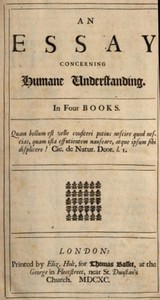
An Essay Concerning Humane Understanding, Volume 1 - MDCXC, Based on the 2nd Edition, Books 1 and 2
by
Locke, John
Download Formats:
Excerpt
_Quam bellum est velle confiteri potius nescire quod nescias, quam ista
effutientem nauseare, atque ipsum sibi displicere!_
Printed by Eliz. Holt, for Thomas Basset, at the George in Fleet Street, near
St. Dunstan’s Church.
THE EPISTLE TO THE READER
ESSAY CONCERNING HUMANE UNDERSTANDING.
BOOK I NEITHER PRINCIPLES NOR IDEAS ARE INNATE
CHAPTER I. INTRODUCTION.
CHAPTER II. NO INNATE SPECULATIVE PRINCIPLES.
CHAPTER III. NO INNATE PRACTICAL PRINCIPLES
CHAPTER IV. OTHER...
Read the Full Text
— End of An Essay Concerning Humane Understanding, Volume 1 - MDCXC, Based on the 2nd Edition, Books 1 and 2 —
Book Information
- Title
- An Essay Concerning Humane Understanding, Volume 1 - MDCXC, Based on the 2nd Edition, Books 1 and 2
- Author(s)
- Locke, John
- Language
- English
- Type
- Text
- Release Date
- January 1, 2004
- Word Count
- 149,564 words
- Library of Congress Classification
- B
- Bookshelves
- Banned Books from Anne Haight's list, Browsing: Philosophy & Ethics, Browsing: Psychiatry/Psychology, Browsing: Religion/Spirituality/Paranormal
- Rights
- Public domain in the USA.
Related Books
Theaetetus
by Plato
Dutch
927h 9m read

Kant prolegomenái minden leendő metafizikához
by Kant, Immanuel
Hungarian
998h 5m read

Muutamia mietteitä kasvatuksesta
by Locke, John
Finnish
1634h 27m read
Kant's Prolegomena to Any Future Metaphysics
by Kant, Immanuel
English
793h 32m read
Academica
by Cicero, Marcus Tullius
English
1579h 33m read
An Essay Concerning Humane Understanding, Volume 2 - MDCXC, Based on the 2nd Edition, Books 3 and 4
by Locke, John
English
2071h 9m read