The Project Gutenberg eBook, Compulsory Vaccination, by Charles T. Pearce,
et al
This eBook is for the use of anyone anywhere in the United States and most
other parts of the world at no cost and with almost no restrictions
whatsoever. You may copy it, give it away or re-use it under the terms of
the Project Gutenberg License included with this eBook or online at
www.gutenberg.org. If you are not located in the United States, you'll have
to check the laws of the country where you are located before using this ebook.
Title: Compulsory Vaccination
Report of a Public Meeting, held in the Marylebone Vestry Hall,
London, on Wednesday evening, October 19, 1870.
Author: Charles T. Pearce
Release Date: July 25, 2016 [eBook #52645]
Language: English
Character set encoding: UTF-8
***START OF THE PROJECT GUTENBERG EBOOK COMPULSORY VACCINATION***
Transcribed from the 1870 Watson Brothers edition by David Price, email
[email protected], using from images made available by _The Internet
Archive_.
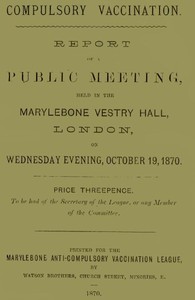
[Picture: Pamphlet cover]
COMPULSORY VACCINATION.
REPORT
OF A
PUBLIC MEETING,
HELD IN THE
MARYLEBONE VESTRY HALL,
LONDON,
ON
WEDNESDAY EVENING, OCTOBER 19, 1870.
* * * * *
PRICE THREEPENCE.
_To be had of the Secretary of the League_, _or any Member_
_of the Committee_.
* * * * *
PRINTED FOR THE
MARYLEBONE ANTI-COMPULSORY VACCINATION LEAGUE,
BY
WATSON BROTHERS, CHURCH STREET, MINORIES, E.
1870.
* * * * *
THE ST. MARYLEBONE
Anti-Compulsory Vaccination League,
FOUNDED 1869.
Executive Committee.
J. CAPLIN, Esq., M.D., F.A.S.L. A. J. DAYMAN, Esq.
C. T. PEARCE, Esq., M.D., Mr. ROBERT COLE.
M.R.C.S.
Mr. AARON EMERY.
R. B. GIBBS, Esq.
Mr. THOMAS HOBBS.
R. G. SNELL, Esq.
Mr. GEORGE MARGERISON.
F. H. HALLAM, Esq.
This League has been established with the following Objects:—
1.—To obtain the Repeal of the COMPULSORY Clause of the VACCINATION ACTS.
2.—To assist in defending Members, who may be prosecuted under that Act.
Tickets of Membership may be obtained for One Shilling of any Member of
the Committee, by whom Donations and Subscriptions will be thankfully
received.
_Or of the Hon. Secretary_,
Mr. G. MARGERISON,
5, BLANDFORD STREET, PORTMAN SQUARE, W.
REPORT.
On Wednesday Evening, October 19th, 1870, a Public Meeting, convened at
the requisition, numerously signed, of the ratepayers of Marylebone, was
held in the Vestry Hall of that large Metropolitan Parish. The object of
the Meeting, as announced by advertisement, was “to take into
consideration the Acts of Parliament which render Vaccination
Compulsory.”
The chair was occupied by R. HALLAM, Esq. a Vestryman, who said, it was
twelve months that day, since a meeting was held in that hall, for the
purpose of inaugurating a Marylebone Branch of the Anti-Vaccination
League. Some gentlemen of the medical profession, subsequently said that
if they had been present, they could have upset all the arguments on the
other side. The executive of the Marylebone Branch had very
straightforwardly said, they would be happy to meet those professional
gentlemen, and the public notice which the secretary would read, invited
their presence. The notice having been read, the Chairman proceeded to
say it must be apparent to all that they were not assembled there to make
pecuniary profit. They did not come to receive vaccination fees, but to
enter their protest against such an iniquity. The subject they were to
discuss was one of the most important that could engage their attention.
A great outcry had been raised about the unfortunate position they stood
in with respect to infanticide and baby-farming; and Dr. Lankester, one
of the coroners for Middlesex, had made himself very busy to have a check
put upon those practices, but why did not the coroner reflect upon the
enormous amount of infanticide caused by the point of the lancet? Could
he be a conscientious man, when he carried his prejudice for vaccination
into the coroner’s court? He very much regretted that they had a medical
coroner, and although he had voted for him at first, he would promise
never to vote for another gentleman of the same profession. He then
referred to the recent inquiry in St. Pancras, on the body of a child
which died the day after it was vaccinated. The death was attributed to
congestion of the lungs, but the iniquitous part of the proceedings was
that the doctor who vaccinated performed the post-mortem examination.
Referring to the general question, he said that under the vaccination
system, even when small-pox was absent there was an equivalent disease
present. Dr. Lankester himself, in a return he had furnished to the
parish of St. James’s, said that although they had no small-pox, they had
its equivalent—scarlet fever—very bad. Dr. Lankester had also said that
there were three small-pox cases in the hospital; one patient was
unvaccinated, and two had been vaccinated. That order of things was not
according to the promise of the vaccinators, who told them that
vaccination was a preventative. Before calling on the speakers he would
just say to the medical profession, that they desired a fair and
impartial investigation. As an individual he was open to conviction, if
any gentleman present could prove he was in the wrong, but as far as he
at present saw, he should as much expect to see the sun shining in the
middle of the night, as to be convinced of the utility of vaccination.
If any medical gentlemen wished to speak and would hand up their names
they should be heard.
Dr. Routh and Dr. Thompson (of the Brompton Hospital) sent up then cards.
Mr. Snell, on rising, said that the meeting was, no doubt, acquainted
with the account of Do-the-boys Hall, in one of the works of the late
Charles Dickens, in which an amusing description is given of the weekly
administration of brimstone and treacle. The boy had to open his mouth
and _nolens volens_, receive therein and swallow the spoonful. Now, said
the speaker, we Englishmen are in a somewhat similar position; it is true
we are not commanded to open our _mouths_, but our _veins_, to receive
the poison of a diseased brute. Now the celebrated John Hunter, the
great Anatomist and Physiologist said, “Any extraneous substance
introduced into the blood modifies the vitalized or living fluid. The
introduction of animal products from another living body, be it a man, a
cow, or even the ass, is infinitely more pernicious because allied to it,
being vitalized.” He held, therefore, that government violated a natural
law, besides one of the fundamental principles of the English
constitution, when it enforced this odious compulsory vaccination, by
depriving parents of their liberty—committing them to prison for refusing
to contaminate their infants with the disease of a brute. The speaker
then briefly called attention to the law of vicarious mortality, which
had been so ably elucidated by Dr. Pearce, in his Essay on Vaccination,
which proved that we had no control over the epidemic visitations of
small-pox, or any other disease. With great pleasure, he moved the
following resolution.
“That the enforcement of the practice of so-called Vaccination, is an
interference with the liberty of the subject, and injurious to the
community, and that therefore, this meeting is of opinion that the
Vaccination Acts ought to be repealed.”
The resolution was seconded by Dr. McOubrey, who called the attention of
the meeting to the unconstitutional character of the Acts which enforced
the practice of vaccination; giving power to magistrates to consign to
prison, men and women, without trial by jury. He adverted to the almost
unexceptional practice of magistrates, of cruelly inflicting the utmost
penalty of the law, and this in defiance of the clause in the Act, which
provides that if a reasonable excuse be offered, the fine may not be
inflicted. The loss of one or even two children by vaccination, was not
held by any magistrate to be a sufficient or reasonable excuse.
Moreover, said the speaker, there is no justification for the law, the
whole thing is a delusion. Vaccination never did prevent small pox, and
Jenner knew it—and therefore he invented a theory that the virus from the
horses’ heel was the true source of the matter, and was alone protective.
The disease which Jenner produced was not like small-pox. Phagædenic
ulcers, with inflamed and swollen glands in the axilla, were the result
of the process which he imposed upon the government, and on his unproved
assertion, that his process would protect the subject for ever, obtained
no less than thirty thousand pounds of British gold. And this was done
against the protest of all the leading medical men of the time.
What are the facts regarding this professed protective power? Why, that
of the patients admitted into the small-pox Hospital, no less than
eighty-four of every hundred eases, were found vaccinated! call you this
protection? The whole thing is a falsehood.
Take the fact that in Paris, in the Barracks of the 1st regiment of the
Voltigeurs of the Guard, in 1867, the soldiers were vaccinated to the
number of 457, when towards the end of 1868, a small-pox epidemic in a
highly confluent form, broke out in this regiment. This epidemic _made
many victims_ where the hygienic conditions, as space, ventilation and
food were excellent; while in the 2nd regiment, in a similar barrack in
the same court-yard, but wherein _no vaccination_ had been done, _not a
single case of small-pox occurred_.
Take another case. In Bavaria every person is vaccinated, yet a short
time ago small-pox broke out in Munich, and the Royal Pages were seized
with small-pox. The Royal Court left the capital in alarm, not less than
if a shell had burst in their midst. Since the passing of the Compulsory
Act almost every constitutional disease that flesh was heir to had
increased most alarmingly. In 1866, 122,222 persons died of chest
disease, and of consumption alone 55,714. Now consumption was increasing
by 2,000 cases a year. These facts should rouse the people to
indignation against a government whose acts are despotic and which aimed
at the destruction of the people’s liberty. He cordially seconded the
resolution.
Before putting the resolution to the meeting the Chairman intimated to
Dr. Routh who had sent up his card that if he wished to move an amendment
he could now do so.
Dr. Routh said: It was not his intention to move a formal amendment to
the resolution, but merely a negative vote. He was very much surprised
at the two speeches he had heard. He had no doubt, both the gentlemen
were perfectly convinced they were right, but he did not know how they
could have come to that conclusion if they had taken statistics. They
had been told that the mortality from every form of disease had
increased, but it had not done so from small-pox. The population was
increasing, and therefore there were more deaths than there used to be.
The speakers on the other side were taking a time when the whole
population of the kingdom was not more than 20,000,000, and comparing the
gross number of deaths then with those that took place now; they ought,
if they meant to deal fairly, to take the number of deaths to the million
of population. It had been said that by the statistics of the Small-pox
Hospital a greater number of persons were there who had been vaccinated
than had not. What was the fact? The official return showed the
following:—Number of deaths among the unvaccinated, 35 per cent.;
vaccinated with one vaccine cicatrice, 7; with two cicatrices, 4; with
three, 1; with four, 5–10ths. Well-marked, 2; badly-marked, 18; those
who had previously had small-pox, 19. This last average showed that the
vaccine was a better preventative than small-pox itself. Dr. Seaton,
medical officer of the Privy Council, had published a return showing the
annual death-rate in England and Wales. The death-rate per million of
population during the 30 years previous to vaccination was 3,000. In ’38
and ’40, when vaccination was diffused, but before it was gratuitous, it
was 770. The average for nine of the years when public vaccination was
gratuitous but not obligatory was 304, and during the time it was both
gratuitous and obligatory, the vaccination death-rate was 202 per
million. Who, in the face of that, would maintain that vaccination was
not a preventative of small-pox? Having referred to the ravages the
disease used to commit, and the powerful nature of the small-pox virus,
he proceeded to say that a great deal had been made of the fact that more
people died of other diseases than usual, when deaths from small-pox were
few in number. It stood to reason that if they saved a certain number of
people from a certain disease, they must leave a greater number than if
they had not saved them to die afterwards from some other disease. So,
when a fearful epidemic had just left a place the number of deaths for
some time afterwards was much smaller than at any other time during a
long period of health. The reason of this was that nearly all the weak
had been killed. It had been said that vaccine put into the system a
great number of noxious diseases. That rested on the mere _ipse dixit_
of a few persons. No doubt, in the crowded and unhealthy neighbourhoods
of the poor, where no attention was paid to cleanliness, serious
consequences might follow upon the mere scratch of the lancet or anything
else, but that furnished no real argument against the system. He quite
acknowledged they had no right to prevent Mr. Tomkins keeping any disease
he liked in his own house, but if Tomkins came out amongst other people,
and poisoned them, they had a right, and it was their duty to the nation,
to take measures for preventing him.
Dr. Thompson was then called upon. He thought in such an important
matter they ought to put aside feeling and look only to the facts
themselves. In the first place, great credit was due to Dr. Jenner for
pressing so forcibly upon public notice the system of vaccination,
although no doubt he did not discover it. If vaccination did not
preserve persons absolutely, neither did a previous attack of small-pox,
for he knew a case of a woman who had it seven times, and died from the
last attack. A strong point had been made by the other side on the
statement that there had been a great increase in the number of deaths
registered from chest diseases since the introduction of vaccination. He
most unhesitatingly admitted that to be a fact, but why was it? It was
not because of vaccination, but in consequence of the introduction of the
use of that instrument (producing a stethoscope) for sounding the chest.
Previously there were next to no means of discovering chest disease, and
persons dying from it were registered as dying from other forms of
disease. There had been no increase shown in the number of deaths from
chest disease. More than 20,000 cases had been under his care during the
last seven or eight years, and he had found that persons suffering from
consumption had, in a very large proportion, suffered from small-pox
also. He believed small-pox to be an exciting cause of consumption,
rather than a preventative as had been asserted. Previous to
vaccination, as many as 4,000 in 1,000,000 died from small-pox, and that
number, since its introduction, had fallen to 158. He really, in his
ignorance, had thought that the anti-vaccination movement would have
ceased in face of the facts from St. Giles’s and Ireland.
The chairman: The sanitary habits of the people have something to do with
the improvement in Ireland.
Dr. Thompson had no doubt that was the case, but it could have nothing to
do with the improvement in St. Giles’s, as the sanitary habits of that
place were not very advanced. Let them continue vaccination till
small-pox was eradicated, and then they could do without it altogether.
Small-pox had only originated once in the history of the world, and if
they could only once stamp it out, it might never recur. His attention
had been called to some figures which he had omitted to notice in regard
to Sweden, where the mortality which was so strikingly reduced after the
introduction of vaccination, that in one year there were only two deaths,
again rose by degrees till it reached 2,000. This was owing to the
carelessness of the people, who thought the disease had gone altogether,
and neglected the continuance of vaccination. Strenuous efforts were
again made when the mortality rose, and it was reduced rapidly, till
there were only 41 deaths in one year.
At the conclusion of Dr. Thompson’s speech several gentlemen rose to put
questions to Dr. Thompson, when Dr. Pearce asked permission of the
chairman to reply to the two medical gentlemen who had just addressed
them. Permission being obtained—
Dr. Pearce said, he felt happy in meeting his two professional brethren,
Dr. Routh and Dr. Thompson, and discussing with them this important
question; and he proposed in order to avoid taxing the memories of the
audience, to mingle the two speeches, and to reply in the reverse order
of their delivery, noticing first the concluding remarks of Dr. Thompson.
Dr. Thompson had, unhappily for the cause he advocated, referred to that
well vaccinated country, Sweden, where every child born is vaccinated,
and where compulsory vaccination has been in operation many years. Dr.
Thompson had pointed out that small-pox had declined in that country, in
consequence of vaccination, adducing the fact, that while in 1838 the
mortality was 1,805, in 1839 it was 1,934, it fell in 1840 to 650, and in
1842 to 58; indeed, in 1846 only two deaths from small-pox were recorded,
and this, said Dr. Thompson, was the result of vaccination; but if he had
continued his inquiry to later years, he would have found, as he will see
there in that table, that the small mortality was owing to the fact that
the epidemic had done its work and taken its departure, but that when
another epidemic came, the mortality was again raised, and in 1849—31
died; in 1850—1,376 died; in 1851 no less than 2,488 died;—the heaviest
mortality for forty years _though every inhabitant of Sweden was
vaccinated_. {11}
And now for Ireland, on which so much stress has been laid of late. You
tell us, that vaccination has extinguished small-pox in that country. I
deny it. For while it is quite true that small-pox is absent—this is not
the result of vaccination—for the Registrar General’s returns shew that
there is less vaccination in Ireland than in England, and far less than
in Scotland. You flatter yourselves that _you_ have put out small-pox by
vaccination. In regard to Ireland the fact is, that inoculation has been
clandestinely carried on in that country, the people having more
confidence in the protecting power of small-pox, a disease which is
human, than in vaccination, a disease of a brute. They have this
instinct, and this instinct is right in the mother who shudders at the
idea of _cow_-pox. You overrule this instinct which is natural, with
your reason, you impose a substitute which is revolting. Small-pox is
absent from Ireland, but is the mortality less? No, on the contrary
under the operation of a natural law which I have illustrated in my essay
on vaccination, to which Mr. Snell has alluded, scarlatina has displaced
small-pox, and the general mortality has increased. It is a general rule
that when small-pox is present you have a low mortality, and when it is
absent you have a higher mortality. Small-pox is absent from England,
but look at your frightful mortality from scarlatina. {12} In the last
two years, I estimate the mortality from scarlatina at 40,000 per annum,
and small-pox only 1,500. And what is the nature of this process which
you call _vaccination_. Dr. McOubrey has already told you this evening,
that the disease which Jenner implanted was _not_ natural cow-pox, but a
disease which developed itself in phagædenic ulcerations. You follow Dr.
Blane who advocated vaccination direct from the heifer to avoid the
admitted dangers arising from arm to arm vaccination—the diseases
transplanted therewith. You tell us to-night, that vaccination with
cow-pox will prevent small-pox. Did Jenner tell you this? Let me read
to you his words at page 7 of his work, published in 1798, he cautions
you against trusting to spontaneous cow-pox, lest you should be deceived
into a false security.
I will read the passage from Jenner, “It is necessary to observe that
pustulous sores frequently appear spontaneously on the nipples of cows,
and instances have occurred of the hands of servants employed in milking,
being affected with sores in consequence, and even of their feeling an
indisposition from absorption. These pustules are of a much milder
nature than those which arise from that contagion which constitutes the
_true_ cow-pox. They are always free from the bluish or livid tint, so
conspicuous in the pustules of that disease. _No erysipelas attends
them_, _nor do they show any phagædenic disposition_, _as in the other
case_, but terminate in a scab, without creating any apparent disorder in
the cow. But this disease is not to be considered as similar in any
respect to that of which I am treating, as it is _incapable of producing
any specific effects on the human constitution_. However, it is of the
greatest consequence to point it out here, lest the want of
discrimination should occasion an _idea_ of security, from the infection
of small-pox which might prove delusive.” Now, mark the words—an idea of
security—it is an idea, it has no reality; and for this idea you commit
to prison mothers, whose only crime is to refuse to obey the mandate of a
faculty, at whose bidding the Act of Parliament, which disgraces the
statute book was passed. This spurious vaccination, this vaccination is
Dr. Blane’s, it is a sham, a delusion. Have we not proof? Appeals have
been made to-night to the statistics of the Small-pox Hospital, drawn up
by Mr. Marson, its surgeon, in which he very ingeniously makes it appear,
that although 84 of every hundred cases are found to have been
vaccinated, the disease small-pox is modified by vaccination—this is a
new tangled dodge. Mr. Marson tells us that the mortality in the
“unprotected” is 34 or 35 per cent., that in modified cases it varied
from 24 down to 7 per cent., and that these _modified_ cases were among
the vaccinated. Stress is laid on the importance of the number of the
cicatrices. While Jenner said one puncture was sufficient, these men
tell us that four, five, even six on each arm are necessary in order to
ensure efficient protection. One dart of the serpent’s sting is not
enough.
This ingenious division of the mortality into groups, according to the
number of cicatrices is a delusion. Why, Mr. Marson tells us, with
regard to the ‘modified’ cases said to have been vaccinated, but having
no marks of vaccination, that they “must have received a protective
influence as regards fatality, which would have been greater, but for the
disease having been influenced by vaccination.”
So it is _assumed_ that when small-pox occurs mildly in the
vaccinated—that the disease is modified thereby. The fact being that it
depends on the natural susceptibility of the subject and not on
vaccination. This different susceptibility in the attacked was pointed
out by Rhazes, an Arabian physician, centuries before vaccination was
thought of; but what happens when small-pox occurs in a severe form? Let
us see—here is Dr. Russell Reynolds’ System of Medicine, and in it, vol.
1, 2nd edition, page 229, is an article by Mr. Marson on small-pox. He
tells us that 104 cases of the severe (corymbose) form of small-pox were
admitted into the hospital—of these 29 were unvaccinated, 74 were found
vaccinated (mark the greater number were vaccinated as usual)—of the 29
unvaccinated, 13 died; of the 74 vaccinated, 32 died;—shewing a
difference in the mortality of less than 3 per cent. Of the 104 cases
one only had been inoculated, that case died. Here then we see that with
all your boasted protection the great majority are found with the mark of
the beast on the arm, yet they die at the rate of 42 per cent.
Reference had been made to the diminution of small-pox in the parish of
St. Giles’s. At a meeting in Kentish Town some months ago, Dr. Ross
adduced what he thought to be evidence of the effect of vaccination in
St. Giles’s. At that meeting he, Dr. Pearce, had combated Dr. Ross’s
argument by shewing that the diminished mortality from small-pox was
owing to its absence and its displacement by scarlatina.
Dr. Seaton’s statistics had been quoted to-night in proof of the
advantage of legislation on the subject. That well paid officer of the
Privy Council had drawn up a table for the Epidemiological Society which
he, Dr. Pearce, had republished in his essay, and which he begged now to
hand to Dr. Routh and Dr. Thomson for their inspection.
_Table_, _showing the annual mortality from small-pox in England in three
periods_: (1) _Before the enactment of any vaccination laws_; (2) _After
vaccination was provided gratuitously_, _but was not obligatory_; _and_
(3) _since vaccination has been obligatory_:—{15}
DIVISION 1. DIVISION 2. DIVISION 3.
Before the enactment Vaccination provided Vaccination
of any Vaccination gratuitously, but not obligatory.
Laws. obligatory.
Year. No. of Year. No. of Year. No. of
Deaths. Deaths. Deaths.
1838 16,268 1841 6,368 1854 2,808
1839 9,131 1842 2,715 1855 2,525
1810 10,431 1847 4,226 1856 2,277
1848 6,903 1857 3,936
1840 4,645 1858 6,460
1850 4,666 1859 3,848
1851 6,997 1860 2,749
1852 7,320 1861 1,320
1853 3,151
Average 11,944 — 5,221 — 3,240
Annual
Deaths.
The table was compiled for the purpose of showing that legislative
measures to provide and enforce vaccination, have been effective in
diminishing the mortality from small-pox.
The year 1838 was the most fatal year, from small-pox, in the present
century. The table is commenced with that year, _while former years are
omitted in which the death-rate from small-pox was low_, (for it had not
prevailed severely since 1825). Hence the average mortality is swelled
to 11,944. So much for the first division.
The third division is supposed to prove that the decrease of the
mortality from small-pox is due to compulsory vaccination. It must be
remembered however, that in the second division there are three epidemic
visitations included, while in the third division there is only one.
Moreover, if the years 1862–3–4–5, be added, the average annual deaths
for the period 1862–65 amount to 5,421, thus—
Year. No. of Deaths.
1862 1,628
1863 5,964
1864 7,684
1865 6,411
— 5,421
Dr. Seaton attributes the diminished mortality from small pox to
compulsory vaccination, closing his account with 1861, which is the year
of lowest mortality in the table. How will he account for the subsequent
increase of mortality from small-pox under a more vigilant enforcement of
the Act of Parliament?
In 1863 it amounted to 5,964; and it rose to 7,684 in 1864; _which was
the most fatal year in regard to small-pox for twenty-four years_. If
vaccination be really “protective,” and if the gradual diminution of the
mortality from small-pox down to the year 1861 was consequent on
vaccination having been made compulsory, how, and why was the mortality
of 1864 from that disease no less than 6,364 _in excess_ of the mortality
of 1861?
Dr. Routh has quoted Dr. Seaton with a view of illustrating the contrast
between the last century and the present in respect to the mortality from
small-pox.
He has told you that prior to vaccination, the annual death-rate of
small-pox per million of population was 3,000. This was a rough estimate
made by Sir Gilbert Blane and Dr. Lettsom. The value of this “estimate”
may be judged of, when I tell you that prior to 1838, there were no
complete statistics of mortality. Mr. Simon in his “Papers on
Vaccination” at page lxviii says, “Till after 1837, _there could be no
authentic knowledge of deaths by small-pox_.”
Dr. Farr in the 30th annual report of the Registrar General says, quoting
Dr. Watt, of Glasgow, a child had a better chance of reaching its tenth
year in the last eighteen years of the last century when small-pox formed
20 per cent. of the whole mortality than it has now, when small-pox
mortality is only two per cent.
No one disputes that small-pox is less prevalent now than it was a
century ago, but what gain is there? Dr. Farr says, “it is useless to
bar the door against one form of zymotic disease, as small-pox by
vaccination, while the _causes_ of zymotic disease are suffered to
remain.”
In 1863 scarlatina destroyed 30,000 in England, a mortality of 1,800 to
each million persons living. In 1869 and 1870 the probability is that
the mortality from scarlatina will reach 40,000 annually, shewing a death
rate per million of 2,000, while small-pox will probably not exceed 70 to
a million.
Small-pox was a scourge in Europe a century ago. Now, scarlatina is the
scourge, and this will continue. One or other form of zymotic disease
will continue to exist while the causes which develope them remain. You
gentlemen, who advocate vaccination as a preventive measure are in
error—you begin at the wrong end—you aim not at taking away the cause,
but prefer to contaminate the body with one disease, to prevent the
subject from taking another, which is the result of filthy habitations,
unclean towns, and bad sanitary arrangements.
It has been disputed to-night that diseases are induced by vaccination;
will it be denied that erysipelas is a common—a frequent result of the
process? What are the facts? Erysipelas, which, prior to vaccination,
was a disease incident to adult life, especially to middle age, is now a
disease of infant life. In the Registrar General’s returns, you will
find in the six years 1862 to 1867, there died of this disease 10,635,
including all ages from birth to 80 years; of that number no less than
3,261 died in the first year of life, _the year of vaccination_, while
3,904 died under five years of age. This frightful mortality of infants
is the direct consequence of vaccination; a natural result; indeed,
Jenner tells us that, that vaccination is alone protective, which is
attended by erysipelas; while the spontaneous cow-pox, which is
_unattended_ by erysipelas, is not protective. Yet when children die of
erysipelas following vaccination, the deaths are certified “_death from
erysipelas_,” while the truth is concealed. The death should be
certified properly, DEATH FROM VACCINATION. But when an inquest is held
in this parish, under the coronership of Dr. Lankester, on a child of Mr.
Emery of Great Portland-street, although the evidence adduced to the jury
clearly shewed that the child died in consequence of vaccination, efforts
are made to conceal the fact; for while the jury unanimously returned a
verdict “_died from erysipelas caused by vaccination_,” the coroner’s
copy deposited at the Registrar General’s office, Somerset-house,
certifies the additional words “_death by misadventure_.” {19} And with
what object were those words added, but to screen the operator, by whose
vaccinating hand another child also lost its life (probably with the same
lancet) on which the coroner for Westminster, Mr. Bedford, held an
inquest. I do not say that Dr. Lankester intentionally suppressed the
truth, to save his professional brother, but I do say, that it is highly
dangerous to the community, to have a _medical_ coroner, whose leanings
in favor of his profession may lead him into partial verdicts. The duty
of a coroner is to hear evidence, and direct the jury as to the _law_,
not to give opinions with a professional bias. Compulsory vaccination
may be defined to be manslaughter by Act of Parliament.
So much for one disease, Erysipelas. Let us now come to another
frightfully increasing disease of infant life, Diarrhœa. I have, during
the last twenty years in which I have given my attention to this
subject—vaccination and its effects—observed the frequency with which
vaccination of infants is followed by a fatal kind of diarrhœa.
Enteritis of infants has without doubt increased and is increasing.
I was not surprised, therefore, to find in the twelfth report of the
medical office of the Privy Council, just published, a paper by Dr.
Seaton on vaccination in Paris, in which at page 176, occurs the
following passage:—
“_In some cases the vaccinated calves have suffered from diarrhœa_.”
At page 178, “In Depaul’s seventh and eighth experiments, for example,
_the calves suffered severely from diarrhœa_.”
Another passage, page 178, shows that diarrhœa is an accompaniment of the
process; “the health of the calf, however, affects the character of the
eruption, for it has been observed that _when diarrhœa happens in the
course of its evolution_, the pustules, although they rise as in the
healthy calf, are smaller in size, and less full.”
And thus infant mortality is increased by the infliction of a disease of
the brute creation, which in the “course of its evolution,” causes
diarrhœa.
The medical press has lately teemed with articles calling attention to
the prevalence of small-pox, in Paris, it is stated that small-pox
prevails there because vaccination is not compulsory. While it is quite
true that the Legislature of Prance has passed no such disgraceful and
tyrannical vaccination acts, as those which exist in England,—yet
vaccination is almost universally adopted. Mr. Smee, the surgeon to the
Bank of England, and examiner of candidates for life assurance, lately,
in a letter to the “Times” newspaper, stated that his large experience
enabled him to state that to find a Frenchman unvaccinated was an
exception. The 12th report of the medical officer of the Privy Council
tells us that in France it has been decreed, under the direction of the
Academy of Medicine, by ministers, that “No infant should enter an orphan
asylum, an hospital, a primary school, a lyceum, or a government college
without a certificate, of vaccination.”
The Army and Navy of France are vaccinated, and vaccination is enjoined,
if not enforced, on all who hold government situations. Besides this, it
is forced upon the poor by a rule that “_those who refuse to have their
children vaccinated_, _shall have no public assistance_.”
The fact is, that vaccination has failed in Paris, as in every other
city. Let the medical gentlemen opposite, look to the paper of Dr.
Seaton, whose cooked statistics they have quoted to-night; the paper to
which I have before alluded, presented to the Lords of the Privy Council
in the 12th report of Mr. Simon, and at page 188, they will find the
following passage:—
“Striking exemplification of the danger of confiding in animal
vaccination during an outbreak of small-pox has been given during the
present epidemic in Paris, no doubt a large share of the _unsuccess_
which has _notoriously_ attended the practice, has been due to the
hurry, and other unfavorable conditions under which it has been
carried on. _But apart from this_, _and where the conditions have
been favorable_, THE FAILURES HAVE BEEN QUITE REMARKABLE.”
I unhesitatingly affirm that vaccination from whatever source, whether
from the heifer direct or from arm to arm, or even the heel of the greasy
horse, which Jenner defined to be the _true source of protective matter_,
is not only a failure—it is a delusion, an imposture, and the law which
enforces it at the bidding of the medical department of the Privy
Council, is a disgrace to the Statute Book of England, and ought to be
repealed. For the reasons I have given, after nearly twenty years of
attention to this important subject, I support the resolution.
Mr. Glidden made a few observations in support of the medical men who had
spoken in advocacy of vaccination, expressing his surprise at the want of
modesty in the last speaker, who, as a member of a learned profession,
spoke disparagingly of his medical brethren, and applied the term
“cooked” to statistics on the other side, while he produced a multitude
of statistics of his own.
The chairman here interposed stating that Dr. Pearce head only produced
the official statistics of the Registrar General. The resolution was
then put and carried with only four dissentients.
Mr. R. B. Gibbs, Hon. Sec. to the Anti-Compulsory Vaccination League,
moved “that a memorial be presented to the Lords of Her Majesty’s Privy
Council, praying them to suspend the vaccination laws until the inquiry,
promised by the Government, had been made,” and said, that similar
requests had been made several times, and that so far back as 1856, the
government had promised a committee of the House of Commons, which
promise was evaded. Instead of a committee an _exparte_ investigation
was made by sending a string of questions to a number of interested
doctors, who, of course upheld the system. This course was much the same
as if the late Royal Commission on Trades Unions had written to the
secretaries of the various unions, to enquire how they worked. If a
question had been asked of Broadhead, respecting the Saw-Grinders’ Union,
of course, he would have reported that it was working satisfactorily.
Mr. Gibbs said, that the League would be satisfied with nothing less than
a full investigation of the Medical Trades Unions. He then adverted to
the case of the Rev. H. J. Allen, who had appealed to the Court of
Queen’s Bench against a second conviction, which conviction had been
upheld by the Court, and Mr. Allen left to pay a lawyer’s bill of over
£30. He trusted that the lovers of freedom would assist him in his
difficulties. Mr. Gibbs then referred to the important testimony, lately
adduced by medical gentlemen in Manchester and elsewhere, that the evil
results of vaccination were often apparent after “successful” operations
with “pure lymph,” and reminded the audience that it was from the effects
of such an operation, that Sir Culling Eardley, and many others had died.
In view of such uncertainties, Mr. Gibbs argued that it was cruel to
enforce the prisoning of the community.
The resolution was seconded by Mr. MacHeath, who in an interesting and
amusing speech alluded to the “beastly” practice of vaccinating the human
species.
The resolution was carried unanimously.
Dr. Caplin moved a vote of thanks to the Chairman, which was heartily
responded to, and the meeting, which was most effective, was brought to a
close.
* * * * *
* * * * *
* * * * *
DEATHS FROM SMALL-POX IN SWEDEN,
1821–1852. {23}
Date. Deaths. Date. Deaths.
1821 37 1837 361
1822 11 1838 1,805
1823 39 1839 1,934
1824 618 1840 650
1825 1,243 1841 237
1826 625 1842 58
1827 600 1843 9
1828 257 1844 6
1829 53 1845 6
1830 104 1846 2
1831 612 1847 13
1832 622 1848 71
1833 1,145 1849 341
1834 1,049 1850 1,376
1835 445 1851 2,488
1836 138 1852 1,534
* * * * *
ADVERTISEMENT.
Preliminary Medical Education
AT
PROVINCIAL HOSPITALS.
BY
WILLIAM PAUL SWAIN, F.R.C.S.,
_Surgeon to the Royal Albert Hospital_, _and Eye Infirmary_, _Devonport_.
Price Sixpence.
FOOTNOTES.
{11} See page 23.
{12} Since the meeting was held the quarterly returns of the Registrar
General has appeared, shewing that in the present year the mortality of
England has considerably increased.
{15} Transactions of the Epidemiological Society, vol. ii., part 1.
{19} Three fourths of the jurymen have in their own hand writing
repudiated the words “death by misadventure” and declare that the verdict
returned did not contain those words. The remaining members of the jury
have not yet been consulted.
{23} From page 92, Dr. Pearce’s Essay on Vaccination.
***END OF THE PROJECT GUTENBERG EBOOK COMPULSORY VACCINATION***
******* This file should be named 52645-0.txt or 52645-0.zip *******
This and all associated files of various formats will be found in:
http://www.gutenberg.org/dirs/5/2/6/4/52645
Updated editions will replace the previous one--the old editions will
be renamed.
Creating the works from print editions not protected by U.S. copyright
law means that no one owns a United States copyright in these works,
so the Foundation (and you!) can copy and distribute it in the United
States without permission and without paying copyright
royalties. Special rules, set forth in the General Terms of Use part
of this license, apply to copying and distributing Project
Gutenberg-tm electronic works to protect the PROJECT GUTENBERG-tm
concept and trademark. Project Gutenberg is a registered trademark,
and may not be used if you charge for the eBooks, unless you receive
specific permission. If you do not charge anything for copies of this
eBook, complying with the rules is very easy. You may use this eBook
for nearly any purpose such as creation of derivative works, reports,
performances and research. They may be modified and printed and given
away--you may do practically ANYTHING in the United States with eBooks
not protected by U.S. copyright law. Redistribution is subject to the
trademark license, especially commercial redistribution.
START: FULL LICENSE
THE FULL PROJECT GUTENBERG LICENSE
PLEASE READ THIS BEFORE YOU DISTRIBUTE OR USE THIS WORK
To protect the Project Gutenberg-tm mission of promoting the free
distribution of electronic works, by using or distributing this work
(or any other work associated in any way with the phrase "Project
Gutenberg"), you agree to comply with all the terms of the Full
Project Gutenberg-tm License available with this file or online at
www.gutenberg.org/license.
Section 1. General Terms of Use and Redistributing Project
Gutenberg-tm electronic works
1.A. By reading or using any part of this Project Gutenberg-tm
electronic work, you indicate that you have read, understand, agree to
and accept all the terms of this license and intellectual property
(trademark/copyright) agreement. If you do not agree to abide by all
the terms of this agreement, you must cease using and return or
destroy all copies of Project Gutenberg-tm electronic works in your
possession. If you paid a fee for obtaining a copy of or access to a
Project Gutenberg-tm electronic work and you do not agree to be bound
by the terms of this agreement, you may obtain a refund from the
person or entity to whom you paid the fee as set forth in paragraph
1.E.8.
1.B. "Project Gutenberg" is a registered trademark. It may only be
used on or associated in any way with an electronic work by people who
agree to be bound by the terms of this agreement. There are a few
things that you can do with most Project Gutenberg-tm electronic works
even without complying with the full terms of this agreement. See
paragraph 1.C below. There are a lot of things you can do with Project
Gutenberg-tm electronic works if you follow the terms of this
agreement and help preserve free future access to Project Gutenberg-tm
electronic works. See paragraph 1.E below.
1.C. The Project Gutenberg Literary Archive Foundation ("the
Foundation" or PGLAF), owns a compilation copyright in the collection
of Project Gutenberg-tm electronic works. Nearly all the individual
works in the collection are in the public domain in the United
States. If an individual work is unprotected by copyright law in the
United States and you are located in the United States, we do not
claim a right to prevent you from copying, distributing, performing,
displaying or creating derivative works based on the work as long as
all references to Project Gutenberg are removed. Of course, we hope
that you will support the Project Gutenberg-tm mission of promoting
free access to electronic works by freely sharing Project Gutenberg-tm
works in compliance with the terms of this agreement for keeping the
Project Gutenberg-tm name associated with the work. You can easily
comply with the terms of this agreement by keeping this work in the
same format with its attached full Project Gutenberg-tm License when
you share it without charge with others.
1.D. The copyright laws of the place where you are located also govern
what you can do with this work. Copyright laws in most countries are
in a constant state of change. If you are outside the United States,
check the laws of your country in addition to the terms of this
agreement before downloading, copying, displaying, performing,
distributing or creating derivative works based on this work or any
other Project Gutenberg-tm work. The Foundation makes no
representations concerning the copyright status of any work in any
country outside the United States.
1.E. Unless you have removed all references to Project Gutenberg:
1.E.1. The following sentence, with active links to, or other
immediate access to, the full Project Gutenberg-tm License must appear
prominently whenever any copy of a Project Gutenberg-tm work (any work
on which the phrase "Project Gutenberg" appears, or with which the
phrase "Project Gutenberg" is associated) is accessed, displayed,
performed, viewed, copied or distributed:
This eBook is for the use of anyone anywhere in the United States and
most other parts of the world at no cost and with almost no
restrictions whatsoever. You may copy it, give it away or re-use it
under the terms of the Project Gutenberg License included with this
eBook or online at www.gutenberg.org. If you are not located in the
United States, you'll have to check the laws of the country where you
are located before using this ebook.
1.E.2. If an individual Project Gutenberg-tm electronic work is
derived from texts not protected by U.S. copyright law (does not
contain a notice indicating that it is posted with permission of the
copyright holder), the work can be copied and distributed to anyone in
the United States without paying any fees or charges. If you are
redistributing or providing access to a work with the phrase "Project
Gutenberg" associated with or appearing on the work, you must comply
either with the requirements of paragraphs 1.E.1 through 1.E.7 or
obtain permission for the use of the work and the Project Gutenberg-tm
trademark as set forth in paragraphs 1.E.8 or 1.E.9.
1.E.3. If an individual Project Gutenberg-tm electronic work is posted
with the permission of the copyright holder, your use and distribution
must comply with both paragraphs 1.E.1 through 1.E.7 and any
additional terms imposed by the copyright holder. Additional terms
will be linked to the Project Gutenberg-tm License for all works
posted with the permission of the copyright holder found at the
beginning of this work.
1.E.4. Do not unlink or detach or remove the full Project Gutenberg-tm
License terms from this work, or any files containing a part of this
work or any other work associated with Project Gutenberg-tm.
1.E.5. Do not copy, display, perform, distribute or redistribute this
electronic work, or any part of this electronic work, without
prominently displaying the sentence set forth in paragraph 1.E.1 with
active links or immediate access to the full terms of the Project
Gutenberg-tm License.
1.E.6. You may convert to and distribute this work in any binary,
compressed, marked up, nonproprietary or proprietary form, including
any word processing or hypertext form. However, if you provide access
to or distribute copies of a Project Gutenberg-tm work in a format
other than "Plain Vanilla ASCII" or other format used in the official
version posted on the official Project Gutenberg-tm web site
(www.gutenberg.org), you must, at no additional cost, fee or expense
to the user, provide a copy, a means of exporting a copy, or a means
of obtaining a copy upon request, of the work in its original "Plain
Vanilla ASCII" or other form. Any alternate format must include the
full Project Gutenberg-tm License as specified in paragraph 1.E.1.
1.E.7. Do not charge a fee for access to, viewing, displaying,
performing, copying or distributing any Project Gutenberg-tm works
unless you comply with paragraph 1.E.8 or 1.E.9.
1.E.8. You may charge a reasonable fee for copies of or providing
access to or distributing Project Gutenberg-tm electronic works
provided that
* You pay a royalty fee of 20% of the gross profits you derive from
the use of Project Gutenberg-tm works calculated using the method
you already use to calculate your applicable taxes. The fee is owed
to the owner of the Project Gutenberg-tm trademark, but he has
agreed to donate royalties under this paragraph to the Project
Gutenberg Literary Archive Foundation. Royalty payments must be paid
within 60 days following each date on which you prepare (or are
legally required to prepare) your periodic tax returns. Royalty
payments should be clearly marked as such and sent to the Project
Gutenberg Literary Archive Foundation at the address specified in
Section 4, "Information about donations to the Project Gutenberg
Literary Archive Foundation."
* You provide a full refund of any money paid by a user who notifies
you in writing (or by e-mail) within 30 days of receipt that s/he
does not agree to the terms of the full Project Gutenberg-tm
License. You must require such a user to return or destroy all
copies of the works possessed in a physical medium and discontinue
all use of and all access to other copies of Project Gutenberg-tm
works.
* You provide, in accordance with paragraph 1.F.3, a full refund of
any money paid for a work or a replacement copy, if a defect in the
electronic work is discovered and reported to you within 90 days of
receipt of the work.
* You comply with all other terms of this agreement for free
distribution of Project Gutenberg-tm works.
1.E.9. If you wish to charge a fee or distribute a Project
Gutenberg-tm electronic work or group of works on different terms than
are set forth in this agreement, you must obtain permission in writing
from both the Project Gutenberg Literary Archive Foundation and The
Project Gutenberg Trademark LLC, the owner of the Project Gutenberg-tm
trademark. Contact the Foundation as set forth in Section 3 below.
1.F.
1.F.1. Project Gutenberg volunteers and employees expend considerable
effort to identify, do copyright research on, transcribe and proofread
works not protected by U.S. copyright law in creating the Project
Gutenberg-tm collection. Despite these efforts, Project Gutenberg-tm
electronic works, and the medium on which they may be stored, may
contain "Defects," such as, but not limited to, incomplete, inaccurate
or corrupt data, transcription errors, a copyright or other
intellectual property infringement, a defective or damaged disk or
other medium, a computer virus, or computer codes that damage or
cannot be read by your equipment.
1.F.2. LIMITED WARRANTY, DISCLAIMER OF DAMAGES - Except for the "Right
of Replacement or Refund" described in paragraph 1.F.3, the Project
Gutenberg Literary Archive Foundation, the owner of the Project
Gutenberg-tm trademark, and any other party distributing a Project
Gutenberg-tm electronic work under this agreement, disclaim all
liability to you for damages, costs and expenses, including legal
fees. YOU AGREE THAT YOU HAVE NO REMEDIES FOR NEGLIGENCE, STRICT
LIABILITY, BREACH OF WARRANTY OR BREACH OF CONTRACT EXCEPT THOSE
PROVIDED IN PARAGRAPH 1.F.3. YOU AGREE THAT THE FOUNDATION, THE
TRADEMARK OWNER, AND ANY DISTRIBUTOR UNDER THIS AGREEMENT WILL NOT BE
LIABLE TO YOU FOR ACTUAL, DIRECT, INDIRECT, CONSEQUENTIAL, PUNITIVE OR
INCIDENTAL DAMAGES EVEN IF YOU GIVE NOTICE OF THE POSSIBILITY OF SUCH
DAMAGE.
1.F.3. LIMITED RIGHT OF REPLACEMENT OR REFUND - If you discover a
defect in this electronic work within 90 days of receiving it, you can
receive a refund of the money (if any) you paid for it by sending a
written explanation to the person you received the work from. If you
received the work on a physical medium, you must return the medium
with your written explanation. The person or entity that provided you
with the defective work may elect to provide a replacement copy in
lieu of a refund. If you received the work electronically, the person
or entity providing it to you may choose to give you a second
opportunity to receive the work electronically in lieu of a refund. If
the second copy is also defective, you may demand a refund in writing
without further opportunities to fix the problem.
1.F.4. Except for the limited right of replacement or refund set forth
in paragraph 1.F.3, this work is provided to you 'AS-IS', WITH NO
OTHER WARRANTIES OF ANY KIND, EXPRESS OR IMPLIED, INCLUDING BUT NOT
LIMITED TO WARRANTIES OF MERCHANTABILITY OR FITNESS FOR ANY PURPOSE.
1.F.5. Some states do not allow disclaimers of certain implied
warranties or the exclusion or limitation of certain types of
damages. If any disclaimer or limitation set forth in this agreement
violates the law of the state applicable to this agreement, the
agreement shall be interpreted to make the maximum disclaimer or
limitation permitted by the applicable state law. The invalidity or
unenforceability of any provision of this agreement shall not void the
remaining provisions.
1.F.6. INDEMNITY - You agree to indemnify and hold the Foundation, the
trademark owner, any agent or employee of the Foundation, anyone
providing copies of Project Gutenberg-tm electronic works in
accordance with this agreement, and any volunteers associated with the
production, promotion and distribution of Project Gutenberg-tm
electronic works, harmless from all liability, costs and expenses,
including legal fees, that arise directly or indirectly from any of
the following which you do or cause to occur: (a) distribution of this
or any Project Gutenberg-tm work, (b) alteration, modification, or
additions or deletions to any Project Gutenberg-tm work, and (c) any
Defect you cause.
Section 2. Information about the Mission of Project Gutenberg-tm
Project Gutenberg-tm is synonymous with the free distribution of
electronic works in formats readable by the widest variety of
computers including obsolete, old, middle-aged and new computers. It
exists because of the efforts of hundreds of volunteers and donations
from people in all walks of life.
Volunteers and financial support to provide volunteers with the
assistance they need are critical to reaching Project Gutenberg-tm's
goals and ensuring that the Project Gutenberg-tm collection will
remain freely available for generations to come. In 2001, the Project
Gutenberg Literary Archive Foundation was created to provide a secure
and permanent future for Project Gutenberg-tm and future
generations. To learn more about the Project Gutenberg Literary
Archive Foundation and how your efforts and donations can help, see
Sections 3 and 4 and the Foundation information page at
www.gutenberg.org
Section 3. Information about the Project Gutenberg Literary
Archive Foundation
The Project Gutenberg Literary Archive Foundation is a non profit
501(c)(3) educational corporation organized under the laws of the
state of Mississippi and granted tax exempt status by the Internal
Revenue Service. The Foundation's EIN or federal tax identification
number is 64-6221541. Contributions to the Project Gutenberg Literary
Archive Foundation are tax deductible to the full extent permitted by
U.S. federal laws and your state's laws.
The Foundation's principal office is in Fairbanks, Alaska, with the
mailing address: PO Box 750175, Fairbanks, AK 99775, but its
volunteers and employees are scattered throughout numerous
locations. Its business office is located at 809 North 1500 West, Salt
Lake City, UT 84116, (801) 596-1887. Email contact links and up to
date contact information can be found at the Foundation's web site and
official page at www.gutenberg.org/contact
For additional contact information:
Dr. Gregory B. Newby
Chief Executive and Director
[email protected]
Section 4. Information about Donations to the Project Gutenberg
Literary Archive Foundation
Project Gutenberg-tm depends upon and cannot survive without wide
spread public support and donations to carry out its mission of
increasing the number of public domain and licensed works that can be
freely distributed in machine readable form accessible by the widest
array of equipment including outdated equipment. Many small donations
($1 to $5,000) are particularly important to maintaining tax exempt
status with the IRS.
The Foundation is committed to complying with the laws regulating
charities and charitable donations in all 50 states of the United
States. Compliance requirements are not uniform and it takes a
considerable effort, much paperwork and many fees to meet and keep up
with these requirements. We do not solicit donations in locations
where we have not received written confirmation of compliance. To SEND
DONATIONS or determine the status of compliance for any particular
state visit www.gutenberg.org/donate
While we cannot and do not solicit contributions from states where we
have not met the solicitation requirements, we know of no prohibition
against accepting unsolicited donations from donors in such states who
approach us with offers to donate.
International donations are gratefully accepted, but we cannot make
any statements concerning tax treatment of donations received from
outside the United States. U.S. laws alone swamp our small staff.
Please check the Project Gutenberg Web pages for current donation
methods and addresses. Donations are accepted in a number of other
ways including checks, online payments and credit card donations. To
donate, please visit: www.gutenberg.org/donate
Section 5. General Information About Project Gutenberg-tm electronic works.
Professor Michael S. Hart was the originator of the Project
Gutenberg-tm concept of a library of electronic works that could be
freely shared with anyone. For forty years, he produced and
distributed Project Gutenberg-tm eBooks with only a loose network of
volunteer support.
Project Gutenberg-tm eBooks are often created from several printed
editions, all of which are confirmed as not protected by copyright in
the U.S. unless a copyright notice is included. Thus, we do not
necessarily keep eBooks in compliance with any particular paper
edition.
Most people start at our Web site which has the main PG search
facility: www.gutenberg.org
This Web site includes information about Project Gutenberg-tm,
including how to make donations to the Project Gutenberg Literary
Archive Foundation, how to help produce our new eBooks, and how to
subscribe to our email newsletter to hear about new eBooks.
Compulsory Vaccination - Report of a Public Meeting, held in the Marylebone Vestry Hall, London, on Wednesday evening, October 19, 1870.
Subjects:
Download Formats:
Excerpt
The Project Gutenberg eBook, Compulsory Vaccination, by Charles T. Pearce,
et al
This eBook is for the use of anyone anywhere in the United States and most
other parts of the world at no cost and with almost no restrictions
whatsoever. You may copy it, give it away or re-use it under the terms of
the Project Gutenberg License included with this eBook or online at
www.gutenberg.org. If you are not located in the United States, you'll have
to check the laws of the country where you are...
Read the Full Text
— End of Compulsory Vaccination - Report of a Public Meeting, held in the Marylebone Vestry Hall, London, on Wednesday evening, October 19, 1870. —
Book Information
- Title
- Compulsory Vaccination - Report of a Public Meeting, held in the Marylebone Vestry Hall, London, on Wednesday evening, October 19, 1870.
- Author(s)
- Marylebone Anti-Compulsory Vaccination League
- Language
- English
- Type
- Text
- Release Date
- July 25, 2016
- Word Count
- 9,407 words
- Library of Congress Classification
- RM
- Bookshelves
- Browsing: Health & Medicine, Browsing: History - General
- Rights
- Public domain in the USA.
Related Books
Horrors of vaccination exposed and illustrated
by Higgins, Chas. M. (Charles Michael)
English
1112h 5m read
A Statement of Facts Tending to Establish an Estimate of the True Value and Present State of Vaccination
by Blane, Gilbert, Sir
English
103h 34m read
The Story of a Great Delusion in a Series of Matter-of-Fact Chapters
by White, William
English
3861h 51m read
Vaccination a Delusion: Its Penal Enforcement a Crime - Proved by the Official Evidence in the Reports of the Royal Commission
by Wallace, Alfred Russel
English
579h 23m read
An account of the manner of inoculating for the small pox in the East Indies - With some observations on the practice and mode of treating that disease in those parts
by Holwell, J. Z. (John Zephaniah)
English
122h 59m read