The Project Gutenberg eBook of Everyday experiences, by F. W. Sears
This eBook is for the use of anyone anywhere in the United States and
most other parts of the world at no cost and with almost no restrictions
whatsoever. You may copy it, give it away or re-use it under the terms
of the Project Gutenberg License included with this eBook or online at
www.gutenberg.org. If you are not located in the United States, you
will have to check the laws of the country where you are located before
using this eBook.
Title: Everyday experiences
Author: F. W. Sears
Release Date: March 8, 2023 [eBook #70231]
Language: English
Produced by: Bob Taylor, and the Online Distributed Proofreading Team at
https://www.pgdp.net (This file was produced from images
generously made available by The Internet Archive)
*** START OF THE PROJECT GUTENBERG EBOOK EVERYDAY EXPERIENCES ***
Transcriber’s Note
Italic text displayed as: _italic_
“THE BOOKS WITHOUT AN IF SERIES”
EVERYDAY
EXPERIENCES
BY
F. W. SEARS, M.P.
AUTHOR OF
“How to Attract Success,” “Concentration—Its Mentology and
Psychology,” “How We Create Ourselves,” “The Law of Cause
and Effect,” “Reincarnation—Why, When, Where?” “Death—Then
What?” “The Unpardonable Sin,” “The Law of Abundance,”
“What Creates Environment,” “Our Judgment Days,”
“The Resurrection of the Body,” “The Secret of Healing,”
“The Risen Self,” “What is God?” “How to Give Treatments,”
etc., etc.
CENTRE PUBLISHING CO.
NEW YORK
L. N. FOWLER & CO.
LONDON, ENG.
Copyright, 1916
F. W. SEARS, M.P.
All rights reserved
PREFACE
“Everyday Experiences” are the simple relation of some of the many
problems which students and patients have presented to me for
solution, the remedy I have prescribed, and the results obtained.
_Knowing_ the “Law of Harmony” in its application to _all_ things,
and _knowing_ the constructive results which will come to those
who apply it in the living out of their daily life, these actual
experiences are given to the world for the benefit of those who are
ready and waiting for them.
THE AUTHOR.
CONTENTS
PAGE
HOW THE RENT WAS PAID 7
THE WORLD’S INJUSTICE 15
BETRAYING ONE’S CONFIDENCE 24
DEVELOPING A CONSCIOUSNESS 33
A BLESSED PRIVILEGE 40
THE TELEPHONE BELL 49
HOW THE RENT WAS PAID
She was about 25, well dressed, neat in appearance, rather good
looking, quite intelligent, and a teacher of art. The distressed
look upon her face when she entered my office showed that she was
undergoing terrible suffering of some kind. She greeted me with the
inquiry, “What in the world will I do, doctor?”
I told her the first thing she should do was to sit down, just get
quiet a little and “let go,” then tell me all about it.
I talked with her about unimportant matters for a few minutes until
I saw that she had grown somewhat calm and quiet in the harmonious
atmosphere of my office and then asked her what her trouble was.
She said that it was money or rather the lack of it. I told her there
was plenty of money in the world and a great abundance of it right
here in New York. “Yes,” she said, “but I can’t get hold of it unless
I pawn my diamond ring. I had to pawn one of them last month in order
to pay my rent and will have to pawn my last one in order to pay my
rent this month and then what shall I do?”
“Why pawn your ring now?” I asked.
“I haven’t pawned it yet,” she said, “but I will have to do so.”
“You may not as yet have gone through the physical act of taking your
ring to the pawn shop and leaving it there,” I replied, “but you have
pawned it already in your consciousness, your thought world, your
imagination, and unless you at once stop pawning it there you will
soon take it to the pawn shop. But should it be necessary for you to
go to the pawn shop, why worry about it? Why not look upon your rings
as cash in the bank, to be drawn upon when necessary. We sometimes
draw our bank balance down to the last dollar but that does not worry
us for we know we will deposit some more right away, and when we do
KNOW it we always get the money to deposit. Why not take this same
attitude towards the ring you have in pawn?”
“Again, this is only Friday and the first of the month does not come
until next Monday,” I said. “Supposing you did not pay your rent on
that day your landlord would not put you out for you have always been
a good tenant and paid your rent heretofore. Even though he was to
serve a dispossess notice on you you have five days in which to pay
or move, so that you have at least a week from to-day, under the
most unfavorable conditions, in which to get your rent money.”
“Yes,” she replied, “that is all very true but from whence is the
money coming? I haven’t been doing any work lately and no one is
paying out any money for my kind of work these days and I haven’t a
cent in sight anywhere and no place I can go to get any, except by
pawning my diamond ring, even if I had two months’ time instead of
only a week.”
“It isn’t necessary for you to know from whence the money is
coming,” I replied, “for that is the work of God—the great Universal
Law. _Your_ work is to KNOW that God always attends to his part
of the business and materializes things for us, both in body and
environment, to accord with the vision or image we create and hold
in our imagination and the harmonious or inharmonious energy we use
in creating and holding it. God always does his part of the work
whether we do ours consciously and intelligently or unconsciously and
ignorantly. Just so long as you hold the image, thought or idea that
you will have to pawn your ring, creating and holding this image,
thought or idea in fear and trembling, then the only thing God can
do for you is to work out that image in material form the same as he
did for you last month. You actually had to pawn your ring then, and
while you paid your rent, yet you are in even worse condition to-day
than you were then. You can continue to do this same thing again this
month and keep it up until there is nothing left for God to do for
you but to continue materializing lack and inharmony for you in every
way. Or by using this same Universal Law which has brought you lack,
but changing your application of it by changing the image, thought,
idea, vision with which you fill your imagination, you can attract
the money to you with which to pay your rent, get it in a perfectly
legitimate and constructive manner and not have to pawn your ring
either, and by continuing to make the new application which I will
teach you you can be in a much better position this time next month
instead of a worse one as you now are.”
“Oh how can I do it, doctor,” she asked.
“Just FILL your thought world, your imagination, with the thought,
idea, image, vision, that you have your rent money NOW, and keep it
FILLED. Every time the thought of lack comes to you displace it at
once with the affirmative statement of ‘I have the rent money NOW,’”
I replied.
“How can I say ‘I have the rent money NOW,’ doctor,” she asked, “when
I know it’s a lie, for I haven’t it?”
“My dear girl,” I said, “as long as you know you haven’t it; as long
as you know it’s a lie, just so long will you continue to be without
it, for God—the Universal Law—can only materialize for you according
to your vision and the energy back of it, and he cannot furnish you
with supply for your needs so long as you continue to create lack,
fear, worry, anxiety, etc., in your consciousness, your imagination.
When you learn to affirm that you have your rent money NOW with
one-tenth the energy and creative power you use in affirming its
lack, God will materialize it for you.”
“Well, doctor, I will try,” she said.
“That will not do,” I answered.
“I will do the best I can, then,” she said.
“That will not do,” again I answered.
“I will do it,” she said.
“Now I _am sure_ you will succeed,” I replied.
On the following Tuesday she came into my office with her face
wreathed in smiles and, after greeting me, said, “Oh doctor, it is
so wonderful. I hardly know how it was done, but it seemed as though
every one in the world wanted to pay me money since I was here the
other day, and I have collected enough money not only to pay my rent
this month but was able to take my ring out of pawn to-day.”
THE WORLD’S INJUSTICE
She was of medium height and so thin she could scarcely make a
respectable shadow. Her well worn but not shabby dress, and her
flimsy jacket told a story of lack in environment which her peaked,
bloodless face and emaciated body showed in the latter.
She had been a room clerk in one of New York City’s big skyscraper
hotels. Worked twelve hours, then had six hours off; worked six hours
and then had twelve hours off. This was her ceaseless grind of work
day after day and night after night, with never a Sunday nor holiday
off.
In the course of her work she was brought into contact with both
guests of the hotel and the hotel employees. She was the meeting
point, as it were, for the complaints, irritations and annoyances of
the former and the excuses and counter-charges of the latter. Her
position was not a sinecure by any means as you may well imagine.
She never had been very strong and after playing the “buffer” between
guests and employees for a couple of years, her nervous system was so
worn out that she decided to quit her position and obtain something
not so hard or trying on her.
She succeeded in securing a position as demonstrator in a department
store for some new invention where she worked only half of each day
and received six dollars a week for her services.
She found that department store customers were not made of
any different material than were hotel guests and the constant
irritations which came up in her dealings with the public continued
to wear on her over-wrought nervous system to such an extent that
night after night she would go to her room without any dinner, throw
herself on her couch without removing any of her clothing, not even
her hat, and lie there all night long, too exhausted to undress and
go to bed.
This condition had been going on for several months when she first
came to see me.
I saw at once that her trouble was not with her work but in the
way she had been doing it—the attitude she had taken towards the
people, things, and conditions with which she contacted. She had been
resenting and resisting the “injustice of the world,” of people and
things. The great injustice which compelled her to labor when she was
not able to work, and which only enabled her to eke out the barest
kind of an existence; the injustice which prevented her from having
friends, going to entertainments, dances, etc., and from enjoying
life as did other girls. Her whole thought world was filled with
a bitter and resentful condemnation and criticism of the “world’s
injustice” to people in general and to herself in particular.
She never once realized, much less thought, that she herself had
set all of the causes in motion which brought this condition into
her life and that she was still setting the causes in motion which
would continue it until she learned her lesson and her own power of
creation.
When I told her this she would not believe it at first, it was such a
new idea to her, but it set her to thinking and she came back a few
days later and said she had decided to place herself entirely in
my hands and would follow my instructions to the very last letter.
There was no hope for her in any other way that she could see and
so she had decided that my instructions could not produce any worse
conditions for her than already existed while there was a promise of
the possibility of something better.
I told her the first thing she was to do was to relax and “let go.”
That she was so tense and resistant she repelled everything which
was at all constructive and harmonious. With each breath she inhaled
she was to make the following affirmation: “I am breathing in the
Peace and Harmony of God’s Universe NOW.” Peace and Harmony are
manifestations of the Universal energy the same as are heat, light,
air, etc., and the more she could realize this Truth and so create
the consciousness that she really was breathing in the Peace and
Harmony, the more would she relate with and attract them to her.
It was necessary for her breathing and affirming to be done without
strain, effort, or tenseness, as anything which required strain,
effort or tenseness lost its value the moment this was begun. Her
entire trouble was not so much in the work she had been doing but
rather _in the way she had been doing it_, and when she developed
the habit—the consciousness—of doing her work without resentment or
resistance—that is without strain, effort or tenseness—did it because
she loved it and it was a “blessed privilege” for her to do it—all
her tired, nervous condition would disappear entirely and she would
become strong, healthy and well.
This result would not be obtained in a day or two, or with only
breathing and affirming a few times each day but that it would be
necessary for her to “make a business” of it and breathe and affirm
many times each day, do this just as often as she could possibly
take the time to do it. She should devote as much time each morning
and evening to the breathing and affirming as she could without
getting the consciousness or feeling that it was work and that she
had to do it, for that meant strain, effort and tenseness, but she
should develop the _want to love to do it because it was the highest,
greatest and best thing she knew how to do_; that she should keep on
doing this without paying any attention to the results she obtained.
When we are all the time “looking for results” it shows a
consciousness of doubt and fear, and it is this state of
consciousness which always delays the materialization of constructive
results because it makes for destructive ones.
During the day she was to take one or two deep breaths and make
the affirmation as frequently as she could think of it, even when
she was attending to a customer, and that in accordance with the
persistency and harmony with which she followed these instructions
would her old conditions disappear and more harmonious ones gradually
take their place.
How well she followed these instructions is evidenced by the fact
that in less than a month’s time she had a good appetite, enjoyed
spending her evenings in social intercourse, slept well every night,
and arose each morning full of life and ambition.
She began to see that what she had thought was the “world’s
injustice” was only the effects of the causes which she herself had
ignorantly and unconsciously set in motion through the destructive
thoughts she had allowed to persist, and she learned through applying
the lessons to her own life which I had taught her that there was no
injustice in the Universal Law.
To-day she is a well woman and has a home of her own where she cares
for those who, like herself of former years, need the instruction and
care I gave to her.
BETRAYING ONE’S CONFIDENCE
“Once I betrayed the confidence of a very dear friend, afterward
doing everything in my power to regain the friendship, love, and
confidence, but the injury seemed too deep for forgiveness. Now what
shall I do next?”
This is an inquiry which I recently received and contains a problem
that affects many lives.
This man said that he did “everything in my power to regain the
friendship, love, and confidence.” I have no doubt but what that is
true in so far as his knowledge goes as to what was in his “power
to do,” but he made the same mistake that the world always makes
and that is he did all of his work in attempting to influence and
control the other party.
Let us first understand that it is impossible for one person to
either betray another’s confidence or injure him in any way. The
careless and indifferent thinker will at once say that this is not
true. I do not intend to argue the question, for my work is not to
either proselyte or convert, but rather it is to teach, and so it
does not make any difference to me as to whether any one agrees with
me or not.
No one is asked to blindly accept any statement I may make, but
the one who really wants to learn will accept “on probation” such
statements as are not as yet truth to him, and then test them out for
himself in every way he may wish until, through his own experience,
he is able to see their truth and accept them because he has proved
them for himself and not because I have made them.
It is true that we often _seem_ to betray another’s confidence or
_seem_ to injure some one else, but we do not do this in reality, we
only _seem_ to do it simply because we have not gone deeply enough
into the study of life to understand the Law of Cause and Effect and
the instruments which are used by God—the great Universal Law—in
working out the effects of causes man sets in motion.
We can and do betray our own confidence and inflict serious injuries
upon ourselves again and again, but _never_ upon another person.
When we study life deeply we see the great universal Law of Cause and
Effect manifesting everywhere and we come to understand that this Law
prevails throughout the Universe and that back of every _effect_,
no matter how trivial and unimportant it may seem to us, lies the
determining _cause_ which produced it. It is true that this _cause_
is too deeply hidden for the superficial and unsuspecting student to
observe it but it is always there and can be found by the soul which
has the _real want_ to discover it.
People and things are only instruments in the hands of God—the great
Universal Law—to work out in the lives of those with whom they
contact the effects of the causes they set in motion, and when we
become convinced of this wonderful Truth we cease to blame others
for any effect we may receive and neither do we blame ourselves for
any effect which we, as the instrument, may give to others. Each
life always does the best it knows how at the particular moment of
the commission of any act. Many times afterward we see that we have
made a mistake and are “sorry” for it, but it is another mistake to
be “sorry.” When we see we have made a mistake and done what we say
is the “wrong” thing, it is because we are in a different state of
consciousness, one that is more harmonious and constructive and
where we can see the bigger vision and larger ideal than the one we
were in at the time the “wrong” act was committed. In the lesser
state of consciousness we were in at the time the act was committed,
that which we did was the best we knew how to do in that thought
current.
It can therefore be readily seen that had our “know how” been better
at that particular moment—that is had we been in a more harmonious
and constructive state of consciousness, or mind, or thought current
at that moment—we would not have committed the act.
Our work then is to so develop our human mind that we will create
within ourselves such a harmonious and constructive state of
consciousness as will cause our “know how” to at all times accord
with our highest ideals.
Had the man who wrote me the inquiry at the beginning of this letter
done this he would never have “betrayed the confidence” of his
friend, for his “know how” would have accorded with his highest
ideals and so prevented the betrayal when the opportunity arose. He
then could not have been used as the destructive instrument in the
life of his friend to betray the latter’s confidence.
While it is true that we are only instruments in the hands of God—the
great Universal Law—to work out in the lives of those with whom we
contact the effects of the causes they have set in motion, it is also
true that we are not compelled to be blind, ignorant and destructive
instruments, directed and propelled by a “fate” over which we have
no control. It is for each life to determine whether it shall be a
constructive or destructive instrument in the hands of the Universal
Law. No one else can decide this question for us. We alone have the
power of choice. We alone are responsible for the effect of our
decision. We can make this decision consciously and intelligently
or unconsciously and ignorantly. We can continue to manage our life
“with eyes which do not see and ears which do not hear” as long as
we may wish. We can remain both blind and ignorant of the effects of
the causes we are momentarily setting in motion just as long as we
desire. God—the great Universal Law—never steps in and interferes
with our doing anything we may desire, no matter whether its effect
on us is what we call “good” or “bad.” He always permits us to go on,
knowing that “the cure of the thing is in the thing itself,” and that
when we have reaped enough of the effects of the destructive causes
we have set in motion we will open our eyes to the larger truth and
learn that we alone were responsible for the cause.
I told this man the first thing he should do was to begin work upon
himself so that his “know how” would better accord with his higher
ideals more of the time. He should also quit “trying to regain the
friendship, love and confidence” of the other person and regain his
own “friendship, love and confidence” and that until he had done
this he could not expect to have it from any one else. He should not
even be sorry nor regret what he had done, because energy expressed
as sorrow or regret was energy used destructively, and it was the
destructive use of energy through the thoughts and emotions we
allowed to persist which made us destructive instruments in the hands
of the Universal Law and so made it possible, in his case, to _seem_
to betray the confidence of his friend.
It would have been impossible, however, for his friend’s confidence
to have been betrayed had not such friend himself created the cause
through his own inharmonious and destructive use of energy by his
thoughts sometime prior to the act. That he was in no way responsible
for his friend’s creation and that had he never lived his friend’s
confidence would have been betrayed by some one else; his friend
would not have escaped the betrayal. He was only responsible for the
fact that he was such a destructive instrument that he could be used
in this particular case. His work was to make his life so harmonious
and constructive from now on that it would be impossible for the
Universal Law to ever use him again as a destructive instrument.
This was the only way in which he could ever “forgive” himself and
when this was accomplished he would not need to be “forgiven” by any
one else for he would only attract to himself harmonious expressions
from those with whom he contacted.
DEVELOPING A CONSCIOUSNESS
Many times I am asked as to what is meant by “developing a
consciousness.”
To “develop a consciousness” of anything is to have knowledge of it;
to understand it; to KNOW it, and to KNOW that one KNOWS it; to make
union with it; to recognize our _oneness_ with it; to know that we
and the thing desired are a part of each other.
Take for instance some one who has never been taught to sew. He
has no knowledge of it and is therefore very clumsy and awkward in
the handling of a needle and thread. By persistent training and
application the intelligence in the cells of the fingers are taught
what to do and when the “consciousness” of how to sew has been
developed in them the fingers lose their clumsiness and become nimble
and dexterous at the work.
The same is true in learning to play on the piano or other musical
instrument; in using a typewriter, sewing machine, etc. In fact when
we attempt to do anything for the first time we are always at a
disadvantage simply because we have not “developed a consciousness”
along that line and so do not recognize our oneness with it.
It is true that some persons learn to do a thing much more quickly
than do others and so we have called them “smarter.” But this is a
mistake for no one really possesses any more ability than does every
other life; some, however, have made better use of their power than
have others. This is true both as regards this present life as well
as in former incarnations.
Should you who read this be one of those who have been discouraged
in the past because you had to work so hard in order to learn how
to do things, just remember that you have stored up in you all the
great wonderful power of the Universe and can learn to express it
harmoniously and constructively along any line you may desire.
The first step to take is to _recognize_ that this is true; then
_recognize_ our union with this universal energy. Our God-self has
this recognition in our inner consciousness and we begin to recognize
it in the human mind through constantly affirming our oneness with
it. We must be just as persistent in doing this as we are when we
are learning to sew or to play on the piano, and no matter how many
mistakes we may make at first, nor how little we seem to accomplish,
we want to keep everlastingly at it.
Many persons have the idea that it is only necessary to repeat an
affirmation over a few times, or to say it in a half-hearted way and
then the results they desire should manifest at once. When they are
sick they seem to think that by saying “I am well,” or “I am not
sick,” a few times that it ought to cure them and because it doesn’t
then they get the idea that there is no power in thought.
When we are sick it is because the recognition of our oneness with
health and harmony has not been well developed, and we might as well
expect a poorly developed musician to correctly play the masterpieces
of Beethoven, Bach, Mozart, Wagner, as to expect a poorly developed
and inharmonious health consciousness to produce a masterpiece in the
way of a perfect physical body.
A poorly developed musician can, with the aid of a good teacher and
by persistent practice, learn to play everything which has ever been
written by any of the great masters, and so can one who has a poorly
developed and inharmonious health consciousness learn to rebuild his
physical body in such perfect health and beauty that it will in truth
become a fitting temple in which the living God in each life may
dwell.
But before one can become either the great master musician or the
perfect creator of a beautiful and harmonious physical body he must
“develop a consciousness” of his _oneness_ with whichever his ideal
may be, whether of music, health, or whatever else he may desire.
Whenever we really want anything our desire always is so strong,
powerful and overwhelming that we are willing to pay the price of
persistency and application and we go after it with all the energy
we can command and work to _make_ it come to us. We strain, strive
and use every effort within our power, and when we do succeed in
getting it in this way we find the results very unsatisfactory. This
is because the world has developed a consciousness of force and uses
force (either physical or mental, or both) in obtaining what it wants.
Force creates inharmony and some day the world will learn the great
lesson that there isn’t anything, no matter how valuable it may seem
to be nor how much we may desire it, for which it is worth paying the
price of one moment of inharmony.
We should learn then to do our work of “developing a consciousness”
without worry, anxiety, strain, effort, tenseness, friction, for all
these thoughts and emotions create inharmony. We should learn not
to fight for anything but to build and “develop a consciousness” of
our oneness with it, creating it in this manner in our thought world
first, recognizing that it is ours NOW (no matter how far away its
materialization may seem to be from us) and then do on the objective
plane whatever we think is necessary or advisable to aid us in its
materialization, but do this quietly, calmly, and with a power which
KNOWS it will succeed. Do it because we love to do it, because it is
a “blessed privilege” for us to do it. We should never do anything
with a consciousness that it is work or drudgery, for that kind of
a consciousness makes the doing of that particular thing a work or
drudgery to us.
A BLESSED PRIVILEGE
She was a very motherly woman of about fifty years of age who had
been coming to me for treatment on account of nervousness. She was
getting along nicely, although she had only been under my care for
about a week, when one day she came into the office all flustrated
and in a highly excited state of mind.
In explaining the cause of her condition she said she was afraid
that all the good work we had done had gone for naught and that
there was no hope for her whatever. This was because her husband’s
sister, who lived in one of the small up-State towns, had arrived the
night before for a three weeks’ visit and that while she loved her
sister-in-law very much, yet they never got on very well together and
this visit meant three weeks of untold misery in trying to please
her visitor. She then unloaded into my ears a tale of woe which took
her half an hour to relate although she talked as fast as her tongue
could rattle it off. I sat back in my chair and listened quietly
until she finished her list of complaints and I do not think she
omitted a single one of them.
Although my patient was a dear woman and would not intentionally hurt
the feelings of any one—she would much rather suffer herself than
to do that—yet I saw plainly that her attitude towards this visit
of her sister-in-law had brought her to a condition where she would
have an attack of hysteria did it continue. The word picture she
painted of the previous visits and the miserable times she had on
those occasions would have caused almost any one to believe that the
sister-in-law was a demon incarnate masquerading as a human being,
instead of being only an ordinary average woman living in the country
and who delighted in the freedom and the fascinating sights of a
large city.
When my patient had finished her story of condemnation, criticism and
complaints, I said: “Is that all?”
“Well, isn’t it enough?” she answered.
I told her that I thought it was and then asked whether she wished to
have the same kind of experiences again this time.
“Of course not, but how can I help it?” she replied. “My
sister-in-law is here and what she has done before she will do again,
and what am I to do?”
“Quit building in your thought world for a repetition of these
experiences and begin to build for what you want instead,” I
answered, “for as long as you continue to take the attitude you have
always heretofore taken towards these visits of your sister-in-law,
and towards what she says and does; as long as you continue to set
the causes in motion which will produce these inharmonious and
destructive effects, just so long will you continue to be miserable
and unhappy every time your visitor comes to see you. YOU, however,
can change _all_ of these conditions and effects by _changing your
attitude towards them_, provided you have the _real want_ to do this.”
“Oh, doctor,” she said, “I will do anything in the world that is
possible for me to do, in order to get rid of all the misery which
these visits have caused me in the past.”
“Then promise me,” I said, “that you will follow my instructions and
I will guarantee that by the time the three weeks’ visit is up you
will tell me they have been the happiest three weeks of your life.”
“Oh, could I only believe that would be possible, doctor,” she said,
“I would be so happy.”
“I do not ask you to believe,” I replied, “but I do ask you to follow
my instructions implicitly, for I know what the results will be even
though you do not know at the present time.”
I told her the first thing she should do was to forget her
own little, petty, personal self with all of its criticisms,
condemnations and self-pity; take her hands off her sister-in-law’s
life and permit her to enjoy herself as _she_ (the sister-in-law)
wanted and that she herself was to turn in and do everything possible
to make the visit a most pleasant one and to give her visitor the
“time of her life.” She was to remember that her sister-in-law lived
in a small town and the visit to New York once a year was a big
event in her life; one which she planned for and talked about for
months before she came, living in the pleasure of its anticipation
and reveling in the joys of it after her return home. The theaters,
churches, shops, big department stores, the crowds of people, the
illuminations on Broadway were never ending objects of interest to
one who only saw them occasionally. That heretofore she (my patient)
had only thought of herself, the extra work, care and bother of
having some one around who disturbed her home life, and that the time
she had spent in entertaining her visitor had been the worst kind of
drudgery to her because she had become satiated with these things
and only went with her visitor because it was her “duty” to do so.
She should plan to go with her visitor wherever the latter wished to
go and do the things her visitor wanted to do, not as a “duty” she
owed to the sister of her husband, as had been the case heretofore,
but _do it as a “blessed privilege”_; do it because she herself
enjoyed giving her visitor a good time; do it because she derived
the greatest pleasure in doing it; do it because she got so much fun,
pleasure and enjoyment out of seeing her sister-in-law have such a
good time that she would rather do it than not.
I told her that when we did anything from the plane of consciousness
where it was our “duty” to do it, that it lost its constructive
effect, for no matter how pleasant we might seem to be on the
outside there was always the inner resentment and resistance in our
consciousness because we felt that we just _had_ to do it on account
of its being our “duty,” but that when we changed our inner state of
consciousness through changing our attitude towards a thing and made
it our “blessed privilege” instead of our “duty” to do it, then the
whole thing changed and what had been before drudgery and difficult
to do, became in fact a joy and pleasure.
Objectively she was not necessarily to do anything different in
entertaining her visitor than she had always done before but _she
was to do it with an entirely different consciousness, a different
thought back of it, a different purpose or motive_. She was to make
it her “blessed privilege” to have her sister-in-law here with her
and was to take advantage of the opportunity to give her the very
best time possible, and that this change of attitude on her part
would work such a transformation in her as to seem miraculous in its
results.
She promised faithfully to follow my instructions and about a week
later she came into the office with her face wreathed in smiles and
eyes shining with joy and gladness. “Oh doctor,” she said, “I could
not wait any longer to see you. I just had to come and tell you how
wonderful it all is. Why last night my sister-in-law put her arms
around my neck and kissed me (something she had never done before in
her life) and said she never knew before how dear I was. Everything
and even more than you promised has come true and I never was so
happy before in all my life, and it is my ‘blessed privilege’ to tell
you this. I cannot thank you for words are too inadequate to express
my gratitude for what you have taught me.”
THE TELEPHONE BELL
Ting-a-ling-ling-ling went the telephone bell. I was hard at work on
an abstract proposition where an interruption of my thought meant
chaos for a while. My telephone had the habit of ringing a couple of
dozen times a day on calls which were not for me, and when I called
up central to complain about it all the satisfaction I received was
“Excuse me, please.”
Already my ’phone had rung a number of times this morning, only to be
met by central’s “Excuse me, please” when I answered it, and I was in
a state of exasperation that almost bordered on a desire to murder
some one.
Several times I had almost gotten to the point in which my abstract
problem seemed to be solved. Twice, just as I was about to grasp its
solution, did the telephone bell ring only for me to hear the old
familiar “Excuse me, please.”
I had complained to the management about these mistakes, the poor
service, etc. Men had been sent to inspect my ’phone and its
connections; many parts of the ’phone had been changed and finally an
entire new instrument had been installed, but still the irritation
and annoyance of calls not for me continued.
I had scolded central and given her “Hail Columbia” many times
because of her alleged carelessness, but all to no avail, and the
calls which were not for me still kept coming and my annoyance
increased rather than diminished. Nothing I had ever said or done and
nothing the Telephone Company seemed able to do appeared to have any
effect in stopping these calls.
Merrily my bell rang on from twenty to twenty-five times a day on
calls which were mistakes. It seemed as though “Old Nick” himself was
using the telephone to see how much he could irritate and annoy me,
and here the ting-a-ling-ling-ling of his material representative was
once more ringing in my ears and the solution of my problem again
gone glimmering.
Impatiently I grabbed the telephone receiver and placed it to my
ear, yelling into the transmitter a “Hello” that for its acidity,
irritability, impatience and petulance could not be surpassed. I
resolved to give central in particular and the Telephone Company in
general such a “jacking up” as they would never forget, should it
be another call which was not for me, and at the same time order my
’phone taken out as it was proving to be a greater annoyance and
trouble than its convenience would balance or offset.
No answer came to my “Hello.” I called again and again in my
impatient and irritated state of consciousness. Finally central
answered saying, “What number, please?” It was a new voice on
my wire; a voice that was filled with friendly feeling and good
fellowship; one that unconsciously made union with the universal
harmony and so felt only the “good” in everything, that all my
irritation, annoyance and sarcasm at once disappeared and I replied
in a voice which was new to me so filled with harmony were its tones,
“You called me?” “Excuse me, please,” said central, and I hung up my
receiver and sat back in my chair without another word.
My ’phone did not ring any more that day, neither did I again take up
the solution of the abstract problem on which I had been working,
for another one filled my thought world and this is the problem and
its solution.
“Why did my ’phone ring so many times each day on calls which were
not for me?”
Back of every effect lies the cause which produces it. Back of
every material thing is the energy which creates it. Nothing
happens—nothing occurs by chance, accident or luck, no matter how
much it may seem to do so.
Looking at the matter concretely of the numerous ’phone calls I had
which were not for me, the Telephone Company was to blame, but they
had made every effort on their part to correct the trouble and it
seemed to get worse instead of better.
I asked myself the question “Where did the blame _rightly_ belong? To
the Telephone Company or to myself?”
I saw that the real solution to this question was in the abstract for
before anything can be reduced to the concrete or material side of
life it must be created first in the abstract.
How then could I be to blame? Through the use I made of energy in the
abstract by the kind of thoughts and emotions I allowed to persist in
my imagination and field of consciousness.
I had been irritable, impatient, intolerant, sarcastic, critical,
condemnatory, not only with the Telephone Company but more or less
with other people and things. This was using energy inharmoniously
in the abstract and there could be only one result which was its
materialization as inharmony in the concrete, and I had been getting
that materialization in the annoyance and irritation which so many
mistakes in the telephone calls had given me. I also saw that was
only one of the ways in which I had been materializing concretely
the energy I had been using inharmoniously in the abstract.
I determined to begin work on myself at once to change the state of
consciousness in me which had permitted this condition to arise and
demonstrate the truth or falsity of my solution of the problem.
It is quite easy to make “good” resolutions, but it is a much more
difficult thing to live them out in one’s daily life. My first
attempts were abject failures, but I refused to be discouraged
and kept working with myself each day. No matter how many times I
failed I renewed my “good” resolutions each time and became even
more determined to carry them out. My idea was _not to repress_ my
annoyance, impatience, irritation, and inharmony, but to _displace
them with kindness and harmony_. Some of my first attempts were most
ludicrous and bordered on the tragic but I kept at it.
The progress seemed so slow at first that frequently I would be
almost overwhelmed with the thought of the impossibility of my ever
accomplishing the desired end but something inside of me would again
get hold of and urge me on. In a couple of months’ time I could begin
to see some improvement, as there would be some days when I would not
have more than half as many calls as usual. In six months’ time I
had done the work so well that days went by when I did not have one
single call which was not for me.
All this occurred a number of years ago and since then the calls
which are not for me have disappeared entirely and it is a rare
instance now for such a thing to occur.
This experience and its solution taught me the lesson of “Who is to
blame,” and since then when anything has come into my life which
was at all inclined to be inharmonious in its effects, instead of
blaming some one else for it I have at once gotten busy with myself
and created more harmony in my own consciousness, and through such
creation have been able to displace all inharmonious effects and
transmute them into “good” effects.
*** END OF THE PROJECT GUTENBERG EBOOK EVERYDAY EXPERIENCES ***
Updated editions will replace the previous one--the old editions will
be renamed.
Creating the works from print editions not protected by U.S. copyright
law means that no one owns a United States copyright in these works,
so the Foundation (and you!) can copy and distribute it in the
United States without permission and without paying copyright
royalties. Special rules, set forth in the General Terms of Use part
of this license, apply to copying and distributing Project
Gutenberg™ electronic works to protect the PROJECT GUTENBERG™
concept and trademark. Project Gutenberg is a registered trademark,
and may not be used if you charge for an eBook, except by following
the terms of the trademark license, including paying royalties for use
of the Project Gutenberg trademark. If you do not charge anything for
copies of this eBook, complying with the trademark license is very
easy. You may use this eBook for nearly any purpose such as creation
of derivative works, reports, performances and research. Project
Gutenberg eBooks may be modified and printed and given away--you may
do practically ANYTHING in the United States with eBooks not protected
by U.S. copyright law. Redistribution is subject to the trademark
license, especially commercial redistribution.
START: FULL LICENSE
THE FULL PROJECT GUTENBERG LICENSE
PLEASE READ THIS BEFORE YOU DISTRIBUTE OR USE THIS WORK
To protect the Project Gutenberg™ mission of promoting the free
distribution of electronic works, by using or distributing this work
(or any other work associated in any way with the phrase “Project
Gutenberg”), you agree to comply with all the terms of the Full
Project Gutenberg™ License available with this file or online at
www.gutenberg.org/license.
Section 1. General Terms of Use and Redistributing Project
Gutenberg™ electronic works
1.A. By reading or using any part of this Project Gutenberg™
electronic work, you indicate that you have read, understand, agree to
and accept all the terms of this license and intellectual property
(trademark/copyright) agreement. If you do not agree to abide by all
the terms of this agreement, you must cease using and return or
destroy all copies of Project Gutenberg™ electronic works in your
possession. If you paid a fee for obtaining a copy of or access to a
Project Gutenberg™ electronic work and you do not agree to be bound
by the terms of this agreement, you may obtain a refund from the
person or entity to whom you paid the fee as set forth in paragraph
1.E.8.
1.B. “Project Gutenberg” is a registered trademark. It may only be
used on or associated in any way with an electronic work by people who
agree to be bound by the terms of this agreement. There are a few
things that you can do with most Project Gutenberg™ electronic works
even without complying with the full terms of this agreement. See
paragraph 1.C below. There are a lot of things you can do with Project
Gutenberg™ electronic works if you follow the terms of this
agreement and help preserve free future access to Project Gutenberg™
electronic works. See paragraph 1.E below.
1.C. The Project Gutenberg Literary Archive Foundation (“the
Foundation” or PGLAF), owns a compilation copyright in the collection
of Project Gutenberg™ electronic works. Nearly all the individual
works in the collection are in the public domain in the United
States. If an individual work is unprotected by copyright law in the
United States and you are located in the United States, we do not
claim a right to prevent you from copying, distributing, performing,
displaying or creating derivative works based on the work as long as
all references to Project Gutenberg are removed. Of course, we hope
that you will support the Project Gutenberg™ mission of promoting
free access to electronic works by freely sharing Project Gutenberg™
works in compliance with the terms of this agreement for keeping the
Project Gutenberg™ name associated with the work. You can easily
comply with the terms of this agreement by keeping this work in the
same format with its attached full Project Gutenberg™ License when
you share it without charge with others.
1.D. The copyright laws of the place where you are located also govern
what you can do with this work. Copyright laws in most countries are
in a constant state of change. If you are outside the United States,
check the laws of your country in addition to the terms of this
agreement before downloading, copying, displaying, performing,
distributing or creating derivative works based on this work or any
other Project Gutenberg™ work. The Foundation makes no
representations concerning the copyright status of any work in any
country other than the United States.
1.E. Unless you have removed all references to Project Gutenberg:
1.E.1. The following sentence, with active links to, or other
immediate access to, the full Project Gutenberg™ License must appear
prominently whenever any copy of a Project Gutenberg™ work (any work
on which the phrase “Project Gutenberg” appears, or with which the
phrase “Project Gutenberg” is associated) is accessed, displayed,
performed, viewed, copied or distributed:
This eBook is for the use of anyone anywhere in the United States and
most other parts of the world at no cost and with almost no
restrictions whatsoever. You may copy it, give it away or re-use it
under the terms of the Project Gutenberg License included with this
eBook or online at www.gutenberg.org. If you are not located in the
United States, you will have to check the laws of the country where
you are located before using this eBook.
1.E.2. If an individual Project Gutenberg™ electronic work is
derived from texts not protected by U.S. copyright law (does not
contain a notice indicating that it is posted with permission of the
copyright holder), the work can be copied and distributed to anyone in
the United States without paying any fees or charges. If you are
redistributing or providing access to a work with the phrase “Project
Gutenberg” associated with or appearing on the work, you must comply
either with the requirements of paragraphs 1.E.1 through 1.E.7 or
obtain permission for the use of the work and the Project Gutenberg™
trademark as set forth in paragraphs 1.E.8 or 1.E.9.
1.E.3. If an individual Project Gutenberg™ electronic work is posted
with the permission of the copyright holder, your use and distribution
must comply with both paragraphs 1.E.1 through 1.E.7 and any
additional terms imposed by the copyright holder. Additional terms
will be linked to the Project Gutenberg™ License for all works
posted with the permission of the copyright holder found at the
beginning of this work.
1.E.4. Do not unlink or detach or remove the full Project Gutenberg™
License terms from this work, or any files containing a part of this
work or any other work associated with Project Gutenberg™.
1.E.5. Do not copy, display, perform, distribute or redistribute this
electronic work, or any part of this electronic work, without
prominently displaying the sentence set forth in paragraph 1.E.1 with
active links or immediate access to the full terms of the Project
Gutenberg™ License.
1.E.6. You may convert to and distribute this work in any binary,
compressed, marked up, nonproprietary or proprietary form, including
any word processing or hypertext form. However, if you provide access
to or distribute copies of a Project Gutenberg™ work in a format
other than “Plain Vanilla ASCII” or other format used in the official
version posted on the official Project Gutenberg™ website
(www.gutenberg.org), you must, at no additional cost, fee or expense
to the user, provide a copy, a means of exporting a copy, or a means
of obtaining a copy upon request, of the work in its original “Plain
Vanilla ASCII” or other form. Any alternate format must include the
full Project Gutenberg™ License as specified in paragraph 1.E.1.
1.E.7. Do not charge a fee for access to, viewing, displaying,
performing, copying or distributing any Project Gutenberg™ works
unless you comply with paragraph 1.E.8 or 1.E.9.
1.E.8. You may charge a reasonable fee for copies of or providing
access to or distributing Project Gutenberg™ electronic works
provided that:
• You pay a royalty fee of 20% of the gross profits you derive from
the use of Project Gutenberg™ works calculated using the method
you already use to calculate your applicable taxes. The fee is owed
to the owner of the Project Gutenberg™ trademark, but he has
agreed to donate royalties under this paragraph to the Project
Gutenberg Literary Archive Foundation. Royalty payments must be paid
within 60 days following each date on which you prepare (or are
legally required to prepare) your periodic tax returns. Royalty
payments should be clearly marked as such and sent to the Project
Gutenberg Literary Archive Foundation at the address specified in
Section 4, “Information about donations to the Project Gutenberg
Literary Archive Foundation.”
• You provide a full refund of any money paid by a user who notifies
you in writing (or by e-mail) within 30 days of receipt that s/he
does not agree to the terms of the full Project Gutenberg™
License. You must require such a user to return or destroy all
copies of the works possessed in a physical medium and discontinue
all use of and all access to other copies of Project Gutenberg™
works.
• You provide, in accordance with paragraph 1.F.3, a full refund of
any money paid for a work or a replacement copy, if a defect in the
electronic work is discovered and reported to you within 90 days of
receipt of the work.
• You comply with all other terms of this agreement for free
distribution of Project Gutenberg™ works.
1.E.9. If you wish to charge a fee or distribute a Project
Gutenberg™ electronic work or group of works on different terms than
are set forth in this agreement, you must obtain permission in writing
from the Project Gutenberg Literary Archive Foundation, the manager of
the Project Gutenberg™ trademark. Contact the Foundation as set
forth in Section 3 below.
1.F.
1.F.1. Project Gutenberg volunteers and employees expend considerable
effort to identify, do copyright research on, transcribe and proofread
works not protected by U.S. copyright law in creating the Project
Gutenberg™ collection. Despite these efforts, Project Gutenberg™
electronic works, and the medium on which they may be stored, may
contain “Defects,” such as, but not limited to, incomplete, inaccurate
or corrupt data, transcription errors, a copyright or other
intellectual property infringement, a defective or damaged disk or
other medium, a computer virus, or computer codes that damage or
cannot be read by your equipment.
1.F.2. LIMITED WARRANTY, DISCLAIMER OF DAMAGES - Except for the “Right
of Replacement or Refund” described in paragraph 1.F.3, the Project
Gutenberg Literary Archive Foundation, the owner of the Project
Gutenberg™ trademark, and any other party distributing a Project
Gutenberg™ electronic work under this agreement, disclaim all
liability to you for damages, costs and expenses, including legal
fees. YOU AGREE THAT YOU HAVE NO REMEDIES FOR NEGLIGENCE, STRICT
LIABILITY, BREACH OF WARRANTY OR BREACH OF CONTRACT EXCEPT THOSE
PROVIDED IN PARAGRAPH 1.F.3. YOU AGREE THAT THE FOUNDATION, THE
TRADEMARK OWNER, AND ANY DISTRIBUTOR UNDER THIS AGREEMENT WILL NOT BE
LIABLE TO YOU FOR ACTUAL, DIRECT, INDIRECT, CONSEQUENTIAL, PUNITIVE OR
INCIDENTAL DAMAGES EVEN IF YOU GIVE NOTICE OF THE POSSIBILITY OF SUCH
DAMAGE.
1.F.3. LIMITED RIGHT OF REPLACEMENT OR REFUND - If you discover a
defect in this electronic work within 90 days of receiving it, you can
receive a refund of the money (if any) you paid for it by sending a
written explanation to the person you received the work from. If you
received the work on a physical medium, you must return the medium
with your written explanation. The person or entity that provided you
with the defective work may elect to provide a replacement copy in
lieu of a refund. If you received the work electronically, the person
or entity providing it to you may choose to give you a second
opportunity to receive the work electronically in lieu of a refund. If
the second copy is also defective, you may demand a refund in writing
without further opportunities to fix the problem.
1.F.4. Except for the limited right of replacement or refund set forth
in paragraph 1.F.3, this work is provided to you “AS-IS”, WITH NO
OTHER WARRANTIES OF ANY KIND, EXPRESS OR IMPLIED, INCLUDING BUT NOT
LIMITED TO WARRANTIES OF MERCHANTABILITY OR FITNESS FOR ANY PURPOSE.
1.F.5. Some states do not allow disclaimers of certain implied
warranties or the exclusion or limitation of certain types of
damages. If any disclaimer or limitation set forth in this agreement
violates the law of the state applicable to this agreement, the
agreement shall be interpreted to make the maximum disclaimer or
limitation permitted by the applicable state law. The invalidity or
unenforceability of any provision of this agreement shall not void the
remaining provisions.
1.F.6. INDEMNITY - You agree to indemnify and hold the Foundation, the
trademark owner, any agent or employee of the Foundation, anyone
providing copies of Project Gutenberg™ electronic works in
accordance with this agreement, and any volunteers associated with the
production, promotion and distribution of Project Gutenberg™
electronic works, harmless from all liability, costs and expenses,
including legal fees, that arise directly or indirectly from any of
the following which you do or cause to occur: (a) distribution of this
or any Project Gutenberg™ work, (b) alteration, modification, or
additions or deletions to any Project Gutenberg™ work, and (c) any
Defect you cause.
Section 2. Information about the Mission of Project Gutenberg™
Project Gutenberg™ is synonymous with the free distribution of
electronic works in formats readable by the widest variety of
computers including obsolete, old, middle-aged and new computers. It
exists because of the efforts of hundreds of volunteers and donations
from people in all walks of life.
Volunteers and financial support to provide volunteers with the
assistance they need are critical to reaching Project Gutenberg™'s
goals and ensuring that the Project Gutenberg™ collection will
remain freely available for generations to come. In 2001, the Project
Gutenberg Literary Archive Foundation was created to provide a secure
and permanent future for Project Gutenberg™ and future
generations. To learn more about the Project Gutenberg Literary
Archive Foundation and how your efforts and donations can help, see
Sections 3 and 4 and the Foundation information page at
www.gutenberg.org
Section 3. Information about the Project Gutenberg Literary
Archive Foundation
The Project Gutenberg Literary Archive Foundation is a non-profit
501(c)(3) educational corporation organized under the laws of the
state of Mississippi and granted tax exempt status by the Internal
Revenue Service. The Foundation's EIN or federal tax identification
number is 64-6221541. Contributions to the Project Gutenberg Literary
Archive Foundation are tax deductible to the full extent permitted by
U.S. federal laws and your state's laws.
The Foundation's business office is located at 809 North 1500 West,
Salt Lake City, UT 84116, (801) 596-1887. Email contact links and up
to date contact information can be found at the Foundation's website
and official page at www.gutenberg.org/contact
Section 4. Information about Donations to the Project Gutenberg
Literary Archive Foundation
Project Gutenberg™ depends upon and cannot survive without
widespread public support and donations to carry out its mission of
increasing the number of public domain and licensed works that can be
freely distributed in machine-readable form accessible by the widest
array of equipment including outdated equipment. Many small donations
($1 to $5,000) are particularly important to maintaining tax exempt
status with the IRS.
The Foundation is committed to complying with the laws regulating
charities and charitable donations in all 50 states of the United
States. Compliance requirements are not uniform and it takes a
considerable effort, much paperwork and many fees to meet and keep up
with these requirements. We do not solicit donations in locations
where we have not received written confirmation of compliance. To SEND
DONATIONS or determine the status of compliance for any particular
state visit www.gutenberg.org/donate
While we cannot and do not solicit contributions from states where we
have not met the solicitation requirements, we know of no prohibition
against accepting unsolicited donations from donors in such states who
approach us with offers to donate.
International donations are gratefully accepted, but we cannot make
any statements concerning tax treatment of donations received from
outside the United States. U.S. laws alone swamp our small staff.
Please check the Project Gutenberg web pages for current donation
methods and addresses. Donations are accepted in a number of other
ways including checks, online payments and credit card donations. To
donate, please visit: www.gutenberg.org/donate
Section 5. General Information About Project Gutenberg™ electronic works
Professor Michael S. Hart was the originator of the Project
Gutenberg™ concept of a library of electronic works that could be
freely shared with anyone. For forty years, he produced and
distributed Project Gutenberg™ eBooks with only a loose network of
volunteer support.
Project Gutenberg™ eBooks are often created from several printed
editions, all of which are confirmed as not protected by copyright in
the U.S. unless a copyright notice is included. Thus, we do not
necessarily keep eBooks in compliance with any particular paper
edition.
Most people start at our website which has the main PG search
facility: www.gutenberg.org
This website includes information about Project Gutenberg™,
including how to make donations to the Project Gutenberg Literary
Archive Foundation, how to help produce our new eBooks, and how to
subscribe to our email newsletter to hear about new eBooks.
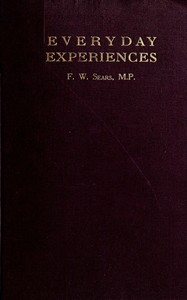
Everyday experiences
Subjects:
Download Formats:
Excerpt
The Project Gutenberg eBook of Everyday experiences, by F. W. Sears
This eBook is for the use of anyone anywhere in the United States and
most other parts of the world at no cost and with almost no restrictions
whatsoever. You may copy it, give it away or re-use it under the terms
of the Project Gutenberg License included with this eBook or online at
www.gutenberg.org. If you are not located in the United States, you
will have to check the laws of the country where you are located before...
Read the Full Text
— End of Everyday experiences —
Book Information
- Title
- Everyday experiences
- Author(s)
- Sears, F. W. (Franklin Warren)
- Language
- English
- Type
- Text
- Release Date
- March 7, 2023
- Word Count
- 10,649 words
- Library of Congress Classification
- BF
- Bookshelves
- Browsing: Philosophy & Ethics, Browsing: Psychiatry/Psychology, Browsing: Religion/Spirituality/Paranormal
- Rights
- Public domain in the USA.
Related Books
The game of life and how to play it
by Shinn, Florence Scovel
English
361h 44m read

Out from the heart
by Allen, James
English
125h 56m read
The Science of Getting Rich
by Wattles, W. D.
English
439h 59m read
The Sixth Sense: Its Cultivation and Use
by Brent, Charles Henry
English
364h 26m read
Nuggets of the New Thought: Several Things That Have Helped People
by Atkinson, William Walker
English
722h 17m read
Dynamic Thought; Or, The Law of Vibrant Energy
by Atkinson, William Walker
English
775h 53m read