*** START OF THE PROJECT GUTENBERG EBOOK 75097 ***
FLYING DOWN A RAINBOW
By HOMER KING GORDON
Author of “The Sky Pirate,” “The Morgan Kid” etc.
As the old-timer said, “Gold’s a funny old gal. She’ll flirt
with you for years and then go throw herself on some total
stranger’s neck.” And it seemed as if it were going to be the
same even in these days when they go prospecting in airplanes.
Jimmy Devlin handed the pilots of Pacific Field a laugh when he paid
four hundred dollars for the old biplane wreck that had been lying in
Hangar Number Three ever since the field opened. Jimmy himself indulged
in a laugh, but it was a hopeful one. He had gone over the wreck pretty
thoroughly and knew exactly what he was buying. The landing gear was
pretty much of a mess. One of the lower wings would have to be almost
completely replaced. The prop was splintered and the crankshaft of the
engine was broken. So were several tie wires, one wing strut, and the
tail skid.
It took practically all of his money, two months of his time, several
square yards of fabric, and many buckets of dope before Jimmy was able
to wheel his wreck out of the hangar and convince a deputy instructor
from the Department of Commerce that it was an aeroplane. The inspector
stood on the grounds while Jimmy made a couple of flights around the
field to prove his contention. It was a successful demonstration and he
got a license to carry passengers in it.
That, of course, was just a beginning. In the three or four weeks which
followed, Jimmy had but one passenger. Competition was too keen for
Jimmy at Pacific Field. His patched and remodeled old flying crate would
not stand comparison with the new modern planes used by the other
commercial pilots. Nor could he afford to hire salesmen or runners to
circulate among the spectators at the airport and solicit business, as
did the other pilots.
Had Jimmy been a more determined salesman, he might have circulated
among the prospective customers himself and drummed up business, but he
was too modest to extol the virtues of his second-hand ship and his own
skill as a pilot.
* * * * *
Jimmy was a favorite among the other pilots at Pacific Field. They liked
his sunny disposition and his hearty laugh. But business was business,
and he had invited competition by trying to break into their established
commercial traffic. They dubbed his plane the “Calico Peacock,” and
kidded him unmercifully about his inability to get any passengers into
it. Jimmy did not mind their fun, but the situation began to get
desperate. He would have moved to some roadside cow pasture and tried to
pick up passengers from the highway, but he owed the field a
forty-dollar hangar bill and had nothing with which to pay it. He was
considering putting the Calico Peacock on the auction block and knocking
it off to the highest bidder when he had his first lucky break.
It happened early one Saturday morning. Jimmy’s Calico Peacock was one
of the first aeroplanes on the starting line. After he had made sure
that enough gasoline remained in the tanks to accommodate a passenger if
some miracle should happen and one should appear, Jimmy wandered over to
the field headquarters and stretched his lean, lanky frame against the
side of the Administration Building to soak up some of the warmth of the
morning sun.
Sunshine was not a very satisfactory substitute for a hearty breakfast,
but Jimmy couldn’t afford the breakfast, and the sun was free. He had
not been there long when the field superintendent came out of his office
and looked questioningly down the field toward the spot where the
commercial passenger planes were being trundled out onto the field. It
was so early that none of the flying salesmen had appeared.
“Got a job for somebody, Cap?” Jimmy asked eagerly.
The field superintendent looked at Jimmy for a moment and then grinned.
“Made to order for you,” he chuckled. “But don’t blame me; you asked for
it.”
* * * * *
A stoop-shouldered old man with thin, straggly white hair came timidly
from the Administration Building and stood at the field superintendent’s
side.
“Am I too early?” he asked timidly, his mild blue eyes apologizing
silently for his temerity in addressing such a magnificent personage as
the field superintendent, resplendent in correct cut flying togs and
polished riding boots.
“Here’s one of the best pilots on the field.” The field superintendent
turned to Jimmy. “His plane’s one of the fastest ships on the ground.”
Jimmy stepped forward promptly.
“This is Jimmy Devlin--Mr. Weber.”
“Ed Weber.” The old man offered his hand shyly. “I am pleased to meet
you.”
“Take good care of Mr. Weber, Jimmy.” The field superintendent winked
broadly and sauntered back to his office.
“Where was it you wanted to go, Mr. Weber?” Jimmy asked. “Did you just
want to take a little ride around the field or did you want to go
somewhere particularly?”
“I want to go to Keno, Nevada,” the old man confided.
“You mean Reno, don’t you?” Jimmy asked.
“No, I mean Keno,” the old man said. “But I don’t wonder you never heerd
of it. ’Tain’t nothin’ more than a water hole to begin with, and it’s
way out on the edge of the mountains more’n a hundred miles south and
east of Reno.”
“Is there a landing field there?”
Jimmy realized that his question was foolish, and, furthermore, that the
old man did not know what he meant.
“I mean a level place, maybe half a mile long or so where I could land
the plane.”
“There’s a flat down between the hills where I reckon you could maneuver
her into a place to set down,” the old man explained. “But how much will
you take to fly me there?”
Jimmy took the old man off behind one of the hangars where he would not
be grabbed by one of the other pilots and then got out his map. Keno did
not show on the map, but Weber made a pencil cross to indicate its
approximate location.
“What is it--a town or a ranch?” Jimmy inquired.
“Wal,” Weber explained, “there used to be a shack there where a man
could get a drink and maybe a slab of bacon and some beans, but I reckon
there ain’t much right now except the water hole. Figgerin’ it
conservative, though, inside of three days there’ll be five thousand men
there and the name of Keno will be spread over the front page of every
newspaper in the U. S.”
The old man chuckled quietly at Jimmy’s bewilderment.
“It’s a gold strike, son,” he said quietly. “I’ve got a sister living up
there in that country. Last night I got a long distance telephone call
from her saying that an old hard pan miner had staggered in with a bag
of samples and his tongue hanging out, blabbing about the strike he’d
made at Keno.”
“When do you want to go?”
“Jist as soon as we can get started, son,” the old man said earnestly.
“Here’s the way I’ve got it figgered out. If we can get into Keno today
we’ll be ahead of the first of the rush. Old-time gold strikes don’t
happen often nowadays, but there’s still enough prospectors and would-be
prospectors left to make a fairly sizable gold rush. But at the best,
they can’t commence to come in until tomorrow morning. I know every foot
of that ground. I always knowed there was gold around Keno somewheres. I
found plenty of rich float but I was never able to track it down. From
the information I got over the telephone last night, I know just where
the strike was made, and if we can get there ahead of the rest of them,
I’ll stake out a claim that will put me on Easy Street for the rest of
my life.”
“Say,” Jimmy asked excitedly, “is there anything to prevent me from
staking out a claim too?”
“Not that I know of, son,” Weber replied, “and I’ll help you pick out a
good one too. Then we’ll fly down to the Carson Land Office and register
them and the trick’s done. I guess I’ll have to go back and see that
nobody squats on the claim, but once they’re registered they’ll be safe
unless it’s so rich that they have to be watched night and day.”
* * * * *
Jimmy made some rapid calculations.
Such a trip would require a capacity supply of gasoline and oil and a
landing on the flat might mean broken landing gear and a repair bill.
“I don’t see how I could do it for any less than a hundred dollars,” he
declared. “Of course if I could pick up a passenger there for the return
trip, I might do it cheaper.”
“I’ve only got fifty,” Weber said. “I’ve throwed up my job collecting
bills for the light company and bought enough grub to last for the trip,
and that’s all I’ve got left.”
The old man tried to hide his disappointment, but Jimmy saw his
shoulders sag and an expression of hopeless discouragement spread across
his face.
“I’m taking a chance of wrecking my plane,” he said, “but if I agree to
try the trip for fifty, will you agree to pay the repair bills if
anything should happen to the ship?”
“If we get there ahead of that rush, son, I’ll buy you a new ship,”
Weber promised. “You ain’t never seen a gold rush, have you?”
Jimmy admitted that he had not.
“But I’ve got the fever to see one,” he grinned. “If you’ll let me have
the fifty, I’ll get the Calico Peacock ready for the hop.”
“Where’s your aeroplane?” Weber asked. “Which one is it?”
Jimmy could detect no expression of disappointment in the old man’s face
when he pointed out the Calico Peacock. That pleased him, although he
knew that Weber had probably never been near an aeroplane before. Paying
half his hangar bill, Jimmy and one of the oil station attendants
trundled the Calico Peacock up to one of the gasoline sumps where it was
filled with gasoline and oil.
The old man’s luggage consisted of a heavy canvas sack filled with
provisions and a tarp-covered roll of blankets.
“If you’ve got any blankets ready, you’d better take them along,” he
advised Jimmy. “’Tain’t likely that we can get away from Keno until
tomorrow morning, so we’ll have to spend tonight under the open sky.”
* * * * *
Jimmy was able to borrow some blankets. The Calico Peacock had been
fitted with a couple of passenger seats ahead of the pilot’s cockpit,
and there was plenty of space for Weber and the luggage. Jimmy loaned
the old man a pair of flying goggles. Weber had provided himself with a
bearskin hunting cap which pulled down over his ears. Before they took
off, Jimmy got out his maps again and they went over them carefully.
From the spot where he had located Keno, the old man traced the course
of the valley on down to a spot where fan-shaped valleys converged to
form a single broad, shallow valley.
“I spent three years there,” he explained. “I’d have been up there yet,
too, if my sister hadn’t worried me into coming down here and getting a
job and living in a house. She was scared that some day I’d slip and
fall and get hurt and nobody would ever know where to go to look for my
bones. She pestered me until I finally give in, but I ain’t surprised
that they struck it up there. No, sir! I knowed it was comin’ and for a
long time I’ve been waitin’ for it to happen. I had my plans all laid.
When she called me up last night, it didn’t take me half an hour to be
all ready to start.”
“Are you sure that there’s enough flat space up there to land?” Jimmy
asked anxiously.
“There’s plenty of room,” Weber assured him calmly. “I wouldn’t be
taking you up there on a wild goose chase. This means too much to me. I
knowed there was gold there. I’ve seen the float. But you know it’s a
funny thing. I was expectin’ it to be found over on Stink Crick.”
He pointed to one of the valleys to the west of Keno.
“I prospected that Keno flat, but I finally came to the conclusion the
main ledge was over on Stink Crick. You know, it’s funny about gold
strikes. I’ll bet a hundred men have prospected Keno at one time or
another without ever locatin’ this strike. You’d never guess how it was
finally found.”
“How?”
“Wal, sir, it jist shows you how these things go,” Weber said
reminiscently. “Accordin’ to my sister over the telephone, this old hard
pan miner that made the strike had a dog that he took along with him to
keep him company. It was just a little rat-tail mutt not much bigger
than a rabbit. While they was camped up here at this Keno water hole,
this mutt chased something into a hole and commenced to bark and snarl
and try to dig it up. He made so much racket that this old hard-shelled
prospector went over to see what all the fuss was about, and believe it
or not, his dog had uncovered the ledge that all of us had been lookin’
for.”
“I’ll bet that dog gets a good home,” Jimmy grinned.
“Wal, that’s the way it goes,” Weber declared. “Maybe I’ve set on that
very ledge of rock and cussed because I couldn’t uncover any color. I
heard tell of a strike made down in Arizona when a burro kicked off a
piece of rock and uncovered the ledge. Gold strikes are made like that.”
“Are you sure we’ll get there in time to get a claim?” Jimmy questioned.
“Unless somebody thinks of going there in an aeroplane like we are,
we’ll beat the leaders,” Weber predicted. “They kain’t get there until
before tomorrow morning at the best, and that means travelin’ around the
sun. It ain’t a big valley, though, and if anybody gets there after
tomorrow night, they’ll be out of luck. There’ll be five thousand men
make the rush, and there’ll be a lot of land staked out that’s plumb
worthless.”
* * * * *
When all their preparations were made, Jimmy helped his passenger into
the Calico Peacock and buckled a safety belt around him.
“Try to relax and take it easy,” he advised.
“You’re not goin’ to be scared any, are you?” the old man asked.
“Not until we start looking for a place to land, anyway,” Jimmy
answered.
“Wal, I’m goin’ to be up here with you. It ain’t goin’ to do me any good
to get scared if you ain’t, son.”
One of the field mechanics spun the stick of the Calico Peacock and a
few moments later, they taxied down to the runway and were off. Jimmy
swung the Calico Peacock out over the bay in a wide spiral, gaining
altitude until he could clear the east bay hills and cut across the
Sacramento Valley. The engine fired regularly for a while, but Jimmy
could see it was beginning to heat. Since he had overhauled it, Jimmy
had not been able to afford a long cross-country flight to get it
properly broken in. It was not surprising to him that it now began to
heat under a full throttle and a heavy load. He cut down his r.p.m. as
much as he dared and hoped that it would gradually cool. Instead, it
grew hotter.
* * * * *
Between Stockton and Sacramento the engine began to smoke. It was a race
between a forced landing in some grain field or landing at the
Sacramento airport. Jimmy made Sacramento, but by a narrow margin. He
landed with a dead prop and an engine that was practically frozen stiff.
Mechanics came out across the field and pulled the Calico Peacock out of
the way of incoming ships.
“Anything wrong?” Weber asked.
“Engine’s heating up,” Jimmy explained. “We’ll have to wait here a while
until it cools off.”
“Then can we go on?” Weber inquired. “We’ll make it, won’t we?”
“I think so,” Jimmy assured him. “Unless we crack some of the bearings
we’ll be all right as soon as this cools off a little.”
“You know, a gold strike’s a funny business,” Weber mused. “You can’t
put your fingers on gold. Just when you think you’re all ready to make a
stake, something comes up. It’s always been like that.”
“We’ll make it or bust.” Jimmy promised.
“I wasn’t thinkin’ so much of that,” Weber declared, “I know you’re
doin’ your best, son, but you ask any old prospector. Gold’s a funny old
gal. She’ll flirt with you for years and then go throw herself on some
total stranger’s neck, right in his lap, as it were.”
A pilot friend of Jimmy’s sauntered over and inquired their trouble.
“You headed for Keno, too?” he asked, looking in the passenger cockpit
and seeing the blanket rolls and grub sack. “Three planes have left here
already for that destination. They say they’ve made a big gold strike up
there.”
“You know who went?” Weber asked eagerly. “I mean, who the passengers
was?” The pilot shook his head.
“I reckon it don’t matter none anyway,” Weber said, “’Tain’t likely they
know Keno like I know it. Most likely they’re just mining men anxious to
be the first on the ground and ready to buy good claims if they can’t
stake them themselves.”
“We’ll get off as soon as we can,” Jimmy promised.
“Take your time, son,” Weber cautioned. “There’s plenty of land up there
for the first forty or fifty that shows up. Just so that we get there
ahead of the old sourdoughs that’ll be driftin’ in in the mornin’. You
know this contraption better than I do, so I ain’t aimin’ to give you
any advice. But I just want you to understand that I spent all my life
just lookin’ for the end of the rainbow and if I miss it once again, it
ain’t goin’ to get the best of me. Don’t take no chances with your
flying machine, son, or risk your neck tryin’ to get an old crackpot
like me up to Keno.”
* * * * *
While they waited for the engine to cool, Jimmy told his passenger about
buying the Calico Peacock and reclaiming it for passenger purposes. The
old man displayed keen interest while Jimmy showed him the repairs he
had made, and the patches he had put on the wing fabric. He also
confessed that the engine was heating because it had never been given a
thorough test after being overhauled. The old man did not appear to
think that he had been victimized. Instead, when he had inquired into
the cost of operating a plane and what dope and fabric and replacements
cost, he seemed to appreciate Jimmy’s generosity in attempting the trip
for fifty dollars.
“You stand to lose more than I do,” he commented. “If we don’t get
there, all I’ll lose is somethin’ I never had, while if anythin’ should
happen to us, you’d lose your whole investment. And after you tellin’ me
how you’ve worked to put the Calico Peacock in shape, I can appreciate
what it means to you.”
From the field officials Jimmy learned that the other planes for Keno
had flown almost directly east, crossing the Sierra Nevadas above Sutter
Creek and the other famous old gold mining landmarks. This was the
shortest route to Keno, although it offered no emergency landing fields
to Jimmy’s knowledge. He would have to cross the Sierra Nevadas at a
high altitude, which made the trip a gamble if his engine started to
heat again. Jimmy was willing to take the chance, but he explained the
risk to his passenger.
“If there’s any safer way, son, you’d better take it,” Weber advised.
“I’m sayin’ that, not on my account, for the shortest way there will
suit me best, but I’m considerin’ your interests.”
“My interests are yours,” Jimmy declared. “I want to take the short way
if you’re willing to take a chance on landing in the tree tops. Even if
the engine does start to heat up, we ought to be over the tops of the
mountains by that time.”
“I’m leavin’ everything to your judgment,” Weber asserted.
“Then we’ll take the short cut,” Jimmy decided. “Let’s get going.”
* * * * *
Leaving Sacramento, they headed eastward and began to climb. Almost
immediately they were over the rolling, grass-covered foothills. Then
they came to the scrub oak country. The rolling hills became steeper.
White water appeared in the streams under them. Mine stipples showed
above the roofs of the small mining settlements as they entered the
famous Mother Lode country.
Jimmy put the Calico Peacock into as stiff a climbing angle as he dared
and opened the throttle wide. As they neared the summit the engine began
to heat again. It was too late to turn back. They were out of reach of
any emergency landing field.
The tree tops began to approach nearer and nearer as the Calico Peacock
came closer to the ceiling it could attain with its pounding, smoking
engine.
They were not more than fifteen feet above the tree tops when they shot
over the ridge at the summit and looked down over the eastern slopes of
the mountains. The smell of hot oil and burning metal made Jimmy clamp
his teeth shut grimly, as he eased the nose of the Calico Peacock down
toward the horizon and took some of the load off the engine.
Weber pointed out a low depression in the hills off to the southeast and
motioned for Jimmy to head the ship in that direction.
For a while Jimmy thought they were going to make it. The engine began
to cool off somewhat as they picked up speed and descended to a lower
altitude. They were within sight of a saucer-shaped depression in the
hills which Weber yelled back was Keno, when the thing happened which
Jimmy had been fearing.
A connecting rod bearing burned out. Instantly the engine began to
pound. The din was terrific. There was only one thing to do. Jimmy
closed the throttle, cut off his ignition, nosed the ship over, and
commenced to pick out a spot to land.
Weber looked back with a silent question.
“Bearing’s busted. We’ve got to land!” Jimmy yelled. “Brace yourself and
get ready for a crash.”
The old man looked off toward Keno and then nodded his understanding.
They would land fifteen or twenty miles short of their destination. It
looked as though he had just missed the rich strike once more. Jimmy
spiraled down over a narrow valley. Trees crowded down to the bank of a
little creek. There was no clear spot in which to make a landing. Jimmy
headed the Calico Peacock into what appeared to be a patch of young
aspens and then braced himself as the crash came.
He expected the ship to nose over as the wing fabric was ripped off and
it settled down into the trees. He was not prepared, however, for the
demolishing crash which followed as the plane settled. A ledge of rocks
had been concealed by the trees. The Calico Peacock nosed head on into
the rocks and crumbled into a tangled mass of wreckage.
* * * * *
When Jimmy regained consciousness, he found himself several yards away
from the wreck. Rough splints and a bandage were around his right
forearm. One of his eyes was swollen shut and a bandage was wrapped
around his head. His left leg throbbed with pain. He was lying on a
blanket and another blanket was spread over him. A few yards away Weber
was bending over a fire. The old man’s clothing was torn, but he moved
about as though he was not seriously injured.
Jimmy moved and Weber came over to him immediately.
“How do you feel?” he asked solicitously.
“Like the devil,” Jimmy groaned. “That was some smash.”
“The blankets kept me from getting hurt,” Weber explained. “I saw it was
coming and held them up in front of me.” He was bruised and his face was
discolored and scratched, but otherwise he did not appear to be injured.
“I wasn’t expecting such a smash,” Jimmy said. “I tried to pick out a
bunch of young trees. I thought we’d simply settle down, maybe turn
over.”
“Well, it could have been worse,” the old man said philosophically.
“That was a nasty crack you got on your head. I was afraid you wasn’t
goin’ to come around.”
“Have I been out long?”
“Nearly three hours, I reckon,” Weber informed him. “But don’t you worry
none. I had no more than got you pulled out and bandaged up before one
of them other planes began circling over and diving down to take a look
at us. Accordin’ to the way they waved around, I figger they’re goin’ to
the nearest place for help. Some one will be coming in here after us as
soon as they can get here. Either they saw us go down or were just
flyin’ over and happened to see the wreck.”
“How far from Keno are we?” Jimmy asked.
“About fifteen miles, I figger,” Weber said. “This is Stink Crick that I
was tellin’ you about. I’ve come up and down this very crick many a
time. Here’s where I figgered the strike would come instead of over at
Keno. But that just shows you how gold strikes happen.”
“If you started now, you could get over to Keno before the rush got
there, couldn’t you?” Jimmy asked slowly. “I suppose you know how to get
over there from here.”
“Yes, I know the trail all right,” the old man admitted.
“And you could beat the rush there, couldn’t you?” Jimmy insisted.
“Wal, I reckon maybe I could,” Weber said.
“Old-timer, you go right ahead,” Jimmy said, “I’m feeling pretty good
now. You strike out across the hills and get your claims located.
Somebody will be along here later and pick me up, or else I’ll stay here
till you get back.”
“I reckon gold ain’t worth that much, son,” the old man said gently.
“Your arm’s broke and your leg’s bruised up, and there’s right smart of
a hole in your head. I’ll never miss what I ain’t never had. You’ve done
your best and you’ve lost your grubstake doin’ it. No, son. Don’t you
fret none about me. There’ll be other gold strikes. I’m goin’ to build
up a fire and make you a pot of coffee and fry up some bacon and you and
me will wait right here until some help comes to get you out.”
“Listen, old-timer,” Jimmy pleaded. “I’ll be all right here. You go
ahead. Stake out a claim for both of us.”
“Son,” the old man said, “there’s lions, bears, and wolves still roamin’
around in this part of the world pretty thick.”
“Leave me your gun; I can take care of myself,” Jimmy protested.
“It ain’t goin’ to be necessary,” Weber declared. “No use of you gettin’
up a fever by arguin’. I got you into this mess, and I’m goin’ to stay
right by you until you get out of it. I’ve been thinkin’ it over for the
last hour or two, and after all, maybe that Keno strike don’t amount to
much. Every strike I’ve ever heard of was always the world’s biggest
bonanza, but they generally all peter out. I don’t mind tellin’ you I
was a little disappointed when your engine commenced to get hot goin’ up
over the summit and I could begin to figger that we’d never make it. But
I’m all over that now.
Jimmy protested and argued until he was too weak to say any more, but
the old man remained obdurate and would not reconsider his determination
to stay with Jimmy until help came. He built a fire and commenced to
make coffee, and then after this was finished and Jimmy had eaten a
little and drunk a cup of hot coffee, Weber commenced to make a bed of
young green twigs on which Jimmy could pass the night in comfort.
Just before sundown a plane came over and dropped a message to them,
saying that rangers had been notified and that help was on its way.
After diving down close to the tree tops to get a reassuring wave from
Jimmy and the old man, the plane passed rapidly out of sight. Weber did
not go to bed. He wrapped Jimmy in all the blankets they had brought and
made him comfortable. But he spent the night by the campfire. Jimmy did
not go to sleep until late, but it was sun-up when he finally awoke.
* * * * *
Weber had breakfast ready. After Jimmy had taken a cup of coffee, the
old man sat down by his side and showed him a handful of rock.
“Son, did you ever see any gold-bearin’ ore?” he demanded.
Jimmy suddenly saw that the old man’s hands were trembling and that he
could hardly control his voice.
“Where did you find them?”
“We flew right down on a rainbow and landed smack-dab on a bag of gold,”
the old man declared exultantly. “I’ve come up and down this crick a
dozen times, but I never found anything but a few pieces of float. But,
this Calico Peacock of yours dug its nose smack-dab into the richest
gold ledge that’s been uncovered in this country for years. We’re rich,
son. We’re so rich I don’t dare figger out how much we’re worth for fear
I’ll wake up. I’ve got our claims all staked out. Last night after you’d
gone to sleep I went over there to see if I couldn’t find my pipe. I
struck some matches and scratched around on the ground and picked up a
piece of this rock that had been busted off the ledge when we hit. There
it was, out before my eyes.”
“Do you think it’s better than Keno would have been?”
“Keno!” the old man said contemptuously. “Why, son, inside of three days
there’ll be twenty thousand men stakin’ claims around here. We don’t
have to work our claims. We can sell them inside of twenty-four hours
for a fortune apiece. Didn’t I tell you that there was no calculatin’
how or when a strike was goin’ to be made?”
[Transcriber’s Note: This story appeared in the April 10, 1929 issue
of “Short Stories” magazine.]
*** END OF THE PROJECT GUTENBERG EBOOK 75097 ***
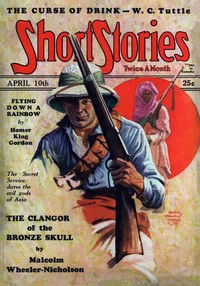
Flying down a rainbow
Download Formats:
Excerpt
Author of “The Sky Pirate,” “The Morgan Kid” etc.
As the old-timer said, “Gold’s a funny old gal. She’ll flirt
with you for years and then go throw herself on some total
stranger’s neck.” And it seemed as if it were going to be the
same even in these days when they go prospecting in airplanes.
Jimmy Devlin handed the pilots of Pacific Field a laugh when he paid
four hundred dollars for the old biplane wreck that had been lying in
Hangar Number Three ever...
Read the Full Text
— End of Flying down a rainbow —
Book Information
- Title
- Flying down a rainbow
- Author(s)
- Gordon, Homer King
- Language
- English
- Type
- Text
- Release Date
- January 12, 2025
- Word Count
- 5,319 words
- Library of Congress Classification
- PS
- Bookshelves
- Browsing: History - American, Browsing: Fiction
- Rights
- Public domain in the USA.
Related Books
Famous stories from foreign countries
English
494h 26m read
The incredible slingshot bombs
by Williams, Robert Moore
English
96h 4m read
The eater of souls
by Kuttner, Henry
English
22h 19m read

Maehoe
by Leinster, Murray
English
115h 53m read
The air splasher
by Watkins, Richard Howells
English
138h 53m read
Hooking a sky ride
by Morrissey, Dan
English
37h 54m read