*** START OF THE PROJECT GUTENBERG EBOOK 68761 ***
_TO BE PUBLISHED SHORTLY_
Fifty Contemporary One-Act Plays
_Edited by Frank Shay and Pierre Loving_
This volume contains FIFTY REPRESENTATIVE ONE-ACT PLAYS of the MODERN
THEATRE, chosen from the dramatic works of contemporary writers all
over the world.
THE CONTENTS ARE
AUSTRIA:
Schnitzler (Arthur)--
BELGIUM:
Maeterlinck (Maurice)--The Intruder
BOLIVIA:
More (Federico)--Interlude
FRANCE:
Ancey (George)--M. Lamblin
Porto-Riche (Georges)--Francoise’s Luck
GERMANY:
Ettlinger (Karl)--Altruism
von Hofmansthal (Hugo)--Madonna Dianora
Wedekind (Frank)--The Tenor
GREAT BRITAIN:
Bennett (Arnold)--A Good Woman
Calderon (George)--The Little Stone House
Cannan (Gilbert)--Mary’s Wedding
Dowson (Ernest)--The Pierrot of the Minute
Ellis (Mrs. Havelock)--The Subjection of Kezia
Hankin (St. John)--The Constant Lover
INDIA:
Mukerji (Dhan Gopal)--The Judgment of Indra
IRELAND:
Gregory (Lady)--The Workhouse Ward
HOLLAND:
Speenhoff (J. H.)--Louise
HUNGARY:
Biro (Lajos)--The Grandmother
ITALY:
Giacosa (Giuseppe)--The Rights of the Soul
RUSSIA:
Andreyev (Leonid)--Love of One’s Neighbor
Tchekoff (Anton)--The Boor
SPAIN:
Benevente (Jacinto)--His Widow’s Husband
Quinteros (Serafina and Joaquin Alvarez)--A Sunny Morning
SWEDEN:
Strindberg (August)--The Creditor
Wied (Gustave)--Autumn Fires
UNITED STATES:
Beach (Lewis)--Brothers
Cowan (Sada)--In the Morgue
Crocker (Bosworth)--The Baby Carriage
Cronyn (George W.)--A Death in Fever Flat
Davies (Mary Carolyn)--The Slave with Two Faces
Day (Frederic L.)--The Slump
Flanner (Hildegarde)--Mansions
Glaspell (Susan)--Trifles
Gerstenberg (Alice)--The Pot Boiler
Helburn (Theresa)--Enter the Hero
Hudson (Holland)--The Shepherd in the Distance
Kemp (Harry)--Boccaccio’s Untold Tale
Langner (Lawrence)--Another Way Out
Millay (Edna St. Vincent)--Aro da Capo
Moeller (Philip)--Helena’s Husband
MacMillan (Mary)--The Shadowed Star
O’Neill (Eugene)--Ile
Stevens (Thomas Wood)--The Nursery Maid of Heaven
Stevens (Wallace)--Three Travelers Watch a Sunrise
Tompkins (Frank G.)--Sham
Walker (Stuart)--The Medicine Show
Wellman (Rita)--For All Time
Wilde (Percival)--The Finger of God
YIDDISH:
Ash (Sholom)--Night
Pinski (David)--Forgotten Souls
_Large 8vo. Cloth. Gilt top._ =NET $5.00= _¾ Turkey Morocco_ =NET
$12.00=
STEWART & KIDD COMPANY
PUBLISHERS :-: CINCINNATI, U.S.A.
STEWART KIDD MODERN PLAYS
Edited by Frank Shay
HEARTS TO MEND
Stewart Kidd Modern Plays
Edited by Frank Shay
To meet the immensely increased demands of the play-reading public
and those interested in the modern drama, Stewart & Kidd Company are
issuing under the general editorship of Frank Shay a series of plays
from the pens of the world’s best contemporary writers. No effort is
being spared to secure the best work available, and the plays are
issued in a form that is at once attractive to readers and suited to
the needs of the performer and producer.
From time to time special announcements will be printed giving complete
lists of the Plays. Those announced thus far are:
SHAM, a Social Satire in One Act.
By Frank G. Tompkins.
Originally produced by Sam Hume, at the Arts and Crafts Theatre,
Detroit.
THE SHEPHERD IN THE DISTANCE, a Pantomime in One Act. By Holland Hudson.
Originally produced by the Washington Square Players.
MANSIONS, a Play in One Act.
By Hildegarde Flanner.
Originally produced by the Indiana Little Theatre Society.
HEARTS TO MEND, a Fantasy in One Act.
By H. A. Overstreet.
Originally produced by the Fireside Players, White Plains, N. Y.
_Others to follow._
_Bound in Art Paper. Each net 50 cents._
HEARTS TO MEND
A FANTASY IN ONE ACT
By
HARRY A. OVERSTREET
HEARTS TO MEND was first produced by the FIRESIDE
PLAYERS, White Plains, N. Y., in April, 1919, with
the following cast:
PIERROT, _James H. Wallace_
PIERRETTE, _Millicent Ives_
TINS-TO-MEND MAN, _G. W. Michelbacker_
[Illustration]
CINCINNATI
STEWART & KIDD COMPANY
PUBLISHERS
COPYRIGHT, 1920
STEWART & KIDD COMPANY
_All Rights Reserved_
COPYRIGHTED IN ENGLAND
This play is fully protected by the copyright law, all requirements of
which have been complied with. No performance, either professional or
amateur, may be given without the written permission of the author or
his representative, who may be addressed in care of the publishers,
Stewart & Kidd Company, Cincinnati, Ohio.
HEARTS TO MEND
_The Scene is the living room, dining room and kitchen--all in
one--of Pierrot and Pierrette. It has the diminutive look of a toy
house, and the immaculate spick-and-spanness. There are copper
kettles and pots on shelves and blue and white plates and cups and
saucers. There is a crib in the corner, left, with a screen that can
be drawn about it. A table is at the right, front, by the side of
which sits Pierrot, head in hands, elbows on knees, very gloomy. A
door, left, leads to an inner room; a door, right, to the street._
HEARTS TO MEND
(_Pierrette is heard singing a lullaby in the next room._)
Old Mister Moon is sinking to rest--
Sleep, kittikins, sleep!
The whispery winds have died in the west--
Sleep--kittikins--sleep!
(_She comes in, holding a babe in her arms; sings--very softly._)
Up in the sky are the firefly stars--
Sleep, kittikins, sleep!
Father will catch them in crystal jars--
Sleep--kittikins--sleep!
(_She lays the babe in its crib, the while softly humming the tune.
Then she draws the screen about the bed. Meantime she casts anxious
glances at the moody Pierrot. The babe asleep, she runs to Pierrot,
kneeling at his side._)
PIERRETTE
Tired, sweetheart?
PIERROT (_indifferently_)
Oh--I guess so.
PIERRETTE
And famished, isn’t that it?
Kettle not boiling,
And table unset;
And hungry man waiting
For slow Pierrette!
It’ll all be on the table, dear, in just the littlest minute.
PIERROT
Oh, it’s not supper.
PIERRETTE
Not supper?
PIERROT
No.
PIERRETTE (_solicitously_)
You haven’t caught cold, Pierrot? You know I told you to wear your
woolen muffler and put on your rain shoes. For a man of your superior
intelligence, you are _so_ careless!
PIERROT
(_getting up with irritation and walking away_)
Oh, let me alone, Pierrette! You wouldn’t understand. Get some supper
for yourself. I don’t want any.
(_She looks at him troubled for a moment. Then she runs to him, puts
her hands on his breast._)
PIERRETTE
Pierrot.
PIERROT
Well?
PIERRETTE
(_pointing an accusing finger at him slowly_)
You--haven’t--been--to--see--your--bank--account--again?
(_Pierrot shakes his head gloomily._)
PIERRETTE
Oh yes you have! Don’t deny it! And worrying yourself to death about
expenses. But Pierrot--things aren’t nearly as bad as you think they
are. I’m doing all my own work--even the washing and the ironing--and
Pierrot!--I’ve got a scheme! We’ll take a boarder!
PIERROT (_disgusted_)
Boarder! Ugh!
PIERRETTE
Why not, sweetheart? Of course, we’d have to talk to him at mealtimes,
I suppose. And you couldn’t kiss me across the table as you used to....
(_Suddenly, with a catch_) Do you know, Pierrot, you haven’t kissed me
across the table for--oh--ever so long!
PIERROT (_struggling with himself_)
Pierrette....
PIERRETTE
Yes, dear.
PIERROT (_trying to get it out--then in despair_)
Oh, what’s the use. I can’t tell it to you.
PIERRETTE (_troubled_)
Why, what is it, Pierrot? You’ve lost something?
PIERROT (_quickly_)
Yes--that’s it. I’ve lost something--the only thing I had,
Pierrette--my song!
PIERRETTE
Ah, the silly people didn’t laugh to-day--that’s it?
Silly, silly people,
Staring at a steeple;--
And you’re all in the dumps, Pierrot? Isn’t that the trouble?
PIERROT
They didn’t laugh to-day, Pierrette; and they didn’t laugh yesterday.
They haven’t laughed for a long time--not as they used to. (_Most
gloomily_) And three of my songs have come back from the editors!
PIERRETTE (_defending him_)
But who cares for editors, Pierrot? They’re such stupid creatures! Some
day you’ll write a great song that everybody’ll love; and then you’ll
see all the foolish little editors bringing you velvets and gold.
PIERROT (_in gloom_)
No. The editors are right. The people are right. Something’s gone out
of me. I’m not the same as I was before--before--How long have we been
married, Pierrette?
PIERRETTE
Just three tiny years!
PIERROT (_sighing_)
Only three years! (_Then bitterly--to Pierrette_) Here!--I’ll give you
a sign. Look! (_He walks with flat, listless feet up and down the room;
then speaks, with a hopeless sob in his voice_) I no longer walk on my
toes! See! Flat--like that! No songs ever walked that way! Songs?
No--here’s the way--
(_He rises momentarily to his toes and sings._)
Oh, a merry, merry fellow,
And a sweet, fair maid,
Danced on the meadow in the gypsy time--
Said the merry, merry fellow
To the sweet, fair maid--
(_He breaks off._)
PIERROT (_hopeless_)
No--I can’t do it. It’s gone out of me. (_Desperately_) Pierrette--I’ve
come to a conclusion. I ought never to have married!
PIERRETTE (_suddenly stabbed_)
Oh, Pierrot, it’s been the most beautiful thing in all the world!
PIERROT
That’s because you’re a woman, Pierrette, and not an artist.
PIERRETTE
But _you_ said it was the most beautiful thing in all the world,
Pierrot.
PIERROT (_vaguely_)
Did I? That was long ago. You don’t understand, Pierrette. Women never
do. Life to them is a little cage in which they sit all day long and
sing tiny songs about tea and muffins. Men are different. Put them in a
cage and they sing for a day. Then they begin to droop.
PIERRETTE (_hurt_)
So you want to go away, Pierrot?
PIERROT (_passionately_)
I want to capture it again--the power, the thrill, the fire of song!
PIERRETTE
And you would capture it if--if I--(_looking toward the screen which
hides the crib_) if we--were not here?
PIERROT (_flinging out his arms in despair_)
Oh, I’m a brute, Pierrette! I don’t know. I’m gone stale--that’s the
trouble. I’m done for--all these worries and things. I’ll sit at home,
I guess, and darn socks!
(_He flings himself into his chair. Pierrette moves quietly about,
putting his tea on the table. She sets tea only for one._)
PIERRETTE (_handing him his cup_)
There, sweetheart. Your tea.
PIERROT (_stirring himself_)
Aren’t you going to have some, too?
PIERRETTE (_controlling her voice and with her back half turned to
him as she goes to the other room_)
Oh no, dear; I’ve had lots of tea this afternoon. I’m not hungry.
Besides, I’m late with the cleaning up. I’ll be gone only a minute.
(_She goes out quickly. Pierrot makes to rise and follow her; then,
with a hopeless wave of the hand, sinks back into the chair. He drinks
his tea moodily. There is a voice outside_)--
“Tins to mend! Tins to mend!”
(_A knock at the door and the Tins-to-mend man enters._)
MAN (_taking off his cap, half humorously, half apologetically_)
Any tins to mend, sir?
PIERROT (_grimly_)
Nothing as easy as that in this house. It’s hearts to mend here!
MAN (_slinging off his pack_)
Hearts to mend?--oho--I do that, too! Truth is (_confidentially_), it’s
come to be my main business. For if you’d believe it, there’s more
hearts to mend and souls to mend than pots and kettles to mend in this
old world of ours. Fact, my dear sir, fact! (_Sits down_) And you can’t
throw hearts away when they begin to show wear--now can you?--like you
throw away an old pot? No siree! (_Impressively_) You got to mend ’em.
And there’s tricks about mendin’ them, sir--tricks in all trades, say
I. You can mend ’em so’s they’s worse’n they was in the beginning.
And you can mend ’em so careful and so clever, you can’t tell they
was ever mended at all. In fact, I’ve mended some of them so they was
better that way than they was in the beginning. Seems curious, but it’s
true. If there was a kettle now you wanted me to work on while I was
talkin’, it’d keep me busy.
(_Pierrot looks about; gets up and tosses him a kettle._)
PIERROT
There! Bang away at that!
(_He sits down again. The Tins-to-mend man hammers away for awhile,
Pierrot watching him gloomily._)
MAN
You see--pots and kettles is curious things. Y’ can’t just let ’em set
there and be. They rust. That’s what they do. Y’ got t’ keep shinin’
’em--keep polishin’ ’em up. And they like it, sir--oh, they do! They
kinda get a hold on life. And when they hang in your kitchen all bright
and happy like, they just seem to sing away like birds. Now you’re a
singer, sir--why don’t you make a song about that?
PIERROT
I can’t sing any more.
MAN
Lost your voice, sir?
PIERROT
No--worse than that--I’m married!
MAN (_solicitously_)
That’s bad, sir; that’s bad--if you’re not married right. They take it
out of a man, them wicked ones!
PIERROT (_firing up_)
Who said she was a wicked one?
MAN
But if she’s good--
PIERROT (_hopelessly_)
Ah, that’s the trouble. She’s good. A man can’t live on goodness alone.
It gets on his nerves.
MAN
And what else should he live on?
PIERROT (_passionately_)
Thrills--passions--longings! The kisses that make dreams--the touches
of hands that make the songs come tumbling out of you--
MAN (_laughing_)
Oho, but it ought to be easy enough for a handsome young master like
you to get those things!
PIERROT
It’d break her heart.
MAN (_lifting his eyes_)
Then you’re fond of her, sir?
PIERROT (_roughly_)
Of course I’m fond of her. That’s just the trouble! (_pause_) But
I’m tired to death of her--and that’s the trouble, too. First, when
I loved her, just a peep of her out of a window would set my heart
dancing. Now, when I see her--it’s just like seeing--the butcher
boy--or the bakeshop woman. (_Rises excitedly_) I tell you when things
are like that, something’s got to be done. An artist can’t live
that way. Ordinary men can. All they want of their wives is to be
cushions--soft--so’s they can go to sleep. Artists are different. They
want the sky and all the quivering stars in the sky. When they marry
(_he makes a grimace_)--it’s good-bye to the stars!
MAN (_looking at him quizzically_)
Did you ever think, sir, why the night was made--with them stars you
talk of?
PIERROT
Why was the night made?
MAN
Or why there’s settin’ o’ the sun and risin’ o’ the sun?
PIERROT
Why is there setting of the sun and rising of the sun?
MAN
Well--I don’t exactly know myself. But I seem to figger it out this
way. Think of what it’d be, I says to myself, if there was all just
one long day. Always day and day and day. Always the same glary light
starin’ y’ in the eye--borin’ into your brain--so’s y’ couldn’t shut it
out from y’; so’s y’ couldn’t get away from it; so’s y’ couldn’t watch
the shadders come stealin’ along, the sun a-settin’ and the twinklin’
stars a-comin’ out--and so’s y’ couldn’t stretch yourself out and
sleep--and so’s y’ couldn’t all of a sudden wake and hear the birds
chirpin’ and a new day come! Ah, it’s that, sir--it’s the comin’ of the
new day that makes life the grand thing it is--the comin’ of the new
day _every_ day!
PIERROT (_wonderingly_)
The coming of the new day every day?
MAN
Just that. It’s a grand plan, sir! Keeps the world young. You try it.
PIERROT
Try it? What do you mean? I’m not the sun.
MAN
Ah, but you can be--and starlight and moonlight! How long was it--now
tell me--since the thought came to you in the morning--I’ll bring
her--I’ll bring her a vi’let? Oho--I know--(_sings_)
Sweet was the honeymoon,
Swift it passed away--
Now we’re steady married folk--
Day after day.
It’s only for a short time--in the beginning--that every day’s a new
day. After that it’s just always the same--always the same--and no
risin’ o’ the sun in the mornin’--no chirp of birds--and no singin’ in
the heart.
PIERROT
You mean--
MAN (_roguishly, bending to his task_)
I mean there’s a good way to mend kettles and a bad way, sir; and when
the kettles are singin’ and the fires are burnin’ under them--Oho--but
there’s more hearts than kettles!
(_Pierrot stands thinking._)
PIERROT (_to himself_)
I used to bring her things--a little red cloak I once brought her. Oh,
she was happy! I remember that day. I made a song about it.
MAN (_hammering away--sings_)
Tins to mend,
And hearts to tend;
Hearts and tins
Have outs and ins!
PIERROT (_continuing--to himself_)
It was one of my very best songs. And she was so happy! (_Suddenly_)
Why--I’ve forgotten all about her lately! Even her birthday! She had to
remind me of it! Poor Pierrette!
MAN (_sings_)
Outs and ins;
Outs and ins;
That’s where the trouble
Of life begins!
(_Pierrot looks up. His eyes suddenly grow bright with an idea._)
PIERROT (_rising to his toes--running to the Tins-to-Mend Man_)
I have it, old fellow--I have it! There’s a shop--just a step away. I
know something she wants there. I’m going to get it for her!
My purse it is lean;
My purse it is lank;
But who cares a flip
For the state of my bank!
(_He dances delighted._)
Come--are you finished? I’ve got to hurry. She’s gone off into that
room to clear up. She’ll be coming back any minute.
MAN (_looking up smiling--handing him the kettle_)
It’s mended. Better than it ever was!
(_Pierrot takes the kettle--runs to the shelf and puts it away. To the
Man--_
PIERROT
Come now, come!
MAN (_gathering up pack_)
I’m coming. (_Sings_)--
Life’s a joy
When turned about;
In to in
And out to out.
PIERROT (_putting on cloak_)
If I hurry now, I’ll have it here before she’s through with her work;
it’s a beauty--it’s a beauty (_dances exultant_).
My pockets are slimpsy as pockets can be;
And short is the space twixt the poorhouse and me;
But while there’s a copper that hasn’t been spent,
I’ll mortgage my shoes for the price of the rent!
(_They both make their exit as Pierrot sings._)
_After a moment, Pierrette opens the inner door softly, and seeing that
no one is there, steps in. She has on a cloak and a hood over her head.
She is very sad._
_She first takes the tea things from the table. Then, hesitating, she
goes to the screen, pulling it softly aside. She leans over the crib
for a merest moment. Then she pulls the screen to again, whispering:_
Up in the sky are the firefly stars;
Sleep, Kittikins, sleep!
Father will catch them in crystal jars--
PIERRETTE
Yes, Kittikins, we must let father. Father can make such beautiful
songs. We must not stand in his way, Kittikins--we love him so.
(_She goes to the shelf and gets down a sheet of paper, the ink horn
and a quill pen--takes them to the table, sits and writes._)
PIERRETTE
We’ll just write this: “Mother Merle--will--take--Kittikins.--She--
loves--her.--Good-bye--Sweetheart.” We’ll leave it here.
(_She folds it and lays it on the table. She half goes once more to the
crib; but she controls herself. Then, as she goes to the door, she half
turns, looks at Pierrot’s chair, and sings softly_)--
Love comes in, a-tip-toe, laughing;
Love trails out with leaden feet--
Love that’s here to-day may leave us,
Banished in a windy street.
I shall love you always, always--
Sweetheart, through the endless years;
I shall love you with my heartaches;
I shall love you with my tears.
(_She goes out into the night._)
(_After a time Pierrot comes hurrying in. His eyes are dancing. His
toes are dancing. He peeks about to see if she is there. Then he makes
to hide his package under the stool, but thinks better of it. He runs
to the screen, but again decides against the place. He looks about and
considers. An idea strikes him and he takes off his peaked hat and
drops the package into that. But again he decides against it. At last,
with a sudden inspiration, he runs to the pewter pot._)
PIERROT (_gleeful_)
She’ll use that to-night when she warms Kittikins’ milk. A great idea!
Oh, she’ll be surprised! And I’ll just pretend I know nothing about it!
I’ll be reading in my book--or writing--making faces at my paper--and
I’ll see her out of the corner of my eye--
Hi, hi--
Pierrette, hot!--
Peep behind
The pewter pot!
She’ll take the pot away. She’ll find the package! She’ll open it! Then
she’ll just go all red and white--I can see her in my mind’s eye--and
she’ll run over to me--
(_He sees the paper on the table; reads it._)
PIERROT
Pierrette! (_He runs to the door of the inner room_) Pierrette! (_He
runs to the street door_) Pierrette! (_Then he runs back for his hat;
but just as he makes to follow her, the meaning of it comes over
him. He drops his hat. He goes slowly to the table, dropping into
his chair_) It’s right. It’s what ought to be. She was a wisp of
sunlight--a night of stars--she was birds singing and summer winds. She
was Pierrette!--(_With a sob_) And I drove her away!
(_He sinks into the chair, his head on his arms. There is a pause. The
door opens softly. Pierrette peeps in. Seeing Pierrot all crumpled up,
she tiptoes toward him a few steps, stretching out her arms yearningly.
But she controls herself, tiptoes a few steps towards the crib, blows
a kiss to the baby and turns to go out again. Pierrot lifts his head
suddenly, sees her and jumps up. Pierrette tries to escape him._)
PIERROT (_catching her in his arms_)
Pierrette!
PIERRETTE
Oh, Pierrot, I just came back for the littlest look. I couldn’t help
it. I’ll go now.
PIERROT
But Pierrette, look! _(He dances about)_ It’s all come back again! I’ve
got a new song singing in me, Pierrette! It’s the best song yet. It’ll
make me famous!
The editors will flock to me,
Exactly as you said--
A-bringing gold and velvets
And a-swelling of my head!
(_He tries to take her cloak off._)
PIERROT (_coaxingly_)
Pierrette, please stay!
PIERRETTE
No, no--it was _because_ I went away, don’t you see? That’s how you
found your song. You’re right, Pierrot--wives _ought_ to go away.
PIERROT
But they ought to come back again, too, Pierrette!
PIERRETTE
Only for a tiny look, Pierrot. They’d like--oh yes, they’d like to
stay. But if they’re wise--ah no--Good-bye!
(_She starts to go. Pierrot runs after her._)
PIERROT
Pierrette--if you _must_ go--wait--(_mysteriously_)--there’s something
here for you.
PIERRETTE
Something for me?
PIERROT
Something for you.
PIERRETTE
Where is it?
PIERROT (_teasingly_)
Perhaps it’s on the ceiling,
Perhaps it’s on the floor;
Perhaps it’s gone to visit the moon,
And won’t be back till four!
PIERRETTE
Oh, Pierrot, don’t tease! Where is it?
PIERROT (_more teasingly_)
Guess!
PIERRETTE
Is it--is it--behind the screen?
PIERROT
Guess again.
PIERRETTE
Is it--is it--under the clock?
PIERROT
Guess again.
PIERRETTE
Is it--is it--under your hat?
PIERROT
Guess again.
PIERRETTE
Is it--is it--ah--I know where it is. It’s behind the pewter pot!
PIERROT
Right!
(_She runs up and gets the package, opens it and discovers a necklace
of gay, red beads._)
PIERRETTE
Why--Pierrot--for me?
PIERROT (_making believe to consider_)
Well, that depends. I thought it was for you. But if you’re going
away--
PIERRETTE
But why did you get it for me?
PIERROT
Do you want to know, sweetheart?
PIERRETTE
Yes.
Pierrot (_dances_)
Old Mister Pierrot
Went to a shop;
Then he came back again--
Hop--skip--hop!
PIERRETTE
But that isn’t the _reason_, Pierrot. Be sensible.
PIERROT (_continues_)
Old Mister Pierrot
Was blue, blue, blue--
Along came a tinker-man
And showed him what to do!
PIERROT
Pierrette, I’ve come to a conclusion!
PIERRETTE (_apprehensively_)
Not another conclusion, Pierrot?
PIERROT
Yes. I’m great on conclusions. It’s this: that most husbands, with
adorable wives, are donkeys!
PIERRETTE
Oh, but I knew that long ago--ever since I married you.
PIERROT
You knew it all that time?
PIERRETTE
Of course.
PIERROT
Then how were you able to put up with me?
PIERRETTE
Oh, I knew you’d discover it some day; and when you did discover it,
you’d be such a _nice_ donkey. Pierrot, I’ve come to a conclusion
myself!
PIERROT (_apprehensively_)
You, too, Pierrette? What is it?
PIERRETTE
That most wives, with clever husbands, are silly geese!
PIERROT (_heartily_)
Why, I’ve known that, Pierrette, ever since I married _you_. I didn’t
think I ought to tell you, though.
PIERRETTE
And I don’t blame you, Pierrot--not for a minute--for wanting me to go
away.
PIERROT (_fervently_)
I want you back, now!
PIERRETTE
But I _am_ going away, Pierrot!
PIERROT
Pierrette!
PIERRETTE
Not now, Pierrot--but some time!
(_As the curtain falls, they bend quickly toward each other, their
hands stretched out behind, and kiss._)
Four Plays of the Free Theater:
“The Fossils,” “The Serenade,” “Francoise’ Luck,” “The Dupe.”
Authorized Translation with Introduction by BARRETT H. CLARK
_The Contents of this Volume are_:
Preface by----Brieux
Antoine and the Free Theater, by Barrett H. Clark.
_The Fossils_, by Francois de Curel. Rather short three-act play, first
produced in 1892. Time, the present. A problem play of family pride and
desire to perpetuate itself. Characters: The Duke de Chartmelle, Robert
de Chartmelle, Nicolas, a Farmer, a Country Neighbor, a Servant, Claire
de Chartmelle, Helen Vatrin, a Nun.
_The Serenade_, by Jean Jullien, a Bourgeois Study in three rather
short acts; first produced in 1887. Characters: Theodore Cottin,
Calixte Poujade, Maxine Champanet, Prosper Poujade, Dumoulin, Fournier,
Nathelie Cottin, Genevieve Cottin, Celina Roulard, Leocadie, Dumoulin,
Clemma, Dodo.
_Francoise’ Luck_, by Georges de Porto-Riche. Medium length, one-act
comedy; first produced in 1888. Characters: Marcel Desroches, Guerin,
Jean, Francois, Maseleine.
_The Dupe_, by Georges Ancey, a comedy in five short acts; first
produced in 1891. Characters: Albert, Madame Viot, Adele, Marie.
_Handsomely bound and uniform with S. & K. Dramatic Series, Net, $2.50.
¾ Turkey Morocco, Net, $8.50._
STEWART & KIDD COMPANY
Publishers Cincinnati, U. S. A.
SHORT PLAYS
BY MARY MACMILLAN
To fill a long-felt want. All have been successfully presented.
Suitable for Women’s Clubs, Girls’ Schools, etc. While elaborate enough
for big presentation, they may be given very simply.
This volume contains ten Plays:
_The Shadowed Star_ has six women, one boy; may all be taken by women.
Time, present. Scene, in a tenement Christmas Eve. One act, 45 minutes.
_The Ring._ Costume play. Time, days of Shakespeare. Three women, seven
men. Scene, interior. One act, 45 minutes.
_The Rose._ One woman, two men. Time, Elizabethan. Scene, castle
interior. One act, 30 minutes. Song introduced.
_Luck._ Four short acts. Time, present. Interior scene. Seven women,
six men. Comedy.
_Entre’ Acte._ Costume play. Time, present. Scene, interior. Two women,
one man. Contains a song. One act.
_A Woman’s a Woman for A’ That._ Time, present. Interior scene. One
act, 45 minutes. Three women, two men. Comedy.
_A Fan and Two Candlesticks._ Costume play, Colonial times. Scene,
interior. Two men, one woman. One act, 20 to 30 minutes. Written in
rhymed couplets.
_A Modern Masque._ Time, present. Scene, outdoors. Fantastic, written
in prose and verse. Costume play in one act, 30 minutes or more. Four
women, three men.
_The Futurists._ One-act farce, of the first woman’s club of the early
eighties. Interior. Forty-five minutes. Eight women.
_The Gate of Wishes._ One-act fantasy. Outdoors. Half hour. One girl,
one man. Singing voices of fairies.
_Handsomely bound and uniform with S. & K. Dramatic Series. 12mo.
Cloth, Net, $2.50; ¾ Turkey Morocco, Net, $8.50._
STEWART & KIDD COMPANY
Publishers Cincinnati, U. S. A.
MORE SHORT PLAYS
BY MARY MACMILLAN
Plays that act well may read well. Miss MacMillan’s Plays are good
reading. Nor is literary excellence a detriment to dramatic performance.
This volume contains eight Plays:
_His Second Girl_. One-act comedy, just before the Civil War. Interior,
45 minutes. Three women, three men.
_At the Church Door_. Fantastic farce, one act, 20 to 30 minutes.
Interior. Present. Two women, two men.
_Honey_. Four short acts. Present, in the southern mountains. Same
interior cabin scene throughout. Three women, one man, two girls.
_The Dress Rehearsal of Hamlet_. One-act costume farce. Present.
Interior. Forty-five minutes. Ten women taking men’s parts.
_The Pioneers_. Five very short acts. 1791 in Middle-West. Interior.
Four men, five women, five children, five Indians.
_In Mendelesia, Part I_. Costume play, Middle Ages. Interior. Thirty
minutes or more. Four women, one man-servant.
_In Mendelesia, Part II_. Modern realism of same plot. One act.
Present. Interior. Thirty minutes. Four women, one maid-servant.
_The Dryad_. Fantasy in free verse, one act. Thirty minutes. Outdoors.
Two women, one man. Present.
These plays, as well as SHORT PLAYS, have been presented by clubs and
schools in Boston, New York, Buffalo, Detroit, Cleveland, New Orleans,
San Francisco, etc., and by the Portmanteau Theatre, the Chicago Art
Institute Theatre, the Denver Little Art Theatre, at Carmel-by-the-Sea
in California, etc.
_Handsomely bound and uniform with S. & K. Dramatic Series. 12mo.
Cloth. Net, $2.50; ¾ Turkey Morocco, Net, $8.50._
STEWART & KIDD COMPANY
Publishers Cincinnati, U. S. A.
_A Notable Achievement_
European Theories of the Drama
AN ANTHOLOGY OF DRAMATIC THEORY AND CRITICISM FROM ARISTOTLE TO
THE PRESENT DAY, IN A SERIES OF SELECTED TEXTS, WITH COMMENTARIES,
BIOGRAPHIES AND BIBLIOGRAPHIES
BY BARRETT H. CLARK
AUTHOR OF
“CONTEMPORARY FRENCH DRAMATISTS,” “THE CONTINENTAL DRAMA OF TODAY,”
“BRITISH AND AMERICAN DRAMA OF TODAY,” ETC., ETC.
A book of paramount importance. This monumental anthology brings
together for the first time the epoch-making theories and criticisms
of the drama which have affected our civilization from the beginnings
in Greece down to the present day. Beginning with Aristotle, each
utterance on the subject has been chosen with reference to its
importance, and its effect on subsequent dramatic writing. The texts
alone would be of great interest and value, but the author, Barrett H.
Clark, has so connected each period by means of inter-chapters that his
comments taken as a whole constitute a veritable history of dramatic
criticism, in which each text bears out his statements.
Nowhere else is so important a body of doctrine on the subject of
the drama to be obtained. It cannot fail to appeal to anyone who is
interested in the theater, and will be indispensable to students.
The introduction to each section of the book is followed by an
exhaustive bibliography; each writer whose work is represented is made
the subject of a brief biography, and the entire volume is rendered
doubly valuable by the index, which is worked out in great detail.
_Prof. Brander Matthews_, of Columbia University, says: “Mr. Clark
deserves high praise for the careful thoroughness with which he has
performed the task he set for himself. He has done well what was
well worth doing. In these five hundred pages he has extracted the
essence of several five-foot shelves. His anthology will be invaluable
to all students of the principles of playmaking; and it ought to be
welcomed by all those whose curiosity has been aroused by the frequent
references of our latter-day theorists of the theater to their
predecessors Aristotle and Horace, Castelvetro and Scaliger, Sidney
and Jonson, d’Aubignac and Boileau, Lessing and Schlegel, Goethe and
Coleridge.”
_Wm. Lyon Phelps_, of Yale University, writes: “Mr. Clark’s book,
‘European Theories of the Drama,’ is an exceedingly valuable work and
ought to be widely useful.”
_Large 8vo, 500 pages. Net, $5.00; ¾ Turkey Morocco, Net, $12._
STEWART & KIDD COMPANY
Publishers Cincinnati, U. S. A.
The Portmanteau Plays
BY STUART WALKER
Edited and with an introduction by Edward Hale Bierstadt
_=Brooklyn Eagle=_: “All of the plays in these attractive maroon
volumes are literary without being pedantic, and dramatic without
being noisy. They are a genuine addition to the steadily growing list
of worthwhile plays by American dramatists. Stewart & Kidd are to be
congratulated on presenting them to the public in such attractive
format.”
Vol. 1--Portmanteau Plays
Introduction
The Trimplet
Nevertheless
Six Who Pass While the Lentils Boil
Medicine Show
Vol. 2--More Portmanteau Plays
Introduction
The Lady of the Weeping Willow Tree
The Very Naked Boy
Jonathan Makes a Wish
To be issued shortly
Vol. 3--Portmanteau Adaptations
Introduction
Gammer Gurton’s Needle
The Birthday of the Infanta
“Seventeen”
_Each of the above volumes handsomely bound and illustrated. Per
volume net, in Silk Cloth $2.50; ¾ Turkey Morocco $8.50_
Stewart & Kidd Company
Publishers Cincinnati, U. S. A.
TRANSCRIBER’S NOTES:
Italicized text is surrounded by underscores: _italics_.
Obvious typographical errors have been corrected.
*** END OF THE PROJECT GUTENBERG EBOOK 68761 ***
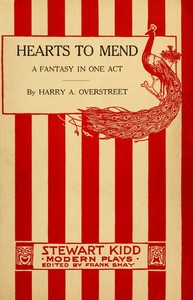
Hearts to mend: A fantasy in one act
Subjects:
Download Formats:
Excerpt
This volume contains FIFTY REPRESENTATIVE ONE-ACT PLAYS of the MODERN
THEATRE, chosen from the dramatic works of contemporary writers all
over the world.
FRANCE:
Ancey (George)--M. Lamblin
Porto-Riche (Georges)--Francoise’s Luck
GERMANY:
Ettlinger (Karl)--Altruism
von Hofmansthal (Hugo)--Madonna Dianora
Wedekind (Frank)--The Tenor
GREAT BRITAIN:
Bennett (Arnold)--A Good Woman
Calderon (George)--The Little Stone House
Cannan (Gilbert)--Mary’s Wedding
Dowson...
Read the Full Text
— End of Hearts to mend: A fantasy in one act —
Book Information
- Title
- Hearts to mend: A fantasy in one act
- Author(s)
- Overstreet, H. A. (Harry Allen)
- Language
- English
- Type
- Text
- Release Date
- August 16, 2022
- Word Count
- 5,514 words
- Library of Congress Classification
- PS
- Bookshelves
- Browsing: Literature, Browsing: Performing Arts/Film, Browsing: Fiction
- Rights
- Public domain in the USA.
Related Books
Big lake
by Riggs, Lynn
English
272h 14m read
The Canterbury pilgrims
by MacKaye, Percy
English
463h 3m read
Bird's nest, a fantasy in one act
by Mygatt, Tracy D. (Tracy Dickinson)
English
170h 3m read
Bimbo, the pirate: A comedy
by Tarkington, Booth
English
144h 28m read
Masks, with Jim's beast, Tides, Among the lions, The reason, The house - one act plays of contemporary life
by Middleton, George
English
573h 55m read
Two Slatterns and a King: A Moral Interlude
by Millay, Edna St. Vincent
English
37h 59m read