*** START OF THE PROJECT GUTENBERG EBOOK 74124 ***
IN THE LINE OF DUTY
By H. P. S. Greene
The story of a flying lieutenant who went A. W. O. L.
A heavy truck lumbered slowly along a road in central France. On both
sides of the road was an uninspiring vista of brown fields, stretching
away as far as the eye could reach, and only occasionally broken by
small clumps of small scrubby trees. On the seat of the truck beside the
driver sat a little man with a drooping mustache. This droopiness was
evidence that he had come there by way of Paris. When he reached the
French capital the mustache had been smartly waxed.
Finally he addressed the driver out of sheer boredom.
“Pretty sad dump around here, ain’t it?” he remarked obviously.
“Sad?” inquired the truck driver, a horse faced man with a large bulge
in his cheek, who suggested mules rather than mechanical means of
locomotion. “Sad? Say, Lieutenant, you ain’t seen nuthin’ yet! Wait till
you see the flyin’ field. They have to lay duckboards to get out to the
airyplanes on. The only birds who have a good time around there are the
Dutchmen--prisoners, you know. I took ’em out a load of beer and cognac
this morning, and there was a hardboiled M.P. sergeant ridin’ the load
to make sure it all got there, an’ it did, too. And then the lucky
suckers work in the kitchen and get all they want to eat, too--the
Dutch, I mean. Makes me sick to think o’ them krauts lyin’ around with
nuthin’ to do but stuff an’ guzzle, while hard workin’ guys like me--
Look, there’s the field now.”
He pointed ahead to a group of low barrack buildings which clustered
near the road on the left hand side. Farther away could be seen several
hangars, but no signs of activity.
“I don’t see any flying going on,” remarked the lieutenant, whose name
was Tommy Lang.
“No, an’ you won’t prob’ly, till next spring,” returned the driver.
He turned off the rough but hard road through the gateway into the camp,
and the engine of the truck began to labor as its wheels sank deep into
the soft mud, so he shifted into second. Once more the truck lurched
forward, but only for a moment. The driver shifted back into first, but
the new impetus gained was only temporary, and presently the chainless
wheels spun vainly. The driver shut off his motor and climbed to the
ground.
“This is as far as we can go, Lieutenant,” he said. “You’ll have to lug
your own baggage in from here. The frogs won’t let us use chains on the
road, so they took ’em away from us.”
He proceeded around to the back of the truck and let down the tailboard
with a bang. Tommy climbed down gingerly, but immediately sank almost to
his knees. The driver was dragging out his bed roll and trunk, which
fell to the ground with a squashy sound; then he went around to the
front of the truck and began to labor at the crank.
“What do I do now?” asked Tommy, looking around.
There wasn’t another soul anywhere in sight.
“Report to the personnel officer up there,” answered the driver, waving
his arm vaguely toward the row of long barrack buildings nearby. So
saying, he climbed once more to the seat and began to churn his way
backward toward firmer ground.
* * * * *
Leaving the sad monument of his baggage, Tommy sloughed through the mud
until he reached a pathway of duckboards which ran parallel to the row
of barracks. On one of these buildings was a sign, and as he approached
it, the latest addition to the great American flying field was able to
see that it read as follows:
PERSONNEL OFFICE
for
OFFICERS
FLYING OFFICERS
FLYING CADETS
CADETS
“And the shepherd separates the sheep from the goats,” thought Tommy as
he climbed a short flight of steps and entered the office. The shepherd,
a small, pot bellied man with captain’s bars but no wings on his serge
blouse, eyed the newest flying lieutenant, his whipcord uniform and his
papers with disfavor.
“All right,” he said in a querulous voice. “Find yourself a bunk in the
flying officers’ barrack. You will be assigned to a section for duty.
Look on the bulletin board in the operations office.”
Tommy saluted and went out. He saw his baggage still forming an island
in the sea of mud, but it seemed to have shrunk appreciably since he
left it. He had an idea that he must salvage it before it disappeared
entirely.
Walking along the duckboard, he heard a chorus of voices raised in
ribald song in one of the barracks and stopped, feeling that he had
reached a friendly haven.
“When I joined the Army I was clean and neat, Now--”
The noise ceased abruptly as the flying officer entered.
“Attention!” shouted one voice.
“Ma-a-a-a-ah!” said another.
The place was full of irreverent and antagonistic cadets, and Tommy
retreated, feeling that it was not the time to stop and explain that the
only reason he was not among them was through the mistake of some
nodding Homer in Washington in giving him a commission as soon as he
enlisted, instead of when he got his pilot’s license. The song followed
him:
“The officers live on the top of the hill,
The flying cadets in the slush and the swill--
I don’t want any more Army.
Gee, how I want to go home.”
He came to the last barrack of all, which was only about three-fourths
built. Going inside, he found it empty of human life, but the contents
was reassuring. Under the neatly spread double-decker bunks were
officers’ boots, and the walls were covered with overcoats bearing the
single stripe of a first lieutenant, and with various flying clothes and
equipment. In what would be the middle of the long building was a single
large stove which feebly radiated its rays of heat against the blasts of
cold damp air from the open end. Near that end were several unoccupied
bunks, one of which Tommy decided must be for him.
* * * * *
It was commencing to get dark outside, and colder, too. The little flyer
huddled closer to the stove and smoked a cigaret. Somebody must come in
before long. Somebody did.
There was a clatter on the duckboards outside and a horde of flying
lieutenants trouped in, making loud noises and crowding around the
stove. Tommy scanned their faces anxiously, but there was nobody there
he knew. A tall, thin man eyed him in a friendly manner, and Tommy asked
him to help him with his baggage. The other assented readily, and they
excavated the large French trunk and fancy bed roll which marked a man
who had enlisted in Paris, and one by one dragged them inside.
“You might as well take this bunk next to me and Fat,” said the tall
man, who was known as Long John. “We got left behind for a day in Paris
by accident, and when we got here the barrack was almost full up, so we
had to take bunks near the end. What ground school did you go to?”
“I never went to ground school,” returned Tommy. “I was an ambulance
driver and enlisted in Paris.”
He looked around curiously at his companions in the barrack. They were
of an unfamiliar genus, men who had had their preliminary training and
got their commissions in the States.
There were various strange divisions in the early days of the Air
Service in France. At the French school at Tours there were, outwardly
at least, several different breeds of Americans. First the Foreign
Legion trained there, and then a lost or strayed detachment of American
gobs. Then the Army started enlisting men in Paris, mostly former
ambulance drivers, who continued the old feud between the American
Ambulance and Norton Harjes, but united in scorn for those whose service
had been confined to the Mexican Border.
Then one day a body of men marched into camp in column of fours, a
military evolution which the ambulance drivers regarded with pitying
contempt.
“Who are those men?” the question ran around.
“Ground school men,” was the reply, and the ex-ambulanciers immediately
joined together in one clique against the others.
Now Tommy was meeting a new division in the ranks of the flyers--those
who had not only been to ground school, but had had preliminary flying
training in the States.
He inquired after various of his friends, only to find that they had
been transferred to a more advanced field; and, realizing that more than
an hour still remained before supper, he started down the road toward a
house he had noticed when the truck brought him to the field. Perhaps he
might find a drink there, and possibly some one he knew. He was cold and
shivering and thought longingly of the woolen underwear sent him by an
aunt, which was buried in his trunk. For years he had worn nothing but
so-called athletic underwear, but the time had evidently come to change.
He approached the house, a solitary farm, but still somehow suggestive
of liquid refreshment. The door stood open hospitably, and he walked in.
His nose had not deceived him, for though there was no one in the room,
a small bar stood along one end, and when the gnarled, stooped lady of
the establishment came in, he ordered a glass of rum. The strong liquor
warmed him.
There was a puttering roar outside, and a motorcycle pulled up at the
door. Tommy observed the evident agitation of the Madame with surprise.
Then a man with a hard face came inside. He looked at Tommy
threateningly.
“Have a drink,” invited the little pilot in friendly tones.
He hated to drink alone, even if he was cold. The other, who wore a
brassard around his arm like a stretcher bearer in the French army,
agreed in a surly manner. Tommy wondered who the fellow was as he gulped
his drink, and waited to see if the other would return the compliment,
as was in vogue in those days. He didn’t, and Tommy turned to leave.
“Hey, feller,” said the surly one. “Guess I’ll have another one.”
“Sure, if you like,” answered Tommy, surprised.
He ordered and paid for another round. There was something peculiar here
that he didn’t understand. Just then there was the sound of another
motorcycle outside.
“The officer of the day!” exclaimed the tough man with the arm band,
rushing out. Tommy heard his voice raised placatingly.
“Yes, sir,” it said. “I just went in to see if there was anybody inside,
but there was no one there.”
“All right, get on with the patrol,” said another voice.
The two motorcycles roared away. Tommy was bewildered. He left the café
and walked back to the barrack. Perhaps he could find out there what it
all meant. Although he bore lieutenant’s bars on his shoulders, he was
as innocent of the Army and its ways as a baby.
* * * * *
At the open ended barrack he found the flying lieutenants gathered
around the stove. Among them was Long John, and he singled him out and
told him his queer story. To Tommy’s surprise he burst into raucous
laughter.
“Hey, Fat! Hey, guys! Listen to this, will ya! This bird goes up the
road to the café that’s out of bounds, and when the M.P. comes in he
asks him to have a drink.”
Chorus--
“Yeah?”
“Yeah. And then he wonders why the M.P. don’t buy him one.”
“No!”
“Fact, and then the M.P. tells him to buy another one, and he does!”
“Yeah?”
“And then the officer of the day drives up, and the M.P. tells him
there’s nobody in there, and they ride off, and now this bird wants to
know what it’s all about!”
A howl of glee went up, and from that moment Tommy became a marked man
at Issy-la-Boue, as he had a habit of doing everywhere he went.
A bugle blew at this juncture and all the flying officers rushed to
their bunks and seized peculiar looking instruments with which they went
outside. Still wondering, Tommy followed them.
* * * * *
It was dark by that time, but he could see them trouping into a brightly
lighted building, and he followed. There they had formed in line, and
were approaching a counter behind which stood cropheaded fat men who
were ladling out what Tommy’s nose told him was food.
As they were served the flyers hurried away to seat themselves on long
benches at bare wooden tables and wolf their meal. Tommy accosted the
large man whom Long John had addressed as Fat, whose bulk had evidently
cut down his speed so that he was near to the end of the line.
“Say,” he asked, “where do I get some of those things they eat out of?”
“What, ain’t you got no messkit?” queried Fat. “You’ll have to draw one
in the morning. For tonight you’d better borrow Long John’s. He’s always
in the head of the line when the doors open, and he eats faster than any
man in the outfit. But where have you been in the Army not to have a
messkit?”
“We always ate in the canteen at the French flying school until the
Y.M.C.A. came along and closed it up because they served wine there,”
answered Tommy. “They made a speech about the evils of drink and were
going to serve chocolate instead, but the chocolate never came. After
that we generally ate at the Greasy Spoon across the road, because they
didn’t serve anything but boiled beef and boiled potatoes at the mess
hall, but even there they furnished dishes.”
“Well, you’ll get no dishes furnished here,” said Fat. “But look, there
goes Long John already. Follow him out to the tubs, and get his messkit
when he gets through washing it.”
Tommy trailed the tall man out into the cold, dark night, where several
dim forms could be seen and heard slopping around near two large tubs on
the ground. As John rose from his task and shook his tools in lieu of
wiping them, Tommy accosted him and borrowed the messkit. Then he rushed
back into the mess hall just in time to get the last of the slum. He
eyed the German K. P.’s with some misgiving.
It occurred to him that it would be a fine opportunity for some
patriotic Boche to wash out the American Air Service by a judicious
application of ground glass or rough-on-rats, but he ate the slum, which
was fairly good, though Teutonically greasy.
Then he went outside to the tubs, where the late eaters were still
trying to wash their utensils. By this time the water was stone cold,
and full of fragments of food. Cries for more hot _Wasser_ rent the air,
but the German K. P.’s only stood in their warm kitchen and laughed, and
made guttural and doubtless insulting remarks in reply. After the iron
discipline of their own army, they were tickled pink at the opportunity
to insult any kind of officer, even an American aviator, who was the
lowest of the low. Tommy wiped most of the grease out of his dish with
his handkerchief and then returned the mess kit to Long John at the
barrack with an apology.
The tall man and Fat were about to start for the operations room to find
out the schedule for the next day, and invited Tommy to come along. On
the bulletin board he found that he had been assigned to Section 13.
Various other changes in sections were posted, but the last one took his
eye. It read:
1st. Lieut. John Smith, A. S. S. O. R. C.
Transferred from Section 3 to Death in Line of Duty.
by order of
--HERMAN KRAUSE, MAJOR, SIGNAL CORPS.
“What’s the idea ordering some guy to ‘Death in Line of Duty’?” he asked
Long John.
“Huh? Oh, they always do that when some bird gets bumped,” answered the
tall man. “You’re in Section 13, same as me. We go to rotary motors in
the morning, and then machine gun.”
“What do you mean, rotary motors?” inquired Tommy.
“Oh, they’ve got one of these Le Rhone motors like they have in the
Nieuports mounted on a block over at the hangars, and some goof gives a
lecture about it, and then we practise twiddling the little
levers--‘manettes’, they call ’em--that make it go. We’ve had it four or
five times already. They always give it to us when they can’t think of
anything else for us to do.”
“But I’ve flown hundreds of miles with rotary motors,” Tommy exclaimed.
“I made all my _voyages_ and my altitude test for my brevet with them.”
“Never mind that,” returned Long John. “You’ll probably have all the
more lectures about ’em on that account.”
They returned to the barrack, and Tommy started to unpack his things.
From his bed roll he produced a pair of rubber boots, made in such a
close imitation of regulation officers’ boots that it took a close
inspection to see that they weren’t the real article.
“What a trick for roll call mornings,” exclaimed Fat, looking at them
enviously. “You know we have roll call at six o’clock, and then we have
to wait until seven for breakfast. Most of the fellows just put on boots
and overcoats to stand the call, and then come back to bed again. You
can pull those things on in a minute and get by with them.”
“A good idea,” proclaimed Tommy, and went to bed with that idea in mind.
He was going to dig out his heavy underwear that night, but decided that
it was too cold, and that he would do it in the morning.
* * * * *
Meanwhile there was another conference going on at headquarters. Major
Krause, the commanding officer of the field, a red faced, apoplectic
man, whose military heroes were Frederick the Great and Baron von
Steuben, was roaring at the adjutant, his “yes man”.
“Here they are,” he bellowed, “sending us another squadron of mechanics,
when we haven’t got half enough room or work for the ones we have now. I
don’t know what we’ll do with them. We’ll have to try to pry another of
those folding barracks out of the French. And they have no officers, and
neither have we, though there’s a whole camp full of young fools with
commissions around here. But we’ll have to pick out one of them to
command the squadron, just to sign the reports that go in. Have you
anybody to suggest?”
“Well,” said the adjutant, “here’s a man got in today named Lang, whose
commission dates back to September, earlier than most of the others, but
I don’t know anything about him.”
“I know too much about most of the others,” said Major Krause. “Give him
a trial. Perhaps he may know something about his military duties. By the
way, did you tell the commanding officer of those officers in the
unfinished barrack that if they wanted it finished they could do it
themselves?”
“Yes, sir, and they said they hadn’t got cards to the Flying Carpenters’
Union, and they didn’t give a damn whether it was finished or not. They
kicked a lot about having to go out and pick up stones off the flying
field in full uniform, too, because the German prisoners stood around
and laughed at them.”
“They did, did they?” roared Major Krause. “What they need is
discipline, and I’m going to give it to them! Tell Captain Yuma to give
them an hour’s close order drill every morning after roll call.”
“Yes, sir,” said the adjutant with satisfaction.
* * * * *
Next morning Tommy woke with a start. He was cold and cramped from the
night on the narrow bunk with insufficient blankets, and for a moment he
thought that he was back in the ambulance sleeping on a stretcher. Then
he saw the other flyers rushing out of the barrack and realized where he
was. He rolled quickly out of his bunk, dragged on the rubber boots,
shuffled into his trench coat, which barely covered his bare knees,
grabbed his hat and ran out after them, only to slip and come tumbling
out of the barrack head first, amid hoarse guffaws from the other
sufferers lined up outside. It had snowed a couple of inches during the
night, and the sharp flakes bit into his tender knees. He scrambled to
his feet and lined up with the rest.
The short, fat captain to whom he had reported the day before called the
roll in his squeaky voice, and then at the top of his lungs cried--
“Squads right!”
A horrified look ran up and down the scantily clad ranks, but the
“March!” followed grimly and inevitably. The captain, who had been a
real estate broker two short months before, had forgotten to have them
call off, and they broke into a milling mob.
“As you were!” he howled.
The ranks formed again, after a considerable delay, during which several
men tried to sneak around the corner of the barrack, and the captain
finally got them marched away. To Tommy, as well as to the late realtor,
and most of the rest, it was a doleful hike. With every step, the man in
front scuffed snow and equally cold mud up against his bare, raw knees,
and soon his boots were full.
In other parts of the great field where they marched there were other
processions of unfortunates, one of flying cadets, one of cadets, and
also several companies of mechanics. They, however, had the advantage of
expecting the march, and were fully dressed. Most of the flying
lieutenants were not. But at last it came to an end, and in the doubtful
shelter of the barrack once more Tommy wiped the mud from his cold wet
knees with a towel.
“Where can I take a bath?” he asked Long John.
John cackled with raucous glee.
“Bath?” he snorted. “Hey, guys, here’s an _hombre_ wants to know where
he can take a bath.”
“Bath?” said Fat. “Why, Paris is the last place I had a bath, and I
don’t expect to have another one till I die and go back there. You’ll
get no baths here. There’s a bath-house in town, but you can’t go there,
for the post’s been quarantined ever since it was started. The M.P.’s
know that anybody that goes A. W. O. L. will want a bath, so they keep a
special guard over the bath-house to pick you up, just like at the
barrooms.”
They dressed, went to the mess hall for beans, washed their mess kits,
and then formed in sections to march to classes. First Section 13 spent
an hour standing around in the blast from the propeller of a rotary
motor, and then went to an unheated barrack to handle the icy parts of a
Lewis machine gun. After which they were allowed to escape to the Red
Cross hut and buy some hot coffee. Hardly had they reached this haven
when an orderly entered.
“Lieutenant Lang,” he bawled. “Is Lieutenant Lang here?”
Tommy took an envelope addressed to him, signed for it and opened it
with apprehension. This was well justified, for the letter told him to
assume command of the 946th Aero Squadron upon its arrival at the field.
He showed it to Fat and Long John, who once more burst into laughter.
“Can you imagine the lucky little stiff?” John inquired of the world in
general. “Here’s a guy knows so little about the Army that he doesn’t
even know an M.P. when he sees one, and here he gets command of a
squadron. You’ll get out of reveille and standing morning formation on
that, and have an orderly to shine your boots for you. You can have them
build off a separate room for you in their barrack with a stove in it.
Pretty soft for a squadron commander, I’ll say.”
“But what will I command them to do?” Tommy asked anxiously.
“Let Old Krause and the adjutant worry about that,” returned John.
“They’ll find plenty of commands for you. But turn everything over to
your top sergeant and make him do it. Tell him, ‘Look here, Sergeant, if
you won’t bother me, I won’t bother you.’ Then all you have to do is
look wise and sign the papers that the sergeant-major or staff sergeant
bring you, and keep out of Krause’s way.”
* * * * *
When the squadron arrived Tommy followed John’s half joking advice and
found that it succeeded admirably. The men partitioned off one end of
the barrack after they got it up, and there made an office for the
sergeant-major and one for Tommy, in which he set up a G. M. cot. Of
course, this office had to have a stove, and so it served splendidly for
quiet games of stud which continued long after lights were out in the
quarters of the flying lieutenants less fortunate than Tommy and his
cronies. And he got along well in his command by keeping out of sight,
and signing unquestioningly the morning reports, rosters, ration reports
and whatnots his sergeants brought him.
But one morning the sergeant-major approached him with a troubled face.
“I don’t know what to do about this, Lieutenant,” he said, holding out a
letter. “I sent it to the adjutant three times and he always sends it
back marked ‘Incorrect.’ You see, they have held up Corporal Letar’s pay
on account of a tailors’ bill against him for twenty-five cents for
repairing his breeches at Shenannigan Field, Texas. Now here is his
service record, and it shows a deduction of a quarter made there in July
for fixing his breeches, and he says that’s the only time he ever had it
done, but they’ve been holding up his pay for three months.”
“Holding up his pay, have they?” said Tommy angrily. “Sent the letter
back three times? We’ll see about that. I’ll take it up to the adjutant
myself.”
He entered the adjutant’s office and spoke loudly:
“Say, what’s all this, about Corporal Letar’s pants? Here’s the letter
all O. K.--just as his service record shows. ‘Twenty-five cents was
deducted from Corporal Letar’s pay in July at Shenannigan Field, Texas,
for repairing his pants.’”
“Ah, that’s what’s wrong,” replied the adjutant smoothly. “Where’s your
grammar? Haven’t you ever been to school? What you should say is:
‘Twenty-five cents were deducted from Corporal Letar’s pay at
Shenannigan Field, Texas--’”
“What’s this?” burst an angry roar from an inner office, as Major Krause
rushed out. “What’s all this about pants? Who’s this talking about
pants? Don’t you know there’s no such thing in the United States Army as
pants? Who are you, young man?”
Tommy stood speechless at the outburst. Why, oh why, hadn’t he kept on
following Long John’s advice about keeping out of sight?
“This is Lieutenant Lang, sir,” said the adjutant silkily, “the
commanding officer of the 946th Aero Squadron on this Post. We were
discussing a very serious error in one of his reports.”
“Oh, it is, is it?” said Major Krause angrily. “I was going to send for
you. I issued orders that all commanding officers of organizations on
this post should personally give their units an hour’s close order drill
every morning. Yesterday morning I saw a sergeant drilling your
squadron. Where were you, sir? Why weren’t you drilling them yourself?”
“Why,” blurted Tommy, “I don’t know how to drill ’em. I never drilled
anybody in my life!”
“What? You, a commissioned officer in the United States Army, stand
there and admit that you are not capable of drilling the men under your
command? Well, sir, you are hereby relieved from that command. Remove
yourself and your belongings from the 946th Squadron’s barrack at once,
to make room for your successor. And, young man, remember this: Never
give ‘You don’t know how’ as an excuse in the United States Army. If you
don’t know how, learn how! If you get an order, do it, and if you can’t
do it, do as near it as you can. That will do. You may go.”
* * * * *
Tommy dragged himself away disconsolately, and had a couple of men of
his late command carry his stuff back to the barrack with the open end.
It was colder than ever now, after the warm quarters from which he had
been ousted. But on the other hand, perhaps this was a blessing in
disguise. He had been flying lately, and had graduated from the penguins
whose wings were too short to fly, and from the gawky twenty-three meter
Nieuports, and now he was on the eighteens.
He ought to be finished with them soon, and then he would be due to move
away from the main field to Field 5 for the smaller, faster fifteen
meter machines. Perhaps there would have been some hitch about going if
he’d been hooked up with the squadron, but now he could leave as soon as
he was ready.
And he was ready to go somewhere, too. He’d now been quarantined at
Issy-la-Boue for over a month and hadn’t been able to leave the post for
a bath. If it wasn’t the measles or the mumps it was the chicken pox, or
somebody had a sore toe. There was a spreading line of red blotches
around his waist, and he knew only too well what it was. The scabies!
And from his experience with the French he knew there was only one
cure--hot sulphur baths with a scrubbing brush, and plenty of them. They
had them at the bath-house in town, but he couldn’t get away. However,
perhaps something would turn up; it always did, sooner or later.
It did the next day. He finished flying early, and returned to the
barrack. As he came in, the telephone rang and he answered. An excited
voiced called:
“Hello, is this the Main Field? This is Field 5. Tommy Lang just crashed
here in an eighteen.”
“Hah?” said Tommy.
“Yeah, deader’n a doornail, too. The whole top of his head’s gone above
the eyes. An awful mess. The only way we knew who it was by his
mustache.”
The spreader of bad news hung up, leaving Tommy dazed. He pinched
himself to make sure that he was alive. It must be Phil who had crashed.
He had a mustache like Tommy’s own, but he was about six feet tall,
while Tommy was nearer five. However, no doubt he had been crumpled up
like an accordion in the fall. Then Tommy had another thought. He seized
the telephone receiver and called the adjutant.
* * * * *
Later that evening when the orderly came to the operations office with
notices for the bulletin board Tommy was waiting for him. An hour later
found him luxuriating in a hot sulphur bath in the town of Issy-la-Boue.
He had caught a ride on a French truck from the field, and there had
been no M.P.’s on duty when he went in. When he came out there were two
near the door, but the night was pitch dark, and they were wrangling
about something--a girl, apparently--and he passed unnoticed. Then he
sought a hotel.
The madame in charge was cordial and voluble.
But yes, she had plenty of room. That _sale guerre_! There were hardly
any commercial travelers nowadays. And then that _salaud_ of a chief
American gendarme who spent nothing himself, and forbade her hotel to
other brave Americans who would! Indeed, he had closed all the cafés and
hotels in town to his countrymen, and opened a café of his own,
importing two _petites femmes_ from Paris to run it for him. But there
was another American officer--a man very distinguished--at her hotel who
appeared lonesome. Perhaps this worthy monsieur would like to join him.
She led Tommy to a small office of some sort, wherein a man in American
uniform was sitting gloomily alone before a bottle of wine. The little
pilot recoiled at sight of the gold leaves on his shoulders, but it
wasn’t Major Krause who sat there. On this major’s blouse were the
_Legion of Honor_, the _Medaille Militaire_, and the _Croix de Guerre_
with many palms, instead of the jingling hardware Krause carried to show
that he was a marksman or something; and this man’s face lit up with a
welcoming smile, instead of the congested dignity habitual with the
commanding officer of the flying field of Issy-la-Boue. Tommy gasped as
he realized that he was in the presence of the great ace himself!
He sat down at the other’s invitation and had a glass of wine. They
joined in lamenting the fact that they couldn’t hang all M.P.’s on the
meat-hooks in front of butcher shops as the _poilus_ did the gendarmes
at Verdun, and agreed that the French are a great people.
“Look at me,” said the ace gloomily. “When I took this commission I had
no idea that they were going to order me away from the front, but now
all the others are killing more Boches and getting ahead of me while I
rot in this hole. They sent me back here to help train you fellows, but
Major Krause wouldn’t pay any attention to what I said, so I left. I
heard some guy who had never flown over the front give you a lecture on
how to do it, and when he said that if you got lost over Germany the way
to find out where you were was to fly down and read the name on some
railway station, I couldn’t bear it any more. I don’t know what the
devil to do--I’m not doing any good around here.”
His gloom was justified. A few months later he was shot down in flames
in a machine condemned by the French.
They heard the voice of the madame raised in loud objurgations outside,
but there was a knock at the door, and immediately a man entered. He
wore the uniform of a first lieutenant, and on his arm the brassard of
an M.P. But his truculence subsided into oiliness at the sight of the
major’s leaves.
“Excuse me, Major,” he said, “but orders are very strict, you know.
Major Krause is very particular that no flying officer should leave the
post under any conditions. I beg your pardon, Lieutenant, but have you
got a pass?”
“He’s with me,” said the ace shortly.
“Oh,” said the M.P. uncertainly, and went out. He wasn’t sure exactly
what the ace’s status was, but his rank was plain enough, and the M.P.
was afraid of burning his fingers.
“Wait till that guy catches me alone,” said Tommy.
“Stick around with me,” said the ace. “Krause doesn’t quite know what to
do about me yet, for I’ve got a pull in Paris, and he’s let me alone
since I left the field.”
* * * * *
For three days Tommy did stick, and lived the life of Riley, sleeping in
a good bed, eating good meals, drinking good wine and taking sulphur
baths twice a day. At the end of that time his scabies was gone.
“I guess I’d better be getting back to the field,” he told the ace. “I
want to get through there and get to the front. I took an awful chance
going A. W. O. L, but maybe my little scheme will work on Krause. If it
doesn’t, and he takes me off flying I’ll be sunk. Think I might as well
go out and let that M.P. pick me up and give me a ride back to camp.”
He shook hands with the ace, and walked out and down the street alone.
He hadn’t gone far when a Ford drew up beside him and stopped. In the
front seat was the M.P. lieutenant, and behind a hard-boiled sergeant
with a .45.
“Hey,” said the lieutenant in rough tones, “let’s see your pass.”
“I ain’t got a pass,” the little man returned.
“All right, then, you’re under arrest. Get in here, and I’ll take you
out to the field.”
Tommy obeyed meekly, and they rode along without conversation. Presently
he was ushered into the presence of Major Krause.
“What?” growled the major. “In town without a pass, eh? What have you
got to say for yourself, young man?”
“Well,” Tommy replied, “the other day you told me never to question an
order in the Army, and if I couldn’t obey an order to come as near it as
I could.”
“What rigamarole is this?” asked Major Krause angrily. “Do you mean to
stand there and tell me I ordered you to go A. W. O. L?”
“Not exactly, sir,” answered Tommy respectfully, “but you see this order
here. I couldn’t see my way clear to carry it out, so I thought I’d
better leave here so as not to embarrass you.”
Major Krause looked at the paper Tommy extended and his eyes goggled.
His face became more congested than ever, and wrinkles corrugated his
brow. What could he do? If he court-martialed this young idiot this
order would undoubtedly be his defense, and Krause’s dignity, a
carefully tended hothouse plant of uncertain virility, could hardly
survive. So he waved his arms in a furious gesture of dismissal and
gurgled like an active volcano, and Tommy saluted and left discreetly.
The paper he had given Krause read:
1st. Lieut. Thomas Lang, A. S. S. O. R. C.
Transferred from Section 13 to Death in Line of Duty.
by order of
--HERMAN KRAUSE, MAJOR, SIGNAL CORPS.
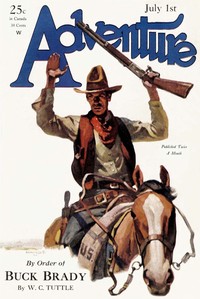
[Transcriber’s Note: This story appeared in the July 1, 1928 issue
of Adventure magazine.]
*** END OF THE PROJECT GUTENBERG EBOOK 74124 ***
In the line of duty
Subjects:
Download Formats:
Excerpt
The story of a flying lieutenant who went A. W. O. L.
A heavy truck lumbered slowly along a road in central France. On both
sides of the road was an uninspiring vista of brown fields, stretching
away as far as the eye could reach, and only occasionally broken by
small clumps of small scrubby trees. On the seat of the truck beside the
driver sat a little man with a drooping mustache. This droopiness was
evidence that he had come there by way of Paris. When he reached the
French capital...
Read the Full Text
— End of In the line of duty —
Book Information
- Title
- In the line of duty
- Author(s)
- Greene, H. P. S. (Henry Paul Stevens)
- Language
- English
- Type
- Text
- Release Date
- July 25, 2024
- Word Count
- 6,473 words
- Library of Congress Classification
- PS
- Bookshelves
- Browsing: History - Warfare, Browsing: Humour
- Rights
- Public domain in the USA.
Related Books

Famous stories from foreign countries
English
494h 26m read
The incredible slingshot bombs
by Williams, Robert Moore
English
96h 4m read

The eater of souls
by Kuttner, Henry
English
22h 19m read

Maehoe
by Leinster, Murray
English
115h 53m read
The air splasher
by Watkins, Richard Howells
English
138h 53m read

Hooking a sky ride
by Morrissey, Dan
English
37h 54m read