*** START OF THE PROJECT GUTENBERG EBOOK 60573 ***
Montezuma Castle
MONTEZUMA CASTLE NATIONAL MONUMENT
ARIZONA
A guide to discovery of
the Castle,
its Builders,
and Neighbors.
$1.00
[Illustration: _Courtesy Sharlot Hall Museum, Prescott_]
[Illustration: Diary entry]
April, 1894
“_We rode along and finally Montezuma Castle loomed up.... I was very
much excited and filled with awe. We just sat and gazed. Finally I
got my little wooden camera out and took a picture of the Castle from
horseback.”
F. G. Steenberg_
The Settlers
Many early visitors thought this cliff dwelling was a “castle” built by
Aztec refugees for their emperor, Montezuma—thus the name!
Today
Thanks to the archeologist, a more realistic story is beginning to
unfold. The setting is a prehistoric one, meaning the people involved
left no written history. They are believed to be the ancestors of some
present-day Southwestern Indians.
Montezuma Castle
Time A.D. 1100-1400
This 20-room apartment house was occupied between 1100 and 1400. It has
approximately the same floor space as a large, three-bedroom home of
today. Perhaps a dozen families, or about 50 people, lived here.
A natural recess provides shelter
Like other nearby caves and crevasses, the large recess in which the
Castle was built is the product of wind and water erosion over eons of
time. Shelter from the elements and solar heat from the winter sun were
probably good reasons for starting a home here. Other ideas have also
been suggested, including protection, tradition, or perhaps the view!
However, with no written records to guide us, maybe the real reasons
will never be known.
300 years of construction
The uppermost wall of the Castle was apparently the first one
constructed. It makes two rooms out of a cave in the highest part of the
recess. Later additions were made in front of and below these rooms. It
appears that modifications were made right up to the time of
abandonment!
Inside the Castle
[Illustration: _A ROOF BEAM chopped to length with a stone axe. Was
the notch at the end used to help lift the log in place?_]
[Illustration: _INSIDE A TYPICAL ROOM. Uprights and ceiling beams
are from sycamore trees. Ceilings and upper-story floors are a
thatching of grasses and shrubs covered with a mud mortar. The
small, T-shaped doorway may have helped in regulating air
circulation._]
[Illustration: _WALLS OF ROCK CEMENTED TOGETHER WITH MUD. Note the
handprints of the original plasterer._]
Today
Because of the natural overhang and quality of construction, Montezuma
Castle stands today as a well-preserved cliff dwelling.
[Illustration: Montezuma Castle]
Say Ranger!
The following are some frequently asked questions about Montezuma Castle
HOW DID THEY GET UP THERE? Probably ladders. Although none were found
here, remains of ladders have been found at other prehistoric sites.
Are there any materials around here from which they could make ladders?
Sycamore and Ash are abundant along the fertile riverbed of nearby
Beaver Creek.
THESE PEOPLE HAD NO WRITTEN HISTORY. HOW THEN DO WE KNOW ABOUT THEIR
LIVES AND TIMES? The large mound at the base of the cliff contains over
three centuries of trash discarded by the cliff dwellers above. As the
layers of food-remains, wornout tools and broken pottery accumulated, an
unwritten history of the lives and times of these people was provided.
What will our dumps and landfills “tell” future archeologists about our
lifestyles?
WHY CAN’T WE GO UP THERE? Montezuma Castle is irreplaceable! Most of the
structure is over 600 years old and once housed about 50 people. Nearly
one-half million people now view this ruin yearly. If the Castle had
been open to visitors last year, what would be left for you to enjoy?
ARE THESE OPENINGS AN ENTRANCE TO THE CASTLE? No! These two small caves
were probably used for food storage. Being high and dry, such walled-up
openings were excellent places to store staples.
Not So Obvious
High and Dry
Slightly lower and to the west of the castle, there once stood an 8- or
9-room dwelling. Over the centuries natural weathering has reduced this
structure to a pile of rocks and dust. Perhaps the people who built in
the cliffs chose this site because they understood desert creeks.
Occasionally, the flats below are covered by floodwaters.
For the future
This ruin has never been excavated. Wouldn’t doing so add to our
knowledge of its occupants? Probably. But instead of calling in the
archeologists today, why not leave this site undisturbed for a while
longer? Archeology is a relatively new science and its techniques are
continually being developed and refined. Could the information buried
here be of greater value in the future?
[Illustration: Unexcavated ruin]
A Day In Their Life
Castle ‘A’
West of Montezuma Castle, at the base of the cliff, is Castle A. In 1934
the ruin was excavated by archeologists. This “dig” provided insight
into the lives of the families who called it home. Let’s step back in
time and join the archeologists in a few of these discoveries....
Abandoned belongings
[Illustration: An abandoned room]
In one room, scattered here and there were corncobs, squash stems,
beans, and the remains of several stone hoes. A large clay storage pot
was found in the right rear corner. By its side, a food grinder was
propped up and ready for use. Did we discover the remains of a farmer’s
home?
Tragedy
Buried in the room directly behind and above the preceding one were the
remains of three infants. The Hopi Indians of northern Arizona believe
in burying a child near the mother so that its spirit may enter another
newborn. Does the discovery of these burials shed light on the spiritual
beliefs of the parents?
Clever housekeeping
[Illustration: Clay pot]
In a room to the left of the child burials a large clay pot was found
propped against a firepit. Was this arrangement accidental? Or, did some
prehistoric housekeeper devise a method for keeping water hot?
A touch of elegance
[Illustration: Cloth with patterns and fringe]
The caves above contained woven material. Many were made from wild plant
fibers for day-to-day use—sandals, skirts, matting, and rope. Other
items were woven from cotton, a cultivated “crop.” Some of these fabrics
were of dyed yarn and made into intricate designs. Today, weaving is
considered an art. Would these prehistoric people agree?
... And Death
The Burials Reveal
Trading
Material goods are frequently found with human remains. Examine the
pictures on these pages. These items were discovered with one of the
female burials. The pendant and decorated bowl indicate that these
people were part of an extensive trading network which covered at least
the length and breadth of the Southwest.
Rigors of life
Of the fifteen skeletons whose ages could be determined, eleven died
before age 45. Some skeletons also provided evidence of arthritis and
other bone diseases. And as noted in the archeological report, “... two
male skulls showed ... several straight, ragged cuts such as could have
been caused by a blunt stone axe.”
[Illustration: _The DECORATED BOWL was made in northeastern Arizona
about 1350-1400._
_The PLAIN BOWL was probably made locally._]
[Illustration: _Shell for the background of this NECKLACE PENDANT is
from the southern California coast. The turquoise is probably from
an area rich in copper._]
Customs
The backs of over half the skulls were flattened! This could have
occurred because infants were often strapped to rigid cradleboards.
Whether this deformation was intentional or not is debatable.
Ponder for a moment
If archeologists examine our gravesites 600 years from now, what will
they learn about us?
Survival
[Illustration: Beaver Creek]
Beaver Creek flows regardless of the season! Most of the time it is
gentle and clear. However, dry periods may reduce streamflow to a
trickle hidden beneath the rocky creekbed. Limbs and twigs are often
lodged in the trees along the creek. This debris is evidence of the
power and height of rampaging flood waters. The cliff dwellers probably
knew and accepted all these moods.
Directly across the creek, buried beneath years of river deposits, are
remnants of prehistoric irrigation ditches. They were used to carry
creek water into cultivated fields of corn, beans, squash and cotton.
These farmers also gathered the wild plants and hunted the animals along
this streamside.
Keep an eye out for animals! Bones of deer, rabbit, squirrel, snake,
turtle, fish and bird were found in the cliff dwellers’ trash mounds.
—_Babs Monroe_
[Illustration: Raccoon]
Today, this tree-lined creek provides a relaxing change from the more
arid surroundings. To the prehistoric cliff dweller it meant survival.
A Neighborhood
[Illustration: Environs of the castle]
Archeologists suggest that this was a community of friends, relatives,
and neighbors. People going about their daily chores—talking about the
weather and the new family next door—or inquiring into the recent death
of a newborn or elderly relative.
This village grew and flourished for over 300 years. And yet, when the
pilgrims stepped onto Plymouth Rock in 1620, this prehistoric community
had been abandoned for over 200 years.
Montezuma Castle National Monument preserves only a few of the hundreds
of similar prehistoric ruins discovered in this area.
_Again the same sad story applies to the ruins ... all were forsaken,
deserted.
Over the centuries they have stood there, empty, forlorn, but ever
lovely in the perfection of the dream which created them._
From the CLIFF DWELLERS
by W.E.S. Folsom-Dickerson
[Illustration: Abandoning the castle]
MONTEZUMA WELL
[Illustration: Montezuma’s Well]
The “Well,” as it is commonly called, is a separate unit of this
National Monument. It is an area rich in cultural and natural history.
Geologists suggest that the Well is a sinkhole formed by water
percolating through limestone. Warm, underground springs supply a daily
flow of 1½ million gallons, and support a pond life devoid of fish!
Nearby are the fossilized remains of irrigation ditches used to carry
this water to prehistoric farmlands. Along the Well’s rim are the ruins
of these farmers’ homes. Today, the water from Montezuma Well irrigates
a nicely shaded picnic area abundant in bird life.
SOUTHWEST PARKS AND MONUMENTS ASSOCIATION
This publication was produced with funds donated by
Southwest Parks and Monuments Association.
www.spma.org
8/01
Recycled paper
Transcriber’s Notes
—Silently corrected a few typos.
—Retained publication information from the printed edition: this eBook
is public-domain in the country of publication.
—In the text versions only, text in italics is delimited by
_underscores_.
End of the Project Gutenberg EBook of Montezuma Castle National Monument,
Arizona, by Anonymous
*** END OF THE PROJECT GUTENBERG EBOOK 60573 ***
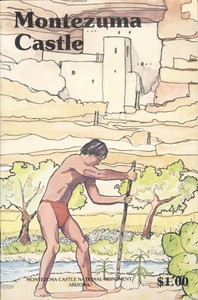
Montezuma Castle National Monument, Arizona - A Guide to Discovery of the Castle, Its Builders, and Neighbors.
Subjects:
Download Formats:
Excerpt
MONTEZUMA CASTLE NATIONAL MONUMENT
ARIZONA
A guide to discovery of
the Castle,
its Builders,
and Neighbors.
[Illustration: _Courtesy Sharlot Hall Museum, Prescott_]
“_We rode along and finally Montezuma Castle loomed up.... I was very
much excited and filled with awe. We just sat and gazed. Finally I
got my little wooden camera out and took a picture of the Castle from
horseback.”
Many early visitors thought this cliff...
Read the Full Text
— End of Montezuma Castle National Monument, Arizona - A Guide to Discovery of the Castle, Its Builders, and Neighbors. —
Book Information
- Title
- Montezuma Castle National Monument, Arizona - A Guide to Discovery of the Castle, Its Builders, and Neighbors.
- Author(s)
- Southwest Parks and Monuments Association
- Language
- English
- Type
- Text
- Release Date
- October 25, 2019
- Word Count
- 1,733 words
- Library of Congress Classification
- E011
- Bookshelves
- Browsing: Culture/Civilization/Society, Browsing: History - American, Browsing: Travel & Geography
- Rights
- Public domain in the USA.
Related Books
Preliminary report on a visit to the Navaho National Monument, Arizona
by Fewkes, Jesse Walter
English
293h 56m read
Wupatki Ruins Trail, Wupatki National Monument
by Southwest Parks and Monuments Association
English
55h 33m read
El Morro Trails: El Morro National Monument, New Mexico
by Southwest Parks and Monuments Association
English
89h 24m read
Nalakihu-Citadel Trail, Wupatki National Monument, Arizona
by Southwest Parks and Monuments Association
English
47h 11m read
Casa Grande Ruins Trail
by Southwest Parks and Monuments Association
English
38h 25m read
Navajo National Monument, Arizona (1951)
by United States. National Park Service
English
74h 17m read