*** START OF THE PROJECT GUTENBERG EBOOK 69644 ***
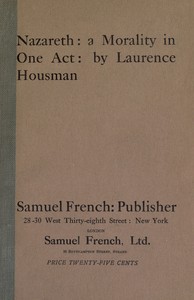
Nazareth: a Morality in
One Act: by Laurence
Housman
Samuel French: Publisher
28-30 West Thirty-eighth Street: New York
LONDON
Samuel French, Ltd.
26 SOUTHAMPTON STREET, STRAND
Copyright, 1916
By LAURENCE HOUSMAN
CAUTION.--Amateurs and Professionals are hereby warned that
“NAZARETH,” being fully protected under the copyright laws of the
United States, is subject to royalty, and any one presenting the play
without the consent of the author or his authorized agent, will be
liable to the penalties by law provided. Application for the right
to produce “NAZARETH” must be made to Samuel French, 28-30 West 38th
Street, New York City.
ALL RIGHTS RESERVED.
NAZARETH.
PROLOGUE.
Since Love first looked on life with human eyes,
Twixt him and us time like a curtain lies.
Of all the years while He made life His own
With dear familiar touch--how little’s known!
The gospels of His Birth, the tale make plain
Then two years till He died and rose again,
Naught else remains to us of all, save when
He, at Jerusalem, with learned men
Was by His parents found, and taken thence
Back to far Nazareth. And by no sense
Of mortal mind from where they now lie hid
Can we recover the fair things He did,
Growing to man’s estate, that He might die
For man’s salvation; hidden there they lie,
The days which mounted up to Calvary.
Yet here on earth that lovely deed was done;
Love in man’s form took life from wind and sun,
Waked, slept, ate bread, and toiled, and without speed,
Patient, made test of each frail weak human need;
Found means on small frail feet men’s ways to go;
From mother tongue was taught man’s speech to know;
So, for man’s making, childhood, boyhood, youth,
Each he endowed in turn with deathless truth,
Himself the type and pattern for each stage
Of human growth. Oh! in what future age
Shall we who, seeking that lost Pattern, roam,
Find it again, and to that form come home?
Ah, friends! this simple showing that ye see
Of Love at Nazareth, this is not He!
’Tis but a thought, a fathering wish, a prayer
That with hearts knit we may come closelier there,
Where He lived lowly. Lo, He by your side
Lies hidden, a waiting guest, still multiplied
By man’s still growing needs,--with such intent
He made humanity His Sacrament;
The flesh and blood, which here we beat and bruise,
Is Christ’s. Ah, put it to some better use!
Be members all with all! Hear what Love saith,
And make your home with Him at Nazareth!
NAZARETH
SCENE:--_The Carpenter’s shop is a low, broad chamber built of wood.
At the back to the left-center a wide open doorway reveals a level
stretch of landscape. It is late afternoon, but the air is still
pale with the heat of day. To the right of the door is a small
square window with wooden shutters thrown wide; before it stands a
carpenter’s bench upon which lies a wooden door frame nearly
finished. The carpenter and his assistant are quietly at work
planing, and boring holes for the fitting in of the rivets; beneath
them the floor is strewn with shavings, saw-dust, and odds and ends
of wood. Away to the left, near a spinning wheel, sits an aged
woman combing flax. Against the wall to the same side of the
doorway sits_ MARY, _the carpenter’s wife, with a book upon her
knees; on the other side her son stands against the door-post, with
his back to the interior, looking out into the sunshine._
_After the scene has opened the carpenter raises himself from a
stooping position, and hands over to_ REUBEN, _his assistant, a
beam of wood, which the latter lays aside._
CARPENTER. ’Twill soon be done. Nay, we’ll not need that now. Yes,
speak on. If you read slowly enough, I can give heed.
MARY. (_Reading_). “Because his visage was so marred, many did marvel
at him then, for more than most his form was scarred, yea, more than
all the sons of men. Yet him shall all the nations hear, and kings
shall shut their mouths for fear.”
CARPENTER. (_To_ REUBEN) Be careful, now the cross-beam’s laid.
OLD ANNA. What cause have kings to be afraid?
MARY. (_Reading_) “Who hath believed our report? To whom is the Lord’s
arm revealed? He shall grow up in tender sort, and as a root from a dry
field, having no form nor comeliness, that men who see should scorn him
less.”
CARPENTER. Hold it fast, now! Nay, don’t let go.
MARY.--
“He is rejected and despised,
A man of sorrows, grief his lot,
He came to us unrecognized,
Despising, we esteemed him not.
Surely our sorrows he hath borne,
And for our sins hath felt the rod,
Wherefore he seemed a shape for scorn----
One smitten by the hand of God.
But he was wounded for our sins,
For our iniquities was scourged,
By chastisement our peace he wins,
And with his stripes mankind is purged.
All we like sheep have gone astray,
Turned everyone to his own way.
And upon him the Lord doth lay
The iniquity of all.”
(OLD ANNA _touches her daughter, and points toward the child_.)
MARY. (_After a pause, watching him_)
My son, what yonder dost thou see,
That holds thy gaze so steadfastly?
Come hither, child, and tell it me.
CHILD.--
I see the land all parched and dry,
And sheep, without a shepherd nigh,
And surely some look like to die.
ANNA. I see no sheep.
MARY.--
Nay, dearest one.
Thine eyes are dazzled by the sun;
See, in the field thy playmates run,
Wilt thou not join them?
CHILD.--
Mother, nay!
I will not go with them to-day.
ANNA. He never was a child for play.
CHILD. Mother, what were you reading then?
MARY.--
Isaiah’s prophecy how men
Shall still be blind when God again
Comes to save Zion and redeem
His chosen ones.
CHILD. Was it a dream?
Or did he see? How did he know?
MARY. He heard God’s word, and told men so.
CHILD. And was that many years ago?
MARY. Seven hundred years.
CHILD.--
But having here
His word to guide them, do men fear
They will not see Salvation near?
ANNA. Aye! many fear it. I for one.
CARPENTER. There, that’s right! Now, ’tis almost done.
(_The child turns towards the carpenter’s bench._)
MARY. Thou will not miss that sight, my son.
CARPENTER.--
Come, little son, and hold the wood!
Brace hard the end, while I make good
The upright. See how crooked it stood!
CHILD. What art thou making, father?
CARPENTER.--
Nay,
See for thyself, my child, what way
One grows to wisdom day by day.
It is a door.
(REUBEN _goes and takes a cup, dips it in a bowl of water near the door
and drinks_.)
CHILD. Whose door?
CARPENTER.
Why, mine,
Till I’m paid for it!
CHILD. How came it thine?
CARPENTER. I made it.
CHILD. How?
CARPENTER.--
Well, first I bought
The timber; after that I wrought,
Rough hewed and shaped it, leaving nought
To chance--so that all parts agree
When joined together. Dost thou see?
Art satisfied?
CHILD. (_After a pause_) Who made the tree?
CARPENTER. (_After a pause_) God made the tree, my son.
CHILD.--
And through
Long years it put forth leaf, and grew
In beauty till man came and slew.
(_He caresses the wood, laying his face upon it_)
CARPENTER. Strange fancies still!
CHILD.--
And so the tree
Died, and gave up its life to be
A door through which man passes free,
To work God’s will.
CARPENTER.--
Come, come, you waste
Your father’s time, my son! Make haste,
Reuben--we’ve got the lintel placed;
Bring me the nails.
REUBEN. (_As he brings the nails and drives them in. Sings_)
Oh, what is yon tree that stands so high
And stretches its arms in sorrow?
“Oh, that is the gallows where I must die,
Where I must die to-morrow.”
Oh, what hast thou done, my only son,
That thou shouldst die to-morrow?
“My life I lend to a well-loved friend
Who health of me would borrow.”
If so thou lend to a well-loved friend,
How heavy must be his sorrow!
“Ah, say not so, for well I know
I hang by his hand to-morrow.”
(_The child has taken the bag of nails from_ REUBEN, _and hands them
to him, one by one, as he drives them in. One of the nails pierces
the child’s palm. He bows his head over it._)
CARPENTER.--
Why, there, there, there! You’ve done it now!
Reuben, ’twas your fault to allow
A little child like him to play
With anything so sharp as they!
(MARY _comes forward and kneels by the child’s side. She takes his
hand and tries to staunch the blood_)
Has it gone far?
MARY.--
The wound is deep.
Stay, I will bind it! See you keep
Your hand up, child. Quick, mother, bring
Yon water fresh-drawn from the spring
To wash it clean, for there was rust.
(ANNA _brings the water bowl, while_ REUBEN _draws forward a low bench
at one end of which she sets it down_)
Maybe, upon the iron, or dust
To cause a festering in the wound.
(MARY _bathes his hand and binds it. The child closes his eyes and
sinks against her breast._)
ANNA.--
Oh! See, he has already swooned
For loss of blood.
MARY.--
Nay, nay, ’tis sleep!
Aye! saw you not how at the leap
Of first sharp pain his face lit up,
And how he bowed as to a cup
His lips, and drained it to the lees?
So to this spirit now comes ease
And rest; for surely here he tastes
Of that dark vintage of the wastes
Whereto, for mortal need, he hastes.
CARPENTER. Strange words!
MARY.--
But stranger than all words
The peace which holds him now and herds
My lamb’s life with the blessed dead.
(_She moves to lay him along the bench._ ANNA _spreads a cloak across
it_)
Lift off the bowl, and let his head
Rest so, even so.
CARPENTER.--
There! Let him lie
Quiet awhile. Ah! he won’t die
Of that!
(_He lays his hand kindly upon his wife, then turns away. Evening has
begun to close in_)
Now, Reuben, you and I
Must stir while daylight yet allows!
This door is for the High-Priest’s house,
And should already be in its place
For now Passover comes apace;
And last night they sent word to say
’Twas to be up before the day,
So that the lintel beam might bear
The blood-marks for the coming year.
MARY. Look! There are stains already there!
CARPENTER. I’ll wash them off!
MARY.--
Nay, let them stay!
This blood, I trow, was shed to-day
To take some mortal’s guilt away.
(_The two men have lifted the door and set it to stand against the
middle post of the doorway where it makes the form of three crosses
standing together._)
CARPENTER.--
Soon through this door the holy feet
Of Caiaphas in service met
Shall pass each day to do God’s will.
MARY.--
And, what he hath ordained, fulfill.
And some day they shall bring a Lamb
And slay, and lo, upon the jamb
And lintel of this self-same door,
Where blessed blood has been before,
More blessed blood shall then be spilt
To take from Caiaphas his guilt.
(_The men having put away their tools lift the door and carry it
away._)
ANNA. (_Reading_) “He was taken from prison and from judgment, and who
shall declare his generation? For he was cut off out of the land of the
living, for the transgression of my people was he smitten. And he made
his grave with the wicked, and with the rich in his death; because he
had done no violence, neither was any deceit in his mouth.”
(_Voices of water-carriers heard without._)
1ST ANTIPHON. The bows of the mighty men are broken.
2ND ANTIPHON. And they that stumbled are girded with strength.
1ST ANTIPHON. They that were full have hired themselves for bread.
2ND ANTIPHON. And they that were hungry have ceased.
(_The women pass by._)
1ST ANTIPHON. So that the barren hath born seven.
2ND ANTIPHON. And she that hath many children is waxed feeble.
1ST ANTIPHON.--
The Lord killeth, and maketh alive.
He bringeth down to the grave and bringeth up.
2ND ANTIPHON. The Lord maketh poor and maketh rich. He bringeth low and
lifteth up.
MARY. It is the women going to the well.
ANNA. What are they singing?
MARY.--
Of the joy that fell,
To Anna for her first-born, Samuel.
ANNA. And thy joy also!
MARY. And the pain as well!
1ST ANTIPHON. He raiseth the poor out of the dust.
2ND ANTIPHON. And lifteth up the beggar from the dunghill.
1ST ANTIPHON. To set them among the princes.
2ND ANTIPHON. And to make them inherit the throne of glory.
1ST ANTIPHON. He will keep the feet of his saints.
2ND ANTIPHON. And the wicked shall be silent in darkness.
1ST ANTIPHON. For by strength shall no man prevail.
2ND ANTIPHON. The adversaries of the Lord shall be broken in pieces.
(_The voices pass away. It begins to grow dark._)
ANNA. (_Sings as she winds her flax_)
Little child, lo, I spin
Flax to clothe thy body in;
Little child, do not grieve
Out of this a cloth I’ll weave,
Make of it a little shirt,----
What man shall do thee hurt?
So while it lasts, wear it still,
What man shall wish thee ill?
Do not from thy body strip
This; ’tis human fellowship.
(_She lays the cloth over the child_)
MARY.--
When thou to death art bowed
This web shall be thy shroud.
So in fellowship with all
Thy soul shall meet God’s call,
Oh, then, may my soul, too,
Wake and see the darkness through
And my ears, no longer bound,
List, to the heavenly sound!
(_A pause._ ANNA _lights a small lamp. As she goes to place it in the
window she stops. Its light falls on the sleeping child_)
MARY.--
See, from his face has passed the pain.
And every sense of heart and brain
Is gathered unto rest again.
O son, O child, while round thy sleep
The peace of God lies folded deep,
Thou can’st not hear thy mother weep.
Oh, me, the anguish and the dread
Of that dark hour which lies ahead
When I shall see thee lying dead.
Clay, cold, and all my cares undone!
O perfect, pure, and stainless one,
My son, my own, my little son.
(_A sound of sheep passing is heard. A shepherd stops at the door, and
looks in. He draws off his hat._)
SHEPHERD. God’s peace be in this house. (_He goes on his way_)
ANNA. Again!
MARY. Who spoke?
ANNA.--
The shepherd from the plain,
The stranger, so last night he came
And stayed to greet us in God’s name,
Then went.
MARY.--
And there were others, too,
Who also stayed.
(_A stranger passes the door._)
STRANGER. Peace be with you!
MARY. God give you peace. (_She rises and turns_)
ANNA. Nay, he is gone.
MARY.--
Oh, strange! And more will come anon,
And each one turning from his way,
Wilt halt here at the door to say
Some word, or show by look or sign
That here peace dwells!
(_Enter an old man._)
OLD MAN.--
Yes, peace is thine!
I would, I would to God, such peace were mine.
(_Enter a little child, led by its mother. The little one kneels
beside the bench where the other child is laid._)
LITTLE CHILD.--
Gentle Jesus, meek and mild,
Look upon a little child,
Pity my simplicity,
And suffer me to come to thee!
(_The mother lifts the little one from its knees and carries it away._)
OLD MAN. (_Weeping, he stands in the child’s place_)
I’m an old sinner, oft have I gone the road
Of mine own will, so now I bear the load;
And in my body grief has come to pass!
Surely, the preacher saith, all flesh is grass,
And goodliness the flower of the field.
Lo, the wind passeth, and its day is o’er,
And in his place man’s name is known no more.
God give us peace.
(_He kneels. While he speaks others have entered. The scene has grown
dark. One of the men carries a lantern_)
1ST MAN. The grass withereth, the flower fadeth, but the word of our
God shall stand forever.
2ND MAN. Son of God, shine on us!
(_All kneel._)
3RD MAN. Lamb of God, look on us!
4TH MAN. Shepherd of men, set thy sign on us!
5TH MAN. And lay thy yoke on us!
1ST MAN. And we will be thankful.
(_The moon rises. Outside the door, others are seen kneeling: men,
women and children._)
ALL. Hail, Mary, full of Grace, the Lord is with thee! Blessed art thou
among women, and blessed is the fruit of thy womb: Jesus. Holy Mary,
Mother of God, pray for us sinners now, and at the hour of our death.
Amen.
(_One by one the men rise and go out. The crowd outside also
disappears._ ANNA _goes and closes the doors, and the shutter of
the window. The house is flooded with moonlight._ MARY _kneels at
the head of the sleeping child. Voices are heard singing._)
VOICES.--
Ave Maria, gratia plena, Dominus tecum!
Benedicta tu in mulieribus, et Benedictus
Fructus ventris tui, Jesus!
CURTAIN.
THE WORLD’S BEST PLAYS
By Celebrated European Authors
A NEW SERIES OF AMATEUR PLAYS BY THE BEST AUTHORS, ANCIENT AND MODERN,
ESPECIALLY TRANSLATED WITH HISTORICAL NOTES, SUGGESTIONS FOR STAGING,
Etc., FOR THE USE OF SCHOOLS, COLLEGES, AND DRAMATIC CLUBS
BARRETT H. CLARK
General Editor
With the immensely increased demand for new plays for purposes of
production by amateurs comes a correspondingly great demand for a
careful selection of those plays which can be easily and well presented
by clubs and colleges. The plays in the present series have been chosen
with regard to their intrinsic value as drama and literature, and at
the same time to their adaptability to the needs and limitations of
such organizations.
The Series, under the personal supervision of Mr. Barrett H. Clark,
instructor in the department of Dramatic Literature at Chautauqua,
New York, assistant stage manager and actor with Mrs. Fiske (season
1912-1913), now comprises 44 titles, more will make their appearance
during the year. Eventually there will be plays from ancient Greece
and Rome, Italy, Spain, France, Russia, Germany, and the Scandinavian
countries, representative of some of the best drama of all ages and
lands.
Each Play is prefaced by a concise historical note by Mr. Clark and
with a few suggestions for staging.
Plays Now Ready
=INDIAN SUMMER=, a comedy in one act by MEILHAC and HALEVY. This little
play, by two of the most famous writers of comedy of the last century,
has been played at the Comédie Francaise at Paris for upwards of forty
years, and remains one of the brightest and most popular works of the
period. PRICE 25 CENTS.
=ROSALIE=, by MAX MAUREY. A “Grand Guignol” comedy in one act, full
of verve and clever dialogue. Rosalie, the stubborn maid, leads her
none too amiable master and mistress into uncomfortable complications
by refusing to open the front door to a supposed guest of wealth and
influence. PRICE 25 CENTS.
=MODESTY=, by PAUL HERVIEU. A delightful trifle by one of the most
celebrated of living dramatists. PRICE 25 CENTS.
=THE ART OF BEING BORED=, (_Le Monde où l’on s’Ennuie_), a comedy in
three acts by EDOUARD PAILLERON. Probably the best-known and most
frequently acted comedy of manners in the realm of nineteenth century
French drama. It is replete with wit and comic situations. For nearly
forty years it has held the stage, while countless imitators have
endeavored to reproduce its freshness and charm. PRICE 25 CENTS.
=A MARRIAGE PROPOSAL=, by ANTON TCHEKHOFF, a comedy in one act, by one
of the greatest of modern Russian writers. This little farce is very
popular in Russia, and satirizes the peasants of that country in an
amusing manner. PRICE 25 CENTS.
=THE GREEN COAT=, by ALFRED DE MUSSET and EMILE AUGIER. A slight and
comic character sketch of the life of Bohemian artists In Paris,
written by one of France’s greatest poets and one of her best-known
dramatists. PRICE 25 CENTS.
=THE WAGER=, by GIUSEPPE GIACOSA. This one act poetic comedy, written
by the most celebrated dramatist of modern Italy, was the author’s
first work. It treats of a wager made by a proud young page, who risks
his life on the outcome of a game of chess. PRICE 25 CENTS.
=THE LITTLE SHEPHERDESS=, a poetic comedy in one act, by ANDRE RIVOIRE.
A charming pastoral sketch by a well-known French poet and dramatist.
Played with success at the Comédie Francaise. PRICE 25 CENTS.
=PHORMIO=, a Latin comedy by TERENCE. An up-to-date version of the
famous comedy. One of the masterpieces of Latin drama: the story
of a father who returns to find that his son has married a slave
girl. Phormio, the parasite-villain who causes the numerous comic
complications, succeeds in unraveling the difficulties, and all ends
happily. PRICE 25 CENTS.
=THE TWINS=, a Latin farce by PLAUTUS, upon which Shakespeare founded
his Comedy of Errors. PRICE 25 CENTS.
=THE BOOR=, by ANTON TCHEKHOFF. A well-known farce by the celebrated
Russian master; it is concerned with Russian peasants, and portrays
with masterly skill the comic side of country life. PRICE 25 CENTS.
=THE BLACK PEARL=, by VICTORIEN SARDOU. One of Sardou’s most famous
comedies of intrigue. A house has, it is thought, been robbed. But
through skilful investigation it is found that the havoc wrought has
been done by lightning. PRICE 25 CENTS.
=CHARMING LEANDRE=, by THEODORE DE BANVILLE. The author of “Gringoire”
is here seen in a poetic vein, yet the Frenchman’s innate sense of
humor recalls, in this satirical little play, the genius of Moliere.
PRICE 25 CENTS.
=THE POST-SCRIPTUM=, by EMILE AUGIER. Of this one-act comedy Professor
Brander Matthews writes: “... one of the brightest and most brilliant
little one-act comedies in any language, and to be warmly recommended
to American readers.” PRICE 25 CENTS.
=THE HOUSE OF FOURCHAMBAULT=, by EMILE AUGIER. One of the greatest of
recent French family dramas. Although the play is serious in tone, it
contains touches which entitle it to a position among the best comedies
of manners of the times. PRICE 50 CENTS.
=MASTER PATELIN, SOLICITOR=, a comedy in three acts. Special version by
BRUEYS. One of the most famous of early French farces. The setting and
character belong to the late Middle Ages. The play is concerned with
the crooked dealings of a clever lawyer. 7 men, 2 women. PRICE 25 CENTS.
=CRISPIN, HIS MASTER’S RIVAL=, a comedy in one act by LE SAGE. A famous
comedy by the author of “Gil Blas,” concerned with the pranks of two
clever valets. 18th century costumes and settings. 4 men, 3 women.
PRICE 25 CENTS.
=THE LEGACY=, a comedy in one act by MARIVAUX. A delicate high comedy
of intrigue. Marivaux one of the masters of old French comedy, and this
play is full of deft touches of characterization. 2 women, 4 men. PRICE
25 CENTS.
=AFTER THE HONEYMOON=, a farce in one act by WOLFGANG GYALUI. A
Hungarian farce full of brilliant dialogue and movement. 1 man, 1
woman. PRICE 25 CENTS.
=A CHRISTMAS TALE=, a poetic play by MAURICE BOUCHOR. A beautiful
little miracle play of love and devotion, laid in 15th century Paris. 2
men, 2 women. PRICE 25 CENTS.
=CRAINQUEBILLE=, a play in three scenes by ANATOLE FRANCE. A delightful
series of pictures of Parisian street life, by the author of “The Man
Who Married a Dumb Wife.” 12 men, 6 women. PRICE 25 CENTS.
=JEAN-MARIE=, a poetic play in one act by ANDRE THEURIET. A pathetic
play of Norman peasant life. 2 men, 1 woman. PRICE 25 CENTS.
=THE REBOUND=, a comedy in one act by L. B. PICARD. A clever comedy of
intrigue, and a satire of social position. 2 women, 5 men. PRICE 25
CENTS.
=THE DOCTOR IN SPITE OF HIMSELF=, by MOLIERE. A famous farce by the
greatest of French dramatists. Sganarelle has to be beaten before he
will acknowledge that he is a doctor, which he is not. He then works
apparently miraculous cures. The play is a sharp satire on the medical
profession in the 17th Century. PRICE 25 CENTS.
=BRIGNOL AND HIS DAUGHTER=, by CAPUS. The first comedy in English of
the most sprightly and satirical of present-day French dramatists.
PRICE 50 CENTS.
=CHOOSING A CAREER=, by G. A. DE CAILLAVET. Written by one of the
authors of “Love Watches.” A farce of mistaken identity, full of
humorous situations and bright lines. PRICE 25 CENTS.
=FRENCH WITHOUT A MASTER=, by TRISTAN BERNARD. A clever farce by one
of the most successful of French dramatists. It is concerned with the
difficulties of a bogus-interpreter who does not know a word of French.
PRICE 25 CENTS.
=PATER NOSTER=, a poetic play in one act, by FRANCOIS COPPEE. A
pathetic incident of the time of the Paris Commune, in 1871. PRICE 25
CENTS.
=THE ROMANCERS=, a comedy in three acts, by EDMOND ROSTAND. New
translation of this celebrated and charming little romantic play by the
famous author of “Cyrano de Bergerac” and “Chantecler.” PRICE 25 CENTS.
=THE MERCHANT GENTLEMAN= (Le Bourgeois Gentil-homme), by MOLIERE. New
translation of one of Moliere’s comic masterpieces, a play which is
peculiarly well adapted to amateur production. PRICE 50 CENTS.
=THE HOUSE OF FOURCHAMBAULT=, by EMILE AUGIER. One of the greatest of
recent French family dramas. Although the play is serious in tone, it
contains touches which entitle it to a position among the best comedies
of manners of the times. PRICE 50 CENTS.
=PANURGE’S SHEEP=, a comedy in one Act by MEILHAC and HALEVY. A famous
and often-acted little play based upon the obstinacy of a charming
woman, who is finally induced to marry. 1 man, 2 women. PRICE 25 CENTS.
=THE LAW-SUIT=, (Der Prozess), a comedy in one act by RODERICH BENEDIX.
A famous comedy by the well-known German-dramatist--author of “The
Obstinate Family,” and “The Third Man.” The play is full of amusing
situations and bright lines. 5 men. PRICE 25 CENTS.
=THE THIRD MAN= (Der Dritte), a comedy in one act by RODERICH BENEDIX.
A highly amusing little comedy based upon the obstinacy of human
beings, and proves the truth of the saying that “love finds a way.” 3
women, 1 man. PRICE 25 CENTS.
=THE GENTLEMAN TRADESMAN= (Le Bourgeois Gentil-homme), a comedy in
four acts by MOLIERE. One of the best-known comedies of the celebrated
master of comedy. “The Gentleman Tradesman” ridicules the affectations
of M. Jourdain, a rich parvenu. 9 men, 5 women. PRICE 50 CENTS.
=THE SICILIAN= (Le Sicilien), a farce in two scenes by MOLIERE. One of
the lighter comedies of intrigue. This play is laid in Sicily, and has
to do with the capture of a beautiful Greek slave from her selfish and
tyrannical master. 4 men, 3 women. PRICE 25 CENTS.
=DOCTOR LOVE= (L’Amour Medecin), a farce in three acts by MOLIERE. An
uproarious farce, satirizing the medical profession. Through it runs
the story of a young girl who pretends to be ill in order that she may
marry the man she loves. 5 men, 4 women. PRICE 25 CENTS.
=THE AFFECTED YOUNG LADIES= (Les Precieuses Ridicules), a comedy in
one act by MOLIERE. The famous satire on intellectual and social
affectation. Like most of Moliere’s plays, the theme in this is ever
modern. 3 women, 6 men. PRICE 25 CENTS.
=I’M GOING!= A comedy in one act by TRISTAN BERNARD. A delightful bit
of comedy of obstinacy and reconciliation. 1 man, 1 woman. PRICE 25
CENTS.
=THE FAIRY= (La Fee), a romantic comedy in one act by OCTAVE FEUILLET.
Laid in a hut in Normandy, this little comedy is full of poetic charm
and quiet humor. The element of the supernatural is introduced in order
to drive home a strong lesson. 1 woman, 3 men. PRICE 25 CENTS.
=THE VILLAGE= (Le Village), a comedy in one act by OCTAVE FEUILLET. The
author here paints the picture of an elderly couple, and shows that
they have not realized their happiness until it is on the point of
being taken from them. 2 women, 2 men. PRICE 25 CENTS.
=THE BENEFICENT BEAR=, a comedy in three acts, by GOLDONI. One of the
best-known comedies of the Father of Italian Comedy. A costume piece
laid in 18th century France, the principal character in which is a
good-hearted, though gruff, old uncle. 4 men, 3 women. PRICE 25 CENTS.
=GRAMMAR= (La Grammaire), a farce in one act by LABICHE. An amusing
and charming comedy by one of the greatest of 19th century French
dramatists. 4 men, 1 woman. PRICE 25 CENTS.
=THE TWO COWARDS= (Les Deux Timides), a comedy in one act by LABICHE.
A very amusing and human little comedy, in which a strong-willed girl
helps her father choose for her the man she wishes to marry. 2 women, 3
men. PRICE 25 CENTS.
=THE DOCTOR IN SPITE OF HIMSELF=, by MOLIERE. A famous farce by the
greatest of French dramatists. Sganarelle has to be beaten before he
will acknowledge that he is a doctor, which he is not. He then works
apparently miraculous cures. The play is a sharp satire on the medical
profession in the 17th Century. PRICE 25 CENTS.
=BRIGNOL AND HIS DAUGHTER=, by CAPUS. The first comedy in English of
the most sprightly and satirical of present-day French dramatists.
PRICE 50 CENTS.
=CHOOSING A CAREER=, by G. A. DE CAILLAVET. Written by one of the
authors of “Love Watches.” A farce of mistaken identity, full of
humorous situations and bright lines. PRICE 25 CENTS.
=FRENCH WITHOUT A MASTER=, by TRISTAN BERNARD. A clever farce by one
of the most successful of French dramatists. It is concerned with the
difficulties of a bogus-interpreter who does not know a word of French.
PRICE 25 CENTS.
=PATER NOSTER=, a poetic play in one act, by FRANCOIS COPPEE. A
pathetic incident of the time of the Paris Commune, in 1871. PRICE 25
CENTS.
=THE ROMANCERS=, a comedy in three acts, by EDMOND ROSTAND. New
translation of this celebrated and charming little romantic play by the
famous author of “Cyrano de Bergerac” and “Chantecler.” PRICE 25 CENTS.
=THE MERCHANT GENTLEMAN=, (Le Bourgeois Gentil-homme), by MOLIERE. New
translation of one of Moliere’s comic masterpieces, a play which is
peculiarly well adapted to amateur production. PRICE 50 CENTS.
* * * * *
Transcriber’s note
Obvious typographical errors have been corrected. All other
inconsistencies are as in the original.
*** END OF THE PROJECT GUTENBERG EBOOK 69644 ***
Nazareth: a morality in one act
Download Formats:
Excerpt
Nazareth: a Morality in
One Act: by Laurence
Housman
Samuel French: Publisher
28-30 West Thirty-eighth Street: New York
LONDON
Samuel French, Ltd.
26 SOUTHAMPTON STREET, STRAND
CAUTION.--Amateurs and Professionals are hereby warned that
“NAZARETH,” being fully protected under the copyright laws of the
United States, is subject to royalty, and any one presenting the play
without the consent of the author or his authorized agent, will be
liable to the...
Read the Full Text
— End of Nazareth: a morality in one act —
Book Information
- Title
- Nazareth: a morality in one act
- Author(s)
- Housman, Laurence
- Language
- English
- Type
- Text
- Release Date
- December 26, 2022
- Word Count
- 5,138 words
- Library of Congress Classification
- PR
- Bookshelves
- Browsing: Literature, Browsing: Religion/Spirituality/Paranormal
- Rights
- Public domain in the USA.
Related Books

The return of Alcestis
by Housman, Laurence
English
69h 10m read
Trimblerigg
by Housman, Laurence
English
1484h 10m read
Echo de Paris
by Housman, Laurence
English
196h 2m read

The Chinese lantern
by Housman, Laurence
English
368h 11m read
The snow man
by Housman, Laurence
English
150h 12m read
Bird in hand
by Housman, Laurence
English
162h 30m read