The Project Gutenberg EBook of Open Letter to President McKinley by
Colored People of Massachusetts, by Colored National League
This eBook is for the use of anyone anywhere in the United States and most
other parts of the world at no cost and with almost no restrictions
whatsoever. You may copy it, give it away or re-use it under the terms of
the Project Gutenberg License included with this eBook or online at
www.gutenberg.org. If you are not located in the United States, you'll have
to check the laws of the country where you are located before using this ebook.
Title: Open Letter to President McKinley by Colored People of Massachusetts
Author: Colored National League
Release Date: January 6, 2019 [EBook #58623]
Language: English
Character set encoding: UTF-8
*** START OF THIS PROJECT GUTENBERG EBOOK OPEN LETTER TO PRESIDENT MCKINLEY ***
Produced by hekula03, Barry Abrahamsen, and the Online
Distributed Proofreading Team at http://www.pgdp.net (This
book was produced from images made available by the
HathiTrust Digital Library.)
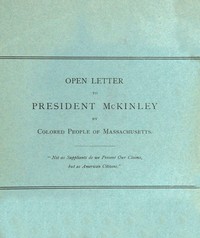
OPEN LETTER
TO
PRESIDENT McKINLEY
BY
COLORED PEOPLE OF MASSACHUSETTS.
--------------
“_Not as Suppliants do we Present Our Claims,
but as American Citizens._”
------------------------------------------------------------------------
OPEN LETTER
TO
PRESIDENT McKINLEY
BY
COLORED PEOPLE OF MASSACHUSETTS.
---------------------
“_Not as Suppliants do we Present Our Claims,
but as American Citizens._”
---------------------
The Colored People of Boston and vicinity, through the COLORED NATIONAL
LEAGUE, at a mass meeting held in the Charles Street Church, Tuesday
evening, October 3d, 1899, addressed an Open Letter to PRESIDENT
MCKINLEY.
The reading of the letter by MR. ARCHIBALD H. GRIMKÉ, Chairman of the
Committee, was listened to with marked attention and interest, and at
the conclusion of its reading the letter was adopted by the meeting with
significant unanimity.
The letter was forwarded to President McKinley, signed by the officers
of the meeting and others.
BOSTON, MASS., October 3, 1899.
Hon. WILLIAM MCKINLEY,
_President of the United States_,
SIR:—
We, colored people of Massachusetts in mass meeting assembled to
consider our oppressions and the state of the country relative
to the same, have resolved to address ourselves to you in an
open letter, notwithstanding your extraordinary, your
incomprehensible silence on the subject of our wrongs in your
annual and other messages to Congress, as in your public
utterances to the country at large. We address ourselves to you,
sir, not as suppliants, but as of right, as American citizens,
whose servant you are, and to whom you are bound to listen, and
for whom you are equally bound to speak, and upon occasion to
act, as for any other body of your fellow-countrymen in like
circumstances. We ask nothing for ourselves at your hands, as
chief magistrate of the republic, to which all American citizens
are not entitled. We ask for the enjoyment of life, liberty, and
the pursuit of happiness equally with other men. We ask for the
free and full exercise of all the rights of American freemen,
guaranteed to us by the Constitution and laws of the Union,
which you were solemnly sworn to obey and execute. We ask you
for what belongs to us by the high sanction of Constitution and
law, and the Democratic genius of our institutions and
civilization. These rights are everywhere throughout the South
denied to us, violently wrested from us by mobs, by lawless
legislatures, and nullifying conventions, combinations, and
conspiracies, openly, defiantly, under your eyes, in your
constructive and actual presence. And we demand, which is a part
of our rights, protection, security in our life, our liberty,
and in the pursuit of our individual and social happiness under
a government, which we are bound to defend in war, and which is
equally bound to furnish us in peace protection, at home and
abroad.
We have suffered, sir,—God knows how much we have
suffered!—since your accession to office, at the hands of a
country professing to be Christian, but which is not Christian,
from the hate and violence of a people claiming to be civilized,
but who are not civilized, and you have seen our sufferings,
witnessed from your high place our awful wrongs and miseries,
and yet you have at no time and on no occasion opened your lips
in our behalf. Why? we ask. Is it because we are black and weak
and despised? Are you silent because without any fault of our
own we were enslaved and held for more than two centuries in
cruel bondage by your forefathers? Is it because we bear the
marks of those sad generations of Anglo-Saxon brutality and
wickedness, that you do not speak? Is it our fault that our
involuntary servitude produced in us widespread ignorance,
poverty and degradation? Are we to be damned and destroyed by
the whites because we have only grown the seeds which they
planted? Are we to be damned by bitter laws and destroyed by the
mad violence of mobs because we are what white men made us? And
is there no help in the federal arm for us, or even one word of
audible pity, protest and remonstrance in your own breast, Mr.
President, or in that of a single member of your Cabinet? Black
indeed we are, sir, but we are also men and American citizens.
From the year 1619 the Anglo-Saxon race in America began to sow
in the mind of the negro race in America seeds of ignorance,
poverty and social degradation, and continued to do so until the
year 1863, when chattel slavery was abolished to save the union
of these states. Then northern white men began, in order to form
a more perfect union, to sow this self-same mind of the negro
with quite different seeds,—seeds of knowledge and freedom;
seeds garnered in the Declaration of Independence for the
feeding of the nations of the earth, such as the natural
equality of all men before the law, their inalienable right to
life, liberty and the pursuit of happiness, and the derivation
of the powers of all just governments from the consent of the
governed. These seeds of your own planting took root in the mind
and heart of the negro, and the crop of quickening intelligence,
desire for wealth, to rise in the social scale, to be as other
men, to be equal with them in opportunities and the free play of
his powers in the rivalry of life, was the direct and legitimate
result.
The struggle of the negro to rise out of his ignorance, his
poverty and his social degradation, in consequence of the growth
of these new forces and ideas within him, to the full stature of
his American citizenship, has been met everywhere in the South
by the active ill-will and determined race-hatred and opposition
of the white people of that section. Turn where he will, he
encounters this cruel and implacable spirit. He dare not speak
openly the thoughts which rise in his breast. He has wrongs such
as have never in modern times been inflicted on a people, and
yet he must be dumb in the midst of a nation which prates loudly
of democracy and humanity, boasts itself the champion of
oppressed peoples abroad, while it looks on indifferent,
apathetic, at appalling enormities and iniquities at home, where
the victims are black and the criminals white. The suppression,
the terror wrought at the South is so complete, so ever-present,
so awful, that no negro’s life or property is safe for a day who
ventures to raise his voice to heaven in indignant protest and
appeal against the deep damnation and despotism of such a social
state. Even teachers and leaders of this poor, oppressed and
patient people may not speak, lest their institutions of
learning and industry, and their own lives pay for their
temerity at the swift hands of savage mobs. But if the peace of
Warsaw, the silence of death reign over our people and their
leaders at the South, we of Massachusetts are free, and must and
shall raise our voice to you and through you to the country, in
solemn protest and warning against the fearful sin and peril of
such explosive social conditions. We, sir, at this crisis and
extremity in the life of our race in the South, and in this
crisis and extremity of the republic as well, in the presence of
the civilized world, cry to you to pause, if but for an hour, in
pursuit of your national policy of “criminal aggression” abroad
to consider the “criminal aggression” at home against humanity
and American citizenship, which is in the full tide of
successful conquest at the South, and the tremendous
consequences to our civilization, and the durability of the
Union itself, of this universal subversion of the supreme law of
the land, of democratic institutions, and of the precious
principle of the religion of Jesus in the social and civil life
of the Southern people.
With one accord, with an anxiety that wrenched our hearts with
cruel hopes and fears, the colored people of the United States
turned to you when Wilmington, N.C., was held for two dreadful
days and nights in the clutch of a bloody revolution; when
negroes, guilty of no crime except the color of their skin and
a desire to exercise the rights of their American citizenship,
were butchered like dogs in the streets of that ill-fated
town; and when government of the people by the people and for
the people perished in your very presence by the hands of
violent men during those bitter November days, for want of
federal aid, which you would not and did not furnish, on the
plea that you could not give what was not asked for by a
coward and recreant governor. And we well understood at the
time, sir, notwithstanding your plea of constitutional
inability to cope with the rebellion in Wilmington, that where
there is a will with constitutional lawyers and rulers there
is always a way, and where there is no will there is no way.
We well knew that you lacked the will, and, therefore, the way
to meet that emergency.
It was the same thing with that terrible ebullition of the mob
spirit at Phœnix, S.C., when black men were hunted and murdered,
and white men shot and driven out of that place by a set of
white savages, who cared not for the Constitution and the laws
of the United States any more than they do for the constitution
and the laws of an empire dead and buried a thousand years. We
looked in vain for some word or some act from you. Neither word
nor act of sympathy for the victims was forthcoming, or of
detestation of an outrage so mad and barbarous as to evoke even
from such an extreme Southern organ as is the _News and
Courier_, of Charleston, S.C., hot and stern condemnation.
Hoping against hope, we waited for your annual message to
Congress in December last, knowing that the Constitution imposed
upon you a duty to give, from time to time, to that body
information of the state of the Union. That, at least, we said,
the President will surely do; he will communicate officially the
facts relative to the tragic, the appalling events, which had
just occurred in the Carolinas to the Congress of the United
States. But not one word did your message contain on this
subject, although it discussed all sorts and conditions of
subjects, from the so-called war for humanity against Spain to
the celebration of the one hundredth anniversary of the founding
of the national capital in 1900. Nothing escaped your eye, at
home or abroad, nothing except the subversion of the
Constitution and laws of the Union in the Southern States, and
the flagrant and monstrous crimes perpetrated upon a weak and
submissive race in defiance of your authority, or in virtual
connivance therewith. Yes, sir, we repeat, or in virtual
connivance therewith.
And, when you made your Southern tour a little later, and we saw
how cunningly you catered to Southern race prejudice and
proscription; how you, the one single public man and magistrate
of the country, who, by virtue of your exalted office, ought
under no circumstances to recognize caste distinctions and
discriminations among your fellow-citizens, received white men
at the Capitol in Montgomery, Ala., and black men afterward in a
negro church; how you preached patience, industry moderation to
your long-suffering black fellow-citizens, and patriotism,
jingoism and imperialism to your white ones; when we saw all
these things, scales of illusion in respect to your object fell
from our eyes. We felt that the President of the United States,
in order to win the support of the South to his policy of
“criminal aggression” in the far East, was ready and willing to
shut his eyes, ears and lips to the “criminal aggression” of
that section against the Constitution and the laws of the land,
wherein they guarantee civil rights and citizenship to the
negro, whose ultimate reduction to a condition of fixed and
abject serfdom is the plain purpose of the Southern people and
their laws.
When, several months subsequently, you returned to Georgia, the
mob spirit, as if to evince its supreme contempt for your
presence and the federal executive authority which you
represent, boldly broke into a prison shed, where were confined
helpless negro prisoners on a charge of incendiarism, and
brutally murdered five of them. These men were American
citizens, entitled to the rights of American citizens,
protection and trial by due process of law. They were, in the
eye of the law, innocent until convicted by a jury of their
peers. Had they been in legal custody in Russia or Spain or
Turkey they had not been slaughtered by a mob under like
circumstances; for the Russian military power, or the Spanish or
the Turkish, would have guarded those men in their helpless and
defenseless condition from the fury of the populace who were
seeking their blood. Sir, they were men; they were your
brothers; they were God’s children, for whom Jesus lived and
died. They ought to have been sacred charges in the hands of any
civilized or semi-civilized State and people. But almost in your
hearing, before your eyes (and you the chief magistrate of a
country loudly boastful of its freedom, Christianity and
civilization), they were atrociously murdered. Did you speak?
did you open your lips to express horror of the awful crime and
stern condemnation of the incredible villainy and complicity of
the constituted authorities of Georgia in the commission of this
monstrous outrage, which out-barbarized barbarism and stained
through and through with indelible infamy before the world your
country’s justice, honor and humanity?
Still later, considering the age, the circumstances and the
nation in which the deed was done, Georgia committed a crime
unmatched for moral depravity and sheer atrocity during the
century. A negro, charged with murder and criminal assault, the
first charge he is reported by the newspapers to have admitted,
and the second to have denied, was taken one quiet Sunday
morning from his captors, and burned to death with indescribable
and hellish cruelty in the presence of cheering thousands of the
so-called best people of Georgia, men, women and children, who
had gone forth on the Christian Sabbath to the burning of a
human being as to a country festival and holiday of innocent
enjoyment and amusement. The downright ferocity and frightful
savagery of that American mob at Newnan outdoes the holiday
humor and thirst for blood of the tiger-like populace of Pagan
Rome, gathered to witness Christian martyrs thrown to lions in
their roaring arenas. The death of Hose was quickly followed by
that of the negro preacher, Strickland, guiltless of crime,
under circumstances and with a brutality of wickedness almost
matching in horror and enormity the torture and murder of the
first; and this last was succeeded by a third victim, who was
literally lashed to death by the wild, beast-like spirit of a
Georgia mob, for daring merely to utter his abhorrence of the
Palmetto iniquity and slaughter of helpless prisoners.
Did you speak? Did you utter one word of reprobation, of
righteous indignation, either as magistrate or as man? Did you
break the shameful silence of shameful months with so much as a
whisper of a whisper against the deep damnation of such defiance
of all law, human and divine; such revulsion of men into beasts,
and relapses of communities into barbarism in the very center of
the republic, and amid the sanctuary of the temple of American
liberty itself? You did not, sir, but your Attorney-General did,
and he only to throw out to the public, to your meek and
long-suffering colored fellow citizens, the cold and cautious
legal opinion that the case of Hose has no federal aspect! Mr.
President, has it any moral or human aspect, seeing that Hose
was a member of the negro race, whom your Supreme Court once
declared has no rights in America which white men are bound to
respect? Is this infamous dictum of that tribunal still the
supreme law of the land? We ask you, sir, since recent events in
Arkansas, Mississippi, Alabama, Virginia and Louisiana, as well
as in Georgia and the Carolinas, indeed throughout the South,
and your own persistent silence, and the persistent silence of
every member of your Cabinet on the subject of the wrongs of
that race in those States, would appear together to imply as
much.
Had, eighteen months ago, the Cuban revolution to throw off the
yoke of Spain, or the attempt of Spain to subdue the Cuban
rebellion, any federal aspect? We believe that you and the
Congress of the United States thought that they had, and
therefore used, finally, the armed force of the nation to expel
Spain from that island. Why? Was it because “the people of the
Island of Cuba are, and of right ought to be free and
independent?” You and the Congress said as much, and may we
fervently pray, sir, in passing, that the freedom and
independence of that brave people shall not much longer be
denied them by our government? But to resume, there was another
consideration which, in your judgment, gave to the Cuban
question a federal aspect, which provoked at last the armed
interposition of our government in the affairs of that island,
and this was “the chronic condition of disturbance in Cuba so
injurious and menacing to our interests and tranquillity, as
well as shocking to our sentiments of humanity.” Wherefore you
presently fulfilled “a duty to humanity by ending a situation,
the indefinite prolongation of which had become insufferable.”
Mr. President, had that “chronic condition of disturbance in
Cuba so injurious and menacing to our interests and tranquillity
as well as shocking to our sentiments of humanity,” which you
wished to terminate and did terminate, a federal aspect, while
that not less “chronic condition of disturbance” in the South,
which is a thousand times more “injurious and menacing to our
interests and tranquillity,” as well as far more “shocking to
our sentiments of humanity,” or ought to be, none whatever? Is
it better to be Cuban revolutionists fighting for Cuban
independence than American citizens striving to do their simple
duty at home? Or is it better only in case those American
citizens doing their simple duty at home happen to be negroes
residing in the Southern States?
Are crying national transgressions and injustices more
“injurious and menacing” to the Republic, as well as “shocking
to its sentiments of humanity,” when committed by a foreign
state, in foreign territory, against a foreign people, than when
they are committed by a portion of our own people against a
portion of our own people at home? There were those of our
citizens who did not think that the Cuban question possessed any
federal aspect, while there were others who thought otherwise;
and these, having the will and the power, eventually found a way
to suppress a menacing danger to the country and a wrong against
humanity at the same time. Where there is a will among
constitutional lawyers and rulers, Mr. President, there is ever
a way; but where there is no will, there is no way. Shall it be
said that the federal government, with arms of Briareus,
reaching to the utmost limits of the habitable globe for the
protection of its citizens, for the liberation of alien
islanders and the subjugation of others, is powerless to
guarantee to certain of its citizens at home their inalienable
right to life, liberty and the pursuit of happiness, because
those citizens happen to be negroes residing in the Southern
section of our country? Do the colored people of the United
States deserve equal consideration with the Cuban people at the
hands of your administration, and shall they, though late,
receive it? If, sir, you have the disposition, as we know that
you have the power, we are confident that you will be able to
find a constitutional way to reach us in our extremity, and our
enemies also, who are likewise enemies to great public interests
and national tranquillity.
I. D. BARNETT, _President_.
EDWARD E. BROWN, _Vice-President_.
EDWARD H. WEST, _Secretary_.
ARCHIBALD H. GRIMKÉ.
EDWIN G. WALKER.
JAMES H. WOLFF.
EMERY T. MORRIS.
WILLIAM O. ARMSTRONG.
THOMAS P. TAYLOR
AND OTHERS.
------------------------------------------------------------------------
● Transcriber’s Notes:
○ The spelling of “defenseless” was corrected to
“defenseless” on page 7.
○ Text that was in italics is enclosed by underscores
(_italics_).
End of the Project Gutenberg EBook of Open Letter to President McKinley by
Colored People of Massachusetts, by Colored National League
*** END OF THIS PROJECT GUTENBERG EBOOK OPEN LETTER TO PRESIDENT MCKINLEY ***
***** This file should be named 58623-0.txt or 58623-0.zip *****
This and all associated files of various formats will be found in:
http://www.gutenberg.org/5/8/6/2/58623/
Produced by hekula03, Barry Abrahamsen, and the Online
Distributed Proofreading Team at http://www.pgdp.net (This
book was produced from images made available by the
HathiTrust Digital Library.)
Updated editions will replace the previous one--the old editions will
be renamed.
Creating the works from print editions not protected by U.S. copyright
law means that no one owns a United States copyright in these works,
so the Foundation (and you!) can copy and distribute it in the United
States without permission and without paying copyright
royalties. Special rules, set forth in the General Terms of Use part
of this license, apply to copying and distributing Project
Gutenberg-tm electronic works to protect the PROJECT GUTENBERG-tm
concept and trademark. Project Gutenberg is a registered trademark,
and may not be used if you charge for the eBooks, unless you receive
specific permission. If you do not charge anything for copies of this
eBook, complying with the rules is very easy. You may use this eBook
for nearly any purpose such as creation of derivative works, reports,
performances and research. They may be modified and printed and given
away--you may do practically ANYTHING in the United States with eBooks
not protected by U.S. copyright law. Redistribution is subject to the
trademark license, especially commercial redistribution.
START: FULL LICENSE
THE FULL PROJECT GUTENBERG LICENSE
PLEASE READ THIS BEFORE YOU DISTRIBUTE OR USE THIS WORK
To protect the Project Gutenberg-tm mission of promoting the free
distribution of electronic works, by using or distributing this work
(or any other work associated in any way with the phrase "Project
Gutenberg"), you agree to comply with all the terms of the Full
Project Gutenberg-tm License available with this file or online at
www.gutenberg.org/license.
Section 1. General Terms of Use and Redistributing Project
Gutenberg-tm electronic works
1.A. By reading or using any part of this Project Gutenberg-tm
electronic work, you indicate that you have read, understand, agree to
and accept all the terms of this license and intellectual property
(trademark/copyright) agreement. If you do not agree to abide by all
the terms of this agreement, you must cease using and return or
destroy all copies of Project Gutenberg-tm electronic works in your
possession. If you paid a fee for obtaining a copy of or access to a
Project Gutenberg-tm electronic work and you do not agree to be bound
by the terms of this agreement, you may obtain a refund from the
person or entity to whom you paid the fee as set forth in paragraph
1.E.8.
1.B. "Project Gutenberg" is a registered trademark. It may only be
used on or associated in any way with an electronic work by people who
agree to be bound by the terms of this agreement. There are a few
things that you can do with most Project Gutenberg-tm electronic works
even without complying with the full terms of this agreement. See
paragraph 1.C below. There are a lot of things you can do with Project
Gutenberg-tm electronic works if you follow the terms of this
agreement and help preserve free future access to Project Gutenberg-tm
electronic works. See paragraph 1.E below.
1.C. The Project Gutenberg Literary Archive Foundation ("the
Foundation" or PGLAF), owns a compilation copyright in the collection
of Project Gutenberg-tm electronic works. Nearly all the individual
works in the collection are in the public domain in the United
States. If an individual work is unprotected by copyright law in the
United States and you are located in the United States, we do not
claim a right to prevent you from copying, distributing, performing,
displaying or creating derivative works based on the work as long as
all references to Project Gutenberg are removed. Of course, we hope
that you will support the Project Gutenberg-tm mission of promoting
free access to electronic works by freely sharing Project Gutenberg-tm
works in compliance with the terms of this agreement for keeping the
Project Gutenberg-tm name associated with the work. You can easily
comply with the terms of this agreement by keeping this work in the
same format with its attached full Project Gutenberg-tm License when
you share it without charge with others.
1.D. The copyright laws of the place where you are located also govern
what you can do with this work. Copyright laws in most countries are
in a constant state of change. If you are outside the United States,
check the laws of your country in addition to the terms of this
agreement before downloading, copying, displaying, performing,
distributing or creating derivative works based on this work or any
other Project Gutenberg-tm work. The Foundation makes no
representations concerning the copyright status of any work in any
country outside the United States.
1.E. Unless you have removed all references to Project Gutenberg:
1.E.1. The following sentence, with active links to, or other
immediate access to, the full Project Gutenberg-tm License must appear
prominently whenever any copy of a Project Gutenberg-tm work (any work
on which the phrase "Project Gutenberg" appears, or with which the
phrase "Project Gutenberg" is associated) is accessed, displayed,
performed, viewed, copied or distributed:
This eBook is for the use of anyone anywhere in the United States and
most other parts of the world at no cost and with almost no
restrictions whatsoever. You may copy it, give it away or re-use it
under the terms of the Project Gutenberg License included with this
eBook or online at www.gutenberg.org. If you are not located in the
United States, you'll have to check the laws of the country where you
are located before using this ebook.
1.E.2. If an individual Project Gutenberg-tm electronic work is
derived from texts not protected by U.S. copyright law (does not
contain a notice indicating that it is posted with permission of the
copyright holder), the work can be copied and distributed to anyone in
the United States without paying any fees or charges. If you are
redistributing or providing access to a work with the phrase "Project
Gutenberg" associated with or appearing on the work, you must comply
either with the requirements of paragraphs 1.E.1 through 1.E.7 or
obtain permission for the use of the work and the Project Gutenberg-tm
trademark as set forth in paragraphs 1.E.8 or 1.E.9.
1.E.3. If an individual Project Gutenberg-tm electronic work is posted
with the permission of the copyright holder, your use and distribution
must comply with both paragraphs 1.E.1 through 1.E.7 and any
additional terms imposed by the copyright holder. Additional terms
will be linked to the Project Gutenberg-tm License for all works
posted with the permission of the copyright holder found at the
beginning of this work.
1.E.4. Do not unlink or detach or remove the full Project Gutenberg-tm
License terms from this work, or any files containing a part of this
work or any other work associated with Project Gutenberg-tm.
1.E.5. Do not copy, display, perform, distribute or redistribute this
electronic work, or any part of this electronic work, without
prominently displaying the sentence set forth in paragraph 1.E.1 with
active links or immediate access to the full terms of the Project
Gutenberg-tm License.
1.E.6. You may convert to and distribute this work in any binary,
compressed, marked up, nonproprietary or proprietary form, including
any word processing or hypertext form. However, if you provide access
to or distribute copies of a Project Gutenberg-tm work in a format
other than "Plain Vanilla ASCII" or other format used in the official
version posted on the official Project Gutenberg-tm web site
(www.gutenberg.org), you must, at no additional cost, fee or expense
to the user, provide a copy, a means of exporting a copy, or a means
of obtaining a copy upon request, of the work in its original "Plain
Vanilla ASCII" or other form. Any alternate format must include the
full Project Gutenberg-tm License as specified in paragraph 1.E.1.
1.E.7. Do not charge a fee for access to, viewing, displaying,
performing, copying or distributing any Project Gutenberg-tm works
unless you comply with paragraph 1.E.8 or 1.E.9.
1.E.8. You may charge a reasonable fee for copies of or providing
access to or distributing Project Gutenberg-tm electronic works
provided that
* You pay a royalty fee of 20% of the gross profits you derive from
the use of Project Gutenberg-tm works calculated using the method
you already use to calculate your applicable taxes. The fee is owed
to the owner of the Project Gutenberg-tm trademark, but he has
agreed to donate royalties under this paragraph to the Project
Gutenberg Literary Archive Foundation. Royalty payments must be paid
within 60 days following each date on which you prepare (or are
legally required to prepare) your periodic tax returns. Royalty
payments should be clearly marked as such and sent to the Project
Gutenberg Literary Archive Foundation at the address specified in
Section 4, "Information about donations to the Project Gutenberg
Literary Archive Foundation."
* You provide a full refund of any money paid by a user who notifies
you in writing (or by e-mail) within 30 days of receipt that s/he
does not agree to the terms of the full Project Gutenberg-tm
License. You must require such a user to return or destroy all
copies of the works possessed in a physical medium and discontinue
all use of and all access to other copies of Project Gutenberg-tm
works.
* You provide, in accordance with paragraph 1.F.3, a full refund of
any money paid for a work or a replacement copy, if a defect in the
electronic work is discovered and reported to you within 90 days of
receipt of the work.
* You comply with all other terms of this agreement for free
distribution of Project Gutenberg-tm works.
1.E.9. If you wish to charge a fee or distribute a Project
Gutenberg-tm electronic work or group of works on different terms than
are set forth in this agreement, you must obtain permission in writing
from both the Project Gutenberg Literary Archive Foundation and The
Project Gutenberg Trademark LLC, the owner of the Project Gutenberg-tm
trademark. Contact the Foundation as set forth in Section 3 below.
1.F.
1.F.1. Project Gutenberg volunteers and employees expend considerable
effort to identify, do copyright research on, transcribe and proofread
works not protected by U.S. copyright law in creating the Project
Gutenberg-tm collection. Despite these efforts, Project Gutenberg-tm
electronic works, and the medium on which they may be stored, may
contain "Defects," such as, but not limited to, incomplete, inaccurate
or corrupt data, transcription errors, a copyright or other
intellectual property infringement, a defective or damaged disk or
other medium, a computer virus, or computer codes that damage or
cannot be read by your equipment.
1.F.2. LIMITED WARRANTY, DISCLAIMER OF DAMAGES - Except for the "Right
of Replacement or Refund" described in paragraph 1.F.3, the Project
Gutenberg Literary Archive Foundation, the owner of the Project
Gutenberg-tm trademark, and any other party distributing a Project
Gutenberg-tm electronic work under this agreement, disclaim all
liability to you for damages, costs and expenses, including legal
fees. YOU AGREE THAT YOU HAVE NO REMEDIES FOR NEGLIGENCE, STRICT
LIABILITY, BREACH OF WARRANTY OR BREACH OF CONTRACT EXCEPT THOSE
PROVIDED IN PARAGRAPH 1.F.3. YOU AGREE THAT THE FOUNDATION, THE
TRADEMARK OWNER, AND ANY DISTRIBUTOR UNDER THIS AGREEMENT WILL NOT BE
LIABLE TO YOU FOR ACTUAL, DIRECT, INDIRECT, CONSEQUENTIAL, PUNITIVE OR
INCIDENTAL DAMAGES EVEN IF YOU GIVE NOTICE OF THE POSSIBILITY OF SUCH
DAMAGE.
1.F.3. LIMITED RIGHT OF REPLACEMENT OR REFUND - If you discover a
defect in this electronic work within 90 days of receiving it, you can
receive a refund of the money (if any) you paid for it by sending a
written explanation to the person you received the work from. If you
received the work on a physical medium, you must return the medium
with your written explanation. The person or entity that provided you
with the defective work may elect to provide a replacement copy in
lieu of a refund. If you received the work electronically, the person
or entity providing it to you may choose to give you a second
opportunity to receive the work electronically in lieu of a refund. If
the second copy is also defective, you may demand a refund in writing
without further opportunities to fix the problem.
1.F.4. Except for the limited right of replacement or refund set forth
in paragraph 1.F.3, this work is provided to you 'AS-IS', WITH NO
OTHER WARRANTIES OF ANY KIND, EXPRESS OR IMPLIED, INCLUDING BUT NOT
LIMITED TO WARRANTIES OF MERCHANTABILITY OR FITNESS FOR ANY PURPOSE.
1.F.5. Some states do not allow disclaimers of certain implied
warranties or the exclusion or limitation of certain types of
damages. If any disclaimer or limitation set forth in this agreement
violates the law of the state applicable to this agreement, the
agreement shall be interpreted to make the maximum disclaimer or
limitation permitted by the applicable state law. The invalidity or
unenforceability of any provision of this agreement shall not void the
remaining provisions.
1.F.6. INDEMNITY - You agree to indemnify and hold the Foundation, the
trademark owner, any agent or employee of the Foundation, anyone
providing copies of Project Gutenberg-tm electronic works in
accordance with this agreement, and any volunteers associated with the
production, promotion and distribution of Project Gutenberg-tm
electronic works, harmless from all liability, costs and expenses,
including legal fees, that arise directly or indirectly from any of
the following which you do or cause to occur: (a) distribution of this
or any Project Gutenberg-tm work, (b) alteration, modification, or
additions or deletions to any Project Gutenberg-tm work, and (c) any
Defect you cause.
Section 2. Information about the Mission of Project Gutenberg-tm
Project Gutenberg-tm is synonymous with the free distribution of
electronic works in formats readable by the widest variety of
computers including obsolete, old, middle-aged and new computers. It
exists because of the efforts of hundreds of volunteers and donations
from people in all walks of life.
Volunteers and financial support to provide volunteers with the
assistance they need are critical to reaching Project Gutenberg-tm's
goals and ensuring that the Project Gutenberg-tm collection will
remain freely available for generations to come. In 2001, the Project
Gutenberg Literary Archive Foundation was created to provide a secure
and permanent future for Project Gutenberg-tm and future
generations. To learn more about the Project Gutenberg Literary
Archive Foundation and how your efforts and donations can help, see
Sections 3 and 4 and the Foundation information page at
www.gutenberg.org
Section 3. Information about the Project Gutenberg Literary Archive Foundation
The Project Gutenberg Literary Archive Foundation is a non profit
501(c)(3) educational corporation organized under the laws of the
state of Mississippi and granted tax exempt status by the Internal
Revenue Service. The Foundation's EIN or federal tax identification
number is 64-6221541. Contributions to the Project Gutenberg Literary
Archive Foundation are tax deductible to the full extent permitted by
U.S. federal laws and your state's laws.
The Foundation's principal office is in Fairbanks, Alaska, with the
mailing address: PO Box 750175, Fairbanks, AK 99775, but its
volunteers and employees are scattered throughout numerous
locations. Its business office is located at 809 North 1500 West, Salt
Lake City, UT 84116, (801) 596-1887. Email contact links and up to
date contact information can be found at the Foundation's web site and
official page at www.gutenberg.org/contact
For additional contact information:
Dr. Gregory B. Newby
Chief Executive and Director
[email protected]
Section 4. Information about Donations to the Project Gutenberg
Literary Archive Foundation
Project Gutenberg-tm depends upon and cannot survive without wide
spread public support and donations to carry out its mission of
increasing the number of public domain and licensed works that can be
freely distributed in machine readable form accessible by the widest
array of equipment including outdated equipment. Many small donations
($1 to $5,000) are particularly important to maintaining tax exempt
status with the IRS.
The Foundation is committed to complying with the laws regulating
charities and charitable donations in all 50 states of the United
States. Compliance requirements are not uniform and it takes a
considerable effort, much paperwork and many fees to meet and keep up
with these requirements. We do not solicit donations in locations
where we have not received written confirmation of compliance. To SEND
DONATIONS or determine the status of compliance for any particular
state visit www.gutenberg.org/donate
While we cannot and do not solicit contributions from states where we
have not met the solicitation requirements, we know of no prohibition
against accepting unsolicited donations from donors in such states who
approach us with offers to donate.
International donations are gratefully accepted, but we cannot make
any statements concerning tax treatment of donations received from
outside the United States. U.S. laws alone swamp our small staff.
Please check the Project Gutenberg Web pages for current donation
methods and addresses. Donations are accepted in a number of other
ways including checks, online payments and credit card donations. To
donate, please visit: www.gutenberg.org/donate
Section 5. General Information About Project Gutenberg-tm electronic works.
Professor Michael S. Hart was the originator of the Project
Gutenberg-tm concept of a library of electronic works that could be
freely shared with anyone. For forty years, he produced and
distributed Project Gutenberg-tm eBooks with only a loose network of
volunteer support.
Project Gutenberg-tm eBooks are often created from several printed
editions, all of which are confirmed as not protected by copyright in
the U.S. unless a copyright notice is included. Thus, we do not
necessarily keep eBooks in compliance with any particular paper
edition.
Most people start at our Web site which has the main PG search
facility: www.gutenberg.org
This Web site includes information about Project Gutenberg-tm,
including how to make donations to the Project Gutenberg Literary
Archive Foundation, how to help produce our new eBooks, and how to
subscribe to our email newsletter to hear about new eBooks.
Open Letter to President McKinley by Colored People of Massachusetts
Download Formats:
Excerpt
The Project Gutenberg EBook of Open Letter to President McKinley by
Colored People of Massachusetts, by Colored National League
This eBook is for the use of anyone anywhere in the United States and most
other parts of the world at no cost and with almost no restrictions
whatsoever. You may copy it, give it away or re-use it under the terms of
the Project Gutenberg License included with this eBook or online at
www.gutenberg.org. If you are not located in the United States, you'll have...
Read the Full Text
— End of Open Letter to President McKinley by Colored People of Massachusetts —
Book Information
- Title
- Open Letter to President McKinley by Colored People of Massachusetts
- Author(s)
- Colored National League
- Language
- English
- Type
- Text
- Release Date
- January 6, 2019
- Word Count
- 6,608 words
- Library of Congress Classification
- E151
- Bookshelves
- Browsing: Culture/Civilization/Society, Browsing: History - American, Browsing: Politics
- Rights
- Public domain in the USA.
Related Books
Three addresses on the relations subsisting between the white and colored people of the United States
by Douglass, Frederick
English
471h 54m read
The Jim Crow Car; Or, Denouncement of injustice meted out to the black race
by Coleman, J. C. (John Clay)
English
500h 50m read
How the National Association for the Advancement of Colored People Began
by Ovington, Mary White
English
104h 46m read