The Project Gutenberg EBook of Our Union and its Defenders, by J. Howard Pugh
This eBook is for the use of anyone anywhere in the United States and most
other parts of the world at no cost and with almost no restrictions
whatsoever. You may copy it, give it away or re-use it under the terms of
the Project Gutenberg License included with this eBook or online at
www.gutenberg.org. If you are not located in the United States, you'll have
to check the laws of the country where you are located before using this ebook.
Title: Our Union and its Defenders
An Oration, Delivered Before the Citizens of Burlington,
N. J., on the Occasion of Their Celebration of the
Eighty-Sixth Anniversary of Independence Day, July 4th, 1862
Author: J. Howard Pugh
Release Date: July 10, 2019 [EBook #59890]
Language: English
Character set encoding: UTF-8
*** START OF THIS PROJECT GUTENBERG EBOOK OUR UNION AND ITS DEFENDERS ***
Produced by Donald Cummings and the Online Distributed
Proofreading Team at http://www.pgdp.net (This file was
produced from images generously made available by The
Internet Archive/American Libraries.)
Our Union and its Defenders:
AN ORATION,
DELIVERED BEFORE THE CITIZENS OF BURLINGTON, N. J.,
ON THE OCCASION OF THEIR CELEBRATION OF THE
EIGHTY-SIXTH ANNIVERSARY OF INDEPENDENCE DAY,
JULY 4th, 1862.
BY J. HOWARD PUGH, M. D.
PHILADELPHIA:
KING & BAIRD, PRINTERS, No. 607 SANSOM STREET.
1862.
CORRESPONDENCE.
_Burlington, July 8th, 1862._
DOCT. J. HOWARD PUGH,
DEAR SIR:
Having listened, with so much pleasure and profit, to the appropriate
and impressive address with which you favored us upon the occasion of
the recent celebration of “Independence Day,” we feel that we would
be failing in duty to those of our fellow-citizens who were deprived
of that gratification, were we to allow the occasion to go by and
be forgotten, without taking measures to have your remarks placed
upon record, and to secure their dissemination among the reading and
thinking members of the community. Our own sentiments are so ably
and admirably expressed therein, that we wish to have the privilege
of presenting them in that shape to all our friends, not only in our
own community, but wherever we can reach them――for even by those who
assisted at the original delivery, they will bear perusing often and
pondering well. We trust they will carry conviction to the misguided,
and strengthen the convictions of the wavering. With this view, we
would request the favor of a copy of your address, for publication.
Very respectfully,
Your fellow citizens,
FRANKLIN WOOLMAN,
THOMAS ROBB,
THOS. MILNOR,
JOHN D. MOORE,
JOHN RODGERS,
N. T. HIGBIE,
M. KNOWLTON,
J. D. ABERCROMBIE,
RICH. SHIPPEN,
WM. R. ALLEN,
JAS. STERLING,
FRED. BROWN.
_Burlington, July 11th, 1862._
GENTLEMEN:
Your kind and flattering favor of the 8th inst., is before me. You can
judge better than I, and if you think there is anything, in my Oration,
at all likely to strengthen or enlighten the patriotism of a single
American, I shall cordially co-operate with you in publishing it. For,
however much I may fear that its usefulness will fall far short of your
wishes, yet, I know that no man now has a right to withhold a word, or
refuse a deed which he has any just reason to suppose will aid, in the
least, the cause of his country. Such reason you have given me in your
kind and partial estimate of my effort, and for this I sincerely thank
you.
Trusting that our beloved country, so dear to all our hearts, so
freighted with all our hopes, may soon emerge triumphant from the
fierce struggle with its foes,
I remain,
Very faithfully yours,
J. HOWARD PUGH.
To Messrs. WOOLMAN, ROBB, MILNOR and others, Committee.
OUR UNION AND ITS DEFENDERS.
In the ways of Providence, there is always fitness in the smallest as
in the greatest things. It is on the Fourth of July, in midsummer, that
we hold the anniversary festivals of American Independence. And it is
a beautiful ordering of the Providence that rules the seasons and the
nations, that the time of these anniversaries is so well suited to
the occasion. For it is fitting, that in the midst of glorious summer
days, when the earth lies richest in the sunlight; when the fields are
golden with the harvests; when the air is fragrant with the scent of
flowers and the new hay; when, in a word, the beauty and the bounty of
nature, unite to fill the heart with gladness and with gratitude, we
should meet in kindred joy and thankfulness to celebrate our nation’s
natal day. For sunshine is the symbol of prosperity, and summer the
symbol of peace; and the wondrous bounty of the season fitly typifies
the fruits of that civil and religious liberty, to establish which our
fathers pledged their lives, their fortunes and their sacred honour.
Not that all these anniversaries have been, or will be days of jubilee.
Not that the chill and sombreness of winter have not settled, will
not settle, upon some. For many stormy years were passed, before the
hope that dawned on that July morning in ’76 became a full and crowned
reality. And then, you remember the day of the grand jubilee proper,
the fiftieth anniversary of our Independence, when both Jefferson――the
author, and Adams――the most eloquent supporter, of the declaration,
died. And then, you remember to-day one year ago, when the American
Congress met in a beleaguered city, within the sound of rebel cannon,
with rebel ensigns flaunting almost in the face of the Capitol, met
in solemn and determined counsel to devise ways and means to save the
nation from destruction at the hands of its own misguided children.
And then, to-day; what shall I say of to-day? To-day, when sorrow
sits brooding in a million homes, when the shadow of civil war still
rests like a pall upon the nation, when in the beautiful Virginia that
Washington loved, his children are grappling in the struggle of death.
Still, it is true, that in the eighty odd years of our Independence
that have passed, there have been few of these anniversary days that
have not wholly been days of jubilee, and with the blessing of God
a little longer on our Union armies, there will be fewer yet in the
eighty years that are to come; fewer yet, I trust, in all the vast and
pregnant future upon which the summer will not smile in poetic fitness,
and which a grateful people will not greet with shouts of gladness and
with songs of praise.
We have all learned to revere the memory of the men who framed and
adopted the Declaration of Independence. All men and all nations
have learned to regard with admiration the energy, the courage, the
fortitude, the exhaustless patience with which our fathers fought
the battles of freedom and inaugurated on this continent the “great
experiment” of popular government. No one now dares to question the
wisdom of their policy, the lofty purity of their lives and purposes,
or the sublime quality of that heroic faith in the final triumph of
their cause, which never failed them in the darkest hours of their long
and bitter struggle to be free. There were tories _then_ all around
them, as there are tories _now_ in the war we are waging, but there is
no one _now_ to vouchsafe a word of praise on behalf of the tories of
the Revolution. They have sunk to that oblivion, or have earned that
unenviable immortality, which belongs to the lot of all who fail their
country in its hour of trial, and have neither voice nor sympathy but
for its enemies. Only those who aided the Colonies in their struggle
with Britain and remembered now with gratitude. And having been, for
eighty years and more, a great and prosperous and happy people, we
feel increasingly, as the years go by, that we cannot venerate the men
too highly, through whose blood and tears, and prayers and blessings,
we were made and kept a nation. On a day like this, and in these hours
of our history, facts like these have great significance.
It is one of the uses of history to teach us what are the noblest uses
of life; what deeds live longest in the memories of men; what motives
give greatest strength and nobility to character; what fruition follows
godlike sacrifices for truth and duty; what ideas and principles,
embodied in life, lift men above the common level and crown them with
immortal honours. It is one of the uses of a day like this to turn us
back to higher sources of inspiration, that we may be the more manfully
fitted for the duties of our time, that we may learn the cost of
liberty, and the worth of patriotism, and the sacredness of principle,
and the holiness of duty. It is one of the uses of a day like this to
teach us that our selfish aims and interests and motives, our lives of
luxury and frivolity, of leisure-loving and wealth-seeking, all sink
to a level of lowest significance, when contrasted with great heroic
virtues such as bore our fathers through the storm and struggle of
the Revolution. And when these lessons have been learned by a people,
and when in the Providence of God the darkest hours of their history
have come; when they are compelled themselves to strike for liberty
or see it perish; when they have risen to that height of patriotism
that they exclaim with old John Adams in ’76, that all that they have,
and all that they are, and all that they hope for in this life, they
are ready to stake upon the altar of their country; when, filled with
such inspiration, they go forth from homes of happiness and peace to
fields of carnage and of death, then, above all, does it belong to the
uses of a day like this to teach the mourning women of the land, and
the children that are fatherless, that these dying and dead soldiers
are one with the heroes of the Revolution; that our country’s history
will embalm their names with equal honour and a common love, and that
a grateful people throughout all the long and coming years will “keep
their memory green.”
And this shall be my theme to-day; to consider whither the nation our
fathers left us is drifting; to consider what we are fighting for; and
to enquire whether the heroes of the struggle of to-day do not deserve
equal honor with their illustrious sires. Nor have I any doubt of the
fitness of this theme for the time and the occasion. For our fathers
fought to create a nation. We fight to have that nation live, to keep
it one and indivisible, and vain were the struggles of the Revolution,
and vain the consecration of days like this to Revolutionary memories,
if they failed to bring out into highest prominence such deeds as those
of the past and passing year. Our fathers fought to create a nation.
And for eighty years there was no sublimer sight beneath the stars than
the nation they created. During these eighty years, this people grew
from three to thirty millions, from thirteen to thirty-four States.
They developed energies such as the world had seldom witnessed. With
marvellous rapidity they levelled forests and builded cities; they
tunnelled mountains, and cultivated valleys vast as empires; they made
their mountain streams turn mills and factories and bear on their
bosoms to the sea, and to all the world, the fruits of this industry
and the products of the land. They dug out from the bosom of the rocky
hills and from dark subterranean recesses a wealth greater than the
Indies, and made the wilderness above them to “bud and blossom as
the rose.” They grew to be a thinking, toiling, tireless people, and
turning from their material successes, they began to manifest progress
and proficiency in literature, in science and in art. And all along
they conducted a system of government which had no parallel in history,
the success of which was distrusted by many of our early statesmen and
by all the world beside. And high above all the evidences of their
wealth and power, above all the beauties and beneficence of their soil
and clime, rose the crowning fact that these teeming, toiling millions
were the freest people upon earth; that they enjoyed, in larger
measure than the world had ever known, the privileges and prerogatives
that belong to manhood, and that they held inviolably sacred, as their
fathers before them, their right to “life, liberty and the pursuit of
happiness.” I know to what criticism these remarks are open. I know
somewhat of the faults and follies of this age and nation. I know how
prone we are upon days like this to forget our mistakes, our follies
and our crimes, and to indulge in strains of national eulogy, and, I
confess, these strains I have rarely relished. I know, too, how common
is the autocratic talk that the equal rights, the enlarged liberties,
which our institutions secure to the citizen, tend only to license in
thought and speech, to fanaticism, to lawlessness, to disrespect of
authority, to no-government. And yet I know that it has not been the
bestowment of privileges upon the _many_, but the despotic domination
of the irresponsible _few_ that has always cursed humanity. And when
I remember how seldom in all the world the fundamental rights of man
have been ever recognized; how throughout all time the _millions_ have
been toiling, suffering, dying, to keep a few priests in power, or a
few tyrants on their thrones; how the _few_, whom the accidents of
birth or fortune have clothed with titles and dignities and powers,
fill all the spaces of history, while the patient masses figure only
as their suppliants and tools, then I am glad to turn to our eighty
years of history, and through all its mistakes and blemishes and
inconsistencies, to recognize the great central fact that has struggled
upon this continent into endless life, that the _rights_ of men _are_
equal, that men have higher uses than to become appendages of nobility
or parasites of royalty, that birth and blood are nothing, that names
and titles are nothing, that all the outward emblems of wealth and
greatness are nothing, compared with the rights which all men possess
in common, compared with the qualities with which God may, and often
does, endow the humblest born of earth.
And this Nation which our Fathers founded, and which thus expanded
into eighty years of such vigorous life; how fares it now? It is racked
and rent with civil war. In little more than a year, a hundred new
battle-fields have been added to its history. Whole States are given
up to desolation. The land is filled with mourners. Hearts are broken
to-day, that a year ago beat high with hope, and love, and happiness.
Childhood, and womanhood, and tottering age, its props all gone, are
mingling their tears and prayers to-day, in the bitterness of a sorrow
that will never end on earth.
I believe that the war now waged by our Northern armies is eminently
just and righteous, or the world has never seen one. I believe that
there never has been a time when the Government could have avoided the
conflict without unutterable dishonour, and that it will inherit and
deserve the contempt of humanity if it fail to continue the struggle
with the utmost vigor, until every atom of this rebellion is crushed
into annihilation. Whether this be the proper view to take of the war,
or not, is a question of momentous import. For, if not, how can we
find comfort for the mourners, who have sent forth the idols of their
households to die in its cause; or how can we fitly rebuke those who
would deepen these sorrows and dampen all patriotic ardor, by their
open sympathy with our enemies in arms? Therefore, does it become us
to ask and answer the question, “What are we fighting for?” What we
are _not_ fighting for is apparent enough. We are not fighting for
the abolition of slavery. We are not fighting, as Lord John Russell
says, for empire. We are not fighting from love of power――from
vindictiveness or hate. We are fighting simply for our own. We are
fighting to establish, on foundations eternal as our mountains, one
grand, stupendous, geographical fact, that the country and people
lying between “the St. John’s and the Rio Grande, between the Tortugas
Islands and Vancouver’s Land,” compose _one Nation_, and are called
“The United States of America.”
In a public address I delivered in this city, some years ago, occurred
these words, viz.: “All over the land, the politicians are echoing the
cry of disunion, but the people do not hear it, or do not heed it; they
are busy at their workshops, on their farms, doing daily duty, earning
daily bread, and they do not hear it; but when they do――when the talk
of politicians begins to shape itself to deeds――they will smother the
life out of this disunion cry.” I believed then, as I believe now, and
as events have proved, if rightly interpreted, that the common sense
of the common people――of the American masses――had long ago settled the
true value of the American Union. The intuitions of a people are better
than their logic. Their profoundest convictions make the least noise.
Not by argument――not by the talk of politicians, nor the expositions
of statesmen――but by the benefits and blessings that flow in upon them
through the passing years, do men learn to measure best the value of
their institutions. The greatest truths sink into the heart silently,
like the dews of Heaven. As the influences of home and of Christian
example mould and fix the character, so do the influences of good
government and beneficent institutions settle the convictions of a
people, unconsciously, noiselessly, but most profoundly. And it is
often true, that nothing but some great world upheaval can arouse men
to a consciousness of their slumbering powers, their sublime beliefs,
and duties, and perils. So still, and strong, and deep was the faith
of the American people in the perpetuity and inestimable worth of the
American Union, that they could not believe it was in danger. But when
they saw the danger, when they knew that rebel cannon were bombarding
Sumter, and that the United States flag had been shot from the walls of
a United States fort, then they rose. And when Banks was retreating,
a month ago, they rose again; and all that they have done, all the
treasure they have poured out, all the men they have sent to battle,
all the sacrifices they have made, all the evidences they have given of
an undying love of country, are nothing, _nothing_, compared with what
they yet will do, _before they will let this Union perish_.
Before the bombardment of Sumter, party prejudice and strife were
strong as ever. Men differed in opinion, and differed with great
bitterness, about all the measures of Government. The cabinet of
Buchanan became disintegrated with conflicting views of his policy.
This policy was praised by many――blamed by more. Equal differences of
opinion met the policy of the new President. Many thought his course
too timid and temporizing; many thought it too aggressive and bold, and
feared (to use their execrable language) that “it would exasperate the
South.” But when the bombardment came, then all men saw at a glance
that a Government that could not feed its own starving garrisons――that
could not command its own forts――was no government at all. They saw at
once that the struggle was one of life and death. And then the Nation
rose, and then the war began. The latent patriotism of the people, that
had been growing and intensifying for three-quarters of a century,
burst forth, at last, like a flame; and from that day to this, the only
question before us――the question to be decided by cannon, and bullets,
and bayonets――has been one of the existence of the American Union. And
whenever men now talk about conciliation, and compromise, and peace,
while five hundred thousand rebels are in arms, they are men of that
doubtful patriotism, which would not shrink to see the great American
Union blotted from the list of Nations.
I have my own opinions about the deep underlying causes that have
produced this war, and you have yours. But we will not discuss them
to-day. They would revive old party issues; they would jar upon the
proprieties of this occasion; they would detract from that unanimity
of thought and action which should characterize all true patriots in
the hour of a nation’s agony. The two facts that need to be remembered
are, that the South aims to destroy the Union, we aim only to preserve
it; and it is not a question of opinion, it is not a question of
party, it is simply a question of _patriotism_, upon which side you
are. There is no middle ground to stand upon. A man _must_ be in favor
of one thing or the other, either the prosecution of the war, on our
behalf, to a triumphant end, or the destruction of the government.
This is so clear that it were folly to reiterate it, did not some men
claim to be neutral. Judge Douglas spoke words of truth that will
live as long as his memory when he said “there can be but two classes
in this contest, _patriots_ and _traitors_.” For the South is not
fighting for concessions and compromises, and never has been; it is
fighting to establish a new government and to break up the old. It
wants no peace but upon this basis. And this basis is one which, by
the help of God, the American people will never grant. And why? First,
because they have learned to love their country as it is. Patriotism
is among the grandest virtues. It belongs to the highest elements of
character. It gives more lustre to historic names than almost any other
single quality. It intensifies life and makes even death glorious
and shadowless. But it implies objects. And a country to excite the
loftiest patriotism is not made in a day, scarce in a century. It must
have a history. In that history must be found the record of immortal
names, immortal deeds and a career illustrating and exalting immortal
principles. And such a country is ours, and it must include the whole
country or patriotism, as we have learned it, is impossible.
Break up our Union and you mar all our history. You write all backward
the lessons of our country’s glory that we have learned from earliest
childhood. You take from us the only object we had learned to regard
with patriotic fervour. It is like taking from one’s home the only
being that gives it life and loveliness. It is like blotting the sun
from the heavens. It is taking from us, at a single stroke, what men,
in all ages of the world, have fought for with the most undaunted
courage, what no nation on the globe to-day, civilized or not, would
ever think of yielding without first risking annihilation. No; we are
satisfied with the Union that our Fathers founded. We are satisfied
with the eighty years experience by which it has been tested. We are
satisfied with the place it has taken among the nations. We want no
new experiments in Government. Especially do we want none initiated
upon the fragments of our own. We know that to the Union we owe all
our progress and our power, all that we have, all that we are, all
that we can hope to be. We know that it is the flag of our Union that
is recognized on every sea and honoured throughout the world. We know
that our little, petty, pompous States sink into insignificance when
we leave their soil, and that it is the name of an _American citizen_
that we prize at home, and that gives us character abroad. It is not
“the rocky hills and stone-clad valleys” of New England, nor the rich
soil and undulating surface of the Middle States with their great
wealth-bearing mountain ranges, nor the fertile prairies of the West,
nor the broad savannas of the South, it is no one of these, but all
in one that we have learned to call our country. It is not Adams and
Hamilton and Harrison and Webster alone, but Washington and Henry and
Jackson and Clay that we have learned to venerate among our heroes and
Statesmen. It is not the battle-fields of New England and the Middle
States alone, but of Virginia and the Carolinas that make up the glory
of our Nationality. It is impossible to blot these names from our
history. It is impossible to erase these memories from our hearts. And
it is impossible to educate a people, with such an ancestry, in such
annals, and have them enjoy the blessings of such a government for the
larger part of a hundred years, and then undertake to break up their
government, either by domestic or by foreign foes, without creating a
convulsion that will shake the world.
There is another reason why we will not accept the destructive
alternative demanded by the South. It is because we believe that
by dismembering the Union and establishing two or more separate
governments upon its ruins, _there can be no such thing as permanent
peace_. We believe that if you cut the Mississippi in two by the
border line of an alien nation, and deny the boundless wealth of the
Mississippi Valley all access to the ocean, except under the frowning
fortresses of a foreign power you cannot expect to have peace. We
believe that to keep our rival systems of tariff and revenue from
clashing, along a line extending from the Atlantic to the Pacific,
without natural defences, through vast regions of wild and thinly
populated territory, is an impossibility.
And then there must be settled all the preliminaries of a
dissolution――questions of boundary, questions of ownership of forts
and public property――questions of division of the national debt, and
of individual obligation――questions of river and harbor navigation;
and then would arise, under forms vastly more difficult of adjustment
all the old political questions that have alienated the sections;
and then would come treaties and intrigues with foreign powers, and
alliances entangling us with all the petty quarrels of Europe, and
keeping us ever implacable enemies, thus rendering us impotent and
without influence among nations. And _this_ is the future to which we
are invited. Now we have _one_ cause of war; attempt to negotiate a
dissolution of the Union, and we shall have _fifty_. And the number
would be all the more, by reason of the parties with whom we should
have to negotiate. For, I maintain that a set of men, who, like the
leaders of this rebellion, would destroy a government like ours, upon
pretexts such as theirs, could not be negotiated with, without war.
And until their pride is humbled, their power broken, until they have
been made to endure somewhat of the bitterness of that suffering they
pour out so overwhelmingly upon others, until their arrogance and
haughtiness are utterly abased in exile or on the scaffold, there can
be no peace upon this continent.
There is still another reason why we will not consent to the disruption
of the Union. Because the probability is too great that it would end
here, and in all the world, and for a thousand years the experiment of
popular government. Already the South disdains the rule of the people.
In a population of ten millions, they have but three hundred thousand
slaveholders. Yet, almost every man in power is a slaveholder. Hence,
government with them is already in the hands of a class. And then, the
tone of their press, and the speeches of their statesmen have aimed
for years to degrade labour, have betrayed a growing dislike for the
equality of rights demanded by our institutions, and have been coloured
with all the assumption and the arrogance of an aristocracy.
And then, the doctrine of Secession, which, thirty years ago, we had
supposed was crushed forever under the gigantic tread of Webster’s
logic and the strokes of Jackson’s iron will――this principle of
disintegration upon which they would base their government, would
sooner or later drive them into despotism. And this principle would
not be without effect upon the North, for it has many advocates here
already. Men are as apt in learning lessons of evil as of good. One
successful rebellion would become the parent of others. The theory of
our government presupposes the existence of various and diverse local
interests, to be controlled by local governments. It is impossible
for these interests not to be sometimes subordinated to the general
welfare. Establish two confederacies, and the constant temptation would
be held out to States with similar local interests, fretting under
imaginary grievances, or maddened by party spirit, to strike off from
the parent State on the one hand, and form alliances with similarly
disaffected portions on the other. The interests of the Western and
Southwestern States are quite as closely connected by the waters of
the Ohio, the Mississippi, and the Missouri, as the interests of
either are with the States upon the Atlantic seaboard, and would be
quite as likely to be formed, ultimately, into a third and independent
government as to remain united with the old. Oregon and California,
washed by the waves of another ocean, and thousands of miles from the
central government, would be especially difficult to hold by the North.
And the worst future of any such subdivisions would be the necessity
that must arise for large and ever-increasing military establishments,
both of the army and navy. A frequently recurring or a prolonged state
of war not only eats up the substance and palsies the industry of a
people, but it is incompatible with the enlarged liberties we claim for
the citizen. The qualities of mind and heart which make the greatest
generals are not commonly those which inculcate the highest regard for
individual rights. The glare and glitter of military reputation cannot
outshine, in all the avenues to power, the less ostentatious merits of
the statesman and scholar without imperilling free institutions. We
risk little from these causes now. No American general now, were he
to manifest within a year more than the genius of the first Napoleon,
could undertake to establish a dictatorship over the American people,
without immediately falling from the pedestal of power. For we have
not forgotten our earliest teachings. We have not forgotten that the
name of Washington belongs to our history. We have been educated in
the meaning of his great and glorious life, and no man now can command
any large influence in American affairs, who is not as ready to lay
down power as to take it up. But, let this people learn to lean, for
half a century, upon the military arm; place them in a position in
which questions must frequently arise to be settled only by the sword;
agitate the peaceful current of their lives with ever-recurring waves
of war; allow their individuality, their liberty of thought and speech,
to become absorbed, year after year, in that oneness of purpose, that
subordination to another’s will, which military law requires, and
they will become as ready, as others have before them, to seek rest,
stability and peace at the expense of liberty and equality, under the
rigour of despotic rule.
There is one other thought I would refer to, in considering these
causes, which keep the North so true to the Union. It is this: these
same causes must operate powerfully in hastening the return of the
South to her allegiance, when once her military power is broken. I
speak, now, upon the supposition that her military power can be broken.
This I have never doubted, and never expect to. If we crush her
political and military leaders, stop for a season the systematic lying
by which she has been deluded, give her time to cool and consider,
she will cheerfully return to her allegiance. If her territory were
separated from ours by great natural barriers, if she were a distinct
and oppressed nationality, like Poland, or Hungary, or Italy, or
Ireland; if her people were of a different race, spoke a different
language, professed a different religion, and were fighting in a
righteous, or at least a reasonable cause,――then we might doubt the
possibility of the restoration of good feeling. There is no doubt but
that the South is carrying on the war with great unanimity, for war
creates its own arguments; but there is no reason to believe that
the masses of the South have ever been convinced that their leaders
were right in beginning the war, or that the breaking up of the Union
could ever ultimate in anything but disaster to themselves and their
posterity. There is great reason to believe that the arch leaders
themselves did not contemplate, at the outset, the destruction of this
government, with a view of establishing two or more independent ones as
a final result. They wanted a new constitution. They could not change
the old one in a constitutional way; they chose to make a new one in an
unconstitutional way. They expected the Border States would immediately
come under it; they expected soon to absorb the Middle States, and the
lower tier of the Northwestern States, and finally all the rest, when
these had become sufficiently humbled. They expected to avoid civil
war; they thought the North quite too craven and mercenary for that,
and, as a chief means of success in accomplishing these ends, they
counted upon the aid of a powerful party in the North. This aid they
received, backed by such journals as the _New York Herald_ and scores
of others, all advocating the adoption of the Montgomery Constitution,
until the bombardment of Fort Sumter awoke the loyalty of the Northern
masses, and the majesty of the United States Government.
There is every reason to believe that, if the question of disunion had
been fairly submitted to the people of the South, before the breaking
out of the war, they would have decided overwhelmingly against it. The
whole region had been so long saturated and cursed with the political
heresies of Calhoun, that their regard for State rights, their feeling
of State pride, had diminished greatly that sentiment of nationality so
characteristic of the North. But every other reason I have given to-day
in favour of the value of this Union, every other reason that can be
given, applies with equal force to the South as to the North. They can
no more afford to do without the Union, than we can. Neither can do
without it, and ever prosper. And once clear away the bitterness of
passion, the pride, the rancour and the unreasonableness that belongs
to a state of actual conflict, and the masses of the South will admit
the fact. And when men say the Union is already dissolved, because the
sections are at war, they exhibit little knowledge of human nature or
of human history. Have they forgotten that almost every country on the
globe has had its great rebellion――has been scourged with civil war?
Do they believe that the animosities now existing between the North
and South are any more bitter, or likely to prove any more lasting,
than those engendered by the civil wars of England, or of France, or of
Spain? I know these animosities will live long enough――too long; this
generation will not survive them. Too much anguish, and passion, and
venom for that. But history will reproduce itself here as elsewhere;
and when we remember the past, and how soothing are the influences of
trade and commerce――how mutually dependent are the products and the
industries of the sections――how we are bound together by railroads, and
telegraphs, and water-courses, and ties of consanguinity,――there is
every reason to believe that, the rebellion conquered, the return of
good feeling would be more speedy and more complete than has usually
followed the scourge of civil war.
Thus, fellow citizens, have I attempted to show to you to-day what
they fight for who fight for the Union――what those forces are that
nerve the arms and inspire the souls of the people: 1st, the sentiment
of nationality――a love of country, not bounded by State lines, but
including the whole country, with its historic names and memories;
2nd, a belief that no permanent peace could follow a dissolution of
the Union, and that the wars it would produce would prove vastly
more desolating and unending than the one now waging; and, 3d, the
probability, the almost certainty, that such dissolution would finally
result in the entire abandonment of the democratic principle in
government.
I am aware that, in enlarging upon these points, I have told you
nothing new. I have, perhaps, told you little from which you would
dissent. Times like these make all men thinkers, and on all cardinal
points all patriots think alike. We are crowding years into days.
Instinctively we recognize our duties. We learn not now our lessons
of highest wisdom from one another. _Events_, God’s teachers and
inspirers, are bringing to the surface all our nobler qualities.
The objects we had set before us as being worthy the struggle of a
life, have all sunk to a lower level, and higher objects have arisen,
demanding self-abandonment, self-sacrifice, and absorbing the whole
soul in love of country, in care for its honour, in sorrow for its
misfortunes, in joy for its triumphs, in devotion to its service
even unto death. The prosecution of this war is not with us a matter
of choice; we do not regard it as a matter about which we have any
right to hesitate or consult our own wishes or interests; it comes
to us in the sphere of our highest duties; it prompts us to ask, not
so much what we owe ourselves, as what we owe posterity; and we know
we shall deserve the just condemnation of history, and the eternal
execration of our children, if we do not sacrifice every selfish aim,
every social comfort, every domestic tie, every interest of property
or life, rather than have this Union divided. Beside this question of
union, the question of slavery, deemed so important by many, sinks
out of sight. Not but that the latter has important bearings on the
war, both in the relation of _cause_ and _cure_, but the great issue
before us is not one of the good or ill of four millions of blacks,
but of thirty millions of whites. The majestic duty of the hour is to
save this Union, for ourselves, for our children and the children of
those who would destroy it, for the unborn millions of the North and
South, the East and the West. Let us, then, honour the dead who die
in this cause, and the living mothers who bore them; let us honour
the heroes who survive the conflict; let their children be taught to
prize the names they inherit, and let it be the joy of the living and
the solace of those who mourn the dead, that the men whose names are
enrolled on the side of the Government, in the battles of ’61 and ’62,
will live forever in the hearts of their countrymen, side by side with
the soldiers of our great Washington. And, moreover, if this war be
as righteous as we believe it, it becomes us to counteract, by word
and deed, those influences, so widespread, so noxious, and withal so
active in diffusing a contrary belief. For there are some men in all
sections of the North, some even in the halls of Congress, some men and
some women in every community, who stigmatise this war on our behalf
as wicked and inhuman; and it would be a shame upon our civilization,
a reproach upon our courage, our intelligence and our patriotism, and
the moral tone of our communities, if we did not meet these calumnies
with fitting rebuke, and if we did not our utmost to prevent a shade
of doubt or suspicion as to the righteous nature of this war from
polluting our northern air, and from invading those northern homes
made desolate by the news of battle and of loved ones dying amid its
terrors. This is no time for half-way measures or half-way men. This
is no time for the deepest convictions of the heart to falter upon the
lips, from motives of mere worldly prudence. Things _must_ be called by
their right names. Deeds _must_ be approved or emphatically condemned.
Men must _be_ what they _seem_. _For_ or _against_ the Government they
must take their stand. Justice, and judgment, and mercy, demand that
there be no trifling, no concealment, no equivocation now. Wars have
been, may be again, about which we can differ, _but this is not one of
them_.
The President of the United States is exerting all his powers, as it
is his duty to do, to save the government from destruction. Greater
responsibility never rested upon a ruler, and he has done his duty
eminently well. He has a right to the sympathy and active aid of every
citizen. In some respects he may have overstepped his constitutional
powers. Men, if true and loyal, may differ from him as to his policy
and prerogatives, and their opinions be entitled to respect, but they
should praise vastly more than blame. But men, who condemn _him_ yet
condemn not _the rebellion_ he is trying to crush are not entitled
to respect. The President, his advisers and agents may err; they are
but human, but their _object_ is to save the Constitution and Union;
the object of the South is the destruction of both, and wherever and
whenever you find men who denounce the former fiercely and the latter
faintly, whose eyes are so microscopic that they can discover, in the
records of Congress and the departments, flaws in legislation and
frauds in contracts, and yet cannot see the tremendous fraud and crime
of this rebellion; whenever you find men who cry peace, peace, and who
mean by peace, and can’t mean otherwise, the independence of the South,
the submission of the North, the dissolution of the Union and the death
of republican liberty, then you have found the deadliest foes your
country has in these dark and trying hours.
We shall succeed in crushing this Rebellion. True, tidings of disaster
float upon the air. God pity the dying soldier, and the desolate homes
throughout the land. If we have lost a great battle the war is just
begun. We may lose one battle, we may lose fifty, but we will gain
more than we lose, and _will_ conquer in the end. We have two men to
their one; we have ten times their wealth; we hold the sea, we have
infinite resources in reserve upon land; we have a cause that will keep
us ever hopeful and defiant, and in the end we _must_ conquer. But
we have lessons of wisdom yet to learn, and we must learn some from
our enemies. Every dollar of property among them, owned by us, they
confiscate and use against us in war. Every dollar of debt owed by
their citizens to ours they claim as the property of their government.
They tolerate no enemies among them. Men who do not heartily support
them they drive out of their country, or into the ranks of their
armies. We have not _dared_ to attack them with their own weapons.
_They never can be conquered till we do_; and it may be true that we
can only learn wisdom in the severe school of defeat and disaster.
But learn it we must and will, and we will teach them, and teach the
world, at whatever sacrifice of means and life, that republican liberty
in America was not born to die. We know, and we must teach them,
that our life-long enthusiasm for popular government, our life-long
hope for its spread throughout the world, that all the memories that
cluster around this sacred day, hallowing our past and brightening our
future, are all involved in, are impossible without, the perpetuity
of this Union. We know that our lives are worth nothing, that all
our aims and achievements are valueless, that we can claim no high
standard for conduct or character, that we can find no link to bind
us to the immortal men who signed _that_ Declaration,{1} if we are to
leave behind us, as a heritage for our children, a Union “divided,
discordant, belligerent,” instead of “Liberty and Union, now and
forever, one and inseparable.”
{1} The Declaration of Independence which had just been read by JOHN
RODGERS, ESQ.
Transcriber’s Notes:
――Text in italics is enclosed by underscores (_italics_).
――Punctuation and spelling inaccuracies were silently corrected.
――Archaic and variable spelling has been preserved.
End of Project Gutenberg's Our Union and its Defenders, by J. Howard Pugh
*** END OF THIS PROJECT GUTENBERG EBOOK OUR UNION AND ITS DEFENDERS ***
***** This file should be named 59890-0.txt or 59890-0.zip *****
This and all associated files of various formats will be found in:
http://www.gutenberg.org/5/9/8/9/59890/
Produced by Donald Cummings and the Online Distributed
Proofreading Team at http://www.pgdp.net (This file was
produced from images generously made available by The
Internet Archive/American Libraries.)
Updated editions will replace the previous one--the old editions will
be renamed.
Creating the works from print editions not protected by U.S. copyright
law means that no one owns a United States copyright in these works,
so the Foundation (and you!) can copy and distribute it in the United
States without permission and without paying copyright
royalties. Special rules, set forth in the General Terms of Use part
of this license, apply to copying and distributing Project
Gutenberg-tm electronic works to protect the PROJECT GUTENBERG-tm
concept and trademark. Project Gutenberg is a registered trademark,
and may not be used if you charge for the eBooks, unless you receive
specific permission. If you do not charge anything for copies of this
eBook, complying with the rules is very easy. You may use this eBook
for nearly any purpose such as creation of derivative works, reports,
performances and research. They may be modified and printed and given
away--you may do practically ANYTHING in the United States with eBooks
not protected by U.S. copyright law. Redistribution is subject to the
trademark license, especially commercial redistribution.
START: FULL LICENSE
THE FULL PROJECT GUTENBERG LICENSE
PLEASE READ THIS BEFORE YOU DISTRIBUTE OR USE THIS WORK
To protect the Project Gutenberg-tm mission of promoting the free
distribution of electronic works, by using or distributing this work
(or any other work associated in any way with the phrase "Project
Gutenberg"), you agree to comply with all the terms of the Full
Project Gutenberg-tm License available with this file or online at
www.gutenberg.org/license.
Section 1. General Terms of Use and Redistributing Project
Gutenberg-tm electronic works
1.A. By reading or using any part of this Project Gutenberg-tm
electronic work, you indicate that you have read, understand, agree to
and accept all the terms of this license and intellectual property
(trademark/copyright) agreement. If you do not agree to abide by all
the terms of this agreement, you must cease using and return or
destroy all copies of Project Gutenberg-tm electronic works in your
possession. If you paid a fee for obtaining a copy of or access to a
Project Gutenberg-tm electronic work and you do not agree to be bound
by the terms of this agreement, you may obtain a refund from the
person or entity to whom you paid the fee as set forth in paragraph
1.E.8.
1.B. "Project Gutenberg" is a registered trademark. It may only be
used on or associated in any way with an electronic work by people who
agree to be bound by the terms of this agreement. There are a few
things that you can do with most Project Gutenberg-tm electronic works
even without complying with the full terms of this agreement. See
paragraph 1.C below. There are a lot of things you can do with Project
Gutenberg-tm electronic works if you follow the terms of this
agreement and help preserve free future access to Project Gutenberg-tm
electronic works. See paragraph 1.E below.
1.C. The Project Gutenberg Literary Archive Foundation ("the
Foundation" or PGLAF), owns a compilation copyright in the collection
of Project Gutenberg-tm electronic works. Nearly all the individual
works in the collection are in the public domain in the United
States. If an individual work is unprotected by copyright law in the
United States and you are located in the United States, we do not
claim a right to prevent you from copying, distributing, performing,
displaying or creating derivative works based on the work as long as
all references to Project Gutenberg are removed. Of course, we hope
that you will support the Project Gutenberg-tm mission of promoting
free access to electronic works by freely sharing Project Gutenberg-tm
works in compliance with the terms of this agreement for keeping the
Project Gutenberg-tm name associated with the work. You can easily
comply with the terms of this agreement by keeping this work in the
same format with its attached full Project Gutenberg-tm License when
you share it without charge with others.
1.D. The copyright laws of the place where you are located also govern
what you can do with this work. Copyright laws in most countries are
in a constant state of change. If you are outside the United States,
check the laws of your country in addition to the terms of this
agreement before downloading, copying, displaying, performing,
distributing or creating derivative works based on this work or any
other Project Gutenberg-tm work. The Foundation makes no
representations concerning the copyright status of any work in any
country outside the United States.
1.E. Unless you have removed all references to Project Gutenberg:
1.E.1. The following sentence, with active links to, or other
immediate access to, the full Project Gutenberg-tm License must appear
prominently whenever any copy of a Project Gutenberg-tm work (any work
on which the phrase "Project Gutenberg" appears, or with which the
phrase "Project Gutenberg" is associated) is accessed, displayed,
performed, viewed, copied or distributed:
This eBook is for the use of anyone anywhere in the United States and
most other parts of the world at no cost and with almost no
restrictions whatsoever. You may copy it, give it away or re-use it
under the terms of the Project Gutenberg License included with this
eBook or online at www.gutenberg.org. If you are not located in the
United States, you'll have to check the laws of the country where you
are located before using this ebook.
1.E.2. If an individual Project Gutenberg-tm electronic work is
derived from texts not protected by U.S. copyright law (does not
contain a notice indicating that it is posted with permission of the
copyright holder), the work can be copied and distributed to anyone in
the United States without paying any fees or charges. If you are
redistributing or providing access to a work with the phrase "Project
Gutenberg" associated with or appearing on the work, you must comply
either with the requirements of paragraphs 1.E.1 through 1.E.7 or
obtain permission for the use of the work and the Project Gutenberg-tm
trademark as set forth in paragraphs 1.E.8 or 1.E.9.
1.E.3. If an individual Project Gutenberg-tm electronic work is posted
with the permission of the copyright holder, your use and distribution
must comply with both paragraphs 1.E.1 through 1.E.7 and any
additional terms imposed by the copyright holder. Additional terms
will be linked to the Project Gutenberg-tm License for all works
posted with the permission of the copyright holder found at the
beginning of this work.
1.E.4. Do not unlink or detach or remove the full Project Gutenberg-tm
License terms from this work, or any files containing a part of this
work or any other work associated with Project Gutenberg-tm.
1.E.5. Do not copy, display, perform, distribute or redistribute this
electronic work, or any part of this electronic work, without
prominently displaying the sentence set forth in paragraph 1.E.1 with
active links or immediate access to the full terms of the Project
Gutenberg-tm License.
1.E.6. You may convert to and distribute this work in any binary,
compressed, marked up, nonproprietary or proprietary form, including
any word processing or hypertext form. However, if you provide access
to or distribute copies of a Project Gutenberg-tm work in a format
other than "Plain Vanilla ASCII" or other format used in the official
version posted on the official Project Gutenberg-tm web site
(www.gutenberg.org), you must, at no additional cost, fee or expense
to the user, provide a copy, a means of exporting a copy, or a means
of obtaining a copy upon request, of the work in its original "Plain
Vanilla ASCII" or other form. Any alternate format must include the
full Project Gutenberg-tm License as specified in paragraph 1.E.1.
1.E.7. Do not charge a fee for access to, viewing, displaying,
performing, copying or distributing any Project Gutenberg-tm works
unless you comply with paragraph 1.E.8 or 1.E.9.
1.E.8. You may charge a reasonable fee for copies of or providing
access to or distributing Project Gutenberg-tm electronic works
provided that
* You pay a royalty fee of 20% of the gross profits you derive from
the use of Project Gutenberg-tm works calculated using the method
you already use to calculate your applicable taxes. The fee is owed
to the owner of the Project Gutenberg-tm trademark, but he has
agreed to donate royalties under this paragraph to the Project
Gutenberg Literary Archive Foundation. Royalty payments must be paid
within 60 days following each date on which you prepare (or are
legally required to prepare) your periodic tax returns. Royalty
payments should be clearly marked as such and sent to the Project
Gutenberg Literary Archive Foundation at the address specified in
Section 4, "Information about donations to the Project Gutenberg
Literary Archive Foundation."
* You provide a full refund of any money paid by a user who notifies
you in writing (or by e-mail) within 30 days of receipt that s/he
does not agree to the terms of the full Project Gutenberg-tm
License. You must require such a user to return or destroy all
copies of the works possessed in a physical medium and discontinue
all use of and all access to other copies of Project Gutenberg-tm
works.
* You provide, in accordance with paragraph 1.F.3, a full refund of
any money paid for a work or a replacement copy, if a defect in the
electronic work is discovered and reported to you within 90 days of
receipt of the work.
* You comply with all other terms of this agreement for free
distribution of Project Gutenberg-tm works.
1.E.9. If you wish to charge a fee or distribute a Project
Gutenberg-tm electronic work or group of works on different terms than
are set forth in this agreement, you must obtain permission in writing
from both the Project Gutenberg Literary Archive Foundation and The
Project Gutenberg Trademark LLC, the owner of the Project Gutenberg-tm
trademark. Contact the Foundation as set forth in Section 3 below.
1.F.
1.F.1. Project Gutenberg volunteers and employees expend considerable
effort to identify, do copyright research on, transcribe and proofread
works not protected by U.S. copyright law in creating the Project
Gutenberg-tm collection. Despite these efforts, Project Gutenberg-tm
electronic works, and the medium on which they may be stored, may
contain "Defects," such as, but not limited to, incomplete, inaccurate
or corrupt data, transcription errors, a copyright or other
intellectual property infringement, a defective or damaged disk or
other medium, a computer virus, or computer codes that damage or
cannot be read by your equipment.
1.F.2. LIMITED WARRANTY, DISCLAIMER OF DAMAGES - Except for the "Right
of Replacement or Refund" described in paragraph 1.F.3, the Project
Gutenberg Literary Archive Foundation, the owner of the Project
Gutenberg-tm trademark, and any other party distributing a Project
Gutenberg-tm electronic work under this agreement, disclaim all
liability to you for damages, costs and expenses, including legal
fees. YOU AGREE THAT YOU HAVE NO REMEDIES FOR NEGLIGENCE, STRICT
LIABILITY, BREACH OF WARRANTY OR BREACH OF CONTRACT EXCEPT THOSE
PROVIDED IN PARAGRAPH 1.F.3. YOU AGREE THAT THE FOUNDATION, THE
TRADEMARK OWNER, AND ANY DISTRIBUTOR UNDER THIS AGREEMENT WILL NOT BE
LIABLE TO YOU FOR ACTUAL, DIRECT, INDIRECT, CONSEQUENTIAL, PUNITIVE OR
INCIDENTAL DAMAGES EVEN IF YOU GIVE NOTICE OF THE POSSIBILITY OF SUCH
DAMAGE.
1.F.3. LIMITED RIGHT OF REPLACEMENT OR REFUND - If you discover a
defect in this electronic work within 90 days of receiving it, you can
receive a refund of the money (if any) you paid for it by sending a
written explanation to the person you received the work from. If you
received the work on a physical medium, you must return the medium
with your written explanation. The person or entity that provided you
with the defective work may elect to provide a replacement copy in
lieu of a refund. If you received the work electronically, the person
or entity providing it to you may choose to give you a second
opportunity to receive the work electronically in lieu of a refund. If
the second copy is also defective, you may demand a refund in writing
without further opportunities to fix the problem.
1.F.4. Except for the limited right of replacement or refund set forth
in paragraph 1.F.3, this work is provided to you 'AS-IS', WITH NO
OTHER WARRANTIES OF ANY KIND, EXPRESS OR IMPLIED, INCLUDING BUT NOT
LIMITED TO WARRANTIES OF MERCHANTABILITY OR FITNESS FOR ANY PURPOSE.
1.F.5. Some states do not allow disclaimers of certain implied
warranties or the exclusion or limitation of certain types of
damages. If any disclaimer or limitation set forth in this agreement
violates the law of the state applicable to this agreement, the
agreement shall be interpreted to make the maximum disclaimer or
limitation permitted by the applicable state law. The invalidity or
unenforceability of any provision of this agreement shall not void the
remaining provisions.
1.F.6. INDEMNITY - You agree to indemnify and hold the Foundation, the
trademark owner, any agent or employee of the Foundation, anyone
providing copies of Project Gutenberg-tm electronic works in
accordance with this agreement, and any volunteers associated with the
production, promotion and distribution of Project Gutenberg-tm
electronic works, harmless from all liability, costs and expenses,
including legal fees, that arise directly or indirectly from any of
the following which you do or cause to occur: (a) distribution of this
or any Project Gutenberg-tm work, (b) alteration, modification, or
additions or deletions to any Project Gutenberg-tm work, and (c) any
Defect you cause.
Section 2. Information about the Mission of Project Gutenberg-tm
Project Gutenberg-tm is synonymous with the free distribution of
electronic works in formats readable by the widest variety of
computers including obsolete, old, middle-aged and new computers. It
exists because of the efforts of hundreds of volunteers and donations
from people in all walks of life.
Volunteers and financial support to provide volunteers with the
assistance they need are critical to reaching Project Gutenberg-tm's
goals and ensuring that the Project Gutenberg-tm collection will
remain freely available for generations to come. In 2001, the Project
Gutenberg Literary Archive Foundation was created to provide a secure
and permanent future for Project Gutenberg-tm and future
generations. To learn more about the Project Gutenberg Literary
Archive Foundation and how your efforts and donations can help, see
Sections 3 and 4 and the Foundation information page at
www.gutenberg.org
Section 3. Information about the Project Gutenberg Literary Archive Foundation
The Project Gutenberg Literary Archive Foundation is a non profit
501(c)(3) educational corporation organized under the laws of the
state of Mississippi and granted tax exempt status by the Internal
Revenue Service. The Foundation's EIN or federal tax identification
number is 64-6221541. Contributions to the Project Gutenberg Literary
Archive Foundation are tax deductible to the full extent permitted by
U.S. federal laws and your state's laws.
The Foundation's principal office is in Fairbanks, Alaska, with the
mailing address: PO Box 750175, Fairbanks, AK 99775, but its
volunteers and employees are scattered throughout numerous
locations. Its business office is located at 809 North 1500 West, Salt
Lake City, UT 84116, (801) 596-1887. Email contact links and up to
date contact information can be found at the Foundation's web site and
official page at www.gutenberg.org/contact
For additional contact information:
Dr. Gregory B. Newby
Chief Executive and Director
[email protected]
Section 4. Information about Donations to the Project Gutenberg
Literary Archive Foundation
Project Gutenberg-tm depends upon and cannot survive without wide
spread public support and donations to carry out its mission of
increasing the number of public domain and licensed works that can be
freely distributed in machine readable form accessible by the widest
array of equipment including outdated equipment. Many small donations
($1 to $5,000) are particularly important to maintaining tax exempt
status with the IRS.
The Foundation is committed to complying with the laws regulating
charities and charitable donations in all 50 states of the United
States. Compliance requirements are not uniform and it takes a
considerable effort, much paperwork and many fees to meet and keep up
with these requirements. We do not solicit donations in locations
where we have not received written confirmation of compliance. To SEND
DONATIONS or determine the status of compliance for any particular
state visit www.gutenberg.org/donate
While we cannot and do not solicit contributions from states where we
have not met the solicitation requirements, we know of no prohibition
against accepting unsolicited donations from donors in such states who
approach us with offers to donate.
International donations are gratefully accepted, but we cannot make
any statements concerning tax treatment of donations received from
outside the United States. U.S. laws alone swamp our small staff.
Please check the Project Gutenberg Web pages for current donation
methods and addresses. Donations are accepted in a number of other
ways including checks, online payments and credit card donations. To
donate, please visit: www.gutenberg.org/donate
Section 5. General Information About Project Gutenberg-tm electronic works.
Professor Michael S. Hart was the originator of the Project
Gutenberg-tm concept of a library of electronic works that could be
freely shared with anyone. For forty years, he produced and
distributed Project Gutenberg-tm eBooks with only a loose network of
volunteer support.
Project Gutenberg-tm eBooks are often created from several printed
editions, all of which are confirmed as not protected by copyright in
the U.S. unless a copyright notice is included. Thus, we do not
necessarily keep eBooks in compliance with any particular paper
edition.
Most people start at our Web site which has the main PG search
facility: www.gutenberg.org
This Web site includes information about Project Gutenberg-tm,
including how to make donations to the Project Gutenberg Literary
Archive Foundation, how to help produce our new eBooks, and how to
subscribe to our email newsletter to hear about new eBooks.
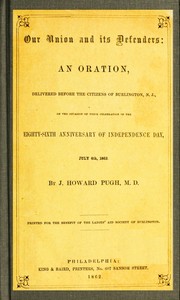
Our Union and Its Defenders - An Oration, Delivered Before the Citizens of Burlington, N.J., on the Occasion of Their Celebration of the Eighty-Sixth Anniversary of Independence Day, July 4th, 1862
Subjects:
Download Formats:
Excerpt
The Project Gutenberg EBook of Our Union and its Defenders, by J. Howard Pugh
This eBook is for the use of anyone anywhere in the United States and most
other parts of the world at no cost and with almost no restrictions
whatsoever. You may copy it, give it away or re-use it under the terms of
the Project Gutenberg License included with this eBook or online at
www.gutenberg.org. If you are not located in the United States, you'll have
to check the laws of the country where you are...
Read the Full Text
— End of Our Union and Its Defenders - An Oration, Delivered Before the Citizens of Burlington, N.J., on the Occasion of Their Celebration of the Eighty-Sixth Anniversary of Independence Day, July 4th, 1862 —
Book Information
- Title
- Our Union and Its Defenders - An Oration, Delivered Before the Citizens of Burlington, N.J., on the Occasion of Their Celebration of the Eighty-Sixth Anniversary of Independence Day, July 4th, 1862
- Author(s)
- Pugh, J. Howard (John Howard)
- Language
- English
- Type
- Text
- Release Date
- July 10, 2019
- Word Count
- 10,615 words
- Library of Congress Classification
- E456
- Bookshelves
- Browsing: History - American, Browsing: History - Warfare, Browsing: Religion/Spirituality/Paranormal
- Rights
- Public domain in the USA.
Related Books
Independence Day
English
1212h 16m read
Welcome to the ransomed; or, Duties of the colored inhabitants of the District of Columbia
by Payne, Daniel Alexander
English
74h 23m read
The year of jubilee; but not to Africans - a discourse, delivered July 4th, 1825, being the 49th anniversary of American independence
by Prime, Nathaniel S. (Nathaniel Scudder)
English
160h 51m read
Oration: The American Mind
by Lyons, Charles W.
English
52h 34m read
Colonel Edward Buncombe, Fifth North Carolina Continental Regiment - His Life, Military Careeer, and Death While a Wounded Prisoner in Philadelphia During the War of the Revolution
by Haywood, Marshall De Lancey
English
94h 25m read
Angels of the Battlefield - A History of the Labors of the Catholic Sisterhoods in the Late Civil War
by Barton, George
English
1935h 8m read