*** START OF THE PROJECT GUTENBERG EBOOK 74934 ***
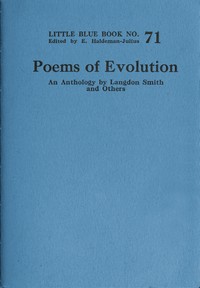
LITTLE BLUE BOOK NO. =71=
Edited by E. Haldeman-Julius
Poems of Evolution
Langdon Smith
and Others
HALDEMAN-JULIUS COMPANY
GIRARD, KANSAS
Copyright, 1924
Haldeman-Julius Company
PRINTED IN THE UNITED STATES OF AMERICA
POEMS OF EVOLUTION
A fire mist and a planet,
A crystal and a cell,
A jellyfish and a saurian,
And caves where the cavemen dwell--
Then a sense of law and beauty,
And a face turned from the clod;
Some call it EVOLUTION,
And some call it GOD.
_William Herbert Carruth._
POEMS OF EVOLUTION
EVOLUTION
LANGDON SMITH
I
When you were a tadpole and I was a fish,
In the Paleozoic time,
And side by side on the ebbing tide
We sprawled through the ooze and slime,
Or skittered with many a caudal flip
Through the depths of the Cambrian fen,
My heart was rife with the joy of life
For I loved you even then.
II
Mindless we lived and mindless we loved,
And mindless at last we died;
And deep in a rift of the Caradoc drift
We slumbered side by side.
The world turned on in the lathe of time,
The hot lands heaved amain,
Till we caught our breath from the womb of death,
And crept into light again.
III
We were Amphibians, scaled and tailed
And drab as a dead man’s hand;
We coiled at ease ’neath the dripping trees,
Or trailed through the mud and sand,
Croaking and blind, with our three-clawed feet
Writing a language dumb,
With never a spark in the empty dark
To hint at a life to come.
IV
Yet happy we lived, and happy we loved,
And happy we died once more;
Our forms were rolled in the clinging mold
Of a Neocomian shore.
The eons came, and the eons fled,
And the sleep that wrapped us fast
Was riven away in a newer day,
And the night of death was past.
V
Then light and swift through the jungle trees
We swung in our airy flights,
Or breathed in the balms of the fronded palms,
In the hush of the moonless nights.
And oh! what beautiful years were these,
When our hearts clung each to each;
When life was filled, and our senses thrilled
In the first faint dawn of speech.
VI
Thus life by life, and love by love,
We passed through the cycles strange,
And breath by breath, and death by death,
We followed the chain of change.
Till there came a time in the law of life
When over the nursing sod
The shadows broke, and the soul awoke
In a strange, dim dream of God.
VII
I was thewed like an Auroch bull,
And tusked like the great Cave Bear;
And you, my sweet, from head to feet,
Were gowned in your glorious hair.
Deep in the gloom of a fireless cave,
When the night fell o’er the plain,
And the moon hung red o’er the river bed,
We mumbled the bones of the slain.
VIII
I flaked a flint to a cutting edge,
And shaped it with brutish craft;
I broke a shank from the woodland dank,
And fitted it, head and haft.
Then I hid me close to the reedy tarn,
Where the Mammoth came to drink;--
Through brawn and bone I drave the stone,
And slew him upon the brink.
IX
Loud I howled through the moonlit wastes,
Loud answered our kith and kin;
From west and east to the crimson feast
The clan came trooping in.
O’er joint and gristle and padded hoof,
We fought and clawed and tore,
And cheek by jowl, with many a growl,
We talked the marvel o’er.
X
I carved that fight on a reindeer bone,
With rude and hairy hand,
I pictured his fall on the cavern wall
That men might understand.
For we lived by blood, and the right of might,
Ere human laws were drawn,
And the Age of Sin did not begin
Till our brutal tusks were gone.
XI
And that was a million years ago,
In a time that no man knows;
Yet here tonight in the mellow light,
We sit at Delmonico’s;
Your eyes are deep as the Devon springs,
Your hair is as dark as jet,
Your years are few, your life is new,
Your soul untried, and yet--
XII
Our trail is on the Kimmeridge clay,
And the scarp of the Purbeck flags,
We have left our bones in the Bagshot stones,
And deep in the Coraline crags;
Our love is old, our lives are old,
And death shall come amain;
Should it come today, what man may say
We shall not live again?
XIII
God wrought our souls from the Tremadoc beds
And furnished them wings to fly;
He sowed our spawn in the world’s dim dawn,
And I know that it shall not die;
Though cities have sprung above the graves
Where the crook-boned men made war,
And the ox-wain creaks o’er the buried caves
Where the mummied mammoths are.
XIV
Then as we linger at luncheon here,
O’er many a dainty dish,
Let us drink anew to the time when you
Were a Tadpole and I was a Fish.
A BALLADE OF EVOLUTION
I
In the mud of the Cambrian main
Did our earliest ancestor dive;
From a shapeless albuminous grain
We mortals our being derive.
He could split himself up into five,
Or roll himself round like a ball;
For the fittest will always survive,
While the weakliest go to the wall.
II
As an active ascidian again
Fresh forms he began to contrive,
Till he grew to a fish with a brain,
And brought forth a mammal alive.
With his rivals he next had to strive
To woo him a mate and a thrall;
So the handsomest managed to wive,
While the ugliest went to the wall.
III
At length as an ape he was fain
The nuts of the forest to rive,
Till he took to the low-lying plain,
And proceeded his fellows to knive.
Thus did cannibal men first arrive
One another to swallow and maul;
And the strongest continued to thrive
While the weakliest went to the wall.
_Envoy_
Prince, in our civilized hive,
Now money’s the measure of all;
And the wealthy in coaches can drive
While the needier go to the wall.
_Grant Allen._
EVOLUTION
As from the old nest birds escape,
As sheds its leaves the living tree,
So if evolved from worm or ape
What odds if we at last are free?
If once but dust or ape or worm,
A growing brain and then a soul,
Sure these are but prophetic germ
Of that which makes our circle whole.
_John Albee._
From THE SONG OF MYSELF
I am an acme of things accomplish’d, and I am an
encloser of things to be.
My feet strike an apex of the apices of the stairs:
On every step bunches of ages, and larger bunches
between the steps,
All below duly travel’d, and still I mount and mount.
Rise after rise bow the phantoms behind me:
Afar down I see the huge first Nothing. I know I was
even there,
I waited unseen and always, and slept through the
lethargic mist,
And took my time and took no hurt from the fetid carbon.
Long I was hugg’d close--long and long.
Immense have been the preparations for me,
Faithful and friendly the arms that have help’d me.
Cycles ferried my cradle, rowing and rowing like
cheerful boatmen;
For room to me stars kept aside in their own rings--
They sent influences to look after what was to hold me.
Before I was born out of my mother generations guided
me,
My embryo has never been torpid, nothing could overlay
it.
For it the nebula cohered to an orb,
The long slow strata piled to rest it on,
Vast vegetables gave it sustenance,
Monstrous sauroids transported it in their mouths and
deposited it with care.
All forces have been steadily employ’d to complete and
delight me,
Now on this spot I stand with my robust soul.
_Walt Whitman._
From THE DEATH SONG OF
TALIESIN
Stir in the dark of the stars unborn that desire
Only the thrill of a wild dumb force set free,
Yearn of the burning heart of the world on fire
For life and birth and battle and wind and sea,
Groping of life after love till the spirit aspire,
Into Divinity ever transmuting the clod,
Higher and higher and higher and higher and higher,
Out of the Nothingness world without end unto God.
_Richard Hovey._
From RAIN IN SUMMER
Thus the seer, with vision clear,
Sees forms appear and disappear
In the perpetual round of strange
Mysterious change
From birth to death, from death to birth,
From earth to heaven, from heaven to earth,
Till glimpses more sublime
Of things unseen before
Unto his wondering eyes reveal
The universe, as an immeasurable wheel
Turning for evermore
In the rapid, rushing river of time.
_Henry Wadsworth Longfellow._
SIMILAR CASES
There was once a little animal
No bigger than a fox
And on five toes he scampered
Over Tertiary rocks.
They called him Eohippus,
And they called him very small,
And they thought him of no value--
When they thought of him at all;
For the lumpish old Dinoceras
And Coryphodon so slow
Were the heavy aristocracy
In days of long ago.
Said the little Eohippus,
“I am going to be a horse!
And on my middle finger-nails
To run my earthly course!
I’m going to have a flowing tail!
I’m going to have a mane!
I’m going to stand fourteen hands high
On the psychozoic plain!”
The Coryphodon was horrified,
The Dinoceras was shocked,
And they chased young Eohippus
But he skipped away and mocked.
Then they laughed enormous laughter
And they groaned enormous groans,
And they bade young Eohippus
Go view his father’s bones.
Said they, “You always were as small
And mean as now we see,
And that’s conclusive evidence
That you’re always going to be.”
“What! Be a great tall handsome beast
With hoofs to gallop on?
_Why! You’d have to change your nature!_”
Said the Loxolophodon.
They considered him disposed of,
And retired with gait serene;
That was the way they argued
In “the early Eocene.”
There was once an Anthropoidal Ape
Far smarter than the rest,
And everything that they could do
He always did the best;
So they naturally disliked him
And they gave him shoulders cool,
And when they had to mention him,
They said he was a fool.
Cried this pretentious Ape one day,
“I’m going to be a Man!
And stand upright, and hunt, and fight,
And conquer all I can!
I’m going to cut down forest trees
To make my houses higher!
I’m going to kill the Mastodon.
I’m going to make a fire!”
Loud screamed the Anthropoidal Apes
With laughter wild and gay;
They tried to catch that boastful one
But he always got away.
So they yelled at him in chorus,
Which he minded not a whit;
And they pelted him with cocoanuts,
Which didn’t seem to hit.
And then they gave him reasons,
Which they thought of much avail,
To prove how his preposterous
Attempt was sure to fail.
Said the sages, “In the first place,
The thing cannot be done.
And, second, if it _could_ be
It would not be any fun!
And, third, and most conclusive,
And admitting no reply,
_You would have to change your nature_!
We should like to see you try!”
They chuckled then triumphantly,
These lean and hairy shapes,
For these things passed as arguments
With the Anthropoidal Apes.
There was once a Neolithic Man,
An enterprising wight,
Who made his chopping implements
Unusually bright.
Unusually clever he,
Unusually brave,
And he drew delightful Mammoths
On the borders of his cave.
To his Neolithic neighbours,
Who were startled and surprised,
Said he, “My friends, in course of time
We shall be civilized!
We are going to live in cities!
We are going to fight in wars!
We are going to eat three times a day
Without the natural cause!
We are going to turn life upside down
About a thing called gold!
We are going to want the earth and take
As much as we can hold!
We are going to wear great piles of stuff
Outside our proper skins!
We are going to have diseases!
And accomplishments!! and sins!!!”
Then they all rose up in fury
Against their boastful friend,
For prehistoric patience
Cometh quickly to an end.
Said one, “This is chimerical,
Utopian! absurd!”
Said another, “What a stupid life!
Too dull, upon my word!”
Cried all, “Before such things can come,
You idiotic child,
_You must alter human nature_!”
And they all sat back and smiled.
Thought they, “An answer to that last
It will be hard to find!”
It was a clinching argument
To the Neolithic Mind!
_Charlotte Perkins Gilman._
THE FIRST IDEALIST
A jellyfish swam in a tropical sea,
And he said, “This world it consists of me:
There’s nothing above and nothing below
That a jellyfish ever can possibly know
(Since we’ve got no sight, or hearing, or smell),
Beyond what our single sense can tell.
Now, all that I learn from the sense of touch
Is the fact of my feelings, viewed as such.
But to think they have any external cause
Is an inference clean against logical laws.
Again, to suppose, as I’ve hitherto done,
There are other jellyfish under the sun,
Is a pure assumption that can’t be backed
By a jot of proof or a single fact.
In short, like Hume, I very much doubt
If there’s anything else at all without.
So I come at last to the plain conclusion,
When the subject is fairly set free from confusion,
That the universe simply centres in me,
And if I were not, then nothing would be.”
That minute, a shark who was strolling by,
Just gulped him down, in the twink of an eye;
And he died, with a few convulsive twists.
But, somehow, the universe still exists.
_Grant Allen._
IMMORTALITY
When I was grass, perhaps I may have wept
As every year the grass blades paled and slept
Or shrieked in anguish impotent beneath
The smooth impartial cropping of great teeth--
I don’t remember much what came to pass
When I was grass.
When I was monkey, I’m afraid the trees
Weren’t always havens of contented ease;
Things killed us and we never could tell why;
No doubt we blamed the earth or sea or sky--
I have forgotten my rebellion’s shape
When I was ape.
Now I have reached the comfortable skin
This stage of living is enveloped in,
And hold the spirit of my mighty race
Self-conscious prisoner under one white face--
I’m awfully afraid I’m going to die,
Now I am I.
* * * * *
When I was man, no doubt I used to care
About the little things that happened there,
And fret to see the years keep going by,
And nations, families and persons die,
I didn’t much appreciate life’s plan
When I was man.
_Charlotte Perkins Gilman._
MIDGES IN THE SUNSHINE
If I could see with a midge’s eye
Or think with a midge’s brain,
I wonder what I’d say of the world
With all its joy and pain.
Would my seven brief hours of mortal life
Seem as long as seventy years,
As I danced in the flickering sunshine
Amid my tiny peers?
Should I feel the slightest hope or care
For the midges yet to be;
Or think I died before my time
If I died at half-past three,
Instead of living till set of sun
On the breath of the summer wind;
Or dream that the world was made for me
And all my little kind?
Perhaps if I did I’d know as much
Of Nature’s mighty plan,
And what it meant for good or ill,
As that larger midge, a man!
_Anonymous._
FROM A RECORD
None sees the slow and upward sweep
By which the soul from life-depths deep
Ascends,--unless, mayhap, when free,
With each new death we backward see
The long perspective of our race,
Our multitudinous past lives trace.
_William Sharp._
SUDDEN LIGHT
I have been here before,
But when or how I cannot tell:
I know the grass beyond the door,
The sweet keen smell,
The sighing sound, the lights around the shore.
You have been mine before,--
How long ago I may not know:
But just when at that swallow’s soar
Your neck turned so,
Some veil did fall,--I knew it all of yore.
Has this been thus before?
And shall not thus time’s eddying flight
Still with our lives our loves restore
In death’s despite,
And day and night yield one delight once more?
_Dante Gabriel Rossetti_
OR EVER THE KNIGHTLY YEARS WERE GONE
Or ever the knightly years were gone
With the old world to the grave,
I was a king in Babylon
And you were a Christian slave.
I saw, I took, I cast you by,
I bent and broke your pride.
You loved me well, or I heard them lie,
But your longing was denied.
Vaguely I knew that by and by
You cursed your gods and died.
And a myriad suns have set and shone
Since then upon the grave
Decreed by the king in Babylon
To her that had been his slave.
The pride I trampled is now my scathe,
For it tramples me again.
The old resentment lasts like death,
For you love, yet you refrain.
I break my heart on your hard unfaith,
Yet I break my heart in vain.
Yet not for an hour do I wish undone
That deed beyond the grave,
When I was a king in Babylon
And you were a virgin slave.
_William Ernest Henley._
AVE POST SAECULA
(_Greeting after the Ages_)
I
When I was a king of Egypt
And Priest of the Sun God Ra,
And you a Peruvian captive
Were brought from your home afar,
In a corner one day in my palace
I caught but a glance from your eyes--
Lonely and alien and wistful--
That filled me with glad surprise.
II
The dusky daughters of Kemi
Had mocked at your lily-like face;
They were arrogant in their beauty
Till I made them the slaves of your grace.
Then together in stately barges
We sailed on the Sacred Nile,
And the joy and the peace of Aahlu
Were mine through your loving smile.
III
Mummies together in spices,
Fine linen, and cloth of gold,
They laid us away in a rock-tomb,
And in hieroglyphics told
Our names and our years and achievements,
And they worshipped us when dead
Till their generations had faded
And new races came in their stead.
IV
Our names and our deeds were forgotten,
And our rock-tomb crumbled away,
But the love that made us immortal
Endured through the brighter day;
And we sometimes looked to earthward
For a glimpse of the river green,
Where I had been king in Egypt
While you were my loyal queen.
V
At the court of the Royal Harlot,
We lived again by the Nile,--
The astrologer Abd-el-Ghizeh
And the maid of honor Ajyl.
And although I had all forgotten
The days of my royal pride,
By the light in your eyes I knew you
And claimed again my bride.
VI
When the haughty Cleopatra
Sailed to meet her Roman Mars,
It was you who held her mirror;
It was I that read their stars.
Did we dream of those primitive barges
That had carried us that same way?--
Who shall say!--but at least we remembered
That our love had lived for aye.
VII
And again, that life completed,
We vanished from mortal sight
Only to join each other
In the spirit world of light.
Who can say in what other ages
We met on earth again,
Or by what celestial stages
We purged ourselves from pain?
VIII
Gone all the royal regalia
And the black magician’s wands;
Now the royal priest turned peddler
Earns his bread in strange new lands.
Trading from city to city,
He journeys wide and far
Till he finds in a distant corner
A damsel like a star.
IX
Years has she toiled in patience,
Lonely and ill at ease,
Feeding her heart with day dreams
That solace but hardly please;
At the touch of his lips she awakens
And the glad light in her face
Tells him once more he holds her
Fast in his fond embrace.
X
For the deeper knowledge is wakened
Far down ’neath the conscious brain,
And he knows his bride of the ages
Has come back to earth again;
And the gate of death has no terror,
Since it cannot separate
The souls that watch for each other
With a love inviolate.
_Laurens Maynard._
OF A TOYOKUNI COLOR PRINT
I
Was I a Samurai renowned,
Two-sworded, fierce, immense of bow?
A histrion angular and profound?
A priest? a porter?--Child, although
I have forgotten clean, I know
That in the shade of Fujisan,
What time the cherry orchards blow,
I loved you once in old Japan.
II
As here you loiter, flowing-gowned
And hugely sashed, with pins a-row
Your quaint head as with flamelets crowned.
Demure, inviting--even so,
When merry maids in Miyako
To feel the sweet o’ the year began,
And green gardens to overflow,
I loved you once in old Japan.
III
Clear shines the hill; the rice-fields round
Two cranes are circling; sleepy and slow,
A blue canal, the lake’s blue bound,
Breaks at the bamboo bridge; and lo!
Touched with the sundown’s spirit and low,
I see you turn, with flirted fan,
Against the plum-tree’s bloomy snow--
I loved you once in old Japan!
_Envoy_
Dear, ’twas a dozen lives ago;
But that I was a lucky man
The Toyokuni here will show,
I loved you once in old Japan.
_William Ernest Henley._
PRE-EXISTENCE
While sauntering through the crowded street
Some half-remembered face I meet,
Albeit upon no mortal shore
That face, methinks, hath smiled before.
Lost in a gay and festal throng
I tremble at some tender song
Set to an air whose golden bars
I must have heard in other stars.
In sacred aisles I pause to share
The blessings of a priestly prayer,
When the whole scene which greets mine eyes
In some strange mode I recognize,
As one whose every mystic part
Had been prefigured in my heart.
At sunset as I calmly stand
A stranger on an alien strand,
Familiar as my childhood’s home
Seems the long stretch of wave and foam.
A ship sails toward me o’er the bay
And what she comes to do and say
I can foretell. A prescient lore
Springs from some life outlived of yore.
O swift, instructive, startling gleams
Of deep soul-knowledge; not as dreams
For aye ye vaguely dawn and die,
But oft with lightning certainty
Pierce through the dark, oblivious brain
To make old thoughts and memories plain:
Thoughts which perchance must travel back
Across the wide bewildering track
Of countless eons; memories far
High reaching as yon palled star,
Unknown, scarce seen, whose flickering grace
Faints on the outmost rings of space.
_Paul Hamilton Hayne._
STANZAS
“_We are such stuff as dreams are made of._”
I
We have forgot what we have been,
And what we are we little know;
We fancy new events begin
But all has happened long ago.
II
Before mine infant eyes had hailed
The new-born glory of the day,
When the first wondrous morn unveiled
The breathing world that round me lay;
The same strange darkness o’er my brain
Folded its close, mysterious wings,
The ignorance of joy or pain,
That each recurring midnight brings.
III
Full oft my feelings make me start,
Like foot prints on a desert shore,
As if the chambers of my heart
Had heard their shadowy step before.
So looking into thy fond eyes,
Strange memories come to me, as though
Somewhere--perchance in Paradise--
I had adored thee long ago.
_Thomas W. Parsons._
THE METEMPSYCHOSIS
I know my own creation was divine.
Strewn on the breezy continents I see
The veined shells and burnished scales which once
Enclosed my being,--husks that had their use;
I brood on all the shapes I must attain
Before I reach the Perfect, which is God,
And dream my dreams and let the rabble go;
For I am of the mountains and the sea
The deserts, and the caverns in the earth
The catacombs and fragments of old worlds.
* * * * *
I was ere Romulus and Remus were;
I was ere Nineveh and Babylon;
I was and am, and evermore shall be,
Progressing, never reaching to the end.
A hundred years I trembled in the grass;
* * * * *
Under the earth in fragrant glooms I dwelt,
There in the veins and sinews of a pine
On a lone isle, where ...
... to and fro I swayed,
Drawing the sunlight from the stooping clouds.
Suns came and went, and many a mystic moon;
* * * * *
Wild music, and strange shadows floated by
Some moaning and some singing. So the years
Clustered about me till the hand of God
Let down the lightning from a sultry sky,
Splintered the pine and split the iron rock;
And from my odorous prison house a bird,
I in its bosom, darted; so we flew,
Turning the brittle edge of one high wave
Island and tree and sea-gods left behind!
* * * * *
A century was a single day.
What is a day to an immortal soul?
A breath, no more. And yet I hold one hour
Beyond all price--that hour when from the sky
I circled near and nearer to the earth,
Nearer and nearer, till I brushed my wings
Against the pointed chestnut trees,...
... and there,
Gathering wild flowers in a cool ravine,
Wandered a woman more divinely shaped
Than any of the creatures of the air,
Or river-goddesses, or restless shades
Of noble matrons marvellous in their time
For beauty and great suffering; and I sung,
I charmed her thought, I gave her dreams, and then
Down from the dewy atmosphere I stole
And nestled in her bosom. There I slept
From moon to moon, while in her eyes a thought
Grew sweet and sweeter, deepening like the dawn--
A mystical forewarning! When the stream,
Breaking through leafless brambles and dead leaves,
Piped shriller treble and from chestnut-boughs
The fruit dropt noiseless through the autumn night,
I gave a low, quick cry as infants do:
We weep when we are born, not when we die!
So was it destined; and thus came I here,
To walk the earth and wear the form of Man,
To suffer bravely as becomes my state,
One step, one grade, one cycle nearer God.
_Thomas Bailey Aldrich._
From THE FINAL THOUGHT
Which way are my feet set?
Through infinite changes yet
Shall I go on,
Nearer and nearer drawn
To thee,
God of Eternity.
How shall the human grow,
By changes fine and slow,
To thy perfection from the life-dawn sought:
What is the highest thought?
* * * * *
Love! Faith is born of it!
Death is the scorn of it!
It fills the earth and thrills the heavens above:
And God is love,
And life is love and though we heed it not,
Love is the final thought.
_Maurice Thompson._
NOTES TO “EVOLUTION”
Stanza I. The Paleozoic period, the oldest division of the geological
series, is separated into two great divisions, the later of which is
distinguished by the number and variety of its fishes and amphibious
animals. The Cambrian is the lowest of the primary strata exhibiting
unmistakable organic remains. Darwin states that the progenitors of
mankind must have been aquatic in their habit since morphology shows
that our lungs consist of a modified swim-bladder which once served
as a float.
Stanza II. The Caradoc sandstone, which takes its name from a
mountain in Shropshire, consists of shelly sandstone of great
thickness containing trilobites and many other fossils.
Stanza IV. Neocomian is the name given the lower division of the
cretaceous system partly, at least, formed by the wearing down of the
pre-existing oolitic rocks. The fresh-water formations of this period
exhibit remains of terrestrial reptiles and the trunks and leaves
of land plants. With this stanza the author ceases to trace the
developments of life through the early geological formations and lays
the scene of the next stanza in the comparatively recent Tertiary
period.
Stanza VI. Huxley expresses his belief that even the highest
faculties of feeling and of intellect began to germinate in lower
forms of life and it is now quite generally conceded that the human
soul is just as much a product of evolution as is the body.
Stanza VII. The Cave Dwellers of the stone age succeed in point of
time an even earlier group of prehistoric man, both so ancient that
no attempt can be made to fix the date of their existence except in
geological terms. At the coming of the Glacial period prehistoric man
was compelled to seek the shelter and warmth of caverns, holding to
these abodes during the centuries which elapsed before the dawn of a
warmer geological epoch. The Auroch is the European bison. The great
Cave Bear was extinct at the dawn of historic time and is known
only from fossils and a single engraving on stone in the prehistoric
museum at Faux.
Stanza VIII. The earliest manifestations of human art consisted of
the chipping of flint implements. The mammoth, the last survivor of
the three species of elephants inhabiting Europe, flourished before
and during the Glacial period. Larger than the modern elephant, it
had large, curved tusks and a thick coat of hair.
Stanza IX. The gregarious instinct, while of the greatest social
importance in its simplest form, implies none of the higher qualities
of mind, neither sympathy nor capacity for mutual aid. It seems
generally called in play in connection with some other instinct,
rendering complete satisfaction of its impulse impossible until
we are surrounded by others who share our emotions. Here the man
of the stone age calls his kith and kin more from an instinct of
self-assertion and elation than from any more developed social
sympathy.
Stanza X. The engravings of animals upon bone or ivory by prehistoric
man mark the earliest human expression of the beautiful in art
for art’s sake, and appear to be the first step in evolution from
savagery.
Stanza XII. Kimmeridge clay, the lowest series of the Upper Oolitic,
is dark bluish gray, shaly clay which is sometimes bituminous and
occasionally, as at Kimmeridge in the Isle of Purbeck, is so rich in
bituminous matter as to be used as fuel.
Beneath the cretaceous rocks in Southeast England a fresh-water
formation called the Wealden is found interlaced between two marine
formations. It is composed of three minor groups: Weald clay,
Hastings sand and Purbeck beds, or flags of limestone and marl. The
Wealden formation is rich in fossils, containing also what appear to
be the oldest examples of bird fossils in Great Britain.
The Bagshot sands, or stones, consist of a series of strata of the
Eocene period, overlying the London clay, the name being derived
from Bagshot Heath in Surrey where they were first examined. At some
places, as near Oxford, England, the Coraline crag is exposed at the
surface, running to a depth of more than fifty feet. It belongs to
the older Pliocene period and indicates a temperate climate.
Stanza XIII. The Tremadoc slate is the uppermost of the three strata
comprised in the Cambrian period in Europe, covering the earliest
portion of the Paleozoic or primary era.
NOTES TO “SIMILAR CASES”
Tertiary Rocks. It is in the rocks of this period that the fossils of
the various extinct primitive quadrupeds are found.
Eohippus. An Eocene perissodactyl with four anterior and three
posterior digits apparently allied to the Hyracotherium ancestors of
horse-like animals.
Dinoceras. A gigantic mammal of elephantine form, having three pairs
of protuberances on the upper surface of his head.
Coryphodon. A fossil mammal somewhat resembling the hippopotamus.
Loxolophodon. An extinct mammal with obliquely crested molars.
Mastodon. An extinct elephant larger but similar in form to existing
species.
Neolithic. Belonging to the later stone age, when first indication of
polished stone weapons and implements of agriculture began to appear.
Mammoths. A very large extinct Pleistocene elephant with coarse outer
hair and close woolly under hair and enormous tusks usually much
curved.
NOTES TO “AVE POST SAECULA”
Stanza I. The idea of a Peruvian captive at the court of an early
Egyptian king will not seem incongruous to those who are familiar
with the apparent evidences of a common origin of the races of
ancient Egypt and of South and Central America, or of the occult
traditions of a land connection between the old world and the new
world before the submerging of Atlantis.
Stanza II. _Kemi_ (_Black_) was the ancient Egyptians’ name for
their own country. _Aahlu_ was the paradise of the ancient Egyptian
religion where the souls of those who were admitted by Osiris might
dwell for three thousand years after which they must return to earth,
for another incarnation.
Stanza VI. Roman Mars is, of course, a poetic figure for Cleopatra’s
warrior lover, Mark Antony.
Stanza VII. Believers in reincarnation teach that in earth lives we
gain experience and in the intervening lives on the higher planes we
rest and transmute that experience into power for the next earth life.
Transcriber’s Note:
Words and phrases in italics are surrounded by underscores, _like
this_. Words in bold are surrounded by equal signs, =like this=.
Partially printed letters and punctuation were completed. Unprinted
word “as” added to “Then as we linger ...”
The following were changed:
“slai” changed to “slain.” ... the bones of the slain....
Extended elipses changed to three dots preceding “... and there,”
*** END OF THE PROJECT GUTENBERG EBOOK 74934 ***
Poems of evolution
Download Formats:
Excerpt
LITTLE BLUE BOOK NO. =71=
Edited by E. Haldeman-Julius
Langdon Smith
and Others
HALDEMAN-JULIUS COMPANY
GIRARD, KANSAS
Copyright, 1924
Haldeman-Julius Company
A fire mist and a planet,
A crystal and a cell,
A jellyfish and a saurian,
And caves where the cavemen dwell--
Then a sense of law and beauty,
And a...
Read the Full Text
— End of Poems of evolution —
Book Information
- Title
- Poems of evolution
- Author(s)
- Smith, Langdon
- Language
- English
- Type
- Text
- Release Date
- December 19, 2024
- Word Count
- 5,714 words
- Library of Congress Classification
- PS
- Bookshelves
- Browsing: Poetry, Browsing: Science - Genetics/Biology/Evolution
- Rights
- Public domain in the USA.
Related Books
Shells
by Wilcox, Ella Wheeler
English
549h 3m read
My betrothed, and other poems
by Magie, Lizzie
English
69h 22m read
Oberon and Puck
by Cone, Helen Gray
English
253h 6m read
Poems, translated and original
by Ellet, E. F. (Elizabeth Fries)
English
618h 55m read
The poetical works of Edmund Clarence Stedman
by Stedman, Edmund Clarence
English
1067h 1m read

The hermit thrush
by Mathews, F. Schuyler (Ferdinand Schuyler)
English
58h 20m read