*** START OF THE PROJECT GUTENBERG EBOOK 74295 ***
Strangers To Straba
By Carl Jacobi
Can a ship hate--and have a
strange hideous life of its own?
[Transcriber's Note: This etext was produced from
Fantastic Universe October 1954.
Extensive research did not uncover any evidence that
the U.S. copyright on this publication was renewed.]
_Like Robert Bloch, Margaret St. Clair, Frank Belknap Long and the
late great Howard P. Lovecraft, Carl Jacobi won his first bright
laurels as a story teller in the "ghoul-haunted woodland of Weir."
He was one of that early group of supernatural horror story writers
who have since turned to science fiction, and achieved in the newer
medium a fame quite as illustrious and quite as enduring. We know
you'll like this somberly exciting yarn._
They sat in Cap Barlow's house on the lonely planet, Straba. It was
early evening and Straba's twin moons were slowly rising from behind
the magenta hills. Outside the window lay Cap's golf course, a study
in toadstool cubism, while opposite the flag of the eighteenth hole
squatted the kid's ship.
The kid had landed there an hour ago. He had introduced himself as
Clarence Raine, field man for Tri-Planet Pharmaceutical, and had
announced urbanely he had come to make a botanical survey. All of which
mildly amused Cap Barlow.
The kid was amused too. From the _Pilot Book_ he had learned that Cap
was the sole inhabitant of Straba, and he regarded him--and rightly
so--as just another hermit nut who preferred the spacial frontiers to
the regular walks of civilization.
The old man packed and lit a meerschaum pipe.
"Yes sir," he said, "efficiency ... regulation ... order ... that's
what's spoiling all life these days. Those addle-headed scientists
aren't satisfied unless they can dovetail everything."
Raine smiled and in the pause that followed cast his eyes about the
room. It was circular and no attempt had been made to conceal its
origin: the bridge-house of some discarded space-going tug. Along the
continuous wall ran a triple tier of bookshelves, but it seemed that
most of the books lay scattered on the table, chairs, and floor.
Above the shelves the wall was decorated with several three-dimensional
water colors, pin-up girls in various stages of undress and mounted
trophies of the rather hideous game Straba provided.
"About this survey," the kid began.
"Only last month," Cap Barlow continued, unmindful of the interruption,
"a salesman stopped off here and wanted to sell me a gadget for my golf
course. Said it would increase the gravitation over the fairways and
prevent the ball from traveling any farther than it does on Earth."
He spat disgustedly. "You'd think any fool would realize it's an ideal
course that can offer a Par three on a thousand yard hole."
But Raine hadn't come this far to listen to the dissertations of an
old man. He was tired from long hours of sitting at the console of his
ship. He stood up wearily.
"If you'll show me where I can stow my gear," he said, "I think I'll
turn in and get some sleep. I've got a lot to do tomorrow."
For a week the kid didn't bother Cap at all. Each morning he went
out with a reference book, a haversack and a canteen, and he didn't
show up again until dark. Cap didn't mention that Straba had been
officially surveyed ten years before or that results of this survey
had been practically negative as far as adding to the _Interplanetary
Pharmacopoeia_ went. If Tri-Planet wanted to train its green personnel
by sending them on a wild goose chase, that was all right with Cap.
But the old man had one thing that interested young Raine: his
telescope mounted in a domed observatory on the top floor. Every night,
Raine spent hours staring through that scope, sighting stars, marking
them on the charts. Cap tried to tell him that those charts were as
perfect as human intellect could make them. Raine had an answer for
that too.
"Those charts are three years old," he said. "In three years a whole
universe could be created or destroyed. Take a look at this star on
Graph 5. I've been watching it, and the way it's acting convinces me
there's another star, probably a Wanderer, approaching it from here."
He indicated a spot on the chart.
He was efficient and persistent. He watched his star, checked and
rechecked his calculation, and in the end, to Cap's amazement sighted
the Wanderer almost exactly where he said it would be.
That discovery only excited him more and after that he spent an even
greater amount of time in the observatory. Then late one night he came
to the top of the stairs and called for Cap.
Cap went up to the scope, and at first he didn't see anything. Then he
did see it: a darker shadow against the interrupted starlight.
"It's a ship," the old man said.
Raine nodded. "My guess too. But what's it doing out of regular space
lanes?"
"You forget you landed here yourself. Straba does occasionally attract
a visitor. Her crew may need water or food."
Raine shook his head. "I hedge-hopped in from asteroid, Torela. This
fellow seems to be coming from deep space."
They continued to watch that approaching shadow, taking turns at
looking through the scope. It seemed to take a long time coming; but
finally there was a roar and a rush of air and a black shape hurtled
out of the eastern sky. The two men ran outside where Cap began to
curse volubly. The ship's anti-gravs were only partially on. It had
hit hard, digging up three hundred yards of the sixteenth fairway and
completely ruined two greens.
Then the dust cleared and the two men stared. The ship was a derelict,
a piece of space flotsam. There was no question about that. It was also
a Cyblla-style coach, one of the first Earth-made passenger freighters
to utilize a power-pile drive, designed when streamlining was thought
to mean following the shape of a cigar. On her bow was a name but
meteorite shrapnel had partially obliterated the letters.
"Jingoes," said Raine, "I never saw a ship like this before. She must
be old--really old!"
The hatches were badly fused and oxidized, and it was evident that
without a blaster it would be impossible to get in. Cap shrugged.
"Let her stay there," he said. "I can make a dog-leg out of the
fifteenth, and keep the course fairly playable. And if I get tired of
seeing that big hulk out of my dining room window I can always plant
some python vines around the nearside of her."
Raine shook his head quickly. "There's no telling what we may find
inside. We've got to find an opening."
He went over the ship like a squirrel looking for a nut. Back under her
stern quarter, just abaft her implosion plates, he found a small refuse
scuttle which seemed movable. He took drills and went to work on it.
Three hours later the two men were inside. There was nothing unusual
about the crew quarters or the adjoining storage space. But when they
reached the control cabin they stood and gaped.
It was like entering a museum. The bulkheads were covered with queer
glass dials, and several panels of manual operating switches. The
power-pile conduits were shielded with lead--lead mind you--and the
lighting was apparently done with some kind of fluorescent tubes
bracketed to the ceiling. It brought Cap back to the time he was a kid
and his grandfather told him stories and legends of the past.
Just above the pilot's old-fashioned cosmoscope was a fancy metal plate
with the ship's name stamped on it. _Perseus!_
"Do you know what ship this is?" demanded Cap, excitedly.
"I can read," said Raine.
"But do you know its history ... the story behind it?"
Raine shook his head without interest.
Cap Barlow was still staring at the nameplate. "_Perseus!_" he repeated
slowly. "It goes back to the First Triad Empire when the planets of
Earth, Venus and Mars were grouped into an Oligarchy, when Venus
was still a frontier. Life there was pretty much a gamble in those
days, and the Oligarchs enforced strict laws of eugenics. They set up
Marriage Boards and all young men and women had to undergo physical
and mental examinations. Couples were paired off only after scientific
scrutiny. In other words it was a cold-blooded system which had no
regard for what we call love."
The old man paused. "Did you ever hear of Mason Stewart?" he asked
suddenly.
Raine shook his head.
"As an individual he's pretty well forgotten today," Cap said. "I
suppose you might call him a promoter. At any rate he figured a way to
make himself a few thousand extra credits. He got hold of two condemned
passenger freighters and with a flair for classical mythology named
them _Perseus_ and _Andromeda_."
Raine, listening, lit a cigarette and blew a shaft of smoke
ceiling-ward.
"The _Perseus_ was moored in North Venus," continued Cap. "The
_Andromeda_, in the South. Stewart managed to spread the word that
these two ships would be heading for Alpha Centauri to start a new
colony. He also let it be known that the passenger lists would be
composed of couples who were in love with each other without scientific
screening or examination."
"Well, what happened?" demanded Raine with an air of acute boredom.
Cap bit off a piece of plug tobacco. "The rumor spread, and berths on
the two ships sold for fabulous prices. Of course, the Constabulary
investigated, but that's where Stewart was clever. The couples were
to be split up: all females in one ship, all men in the other. The
Constabulary warned them that it would take years to cross such an
immense distance--those were the days before the Wellington overdrive,
of course.
"But the couples wouldn't listen, and the two ships took off. People
of three worlds made a big fuss over them. The theme invaded the
teletheater and the popular tape novels of the day. Newscasters went
wild in their extravagant reports.
"And then the truth came out. Stewart got drunk and let slip the fact
that the boosters on the two ships were absolutely worthless and
capable of operating for only a short time. By then the ships were
several hundred thousand miles beyond the System and out of radio
range. Rescue ships were sent out but found nothing though they went as
far as they dared. Stewart was jailed and executed. That's the story of
the _Perseus_."
Raine nodded and ground his cigarette stub against a bulkhead. "Let's
get on with the examination," he said.
They continued down the dark corridors, Raine leading the way with
a magno search lamp. Some of the cabins were in a perfect state of
preservation. Others were mere cubicles of rust and oxidation. Once Cap
touched a chair which apparently had been made of wood or some similar
product; it dissolved into dust on the instant.
This was the _Perseus_, the ship which had carried the male passengers
of that strange and ancient argosy, but as yet they had come upon no
skeletons or human remains. What then had happened to them?
Five minutes later they entered the captain's cabin and found the
answer. On the metal desk, preserved in litnite, lay the rough log. Cap
picked it up, opened it carefully and began to read:
_January 21--All hands and passengers in good health, but God help
us, booster reading: zero-zero. By radio we have learned that our
sister ship, the Andromeda, is also without auxiliary power and
adrift. Such a dual catastrophe would certainly argue for something
other than coincidence._
_Our charts show an asteroid of sizeable proportions to lie
approximately midway between the two ships. Under ordinary
circumstances I would order the lifeboats run out at once and
attempt to reach this planetoid, hoping that by some miracle it
will be capable of supporting life. But the circumstances are far
from ordinary._
_We sighted them at 4:30 P.M., Earth-time, a few moments after
the booster went dead and the ship lost steerageway. Absorbers!
They hover out there in space, clearly visible through the ports,
waiting for us to open the airlock. There are two of them, but even
as I write, one has turned and with unfailing accuracy has headed
in the direction of the Andromeda._
_Absorbers! What a world of myth and legend surrounds them. Are
they organic or inorganic? I do not know. I only know they have
been mortally feared by sailors since the first rocket blasted
through Earth's orbit. They are what their name implies: devourers
of life, with the peculiar, apparently meaningless power of
transforming themselves into a physical facsimile of their victims._
_One of them is out there now, swirling lazily like a miasmic cloud
of saffron dust...._
Cap handed the book to Raine who read it and handed it back without
comment. And at that moment Cap saw the kid in his true light: a
cold-blooded extrovert who was interested in the ship only for what he
could get out of her.
Next day, without asking permission, Raine began the task of
dismantling the _Perseus_. He knew he had a potential fortune at his
fingertips, for every portable object he could transport back to Earth
or Venus would bring a high price from curio-hungry antique hunters.
For a week he worked almost unceasingly at the salvage operation. He
unscrewed the ship's nameplate and made a little plush box for it. He
took down the dials of the cosmoscope, the astrolog and other smaller
instruments and made them ready for shipment. He stripped out the
entire intercom mechanism, the old-fashioned lighting fixtures, to say
nothing of the furniture and personal effects which hadn't spoiled by
time.
It was on a Sunday evening that matters came to a head. In the early
dusk Straba's twin moons were well above the horizon, shining with a
pale light. Cap was in the kitchen brewing himself a cup of coffee when
through the window he saw Raine emerge from the _Perseus_ and carry an
armful of equipment across to the little lean-to shed where he stored
the salvage. He came out of the shed and something prompted him to look
forward. An instant later he ran to the house and took the steps three
at a time to the observatory.
He was up there a quarter of an hour before he came down again, a queer
look on his face.
"Mr. Barlow," he said, "what's that thing that looks like a gun
emplacement on the flat on the other side of the house?"
"That's exactly what it is," Cap told him. "A Dofield atomic defender.
I've had that gun here a long time. When I first set up housekeeping
on Straba, this part of the System was pretty wild. Pirates weren't
unusual."
"What's its range?"
"Well, I don't know exactly. But it has a double trajectory that makes
it a pretty potent weapon."
Raine looked at the old man for a long moment. "You probably don't
believe in coincidences," he said. "But come upstairs. I want to show
you something."
Cap followed him up to the observatory and looked through the scope. At
first he couldn't believe his eyes. If he had been alone he would have
said he was dreaming.
But there it was, a miniature satellite caught helplessly in the
planet's polar attraction, midway between Straba's twin moons. He was
looking at another antiquated space vessel; a ship that almost detail
for detail was a replica of the _Perseus_. The truth dawned on him
gradually.
_It was the Andromeda--the sister ship of the Perseus!_
The kid didn't hurry himself, bringing in the _Andromeda_. For two
nights he did nothing but watch the sister ship through the scope.
Then he carefully removed the preservative covering from the Dofield
defender, cleaned and oiled the barrel and made the gun ready for a
charge.
"If I can put a shot abaft her midsection," he said, "it might spin
her out of polar draw long enough to fall into Straba's linear
attraction...."
"Why don't you take your ship up and tow her in?" Cap said.
Raine shook his head. "Too dangerous. I'd have to come to a dead stop
to fasten my grappler and at that range I'd likely become a satellite
myself."
Meantime the _Perseus_ lay neglected save for the tour of inspection
Cap took through her on Friday morning. Cap hadn't been in the ship
since Raine had started his salvage operations, and the old man was
curious to see how work had progressed.
He entered through the refuse scuttle and proceeded to the control
room. The bulkheads were bare expanses with only a few nests of torn
wires and broken conduits to show where the dials and gauges had been
ripped from their mounting places. The place looked desecrated and
defiled.
Cap left the control room and mounted to the pilot's cuddy. Here, too,
Raine's work was in evidence. The old man stood there, looking at the
dismantled chart screens and thinking about the ship's strange and
tragic past.
Her lifeboats were gone and the inner door of the airlock was still
open. Her passengers and crew must have attempted escape in the end.
Had they managed to slip by the Absorber and reached the asteroid, the
name or chart number of which the captain had neglected to mention in
the log? And were there such things as Absorbers or had the captain
under stress of the situation given in to his emotions and flights of
fancy.
Cap had heard the usual sailors' stories, of course. How a freighter
had come upon one of them off Saturn's rim and sent out a gig to
investigate. How the gig and all men in it had simply dissolved and
become a part of the writhing cloud of mist. And how that cloud had
then slowly coalesced into the shape of the six men and the gig.
As he stood there, Cap abruptly became aware of a vague pulsation, a
rhythmic thudding from far off. He put his ear to the wall. The sound
lost some of its vagueness but was still undeterminable as to source.
He went down the port ladder to the 'tween deck. Here the sound faded
into nothingness, only to return as he descended the catwalk to the
engine room. But in that cavern-like chamber he became conscious of
something else.
He had a feeling he was surrounded by life as if he stood within the
body of a living intelligence whose material form included the ship
itself.
Clearly audible now was that distant thud ... thud ... thud ... like
the beating of a great heart.
Saturday Raine announced he was ready to "shoot down" the _Andromeda_.
Unfortunately Cap figured he wouldn't be there to see the show. He had
had a signal from one of his weather-robots on the dark side of the
planet that morning, reporting that a cold front was moving down and
the migration of the Artoks was about to begin. The Artoks could be
mighty troublesome when they came en masse. If Cap didn't want his golf
course eaten to the roots he'd have to stop them before they started.
The generators which powered the barrier wires across the Pass would
have to be turned on and the relay stations set in order.
It was late before he made his return. Dusk had set in and the Straba's
twin moons were riding high when he reached the hill over-looking
the house. On the flat below him he could see the moonlight glint on
the barrel of the Dofield defender, and he could see Clarence Raine
standing by the gun as he made preparations to fire.
* * * * *
For a moment Cap stood there, drinking in the scene: his golf course
spread out in the blue light like a big carpet and in the center of it
the black cigar-shaped _Perseus_. There was something virile about that
antiquated ship, something different from the _Andromeda_ he had seen
through scope. It was as if the _Perseus_ were all masculine, while the
_Andromeda_ were its daintier feminine counterpart.
And then Raine touched the trigger. There was an ellipse of yellow
flame, a mushroom of white smoke and a dull roar. Cap was flung
backward by the shockwave. The hills fielded the explosion, flung it
back, and the thunder went grumbling over the countryside.
In the empty silence that followed, Cap's wrist watch ticked off the
passing minutes. The moonlight returned from behind a passing cloud,
to reveal Raine by the Dofield defender, binoculars to his eyes. Time
snailed by. The night was passing.
And then the roar came again, this time from above. Cap saw a great
cylindrical shadow slanting down from the sky. The _Andromeda_ struck
far out on the flat beyond the house. It struck with a crash of
grinding metal and crumbling girders.
For an instant after that a hush fell over everything. And then from
the _Perseus_ in the golf course came a sound, low at first, growing
louder and louder. To Cap it sounded like a moan of anguish, of hatred
and despair that seemed to issue from a hundred throats.
The _Perseus_ trembled, began to move.
Cap stared. The ship moved on its belly across the fairway. Like
a timeless juggernaut it entered the flat and slid out across the
tableland toward the crumpled wreckage of its sister vessel.
Raine twisted about as he heard the thunder of that advancing hulk.
Fear and disbelief contorted his face. He uttered a cry, leaped from
the mount of the Dofield and began to run wildly across the flat. For
an instant Cap thought he was going to reach the first low hillock
that led to higher ground and safety. But Cap had reckoned without the
terrific drive of that vessel.
Was it the Absorber--that strange creature of outer space--which had
transposed its own inexplicable life into the shell of the dismantled
_Perseus_ and now _was_ that ship _alive_ with all the ship's hates,
joys and sorrows? Organic into inorganic--a transmutation of a
supernormal life into a materialistic structure of metal ... cosmic
metempsychosis too tremendous for the finite mind to grasp.
The _Perseus_ came on, bowling across the flat like a monster of metal
gone mad, grinding over rock outcrop and gravel, throwing up a thick
cloud of dust. It came on with a terrible fixation of purpose, with a
relentless compulsion that knew no halting. It met and engulfed the
helpless figure of Clarence Raine and a cry of mingled hate and triumph
seemed to rise up from its metal body.
The _Perseus_ continued along the moonlit plateau, heading straight for
the wreckage of the _Andromeda_. Not until it had reached that formless
mass did it stop. Then it shuddered to a standstill and ever so gently
touched its prow to the prow of the sister ship.
For a long moment Cap stood there motionless. Then, head down, he
slowly made his way down the hill toward his house.
*** END OF THE PROJECT GUTENBERG EBOOK 74295 ***
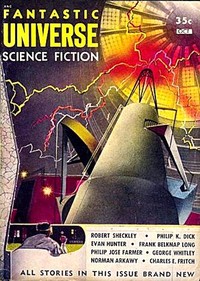
Excerpt
Can a ship hate--and have a
strange hideous life of its own?
[Transcriber's Note: This etext was produced from
Fantastic Universe October 1954.
Extensive research did not uncover any evidence that
the U.S. copyright on this publication was renewed.]
_Like Robert Bloch, Margaret St. Clair, Frank Belknap Long and the
late great Howard P. Lovecraft, Carl Jacobi won his first bright
laurels as a story teller in the...
Read the Full Text
— End of Strangers to Straba —
Book Information
- Title
- Strangers to Straba
- Author(s)
- Jacobi, Carl
- Language
- English
- Type
- Text
- Release Date
- August 22, 2024
- Word Count
- 3,867 words
- Library of Congress Classification
- PS
- Bookshelves
- Browsing: Science-Fiction & Fantasy
- Rights
- Public domain in the USA.
Related Books
The crystal planetoids
by Coblentz, Stanton A. (Stanton Arthur)
English
441h 21m read

Famous stories from foreign countries
English
494h 26m read

Terror out of the past
by Gallun, Raymond Z., Gallun, Raymond Z. (Raymond Zinke)
English
247h 56m read
Corsairs of the cosmos
by Hamilton, Edmond
English
152h 39m read
The incredible slingshot bombs
by Williams, Robert Moore
English
96h 4m read
The young naval captain
by Stratemeyer, Edward
English
700h 5m read