*** START OF THE PROJECT GUTENBERG EBOOK 74137 ***
THE CLOSED DOOR
By John Fleming Wilson
“I left the wreck in the last boat,” Gorham told me. “It was a very dark
and stormy morning and the sea ran before the gale in great splashes of
a kind of vivid, intense white. To the east of us the California coast
rose like a shadow out of the spume and spindrift. And that woman sat
beside me on the thwart and clutched my arm with a steady, relentless
strength which affected me more than if she had screamed.”
“I never could understand that affair,” I said. “Harry Owen was not only
a seaman of ability and experience, but the last man in the world
to----”
Gorham sighed and lifted his tired eyes to mine.
“I have never appeared in the affair, of course,” he remarked. “I was
only a passenger on the _Shearwater_. The underwriters didn’t go into
the matter.” My companion sighed again, staring at me owlishly. He
rubbed his great forearm thoughtfully. “That woman’s fingers were set in
my flesh, I tell you, right through my jacket. And it was precisely as
if she were screaming. And any minute I expected a sea to tumble us all
into Davy Jones’ locker.”
“His wife?” I commented.
“Of course,” Gorham replied. “So she was--Captain Harry Owen’s wife. And
although she had been married to him six years she had never so much as
suspected, I think.”
“Suspected what?”
Gorham made a slight gesture of disdain for my dullness.
“Who the other woman was.”
It was my turn to stare. Hadn’t I known Owen for years, been shipmate
with him, been his friend? And didn’t everybody know that after he
married pretty Sheila McTodd he never so much as glanced at another
woman?
“You mean to tell me that there was another woman?” I demanded of
Gorham. Then something in the extraordinary expression of his usually
calm face stopped me. “Then that explains----”
“Why the _Shearwater_ was, in a way, deliberately cast away,” he
finished.
“Did you know the other woman?” I asked.
He nodded.
“Did I know her?” I insisted.
Gorham whispered a name and we looked at each other intently, each
waiting for the other to speak.
“It is incredible!” I said finally, and I walked to the window and
stared out into the rain that was lashing San Francisco. Then I turned
on him fiercely. “You don’t know what you are saying! I tell you Harry
Owen, to my certain knowledge, never so much as went to tea with Kitty
Melrose after he married Sheila. And of all women to accuse of being--of
being--” I shook my fist at Gorham.
He did not move.
“I _know_!” he said quietly. “I tell you I was there. She was the first
woman I saw when our boat finally reached the _Western Pacific_ and we
were literally dragged on board out of the boiling sea. The instant I
caught her eyes, I knew. She was standing in a sheltered corner of the
deckhouse, her dark hair set with pearls of spray and her lips parted in
a sort of childlike amazement. It was exactly as if I had been working
over a puzzle for years and suddenly the missing bit popped up and
completed it, solved it.”
I came back and sat down. I was rather astonished at my own coolness.
“Kitty Melrose was the most charming girl I ever knew,” I remarked.
“Clean and fine and upstanding and willful and witching.”
Gorham suddenly brought his great palm down on the chair arm with a
mighty smack.
“Of course. We both knew her. Half of us were in love with her. She
never looked at any of us. She was at once our best of friends and yet
aloof. And of us all but one man touched that secret spot which lies in
every woman’s heart--and he went and married the McTodd girl. Nice
enough, probably, and all that; but not in Harry Owen’s class nor in
Kitty Melrose’s set. And Harry Owen threw away the _Shearwater_ for
Kitty’s sake.”
“But he hadn’t met her in years,” I persisted.
“Of course not!” Gorham retorted. “He was in love with her. He didn’t
even dare think of her. He had tied himself up tight and fast to Sheila.
You remember his marriage?”
“I was on the China coast at the time,” I growled. “I heard some queer
things--which I didn’t believe.”
“Right!” was his answer. “But we’re going to get this thing straight.
The world has forgotten the wreck of the _Shearwater_ and the mystery of
it. But you and I were Harry’s friends. We were Kitty’s friends. And for
the sake of the two of them I’m going to tell you the truth to-night.
Then we are never going to whisper so much as a word all the rest of our
lives. Some people would misunderstand.”
He lighted his pipe deliberately and stared into the grate a moment.
Gorham is noted in many ports for his mumness, his almost savage
insistence on plain facts, his steady judgment. And here he was talking
of a mystery. I felt the note of unsureness in his voice.
“In a case like this,” he began, “I want to go back a little and fix the
facts we both know, as a sort of starting point. In the first place,
Harry Owen was what we call a gentleman, well bred, pretty well
educated, sent to sea as a stripling to make a man out of him, as the
phrase runs. But one always saw him sooner or later in the old crowd.
The nice crowd you and I knew when we were younger. He got his papers
easily enough and gossip ran that he was going to stop ashore and be
something in the broking line. He spoke to me about it one trip I made
on the old _City of Peking_. He thought it would be pretty splendid to
be a broker. He was tired of the sea--it was no place for an ambitious
man--a dog’s life.
“Well, he came home here to San Francisco and played about for a couple
of months. Then old Ben Harris offered him a good place in his business.
I thought it was settled. Harry was oddly serious-minded about it. Then
he suddenly vanished--went off to sea as chief officer of a freighter.
You understand me? He fell in love with Kitty Melrose and she refused
him. Instead of staying and sticking it out, Harry threw up Ben Harris’
offer and went off. That’s the time some of us remarked that Owen wasn’t
the man we thought him. We didn’t know he was in love with Kitty
Melrose.”
“And he came back and married Sheila McTodd. That was the end of him
socially,” I remarked. “And you ask me to believe the unbelievable--that
a man in love with Kitty would marry anybody else. You remember her? I
recall one evening I saw her standing in the doorway of her father’s
house. I came to the foot of the steps and looked up. And with a
perfectly simple and unpremeditated motion she stretched out both her
arms, barring the doorway, her firm hands resting on the lintels. I tell
you that that unconscious attitude made me feel for an instant a chill,
as if the guardian of paradise were barring it to me.”
Gorham nodded.
“Exactly. We can both understand Harry Owen’s frame of mind. That he was
an ass is not to the point. Life wasn’t worth living without Kitty--so
he went to sea.”
“And married,” I murmured.
“Instead of getting properly drunk!” was the brutal response.
I was scandalized, but my companion would have none of my pleas for
decency.
“The young fellow was half crazed,” he repeated, “so he went and married
Sheila McTodd. He went to sea the day after the wedding. Some time later
I met him in Panama, and he was barely civil. That same night I saw him
sitting at a greasy cafe table staring into nothing, an empty glass in
his fist. The next day a skipper more than half insinuated that Harry
Owen was going to the devil. So he did, for a year. Then something bred
in his bone drew him back from the edge and began to remold him. But, as
a matter of fact, no career was open to him, except to con freighters
back and forth on the Pacific. He had had his chance and lost it.”
“When he lost Kitty Melrose.”
“When he married the McTodd girl,” Gorham corrected me softly. Then he
went on: “His history was that of hundreds of other seafaring men from
that time on; dogged, hard work, scanty savings and intervals when he
had to tramp the streets in search of a berth. But he managed pretty
well. He saved money. He treated Sheila in an exemplary manner. But he
avoided all contact with the old crowd; he was almost ferocious, at
times, when one caught him on the street and spoke of former times. Yet
all the while he was working steadily upward. Then he happened on that
salvage job of the _Mary Foster_, and dumped fifteen thousand dollars
into Sheila’s bank account. I met him in Liverpool six months later. He
was embarrassed, as if he had no business away from the Pacific. It
appeared he had a very good command. But he was going back to San
Francisco, just the same----”
“Gave up his second chance in a big line,” I interrupted.
Gorham nodded.
“He couldn’t stand it, you see. Kitty was in California. He suffered the
agonies of the damned that night in a little hotel near the landing
stage--for Harry Owen wanted to talk, to sit there in that infinitely
dingy room in that ill-smelling hostel in Liverpool and tell me the
truth, the enormous and insurmountable fact of his existence, that he
loved Kitty Melrose; and he dared not. But it showed on his face, white
and haggard under the tan; in his hard-bitten lips and tense hands. He
tossed up his command and took a miserable old tramp back to the Golden
Gate. From that time on, he stayed in the coastwise trade.
“Imagine to yourself,” Gorham went on, “the manner of life the man led;
instead of getting drunk, he got himself married, and so forever
debarred from seeing the one woman the world held for him. He was
constantly coming into San Francisco and snatching at the papers to see
whether Kitty was engaged, or married; he was constantly leaving the
city, knowing that he could never be anything in her splendid life.”
“Ah,” I said, “he talked at last, did he?”
Gorham ignored my thrust.
“There was always Sheila, too. And when I speak of her, of Harry Owen’s
wife, I am on firmer ground. She made a confidant of me; she used to
visit my office on some excuse or other and conclude by saying abruptly
and bitterly, ‘I suppose you won’t tell----’
“That was her complaint about life; none of us who had been part of
Harry’s old, youthful days could carry over, so to speak. She was forced
to recognize that, when he married her, he had closed a door which she
could not pry open.”
Gorham tapped the hot ashes out of his pipe thoughtfully.
“I don’t profess to understand women, but Sheila was angered by the
indisputable fact of Harry Owen’s faithfulness to his marriage vows. She
knew, as women do know those things, that he was living up to some one
else’s standard. And try as she might, she could never ascertain even so
much as the name of any woman with whom her husband had been in love.
She knew he did not love her, nor ever had. You see? He lived
irreproachably--and not for her. So, after she had cunningly questioned
me about Harry’s youth, she would say in her thin, plaintive voice: ‘I
suppose you won’t tell----’ I used to look at her in amazement. She was
so deplorably”--he sought for the word hesitatingly, bashfully--“
immodest about it. I shudder when I think how some women lay bare and
open to a passer-by the secrets, the petty obscurities, of their lives.
“At last, Owen got the _Shearwater_.”
“You got it for him,” I remarked.
“I helped,” Gorham confessed. “I couldn’t bear to see our old chum
handling steam schooners and colliers in and out of the harbor where we
had had our joyous and happy youth, while the rest of us went ahead and
kept up the old associations and friendships and got a taste of
happiness. So I put in a word for him with the owners and he took over
the old packet. She carried passengers, as you know, and he sat each
evening at the head of his table in the saloon and chatted with people
who admired his trim figure and address. Yet you must understand that
all this time he never gave me a hint of the truth. I never knew or
suspected that Kitty Melrose had refused to marry him, never dreamed
that he loved her. Sheila herself had put the puzzle in concrete form
for me.”
“You mean she told you Harry was in love with another woman?” I
demanded.
“Of course not--not in so many words,” he returned. “But she had made it
clear enough that she thought about it constantly. Naturally enough, I
felt there might be grounds--in the event it proved she was right. But
here we come to the miracle of the whole affair.”
Gorham stirred uneasily, lighted another pipe, and stared at me
intently.
“You are to keep in mind that, from now on, I am telling you precisely
what passed under my own eyes, I am not sitting in judgment. I am
expressing no opinion and drawing no inferences. As I told you, I left
the _Shearwater_ in the last boat.”
“Go on,” I said. “I know nothing about it--except that Owen went mad.
_That_ is certain.”
The man opposite me cast his eyes down.
“It was so reported,” he acknowledged. “I beg of you to do as I am
doing--express no opinion.” He lifted his eyes to mine. “I am not a
sentimentalist. But when a fact is cast up at my feet like a bottle on
the beach, I accept it. Listen:
“The _Shearwater_ was to sail from San Francisco for San Pedro on a
Friday afternoon in January. In the morning I found I had to go South
and, because the steamer would land me in time for business on Monday
morning, I telephoned down for passage. A few minutes before sailing
time I arrived at the pier and found Sheila there, too; she was
complaining bitterly about something. I pulled up and would have gone
away, but she made a point of my staying, wiped her eyes, and said in a
constrained way, ‘I’m going South this trip with Harry.’
“He seemed struck dumb; she went on to say she had arranged it with the
port captain, and then began to fuss about the cabin. She took something
from Owen’s desk and put it in a rack. It was perfectly apparent that
she had never been in the cabin before. She said as much.
“Of course, Harry had to go on the bridge immediately. We sailed on the
dot. When we had passed Angel Island he asked me to join him.
“‘It will be a dirty trip,’ he said to me composedly. ‘The barometer is
jumping and the _Shearwater_ is heavily laden. I wish----’
“He did not finish the sentence; but I understood that he resented
Sheila’s presence on his ship, in his cabin. We passed on to other
topics and so carried on our conversation till we were well abreast of
Pigeon Point. It was already blowing very heavily, in squalls, and the
sea was making fast. Just at dark Harry suddenly interrupted his talk to
say, ‘Will you please find Sheila and see that she has her dinner? I
must stay on the bridge all night.’
“So I went below and found Mrs. Owen in the cabin, seated in a big
chair. She was seasick, she told me quietly, when I had given her her
husband’s message. I went down and dined by myself. After dinner I
rejoined Harry on the bridge. It was a very nasty night indeed, and the
old _Shearwater_ was making heavy weather of it. I stayed an hour, and
during that time the _Western Pacific_, also southbound, overhauled us
and was swallowed up in the darkness. She would reach San Pedro twelve
hours ahead of us.
“At last I turned in, only to be aroused a few hours later by a
quartermaster with a summons to the bridge. Harry Owen was there,
sheathed in oilskins, his sou’wester pulled down over his eyes, his
whole form streaming with brine.
“‘Look!’ he bawled in my ear, and I looked.
Far away and to leeward rockets were going up, throwing a dim refulgence
against the overcast sky.
“‘It’s the _Western Pacific_,’ he told me quietly. ‘She tried to cut
corners and, I suppose, broke her propeller shafts.’”
Gorham glanced at me.
“As a matter of fact that was what had happened. But Owen seemed rather
at a loss.
“‘I’ve got to go in and stand by,’ he said. ‘That goes without saying.
But she’s within six miles of the rocks and the _Shearwater_ can’t tow
her out against this gale, and the notion of transferring passengers is
hopeless.’
“‘What kind of line have you--the best?’ I demanded.
“The chief mate answered that question. The _Shearwater_ had a new,
nice, sweet, ten-inch manila. It might do.
“‘We’ll run in and have a look-see, anyway,’ said Harry in something of
his old manner.
“So we ran in and a ticklish job it was. But presently we were within a
quarter of a mile of the disabled steamship and the wireless got busy.
The _Western Pacific_ wanted to be towed out of danger--a matter of
forty miles. Transferring anybody was out of the question, for the sea
was terrific. No boat could live in it. Both captains were pretty
anxious. Finally Owen ran the _Shearwater_ right up under the lee of the
_Western Pacific_ and threw his searchlight on her. She was all right,
sea anchor out and riding fairly easily. But when Harry Owen laid down
his binoculars he was a different man. I know now what he saw. He made
no further demur about attempting a tow and we spent an hour passing our
new line, fixing chafing gear and so on.
“It was none of my business, you understand.
“We picked up our tow and started out. Within fifteen minutes I
comprehended, though not a word was said, that we had tried an
impossibility. The _Shearwater_ was too old; she wasn’t up to towing a
six-thousand tonner against sea and gale. Her wooden topsides were
rotten. We could barely steer her. Then word came to the bridge that the
hawser was pulling the after deck to bits. Harry Owen listened and then
stared out over the sea, running with a brisk, ugly weight before the
wind. He went aft and I joined him. The _Shearwater_ was so built that
the only place to take the line to was a small windlass directly in
front of the steering gear, consequently the great straining hawser was
slowly, but surely, tearing out the entire structure that held the
leaping rudderhead and the quadrants.
“‘You’ve got to let her go, sir,’ said the mate, showing an anxious
face. I shall never forget the queer pallor of his countenance under the
dim light of the lantern on the deckhouse wall.
“Owen looked at him fixedly a moment. Then he said, just as I am
speaking now, ‘Take the hawser around the after deckhouse, mister.’
“The mate gaped at him. But Owen’s eyes never wavered. The order was
obeyed, though it took an hour, during which sea after sea came aboard
the old _Shearwater_ and the _Western Pacific_ began frantic speech by
wireless. However, the job was done.
“From now on the _Shearwater_ was, you understand, almost helpless. It
was cruel work and, at last, Harry himself took the wheel. Ten-inch
lines, no matter how good they are, can’t stand up under such a strain
as was inevitably put on ours. But Owen deliberately sacrificed his own
vessel to save the _Western Pacific_.”
“I heard he went mad,” I murmured. Gorham lighted another pipe.
“Get this into your head: the big liner was on a lee shore, no help in
sight; she would have gone on the rock in an hour had it not been for
the _Shearwater_. But twenty miles south she would have been safe. Tugs
were coming to her assistance. It was that twenty miles Owen was trying
to make.”
“He was mad to try it,” I said. “No seaman with freight and passengers
is justified in wrecking his own ship that way. And you tell me----”
“The chief officer and the engineer came to me about it,” Gorham went
on. “That was their idea--that Harry Owen was mad. The _Shearwater_ was
being picked apart by the seas, as a boy pulls a toy to bits. In fact,
when they finally appealed to me--after a deadly scene on the bridge--it
looked very much as though we would be lucky to get to port ourselves
without assistance. I recall that as we talked, down in the engineer’s
cabin in full sight of the trampling engines, our voices were mournfully
muffled. I was Harry Owen’s oldest friend, they told me, while the
combers boomed and crashed overhead. It was my business to bring him to
his senses.”
“Did they really think he was mad?” I demanded.
Gorham puffed at his pipe slowly. Then he rose and went to his
portmanteau and fumbled around a little and came back with a bit of
soiled, flimsy paper.
“They had this,” he explained. “The wireless man had brought it to the
chief and it put them all in a blue funk.” He spread the paper out on
his great knee and read it thoughtfully. “Harry sent it as a message
while we were making a fresh hitch for the hawser.”
Gorham handed it to me with a gesture, as if to say: “You see what we
were confronted with.”
I read that little sheet, written in Harry Owen’s bold script. It was
brief. Then I laid it on the table.
“And what did Sheila have to say?” I asked.
“She knew nothing about that message,” he responded. “Nor did she know
much about what was going on. I went in to see her several times. She
sat in a big chair fastened to the deck in Harry’s cabin and stared at
me out of her cold, shallow eyes.”
“Did nobody else go to her?” I inquired. “I’d have thought the chief
officer--”
“The chief officer had had enough in the wheelhouse,” Gorham replied.
“He came out like a man in a daze; but he did his duty like a man. No
idle hands on the _Shearwater_ that night!”
“But what did they make out of that message?” I insisted. “You tell me
they went to you as a final resort, to ask you to bring Harry Owen to
his proper senses. What did they make out of that wireless he sent?”
Gorham peered at me.
“What would _you_ make out of it?”
I thought this over. Now that the story was plain in my mind, I could
easily interpret that short, strange message. But what would I have made
of it, seated on a lounge in sight of swiftly moving engines, with the
boom of a tempest roaring overhead and only this faintest of glimmers to
light up the darkness in the soul of a man who was ruthlessly carrying
me to destruction? I shook my head.
Gorham went on composedly:
“At dawn we still had six miles to drag the _Western Pacific_. The line
still held, because of Owen’s extraordinary seamanship. That was his
hold on his crew. I am convinced that no other man afloat could have
kept his men at work as Harry did. And what work!
“The gale had piled up a sea that ran irresistibly from horizon to
horizon, which lifted the _Shearwater_ up to dizzy heights, flung her
savagely to one side, dropped her into vast hollows that resounded like
caverns. And as the vessel disintegrated under our feet, we patched her
up. I tell you we labored like men possessed to keep that wretched old
packet alive, to keep her going--to keep the steady pull on the hawser
that meant safety for those hundreds on the liner. Yet no help came. The
carpenter reported three feet of water in the hold, seams opening up in
the wooden topsides, beams buckling below under the terrific strain.
“The gale died slowly. At noon it was a breeze; then it shifted to a
brisk offshore wind and the _Western Pacific_, as jaunty as ever,
signaled she was all right. The wireless reported that within a couple
of hours all kinds of assistance would arrive. And before the final
cheering message had come our engines suddenly stopped. The _Shearwater_
was sinking, and sinking fast. The pumps were choked; every sea that
broached over us poured its tons down into the holds through the
shattered decks.
“Harry Owens turned the wheel over to a hand and came out, to see his
crew crowding the decks. He gave a brusque order to cast off the hawser
and listened quietly to the chief officer and the engineer.
“‘A bad run of sea yet,’ was all he said, and went into his own cabin. I
followed him, leaving the officers to get the boats ready for launching.
Sheila was still crouched in that great chair, her fingers set into its
leather arms. Harry looked at her and remarked very simply, ‘The ship is
sinking. We shall have to take to the boats. There is time yet. You’ll
find yourself quite comfy on the _Western Pacific_.
“She rose with a single movement. ‘This ship is going down?’ she cried.
Then flared up wildly. ‘The only decent ship you ever had, and you let
her sink!’
“Harry met her eyes calmly. ‘Poor Sheila!’ he said in a tuneless voice.
Then he lighted a cigar and left for the deck, where the crew were
sweating about the boats and life rafts. He went to a little group of
passengers and told them briefly that he was sending them off to the
liner, now riding easily and rather pompously a mile away to the drag of
the hawser we had let go. Then he drew me aside.
“‘I shall send you in charge of one of the boats,’ he told me. ‘You will
take Sheila with you.’ He twisted his lips into a wry smile. ‘Poor
Sheila!’ he croaked.
“I was dumfounded. I scrutinized the man carefully. He was as sober and
as collected as we are now. His eyes were steady. A blob of sea broke
over the shattered bulwarks and flooded to our knees. He did not notice
it.
“‘You saved the _Western Pacific_,’ I said, ‘and you have ruined
yourself. Man, man!’
“I was terribly angry with him. Yet he stood in the midst of that
tragedy like one who had succeeded, not failed. He dominated us all, a
kind of heroic and pitiable figure.
“So we got into the boats--the sea was going down rapidly, and the
_Western Pacific_ sent over four boats to help out. Into the last boat
we put Sheila, dry eyed, cold, almost, one might say, frozen in her
expression. Harry handed her over the broken rail with a kind of gentle
compassion. He did not say anything to her. It happened that it was one
of the liner’s boats and the mate in charge stared up at Owen
expectantly. The _Shearwater_ was almost awash. Still Harry made no
movement to get into the boat. Instead, he thrust me in and I found
myself seated with Sheila.
“‘Hurry up, sir!’ cried the mate in our boat.
“But Harry shook his head with a firm and determined movement.
“‘Shove off!’ he ordered, and the men obeyed like children. But their
officer bawled out, again and again, vainly. Harry Owen stared at us
all, rising and falling on the spumy seas, and then turned away and went
into his own cabin. As he closed the door the _Shearwater_ dipped her
battered bows deeply. A surge overran her. She lurched to starboard,
righted herself and slowly went down. She seemed to stop when the water
was halfway up the deckhouse and floated a moment, half submerged. I
think we all stared at Harry Owen’s door.
“It did not open.
“As I told you, Sheila did not utter a cry; but her fingers were set in
my flesh so I had the impression of some one screaming. A moment later
the _Shearwater_ vanished.
“In that instant I was enormously puzzled. I had seen a riddle set and
staged before my eyes and I had no answer to it. I do not remember the
men pulling the lifeboat over to the _Western Pacific_--I recall nothing
but the darkness of that tremendous and tragic problem and the incessant
pressure of Sheila’s fingers into my arm. But when we reached the
liner’s deck, I supporting Sheila, I saw a woman standing in a little
recess of the deckhouse. It was Kitty Melrose. She was as lovely and
witching as ever, her eyes shining, her lips parted gently.
“How do women know? I cannot tell. But Sheila caught sight of her and
thrust through the crowd to her and peered into her beautiful and
shining eyes with a kind of terror. Kitty’s expression never changed;
she stood there with pearls of spray in her hair and a look of
childlike, glorious amazement on her face, which was turned toward the
dreary spot where a few bits of wreckage showed above the grave of the
_Shearwater_. And do you know what Sheila said?”
Gorham laid his pipe aside and lowered his eyes.
“She said, quite simply, ‘Nobody would ever tell me.’”
He stopped and picked up his pipe again.
“At that moment the skipper of the _Western Pacific_ came bustling
along.
“‘Where is Captain Owen?’ he bawled.
“The chief officer of the _Shearwater_ answered that question: ‘With his
ship,’ he said in an ugly, injured tone.
“I assure you that that captain, faultlessly dressed, quite magnificent
and self-confident, now that his own vessel was safe, hadn’t a word to
say. The _Shearwater’s_ engineer turned on him with a snarling, ‘Captain
Owen ran his own ship under to save yours.’
“But, while that was the bald truth, I felt no interest in the affair on
that side. I was looking at Kitty Melrose. Sheila’s queer, plaintive,
‘Nobody would ever tell me,’ sounded in my ears. In my pocket was that
message that Harry had wirelessed across the night before. What would
Kitty say? Nothing, of course. She stood remote and fine and composed in
a little space surrounded by anxious and curious and respectful men and
women. Yet I saw in her gaze, still fixed on the spot amid the tumbling
seas where Harry Owen had gone to his death, something”--Gorham fumbled
around a bit, scratched a match, blew it out, glanced at me with a
gloomy eye, finished his sentence in a voice suddenly husky--“something
Harry must have dreamed of seeing.”
“They said he was crazy,” I remarked lifelessly.
“Women drive men mad,” Gorham returned with amazing earnestness.
“Harry’s madness was--it was something you and I would give our souls
for.”
“I looked down at the flimsy bit of paper on the table, and sighed. It
was Owen’s final message. It read:
Miss Katherine Melrose, SS _W. Pacific_.
You cannot say no this time.
Harry Owen, Master _Shearwater_.
“Yes,” said Gorham slowly, “I saw her hand rest lightly on her bosom and
I knew that Harry’s message lay there.”
“But she never answered it!” I cried.
My companion stared at me.
“Oh, yes, she answered it. As such women do. That night she came to my
room and said abruptly, ‘They tell me he--Harry--Harry Owen went into
his cabin and closed the door.’
“‘That is true,’ I told her.
“‘And he did not open the door again?’ she insisted.
“‘No,’ I said.
“She lifted her bright and luminous eyes to mine and tried to smile,
gallantly.
“‘He wouldn’t,’ she said quietly. ‘It was like Harry to close a
door--and never open it again.’
“Then she slipped out of my room without a sound.”
[Transcriber’s Note: This story appeared in the October 1922 issue of
Ainslee’s magazine.]
*** END OF THE PROJECT GUTENBERG EBOOK 74137 ***
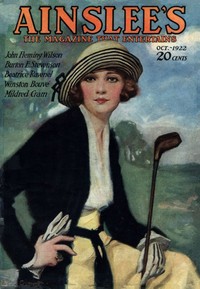
The closed door
Subjects:
Download Formats:
Excerpt
“I left the wreck in the last boat,” Gorham told me. “It was a very dark
and stormy morning and the sea ran before the gale in great splashes of
a kind of vivid, intense white. To the east of us the California coast
rose like a shadow out of the spume and spindrift. And that woman sat
beside me on the thwart and clutched my arm with a steady, relentless
strength which affected me more than if she had screamed.”
“I never could understand that affair,” I said. “Harry Owen was...
Read the Full Text
— End of The closed door —
Book Information
- Title
- The closed door
- Author(s)
- Miller, Mary Ashe, Wilson, John Fleming
- Language
- English
- Type
- Text
- Release Date
- July 27, 2024
- Word Count
- 5,576 words
- Library of Congress Classification
- PS
- Bookshelves
- Browsing: Fiction
- Rights
- Public domain in the USA.
Related Books

Famous stories from foreign countries
English
494h 26m read
The incredible slingshot bombs
by Williams, Robert Moore
English
96h 4m read

The eater of souls
by Kuttner, Henry
English
22h 19m read
Emmanuel Appadocca; or, Blighted life, Volume 2 (of 2)
by Philip, Maxwell
English
815h 52m read
Emmanuel Appadocca; or, Blighted life, Volume 1 (of 2)
by Philip, Maxwell
English
884h 9m read

An American tragedy, v. 2
by Dreiser, Theodore
English
2843h 53m read