The Project Gutenberg EBook of The cõforte of louers, by Stephen Hawes
This eBook is for the use of anyone anywhere at no cost and with
almost no restrictions whatsoever. You may copy it, give it away or
re-use it under the terms of the Project Gutenberg License included
with this eBook or online at www.gutenberg.org
Title: The cõforte of louers
The Comfort of Lovers
Author: Stephen Hawes
Release Date: August 15, 2007 [EBook #22326]
Language: English
Character set encoding: UTF-8
*** START OF THIS PROJECT GUTENBERG EBOOK THE CÕFORTE OF LOUERS ***
Produced by Louise Hope, David Starner and the Online
Distributed Proofreading Team at http://www.pgdp.net
[Transcriber’s Note:
This e-text includes characters that will only display in UTF-8
(Unicode) text readers:
ãẽĩõũỹ = vowel with “tilde” or overline
If any of these characters do not display properly--in particular,
if the diacritic does not appear directly above the letter--or if the
quotation marks in this paragraph appear as garbage, make sure your
text reader’s “character set” or “file encoding” is set to Unicode
(UTF-8). You may also need to change the default font.
Spelling and punctuation are unchanged. A few abbreviations are shown
with brackets:
[the] = “y” with small “e” directly above it; the more accurate
form yͤ may not display correctly in all text readers.
[with] = “w” with superscript “t”
[that] = two forms, “y” and “þ” (thorn), each with superscript “t”.
[us] = “us” abbreviation resembling superscript “9”.
Many parts of this text were damaged, especially at the beginnings
or ends of lines. One line at the top of a page, shown as a row of
asterisks, is entirely missing. Other words have been reconstructed
from their surviving portions; the conjectural letters are shown in
{braces}. The html version of this e-text shows the reconstructions.
Other errors are listed at the end of the text.]
[Illustration:
The cõforte of louers]
The comforte of louers made and compyled by Steuen Hawes
somtyme grome of the honourable chambre of our late souerayne
lorde kynge Henry [the] seuenth (whose soule god pardon).
In the seconde yere of the reygne of our most naturall
souerayne lorde kỹge Henry the eyght.
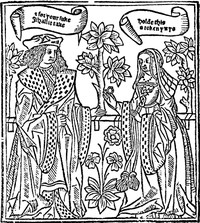
[Illustration:
& for your sake
I shall it take
holde this
a token y wys]
¶ The prohemye.
The gentyll poetes / vnder cloudy fygures
Do touche a trouth / and cloke it subtylly
Harde is to cõstrue poetycall scryptures
They are so fayned / & made sẽtẽcyously
For som do wryte of loue by fables pryuely
Some do endyte / vpon good moralyte
Of chyualrous actes / done in antyquyte
Whose fables and storyes ben pastymes pleasaunt
To lordes and ladyes / as is theyr lykynge
Dyuers to moralyte / ben oft attendaunt
And many delyte to rede of louynge
Youth loueth aduenture / pleasure and lykynge
Aege foloweth polycy / sadnesse and prudence
Thus they do dyffre / eche in experyence
I lytell or nought / experte in this scyence
Compyle suche bokes / to deuoyde ydlenes
Besechynge the reders / with all my delygence
Where as I offende / for to correct doubtles
Submyttynge me to theyr grete gentylnes
As none hystoryagraffe / nor poete laureate
But gladly wolde folowe / the makynge of Lydgate
Fyrst noble Gower / moralytees dyde endyte
And after hym Cauncers / grete bokes delectable
Lyke a good phylozophre / meruaylously dyde wryte
After them Lydgate / the monke commendable
Made many wonderfull bokes moche profytable
But syth the are deed / & theyr bodyes layde in chest
I pray to god to gyue theyr soules good rest
¶ Finis prohemii.
Whan fayre was phebus / [with] his bemes bryght
Amyddes of gemyny / aloft the fyrmament
Without blacke cloudes / castynge his pured lyght
With sorowe opprest / and grete incombrement
Remembrynge well / my lady excellent
Saynge o fortune helpe me to preuayle
For thou knowest all my paynfull trauayle
I went than musynge / in a medowe grene
Myselfe alone / amonge the floures in dede
With god aboue / the futertens is sene
To god I sayd / thou mayst my mater spede
And me rewarde / accordynge to my mede
Thou knowest the trouthe / I am to the true
Whan that thou lyst / thou mayst them all subdue
Who dyde preserue the yonge edyppus
Whiche sholde haue be slayne by calculacyon
To deuoyde grete thynges / the story sheweth vs
That were to come / by true reuelacyon
Takynge after theyr hole operacyon
In this edyppus / accordynge to affecte
Theyr cursed calkynge / holly to abiecte
Who dyde preserue / Ionas and moyses
Who dyde preserue yet many other mo
As the byble maketh mencyon doubles
Who dyde kepe Charles frome his euyll fo
Who was he / that euer coude do so
But god alone / than in lyke wyse maye he
Kepe me full sure / frome all inyquyte
Thus as I called to my remembraunce
Suche trewe examples / I tenderly dyde wepe
Remembrynge well / goddes hyghe ordynaũce
Syghynge full oft / with inwarde teres depe
Tyll at the last / I fell in to a slepe
And in this slepe / me thought I dyde repayre
My selfe alone / in to a garden fayre
This goodly gardyn / I dyde well beholde
Where I sawe a place / ryght gaye and gloryous
With golden turrettes / paynted many afolde
Lyke a place of pleasure moste solacyous
The wyndowes glased / with crystall precyous
The golden fanes / with wynde and melody
By dulcet sounde / and meruaylous armony
The knottes flagraunt / with aromatyke odoure
With goodly sprynges / of meruaylous mountaynes
I dyde than tast / the redolent lycoure
Moost clere and swete / of the goodly vaynes
Whiche dyde me ease / somwhat of my paynes
Tyll to me came / a lady of goodly age
Apareyled sadly / and demure of vysage
To me she sayd / me thynke ye are not well
ye haue caught colde / and do lyue in care
Tell me your mynde / now shortly euerydele
To layne the trouthe / I charge you to beware
I shall for you / a remedy prepare
Dyspeyre you not / for no thynge that is past
Tell me your mynde / and be nought agast
Alas madame / vnto her than I sayd
It is no wonder / of myne inwarde payne
yf that my herte be meruayllously dysmayde
My trouthe and loue / therof is cause certayne
Dyuers yeres ago / I dyde in mynde retayne
A lady yonge / a lady fayre of syght
Good // wyse / and goodly / an holsome sterre of lyght
I durst not speke vnto her of my loue
Yet vnder coloure I dyuers bokes dyde make
Full pryuely / to come to my aboue
Thus many nyghtes / I watched for her sake
To her and to hers / my trouthe well to take
Without ony spotte / of ony maner yll
God knoweth all myn herte / my mynde & my wyll
The hygh dame nature / by her grete myght & power
Man / beest / and foule / in euery degre
Fro whens they came at euery maner houre
Dooth trye the trouthe / without duplycyte
For euery thynge must shewe the properte
Gentyll vngentyll / dame nature so well tryet
That all persones it openly espyeth
The lorde and knyght / delyteth for to here
Cronycles and storyes / of noble chyualry
The gentyll man gentylnes / for his passe tyme dere
The man of lawe / to here lawe truely
The yeman delyteth to talke of yomanry
The ploman his londe for to ere and sowe
Thus nature werketh / in hye degre and lowe
For yf there were one of the gentyll blode
Conuayde to yomanry for nourysshement
Dyscrecyon comen he sholde chaunge his mode
Though he knewe not / his parentes verament
Yet nature wolde werke / so by entendyment
That he sholde folowe / the condycyons doubtles
Of his true blode / by outwarde gentylnes
In all this worlde / ben but thynges twayne
As loue and hate / the trouth for to tell
And yf I sholde hate my lady certayne
Than worthy I were / to dye of deth cruell
Seynge all ladyes / that she doth excell
In beaute / grace / prudence and mekenes
What man on lyue / can more in one expres
yf she with me sholde take dyspleasure
Whiche loueth her by honoures desyre
What sholde she do / with suceh a creature
That hateth her / by inwarde fraude and yre
I yet a louer / do not so atyre
My fayth and hope / I put in her grace
Releace to graunt me / by good tyme and space
Thretened with sorowe / of may paynes grete
Thre yeres ago my ryght hande I dyde bynde
Fro my browes for fere / [the] dropes doune dyde sweet
God knoweth all it was nothynge my mynde
Vnto no persone / I durst my her to vntwynde
yet the trouthe knowynge / the good gretest P
Maye me release / of all my /p/p/p/ thre
Now ryght fayre lady / so sadde and demure
My mynde ye knowe / in euery maner thynge
I trust for trouthe / ye wyll not me dyscure
Sythes I haue shewed you without lesynge
At your request / the cause of my mournynge
Whiche abyde in sorowe / in my remembraunce
Without good conforte / saufe of esperaunce
Fayre sone sayd she / sythens I knowe your thought
your worde and dede / and here to be one
Dyspayre you not / for it auayleth nought
Ioye cometh after / whan the payne is gone
Conforte yourselfe / and muse not so alone
Doubt ye no thynge / but god wyll so agre
That at the last / ye shall your lady se
Be alwaye meke / let wysdome be your guyde
Aduenture for honoure / and put your selfe in preace
Clymbe not to fast / lest sodenly ye slyde
Lete god werke styll / he wyll your mynde encrece
Begynne no warre / be gladde to kepe the peace
Prepence no thynge / agaynst the honoure
Of ony lady / by fraudolent fauoure
Alas madame / vnto her than sayd I
Aboue .xx. woulues / dyde me touse and rent
Not longe agone / delynge moost shamefully
That by theyr tuggynge / my lyfe was nere spent
I dyde perceyue / somwhat of theyr entente
As the trouthe is knowen / vnto god aboue
My ladyes fader they dyde lytell loue
Seynge theyr falshode / and theyr subtylte
For fere of deth /where as I loued best
I dyde dysprayse / to knowe theyr cruelte
Somwhat to wysdome / accordynge to behest
Though that my body had but lytell rest
My herte was trewe vnto my ladyes blood
For all theyr dedes I thought no thynge but good
Some had wende the hous for to swepe
Nought was theyr besom / I holde it set on fyre
The inwarde wo in to my herte dyde crepe
To god aboue / I made my hole desyre
Saynge o good lorde of heuenly empyre
Let the mount with all braunches swete
Entyerly growe / god gyue vs grace to mete
Soma had wened for to haue made an ende
Of my bokes / before he hadde begynnynge
But all vayne they dyde so comprehende
Whan they of them lacke vnderstandynge
Vaynfull was & is theyr mysse contryuynge
Who lyst the trouthe of them for to enfuse
For the reed and whyte they wryte full true
Well sayd this lady I haue perceueraunce
Of our bokes / whiche that ye endyte
So as ye saye is all the cyrcumstaunce
Vnto the hyghe pleasure of the reed and the whyte
Which hath your trouth / and wyll you acquyte
Doubte ye no thynge / but at the last ye maye
Of your true mynde yet fynde a Ioyfull daye
Forsothe I sayd / dysdayne and straungenesse
I fere them sore / and fals reporte
I wolde they were / in warde all doutles
Lyke as I was / without conforte
Than wolde I thynke / my lady wolde resorte
Vnto dame mercy / my payne to consyder
God knoweth all / I wolde we were togyder
Though in meane season / of grene grasse I fede
It wolde not greue me / yf she knewe my heuynesse
My trauayle is grete / I praye god be my spede
To resyste the myght / of myn enmyes subtylnesse
Whiche awayte to take / me by theyr doublenesse
My wysdome is lytel / yet god may graunt me grace
Them to defende / in euery maner of cace
Lerne this she sayd / yf that you can by wytte
Of foes make frendes / they wyll be to you sure
yf that theyr frendshyp / be vnto you knytte
It is oft stedfast / and wyll longe endure
yf alwaye malyce / they wyll put in vre
No doubte it is / than god so hyght and stronge
Ful meruaylously / wyl soone reuenge theyr wronge
And now she sayd come on your waye with me
Unto a goodly toure whiche is solacyous
Beholde it yonder / full of felycyte
Quadrant it was / me thought full meruaylous
With golden turrettes / gaye and gloryous
Gargayled with greyhoũdes / and with many lyons
Made of fyne golde / with dyuers sondry dragons
The wyndowes byrall / without resplendysshaunt
The fayre yuery / coloured with grene
And all aboute there was dependaunt
Grete gargeyles of golde / full meruaylously besene
Neuer was made / a fayrer place I wene
The ryght excellent lady toke her intresse
Ryght so dyde I / by meruaylous swetnesse
Whan we came in / I dyde aboute beholde
The goodly temple / with pynacles vp sette
Wherin were ymages / of kynges all of golde
With dyuers scryptures / without ony lette
Aloft the roofe / were emeraudes full grette
Set in fyne golde / with amyable rudyes
Endented with dyamondes / and mayn turkyes
The wyndowes hystoried / with many noble kynges
The pyllers Iasper / dyuersed with asure
By pendaunt penacles / of many noble rynges
The pauement calcedony / beynge fayre and sure
The aras golde / with the story pure
Of the syche of thebes / with actes auenturous
Of ryght noble knyghtes / hardy and chyualrous
Than sayd this lady / I must now go hence
Passe ye tyme here / accordynge to your lykynge
It maye fortune / your lady of excellence
Wyll passe her tyme here / soone by walkynge
Than maye she se / your dolefull mournynge
And fare ye well / I maye no lenger tary
Marke well my lesson / and from it do not vary
Whan she was gone / the temple all alonge
I went my selfe / with syghtes grete and feruent
Alas I sayd / with inwarde paynes stronge
My herte doth blede / now all to torne and rent
For lacke of conforte / my herte is almost spent
O meruelo[us] fortune / which hast ĩ loue me brought
Where is my conforte / that I so longe haue sought
O wonderfull loue / whiche fell vnto my lotte
O loue ryght clene / without ony thought vntrue
Syth thy fyrst louynge / not blemyssed with spotte
But euermore / the falseshede to extue
O dolorous payne / whiche doste renue
O pyteous herte / where is the helthe and boote
Of thy lady / that perst the at the roote
What thynge is loue / that causeth suche turment
From whens cometh it / me thynke it is good questyõ
Yf it be nature / from nature it is sent
Loue maye come of kynde by true affeccyon
Loue may appetyte / by naturall eleccyon
Than must loue nedes be / I perceyue it in mynde
A thynge fyrst gyuen / by the god of kynde
Alas o nature / why mayst not thou truely
Cause my lady loue / as thou hast me constrayned
Hath she power to domyne the vtterly
Why mayst not thou / cause her {be} somwhat payned
With natures moeuynge / for lou{e is} not fayned
Alas for sorowe / why madest th{ou h}er so fayre
Without to loue / that she lyst soone repayre
Two thynges me conforte / euer in pryncypall
The fyrst be bokes / made in antyquyte
By Gower and Chauncers / poetes rethorycall
And Lydgate eke / by good auctoryte
Makynge mencyon / of the felycyte
Of my lady and me / by dame fortunes chaunce
To mete togyders / by wonderfull ordynaunce
The seconde is / where fortune dooth me brynge
In many placys / I se by prophecy
As in the storyes / of the olde buyldynge
Letters for my lady / depeynted wonderly
And letters for me / besyde her meruayllously
Agreynge well / vnto my bokes all
In dyuers placys / I se it in generall
O loue moost dere / o loue nere to my harte
O gentyll floure / I wolde you knewe my wo
Now that your beaute / perst me with the darte
With your vertue / and your mekenes also
Sythens ye so dyde / it is ryght longe ago
My herte doth se you / it is for you bebledde
Myne eyen with teeres / ben often made full redde
Where are ye now / the floure of Ioye and grace
Whiche myght me conforte / in this inwarde sorowe
Myne excellent lady / it is a ryght pyteous case
Good be my guyde / and saynt George vnto borowe
O clere Aurora / the sterre of the morowe
Whiche many yeres / with thy bemes mery
Hath me awaked / to se thyne emyspery
{Th}us as I mourned / I sawe than apper{e}
Thre goodly myrours dependaunt on the wall
Set in fyne golde bordred with stones clere
The glasses pure / they were of crystall
Made longe ago to be memoryall
And vnder the fyrst glasse ryght fayre wryten was
Beholde thy selfe / and thy fautes or thou passe
By a sylken threde / small as ony heere
Ouer I sawe hange / a swerde full ponderous
Without a scauberde / full sharpe for to fere
The poynt dounwarde / ryght harde and asperous
All this I sawe / with hert full dolorous
Yet at auenture / to se the mystery
In the myroure / I loked than full sodenly
In this glasse I sawe / how I had ledde my lyfe
Sythens the tyme of my dyscrecyon
As vnto wyldnesse / alwaye affyrmatyfe
Folowynge the pleasure / of wylfull amonycyon
Not vnto vertue hauynge intencyon
Ihesu sayd I / thou hast me well preserued
From this swerdes fall / whiche I haue oft deserued
O ye estates / aloft on fortunes whele
Remembre this swerde / whiche ouer you dependeth
Beware the fall / before that ye it fele
Se your one euyll / se what vengeaunce ensueth
Correcte none other / whan that your fautes renueth
Calke not not goddes power / bryef not [the] tens future
Beholde this glasse / se how he may endure
Many one {weneth / the future t}ens to {brefe}
By calculacyon goddes power to withstande
Bathynge theyr swerdes / in blode by myschefe
Tyll at the last as I do vnderstande
This swerde doth fal by the myght of goddes hande
Vpon then all / whiche wolde his power abate
Then they repent but than it is to late
This goodly myrour / I ryght well behelde
Remembrynge well / my dedes done in tymes past
I toke forwytte / than for to be my shelde
By grace well armed / not to be agast
Thus as I stode / I dyde se at the last
The seconde myrour / as bryght as phebus
Set rounde about / with stones precyous
Ouer whiche dyde hãge / a floure of golde ryght fyne
Wherin was set / an emeraude full bryght
Ryght large and grete / whiche wõderfull dyde shyne
That me thought it was / grete conforte to my syght
Bordred with dyamondes / castỹge a meruaylo[us] lyght
This floure dyde hange / by a ryght subtyll gynne
With a chayne of yron / and many a pryue pynne
Besyde whiche there was / a table of golde
With a goodly scrypture / enameled of grene
The sentence wherof / I dyde well beholde
The whiche sayd thus / it is openly sene
That many a one / full pryuely dooth wene
To blynde an other / by crafte and subtylnes
That ofte blyndeth hym / for all his doublenes
In this myrour whiche is here besyde
Thou shalt well lerne / they selfe for to knowe
Passe forth no ferder / but loke and abyde
Se what shall come / lest that thou ouer throwe
A sodayne rysynge dooth oft fall alowe
Without the grounde / be ryghe sure and perfyte
Beholde well this glasse / & take thy respyte
Whan thou hast so done / to this floure resorte
Laboure to gete it / from this harde yren chayne
Unto the gynnes / vnto thy grete conforte
Yf that thou canst / and take it for thy payne
To be they helpe / in thy Iournaye certayne
Lo here the vertues vnder wryten be
Of this ryall floure in euery degre
This ryche emeraude / who so dooth it bere
From his fyrst werynge / his syght shal not mynysshe
Payne of the heed he nedeth not to fere
By dynt of swerde / he shall neuer perysshe
Ne no thynge begyn / but he shall well fynysshe
Yf it be ryghtfull aftyr a true entent
Without resystence of grete impedyment
Of all nygromancy / and fals enchauntement
Agaynst hym wrought / he shall knowe the effecte
They can not blynde hym by cursed sentement
But he theyr werkes may ryght soone abiecte
No maner poyson he nedeth to susspecte
Neyther in mete not yet in ale ne wyne
Yf it beset well besyde a serpentyne
Yf he vntrue be vnto his gentyll lady
It wyll breke asondre / or crase than doubtlesse
It kepeth close / neuet the auoutry
This gentyll emeraude / this stone of rychesse
Hath many mo vertues / whiche I do not expresse
As saynt Iohan euangelyst doeth shewe openly
Who of his makynge lyst se the lapydary
When I had aduerted / in my remembraunce
All the maters / vnto the glasse I wente
Beholdynge it / by a longe cyrcumstaunce
Where as I dyde perceyue well verament
How preuy malyce / his messengers had sent
With subtyll engynes / to lye in a wayte
Yf that they coude take me with a bayte
I sawe there trappes / I sawe theyr gynnes all
I thanked god than / the swete holy goost
Whiche brought me hyder so well in specyall
Without whiche myrour / I had been but loost
In god aboue / the lorde of myghtes moost
I put my trust / for to withstande theyr euyll
Whiche dayly wrought / by the myght of the deuyll
I sawe theyr maysters blacke and tydyous
Made by the craft of many a nacyon
For to dystroye me / with strokes peryllous
To lette my Iournaye / as I make relacyon
Peryllous was the waye / and the cytuacyon
Full gladde was I of the vertu of this glasse
Whiche shewed me / what daungers I sholde passe
O all ye estates / of the hygh renowne
Beware these gynnes / beware theyr subtylte
The deuyll is grete / {and re}dy to cast downe
By calculacyon / of the {cur}sed cruelte
Of the subtyll beestes / full of inyquyte
In the olde tyme what snares were there sette
By fals calkynge / to dystroye lordes grete
Than after this to the yron gynne
I wente anone my wyte for to proue
By lytell and lytell / to vndo euery pynne
Thus in and out / I dyde the chayne ofte moue
Yet coude I not come / vnto myne aboue
Tyll at the last / I dyde the crafte espy
Vndoynge the pynnes / & chayne full meruaylously
Full gladde was I than / whan I had this floure
I kyst it oft / I behelde the coloure grene
It swaged ryght well / myn inwarde doloure
Myn eyes conforted / with the bryghtnes I wene
This ryall floure / this emeraude to shene
Whan I had goten it by my prudence
Ryght gladde I was / of fortunes premynence
O fortune sayd I / thou art ryght fauorable
For many a one / hath ben by symylytude
To wynne this floure / full gretely tendable
But they the subtylnes / myght nothynge exclude
Sythnen by wysdome / I dyde this fraude conclude
This floure / I sette nere my harte
For perfyte loue / of my fayre ladyes darte
So this accomplysshed / than incontynent
To the thyrde myrour I went dyrectly
Beholdynge aboute by good auysement
Seynge an ymage made full wonderly
Of the holy goost with flambes ardauntly
Vnder whiche I sawe with letters fayre and pure
In golde well grauen this meruaylous scrypture
Frome the fader and the sone my power procedynge
And of my selfe I god do ryght ofte inspyre
Dyuers creatures with spyrytuall knowynge
Inuysyble by dyuyne flambynge fyre
The eyes I entre not it is not my desyre
& am not coloured of the terrestryall grounde
Nor entre the eres for I do not sounde
Nor by the nose for I am not myxte
With ony maner of the ayry influence
Nor by the mouthe for I am not fyxte
For to be swalowed by erthly experyence
Nor yet by felynge or touchynge exystence
My power dyuyne can not be palpable
For I myselfe am no thynge manyable
Yet vysyble I may be by good apparaunce
As in the lykenesse of a doue vnto chryste Ihesu
At his baptysme I dyde it with good countenaunce
To shewe our godhed to be hygh and true
And at his transfyguracyon our power to ensue
In a fayre cloude with clere rayes radyaunt
Ouer hym that I was well apparaunt
Also truely yet at the feest of pentycoste
To the sones moder and the apostelles all
In tonges of fyre as god of myghtes moost
I dyde appere shewynge my power spyrytuall
Enflambynge theyr hertes by vertues supernall
Whiche after that by languages well
In euery regyon coude pronounce the gospell
And where I lyst by power dyuyne
I do enspyre oft causynge grete prophecy
Whiche is mysconstrued whan some do enclyne
Thynkynge by theyr wytte to perceyue it lyghtly
Or elles calke with deuylles the trouth to sertyfy
Whiche contrary be to all true saynge
For deuylles be subtyll and alwaye lyenge
Whan I had aduerted with my dylygence
All the scrypture I sawe me besyde
Hãge a fayre swerde & shelde of meruailous excellẽce
Whiche to beholde I dyde than abyde
To blase the armes I dyde well prouyde
The felde was syluer / and in it a medowe grene
With an olyue tre full meruaylously besene
Two lyons of asure vpon euery syde
Couchande were truely besyde this olyue tree
A hande of stele wherin was wryten pryde
Dyde holde this ryall swerde in certaynte
A scrypture there was whiche sayd by subtylte
Of a grete lady hondred yeres ago
In the hande of stele this swerde was closed so
No maner persone / maye{s touch}e this swerde
But one persone / chosen by {go}d in dede
Of this ladyes kynred / n{ot} to be aferde
To touche this hande / his mater for to spede
And to vndo it / and take it for his mede
But yf that he / be not of the lygnage
The hand wyll sle hym / after olde vsage
This ryall swerde / that called is preprudence
Who can it gette / it hath these vertues thre
Fyrst to wynne ryght / without longe resystence
Secondly encreaseth / all trouth and amyte
Thyrdly of the berer through duplycyte
Be pryuely fals / to the ordre of chyualry
The swerdes crosse wyll crase / and shewe it openly
This shelde also / who so dooth it bere
Whiche of olde tyme / was called perceueraunce
Hath thre vertues / fyrst he nedeth not fere
Ony grete blodeshede / by wronge incombraunce
Secondly / it wolde make good apparaunce
By hete vnto hym / to gyue hym warnynge
To be redy / agayst his enmyes comynge
The thyrde is this / yf this calenge be ryghtfull
Neuer no swerde / shall through his harneys perce
Nor make hym blody / with woundes rufull
For he there strength / may ryghtfully reuerce
Yet moreouer / as I do well reherce
This ryall shelde / in what place it be borne
Shall soone be wonne / and shall not be forlorne
These thynges sene / to the thyrde myroure clere
I went anone / and in it loked ryght ofte
Where in my syght / dyde wonderly appere
The fyrmament / with the sonne all alofte
The wynde not grete / but blowynge fayre and softe
And besyde the sonne / I sawe a meruaylous sterre
With beames twayne / the whiche were cast aferre
The one turnynge towarde the sterre agayne
The other stretched ryght towarde Phebus
To beholde this sterre / I was somwhat fayne
But than I mused with herte full dolorous
Whyder it sygnyfyed thynges good or peryllous
Thus longe I studyed / tyll at the last I thought
What it sholde meane / as in my herte I sought
This sterre it sygnyfyeth the resynge of a knyght
The bowynge beame agayne so tournynge
Betokened rattonnes of them whiche by myght
Wolde hym resyst by theyr wronge resystynge
The beame towarde Phebus clerely shynynge
Betokened many meruaylous fyres grete
On them to lyght that wolde his purpose lete
In the fyre clerest of euery element
God hath appered vnto many a one
Inspyrynge them / with grete wytte refulgent
Who lyst to rede many dayes agone
Many one wryteth trouthe / yet cõforte hath he none
Wherfore I fere me / lyke a swarme of bees
Wylde fyre wyll lyght amonge a thousande pees
¶ Sepe expugnauerunt me a iuuentute mea:
et enim non potuerunt michi.
As the cantycles maketh good mencyon
They haue oft expugned me / syth my yonge age
Yet coude they haue me / in theyr domynyon
Though many a one / vnhappely do rage
They shall haue sorowe that shytte me in a cage
In a grete dyspyte of the holy goost
He maye them brenne / theyr calkynge is but loost
¶ Supra dorsum meũ fabricauerũt peccatores:
prolongauerũt iniquitatẽ suã.
Vpon my backe synners hath fabrysed
They haue prolonged theyr grete inyquyte
From daye to daye it is not my mynysshed
Wherfore for vengeaunce by grete extremyte
It cryeth aboue / now vnto the deyte
Whiche that his mynysters haue suffred so longe
To lyue in synne and euyll wayes wronge
Whan I had perceyued euery maner thynge
Of this ryall myrour / accordynge to effecte
Remembrynge the verses / of the olde saynge
Whiche in my mynde I dyde well coniecte
Than to the swerde / I thought to haue respecte
Ryght so I went / than at all auenture
Vnto the hande / that helde the swerde so sure
I felte the hande / of the stell so fyne
Me thought it quaked / the fyngers gan to stretche
I thought by that / I came than of the lyne
Of the grete lady / that fyrst the swerde dyde fetche
The swerdes pomell / I began to ketche
The hande swerued / but yet neuer the lesse
I helde them bothe / by excellent prowes
{An}d at the last / I felte the hande departe
The swerde I toke / with all my besynesse
So I subdued / all the magykes arte
And founde the scauberde / of meruaylous rychesse
After that I toke the shelde doune doubtlesse
Kyssynge the swerde / and the shelde ofte I wys
Thankynge god / the whiche was cause of this
Gladde was I than / of my ryall floure
Of my swerde and shelde / I reioyced also
It pacyfyed well / my inwarde doloure
But fro my ladyes beaute / my mynde myght not go
I loued her surely / for I loued no mo
Thus my fayre floure / and my swerde and shelde
With eyen ryght meke / full often I behelde
Than sayd I (well) this is an happy chaunce
I trust now shortly / my lady for to se
O fortune sayd I / whiche brought me on the daũce
Fyrst to beholde her ryght excellent beaute
And so by chaunce / hast hyder conueyde me
Getynge me also / my floure my shelde and swerde
I nought mystrust the / why sholde I be aferde
O ryght fayre lady / as the bryght daye sterre
Shyneth before the rysynge of the sonne
Castynge her beames / all aboute aferre
Exylynge grete wyndes / and the mystes donne
So ryght fayre lady / where as thou doost wonne
Thy beautefull bryghtnes / thy vertue and thy grace
Dooth clere Illumyne / all thy boure and place
The gentyll {herte is plonged in} dystresse
Dooth walowe and tomble in somers nyght
Replete with wo / and mortall heuynesse
Tyll that aurora / with her beames bryght
Aboute the fyrmament / castynge her pured lyght
Ageynst the rysynge / of refulgent tytan
Whan that declyneth / the fayre dame dyan
Than dooth the louer / out of this bedde aryse
With wofull mynde / beholdynge than the ayre
Alas he sayth / what nedeth to deuyse
Ony suche pastyme / here for to repayre
Where is my conforte / where is my lady fayre
Where is my Ioye / where is now all my boote
Where is she nowe / that persed my herte rote
This maye I saye / vnto my owne dere loue
My goodly lady / fayrest and moost swete
In all my bokes / fayre fortune doth moue
For a place of grace / where that we sholde mete
Also my bokes full pryuely you grete
The effectes therof / dooth well dayly ensue
By meruelous thynges / to proue them to be true
The more my payne / the more my loue encreaseth
The more my Ieopardy / the truer is my harte
The more I suffre / the lesse the fyre releasheth
The more I complayne the more is my smarte
The more I se her / the sharper is the darte
The more I wryte / the more my teeres dystyll
The more I loue / the hotter is my wyll
O moost fayre lady / yonge / good / and vertuous
I knewe full well / neuer your countenaunce
Shewed me ony token / to make me amerous
But what for that / your prudent gouernaunce
Hath enrached my herte / for to gyue attendaunce
your excellent beaute / you coude no thynge lette
To cause my herte vpon you to be sette
My ryght fayre lady / yf at the chesse I drawe
My selfe I knowe not / as a cheke frome a mate
But god aboue the whiche sholde haue in awe
By drede truely euery true estate
He maye take vengeaunce / though he tary late
He knoweth my mynde / he knoweth my remedy
He maye reuenge me / he knoweth my Ieoperdy
O thou fayre fortune / torne not fro me thy face
Remembre my sorowe / for my goodly lady
My tendre herte / she dooth full oft enbrace
And as of that it is no wonder why
For vpon her is all my desteny
Submyttynge me / vnto her gracyous wyll
Me for to saue or sodaynly to spyll
O ryght fayre lady of grene flourynge age
you can not do but as your frendes agre
your wyte is grete / you mekenes / dooth not swage
Exyle dysdayne / and be ruled by pety
The frenshe man sayth / that shall be shall be
yf that I dye / louer was neuer none
Deyed in this worlde / for a fayrer persone
Your beaute causeth all my amyte
Why sholde your beaute / to my dethe condyscende
your vertue and mekenes / dyde so arest me
Why sholde ye than to dame dysdayne intende
your prudence your goodnes / dooth mercy extende
Why sholde ye than enclyne to cruelte
Your grace I trust wyll non extremyte
A dere herte I maye complayne ryght longe
you here me not / nor se me not arayed
Nor causes my paynes for to be stronge
It was myn eyes / that made me fyrst dysmayde
With stroke of loue / that coude not me delaye
My ryght fayre lady / my herte is colde and faynt
Wolde now to god / that you knewe my complaynte
Thus as I mourned I herde a lady speke
I loked asyde I sawe my lady gracyous
My herte than fared / as it sholde breke
For perfyte Ioye whiche was solacyous
Before her grace / ryght swete and precyous
I kneled doune / saynge with all mekenesse
Please it your grace / & excellent noblenes
No dyspleasure to take for my beynge here
For fortune me brought / to this place ryall
Where I haue wonne this floure so vertuous & dere
This swerde and shelde / also not peregall
Towadre hym aduenture to be tryumphall
And now by fortunes desteny and fate
Do here my duety vnto your hygh estate
Ihesu sayd she than / who hadde wende to fynde
Your selfe walkynge / in this place all alone
Full lytell thought I / ye were not in my mynde
What is the cause / that ye make suche mone
I thynke some thynge / be from you past and gone
But I wonder / how that ye dyde attayne
This floure / this swerde / the shelde also certayne
For by a lady in the antyquyte
They were made to a meruaylous entente
That none sholde get them / but by auctoryte
Whiche onely by fortune / sholde hyder be sent
Full many knyghtes by entendement
Hath them aduentred / to haue them in dede
But all was vayne / for they myght neuer spede
Wherfore surely / ye are moche fortunate
Them for to wynne by your aduenture
But it was no thynge to you ordynate
And you dyde well / to put your selfe in vre
To proue the Ieoperdy / whiche hath made you sure
Leue all your mournynge / for there is no wyght
Hath greter cause / for to be gladde and lyght
I behelde well her demure countenaunce
Vnto her swete wordes / gyuynge good audyence
And than I marked in my remembraunce
Her pleasaunt apparayle / with all my dylygence
Whiche was full ryche of meruaylous excellence
Fyrst alofte her forheed / full properly was dressed
Vnder her orellettes / her golden heere well tressed
About her necke whyte as ony lyly
A prety chayne of the fynest golde
Some lynkes with grene enameled truely
And some were blacke / the whiche I dyde beholde
The vaynes blewe / in her fayre necke well tolde
With her swete vysage tydynges to my herte
That sodynly my thoughtes were asterte
Her gowne was golde / of the clothe of tyssewe
With armyns poudred / and wyde sleues pendaunt
Her kyrtell grene of the fyne satyn newe
To bere her longe trayne / was well attendaunt
Gentyll dame dylygence / neuer varyaunt
Than as touchynge her noble stature
I thynke there can be / no goodlyer creature
As of her aege / so tendre and grene
Fayre / gracyous / prudent / and louynge humylyte
Her vertue shyneth / beynge bryght and shene
In her is nether pryde ne sybtylte
Her gentyll herte / enclyneth to bounte
Thus beaute / godlynesse / vertue / grace / and wytte
With bounte and mekenesse / in this lady is knytte
¶ Amour.
Thus whan my eyes hadde beholde her wele
Madame I sayd how may I now be gladde
But sygh and sorowe with herte euery dele
Longe haue I loued / and lytell conforte hadde
Wherfore no wonder though that I be sadde
Your tendre age / full lytell knoweth ywys
To loue vnloued / what wofull payne it is
¶ Pucell.
{Tho}ughe that I be yonge / yet I haue perceueraũce
{Th}at ther is no lady / yf that she gentyll be
{And} ye haue with her ony acquayntaunce
And after cast / to her your amyte
Grounded on honoure / without duplycyte
I wolde thynke in mynde / she wolde condescende
To graunt your fauoure / yf ye none yll intende
¶ Amour.
A fayre lady I haue vnto her spoken
That I loue best / and she dooth not it knowe
Though vnto her / I haue my mynde broken
Her beaute clere / dooth my herte ouerthrowe
Whan I do se her / my herte booth sobbe I trowe
Wherfore fayre lady / all dysparate of conforte
I speke vnknowen / I must to wo resorte
¶ Pucell.
Me thynke ye speke / now vnder parable
Do ye se her here / whiche is cause of your grefe
Yf ye so dyde / that sholde I be able
As in this cause / te be to your relefe
Ryght lothe I were to se your myschefe
For ye knowe well / what case that I am yn
Peryllous it wolde be / or that ye coude me wyne
¶ Amour.
Madame sayd I / thoughe myn eyes se her not
Made dymme [with] wepynde / & with grete wo togyder
Yet dooth myn herte / at this tyme I wote
Her excellent beaute / ryght inwardly concyder
Good fortune I trust / hath now brought me hyder
To se your mekenes / whiche doth her rapyre
Whose swete conforte / dooth kepe me fro dyspayre.
¶ Pucell.
Of late I sawe aboke of your makynge
Called the pastyme of pleasure / whiche is wõd{erous}
For I thynge and you had not ben in louynge
Ye coude neuer haue made it so sentencyo{us}
I redde there all your passage daungerous
Wherfore I wene for the fayre ladyes sake
That ye dyd loue / ye dyde that boke so make
¶ Amour.
Forsothe madame / I dyde compyle that boke
As the holy goost / I call vnto wytnes
But ygnorauntly / who so lyst to loke
Many meruelous thynges in it / I do expresse
My lyue and loue / to enserche well doublesse
Many a one doth wryte / I knowe not what in dede
Yet the effecte dooth folowe / the trouthe for to spede
¶ Pucell.
I graunt you well / all that whiche you saye
But tell me who it is / that ye loue so sure
I promyse you that I wyll not bewraye
Her name truely to ony creature
Pyte it is / you sholde suche wo endure
I do perceyue / she is not ryght ferre hence
Whiche that ye loue / withouten neclygence
¶ Amour.
Surely madame / syth it pleaseth your hyghnesse
And your honour to speke so nobly
It is your grace / that hath the intresse
In my true herte / with loue so feruently
Ryght longe ago / your beaute sodanly
Entred my mynde / and hath not syth dekayde
With feruent loue / moost wofully arayde
¶ Pucell.
{A}nd is it I / that is cause of your loue
{y}f it so be I can not helpe your payne
It sholde be harde / to gete to your aboue
Me for to loue / I dyde not you constrayne
{y}e knowe what I am / I knowe not you certayne
I am as past your loue to specyfy
Why wyll ye loue where is no remedy
¶ Amour.
A madame you are cause of my languysshe
ye maye me helpe / yf that it to you please
To haue my purpose / my herte dooth not menysshe
Thoughe I was seke / ye knewe not my dysease
I am not hole / your mercy maye me ease
To proue what I am / the holy goost werke styll
My lyfe and deth / I yelde nowe to your wyll
¶ Pucell.
Fortune me thynke / is meruaylous fauorable
To you by getynge / of this ryall floure
Hauynge this swerde / and shelde so profytable
In mortall daungers / to be your socoure
But as touchynge your loue and fauoure
I can not graunt / neyther fyrst ne last
ye knowe what I am / ye knowe my loue is past
¶ Amour.
Madame the floure / the swerde and shelde also
Whiche fortune gate me / are not halfe so dere
As your persone the cause of my wo
Whose grace and beaute / shyneth so ryght clere
That in my herte your beaute doth appere
Nothynge is past / but that fortunes pleasure
May call it agayne / in the tyme future
¶ Pucell.
I denye not but that your dedes do shewe
By meruaylous prowes / truely your gentylnesse
To make you a carter / there were not afewe
But tho by crafte / whiche thought you to oppresse
To accombre them selfe applye the besynesse
yet thynke not you / so soone to se a cradle
I graunt you loue / whan ye were golden sadle
¶ Amour.
Madame truely / it is oft dayly sene
Many a one dooth trust / his fortune to take
From an other man / to make hym blynde I wene
Whiche blyndeth hym / and dooth his pompe aslake
Often some hye / do fall alowe and quake
Ryght so maye they / whiche dyde fyrst prepence
My wo and payne for all theyr yll scyence
¶ Pucell.
To loue me so / whiche knoweth my persone
And my frendes eke / me thynke ye are not wyse
As now of me conforte haue ye none
Wherefore this answere / maye to you suffyse
I can not do / but as my frendes deuyse
I can no thynge do / but as they accorde
They haue me promest / to a myghty lorde
¶ Amour.
Madame in this worlde ben but thynges twayne
As loue and hate / ye knowe your selfe the trouthe
yf I sholde hate you / deth I were worthy playne
Than had you cause / with me to be wrothe
To deserue dyspleasure / my herte wolde be lothe
Wherfore fayre lady / I yelde at this hower
To your mekenes / my herte my loue and power
¶ Pucell.
{I} thynke you past all chyldy ygnoraunce
{But} gladde I am / yf prudence be your guyde
{Gr}ace cometh often after gouernaunce
{B}eware of foly / beware of inwarde pryde
Clymbe not to fast / but yet fortune abyde
For your loue I thanke you / yf trouthe haue it fyxte
As with yll thought / neuer for to be myxte
¶ Amour.
Surely my mynde / nor yet my purpose
In ony cause by foly dyde vary
Neuer doynge thynke open ne close
That to your honour sholde be contrary
As yet for grace I am content to tary
For myn enmyes fraude and subtylnes
Whiche pryuely begyne theyr owne vnhapynesse
¶ Pucell.
Now of trouthe / I do vnto you tell
The thynge [that] to your enmyes is moost dyspleasure
Is for to gouerne you by wysdome ryght well
That causeth enuy in theyr hertes to endure
But be ye pacyent and ye shall be sure
Suche thynges as the ordayne vnto your gref
Wyll lyght on them to theyr owne myschefe
¶ Amour.
Surely I thynke / I suffred well the phyppe
The nette also dydde teche me on the waye
But me to bere I trowe they lost a lyppe
For the lyfte hande extendyd my Iournaye
And not to call me for my sporte and playe
Wherfore by foly yf that they do synne
The holy goost maye well the batayle wynne
¶ Pucell.
Yf fortune wolde / for the payne ye haue taken
I wolde graũt you loue / but it may nothỹge a{uayle}
My loue is past / it can not be forsaken
Therfore I praye you leue your trauayle
Full lothe I were / your deth to bewayle
There is no nette / nor no tempted snare
But ye them knowe / wherfore ye maye beware
¶ Amour.
The snares and nettes / set in sondrye maner
Doone in tyme past / made many a byrde a dawe
The tempted gynnes / were sette so cyrculer
But euermore it is an olde sayd sawe
Examples past dooth theche one to withdrawe
Frome all suche perylles / wherfore than maye I
By grace of god / beware full parfytly
¶ Pucell.
Ye saye the trouthe / and I do not submytte
My wyll and thought to the lady Venus
As she is goddesse / and doth true loue knytte
Ryght so to determyne / the mater betwene vs
With assent of fortune / so good gracyous
Besechynge you now for to holde you styll
For these two ladyes / maye your mynde fulfyll
¶ Amour.
My ryght dere lady / I do therto consente
Swete are your wordes they confort my thought
Of Venus and fortune / I abyde the Iugement
But ryght dere lady / whome I longe haue sought
Forgete me not / remembre loue dere bought
Of my herte / I wolde ye knewe the preuyte
Than as I thynke ye wolde remembre me
* * * * *
[** **] {th}at came ladyes [**] {yght} [** **]
[** **] {s}he our talkynge / [that] tyme dyde surrendr{e}
[** **] {ma}dame / ye do well here repayre
{To that good}ly temple / for to take the ayre
With that sodaynly / I truely awoke
Takynge pen and ynke to make this lytell boke
¶ Go lytell treaty se submyte the humbly
To euery lady / excusynge thy neclygence
Besechynge them / to remembre truely
How thou doost purpose to do thy dylygence
To make suche bokes by true experyence
From daye to daye theyr pastyme to attende
Rather to dye / than thau wolde them offende
¶ Enprynted
by me Wynkyn de
Worde.
[Illustration: publisher’s symbol]
* * * * *
* * * *
* * * * *
Errors and Anomalies
Initial “y” was randomly printed as “Y” or “y”. Initial “W” is
also small, but distinguishable from “w” elsewhere in the line.
Abbreviations such as ã or [with] were used only in very long lines
that would otherwise not have fit on the page.
Original text unchanged, with notes or possible correction in brackets:
[As in the main text, bracketed “with” is the “w^t” abbreviation.]
Good // wyse / and goodly / an holsome sterre of lyght
[double lines in original]
What sholde she do / with suceh a creature [suche?]
Vnto no persone / I durst my her to vntwynde [my herte?]
Soma had wened for to haue made an ende [Some?]
Vaynfull was & is theyr mysse contryuynge [spacing unchanged]
Calke not not goddes power / bryef not [the] tens future
[douplication in original
It kepeth close / neuet the auoutry [neuer?]
Towadre hym aduenture to be tryumphall [Towarde?]
Whan I do se her / my herte booth sobbe I trowe [dooth sobbe?]
Made dymme [with] wepynde / & with grete wo togyder [wepynge?]
For I thynge and you had not ben in louynge [thynke?]
Rather to dye / than thau wolde them offende [spelling unchanged]
Changed text, with original in brackets:
Do touche a trouth / and cloke it subtylly [clokeit]
Whan fayre was phebus / [with] his bemes bryght [phebns]
Aboue .xx. woulues / dyde me touse and rent [Aboue.xx.woulues]
Let the mount with all braunches swete [mouut]
Of ryght noble knyghtes / hardy and chyualrous [knyghees]
Loue may appetyte / by naturall eleccyon [natururall]
To mete togyders / by wonderfull ordynaunce [wonderull]
Good be my guyde / and saynt George vnto borowe [aud]
Ouer whiche dyde hãge / a floure of golde ryght fyne [foure]
Seynge an ymage made full wonderly [madefull]
For he there strength / may ryghtfully reuerce [steength]
Sepe expugnauerunt me a iuuentute mea [expngnauerunt]
In a grete dyspyte of the holy goost [grte]
Her beaute clere / dooth my herte ouerthrowe [Her beuaet]
Of late I sawe a boke of your makynge [aboke]
Whiche that ye loue / withouten neclygence [wihtouten]
May call it agayne / in the tyme future [futrure]
Doone in tyme past / made many a byrde a dawe [abyrde]
Reconstructions and Missing Text:
Many one {weneth / the future t}ens to {brefe}
_“tens” may be “sens”, but letter-spacing is wide_
I wolde graũt you loue / but it may nothỹge a{uayle}
_The end of this line is cut off; the text is very long,
necessitating the ũ and ỹ abbreviations._
_Reconstruction of the final stanza is mostly conjectural. The
likeliest endings for the first two lines are “tendre” and “fayre”._
End of the Project Gutenberg EBook of The cõforte of louers, by Stephen Hawes
*** END OF THIS PROJECT GUTENBERG EBOOK THE CÕFORTE OF LOUERS ***
***** This file should be named 22326-0.txt or 22326-0.zip *****
This and all associated files of various formats will be found in:
http://www.gutenberg.org/2/2/3/2/22326/
Produced by Louise Hope, David Starner and the Online
Distributed Proofreading Team at http://www.pgdp.net
Updated editions will replace the previous one--the old editions
will be renamed.
Creating the works from public domain print editions means that no
one owns a United States copyright in these works, so the Foundation
(and you!) can copy and distribute it in the United States without
permission and without paying copyright royalties. Special rules,
set forth in the General Terms of Use part of this license, apply to
copying and distributing Project Gutenberg-tm electronic works to
protect the PROJECT GUTENBERG-tm concept and trademark. Project
Gutenberg is a registered trademark, and may not be used if you
charge for the eBooks, unless you receive specific permission. If you
do not charge anything for copies of this eBook, complying with the
rules is very easy. You may use this eBook for nearly any purpose
such as creation of derivative works, reports, performances and
research. They may be modified and printed and given away--you may do
practically ANYTHING with public domain eBooks. Redistribution is
subject to the trademark license, especially commercial
redistribution.
*** START: FULL LICENSE ***
THE FULL PROJECT GUTENBERG LICENSE
PLEASE READ THIS BEFORE YOU DISTRIBUTE OR USE THIS WORK
To protect the Project Gutenberg-tm mission of promoting the free
distribution of electronic works, by using or distributing this work
(or any other work associated in any way with the phrase "Project
Gutenberg"), you agree to comply with all the terms of the Full Project
Gutenberg-tm License (available with this file or online at
http://gutenberg.org/license).
Section 1. General Terms of Use and Redistributing Project Gutenberg-tm
electronic works
1.A. By reading or using any part of this Project Gutenberg-tm
electronic work, you indicate that you have read, understand, agree to
and accept all the terms of this license and intellectual property
(trademark/copyright) agreement. If you do not agree to abide by all
the terms of this agreement, you must cease using and return or destroy
all copies of Project Gutenberg-tm electronic works in your possession.
If you paid a fee for obtaining a copy of or access to a Project
Gutenberg-tm electronic work and you do not agree to be bound by the
terms of this agreement, you may obtain a refund from the person or
entity to whom you paid the fee as set forth in paragraph 1.E.8.
1.B. "Project Gutenberg" is a registered trademark. It may only be
used on or associated in any way with an electronic work by people who
agree to be bound by the terms of this agreement. There are a few
things that you can do with most Project Gutenberg-tm electronic works
even without complying with the full terms of this agreement. See
paragraph 1.C below. There are a lot of things you can do with Project
Gutenberg-tm electronic works if you follow the terms of this agreement
and help preserve free future access to Project Gutenberg-tm electronic
works. See paragraph 1.E below.
1.C. The Project Gutenberg Literary Archive Foundation ("the Foundation"
or PGLAF), owns a compilation copyright in the collection of Project
Gutenberg-tm electronic works. Nearly all the individual works in the
collection are in the public domain in the United States. If an
individual work is in the public domain in the United States and you are
located in the United States, we do not claim a right to prevent you from
copying, distributing, performing, displaying or creating derivative
works based on the work as long as all references to Project Gutenberg
are removed. Of course, we hope that you will support the Project
Gutenberg-tm mission of promoting free access to electronic works by
freely sharing Project Gutenberg-tm works in compliance with the terms of
this agreement for keeping the Project Gutenberg-tm name associated with
the work. You can easily comply with the terms of this agreement by
keeping this work in the same format with its attached full Project
Gutenberg-tm License when you share it without charge with others.
1.D. The copyright laws of the place where you are located also govern
what you can do with this work. Copyright laws in most countries are in
a constant state of change. If you are outside the United States, check
the laws of your country in addition to the terms of this agreement
before downloading, copying, displaying, performing, distributing or
creating derivative works based on this work or any other Project
Gutenberg-tm work. The Foundation makes no representations concerning
the copyright status of any work in any country outside the United
States.
1.E. Unless you have removed all references to Project Gutenberg:
1.E.1. The following sentence, with active links to, or other immediate
access to, the full Project Gutenberg-tm License must appear prominently
whenever any copy of a Project Gutenberg-tm work (any work on which the
phrase "Project Gutenberg" appears, or with which the phrase "Project
Gutenberg" is associated) is accessed, displayed, performed, viewed,
copied or distributed:
This eBook is for the use of anyone anywhere at no cost and with
almost no restrictions whatsoever. You may copy it, give it away or
re-use it under the terms of the Project Gutenberg License included
with this eBook or online at www.gutenberg.org
1.E.2. If an individual Project Gutenberg-tm electronic work is derived
from the public domain (does not contain a notice indicating that it is
posted with permission of the copyright holder), the work can be copied
and distributed to anyone in the United States without paying any fees
or charges. If you are redistributing or providing access to a work
with the phrase "Project Gutenberg" associated with or appearing on the
work, you must comply either with the requirements of paragraphs 1.E.1
through 1.E.7 or obtain permission for the use of the work and the
Project Gutenberg-tm trademark as set forth in paragraphs 1.E.8 or
1.E.9.
1.E.3. If an individual Project Gutenberg-tm electronic work is posted
with the permission of the copyright holder, your use and distribution
must comply with both paragraphs 1.E.1 through 1.E.7 and any additional
terms imposed by the copyright holder. Additional terms will be linked
to the Project Gutenberg-tm License for all works posted with the
permission of the copyright holder found at the beginning of this work.
1.E.4. Do not unlink or detach or remove the full Project Gutenberg-tm
License terms from this work, or any files containing a part of this
work or any other work associated with Project Gutenberg-tm.
1.E.5. Do not copy, display, perform, distribute or redistribute this
electronic work, or any part of this electronic work, without
prominently displaying the sentence set forth in paragraph 1.E.1 with
active links or immediate access to the full terms of the Project
Gutenberg-tm License.
1.E.6. You may convert to and distribute this work in any binary,
compressed, marked up, nonproprietary or proprietary form, including any
word processing or hypertext form. However, if you provide access to or
distribute copies of a Project Gutenberg-tm work in a format other than
"Plain Vanilla ASCII" or other format used in the official version
posted on the official Project Gutenberg-tm web site (www.gutenberg.org),
you must, at no additional cost, fee or expense to the user, provide a
copy, a means of exporting a copy, or a means of obtaining a copy upon
request, of the work in its original "Plain Vanilla ASCII" or other
form. Any alternate format must include the full Project Gutenberg-tm
License as specified in paragraph 1.E.1.
1.E.7. Do not charge a fee for access to, viewing, displaying,
performing, copying or distributing any Project Gutenberg-tm works
unless you comply with paragraph 1.E.8 or 1.E.9.
1.E.8. You may charge a reasonable fee for copies of or providing
access to or distributing Project Gutenberg-tm electronic works provided
that
- You pay a royalty fee of 20% of the gross profits you derive from
the use of Project Gutenberg-tm works calculated using the method
you already use to calculate your applicable taxes. The fee is
owed to the owner of the Project Gutenberg-tm trademark, but he
has agreed to donate royalties under this paragraph to the
Project Gutenberg Literary Archive Foundation. Royalty payments
must be paid within 60 days following each date on which you
prepare (or are legally required to prepare) your periodic tax
returns. Royalty payments should be clearly marked as such and
sent to the Project Gutenberg Literary Archive Foundation at the
address specified in Section 4, "Information about donations to
the Project Gutenberg Literary Archive Foundation."
- You provide a full refund of any money paid by a user who notifies
you in writing (or by e-mail) within 30 days of receipt that s/he
does not agree to the terms of the full Project Gutenberg-tm
License. You must require such a user to return or
destroy all copies of the works possessed in a physical medium
and discontinue all use of and all access to other copies of
Project Gutenberg-tm works.
- You provide, in accordance with paragraph 1.F.3, a full refund of any
money paid for a work or a replacement copy, if a defect in the
electronic work is discovered and reported to you within 90 days
of receipt of the work.
- You comply with all other terms of this agreement for free
distribution of Project Gutenberg-tm works.
1.E.9. If you wish to charge a fee or distribute a Project Gutenberg-tm
electronic work or group of works on different terms than are set
forth in this agreement, you must obtain permission in writing from
both the Project Gutenberg Literary Archive Foundation and Michael
Hart, the owner of the Project Gutenberg-tm trademark. Contact the
Foundation as set forth in Section 3 below.
1.F.
1.F.1. Project Gutenberg volunteers and employees expend considerable
effort to identify, do copyright research on, transcribe and proofread
public domain works in creating the Project Gutenberg-tm
collection. Despite these efforts, Project Gutenberg-tm electronic
works, and the medium on which they may be stored, may contain
"Defects," such as, but not limited to, incomplete, inaccurate or
corrupt data, transcription errors, a copyright or other intellectual
property infringement, a defective or damaged disk or other medium, a
computer virus, or computer codes that damage or cannot be read by
your equipment.
1.F.2. LIMITED WARRANTY, DISCLAIMER OF DAMAGES - Except for the "Right
of Replacement or Refund" described in paragraph 1.F.3, the Project
Gutenberg Literary Archive Foundation, the owner of the Project
Gutenberg-tm trademark, and any other party distributing a Project
Gutenberg-tm electronic work under this agreement, disclaim all
liability to you for damages, costs and expenses, including legal
fees. YOU AGREE THAT YOU HAVE NO REMEDIES FOR NEGLIGENCE, STRICT
LIABILITY, BREACH OF WARRANTY OR BREACH OF CONTRACT EXCEPT THOSE
PROVIDED IN PARAGRAPH F3. YOU AGREE THAT THE FOUNDATION, THE
TRADEMARK OWNER, AND ANY DISTRIBUTOR UNDER THIS AGREEMENT WILL NOT BE
LIABLE TO YOU FOR ACTUAL, DIRECT, INDIRECT, CONSEQUENTIAL, PUNITIVE OR
INCIDENTAL DAMAGES EVEN IF YOU GIVE NOTICE OF THE POSSIBILITY OF SUCH
DAMAGE.
1.F.3. LIMITED RIGHT OF REPLACEMENT OR REFUND - If you discover a
defect in this electronic work within 90 days of receiving it, you can
receive a refund of the money (if any) you paid for it by sending a
written explanation to the person you received the work from. If you
received the work on a physical medium, you must return the medium with
your written explanation. The person or entity that provided you with
the defective work may elect to provide a replacement copy in lieu of a
refund. If you received the work electronically, the person or entity
providing it to you may choose to give you a second opportunity to
receive the work electronically in lieu of a refund. If the second copy
is also defective, you may demand a refund in writing without further
opportunities to fix the problem.
1.F.4. Except for the limited right of replacement or refund set forth
in paragraph 1.F.3, this work is provided to you 'AS-IS' WITH NO OTHER
WARRANTIES OF ANY KIND, EXPRESS OR IMPLIED, INCLUDING BUT NOT LIMITED TO
WARRANTIES OF MERCHANTIBILITY OR FITNESS FOR ANY PURPOSE.
1.F.5. Some states do not allow disclaimers of certain implied
warranties or the exclusion or limitation of certain types of damages.
If any disclaimer or limitation set forth in this agreement violates the
law of the state applicable to this agreement, the agreement shall be
interpreted to make the maximum disclaimer or limitation permitted by
the applicable state law. The invalidity or unenforceability of any
provision of this agreement shall not void the remaining provisions.
1.F.6. INDEMNITY - You agree to indemnify and hold the Foundation, the
trademark owner, any agent or employee of the Foundation, anyone
providing copies of Project Gutenberg-tm electronic works in accordance
with this agreement, and any volunteers associated with the production,
promotion and distribution of Project Gutenberg-tm electronic works,
harmless from all liability, costs and expenses, including legal fees,
that arise directly or indirectly from any of the following which you do
or cause to occur: (a) distribution of this or any Project Gutenberg-tm
work, (b) alteration, modification, or additions or deletions to any
Project Gutenberg-tm work, and (c) any Defect you cause.
Section 2. Information about the Mission of Project Gutenberg-tm
Project Gutenberg-tm is synonymous with the free distribution of
electronic works in formats readable by the widest variety of computers
including obsolete, old, middle-aged and new computers. It exists
because of the efforts of hundreds of volunteers and donations from
people in all walks of life.
Volunteers and financial support to provide volunteers with the
assistance they need, is critical to reaching Project Gutenberg-tm's
goals and ensuring that the Project Gutenberg-tm collection will
remain freely available for generations to come. In 2001, the Project
Gutenberg Literary Archive Foundation was created to provide a secure
and permanent future for Project Gutenberg-tm and future generations.
To learn more about the Project Gutenberg Literary Archive Foundation
and how your efforts and donations can help, see Sections 3 and 4
and the Foundation web page at http://www.pglaf.org.
Section 3. Information about the Project Gutenberg Literary Archive
Foundation
The Project Gutenberg Literary Archive Foundation is a non profit
501(c)(3) educational corporation organized under the laws of the
state of Mississippi and granted tax exempt status by the Internal
Revenue Service. The Foundation's EIN or federal tax identification
number is 64-6221541. Its 501(c)(3) letter is posted at
http://pglaf.org/fundraising. Contributions to the Project Gutenberg
Literary Archive Foundation are tax deductible to the full extent
permitted by U.S. federal laws and your state's laws.
The Foundation's principal office is located at 4557 Melan Dr. S.
Fairbanks, AK, 99712., but its volunteers and employees are scattered
throughout numerous locations. Its business office is located at
809 North 1500 West, Salt Lake City, UT 84116, (801) 596-1887, email
[email protected]. Email contact links and up to date contact
information can be found at the Foundation's web site and official
page at http://pglaf.org
For additional contact information:
Dr. Gregory B. Newby
Chief Executive and Director
[email protected]
Section 4. Information about Donations to the Project Gutenberg
Literary Archive Foundation
Project Gutenberg-tm depends upon and cannot survive without wide
spread public support and donations to carry out its mission of
increasing the number of public domain and licensed works that can be
freely distributed in machine readable form accessible by the widest
array of equipment including outdated equipment. Many small donations
($1 to $5,000) are particularly important to maintaining tax exempt
status with the IRS.
The Foundation is committed to complying with the laws regulating
charities and charitable donations in all 50 states of the United
States. Compliance requirements are not uniform and it takes a
considerable effort, much paperwork and many fees to meet and keep up
with these requirements. We do not solicit donations in locations
where we have not received written confirmation of compliance. To
SEND DONATIONS or determine the status of compliance for any
particular state visit http://pglaf.org
While we cannot and do not solicit contributions from states where we
have not met the solicitation requirements, we know of no prohibition
against accepting unsolicited donations from donors in such states who
approach us with offers to donate.
International donations are gratefully accepted, but we cannot make
any statements concerning tax treatment of donations received from
outside the United States. U.S. laws alone swamp our small staff.
Please check the Project Gutenberg Web pages for current donation
methods and addresses. Donations are accepted in a number of other
ways including checks, online payments and credit card donations.
To donate, please visit: http://pglaf.org/donate
Section 5. General Information About Project Gutenberg-tm electronic
works.
Professor Michael S. Hart is the originator of the Project Gutenberg-tm
concept of a library of electronic works that could be freely shared
with anyone. For thirty years, he produced and distributed Project
Gutenberg-tm eBooks with only a loose network of volunteer support.
Project Gutenberg-tm eBooks are often created from several printed
editions, all of which are confirmed as Public Domain in the U.S.
unless a copyright notice is included. Thus, we do not necessarily
keep eBooks in compliance with any particular paper edition.
Most people start at our Web site which has the main PG search facility:
http://www.gutenberg.org
This Web site includes information about Project Gutenberg-tm,
including how to make donations to the Project Gutenberg Literary
Archive Foundation, how to help produce our new eBooks, and how to
subscribe to our email newsletter to hear about new eBooks.
The cõforte of louers - The Comfort of Lovers
Subjects:
Download Formats:
Excerpt
The Project Gutenberg EBook of The cõforte of louers, by Stephen Hawes
This eBook is for the use of anyone anywhere at no cost and with
almost no restrictions whatsoever. You may copy it, give it away or
re-use it under the terms of the Project Gutenberg License included
with this eBook or online at www.gutenberg.org
Title: The cõforte of louers
The Comfort of Lovers
Read the Full Text
— End of The cõforte of louers - The Comfort of Lovers —
Book Information
- Title
- The cõforte of louers - The Comfort of Lovers
- Author(s)
- Hawes, Stephen
- Language
- English
- Type
- Text
- Release Date
- August 15, 2007
- Word Count
- 11,198 words
- Library of Congress Classification
- PR
- Bookshelves
- Browsing: Literature, Browsing: Poetry
- Rights
- Public domain in the USA.
Related Books

Laululoi Aunukselazil
Finnish
100h 12m read
Ara vus prec
by Eliot, T. S. (Thomas Stearns)
English
112h 21m read
The complete works of John Gower, volume 4
by Gower, John
English
2605h 55m read
Horizons and landmarks
by Lysaght, Sidney Royse
English
280h 34m read
The complete works of John Gower, volume 3
by Gower, John
English
3512h 35m read
The complete works of John Gower, volume 2
by Gower, John
English
3975h 19m read