The Project Gutenberg eBook of The Fiend’s Delight, by Dod Grile
This eBook is for the use of anyone anywhere in the United States and
most other parts of the world at no cost and with almost no restrictions
whatsoever. You may copy it, give it away or re-use it under the terms
of the Project Gutenberg License included with this eBook or online at
www.gutenberg.org. If you are not located in the United States, you
will have to check the laws of the country where you are located before
using this eBook.
Title: The Fiend’s Delight
Author: Ambrose Bierce
Pseudonym: Dod Grile
Release Date: March 22, 2002 [eBook #4793]
[Most recently updated: February 18, 2022]
Language: English
Character set encoding: UTF-8
Produced by: Charles Aldarondo
*** START OF THE PROJECT GUTENBERG EBOOK THE FIEND’S DELIGHT ***
[Illustration]
The Fiend’s Delight
by Dod Grile
“Count that day lost whose low descending sun Views from thy hand no
worthy action done.”
New York:
1873.
TO THE IMMUTABLE AND INFALLIBLE GODDESS, GOOD TASTE, IN GRATITUDE FOR
HER CONDEMNATION OF ALL SUPERIOR AUTHORS, AND IN THE HOPE OF
PROPITIATING HER CREATORS AND EXPOUNDERS,
This Volume is reverentially Dedicated BY HER DEVOUT WORSHIPPER,
THE AUTHOR.
Contents
PREFACE
SOME FICTION
One More Unfortunate
The Strong Young Man of Colusa
The Glad New Year
The Late Dowling, Senior
“Love’s Labour Lost”
A Comforter
Little Isaac
The Heels of Her
A Tale of Two Feet
The Scolliver Pig
Mr. Hunker’s Mourner
A Bit of Chivalry
The Head of the Family
Deathbed Repentance
The New Church that was not Built
A Tale of the Great Quake
Johnny
The Child’s Provider
Boys who Began Wrong
A Kansas Incident
Mr. Grile’s Girl
His Railway
Mr. Gish Makes a Present
A Cow-County Pleasantry
The Optimist, and What He Died Of
The Root of Education
Retribution
The Faithful Wife
Margaret the Childless
The Discomfited Demon
The Mistake of a Life
L. S.
The Baffled Asian
TALL TALK
A Call to Dinner
On Death and Immortality
Music—Muscular and Mechanical
The Good Young Man
The Average Parson
Did We Eat One Another?
Your Friend’s Friend
Le Diable est aux Vaches
Angels and Angles
A Wingless Insect
Pork on the Hoof
The Young Person
A Certain Popular Fallacy
Pastoral Journalism
Mendicity’s Mistake
Insects
Picnicking considered as a Mistake
Thanksgiving Day
Flogging
Reflections upon the Beneficent Influence of the Press
Charity
The Study of Human Nature
Additional Talk—Done in the Country
Current Journalings
OBITUARY NOTICES
CHRISTIANS
PAGANS
MUSINGS, PHILOSOPHICAL AND THEOLOGICAL
LAUGHORISMS
“ITEMS” FROM THE PRESS OF INTERIOR CALIFORNIA
POESY
Ye Idyll of ye Hippopopotamus
Epitaph on George Francis Train
Jerusalem, Old and New
Communing with Nature
Conservatism and Progress
Inter Arma Silent Leges
Quintessence
Resurgam
PREFACE
The atrocities constituting this “cold collation” of diabolisms are
taken mainly from various Californian journals. They are cast in the
American language, and liberally enriched with unintelligibility. If
they shall prove incomprehensible on this side of the Atlantic, the
reader can pass to the other side at a moderately extortionate charge.
In the pursuit of my design I think I have killed a good many people in
one way and another; but the reader will please to observe that they
were not people worth the trouble of leaving alive. Besides, I had the
interests of my collaborator to consult. In writing, as in compiling, I
have been ably assisted by my scholarly friend Mr. Satan; and to this
worthy gentleman must be attributed most of the views herein set forth.
While the plan of the work is partly my own, its spirit is wholly his;
and this illustrates the ascendancy of the creative over the merely
imitative mind. _Palmam qui meruit ferat_—I shall be content with the
profit.
DOD GRILE.
SOME FICTION
“One More Unfortunate.”
It was midnight—a black, wet, midnight—in a great city by the sea. The
church clocks were booming the hour, in tones half-smothered by the
marching rain, when an officer of the watch saw a female figure glide
past him like a ghost in the gloom, and make directly toward a wharf.
The officer felt that some dreadful tragedy was about to be enacted,
and started in pursuit. Through the sleeping city sped those two dark
figures like shadows athwart a tomb. Out along the deserted wharf to
its farther end fled the mysterious fugitive, the guardian of the night
vainly endeavouring to overtake, and calling to her to stay. Soon she
stood upon the extreme end of the pier, in the scourging rain which
lashed her fragile figure and blinded her eyes with other tears than
those of grief. The night wind tossed her tresses wildly in air, and
beneath her bare feet the writhing billows struggled blackly upward for
their prey. At this fearful moment the panting officer stumbled and
fell! He was badly bruised; he felt angry and misanthropic. Instead of
rising to his feet, he sat doggedly up and began chafing his abraded
shin. The desperate woman raised her white arms heavenward for the
final plunge, and the voice of the gale seemed like the dread roaring
of the waters in her ears, as down, down, she went—in imagination—to a
black death among the spectral piles. She backed a few paces to secure
an impetus, cast a last look upon the stony officer, with a wild shriek
sprang to the awful verge and came near losing her balance. Recovering
herself with an effort, she turned her face again to the officer, who
was clawing about for his missing club. Having secured it, he started
to leave.
In a cosy, vine-embowered cottage near the sounding sea, lives and
suffers a blighted female. Nothing being known of her past history, she
is treated by her neighbours with marked respect. She never speaks of
the past, but it has been remarked that whenever the stalwart form of a
certain policeman passes her door, her clean, delicate face assumes an
expression which can only be described as frozen profanity.
The Strong Young Man of Colusa.
Professor Dramer conducted a side-show in the wake of a horse-opera,
and the same sojourned at Colusa. Enters unto the side show a powerful
young man of the Colusa sort, and would see his money’s worth. Blandly
and with conscious pride the Professor directs the young man’s
attention to his fine collection of living snakes. Lithely the
blacksnake uncoils in his sight. Voluminously the bloated boa convolves
before him. All horrent the cobra exalts his hooded head, and the
spanning jaws fly open. Quivers and chitters the tail of the cheerful
rattlesnake; silently slips out the forked tongue, and is as silently
absorbed. The fangless adder warps up the leg of the Professor, lays
clammy coils about his neck, and pokes a flattened head curiously into
his open mouth. The young man of Colusa is interested; his feelings
transcend expression. Not a syllable breathes he, but with a deep-drawn
sigh he turns his broad back upon the astonishing display, and goes
thoughtfully forth into his native wild. Half an hour later might have
been seen that brawny Colusan, emerging from an adjacent forest with a
strong faggot.
Then this Colusa young man unto the appalled Professor thus: “Ther
ain’t no good place yer in Kerloosy fur fittin’ out serpence to be
subtler than all the beasts o’ the field. Ther’s enmity atween our seed
and ther seed, an’ it shell brooze ther head.” And with a singleness of
purpose and a rapt attention to detail that would have done credit to a
lean porker garnering the strewn kernels behind a deaf old man who
plants his field with corn, he started in upon that reptilian host, and
exterminated it with a careful thoroughness of extermination.
The Glad New Year.
A poor brokendown drunkard returned to his dilapidated domicile early
on New Year’s morn. The great bells of the churches were jarring the
creamy moonlight which lay above the soggy undercrust of mud and snow.
As he heard their joyous peals, announcing the birth of a new year, his
heart smote his old waistcoat like a remorseful sledge-hammer.
“Why,” soliloquized he, “should not those bells also proclaim the
advent of a new resolution? I have not made one for several weeks, and
it’s about time. I’ll swear off.”
He did it, and at that moment a new light seemed to be shed upon his
pathway; his wife came out of the house with a tin lantern. He rushed
frantically to meet her. She saw the new and holy purpose in his eye.
She recognised it readily—she had seen it before. They embraced and
wept. Then stretching the wreck of what had once been a manly form to
its full length, he raised his eyes to heaven and one hand as near
there as he could get it, and there in the pale moonlight, with only
his wondering wife, and the angels, and a cow or two, for witnesses, he
swore he would from that moment abstain from all intoxicating liquors
until death should them part. Then looking down and tenderly smiling
into the eyes of his wife, he said: “Is it not well, dear one?” With a
face beaming all over with a new happiness, she replied:
“Indeed it is, John—let’s take a drink.” And they took one, she with
sugar and he plain.
The spot is still pointed out to the traveller.
The Late Dowling, Senior
My friend, Jacob Dowling, Esq., had been spending the day very
agreeably in his counting-room with some companions, and at night
retired to the domestic circle to ravel out some intricate accounts.
Seated at his parlour table he ordered his wife and children out of the
room and addressed himself to business. While clambering wearily up a
column of figures he felt upon his cheek the touch of something that
seemed to cling clammily to the skin like the caress of a naked oyster.
Thoughtfully setting down the result of his addition so far as he had
proceeded with it, he turned about and looked up.
“I beg your pardon, sir,” said he, “but you have not the advantage of
my acquaintance.”
“Why, Jake,” replied the apparition—whom I have thought it useless to
describe—“don’t you know me?”
“I confess that your countenance is familiar,” returned my friend, “but
I cannot at this moment recall your name. I never forget a face, but
names I cannot remember.”
“Jake!” rumbled the spectre with sepulchral dignity, a look of
displeasure crawling across his pallid features, “you’re foolin’.”
“I give you my word I am quite serious. Oblige me with your name, and
favour me with a statement of your business with me at this hour.”
The disembodied party sank uninvited into a chair, spread out his knees
and stared blankly at a Dutch clock with an air of weariness and
profound discouragement. Perceiving that his guest was making himself
tolerably comfortable my friend turned again to his figures, and
silence reigned supreme. The fire in the grate burned noiselessly with
a mysterious blue light, as if it could do more if it wished; the Dutch
clock looked wise, and swung its pendulum with studied exactness, like
one who is determined to do his precise duty and shun responsibility;
the cat assumed an attitude of intelligent neutrality. Finally the
spectre trained his pale eyes upon his host, pulled in a long breath
and remarked:
“Jake, I’m yur dead father. I come back to have a talk with ye ’bout
the way things is agoin’ on. I want to know ’f you think it’s right
notter _recognise_ yur dead parent?”
“It _is_ a little rough on you, dear,” replied the son without looking
up, “but the fact is that [7 and 3 are 10, and 2 are 12, and 6 are 18]
it is so long since you have been about [and 3 off are 15] that I had
kind of forgotten, and [2 into 4 goes twice, and 7 into 6 you can’t]
you know how it is yourself. May I be permitted to again inquire the
precise nature of your present business?”
“Well, yes—if you wont talk anything but shop I s’pose I must come to
the p’int. Isay! you don’t keep any thing to drink ’bout yer, do
ye—Jake?”
“14 from 23 are 9—I’ll get you something when we get done. Please
explain how we can serve one another.”
“Jake, I done everything for you, and you ain’t done nothin’ for me
since I died. I want a monument bigger’n Dave Broderick’s, with an
eppytaph in gilt letters, by Joaquin Miller. I can’t git into any kind
o’ society till I have ’em. You’ve no idee how exclusive they are where
I am.”
This dutiful son laid down his pencil and effected a stiffly vertical
attitude. He was all attention:
“Anything else to-day?” he asked—rather sneeringly, I grieve to state.
“No-o-o, I don’t think of anything special,” drawled the ghost
reflectively; “I’d like to have an iron fence around it to keep the
cows off, but I s’pose that’s included.”
“_Of_ course! And a gravel walk, and a lot of abalone shells, and fresh
posies daily; a marble angel or two for company, and anything else that
will add to your comfort. Have you any other extremely reasonable
request to make of me?”
“Yes—since you mention it. I want you to contest my will. Horace Hawes
is having his’n contested.”
“My fine friend, you did not make any will.”
“That ain’t o’ no consequence. You forge me a good ’un and contest
that.”
“With pleasure, sir; but that will be extra. Now indulge me in one
question. You spoke of the society where you reside. _Where_ do you
reside?”
The Dutch clock pounded clamorously upon its brazen gong a countless
multitude of hours; the glowing coals fell like an avalanche through
the grate, spilling all over the cat, who exalted her voice in a squawk
like the deathwail of a stuck pig, and dashed affrighted through the
window. A smell of scorching fur pervaded the place, and under cover of
it the aged spectre walked into the mirror, vanishing like a dream.
“Love’s Labour Lost”
Joab was a beef, who was tired of being courted for his clean, smooth
skin. So he backed through a narrow gateway six or eight times, which
made his hair stand the wrong way. He then went and rubbed his fat
sides against a charred log. This made him look untidy. You never
looked worse in your life than Joab did.
“Now,” said he, “I shall be loved for myself alone. I will change my
name, and hie me to pastures new, and all the affection that is then
lavished upon me will be pure and disinterested.”
So he strayed off into the woods and came out at old Abner Davis’
ranch. The two things Abner valued most were a windmill and a
scratching-post for hogs. They were equally beautiful, and the fame of
their comeliness had gone widely abroad. To them Joab naturally paid
his attention. The windmill, who was called Lucille Ashtonbury
Clifford, received him with expressions of the liveliest disgust. His
protestations of affection were met by creakings of contempt, and as he
turned sadly away he was rewarded by a sound spank from one of her
fans. Like a gentlemanly beef he did not deign to avenge the insult by
overturning Lucille Ashtonbury; and it is well for him that he did not,
for old Abner stood by with a pitchfork and a trinity of dogs.
Disgusted with the selfish heartlessness of society, Joab shambled off
and was passing the scratching-post without noticing her. (Her name was
Arabella Cliftonbury Howard.) Suddenly she kicked away a multitude of
pigs who were at her feet, and called to the rolling beef of uncanny
exterior:
“Comeer!”
Joab paused, looked at her with his ox-eyes, and gravely marching up,
commenced a vigorous scratching against her.
“Arabella,” said he, “do you think you could love a shaggy-hided beef
with black hair? Could you love him for himself alone?”
Arabella had observed that the black rubbed off, and the hair lay sleek
when stroked the right way.
“Yes, I think so; could you?”
This was a poser: Joab had expected her to talk business. He did not
reply. It was only her arch way; she thought, naturally, that the best
way to win any body’s love was to be a fool. She saw her mistake. She
had associated with hogs all her life, and this fellow was a beef!
Mistakes must be rectified very speedily in these matters.
“Sir, I have for you a peculiar feeling; I may say a tenderness.
Hereafter you, and you only, shall scratch against Arabella Cliftonbury
Howard!”
Joab was delighted; he stayed and scratched all day. He was loved for
himself alone, and he did not care for anything but that. Then he went
home, made an elaborate toilet, and returned to astonish her. Alas! old
Abner had been about, and seeing how Joab had worn her smooth and
useless, had cut her down for firewood. Joab gave one glance, then
walked solemnly away into a “clearing,” and getting comfortably astride
a blazing heap of logs, made a barbacue of himself!
After all, Lucille Ashtonbury Clifford, the light-headed windmill,
seems to have got the best of all this. I have observed that the
light-headed commonly get the best of everything in this world; which
the wooden-headed and the beef-headed regard as an outrage. I am not
prepared to say if it is or not.
A Comforter
William Bunker had paid a fine of two hundred dollars for beating his
wife. After getting his receipt he went moodily home and seated himself
at the domestic hearth. Observing his abstracted and melancholy
demeanour, the good wife approached and tenderly inquired the cause.
“It’s a delicate subject, dear,” said he, with love-light in his eyes;
“let’s talk about something good to eat.”
Then, with true wifely instinct she sought to cheer him up with
pleasing prattle of a new bonnet he had promised her. “Ah! darling,” he
sighed, absently picking up the fire-poker and turning it in his hands,
“let us change the subject.”
Then his soul’s idol chirped an inspiring ballad, kissed him on the top
of his head, and sweetly mentioned that the dressmaker had sent in her
bill. “Let us talk only of love,” returned he, thoughtfully rolling up
his dexter sleeve.
And so she spoke of the vine-enfolded cottage in which she fondly hoped
they might soon sip together the conjugal sweets. William became
rigidly erect, a look not of earth was in his face, his breast heaved,
and the fire-poker quivered with emotion. William felt deeply. “Mine
own,” said the good woman, now busily irrigating a mass of snowy dough
for the evening meal, “do you know that there is not a bite of meat in
the house?”
It is a cold, unlovely truth—a sad, heart-sickening fact—but it must be
told by the conscientious novelist. William repaid all this
affectionate solicitude—all this womanly devotion, all this trust,
confidence, and abnegation in a manner that needs not be particularly
specified.
A short, sharp curve in the middle of that iron fire-poker is eloquent
of a wrong redressed.
Little Isaac
Mr. Gobwottle came home from a meeting of the Temperance Legion
extremely drunk. He went to the bed, piled himself loosely atop of it
and forgot his identity. About the middle of the night, his wife, who
was sitting up darning stockings, heard a voice from the profoundest
depths of the bolster: “Say, Jane?”
Jane gave a vicious stab with the needle, impaling one of her fingers,
and continued her work. There was a long silence, faintly punctuated by
the bark of a distant dog. Again that voice—“Say—Jane!”
The lady laid aside her work and wearily, replied: “Isaac, do go to
sleep; they _are_ off.”
Another and longer pause, during which the ticking of the clock became
painful in the intensity of the silence it seemed to be measuring.
“Jane, _what’s_ off!” “Why, your boots, to be sure,” replied the
petulant woman, losing patience; “I pulled them off when you first lay
down.”
Again the prostrate gentleman was still. Then when the candle of the
waking housewife had burned low down to the socket, and the wasted
flame on the hearth was expiring bluely in convulsive leaps, the head
of the family resumed: “Jane, who said anything about boots?”
There was no reply. Apparently none was expected, for the man
immediately rose, lengthened himself out like a telescope, and
continued: “Jane, I must have smothered that brat, and I’m ’fernal
sorry!”
“What brat?” asked the wife, becoming interested.
“Why, ours—our little Isaac. I saw you put ’im in bed last week, and
I’ve been layin’ right onto ’im!”
“What under the sun _do_ you mean?” asked the good wife; “we haven’t
any brat, and never had, and his name should not be Isaac if we had. I
believe you are crazy.”
The man balanced his bulk rather unsteadily, looked hard into the eyes
of his companion, and triumphantly emitted the following conundrum:
“Jane, look-a-here! If we haven’t any brat, what’n thunder’s the use o’
bein’ married!”
Pending the solution of the momentous problem, its author went out and
searched the night for a whisky-skin.
The Heels of Her
Passing down Commercial-street one fine day, I observed a lady standing
alone in the middle of the sidewalk, with no obvious business there,
but with apparently no intention of going on. She was outwardly very
calm, and seemed at first glance to be lost in some serene
philosophical meditation. A closer examination, however, revealed a
peculiar restlessness of attitude, and a barely noticeable uneasiness
of expression. The conviction came upon me that the lady was in
distress, and as delicately as possible I inquired of her if such were
not the case, intimating at the same time that I should esteem it a
great favour to be permitted to do something. The lady smiled blandly
and replied that she was merely waiting for a gentleman. It was
tolerably evident that I was not required, and with a stammered apology
I hastened away, passed clear around the block, came up behind her, and
took up a position on a dry-goods box; it lacked an hour to dinner
time, and I had leisure. The lady maintained her attitude, but with
momently increasing impatience, which found expression in singular
wave-like undulations of her lithe figure, and an occasional
unmistakeable contortion. Several gentlemen approached, but were
successively and politely dismissed. Suddenly she experienced a quick
convulsion, strode sharply forward one step, stopped short, had another
convulsion, and walked rapidly away. Approaching the spot I found a
small iron grating in the sidewalk, and between the bars two little
boot heels, riven from their kindred soles, and unsightly with snaggy
nails.
Heaven only knows why that entrapped female had declined the proffered
assistance of her species—why she had elected to ruin her boots in
preference to having them removed from her feet. Upon that day when the
grave shall give up its dead, and the secrets of all hearts shall be
revealed, I shall know all about it; but I want to know now.
A Tale of Two Feet
My friend Zacharias was accustomed to sleep with a heated stone at his
feet; for the feet of Mr. Zacharias were as the feet of the dead. One
night he retired as usual, and it chanced that he awoke some hours
afterwards with a well-defined smell of burning leather, making it
pleasant for his nostrils.
“Mrs. Zacharias,” said he, nudging his snoring spouse, “I wish you
would get up and look about. I think one of the children must have
fallen into the fire.”
The lady, who from habit had her own feet stowed comfortably away
against the warm stomach of her lord and master, declined to make the
investigation demanded, and resumed the nocturnal melody. Mr. Zacharias
was angered; for the first time since she had sworn to love, honour,
and obey, this female was in open rebellion. He decided upon prompt and
vigorous action. He quietly moved over to the back side of the bed and
braced his shoulders against the wall. Drawing up his sinewy knees to a
level with his breast, he placed the soles of his feet broadly against
the back of the insurgent, with the design of propelling her against
the opposite wall. There was a strangled snort, then a shriek of female
agony, and the neighbours came in.
Mutual explanations followed, and Mr. Zacharias walked the streets of
Grass Valley next day as if he were treading upon eggs worth a dollar a
dozen.
The Scolliver Pig
One of Thomas Jefferson’s maxims is as follows: “When angry, count ten
before you speak; if very angry, count a hundred.” I once knew a man to
square his conduct by this rule, with a most gratifying result. Jacob
Scolliver, a man prone to bad temper, one day started across the fields
to visit his father, whom he generously permitted to till a small
corner of the old homestead. He found the old gentleman behind the
barn, bending over a barrel that was canted over at an angle of seventy
degrees, and from which issued a cloud of steam. Scolliver _père_ was
evidently scalding one end of a dead pig—an operation essential to the
loosening of the hair, that the corpse may be plucked and shaven.
“Good morning, father,” said Mr. Scolliver, approaching, and displaying
a long, cheerful smile. “Got a nice roaster there?” The elder
gentleman’s head turned slowly and steadily, as upon a swivel, until
his eyes pointed backward; then he drew his arms out of the barrel, and
finally, revolving his body till it matched his head, he deliberately
mounted upon the supporting block and sat down upon the sharp edge of
the barrel in the hot steam. Then he replied, “Good mornin’ Jacob. Fine
mornin’.”
“A little warm in spots, I should imagine,” returned the son. “Do you
find that a comfortable seat?” “Why-yes-it’s good enough for an old
man,” he answered, in a slightly husky voice, and with an uneasy
gesture of the legs; “don’t make much difference in this life where we
set, if we’re good—does it? This world ain’t heaven, anyhow, I
s’spose.”
“There I do not entirely agree with you,” rejoined the young man,
composing his body upon a stump for a philosophical argument. “I don’t
neither,” added the old one, absently, screwing about on the edge of
the barrel and constructing a painful grimace. There was no argument,
but a silence instead. Suddenly the aged party sprang off that barrel
with exceeding great haste, as of one who has made up his mind to do a
thing and is impatient of delay. The seat of his trousers was steaming
grandly, the barrel upset, and there was a great wash of hot water,
leaving a deposit of spotted pig. In life that pig had belonged to Mr.
Scolliver the younger! Mr. Scolliver the younger was angry, but
remembering Jefferson’s maxim, he rattled off the number ten, finishing
up with “You—thief!” Then perceiving himself _very_ angry, he began all
over again and ran up to one hundred, as a monkey scampers up a ladder.
As the last syllable shot from his lips he planted a dreadful blow
between the old man’s eyes, with a shriek that sounded like—“You son of
a sea-cook!”
Mr. Scolliver the elder went down like a stricken beef, and his son
often afterward explained that if he had not counted a hundred, and so
given himself time to get thoroughly mad, he did not believe he could
ever have licked the old man.
Mr. Hunker’s Mourner
Strolling through Lone Mountain cemetery one day my attention was
arrested by the inconsolable grief of a granite angel bewailing the
loss of “Jacob Hunker, aged 67.” The attitude of utter dejection, the
look of matchless misery upon that angel’s face sank into my heart like
water into a sponge. I was about to offer some words of condolence when
another man, similarly affected, got in before me, and laying a rather
unsteady hand upon the celestial shoulder tipped back a very senile
hat, and pointing to the name on the stone remarked with the most exact
care and scrupulous accent: “Friend of yours, perhaps; been dead long?”
There was no reply; he continued: “Very worthy man, that Jake; knew him
up in Tuolumne. Good feller—Jake.” No response: the gentleman settled
his hat still farther back, and continued with a trifle less exactness
of speech: “I say, young wom’n, Jake was my pard in the mines. Goo’
fell’r I ’bserved!”
The last sentence was shot straight into the celestial ear at short
range. It produced no effect. The gentleman’s patience and rhetorical
vigilance were now completely exhausted. He walked round, and planting
himself defiantly in front of the vicarious mourner, he stuck his hands
doggedly into his pockets and delivered the following rebuke, like the
desultory explosions of a bunch of damaged fire-crackers: “It wont do,
old girl; ef Jake knowed how you’s treatin’ his old pard he’d jest git
up and snatch you bald headed—_he_ would! You ain’t no friend o’ his’n
and you ain’t yur fur no good—you bet! Now you jest ’sling your swag
an’ bolt back to heaven, or I’m hanged ef I don’t have suthin’ worse’n
horse-stealin’ to answer fur, this time.”
And he took a step forward. At this point I interfered.
A Bit of Chivalry
At Woodward’s Garden, in the city of San Francisco, is a rather badly
chiselled statue of Pandora pulling open her casket of ills. Pandora’s
raiment, I grieve to state, has slipped down about her waist in a
manner exceedingly reprehensible. One evening about twilight, I was
passing that way, and saw a long gaunt miner, evidently just down from
the mountains, and whom I had seen before, standing rather unsteadily
in front of Pandora, admiring her shapely figure, but seemingly afraid
to approach her. Seeing me advance, he turned to me with a queer,
puzzled expression in his funny eyes, and said with an earnestness that
came near defeating its purpose, “Good ev’n’n t’ye, stranger.” “Good
evening, sir,” I replied, after having analyzed his salutation and
extracted the sense of it. Lowering his voice to what was intended for
a whisper, the miner, with a jerk of his thumb Pandoraward, continued:
“Stranger, d’ye hap’n t’know ’er?” “Certainly; that is Bridget Pandora,
a Greek maiden, in the pay of the Board of Supervisors.”
He straightened himself up with a jerk that threatened the integrity of
his neck and made his teeth snap, lurched heavily to the other side,
oscillated critically for a few moments, and muttered: “Brdgtpnd—.” It
was too much for him; he went down into his pocket, fumbled feebly
round, and finally drawing out a paper of purely hypothetical tobacco,
conveyed it to his mouth and bit off about two-thirds of it, which he
masticated with much apparent benefit to his understanding, offering
what was left to me. He then resumed the conversation with the easy
familiarity of one who has established a claim to respectful attention:
“Pardner, couldn’t ye interdooce a fel’r’s wants tknow’er?”
“Impossible; I have not the honour of her acquaintance.” A look of
distrust crept into his face, and finally settled into a savage scowl
about his eyes. “Sed ye knew ’er!” he faltered, menacingly. “So I do,
but I am not upon speaking terms with her, and—in fact she declines to
recognise me.” The soul of the honest miner flamed out; he laid his
hand threateningly upon his pistol, jerked himself stiff, glared a
moment at me with the look of a tiger, and hurled this question at my
head as if it had been an iron interrogation point: _“W’at a’ yer ben
adoin’ to that gurl?”_
I fled, and the last I saw of the chivalrous gold-hunter, he had his
arm about Pandora’s stony waist and was endeavouring to soothe her
supposed agitation by stroking her granite head.
The Head of the Family
Our story begins with the death of our hero. The manner of it was
decapitation, the instrument a mowing machine. A young son of the
deceased, dumb with horror, seized the paternal head and ran with it to
the house.
“There!” ejaculated the young man, bowling the gory pate across the
threshold at his mother’s feet, “look at that, will you?”
The old lady adjusted her spectacles, lifted the dripping head into her
lap, wiped the face of it with her apron, and gazed into its fishy eyes
with tender curiosity. “John,” said she, thoughtfully, “is this yours?”
“No, ma, it ain’t none o’ mine.”
“John,” continued she, with a cold, unimpassioned earnestness, “where
did you get this thing?”
“Why, ma,” returned the hopeful, “that’s Pap’s.”
“John”—and there was just a touch of severity in her voice—“when your
mother asks you a question you should answer that particular question.
Where did you get this?”
“Out in the medder, then, if you’re so derned pertikeller,” retorted
the youngster, somewhat piqued; “the mowin’ machine lopped it off.”
The old lady rose and restored the head into the hands of the young
man. Then, straightening with some difficulty her aged back, and
assuming a matronly dignity of bearing and feature, she emitted the
rebuke following:
“My son, the gentleman whom you hold in your hand—any more pointed
allusion to whom would be painful to both of us—has punished you a
hundred times for meddling with things lying about the farm. Take that
head back and put it down where you found it, or you will make your
mother very angry.”
Deathbed Repentance
An old man of seventy-five years lay dying. For a lifetime he had
turned a deaf ear to religion, and steeped his soul in every current
crime. He had robbed the orphan and plundered the widow; he had wrested
from the hard hands of honest toil the rewards of labour; had lost at
the gaming-table the wealth with which he should have endowed churches
and Sunday schools; had wasted in riotous living the substance of his
patrimony, and left his wife and children without bread. The
intoxicating bowl had been his god—his belly had absorbed his entire
attention. In carnal pleasures passed his days and nights, and to the
maddening desires of his heart he had ministered without shame and
without remorse. He was a bad, bad egg! And now this hardened iniquitor
was to meet his Maker! Feebly and hesitatingly his breath fluttered
upon his pallid lips. Weakly trembled the pulse in his flattened veins!
Wife, children, mother-in-law, friends, who should have hovered
lovingly about his couch, cheering his last moments and giving him
medicine, he had killed with grief, or driven widely away; and he was
now dying alone by the inadequate light of a tallow candle, deserted by
heaven and by earth. No, not by heaven. Suddenly the door was pushed
softly open, and there entered the good minister, whose pious counsel
the suffering wretch had in health so often derided. Solemnly the man
of God advanced, Bible in hand. Long and silently he stood uncovered in
the presence of death. Then with cold and impressive dignity he
remarked, “Miserable old sinner!”
Old Jonas Lashworthy looked up. He sat up. The voice of that holy man
put strength into his aged limbs, and he stood up. He was reserved for
a better fate than to die like a neglected dog: Mr. Lashworthy was
hanged for braining a minister of the Gospel with a boot-jack. This
touching tale has a moral.
MORAL OF THIS TOUCHING TALE.—In snatching a brand from the eternal
burning, make sure of its condition, and be careful how you lay hold of
it.
The New Church that was not Built
I have a friend who was never a church member, but was, and is, a
millionaire—a generous benevolent millionaire—who once went about doing
good by stealth, but with a natural preference for doing it at his
office. One day he took it into his thoughtful noddle that he would
like to assist in the erection of a new church edifice, to replace the
inadequate and shabby structure in which a certain small congregation
in his town then worshipped. So he drew up a subscription paper,
modestly headed the list with “Christian, 2000 dollars,” and started
one of the Deacons about with it. In a few days the Deacon came back to
him, like the dove to the ark, saying he had succeeded in procuring a
few names, but the press of his private business was such that he had
felt compelled to intrust the paper to Deacon Smith.
Next day the document was presented to my friend, as nearly blank as
when it left his hands. Brother Smith explained that he (Smith) had
started this thing, and a brother calling himself “Christian,” whose
name he was not at liberty to disclose, had put down 2000 dollars.
Would our friend aid them with an equal amount? Our friend took the
paper and wrote “Philanthropist, 1000 dollars,” and Brother Smith went
away.
In about a week Brother Jones put in an appearance with the
subscription paper. By extraordinary exertions Brother Jones—thinking a
handsome new church would be an ornament to the town and increase the
value of real estate—had got two brethren, who desired to remain
_incog_., to subscribe: “Christian” 2000 dollars, and “Philanthropist”
1000 dollars. Would my friend kindly help along a struggling
congregation? My friend would. He wrote “Citizen, 500 dollars,”
pledging Brother Jones, as he had pledged the others, not to reveal his
name until it was time to pay.
Some weeks afterward, a clergyman stepped into my friend’s
counting-room, and after smilingly introducing himself, produced that
identical subscription list.
“Mr. K.,” said he, “I hope you will pardon the liberty, but I have set
on foot a little scheme to erect a new church for our congregation, and
three of the brethren have subscribed handsomely. Would you mind doing
something to help along the good work?”
My friend glanced over his spectacles at the proffered paper. He rose
in his wrath! He towered! Seizing a loaded pen he dashed at that fair
sheet and scrabbled thereon in raging characters, “Impenitent
Sinner—_Not one cent, by G—!_”
After a brief explanatory conference, the minister thoughtfully went
his way. That struggling congregation still worships devoutly in its
original, unpretending temple.
A Tale of the Great Quake
One glorious morning, after the great earthquake of October 21, 1868,
had with some difficulty shaken me into my trousers and boots, I left
the house. I may as well state that I left it immediately, and by an
aperture constructed for another purpose. Arrived in the street, I at
once betook myself to saving people. This I did by remarking closely
the occurrence of other shocks, giving the alarm and setting an example
fit to be followed. The example was followed, but owing to the vigour
with which it was set was seldom overtaken. In passing down Clay-street
I observed an old rickety brick boarding-house, which seemed to be just
on the point of honouring the demands of the earthquake upon its
resources. The last shock had subsided, but the building was slowly and
composedly settling into the ground. As the third story came down to my
level, I observed in one of the front rooms a young and lovely female
in white, standing at a door trying to get out. She couldn’t, for the
door was locked—I saw her through the key-hole. With a single blow of
my heel I opened that door, and opened my arms at the same time.
“Thank God,” cried I, “I have arrived in time. Come to these arms.”
The lady in white stopped, drew out an eye-glass, placed it carefully
upon her nose, and taking an inventory of me from head to foot,
replied:
“No thank you; I prefer to come to grief in the regular way.”
While the pleasing tones of her voice were still ringing in my ears I
noticed a puff of smoke rising from near my left toe. It came from the
chimney of that house.
Johnny
Johnny is a little four-year-old, of bright, pleasant manners, and
remarkable for intelligence. The other evening his mother took him upon
her lap, and after stroking his curly head awhile, asked him if he knew
who made him. I grieve to state that instead of answering “Dod,” as
might have been expected, Johnny commenced cramming his face full of
ginger-bread, and finally took a fit of coughing that threatened the
dissolution of his frame. Having unloaded his throat and whacked him on
the back, his mother propounded the following supplementary conundrum:
“Johnny, are you not aware that at your age every little boy is
expected to say something brilliant in reply to my former question? How
can you so dishonour your parents as to neglect this golden
opportunity? Think again.”
The little urchin cast his eyes upon the floor and meditated a long
time. Suddenly he raised his face and began to move his lips. There is
no knowing what he might have said, but at that moment his mother noted
the pressing necessity of wringing and mopping his nose, which she
performed with such painful and conscientious singleness of purpose
that Johnny set up a war-whoop like that of a night-blooming tomcat.
It may be objected that this little tale is neither instructive nor
amusing. I have never seen any stories of bright children that were.
The Child’s Provider
Mr. Goboffle had a small child, no wife, a large dog, and a house. As
he was unable to afford the expense of a nurse, he was accustomed to
leave the child in the care of the dog, who was much attached to it,
while absent at a distant restaurant for his meals, taking the
precaution to lock them up together to prevent kidnapping. One day,
while at his dinner, he crowded a large, hard-boiled potato down his
neck, and it conducted him into eternity. His clay was taken to the
Coroner’s, and the great world went on, marrying and giving in
marriage, lying, cheating, and praying, as if he had never existed.
Meantime the dog had, after several days of neglect, forced an egress
through a window, and a neighbouring baker received a call from him
daily. Walking gravely in, he would deposit a piece of silver, and
receiving a roll and his change would march off homeward. As this was a
rather unusual proceeding in a cur of his species, the baker one day
followed him, and as the dog leaped joyously into the window of the
deserted house, the man of dough approached and looked in. What was his
surprise to see the dog deposit his bread calmly upon the floor and
fall to tenderly licking the face of a beautiful child!
It is but fair to explain that there was nothing but the face
remaining. But this dog did so love the child!
Boys who Began Wrong
Two little California boys were arrested at Reno for horse thieving.
They had started from Surprise Valley with a cavalcade of thirty
animals, and disposed of them leisurely along their line of march,
until they were picked up at Reno, as above explained. I don’t feel
quite easy about those youths—away out there in Nevada without their
Testaments! Where there are no Sunday School books boys are so apt to
swear and chew tobacco and rob sluice-boxes; and once a boy begins to
do that last he might as well sell out; he’s bound to end by doing
something bad! I knew a boy once who began by robbing sluice-boxes, and
he went right on from bad to worse, until the last I heard of him he
was in the State Legislature, elected by Democratic votes. You never
saw anybody take on as his poor old mother did when she heard about it.
“Hank,” said she to the boy’s father, who was forging a bank note in
the chimney corner, “this all comes o’ not edgercatin’ ’im when he was
a baby. Ef he’d larnt spellin’ and ciferin’ he never could a-ben
elected.”
It pains me to state that old Hank didn’t seem to get any thinner under
the family disgrace, and his appetite never left him for a minute. The
fact is, the old gentleman wanted to go to the United States Senate.
A Kansas Incident
An invalid wife in Leavenworth heard her husband make proposals of
marriage to the nurse. The dying woman arose in bed, fixed her large
black eyes for a moment upon the face of her heartless spouse with a
reproachful intensity that must haunt him through life, and then fell
back a corpse. The remorse of that widower, as he led the blushing
nurse to the altar the next week, can be more easily imagined than
described. Such reparation as was in his power he made. He buried the
first wife decently and very deep down, laying a handsome and
exceedingly heavy stone upon the sepulchre. He chiselled upon the stone
the following simple and touching line: “She can’t get back.”
Mr. Grile’s Girl
In a lecture about girls, Cady Stanton contrasted the buoyant spirit of
young males with the dejected sickliness of immature women. This, she
says, is because the latter are keenly sensitive to the fact that they
have no aim in life. This is a sad, sad truth! No longer ago than last
year the writer’s youngest girl—Gloriana, a skin-milk blonde concern of
fourteen—came pensively up to her father with big tears in her little
eyes, and a forgotten morsel of buttered bread lying unchewed in her
mouth.
“Papa,” murmured the poor thing, “I’m gettin’ awful pokey, and my
clothes don’t seem to set well in the back. My days are full of
ungratified longin’s, and my nights don’t get any better. Papa, I think
society needs turnin’ inside out and scrapin’. I haven’t got nothin’ to
aspire to—no aim; nor anything!”
The desolate creature spilled herself loosely into a cane-bottom chair,
and her sorrow broke “like a great dyke broken.”
The writer lifted her tenderly upon his knee and bit her softly on the
neck.
“Gloriana,” said he, “have you chewed up all that toffy in two days?”
A smothered sob was her frank confession.
“Now, see here, Glo,” continued the parent, rather sternly, “don’t let
me hear any more about ‘aspirations’—which are always adulterated with
_terra alba_—nor ‘aims’—which will give you the gripes like anything.
You just take this two shilling-piece and invest every penny of it in
lollipops!”
You should have seen the fair, bright smile crawl from one of that
innocent’s ears to the other—you should have marked that face sprinkle,
all over with dimples—you ought to have beheld the tears of joy jump
glittering into her eyes and spill all over her father’s clean shirt
that he hadn’t had on more than fifteen minutes! Cady Stanton is
impotent of evil in the Grile family so long as the price of sweets
remains unchanged.
His Railway
The writer remembers, as if it were but yesterday, when he edited the
Hang Tree _Herald_. For six months he devoted his best talent to
advocating the construction of a railway between that place and
Jayhawk, thirty miles distant. The route presented every inducement.
There would be no grading required, and not a single curve would be
necessary. As it lay through an uninhabited alkali flat, the right of
way could be easily obtained. As neither terminus had other than
pack-mule communication with civilization, the rolling stock and other
material must necessarily be constructed at Hang Tree, because the
people at the other end didn’t know enough to do it, and hadn’t any
blacksmith. The benefit to our place was indisputable; it constituted
the most seductive charm of the scheme. After six months of
conscientious lying, the company was incorporated, and the first
shovelful of alkali turned up and preserved in a museum, when suddenly
the devil put it into the head of one of the Directors to inquire
publicly what the road was designed to carry. It is needless to say the
question was never satisfactorily answered, and the most daring
enterprise of the age was knocked perfectly cold. That very night a
deputation of stockholders waited upon the editor of the _Herald_ and
prescribed a change of climate. They afterward said the change did them
good.
Mr. Gish Makes a Present
In the season for making presents my friend Stockdoddle Gish, Esq.,
thought he would so far waive his superiority to the insignificant
portion of mankind outside his own waistcoat as to follow one of its
customs. Mr. Gish has a friend—a delicate female of the shrinking
sort—whom he favours with his esteem as a sort of equivalent for the
respect she accords him when he browbeats her. Our hero numbers among
the blessings which his merit has extorted from niggardly Nature a
gaunt meathound, between whose head and body there exists about the
same proportion as between those of a catfish, which he also resembles
in the matter of mouth. As to sides, this precious pup is not
dissimilar to a crockery crate loosely covered with a wet sheet. In
appetite he is liberal and cosmopolitan, loving a dried sheepskin as
well in proportion to its weight as a kettle of soap. The village which
Mr. Gish honours by his residence has for some years been kept upon the
dizzy verge of financial ruin by the maintenance of this animal.
The reader will have already surmised that it was this beast which our
hero selected to testify his toleration of his lady friend. There never
was a greater mistake. Mr. Gish merely presented her a sheaf of
assorted angle-worms, neatly bound with a pink ribbon tied into a
simple knot. The dog is an heirloom and will descend to the Gishes of
the next generation, in the direct line of inheritance.
A Cow-County Pleasantry
About the most ludicrous incident that I remember occurred one day in
an ordinarily solemn village in the cow-counties. A worthy matron, who
had been absent looking after a vagrom cow, returned home, and pushing
against the door found it obstructed by some heavy substance, which,
upon examination, proved to be her husband. He had been slaughtered by
some roving joker, who had wrought upon him with a pick-handle. To one
of his ears was pinned a scrap of greasy paper, upon which were
scrambled the following sentiments in pencil-tracks:
“The inqulosed boddy is that uv old Burker. Step litely, stranger, fer
yer lize the mortil part uv wat you mus be sum da. Thers arrest for the
weery! If Burker heddenta wurkt agin me fer Corner I wuddenta bed to
sit on him. Ov setch is the kingum of hevvun! You don’t want to moov
this boddy til ime summuns to hold a ninquest. Orl flesh are gras!”
The ridiculous part of the story is that the lady did not wait to
summon the Coroner, but took charge of the remains herself; and in
dragging them toward the bed she exploded into her face a shotgun,
which had been cunningly contrived to discharge by a string connected
with the body. Thus was she punished for an infraction of the law. The
next day the particulars were told me by the facetious Coroner himself,
whose jury had just rendered a verdict of accidental drowning in both
cases. I don’t know when I have enjoyed a heartier laugh.
The Optimist, and What He Died Of
One summer evening, while strolling with considerable difficulty over
Russian Hill, San Francisco, Mr. Grile espied a man standing upon the
extreme summit, with a pensive brow and a suit of clothes which seemed
to have been handed down through a long line of ancestors from a remote
Jew peddler. Mr. Grile respectfully saluted; a man who has any clothes
at all is to him an object of veneration. The stranger opened the
conversation:
“My son,” said he, in a tone suggestive of strangulation by the
Sheriff, “do you behold this wonderful city, its wharves crowded with
the shipping of all nations?”
Mr. Grile beheld with amazement.
“Twenty-one years ago—alas! it used to be but twenty,” and he wiped
away a tear—“you might have bought the whole dern thing for a Mexican
ounce.”
Mr. Grile hastened to proffer a paper of tobacco, which disappeared
like a wisp of oats drawn into a threshing machine.
“I was one among the first who—”
Mr. Grile hit him on the head with a paving-stone by way of changing
the topic.
“Young man,” continued he, “do you feel this bommy breeze? There isn’t
a climit in the world—”
This melancholy relic broke down in a fit of coughing. No sooner had he
recovered than he leaped into the air, making a frantic clutch at
something, but apparently without success.
“Dern it,” hissed he, “there goes my teeth; blowed out again, by
hokey!”
A passing cloud of dust hid him for a moment from view, and when he
reappeared he was an altered man; a paroxysm of asthma had doubled him
up like a nut-cracker.
“Excuse me,” he wheezed, “I’m subject to this; caught it crossin’ the
Isthmus in ’49. As I was a-sayin’, there’s no country in the world that
offers such inducements to the immygrunt as Californy. With her fertile
soil, her unrivalled climit, her magnificent bay, and the rest of it,
there is enough for all.”
This venerable pioneer picked a fragmentary biscuit from the street and
devoured it. Mr. Grile thought this had gone on about long enough. He
twisted the head off that hopeful old party, surrendered himself to the
authorities, and was at once discharged.
The Root of Education
A pedagogue in Indiana, who was “had up” for unmercifully waling the
back of a little girl, justified his action by explaining that “she
persisted in flinging paper pellets at him when his back was turned.”
That is no excuse. Mr. Grile once taught school up in the mountains,
and about every half hour had to remove his coat and scrape off the
dried paper wads adhering to the nap. He never permitted a trifle like
this to unsettle his patience; he just kept on wearing that gaberdine
until it had no nap and the wads wouldn’t stick. But when they took to
dipping them in mucilage he made a complaint to the Board of Directors.
“Young man,” said the Chairman, “ef you don’t like our ways, you’d
better sling your blankets and git. Prentice Mulford tort skule yer for
more’n six months, and he never said a word agin the wads.”
Mr. Grile briefly explained that Mr. Mulford might have been brought up
to paper wads, and didn’t mind them.
“It ain’t no use,” said another Director, “the children hev got to be
amused.”
Mr. Grile protested that there were other amusements quite as
diverting; but the third Director here rose and remarked:
“I perfeckly agree with the Cheer; this youngster better travel. I
consider as paper wads lies at the root uv popillar edyercation; ther a
necessary adjunck uv the skool systim. Mr. Cheerman, I move and second
that this yer skoolmarster be shot.”
Mr. Grile did not remain to observe the result of the voting.
Retribution
A citizen of Pittsburg, aged sixty, had, by tireless industry and the
exercise of rigid economy, accumulated a hoard of frugal dollars, the
sight and feel whereof were to his soul a pure delight. Imagine his
sorrow and the heaviness of his aged heart when he learned that the
good wife had bestowed thereof upon her brother bountiful largess
exceeding his merit. Sadly and prayerfully while she slept lifted he
the retributive mallet and beat in her brittle pate. Then with the
quiet dignity of one who has redressed a grievous wrong, surrendered
himself unto the law this worthy old man. Let him who has never known
the great grief of slaughtering a wife judge him harshly. He that is
without sin among you, let him cast the first stone—and let it be a
large heavy stone that shall grind that wicked old man into a powder of
exceeding impalpability.
The Faithful Wife.
“A man was sentenced to twenty years’ confinement for a deed of
violence. In the excitement of the moment his wife sought and obtained
a divorce. Thirteen years afterward he was pardoned. The wife brought
the pardon to the gate; the couple left the spot arm in arm; and in
less than an hour they were again united in the bonds of wedlock.”
Such is the touching tale narrated by a newspaper correspondent. It is
in every respect true; I knew the parties well, and during that long
bitter period of thirteen years it was commonly asked concerning the
woman: “Hasn’t that hag trapped anybody yet? She’ll have to take back
old Jabe when he gets out.” And she did. For nearly thirteen weary
years she struggled nobly against fate: she went after every unmarried
man in her part of the country; but “No,” said they, “we cannot—indeed
we cannot—marry you, after the way you went back on Jabe. It is likely
that under the same circumstances you would play us the same scurvy
trick. G’way, woman!” And so the poor old heartbroken creature had to
go to the Governor and get the old man pardoned out. Bless her for her
steadfast fidelity!
Margaret the Childless
This, therefore, is the story of her:—Some four years ago her husband
brought home a baby, which he said he found lying in the street, and
which they concluded to adopt. About a year after this he brought home
another, and the good woman thought she could stand that one too. A
similar period passed away, when one evening he opened the door and
fell headlong into the room, swearing with studied correctness at a dog
which had tripped him up, but which upon inspection turned out to be
another baby. Margaret’s suspicion was aroused, but to allay his she
hastened to implore him to adopt that darling also, to which, after
some slight hesitation, he consented. Another twelvemonth rolled into
eternity, when one evening the lady heard a noise in the back yard, and
going out she saw her husband labouring at the windlass of the well
with unwonted industry. As the bucket neared the top he reached down
and extracted another infant, exactly like the former ones, and holding
it up, explained to the astonished matron: “Look at this, now; did you
ever see such a sweet young one go a-campaignin’ about the country
without a lantern and a-tumblin’ into wells? There, take the poor
little thing in to the fire, and get off its wet clothes.” It suddenly
flashed across his mind that he had neglected an obvious precaution—the
clothes were not wet—and he hastily added: “There’s no tellin’ what
would have become of it, a-climbin’ down that rope, if I hadn’t seen it
afore it got down to the water.”
Silently the good wife took that infant into the house and disrobed it;
sorrowfully she laid it alongside its little brothers and sister; long
and bitterly she wept over the quartette; and then with one tender look
at her lord and master, smoking in solemn silence by the fire, and
resembling them with all his might, she gathered her shawl about her
bowed shoulders and went away into the night.
The Discomfited Demon
I never clearly knew why I visited the old cemetery that night. Perhaps
it was to see how the work of removing the bodies was getting on, for
they were all being taken up and carted away to a more comfortable
place where land was less valuable. It was well enough; nobody had
buried himself there for years, and the skeletons that were now exposed
were old mouldy affairs for which it was difficult to feel any respect.
However, I put a few bones in my pocket as souvenirs. The night was one
of those black, gusty ones in March, with great inky clouds driving
rapidly across the sky, spilling down sudden showers of rain which as
suddenly would cease. I could barely see my way between the empty
graves, and in blundering about among the coffins I tripped and fell
headlong. A peculiar laugh at my side caused me to turn my head, and I
saw a singular old gentleman whom I had often noticed hanging about the
Coroner’s office, sitting cross-legged upon a prostrate tombstone.
“How are you, sir?” said I, rising awkwardly to my feet; “nice night.”
“Get off my tail,” answered the elderly party, without moving a muscle.
“My eccentric friend,” rejoined I, mockingly, “may I be permitted to
inquire your street and number?”
“Certainly,” he replied, “No. 1, Marle Place, Asphalt Avenue, Hades.”
“The devil!” sneered I.
“Exactly,” said he; “oblige me by getting off my tail.”
I was a little staggered, and by way of rallying my somewhat dazed
faculties, offered a cigar: “Smoke?”
“Thank you,” said the singular old gentleman, putting it under his
coat; “after dinner. Drink?”
I was not exactly prepared for this, but did not know if it would be
safe to decline, and so putting the proffered flask to my lips
pretended to swig elaborately, keeping my mouth tightly closed the
while. “Good article,” said I, returning it. He simply remarked,
“You’re a fool,” and emptied the bottle at a gulp.
“And now,” resumed he, “you will confer a favour I shall highly
appreciate by removing your feet from my tail.”
There was a slight shock of earthquake, and all the skeletons in sight
arose to their feet, stretched themselves and yawned audibly. Without
moving from his seat, the old gentleman rapped the nearest one across
the skull with his gold-headed cane, and they all curled away to sleep
again.
“Sire,” I resumed, “indulge me in the impertinence of inquiring your
business here at this hour.”
“My business is none of yours,” retorted he, calmly; “what are you up
to yourself?”
“I have been picking up some bones,” I replied, carelessly.
“Then you are—”
“I am—”
“A Ghoul!”
“My good friend, you do me injustice. You have doubtless read very
frequently in the newspapers of the Fiend in Human Shape whose actions
and way of life are so generally denounced. Sire, you see before you
that maligned party!”
There was a quick jerk under the soles of my feet, which pitched me
prone upon the ground. Scrambling up, I saw the old gentleman vanishing
behind an adjacent sandhill as if the devil were after him.
The Mistake of a Life
The hotel was in flames. Mr. Pokeweed was promptly on hand, and tore
madly into the burning pile, whence he soon emerged with a nude female.
Depositing her tenderly upon a pile of hot bricks, he mopped his
steaming front with his warm coat-tail.
“Now, Mrs. Pokeweed,” said he, “where will I be most likely to find the
children? They will naturally wish to get out.”
The lady assumed a stiffly vertical attitude, and with freezing dignity
replied in the words following:
“Sir, you have saved my life; I presume you are entitled to my thanks.
If you are likewise solicitous regarding the fate of the person you
have mentioned, you had better go back and prospect round till you find
her; she would probably be delighted to see you. But while I have a
character to maintain unsullied, you shall not stand there and call me
Mrs. Pokeweed!”
Just then the front wall toppled outward, and Pokeweed cleared the
street at a single bound. He never learned what became of the strange
lady, and to the day of his death he professed an indifference that was
simply brutal.
L. S.
Early one evening in the autumn of ’64, a pale girl stood singing
Methodist hymns at the summit of Bush Street hill. She was attired,
Spanish fashion, in a loose overcoat and slippers. Suddenly she broke
off her song, a dark-browed young soldier from the Presidio cautiously
approached, and seizing her fondly in his arms, snatched away the
overcoat, retreating with it to an auction-house on Pacific Street,
where it may still be seen by the benighted traveller, just a-going for
two-and-half-and never gone!
The poor maiden after this misfortune felt a bitter resentment swelling
in her heart, and scorning to remain among her kind in that costume,
took her way to the Cliff House, where she arrived, worn and weary,
about breakfast-time.
The landlord received her kindly, and offered her a pair of his best
trousers; but she was of noble blood, and having been reared in luxury,
respectfully declined to receive charity from a low-born stranger. All
efforts to induce her to eat were equally unavailing. She would stand
for hours on the rocks where the road descends to the beach, and gaze
at the playful seals in the surf below, who seemed rather flattered by
her attention, and would swim about, singing their sweetest songs to
her alone. Passers-by were equally curious as to _her_, but a broken
lyre gives forth no music, and her heart responded not with any more
long metre hymns.
After a few weeks of this solitary life she was suddenly missed. At the
same time a strange seal was noted among the rest. She was remarkable
for being always clad in an overcoat, which she had doubtless fished up
from the wreck of the French galleon _Brignardello_, which went ashore
there some years afterward.
One tempestuous night, an old hag who had long done business as a
hermitess on Helmet Rock came into the bar-room at the Cliff House, and
there, amidst the crushing thunders and lightnings spilling all over
the horizon, she related that she had seen a young seal in a
comfortable overcoat, sitting pensively upon the pinnacle of Seal Rock,
and had distinctly heard the familiar words of a Methodist hymn. Upon
inquiry the tale was discovered to be founded upon fact. The identity
of this seal could no longer be denied without downright blasphemy, and
in all the old chronicles of that period not a doubt is even implied.
One day a handsome, dark, young lieutenant of infantry, Don Edmundo by
name, came out to the Cliff House to celebrate his recent promotion.
While standing upon the verge of the cliff, with his friends all about
him, Lady Celia, as visitors had christened her, came swimming below
him, and taking off her overcoat, laid it upon a rock. She then turned
up her eyes and sang a Methodist hymn.
No sooner did the brave Don Edmundo hear it than he tore off his
gorgeous clothes, and cast himself headlong in the billows. Lady Celia
caught him dexterously by the waist in her mouth, and, swimming to the
outer rock, sat up and softly bit him in halves. She then laid the
pieces tenderly in a conspicuous place, put on her overcoat, and
plunging into the waters was never seen more.
Many are the wild fabrications of the poets about her subsequent
career, but to this day nothing authentic has turned up. For some
months strenuous efforts were made to recover the wicked Lieutenant’s
body. Every appliance which genius could invent and skill could wield
was put in requisition; until one night the landlord, fearing these
constant efforts might frighten away the seals, had the remains quietly
removed and secretly interred.
The Baffled Asian
One day in ’49 an honest miner up in Calaveras county, California, bit
himself with a small snake of the garter variety, and either as a
possible antidote, or with a determination to enjoy the brief remnant
of a wasted life, applied a brimming jug of whisky to his lips, and
kept it there until, like a repleted leech, it fell off.
The man fell off likewise.
The next day, while the body lay in state upon a pine slab, and the
bereaved partner of the deceased was unbending in a game of seven-up
with a friendly Chinaman, the game was interrupted by a familiar voice
which seemed to proceed from the jaws of the corpse: “I say—Jim!”
Bereaved partner played the king of spades, claimed “high,” and then,
looking over his shoulder at the melancholy remains, replied, “Well,
what is it, Dave? I’m busy.”
“I say—Jim!” repeated the corpse in the same measured tone.
With a look of intense annoyance, and muttering something about “people
that could never stop dead more’n a minute,” the bereaved partner rose
and stood over the body with his cards in his hand.
“Jim,” continued the mighty dead, “how fur’s this thing gone?”
“I’ve paid the Chinaman two-and-a-half to dig the grave,” responded the
bereaved.
“Did he strike anything?”
The Chinaman looked up: “Me strikee pay dirt; me no bury dead ’Melican
in ’em grave. Me keep ’em claim.”
The corpse sat up erect: “Jim, git my revolver and chase that pig-tail
off. Jump his dam sepulchre, and tax his camp five dollars each fer
prospectin’ on the public domain. These Mungolyun hordes hez got to be
got under. And—I say—Jim! ’f any more serpents come foolin’ round here
drive ’em off. ’T’aint right to be bitin’ a feller when whisky’s two
dollars a gallon. Dern all foreigners, anyhow!”
And the mortal part pulled on its boots.
TALL TALK
A Call to Dinner
When the starving peasantry of France were bearing with inimitable
fortitude their great bereavement in the death of Louis le Grand, how
cheerfully must they have bowed their necks to the easy yoke of Philip
of Orleans, who set them an example in eating which he had not the
slightest objection to their following. A monarch skilled in the
mysteries of the _cuisine_ must wield the sceptre all the more gently
from his schooling in handling the ladle. In royalty, the delicate
manipulation of an _omelette soufflé_ is at once an evidence of genius,
and an assurance of a tender forbearance in state policy. All good
rulers have been good livers, and if all bad ones have been the same
this merely proves that even the worst of men have still something
divine in them.
There is more in a good dinner than is disclosed by the removal of the
covers. Where the eye of hunger perceives but a juicy roast, the eye of
faith detects a smoking God. A well-cooked joint is redolent of
religion, and a delicate pasty is crisp with charity. The man who can
light his after-dinner Havana without feeling full to the neck with all
the cardinal virtues is either steeped in iniquity or has dined badly.
In either case he is no true man. We stoutly contend that that worthy
personage Epicurus has been shamefully misrepresented by abstemious,
and hence envious and mendacious, historians. Either his philosophy was
the most gentle, genial, and reverential of antique systems, or he was
not an Epicurean, and to call him so is a deceitful flattery. We hold
that it is morally impossible for a man to dine daily upon the fat of
the land in courses, and yet deny a future state of existence, beatific
with beef, and ecstatic with all edibles. Another falsity of history is
that of Heliogabalus—was it not?—dining off nightingales’ tongues. No
true _gourmet_ would ever send this warbler to the shambles so long as
scarcer birds might be obtained.
It is a fine natural instinct that teaches the hungry and cadaverous to
avoid the temples of religion, and a short-sighted and misdirected zeal
that would gather them into the sanctuary. Religion is for the
oleaginous, the fat-bellied, chylesaturated devotees of the table.
Unless the stomach be lined with good things, the parson may say as
many as he likes and his truths shall not be swallowed nor his wisdom
inly digested. Probably the highest, ripest, and most acceptable form
of worship is that performed with a knife and fork; and whosoever on
the resurrection morning can produce from amongst the lumber of his
cast-off flesh a thin-coated and elastic stomach, showing evidences of
daily stretchings done in the body, will find it his readiest passport
and best credential. We believe that God will not hold him guiltless
who eats with his knife, but if the deadly steel be always well laden
with toothsome morsels, divine justice will be tempered with mercy to
that man’s soul. When the author of the “Lost Tales” represented
Sisyphus as capturing his guest, the King of Terrors, and stuffing the
old glutton with meat and drink until he became “a jolly, rubicund,
tun-bellied Death,” he gave us a tale which needs no _hæc fabula docet_
to point out the moral.
We verily believe that Shakspeare writ down Fat Jack at his last gasp,
as babbling, not o’ green fields, but o’ green turtle, and that that
starvling Colley Cibber altered the text from sheer envy at a good
man’s death. To die well we must live well, is a familiar platitude.
Morality is, of course, _best_ promoted by the good quality of our
fare, but quantitative excellence is by no means to be despised.
_Cæteris paribus_, the man who eats much is a better Christian than the
man who eats little, and he who eats little will pursue a more
uninterrupted course of benevolence than he who eats nothing.
On Death and Immortality
Did it ever strike you, dear reader, that it must be a particularly
pleasant thing to be dead? To say nothing hackneyed about the blessed
freedom from the cares and vexations of life—which we cling to with
such tenacity while we can, and which, when we have no longer the power
to hold, we let go all at once, with probably a feeling of exquisite
relief—and to take no account of this latter probable but totally
undemonstrable felicity, it must be what boys call awfully jolly to be
dead.
Here you are, lying comfortably upon your back—what is left of it—in
the cool dark, and with the smell of the fresh earth all about you.
Your soul goes knocking about amongst an infinity of shadowy things,
Lord knows where, making all sorts of silent discoveries in the gloom
of what was yesterday an unknown and mysterious future, and which,
after centuries of exploration, must still be strangely unfamiliar. The
nomadic thing doubtless comes back occasionally to the old grave—if the
body is so fortunate as to possess one—and looks down upon it with big
round eyes and a lingering tenderness.
It is hard to conceive a soul entirely cut loose from the old bones,
and roving rudderless about eternity. It was probably this inability to
mentally divorce soul from substance that gave us that absurdly
satisfactory belief in the resurrection of the flesh. There is said to
be a race of people somewhere in Africa who believe in the immortality
of the body, but deny the resurrection of the soul. The dead will rise
refreshed after their long sleep, and in their anxiety to test their
rejuvenated powers, will skip bodily away and forget their souls. Upon
returning to look for them, they will find nothing but little blue
flames, which can never be extinguished, but may be carried about and
used for cooking purposes. This belief probably originates in some dim
perception of the law of compensation. In this life the body is the
drudge of the spirit; in the next the situation is reversed.
The heaven of the Mussulman is not incompatible with this kind of
immortality. Its delights, being merely carnal ones, could be as well
or better enjoyed without a soul, and the latter might be booked for
the Christian heaven, with only just enough of the body to attach a
pair of wings to. Mr. Solyman Muley Abdul Ben Gazel could thus enjoy a
dual immortality and secure a double portion of eternal felicity at no
expense to anybody.
In fact, there can be no doubt whatever that this theory of a double
heaven is the true one, and needs but to be fairly stated to be
universally received, inasmuch as it supposes the maximum of felicity
for terrestrial good behaviour. It is therefore a sensible theory,
resting upon quite as solid a foundation of fact as any other theory,
and must commend itself at once to the proverbial good sense of
Christians everywhere. The trouble is that some architectural scoundrel
of a priest is likely to build a religion upon it; and what the world
needs is theory—good, solid, nourishing theory.
Music—Muscular and Mechanical
One cheerful evidence of the decivilization of the Anglo-Saxon race is
the late tendency to return to first principles in art, as manifested
in substituting noise for music. Herein we detect symptoms of a rapid
relapse into original barbarism. The savage who beats his gong or
kettledrum until his face is of a delicate blue, and his eyes assert
themselves like those of an unterrified snail, believes that musical
skill is a mere question of brawn—a matter of muscle. If not wholly
ignorant of technical gymnastics, he has a theory that a deftness at
dumb-bells is a prime requisite in a finished artist. The advance—in a
circle—of civilization has only partially unsettled this belief in the
human mind, and we are constantly though unconsciously reverting to it.
It is true the modern demand for a great deal of music has outstripped
the supply of muscle for its production; but the ingenuity of man has
partially made up for his lack of physical strength, and the sublimer
harmonies may still be rendered with tolerable effectiveness, and with
little actual fatigue to the artist. As we retrograde towards the
condition of Primeval Man—the man with the gong and kettledrum—the
blacksmith slowly reasserts his place as the interpreter of the
maestro.
But there is a limit beyond which muscle, whether that of the arm or
cheek, can no further go, without too great an expenditure of force in
proportion to the volume of noise attainable. And right here the
splendid triumphs of modern invention and discovery are made manifest;
electricity and gunpowder come to the relief of puny muscle, simple
appliance, and orchestras limited by sparse population. Batteries of
artillery thunder exultingly our victory over Primeval Man, beaten at
his own game—signally routed and put to shame, pounding his impotent
gong and punishing his ridiculous kettledrum in frantic silence, amidst
the clash and clang and roar of modern art.
The Good Young Man
Why is he? Why defaces he the fair page of creation, and why is he to
be continued? This has never been explained; it is one of those
dispensations of Providence the design whereof is wrapped in
profoundest obscurity. The good young man is perhaps not without excuse
for his existence, but society is without excuse for permitting it. At
his time of life to be “good” is to insult humanity. Goodness is proper
to the aged; it is their sole glory; why should this milky stripling
bring it into disrepute? Why should he be permitted to defile with the
fat of his sleek locks a crown intended to adorn the grizzled pow of
his elders?
A young man may be manly, gentle, honourable, noble, tender and true,
and nobody will ever think of calling him a good young man. Your good
young man is commonly a sneak, and is very nearly allied to that other
social pest, the “nice young lady.” As applied to the immature male of
our kind, the adjective “good” seems to have been perverted from its
original and ordinary signification, and to have acquired a dyslogistic
one. It is a term of reproach, and means, as nearly as may be,
“characterless.” That any one should submit to have it applied to him
is proof of the essential cowardice of Virtue.
We believe the direst ill afflicting civilization is the good young
man. The next direst is his natural and appointed mate, the nice young
lady. If the two might be tied neck and heels together and flung into
the sea, the land would be the fatter for it.
The Average Parson
Our objection to him is not that he is senseless; this—as it concerns
us not—we can patiently endure. Nor that he is bigoted; this we expect,
and have become accustomed to. Nor that he is small-souled, narrow, and
hypocritical; all these qualities become him well, sitting easily and
gracefully upon him. We protest against him because he is always
“carrying on.”
To carry on, in one way or another, seems to be the function of his
existence, and essential to his health. When he is not doing it in the
pulpit he is at it in the newspapers; when both fail him he resorts to
the social circle, the church meeting, the Sunday-school, or even the
street corner. We have known him to disport for half a day upon the
kerb-stone, carrying on with all his might to whomsoever would endure
it.
No sooner does a young sick-faced theologue get safely through his
ordination, as a baby finishes teething, than straightway he casts
about him for an opportunity to carry on. A pretext is soon found, and
he goes at it hammer and tongs; and forty years after you shall find
him at the same trick with as simple a faith, as exalted an
expectation, as vigorous an impotence, as the day he began.
His carryings-on are as diverse in kind, as comprehensive in scope, as
those of the most versatile negro minstrel. He cuts as many capers in a
lifetime as there are stars in heaven or grains of sand in a barrel of
sugar. Everything is fish that comes to his net. If a discovery in
science is announced, he will execute you an antic upon it before it
gets fairly cold. Is a new theory advanced—ten to one while you are
trying to get it through your head he will stand on his own and make
mouths at it. A great invention provokes him into a whirlwind of
flip-flaps absolutely bewildering to the secular eye; while at any
exceptional phenomenon of nature, such as an earthquake, he will
project himself frog-like into an infinity of lofty gymnastic
absurdities.
In short, the slightest agitation of the intellectual atmosphere sets
your average parson into a tempest of pumping like the jointed ligneous
youth attached to the eccentric of a boy’s whirligig. His philosophy of
life may be boiled down into a single sentence: Carry on and you will
be happy.
Did We Eat One Another?
There is no doubt of it. The unwelcome truth has long been suppressed
by interested parties who find their account in playing sycophant to
that self-satisfied tyrant Modern Man; but to the impartial philosopher
it is as plain as the nose upon an elephant’s face that our ancestors
ate one another. The custom of the Fiji Islanders, which is their only
stock-in-trade, their only claim to notoriety, is a relic of barbarism;
but it is a relic of _our_ barbarism.
Man is naturally a carnivorous animal. This none but greengrocers will
dispute. That he was formerly less vegetarian in his diet than at
present, is clear from the fact that market-gardening increases in the
ratio of civilization. So we may safely assume that at some remote
period Man subsisted upon an exclusively flesh diet. Our uniform vanity
has given us the human mind as the _ne plus ultra_ of intelligence, the
human face and figure as the standard of beauty. Of course we cannot
deny to human fat and lean an equal superiority over beef, mutton, and
pork. It is plain that our meat-eating ancestors would think in this
way, and, being unrestrained by the mawkish sentiment attendant upon
high civilization, would act habitually upon the obvious suggestion. _À
priori_, therefore, it is clear that we ate ourselves.
Philology is about the only thread which connects us with the
prehistoric past. By picking up and piecing out the scattered remnants
of language, we form a patchwork of wondrous design. Oblige us by
considering the derivation of the word “sarcophagus,” and see if it be
not suggestive of potted meats. Observe the significance of the phrase
“sweet sixteen.” What a world of meaning lurks in the expression “she
is sweet as a peach,” and how suggestive of luncheon are the words
“tender youth.” A kiss itself is but a modified bite, and when a young
girl insists upon making a “strawberry mark” upon the back of your
hand, she only gives way to an instinct she has not yet learned to
control. The fond mother, when she says her babe is almost “good enough
to eat,” merely shows that she herself is only a trifle too good to eat
it.
These evidences might be multiplied _ad infinitum;_ but if enough has
been said to induce one human being to revert to the diet of his
ancestors, the object of this essay is accomplished.
Your Friend’s Friend
If there is any individual who combines within himself the vices of an
entire species it is he. A mother-in-law has usually been thought a
rather satisfactory specimen of total depravity; it has been customary
to regard your sweetheart’s brother as tolerably vicious for a young
man; there is excellent authority for looking upon your business
partner as not wholly without merit as a nuisance—but your friend’s
friend is as far ahead of these in all that constitutes a healthy
disagreeableness as they themselves are in advance of the average
reptile or the conventional pestilence.
We do not propose to illustrate the great truth we have in hand by
instances; the experience of the reader will furnish ample evidence in
support of our proposition, and any narration of pertinent facts could
only quicken into life the dead ghosts of a thousand sheeted annoyances
to squeak and gibber through a memory studded thick with the tombstones
of happy hours murdered by your friend’s friend.
Also, the animal is too well known to need a description. Imagine a
thing in all essential particulars the exact reverse of a desirable
acquaintance, and you have his mental photograph. How your friend could
ever admire so hopeless and unendurable a bore is a problem you are
ever seeking to solve. Perhaps you may be assisted in it by a previous
solution of the kindred problem—how he could ever feel affection for
yourself? Perhaps your friend’s friend is equally exercised over that
question. Perhaps from his point of view _you_ are your friend’s
friend.
Le Diable est aux Vaches.
If it be that ridicule is the test of truth, as Shaftesbury is reported
to have said and didn’t, the doctrine of Woman Suffrage is the truest
of all faiths. The amount of really good ridicule that has been
expended upon this thing is appalling, and yet we are compelled to
confess that to all appearance “the cause” has been thereby shorn of no
material strength, nor bled of its vitality. And shall it be admitted
that this potent argument of little minds is as powerless as the
dullards of all ages have steadfastly maintained? Forbid it, Heaven!
the gimlet is as proper a gimlet as any in all Christendom, but the
timber is too hard to pierce! Grant ye that “the movement” is waxing
more wondrous with each springing sun, who shall say what it might not
have been but for the sharp hatcheting of us wits among its boughs? If
the doctor have not cured his patient by to-morrow he may at least
claim that without the physic the man would have died to-day.
And pray who shall search the vitals of a whale with a bodkin—who may
reach his jackknife through the superposed bubber? Pachyderm, thy name
is Woman! All the king’s horses and all the king’s men shall not bend
the bow that can despatch a clothyard shaft through thy pearly hide.
The male and female women who nightly howl their social and political
grievances into the wide ear of the universe are as insensible to the
prickings of ridicule as they are unconscious of logic. An intellectual
Goliah of Gath might spear them with an epigram like unto a weaver’s
beam, and the sting thereof would be as but the nipping of a red ant.
Apollo might speed among them his silver arrows, which erst heaped the
Phrygian shores with hecatombs of Argive slain, and they would but
complain of the mosquito’s beak. Your female reformer goes smashing
through society like a tipsy rhinoceros among the tulip beds, and all
the torrent of brickbats rained upon her skin is shed, as globules of
mercury might be supposed to run off the back of a dry drake.
One of the rarest amusements in life is to go about with an icicle
suspended by a string, letting it down the necks of the unwary. The
sudden shrug, the quick frightened shudder, the yelp of apprehension
are sources of a pure, because diabolical, delight. But these women—you
may practise your chilling joke upon one of them, and she will calmly
wonder where you got your ice, and will pen with deliberate fingers an
ungrammatical resolution denouncing congelation as tyrannical and
obsolete.
We despair of ever dispelling these creatures by pungent
pleasantries—of routing them by sharp censure. They are, apparently, to
go on practically unmolested to the end. Meantime we are cast down with
a mighty proneness along the dust; our shapely anatomy is clothed in a
jaunty suit of sackcloth liberally embellished with the frippery of
ashes; our days are vocal with wailing, our nights melodious with
snuffle!
Brethren, let us pray that the political sceptre may not pass from us
into the jewelled hands which were intended by nature for the clouting
of babes and sucklings.
Angels and Angles
When abandoned to her own devices, the average female has a tendency to
“put on her things,” and to contrive the same, in a manner that is not
conducive to patience in the male beholder. Her besetting iniquity in
this particular is a fondness for angles, and she is unwavering in her
determination to achieve them at whatever cost.
Now we vehemently affirm that in woman’s apparel an angle is an offence
to the male eye, and therefore a crime of no small magnitude. In the
masculine garb angles are tolerable—angles of whatever acuteness. The
masculine character and life are rigid and angular, and the apparel
should, or at least may, proclaim the man. But with the soft, rounded
nature of woman, her bending flexibility of temper, angles are
absolutely incompatible. In her outward seeming all should be easy and
flowing—every fold a nest of graces, and every line a curve.
By close attention to this great truth, and a conscientious striving
after its advantages, woman may hope to become rather comely of
exterior, and to find considerable favour in the eyes of man. It is not
impossible that, without any abatement of her present usefulness, she
may come to be regarded as actually ornamental, and even attractive. If
with her angles she will also renounce some hundreds of other equally
harassing absurdities of attire, she may consider her position assured,
and her claim to masculine toleration reasonably well grounded.
A Wingless Insect
It would be profitable in the end if man would take a hint from his
lack of wings, and settle down comfortably into the assurance that
midair is not his appointed element. The confession is a humiliating
one, but there is a temperate balm in the consciousness that his
inability to “shave with level wing” the blue empyrean cannot justly be
charged upon himself. He has done his endeavour, and done it nobly; but
he’ll break his precious neck.
In Goldsmith’s veracious “History of Animated Nature” is a sprightly
account of one Nicolas, who was called, if our memory be not at fault,
the man-fish, and who was endowed by his Creator—the late Mr. Goldsmith
aforesaid—with the power of conducting an active existence under the
sea. That equally veracious and instructive work “The Arabian Nights’
Entertainments,” peoples the bottom of old ocean with powerful nations
of similarly gifted persons; while in our own day “the Man-Frog” has
taught us what may be done in this line when one has once got the knack
of it.
Some years since (we do not know if he has yet suffered martyrdom at
the hand of the fiendish White) there lived a noted Indian chieftain
whose name, being translated, signifies
“The-Man-Who-Walks-Under-the-Ground,” probably a lineal descendant of
the gnomes. We have ourselves walked under the ground in wine cellars.
With these notable examples in mind, we are not prepared to assert
that, though man has as a rule neither the gills of a fish nor the nose
of a mole, he may not enjoy a drive at the bottom of the sea, or a
morning ramble under the subsoil. But with the exception of Peter
Wilkins’ Flying Islanders—whose existence we vehemently dispute—and
some similar creatures whom it suits our purpose to ignore, there is no
record of any person to whom the name of
The-Man-Who-Flies-Over-the-Hills may be justly applied. We make no
account of the shallow device of Mongolfier, nor the dubious
contrivance of Marriott. A gentleman of proper aspirations would scorn
to employ either, as the Man-Frog would reject a diving-bell, or the
subterranean chieftain would sneer at the Mont Cenis tunnel. These
“weak inventions” only emphasize our impotence to strive with the
subtle element about and above. They prove nothing so conclusively as
that we _can’t_ fly—a fact still more strikingly proven by the constant
thud of people tumbling out of them. To a Titan of comprehensive ear,
who could catch the noises of a world upon his single tympanum as
Hector caught Argive javelins upon his shield, the patter of dropping
aeronauts would sound like the gentle pelting of hailstones upon a
dusty highway—so thick and fast they fall.
It is probable that man is no more eager to float free into space than
the earth—if it be sentient—is to shake him off; but it would appear
that he and it must, like the Siamese twins, consent to endure the
disadvantages of a mutually disagreeable intimacy. We submit that it is
hardly worth his while to continue “larding the lean earth” with his
carcase in the vain endeavour to emulate angels, whom in no respect he
at all resembles.
Pork on the Hoof
The motto _aut Cæsar aut nullus_ is principally nonsense, we take it.
If one may not be a man, one may, in most cases, be a hog with equal
satisfaction to his mind and heart.
There is Thompson Washington Smith, for example (his name is not
Thompson, nor Washington, nor yet Smith; we call him so to conceal his
real name, which is perhaps Smythe). Now Thompson, there is reason to
believe, tried earnestly for some years to be a man. Alas! he began
while he was a boy, and got exhausted before he arrived at maturity. He
could make no further effort, and manhood is not acquired without a
mighty struggle, nor maintained without untiring industry. So having
fatigued himself before reaching the starting-point, Thompson
Washington did not re-enter the race for manhood, but contented his
simple soul with achieving a modest swinehood. He became a hog of
considerable talent and promise.
Let it not be supposed that Thompson has anything in common with the
typical, ideal hog—him who encrusts his hide with clay, and inhumes his
muzzle in garbage. Far from it; he is a cleanly—almost a godly-hog,
preternaturally fair of exterior, and eke fastidious of appetite. He is
glossy of coat, stainless of shirt, immaculate of trousers. He is shiny
of beaver and refulgent of boot. With all, a Hog. Watch him ten minutes
under any circumstances and his face shall seem to lengthen and sharpen
away, split at the point, and develop an unmistakeable snout. A ridge
of bristles will struggle for sunlight under the gloss of his coat.
This is your imagination, and that is about as far as it will take you.
So long as Thompson Washington, actual, maintains a vertical attitude,
Thompson Washington, unreal, will not assume an horizontal one. Your
fancy cannot “go the whole hog.”
It only remains to state explicitly to whom we are alluding. Well,
there is a stye in the soul of every one of us, in which abides a
porker more or less objectionable. We don’t all let him range at large,
like Smith, but he will occasionally exalt his visage above the rails
of even the most cleverly constructed pen. The best of us are they who
spend most time repressing the beast by rapping him upon the nose.
The Young Person
We are prepared, not perhaps to prove, but to maintain, that
civilization would be materially aided and abetted by the offer of a
liberal reward for the scalps of Young Persons with the ears attached.
Your regular Young Person is a living nuisance, whose every act is a
provocation to exterminate her. We say “her,” not because, physically
considered, the Y. P. is necesarily of the she sex; more commonly is it
an irreclaimable male; but morally and intellectually it is an unmixed
female. Her virtues are merely milk-and-morality-her intelligence is
pure spiritual whey. Her conversation (to which not even her own
virtues and intelligence are in any way related) is three parts
rain-water that has stood too long and one part cider that has not
stood long enough—a sickening, sweetish compound, one dose of which
induces in the mental stomach a colicky qualm, followed, if no
correctives be taken, by violent retching, coma, and death.
The Young Person vegetates best in the atmosphere of parlours and
ball-rooms; if she infested the fields and roadsides like the
squirrels, lizards, and mud-hens, she would be as ruthlessly
exterminated as they. Every passing sportsman would fill her with
duck-shot, and every strolling gentleman would step out of his way to
smite off her head with his cane, as one decapitates a thistle. But in
the drawing-room one lays off his destructiveness with his hat and
gloves, and the Young Person enjoys the same immunity that a sleepy
mastiff grants to the worthless kitten campaigning against his nose.
But there is no good reason why the Spider should be destroyed and the
Young Person tolerated.
A Certain Popular Fallacy
The world makes few graver mistakes than in supposing a man must
necessarily possess all the cardinal virtues because he has a big dog
and some dirty children.
We know a butcher whose children are not merely dirty—they are
fearfully and wonderfully besmirched by the hand of an artist. He has,
in addition, a big dog with a tendency to dropsy, who flies at you
across the street with such celerity that he outruns his bark by a full
second, and you are warned of your danger only after his teeth are
buried in your leg. And yet the owner of these children and father of
this dog is no whit better, to all appearance, than a baker who has
clean brats and a mild poodle. He is not even a good butcher; he hacks
a rib and lacerates a sirloin. He talks through his nose, which turns
up to such an extent that the voice passes right over your head, and
you have to get on a table to tell whether he is slandering his dead
wife or swearing at yourself.
If that man possessed a thousand young ones, exaltedly nasty, and dogs
enough to make a sub-Atlantic cable of German sausage, you would find
it difficult to make us believe in him. In fact, we look upon the big
dog test of morality as a venerable mistake—natural but erroneous; and
we regard dirty children as indispensable in no other sense than that
they are inevitable.
Pastoral Journalism
There shall be joy in the household of the country editor what time the
rural mind shall no longer crave the unhealthy stimuli afforded by
fascinating accounts of corpulent beets, bloated pumpkins, dropsical
melons, aspiring maize, and precocious cabbages. Then the bucolic
journalist shall have surcease of toil, and may go out upon the meads
to frisk with kindred lambs, frolic familiarly with loose-jointed
colts, and exchange grave gambollings with solemn cows. Then shall the
voice of the press, no longer attuned to the praises of the vegetable
kingdom, find a more humble, but not less useful, employment in calling
the animal kingdom to the evening meal beneath the sanctum window.
To the over-worked editor life will have a fresh zest and a new
significance. The hills shall hump more greenly upward to a bluer sky,
the fields blush with a more tender sunshine. He will go forth at dawn
with countless flipflaps of gymnastic joy; and when the white sun shall
redden with the blood of dying day, and the hogs shall set up a fine
evening hymn of supplication to the Giver of Swill, he will stand upon
the editorial head, blissfully conscious that his intellect is
a-ripening for the morrow’s work.
The rural newspaper! We sit with it in hand, running our fingers over
the big staring letters, as over the black and white keys of a piano,
drumming out of them a mild melody of perfect repose. With what delight
do we disport us in the illimitable void of its nothingness, as who
should swim in air! Here is nothing to startle—nothing to wound. The
very atmosphere is saturated with “the spirit of the rural press;” and
even our dog stands by, with pendant tail, slowly dropping the lids
over his great eyes; and then, jerking them suddenly up again, tries to
look as if he were not sleepy in the least. A pleasant smell of
ploughed ground comes strong upon us. The tinkle of ghostly cow-bells
falls drowsily upon the ear. Airy figures of phenomenal esculents float
dreamily before our half-shut eyes, and vanish ere perfect vision can
catch them. About and above are the drone of bees, and the muffled
thunder of milk streams shooting into the foaming pail. The gabble of
distant geese is faintly marked off by the bark of a distant dog. The
city with its noises sinks away from our feet as from one in a balloon,
and our senses are steeped in country languor. We slumber.
God bless the man who first invented the country newspaper!—though
Sancho Panza blessed him once before.
Mendicity’s Mistake
Your famishing beggar is a fish of as sorry aspect as may readily be
scared up. Generally speaking, he is repulsive as to hat, abhorrent as
to vesture, squalid of boot, and in _tout ensemble_ unseemly and
atrocious. His appeal for alms falls not more vexingly upon the ear
than his offensive personality smites hard upon the eye. The touching
effectiveness of his tale is ever neutralized by the uncomeliness of
his raiment and the inartistic besmirchedness of his countenance. His
pleading is like the pathos of some moving ballad from the lips of a
negro minstrel; shut your eyes and it shall make you fumble in your
pocket for your handkerchief; open them, and you would fain draw out a
pistol instead.
It is to be wished that Poverty would garb his body in a clean skin,
that Adversity would cultivate a taste for spotless linen, and that
Beggary would address himself unto your pocket from beneath a downy
hat. However, we cannot hope to immediately impress these worthy
mendicants with the advantage of devoting a portion of their gains to
the purchase of purple and fine linen, instead of expending their all
upon the pleasures of the table and riotous living; but our duty unto
them remains.
The very least that one can do for the offensive needy is to direct
them to the nearest clothier. That, therefore, is the proper course.
Insects.
Every one has observed, a solitary ant breasting a current of his
fellows as he retraces his steps to pack off something he has
forgotten. At each meeting with a neighbour there is a mutual pause,
and the two confront each other for a moment, reaching out their
delicate antennae, and making a critical examination of one another’s
person. This the little creature repeats with tireless persistence to
the end of his journey.
As with the ant, so with the other insect—the sprightly “female of our
species.” It is really delightful to watch the fine frenzy of her
lovely eye as she notes the approach of a woman more gorgeously arrayed
than herself, or the triumphant contempt that settles about her lips at
the advance of a poorly clad sister. How contemplatively she lingers
upon each detail of attire—with what keen penetration she takes in the
general effect at a sweep!
And this suggests the fearful thought—what _would_ the darlings do if
they wore no clothes? One-half their pleasure in walking on the street
would vanish like a dream, and an equal proportion of the philosopher’s
happiness in watching them would perish in the barren prospect of an
inartistic nudity.
Picnicking considered as a Mistake
Why do people attend public picnics? We do not wish to be iterative,
but why do they? Heaven help them! it is because they know no better,
and no one has had the leisure to enlighten them.
Now your picnic-goer is a muff—an egregious, gregarious muff, and a
glutton. Moreover, a nobody who, if he be male wears, in nine cases in
ten, a red necktie and a linen duster to his heel; if she be female
hath soiled hose to her calf, and in her face a premonition of colic to
come.
We hold it morally impossible to attend a picnic and come home pure in
heart and undefiled of cuticle. For the dust will get in your nose,
clog your ears, make clay in your mouth and mortar in your eyes, and so
stop up all the natural passages to the soul; whereby the wickedness
which that subtle organ doth constantly excrete is balked of its issue,
tainting the entire system with a grievous taint.
At picnics, moreover, is engendered an unpleasant perspiration, which
the patient must perforce endure until he shall bathe him in a bath. It
is not sweet to reek, and your picnicker must reek. Should he chance to
break a leg, or she a limb, the inevitable exposure of the pedal
condition is alarming and eke humiliating.
Thanksgiving Day
There be those of us whose memories, though vexed with an oyster-rake
would not yield matter for gratitude, and whose piety though strained
through a sieve would leave no trace of an object upon which to lavish
thanks. It is easy enough, with a waistcoat selected for the occasion,
to eat one’s proportion of turkey and hide away one’s allowance of
wine; and if this be returning thanks, why then gratitude is
considerably easier, and vastly more agreeable, than falling off a log,
and may be acquired in one easy lesson without a master. But if more
than this be required—if to be grateful means anything beyond being
gluttonous, your true philosopher—he of the severe brow upon which
logic has stamped its eternal impress, and from whose heart sentiment
has been banished along with other small vices—your true philosopher,
say we, will think twice before he “crooks the pregnant hinges of the
knee” in humble observance of the day.
For here is the nut of reason he is obliged to crack before he can
obtain the kernel of emotion proper to the day. Unless the blessings we
enjoy are favours from the Omnipotent, to be grateful is to be absurd.
If they are, then, also the ills with which we are afflicted have the
same origin. Grant this, and you make an offset of the latter against
the former, or are driven either to the ridiculous position that we
must be equally grateful for both evils and blessings, or the no less
ridiculous one that all evils are blessings in disguise.
But the truth is, my fine friend, your annual gratitude is a sorry
sham, a cloak, my good fellow, to cover your unhandsome gluttony; and
when by chance you do take to your knees, it is only that you prefer to
digest your bird in that position. We understand your case accurately,
and the hard sense we are poking at you is not a preachment for your
edification, but a bit of harmless fun for our own diversion. For, look
you! there is really a subtle but potent relation between the gratitude
of the spirit and the stuffing of the flesh.
We have ever taught the identity of Soul and Stomach; these are but
different names for one object considered under differing aspects.
Thankfulness we believe to be a kind of ether evolved by the action of
the gastric fluid upon rich meats. Like all gases it ascends, and so
passes out of the esophagus in prayer and psalmody. This beautiful
theory we have tested by convincing experiments in the manner
following:—
_Experiment 1st._—A quantity of grass was placed in a large bladder,
and a gill of the gastric fluid of a sheep introduced. In ten minutes
the neck of the bladder emitted a contented bleat.
_Experiment 2nd._—A pound of beef was substituted for the grass, and
the fluid of a dog for that of the sheep. The result was a cheerful
bark, accompanied by an agitation of the bottom of the bladder, as if
it were attempting to wag an imaginary tail.
_Experiment 3rd._—The bladder was charged with a handful of chopped
turkey, and an ounce of human gastric juice obtained from the Coroner.
At first, nothing but a deep sigh of satisfaction escaped from the neck
of the bladder, followed by an unmistakeable grunt, similar to that of
a hog. Upon increasing the proportion of turkey, and confining the gas,
the bladder was very much distended, appearing to suffer great
uneasiness. The restriction being removed, the neck distinctly
articulated the words “Praise God, from whom all blessings flow!”
Against such demonstration as this any mere theological theorizing is
of no avail.
Flogging
It may justly be demanded of the essayist that he shall give some small
thought to the question of corporal punishment by means of the “cat,”
and “ground-ash.” We have given the subject the most elaborate
attention; we have written page after page upon it. Day and night we
have toiled and perspired over that distressing problem. Through
Summer’s sun and Winter’s snow, with all unfaltering purpose, we have
strung miles of ink upon acres of paper, weaving wisdom into eloquence
with the tireless industry of a silkworm fashioning his cocoon. We have
refused food, scorned sleep, and endured thirst to see our work grow
beneath our cunning hand. The more we wrote the wiser we became; the
opinions of one day were rejected the next; the blind surmising of
yesterday ripened into the full knowledge of to-day, and this matured
into the superhuman omniscience of this evening. We have finally got so
infernally clever that we have abandoned the original design of our
great work, and determined to make it a compendium of everything that
is accurately known up to date, and the bearing of this upon flogging
in general.
To other, and inferior, writers it is most fortunate that our design
has taken so wide a scope. These can go on with their perennial wrangle
over the petty question of penal and educational flagellation, while we
grapple with the higher problem, and unfold the broader philosophy of
an universal walloping.
Reflections upon the Beneficent Influence of the Press
_Reflection 1._—The beneficent influence of the Press is most talked
about by the Press.
_Reflection 2._—If the Press were less evenly divided upon all social,
political, and moral questions the influence of its beneficence would
be greater than it is.
_Reflection 3._—The beneficence of its influence would be more marked.
_Reflection 4._—If the Press were more wise and righteous than it is,
it might escape the reproach of being more foolish and wicked than it
should be.
_Reflection 5._—The foregoing Reflection is _not_ an identical
proposition.
_Reflection 6._—(_a_) The beneficent influence of the Press cannot be
purchased for money. (_b_) It can if you have enough money.
Charity
Charity is certain to bring its reward—if judiciously bestowed. The
Anglo-Saxons are the most charitable race in the world—and the most
judicious. The right hand should never know of the charity that the
left hand giveth. There is, however, no objection to putting it in the
papers. Charity is usually represented with a babe in her arms—going to
place it benevolently upon a rich man’s doorstep.
The Study of Human Nature
To the close student of human nature no place offers such manifold
attractions, such possibilities of deep insight, such a mine of
suggestion, such a prodigality of illustration, as a pig-pen at feeding
time. It has been said, with allusion to this philosophical pursuit,
that “there is no place like home;” but it will be seen that this is
but another form of the same assertion.—_End of the Essay upon the
Study of Human Nature._
Additional Talk—Done in the Country
I.
.... Life in the country may be compared to the aimless drifting of a
house-dog professing to busy himself about a lawn. He goes nosing
about, tacking and turning here and there with the most intense
apparent earnestness; and finally seizes a blade of grass by the
middle, chews it savagely, drops it; gags comically, and curls away to
sleep as if worn out with some mighty exercise. Whatever pursuit you
may engage in in the country is sure to end in nausea, which you are
quite as sure to try to get recognised as fatigue.
II.
.... A windmill keeps its fans going about; they do not stop long in
one position. A man should be like the fans of a windmill; he should go
about a good deal, and not stop long—in the country.
III.
.... A great deal has been written and said and sung in praise of green
trees. And yet there are comparatively few green trees that are good to
eat. Asparagus is probably the best of them, though celery is by no
means to be despised. Both may be obtained in any good market in the
city.
IV.
.... A cow in walking does not, as is popularly supposed, pick up all
her feet at once, but only one of them at a time. Which one depends
upon circumstances. The cow is but an indifferent pedestrian. _Hæc
fabula docet_ that one should not keep three-fourths of his capital
lying idle.
V.
.... The Quail is a very timorous bird, who never achieves anything
notable, yet he has a crest. The Jay, who is of a warlike and powerful
family, has no crest. There is a moral in this which Aristocracy will
do well to ponder. But the quail is very good to eat and the jay is
not. The quail is entitled to a crest. (In the Eastern States, this
meditation will provoke dispute, for there the jay has a crest and the
quail has not. The Eastern States are exceptional and inferior.)
VI.
.... The destruction of rubbish with fire makes a very great smoke. In
this particular a battle resembles the destruction of rubbish. There
would be a close resemblance even if a battle evolved no smoke.
Rubbish, by the way, is not good eating, but an essayist should not be
a _gourmet_—in the country.
VII.
.... Sweet milk should be taken only in the middle of the night. If
taken during the day it forms a curd in the stomach, and breeds a dire
distress. In the middle of the night the stomach is supposed to be
innocent of whisky, and it is the whisky that curdles the milk. Should
you be sleeping nicely, I would not advise you to come out of that
condition to drink sweet milk.
VIII.
.... In the country the atmosphere is of unequal density, and in
passing through the denser portions your silk hat will be ruffled, and
the country people will jeer at it. They will jeer at it anyhow. When
going into the country, you should leave your silk hat at a bank,
taking a certificate of deposit.
IX.
.... The sheep chews too fast to enjoy his victual.
CURRENT JOURNALINGS
... Following is the manner of death incurred by Dr. Deadwood, the
celebrated African explorer, which took place at Ujijijijiji, under the
auspices of the Royal Geographical Society of England, assisted, at
some distance, by Mr. Shandy of the _New York Herald:_—
An intelligent gorilla has recently been imported to this country, who
had the good fortune to serve the Doctor as a body servant in the
interior of Africa, and he thus describes the manner of his master’s
death. The Doctor was accustomed to pass his nights in the stomach of
an acquaintance—a crocodile about fifty feet long. Stepping out one
evening to take an observation of one of the lunar eclipses peculiar to
the country, he spoke to his host, saying that as he should not return,
until after bedtime, he would not trouble him to sit up to let him in;
he would just leave the door open till he came home. By way of doing
so, he set up a stout fence-rail between his landlord’s distended jaws,
and went away.
Returning about midnight, he took off his boots outside, so as not to
awaken his friend, entered softly, knocked away the prop, and prepared
to turn in. But the noise of pounding on the rail had aroused the
householder, and so great was the feeling of relief induced by the
relaxation of the maxillary muscles, that he unconsciously shut his
mouth to smile, without giving his tenant time to get into the bedroom.
The Doctor was just stooping to untie his drawers, when he was caught
between the floor and ceiling, like a lemon in a squeezer.
Next day the melancholy remains were given up to our informant, who
displays a singular reticence regarding his disposition of them; merely
picking his teeth with his claws in an absent, thoughtful kind of way,
as if the subject were too mournful to be discussed in all its
harrowing details.
None of the Doctor’s maps or instruments were recovered; his bereaved
landlord holds them as security for certain rents claimed to be due and
unpaid. It is probable that Great Britain will make a stern demand for
them, and if they are not at once surrendered will—submit her claim to
a Conference.
.... The prim young maidens who affiliate with the Young Men’s
Christian Association of San Francisco—who furnish the posies for their
festivals, and assist in the singing of psalms—have a gymnasium in the
temple. Thither they troop nightly to display their skill in turning
inside out and shutting themselves up like jack-knives of the gentler
kind.
Here may be seen the godly Rachel and the serious Ruth, suspended by
their respective toes between the heaven to which they aspire and the
wicked world they do abhor. Here the meek-eyed Hannah, pendent from the
horizontal bar, doubleth herself upon herself and stares fixedly
backward from between her shapely limbs, a thing of beauty and a joy
for several minutes. Mehitable Ann, beloved of young Soapenlocks,
vaults lightly over a barrier and with unspoken prayer lays hold on the
unstable trapeze mounting aloft in air. Jerusha, comeliest of her sex,
ties herself in a double bow-knot, and meditates upon the doctrine of
election.
O, blessed temple of grace divine! O, innocence and youth and simple
faith! O, water and molasses and unsalted butter! O, niceness absolute
and godly whey! Would that we were like unto these ewe lambs, that we
might frisk and gambol among them without evil. Would that we were
female, and Christian, and immature, with a flavour as of green grass
and a hope in heaven. Then would we, too, sing hymns through our
blessed nose, and contort and musculate with much satisfaction of soul,
even in the gymnasium of The Straight-backed.
.... Some raging iconoclast, after having overthrown religion by
history, upset history by science, and then toppled over science, has
now laid his impious hands upon babies’ nursing bottles.
“The tubes of these infernal machines,” says this tearing beast, “are
composed of india-rubber dissolved in bisulphide of carbon, and
thickened with lead, resin, and sometimes oxysulphuret of antimony,
from which, when it comes in contact with the milk, sulphuretted
hydrogen is evolved, and lactate of lead formed in the stomach.”
This logic is irresistible. Granting only that the tubes are made in
that simple and intelligible manner (and anybody can see for himself
that they are), the sulphuretted hydrogen and the lactate of lead
follow (down the œsophagus) as a logical sequence. But the scientific
horror seems to be profoundly unaware that these substances are not
only harmless to the child, but actually nutritious and essential to
its growth. Not only so, but nature has implanted in its breast an
instinctive craving for these very comforts. Often have we seen some
wee thing turn disgusted from the breast and lift up its thin voice:
“Not for Joseph; give me the bottle with the oxysulphuret of antimony
tube. I take sulphuretted hydrogen and lactate of lead in mine every
time!” And we have said: “Nature is working in that darling. What God
hath joined together let no man put asunder!”
And we have thought of the wicked iconoclast.
.... There are a lot of evil-minded horses about the city, who seem to
take a fiendish delight in letting fly their heels at whomsoever they
catch in a godly reverie unconscious of their proximity. This is
perfectly natural and human, but it is annoying to be always getting
horse-kicked when one is not in a mood for it.
The worst of it is, these horses always manage it so as to get tethered
across the sidewalk in the most populous thoroughfares, where they at
once drop into the semblance of a sound slumber. By this means they
lure the unsuspecting to their doom, and just as some unconscious
pedestrian is passing astern of them they wake up, and without a
preliminary yawn, or even a warning shake of the tail like the more
chivalrous rattlesnake, they at once discharge their feet at him with a
rapidity and effect that are quite surprising if the range be not too
long. Usually this occurs in Merchant-street, below Montgomery, and the
damage is merely nominal; some worthless Italian fisherman, market
gardener, or decayed gentleman oozing out of a second-class restaurant
being the only sufferer.
Rut not infrequently these playful brutes get themselves tethered in
some fashionable promenade, and the consequence is demoralizing to
white people. We speak within the limits of possibility when we say
that we have seen no less than seven women and children in the air at
once, impelled heavenward by as many consecutive kicks of a single
skilled operator. No longer ago than we can remember we saw an aged
party in spectacles and a clawhammer coat gyrating through the air like
an irregular bolt shot out of a catapult. Before we could ascertain
from him the site of the quadruped from whom he had received his
impulsion, he had passed like a vague dream, and the equine scoundrel
went unwhipped of justice.
These flying squadrons are serious inconveniences to public travel; it
is conducive to profanity to have a whizzing young woman, a rattling
old man, or a singing baby flung against one’s face every few moments
by the hoofs of some animal whom one has never injured, and who is a
perfect stranger.
It ought to be stopped.
.... In the telegraphic account of a distressing railway accident in
New York, we find the following:—“The body of Mr. Germain was
identified by his business partner, John Austin, who seemed terribly
affected by his loss.”
O, reader, how little we think upon the fearful possibilities hidden
away in the womb of the future. Any day may snatch from our life its
light. One moment we were happy in the possession of some dear object,
about which to twine the tendrils of the heart; the next, we cower and
shiver in the chill gloom of a bereavement that withers the soul and
makes existence an intolerable burden! To-day all nature smiles with a
sunny warmth, and life spreads before us a wilderness of sweets;
to-morrow—we lose our business partner!
.... Mr. J. L. Dummle, one of our most respected citizens, left his
home to go, as he said, to his office. There was nothing unusual in his
demeanour, and he appeared to be in his customary health and spirits.
It is not known that there was anything in his financial or domestic
affairs to make life distasteful to him. About half an hour after
parting with his family, he was seen conversing with a friend at the
corner of Kearny and Sutter-streets, from which point he seems to have
gone directly to the Vallejo-street wharf. He was here seen by the
captain of the steamer _New World_, standing upon the extreme end of
the wharf, but the circumstance did not arouse any suspicion in the
mind of the Captain, to whom he was well known. At that moment some
trivial business diverted the Captain’s attention, and he saw Mr.
Dummle no more; but it has been ascertained that the latter proceeded
directly home, where he may now be seen by any one desiring to obtain
further particulars of the melancholy event here narrated.
Mr. Dummle speaks of it with perfect frankness and composure.
.... In deference to a time-worn custom, on the first day of the year
the writer swore to, affixed a revenue stamp upon, and recorded the
following document:—
“I will not, during this year, utter a profane word—unless in
sport—without having been previously vexed by something.
“I will murder no one that does not offend me, except for his money.
“I will commit highway robbery upon none but small school children, and
then only under the stimulus of present or prospective hunger.
“I will not bear false witness against my neighbour where nothing is to
be made by it.
“I will be as moral and religious as the law shall compel me to be.
“I will run away with no man’s wife without her full and free consent,
and never, no never, so help me heaven! will I take his children along.
“I wont write any wicked slanders against anybody, unless by refraining
I should sacrifice a good joke.
“I wont beat any cripples who do not come fooling about me when I am
busy; and I will give all my neighbours’ boots to the poor.”
....A town in Vermont has a society of young men, formed for the
express purpose of rescuing young ladies from drowning. We warn these
gentlemen that we will not accept even honorary membership in their
concern; we do not sympathize with the movement. Upon several occasions
we have stood by and seen young ladies’ noses disappear beneath the
waters blue, with a stolid indifference that would have been creditable
in a husband. It was a trifle rough on the darlings, but if we know our
own mind we do not purpose, just for the doubtful pleasure of saving a
female’s life, to surrender our prerogative of marrying when and whom
we like.
If we take a fancy to a woman we shall wed her, but we’re not to be
coerced into matrimony by any ridiculous school-girl who may chance to
fall into a horse-pond. We know their tricks and their manners—waking
to consciousness in a fellow’s arms and throwing their own wet ones
about his neck, saying, “The life you have preserved, noble youth, is
yours; whither thou goest I will go; thy horses and carriages shall be
my horses and carriages!”
We are too old a sturgeon to be caught with a spoon-hook. Ladies in the
vicinity of our person need not hesitate to fling themselves madly into
the first goose-puddle that obstructs their way; their liberty of
action will be scrupulously respected.
.... There is a bladdery old nasality ranging about the country upon
free passes, vexing the public ear with “hallowed songs,” and making of
himself a spectacle to the eye. This bleating lamb calls himself the
“Sacred Singer,” and has managed to get that pleasing title into the
newspapers until it is become as offensive as himself.
Now, therefore, we do trustfully petition that this wearisome
psalm-sharp, this miauling meter-monger, this howling dervish of hymns
devotional, may strain his trachea, unsettle the braces of his lungs,
crack his ridiculous gizzard and perish of pneumonia starvation. And
may the good Satan seize upon the catgut strings of his tuneful soul,
and smite therefrom a wicked, wicked waltz!
.... We hold a most unflattering opinion of the man who will thieve a
dog, but between him and the man who will keep one, the moral
difference is not so great as to be irreconcilable.
Our own dog is a standing example of canine inutility. The scurvy cur
is not only totally depraved in his morals, but his hair stands the
wrong way, and his tail is of that nameless type intermediate between
the pendulously pitiful and the spirally exasperating—a tail which
gives rise to conflicting emotions in the mind of the beholder, and
causes the involuntarily uplifted hand to hesitate if it shall knuckle
away the springing tear, or fall in thunderous vengeance upon the head
of the dog’s master.
That dog spends about half his elegant leisure in devouring the cold
victuals of compassion, and the other half in running after the bricks
of which he is the provocation and we are the target. Within the last
six years we employed as editors upon the unhappy journal which it was
intended that this article should redeem, no less than sixteen
pickpockets, hoping they would steal him; but with an acute
intelligence of which their writing conveyed but an imperfect idea,
they shunned the glittering bait, as one walks to windward of the
deadly upas tree. We have given him away to friends until we haven’t a
friend left; we have offered him at auction-sales, and been ourselves
knocked down; we have decoyed him into strange places and abandoned
him, until we are poor from the payment of unpromised rewards. In the
character of a charitable donation he has been driven from the door of
every orphan asylum, foundling hospital, and reform school in the
State. Not a week passes but we forfeit exemplary damages for inciting
him to fall foul of passing gentlemen, in the vain hope of getting him
slain.
If any one would wish to purchase a cheap dog, we would sell this
beast.
.... A religious journal published in the Far West says that Brothers
Dong, Gong, and Tong are Chinese converts to its church. There is a
fine religious nasality about these names that is strongly suggestive
of the pulpit in the palmy days of the Puritans.
By the way, we should dearly love to know how to baptize a Chinaman. We
have a shrewd suspicion that it is done as the Mongolian laundryman
dampens our linen: by taking the mouth full of water and spouting it
over the convert’s head in a fine spray. If so, it follows that the
pastor having most “cheek” is best qualified for cleansing the pagan
soul.
An important question arises here. Suppose Dong, Gong, and Tong to have
been baptized in this way, who pronounced that efficacious formula, “I
baptize thee in the name,” etc.? Clearly the parson, with his mouth
full of water, could not have done so at the instant of baptism, and if
the sentence was spoken by any other person it was a falsehood. It must
therefore have been spoken either before the minister distended his
cheeks, or after he had exhausted them. In either case, according to
the learned Dr. Sicklewit, the ceremony is utterly null and void of
effect. (_Study of Baptism_, vol. ix., ch. cxix. § vi. p. 627, line 13
from bottom.)
Possibly, however, D., G. and T. were not baptized in this way. Then
how the devil were they baptized?—and why?
.... Henry Wolfe, of Kentucky, aged one hundred and eight years, who
had never been sick in his life, lay down one fine day and sawed his
neck asunder with a razor. Henry did not believe in self-slaughter; he
despised it. It was Henry’s opinion that as God had placed us here we
should stay until it was His pleasure to remove us. That is also our
opinion, and the opinion of all other good Christians who would like to
die but are afraid to do it. It will be observed that Henry could not
claim originality of opinion.
But there is a point beyond which hope deferred maketh the heart sick,
and Henry had passed that point. He waited patiently till he was naked
of scalp and deaf of ear. He endured without repining the bent back,
the sightless eyes, and the creaking joints incident to over-maturity.
But when he saw a man perish of senility, who in infancy had called him
“Old Hank,” Mr. Wolfe thought patience had ceased to be commendable,
and he abandoned his post of duty without being regularly relieved.
It is to be hoped he will be hotly punished for it.
.... One day an obscure and unimportant person pitched himself among
the rolling porpoises, from a ferry-boat, and an officious busy-body,
not at once clearly apprehending that the matter was none of his
immediate business, hied him down to the engineer and commanded that
official to “back her, hard!” As it is customary upon the high seas for
such orders to emanate from the officer in command, that particular
boat kept forging ahead, and the unimportant old person carried out his
original design—that is, he went to the bottom like an iron wedge.
Rises the press in its wrath and prates about a Grand Jury! Shrieks an
intelligent public, in chorus, at the heartless engineer!
Meantime the pretty fish are running away with choice bits of God’s
image at the bottom of the bay; the cunning crab makes merry with a
dead man’s eye, the nipping shrimp sweetens himself for the table upon
the clean juices of a succulent corpse. Below all is peace and fat
feasting; above rolls the sounding ocean of eternal Bosh!
.... There is war! The woman suffrage folk go up against one another,
because that a portion of them cleave to the error that the Bible is a
collection of fables. These will probably divest themselves of this
belief about the time that Mr. Satan stands over them with a
toasting-fork, points significantly to a glowing gridiron, and says to
each suffrager:
“Madame, I beg your pardon, but you will please retire to the ladies’
dressing-room, disrobe, unpad, lay off your back-hair; and make
yourself as comfortable as possible while some fresh coals are being
put on the fire. When you have unmade your toilet you may touch that
bell, and you will be nicely buttered and salted for the iron. A polite
and gentlemanly attendant will occasionally turn you, and I shall take
pleasure in looking in upon you once in a million years, to see that
you are being properly done. Exceedingly sultry weather, Madame. _Au
revoir_.”
.... The funeral of the Rev. Father Byrne took place from the Church of
the Holy Cross. The ceremonies were of the most solemn and impressive
character, and were keenly enjoyed by the empty benches by which the
Protestant clergy were ably represented. Why turned ye not out, O
Biblethump, and Muddletext, and you, Hymnsing? Is it thus that the
Master was wont to treat the dead?
Now get thee into the secret recesses of thy closet, Rev. Lovepreach;
knuckle down upon thy knees and pray to a tolerant God not to smite
thee with a plague. For lo! thou hast been a bigoted, bat-eyed,
cat-hearted fraud—a preacher of peace and a practiser of strife. For
these many years thy tongue hath been dropping gospel honey, and thy
soul secreting bitterness. Thy voice has been as the sound of glad
horns upon a hill, but thy ways are the ways of a gaunt hound tracking
the hunted stag. “Holier than we,” are you? And when the worker of
differing faith is gone to his account, you turn your sleek back upon
the God’s image as it is given to the waiting worms. Perdition seize
thee and thy holiness! we’ll none of it.
.... Two hundred dollars for biting a woman’s neck and arms! That was
the sentence imposed upon the gentle Mr. Hill, because His Eminence set
his incisors into the yielding tissue of Mrs. Langdon, a lady with whom
his wife happened to be debating by means of a stew-kettle.
If this monstrous decision stand, the writer owes the treasury about
ten thousand dollars. Though by nature of a mild and gentle appetite,
preferring simple roots and herbs, yet it has been his custom to nip
all female necks and arms that have been willingly submitted unto his
teeth. He hath found in this harmless, and he had supposed lawful,
practice, an exceeding sweetness of sensation, and a satisfaction
wherewith the delights of sausage, or the bliss of pigs’ feet, can in
nowise compare. Having commonly found the gratification mutual, he
thinks he is justified in maintaining its innocence.
.... We are tolerably phlegmatic and notoriously hard to provoke. We
look on with considerable composure while our favourite Chinaman is
being dismembered in the streets, and our dog publicly insulted.
Detecting an alien hand in our trousers pocket excites in us only a
feeling of temperate disapprobation, and an open swindle executed upon
our favourite cousin by an unscrupulous shopkeeper we regard simply as
an instance of enterprise which has taken an unfortunate direction.
Slow to anger, quick to forgive, charitable in judgment and to mercy
prone; with unbounded faith in the entire goodness of man and the
complete holiness of woman; seeking ever for palliating circumstances
in the conduct of the blackest criminal—we are at once a model of
moderation and a pattern of forbearance.
But if Mrs. Victoria Woodhull and her swinish crew of free lovers had
but a single body, and that body lay asleep under the upturned root of
a prostrate oak, we would work with a dull jack-knife day and
night—month in and month out—through summer’s sun and winter’s storm—to
sever that giant trunk, and let that mighty root, clasping its mountain
of inverted earth, back into the position assigned to it by nature and
by nature’s God!
.... We like a liar—a thoroughly conscientious, industrious, and
ingenious liar. Not your ordinary prevaricator, who skirts along the
coast of truth, keeping ever within sight of the headlands and
promontories of probability—whose excursions are limited to short,
fair-weather reaches into the ocean of imagination, and who paddles for
port as if the devil were after him whenever a capful of wind threatens
a storm of exposure; but a bold, sea-going liar, who spurns a
continent, striking straight out for blue water, with his eyes fixed
upon the horizon of boundless mendacity.
We have found such a one, and our hat is at half-mast in token of
profound esteem and conscious inferiority. This person gravely tells us
that at the burning of the Archiepiscopal Palace at Bourges, among
other valuable manuscripts destroyed was the original death-warrant of
Jesus Christ, signed at Jerusalem by one Capel, and dated U. C. 783.
Not only so, but he kindly favours us with a literal translation of it!
One cannot help warming up to a man who can lie like that. Talk about
Chatterton’s Rowley deception, Macpherson’s Ossian fraud, or Locke’s
moon hoax! Compared with this tremendous fib they are as but the stilly
whisper of a hearth-stone cricket to the shrill trumpeting of a wounded
elephant—the piping of a sick cocksparrow to the brazen clang of a
donkey in love!
.... For the memory of the late John Ridd, of Illinois, we entertain
the liveliest contempt. Mr. Ridd recently despatched himself with a
firearm for the following reasons, set forth in a letter that he left
behind.
“Two years ago I discovered that I was worthless. My great failings are
insincerity of character and sly ugliness. Any one who watched me a
little while would discover my unenviable nature.”
Now, it is not that Mr. Ridd was worthless that we hold his memory in
reprobation; nor that he was insincere, nor sly, nor ugly. It is
because possessing these qualities he was fool enough to think they
disqualified him for the duties of life, or stood in the way of his
being an ornament to society and an honour to his country.
....“About the first of next month,” says a pious contemporary, “we
shall discontinue the publication of our paper in this city, and shall
remove our office and fixtures to—, where we hope for a blessing upon
our work, and a share of advertising patronage.”
A numerous editorial staff of intelligent jackasses will accompany the
caravan. In imagination we behold them now, trudging gravely along
behind the moving office fixtures, their goggle eyes cast down in
Christian meditation, their horizontal ears flopping solemnly in unison
with their measured tread. Ever and anon the leader halts, uprolls the
speculative eye, arrests the oscillation of the ears, laying them
rigidly back along the neck, exalts the conscious tail, drops the lank
jaw, and warbles a psalm of praise that shakes the blind hills from
their eternal repose. His companions take up the parable in turn, “and
the echoes, huddling in affright, like Odin’s hounds,” go baying down
the valleys and clamouring amongst the pines, like a legion of
invisible fiends after a strange cat. Then again all is hush, and
tramp, and sanctity, and flop, and holy meditation! And so the
pilgrimage is accomplished. Selah! Hee-haw!
.... A man in California has in his possession the rope with which his
father was hanged by a vigilance committee in ’49 for horse-stealing.
He keeps it neatly coiled away in an old cheese-box, and every Sunday
morning he lays his left hand reverently upon it, and with uncovered
head and a look of stern determination in his eye, raises his right to
heaven, and swears by an avenging God it served the old man right!
It has not been deemed advisable to put this dutiful son under bonds to
keep the peace.
.... A contemporary has some elaborate obituary commendation of a boy
seven years of age, who was “a child of more than ordinary
sprightliness, loved the Bible, and was deeply impressed with a
veneration for holy things.”
Now we would sorrowfully ask our contemporary if he thinks flattery
like this can soothe the dull cold ear of young Dobbin? Dobbin _père_
may enjoy it as light and entertaining reading, but when the
resurrecting angel shall stir the dust of young Theophilus with his
foot, and sing out “get up, Dobbin,” we think that sprightly youth will
whimper three times for molasses gingerbread before he will signify an
audible aspiration for the Bible. A sweet-tooth is often mistaken for
early piety, and licking a sugar archangel may be easily construed as
veneration for holy things.
.... A young physician of Troy became enamoured of a rich female
patient, and continued his visits after she was convalescent. During
one of these he had the misfortune to give her the small-pox, having
neglected to change his clothes after calling on another patient
enjoying that malady. The lady had to be removed to the pest-house,
where the stricken medico sedulously attends her for nothing. His
generosity does not end here: he declares that should she recover he
will marry her—if she be not too badly pitted.
Apparently the legal profession does not enjoy a monopoly of all the
self-sacrifice that is current in the world.
.... A young woman stood before the mirror with a razor. Pensively she
twirled the unaccustomed instrument in her jewelled fingers, fancying
her smooth cheek clothed with a manly beard. In imagination she saw her
pouting lips shaded by the curl of a dark moustache, and her eyes grew
dim with tears that it was not, never could be, so. And the mirrored
image wept back at her a silent sob, the echo of her grief.
“Ah,” she sighed, “why did not God make me a man? Must I still drag out
this hateful, whiskerless existence?”
The girlish tears welled up again and overran her eyes. Thoughtfully
she crossed her right hand over to her left ear; carefully but timidly
she placed the keen, cold edge of the steel against the smooth
alabaster neck, twisted the fingers of her other hand into her long
black hair, drew back her head and ripped away. There was an apparition
in that mirror as of a ripe watermelon opening its mouth to address a
public meeting; there were the thud and jar of a sudden sitting down;
and when the old lady came in from frying doughnuts in the adjoining
room she found something that seemed to interest her—something still
and warm and wet—something kind of doubled up.
Ah! poor old wretch! your doughnuts shall sizzle and sputter and swim
unheeded in their grease; but the beardless jaw that should have wagged
filially to chew them is dropped in death; the stomach which they
should have distended is crinkled and dry for ever!
.... Miss Olive Logan’s lecture upon “girls” has suggested to the
writer the propriety of delivering one upon “boys.” He doesn’t know
anything about boys, and is therefore entirely unprejudiced. He was
never a boy himself—has always been just as old as he is now; though
the peculiar vagueness of his memory previously to the time of building
the pyramid of Cheops, and his indistinct impressions as to the
personal appearance of Job, lead to the suspicion that his faculties at
that time were partially undeveloped. He regards himself as the only
lecturer extant who can do justice to boys; and he prefers to do it
with an axe-handle, but is willing, like Olive Logan, to sacrifice his
mere preferences for the purpose of making money.
This lecture will take place as soon as a sum of money has been sent to
this office sufficiently large to justify him in renting a hall for one
hour’s uninterrupted profanity—sixty minutes of careful, accurate, and
elaborate cursing. Admission—all the money you have about you. Boys
will be charged in proportion to their estimated depravity; fifty
dollars a head for the younger sorts, and from five hundred to one
thousand for those more advanced in general diabolism.
.... Some women in New York have set the fashion of having costly
diamonds set into their front teeth. The attention of robbers and
garotters is called to this fact, with the recommendation that no
greater force be used than is necessary. The use of the ordinary
bludgeon or slung shot would be quite needless; a gentle tap on the
head with a clay pipe or a toothpick will place the victim in the
proper condition to be despoiled. Great care should be exercised in
extracting the jewels; instead of the teeth being knocked inwards, as
in ordinary cases of mere purposeless mangling, they should be
artistically lifted out by inserting the point of a crowbar into the
mouth and jumping on the other end.
.... The Coroner having broken his leg, inquests will hereafter be held
by the Justices of the Peace. People intending to commit suicide will
confer a favour by worrying along until the Coroner shall recover, as
the Justices are all new to the business. The cold, uncharitable world
is tolerably hard to endure, but if unfortunates will secure some
respectable employment and go to work at it they will be surprised to
find how glibly the moments will glide away. The Coroner will probably
be ready for their carcases in about four weeks, and it would be well
not to bind themselves to service for a longer period, lest he should
find it necessary to send for them and do their little business
himself. A fair supply of street-cadavers and water-corpses can usually
be counted on, but it is absolutely necessary to have a certain
proportion of suicides.
.... John Reed, of Illinois, is a man who knows his rights, and knowing
dares maintain. Having communicated to a young lady his intention of
conferring upon her the honour of his company at a Fourth of July
celebration, John was pained and disgusted to hear the proposal quietly
declined. John went thoughtfully away to a neighbour who keeps a
double-shotgun. This he secured, and again sought the object of his
hopeless preference. The object was seated at the dinner-table
contending with her lobscouse, and did not feel his presence near. Mr.
Reed poised and sighted his artillery, and with the very natural
remark, “I think this fetcher,” he exploded the twin charges. A moment
later might have been seen the rare spectacle of a headless young lady
sitting bolt upright at table, spooning a wad of hash into the top of
her neck. The wall opposite presented the appearance of having been
bombarded with fresh livers and baptized with sausage-meat.
No one in the vicinity slept any that night. They were busy getting
ready for the Fourth: the gentlemen going about inviting the ladies to
attend the celebration, and the ladies hastily and unconditionally
accepting.
.... In answer to the ladies who are always bothering him for a
photograph, Mr. Grile hopes to satisfy all parties by the following
meagre description of his charms.
In person he is rather thin early in the morning, and a trifle
corpulent after dinner; in complexion pale, with a suspicion of ruby
about the gills. He wears his hair brown, and parted crosswise of his
remarkably fine head. His eyes are of various colours, but mostly
bottle-green, with a glare in them reminding one of incipient
hydrophobia—from which he really suffers. A permanent depression in the
bridge of his nose was inherited from a dying father what time the son
mildly petitioned for a division of the estate to which he and his
seventeen brothers were about to become the heirs. The mouth is
gentlemanly capacious, indicative of high breeding and feeding; the
under jaw projects slightly, forming a beautiful natural reservoir for
the reception of beer and other liquids. The forehead retreats rapidly
whenever a creditor is met, or an offended reader espied coming toward
the office.
His legs are of unequal length, owing to his constant habit of using
one of them to kick people who may happen to present a fairer mark than
the nearest dog. His hand is remarkably slender and white, and is
usually inserted in another man’s pocket. In dress he is wonderfully
fastidious, preferring to wear nothing but what is given him. His gait
is something between those of a mud-turtle and a jackass-rabbit,
verging closely on to the latter at periods of supposed personal
danger, as before intimated.
In conversation he is animated and brilliant, some of his lies being
quite equal to those of Coleridge or Bolingbroke; but in repose he
resembles nothing so much as a heap of old clothes. In conclusion, his
respect for letter-writing ladies is so great that he would not touch
one of them with a ten-foot pole.
.... Only one hundred and ten thousand pious pilgrims visited Mount
Ararat in a body this year. The urbane and gentlemanly proprietors of
the Ark Tavern complain that their receipts have hardly been sufficient
to pay for the late improvements in this snug retreat. These gentlemen
continue to keep on hand their usual assortment of choice wines,
liquors, and cigars.
Opposite the Noah House, Shem Street, between Ham and Japhet.
.... It is commonly supposed that President Lopez, of Paraguay, was
killed in battle; but after reading the following slander upon him and
his mother, written some time since by a friend of ours, it is
difficult to believe he did not commit suicide:—
“The telegraph informs us that President Lopez, of Paraguay, has again
murdered his mother for conspiring against his life. That sprightly,
and active old lady has now been executed three thousand times for the
same offence. She is now eighty-three years old, and erect as a
telegraph pole. Time writes no wrinkles on her awful brow, and her
teeth are as sound as on the day of her birth. She rises every morning
punctually at four o’clock and walks ten miles; then, after a light
breakfast, enters her study and proceeds to hatch out a new conspiracy
against her first born. About 2 P. M. it is discovered, and she is
publicly executed. A light toast and a cup of strong tea finish the
day’s business; she retires at seven and goes to sleep with her mouth
open. She has pursued this life with the most unfaltering regularity
for the last fifty years. It is only by this unswerving adherence to
hygienic principles that she has attained her present green old age.”
.... There is a person resident in Stockton Street whom we cannot
regard with feelings other than those of lively disapproval. It is not
that the woman—for this person is a mature female—ever did us any harm,
or is likely to; that is not our grievance. What we seriously object to
and actively contemn—yea, bitterly denounce—is the nose of her. So
mighty a nose we have never beheld—so spacious, and open, and roomy a
human snout the unaided imagination is impotent to picture. It rises
from her face like a rock from a troubled sea-grand, serene, majestic!
It turns up at an angle that fills the spectator with admiration, and
impresses him with an awe that is speechless.
But we have no space for a description of this eternal proboscis.
Suffice it that its existence is a standing menace to society, a threat
to civilization, and a danger to commerce. The woman who will harbour
and cherish such an organ is no better than a pirate. We do not know
who she is, and we have no desire to know. We only know that all the
angels could not pull us past her house with a chain cable, without
giving us one look at that astounding feature. It is the one prominent
landmark of the nineteenth century—the special wonder of the age—the
solitary marvel of a generation!
We would give anything to see her blow it.
.... At the Coroner’s inquest in the case of John Harvey there was
considerable difficulty in ascertaining the cause of death, but as one
witness testified that the deceased was pounding fulminate of mercury
at the Powder Works just previously to his lamented demise, there is
good reason to believe he was hoist into heaven with his own petard. In
fact, such fractions of him as have come to hand, up to date, seem to
confirm this view. This evidence is rather disjointed and fragmentary,
but it is sufficient to discourage the brutal practice of pounding
fulminate of mercury when our streets and Sunday-schools are swarming
with available Chinaman who seldom hit back.
.... We find the following touching tale in all the newspapers. It
belongs to that class of tales concerning which the mildest doubt is
hateful blasphemy.
“A little girl in Ithaca, just before she died, exclaimed: ‘Papa, take
hold of my hand and help me across.’ Her father had died two months
before. Did she see him?”
There is not a doubt of it; but interested relatives have somewhat
misstated the little girl’s exclamation, which was this:—
“Papa, take hold of my hand, and I will help you out of that.”
.... We get the most distressing accounts of the famine in Persia. It
is said that cannibalism is as common among the starving inhabitants as
pork-eating in California.
This is very sad; it shows either a very low state of Persian morality
or a conspicuous lack of Persian ingenuity. They ought to manage it as
the conscientious Indians do. In time of famine these gentle creatures
never disgrace themselves by feasting upon each other: they permit
their dogs to devour the dead, and then they eat the dogs.
.... An old lady was set upon by a fiend in human apparel, and
remorselessly kissed in the presence of her daughter.
This happened a few days since in Iowa, where the fiend now lies
buried. Any man who is so dead to shame, and so callous of soul
generally, as to force his unwelcome endearments upon a poor,
defenceless old lady, while her beautiful young daughter stands weeping
by, equally defenceless, deserves pretty much all the evil that can be
done to him. Splitting him like a fish is so disgracefully inadequate a
punishment, that the man who should administer it might justly be
regarded as an accomplice.
.... From London we have intelligence of the stabbing to death of a man
by mistake. His assassin mistook him for a person related to himself,
whose loss would be his own financial gain. Fancy the utter dejection
of this stabber when he discovered the absurd blunder he had committed!
We believe a slip like that would justify a man in throwing down the
knife and discarding murder for ever; while two such errors would be
ample excuse for him to go into some kind of business.
.... A small but devout congregation were at worship. When it had
become a free exhibition, in which any brother could enact a part, a
queer-looking person got up and began a pious and learned exhortation.
He spake for some two hours, and was listened to with profound
attention, his discourse punctuated with holy groans and pious amens
from an edified circle of the saintly. Tears fell as the gentle rains
from heaven. Several souls were then and there snatched as brands from
the eternal burning, and started on their way to heaven rejoicing. At
the end of the second hour, and as the inspired stranger approached
“eighty-seventhly,” some one became curious to know who the teacher
was, when lo! it turned out that he was an escaped lunatic from the
Asylum.
The curses of the elect were not loud but deep. They fumed with
exceeding wrath, and slopped over with pious indignation at the swindle
put upon them. The inspired, however, escaped, and was afterwards
captured in a cornfield.
The funeral was unostentatious.
.... We hear a great deal of sentiment with regard to the last solar
eclipse. Considerable ink has been consumed in setting forth the
terrible and awe-inspiring features of the scene. As there will be no
other good one this season, the following recipe for producing one
artificially will be found useful:—Suspend a grindstone from the centre
of a room. Take a cheese of nearly the same size, and after blacking
one side of it, pass it slowly across the face of the grindstone and
observe the effect in a mirror placed opposite, on the cheese side. The
effect will be terrific, and may be heightened by taking a rum punch
just at the instant of contact. This plan is quite superior to that of
nature, for with several cheeses graduated in size, all known varieties
of eclipse may be presented. In writing up the subsequent account, a
great many interesting phenomena may be introduced quite impossible to
obtain either by this or any other process.
.... We have observed with considerable impatience that the authors of
Sunday School books do not seem to know anything; there is no reason
why these pleasant volumes should not be made as effective as they are
deeply interesting. The trouble is in the method of treating wicked
children; instead of being destroyed by appalling calamities, they
should simply be made painfully ridiculous.
For example, the little scoundrel who climbs up an apple-tree to
plunder a bird’s-nest, ought _never_ to fall and break his neck. He
should be permitted to garner his unholy harvest of eggs in his pocket,
then lose his balance, catch the seat of his pantaloons on a knot-hole,
and hang doubled up, with the smashed eggs trickling down his jacket,
and getting into his hair and eyes. Then the good little girls should
be lugged in, to poke fun at him, and ask him if he likes ’em hard or
soft. This would be a most impressive warning.
The boy who neglects his prayers to go boating on a Sunday ought not to
be drowned. He should be spilled out into the soft mud along shore, and
stuck fast where the Sunday School scholars could pelt him with slush,
and their teacher have a fair fling at him with a dead cat.
The small female glutton who steals jam in the pantry ought not to get
poisoned. She should get after a pot of warm glue, which should be made
to miraculously stiffen the moment she gets it into her mouth, and have
to be gouged out of her with a chisel and hammer.
Then there is the swearing party, who is struck by lightning—a very
shallow and unprofitable device. He should open his face to swear,
dislocate his jaw, be unable to get closed up, and the rats should get
in at night, make nests there, and breed.
There are other suggestions that might be made, but these will give a
fair idea of our method, the foundation of which is the substitution of
potent ridicule for the current grave but imbecile rebuke. It may be
gratifying to learn that we are embodying our views in a whole library
of Sunday School literature, adapted to the meanest capacity, and
therefore equally edifying to pupil, pastor, and parent.
.... A young correspondent, who has lately read a great deal in the
English papers about “baby-farming,” wishes to know what that may be.
It is a new method of agriculture, in which the young of our species
are used for manure.
The babies are collected each day and put into large vats containing
equal parts of hydrobicarbonate of oxygenated sulphide, and oxygenated
sulphide of hydrobicarbonate, where they are left to soak overnight. In
the morning they are carefully macerated in a mortar and are then
poured into shallow copper pans, where they remain until all the liquid
portions have been evaporated by the sun. The residuum is then scraped
out, and after the addition of a certain proportion of quicklime the
whole is thrown away. Ordinary bone dust and charcoal are then used for
manure, and the baby farmers seldom fail of getting a good crop of
whatever they plant, provided they stick the seeds in right end up.
It will be seen that the result depends more upon the hydrobicarbonate
than upon the infants; there isn’t much virtue in babies. But then our
correspondent should remember that there is none at all in adults.
.... A young woman writes to a contemporary, desiring to learn if it is
true that kissing a dead man will cure the tooth-ache. It might; it
sometimes makes a great difference whether you take your medicine hot
or cold. But we would earnestly advise her to try kissing a multitude
of live men before taking so peculiar a prescription. It is our
impression that corpses are absolutely worthless for kissing purposes,
and if one can find no better use for them, they might as well be
handed over to the needy and deserving worm.
.... Mr. Knettle, deceased, became irritated, and fired three shots
from a revolver into the head of his coy sweetheart, while she was
making believe to run away from him. It has seldom been our lot—except
in the cases of a few isolated policemen—to record so perfectly
satisfactory target practice. If that man had lived he would have made
his mark as well as hit it. He died by his own hand at the beginning of
a brilliant career, and although we cannot hope to emulate his
shooting, we may cherish the memory of his virtues just as if we could
bring down our girl every time at ten paces.
.... A pedagogue has been sentenced to the county gaol, for six months,
for whipping a boy in a brutal manner. The public heartily approves the
sentence, and, quite naturally, we dissent. We know nothing whatever
about this particular case, but upon general principles we favour the
extreme flagellation of incipient Man. In our own case the benefit of
the system is apparent; had not our pious parent administered daily
rebukes with such foreign bodies as he could lay his hands on we might
have grown up a Presbyterian deacon.
Look at us now!
.... A man who played a leading part in a late railroad accident had
had his life insured for twenty thousand dollars. Unfortunately the
policy expired just before he did, and he had neglected to renew it.
This is a happy illustration of the folly of procrastination. Had he
got himself killed a few days sooner his widow would have been provided
with the means of setting up housekeeping with another man.
.... People ought not to pack cocked pistols about in the hip pockets
of their trousers; the custom is wholly indefensible. Such is the
opinion of the last man who leaned up against the counter in a
Marysville drinking-saloon for a quiet chat with the barkeeper.
The odd boot will be given to the poor.
.... A man ninety-seven years of age has just died in the State of New
York. The Sun says he had conversed with both President Washington and
President Grant.
If there were any further cause of death it is not stated.
.... The letter following was written by the Rev. Reuben Hankerlockew,
a Persian Christian, in relation to the late famine in his country. The
Rev. gentleman took a hopeful view of affairs.
“Peace be with you—bless your eyes! Our country is now suffering the
direst of calamities, compared with which the punishment of Tarantulus”
(we suppose our correspondent meant Tantalus) “was nice, and the agony
of a dyspeptic ostrich in a junk shop is a condition to be coveted. We
are in the midst of plenty, but we can’t get anything that seems to
suit. The supply of old man is practically unlimited, but it is too
tough to chew. The market stalls are full of fresh girl, but the
scarcity of salt renders the meat entirely useless for table purposes.
Prime wife is cheap as dirt—and about as good. There is a ‘corner’ in
pickled baby, and nobody can ‘fill.’ The same article on the hoof is
all held by a ring of speculators at figures which appal the man of
moderate means. Of the various brands of ‘cemetery,’ that of Japan is
most abundant, owing to the recent pestilence, but it is, fishy and
rank. As for grain, or vegetable filling of any kind, there is none in
Persia, except the small lot I have on hand, which will be disposed of
in limited quantities for ready money. But don’t you foreigners bother
about us—we shall get along all right—until I have disposed of my
cereals. Persia does not need any foreign corn until after that.”
It is improbable that the Rev. gentleman himself perished of
starvation.
.... We are filled with unspeakable gratification to record the death
of that double girl who has been in everybody’s mouth for months. This
shameless little double-ender, with two heads and one body—two cherries
on a single stem, as it were—has been for many moons afflicting our
simple soul with an itching desire that she might die—the nasty pig!
Two half-girls, joined squarely at the waist, and without any legs, are
not a pleasant type of the coming woman.
Had she lived, she would have been a bone of social, theological, and
political contention, and we should never have heard the end—of which
she had two alike. If she had lived to marry, some mischief—making
scoundrel would have procured the indictment of her husband for bigamy.
The preachers would have fought for her, and if converted separately,
her Methodist end might have always been thrashing her Episcopal end,
or _vice versâ_. When she came to serve on a jury, nobody could have
decided if there ought to be eleven others or only ten; and if she ever
voted twice, the opposite party would have had her up for repeating;
and if only once, she would have been read out of her own, for criminal
apathy in the exercise of the highest duty, etc.
We bless God for taking her away, though what He can want with her is
as difficult a problem as herself or Himself. She will have to wear two
golden crowns, thus entailing a double expense; she wont be able to fly
any, and having no legs, she must be constantly watched to keep her
from rolling out of heaven. She will just have to lie on a soft cloud
in some out-of-the-way corner, and eternally toot two trumpets, without
other exercise. If Gabriel is the sensible fellow we think him, he wont
wake her at the Resurrection.
Look at this infant in any light you please, and it is evident that she
was a dead failure and is yet. She did but one good thing, and that was
to teach the Siamese Twins how to die. After they shall have taken the
hint, we hope to have no more foolish experiments in double folks born
that way. Married couples are sufficiently unpleasing.
.... The head biblesharp of the New York _Independent_ resigned his
position, because the worldly proprietor would insist upon running the
commercial column of that sheet in a secular manner, with an eye to the
goods that perish. The godly party wished him to ignore the filthy
lucre of this world, and lay up for himself treasures in heaven; but
the sordid wretch would seize every covert opportunity to reach out his
little muckrake after the gold of the gentile, to the neglect of the
things that appertain unto salvation. Therefore did the conscientious
driver of the piety-quill betake himself to some new field.
Will the editors of all similar sheets do likewise? or have they more
elastic consciences? For, behold, the muckrake is likewise visible in
all.
.... Some of the Red Indians on the plains have discarded the songs of
their fathers, and adopted certain of Dr. Watts’s hymns, which they
howl at their scalp-dances with much satisfaction.
This is encouraging, certainly, but we dare not counsel the good
missionaries to pack up their libraries and go home with the impression
that the noble red is thoroughly converted. There yet remains a work to
do; he must be taught to mortify, instead of paint, his countenance,
and induced to abandon the savage vice of stealing for the Christian
virtue of cheating. Likewise he must be made to understand that
although conjugal fidelity is highly commendable, all civilized nations
are distinguished by a faithful adherence to the opposite practice.
.... Some raving maniac sends us a mass of stuff, which savours
strongly of Walt Whitman, and which, probably for that reason, he calls
poetry. We have room for but a single bit of description, which we
print as an illustration of the depth of literary depravity which may
be attained by a “poet” in love:—
“Behold, thou art fair, my love: behold, thou art fair; thou hast
dove’s eyes within thy locks; thy hair is as a flock of goats that
appear from Mt. Gilead. Thy teeth are like a flock of sheep that are
even shorn, which came up from the washing; whereof every one bear
twins, and none is barren among them. Thy lips are like a thread of
scarlet, and thy speech is comely; thy temples are like a piece of
pomegranate within thy locks. Thy neck is a tower of ivory; thine eyes
like the fishpools of Heshbon, by the gate of Bath-rabbim; thy nose is
as the tower of Lebanon looking towards Damascus.”
Really, we think that will do for one instalment. What the mischief
this “poet” means, with his goat’s hair, sheep’s teeth, and temples
like a piece of pomegranate, is quite beyond our mental reach. We would
suggest that the ignorance of English grammar displayed in the phrase
“every one bear twins,” is not atoned for by comparing his mistress’s
eyes to a duck pond, and her nose to the “tower of Lebanon looking
towards Damascus.” The latter simile is suggestive of unpleasant
consequences to the inhabitants of that village in case the young lady
should decide to blow that astounding feature! Our very young
contributor will consider himself dismissed with such ignominy as is
implied by our frantic indifference.
.... A liberal reward will be paid by the writer for a suitably
vituperative epithet to be applied to the ordinary street preacher. The
writer has himself laboured with so unflagging a zeal in the pursuit of
the proper word, has expended the midnight oil with so lavish and
matchless a prodigality, has kneaded his brain with such a singular
forgetfulness of self—that he is gone clean daft. And all, without
adequate result! From the profoundest deep of his teeming invention he
succeeded in evolving only such utterly unsatisfying results as
“rhinoceros,” “polypus,” and “sheeptick” in the animal kingdom, and
“rhubarb,” “snakeroot,” and “smartweed” in the vegetable. The mineral
world was ransacked, but gave forth only “old red sandstone,” which is
tolerably severe, but had been previously used to stigmatize a member
of the Academy of Sciences.
Now, what we wish to secure is a word that shall contain within itself
all the essential principles of downright abuse; the mere pronouncing
of which in the public street would subject one to the inconvenience of
being rent asunder by an infuriated populace—something so atrociously
apt and so exquisitely diabolical that any person to whom it should be
applied would go right away out and kick himself to death with a
jackass. We covenant that the inventor shall be slain the moment we are
in possession of his infernal secret, as life would of course be a
miserable burden to him ever afterward.
With a calm reliance upon the fertile scurrility of our readers, we
leave the matter in their hands, commending their souls to the merciful
God who contrived them.
.... We have received from a prominent clergyman a long letter of
earnest remonstrance against what he is pleased to term our “unprovoked
attacks upon God’s elect.”
We emphatically deny that we have ever made any unprovoked attacks upon
them. “God’s elect” are always irritating us. They are eternally lying
in wait with some monstrous absurdity, to spring it upon us at the very
moment when we are least prepared. They take a fiendish delight in
torturing us with tantrums, galling us with gammon, and pelting us with
platitudes. Whenever we disguise ourself in the seemly toggery of the
godly, and enter meekly into the tabernacle, hoping to pass unobserved,
the parson is sure to detect us and explode a bombful of bosh upon our
devoted head. No sooner do we pick up a religious weekly than we
stumble and sprawl through a bewildering succession of inanities,
manufactured expressly to ensnare our simple feet. If we take up a
tract we are laid out cold by an apostolic knock straight from the
clerical shoulder. We cannot walk out of a pleasant Sunday without
being keeled over by a stroke of pious lightning flashed from the
tempestuous eye of an irate churchman at our secular attire. Should we
cast our thoughtless glance upon the demure Methodist Rachel we are
paralysed by a scowl of disapprobation, which prostrates like the shock
of a gymnotus; and any of our mild pleasantry at the expense of young
Squaretoes is cut short by a Bible rebuke, shot out of his mouth like a
rock from a catapult.
Is it any wonder that we wax gently facetious in conversing of “the
elect?”—that in our weak way we seek to get even? Now, good clergyman,
go thou to the devil, and leave us to our own devices; or an offended
journalist shall skewer thee upon his spit, and roast thee in a blaze
of righteous indignation.
.... The New York _Tribune_, descanting upon the recent national
misfortune by which the writer’s red right hand was quietly chewed by
an envious bear, says it cannot commend the writer’s example, but hopes
“his next appearance in print may edify his readers on the dangers of
such a practice.”
We had not hitherto deemed it necessary to raise a warning voice to a
universe not much given to fooling with bears anyhow, but embrace this
opportunity to declare ourself firmly and unalterably opposed to the
whole business. We plant our ample feet squarely upon the platform of
non-intervention, so far as affects the social economy and individual
idiosyncrasies of bears. But if the _Tribune_ man expects a homily upon
the sin of feeding oneself in courses to wild animals, he is informed
that we waste no words upon the senseless wretch who is given to that
species of iniquity. We regard him with ineffable self-contempt.
.... A young girl in Grass Valley having died, her father wrote some
verses upon the occasion, in which she is made to discourse thus:—
“Then do not detain me, for why should I stay
When cherubs in heaven call me away?
Earth has no pleasure, no joys that compare,
With the joys that await us in heaven so fair.”
As the little darling was only two years and a fraction of age it is
tolerably impossible to divine upon what authority she sought to throw
discredit upon the joys of earth: her observation having been limited
to mother’s milk and treacle toffy. But that’s just the way with
professing Christians; they are always disparaging the delights which
they are unfitted to enjoy.
.... The Rev. Dr. Cunningham instructs his congregation that it is not
enough to give to the Church what they can spare, but to give and keep
giving until they feel it to be a burden and a sacrifice. These,
brethren, are the inspired words of one who has a deep and abiding
pecuniary interest in what he is talking about. Such a man cannot err,
except by asking too little; and empires have risen and perished,
islands have sprung from the sea, mountains have burnt their bowels
out, and rivers have run dry, since a man of God has committed this
error.
OBITUARY NOTICES
CHRISTIANS
.... It is with a feeling of professional regret that we record the
death of Mr. Jacob Pigwidgeon. Deceased was one of our earliest
pioneers, who came to this State long before he was needed. His age is
a matter of mere conjecture; probably he was less advanced in years
than Methuselah would have been had he practised a reasonable
temperance in eating and drinking. Mr. Pigwidgeon was a gentleman of
sincere but modest piety, profoundly respected by all who fancied
themselves like him. Probably no man of his day exercised so peculiar
an influence upon society. Ever, foremost in every good work out of
which there was anything to be made, an unstinted dispenser of every
species of charity that paid a commission to the disburser, Mr.
Pigwidgeon was a model of generosity; but so modestly did he lavish his
favours that his left hand seldom knew what pocket his right hand was
relieving. During the troubles of ’56 he was closely identified with
the Vigilance Committee, being entrusted by that body with the
important mission of going into Nevada and remaining there. In 1863 he
was elected an honorary member of the Society for the Prevention of
Humanity to the Chinese, and there is little doubt but he might have
been anything, so active was the esteem with which he inspired those
for whom it was desired that he should vote.
Originally born in Massachusetts, but for twenty-one years a native of
California and partially bald, possessing a cosmopolitan nature that
loved an English shilling as well, in proportion to its value, as a
Mexican dollar, the subject of our memoir was one whom it was an honour
to know, and whose close friendship was a luxury that only the affluent
could afford. It shall even be the writer’s proudest boast that he
enjoyed it at less than half the usual rates.
The circumstances attending his taking off were most mournful. He had
been for some time very much depressed in spirits of one kind and
another, and on last Wednesday morning was observed to be foaming at
the mouth. No attention was paid to this; his family believing it to be
a symptom of hydrophobia, with which he had been afflicted from the
cradle. Suddenly a dark-eyed stranger entered the house, took the
patient’s neck between his thumb and forefinger, threw the body across
his shoulder, winked respectfully to the bereaved widow, and withdrew
by way of the kitchen cellar. Farewell, pure soul! we shall meet again.
.... We are reluctantly compelled to relate the untimely death of Mrs.
Margaret Ann Picklefinch, which occurred about one o’clock yesterday
morning. The circumstances attending the melancholy event were these:—
Just before the hour named, her husband, the well-known temperance
lecturer, and less generally known temperance lecturee, came home from
an adjourned meeting of the Cold-Water Legion, and retired very drunk.
His estimable lady got up and pulled off his boots, as usual. He got
into bed and she lay down beside him. She uttered a mild preliminary
oath of endearment and suddenly ceased speaking. It must have been
about this time she died. About daylight he invited her to get up and
make a fire. Detecting no movement in her body he enforced family
discipline. The peculiar hard sound of his wife striking the floor
first aroused his suspicions of the bereavement he had sustained, and
upon rising later in the day he found his first fears realized; the
lady had waived her claim to his further protection.
We extend to Mr. P. our sincere sympathy in the greatest calamity that
can befall an unmarriageable man. The inconsolable survivor called at
our office last evening, conversed feelingly some moments about the
virtues of the dear departed, and left with the air of a dog that has
had his tail abbreviated and is forced to begin life anew. Truly the
decrees of Providence appear sometimes absurd.
.... Mr. Bildad Gorcas, whose death has cast a wet blanket of gloom
over our community, was a man comparatively unknown, but his life
furnishes an instructive lesson to fast livers. Mr. Gorcas never in his
life tasted ardent spirits, ate spiced meats, or sat up later than nine
o’clock in the evening. He rose, summer and winter, at two A. M., and
passed an hour and three quarters immersed in ice water. For the last
twenty years he has walked fifteen miles daily before breakfast, and
then gone without breakfast. During his waking hours he was never a
moment idle; when not hard at work he was trying to think. Up to the
time of his death, which occurred last Sunday, he had never spoken to a
doctor, never had occasion to curse a dentist, had a luxurious growth
of variegated hair, and there was not a wrinkle upon any part of his
body. If he had not been cut off by falling across a circular saw at
the early age of thirty-two, there is no telling how long he might have
weathered it through.
A life like his is so bright and shining an example that we are almost
sorry he died.
.... During the week just rolled into eternity, our city has been
plunged into the deepest grief. He who doeth all things well, though to
our weak human understanding His acts may sometimes seen to savour of
injustice, has seen fit to remove from amongst us one whose genius and
blameless life had endeared him to friend and foe alike.
In saying that Mr. Jowler was a dog of preeminent abilities and
exceptional virtues, we but faintly echo the verdict of a bereaved
Universe. Endowed with a gigantic intellect and a warm heart, modest in
his demeanour genial in his intercourse with friends and acquaintances,
and forbearing towards strangers (with whom he ever maintained the most
cordial relations, unmarred by the gross familiarity—too common among
dogs of inferior breeds), inoffensive in his daily walk and
conversation, the deceased was universally respected and his loss will
be even more generally deplored.
It would be a work of supererogation to give a _résumé_ of the public
career of one so well known—one whose name has become a household word.
In private life his character was equally estimable. He had ever a wag
of encouragement for the young, the ill-favoured, the belaboured, and
the mangy. Though his gentle spirit has passed away, he has left with
us the record of his virtues as a shining example for all puppies; and
the writer is pleased to admit that so far as in him lay he has himself
endeavoured to profit by it.
PAGANS
.... Yo Hop is dead! He was last seen alive about three o’clock
yesterday morning by a white labourer who was returning home after an
elongated orgie at a Barbary Coast inn, and at the time seemed to be in
undisputed possession of all his faculties; the remainder of his
personal property having been transferred to the white labourer
aforesaid. At the moment alluded to, Mr. Hop was in the act of throwing
up his arms, as if to ward off some impending danger in the hands of
the sole spectator. An instant later he experienced one of those sudden
deaths which have made this city popularly famous and surgically
interesting.
The lamented was forty years of age; how much longer he might have
lived, in his own country, it is impossible to determine; but it is to
be remarked that the climate of California is a very trying one to
people of his peculiar organization. The body was kindly taken in
charge by a resident of the vicinity, and now lies in state in his back
yard, where it is being carefully prepared for burial by those skilful
meathounds, Messrs. Lassirator, Mangler, and Chure, whose names are a
sufficient guarantee that the mournful rites will be attended to in a
manner befitting the solemn occasion.
We tender the bereaved widow our sincere sympathy at the regular rates.
The cause of Mr. Hop’s demise is unknown. It is unimportant.
.... A dead Asian was recently found in a ditch in Nevada county. His
head, like that of a toad, had a precious jewel imbedded in it, about
the size of an ordinary watermelon, and a clear majority of his
fingers, toes, and features had received Christian burial in the
stomachs of several contiguous hogs with roving commissions. As he
seemed unwilling to state who he was, or how he got his deserts, he was
tenderly replaced in his last ditch, and his discoverers proceeded
leisurely for the coroner. Upon the arrival of that public functionary
some days later, a pile of nice clean bones was discovered, with this
touching epitaph inscribed with a lead pencil upon a segment of the
skull:
“Yur lize wot cant be chawd of Chineece jaik; xekewted bi me fur a
plitikle awfens, and et bi mi starven hogs, wich aint hed nuthin afore
sence jaix boss stoal mi korn. BIL ROPER, and ov sich is Kingdem cum.”
.... The following report of an autopsy is of peculiar interest to
physicians and Christians:—Case 81st.—_Felo de se_. Yow Kow, yellow,
male, Chinese, aged 94; found dead on the street; addicted to opium.
_Autopsy_—sixteen hours after death. Slobbering at the mouth; head
caved in; immense rigor mortis; eyes dilated and gouged out; abdomen
lacerated; hemorrhage from left ear. _Head_. Water on the brain; scalp
congested, rather; when burst with a mallet interior of head resembled
a war map. _Thorax_. Charge of buckshot in left lung; diaphragm
suffused; heart wanting—finger marks in that vicinity; traces of
hobnails outside. _Abdomen_. Lacerated as aforesaid; small intestines
cumbered with brick dust; slingshot in duodenum; boot-heel imbedded in
pelvis; butcher’s knife fixed rigidly in right kidney.
_Remarks:_ Chinese immigration will ruin any country in the world.
MUSINGS, PHILOSOPHICAL AND THEOLOGICAL
.... Seated in his den, in the chill gloom of a winter twilight,
comforting his stomach with hoarded bits of cheese and broad biscuits,
Mr. Grile thinketh unto himself after this fashion of thought:
I.
To eat biscuits and cheese before dining is to confess that you do not
expect to dine.
II.
“Once bit, twice shy,” is a homely saying, but singularly true. A man
who has been swindled will be very cautious the second time, and the
third. The fourth time he may be swindled again more easily and
completely than before.
III.
A four-footed beast walks by lifting one foot at a time, but a
four-horse team does not walk by lifting one horse at a time. And yet
you cannot readily explain why this is so.
IV.
If a jackass were to describe the Deity he would represent Him with
long ears and a tail. Man’s ideal is the higher and truer one; he
pictures Him as somewhat resembling a man.
V.
The bald head of a man is a very common spectacle. You have never seen
the bald head of a woman.
VI.
Baldheaded women are a very common spectacle.
VII.
Piety, like small-pox, comes by infection. Robinson Crusoe, however,
caught it alone on his island. It is probable that he had it in his
blood.
VIII.
The doctrine of foreknowledge does not imply the truth of
foreordination. Foreordination is a cause antedating an event.
Foreknowledge is an effect, not of something that is going to occur,
which would be absurd, but the effect of its being going to occur.
IX.
Those who cherish the opposite opinion may be very good citizens.
X.
Old shoes are easiest, because they have accommodated themselves to the
feet. Old friends are least intolerable because they have adapted
themselves to the inferior parts of our character.
XI.
Between old friends and old shoes there are other points of
resemblance.
XII.
Everybody professes to know that it would be difficult to find a needle
in a haystack, but very few reflect that this is because haystacks
seldom contain needles.
XIII.
A man with but one leg is a better man than a man with two legs, for
the reason that there is less of him.
XIV.
A man without any legs is better than a man with one leg; not because
there is less of him, but because he cannot get about to enact so much
wickedness.
XV.
When an ostrich is pursued he conceals his head in a bush; when a man
is pursued he conceals his property. By instinct each knows his enemy’s
design.
XVI.
There are two things that should be avoided; the deadly upas tree and
soda water. The latter will make you puffy and poddy.
XVII.
This list of things to be avoided is necessarily incomplete.
XVIII.
In calling a man a hog, it is the man who gets angry, but it is the hog
who is insulted. Men are always taking up the quarrels of others.
XIX.
Give an American a newspaper and a pie and he will make himself
comfortable anywhere.
XX.
The world of mind will be divided upon the question of baptism so long
as there are two simple and effective methods of baptising, and they
are equally disagreeable.
XXI.
They are not equally disagreeable, but each is disagreeable enough to
attract disciples.
XXII.
The face of a pig is a more handsome face than the face of a man—in the
pig’s opinion.
XXIII.
A pig’s opinion upon this question is as likely to be correct as is a
man’s opinion.
XXIV.
It is better not to take a wife than to take one belonging to some
other man: for if she has been a good wife to him, she has adapted her
nature to his, and will therefore be unsuited to yours. If she has not
been a good wife to him she will not be to you.
XXV.
The most gifted people are not always the most favoured: a man with
twelve legs can derive no benefit from ten of them without crawling
like a centipede.
XXVI.
A woman and a cow are the two most beautiful creatures in the world.
For proof of the beauty of a cow, the reader is referred to an ox; for
proof of the beauty of a woman, an ox is referred to the reader.
XXVII.
There is reason to believe that a baby is less comely than a calf, for
the reason that all kine esteem the calf the more comely beast, and
there is one man who does not esteem the baby the more comely beast.
XXVIII.
To judge of the wisdom of an act by its result is a very shallow plan.
An action is wise or unwise the moment it is decided upon.
XXIX.
If the wisdom of an action may not be determined by the result, it is
very difficult to determine it.
XXX.
It is impossible.
XXXI.
The moon always presents the same side to the earth because she is
heaviest on that side. The opposite side, however, is more private and
secluded.
XXXII.
Camels and Christians receive their burdens kneeling.
XXXIII.
It was never intended that men should be saints in heaven until they
are dead and good for nothing else. On earth they are mostly
XXXIV.
Fools.
I, Grile, have arranged these primal truths in the order of their
importance, in the hope that some patient investigator may amplify and
codify them into a coherent body of doctrine, and so establish a new
religion. I would do it myself were it not that a very corpulent and
most unexpected pudding is claiming my present attention.
O, steaming enigma! O, savoury mountain of hidden mysteries! too long
neglected for too long a sermon. Engaging problem, let me reveal the
secrets latent in thy breast, and unfold thine occult philosophy!
[_Cutting into the pudding_.] Ah! here, and here alone is—[_Eating
it_].
LAUGHORISMS
.... When a favourite dog has an incurable pain, you “put him out of
his misery” with a bullet or an axe. A favourite child similarly
afflicted is preserved as long as possible, in torment. I do not say
that this is not right; I claim only that it is not consistent. There
are two sorts of kindness; one for dogs, and another for children. A
very dear friend, wallowing about in the red mud of a battle-field,
once asked me for some of the dog sort. I suspect, if no one had been
looking, he would have got it.
.... It is to be feared that to most men the sky is but a concave
mirror, showing nothing behind, and in looking into which they see only
their own distorted images, like the reflection of a face in a spoon.
Hence it needs not surprise that they are not very devout worshippers;
it is a great wonder they do not openly scoff.
.... The influence of climate upon civilization has been more
exhaustively treated than studied. Otherwise, we should know how it is
that some countries that have so much climate have no civilization.
.... Whoso shall insist upon holding your attention while he expounds
to you things that you have always thriven without knowing resembles
one who should go about with a hammer, cracking nuts upon other
people’s heads and eating the kernels himself.
.... There are but two kinds of temporary insanity, and each has but a
single symptom. The one was discovered by a coroner, the other by a
lawyer. The one induces you to kill yourself when you are unwell of
life; the other persuades you to kill somebody else when you are
fatigued of seeing him about.
.... People who honour their fathers and their mothers have the
comforting promise that their days shall be long in the land. They are
not sufficiently numerous to make the life assurance companies think it
worth their while to offer them special rates.
.... There are people who dislike to die, for apparently no better
reason than that there are a few vices they have not had the time to
try; but it must be confessed that the fewer there are of these
untasted sweets, the more loth are they to leave them.
.... Men ought to sin less in petty details, and more in the lump; that
they might the more conveniently be brought to repentance when they are
ready. They should imitate the touching solicitude of the lady for the
burglar, whom she spares much trouble by keeping her jewels well
together in a box.
.... I once knew a man who made me a map of the opposite hemisphere of
the moon. He was crazy. I knew another who taught me what country lay
upon the other side of the grave. He was a most acute thinker—as he had
need to be.
.... Those who are horrified at Mr. Darwin’s theory, may comfort
themselves with the assurance that, if we are descended from the ape,
we have not descended so far as to preclude all hope of return.
.... There is more poison in aphorisms than in painted candy; but it is
of a less seductive kind.
.... If it were as easy to invent a credible falsehood as it is to
believe one, we should have little else in print. The mechanical
construction of a falsehood is a matter of the gravest import.
.... There is just as much true pleasure in walloping one’s own wife as
in the sinful enjoyment of another man’s right. Heaven gives to each
man a wife, and intends that he shall cleave to her alone. To cleave is
either to “split” or to “stick.” To cleave to your wife is to split her
with a stick.
.... A strong mind is more easily impressed than a weak one: you shall
not as readily convince a fool that you are a philosopher, as a
philosopher that you are a fool.
.... In our intercourse with men, their national peculiarities and
customs are entitled to consideration. In addressing the common
Frenchman take off your hat; in addressing the common Irishman make him
take off his.
.... It is nearly always untrue to say of a man that he wishes to leave
a great property behind him when he dies. Usually he would like to take
it along.
.... Benevolence is as purely selfish as greed. No one would do a
benevolent action if he knew it would entail remorse.
.... If cleanliness is next to godliness, it is a matter of unceasing
wonder that, having gone to the extreme limit of the former, so many
people manage to stop short exactly at the line of demarcation.
.... Most people have no more definite idea of liberty than that it
consists in being compelled by law to do as they like.
.... Every man is at heart a brute, and the greatest injury you can put
upon any one is to provoke him into displaying his nature. No gentleman
ever forgives the man who makes him let out his beast.
.... The Psalmist never saw the seed of the righteous begging bread. In
our day they sometimes request pennies for keeping the street-crossings
in order.
.... When two wholly irreconcilable propositions are presented to the
mind, the safest way is to thank Heaven that we are not like the
unreasoning brutes, and believe both.
.... If every malefactor in the church were known by his face it would
be necessary to prohibit the secular tongue from crying “stop thief.”
Otherwise the church bells could not be heard of a pleasant Sunday.
.... Truth is more deceptive than falsehood, because it is commonly
employed by those from whom we do not expect it, and so passes for what
it is not.
.... “If people only knew how foolish it is” to take their wine with a
dash of prussic acid, it is probable that they would—prefer to take it
with that addition.
.... “A man’s honour,” says a philosopher, “is the best protection he
can have.” Then most men might find a heartless oppressor in the
predatory oyster.
.... The canary gets his name from the dog, an animal whom he looks
down upon. We get a good many worse things than names from those
beneath us; and they give us a bad name too.
.... Faith is the best evidence in the world; it reconciles
contradictions and proves impossibilities. It is wonderfully developed
in the blind.
.... He who undertakes an “Account of Idiots in All Ages” will find
himself committed to the task of compiling most known biographies. Some
future publisher will affix a life of the compiler.
.... Gratitude is regarded as a precious virtue, because tendered as a
fair equivalent for any conceivable service.
.... A bad marriage is like an electric machine: it makes you dance,
but you can’t let go.
.... The symbol of Charity should be a circle. It usually ends exactly
where it begins—at home.
.... Most people redeem a promise as an angler takes in a trout; by
first playing it with a good deal of line.
.... It is a grave mistake to suppose defaulters have no consciences.
Some of them have been known, under favourable circumstances, to
restore as much as ten per cent. of their plunder.
.... There is nothing so progressive as grief, and nothing so
infectious as progress. I have seen an acre of cemetery infected by a
single innovation in spelling cut upon a tombstone.
.... It is wicked to cheat on Sunday. The law recognises this truth,
and shuts up the shops.
.... In the infancy of our language to be “foolish” signified to be
affectionate; to be “fond” was to be silly. We have altered that now:
to be “foolish” is to be silly, to be “fond” is to be affectionate. But
that the change could ever have been made is significant.
.... If you meet a man on the narrow crossing of a muddy street, stand
quite still. He will turn out and go round you, bowing his apologies.
It is courtesy to accept them.
.... If every hypocrite in the United States were to break his leg at
noon to-day, the country might be successfully invaded at one o’clock
by the warlike hypocrites of Canada.
.... To Dogmatism the Spirit of Inquiry is the same as the Spirit of
Evil; and to pictures of the latter it has appended a tail, to
represent the note of interrogation.
.... We speak of the affections as originating in instinct. This is a
miserable subterfuge to shift the obloquy from the judgment.
.... What we call decency is custom; what we term indecency is merely
customary.
.... The noblest pursuit of Man is the pursuit of Woman.
.... “Immoral” is the solemn judgment of the stalled ox upon the
sun-inspired lamb.
“ITEMS” FROM THE PRESS OF INTERIOR CALIFORNIA.
.... A little bit of romance has just transpired to relieve the
monotony of our metropolitan life. Old Sam Choggins, whom the editor of
this paper has so often publicly thrashed, has returned from Mud
Springs with a young wife. He is said to be very fond of her, and the
way he came to get her was this:
Some time ago we courted her, but finding she was “on the make,” threw
her off, after shooting her brother and two cousins. She vowed revenge,
and promised to marry any man who would horsewhip us. This Sam agreed
to undertake, and she married him on that promise.
We shall call on Sam to-morrow with our new shot-gun, and present our
congratulations in the usual form.—_Hangtown “Gibbet.”_
.... The purposeless old party with the boiled shirt, who has for some
days been loafing about the town peddling hymn-books at merely nominal
prices (a clear proof that he stole them), has been disposed of in a
cheap and satisfactory manner. His lode petered out about six o’clock
yesterday afternoon; our evening edition being delayed until that time,
by request. The cause of his death, as nearly as could be ascertained
by a single physician—Dr. Duffer being too drunk to attend—was Whisky
Sam, who, it will be remembered, delivered a lecture some weeks ago
entitled “Dan’l in the Lion’s Den; and How They’d aEt ’Im ef He’d Ever
ben Ther”—in which he triumphantly overthrew revealed religion.
His course yesterday proves that he can act as well as talk.—_Devil
Gully “Expositor.”_
.... There was considerable excitement, in the street yesterday, owing
to the arrival of Bust-Head Dave, formerly of this place, who came over
on the stage from Pudding Springs. He was met at the hotel by Sheriff
Knogg, who leaves a large family, and whose loss will be universally
deplored. Dave walked down the street to the bridge, and it reminded
one of old times to see the people go away as he heaved in view. It was
not through any fear of the man, but from the knowledge that he had
made a threat (first published in this paper) to clean out the town.
Before leaving the place Dave called at our office to settle for a
year’s subscription (invariably in advance) and was informed, through a
chink in the logs, that he might leave his dust in the tin cup at the
well.
Dave is looking very much larger than at his last visit just previous
to the funeral of Judge Dawson. He left for Injun Hill at five o’clock,
amidst a good deal of shooting at rather long range, and there will be
an election for Sheriff as soon as a stranger can be found who will
accept the honour.—_Yankee Flat “Advertiser.”_
.... It is to be hoped the people will all turn out to-morrow,
according to advertisement in another column. The men deserve hanging,
no end, but at the same time they are human, and entitled to some
respect; and we shall print the name of every adult male who does not
grace the occasion with his presence. We make this threat simply
because there have been some indications of apathy; and any man who
will stay away when Bob Bolton and Sam Buxter are to be hanged, is
probably either an accomplice or a relation. Old Blanket-Mouth Dick was
not the only blood relation these fellows have in this vicinity; and
the fate that befell _him_ when they could not be found ought to be a
warning to the rest.
We hope to see a full attendance. The bar is just in rear of the
gibbet, and will be run by a brother of ours. Gentlemen who shrink from
publicity will patronize that bar.—_San Louis Jones “Gazette.”_
.... A painful accident occurred in Frog Gulch yesterday which has cast
a good deal of gloom over a hitherto joyous and whisky loving
community. Dan Spigger—or as he was familiarly called, Murderer Dan—got
drunk at his usual hour yesterday, and as is his custom took down his
gun, and started after the fellow who went home with his girl the night
before. He found him at breakfast with his wife and thirteen children.
After killing them he started out to return, but being weary, stumbled
and broke his leg. Dr. Bill found him in that condition, and having no
waggon at hand to convey him to town, shot him to put him out of his
misery.
Dan was dearly loved by all who knew him, and his loss is a Democratic
gain. He seldom disagreed with any but Democrats, and would have
materially reduced the vote of that party had he not been so untimely
cut off.—_Jackass Gap “Bulletin.”_
.... The dance-house at the corner of Moll Duncan Street and Fish-trap
Avenue has been broken up. Our friend, the editor of the _Jamboree_,
succeeded in getting his cock-eyed sister in there as a beer-slinger,
and the hurdy-gurdy girls all swore they would not stand her society;
and they got up and got. The light fantastic is not tripped there any
more, except when the _Jamboree_ man sneaks in and dances a jig for his
morning pizen.—_Murderburg “Herald.”_
.... The Superintendent of the Mag Davis Mine requests us to state that
the custom of pitching Chinamen and Injins down the shaft will have to
be stopped, as he has resumed work in the mine. The old well, back of
Jo Bowman’s, is just as good, and is more centrally located.—_New
Jerusalem “Courier.”_
.... Three women while amusing themselves in Calaveras county met with
a serious accident. They were jumping across a hole eight hundred feet
deep and ten wide. One of them couldn’t quite make it, succeeding only
in grasping a sage-bush on the opposite edge, where she hung suspended.
Her companions, who had just stepped into an adjacent saloon, saw her
peril, and as soon as they had finished drinking went to her
assistance. Previously to liberating her, one of them by way of a joke
uprooted the bush. This exasperated the other, and she, threw her
companion half-way across the shaft. She then attempted to cross over
to the other side in two jumps.
The affair has made considerable talk.—_Red Head “Tribune.”_
.... A family who for fifteen years have lived at the bottom of a mine
shaft in Siskiyou county, were all drowned by a rain-storm last
Wednesday night. They had neglected their usual precaution of putting
an umbrella over the mouth of the shaft. The man—who had always been
vacillating in politics—was taken out a stiff Radical.—_Dog Valley
“Howl.”_
.... There is a fellow in town who claims to be the man that murdered
Sheriff White some months ago. We consider him an impostor, seeking
admission into society above his level, and hope people will stop
inviting him to their houses.—_Nigger Hill “Patriot.”_
.... A stranger wearing a stovepipe hat arrived in town yesterday,
putting up at the Nugget House. The boys are having a good time with
that hat this morning, and the funeral will take place at two
o’clock.—_Spanish Camp “Flag.”_
.... The scoundrel who tipped over our office last month will be hung
to-morrow, and no paper will be issued next day.—_Sierra
“Fire-cracker.”_
.... The old grey-headed party who lost his life last Friday at the
jewelled hands of our wife, deserves more than a passing notice at
ours. He came to this city last summer, and started a weekly Methodist
prayer meeting, but being warned by the Police, who was formerly a
Presbyterian, gave up the swindle. He afterward undertook to introduce
Bibles and hymn-books, and, it is said, on one occasion attempted to
preach. This was a little more than an outraged community could be
expected to endure, and at our suggestion he was tarred and feathered.
For a time this treatment seemed to work a reform, but the heart of a
Methodist is, above all things, deceitful and desperately wicked, and
he was soon after caught in the very act of presenting a spelling-book
to old Ben Spoffer’s youngest daughter, Ragged Moll, since hung. The
Vigilance Committee _pro tem_. waited upon him, when he was decently
shot and left for dead, as was recorded in this paper, with an obituary
notice for which we have never received a cent. Last Friday, however,
he was discovered sneaking into the potato patch connected with this
paper, and our wife, God bless her, got an axe and finished him then
and there.
His name was John Bucknor, and it is reported (we do not know with how
much truth) that at one time there was an improper intimacy between him
and the lady who despatched him. If so, we pity Sal.—_Coyote
“Trapper.”_
.... Our readers may have noticed in yesterday’s issue an editorial
article in which we charged Judge Black with having murdered his
father, beaten his wife, and stolen seven mules from Jo Gorman. The
facts are substantially true, though somewhat different from what we
stated. The killing was done by a Dutchman named Moriarty, and the
bruises we happened to see on the face of the Judge’s wife were caused
by a fall—she being, doubtless, drunk at the time. The mules had only
strayed into the mountains, and have returned all right.
We consider the Judge’s anger at so trifling an error very ridiculous
and insulting, and shall shoot him the first time he comes to town. An
Independent Press is not to be muzzled by any absurd old buffer with a
crooked nose, and a sister who is considerably more mother than wife.
Not as long as we have our usual success in thinning out the judiciary
with buck shot.—_Lone Tree “Sockdolager.”_
.... Yesterday, as Job Wheeler was returning from a clean-up at the
Buttermilk Flume, he stopped at Hell Tunnel to have a chat with the
boys. John Tooley took a fancy to Job’s watch, and asked for it. Being
refused, he slipped away, and going to Job’s shanty, killed his three
half-breed children and a valuable pig. This is the third time John has
played some scurvy trick, and it is about time the Superintendent
discharged him. There is entirely too much of this practical joking
amongst the boys, and it will lead to trouble yet.—_Nugget Hill
“Pickaxe of Freedom.”_
.... The stranger from Frisco with the claw-hammer coat, who put up at
the Gag House last Thursday, and was looking for a chance to invest,
was robbed the other night of three hundred ounces of clean dust. We
know who did it, but don’t be frightened, John Lowry; we’ll never tell,
though we are awful hard up, owing to our subscribers going back on
us.—_Choketown “Rocker.”_
.... Old Mother Gooly, who works a ranch on shares near Whiskyville,
was married last Sunday to the new Episcopalian preacher from Dogburg.
It seems that he laboured more faithfully to convert her soul than to
save the crop, and the bride protested against his misdirected
industry, with a crowbar. The citizens are very much grieved to lose
one whose abilities they never fairly appreciated until his brain was
scraped off the iron and weighed. It was found to be considerably
heavier than the average.
But the verdict of the people is unanimously given. He ought not to
have fooled with Mother Gooly’s immortal part, to the neglect of the
wheat crop. That kind of thing is not popular at Whiskyville. It is not
business.—“_Bullwhacker’s Own.”_
.... The railroad from this city north-west will be commenced as soon
as the citizens get tired of killing the Chinamen brought up to do the
work, which will probably be within three or four weeks. The carcases
are accumulating about town and begin to become unpleasant.—_Gravel
Hill “Thunderbolt.”_
.... The man who was shot last week at the Gulch will be buried next
Thursday. He is not yet dead, but his physician wishes to visit a
mother-in-law at Lard Springs, and is therefore very anxious to get the
case off his hands. The undertaker describes the patient as “the
longest cuss in that section.”—_Santa Peggie “Times.”_
.... There is some dispute about land titles at Little Bilk Bar. About
half a dozen cases were temporarily decided on Wednesday, but it is
supposed the widows will renew the litigation. The only proper way to
prevent these vexatious lawsuits is to hang the Judge of the County
Court.—_Cow-County “Outcropper.”_
POESY
Ye Idyll of Ye Hippopopotamus
With a Methodist hymn in his musical throat,
The Sun was emitting his ultimate note;
His quivering larynx enwrinkled the sea
Like an Ichthyosaurian blowing his tea;
When sweetly and pensively rattled and rang
This plaint which an Hippopopotamus sang:
“O, Camomile, Calabash, Cartilage-pie,
Spread for my spirit a peppermint fry;
Crown me with doughnuts, and drape me with cheese,
Settle my soul with a codliver sneeze.
Lo, how I stand on my head and repine—
Lollipop Lumpkin can never be mine!”
Down sank the Sun with a kick and a plunge,
Up from the wave rose the head of a Sponge;
Ropes in his ringlets, eggs in his eyes,
Tip-tilted nose in a way to surprise.
These the conundrums he flung to the breeze,
The answers that Echo returned to him these:
“Cobblestone, Cobblestone, why do you sigh—
Why do you turn on the tears?”
“My mother is crazy on strawberry jam,
And my father has petrified ears.”
“Liverwort, Liverwort, why do you droop—
Why do you snuffle and scowl?”
“My brother has cockle-burs into his eyes,
And my sister has married an owl.”
“Simia, Simia, why do you laugh—
Why do you cackle and quake?”
“My son has a pollywog stuck in his throat,
And my daughter has bitten a snake.”
Slow sank the head of the Sponge out of sight,
Soaken with sea-water—then it was night.
The Moon had now risen for dinner to dress,
When sweetly the Pachyderm sang from his nest;
He sang through a pestle of silvery shape,
Encrusted with custard—empurpled with crape;
And this was the burden he bore on his lips,
And blew to the listening Sturgeon that sips
From the fountain of opium under the lobes
Of the mountain whose summit in buffalo robes
The winter envelops, as Venus adorns
An elephant’s trunk with a chaplet of thorns:
“Chasing mastodons through marshes upon stilts of light ratan,
Hunting spiders with a shotgun and mosquitoes with an axe,
Plucking peanuts ready roasted from the branches of the oak,
Waking echoes in the forest with our hymns of blessed bosh,
We roamed—my love and I.
By the margin of the fountain spouting thick with clabbered milk,
Under spreading boughs of bass-wood all alive with cooing toads,
Loafing listlessly on bowlders of octagonal design,
Standing gracefully inverted with our toes together knit,
We loved—my love and I.”
Hippopopotamus comforts his heart
Biting half—moons out of strawberry tart.
Epitaph on George Francis Train
(Inscribed on a Pork-barrel.)
Beneath this casket rots unknown
A Thing that merits not a stone,
Save that by passing urchin cast;
Whose fame and virtues we express
By transient urn of emptiness,
With apt inscription (to its past
Relating—and to his): “Prime Mess.”
No honour had this infidel,
That doth not appertain, as well,
To haltered caitiff on the drop;
No wit that would not likewise pass
For wisdom in the famished ass
Who breaks his neck a weed to crop,
When tethered in the luscious grass.
And now, thank God, his hateful name
Shall never rescued be from shame,
Though seas of venal ink be shed;
No sophistry shall reconcile
With sympathy for Erin’s Isle,
Or sorrow for her patriot dead,
The weeping of this crocodile.
Life’s incongruity is past,
And dirt to dirt is seen at last,
The worm of worm afoul doth fall.
The sexton tolls his solemn bell
For scoundrel dead and gone to—well,
It matters not, it can’t recall
This convict from his final cell.
Jerusalem, Old and New
Didymus Dunkleton Doty Don John
Is a parson of high degree;
He holds forth of Sundays to marvelling crowds
Who wonder how vice can still be
When smitten so stoutly by Didymus Don—
Disciple of Calvin is he.
But sinners still laugh at his talk of the New
Jerusalem—ha-ha, te-he!
And biting their thumbs at the doughty Don John—
This parson of high degree—
They think of the streets of a village they know,
Where horses still sink to the knee,
Contrasting its muck with the pavement of gold
That’s laid in the other citee.
They think of the sign that still swings, uneffaced
By winds from the salt, salt sea,
Which tells where he trafficked in tipple, of yore—
Don Dunkleton Johnny, D. D.
Didymus Dunkleton Doty Don John
Still plays on his fiddle-D. D.,
His lambkins still bleat in full psalmody sweet,
And the devil still pitches the key.
Communing with Nature
One evening I sat on a heavenward hill,
The winds were asleep and all nature was still,
Wee children came round me to play at my knee,
As my mind floated rudderless over the sea.
I put out one hand to caress them, but held
With the other my nose, for these cherubim smelled.
I cast a few glances upon the old sun;
He was red in the face from the race he had run,
But he seemed to be doing, for aught I could see,
Quite well without any assistance from me.
And so I directed my wandering eye
Around to the opposite side of the sky,
And the rapture that ever with ecstasy thrills
Through the heart as the moon rises bright from the hills,
Would in this case have been most exceedingly rare,
Except for the fact that the moon was not there.
But the stars looked right lovingly down in the sea,
And, by Jupiter, Venus was winking at me!
The gas in the city was flaring up bright,
Montgomery Street was resplendent with light;
But I did not exactly appear to advance
A sentiment proper to that circumstance.
So it only remains to explain to the town
That a rainstorm came up before I could come down.
As the boots I had on were uncommonly thin
My fancy leaked out as the water leaked in.
Though dampened my ardour, though slackened my strain,
I’ll “strike the wild lyre” who sings the sweet rain!
Conservatism and Progress
Old Zephyr, dawdling in the West,
Looked down upon the sea,
Which slept unfretted at his feet,
And balanced on its breast a fleet
That seemed almost to be
Suspended in the middle air,
As if a magnet held it there,
Eternally at rest.
Then, one by one, the ships released
Their folded sails, and strove
Against the empty calm to press
North, South, or West, or East,
In vain; the subtle nothingness
Was impotent to move.
Ten Zephyr laughed aloud to see:—
“No vessel moves except by me,
And, heigh—ho! I shall sleep.”
But lo! from out the troubled North
A tempest strode impatient forth,
And trampled white the deep;
The sloping ships flew glad away,
Laving their heated sides in spray.
The West then turned him red with wrath,
And to the North he shouted:
“Hold there! How dare you cross my path,
As now you are about it?”
The North replied with laboured breath—
His speed no moment slowing:—
“My friend, you’ll never have a path,
Unless you take to blowing.”
Inter Arma Silent Leges
(An Election Incident.)
About the polls the freedmen drew,
To vote the freemen down;
And merrily their caps up-flew
As Grant rode through the town.
From votes to staves they next did turn,
And beat the freemen down;
Full bravely did their valour burn
As Grant rode through the town.
Then staves for muskets they forsook,
And shot the freemen down;
Right royally their banners shook
As Grant rode through the town.
Hail, final triumph of our cause!
Hail, chief of mute renown!
Grim Magistrate of Silent Laws,
A-riding freedom down!
Quintessence
“To produce these spicy paragraphs, which have been unsuccessfully
imitated by every newspaper in the State, requires the combined efforts
of five able-bodied persons associated on the editorial staff of this
journal.”—_New York Herald_.
Sir Muscle speaks, and nations bend the ear:
“Hark ye these Notes—our wit quintuple hear;
Five able-bodied editors combine
Their strength prodigious in each laboured line!”
O wondrous vintner! hopeless seemed the task
To bung these drainings in a single cask;
The riddle’s read—five leathern skins contain
The working juice, and scarcely feel the strain.
Saviours of Rome! will wonders never cease?
A ballad cackled by five tuneful geese!
Upon one Rosinante five stout knights
Ride fiercely into visionary fights!
A cap and bells five sturdy fools adorn,
Five porkers battle for a grain of corn,
Five donkeys squeeze into a narrow stall,
Five tumble-bugs propel a single ball!
Resurgam
Dawns dread and red the fateful morn—
Lo, Resurrection’s Day is born!
The striding sea no longer strides,
No longer knows the trick of tides;
The land is breathless, winds relent,
All nature waits the dread event.
From wassail rising rather late,
Awarding Jove arrives in state;
O’er yawning graves looks many a league,
Then yawns himself from sheer fatigue.
Lifting its finger to the sky,
A marble shaft arrests his eye—
This epitaph, in pompous pride,
Engraven on its polished side:
“Perfection of Creation’s plan,
Here resteth Universal Man,
Who virtues, segregated wide,
Collated, classed, and codified,
Reduced to practice, taught, explained,
And strict morality maintained.
Anticipating death, his pelf
He lavished on this monolith;
Because he leaves nor kin nor kith
He rears this tribute to himself,
That Virtue’s fame may never cease.
_Hic jacet_—let him rest in peace!”
With sober eye Jove scanned the shaft,
Then turned away and lightly laughed
“Poor Man! since I have careless been
In keeping books to note thy sin,
And thou hast left upon the earth
This faithful record of thy worth,
Thy final prayer shall now be heard:
Of life I’ll not renew thy lease,
But take thee at thy carven word,
And let thee rest in solemn peace!”
THE END
“For my own part, I must confess to bear a very singular respect to
this animal, by whom I take human nature to be most admirably held
forth in all its qualities as well as operations; and, therefore,
whatever in my small reading occurs concerning this, our fellow
creature, I do never fail to set it down by way of commonplace; and
when I have occasion to write upon human reason, politics, eloquence or
knowledge, I lay my memorandums before me, and insert them with a
wonderful facility of application.”—SWIFT.
*** END OF THE PROJECT GUTENBERG EBOOK THE FIEND’S DELIGHT ***
Updated editions will replace the previous one--the old editions will
be renamed.
Creating the works from print editions not protected by U.S. copyright
law means that no one owns a United States copyright in these works,
so the Foundation (and you!) can copy and distribute it in the
United States without permission and without paying copyright
royalties. Special rules, set forth in the General Terms of Use part
of this license, apply to copying and distributing Project
Gutenberg-tm electronic works to protect the PROJECT GUTENBERG-tm
concept and trademark. Project Gutenberg is a registered trademark,
and may not be used if you charge for an eBook, except by following
the terms of the trademark license, including paying royalties for use
of the Project Gutenberg trademark. If you do not charge anything for
copies of this eBook, complying with the trademark license is very
easy. You may use this eBook for nearly any purpose such as creation
of derivative works, reports, performances and research. Project
Gutenberg eBooks may be modified and printed and given away--you may
do practically ANYTHING in the United States with eBooks not protected
by U.S. copyright law. Redistribution is subject to the trademark
license, especially commercial redistribution.
START: FULL LICENSE
THE FULL PROJECT GUTENBERG LICENSE
PLEASE READ THIS BEFORE YOU DISTRIBUTE OR USE THIS WORK
To protect the Project Gutenberg-tm mission of promoting the free
distribution of electronic works, by using or distributing this work
(or any other work associated in any way with the phrase "Project
Gutenberg"), you agree to comply with all the terms of the Full
Project Gutenberg-tm License available with this file or online at
www.gutenberg.org/license.
Section 1. General Terms of Use and Redistributing Project
Gutenberg-tm electronic works
1.A. By reading or using any part of this Project Gutenberg-tm
electronic work, you indicate that you have read, understand, agree to
and accept all the terms of this license and intellectual property
(trademark/copyright) agreement. If you do not agree to abide by all
the terms of this agreement, you must cease using and return or
destroy all copies of Project Gutenberg-tm electronic works in your
possession. If you paid a fee for obtaining a copy of or access to a
Project Gutenberg-tm electronic work and you do not agree to be bound
by the terms of this agreement, you may obtain a refund from the
person or entity to whom you paid the fee as set forth in paragraph
1.E.8.
1.B. "Project Gutenberg" is a registered trademark. It may only be
used on or associated in any way with an electronic work by people who
agree to be bound by the terms of this agreement. There are a few
things that you can do with most Project Gutenberg-tm electronic works
even without complying with the full terms of this agreement. See
paragraph 1.C below. There are a lot of things you can do with Project
Gutenberg-tm electronic works if you follow the terms of this
agreement and help preserve free future access to Project Gutenberg-tm
electronic works. See paragraph 1.E below.
1.C. The Project Gutenberg Literary Archive Foundation ("the
Foundation" or PGLAF), owns a compilation copyright in the collection
of Project Gutenberg-tm electronic works. Nearly all the individual
works in the collection are in the public domain in the United
States. If an individual work is unprotected by copyright law in the
United States and you are located in the United States, we do not
claim a right to prevent you from copying, distributing, performing,
displaying or creating derivative works based on the work as long as
all references to Project Gutenberg are removed. Of course, we hope
that you will support the Project Gutenberg-tm mission of promoting
free access to electronic works by freely sharing Project Gutenberg-tm
works in compliance with the terms of this agreement for keeping the
Project Gutenberg-tm name associated with the work. You can easily
comply with the terms of this agreement by keeping this work in the
same format with its attached full Project Gutenberg-tm License when
you share it without charge with others.
1.D. The copyright laws of the place where you are located also govern
what you can do with this work. Copyright laws in most countries are
in a constant state of change. If you are outside the United States,
check the laws of your country in addition to the terms of this
agreement before downloading, copying, displaying, performing,
distributing or creating derivative works based on this work or any
other Project Gutenberg-tm work. The Foundation makes no
representations concerning the copyright status of any work in any
country other than the United States.
1.E. Unless you have removed all references to Project Gutenberg:
1.E.1. The following sentence, with active links to, or other
immediate access to, the full Project Gutenberg-tm License must appear
prominently whenever any copy of a Project Gutenberg-tm work (any work
on which the phrase "Project Gutenberg" appears, or with which the
phrase "Project Gutenberg" is associated) is accessed, displayed,
performed, viewed, copied or distributed:
This eBook is for the use of anyone anywhere in the United States and
most other parts of the world at no cost and with almost no
restrictions whatsoever. You may copy it, give it away or re-use it
under the terms of the Project Gutenberg License included with this
eBook or online at www.gutenberg.org. If you are not located in the
United States, you will have to check the laws of the country where
you are located before using this eBook.
1.E.2. If an individual Project Gutenberg-tm electronic work is
derived from texts not protected by U.S. copyright law (does not
contain a notice indicating that it is posted with permission of the
copyright holder), the work can be copied and distributed to anyone in
the United States without paying any fees or charges. If you are
redistributing or providing access to a work with the phrase "Project
Gutenberg" associated with or appearing on the work, you must comply
either with the requirements of paragraphs 1.E.1 through 1.E.7 or
obtain permission for the use of the work and the Project Gutenberg-tm
trademark as set forth in paragraphs 1.E.8 or 1.E.9.
1.E.3. If an individual Project Gutenberg-tm electronic work is posted
with the permission of the copyright holder, your use and distribution
must comply with both paragraphs 1.E.1 through 1.E.7 and any
additional terms imposed by the copyright holder. Additional terms
will be linked to the Project Gutenberg-tm License for all works
posted with the permission of the copyright holder found at the
beginning of this work.
1.E.4. Do not unlink or detach or remove the full Project Gutenberg-tm
License terms from this work, or any files containing a part of this
work or any other work associated with Project Gutenberg-tm.
1.E.5. Do not copy, display, perform, distribute or redistribute this
electronic work, or any part of this electronic work, without
prominently displaying the sentence set forth in paragraph 1.E.1 with
active links or immediate access to the full terms of the Project
Gutenberg-tm License.
1.E.6. You may convert to and distribute this work in any binary,
compressed, marked up, nonproprietary or proprietary form, including
any word processing or hypertext form. However, if you provide access
to or distribute copies of a Project Gutenberg-tm work in a format
other than "Plain Vanilla ASCII" or other format used in the official
version posted on the official Project Gutenberg-tm website
(www.gutenberg.org), you must, at no additional cost, fee or expense
to the user, provide a copy, a means of exporting a copy, or a means
of obtaining a copy upon request, of the work in its original "Plain
Vanilla ASCII" or other form. Any alternate format must include the
full Project Gutenberg-tm License as specified in paragraph 1.E.1.
1.E.7. Do not charge a fee for access to, viewing, displaying,
performing, copying or distributing any Project Gutenberg-tm works
unless you comply with paragraph 1.E.8 or 1.E.9.
1.E.8. You may charge a reasonable fee for copies of or providing
access to or distributing Project Gutenberg-tm electronic works
provided that:
* You pay a royalty fee of 20% of the gross profits you derive from
the use of Project Gutenberg-tm works calculated using the method
you already use to calculate your applicable taxes. The fee is owed
to the owner of the Project Gutenberg-tm trademark, but he has
agreed to donate royalties under this paragraph to the Project
Gutenberg Literary Archive Foundation. Royalty payments must be paid
within 60 days following each date on which you prepare (or are
legally required to prepare) your periodic tax returns. Royalty
payments should be clearly marked as such and sent to the Project
Gutenberg Literary Archive Foundation at the address specified in
Section 4, "Information about donations to the Project Gutenberg
Literary Archive Foundation."
* You provide a full refund of any money paid by a user who notifies
you in writing (or by e-mail) within 30 days of receipt that s/he
does not agree to the terms of the full Project Gutenberg-tm
License. You must require such a user to return or destroy all
copies of the works possessed in a physical medium and discontinue
all use of and all access to other copies of Project Gutenberg-tm
works.
* You provide, in accordance with paragraph 1.F.3, a full refund of
any money paid for a work or a replacement copy, if a defect in the
electronic work is discovered and reported to you within 90 days of
receipt of the work.
* You comply with all other terms of this agreement for free
distribution of Project Gutenberg-tm works.
1.E.9. If you wish to charge a fee or distribute a Project
Gutenberg-tm electronic work or group of works on different terms than
are set forth in this agreement, you must obtain permission in writing
from the Project Gutenberg Literary Archive Foundation, the manager of
the Project Gutenberg-tm trademark. Contact the Foundation as set
forth in Section 3 below.
1.F.
1.F.1. Project Gutenberg volunteers and employees expend considerable
effort to identify, do copyright research on, transcribe and proofread
works not protected by U.S. copyright law in creating the Project
Gutenberg-tm collection. Despite these efforts, Project Gutenberg-tm
electronic works, and the medium on which they may be stored, may
contain "Defects," such as, but not limited to, incomplete, inaccurate
or corrupt data, transcription errors, a copyright or other
intellectual property infringement, a defective or damaged disk or
other medium, a computer virus, or computer codes that damage or
cannot be read by your equipment.
1.F.2. LIMITED WARRANTY, DISCLAIMER OF DAMAGES - Except for the "Right
of Replacement or Refund" described in paragraph 1.F.3, the Project
Gutenberg Literary Archive Foundation, the owner of the Project
Gutenberg-tm trademark, and any other party distributing a Project
Gutenberg-tm electronic work under this agreement, disclaim all
liability to you for damages, costs and expenses, including legal
fees. YOU AGREE THAT YOU HAVE NO REMEDIES FOR NEGLIGENCE, STRICT
LIABILITY, BREACH OF WARRANTY OR BREACH OF CONTRACT EXCEPT THOSE
PROVIDED IN PARAGRAPH 1.F.3. YOU AGREE THAT THE FOUNDATION, THE
TRADEMARK OWNER, AND ANY DISTRIBUTOR UNDER THIS AGREEMENT WILL NOT BE
LIABLE TO YOU FOR ACTUAL, DIRECT, INDIRECT, CONSEQUENTIAL, PUNITIVE OR
INCIDENTAL DAMAGES EVEN IF YOU GIVE NOTICE OF THE POSSIBILITY OF SUCH
DAMAGE.
1.F.3. LIMITED RIGHT OF REPLACEMENT OR REFUND - If you discover a
defect in this electronic work within 90 days of receiving it, you can
receive a refund of the money (if any) you paid for it by sending a
written explanation to the person you received the work from. If you
received the work on a physical medium, you must return the medium
with your written explanation. The person or entity that provided you
with the defective work may elect to provide a replacement copy in
lieu of a refund. If you received the work electronically, the person
or entity providing it to you may choose to give you a second
opportunity to receive the work electronically in lieu of a refund. If
the second copy is also defective, you may demand a refund in writing
without further opportunities to fix the problem.
1.F.4. Except for the limited right of replacement or refund set forth
in paragraph 1.F.3, this work is provided to you 'AS-IS', WITH NO
OTHER WARRANTIES OF ANY KIND, EXPRESS OR IMPLIED, INCLUDING BUT NOT
LIMITED TO WARRANTIES OF MERCHANTABILITY OR FITNESS FOR ANY PURPOSE.
1.F.5. Some states do not allow disclaimers of certain implied
warranties or the exclusion or limitation of certain types of
damages. If any disclaimer or limitation set forth in this agreement
violates the law of the state applicable to this agreement, the
agreement shall be interpreted to make the maximum disclaimer or
limitation permitted by the applicable state law. The invalidity or
unenforceability of any provision of this agreement shall not void the
remaining provisions.
1.F.6. INDEMNITY - You agree to indemnify and hold the Foundation, the
trademark owner, any agent or employee of the Foundation, anyone
providing copies of Project Gutenberg-tm electronic works in
accordance with this agreement, and any volunteers associated with the
production, promotion and distribution of Project Gutenberg-tm
electronic works, harmless from all liability, costs and expenses,
including legal fees, that arise directly or indirectly from any of
the following which you do or cause to occur: (a) distribution of this
or any Project Gutenberg-tm work, (b) alteration, modification, or
additions or deletions to any Project Gutenberg-tm work, and (c) any
Defect you cause.
Section 2. Information about the Mission of Project Gutenberg-tm
Project Gutenberg-tm is synonymous with the free distribution of
electronic works in formats readable by the widest variety of
computers including obsolete, old, middle-aged and new computers. It
exists because of the efforts of hundreds of volunteers and donations
from people in all walks of life.
Volunteers and financial support to provide volunteers with the
assistance they need are critical to reaching Project Gutenberg-tm's
goals and ensuring that the Project Gutenberg-tm collection will
remain freely available for generations to come. In 2001, the Project
Gutenberg Literary Archive Foundation was created to provide a secure
and permanent future for Project Gutenberg-tm and future
generations. To learn more about the Project Gutenberg Literary
Archive Foundation and how your efforts and donations can help, see
Sections 3 and 4 and the Foundation information page at
www.gutenberg.org
Section 3. Information about the Project Gutenberg Literary
Archive Foundation
The Project Gutenberg Literary Archive Foundation is a non-profit
501(c)(3) educational corporation organized under the laws of the
state of Mississippi and granted tax exempt status by the Internal
Revenue Service. The Foundation's EIN or federal tax identification
number is 64-6221541. Contributions to the Project Gutenberg Literary
Archive Foundation are tax deductible to the full extent permitted by
U.S. federal laws and your state's laws.
The Foundation's business office is located at 809 North 1500 West,
Salt Lake City, UT 84116, (801) 596-1887. Email contact links and up
to date contact information can be found at the Foundation's website
and official page at www.gutenberg.org/contact
Section 4. Information about Donations to the Project Gutenberg
Literary Archive Foundation
Project Gutenberg-tm depends upon and cannot survive without
widespread public support and donations to carry out its mission of
increasing the number of public domain and licensed works that can be
freely distributed in machine-readable form accessible by the widest
array of equipment including outdated equipment. Many small donations
($1 to $5,000) are particularly important to maintaining tax exempt
status with the IRS.
The Foundation is committed to complying with the laws regulating
charities and charitable donations in all 50 states of the United
States. Compliance requirements are not uniform and it takes a
considerable effort, much paperwork and many fees to meet and keep up
with these requirements. We do not solicit donations in locations
where we have not received written confirmation of compliance. To SEND
DONATIONS or determine the status of compliance for any particular
state visit www.gutenberg.org/donate
While we cannot and do not solicit contributions from states where we
have not met the solicitation requirements, we know of no prohibition
against accepting unsolicited donations from donors in such states who
approach us with offers to donate.
International donations are gratefully accepted, but we cannot make
any statements concerning tax treatment of donations received from
outside the United States. U.S. laws alone swamp our small staff.
Please check the Project Gutenberg web pages for current donation
methods and addresses. Donations are accepted in a number of other
ways including checks, online payments and credit card donations. To
donate, please visit: www.gutenberg.org/donate
Section 5. General Information About Project Gutenberg-tm electronic works
Professor Michael S. Hart was the originator of the Project
Gutenberg-tm concept of a library of electronic works that could be
freely shared with anyone. For forty years, he produced and
distributed Project Gutenberg-tm eBooks with only a loose network of
volunteer support.
Project Gutenberg-tm eBooks are often created from several printed
editions, all of which are confirmed as not protected by copyright in
the U.S. unless a copyright notice is included. Thus, we do not
necessarily keep eBooks in compliance with any particular paper
edition.
Most people start at our website which has the main PG search
facility: www.gutenberg.org
This website includes information about Project Gutenberg-tm,
including how to make donations to the Project Gutenberg Literary
Archive Foundation, how to help produce our new eBooks, and how to
subscribe to our email newsletter to hear about new eBooks.
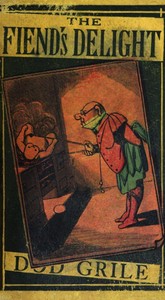
The Fiend's Delight
Download Formats:
Excerpt
The Project Gutenberg eBook of The Fiend’s Delight, by Dod Grile
This eBook is for the use of anyone anywhere in the United States and
most other parts of the world at no cost and with almost no restrictions
whatsoever. You may copy it, give it away or re-use it under the terms
of the Project Gutenberg License included with this eBook or online at
www.gutenberg.org. If you are not located in the United States, you
will have to check the laws of the country where you are located before...
Read the Full Text
— End of The Fiend's Delight —
Book Information
- Title
- The Fiend's Delight
- Author(s)
- Bierce, Ambrose
- Language
- English
- Type
- Text
- Release Date
- December 1, 2003
- Word Count
- 41,079 words
- Library of Congress Classification
- PS
- Bookshelves
- Browsing: Humour, Browsing: Literature, Browsing: Fiction
- Rights
- Public domain in the USA.
Related Books
Tales of the turf
by Fullerton, Hugh S. (Hugh Stuart)
English
237h 1m read

Light interviews with shades
by Jones, Robert Webster
English
499h 42m read

The Eatonville anthology
by Hurston, Zora Neale
English
75h 22m read

The collected stories of Elisabeth Sanxay Holding from Munsey's Magazine, 1920-1928
by Holding, Elisabeth Sanxay
English
6382h 8m read
The red-hot dollar, and other stories from the Black Cat
by Umbstaetter, H. D. (Herman Daniel)
English
492h 44m read
The Amouretta landscape, and other stories
by Adams, Adeline
English
878h 27m read