*** START OF THE PROJECT GUTENBERG EBOOK 51317 ***
Note: Images of the original pages are available through
Villanova University Digital Library. See
http://digital.library.villanova.edu/Item/vudl:354895
Transcriber's note:
Text enclosed by underscores is in italics (_italics_).
The spelling of the U.S. state name as "Louisana" has
not been corrected as it is consistently used for all 5
references to the state.
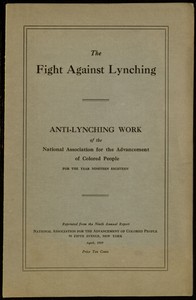
THE FIGHT AGAINST LYNCHING
Anti-Lynching Work of the National Association for the Advancement
of Colored People for the Year Nineteen Eighteen
Reprinted from the Ninth Annual Report
National Association for the Advancement of Colored People
70 Fifth Avenue, New York
April, 1919
Price Ten Cents
* * * * * *
LYNCHING PAMPHLETS*
PRESIDENT WILSON'S LYNCHING AND MOB VIOLENCE PRONOUNCEMENT (of July 26,
1918).
LYNCHINGS OF MAY, 1918, IN BROOKS AND LOWNDES COUNTIES, GEORGIA; an
investigation by the N. A. A. C. P.; 8 pages.
THE MASSACRE OF EAST ST. LOUIS; an account of an Investigation by W. E.
BURGHARDT DU BOIS and MARTHA GRUENING, for the N. A. A. C. P.,
illustrated, 20 pages, reprinted from _The Crisis_ for September, 1917.
THE BURNING OF ELL PERSON AT MEMPHIS, TENN.; an account taken from the
Memphis daily papers of May 22, 23, 24 and June 3, 1917; 4 pages.
THE BURNING OF ELL PERSON AT MEMPHIS, TENN.; an investigation by James
Weldon Johnson for the N. A. A. C. P.; reprinted from _The Crisis_ for
July, 1917; 8 pages.
THE LYNCHING OF ANTHONY CRAWFORD (at Abbeville, S. C., October 21, 1916).
Article by ROY NASH (then) Secretary, N. A. A. C. P.; reprinted from the
_Independent_ for December, 1916; 4 pages, large size.
NOTES ON LYNCHING IN THE UNITED STATES, compiled from _The Crisis_, 1912;
16 pages.
THIRTY YEARS OF LYNCHING IN THE UNITED STATES, 1889-1918, April, 1919;
circa 100 pages, fifteen cents.
* Copies of the pamphlets listed may be obtained from the Secretary
of the Association.
* * * * * *
ANTI-LYNCHING COMMITTEE
NATIONAL ASSOCIATION FOR THE ADVANCEMENT
OF COLORED PEOPLE
WILLIAM ENGLISH WALLING, _Chairman_
JOHN R. SHILLADY, _Secretary_
PHILIP G. PEABODY
MOORFIELD STOREY
ARCHIBALD H. GRIMKÉ
W. E. B. DU BOIS
MARY WHITE OVINGTON
FOREWORD
The anti-lynching work of the National Association for the Advancement of
Colored People is carried on as a part of the activities of the Association
under the direction of the Association's Anti-Lynching Committee, whose
names appear elsewhere.
This work was made possible in the beginning through an initial
contribution of $1,000 made by Mr. Philip G. Peabody, of Boston, Mass., in
the fall of 1916, toward a fund of $10,000 to be used in a vigorous
campaign against the lynching evil. The Association's president, Mr.
Moorfield Storey, contributed a second $1,000 and as the result of a
wide-spread appeal an amount slightly in excess of $10,000 over and above
the cost of the appeal was subscribed. The Association is endeavoring to
raise approximately $10,000 annually to carry on this work.
The principal activities of the anti-lynching campaign include:
Investigation of as many of the lynchings as possible.
Publication and distribution of the investigator's findings and of other
data concerning lynching.
Inquiries and protests whenever lynchings occur, to governors, sheriffs
and other state and local authorities by telegraph and letter, and, in
selected cases, amounting in the aggregate to a considerable number,
appeals to leading chambers of commerce urging them to demand that their
governors and other officials take legal action against lynchers.
Press publicity of such inquiries and protests and of the results of the
Association's investigations and other matter of current "news" interest
in order thus to create public sentiment against lynching.
Research into the facts regarding past lynchings.
Collection of press and editorial comment on lynching in general and on
particular lynchings.
Study of causes and remedies for lynching.
Efforts to secure specific legislation to prevent lynching.
Continuous agitation of the subject through the columns of the
Association's organ, _The Crisis_ and through meetings and addresses upon
every appropriate occasion.
Generally to keep the evil of lynching before the American people as a
live issue and to offer a constructive program for its abolition.
The Association, through its president and secretary, acting for the
Anti-Lynching Committee, took the initiative in promoting a National
Conference on Lynching which will be held in New York City on the fifth and
sixth of May, 1919, for the purpose of focusing the attention of the nation
on this blot upon America's fair name and of working out an effective,
constructive program for its abolition. This conference has been called by
one hundred and twenty leaders of American opinion, it being judged best
that the conference be called by distinguished Americans rather than by the
Association itself, or the Anti-Lynching Committee, in order that the
appeal might not be hampered in the minds of anyone by its association with
the work of an organization devoted to the interests of the Negro, and to
which there might be opposition on that account.
Among the signers of this call are the attorney general of the United
States, five governors, one of them, Governor Hugh M. Dorsey of Georgia, a
southern governor, four ex-governors, one of these, Hon. Emmet O'Neal of
Alabama, from the South, two ex-attorney generals of the United States,
nine university presidents, the president of the American Bar Association,
a number of leading lawyers of national reputation of the country,
including Elihu Root and Charles Evans Hughes, Cardinal Gibbons and leading
churchmen and representative colored leaders. Nineteen of the signers of
the call are representatives leaders of southern white liberal opinion.
The Association urgently appeals for financial support in its constructive
efforts to stamp out lynching in the United States.
JOHN R. SHILLADY, _Secretary_
NATIONAL ASSOCIATION FOR THE ADVANCEMENT
OF COLORED PEOPLE
THE FIGHT AGAINST LYNCHING
"I therefore very earnestly and solemnly beg that the governors of all
the states, the law officers of every community, and above all, the men
and women of every community in the United States, all who revere America
and wish to keep her name without stain or reproach, will co-operate, not
passively merely, but actively and watchfully to make an end of this
disgraceful evil. It cannot live where the community does not countenance
it."
July 26, 1918. WOODROW WILSON.
COMMENT BY THE WAY
An increased executive and clerical staff has permitted the Association to
devote more time and thought to its Anti-Lynching work and to conduct a
more energetic campaign for legal trial of Negro alleged offenders, than in
any previous year of the Association's history. Lynching is rapidly
becoming a national issue. Under the stress of war time, mob violence has
menaced communities heretofore relatively immune. Four white men were
lynched in 1918. And yet, when all the facts are summed up, and we would be
the last to minimize the evil of mob violence or to excuse it in the least
degree, _the lynching of Negroes by whites_ is the outstanding fact in the
situation.
Sixty-three Negroes are known to have died at the hands of white mobs
during 1918, as we point out in succeeding pages. These lynchings might
well be regarded as evidences of civil war were it not that _up to this
time_ the Negroes have not retaliated in kind. In the absence of combined
action by Negroes forcibly to protect members of their race, the lynching
of black men and women by white men for all causes and no cause, so far as
crimes are concerned, can only be compared, although in lesser degree, to
Russian pogroms against Jews under the Tzarist regime, or to Turkish
attacks upon the Armenians.
We would deeply deplore the forcible defense of Negroes by other Negroes,
since it would perhaps lead to sanguinary conflicts between the lower
element of whites and the Negroes, but no sane observer can fail to reflect
that either white men, who make and enforce the laws, must stop mob attacks
upon black men, no matter what reason may be given for the attacks, or
confess themselves unable to maintain law and order and protect _all_
citizens from unlawful attack. No class of citizens can be denied the
protection of the law with impunity.
The National Association for the Advancement of Colored People fights this
evil, as others in its program, with spiritual and legal weapons. Its
appeal is to the heart, the mind, the conscience of America. It insists
upon "ordered law and humane justice," to quote a phrase used by President
Wilson in his appeal to the country against lynching. It has hoped that the
better South would rouse itself and wipe out this terrible blot upon its
honor. But the wait has been a long one. Can the Negro depend upon securing
_his day in court_ so long as he has no say as to who sits upon the bench,
in the jury box, or who becomes the sheriff or chief of police? Think it
over in the light of experience, ye voters and students of history and
politics!
EXTENT OF THE LYNCHING EVIL[1]
_Previous to 1918_
The records show that from 1885 to 1917, both inclusive, approximately
3,740 lynchings have occurred in the United States. Two thousand seven
hundred and forty-three (2,743) of this number have had colored persons as
victims and nine hundred and ninety-seven (997) have been white. The
relative percentages of white and colored victims for the 33 years covered
is 26 per cent, white; 74 per cent, colored.
Assuming that the record for the earlier years is less accurate than for
the later period, because of many factors (all lynching figures are
probably minimum), the figures for the 18 years, 1900 to 1917, both
inclusive, are given. Fourteen hundred and twenty-seven (1,427) lynchings
are recorded for the period named. Twelve hundred and forty-one (1,241) of
these (86.7 per cent) were Negroes; 186 (13.3 per cent) were white. The
relative decrease of white victims is marked.
The victims of the East St. Louis mob riots of July, 1917, are excluded, as
are those of the mob riot at Chester, Pa. The number of victims at East St.
Louis has been estimated at as many as 175. In the report of the
Congressional Investigating Committee (House Document No. 1,231, 65th
Congress, 2nd Session) the Committee says that "at least 39 Negroes and 8
white people were killed outright, and hundreds of Negroes were wounded and
maimed."[2]
_During 1918_
During 1918, 63 Negroes and 4 white persons were lynched, as established by
well authenticated evidence.[3] The Executive Office has been advised of a
probable increase of this figure by 12 cases of which it is said that
confirmation of lynching can be obtained, but, as the Executive Office has
been unable to investigate these cases, they have, of course, been excluded
from our figures.
An Association staff member, while in the South studying special problems,
was informed by reliable colored people in Georgia that twelve unreported
cases (in the press or elsewhere) have occurred since the Association
investigated the Brooks and Lowndes Counties, Georgia, lynching orgy of
May, 1918, and that the only apparent effect in Georgia of the President's
lynching pronouncement of July 26th last, has been an apparently concerted
agreement on the part of press and authorities to keep all news regarding
lynchings out of the Georgia press. Lending some color to this charge, is
the fact that, so far as we are aware, no Georgia daily has at any time
since May, 1918, published any account of the investigation made by the
Association or of the fact that 17 names of mob leaders were put in the
hands of Governor Dorsey, despite the considerable press comment in the
press of other states.
One of our Texas branches (Houston) reported the case of one alleged victim
of a mob who was buried secretly and no publicity given to the facts. The
branch's president had written to the acting-governor requesting an
investigation of the circumstances.[4] Finally, some lynchings which do not
get into the press, are not carried beyond the immediate neighborhood,
sometimes a very small one, unless there is some unusual feature to
distinguish the event.
DISTRIBUTION OF THE 1918 LYNCHINGS
During 1918 lynchings have occurred in the following states:[5]
Alabama 3
Arkansas 3
California 1
Florida 2
Georgia 19
Kentucky 1
Louisana 9
Illinois 1
Mississippi 7
North Carolina 2
Oklahoma 1
South Carolina 1
Tennessee 4
Texas 11[6]
Virginia 1
Wyoming 1
---
67
OFFENSES CHARGED AGAINST THE 1918 VICTIMS[7]
_Negroes_
"Attacks on white women" 13
"Attacks on colored women" 1
"Living with white woman" 1
"Too revolting to publish" 2
"Shooting and killing officer of law" 10
"Murder of civilian" 14
"Shooting and wounding" 4
"Conspiracy to avenge killing of relative" 6
"Accomplice in murder" 3
"Aiding mob victim in attempt to escape" 1
"Intent to rob and kidnap" 1
"Quarrel with employer" 1
"Creating disturbance" 1
"Stealing hogs" 3
"Unknown" 2
---
63
_Whites_
"Disloyal utterances" 2
"Murder" 2
---
4
SPECIAL FEATURES OF LYNCHINGS
Five of the Negro victims have been women. Two colored men were burned at
the stake before death; four Negroes were burned after death; three
Negroes, aside from those burned at the stake, were tortured before death;
in one case the victim's dead body was carried into town on the running
board of an automobile and thrown into a public park where "it was viewed
by thousands;" one Negro victim was captured and handed to the officers of
the law by Negroes themselves. A mother and her five children were lynched
by a Texas mob, the mother having been shot as she was attempting to drag
the bodies of her four dead sons from their burning home at daybreak, the
house (only a cabin) having been fired by the mob. The crime in this case
was "alleged conspiracy to avenge" the killing of another son by officers
who had come to arrest him for "evading the draft law." This latter case
has not been classified as a lynching.
Most atrocious of all, so far as the community was concerned, was the five
days' orgy in Brooks and Lowndes Counties, which has been made the occasion
for special publicity and special efforts by the Association, to which
reference is made on page 9 of this report. In that case the particularly
vicious brutality of the mob went beyond what one is prepared to expect
from Georgia mobs--and one expects a good deal in the way of "cruel and
unusual punishments" from them. The horrible cruelties visited upon Mary
Turner, an eight month's pregnant woman, are recited in the investigation
published of our investigator's findings.[8]
In two cases the lynchings were carried out in the court house yard and in
one of these picture post card photos were sold on the streets at 25 cents
each.
TAKEN FROM PEACE OFFICERS AND JAILS
Our records show the following number of cases of lynchings of Negroes in
which the victim was taken from officers or jails:
Alabama 2
Georgia 4
Louisana 2
Mississippi 1
North Carolina 1
Oklahoma 1
South Carolina 1
Tennessee 1
---
13
INNOCENCE ADMITTED PUBLICLY
In three cases of which we have record the press has spoken of the
innocence of victims; one of these involved three persons, another the ten
victims of Brooks and Lowndes Counties mobs (aside from the one person who
shot the white farmer which was the incentive to the lynchings). In another
case it is the common belief in the community in which a Negro was lynched
for "killing a white woman" that the husband of the woman was himself the
murderer. No charge has been brought against him, however, by the
authorities. In such cases, Negroes are usually too fearful of danger and
too hopeless of anything being done, to initiate legal action. In an
additional case a bank cashier declared in an interview in an Alabama
paper, that a certain lynching victim had committed no offense, that there
had been a mistake made in the man the mob was after.
LEGAL ACTION TAKEN BY PUBLIC OFFICIALS
Governor Thomas W. Bickett of North Carolina ordered the sheriff to
investigate one case, but the sheriff reported that the "guilty parties
could not be ascertained." The Governor in another case personally appealed
to a mob at midnight and prevented the lynching of a man who was later
hanged. The same Governor in November appealed to the Federal authorities
and secured the support of a tank corps of 250 Federal army men to assist
the authorities of Winston-Salem, North Carolina, in holding the local jail
against a mob which was attempting to get a Negro prisoner to lynch him.
The Mayor and "Home Guards" of Winston-Salem, aided by the Federal soldiers
alluded to, protected the aforementioned prisoner at the cost of the lives
of some of the "Home Guards," for which public service, so unusual where
Negro-hunting mobs are concerned, they should receive the tributes of all
good citizens. (The Association's appreciation was made known to all
concerned by a public commendation).[9]
Governor Richard I. Manning of South Carolina ordered a sheriff to arrest
17 prominent farmers who had participated in a lynching. Bail was fixed at
a total of $97,500, in February. From the Judge who placed the men under
bail we learn that no indictments were found by the grand jury. "Lack of
evidence," is given as the reason.
Governor Charles Henderson of Alabama, in November, actively supported the
attorney general of the state, who, at the instance of the Governor,
personally took charge of an investigation of two lynchings which occurred
in that state on the 10th and 12th of that month.
When a regular grand jury then in session failed to indict, a prominent
detective agency was engaged and upon the evidence secured by them, a
special grand jury, headed by a local clergyman, brought in 24 indictments.
Seventeen men were lodged in jail without bail.[10]
SPECIFIC ACTION BY THE EXECUTIVE OFFICE
The following tables summarize the action taken in specific cases by the
Association:
=======================================================================
Telegrams and Letters
of Protest, Inquiry and Acknowledgments Press
Commendation Stories
------------------------- -------------------------------
Chamb. Other
State Gov. of Official Gov. C. of C. Other
Com. Persons
-----------------------------------------------------------------------
Alabama 2 10 .. .. 2 .. 1
Arkansas 1 .. .. .. .. .. 1
Georgia 5 2 .. 2 .. .. 8
Kentucky 1 .. .. .. .. .. 1
Louisana 7 11 .. .. 2 .. 9
Mississippi 2 .. .. .. .. 1 2
North Carolina 3 1 1 2 1 1 3
Oklahoma 1 .. .. 1 .. .. 2
South Carolina 1 .. .. .. .. .. 1
Tennessee 5 9 7 2 3 2 9
Texas 3 .. 1 1 .. .. 3
Wyoming 1 .. .. 1 .. .. 1
---------------------------------------------------------
32 33 9 9 8 4 40*
=======================================================================
* In listing by states there are duplications in cases where a single
press story includes matter affecting more than one state. The total 40
is the actual number of press stories, eliminating the duplicate count
by states.
Special investigations by a member of the staff have been made of lynchings
at Fayetteville, Ga., Brooks and Lowndes Counties, Ga., Estill Springs,
Tenn., Blackshear, Ga., and of race riots and disturbances at Camp Merritt,
N. J., Brooklyn, N. Y. and Philadelphia, Pa.[11]
Memoranda were prepared and sent to the President of the United States, to
the Attorney General of the United States and to the executive committees
of the American Bar Association, on the general subject of lynching, but
with reference to immediate practical action desired by the Association.
Letters requesting editorial interest in the fight against lynching were
addressed to the leading papers of the country on several occasions and
matter has been prepared for specific use by individual papers.
Publicity in the press was secured for the memorandum to the President and
to the Attorney General. Mr. Storey's address to the Wisconsin Bar
Association, June, 1918, on "The Negro Question," which contains much
reference to lynching, was sent to all the members of the Cabinet and of
the Congress, to Governors of all the states, mayors of cities, to
newspapers, periodicals, and to leading citizens and will be given wider
circulation during the early part of 1919.[12]
The members of the executive staff have made reference to lynching in
addresses in many cities to both white and colored audiences. Certain of
Field Secretary Johnson's addresses before white audiences have met with
notable responses.
The offer of the publishers of the _San Antonio Express_, San Antonio,
Texas, made in April, to pay rewards of $1,000, for each conviction and
punishment of the lynchers of a Negro (and $500, if white), has been given
wide publicity among the branches and the colored press. (No one has
claimed a reward from this fund as yet, however).
ILLUSTRATION OF RESULTS FOLLOWING THE ASSOCIATION'S PUBLICITY WORK
The following examples of results following publicity sent out by the
Association and telegrams addressed to Governors and Chambers of Commerce
are reviewed:
On November 9, telegrams of inquiry and appeal for legal action in the case
of the lynching of George Taylor at Rolesville, near Raleigh, N. C., were
sent to Governor Bickett of North Carolina, to the County Solicitor of Wake
County and to the Chamber of Commerce of Raleigh, of which that to the
Governor was acknowledged. The Governor said that he agreed with the points
made in the telegram and would back the County Solicitor in efforts to fix
the blame for the affair. The Solicitor carried on an investigation for two
weeks, examining 21 white and 9 colored witnesses. The coroner's jury ran
true to form, finding that the victim came to his death at the hands of
"parties unknown" to the jury.
The two leading Raleigh newspapers, one of them owned by Secretary of the
Navy Daniels, carried strong editorial comment against the lynching and
criticized the dereliction of the officers in allowing their prisoner to be
taken from them. One of them commented directly and favorably on the
Association's telegrams to the Governor.
Ten days later, as has been mentioned on a preceding page of this report,
the same Governor appealed successfully to an adjacent army camp for help
to support the mayor and "home guards" of Winston-Salem in holding the
local jail against a mob which was attempting to seize a Negro prisoner to
lynch him.
The Chambers of Commerce of Montgomery and Birmingham, Alabama,
acknowledged telegrams and letters of the Association sent during November,
saying that they supported our view (that the lynchers of Will Byrd and
Henry Whiteside should be ascertained and legal action against them taken)
and that the Governor had ordered the action referred to on a previous page
of this report, that of instructing the attorney general of the state to
push an investigation of the lynchings at Sheffield and Tuscumbia, Alabama.
Space forbids the citation of further examples. In many cases, however, no
direct effect was produced by the Association's long distance efforts. It
would be a mistake, however, to assume that no beneficial results can be
credited to such of the Association's forty telegraphic inquiries
(accompanied by newspaper publicity) as had occasioned no immediate action.
Correspondents have written and callers at the National Headquarters have
assured the National Officers of the value of this publicity work. In some
cases local leaders among the white citizens have called upon colored
people to assure them of their concern for the well being and protection of
the _good_ Negro and incidentally, we are told, to advise them against
allying themselves with "northern agitators."
That the pressure of national opinion is felt and feared, even in the
center of the lynching area, is evidenced by such editorials as that
following a protest against a Louisana lynching, in which a local editor
devoted a column of matter to "lambasting" the National Secretary under the
caption "No Outside Scolds Needed." It was asked why this "Association with
the long name" was endeavoring to hold Louisana up to the _scorn of the
country_, etc., _ad lib._
OUTSTANDING EVENTS ASIDE FROM ASSOCIATION EFFORTS
The most notable events affecting the anti-lynching campaign, aside from
the Association's efforts, have been the President's July 26 pronouncement
against lynching, the formation of the Tennessee Law and Order League to
suppress lynching in March, and its announced campaign to stimulate the
organization of similar movements in all the Southern states and the offer
of _The San Antonio Express_ heretofore mentioned.[13] The latter offer is,
of course, of scant promise for effective service in the campaign.
LYNCHING RECORD FOR 1918
January 17--Hazelhurst, Miss., Sam Edwards, burned to death; charged with
murder of Bera Willes, seventeen-year-old white girl.
" 26--Benton, La., Jim Hudson, hanged; living with a white woman.
February 7--Fayetteville, Ga., "Bud" Cosby, hanged; intent to rob and
kidnapping.
" 12--Estill Springs, Tenn., Jim McIllheron, burned; accused of
shooting to death two white men. G. W. Lych, who hid McIllheron, was shot
to death.
" 23--Fairfax, S. C., Walter Best, hanged; accused of murder.
" 26--Rayville, La., Jim Lewis, Jim Jones and Will Powell, two
hanged and one shot to death; accused of stealing hogs. In the fray one
white man and one Negro were killed.
" 26--Willacoochee, Ga., Ed. Dansy, shot; he had killed two white
officers and wounded three others.
March 16--Monroe, La., George McNeel and John Richards, hanged; alleged
attack upon a white woman.
" 22--Crawfordsville, Ga., Spencer Evans, hanged; convicted of
criminal assault upon a colored woman at the February term of court and
sentenced to be hanged, but a mob took him from jail and lynched him.
" 26--Lewiston, N. C., Peter Bazemore; alleged attack upon a white
woman.
April 4--Collinsville, Ill., Robert P. Praeger, hanged (white); accused
of making disloyal remarks.
" 20--Poplarville, Miss., Claud Singleton, hanged; accused of
murdering a white man. He had been sentenced to life imprisonment.
" 22--Lexington, Tenn., Berry Noyes, hanged; murder of Sheriff W. E.
McBride.
" 22--Monroe, La., Clyde Williams, hanged; shooting C. L. Thomas,
Missouri-Pacific station agent at Fawndale.
May 17--Valdosta, Ga., Will Head, Will Thompson, Hayes Turner, Mary
Turner, Sydney Johnson, Eugene Rice, Chime Riley, Simon Schuman and three
unidentified Negroes, hanged; alleged complicity in the murder of Hampton
Smith.
" 20--Erwin, Tenn., Thomas Devert, shot and burned; alleged murder of a
white girl.
" 22--Miami, Fla., Henry Jackson, hanged; throwing a white man
underneath a train.
" 22--Red Level, Ala., John Womack, shot; alleged assault on a white
woman.
" 23--Cordele, Ga., James Cobb, hanged; alleged murder of Mrs. Roy
Simmons.
" 25--Barnesville, Ga., John Calhoun, shot; alleged murder of John A.
Willis.
June 4--Huntsville, Tex., Sarah Cabiness and her five children; Peter,
Cute, Tenola, Thomas and Bessie, shot; alleged threat to avenge killing
of George Cabiness.
" 4--Beaumont, Tex., Kirby Goolsie, hanged; alleged attack on a white
girl.
" 4--Sanderson, Tex., Edward Valentine (white); murder.
" 18--Mangham, La., George Clayton, hanged; murder of his employer,
Ben Brooks. In a battle with the posse he wounded six men, probably
fatally.
" 18--Earle, Ark., Allen Mitchell, hanged; wounding Mrs. W. M.
Langston.
" 29--Madill, Okla., L. McGill, hanged; alleged attack upon a white
woman.
July 27--Ben Hur, Tex., Gene Brown, hanged; alleged assault on a white
woman.
August 7--Bastrop, La., "Bubber" Hall, hanged; alleged attack on a white
woman.
" 11--Colquit, Ga., Ike Radney; reason unknown.
" 15--Natchez, Miss., Bill Dukes, shot to death. "He was guilty of a
crime too revolting for publication."
" 15--Quincy, Fla., unidentified Negro; reason unknown.
" 15--Macon, Ga., John Gilham, hanged; alleged attack on two white
women.
" 28--Hot Springs, Ark., Frederick Wagner (white); disloyal
utterances.
September 3--San Pedro, Cal., Warren Czerich (white); murder.
" 18--Buff Lake, Tex., Abe O'Neal; shot and wounded white man.
" 24--Waycross, Ga., Sandy Reeves, hanged; alleged assault on a
white girl.
November 5--Rolesville, N. C., George Taylor, hanged; rape.
" 11--Sheffield, Ala., William Bird, hanged; "for creating
disturbance."
" 12--Sheffield, Ala., George Whiteside, hanged; charged with the
murder of a policeman.
" 14--Fort Bend County, Tex., Charles Shipman; disagreement with
landowner.
" 24--Culpepper, Va., Allie Thompson; charged with assaulting a
white woman.
December 10--Green River, Wyo., Edward Woodson; charged with killing a
railroad switchman.
" 16--Hickman, Ky., Charles Lewis, hanged; alleged to have beaten
Deputy Sheriff Thomas.
" 18--Newport, Ark., Willis Robinson, hanged; murder of Patrolman
Charles Williams.
" 21--Shubuta, Miss., Major and Andrew Clarke and Maggie and Alma
House, hanged; accused of murder of Dr. E. L. Johnston.
NATIONAL ASSOCIATION
FOR THE
ADVANCEMENT OF COLORED PEOPLE
Organized, February, 1909
Incorporated, May, 1911
1. To abolish legal injustice against Negroes.
2. To stamp out race discriminations.
3. To prevent lynchings, burnings and torturings of black people.
4. To assure to every citizen of color the common rights of American
citizenship.
_President Wilson declared for woman suffrage as a war measure. Black
men are not allowed to vote in many of the states of the Union, despite
the Fifteenth Amendment._
5. To compel equal accommodations in railroad travel, irrespective of
color.
6. To secure for colored children an equal opportunity to public school
education through a fair apportionment of public education funds.
_Unless the colored child can be educated he is at a fearful
disadvantage. An uneducated Negro population menaces national
well-being. This education should be of hand and brain and can be
adequately done_ for all Negro children, not the fortunate few, _only
by public schools_.
7. To emancipate in fact, as well as in name, a race of nearly 12,000,000
American-born citizens.
The only means we can employ are education, organization, agitation,
publicity--the force of an enlightened public opinion.
THE WORK IS SUPPORTED ENTIRELY BY VOLUNTARY CONTRIBUTIONS AND MEMBERSHIPS.
Send contributions to
OSWALD GARRISON VILLARD, _Treasurer_,
70 FIFTH AVENUE, NEW YORK.
NATIONAL ASSOCIATION
FOR THE
ADVANCEMENT OF COLORED PEOPLE
70 Fifth Avenue, New York City
Official Organ--THE CRISIS, published Monthly.
----
NATIONAL OFFICERS
_President_
MOORFIELD STOREY
_Vice-Presidents_
ARCHIBALD H. GRIMKÉ
REV. JOHN HAYNES HOLMES
BISHOP JOHN HURST
CAPT. ARTHUR B. SPINGARN
OSWALD GARRISON VILLARD
EXECUTIVE OFFICERS
_Chairman of the Board_, MARY WHITE OVINGTON
JOHN R. SHILLADY, _Secretary_
OSWALD GARRISON VILLARD, _Treasurer_
DR. W. E. B. DU BOIS, _Director of Publications and Research_
JAMES WELDON JOHNSON, _Field Secretary_
WALTER F. WHITE, _Assistant Secretary_
BOARD OF DIRECTORS
_Baltimore_
Bishop John Hurst
_Boston_
Joseph Prince Loud
Moorfield Storey
Butler R. Wilson
_Buffalo_
Mary B. Talbert
_Chicago_
Jane Addams
Dr. C. E. Bentley
_Memphis_
R. R. Church
_New Haven_
George W. Crawford
_New York_
Rev. Hutchens C. Bishop
Dr. W. E. B. Du Bois
Rev. John Haynes Holmes
Dr. V. Morton Jones
Florence Kelley
Paul Kennaday
John E. Milholland
Mary White Ovington
Capt. Arthur B. Spingarn
Major J. E. Spingarn
Charles H. Studin
Oswald Garrison Villard
Lillian D. Wald
William English Walling
_Philadelphia_
Dr. William A. Sinclair
_Springfield_
Rev. G. R. Waller
_St. Louis_
Hon. Charles Nagel
_Wilberforce_
Col. Chas. Young, U. S. A.
_Washington_
Prof. Geo. William Cook
Archibald H. Grimké
Charles Edward Russell
NOTES.
[1] The Association has in preparation a pamphlet, which will appear in
April, 1919, entitled, "Thirty Years of Lynching in the United States,
1889-1918," which can be secured from the secretary.
[2] "The bodies of the dead Negroes," testified an eye-witness, "were
thrown into a morgue like so many dead hogs." Ibid., page 4.
[3] See page 18 for chronological list of name, place, date and alleged
cause of lynchings for 1918.
[4] Nothing came of this request in the way of legal action.
[5] Four of the lynched victims were white men (one each in Arkansas,
California, Illinois and Texas), 63 were Negroes and 5 of the latter
women.
[6] In _The Crisis_ for February, 1919, page 181, this total is given as
12. The case of George Cabiness, whose mother and four brothers and
sister were lynched, for alleged threats to avenge the killing of
George, has been eliminated from the lynching record as the latter was
alleged to have been killed resisting arrest.
[7] According to press accounts, except in a very few cases in which the
victim was actually tried before a court and later taken from the jail
and lynched.
[8] Published in _The Crisis_ for September, 1918 _The Work of a Mob_, and
reprinted by the Association under the title, "_The Lynchings of May,
1918, in Brooks and Lowndes Counties Georgia_," September, 1918, 6 p.
[9] As we go to press, information has come that Judge B. F. Long has
sentenced 15 men involved in the attempt to storm the Winston-Salem
jail to prison terms ranging from fourteen months to six years. This
is indeed a rarity and an occasion for rejoicing.
[10] _At the trial of the two alleged ringleaders of the mobs, which was
held at Tuscumbia, Alabama, on February 3 and 4, 1919, the jury,
assembled from the neighborhood, found a verdict of not guilty. The
secretary of the Association was in attendance at the trial and has
written a report of it which has been published as a special pamphlet
Dispensing With Justice in Alabama_--a Report of the Trial of Frank
Dillard, Alleged Lyncher, at Tuscumbia, Alabama, February 3 and 4,
1919, by John R. Shillady, Secretary, National Association for the
Advancement of Colored People.
[11] Of these investigations, the following have been published and may be
obtained upon application to the National Secretary: Brooks and
Lowndes Counties, Georgia (see foot-note, page 11); Estill Springs,
Tenn. (see _The Crisis_ for May, 1918, pages 16-20); Philadelphia Race
Riots of July 26 to July 31, 1918, 8 p.
[12] Printed by the National Association for the Advancement of Colored
People as "The Negro Question" (with resolutions adopted by the Bar
Association following the delivery of the address), 30 pages, ten
cents per copy.
[13] Little, if any, progress was made in 1918, however, in the Law and
Order League endeavor, according to our best information, and no
rewards were claimed from the San Antonio Express.
*** END OF THE PROJECT GUTENBERG EBOOK 51317 ***
The Fight Against Lynching - Anti-Lynching Work of the National Association for the Advancement of Colored People for the Year Nineteen Eighteen
Subjects:
Download Formats:
Excerpt
Note: Images of the original pages are available through
Villanova University Digital Library. See
http://digital.library.villanova.edu/Item/vudl:354895
Text enclosed by underscores is in italics (_italics_).
The spelling of the U.S. state name as "Louisana" has
not been corrected as it is consistently used for all 5
references to the state.
Anti-Lynching Work of the National Association for the Advancement
of Colored People for the Year Nineteen Eighteen...
Read the Full Text
— End of The Fight Against Lynching - Anti-Lynching Work of the National Association for the Advancement of Colored People for the Year Nineteen Eighteen —
Book Information
- Title
- The Fight Against Lynching - Anti-Lynching Work of the National Association for the Advancement of Colored People for the Year Nineteen Eighteen
- Author(s)
- National Association for the Advancement of Colored People
- Language
- English
- Type
- Text
- Release Date
- February 28, 2016
- Word Count
- 5,344 words
- Library of Congress Classification
- HV
- Bookshelves
- Browsing: History - American, Browsing: Politics, Browsing: Sociology
- Rights
- Public domain in the USA.
Related Books
The Truth About Lynching and the Negro in the South - In Which the Author Pleads That the South Be Made Safe for the White Race
by Collins, Winfield H. (Winfield Hazlitt)
English
526h 17m read
Why is the Negro Lynched?
by Douglass, Frederick
English
311h 28m read
Mob Rule in New Orleans - Robert Charles and His Fight to Death, the Story of His Life, Burning Human Beings Alive, Other Lynching Statistics
by Wells-Barnett, Ida B.
English
408h 25m read
Southern Horrors: Lynch Law in All Its Phases
by Wells-Barnett, Ida B.
English
211h 9m read