The Project Gutenberg eBook of The Metamorphoses of Ovid, by Publius Ovidius Naso
This eBook is for the use of anyone anywhere in the United States and
most other parts of the world at no cost and with almost no restrictions
whatsoever. You may copy it, give it away or re-use it under the terms
of the Project Gutenberg License included with this eBook or online at
www.gutenberg.org. If you are not located in the United States, you
will have to check the laws of the country where you are located before
using this eBook.
Title: The Metamorphoses of Ovid
Vol. I, Books I-VII
Author: Publius Ovidius Naso
Translator: Henry Thomas Riley
Release Date: June 8, 2007 [eBook #21765]
[Most recently updated: June 28, 2021]
Language: English
Character set encoding: UTF-8
Produced by: Louise Hope, Steve Schulze and the Online Distributed Proofreading Team
*** START OF THE PROJECT GUTENBERG EBOOK THE METAMORPHOSES OF OVID ***
[Transcriber’s Note:
In the original text, words and phrases supplied by the translator
were printed in _italics_. In this e-text they are shown in {braces}.
Italics in the notes and commentary are shown conventionally with
_lines_, boldface by =marks=.
Line numbers from the original Latin poem were printed as headnotes
on each page. For this e-text, only the line numbers of each complete
“Fable” are given. Line numbers used in footnotes are retained from
the original text; these, too, refer to the Latin poem and are
independent of line divisions in the translation.
Parts of this e-text use material from another edition of the Riley
translation of the _Metamorphoses_: George Bell (London, 1893).
Details are given at the end of the text, before the Errata. Each
segment of the introductory material is individually identified.]
THE
METAMORPHOSES OF OVID
Vol. I--Books I-VII
LITERALLY TRANSLATED WITH NOTES AND EXPLANATIONS
by
HENRY T. RILEY, M.A.
With an Introduction by
EDWARD BROOKS, JR.
Copyright, 1899, By David McKay
Press Of
Sherman & Co., Philadelphia
INTRODUCTION.
[From Bell edition.]
The Metamorphoses of Ovid are a compendium of the Mythological
narratives of ancient Greece and Rome, so ingeniously framed, as to
embrace a large amount of information upon almost every subject
connected with the learning, traditions, manners, and customs of
antiquity, and have afforded a fertile field of investigation to the
learned of the civilized world. To present to the public a faithful
translation of a work, universally esteemed, not only for its varied
information, but as being the masterpiece of one of the greatest Poets
of ancient Rome, is the object of the present volume.
To render the work, which, from its nature and design, must, of
necessity, be replete with matter of obscure meaning, more inviting
to the scholar, and more intelligible to those who are unversed in
Classical literature, the translation is accompanied with Notes and
Explanations, which, it is believed, will be found to throw considerable
light upon the origin and meaning of some of the traditions of heathen
Mythology.
In the translation, the text of the Delphin edition has been generally
adopted; and no deviation has been made from it, except in a few
instances, where the reason for such a step is stated in the notes;
at the same time, the texts of Burmann and Gierig have throughout been
carefully consulted. The several editions vary materially in respect to
punctuation; the Translator has consequently used his own discretion in
adopting that which seemed to him the most fully to convey in each
passage the intended meaning of the writer.
The Metamorphoses of Ovid have been frequently translated into the
English language. On referring to Mr. Bohn’s excellent Catalogue of the
Greek and Latin Classics and their Translations, we find that the whole
of the work has been twice translated into English Prose, while five
translations in Verse are there enumerated. A prose version of the
Metamorphoses was published by Joseph Davidson, about the middle of
the last century, which professes to be “as near the original as the
different idioms of the Latin and English will allow;” and to be
“printed for the use of schools, as well as of private gentlemen.” A few
moments’ perusal of this work will satisfy the reader that it has not
the slightest pretension to be considered a literal translation, while,
by its departure from the strict letter of the author, it has gained
nothing in elegance of diction. It is accompanied by “critical,
historical, geographical, and classical notes in English, from the best
Commentators, both ancient and modern, beside a great number of notes,
entirely new;” but notwithstanding this announcement, these annotations
will be found to be but few in number, and, with some exceptions in the
early part of the volume, to throw very little light on the obscurities
of the text. A fifth edition of this translation was published so
recently as 1822, but without any improvement, beyond the furbishing up
of the old-fashioned language of the original preface. A far more
literal translation of the Metamorphoses is that by John Clarke, which
was first published about the year 1735, and had attained to a seventh
edition in 1779. Although this version may be pronounced very nearly to
fulfil the promise set forth in its title page, of being “as literal as
possible,” still, from the singular inelegance of its style, and the
fact of its being couched in the conversational language of the early
part of the last century, and being unaccompanied by any attempt at
explanation, it may safely be pronounced to be ill adapted to the
requirements of the present age. Indeed, it would not, perhaps, be too
much to assert, that, although the translator may, in his own words,
“have done an acceptable service to such gentlemen as are desirous of
regaining or improving the skill they acquired at school,” he has, in
many instances, burlesqued rather than translated his author. Some of
the curiosities of his version will be found set forth in the notes;
but, for the purpose of the more readily justifying this assertion, a
few of them are adduced: the word “nitidus” is always rendered “neat,”
whether applied to a fish, a cow, a chariot, a laurel, the steps of a
temple, or the art of wrestling. He renders “horridus,” “in a rude
pickle;” “virgo” is generally translated “the young lady;” “vir” is
“a gentleman;” “senex” and “senior” are indifferently “the old blade,”
“the old fellow,” or “the old gentleman;” while “summa arx” is “the very
tip-top.” “Misera” is “poor soul;” “exsilio” means “to bounce forth;”
“pellex” is “a miss;” “lumina” are “the peepers;” “turbatum fugere” is
“to scower off in a mighty bustle;” “confundor” is “to be jumbled;” and
“squalidus” is “in a sorry pickle.” “Importuna” is “a plaguy baggage;”
“adulterium” is rendered “her pranks;” “ambages” becomes either “a long
rabble of words,” “a long-winded detail,” or “a tale of a tub;”
“miserabile carmen” is “a dismal ditty;” “increpare hos” is “to rattle
these blades;” “penetralia” means “the parlour;” while “accingere,” more
literally than elegantly, is translated “buckle to.” “Situs” is “nasty
stuff;” “oscula jungere” is “to tip him a kiss;” “pingue ingenium” is a
circumlocution for “a blockhead;” “anilia instrumenta” are “his old
woman’s accoutrements;” and “repetito munere Bacchi” is conveyed to the
sense of the reader as, “they return again to their bottle, and take the
other glass.” These are but a specimen of the blemishes which disfigure
the most literal of the English translations of the Metamorphoses.
In the year 1656, a little volume was published, by J[ohn] B[ulloker,]
entitled “Ovid’s Metamorphosis, translated grammatically, and, according
to the propriety of our English tongue, so far as grammar and the verse
will bear, written chiefly for the use of schools, to be used according
to the directions in the preface to the painfull schoolmaster, and more
fully in the book called, ‘Ludus Literarius, or the Grammar school,
chap. 8.’” Notwithstanding a title so pretentious, it contains a
translation of no more than the first 567 lines of the first Book,
executed in a fanciful and pedantic manner; and its rarity is now the
only merit of the volume. A literal interlinear translation of the first
Book “on the plan recommended by Mr. Locke,” was published in 1839,
which had been already preceded by “a selection from the Metamorphoses
of Ovid, adapted to the Hamiltonian system, by a literal and interlineal
translation,” published by James Hamilton, the author of the Hamiltonian
system. This work contains selections only from the first six books, and
consequently embraces but a very small portion of the entire work.
For the better elucidation of the different fabulous narratives and
allusions, explanations have been added, which are principally derived
from the writings of Herodotus, Apollodorus, Pausanias, Dio Cassius,
Dionysius of Halicarnassus, Strabo, Hyginus, Nonnus, and others of the
historians, philosophers, and mythologists of antiquity. A great number
of these illustrations are collected in the elaborate edition of Ovid,
published by the Abbé Banier, one of the most learned scholars of the
last century; who has, therein, and in his “Explanations of the Fables
of Antiquity,” with indefatigable labour and research, culled from the
works of ancient authors, all such information as he considered likely
to throw any light upon the Mythology and history of Greece and Rome.
This course has been adopted, because it was considered that a statement
of the opinions of contemporary authors would be the most likely to
enable the reader to form his own ideas upon the various subjects
presented to his notice. Indeed, except in two or three instances, space
has been found too limited to allow of more than an occasional reference
to the opinions of modern scholars. Such being the object of the
explanations, the reader will not be surprised at the absence of
critical and lengthened discussions on many of those moot points of
Mythology and early history which have occupied, with no very positive
result, the attention of Niebuhr, Lobeck, Müller, Buttmann, and many
other scholars of profound learning.
A SYNOPTICAL VIEW
of the Principal Transformations Mentioned in
THE METAMORPHOSES.
[From Bell edition, omitting Books VIII-XV.]
BOOK I.
Chaos is divided by the Deity into four Elements: to these their
respective inhabitants are assigned, and man is created from earth and
water. The four Ages follow, and in the last of these the Giants aspire
to the sovereignty of the heavens; being slain by Jupiter, a new race of
men springs up from their blood. These becoming noted for their impiety,
Jupiter not only transforms Lycaon into a wolf, but destroys the whole
race of men and animals by a Deluge, with the exception of Deucalion and
Pyrrha, who, when the waters have abated, renew the human race, by
throwing stones behind them. Other animated beings are produced by heat
and moisture: and, among them, the serpent Python. Phœbus slays him, and
institutes the Pythian games as a memorial of the event, in which the
conquerors are crowned with beech; for as yet the laurel does not exist,
into which Daphne is changed soon after, while flying from Phœbus. On
this taking place, the other rivers repair to her father Peneus, either
to congratulate or to console him; but Inachus is not there, as he is
grieving for his daughter Io, whom Jupiter, having first ravished her,
has changed into a cow. She is entrusted by Juno to the care of Argus;
Mercury having first related to him the transformation of the Nymph
Syrinx into reeds, slays him, on which his eyes are placed by Juno in
the tail of the peacock. Io, having recovered human shape, becomes the
mother of Epaphus.
BOOK II.
Epaphus, having accused Phaëton of falsely asserting that Phœbus is his
father, Phaëton requests Phœbus, as a proof of his affection towards his
child, to allow him the guidance of the chariot of the Sun for one day.
This being granted, the whole earth is set on fire by him, and the
Æthiopians are turned black by the heat. Jupiter strikes Phaëton with a
thunderbolt, and while his sisters and his kinsman Cyenus are lamenting
him, the former are changed into trees, and Cyenus into a swan. On
visiting the earth, that he may repair the damage caused by the
conflagration, Jupiter sees Calisto, and, assuming the form of Diana, he
debauches her. Juno, being enraged, changes Calisto into a bear; and her
own son Arcas being about to pierce her with an arrow, Jupiter places
them both among the Constellations. Juno having complained of this to
Oceanus, is borne back to the heavens by her peacocks, who have so
lately changed their colour; a thing which has also happened to the
raven, which has been lately changed from white to black, he having
refused to listen to the warnings of the crow (who relates the story of
its own transformation, and of that of Nyctimene into an owl), and
having persisted in informing Phœbus of the intrigues of Coronis. Her
son Æsculapius being cut out of the womb of Coronis and carried to the
cave of Chiron the Centaur, Ocyrrhoë, the daughter of Chiron, is changed
into a mare, while she is prophesying. Her father in vain invokes the
assistance of Apollo, for he, in the guise of a shepherd, is tending his
oxen in the country of Elis. He neglecting his herd, Mercury takes the
opportunity of stealing it; after which he changes Battus into a
touchstone, for betraying him. Flying thence, Mercury beholds Herse, the
daughter of Cecrops, and debauches her. Her sister Aglauros, being
envious of her, is changed into a rock. Mercury returns to heaven, on
which Jupiter orders him to drive the herds of Agenor towards the shore;
and then, assuming the form of a bull, he carries Europa over the sea to
the isle of Crete.
BOOK III.
Agenor commands his son Cadmus to seek his sister Europa. While he is
doing this, he slays a dragon in Bœotia; and having sowed its teeth in
the earth, men are produced, with whose assistance he builds the walls
of Thebes. His first cause of grief is the fate of his grandson Actæon,
who, being changed into a stag, is torn to pieces by his own hounds.
This, however, gives pleasure to Juno, who hates not only Semele, the
daughter of Cadmus, and the favourite of Jupiter, but all the house of
Agenor as well. Assuming the form of Beroë, she contrives the
destruction of Semele by the lightnings of Jupiter; while Bacchus, being
saved alive from his mother’s womb, is brought up on the earth. Jupiter
has a discussion with Juno on the relative pleasures of the sexes, and
they agree to refer the question to Tiresias, who has been of both
sexes. He gives his decision in favour of Jupiter, on which Juno
deprives him of sight; and, by way of recompense, Jupiter bestows on him
the gift of prophesy. His first prediction is fulfilled in the case of
Narcissus, who, despising the advances of all females (in whose number
is Echo, who has been transformed into a sound), at last pines away with
love for himself, and is changed into a flower which bears his name.
Pentheus, however, derides the prophet; who predicts his fate, and his
predictions are soon verified; for, on the celebration of the orgies,
Bacchus having assumed a disguise, is brought before him; and having
related to Pentheus the story of the transformation of the Etrurian
sailors into dolphins, he is thrown into prison. On this, Pentheus is
torn in pieces by the Bacchanals, and great respect is afterwards paid
to the rites of Bacchus.
BOOK IV.
Still Alcithoë and her sisters, neglecting the rites, attend to their
spinning, during the festivities, and pass the time in telling stories;
and, among others, that of Pyramus and Thisbe, by whose blood the
mulberry is turned from white to black, and that of the discovery of the
intrigues of Mars and Venus, on the information of the Sun. They also
tell how the Sun assumed the form of Eurynome, that he might enjoy her
daughter Leucothoë; how Clytie, becoming jealous of her sister, was
transformed into a sun-flower; and how Salmacis and Hermaphroditus had
become united into one body. After this, through the agency of Bacchus,
the sisters are transformed into bats, and their webs are changed into
vines. Ino rejoicing at this, Juno, in her hatred and indignation, sends
one of the Furies to her, who causes her to be struck with insanity, on
which she leaps into the sea, with her son Melicerta in her arms; but by
the intercession of Venus, they become sea Deities, and their Sidonian
attendants, who are bewailing them as dead, are changed into rocks.
Cadmus, afflicted at this fresh calamity, retires from Thebes, and flies
to Illyria, together with his wife, where they are both transformed into
serpents. Of those who despise Bacchus, Acrisius alone remains, the
grandfather of Perseus, who, having cut off the head of the Gorgon
Medusa, serpents are produced by her blood. Perseus turns Atlas into a
mountain, and having liberated Andromeda, he changes sea-weed into
coral, and afterwards marries her.
BOOK V.
A tumult arising during the celebration of the nuptials, Phineus claims
Andromeda, who has been betrothed to him; and together with Prœtus, he
and Polydectes are turned into stone. Pallas, who has aided Perseus, now
leaves him, and goes to Helicon, to see the fountain of Hippocrene. The
Muses tell her the story of Pyreneus and the Pierides, who were
transformed into magpies after they had repeated various songs on the
subjects of the transformation of the Deities into various forms of
animals; the rape of Proserpine, the wanderings of Ceres, the change of
Cyane into a fountain, of a boy into a lizard, of Ascalaphus into an
owl, of the Sirens into birds in part, of Arethusa into a spring, of
Lyncus into a lynx, and of the invention of agriculture by Triptolemus.
BOOK VI.
Influenced by the example of the Muses, Pallas determines on the
destruction of Arachne. She enters with her into a contest for the
superiority in the art of weaving. Each represents various
transformations on her web, and then Arachne is changed into a spider.
Niobe, however, is not deterred thereby from preferring her own lot to
that of Latona; on account of which, all her children are slain by
Apollo and Diana, and she is changed into a rock. On learning this,
while one person relates the transformation by Latona of the Lycian
rustics into frogs, another calls to mind how Marsyas was flayed by
Apollo. Niobe is lamented by Pelops, whose shoulder is of ivory. To
console the Thebans in their afflictions, ambassadors come from the
adjacent cities. The Athenians alone are absent, as they are attacked by
hordes of barbarians, who are routed by Tereus, who marries Progne, the
daughter of Pandion. Tereus coming a second time to Athens, takes back
with him to his kingdom Philomela, his wife’s sister; and having
committed violence on her, with other enormities, he is transformed into
a hoopoe, while Philomela is changed into a nightingale, and Progne
becomes a swallow. Pandion, hearing of these wondrous events dies of
grief. Erectheus succeeds him, whose daughter, Orithyia, is ravished by
Boreas, and by him is the mother of Calais and Zethes, who are of the
number of the Argonauts on the following occasion.
BOOK VII.
Jason, by the aid of Medea, having conquered the bulls that breathe
forth flames, having sowed the teeth of a serpent, from which armed men
are produced, and having lulled the dragon to sleep, recovers the Golden
Fleece. Medea, accompanying Jason to Greece, restores Æson to youth by
the aid of drugs; and promising the same to Pelias, having first, as a
specimen, changed a ram into a lamb, by stratagem she kills him. Passing
through many places made remarkable by various transformations, and
having slain her children, she marries Ægeus, when Theseus returns home,
and narrowly escapes being poisoned by her magic potions. Minos
interrupts the joy of Ægeus on the return of his son, and wages war
against him; having collected troops from all parts, even from Paros,
where Arne has been changed into a jackdaw. Minos endeavours to gain the
alliance of Æacus, who, however, refuses it, and sends the Myrmidons,
(who have been changed into ants from men after a severe pestilence),
under the command of Cephalus to assist Ægeus. Cephalus relates to
Phocus, the son of Æacus, how, being carried off by Aurora and assuming
another shape, he had induced his wife Procris to prove faithless; and
how he had received from her a dog and a javelin, the former of which,
together with a fox, was changed into stone; while the latter, by
inadvertence, caused the death of his wife.
INTRODUCTION.
[By Edward Brooks, Jr., from McKay edition.]
P. Ovidius Naso--commonly known as Ovid--was born at Sulmo, about,
ninety miles from Rome, in the year 43 B.C. His father belonged to an
old equestrian family, and at an early age brought his son to Rome,
where he was educated under the most distinguished masters. Very little
is known of the poet’s life, except that which is gathered from his own
writings. After finishing his education at home he visited Athens, in
company with the poet Macer, for the purpose of completing his studies,
and before returning visited the magnificent cities of Asia Minor and
spent nearly a year in Sicily.
Although as a young man Ovid showed a natural taste and inclination for
poetical composition, he was by no means encouraged to indulge in this
pursuit. His father thought that the profession of law was much more apt
to lead to distinction and political eminence than the vocation of a
poet. He therefore dissuaded his son from writing poetry and urged him
to devote himself to the legal profession. Compliance with his father’s
wishes led him to spend much time in the forum, and for a while poetry
was abandoned. Upon attaining his majority, he held several minor
offices of state; but neither his health nor his inclinations would
permit him to perform the duties of public life. Poetry was his love,
and in spite of the strong objections of his father, he resolved to
abandon the law courts and devote himself to a more congenial
occupation. He sought the society of the most distinguished poets of the
day, and his admiration for them amounted almost to reverence. He
numbered among his intimate friends the poets Macer, Propertius,
Ponticus and Bassus, while Æmilius Macer, Virgil’s contemporary, used to
read his compositions to him, and even the fastidious Horace, it is
said, occasionally delighted the young man’s ear with the charm of his
verse.
Ovid was married three times. His first wife he married when little more
than a boy, and the union does not seem to have been a happy one, though
it was probably due to no fault of the wife. His second wife seems also
to have been of blameless character, but his love for her was of short
duration. His third wife was a lady of the great Fabian house and a
friend of the Empress Livia. She appears to have been a woman in every
way worthy of the great and lasting love which the poet lavished upon
her to the day of his death.
Up to the age of fifty Ovid had lived a life of prosperity and
happiness. Though not a wealthy man, his means were such as to permit
him to indulge in the luxuries of refined life, and his attainments as a
poet had surrounded him with a circle of most desirable friends and
admirers. He had even obtained the favor and patronage of the royal
family. About the year 8 A.D. he, however, incurred the great
displeasure of Augustus, and was ordered by him to withdraw from Rome
and dwell in the colony of Tomi, on the shore of the Euxine sea. Leaving
behind him a wife to whom he was devotedly attached he obeyed the edict
of his emperor and entered upon an exile from which he was destined
never to return. He died in banishment at Tomi in the year 18 A.D.
The exact reason for Ovid’s banishment has never been clear, though
there have been many conjectures as to the cause. About two years
previous to his exile Ovid had published a composition which had greatly
displeased Augustus, on account of its immoral tendency. Almost
coincident with this publication was the discovery of the scandal
relating to Julia, daughter of the emperor. It is probable that the
proximity of these two events tended to intensify the imperial
displeasure, and when some time later there was made public the intrigue
of the emperor’s granddaughter, the indignation of Augustus gave itself
vent in the banishment of Ovid.
The writings of Ovid consist of the _Amores_ in three books; the _Heroic
Epistles_, twenty-one in number; the _Ars Amatoria_; the _Remedia
Amoris_; the _Metamorphoses_, in fifteen books; the _Fasti_, in six
books; the _Tristia_, in five books; the _Epistles_, in four books, and
a few minor poems. In the following pages will be found a translation of
the _Metamorphoses_.
THE METAMORPHOSES.
BOOK THE FIRST.
THE ARGUMENT. [I.1-4]
My design leads me to speak of forms changed into new bodies.[1] Ye
Gods, (for you it was who changed them,) favor my attempts,[2] and bring
down the lengthened narrative from the very beginning of the world,
{even} to my own times.[3]
[Footnote 1: _Forms changed into new bodies._--Ver. 1. Some
commentators cite these words as an instance of Hypallage as being
used for ‘corpora mutata in novas formas,’ ‘bodies changed into
new forms;’ and they fancy that there is a certain beauty in the
circumstance that the proposition of a subject which treats of the
changes and variations of bodies should be framed with a
transposition of words. This supposition is perhaps based rather
on the exuberance of a fanciful imagination than on solid grounds,
as if it is an instance of Hypallage, it is most probably quite
accidental; while the passage may be explained without any
reference to Hypallage, as the word ‘forma’ is sometimes used to
signify the thing itself; thus the words ‘formæ deorum’ and
‘ferarum’ are used to signify ‘the Gods,’ or ‘the wild beasts’
themselves.]
[Footnote 2: _Favor my attempts._--Ver. 3. This use of the word
‘adspirate’ is a metaphor taken from the winds, which, while they
fill the ship’s sails, were properly said ‘adspirare.’ It has been
remarked, with some justice, that this invocation is not
sufficiently long or elaborate for a work of so grave and
dignified a nature as the Metamorphoses.]
[Footnote 3: _To my own times._--Ver. 4. That is, to the days of
Augustus Cæsar.]
FABLE I. [I.5-31]
God reduces Chaos into order. He separates the four elements, and
disposes the several bodies, of which the universe is formed, into
their proper situations.
At first, the sea, the earth, and the heaven, which covers all things,
were the only face of nature throughout the whole universe, which men
have named Chaos; a rude and undigested mass,[4] and nothing {more} than
an inert weight, and the discordant atoms of things not harmonizing,
heaped together in the same spot. No Sun[5] as yet gave light to the
world; nor did the Moon,[6] by increasing, recover her horns anew. The
Earth did not {as yet} hang in the surrounding air, balanced by its own
weight, nor had Amphitrite[7] stretched out her arms along the
lengthened margin of the coasts. Wherever, too, was the land, there also
was the sea and the air; {and} thus was the earth without firmness, the
sea unnavigable, the air void of light; in no one {of them} did its
{present} form exist. And one was {ever} obstructing the other; because
in the same body the cold was striving with the hot, the moist with the
dry, the soft with the hard, things having weight with {those} devoid of
weight.
To this discord God and bounteous Nature[8] put an end; for he separated
the earth from the heavens, and the waters from the earth, and
distinguished the clear heavens from the gross atmosphere. And after he
had unravelled these {elements}, and released them from {that} confused
heap, he combined them, {thus} disjoined, in harmonious unison, {each}
in {its proper} place. The element of the vaulted heaven,[9] fiery and
without weight, shone forth, and selected a place for itself in the
highest region; next after it, {both} in lightness and in place, was the
air; the Earth was more weighty than these, and drew {with it} the more
ponderous atoms, and was pressed together by its own gravity. The
encircling waters sank to the lowermost place,[10] and surrounded the
solid globe.
[Footnote 4: _A rude and undigested mass._--Ver. 7. This is very
similar to the words of the Scriptures, ‘And the earth was without
form and void,’ Genesis, ch. i. ver. 2.]
[Footnote 5: _No Sun._--Ver. 10. Titan. The Sun is so called, on
account of his supposed father, Hyperion, who was one of the
Titans. Hyperion is thought to have been the first who, by
assiduous observation, discovered the course of the Sun, Moon, and
other luminaries. By them he regulated the time for the seasons,
and imparted this knowledge to others. Being thus, as it were, the
father of astronomy, he has been feigned by the poets to have been
the father of the Sun and the Moon.]
[Footnote 6: _The Moon._--Ver. 11. Phœbe. The Moon is so called
from the Greek φοῖβος, ‘shining,’ and as being the sister of
Phœbus, Apollo, or the Sun.]
[Footnote 7: _Amphitrite._--Ver. 14. She was the daughter of
Oceanus and Doris, and the wife of Neptune, God of the Sea. Being
the Goddess of the Ocean, her name is here used to signify the
ocean itself.]
[Footnote 8: _Nature._--Ver. 21. ‘Natura’ is a word often used by
the Poet without any determinate signification, and to its
operations are ascribed all those phenomena which it is found
difficult or impossible to explain upon known and established
principles. In the present instance it may be considered to mean
the invisible agency of the Deity in reducing Chaos into a form of
order and consistency. ‘Et’ is therefore here, as grammarians term
it, an expositive particle; as if the Poet had said, ‘Deus sive
natura,’ ‘God, or in other words, nature.’]
[Footnote 9: _The element of the vaulted heaven._--Ver. 26. This
is a periphrasis, signifying the regions of the firmament or upper
air, in which the sun and stars move; which was supposed to be of
the purest fire and the source of all flame. The heavens are
called ‘convex,’ from being supposed to assume the same shape as
the terrestrial globe which they surround.]
[Footnote 10: _The lowermost place._--Ver. 31. ‘Ultima’ must not
be here understood in the presence of ‘infima,’ or as signifying
‘last,’ or ‘lowest,’ in a strict philosophical sense, for that
would contradict the account of the formation of the world given
by Hesiod, and which is here closely followed by Ovid; indeed, it
would contradict his own words,--‘Circumfluus humor coercuit
solidum orbem.’ The meaning seems to be, that the waters possess
the lowest place only in respect to the earth whereon we tread,
and not relatively to the terrestrial globe, the supposed centre
of the system, inasmuch as the external surface of the earth in
some places rises considerably, and leaves the water to subside in
channels.]
EXPLANATION.
The ancient philosophers, unable to comprehend how something could be
produced out of nothing, supposed a matter pre-existent to the Earth
in its present shape, which afterwards received form and order from
some powerful cause. According to them, God was not the Creator, but
the Architect of the universe, in ranging and disposing the elements
in situations most suitable to their respective qualities. This is the
Chaos so often sung of by the poets, and which Hesiod was the first to
mention.
It is clear that this system was but a confused and disfigured
tradition of the creation of the world, as mentioned by Moses; and
thus, beneath these fictions, there lies some faint glimmering of
truth. The first two chapters of the book of Genesis will be found to
throw considerable light on the foundation of this Mythological system
of the world’s formation.
Hesiod, the most ancient of the heathen writers who have enlarged upon
this subject, seems to have derived much of his information from the
works of Sanchoniatho, who is supposed to have borrowed his ideas
concerning Chaos from that passage in the second verse of the first
Chapter of Genesis, which mentions the darkness that was spread over
the whole universe--‘and darkness was upon the face of the deep’--for
he expresses himself almost in those words. Sanchoniatho lived before
the Trojan war, and professed to have received his information
respecting the original construction of the world from a priest of
‘Jehovah,’ named Jerombaal. He wrote in the Phœnician language; but we
have only a translation of his works, by Philo Judæus, which is by
many supposed to be spurious. It is, however, very probable, that from
him the Greeks borrowed their notions regarding Chaos, which they
mingled with fables of their own invention.
FABLE II. [I.32-88]
After the separation of matter, God gives form and regularity to the
universe; and all other living creatures being produced, Prometheus
moulds earth tempered with water, into a human form, which is animated
by Minerva.
When thus he, whoever of the Gods he was,[11] had divided the mass {so}
separated, and reduced it, so divided, into {distinct} members; in the
first place, that it might not be unequal on any side, he gathered it up
into the form of a vast globe; then he commanded the sea to be poured
around it, and to grow boisterous with the raging winds, and to surround
the shores of the Earth, encompassed {by it}; he added also springs, and
numerous pools and lakes, and he bounded the rivers as they flowed
downwards, with slanting banks. These, different in {different} places,
are some of them swallowed up[12] by {the Earth} itself; some of them
reach the ocean, and, received in the expanse of waters that take a
freer range, beat against shores instead of banks.
He commanded the plains,[13] too, to be extended, the valleys to sink
down, the woods to be clothed with green leaves, the craggy mountains to
arise; and, as on the right-hand side,[14] two Zones intersect the
heavens, and as many on the left; {and as} there is a fifth hotter than
these, so did the care of the Deity distinguish this enclosed mass {of
the Earth} by the same number, and as many climates are marked out upon
the Earth. Of these, that which is the middle one[15] is not habitable
on account of the heat; deep snow covers two[16] {of them}. Between
either these he placed as many more,[17] and gave them a temperate
climate, heat being mingled with cold.
Over these hangs the air, which is heavier than fire, in the same degree
that the weight of water is lighter than the weight of the earth. Here
he ordered vapors, here too, the clouds to take their station; the
thunder, too, to terrify the minds of mortals, and with the lightnings,
the winds that bring on cold. The Contriver of the World did not allow
these indiscriminately to take possession of the sky. Even now,
(although they each of them govern their own blasts in a distinct tract)
they are with great difficulty prevented from rending the world asunder,
so great is the discord of the brothers.[18] Eurus took his way[19]
towards {the rising of} Aurora and the realms of Nabath[20] and Persia,
and the mountain ridges exposed to the rays of the morning. The Evening
star, and the shores which are warm with the setting sun, are bordering
upon Zephyrus.[21] The terrible Boreas invaded Scythia,[22] and the
regions of the North. The opposite quarter is wet with continual clouds,
and the drizzling South Wind.[23] Over these he placed the firmament,
clear and devoid of gravity, and not containing anything of the dregs of
earth.
Scarcely had he separated all these by fixed limits, when the stars,
which had long lain hid, concealed beneath that mass {of Chaos}, began
to glow through the range of the heavens. And that no region might be
destitute of its own {peculiar} animated beings, the stars and the forms
of the Gods[24] possess the tract of heaven; the waters fell to be
inhabited by the smooth fishes;[25] the Earth received the wild beasts,
{and} the yielding air the birds.
{But} an animated being, more holy than these, more fitted to receive
higher faculties, and which could rule over the rest,[26] was still
wanting. {Then} Man was formed. Whether it was that the Artificer of all
things, the original of the world in its improved state, framed him from
divine elements;[27] or whether, the Earth, being newly made, and but
lately divided from the lofty æther, still retained some atoms of its
kindred heaven, which, tempered with the waters of the stream, the son
of Iapetus fashioned after the image of the Gods, who rule over all
things. And, whereas other animals bend their looks downwards upon the
Earth, to Man he gave a countenance to look on high and to behold the
heavens, and to raise his face erect to the stars. Thus, that which had
been lately rude earth, and without any regular shape, being changed,
assumed the form of Man, {till then} unknown.
[Footnote 11: _Whoever of the Gods he was._--Ver. 32. By this
expression the Poet perhaps may intend to intimate that the God
who created the world was some more mighty Divinity than those who
were commonly accounted Deities.]
[Footnote 12: _Are some of them swallowed up._--Ver. 40. He here
refers to those rivers which, at some distance from their sources,
disappear and continue their course under ground. Such was the
stream of Arethusa, the Lycus in Asia, the Erasinus in Argolis,
the Alpheus in Peloponnesus, the Arcas in Spain, and the Rhone in
France. Most of these, however, after descending into the earth,
appear again and discharge their waters into the sea.]
[Footnote 13: _He commanded the plains._--Ver. 43. The use here of
the word ‘jussit,’ signifying ‘ordered,’ or ‘commanded,’ is
considered as being remarkably sublime and appropriate, and
serving well to express the ease wherewith an infinitely powerful
Being accomplishes the most difficult works. There is the same
beauty here that was long since remarked by Longinus, one of the
most celebrated critics among the ancients, in the words used by
Moses, ‘And God said, Let there be light, and there was light,’
Genesis, ch. i. ver. 3.]
[Footnote 14: _On the right-hand side._--Ver. 45. The “right hand”
here refers to the northern part of the globe, and the “left hand”
to the southern. He here speaks of the zones. Astronomers have
divided the heavens into five parallel circles. First, the
equinoctial, which lies in the middle, between the poles of the
earth, and obtains its name from the equality of days and nights
on the earth while the sun is in its plane. On each side are the
two tropics, at the distance of 23 deg. 30 min., and described by
the sun when in his greatest declination north and south, or at
the summer and winter solstices. That on the north side of the
equinoctial is called the tropic of Cancer, because the sun
describes it when in that sign of the ecliptic; and that on the
south side is, for a similar reason, called the tropic of
Capricorn. Again, at the distance of 23½ degrees from the poles
are two other parallels called the polar circles, either because
they are near to the poles, or because, if we suppose the whole
frame of the heavens to turn round on the plane of the
equinoctial, these circles are marked out by the poles of the
ecliptic. By means of these parallels, astronomers have divided
the heavens into four zones or tracks. The whole space between the
two tropics is the middle or torrid zone, which the equinoctial
divides into two equal parts. On each side of this are the
temperate zones, which extend from the tropics to the two polar
circles. And lastly, the portions enclosed by the polar circles
make up the frigid zones. As the planes of these circles produced
till they reached the earth, would also impress similar parallels
upon it, and divide it in the same manner as they divide the
heavens, astronomers have conceived five zones upon the earth,
corresponding to those in the heavens, and bounded by the same
circles.]
[Footnote 15: _That which is the middle one._--Ver. 49. The
ecliptic in which the sun moves, cuts the equator in two opposite
points, at an angle of 23½ degrees; and runs obliquely from one
tropic to another, and returns again in a corresponding direction.
Hence, the sun, which in the space of a year, performs the
revolution of this circle, must in that time be twice vertical to
every place in the torrid zone, except directly under the tropics,
and his greatest distance from their zenith at noon, cannot exceed
47 degrees. Thus his rays being often perpendicular, or nearly so,
and never very oblique, must strike more forcibly, and cause more
intense heat in that spot. Being little acquainted with the extent
and situation of the earth, the ancients believed it
uninhabitable. Modern discovery has shown that this is not the
case as to a considerable part of the torrid zone, though with
some parts of it our acquaintance is still very limited.]
[Footnote 16: _Deep snow covers two._--Ver. 50. The two polar or
frigid zones. For as the sun never approaches these nearer than
the tropic on that side, and is, during one part of the year,
removed by the additional extent of the whole torrid zone, his
rays must be very oblique and faint, so as to leave these tracts
exposed to almost perpetual cold.]
[Footnote 17: _He placed as many more._--Ver. 51. The temperate
zones, lying between the torrid and the frigid, partake of the
character of each in a modified degree, and are of a middle
temperature between hot and cold. Here, too, the distinction of
the seasons is manifest. For in either temperate zone, when the
sun is in that tropic, which borders upon it, being nearly
vertical, the heat must be considerable, and produce summer; but
when he is removed to the other tropic by a distance of 47
degrees, his rays will strike but faintly, and winter will be the
consequence. The intermediate spaces, while he is moving from one
tropic to the other, make spring and autumn.]
[Footnote 18: _The brothers._--Ver. 60. That is, the winds, who,
according to the Theogony of Hesiod, were the sons of Astreus, the
giant, and Aurora.]
[Footnote 19: _Eurus took his way._--Ver. 61. The Poet, after
remarking that the air is the proper region of the winds, proceeds
to take notice that God, to prevent them from making havoc of the
creation, subjected them to particular laws, and assigned to each
the quarter whence to direct his blasts. Eurus is the east wind,
being so called from its name, because it blows from the east. As
Aurora, or the morning, was always ushered in by the sun, who
rises eastward, she was supposed to have her habitation in the
eastern quarter of the world; and often, in the language of
ancient poetry, her name signifies the east.]
[Footnote 20: _The realms of Nabath._--Ver. 61. From Josephus we
learn that Nabath, the son of Ishmael, with his eleven brothers,
took possession of all the country from the river Euphrates to the
Red Sea, and called it Nabathæa. Pliny the Elder and Strabo speak
of the Nabatæi as situated between Babylon and Arabia Felix, and
call their capital Petra. Tacitus, in his Annals (Book ii.
ch. 57), speaks of them as having a king. Perhaps the term
‘Nabathæa regna’ implies here, generally, the whole of Arabia.]
[Footnote 21: _Are bordering upon Zephyrus._--Ver. 63. The region
where the sun sets, that is to say, the western part of the world,
was assigned by the ancients to the Zephyrs, or west winds, so
called by a Greek derivation because they cherish and enliven
nature.]
[Footnote 22: _Boreas invaded Scythia._--Ver. 34. Under the name
of Scythia, the ancients generally comprehended all the countries
situate in the extreme northern regions. ‘Septem trio,’ meaning
the northern region of the world, is so called from the ‘Triones,’
a constellation of seven stars, near the North Pole, known also as
the Ursa Major, or Greater Bear, and among the country people of
our time by the name of Charles’s Wain. Boreas, one of the names
of ‘Aquilo,’ or the ‘north wind,’ is derived from a Greek word,
signifying ‘an eddy.’ This name was probably given to it from its
causing whirlwinds occasionally by its violence.]
[Footnote 23: _The drizzling South Wind._--Ver. 66. The South Wind
is especially called rainy, because, blowing from the
Mediterranean sea on the coast of France and Italy, it generally
brings with it clouds and rain.]
[Footnote 24: _The forms of the Gods._--Ver. 73. There is some
doubt what the Poet here means by the ‘forms of the Gods.’ Some
think that the stars are meant, as if it were to be understood
that they are forms of the Gods. But it is most probably only a
poetical expression for the Gods themselves, and he here assigns
the heavens as the habitation of the Gods and the stars; these
last, according to the notion of the Platonic philosophers being
either intelligent beings, or guided and actuated by such.]
[Footnote 25: _Inhabited by the smooth fishes._--Ver. 74.
‘Cesserunt nitidis habitandæ piscibus;’ Clarke translates ‘fell
to the neat fishes to inhabit.’]
[Footnote 26: _Could rule over the rest._--Ver. 77. This strongly
brings to mind the words of the Creator, described in the first
chapter of Genesis, ver. 28. ‘And God said unto them--_have
dominion_ over the fish of the sea, and over the fowl of the air,
and over every living thing that moveth upon the earth.’]
[Footnote 27: _Framed him from divine elements._--Ver. 78. We have
here strong grounds for contending that the ancient philosophers,
and after them the poets, in their account of the creation of the
world followed a tradition that had been copied from the Books of
Moses. The formation of man, in Ovid, as well as in the Book of
Genesis, is the last work of the Creator, and was, for the same
purpose, that man might have dominion over the other animated
works of the creation.]
EXPLANATION.
According to Ovid, as in the book of Genesis, man is the last work of
the Creator. The information derived from Holy Writ is here presented
to us, in a disfigured form. Prometheus, who tempers the earth, and
Minerva, who animates his workmanship, is God, who formed man, and
‘breathed into his nostrils the breath of life.’
Some writers have labored to prove that this Prometheus, of the
heathen Mythology, was a Scriptural character. Bochart believes him to
have been the same with Magog, mentioned in the book of Genesis.
Prometheus was the son of Iapetus, and Magog was the son of Japhet,
who, according to that learned writer, was identical with Iapetus. He
says, that as Magog went to settle in Scythia, so did Prometheus; as
Magog either invented, or improved, the art of founding metals, and
forging iron, so, according to the heathen poets, did Prometheus.
Diodorus Siculus asserts that Prometheus was the first to teach
mankind how to produce fire from the flint and steel.
The fable of Prometheus being devoured by an eagle, according to some,
is founded on the name of Magog, which signifies ‘a man devoured by
sorrow.’ Le Clerc, in his notes on Hesiod, says, that Epimetheus, the
brother of Prometheus, was the same with the Gog of Scripture, the
brother of Magog. Some writers, again, have exerted their ingenuity to
prove that Prometheus is identical with the patriarch Noah.
FABLE III. [I.89-112]
The formation of man is followed by a succession of the four ages of
the world. The first is the Golden Age, during which Innocence and
Justice alone govern the world.
The Golden Age was first founded, which, without any avenger, of its own
accord, without laws, practised both faith and rectitude. Punishment,
and the fear {of it}, did not exist, and threatening decrees were not
read upon the brazen {tables},[28] fixed up {to view}, nor {yet} did the
suppliant multitude dread the countenance of its judge; but {all} were
in safety without any avenger. The pine-tree, cut from its {native}
mountains, had not yet descended to the flowing waves, that it might
visit a foreign region; and mortals were acquainted with no shores
beyond their own. Not as yet did deep ditches surround the towns; no
trumpets of straightened, or clarions of crooked brass,[29] no helmets,
no swords {then} existed. Without occasion for soldiers, the minds {of
men}, free from care, enjoyed an easy tranquillity.
The Earth itself, too, in freedom, untouched by the harrow, and wounded
by no ploughshares, of its own accord produced everything; and men,
contented with the food created under no compulsion, gathered the fruit
of the arbute-tree, and the strawberries of the mountain, and cornels,
and blackberries adhering to the prickly bramble-bushes, and acorns
which had fallen from the wide-spreading tree of Jove. {Then} it was an
eternal spring; and the gentle Zephyrs, with their soothing breezes,
cherished the flowers produced without any seed. Soon, too, the Earth
unploughed yielded crops of grain, and the land, without being renewed,
was whitened with the heavy ears of corn. Then, rivers of milk, then,
rivers of nectar were flowing, and the yellow honey was distilled from
the green holm oak.
[Footnote 28: _Read upon the brazen tables._--Ver. 91. It was the
custom among the Romans to engrave their laws on tables of brass,
and fix them in the Capitol, or some other conspicuous place, that
they might be open to the view of all.]
[Footnote 29: _Clarions of crooked brass._--Ver. 98. ‘Cornu’ seems
to have been a general name for the horn or trumpet; whereas the
“tuba” was a straight trumpet, while the ‘lituus’ was bent into a
spiral shape. Lydus says that the ‘lituus’ was the sacerdotal
trumpet, and that it was employed by Romulus when he proclaimed
the title of his newly-founded city. Acro says that it was
peculiar to the cavalry, while the ‘tuba’ belonged to the
infantry. The notes of the ‘lituus’ are usually described as harsh
and shrill.]
EXPLANATION.
The heathen poets had learned, most probably from tradition, that our
first parents lived for some time in peaceful innocence; that, without
tillage, the garden of Eden furnished them with fruit and food in
abundance; and that the animals were submissive to their commands:
that after the fall the ground became unfruitful, and yielded nothing
without labor; and that nature no longer spontaneously acknowledged
man for its master. The more happy days of our first parents they seem
to have styled the Golden Age, each writer being desirous to make his
own country the scene of those times of innocence. The Latin writers,
for instance, have placed in Italy, and under the reign of Saturn and
Janus, events, which, as they really happened, the Scriptures relate
in the histories of Adam and of Noah.
FABLE IV. [I.113-150]
In the Silver Age, men begin not to be so just, nor, consequently, so
happy, as in the Golden Age. In the Brazen Age, which succeeds, they
become yet less virtuous; but their wickedness does not rise to its
highest pitch until the Iron Age, when it makes its appearance in all
its deformity.
Afterwards (Saturn being driven into the shady realms of Tartarus), the
world was under the sway of Jupiter; {then} the Silver Age succeeded,
inferior to {that of} gold, but more precious than {that of} yellow
brass. Jupiter shortened the duration of the former spring, and divided
the year into four periods by means of winters, and summers, and
unsteady autumns, and short springs. Then, for the first time, did the
parched air glow with sultry heat, and the ice, bound up by the winds,
was pendant. Then, for the first time, did men enter houses; {those}
houses were caverns, and thick shrubs, and twigs fastened together with
bark. Then, for the first time, were the seeds of Ceres buried in long
furrows, and the oxen groaned, pressed by the yoke {of the ploughshare}.
The Age of Brass succeeded, as the third {in order}, after these;
fiercer in disposition, and more prone to horrible warfare, but yet free
from impiety. The last {Age} was of hard iron. Immediately every species
of crime burst forth, in this age of degenerated tendencies;[30]
modesty, truth, and honor took flight; in their place succeeded fraud,
deceit, treachery, violence, and the cursed hankering for acquisition.
The sailor now spread his sails to the winds, and with these, as yet, he
was but little acquainted; and {the trees}, which had long stood on the
lofty mountains, now, {as} ships bounded[31] through the unknown waves.
The ground, too, hitherto common as the light of the sun and the
breezes, the cautious measurer marked out with his lengthened boundary.
And not only was the rich soil required to furnish corn and due
sustenance, but men even descended into the entrails of the Earth; and
riches were dug up, the incentives to vice, which the Earth had hidden,
and had removed to the Stygian shades.[32] Then destructive iron came
forth, and gold, more destructive than iron; then War came forth, that
fights through the means of both,[33] and that brandishes in his
blood-stained hands the clattering arms. Men live by rapine; the guest
is not safe from his entertainer, nor the father-in-law from the
son-in-law; good feeling, too, between brothers is a rarity. The husband
is eager for the death of the wife, she {for that} of her husband.
Horrible stepmothers {then} mingle the ghastly wolfsbane; the son
prematurely makes inquiry[34] into the years of his father. Piety lies
vanquished, and the virgin Astræa[35] is the last of the heavenly
{Deities} to abandon the Earth, {now} drenched in slaughter.
[Footnote 30: _Age of degenerated tendencies._--Ver. 128. ‘Vena’
signifies among other things, a vein or track of metal as it lies
in the mine. Literally, ‘venæ pejoris’ signifies ‘of inferior
metal.’]
[Footnote 31: _Now as ships bounded._--Ver. 134. ‘Insultavere
carinæ.’ This line is translated by Clarke, ‘The keel-pieces
bounced over unknown waves.’]
[Footnote 32: _To the Stygian shades._--Ver. 139. That is, in deep
caverns, and towards the centre of the earth; for Styx was feigned
to be a river of the Infernal Regions, situate in the depths of
the earth.]
[Footnote 33: _Through the means of both._--Ver. 142. Gold forms,
perhaps, more properly the sinews of war than iron. The history of
Philip of Macedon gives a proof of this, as he conquered Greece
more by bribes than the sword, and used to say, that he deemed no
fortress impregnable, where there was a gate large enough to admit
a camel laden with gold.]
[Footnote 34: _Prematurely makes inquiry._--Ver. 148. Namely, by
inquiring of the magicians and astrologers, that by their skill in
casting nativities, they might inform them the time when their
parents were likely to die, and to leave them their property.]
[Footnote 35: _Astræa._--Ver. 150. She was the daughter of Astræus
and Aurora, or of Jupiter and Themis, and was the Goddess of
Justice. On leaving the earth, she was supposed to have taken her
place among the stars as the Constellation of the Virgin.]
EXPLANATION.
The Poet here informs us, that during the Golden Age, a perpetual
spring reigned on the earth, and that the division of the year into
seasons was not known until the Silver Age. This allusion to Eden is
very generally to be found in the works of the heathen poets. The
Silver Age is succeeded by the Brazen, and that is followed by the
Iron Age, which still continues. The meaning is, that man gradually
degenerated from his primeval innocence, and arrived at that state of
wickedness and impiety, of which the history of all ages, ancient and
modern, presents us with so many lamentable examples.
The limited nature of their views, and the fact that their exuberant
fancy was the source from which they derived many of their alleged
events, naturally betrayed the ancient writers into great
inconsistencies. For in the Golden Age of Saturn, we find wars waged,
and crimes committed. Saturn expelled his father, and seized his
throne; Jupiter, his son, treated Saturn as he had done his father
Uranus; and Jupiter, in his turn, had to wage war against the Giants,
in their attempt to dispossess him of the heavens.
FABLE V. [I.151-162]
The Giants having attempted to render themselves masters of heaven,
Jupiter buries them under the mountains which they have heaped
together to facilitate their assault; and the Earth, animating their
blood, forms out of it a cruel and fierce generation of men.
And that the lofty {realms of} æther might not be more safe than the
Earth, they say that the Giants aspired to the sovereignty of Heaven,
and piled the mountains, heaped together, even to the lofty stars. Then
the omnipotent Father, hurling his lightnings, broke through
Olympus,[36] and struck Ossa away from Pelion, that lay beneath it.
While the dreadful carcasses lay overwhelmed beneath their own
structure, they say that the Earth was wet, drenched with the plenteous
blood of her sons, and that she gave life to the warm gore; and that,
lest no memorial of this ruthless race should be surviving, she shaped
them into the form of men. But that generation, too, was a despiser of
the Gods above, and most greedy of ruthless slaughter, and full of
violence: you might see that they derived their origin from blood.
[Footnote 36: _Olympus._--Ver. 154. Olympus was a mountain between
Thessaly and Macedonia. Pelion was a mountain of Thessaly, towards
the Pelasgic gulf; and Ossa was a mountain between Olympus and
Pelion. These the Giants are said to have heaped one on another,
in order to scale heaven.]
EXPLANATION.
The war of the giants, which is here mentioned, is not to be
confounded with that between Jupiter and the Titans, who were
inhabitants of heaven. The fall of the angels, as conveyed by
tradition, probably gave rise to the story of the Titans; while,
perhaps, the building of the tower of Babel may have laid the
foundation of that of the attempt by the giants to reach heaven.
Perhaps, too, the descendants of Cain, who are probably the persons
mentioned in Scripture as the children ‘of men’ and ‘giants,’ were the
race depicted under the form of the Giants, and the generation that
sprung from their blood. See Genesis, ch. vi. ver. 2, 4.
FABLE VI. [I.163-215]
Jupiter, having seen the crimes of this impious race of men, calls a
council of the Gods, and determines to destroy the world.
When the Father {of the Gods}, the son of Saturn, beheld this from his
loftiest height, he groaned aloud; and recalling to memory the polluted
banquet on the table of Lycaon, not yet publicly known, from the crime
being but lately committed, he conceives in his mind vast wrath, and
such as is worthy of Jove, and calls together a council; no delay
detains them, thus summoned.
There is a way on high,[37] easily seen in a clear sky, and which,
remarkable for its very whiteness, receives the name of the Milky {Way}.
Along this is the way for the Gods above to the abode of the great
Thunderer and his royal palace. On the right and on the left side the
courts of the ennobled Deities[38] are thronged, with open gates. The
{Gods of} lower rank[39] inhabit various places; in front {of the Way},
the powerful and illustrious inhabitants of Heaven have established
their residence. This is the place which, if boldness may be allowed to
my expression, I should not hesitate to style the palatial residence of
Heaven. When, therefore, the Gods above had taken their seats in the
marble hall of assembly; he himself, elevated on his seat, and leaning
on his sceptre of ivory, three or four times shook the awful locks[40]
of his head, with which he makes the Earth, the Seas, and the Stars to
tremble. Then, after such manner as this, did he open his indignant
lips:--
“Not {even} at that time was I more concerned for the empire of the
universe, when each of the snake-footed monsters was endeavoring to lay
his hundred arms on the captured skies. For although that was a
dangerous enemy, yet that war was with but one stock, and sprang from a
single origin. Now must the race of mortals be cut off by me, wherever
Nereus[41] roars on all sides of the earth; {this} I swear by the Rivers
of Hell, that glide in the Stygian grove beneath the earth. All methods
have been already tried; but a wound that admits of no cure, must be cut
away with the knife, that the sound parts may not be corrupted. I have
{as subjects}, Demigods, and I have the rustic Deities, the Nymphs,[42]
and the Fauns, and the Satyrs, and the Sylvans, the inhabitants of the
mountains; these, though as yet, we have not thought them worthy of the
honor of Heaven, let us, at least, permit to inhabit the earth which we
have granted them. And do you, ye Gods of Heaven, believe that they will
be in proper safety, when Lycaon remarkable for his cruelty, has formed
a plot against {even} me, who own and hold sway over the thunder and
yourselves?”
All shouted their assent aloud, and with ardent zeal they called for
vengeance on one who dared such {crimes}. Thus, when an impious band[43]
{madly} raged to extinguish the Roman name in the blood of Cæsar, the
human race was astonished with sudden terror at ruin so universal, and
the whole earth shook with horror. Nor was the affectionate regard,
Augustus, of thy subjects less grateful to thee, than that was to
Jupiter. Who, after he had, by means of his voice and his hand,
suppressed their murmurs, all of them kept silence. Soon as the clamor
had ceased, checked by the authority of their ruler, Jupiter again broke
silence in these words:
“He, indeed, (dismiss your cares) has suffered {dire} punishment; but
what was the offence and what the retribution, I will inform you. The
report of the iniquity of the age had reached my ears; wishing to find
this not to be the truth, I descended from the top of Olympus, and,
a God in a human shape, I surveyed the earth. ’Twere an endless task to
enumerate how great an amount of guilt was everywhere discovered; the
report itself was below the truth.”
[Footnote 37: _There is a way on high._--Ver. 168. The Poet here
gives a description of the court of heaven; and supposing the
galaxy, or Milky Way, to be the great road to the palace of
Jupiter, places the habitations of the Gods on each side of it,
and adjoining the palace itself. The mythologists also invented a
story, that the Milky Way was a track left in the heavens by the
milk of Juno flowing from the mouth of Hercules, when suckled by
her. Aristotle, however, suspected what has been since confirmed
by the investigations of modern science, that it was formed by the
light of innumerable stars.]
[Footnote 38: _The ennobled Deities._--Ver. 172. These were the
superior Deities, who formed the privy councillors of Jupiter, and
were called ‘Di majorum gentium,’ or, ‘Di consentes.’ Reckoning
Jupiter as one, they were twelve in number, and are enumerated by
Ennius in two limping hexameter lines:--
‘Juno, Vesta, Minerva, Ceres, Diana, Venus, Mars,
Mercurius, Jovis, Neptunus, Vulcanus, Apollo.’]
[Footnote 39: _The Gods of lower rank._--Ver. 173. These were the
‘Dii minorum gentium,’ or inferior Deities.]
[Footnote 40: _Shook the awful locks._--Ver. 179. This awful nod
of Jupiter, the sanction by which he confirms his decrees, is an
idea taken from Homer; by whom it is so vividly depicted at the
end of the first book of the Iliad, that Phidias, in his statue of
that God, admired for the awful majesty of its looks, is said to
have derived his conception of the features from that description.
Virgil has the same idea in the Æneid, book x; ‘Annuit, et totum
metu tremefecit Olympum.’]
[Footnote 41: _Nereus._--Ver. 187. He was one of the most ancient
of the Deities of the sea, and was the son of Oceanus and Tethys.]
[Footnote 42: _The Nymphs._--Ver. 192. The terrestrial Nymphs were
the Dryads and Hamadryads, who haunting the woods, and the
duration of their existence depending upon the life of particular
trees, derived their name from the Greek word δρῦς, ‘an oak.’ The
Oreades were nymphs who frequented the mountains, while the Napeæ
lived in the groves and valleys. There were also Nymphs of the sea
and of the rivers; of which, the Nereids were so called from their
father Nereus, and the Oceanitides, from Oceanus. There were also
the Naiads, or nymphs of the fountains, and many others.]
[Footnote 43: _Thus when an impious band._--Ver. 200. It is a
matter of doubt whether he here refers to the conspiracies of
Brutus and Cassius against Julius Cæsar, or whether to that
against Augustus, which is mentioned by Suetonius, in the
nineteenth chapter of his History. As Augustus survived the latter
conspiracy, and the parallel is thereby rendered more complete,
probably this is the circumstance here alluded to.]
EXPLANATION.
It is to be presumed, that Ovid here follows the prevailing tradition
of his time; and it is surprising how closely that tradition adheres
to the words of Scripture, relative to the determination of the
Almighty to punish the earth by a deluge, as disclosed in the sixth
chapter of Genesis. The Poet tells us, that the King of heaven calls
the Gods to a grand council, to deliberate upon the punishment of
mankind, in retribution for their wickedness. The words of Scripture
are, “And God saw that the wickedness of man was great in the earth,
and that every imagination of the thoughts of his heart was only evil
continually. And it repented the Lord that he had made man on the
earth, and it grieved him at his heart. And the Lord said, ‘I will
destroy man, whom I have created from the face of the earth; both man
and beast, and the creeping thing, and the fowls of the air: for it
repenteth me that I have made them.’” --Genesis, ch. vi. ver. 5, 6, 7.
Tradition seems to have faithfully carried down the fact, that, amid
this universal corruption, there was still at least one just man, and
here it attributes to Deucalion the merit that belonged to Noah.
FABLE VII. [I.216-243]
Lycaon, king of Arcadia, in order to discover if it is Jupiter himself
who has come to lodge in his palace, orders the body of an hostage,
who had been sent to him, to be dressed and served up at a feast. The
God, as a punishment, changes him into a wolf.
I had {now} passed Mænalus, to be dreaded for its dens of beasts of
prey, and the pine-groves of cold Lycæus, together with Cyllene.[44]
After this, I entered the realms and the inhospitable abode of the
Arcadian tyrant, just as the late twilight was bringing on the night.
I gave a signal that a God had come, and the people commenced to pay
their adorations. In the first place, Lycaon derided their pious
supplications. Afterwards, he said, I will make trial, by a plain proof,
whether this is a God, or whether he is a mortal; nor shall the truth
remain a matter of doubt. He then makes preparations to destroy me, when
sunk in sleep, by an unexpected death; this mode of testing the truth
pleases him. And not content with that, with the sword he cuts the
throat of an hostage that had been sent from the nation of the
Molossians,[45] and then softens part of the quivering limbs, in boiling
water, and part he roasts with fire placed beneath. Soon as he had
placed these on the table, I, with avenging flames, overthrew the house
upon the household Gods,[46] worthy of their master. Alarmed, he himself
takes to flight, and having reached the solitude of the country, he
howls aloud, and in vain attempts to speak; his mouth gathers rage from
himself, and through its {usual} desire for slaughter, it is directed
against the sheep, and even still delights in blood. His garments are
changed into hair, his arms into legs; he becomes a wolf, and he still
retains vestiges of his ancient form. His hoariness is still the same,
the same violence {appears} in his features; his eyes are bright as
before; {he is still} the same image of ferocity.
“Thus fell one house; but one house alone did not deserve to perish;
wherever the earth extends, the savage Erinnys[47] reigns. You would
suppose that men had conspired to be wicked; let all men speedily feel
that vengeance which they deserve to endure, for such is my
determination.”
[Footnote 44: _Together with Cyllene._--Ver. 217. Cyllenus, or
Cyllene, was a mountain of Arcadia, sacred to Mercury, who was
hence called by the poets Cyllenius. Lycæus was also a mountain of
Arcadia, sacred to Pan, and was covered with groves of
pine-trees.]
[Footnote 45: _Of the Molossians._--Ver. 226. The Molossi were a
people of Epirus, on the eastern side of the Ambracian gulf. Ovid
here commits a slight anachronism, as the name was derived from
Molossus, the son of Neoptolemus, long after the time of Lycaon.
Besides, as Burmann observes, who could believe that ‘wars could
be waged at such an early period between nations so distant as the
Molossi and the Arcadians?’ Apollodorus says, that it was a child
of the same country, whose flesh Lycaon set before Jupiter. Other
writers say that it was Nyctimus, the son of Lycaon, or Arcas, his
grandson, that was slain by him.]
[Footnote 46: _Upon the household Gods._--Ver. 231. This
punishment was awarded to the Penates, or household Gods of
Lycaon, for taking such a miscreant under their protection.]
[Footnote 47: _The savage Erinnys._--Ver. 241. Erinnys was a
general name given to the Furies by the Greeks. They were three in
number--Alecto, Tisiphone, and Megæra. These were so called,
either from the Greek ἔρις νοῦ, ‘the discord of the mind,’ or from
ἐν τῇ ἔρα ναίειν, ‘their inhabiting the earth,’ watching the
actions of men.]
EXPLANATION.
If Ovid is not here committing an anachronism, and making Jupiter,
before the deluge, relate the story of a historical personage, who
existed long after it, the origin of the story of Lycaon must be
sought in the antediluvian narrative. It is just possible that the
guilty Cain may have been the original of Lycaon. The names are not
very dissimilar: they are each mentioned as the first murderer; and
the fact, that Cain murdered Abel at the moment when he was offering
sacrifice to the Almighty, may have given rise to the tradition that
Lycaon had set human flesh before the king of heaven. The Scripture,
too, tells us, that Cain was personally called to account by the
Almighty for his deed of blood.
The punishment here inflicted on Lycaon was not very dissimilar to
that with which Cain was visited. Cain was sentenced to be a fugitive
and a wanderer on the face of the earth; and such is essentially the
character of the wolf, shunned by both men and animals. Of course,
there are many points to which it is not possible to extend the
parallel. Some of the ancient writers tell us, that there were two
Lycaons, the first of whom was the son of Phoroneus, who reigned in
Arcadia about the time of the patriarch Jacob; and the second, who
succeeded him, polluted the festivals of the Gods by the sacrifice of
the human race; for, having erected an altar to Jupiter, at the city
of Lycosura, he slew human victims on it, whence arose the story
related by the Poet. This solution is given by Pausanias, in his
Arcadica. We are also told by that historian, and by Suidas, that
Lycaon was, notwithstanding, a virtuous prince, the benefactor of his
people, and the promoter of improvement.
FABLE VIII. [I.244-312]
Jupiter, not thinking the punishment of Lycaon sufficient to strike
terror into the rest of mankind, resolves, on account of the universal
corruption, to extirpate them by a universal deluge.
Some, by their words approve the speech of Jupiter, and give spur to
him, {indignantly} exclaiming; others, by {silent} assent fulfil their
parts. Yet the {entire} destruction of the human race is a cause of
grief to them all, and they inquire what is to be the form of the earth
in future, when destitute of mankind? who is to place frankincense[48]
on the altars? and whether it is his design to give up the nations for a
prey to the wild beasts? The ruler of the Gods forbids them making these
enquiries, to be alarmed (for that the rest should be his care); and he
promises, {that} from a wondrous source {he will raise} a generation
unlike the preceding race.
And now he was about to scatter his thunder over all lands; but he was
afraid lest, perchance, the sacred æther might catch fire, from so many
flames, and the extended sky might become inflamed. He remembers, too,
that it was in the {decrees of} Fate, that a time should come,[49] at
which the sea, the earth, and the palace of heaven, seized {by the
flames}, should be burned, and the laboriously-wrought fabric of the
universe should be in danger of perishing. The weapons forged by the
hands of the Cyclops are laid aside; a different {mode of} punishment
pleases him: to destroy mankind beneath the waves, and to let loose the
rains from the whole tract of Heaven. At once he shuts the North Wind in
the caverns of Æolus, and {all} those blasts which dispel the clouds
drawn over {the Earth}; and {then} he sends forth the South Wind. With
soaking wings the South Wind flies abroad, having his terrible face
covered with pitchy darkness; his beard {is} loaded with showers, the
water streams down from his hoary locks, clouds gather upon his
forehead, his wings and the folds of his robe[50] drip with wet; and, as
with his broad hand he squeezes the hanging clouds, a crash arises, and
thence showers are poured in torrents from the sky. Iris,[51] the
messenger of Juno, clothed in various colors, collects the waters, and
bears a supply {upwards} to the clouds.
The standing corn is beaten down, and the expectations of the
husbandman, {now} lamented by him, are ruined, and the labors of a long
year prematurely perish. Nor is the wrath of Jove satisfied with his own
heaven; but {Neptune}, his azure brother, aids him with his auxiliary
waves. He calls together the rivers, which, soon as they had entered the
abode of their ruler, he says, “I must not now employ a lengthened
exhortation; pour forth {all} your might, so the occasion requires. Open
your abodes, and, {each} obstacle removed, give full rein to your
streams.” {Thus} he commanded; they return, and open the mouths of their
fountains,[52] and roll on into the ocean with unobstructed course. He
himself struck the Earth with his trident, {on which} it shook, and with
a tremor laid open the sources of its waters. The rivers, breaking out,
rush through the open plains, and bear away, together with the standing
corn, the groves, flocks, men, houses, and temples, together with their
sacred {utensils}. If any house remained, and, not thrown down, was able
to resist ruin so vast, yet the waves, {rising} aloft, covered the roof
of that {house}, and the towers tottered, overwhelmed beneath the
stream. And now sea and land had no mark of distinction; everything now
was ocean; and to that ocean shores were wanting. One man takes
possession of a hill, another sits in a curved boat, and plies the oars
there where he had lately ploughed; another sails over the standing
corn, or the roof of his country-house under water; another catches a
fish on the top of an elm-tree. An anchor (if chance so directs) is
fastened in a green meadow, or the curving keels come in contact with
the vineyards, {now} below them; and where of late the slender goats had
cropped the grass, there unsightly sea-calves are now reposing their
bodies.
The Nereids wonder at the groves, the cities, and the houses under
water; dolphins get into the woods, and run against the lofty branches,
and beat against the tossed oaks. The wolf swims[53] among the sheep;
the wave carries along the tawny lions; the wave carries along the
tigers. Neither does the powers of his lightning-shock avail the wild
boar, nor his swift legs the stag, {now} borne away. The wandering bird,
too, having long sought for land, where it may be allowed to light, its
wings failing, falls down into the sea. The boundless range of the sea
had overwhelmed the hills, and the stranger waves beat against the
heights of the mountains. The greatest part is carried off by the water:
those whom the water spares, long fastings overcome, through scantiness
of food.
[Footnote 48: _To place frankincense._--Ver. 249. In those early
ages, corn or wheaten flour, was the customary offering to the
Deities, and not frankincense, which was introduced among the
luxuries of more refined times. Ovid is consequently guilty of an
anachronism here.]
[Footnote 49: _That a time should come._--Ver. 256. Lactantius
informs us that the Sibyls predicted that the world should perish
by fire. Seneca also, in his consolation to Marcia, and in his
Quæstiones Naturales, mentions the same destined termination of
the present state of the universe. It was a doctrine of the Stoic
philosophers, that the stars were nurtured with moisture, and that
on the cessation of this nourishment the conflagration of the
universe would ensue.]
[Footnote 50: _The folds of his robe._--Ver. 267. ‘Rorant pennæ
sinusque,’ is quaintly translated by Clarke, ‘his wings and the
plaits of his coat drop.’]
[Footnote 51: _Iris._--Ver. 271. The mention of Iris, the goddess
of the rainbow, in connection with the flood of Deucalion, cannot
fail to remind us of the ‘bow set in the cloud, for a token of the
covenant between God and the earth,’ on the termination of Noah’s
flood.--Gen. x. 14.]
[Footnote 52: _The mouths of their fountains._--Ver. 281. The
expressions in this line and in line 283, are not unlike the words
of the 11th verse of the 7th chapter of Genesis, ‘The fountains of
the great deep were broken up.’]
[Footnote 53: _The wolf swims._--Ver. 304. One commentator remarks
here, that there was nothing very wonderful in a dead wolf
swimming among the sheep without devouring them. Seneca is,
however, too severe upon our author in saying that he is trifling
here, in troubling himself on so serious an occasion with what
sheep and wolves are doing: for he gravely means to say, that the
beasts of prey are terrified to that degree that they forget their
carnivorous propensities.]
EXPLANATION.
Pausanias makes mention of five deluges. The two most celebrated
happened in the time of Ogyges, and in that of Deucalion. Of the last
Ovid here speaks; and though that deluge was generally said to have
overflowed Thessaly only, he has evidently adopted in his narrative
the tradition of the universal deluge, which all nations seem to have
preserved. He says, that the sea joined its waters to those falling
from heaven. The words of Scripture are (Genesis, vii. 11), ‘All the
fountains of the great deep were broken up, and the windows of heaven
were opened.’ In speaking of the top of Parnassus alone being left
uncovered, the tradition here followed by Ovid probably referred to
Mount Ararat, where Noah’s ark rested. Noah and his family are
represented by Deucalion and Pyrrha. Both Noah and Deucalion were
saved for their virtuous conduct; when Noah went out of the ark, he
offered solemn sacrifices to God; and Pausanias tells us that
Deucalion, when saved, raised an altar to Jupiter the Liberator. The
Poet tells us, that Deucalion’s deluge was to be the last: God
promised the same thing to Noah. Josephus, in his Antiquities, Book
i., tells us, that the history of the universal deluge was written by
Nicolas of Damascus, Berosus, Mnaseas, and other ancient writers, from
whom the Greeks and Romans received it.
FABLE IX. [I.313-366]
Neptune appeases the angry waves; and he commands Triton to sound his
shell, that the sea may retire within its shores, and the rivers
within their banks. Deucalion and Pyrrha are the only persons saved
from the deluge.
Phocis separates the Aonian[54] from the Actæan region; a fruitful land
while it was a land; but at that time {it had become} a part of the sea,
and a wide plain of sudden waters. There a lofty mountain rises towards
the stars, with two tops, by name Parnassus,[55] and advances beyond the
clouds with its summit. When here Deucalion (for the sea had covered all
other places), borne in a little ship, with the partner of his couch,
{first} rested; they adored the Corycian Nymphs,[56] and the Deities of
the mountain, and the prophetic Themis,[57] who at that time used to
give out oracular responses. No man was there more upright than he, nor
a greater lover of justice, nor was any woman more regardful of the
Deities than she.
Soon as Jupiter {beholds} the world overflowed by liquid waters, and
sees that but one man remains out of so many thousands of late, and sees
that but one woman remains out of so many thousands of late, both
guiltless, and both worshippers of the Gods, he disperses the clouds;
and the showers being removed by the North Wind, he both lays open the
earth to the heavens, and the heavens to the earth. The rage, too, of
the sea does not continue; and his three-forked trident {now} laid
aside, the ruler of the deep assuages the waters, and calls upon the
azure Triton standing above the deep, and having his shoulders covered
with the native purple shells;[58] and he bids him blow[59] his
resounding trumpet, and, the signal being given, to call back the waves
and the streams. The hollow-wreathed trumpet[60] is taken up by him,
which grows to a {great} width from its lowest twist; the trumpet,
which, soon as it receives the air in the middle of the sea, fills with
its notes the shores lying under either sun. Then, too, as soon as it
touched the lips of the God dripping with his wet beard, and being
blown, sounded the bidden retreat;[61] it was heard by all the waters
both of earth and sea, and stopped all those waters by which it was
heard. Now the sea[62] {again} has a shore; their channels receive the
full rivers; the rivers subside; the hills are seen to come forth. The
ground rises, places increase {in extent} as the waters decrease; and
after a length of time, the woods show their naked tops, and retain the
mud left upon their branches.
The world was restored; which when Deucalion beheld to be empty, and how
the desolate Earth kept a profound silence, he thus addressed Pyrrha,
with tears bursting forth:--“O sister, O wife, O thou, the only woman
surviving, whom a common origin,[63] and a kindred descent, and
afterwards the marriage tie has united to me, and {whom} now dangers
themselves unite to me; we two are the whole people of the earth,
whatever {both} the East and the West behold; of all the rest, the sea
has taken possession. And even now there is no certain assurance of our
lives; even yet do the clouds terrify my mind. What would now have been
thy feelings, if without me thou hadst been rescued from destruction,
O thou deserving of compassion? In what manner couldst thou have been
able alone to support {this} terror? With whom for a consoler, {to
endure} these sorrows? For I, believe me, my wife, if the sea had only
carried thee off, should have followed thee, and the sea should have
carried me off as well. Oh that I could replace the people {that are
lost} by the arts of my father,[64] and infuse the soul into the moulded
earth! Now the mortal race exists in us two {alone}. Thus it has seemed
good to the Gods, and we remain as {mere} samples of mankind.”
[Footnote 54: _The Aonian._--Ver. 313. Aonia was a mountainous
region of Bœotia; and Actæa was an ancient name of Attica, from
ἄκτη, the sea-shore.]
[Footnote 55: _By name Parnassus._--Ver. 317. Mount Parnassus has
two peaks, of which the one was called ‘Tichoreum,’ and was sacred
to Bacchus; and the other ‘Hypampeum,’ and was devoted to Apollo
and the Muses.]
[Footnote 56: _The Corycian Nymphs._--Ver. 320. The Corycian
Nymphs were so called from inhabiting the Corycian cavern in Mount
Parnassus; they were fabled to be the daughters of Plistus,
a river near Delphi. There was another Corycian cave in Cilicia,
in Asia Minor.]
[Footnote 57: _The prophetic Themis._--Ver. 321. Themis is said to
have preceded Apollo in giving oracular responses at Delphi. She
was the daughter of Cœlus and Terra, and was the first to instruct
men to ask of the Gods that which was lawful and right, whence she
took the name of Themis, which signifies in Greek, ‘that which is
just and right.’]
[Footnote 58: _The native purple shells._--Ver. 332. ‘Murex’ was
the name of the shell-fish from which the Tyrian purple, so much
valued by the ancients, was procured. Some suppose that the
meaning here is, that Triton had his shoulders tinted with the
purple color of the murex. It is, however, more probable that the
Poet means to say that he had his neck and shoulders studded with
the shells of the murex, perhaps as a substitute for scales.]
[Footnote 59: _He bids him blow._--Ver. 333. There were several
Tritons, or minor sea gods. The one mentioned here, the chief
Triton, was fabled to be the son of Neptune and Amphitrite, who
always preceded Neptune in his course, and whose arrival he was
wont to proclaim by the sound of his shell. He was usually
represented as swimming, with the upper part of his body
resembling that of a human being, while his lower parts terminated
with the tail of a fish.]
[Footnote 60: _The hollow-wreathed trumpet._--Ver. 335. The
‘Buccina,’ or, as we call it, ‘the conch shell,’ was a kind of
horn, or trumpet, made out of a shell, called ‘buccinum.’ It was
sometimes artificially curved, and sometimes straight, retaining
the original form of the shell. The twisted form of the shell was
one of the characteristic features of the trumpet, which, in later
times, was made of horn, wood, or metal, so as to imitate the
shell. It was chiefly used among the Romans, to proclaim the
watches of the day and of the night, which watches were thence
called ‘buccina prima,’ ‘secunda,’ etc. It was also blown at
funerals, and at festive entertainments, both before sitting down
to table and after. Macrobius tells us, that Tritons holding
‘buccinæ’ were fixed on the roof of the temple of Saturn.]
[Footnote 61: _The bidden retreat._--Ver. 340. ‘Canere receptus’
was ‘to sound the retreat,’ as the signal for the soldiers to
cease fighting, and to resume their march.]
[Footnote 62: _Now the sea._--Ver. 343. This and the two following
lines are considered as entitled to much praise for their
terseness and brevity, as depicting by their short detached
sentences the instantaneous effect produced by the commands of
Neptune in reducing his dominions to a state of order.]
[Footnote 63: _A common origin._--Ver. 352. Because Prometheus was
the father of Deucalion and Epimetheus of Pyrrha; Prometheus and
Epimetheus being the sons of Iapetus. It is in an extended sense
that he styles her ‘sister,’ she being really his cousin.]
[Footnote 64: _The arts of my father._--Ver. 363. He alludes to
the story of his father, Prometheus, having formed men of clay,
and animated them with fire stolen from heaven.]
EXPLANATION.
Jupiter, Neptune, and Pluto, were, perhaps, originally three brothers,
kings of three separate kingdoms. Having been deified each retaining
his sovereignty, they were depicted as having the world divided
between them; the empire of the sea falling to the share of Neptune.
Among his occupations, were those of raising and calming the seas; and
Ovid here represents him as being so employed.
FABLE X. [I.367-415]
Deucalion and Pyrrha re-people the earth by casting stones behind
them, in the manner prescribed by the Goddess Themis, whose oracle
they had consulted.
He {thus} spoke, and they wept. They resolved to pray to the Deities of
Heaven, and to seek relief through the sacred oracles. There is no
delay; together they repair to the waters of Cephisus,[65] though not
yet clear, yet now cutting their wonted channel. Then, when they have
sprinkled the waters poured on their clothes[66] and their heads, they
turn their steps to the temple of the sacred Goddess, the roof of which
was defiled with foul moss, and whose altars were standing without
fires. Soon as they reached the steps of the temple, each of them fell
prostrate on the ground, and, trembling, gave kisses to the cold
pavement. And thus they said:
“If the Deities, prevailed upon by just prayers, are to be mollified, if
the wrath of the Gods is to be averted; tell us, O Themis, by what art
the loss of our race is to be repaired, and give thy assistance, O most
gentle {Goddess} to our ruined fortunes.” The Goddess was moved, and
gave this response: “Depart from my temple, and cover your heads,[67]
and loosen the garments girt {around you}, and throw behind your backs
the bones of your great mother.” For a long time they are amazed; and
Pyrrha is the first by her words to break the silence, and {then}
refuses to obey the commands of the Goddess; and begs her, with
trembling lips, to grant her pardon, and dreads to offend the shades of
her mother by casting her bones. In the meantime they reconsider the
words of the response given, {but} involved in dark obscurity, and they
ponder them among themselves. Upon that, the son of Prometheus soothes
the daughter of Epimetheus with {these} gentle words, and says, “Either
is my discernment fallacious, or the oracles are just, and advise no
sacrilege. The earth is the great mother; I suspect that the stones in
the body of the earth are the bones meant; these we are ordered to throw
behind our backs.” Although she, descended from Titan,[68] is moved by
this interpretation of her husband, still her hope is involved in doubt;
so much do they both distrust the advice of heaven; but what harm will
it do to try?
They go down, and they veil their heads, and ungird their garments, and
cast stones, as ordered, behind their footsteps. The stones (who could
have believed it, but that antiquity is a witness {of the thing?}) began
to lay aside their hardness and their stiffness, and by degrees to
become soft; and when softened, to assume a {new} form. Presently after,
when they were grown larger, a milder nature, too, was conferred on
them, so that some shape of man might be seen {in them}, yet though but
imperfect; and as if from the marble commenced {to be wrought}, not
sufficiently distinct, and very like to rough statues. Yet that part of
them which was humid with any moisture, and earthy, was turned into
{portions adapted for} the use of the body. That which is solid, and
cannot be bent, is changed into bones; that which was just now a vein,
still remains under the same name.[69] And in a little time, by the
interposition of the Gods above, the stones thrown by the hands of the
man, took the shape of a man, and the female {race} was renewed by the
throwing of the woman. Thence are we a hardy generation, and able to
endure fatigue, and we give proofs from what original we are sprung.
[Footnote 65: _The waters of Cephisus._--Ver. 369. The river
Cephisus rises on Mount Parnassus, and flows near Delphi.]
[Footnote 66: _Poured on their clothes._--Ver. 371. It was the
custom of the ancients, before entering a temple, either to
sprinkle themselves with water, or to wash the body all over.]
[Footnote 67: _Cover your heads._--Ver. 382. It was a custom among
the ancients to cover their heads in sacrifice and other acts of
worship, either as a mark of humility, or, according to Plutarch,
that nothing of ill omen might meet their sight, and thereby
interrupt the performance of the rites.]
[Footnote 68: _Descended from Titan._--Ver. 395. Pyrrha was of the
race of the Titans; for Iapetus, her grandfather, was the son of
Titan and Terra.]
[Footnote 69: _Under the same name._--Ver. 410. With his usual
propensity for punning, he alludes to the use of the word ‘vena,’
as signifying either ‘a vein’ of the body, or a ‘streak’ or ‘vein’
in stone, according to the context.]
EXPLANATION.
In the reign of Deucalion, king of Thessaly, the course of the river
Peneus was stopped, probably by an earthquake. In the same year so
great a quantity of rain fell, that all Thessaly was overflowed.
Deucalion and some of his subjects fled to Mount Parnassus; where they
remained until the waters abated. The children of those who were
preserved are the stones of which the Poet here speaks. The Fable,
probably, has for its foundation the double meaning of the word
‘Eben,’ or ‘Aben,’ which signifies either ‘a stone,’ or ‘a child.’ The
Scholiast on Pindar tells us, too, that the word λάος, which means
people, formerly also signified ‘a stone.’
The brutal and savage nature of the early races of men may also have
added strength to the tradition that they derived their original from
stones. After the inundation, Deucalion is said to have repaired to
Athens, where he built a temple to Jupiter, and instituted sacrifices
in his honor. Some suppose that Cranaus reigned at Athens when
Deucalion retired thither; though Eusebius informs us it was under the
reign of Cecrops. Deucalion was the son of Prometheus, and his wife
Pyrrha was the daughter of his uncle, Epimetheus. After his death, he
received the honor of a temple, and was worshipped as a Divinity.
FABLE XI. [I.416-451]
The Earth, being warmed by the heat of the sun, produces many
monsters: among others, the serpent Python, which Apollo kills with
his arrows. To establish a memorial of this event, he institutes the
Pythian games, and adopts the surname of Pythius.
The Earth of her own accord brought forth other animals of different
forms; after that the former moisture was thoroughly heated by the rays
of the sun, and the mud and the wet fens fermented with the heat; and
the fruitful seeds of things nourished by the enlivening soil, as in the
womb of a mother, grew, and, in lapse of time, assumed some {regular}
shape. Thus, when the seven-streamed Nile[70] has forsaken the oozy
fields, and has returned its waters to their ancient channel, and the
fresh mud has been heated with the æthereal sun, the laborers, on
turning up the clods, meet with very many animals, and among them, some
just begun at the very moment of their formation, and some they see
{still} imperfect, and {as yet} destitute of {some} of their limbs; and
often, in the same body, is one part animated, the other part is coarse
earth. For when moisture and heat have been subjected to a due mixture,
they conceive; and all things arise from these two.
And although fire is the antagonist of heat, {yet} a moist vapor creates
all things, and this discordant concord is suited for generation; when,
therefore, the Earth, covered with mud by the late deluge, was
thoroughly heated by the æthereal sunshine and a penetrating warmth, it
produced species {of creatures} innumerable; and partly restored the
former shapes, and partly gave birth to new monsters. She, indeed, might
have been unwilling, but then she produced thee as well, thou enormous
Python; and thou, unheard-of serpent, wast a {source of} terror to this
new race of men, so vast a part of a mountain didst thou occupy.
The God that bears the bow, and that had never before used such arms,
but against the deer and the timorous goats, destroyed him, overwhelmed
with a thousand arrows, his quiver being well-nigh exhausted, {as} the
venom oozed forth through the black wounds; and that length of time
might not efface the fame of the deed, he instituted sacred games,[71]
with contests famed {in story}, called “Pythia,” from the name of the
serpent {so} conquered. In these, whosoever of the young men conquered
in boxing, in running, or in chariot-racing, received the honor of a
crown of beechen leaves.[72] As yet the laurel existed not, and Phœbus
used to bind his temples, graceful with long hair, with {garlands from}
any tree.
[Footnote 70: _The seven-streamed Nile._--Ver. 423. The river Nile
discharges itself into the sea by seven mouths. It is remarkable
for its inundations, which happen regularly every year, and
overflow the whole country of Egypt. To this is chiefly owing the
extraordinary fertility of the soil of that country; for when the
waters subside, they leave behind them great quantities of mud,
which, settling upon the land, enrich it, and continually
reinvigorate it.]
[Footnote 71: _Instituted sacred games._--Ver. 446. Yet Pausanias,
in his Corinthiaca, tells us that they were instituted by
Diomedes; others, again, say by Eurylochus the Thessalian; and
others, by Amphictyon, or Adrastus. The Pythian games were
celebrated near Delphi, on the Crissæan plain, which contained a
race-course, a stadium of 1000 feet in length, and a theatre, in
which the musical contests took place. They were once held at
Athens, by the advice of Demetrius Poliorcetes, because the
Ætolians were in possession of the passes round Delphi. They
were most probably originally a religious ceremonial, and were
perhaps only a musical contest, which consisted in singing a hymn
in honor of the Pythian God, accompanied by the music of the
cithara. In later times, gymnastic and equestrian games and
exercises were introduced there. Previously to the 48th Olympiad,
the Pythian games had been celebrated at the end of every eighth
year; after that period they were held at the end of every fourth
year. When they ceased to be solemnized is unknown; but in the
time of the Emperor Julian they still continued to be held.]
[Footnote 72: _Crown of beechen leaves._--Ver. 449. This was the
prize which was originally given to the conquerors in the Pythian
games. In later times, as Ovid tells us, the prize of the victor
was a laurel chaplet, together with the palm branch, symbolical of
his victory.]
EXPLANATION.
The story of the serpent Python, being explained on philosophical
principles, seems to mean, that the heat of the sun, having dissipated
the noxious exhalations emitted by the receding waters, the reptiles,
which had been produced from the slime left by the flood, immediately
disappeared.
If, however, we treat this narrative as based on historical facts, it
is probable that the serpent represented some robber who infested the
neighborhood of Parnassus, and molested those who passed that way for
the purpose of offering sacrifice. A prince, either bearing the name
of Apollo, or being a priest of that God, by his destruction liberated
that region from this annoyance. This event gave rise to the
institution of the Pythian games, which were celebrated near Delphi.
Besides the several contests mentioned by Ovid, singing, dancing, and
instrumental music, formed part of the exercises of these games. The
event which Ovid here places soon after the deluge, must have happened
much later, since in the time of Deucalion, the worship of Apollo was
not known at Delphi. The Goddess Themis then delivered oracles there,
which, previously to her time, had been delivered by the Earth.
FABLE XII. [I.452-567]
Apollo, falling in love with Daphne, the daughter of the river Peneus,
she flies from him. He pursues her; on which, the Nymph, imploring the
aid of her father, is changed into a laurel.
Daphne, the daughter of Peneus, was the first love of Phœbus; whom, not
blind chance, but the vengeful anger of Cupid assigned to him.
The Delian {God},[73] proud of having lately subdued the serpent, had
seen him bending the bow and drawing the string, and had said, “What
hast thou to do, wanton boy, with gallant arms? Such a burden as that
{better} befits my shoulders; I, who am able to give unerring wounds to
the wild beasts, {wounds} to the enemy, who lately slew with arrows
innumerable the swelling Python, that covered so many acres {of land}
with his pestilential belly. Do thou be contented to excite I know not
what flames with thy torch; and do not lay claim to praises {properly}
my own.”
To him the son of Venus replies, “Let thy bow shoot all things, Phœbus;
my bow {shall shoot} thee; and as much as all animals fall short of
thee, so much is thy glory less than mine.” He {thus} said; and cleaving
the air with his beating wings, with activity he stood upon the shady
heights of Parnassus, and drew two weapons out of his arrow-bearing
quiver, of different workmanship; the one repels, the other excites
desire. That which causes {love} is of gold, and is brilliant, with a
sharp point; that which repels it is blunt, and contains lead beneath
the reed. This one the God fixed in the Nymph, the daughter of Peneus,
but with the other he wounded the {very} marrow of Apollo, through his
bones pierced {by the arrow}. Immediately the one is in love; the other
flies from the {very} name of a lover, rejoicing in the recesses of the
woods, and in the spoils of wild beasts taken {in hunting}, and becomes
a rival of the virgin Phœbe. A fillet tied together[74] her hair, put up
without any order. Many a one courted her; she hated all wooers; not
able to endure, and quite unacquainted with man, she traverses the
solitary parts of the woods, and she cares not what Hymen,[75] what
love, {or} what marriage means. Many a time did her father say, “My
daughter, thou owest me a son-in-law;” many a time did her father say,
“My daughter, thou owest me grandchildren.” She, utterly abhorring the
nuptial torch,[76] as though a crime, has her beauteous face covered
with the blush of modesty; and clinging to her father’s neck, with
caressing arms, she says, “Allow me, my dearest father, to enjoy
perpetual virginity; her father, in times, bygone, granted this to
Diana.”
He indeed complied. But that very beauty forbids thee to be what thou
wishest, and the charms of thy person are an impediment to thy desires.
Phœbus falls in love, and he covets an alliance with Daphne, {now} seen
by him, and what he covets he hopes for, and his own oracles deceive
him; and as the light stubble is burned, when the ears of corn are taken
off, and as hedges are set on fire by the torches, which perchance a
traveller has either held too near them, or has left {there}, now about
the break of day, thus did the God burst into a flame; thus did he burn
throughout his breast, and cherish a fruitless passion with his hopes.
He beholds her hair hanging unadorned upon her neck, and he says, “And
what would {it be} if it were arranged?” He sees her eyes, like stars,
sparkling with fire; he sees her lips, which it is not enough to have
{merely} seen; he praises both her fingers and her hands, and her arms
and her shoulders naked, from beyond the middle; whatever is hidden from
view, he thinks to be still more beauteous. Swifter than the light wind
she flies, and she stops not at these words of his, as he calls her
back:
“O Nymph, daughter of Peneus, stay, I entreat thee! I am not an enemy
following thee. In this way the lamb {flies} from the wolf; thus the
deer {flies} from the lion; thus the dove flies from the eagle with
trembling wing; {in this way} each {creature flies from} its enemy: love
is the cause of my following thee. Ah! wretched me! shouldst thou fall
on thy face, or should the brambles tear thy legs, that deserve not to
be injured, and should I prove the cause of pain to thee. The places are
rugged, through which thou art {thus} hastening; run more leisurely,
I entreat thee, and restrain thy flight; I myself will follow more
leisurely. And yet, inquire whom thou dost please; I am not an
inhabitant of the mountains, I am not a shepherd; I am not here, in rude
guise,[77] watching the herds or the flocks. Thou knowest not, rash
girl, thou knowest not from whom thou art flying, and therefore it is
that thou dost fly. The Delphian land, Claros and Tenedos,[78] and the
Pataræan palace pays service to me. Jupiter is my sire; by me, what
shall be, what has been, and what is, is disclosed; through me, songs
harmonize with the strings. My own {arrow}, indeed, is unerring; yet one
there is still more unerring than my own, which has made this wound in
my heart, {before} unscathed. The healing art is my discovery, and
throughout the world I am honored as the bearer of help, and the
properties of simples are[79] subjected to me. Ah, wretched me![80] that
love is not to be cured by any herbs; and that those arts which afford
relief to all, are of no avail for their master.”
The daughter of Peneus flies from him, about to say still more, with
timid step, and together with him she leaves his unfinished address.
Then, too, she appeared lovely; the winds exposed her form to view, and
the gusts meeting her fluttered about her garments, as they came in
contact, and the light breeze spread behind her her careless locks;
and {thus}, by her flight, was her beauty increased. But the youthful
God[81] has not patience any longer to waste his blandishments; and as
love urges him on, he follows her steps with hastening pace. As when the
greyhound[82] has seen the hare in the open field, and the one by {the
speed of} his legs pursues his prey, the other {seeks} her safety; the
one is like as if just about to fasten {on the other}, and now, even
now, hopes to catch her, and with nose outstretched plies upon the
footsteps {of the hare}. The other is in doubt whether she is caught
{already}, and is delivered from his very bite, and leaves behind the
mouth {just} touching her. {And} so is the God, and {so} is the
virgin;[83] he swift with hopes, she with fear.
Yet he that follows, aided by the wings of love, is the swifter, and
denies her {any} rest; and is {now} just at her back as she flies, and
is breathing upon her hair scattered upon her neck. Her strength being
{now} spent, she grows pale, and being quite faint, with the fatigue of
so swift a flight, looking upon the waters of Peneus, she says, “Give
me, my father, thy aid, if you rivers have divine power. Oh Earth,
either yawn {to swallow me}, or by changing it, destroy that form, by
which I have pleased too much, and which causes me to be injured.”
Hardly had she ended her prayer, {when} a heavy torpor seizes her limbs;
{and} her soft breasts are covered with a thin bark. Her hair grows into
green leaves, her arms into branches; her feet, the moment before so
swift, adhere by sluggish roots; a {leafy} canopy overspreads her
features; her elegance alone[84] remains in her. This, too, Phœbus
admires, and placing his right hand upon the stock, he perceives that
the breast still throbs beneath the new bark; and {then}, embracing the
branches as though limbs in his arms, he gives kisses to the wood, {and}
yet the wood shrinks from his kisses. To her the God said: “But since
thou canst not be my wife, at least thou shalt be my tree; my hair, my
lyre,[85] my quiver shall always have thee, oh laurel! Thou shalt be
presented to the Latian chieftains, when the joyous voice of the
soldiers shall sing the song of triumph,[86] and the long procession
shall resort to the Capitol. Thou, the same, shalt stand as a most
faithful guardian at the gate-posts of Augustus before his doors,[87]
and shalt protect the oak placed in the centre; and as my head is {ever}
youthful with unshorn locks, do thou, too, always wear the lasting
honors of thy foliage.”
Pæan had ended {his speech}; the laurel nodded assent with its new-made
boughs, and seemed to shake its top just like a head.
[Footnote 73: _The Delian God._--Ver. 454. Apollo is so called,
from having been born in the Isle of Delos, in the Ægean Sea. The
Peneus was a river of Thessaly.]
[Footnote 74: _A fillet tied together._--Ver. 477. The ‘vitta’ was
a band encircling the head, and served to confine the tresses of
the hair. It was worn by maidens and by married women also; but
the ‘vitta’ assumed on the day of marriage was of a different form
from that used by virgins. It was not worn by women of light
character, or even by the ‘libertinæ,’ or female slaves who had
been liberated; so that it was not only deemed an emblem of
chastity, but of freedom also. It was of various colors: white and
purple are mentioned. In the later ages the ‘vitta’ was sometimes
set with pearls.]
[Footnote 75: _Hymen._--Ver. 480. Hymen, or Hymenæus, was one of
the Gods of Marriage; hence the name ‘Hymen’ was given to the
union of two persons in marriage.]
[Footnote 76: _The nuptial torch._--Ver. 483. Plutarch tells us,
that it was the custom in the bridal procession to carry five
torches before the bride, on her way to the house of her husband.
Among the Romans, the nuptial torch was lighted at the parental
hearth of the bride, and was borne before her by a boy, whose
parents were alive. The torch was also used at funerals, for the
purpose of lighting the pile, and because funerals were often
nocturnal ceremonies. Hence the expression of Propertius,--
‘Vivimus inter utramque facem,’ ‘We are living between the two
torches.’ Originally, the ‘tædæ’ seem to have been slips or
lengths of resinous pine wood: while the ‘fax’ was formed of a
bundle of wooden staves, either bound by a rope drawn round them
in a spiral form, or surrounded by circular bands at equal
distances. They were used by travellers and others, who were
forced to be abroad after sunset; whence the reference in line 493
to the hedge ignited through the carelessness of the traveller,
who has thrown his torch there on the approach of morning.]
[Footnote 77: _Here in rude guise._--Ver. 514. ‘Non hic armenta
gregesve Horridus observo’ is quaintly translated by Clarke, ‘I do
not here in a rude pickle watch herds or flocks.’]
[Footnote 78: _Claros and Tenedos._--Ver. 516. Claros was a city
of Ionia, famed for a temple and oracle of Apollo, and near which
there was a mountain and a grove sacred to him. There was an
island in the Myrtoan Sea of that name, to which some suppose that
reference is here made. Tenedos was an island of the Ægean Sea, in
the neighborhood of Troy. Patara was a city of Lycia, where Apollo
gave oracular responses during six months of the year. It was from
Patara that St. Paul took ship for Phœnicia, Acts, xxi. 1, 2.]
[Footnote 79: _The properties of simples._--Ver. 522. The first
cultivators of the medical art pretended to nothing beyond an
acquaintance with the medicinal qualities of herbs and simples; it
is not improbable that inasmuch as the vegetable world is
nourished and raised to the surface of the earth in a great degree
by the heat of the sun, a ground was thereby afforded for
allegorically saying that Apollo, or the Sun, was the discoverer
of the healing art.]
[Footnote 80: _Ah! wretched me!_--Ver. 523. A similar expression
occurs in the Heroides, v. 149, ‘Me miseram, quod amor non est
medicabilis herbis.’]
[Footnote 81: _The youthful God._--Ver. 531. Apollo was always
represented as a youth, and was supposed never to grow old. The
Scholiast on the Thebais of Statius, b. i., v. 694, says, ‘The
reason is, because Apollo is the Sun; and because the Sun is fire,
which never grows old.’ Perhaps the youthfulness of the Deity is
here mentioned, to account for his ardent pursuit of the flying
damsel.]
[Footnote 82: _As when the greyhound._--Ver. 533. The comparison
here of the flight of Apollo after Daphne, to that of the
greyhound after the hare, is considered to be very beautifully
drawn, and to give an admirable illustration of the eagerness with
which the God pursues on the one hand, and the anxiety with which
the Nymph endeavors to escape on the other. Pope, in his Windsor
Forest, has evidently imitated this passage, where he describes
the Nymph Lodona pursued by Pan, and transformed into a river. His
words are--
‘Not half so swift the trembling doves can fly,
When the fierce eagle cleaves the liquid sky;
Not half so swiftly the fierce eagle moves,
When through the clouds he drives the trembling doves;
As from the God she flew with furious pace,
Or as the God more furious urged the chase.
Now fainting, sinking, pale, the nymph appears;
Now close behind, his sounding steps she hears;
And now his shadow reach’d her as she run,
His shadow lengthened by the setting sun;
And now his shorter breath, with sultry air,
Pants on her neck, and fans her parting hair.’
The greyhound was probably called ‘canis Gallicus,’ from having
been originally introduced into Italy from Gaul. ‘Vertagus’ was
their Gallic name, which we find used by Martial, and Gratian in
his Cynegeticon, ver. 203.]
[Footnote 83: _And so is the virgin._--Ver. 539. ‘Sic Deus et
virgo est’ is translated by Clarke, ‘So is the God and the young
lady;’ indeed, he mostly translates ‘virgo,’ ‘young lady.’]
[Footnote 84: _Her elegance alone._--Ver. 552. Clarke translates
‘Remanet nitor unus in illa,’ ‘her neatness alone continues in
her.’]
[Footnote 85: _My lyre._--Ver. 559. The players of the cithara,
the instrument of Apollo, were crowned with laurel, in the scenic
representations of the stage.]
[Footnote 86: _The song of triumph._--Ver. 560. The Poet here pays
a compliment to Augustus and the Roman people. The laurel was the
emblem of victory among the Romans. On such occasions the ‘fasces’
of the general and the spears and javelins of the soldiers were
wreathed with laurel; and after the time of Julius Cæsar, the
Roman general, when triumphing, wore a laurel wreath on his head,
and held a branch of laurel in his hand.]
[Footnote 87: _Before his doors._--Ver. 562. He here alludes to
the civic crown of oak leaves which, by order of the Senate, was
placed before the gate of the Palatium, where Augustus Cæsar
resided, with branches of laurel on either side of it.]
EXPLANATION.
To explain this Fable, it must be laid down as a principle that there
were originally many Jupiters, and Apollos, and Mercuries, whose
intrigues being, in lapse of time, attributed to but one individual,
that fact accounts for the great number of children which claimed
those respective Gods for their fathers.
Some prince probably, for whom his love of learning had acquired the
name of Apollo, falling in love with Daphne, pursued her to the brink
of the river Peneus, into which, being accidentally precipitated, she
perished in her lover’s sight. Some laurels growing near the spot,
perhaps gave rise to the story of her transformation; or possibly the
etymology of the word ‘Daphne,’ which in Greek signifies a laurel, was
the foundation of the Fable. Pausanias, however, in his Arcadia, gives
another version of this story. He says that Leucippus, son of Œnomaus,
king of Pisa, falling in love with Daphne, disguised himself in female
apparel, and devoted himself to her service. He soon procured her
friendship and confidence; but Apollo, who was his rival, having
discovered his fraud, one day redoubled the heat of the sun. Daphne
and her companions going to bathe, obliged Leucippus to follow their
example, on which, having discovered his stratagem, they killed him
with the arrows which they carried for the purposes of hunting.
Diodorus Siculus tells us that Daphne was the same with Manto, the
daughter of Tiresias, who was banished to Delphi, where she delivered
oracles, of the language of which Homer availed himself in the
composition of his poems. The inhabitants of Antioch asserted that the
adventure here narrated happened in the suburbs of their city, which
thence derived its name of Daphne.
FABLE XIII. [I.568-600]
Jupiter, pursuing Io, the daughter of Inachus, covers the earth with
darkness, and ravishes the Nymph.
There is a grove of Hæmonia,[88] which a wood, placed on a craggy rock,
encloses on every side. They call it Tempe;[89] through this the river
Peneus, flowing from the bottom of {mount} Pindus,[90] rolls along with
its foaming waves, and in its mighty fall, gathers clouds that scatter
{a vapor like} thin smoke,[91] and with its spray besprinkles the tops
of the woods, and wearies places, far from near to it, with its noise.
This is the home, this the abode, these are the retreats of the great
river; residing here in a cavern formed by rocks, he gives law to the
waters, and to the Nymphs that inhabit those waters. The rivers of that
country first repair thither, not knowing whether they should
congratulate, or whether console the parent; the poplar-bearing
Spercheus,[92] and the restless Enipeus,[93] the aged Apidanus,[94] the
gentle Amphrysus,[95] and Æas,[96] and, soon after, the other rivers,
which, as their current leads them, carry down into the sea their waves,
wearied by wanderings. Inachus[97] alone is absent, and, hidden in his
deepest cavern, increases his waters with his tears, and in extreme
wretchedness bewails his daughter Io as lost; he knows not whether she
{now} enjoys life, or whether she is among the shades below; but her,
whom he does not find anywhere, he believes to be nowhere, and in his
mind he dreads the worst.
Jupiter had seen Io as she was returning from her father’s stream, and
had said, “O maid, worthy of Jove, and destined to make I know not whom
happy in thy marriage, repair to the shades of this lofty grove (and he
pointed at the shade of the grove) while it is warm, and {while} the Sun
is at his height, in the midst of his course. But if thou art afraid to
enter the lonely abodes of the wild beasts alone, thou shalt enter the
recesses of the groves, safe under the protection of a God, and {that} a
God of no common sort; but {with me}, who hold the sceptre of heaven in
my powerful hand; {me}, who hurl the wandering lightnings--Do not fly
from me;” for {now} she was flying. And now she had left behind the
pastures of Lerna,[98] and the Lircæan plains planted with trees, when
the God covered the earth far and wide with darkness overspreading, and
arrested her flight, and forced her modesty.
[Footnote 88: _A grove of Hæmonia._--Ver. 568. Hæmonia was an
ancient name of Thessaly, so called from its king, Hæmon, a son of
Pelasgus, and father of Thessalus, from which it received its
later name.]
[Footnote 89: _Call it Tempe._--Ver. 569. Tempe was a valley of
Thessaly, proverbial for its pleasantness and the beauty of its
scenery. The river Peneus ran through it, but not with the
violence which Ovid here depicts; for Ælian tells us that it runs
with a gentle sluggish stream, more like oil than water.]
[Footnote 90: _Mount Pindus._--Ver. 570. Pindus was a mountain
situate on the confines of Thessaly.]
[Footnote 91: _Like thin smoke._--Ver. 571. He speaks of the
spray, which in the fineness of its particles resembles smoke.]
[Footnote 92: _Spercheus._--Ver. 579. The Spercheus was a rapid
stream, flowing at the foot of Mount Æta into the Malian Gulf,
and on whose banks many poplars grew.]
[Footnote 93: _Enipeus._--Ver. 579. The Enipeus rises in Mount
Othrys, and runs through Thessaly. Virgil (Georgics, iv. 468)
calls it ‘Altus Enipeus,’ the deep Enipeus.]
[Footnote 94: _Apidanus._--Ver. 580. The Apidanus, receiving the
stream of the Enipeus at Pharsalia, flows into the Peneus. It is
supposed by some commentators to be here called ‘senex,’ aged,
from the slowness of its tide. But where it unites the Enipeus it
flows with violence, so that it is probably called ‘senex,’ as
having been known and celebrated by the poets from of old.]
[Footnote 95: _Amphrysus._--Ver. 580. This river ran through that
part of Thessaly known by the name of Phthiotis.]
[Footnote 96: _Æas._--Ver. 580. Pliny the Elder (Book iii, ch. 23)
calls this river Aous. It was a small limpid stream, running
through Epirus and Thessaly, and discharging itself into the
Ionian sea.]
[Footnote 97: _Inachus._--Ver. 583. This was a river of Argolis,
now known as the Naio. It took its rise either in Lycæus or
Artemisium, mountains of Arcadia. Stephens, however, thinks that
Lycæus was a mountain of Argolis.]
[Footnote 98: _Lerna._--Ver. 597. This was a swampy spot on the
Argive territory, where the poets say that the dragon with seven
heads, called Hydra, which was slain by Hercules, had made his
haunt. It is not improbable that the pestilential vapors of this
spot were got rid of by means of its being drained under the
superintendence of Hercules, on which fact the story was founded.
Some commentators, however, suppose the Lerna to have been a
flowing stream.]
EXPLANATION.
The Greeks frequently embellished their mythology with narratives of
Phœnician or Egyptian origin. The story of Io probably came from
Egypt. Isis was one of the chief divinities of that country, and her
worship naturally passed, with their colonies, into foreign countries.
Greece received it when Inachus went to settle there, and in lapse of
time Isis, under the name of Io, was supposed to have been his
daughter, and the fable was invented which is here narrated by Ovid.
The Greek authors, Apollodorus, Strabo, Diodorus Siculus, and
Pausanias, say that Io was the daughter of Inachus, the first king of
Argos; that Jupiter carried her away to Crete; and that by her he had
a son named Epaphus, who went to reign in Egypt, whither his mother
accompanied him. They also tell us that she married Apis, or Osiris,
who, after his death, was numbered among the Deities of Egypt by the
name of Serapis. From them we also learn that Juno, being actuated by
jealousy, on the discovery of the intrigue, put Io under the care of
her uncle Argus, a man of great vigilance, but that Jupiter having
slain him, placed his mistress on board of a vessel which had the
figure of a cow at its head; from which circumstance arose the story
of the transformation of Io. The Greek writers also state, that the
Bosphorus, a part of the Ægean sea, derived its name from the passage
of Io in the shape of a cow.
FABLE XIV. [I.601-688]
Jupiter, having changed Io into a cow, to conceal her from the
jealousy of Juno, is obliged to give her to that Goddess, who commits
her to the charge of the watchful Argus. Jupiter sends Mercury with an
injunction to cast Argus into a deep sleep, and to take away his life.
In the meantime Juno looked down upon the midst of the fields, and
wondering that the fleeting clouds had made the appearance of night
under bright day, she perceived that they were not {the vapors} from a
river, nor were they raised from the moist earth, and {then} she looked
around {to see} where her husband was, as being one who by this time was
full well acquainted with the intrigues of a husband {who had been} so
often detected.[99] After she had found him not in heaven, she said,
“I am either deceived, or I am injured;” and having descended from the
height of heaven, she alighted upon the earth, and commanded the mists
to retire. He had foreseen the approach of his wife, and had changed the
features of the daughter of Inachus into a sleek heifer.[100] As a cow,
too, {she} is beautiful. The daughter of Saturn, though unwillingly,
extols the appearance of the cow; and likewise inquires, whose it is,
and whence, or of what herd it is, as though ignorant of the truth.
Jupiter falsely asserts that it was produced out of the earth, that the
owner may cease to be inquired after. The daughter of Saturn begs her of
him as a gift. What can {he} do? It is a cruel thing to deliver up his
{own} mistress, {and} not to give her up is a cause of suspicion. It is
shame which persuades him on the one hand, love dissuades him on the
other. His shame would have been subdued by his love; but if so trifling
a gift as a cow should be refused to the sharer of his descent and his
couch, she might {well} seem not to be a cow.
The rival now being given up {to her}, the Goddess did not immediately
lay aside all apprehension; and she was {still} afraid of Jupiter, and
was fearful of her being stolen, until she gave her to Argus, the son of
Aristor, to be kept {by him}. Argus had his head encircled with a
hundred eyes. Two of them used to take rest in their turns, the rest
watched, and used to keep on duty.[101] In whatever manner he stood, he
looked towards Io; although turned away, he {still} used to have Io
before his eyes. In the daytime he suffers her to feed; but when the sun
is below the deep earth, he shuts her up, and ties a cord round her neck
undeserving {of such treatment}. She feeds upon the leaves of the arbute
tree, and bitter herbs, and instead of a bed the unfortunate {animal}
lies upon the earth, that does not always have grass {on it}, and drinks
of muddy streams. And when, too, she was desirous, as a suppliant, to
stretch out her arms to Argus, she had no arms to stretch out to Argus;
and she uttered lowings from her mouth, {when} endeavoring to complain.
And at {this} sound she was terrified, and was affrighted at her own
voice.
She came, too, to the banks, where she was often wont to sport, the
banks of {her father}, Inachus; and soon as she beheld her new horns in
the water, she was terrified, and, astonished, she recoiled from
herself. The Naiads knew her not, and Inachus himself knew her not, who
she was; but she follows her father, and follows her sisters, and
suffers herself to be touched, and presents herself to them, as they
admire {her}. The aged Inachus held her some grass he had plucked; she
licks his hand, and gives kisses to the palms of her father. Nor does
she restrain her tears; and if only words would follow, she would
implore his aid, and would declare her name and misfortunes. Instead of
words, letters, which her foot traced in the dust, completed the sad
discovery of the transformation of her body. “Ah, wretched me!” exclaims
her father Inachus; and clinging to the horns and the neck of the
snow-white cow, as she wept, he repeats, “Ah, wretched me! and art thou
my daughter, that hast been sought for by me throughout all lands? While
undiscovered, thou wast a lighter grief {to me}, than {now, when} thou
art found. Thou art silent, and no words dost thou return in answer to
mine; thou only heavest sighs from the depth of thy breast, and what
alone thou art able to do, thou answerest in lowings to my words. But I,
in ignorance {of this}, was preparing the bridal chamber, and the
{nuptial} torches for thee; and my chief hope was that of a son-in-law,
my next was that of grandchildren. But now must thou have a mate from
the herd, now, {too}, an offspring of the herd. Nor is it possible for
me to end grief so great by death; but it is a detriment to be a God;
and the gate of death being shut against me, extends my grief to eternal
ages.”
While thus he lamented, the starry Argus removed her away, and carried
the daughter, {thus} taken from her father, to distant pastures. He
himself, at a distance, occupies the lofty top of a mountain, whence, as
he sits, he may look about on all sides.
Nor can the ruler of the Gods above, any longer endure so great miseries
of the granddaughter of Phoroneus;[102] and he calls his son {Mercury},
whom the bright Pleiad, {Maia},[103] brought forth, and orders him to
put Argus to death. There is {but} little delay to take wings upon his
feet, and his soporiferous wand[104] in his hand, and a cap for his
hair.[105] After he had put these things in order, the son of Jupiter
leaps down from his father’s high abode upon the earth, and there he
takes off his cap, and lays aside his wings; his wand alone was
retained. With this, as a shepherd, he drives some she-goats through the
pathless country, taken up as he passed along, and plays upon oaten
straws joined together.
The keeper appointed by Juno, charmed by the sound of this new
contrivance, says, “Whoever thou art, thou mayst be seated with me upon
this stone; for, indeed, in no {other} place is the herbage more
abundant for thy flock; and thou seest, too, that the shade is
convenient for the shepherds.” The son of Atlas sat down, and with much
talking he occupied the passing day with his discourse, and by playing
upon his joined reeds he tried to overpower his watchful eyes. Yet {the
other} strives hard to overcome soft sleep; and although sleep was
received by a part of his eyes, yet with a part he still keeps watch. He
inquires also (for the pipe had been {but} lately invented) by what
method it had been found out.
[Footnote 99: _So often detected._--Ver. 606. Clarke translates
‘deprensi toties mariti’ by the expression, ‘who had been so often
catched in his roguery.’]
[Footnote 100: _Into a sleek heifer._--Ver. 611. Clarke renders
the words, ‘nitentem juvencam,’ a neat heifer.]
[Footnote 101: _To keep on duty._--Ver. 627. ‘In statione
manebant.’ This is a metaphorical expression, taken from military
affairs, as soldiers in turns relieve each other, and take their
station, when they keep watch and ward.]
[Footnote 102: _Phoroneus._--Ver. 668. He was the father of Jasius
and of Inachus, the parent of Io. Some accounts, however, say that
Inachus was the father of Phoroneus, and the son of Oceanus.]
[Footnote 103: _Pleiad Maia._--Ver. 670. Maia was one of the seven
daughters of Atlas, who were styled Pleiädes after they were
received among the constellations.]
[Footnote 104: _Soporiferous wand._--Ver. 671. This was the
‘caduceus,’ or staff, with which Mercury summoned the souls of the
departed from the shades, induced slumber, and did other offices
pertaining to his capacity as the herald and messenger of Jupiter.
It was represented as an olive branch, wreathed with two snakes.
In time of war, heralds and ambassadors, among the Greeks, carried
a ‘caduceus.’ It was not used by the Romans.]
[Footnote 105: _A cap for his hair._--Ver. 672. This was a cap
called ‘Petasus.’ It had broad brims, and was not unlike the
‘causia,’ or Macedonian hat, except that the brims of the latter
were turned up at the sides.]
EXPLANATION.
The story of the Metamorphosis of Io has been already enlarged upon in
the Explanation of the preceding Fable. It may, however, not be
irrelevant to observe, that myths, or mythological stories or fables,
are frequently based upon some true history, corrupted by tradition in
lapse of time. The poets, too, giving loose to their fancy in their
love of the marvellous, have still further disfigured the original
story; so that it is in most instances extremely difficult to trace
back the facts to their primitive simplicity, by a satisfactory
explanation of each circumstance attending them, either upon a
philosophical, or an historical principle of solution.
FABLE XV. [I.689-712]
Pan, falling in love with the Nymph Syrinx, she flies from him; on
which he pursues her. Syrinx, arrested in her flight by the waves of
the river Ladon, invokes the aid of her sisters, the Naiads, who
change her into reeds. Pan unites them into an instrument with seven
pipes, which bears the name of the Nymph.
Then the God says, “In the cold mountains of Arcadia, among the
Hamadryads of Nonacris,[106] there was one Naiad very famous; the Nymphs
called her Syrinx. And not once {alone} had she escaped the Satyrs as
they pursued, and whatever Gods either the shady grove or the fruitful
fields have {in them}. In her pursuits and her virginity itself she used
to devote herself to the Ortygian Goddess;[107] and being clothed after
the fashion of Diana, she might have deceived one, and might have been
supposed to be the daughter of Latona, if she had not had a bow of
cornel wood, the other, {a bow} of gold; and even then did she
{sometimes} deceive {people}. Pan spies her as she is returning from the
hill of Lycæus, and having his head crowned with sharp pine leaves, he
utters such words as these;” it remained {for Mercury} to repeat the
words, and how that the Nymph, slighting his suit, fled through pathless
spots, until she came to the gentle stream of sandy Ladon;[108] and that
here, the waters stopping her course, she prayed to her watery sisters,
that they would change her; and {how} that Pan, when he was thinking
that Syrinx was now caught by him, had seized hold of some reeds of the
marsh, instead of the body of the Nymph; and {how}, while he was sighing
there, the winds moving amid the reeds had made a murmuring noise, and
like one complaining; and {how} that, charmed by this new discovery and
the sweetness of the sound, he had said, “This mode of converse with
thee shall ever remain with me;” and that accordingly, unequal reeds
being stuck together among themselves by a cement of wax, had {since}
retained the name of the damsel.
[Footnote 106: _Nonacris._--Ver. 690. Nonacris was the name of
both a mountain and a city of Arcadia, in the Peloponnesus.]
[Footnote 107: _The Ortygian Goddess._--Ver. 694. Diana is called
“Ortygian,” from the isle of Delos, where she was born, one of
whose names was Ortygia, from the quantity of quails, ὄρτυγες,
there found.]
[Footnote 108: _Ladon._--Ver. 702. This was a beautiful river of
Arcadia, flowing into the Alpheus: its banks were covered with
vast quantities of reeds. Ovid here calls its stream ‘placidum;’
whereas in the fifth book of the Fasti, l. 89, he calls it
‘rapax,’ ‘violent;’ and in the second book of the Fasti, l. 274,
its waters are said to be ‘citæ aquæ,’ swift waters. Some
commentators have endeavored to reconcile these discrepancies; but
the probability is, that Ovid, like many other poets, used his
epithets at random, or rather according to the requirements of the
measure for the occasion.]
EXPLANATION.
This appears to have been an Egyptian fable, imported into the works
of the Grecian poets. Pan was probably a Divinity of the Egyptians,
who worshipped nature under that name, as we are told by Herodotus and
Diodorus Siculus. As, however, according to Nonnus, there were not
less than twelve Pans, it is possible that the adventure here related
may have been supposed to have happened to one of them who was a
native of Greece. He was most probably the inventor of the Syrinx, or
Pandæan pipe, and, perhaps, formed his first instrument from the
produce of the banks of the River Ladon, from which circumstance
Syrinx may have been styled the daughter of that river.
FABLE XVI. [I.713-723]
Mercury, having lulled Argus to sleep, cuts off his head, and Juno
places his eyes in the peacock’s tail.
The Cyllenian God[109] being about to say such things, perceived that
all his eyes were sunk in sleep, and that his sight was wrapped[110] in
slumber. At once he puts an end to his song, and strengthens his
slumbers, stroking his languid eyes with his magic wand. There is no
delay; he wounds him, as he nods, with his crooked sword, where the head
is joined to the neck; and casts him, all blood-stained, from the rock,
and stains the craggy cliff with his gore.
Argus, thou liest low, and the light which thou hadst in so many eyes is
{now} extinguished; and one night takes possession of a {whole} hundred
eyes. The daughter of Saturn takes them, and places them on the feathers
of her own bird, and she fills its tail with starry gems.
[Footnote 109: _The Cyllenian God._--Ver. 713. Mercury is so
called from Cyllene, in Arcadia, where he was born.]
[Footnote 110: _That his sight was wrapped._--Ver. 714. Clarke
translates ‘Adopertaque lumina somno,’ ‘and his peepers covered
with sleep.’]
EXPLANATION.
The ancient writers, Asclepiades and Pherecydes, tell us, that Argus
was the son of Arestor. He is supposed by some to have been the fourth
king of Argos after Inachus, and to have been a person of great wisdom
and penetration, on account of which he was said to have a hundred
eyes. Io most probably was committed to his charge, and he watched
over her with the greatest care.
It is impossible to divine the reason why his eyes were said to have
been set by Juno in the tail of the peacock; though, perhaps, the
circumstance has no other foundation than the resemblance of the human
eye to the spots in the tail of that bird, which was consecrated to
Juno. Besides, if Juno is to be considered the symbol of Air, or
Æther, through which light is transmitted to us, it is not surprising
that the ancients bestowed so many eyes upon the bird which was
consecrated to her.
FABLE XVII. [I.724-779]
Io, terrified and maddened with dreadful visions, runs over many
regions, and stops in Egypt, when Juno, at length, being pacified,
restores her to her former shape, and permits her to be worshipped
there, under the name of Isis.
Immediately, she was inflamed with rage, and deferred not the time of
{expressing} her wrath; and she presented a dreadful Fury before the
eyes and thoughts of the Argive mistress,[111] and buried in her bosom
invisible stings, and drove her, in her fright, a wanderer through the
whole earth. Thou, O Nile, didst remain, as the utmost boundary of her
long wanderings. Soon as she arrived there, she fell upon her knees,
placed on the edge of the bank, and raising herself up, with her neck
thrown back, and casting to Heaven those looks which then alone she
could, by her groans, and her tears, and her mournful lowing, she seemed
to be complaining of Jupiter, and to be begging an end of her sorrows.
He, embracing the neck of his wife with his arms, entreats her, at
length, to put an end to her punishment; and he says, “Lay aside thy
fears for the future; she shall never {more} be the occasion of any
trouble to thee;” and {then} he bids the Stygian waters to hear this
{oath}. As soon as the Goddess is pacified, {Io} receives her former
shape, and she becomes what she was before; the hairs flee from off of
her body, her horns decrease, and the orb of her eye becomes less; the
opening of her jaw is contracted; her shoulders and her hands return,
and her hoof, vanishing, is disposed of into five nails; nothing of the
cow remains to her, but the whiteness of her appearance; and the Nymph,
contented with the service of two feet, is raised erect {on them}; and
{yet} she is afraid to speak, lest she should low like a cow, and
timorously tries again the words {so long} interrupted. Now, as a
Goddess, she is worshipped by the linen-wearing throng[112] {of Egypt}.
To her, at length, Epaphus[113] is believed to have been born from the
seed of great Jove, and throughout the cities he possesses temples
joined to {those of} his parent. Phaëton, sprung from the Sun, was equal
to him in spirit and in years; whom formerly, as he uttered great
boasts, and yielded not {at all} to him, and proud of his father,
Phœbus, the grandson of Inachus could not endure; and said, “Thou,
{like} a madman, believest thy mother in all things, and art puffed up
with the conceit of an imaginary father.”
Phaëton blushed, and in shame repressed his resentment; and he reported
to his mother, Clymene,[114] the reproaches of Epaphus; and said,
“Mother, to grieve thee still more, I, the free, the bold {youth}, was
silent; I am ashamed both that these reproaches can be uttered against
us, and that they cannot be refuted; but do thou, if only I am born of a
divine race, give me some proof of so great a descent, and claim me for
heaven.” {Thus} he spoke, and threw his arms around the neck of his
mother; and besought her, by his own head and by that of Merops,[115]
and by the nuptial torches of his sisters, that she would give him some
token of his real father.
It is a matter of doubt whether Clymene was more moved by the entreaties
of Phaëton, or by resentment at the charge made against her; and she
raised both her arms to heaven, and, looking up to the light of the Sun,
she said, “Son, I swear to thee, by this beam, bright with shining rays,
which both hears and sees us, that thou, that thou, {I say}, wast
begotten by this Sun, which thou beholdest; by this {Sun}, which governs
the world. If I utter an untruth, let him deny himself to be seen by me,
and let this light prove the last for my eyes. Nor will it be any
prolonged trouble for thee to visit thy father’s dwelling; the abode
where he arises is contiguous to our regions.[116] If only thy
inclination disposes thee, go forth, and thou shalt inquire of himself.”
Phaëton immediately springs forth, overjoyed, upon these words of his
mother, and reaches the skies in imagination; and he passes by his own
Æthiopians, and the Indians situate beneath the rays of the Sun,[117]
and briskly wends his way to the rising of his sire.
[Footnote 111: _The Argive mistress._--Ver. 726. Clarke renders
‘Pellicis Argolicæ,’ ‘of the Grecian miss.’]
[Footnote 112: _The linen-wearing throng._--Ver. 747. The priests,
and worshippers of Isis, with whom Io is here said to be
identical, paid their adoration to her clothed in linen vestments.
Probably, Isis was the first to teach the Egyptians the
cultivation of flax.]
[Footnote 113: _Epaphus._--Ver. 748. Herodotus, in his second
book, tells us, that this son of Jupiter, by Io, was the same as
the Egyptian God, Apis. Eusebius, quoting from Apollodorus, says
that Epaphus was the son of Io, by Telegonus, who married her.]
[Footnote 114: _Clymene._--Ver. 756. She was a Nymph of the sea,
the daughter of Oceanus and Tethys.]
[Footnote 115: _Merops._--Ver. 763. He was king of Ethiopia, and
marrying the Nymph Clymene, was either the stepfather of Phaëton,
or, as some writers say, his putative father.]
[Footnote 116: _To our regions._--Ver. 773. Ethiopia, which, in
the time of Ovid, was generally looked upon as one of the regions
of the East.]
[Footnote 117: _The rays of the Sun._--Ver. 778. ‘Ignibus
sidereis,’ means here the ‘heat,’ or ‘fire of the sun,’ the sun
being considered as a ‘sidus,’ or ‘luminous heavenly body.’]
EXPLANATION.
To the elucidation of this narrative, already given, we will only add,
that some of the mythologists inform us, that when Mercury had lulled
Argus to sleep, a youth named Hierax awoke him; on which Mercury
killed Argus with a stone, and turned Hierax into a spar-hawk.
BOOK THE SECOND.
FABLE I. [II.1-303]
Phaëton, insulted by Epaphus, goes to the Palace of Apollo, to beseech
him to give some token that he is his son. Apollo, having sworn, by
the river Styx, to refuse him nothing that he should desire, he
immediately asks to guide his chariot for one day. He is unsuccessful
in the attempt, and, the horses running away, the world is in danger
of being consumed.
The palace of the Sun was raised high, on stately columns, bright with
radiant gold, and carbuncle that rivals the flames; polished ivory
covered its highest top, {and} double folding doors shone with the
brightness of silver. The workmanship {even} exceeded the material; for
there Mulciber had carved the sea circling round the encompassed Earth;
and the orb of the Earth, and the Heavens which hang over that orb.
{There} the waves have {in them} the azure Deities, both Triton,
sounding {with his shell}, and the changing Proteus, and Ægeon,[1]
pressing the huge backs of whales with his arms; Doris,[2] too, and her
daughters, part of whom appear to be swimming, part, sitting on the
bank, to be drying their green hair; some {are seen} borne upon fishes.
The features in all are not the same, nor, however, {remarkably}
different: {they are} such as those of sisters ought to be. The Earth
has {upon it} men and cities, and woods, and wild beasts, and rivers,
and Nymphs, and other Deities of the country. Over these is placed the
figure of the shining Heaven, and there are six Signs {of the Zodiac} on
the right door, and as many on the left.
Soon as the son of Clymene had arrived thither by an ascending path,
and entered the house of his parent, {thus} doubted of; he immediately
turned his steps to the presence of his father, and stood at a distance,
for he could not bear the refulgence nearer. Arrayed in a purple
garment, Phœbus was seated on a throne sparkling with brilliant
emeralds. On his right hand, and on his left, the Days, the Months,
the Years, the Ages, and the Hours were arranged, at corresponding
distances, and the fresh Spring was standing, crowned with a chaplet of
blossoms; Summer was standing naked, and wearing garlands made of ears
of corn; Autumn, too, was standing besmeared with the trodden-out
grapes; and icy Winter, rough with his hoary hair.
Then the Sun, from the midst of this place, with those eyes with which
he beholds all things, sees the young man struck with fear at the
novelty of {these} things, and says, “What is the occasion of thy
journey {hither}? What dost thou seek, Phaëton, in this {my} palace,
a son not to be denied by his parent?”
He answers, “O thou universal Light of the unbounded World, Phœbus, my
father, if thou grantest me the use of that name; and if Clymene is not
concealing an error under a {false} pretext, give me, my parent, some
token, by which I may be believed to be really thy progeny; and remove
this uncertainty from my mind.” Thus he spoke; but his parent took off
the rays shining all around his head, and commanded him to come nearer;
and, having embraced him, he says, “{And} neither art thou deserving to
be denied to be mine, and Clymene has told thee thy true origin; and
that thou mayst have the less doubt, ask any gift thou mayst please,
that thou mayst receive it from me bestowing it. Let the lake, by which
the Gods are wont to swear, and which is unseen, {even} by my eyes, be
as a witness of my promise.”
Hardly had he well finished, when he asks for his father’s chariot, and
for the command and guidance of the wing-footed horses for one day. His
father repented that he had {so} sworn, and shaking his splendid head
three or four times, he said, “By thine have my words been made rash.
I wish I were allowed not to grant what I have promised! I confess, my
son, that this alone I would deny thee. {Still}, I may dissuade thee:
thy desire is not attended with safety. Thou desirest, Phaëton, a gift
{too} great, and {one} which is suited neither to thy strength, nor to
such youthful years. Thy lot is that of a mortal; that which thou
desirest, belongs not to mortals. {Nay}, thou aimest, in thy ignorance,
at even more than it is allowed the Gods above to obtain. Let every one
be self-satisfied, {if he likes}; still, with the exception of myself,
no one is able to take his stand upon the fire-bearing axle-tree. Even
the Ruler of vast Olympus, who hurls the ruthless bolts with his
terrific right hand, cannot guide this chariot; and {yet}, what have we
greater than Jupiter? The first {part of the} road is steep, and such as
the horses, {though} fresh in the morning, can hardly climb. In the
middle of the heavens it is high aloft, from whence it is often a
{source of} fear, {even} to myself, to look {down} upon the sea and the
earth, and my breast trembles with fearful apprehensions. The last stage
is a steep descent, and requires a sure command {of the horses}. Then,
too, Tethys[3] herself, who receives me in her waves, extended below, is
often wont to fear, lest I should be borne headlong {from above}.
Besides, the heavens are carried round[4] with a constant rotation, and
carry {with them} the lofty stars, and whirl them with rapid revolution.
Against this I have to contend; and that force which overcomes {all}
other things, {does} not {overcome} me; and I am carried in a contrary
direction to the rapid world. Suppose the chariot given {to thee}; what
couldst thou do? Couldst thou proceed, opposed to the whirling poles, so
that the rapid heavens should not carry thee away? Perhaps, too, thou
dost fancy in thy mind that there are groves, and cities of the Gods,
and temples enriched with gifts; {whereas}, the way is through dangers,
and the forms of wild beasts;[5] and though thou shouldst keep on thy
road, and be drawn aside by no wanderings, still thou must pass amid the
horns of the threatening Bull, and the Hæmonian[6] bow, and {before} the
visage of the raging Lion, and the Scorpion, bending his cruel claws
with a wide compass, and the Crab, that bends his claws in a different
manner; nor is it easy for thee to govern the steeds spirited by those
fires which they have in their breasts, and which they breathe forth
from their mouths and their nostrils. Hardly are they restrained by me,
when their high-mettled spirit is {once} heated, and their necks
struggle against the reins. But do thou have a care, my son, that I be
not the occasion of a gift fatal to thee, and while the matter {still}
permits, alter thy intentions. Thou askest, forsooth, a sure proof that
thou mayst believe thyself sprung from my blood? I give thee a sure
proof in {thus} being alarmed {for thee}; and by my paternal
apprehensions, I am shown to be thy father. Lo, behold my countenance!
I wish, too, that thou couldst direct thy eyes into my breast, and
discover my fatherly concern within! Finally, look around thee, upon
whatever the rich world contains, and ask for anything out of the
blessings, so many and so great, of heaven, of earth, and of sea; {and}
thou shalt suffer no denial. In this one thing alone I beg to be
excused, which, {called} by its right name, is a penalty, and not an
honor; thou art asking, Phaëton, a punishment instead of a gift. Why, in
thy ignorance, art thou embracing my neck with caressing arms? Doubt
not; whatever thou shalt desire shall be granted thee (by the Stygian
waves I have sworn it); but do thou make thy desire more considerately.”
He had finished his admonitions; and yet {Phaëton} resists his advice,
and presses his point, and burns with eagerness for the chariot.
Wherefore, his parent having delayed as long as he could, leads the
young man to the lofty chariot, the gift of Vulcan. The axle-tree was of
gold, the poles were of gold; the circumference of the exterior of the
wheel was of gold; the range of the spokes was of silver. Chrysolites
and gems placed along the yoke in order, gave a bright light from the
reflected sun. And while the aspiring Phaëton is admiring these things,
and is examining the workmanship, behold! the watchful Aurora opened her
purple doors in the ruddy east, and her halls filled with roses. The
stars disappear, the troops whereof Lucifer gathers, and moves the last
from his station in the heavens. But the father Titan, when he beheld
the earth and the universe growing red, and the horns of the far-distant
Moon, as if about to vanish, orders the swift Hours to yoke the horses.
The Goddesses speedily perform his commands, and lead forth the steeds
from the lofty stalls, snorting forth flames, and filled with the juice
of Ambrosia; and {then} they put on the sounding bits.
Then the father touched the face of his son with a hallowed drug, and
made it able to endure the burning flames, and placed the rays upon his
locks, and fetching from his troubled heart sighs presaging his sorrow,
he said: “If thou canst here at least, my boy, obey the advice of thy
father, be sparing of the whip, and use the bridle with nerve. Of their
own accord they are wont to hasten on; the difficulty is to check them
in their full career. And let not the way attract thee through the five
direct circles.[7] There is a track cut obliquely, with a broad
curvature, and bounded by the extremities of three zones, and {so} it
shuns the South pole, and the Bear united to the North. Let thy way be
here; thou wilt perceive distinct traces of the wheels. And that heaven
and earth may endure equal heat, neither drive too low, nor urge the
chariot along the summit of the sky. Going forth too high, thou wilt set
on fire the signs of the heavens; too low, the earth; in the middle
course thou will go most safely. Neither let the right wheel bear thee
off towards the twisted Serpent, nor let the left lead thee to the low
Altar; hold thy course between them. The rest I leave to Fortune, who,
I pray, may aid thee, and take more care of thee, than thou dost of
thyself. Whilst I am speaking, the moist Night has touched the goals
placed on the Western shores; delay is not allowed me. I am required;
the Morning is shining forth, the darkness being dispersed. Seize the
reins with thy hands; or if thou hast a mind capable of change, make use
of my advice, {and} not my chariot, while thou art {still} able, and art
even yet standing upon solid ground; and while thou art not yet in thy
ignorance filling the chariot that thou didst so unfortunately covet.”
The other leaps into the light chariot with his youthful body, and
stands aloft, and rejoices to take in his hand the reins presented {to
him}, and then gives thanks to his reluctant parent. In the meantime the
swift Pyroeis, and Eoüs and Æthon, the horses of the sun, and Phlegon,
{making} the fourth, fill the air with neighings, sending forth flames,
and beat the barriers with their feet. After Tethys, ignorant of the
destiny of her grandson, had removed these, and the scope of the
boundless universe was given them, they take the road, and moving their
feet through the air, they cleave the resisting clouds, and raised aloft
by their wings, they pass by the East winds that had arisen from the
same parts. But the weight was light; and such as the horses of the sun
could not feel; and the yoke was deficient of its wonted weight. And as
the curving ships, without proper ballast, are tossed about, and
unsteady, through their too great lightness, are borne through the sea,
so does the chariot give bounds[8] in the air, unimpeded by its usual
burden, and is tossed on high, and is just like an empty one.
Soon as the steeds have perceived this, they rush on, and leave the
beaten track, and run not in the order in which {they did} before. He
himself becomes alarmed; and knows not which way to turn the reins
entrusted {to him}, nor does he know where the way is, nor, if he did
know, could he control them. Then, for the first time, did the cold
Triones grow warm with sunbeams, and attempt, in vain, to be dipped in
the sea that was forbidden {to them}. And the Serpent which is situate
next to the icy pole, being before torpid with cold, and formidable to
no one, grew warm, and regained new rage from the heat. They say,
too,[9] that thou, Boötes, being disturbed, took to flight; although
thou wast {but} slow, and thy wain impeded thee. But when, from the
height of the skies, the unhappy Phaëton looked down upon the earth,
lying far, very far beneath, he grew pale, and his knees shook with a
sudden terror; and in a light so great, darkness overspread his eyes.
And now he could wish that he had never touched the horses of his
father; and now he is sorry that he knew his descent, and that he
prevailed in his request; now desiring to be called the son of Merops.
He is borne along, just as a ship driven by the furious Boreas, to which
its pilot has given up the overpowered helm, {and} which he has resigned
to the Gods and {the effect of} his supplications. What can he do? much
of heaven is left behind his back; still more is before his eyes. Either
{space} he measures in his mind; and at one moment he is looking forward
to the West, which it is not allowed him by fate to reach; {and}
sometimes he looks back upon the East. Ignorant what to do, he is
stupefied; and he neither lets go the reins, nor is he able to retain
them; nor does he know the names of the horses. In his fright, too, he
sees strange objects scattered everywhere in various parts of the
heavens, and the forms of huge wild beasts. There is a spot where the
Scorpion bends his arms into two curves, and with his tail and claws
bending on either side, he extends his limbs through the space of two
signs {of the Zodiac}. As soon as the youth beheld him wet with the
sweat of black venom, and threatening wounds with the barbed point {of
his tail}, bereft of sense, he let go the reins, in a chill of horror.
Soon as they, falling down, have touched the top of their backs, the
horses range at large: and no one restraining them, they go through the
air of an unknown region; and where their fury drives them thither,
without check, do they hurry along, and they rush on to the stars fixed
in the sky, and drag the chariot through pathless places. One while they
are mounting aloft, and now they are borne through steep places, and
{along} headlong paths in a tract nearer to the earth.
The Moon, too, wonders that her brother’s horses run lower than her own,
and the scorched clouds send forth smoke. As each region is most
elevated, it is caught by the flames, and cleft, it makes {vast} chasms,
and becomes dry, its moisture being carried away. The grass grows pale;
the trees, with their foliage, are burnt up; and the dry standing corn
affords fuel for its own destruction. {But} I am complaining of trifling
{ills}. Great cities perish, together with their fortifications, and the
flames turn whole nations, with their populations, into ashes; woods,
together with mountains, are on fire. Athos[10] burns, and the Cilician
Taurus,[11] and Tmolus,[12] and Œta,[13] and Ida,[14] now dry, {but}
once most famed for its springs; and Helicon,[15] the resort of the
Virgin {Muses}, and Hæmus,[16] not yet {called} Œagrian. Ætna[17] burns
intensely with redoubled flames, and Parnassus, with its two summits,
and Eryx,[18] and Cynthus,[19] and Othrys, and Rhodope,[20] at length to
be despoiled of its snows, and Mimas,[21] and Dindyma,[22] and
Mycale,[23] and Cithæron,[24] created for {the performance of} sacred
rites. Nor does its cold avail {even} Scythia; Caucasus[25] is on fire,
and Ossa with Pindus, and Olympus, greater than them both, and the lofty
Alps,[26] and the cloud-bearing Apennines.[27]
Then, indeed, Phaëton beholds the world set on fire on all sides, and he
cannot endure heat so great, and he inhales with his mouth scorching
air, as though from a deep furnace, and perceives his own chariot to be
on fire. And neither is he able now to bear the ashes and the emitted
embers; and, on every side, he is involved in heated smoke. Covered with
a pitchy darkness, he knows not whither he is going, nor where he is,
and is hurried away at the pleasure of the winged steeds. They believe
that it was then that the nations of the Æthiopians contracted their
black hue,[28] the blood being attracted into the surface of the body.
Then was Libya[29] made dry by the heat, the moisture being carried off;
then, with dishevelled hair, the Nymphs lamented the springs and the
lakes. Bœotia bewails Dirce,[30] Argos Amymone,[31] and Ephyre[32] the
waters of Pirene. Nor do rivers that have got banks distant in
situation, remain {secure}; Tanais[33] smokes in the midst of its
waters, and the aged Peneus, and Teuthrantian Caïcus,[34] and rapid
Ismenus,[35] with Phocean Erymanthus,[36] and Xanthus[37] again to burn,
and yellow Lycormas,[38] and Mæander,[39] which sports with winding
streams, and the Mygdonian Melas,[40] and the Tænarian Eurotas.[41] The
Babylonian Euphrates, too, was on fire, Orontes[42] was in flames, and
the swift Thermodon[43] and Ganges,[44] and Phasis,[45] and Ister.[46]
Alpheus[47] boils; the banks of Spercheus burn; and the gold which
Tagus[48] carries with its stream, melts in the flames. The river birds
too, which made famous the Mæonian[49] banks {of the river} with their
song, grew hot in the middle of Caÿster. The Nile, affrighted, fled to
the remotest parts of the earth, and concealed his head, which still
lies hid; his seven last mouths are empty, {become} seven {mere}
channels, without any stream. The same fate dries up the Ismarian
{rivers}, Hebrus together with Strymon,[50] and the Hesperian[51]
streams, the Rhine, and the Rhone, and the Po, and the Tiber, to which
was promised the sovereignty of the world.
All the ground bursts asunder; and through the chinks, the light
penetrates into Tartarus, and startles the Infernal King with his
spouse. The Ocean too, is contracted, and that which lately was sea, is
a surface of parched sand; and the mountains which the deep sea had
covered, start up and increase {the number of} the scattered
Cyclades.[52] The fishes sink to the bottom, and the crooked Dolphins do
not care to raise themselves on the surface into the air, as usual. The
bodies of sea calves float lifeless on their backs, on the top of the
water. The story, too, is, that {even} Nereus himself, and Doris and
their daughters, lay hid in the heated caverns. Three times had Neptune
ventured, with a stern countenance, to thrust his arms out of the water;
three times he was unable to endure the scorching heat of the air.
However, the genial Earth, as she was surrounded with sea, amid the
waters of the main, and the springs, dried up on every side, which had
hidden themselves in the bowels of their cavernous parent, burnt-up,
lifted up her all-productive face[53] as far as her neck, and placed her
hands to her forehead, and shaking all things with a vast trembling, she
sank down a little, and retired below the spot where she is wont to be,
and thus she spoke, with a parched voice: “O sovereign of the Gods, if
thou approvest of this, if I have deserved it, why do thy lightnings
linger? Let me, {if} doomed to perish by the force of fire, perish by
thy flames; and alleviate my misfortune, by being the author {of it}.
With difficulty, indeed, do I open my mouth for these very words;” (the
vapor had oppressed her utterance.) “Behold my scorched hair, and such a
quantity of ashes over my eyes, so much {too}, over my features. And
dost thou give this as my recompense? this, as the reward of my
fertility and of my duty, in that I endure wounds from the crooked
plough and harrows, and am harassed all the year through? In that I
supply green leaves for the cattle, and corn, a wholesome food for
mankind, and frankincense for yourselves? But still, suppose that I am
deserving of destruction, why have the waves {deserved this}? Why has
thy brother deserved it? Why do the seas, delivered to him by lot,
decrease, and why do they recede still further from the sky? But if
regard for neither thy brother nor for myself influences thee, still
have consideration for thy own skies; look around, on either side, {how}
each pole is smoking; if the fire shall injure them, thy palace will
fall in ruins. See! Atlas[54] himself is struggling, and hardly can he
bear the glowing heavens on his shoulders. If the sea, if the earth
perishes, if the palace of heaven, we are thrown[55] into the confused
state of ancient chaos. Save it from the flames, if aught still
survives, and provide for the preservation of the universe.”
Thus spoke the Earth; nor, indeed, could she any longer endure the
vapor, nor say more; and she withdrew her face within herself, and the
caverns neighboring to the shades below.
[Footnote 1: _Ægeon._--Ver. 10. Homer makes him to be the same
with Briareus. According to another account, which Ovid here
follows, he was a sea God, the son of Oceanus and Terra.]
[Footnote 2: _Doris._--Ver. 11. She was the daughter of Oceanus,
the wife of Nereus, and the mother of the fifty Nereids.]
[Footnote 3: _Tethys._--Ver. 69. She was the daughter of Cœlus and
Terra, and the wife of Oceanus. Her name is here used to signify
the ocean itself.]
[Footnote 4: _Are carried round._--Ver. 70. Clarke thus renders
this line,--“Add, too, that the heaven was whisked round with a
continual rolling.”]
[Footnote 5: _Wild beasts._--Ver. 78. The signs of the Zodiac.]
[Footnote 6: _Hæmonian._--Ver. 81. Or Thessalian. He here alludes
to the Thessalian Chiron, the Centaur, who, according to Ovid and
other writers, was placed in the Zodiac as the Constellation
Sagittarius: while others say that Crotus, or Croto, the son of
Eupheme, the nurse of the Muses, was thus honored.]
[Footnote 7: _Through the five direct circles._--Ver. 129. There
is some obscurity in this passage, arising from the mode of
expression. Phœbus here counsels Phaëton what track to follow, and
tells him to pursue his way by an oblique path, and not directly
in the plane of the equator. This last is what he calls ‘directos
via quinque per arcus.’ These five arcs, or circles, are the five
parallel circles by which astronomers distinguish the heavens,
namely, the two polar circles, the two tropics, and the
equinoctial. The latter runs exactly in the middle, between the
other two circles, so that the expression must be understood to
mean, ‘pursue not your way directly through that circle which is
the middlemost of the five, but observe the track that cuts it
obliquely.’]
[Footnote 8: _The chariot give bounds._--Ver. 165-6. Clarke thus
renders these lines.--‘Thus does the chariot give jumps into the
air without its usual weight, and is kicked up on high, and is
like one empty.’]
[Footnote 9: _They say, too._--Ver. 176-7. The following is
Clarke’s translation of these two lines,--‘They say, too, that
you, Boötes, scowered off in a mighty bustle, although you were
but slow, and thy cart hindered thee.’]
[Footnote 10: _Athos._--Ver. 217. Athos (now Monte Santo) was a
mountain of Macedonia, so lofty that its shadow was said to extend
even to the Isle of Lemnos, which was eighty-seven miles distant.]
[Footnote 11: _Taurus._--Ver. 217. This was an immense mountain
range which ran through the middle of Cilicia, in Asia Minor.]
[Footnote 12: _Tmolus._--Ver. 217. Tmolus (now Bozdaz) was a
mountain of Lydia, famed for its wines and saffron. Pactolus,
a stream with sands reputed to be golden, took its rise there.]
[Footnote 13: _Œta._--Ver. 217. This was a mountain chain, which
divided Thessaly from Doris and Phocis; famed for the death of
Hercules on one of its ridges.]
[Footnote 14: _Ida._--Ver. 218. There were two mountains of the
name of Ide, or Ida; one in Crete, the other near Troy. The latter
is here referred to, as being famed for its springs.]
[Footnote 15: _Helicon._--Ver. 219. This was a mountain of Bœotia,
sacred to the Virgin Muses.]
[Footnote 16: _Hæmus._--Ver. 219. This, which is now called the
Balkan range, was a lofty chain of mountains running through
Thrace. Orpheus, the son of Œagrus and Calliope, was there torn in
pieces by the Mænades, or Bacchanalian women, whence the mountain
obtained the epithet of ‘Œagrian.’]
[Footnote 17: _Ætna._--Ver. 220. This is the volcanic mountain of
Sicily; the flames caused by the fall of Phaëton, added to its
own, caused them to be redoubled.]
[Footnote 18: _Eryx._--Ver. 221. This was a mountain of Sicily,
now called San Juliano. On it, a magnificent temple was erected,
in honor of Venus.]
[Footnote 19: _Cynthus._--Ver. 221. This was a mountain of Delos,
on which Apollo and Diana were said to have been born.]
[Footnote 20: _Rhodope._--Ver. 222. It was a high mountain, capped
with perpetual snows, in the northern part of Thrace.]
[Footnote 21: _Mimas._--Ver. 222. A mountain of Ionia, near the
Ionian Sea. It was of very great height; whence Homer calls it
ὑψίκρημνος.]
[Footnote 22: _Dindyma._--Ver. 223. This was a mountain of
Phrygia, near Troy, sacred to Cybele, the mother of the Gods.]
[Footnote 23: _Mycale._--Ver. 223. A mountain of Caria, opposite
to the Isle of Samos.]
[Footnote 24: _Cithæron._--Ver. 223. This was a mountain of
Bœotia, famous for the orgies of Bacchus, there celebrated. In its
neighborhood, Pentheus was torn to pieces by the Mænades, for
slighting the worship of Bacchus.]
[Footnote 25: _Caucasus._--Ver. 224. This was a mountain chain in
Asia, between the Euxine and Caspian Seas.]
[Footnote 26: _Alps._--Ver. 226. This mountain range divides
France from Italy.]
[Footnote 27: _Apennines._--Ver. 226. This range of mountains runs
down the centre of Italy.]
[Footnote 28: _Their black hue._--Ver. 235. The notion that the
blackness of the African tribes was produced by the heat of the
sun, is borrowed by the Poet from Hesiod. Hyginus, too, says, ‘the
Indians, because, by the proximity of the fire, their blood was
turned black by the heat thereof, became of black appearance
themselves.’ Notwithstanding the learned and minute investigations
of physiologists on the subject, this question is still involved
in considerable obscurity.]
[Footnote 29: _Libya._--Ver. 237. This was a region between
Mauritania and Cyrene. The Greek writers, however, often use the
word to signify the whole of Africa. Servius gives a trifling
derivation for the name, in saying that Libya was so called,
because λείπει ὁ ὕετος, ‘it is without rain.’]
[Footnote 30: _Dirce._--Ver. 239. Dirce was a celebrated fountain
of Bœotia, into which it was said that Dirce, the wife of Lycus,
king of Thebes, was transformed.]
[Footnote 31: _Amymone._--Ver. 240. It was a fountain of Argos,
near Lerna, into which the Nymph, Amymone, the daughter of Lycus,
king of the Argives, was said to have been transformed.]
[Footnote 32: _Ephyre._--Ver. 240. It was the most ancient name of
Corinth, in the citadel of which, or the Acrocorinthus, was the
spring Pyrene, of extreme brightness and purity and sacred to the
Muses.]
[Footnote 33: _Tanais._--Ver. 242. This river, now the Don, after
a long winding course, discharges itself into the ‘Palus Mæotis,’
now the sea of ‘Azof.’]
[Footnote 34: _Caïcus._--Ver. 243. This is a river of Mysia, here
called ‘Teuthrantian,’ from Mount Teuthras, in its vicinity.]
[Footnote 35: _Ismenus._--Ver. 244. Ismenus was a river of Bœotia,
that flowed past Thebes into the Euripus.]
[Footnote 36: _Erymanthus._--Ver. 245. This was a river of
Arcadia, which, rising in a mountain of that name, fell into the
Alpheus.]
[Footnote 37: _Xanthus._--Ver. 245. This was a river of Troy; here
spoken of as destined to behold flames a second time, in the
conflagration of that city.]
[Footnote 38: _Lycormas._--Ver. 245. This was a rapid river of
Ætolia, which was afterwards known by the name of Evenus.]
[Footnote 39: _Mæander._--Ver. 246. This was a river of Phrygia,
flowing between Lydia and Caria; it was said to have 600 windings
in its course.]
[Footnote 40: _Melas._--Ver. 247. This name was given to many
rivers of Thrace, Thessaly, and Asia, on account of the darkness
of the color of their waters; the name was derived from the Greek
word μέλας, ‘black.’]
[Footnote 41: _Tænarian Eurotas._--Ver. 247. The Eurotas was a
river of Laconia, which flowed under the walls of the city of
Sparta, and discharged itself into the sea near the promontory of
Tænarus, now called Cape Matapan. The Eurotas is now called
‘Basilipotamo,’ or ‘king of streams.’]
[Footnote 42: _Orontes._--Ver. 248. The Orontes was a river of
Asia Minor, which flowed near Antioch.]
[Footnote 43: _Thermodon._--Ver. 249. This was a river of
Cappadocia, near which the Amazons were said to dwell.]
[Footnote 44: _Ganges._--Ver. 249. This is one of the largest
rivers in Asia, and discharges itself into the Persian Gulf; and
not, as Gierig says, in his note on this passage, in the Red Sea.]
[Footnote 45: _Phasis._--Ver. 249. This was a river of Colchis,
falling into the Euxine Sea.]
[Footnote 46: _Ister._--Ver. 249. The Danube had that name from
its source to the confines of Germany; and thence, in its course
through Scythia to the sea, it was called by the name of ‘Ister.’]
[Footnote 47: _Alpheus._--Ver. 250. It was a river of Arcadia, in
Peloponnesus.]
[Footnote 48: _Tagus._--Ver. 251. This was a river of Spain, which
was said to bring down from the mountains great quantities of
golden sand. The Poet here feigns this to be melted by the heat of
the sun, and in that manner to be carried along by the current of
the river.]
[Footnote 49: _Mæonian._--Ver. 252. Mæonia was so called from the
river Mæon, and was another name of Lydia. The Caÿster, famous for
its swans, flowed through Lydia.]
[Footnote 50: _Strymon._--Ver. 257. The Hebrus and the Strymon
were rivers of Thrace. Ismarus was a mountain of that country,
famous for its vines.]
[Footnote 51: _Hesperian._--Ver. 258. Hesperia, or ‘the western
country,’ was a general name of not only Spain and Gaul, but even
Italy. The Rhine is a river of France and Germany, the Rhone of
France. The Padus, or Po, and the Tiber, are rivers of Italy.]
[Footnote 52: _Cyclades._--Ver. 264. The Cyclades were a cluster
of islands in the Ægean Sea, surrounding Delos as though with a
circle, whence their name.]
[Footnote 53: _Her all-productive face._--Ver. 275. The earth was
similarly called by the Greeks παμμήτωρ, ‘the mother of all
things.’ So Virgil calls it ‘omniparens.’]
[Footnote 54: _Atlas._--Ver. 296. This was a mountain of
Mauritania, which, by reason of its height, was said to support
the heavens.]
[Footnote 55: _We are thrown._--Ver. 299. Clarke translates, ‘In
chaos antiquum confundimur,’ ‘We are then jumbled into the old
chaos again.’]
EXPLANATION.
If we were to regard this fable solely as an allegory intended to
convey a moral, we should at once perceive that the adventure of
Phaëton represents the wilful folly of a rash young man, who consults
his own inclination, rather than the dictates of wisdom and prudence.
Some ancient writers tell us that Phaëton was the son of Phœbus and
Clymene, while others make the nymph Rhoda to have been his mother.
Apollodorus, following Hesiod, says that Herse, the daughter of
Cecrops, king of Athens, was the mother of Cephalus, who was carried
away by Aurora; which probably means that he left Greece for the
purpose of settling in the East. Cephalus had a son named Tithonus,
the father of Phaëton. Thus Phaëton was the fourth in lineal descent
from Cecrops, who reigned at Athens about 1580, B.C. The story is most
probably based upon the fact of some excessive heat that happened in
his time. Aristotle supposes that at that period flames fell from
heaven, which ravaged several countries. Possibly the burning of the
cities of the plain, or the stay of the sun in his course at the
command of Joshua, may have been the foundation of the story. St.
Chrysostom suggests that it is based upon an imperfect version of the
ascent of Elijah in a chariot of fire; that name, or rather ‘Elias,’
the Greek form of it, bearing a strong resemblance to Ἥλιος, the Greek
name of the sun. Vossius suggests that this is an Egyptian history,
and considers the story of the grief of Phœbus for the loss of his son
to be another version of the sorrows of the Egyptians for the death of
Osiris. The tears of the Heliades, or sisters of Phaëton, he conceives
to be identical with the lamentations of the women who wept for the
death of Thammuz. The Poet, when he tells us that Phaëton abandoned
his chariot on seeing The Scorpion, probably intends to show that the
event of which he treats happened in the month in which the sun enters
that sign.
Plutarch and Tzetzes tell us that Phaëton was a king of the
Molossians, who drowned himself in the Po; that he was a student of
astronomy, and foretold an excessive heat which happened in his reign,
and laid waste his kingdom. Lucian, also, in his Discourse on
Astronomy, gives a similar explanation of the story, and says that
this prince dying very young, left his observations imperfect, which
gave rise to the fable that he did not know how to drive the chariot
of the sun to the end of its course.
FABLE II. [II.305-324]
Jupiter, to save the universe from being consumed, hurls his thunder
at Phaëton, on which he falls headlong into the river Eridanus.
But the omnipotent father, having called the Gods above to witness, and
him, too, who had given the chariot {to Phaëton}, that unless he gives
assistance, all things will perish in direful ruin, mounts aloft to the
highest eminence, from which he is wont to spread the clouds over the
spacious earth; from which he moves his thunders, and hurls the
brandished lightnings. But then, he had neither clouds that he could
draw over the earth, nor showers that he could pour down from the sky.
He thundered aloud, and darted the poised lightning from his right ear
against the charioteer, and at the same moment deprived him both of his
life and his seat, and by his ruthless fires restrained the flames. The
horses are affrighted, and, making a bound in an opposite direction,
they shake the yoke from off their necks, and disengage themselves from
the torn harness. In one place lie the reins; in another, the axle-tree
wrenched away from the pole; in another part {are} the spokes of the
broken wheels; and the fragments of the chariot torn in pieces are
scattered far and wide. But Phaëton, the flames consuming his yellow
hair, is hurled headlong, and is borne in a long tract through the air;
as sometimes a star from the serene sky may appear to fall, although it
{really} has not fallen. Him the great Eridanus receives, in a part of
the world far distant from his country, and bathes his foaming face.
FABLE III. [II.325-366]
The sisters of Phaëton are changed into poplars, and their tears
become amber distilling from those trees.
The Hesperian Naiads[56] commit his body, smoking from the three-forked
flames, to the tomb, and inscribe these verses on the stone:--“Here is
Phaëton buried, the driver of his father’s chariot, which if he did not
manage, still he miscarried in a great attempt.” But his wretched father
had hidden his face, overcast with bitter sorrow, and, if only we can
believe it, they say that one day passed without the sun.[57] The flames
afforded light; and {so far}, there was some advantage in that disaster.
But Clymene, after she had said whatever things were to be said amid
misfortunes so great, traversed the whole earth, full of woe, and
distracted, and tearing her bosom. And first seeking his lifeless limbs,
{and} then his bones, she found his bones, however, buried on a foreign
bank. She laid herself down on the spot; and bathed with tears the name
she read on the marble, and warmed it with her open breast. The
daughters of the Sun mourn no less, and give tears, an unavailing gift,
to his death; and beating their breasts with their hands, they call
Phaëton both night and day, who is doomed not to hear their sad
complaints; and they lie scattered about the tomb.
The Moon had four times filled her disk, by joining her horns; they,
according to their custom (for use had made custom), uttered
lamentations; among whom Phaëthusa, the eldest of the sisters, when she
was desirous to lie on the ground, complained that her feet had grown
stiff; to whom the fair Lampetie attempting to come, was detained by a
root suddenly formed. A third, when she is endeavoring to tear her hair
with her hands, tears off leaves; one complains that her legs are held
fast by the trunk of a tree, another that her arms are become long
branches. And while they are wondering at these things, bark closes upon
their loins; and by degrees, it encompasses their stomachs, their
breasts, their shoulders, and their hands; and only their mouths are
left uncovered, calling upon their mother. What is their mother to do?
but run here and there, whither frenzy leads her, and join her lips
{with theirs}, while {yet} she may? That is not enough; she tries to
pull their bodies out of the trunks {of the trees}, and with her hands
to tear away the tender branches; but from thence drops of blood flow as
from a wound. Whichever {of them} is wounded, cries out, “Spare me,
mother, O spare me, I pray; in the tree my body is being torn. And now
farewell.” The bark came over the last words.
Thence tears flow forth; and amber distilling from the new-formed
branches, hardens in the sun; which the clear river receives and sends
to be worn by the Latian matrons.
[Footnote 56: _The Hesperian Naiads._--Ver. 325. These were the
Naiads of Italy. They were by name Phaëthusa, Lampetie, and
Phœbe.]
[Footnote 57: _Passed without the sun._--Ver. 331. There is,
perhaps, in this line some faint reference to a tradition of the
sun having, in the language of Scripture, ‘stood still upon
Gibeon, in his course, by the command of Joshua, when dispensing
the divine vengeance upon the Amorites,’ Joshua, x. 13. Or of the
time when ‘the shadow returned ten degrees backward’, by the
sun-dial of Ahaz, 2 Kings, xx. 11.]
FABLE IV. [II.367-400]
Cycnus, king of Liguria, inconsolable for the death of Phaëton, is
transformed into a swan.
Cycnus, the son of Sthenelus,[58] was present at this strange event;
who, although he was related to thee, Phaëton, on his mother’s side, was
yet more nearly allied in affection. He having left his kingdom (for he
reigned over the people and the great cities of the Ligurians[59]) was
filling the verdant banks and the river Eridanus, and the wood, {now}
augmented by the sisters, with his complaints; when the man’s voice
became shrill, and gray feathers concealed his hair. A long neck, too,
extends from his breast, and a membrane joins his reddening toes;
feathers clothe his sides, {and} his mouth holds a bill without a point.
Cycnus becomes a new bird; but he trusts himself not to the heavens or
the air, as being mindful of the fire unjustly sent from thence. He
frequents the pools and the wide lakes, and abhorring fire, he chooses
the streams, the {very} contrary of flames.
Meanwhile, the father of Phaëton, in squalid garb, and destitute of his
comeliness, just as he is wont to be when he suffers an eclipse of his
disk, abhors both the light, himself, and the day; and gives his mind up
to grief, and adds resentment to his sorrow, and denies his services to
the world. “My lot,” says he, “has been restless enough from the {very}
beginning of time, and I am tired of labors endured by me, without end
and without honor. Let any one else drive the chariot that carries the
light. If there is no one, and all the Gods confess that they cannot do
it, let {Jupiter} himself drive it; that, at least, while he is trying
my reins, he may for a time lay aside the lightnings that bereave
fathers. Then he will know, having made trial of the strength of the
flame-footed steeds, that he who did not successfully guide them, did
not deserve death.”
All the Deities stand around the Sun, as he says such things; and they
entreat him, with suppliant voice, not to determine to bring darkness
over the world. Jupiter, as well, excuses the hurling of his lightnings,
and imperiously adds threats to entreaties. Phœbus calls together his
steeds, maddened and still trembling with terror, and, subduing them,
vents his fury both with whip and lash; for he is furious, and upbraids
them with his son, and charges {his death} upon them.
[Footnote 58: _Sthenelus._--Ver. 367. He was a king of Liguria.
Commentators have justly remarked that it was not very likely that
a king of Liguria should be related to Clymene, a queen of the
Ethiopians, as Ovid, in the next line, says was the case. This
story was probably invented by some writer, who fancied that there
were two persons of the name of Phaëton; one the subject of eastern
tradition, and the other a personage of the Latin mythology.]
[Footnote 59: _The Ligurians._--Ver. 370. These were a people
situate on the eastern side of Etruria, between the rivers Var and
Macra. The Grecian writers were in the habit of styling the whole
of the north of Italy Liguria.]
EXPLANATION.
Plutarch places the tomb of Phaëton on the banks of the river Po; and
it is not improbable that his mother and sisters, grieving at his
fate, ended their lives in the neighborhood of his tomb, being
overcome with grief, which gave rise to the story that they were
changed into the poplars on its banks, which distilled amber. Some
writers say, that they were changed into larch trees, and not poplars.
Hesiod and Pindar also make mention of this tradition. Possibly,
Cycnus, being a friend of Phaëton, may have died from grief at his
loss, on which the poets graced his attachment with the story that he
was changed into a swan. Apollodorus mentions two other persons of the
name of Cycnus. One was the son of Mars, and was killed before Troy;
the other, as Hesiod tells us, was killed by Hercules. Lucian, in his
satirical vein, tells us, that inquiring on the banks of the Po for
the swans, and the poplars distilling amber, he was told that no such
things had ever been seen there; and that even the tradition of
Phaëton and his sisters was utterly unknown to the inhabitants of
those parts.
FABLE V. [II.401-465]
Jupiter, while taking a survey of the world, to extinguish the remains
of the fire, falls in love with Calisto, whom he sees in Arcadia; and,
in order to seduce that Nymph, he assumes the form of Diana. Her
sister Nymphs disclose her misfortune before the Goddess, who drives
her from her company, on account of the violation of her vow of
chastity.
But the omnipotent father surveys the vast walls of heaven, and
carefully searches, that no part, impaired by the violence of the fire,
may fall to ruin. After he has seen them to be secure and in their own
{full} strength, he examines the earth, and the works of man; yet a care
for his own Arcadia is more particularly his object. He restores, too,
the springs and the rivers, that had not yet dared to flow, he gives
grass to the earth: green leaves to the trees; and orders the injured
forests again to be green. While {thus} he often went to and fro, he
stopped short on {seeing} a virgin of Nonacris, and the fires engendered
within his bones received {fresh} heat. It was not her employment to
soften the wool by teasing, nor to vary her tresses in their
arrangement; while a buckle fastened her garment, and a white fillet her
hair, carelessly flowing; and at one time she bore in her hand a light
javelin, at another, a bow. She was a warrior of Phœbe; nor did any
{Nymph} frequent Mænalus, more beloved by Trivia,[60] than she; but no
influence is of long duration. The lofty Sun had {now} obtained a
position beyond the mid course, when she enters a grove which no
generation had {ever} cut. Here she puts her quiver off from her
shoulders, and unbends her pliant bow, and lies down on the ground,
which the grass had covered, and presses her painted quiver, with her
neck laid on it. When Jupiter saw her {thus} weary, and without a
protector, he said, “For certain, my wife will know nothing of this
stolen embrace; or, if she should chance to know, is her scolding, is
it, {I say}, of such great consequence?”
Immediately he puts on the form and dress of Diana, and says, “O Virgin!
one portion of my train, upon what mountains hast thou been hunting?”
The virgin raises herself from the turf, and says, “Hail, Goddess! {that
art}, in my opinion, greater than Jove, even if he himself should hear
it.” He both smiles and he hears it, and is pleased at being preferred
to himself; and he gives her kisses, not very moderate, nor such as
would be given by a virgin. He stops her as she is preparing to tell him
in what wood she has been hunting, by an embrace, and he does not betray
himself without the commission {of violence}. She, indeed, on the other
hand, as far as a woman could do (would that thou hadst seen her,
daughter of Saturn, {then} thou wouldst have been more merciful), she,
indeed, {I say}, resists; but what damsel, or who {besides}, could
prevail against Jupiter? Jove, {now} the conqueror, seeks the heavens
above; the grove and the conscious wood is {now} her aversion. Making
her retreat thence, she is almost forgetting to take away her quiver
with her arrows, and the bow which she had hung up.
Behold, Dictynna,[61] attended by her train, as she goes along the lofty
Mænalus, and exulting in the slaughter of the wild beasts, beholds her,
and calls her, thus seen. Being so called, she drew back, and at first
was afraid lest Jupiter might be under her {shape}; but after she saw
the Nymphs walking along with her, she perceived that there was no
deceit,[62] and she approached their train. Alas! how difficult it is
not to betray a crime by one’s looks! She scarce raises her eyes from
the ground, nor, as she used to do, does she walk by the side of the
Goddess, nor is she the foremost in the whole company; but she is
silent, and by her blushes she gives signs of her injured honor. And
Diana, but {for the fact}, that she is a virgin, might have perceived
her fault by a thousand indications; the Nymphs are said to have
perceived it.
The horns of the Moon were {now} rising again in her ninth course, when
the hunting Goddess, faint from her brother’s flames, lighted on a cool
grove, out of which a stream ran, flowing with its murmuring noise, and
borne along the sand worn fine {by its action}. When she had approved of
the spot, she touched the surface of the water with her foot; and
commending it as well, she says, “All overlookers are far off; let us
bathe our bodies, with the stream poured over them.” She of
Parrhasia[63] blushed; they all put off their clothes; she alone sought
{an excuse for} delay. Her garment was removed as she hesitated, which
being put off, her fault was exposed with her naked body. Cynthia said
to her, in confusion, and endeavoring to conceal her stomach with her
hands, “Begone afar hence! and pollute not the sacred springs;” and she
ordered her to leave her train.
[Footnote 60: _Trivia._--Ver. 416. This was an epithet of Diana,
as presiding over and worshipped in the places where three roads
met, which were called ‘trivia.’ Being known as Diana on earth,
the Moon in the heavens, and Proserpine in the infernal regions,
she was represented at these places with three faces; those of a
horse, a dog, and a female; the latter being in the middle.]
[Footnote 61: _Dictynna._--Ver. 441. Diana was so called from the
Greek word δικτὺς, ‘a net,’ which was used by her for the purposes
of hunting.]
[Footnote 62: _There was no deceit._--Ver. 446. Clarke translates
‘sensit abesse dolos,’ ‘she was convinced there was no roguery in
the case.’]
[Footnote 63: _She of Parrhasia._--Ver. 460. Calisto is so called
from Parrhasia, a region of Arcadia. Parrhasius was the name of a
mountain, a grove, and a city of that country and was derived from
the name of Parrhasus, a son of Lycaon.]
FABLES VI AND VII. [II.466-550]
Juno, being jealous that Calisto has attracted Jupiter, transforms her
into a Bear. Her son, Arcas, not recognizing his mother in that shape,
is about to kill her; but Jupiter removes them both to the skies,
where they form the Constellations of the Great and the Little Bear.
The raven, as a punishment for his garrulity, is changed from white to
black.
The spouse of the great Thunderer had perceived this some time before,
and had put off the severe punishment {designed for her}, to a proper
time. There is {now} no reason for delay; and now the boy Arcas (that,
too, was a grief to Juno) was born of the mistress {of her husband}.
Wherefore, she turned her thoughts, full of resentment, and her eyes
{upon her}, and said, “This thing, forsooth, alone was wanting, thou
adulteress, that thou shouldst be pregnant, and that my injury should
become notorious by thy labors, and that {thereby} the disgraceful
conduct of my {husband}, Jupiter, should be openly declared. Thou shalt
not go unpunished; for I will spoil that shape of thine, on which thou
pridest thyself, and by which thou, mischievous one,[64] dost charm my
husband.”
{Thus} she spoke; and seizing her straight in front by the hair,[65]
threw her on her face to the ground. She suppliantly stretched forth her
arms; those arms began to grow rough with black hair,[66] and her hands
to be bent, and to increase to hooked claws, and to do the duty of feet,
and the mouth, that was once admired by Jupiter, to become deformed with
a wide opening; and lest her prayers, and words not needed, should
influence her feelings, the power of speech is taken from her; an angry
and threatening voice, and full of terror, is uttered from her hoarse
throat. Still, her former understanding remains in her, even thus become
a bear; and expressing her sorrows by her repeated groans, she lifts up
her hands, such as they are, to heaven and to the stars, and she deems
Jove ungrateful, though she cannot call him so. Ah! how often, not
daring to rest in the lonely wood, did she wander about before her own
house, and in the fields once her own. Ah! how often was she driven over
the crags by the cry of the hounds; and, a huntress herself, she fled in
alarm, through fear of the hunters! Often, seeing the wild beasts, did
she lie concealed, forgetting what she was; and, a bear herself, dreaded
the he-bears seen on the mountains, and was alarmed at the wolves,
though her father was among them.
Behold! Arcas, the offspring of the daughter of Lycaon, ignorant of who
is his parent, approaches her, thrice five birthdays being now nearly
past; and while he is following the wild beasts, while he is choosing
the proper woods, and is enclosing the Erymanthian forests[67] with his
platted nets, he meets with his mother. She stood still, upon seeing
Arcas, and was like one recognizing {another}. He drew back, and, in his
ignorance, was alarmed at her keeping her eyes fixed upon him without
ceasing; and, as she was desirous to approach still nearer, he would
have pierced her breast with the wounding spear. Omnipotent {Jove}
averted this, and removed both them and {such} wickedness; and placed
them, carried through vacant space with a rapid wind, in the heavens,
and made them neighboring Constellations.
Juno swelled with rage after the mistress shone amid the stars, and
descended on the sea to the hoary Tethys, and the aged Ocean, a regard
for whom has often influenced the Gods; and said to them, inquiring the
reason of her coming, “Do you inquire why I, the queen of the Gods, am
come hither from the æthereal abodes? Another has possession of heaven
in my stead. May I be deemed untruthful, if, when the night has made the
world dark, you see not in the highest part of heaven stars but lately
{thus} honored to my affliction; there, where the last and most limited
circle surrounds the extreme part of the axis {of the world}. Is there,
then, {any ground} why one should hesitate to affront Juno, and dread my
being offended, who only benefit them by my resentment? See what a great
thing I have done! How vast is my power! I forbade her to be of human
shape; she has been made a Goddess; ’tis thus that I inflict punishment
on offenders; such is my mighty power! Let him obtain {for her} her
former shape, and let him remove this form of a wild beast; as he
formerly did for the Argive Phoronis. Why does he not marry her as well,
divorcing Juno, and place her in my couch, and take Lycaon for his
father-in-law? But if the wrong done to your injured foster-child
affects you, drive the seven Triones away from your azure waters, and
expel the stars received into heaven as the reward of adultery, that a
concubine may not be received into your pure waves.”
The Gods of the sea granted her request. The daughter of Saturn enters
the liquid air in her graceful chariot,[68] with her variegated
peacocks; peacocks just as lately tinted, upon the killing of Argus, as
thou, garrulous raven, hadst been suddenly transformed into {a bird
having} black wings, whereas thou hadst been white before. For this bird
was formerly of a silver hue, with snow-white feathers, so that he
equalled the doves entirely without spot; nor would he give place to the
geese that were to save the Capitol by their watchful voice, nor to the
swan haunting the streams. His tongue was the cause of his disgrace; his
chattering tongue being the cause, that the color which was white is now
the reverse of white.
There was no one more beauteous in all Hæmonia than Larissæan[69]
Coronis. At least, she pleased thee, Delphian {God}, as long as she
continued chaste, or was not the object of remark. But the bird of
Phœbus found out her infidelity;[70] and the inexorable informer winged
his way to his master, that he might disclose the hidden offence. Him
the prattling crow follows, with flapping wings, to make all inquiries
of him. And having heard the occasion of his journey, she says, “Thou
art going on a fruitless errand; do not despise the presages of my
voice.”
[Footnote 64: _Thou, mischievous one._--Ver. 475. Clarke, rather
too familiarly, renders ‘importuna,’ ‘plaguy baggage.’]
[Footnote 65: _In front by the hair._--Ver. 476. ‘Adversâ prensis
a fronte capillis,’ is rendered by Clarke, ‘seizing her fore-top.’
Had he been describing the combats of two fish-wives, such a
version would have been, perhaps, more appropriate than in the
present instance.]
[Footnote 66: _With black hair._--Ver. 478. To the explanation
given at the end of the story, we may here add the curious one
offered by Palæphatus. He says that Calisto was a huntress who
entered the den of a bear, by which she was devoured; and that the
bear coming out, and Calisto being no more seen, it was reported
that she had been transformed into a bear.]
[Footnote 67: _Erymanthian forests._--Ver. 499. Erymanthus was a
mountain of Arcadia, which was afterwards famous for the slaughter
there, by Hercules, of the wild boar, which made it his haunt.]
[Footnote 68: _Graceful chariot._--Ver. 531. Clarke translates
‘habili curru,’ ‘her neat chariot.’]
[Footnote 69: _Larissæan._--Ver. 542. Larissa was the chief city
of Thessaly, and was situate on the river Peneus.]
[Footnote 70: _Her infidelity._--Ver. 545. ‘Sed ales sensit
adulterium Phœbeius,’ is translated by Clarke, ‘but the Phœban
bird found out her pranks.’]
EXPLANATION.
Cicero (On the Nature of the Gods, Book iii.) tells us, that Lycaon
had a daughter who delighted in the chase, and that Jupiter, the
second of that name, the king of Arcadia, fell in love with her. This
was the ground on which she was said to have been a favorite of Diana.
The story of Calisto having been received into Heaven, and forming the
Constellation of the Bear, was perhaps grounded on the fact of Lycaon,
her father, having been the first known to take particular notice of
this Constellation. The story of the request of Juno, that Tethys will
not receive this new Constellation into the Ocean, is probably derived
from the circumstance, that the Bear, as well as the other stars
within the Arctic Circle, never sets.
Possibly, Arcas, the son of Calisto, dying at a youthful age, may have
been the origin of the Constellation of the Lesser Bear.
FABLE VIII. [II.551-590]
A virgin, the favorite of Apollo, of the same name with Coronis, is
changed into a crow, for a story which she tells Minerva, concerning
the basket in which Ericthonius was enclosed.
“Consider what I was, and what I am, and inquire into my deserts. Thou
wilt find that my fidelity was my ruin. For once upon a time, Pallas had
enclosed Ericthonius, an offspring born without a mother, in a basket
made of Actæan twigs; and had given it to keep to the three virgins born
of the two-shaped[71] Cecrops, and had given them this injunction, that
they should not inquire into her secrets. I, being hidden among the
light foliage, was watching from a thick elm what they were doing. Two
{of them}, Pandrosos and Herse, observe their charge without {any}
treachery; Aglauros alone calls her sisters cowards, and unties the
knots with her hand; but within they behold a child, and a dragon
extended by him. I told the Goddess what was done; for which such a
return as this is made to me, that I am said to have been banished from
the protection of Minerva, and am placed after the bird of the night. My
punishment may warn birds not to incur dangers, by their chattering. But
I consider {that} she courted me with no inclination of my own, nor
asking for any such {favors}. This thou mayst ask of Pallas thyself;
although she is angry, she will not, with all her anger, deny this. For
Coroneus, one famous in the land of Phocis (I mention what is well
known) begot me: and {so} I was a virgin of royal birth, and was courted
by rich suitors ({so} despise me not). My beauty was the cause of my
misfortune; for while I was passing with slow steps along the sea-shore,
on the surface of the sand, as I was wont {to do}, the God of the Ocean
beheld me, and was inflamed; and when he had consumed his time to no
purpose, in entreating me with soft words, he prepared {to use}
violence, and followed me. I fled, and I left the firm shore, and
wearied myself in vain on the yielding sand. Then I invoked both Gods
and men; but my voice did not reach any mortal. A virgin was moved for a
virgin, and gave me assistance. I was extending my arms toward heaven;
{when those} arms began to grow black with light feathers. I struggled
to throw my garments from off my shoulders, but they were feathers, and
had taken deep root in my skin. I tried to beat my naked breast with my
hands, but I had now neither hands nor naked breast. I ran; and the sand
did not retard my feet as before, and I was lifted up from the surface
of the ground. After that, being lifted up, I was carried through the
air, and was assigned, as a faultless companion, to Minerva. Yet what
does this avail me, if Nyctimene, made a bird for a horrid crime, has
succeeded me in my honor?”
[Footnote 71: _Two-shaped._--Ver. 555. Cecrops is here so called,
and in the Greek, διφυὴς from the fact of his having been born in
Egypt, and having settled in Greece, and was thus to be reckoned
both as an Egyptian, and in the number of the Greeks.]
EXPLANATION.
Ericthonius was fabled to be the son, or foster-child, of Athene, or
Minerva, perhaps because he was the son of the daughter of Cranaus,
who had the name of Athene, by a priest of Vulcan, which Divinity was
said to have been his progenitor. St. Augustine alleges that he was
exposed, and found in a temple dedicated to Minerva and Vulcan. His
name being composed of two words, ἔρις and χθὼν, signifying
‘contention,’ and ‘earth,’ Strabo imagines that he was the son of
Vulcan and the Earth. But it seems that the real ground on which he
was called by that name was, that he disputed the right to the crown
of Athens with Amphictyon, on the death of Cranaus, the second king.
Amphictyon prevailed, but Ericthonius succeeded him. To hide his legs,
which were deformed, he is said to have invented chariots; though that
is not likely, as Egypt, from which Greece had received many colonies,
was acquainted with the use of them from the earliest times. He is
also said to have instituted the festival of the Panathenæa, at
Athens, whence, in process of time, it was adopted by the whole of
Greece.
Hyginus tells us, that after his death he was received into heaven as
the constellation ‘Auriga,’ or ‘the Charioteer;’ and he further
informs us, that the deformity of his legs gave occasion to the
saying, that he was half man and half a serpent. Apollodorus says that
he was born in Attica; that he was the son of Cranaë, the daughter of
Attis; and that he dethroned Amphictyon, and became the fourth king of
Athens.
FABLE IX. [II.591-632]
Nyctimene having entertained a criminal passion for her father,
Nycteus, the Gods, to punish her incest, transform her into an owl.
Apollo pierces the breast of Coronis with an arrow, on the raven
informing him of the infidelity of his mistress.
“Has not the thing, which is very well known throughout the whole of
Lesbos,[72] been heard of by thee, that Nyctimene defiled the bed of her
father? She is a bird indeed; but being conscious of her crime, she
avoids {the human} gaze and the light, and conceals her shame in the
darkness; and by all {the birds} she is expelled entirely from the sky.”
The raven says to him, saying such things, “May this, thy calling of me
back, prove a mischief to thee, I pray; I despise the worthless omen.”
Nor does he drop his intended journey; and he tells his master, that he
has seen Coronis lying down with a youth of Hæmonia. On hearing the
crime of his mistress, his laurel fell down; and at the same moment his
usual looks, his plectrum,[73] and his color, forsook the God. And as
his mind was {now} burning with swelling rage, he took up his wonted
arms, and levelled his bow bent from the extremities, and pierced, with
an unerring shaft, that bosom, that had been so oft pressed to his own
breast. Wounded, she uttered a groan, and, drawing the steel from out of
the wound, she bathed her white limbs with purple blood; and she said,
“I might {justly}, Phœbus, have been punished by thee, but {still I
might} have first brought forth; now we two shall die in one.” Thus far
{she spoke}; and she poured forth her life, together with her blood.
A deadly coldness took possession of her body deprived of life.
The lover, too late, alas! repents of his cruel vengeance, and blames
himself that he listened {to the bird, and} that he was so infuriated.
He hates the bird, through which he was forced to know of the crime and
the cause of his sorrow; he hates, too, the string, the bow, and his
hand; and together with his hand, {those} rash weapons, the arrows. He
cherishes her fallen to the ground, and by late resources endeavors to
conquer her destiny; and in vain he practices his physical arts.
When he found that these attempts were made in vain, and that the
funeral pile was being prepared, and that her limbs were about to be
burnt in the closing flames, then, in truth, he gave utterance to sighs
fetched from the bottom of his heart (for it is not allowed the
celestial features to be bathed with tears). No otherwise than, as when
an axe, poised from the right ear {of the butcher}, dashes to pieces,
with a clean stroke, the hollow temples of the sucking calf, while the
dam looks on. Yet after Phœbus had poured the unavailing perfumes on her
breast, when he had given the {last} embrace and had performed the due
obsequies prematurely hastened, he did not suffer his own offspring to
sink into the same ashes; but he snatched the child from the flames and
from the womb of his mother, and carried him into the cave of the
two-formed Chiron. And he forbade the raven, expecting for himself the
reward of his tongue that told no untruth, to perch any longer among the
white birds.
[Footnote 72: _Lesbos._--Ver. 591. This was an island in the Ægean
sea, lying to the south of Troy.]
[Footnote 73: _Plectrum._--Ver. 601. This was a little rod, or
staff, with which the player used to strike the strings of the
lyre, or cithara, on which he was playing.]
EXPLANATION.
History does not afford us the least insight into the foundation of
the story of Coronis transformed into a crow, for making too faithful
a report, nor that of the raven changed from white to black, for
talking too much. If they are based upon some events which really
happened, we must be content to acknowledge that these Fables refer to
the history of two persons entirely unknown to us, and who, perhaps,
lived as far back as the time of the daughters of Cecrops, to whom the
story seems to bear some relation. Coronis being the name of a crow as
well as of a Nymph, Lucian and other writers have fabled that her son,
Æsculapius, was produced from the egg of that bird, and was born in
the shape of a serpent, under which form he was very generally
worshipped.
FABLE X. [II.633-675]
Ocyrrhoe, the daughter of the Centaur Chiron, attempting to predict
future events, tells her father the fate of the child Æsculapius, on
which the Gods transform her into a mare.
In the meantime the half-beast {Chiron} was proud of a pupil of Divine
origin, and rejoiced in the honor annexed to the responsibility. Behold!
the daughter of the Centaur comes, having her shoulders covered with her
yellow hair; whom once the nymph Chariclo,[74] having borne her on the
banks of a rapid stream, called Ocyrrhoë. She was not contented to learn
her father’s arts {only; but} she sang the secrets of the Fates.
Therefore, when she had conceived in her mind the prophetic transports,
and grew warm with the God, whom she held confined within her breast,
she beheld the infant, and she said, “Grow on, child, the giver of
health to the whole world; the bodies of mortals shall often owe their
{own existence} to thee. To thee will it be allowed to restore life when
taken away; and daring to do that once against the will of the Gods,
thou wilt be hindered by the bolts of thy grandsire from being able any
more to grant that {boon}. And from a God thou shalt become a lifeless
carcase; and a God {again}, who lately wast a carcase; and twice shalt
thou renew thy destiny. Thou likewise, dear father, now immortal, and
produced at thy nativity, on the condition of enduring for ever, wilt
then wish that thou couldst die, when thou shalt be tormented on
receiving the blood of a baneful serpent[75] in thy wounded limbs; and
the Gods shall make thee from an immortal {being}, subject to death, and
the three Goddesses[76] shall cut thy threads.”
Something still remained in addition to what she had said. She heaved a
sigh from the bottom of her breast, and the tears bursting forth,
trickled down her cheeks, and thus she said: “The Fates prevent me, and
I am forbidden to say any more, and the use of my voice is precluded. My
arts, which have brought the wrath of a Divinity upon me, were not of so
much value; I wish that I had not been acquainted with the future. Now
the human shape seems to be withdrawing from me; now grass pleases {me}
for my food; now I have a desire to range over the extended plains; I am
turned into a mare, and into a shape kindred {to that of my father}. But
yet, why entirely? For my father partakes of both forms.”
As she was uttering such words as these, the last part of her complaint
was but little understood; and her words were confused. And presently
neither {were} they words indeed, nor did it appear to be the voice of a
mare, but of one imitating a mare. And in a little time she uttered
perfect neighing, and stretched her arms upon the grass. Then did her
fingers grow together, and a smooth hoof united five nails in one
continued piece of horn. The length of her face and of her neck
increased; the greatest part of her long hair became a tail. And as the
hairs lay scattered about her neck, they were transformed into a mane
{lying} upon the right side; at once both her voice and her shape were
changed. And this wondrous change gave her the {new} name {of Enippe}.
[Footnote 74: _Chariclo._--Ver. 636. She was the daughter of
Apollo, or of Oceanus, but is supposed not to have been the same
person that is mentioned by Apollodorus as the mother of the
prophet Tiresias.]
[Footnote 75: _A baneful serpent._--Ver. 652. This happened when
one of the arrows of Hercules, dipped in the poison of the Lernæan
Hydra, pierced the foot of Chiron while he was examining it.]
[Footnote 76: _The three Goddesses._--Ver. 654. Namely, Clotho,
Lachesis, and Atropos, the ‘Parcæ,’ or ‘Destinies.’]
FABLE XI. [II.676-707]
Mercury, having stolen the oxen of Apollo, and Battus having perceived
the theft, he engages him, by a present, to keep the matter secret.
Mistrusting, however, his fidelity, he assumes another shape, and
tempting him with presents, he succeeds in corrupting him. To punish
his treachery, the God changes him into a touchstone.
The Philyrean[77] hero wept, and in vain, {God} of Delphi, implored thy
assistance; but neither couldst thou reverse the orders of great
Jupiter, nor, if thou couldst have reversed them wast thou then present;
{for then} thou wast dwelling in Elis and the Messenian[78] fields. This
was the time when a shepherd’s skin garment was covering thee, and a
stick cut out of the wood was the burden of thy left hand, {and} of the
other, a pipe unequal with its seven reeds. And while love is thy
concern, while thy pipe is soothing thee, some cows are said to have
strayed unobserved into the plains of Pylos.[79] The son of Maia the
daughter of Atlas, observes them, and with his {usual} skill hides them,
driven off, in the woods. Nobody but an old man, well-known in that
country, had noticed the theft: all the neighborhood called him Battus.
He was keeping the forests and the grassy pastures, and the set of
fine-bred mares of the rich Neleus.[80]
{Mercury} was afraid of him, and took him aside with a gentle hand, and
said to him, “Come, stranger, whoever thou art, if, perchance any one
should ask after these herds, deny that thou hast seen them; and, lest
no requital be paid thee for so doing, take a handsome cow as thy
reward;” and {thereupon} he gave {him one}. On receiving it, the
stranger returned this answer: “Thou mayst go in safety. May that stone
first make mention of thy theft;” and he pointed to a stone. The son of
Jupiter feigned to go away. {But} soon he returned, and changing his
form, together with his voice, he said, “Countryman, if thou hast seen
any cows pass along this way, give me thy help, and break silence about
the theft; a female, coupled together with its bull shall be presented
thee as a reward.” But the old man,[81] after his reward was {thus}
doubled, said, “They will be beneath those hills;” and beneath those
hills they {really} were. The son of Atlas laughed and said, “Dost thou,
treacherous man, betray me to my own self? Dost betray me to myself?”
and {then} he turned his perjured breast into a hard stone, which even
now is called the “Touchstone;”[82] and this old disgrace is {attached}
to the stone that {really} deserves it not.
[Footnote 77: _Philyrean._--Ver. 676. Chiron was the son of
Philyra, by Saturn.]
[Footnote 78: _Messenian._--Ver. 679. Elis and Messenia were
countries of Peloponnesus; the former was on the northwest, and
the latter on the southwest side of it.]
[Footnote 79: _Plains of Pylos._--Ver. 684. There were three
cities named Pylos in Peloponnesus. One was in Elis, another in
Messenia, and the third was situate between the other two. The
latter is supposed to have been the native place of Nestor, though
they all laid claim to that honor.]
[Footnote 80: _Neleus._--Ver. 689. He was the king of Pylos, and
the father of Nestor.]
[Footnote 81: _The old man._--Ver. 702. Clarke quaintly translates
‘at senior,’ ‘but then the old blade.’]
[Footnote 82: _The ‘Touchstone.’_--Ver. 706. It is a matter of
doubt among commentators whether ‘index’ here means a general term
for the touchstone, by which metals are tested; or whether it
means that Battus was changed into one individual stone, which
afterwards was called ‘index.’ Lactantius, by his words, seems to
imply that the latter was the case. He says, ‘He changed him into
a stone, which, from this circumstance, is called “index” about
Pylos.’ ‘Index’ was a name of infamy, corresponding with the Greek
word συκοφάντης, and with our term ‘spy.’]
EXPLANATION.
The Centaurs, fabulous monsters, half men and half horses, were
perhaps the first horsemen in Thessaly and its neighborhood. It is
also probable that Chiron, who was one of these, acquired great fame
by the knowledge he had acquired at a time and in a country where
learning was little cultivated. The ancients regarded him as the first
promulgator of the utility of medicines, in which he was said to have
instructed his pupil Æsculapius. He was also considered to be an
excellent musician and a good astronomer, as we learn from Homer,
Diodorus Siculus, and other authors. Most of the heroes of that age,
and among them Hercules and Jason, studied under him. Very probably,
the only foundation for the story of the transformation of Ocyrrhoë,
was the skill and address which, under her father’s instruction, she
acquired in riding and the management of horses. For if, as it seems
really was the case, the horsemen of that age were taken for monsters,
half men and half horses, it is not surprising to find the story that
the daughter of a Centaur was transformed into a mare.
Chiron is generally supposed to have marked out the Constellations,
for the purpose of directing the Argonauts in their voyage for the
recovery of the Golden Fleece.
FABLE XII. [II.708-764]
Mercury, falling in love with Herse, the daughter of Cecrops,
endeavors to engage Aglauros in his interest, and by her means, to
obtain access to her sister. She refuses to assist him, unless he
promises to present her with a large sum of money.
Hence, the bearer of the caduceus raised himself upon equal wings; and
as he flew, he looked down upon the fields of Munychia,[83] and the land
pleasing to Minerva, and the groves of the well-planted Lycæus. On that
day, by chance, the chaste virgins were, in their purity, carrying the
sacred offerings in baskets crowned with flowers, upon their heads to
the joyful citadel of Pallas. The winged God beholds them returning
thence; and he does not shape his course directly forward, but wheels
round in the {same} circle. As that bird swiftest in speed, the kite, on
espying the entrails, while he is afraid, and the priests stand in
numbers around the sacrifice, wings his flight in circles, and yet
ventures not to go far away, and greedily hovers around {the object of}
his hopes with waving wings, so does the active Cyllenian {God} bend his
course over the Actæan towers, and circles round in the same air. As
much as Lucifer shines more brightly than the other stars, and as much
as the golden Phœbe {shines more brightly} than thee, O Lucifer, so much
superior was Herse, as she went, to all the {other} virgins, and was the
ornament of the solemnity and of her companions. The son of Jupiter was
astonished at her beauty; and as he hung in the air, he burned no
otherwise than as when the Balearic[84] sling throws forth the plummet
of lead; it flies and becomes red hot in its course, and finds beneath
the clouds the fires which it had not {before}.
He alters his course, and, having left heaven, goes a different way; nor
does he disguise himself; so great is his confidence in his beauty.
This, though it is {every way} complete, still he improves by care, and
smooths his hair and {adjusts} his mantle,[85] that it may hang
properly, so that the fringe and all the gold may be seen; {and minds}
that his long smooth wand, with which he induces and drives away sleep,
is in his right hand, and that his wings[86] shine upon his beauteous
feet.
A private part of the house had three bed-chambers, adorned with ivory
and with tortoiseshell, of which thou, Pandrosos, hadst the right-hand
one, Aglauros the left-hand, and Herse had the one in the middle. She
that occupied the left-hand one was the first to remark Mercury
approaching, and she ventured to ask the name of the God, and the
occasion of his coming. To her thus answered the grandson of Atlas and
of Pleione: “I am he who carries the commands of my father through the
air. Jupiter himself is my father. Nor will I invent pretences; do thou
only be willing to be attached to thy sister, and to be called the aunt
of my offspring. Herse is the cause of my coming; I pray thee to favor
one in love.” Aglauros looks upon him with the same eyes with which she
had lately looked upon the hidden mysteries of the yellow-haired
Minerva, and demands for her agency gold of great weight; {and}, in the
meantime, obliges him to go out of the house. The warlike Goddess turned
upon her the orbs of her stern eyes, and drew a sigh from the bottom {of
her heart}, with so great a motion, that she heaved both her breast and
the Ægis placed before her valiant breast. It occurred {to her} that she
had laid open her secrets with a profane hand, at the time when she
beheld progeny created for {the God} who inhabits Lemnos,[87] without a
mother, {and} contrary to the assigned laws; and that she could now be
agreeable both to the God and to the sister {of Aglauros}, and that she
would be enriched by taking the gold, which she, in her avarice, had
demanded. Forthwith she repairs to the abode of Envy, hideous with black
gore. Her abode is concealed in the lowest recesses of a cave, wanting
sun, {and} not pervious to any wind, dismal and filled with benumbing
cold; and which is ever without fire, and ever abounding with darkness.
[Footnote 83: _Munychia._--Ver. 709. Munychia was the name of a
promontory and harbor of Attica, between the Piræus and the
promontory of ‘Sunium.’ The spot was so called from Munychius, who
there built a temple in honor of Diana.]
[Footnote 84: _Balearic._--Ver. 727. The Baleares were the islands
of Majorca, Minorca, and Iviza, in the Mediterranean, near the
coast of Spain. The natives of these islands were famous for their
skill in the use of the sling. That weapon does not appear to have
been used in the earliest times among the Greeks, as Homer does
not mention it; it had, however, been introduced by the time of
the war with Xerxes, though even then the sling was, perhaps,
rarely used as a weapon. The Acarnanians and the Achæans of Agium,
Patræ, and Dymæ were very expert in the use of the sling. That
used by the Achæans was made of three thongs of leather, and not
of one only, like those of other nations. The natives of the
Balearic isles are said to have attained their skill from the
circumstance of their mothers, when they were children, obliging
them to obtain their food by striking it, from a tree, with a
sling. While other slings were made of leather, theirs were made
of rushes. Besides stones, plummets of lead, called ‘glandes,’
(as in the present instance), and μολύβδιδες, of a form between
acorns and almonds, were cast in moulds, to be thrown from slings.
They have been frequently dug up in various parts of Greece, and
particularly on the plains of Marathon. Some have the device of a
thunderbolt; while others are inscribed with δέξαι, ‘take this.’
It was a prevalent idea with the ancients that the stone
discharged from the sling became red hot in its course, from the
swiftness of its motion.]
[Footnote 85: _Adjusts his mantle._--Ver. 733. ‘Chlamydemque ut
pendeat apte, Collocat,’ etc., is translated by Clarke--‘And he
places his coat that it might hang agreeably, that the border and
all its gold might appear.’]
[Footnote 86: _That his wings._--Ver. 736. Clarke renders ‘ut
tersis niteant talaria plantis,’ ‘that his wings shine upon his
spruce feet.’]
[Footnote 87: _God who inhabits Lemnos._--Ver. 757. Being
precipitated from heaven for his deformity, Vulcan fell upon the
Isle of Lemnos, in the Ægean Sea, where he exercised the craft of
a blacksmith, according to the mythologists. The birth of
Ericthonius, by the aid of Minerva, is here referred to.]
EXPLANATION.
Cicero tells us, that there were several persons in ancient times
named Mercury. The probability is, that one of them fell in love with
Herse, one of the daughters of Cecrops, king of Athens; and that
Aglauros becoming jealous of her, this tradition was built upon facts
of so ordinary a nature.
FABLE XIII. [II.765-832]
Pallas commands Envy to make Aglauros jealous of her sister Herse.
Envy obeys the request of the Goddess; and Aglauros, stung with that
passion, continues obstinate in opposing Mercury’s passage to her
sister’s apartment, for which the God changes her into a statue.
When the female warrior, to be dreaded in battle, came hither, she stood
before the abode (for she did not consider it lawful to go under the
roof), and she struck the door-posts with the end of the spear. The
doors, being shaken, flew open; she sees Envy within, eating the flesh
of vipers, the nutriment of her own bad propensities; and when she sees
her, she turns away her eyes. But the other rises sluggishly from the
ground, and leaves the bodies of the serpents half devoured, and stalks
along with sullen pace. And when she sees the Goddess graced with beauty
and with {splendid} arms, she groans, and fetches a deep sigh at her
appearance. A paleness rests on her face, {and} leanness in all her
body; she never looks direct on you; her teeth are black with rust; her
breast is green with gall; her tongue is dripping with venom. Smiles
there are none, except such as the sight of grief has excited. Nor does
she enjoy sleep, being kept awake with watchful cares; but sees with
sorrow the successes of men, and pines away at seeing them. She both
torments and is tormented at the same moment, and is {ever} her own
punishment. Yet, though Tritonia[88] hated her, she spoke to her briefly
in such words as these: “Infect one of the daughters of Cecrops with thy
poison; there is occasion so {to do}; Aglauros is she.”
Saying no more, she departed, and spurned the ground with her spear
impressed on it. She, beholding the Goddess as she departed, with a look
askance, uttered a few murmurs, and grieved at the success of Minerva;
and took her staff, which wreaths of thorns entirely surrounded; and
veiled in black clouds, wherever she goes she tramples down the blooming
fields, and burns up the grass, and crops the tops {of the flowers}.
With her breath, too, she pollutes both nations and cities, and houses;
and at last she descries the Tritonian[89] citadel, flourishing in arts
and riches, and cheerful peace. Hardly does she restrain her tears,
because she sees nothing to weep at. But after she has entered the
chamber of the daughter of Cecrops, she executes her orders; and touches
her breast with her hand stained with rust, and fills her heart with
jagged thorns. She breathes into her as well the noxious venom, and
spreads the poison black as pitch throughout her bones, and lodges it in
the midst of her lungs.
And that these causes of mischief may not wander through too wide a
space, she places her sister before her eyes, and the fortunate marriage
of {that} sister, and the God under his beauteous appearance, and
aggravates each particular. By this, the daughter of Cecrops being
irritated, is gnawed by a secret grief, and groans, tormented by night,
tormented by day, and wastes away in extreme wretchedness, with a slow
consumption, as ice smitten upon by a sun often clouded. She burns at
the good fortune of the happy Herse, no otherwise than as when fire is
placed beneath thorny reeds, which do not send forth flames, and burn
with a gentle heat. Often does she wish to die, that she may not be a
witness to any such thing; often, to tell the matters, as criminal, to
her severe father. At last, she sat herself down in the front of the
threshold, in order to exclude the God when he came; to whom, as he
proffered blandishments and entreaties, and words of extreme kindness,
she said, “Cease {all this}; I shall not remove myself hence, until thou
art repulsed.” “Let us stand to that agreement,” says the active
Cyllenian {God}; and he opens the carved door with his wand. But in her,
as she endeavors to arise, the parts which we bend in sitting cannot be
moved, through their numbing weight. She, indeed, struggles to raise
herself, with her body, upright; but the joints of her knees are stiff,
and a chill runs through her nails, and her veins are pallid, through
the loss of blood.
And as the disease {of} an incurable cancer is wont to spread in all
directions, and to add the uninjured parts to the tainted; so, by
degrees, did a deadly chill enter her breast, and stop the passages of
life, and her respiration. She did not endeavor to speak; but if she had
endeavored, she had no passage for her voice. Stone had now possession
of her neck; her face was grown hard, and she sat, a bloodless statue.
Nor was the stone white; her mind had stained it.
[Footnote 88: _Tritonia._--Ver. 783. Minerva is said to have been
called Tritonia, either from the Cretan word τριτω, signifying ‘a
head,’ as she sprang from the head of Jupiter; or from Trito, a
lake of Libya, near which she was said to have been born.]
[Footnote 89: _Tritonian._--Ver. 794. Athens, namely, which was
sacred to Pallas, or Minerva, its tutelary divinity.]
EXPLANATION.
Pausanias, in his Attica, somewhat varies this story, and says that
the daughters of Cecrops, running mad, threw themselves from the top
of a tower. It is very probable that on the introduction of the
worship of Pallas, or Minerva, into Attica, these daughters of Cecrops
may have hesitated to encourage the innovation, and the story was
promulgated that the Goddess had in that manner punished their
impiety. This seems the more likely, from the fact mentioned by
Pausanias that Pandrosos, the third daughter of Cecrops, had, after
her death, a temple built in honor of her, near that of Minerva,
because she had continued faithful to that Goddess, and had not
disobeyed her, as her sisters had done. The reputation and good fame
of Herse and Aglauros had, however, been restored by the time of
Herodotus, since he informs us that they both had their temples at
Athens.
FABLE XIV. [II.833-875]
Jupiter assumes the shape of a Bull, and carrying off Europa, swims
with her on his back to the isle of Crete.
When the grandson of Atlas had inflicted this punishment upon her words
and her profane disposition, he left the lands named after Pallas, and
entered the skies with his waving wings. His father calls him on one
side; and, not owning the cause of his love, he says, “My son, the
trusty minister of my commands, banish delay, and swiftly descend with
thy usual speed, and repair to the region which looks towards thy
{Constellation} mother on the left side, (the natives call it
Sidonis[90] by name) and drive towards the sea-shore, the herd belonging
to the king, which thou seest feeding afar upon the grass of the
mountain.”
{Thus} he spoke; and already were the bullocks, driven from the
mountain, making for the shore named, where the daughter of the great
king, attended by Tyrian virgins, was wont to amuse herself. Majesty and
love but ill accord, nor can they continue in the same abode. The father
and the ruler of the Gods, whose right hand is armed with the
three-forked flames, who shakes the world with his nod, laying aside the
dignity of empire, assumes the appearance of a bull; and mixing with the
oxen, he lows, and, in all his beauty, walks about upon the shooting
grass. For his color is that of snow, which neither the soles of hard
feet have trodden upon, nor the watery South wind melted. His neck
swells with muscles; dewlaps hang from {between} his shoulders. His
horns are small indeed, but such as you might maintain were made with
the hand, and more transparent than a bright gem. There is nothing
threatening in his forehead; nor is his eye formidable; his countenance
expresses peace.
The daughter of Agenor is surprised that he is so beautiful, and that he
threatens no attack; but although so gentle, she is at first afraid to
touch him. By and by she approaches him, and holds out flowers to his
white mouth. The lover rejoices, and till his hoped-for pleasure comes,
he gives kisses to her hands; scarcely, oh, scarcely, does he defer the
rest. And now he plays with her, and skips upon the green grass; {and}
now he lays his snow-white side upon the yellow sand. And, her fear
{now} removed by degrees, at one moment he gives his breast to be patted
by the hand of the virgin; at another, his horns to be wreathed with
new-made garlands. The virgin of royal birth even ventured to sit down
upon the back of the bull, not knowing upon whom she was pressing. Then
the God, by degrees {moving} from the land, and from the dry shore,
places the fictitious hoofs of his feet in the waves near the brink.
Then he goes still further, and carries his prize over the expanse of
the midst of the ocean. She is affrighted, and, borne off, looks back on
the shore she has left; and with her right hand she grasps his horn,
{while} the other is placed on his back; her waving garments are ruffled
by the breeze.
[Footnote 90: _Sidonis._--Ver. 840. Sidon, or Sidonis, was a
maritime city of Phœnicia, near Tyre, of whose greatness it was
not an unworthy rival.]
EXPLANATION.
This Fable depicts one of the most famous events in the ancient
Mythology. As we have already remarked, it is supposed that there were
several persons of the name of Zeus, or Jupiter; though there is great
difficulty in assigning to each individual his own peculiar
adventures. Vossius refers the adventure of Niobe, the daughter of
Phoroneus, to Jupiter Apis, the king of Argos, who reigned about B.C.
1770; and that of Danaë to Jupiter Prœtus, who lived about 1350 years
before the Christian era. It was Jupiter Tantalus, according to him,
that carried off Ganymede; and it was Jupiter, the father of Hercules,
that deceived Leda. He says that the subject of the present Fable was
Jupiter Asterius, who reigned about B.C. 1400. Diodorus Siculus tells
us that he was the son of Teutamus, who, having married the daughter
of Creteus, went with some Pelasgians to settle in the island of
Crete, of which he was the first king. We may then conclude, that
Jupiter Asterius, having heard of the beauty of Europa, the daughter
of Agenor, King of Tyre, fitted out a ship, for the purpose of
carrying her off by force. This is the less improbable, as we learn
from Herodotus, that the custom of carrying those away by force, who
could not be obtained by fair means, was very common in these rude
ages.
The ship in which Asterius made his voyage, had, very probably, the
form of a bull for its figure-head; which, in time, occasioned those
who related the adventure, to say, that Jupiter concealed himself
under the shape of that animal, to carry off his mistress. Palæphatus
and Tzetzes suggest, that the story took its rise from the name of
the general of Asterius, who was called Taurus, which is also the
Greek name for a bull. Bochart has an ingenious suggestion, based upon
etymological grounds. He thinks that the twofold meaning of the word
‘Alpha,’ or ‘Ilpha,’ which, in the Phœnician dialect, meant either a
ship or a bull, gave occasion to the fable; and that the Greeks, on
reading the annals of the Phœnicians, by mistake, took the word in the
latter sense.
Europa was honored as a Divinity after her death, and a festival was
instituted in her memory, which Hesychius calls ‘Hellotia,’ from
Ἑλλωτὶς, the name she received after her death.
BOOK THE THIRD.
FABLE I. [III.1-34]
Jupiter, having carried away Europa, her father, Agenor, commands his
son Cadmus to go immediately in search of her, and either to bring
back his sister with him, or never to return to Phœnicia. Cadmus,
wearied with his toils and fruitless inquiries, goes to consult the
oracle at Delphi, which bids him observe the spot where he should see
a cow lie down, and build a city there, and give the name of Bœotia to
the country.
And now the God, having laid aside the shape of the deceiving Bull, had
discovered himself, and reached the Dictæan land; when her father,
ignorant {of her fate}, commands Cadmus to seek her {thus} ravished, and
adds exile as the punishment, if he does not find her; being {both}
affectionate and unnatural in the self-same act. The son of Agenor,
having wandered over the whole world,[1] as an exile flies from his
country and the wrath of his father, for who is there that can discover
the intrigues of Jupiter? A suppliant, he consults the oracle of Phœbus,
and inquires in what land he must dwell. “A heifer,” Phœbus says, “will
meet thee in the lonely fields, one that has never borne the yoke, and
free from the crooked plough. Under her guidance, go on thy way; and
where she shall lie down on the grass, there cause a city to be built,
and call it the Bœotian[2] {city}.”
Scarcely had Cadmus well got down from the Castalian cave,[3] {when} he
saw a heifer, without a keeper, slowly going along, bearing no mark of
servitude upon her neck. He follows, and pursues her steps with
leisurely pace, and silently adores Phœbus, the adviser of his way.
{And} now he had passed the fords of the Cephisus, and the fields of
Panope, {when} the cow stood still and raising her forehead, expansive
with lofty horns, towards heaven, she made the air reverberate with her
lowings. And so, looking back on her companions that followed behind,
she lay down, and reposed her side upon the tender grass. Cadmus
returned thanks, and imprinted kisses upon the stranger land, and
saluted the unknown mountains and fields. He was {now} going to offer
sacrifice to Jupiter, and commanded his servants to go and fetch some
water for the libation from the running springs. An ancient grove was
standing {there, as yet} profaned by no axe. There was a cavern in the
middle {of it}, thick covered with twigs and osiers, forming a low arch
by the junction of the rocks; abounding with plenty of water. Hid in
this cavern, there was a dragon sacred to Mars,[4] adorned with crests
and a golden {color}. His eyes sparkle with fire, {and} all his body is
puffed out with poison; three tongues, {too}, are brandished, and his
teeth stand in a triple row.
[Footnote 1: _Over the whole world._--Ver. 6. Apollodorus tells us
that Cadmus lived in Thrace until the death of his mother,
Telephassa, who accompanied him; and that, after her decease, he
proceeded to Delphi to make inquiries of the oracle.]
[Footnote 2: _Bœotian._--Ver. 13. He implies here that Bœotia
received its name from the Greek word βοῦς, ‘an ox’ or ‘cow.’
Other writers say that it was so called from Bœotus, the son of
Neptune and Arne. Some authors also say that Thebes received its
name from the Syrian word ‘Thebe,’ which signified ‘an ox.’]
[Footnote 3: _Castalian cave._--Ver. 14. Castalius was a fountain
at the foot of Mount Parnassus, and in the vicinity of Delphi. It
was sacred to the Muses.]
[Footnote 4: _Sacred to Mars._--Ver. 32. Euripides says, that the
dragon had been set there by Mars to watch the spot and the
neighboring stream. Other writers say that it was a son of Mars,
Dercyllus by name, and that a Fury, named Tilphosa, was its
mother. Ancient history abounds with stories of enormous serpents.
The army of Regulus is said by Pliny the Elder, to have killed a
serpent of enormous size, which obstructed the passage of the
river Bagrada, in Africa. It was 120 feet in length.]
EXPLANATION.
Reverting to the history of Europa, it may be here remarked, that
Apollodorus has preserved her genealogy. Libya, according to that
author, had two sons by Neptune, Belus and Agenor. The latter married
Telephassa, by whom he had Cadmus, Phœnix, and Cilix, and a daughter
named Europa. Some ancient writers, however, say, that Europa was the
daughter of Phœnix, and the grandchild of Agenor.
Some authors, and Ovid among the rest, have supposed that Europe
received its name from Europa. Bochart has, with considerable
probability, suggested that it was originally so called from the fair
complexion of the people who inhabited it. Europa herself may have
received her name also from the fairness of her complexion: hence, the
poets, as the Scholiast on Theocritus tells us, invented a fable, that
a daughter of Juno stole her mother’s paint, to give it to Europa, who
used it with so much success as to ensure, by its use, an extremely
fair and beautiful complexion.
FABLE II. [III.35-130]
The companions of Cadmus, fetching water from the fountain of Mars,
are devoured by the Dragon that guards it. Cadmus, on discovering
their destruction, slays the monster, and, by the advice of Minerva,
sows the teeth, which immediately produce a crop of armed men. They
forthwith quarrel among themselves, and kill each other, with the
exception of five who assist Cadmus in building the city of Thebes.
After the men who came from the Tyrian nation had touched this grove
with ill-fated steps, and the urn let down into the water made a splash;
the azure dragon stretched forth his head from the deep cave, and
uttered dreadful hissings. The urns dropped from their hands; and the
blood left their bodies, and a sudden trembling seized their astonished
limbs. He wreathes his scaly orbs in rolling spires, and with a spring
becomes twisted into mighty folds; and uprearing himself from below the
middle into the light air, he looks down upon all the grove, and is of
as large a size,[5] as, if you were to look on him entire, {the serpent}
which separates the two Bears.
There is no delay; he seizes the Phœnicians (whether they are resorting
to their arms or to flight, or whether fear itself is preventing either
{step}); some he kills with his sting,[6] some with his long folds, some
breathed upon[7] by the venom of his baneful poison.
The sun, now at its height, had made the shadows {but} small: the son of
Agenor wonders what has detained his companion and goes to seek his men.
His garment was a skin torn from a lion; his weapon was a lance with
shining steel, and a javelin; and a courage superior to any weapon. When
he entered the grove, and beheld the lifeless bodies, and the victorious
enemy of immense size upon them, licking the horrid wounds with
bloodstained tongue, he said, “Either I will be the avenger of your
death, bodies {of my} faithful {companions}, or {I will be} a sharer {in
it}.” {Thus} he said; and with his right hand he raised a huge stone,[8]
and hurled the vast {weight} with a tremendous effort. {And} although
high walls with lofty towers would have been shaken with the shock of
it, {yet} the dragon remained without a wound; and, being defended by
his scales as though with a coat of mail, and the hardness of his black
hide, he repelled the mighty stroke with his skin. But he did not
overcome the javelin as well with the same hardness; which stood fast,
fixed in the middle joint of his yielding spine, and sank with the
entire {point of} steel into his entrails. Fierce with pain, he turned
his head towards his back, and beheld his wounds, and bit the javelin
fixed there. And after he had twisted it on every side with all his
might, with difficulty he wrenched it from his back; yet the steel stuck
fast in his bones. But then, when this newly inflicted wound has
increased his wonted fury, his throat swelled with gorged veins, and
white foam flowed around his pestilential jaws. The Earth, too, scraped
with the scales, sounds again, and the livid steam that issues from his
infernal mouth,[9] infects the tainted air. One while he is enrolled in
spires making enormous rings; sometimes he unfolds himself straighter
than a long beam. Now with a vast impulse, like a torrent swelled with
rain, he is borne along, and bears down the obstructing forests with his
breast. The son of Agenor gives way a little; and by the spoil of the
lion he sustains the shock, and with his lance extended before him,
pushes back his mouth, as it advances. The dragon rages, and vainly
inflicts wounds on the hard steel, and fixes his teeth upon the point.
And now the blood began to flow from his poisonous palate, and had dyed
the green grass with its spray. But the wound was slight; because he
recoiled from the stroke, and drew back his wounded throat, and by
shrinking prevented the blow from sinking deep, and did not suffer it to
go very far. At length, the son of Agenor, still pursuing, pressed the
spear lodged in his throat, until an oak stood in his way as he
retreated, and his neck was pierced, together with the trunk. The tree
was bent with the weight of the serpent, and groaned at having its trunk
lashed with the extremity of its tail.
While the conqueror was surveying the vast size of his vanquished enemy,
a voice was suddenly heard (nor was it easy to understand whence {it
was}, but heard it was). “Why, son of Agenor, art thou {thus}
contemplating the dragon slain {by thee}? Even thou {thyself} shalt be
seen {in the form of} a dragon.”[10] He, for a long time in alarm, lost
his color together with his presence of mind, and his hair stood on end
with a chill of terror. Lo! Pallas, the favorer of the hero, descending
through the upper region of the air, comes to him, and bids him sow the
dragon’s teeth under the earth turned up, as the seeds of a future
people. He obeyed; and when he had opened a furrow with the pressed
plough, he scattered the teeth on the ground as ordered, the seed of a
race of men. Afterwards (’tis beyond belief) the turf began to move, and
first appeared a point of a spear out of the furrows, next the coverings
of heads nodding with painted cones;[11] then the shoulders and the
breast, and the arms laden with weapons start up, and a crop of men
armed with shields grows apace. So, when the curtains[12] are drawn up
in the joyful theaters, figures are wont to rise, and first to show
their countenances; by degrees the rest; and being drawn out in a
gradual continuation, the whole appear, and place their feet on the
lowest edge {of the stage}. Alarmed with this new enemy, Cadmus is
preparing to take arms, when one of the people that the earth had
produced cries out, “Do not take up {arms}, nor engage thyself in civil
war.” And then, engaged hand to hand, he strikes one of his earth-born
brothers with the cruel sword, {while} he himself falls by a dart sent
from a distance. He, also, who had put him to death, lives no longer
than the other, and breathes forth the air which he has so lately
received. In a similar manner, too, the whole troop becomes maddened,
and the brothers {so} newly sprung up, fall in fight with each other, by
mutual wounds. And now the youths that had the space of {so} short an
existence allotted them, beat with throbbing breast their blood-stained
mother, five {only} remaining, of whom Echion[13] was one. He, by the
advice of Tritonia, threw his arms upon the ground, and both asked and
gave the assurance of brotherly concord.
The Sidonian stranger had these as associates in his task, when he built
the city that was ordered by the oracle of Phœbus.
[Footnote 5: _As large a size._--Ver. 44. This description of the
enormous size of the dragon or serpent is inconsistent with what
the Poet says in line 91, where we find Cadmus enabled to pin his
enemy against an oak.]
[Footnote 6: _With his sting._--Ver. 48. He enumerates in this one
instance the various modes by which serpents put their prey to
death, either by means of their sting, or, in the case of the
larger kinds of serpent, by twisting round it, and suffocating it
in their folds.]
[Footnote 7: _Some breathed upon._--Ver. 49. It was a prevalent
notion among the ancients, that some serpents had the power of
killing their prey by their poisonous breath. Though some modern
commentators on this passage may be found to affirm the same thing,
it is extremely doubtful if such is the fact. The notion was,
perhaps, founded on the power which certain serpents have of
fascinating their prey by the agency of the eye, and thus
depriving it of the means of escape.]
[Footnote 8: _A huge stone._--Ver. 59. ‘Molaris’ here means a
stone as large as a mill-stone, and not a mill-stone itself, for
we must remember that this was an uninhabited country, and
consequently a stranger to the industry of man.]
[Footnote 9: _His infernal mouth._--Ver. 76. ‘Stygio’ means
‘pestilential as the exhalations of the marshes of Styx.’]
[Footnote 10: _Form of a dragon._--Ver. 98. This came to pass
when, having been expelled from his dominions by Zethus and
Amphion, he retired to Illyria, and was there transformed into a
serpent, a fate which was shared by his wife Hermione.]
[Footnote 11: _With painted cones._--Ver. 108. The ‘conus’ was the
conical part of the helmet into which the crest of variegated
feathers was inserted.]
[Footnote 12: _When the curtains._--Ver. 111. The ‘Siparium’ was a
piece of tapestry stretched on a frame, and, rising before the
stage, answered the same purpose as the curtain or drop-scene with
us, in concealing the stage till the actors appeared. Instead of
drawing up this curtain to discover the stage and actors,
according to our present practice, it was depressed when the play
began, and fell beneath the level of the stage; whence ‘aulæa
premuntur,’ ‘the curtain is dropped,’ meant that the play had
commenced. When the performance was finished, this was raised
again gradually from the foot of the stage; therefore ‘aulæa
tolluntur,’ ‘the curtain is raised,’ would mean that the play had
finished. From the present passage we learn, that in drawing it up
from the stage, the curtain was gradually displayed, the unfolding
taking place, perhaps, below the boards, so that the heads of the
figures rose first, until the whole form appeared in full with the
feet resting on the stage, when the ‘siparium’ was fully drawn up.
From a passage in Virgil’s Georgics (book iii. l. 25), we learn
that the figures of Britons (whose country had then lately been
the scene of new conquests) were woven on the canvas of the
‘siparium,’ having their arms in the attitude of lifting the
curtain.]
[Footnote 13: _Echion._--Ver. 126. The names of the others were
Udeus, Chthonius, Hyperenor, and Pelor, according to Apollodorus.
To these some added Creon, as a sixth.]
EXPLANATION.
Agenor, on losing his daughter, commands his sons to go in search of
her, and not to return till they have found her. The young princes,
either unable to learn what was become of her, or, perhaps, being too
weak to recover her out of the hands of the king of Crete, did not
return to their father, but established themselves in different
countries; Cadmus settling in Bœotia, Cilix in Cilicia, to which he
gave his name, and Phœnix, as Hyginus tells us, remaining in Africa.
Photius, quoting from Conon, the historian, informs us, that the hope
of conquering some country in Europe, and establishing a colony there,
was the true ground of the voyage of Cadmus.
Palæphatus, and other writers, say, that the Dragon which was killed
by Cadmus was a king of the country, who was named Draco, and was a
son of Mars: that his teeth were his subjects, who rallied again after
their defeat, and that Cadmus put them all to the sword, except
Chthonius, Udeus, Hyperenor, Pelor, and Echion, who became reconciled
to him. Heraclitus, however, assures us, that Cadmus really did slay a
serpent, which was very annoying to the Bœotian territory. Bochart and
LeClerc are of opinion that the Fable has the following
foundation:--They say, that in the Phœnician language, the same word
signifies either the teeth of a serpent, or short javelins, pointed
with brass; that the word which signifies the number five likewise
means an army; and that probably, from these circumstances, the Fable
may have taken its rise. For the Greeks, in following the annals
written in the Phœnician language, while writing the history of the
founder of Thebes, instead of describing his soldiers as wearing
helmets on their heads, with back and breast-plates, and with darts in
their hands pointed with brass, which equipment was then entirely
novel in Greece, chose rather to follow the more wonderful version,
and to say, that Cadmus had five companions produced from the teeth of
a serpent; as, according to Bochart’s suggestion, the same Phœnician
phrase may either signify a company of men sprung from the teeth of a
serpent, or a company of men armed with brazen darts.
This conjecture is, perhaps, confirmed by a story related by Herodotus
(book ii.), which resembles it very much. He tells us, that
Psammeticus, king of Egypt, being driven to the marshy parts of his
kingdom, sent to consult the oracle of Latona, which answered that he
should be restored by brass men coming from the sea. At the time, this
answer appeared to him entirely frivolous; but certain Ionian
soldiers, being obliged, some years after, to retire to Egypt, and
appearing on the shore with their weapons and armor, all of brass,
those who perceived them ran immediately to inform the king, that men
clad in brass were plundering the country. The prince then fully
comprehended the meaning of the oracle, and making an alliance with
them, recovered his throne by the assistance they gave him. These
brass men come from the sea, and those sprung from the earth were
soldiers who assisted Psammeticus and Cadmus in carrying out their
objects. Bochart’s conjecture is strengthened by the fact, that Cadmus
was either the inventor of the cuirass and javelin, or the first that
brought them into Greece. Without inquiring further into the subject,
we may conclude, that the men sprung from the earth, or the dragon’s
teeth which were sown, were the people of the country, whom Cadmus
found means to bring over to his interest; and that they first helped
him to conquer his enemies, and then to build the citadel of Thebes,
to ensure his future security. Apollodorus says that Cadmus, to
expiate the slaughter of the dragon, was obliged to serve Mars a whole
year; which year, containing eight of our years, it is not improbable
that Cadmus rendered services for a long time to his new allies before
he received any assistance from them.
FABLE III. [III.131-252]
Actæon, the grandson of Cadmus, fatigued with hunting and excessive
heat, inadvertently wanders to the cool valley of Gargaphie, the usual
retreat of Diana, when tired with the same exercise. There, to his
misfortune, he surprises the Goddess and her Nymphs while bathing, for
which she transforms him into a stag, and his own hounds tear him to
pieces.
And now Thebes was standing; now Cadmus, thou mightst seem happy in thy
exile. Both Mars and Venus[14] had become thy father-in-law and
mother-in-law; add to this, issue by a wife so illustrious, so many
sons[15] and daughters, and grandchildren, dear pledges {of love};
these, too, now of a youthful age. But, forsooth, the last day {of life}
must always be awaited by man, and no one ought to be pronounced happy
before his death,[16] and his last obsequies. Thy grandson, Cadmus, was
the first occasion of sorrow to thee, among so much prosperity, the
horns, too, not his own, placed upon his forehead, and you, O dogs,
glutted with the blood of your master. But, if you diligently inquire
into his {case}, you will find the fault of an accident, and not
criminality in him; for what criminality did mistake embrace?
There was a mountain stained with the blood of various wild beasts; and
now the day had contracted the meridian shadow of things, and the sun
was equally distant from each extremity {of the heavens}; when the
Hyantian youth[17] {thus} addressed the partakers of his toils, as they
wandered along the lonely haunts {of the wild beasts}, with gentle
accent: “Our nets are moistened, my friends, and our spears, too, with
the blood of wild beasts; and the day has yielded sufficient sport; when
the next morn, borne upon her rosy chariot, shall bring back the light,
let us seek again our proposed task. Now Phœbus is at the same distance
from both lands, {the Eastern and the Western}, and is cleaving the
fields with his heat. Cease your present toils, and take away the
knotted nets.” The men execute his orders, and cease their labors. There
was a valley, thick set with pitch-trees and the sharp-pointed cypress;
by name Gargaphie,[18] sacred to the active Diana. In the extreme recess
of this, there was a grotto in a grove, formed by no art; nature, by her
ingenuity, had counterfeited art; for she had formed a natural arch, in
the native pumice and the light sand-stones. A limpid fountain ran
murmuring on the right hand with its little stream, having its spreading
channels edged with a border of grass. Here, {when} wearied with
hunting, the Goddess of the woods was wont to bathe her virgin limbs in
clear water.
After she had entered there, she handed to one of the Nymphs, her
armor-bearer, her javelin, her quiver, and her unstrung bow. Another
Nymph put her arms under her mantle, when taken off: two removed the
sandals from her feet. But Crocale,[19] the daughter of Ismenus, more
skilled than they, gathered her hair, which lay scattered over her neck,
into a knot, although she herself was with {her hair} loose.
Nephele,[20] and Hyale,[21] and Rhanis,[22] fetch water, Psecas[23] and
Phyale[24] {do the same}, and pour it from their large urns. And while
the Titanian {Goddess} was there bathing in the wonted stream, behold!
the grandson of Cadmus, having deferred the remainder of his sport till
{next day}, came into the grove, wandering through the unknown wood,
with uncertain steps; thus did his fate direct him.
Soon as he entered the grotto, dropping with its springs, the Nymphs,
naked as they were, on seeing a man, smote their breasts, and filled all
the woods with sudden shrieks, and gathering round Diana, covered her
with their bodies. Yet the Goddess herself was higher than they, and was
taller than them all by the neck. The color that is wont to be in
clouds, tinted by the rays of the sun {when} opposite, or that of the
ruddy morning, was on the features of Diana, when seen without her
garments. She, although surrounded with the crowd of her attendants,
stood sideways, and turned her face back; and how did she wish that she
had her arrows at hand; {and} so she took up water,[25] which she did
have {at hand}, and threw it over the face of the man, and sprinkling
his hair with the avenging stream, she added these words, the presages
of his future woe: “Now thou mayst tell, if tell thou canst, how that I
was seen by thee without my garments.” Threatening no more, she places
on his sprinkled head the horns of a lively stag; she adds length to his
neck, and sharpens the tops of his ears; and she changes his hands into
feet, and his arms into long legs, and covers his body with a spotted
coat of hair; fear, too is added. The Autonoëian[26] hero took to
flight, and wondered that he was so swift in his speed; but when he
beheld his own horns in the wonted stream, he was about to say, “Ah,
wretched me!” {when} no voice followed. He groaned; that was {all} his
voice, and his tears trickled down a face not his own, {but that of a
stag}. His former understanding alone remained. What should he do?
Should he return home, and to the royal abode? or should he lie hid in
the woods? Fear hinders the one {step}, shame the other. While he was
hesitating, the dogs espied him, and first Melampus,[27] and the
good-nosed Ichnobates gave the signal, in full cry. Ichnobates,[28] was
a Gnossian {dog}; Melampus was of Spartan breed. Then the rest rush on,
swifter than the rapid winds; Pamphagus,[29] and Dorcæus,[30] and
Oribasus,[31] all Arcadian {dogs}; and able Nebrophonus,[32] and with
Lælaps,[33] fierce Theron,[34] and Pterelas,[35] excelling in speed,
Agre[36] in her scent, and Hylæus,[37] lately wounded by a fierce boar,
and Nape,[38] begotten by a wolf, and Pœmenis,[39] that had tended
cattle, and Harpyia,[40] followed by her two whelps, and the Sicyonian
Ladon,[41] having a slender girth; Dromas,[42] too, and Canace,[43]
Sticte,[44] and Tigris, and Alce,[45] and Leucon,[46] with snow-white
hair, and Asbolus,[47] with black, and the able-bodied Lacon,[48] and
Aëllo,[49] good at running, and Thoüs,[50] and swift Lycisca,[51] with
her Cyprian brother, Harpalus,[52] too, having his black face marked
with white down the middle, and Melaneus,[53] and Lachne,[54] with a
wire-haired body, and Labros,[55] and Agriodos,[56] bred of a Dictæan
sire, but of a Laconian dam, and Hylactor,[57] with his shrill note; and
others which it were tedious to recount.
This pack, in eagerness for their prey, are borne over rocks and cliffs,
and crags difficult of approach, where the path is steep, and where
there is no road. He flies along the routes by which he has so often
pursued; alas! he is {now} flying from his own servants. Fain would he
have cried, “I am Actæon, recognize your own master.” Words are wanting
to his wishes; the air resounds with their barking. Melanchætes[58] was
the first to make a wound on his back, Theridamas[59] the next;
Oresitrophus[60] fastened upon his shoulder. These had gone out later,
but their course was shortened by a near cut through the hill. While
they hold their master, the rest of the pack come up, and fasten their
teeth in his body. Now room is wanting for {more} wounds. He groans, and
utters a noise, though not that of a man, {still}, such as a stag cannot
make; and he fills the well-known mountains with dismal moans, and
suppliant on his bended knees, and like one in entreaty, he turns round
his silent looks as though {they were} his arms.
But his companions, in their ignorance, urge on the eager pack with
their usual cries, and seek Actæon with their eyes; and cry out “Actæon”
aloud, as though he were absent. At his name he turns his head, as they
complain that he is not there, and in his indolence, is not enjoying a
sight of the sport afforded them. He wished, indeed, he had been away,
but there he was; and he wished to see, not to feel as well, the cruel
feats of his own dogs. They gather round him on all sides, and burying
their jaws in his body, tear their master in pieces under the form of an
imaginary stag. And the rage of the quiver-bearing Diana is said not to
have been satiated, until his life was ended by many a wound.
[Footnote 14: _Mars and Venus._--Ver. 132. The wife of Cadmus was
Hermione, or Harmonia, who was said to have been the daughter of
Mars and Venus. The Deities honored the nuptials with their
presence, and presented marriage gifts, while the Muses and the
Graces celebrated the festivity with hymns of their own
composition.]
[Footnote 15: _So many sons._--Ver. 134. Apollodorus, Hyginus, and
others, say that Cadmus had but one son, Polydorus. If so, ‘tot,’
‘so many,’ must here refer to the number of his daughters and
grandchildren. His daughters were four in number, Autonoë, Ino,
Semele, and Agave. Ino married Athamas, Autonoë Aristæus, Agave
Echion, while Semele captivated Jupiter. The most famous of the
grandsons of Cadmus were Bacchus, Melicerta, Pentheus, and Actæon.]
[Footnote 16: _Before his death._--Ver. 135. This was the famous
remark of Solon to Crœsus, when he was the master of the opulent
and flourishing kingdom of Lydia, and seemed so firmly settled on
his throne, that there was no probability of any interruption of
his happiness. Falling into the hands of Cyrus the Persian, and
being condemned to be burnt alive, he recollected this wise saying
of Solon, and by that means saved his life, as we are told by
Herodotus, who relates the story at length. Euripides has a
similar passage in his Troades, line 510.]
[Footnote 17: _The Hyantian youth._--Ver. 147. Actæon is thus
called, as being a Bœotian. The Hyantes were the ancient or
aboriginal inhabitants of Bœotia.]
[Footnote 18: _Gargaphie._--Ver. 156. Gargaphie, or Gargaphia, was
a valley situate near Platæa, having a fountain of the same name.]
[Footnote 19: _Crocale._--Ver. 169. So called, perhaps, from
κεκρύφαλος, an ornament for the head, being a coif, band, or
fillet of network for the hair called in Latin ‘reticulum,’ by
which name her office is denoted. The handmaid, whose duty it was
to attend to the hair, held the highest rank in ancient times
among the domestics.]
[Footnote 20: _Nephele._--Ver. 171. From the Greek word νεφέλη,
‘a cloud.’]
[Footnote 21: _Hyale._--Ver. 171. This is from ὕαλος, ‘glass,’ the
name signifying ‘glassy,’ ‘pellucid.’ The very name calls to mind
Milton’s line in his Comus--
‘Under the glassy, cool, translucent wave.’]
[Footnote 22: _Rhanis._--Ver. 171. This name is adapted from the
Greek verb ῥαίνω, ‘to sprinkle.’]
[Footnote 23: _Psecas._--Ver. 172. From the Greek ψεκὰς, ‘a
dew-drop.’]
[Footnote 24: _Phyale._--Ver. 172. This is from the Greek φιαλὴ,
‘an urn.’]
[Footnote 25: _Took up water._--Ver. 189. The ceremonial of
sprinkling previous to the transformation seems not to have been
neglected any more by the offended Goddesses of the classical
Mythology, than by the intriguing enchantresses of the Arabian
Nights’ Entertainments; as the unfortunate Beder, when under the
displeasure of the vicious queen Labè, experienced to his great
inconvenience. The love for the supernatural, combined with an
anxious desire to attribute its operations to material and visible
agencies, forms one of the most singular features of the human
character.]
[Footnote 26: _Autonoëian._--Ver. 198. Autonoë was the daughter of
Cadmus and Hermione, or Harmonia, and the wife of Aristæus, by
whom she was the mother of Actæon. We may here remark, that in one
of his satires, Lucian introduces Juno as saying to Diana, that
she had let loose his dogs on Actæon, for fear lest, having seen
her naked, he should divulge the deformity of her person.]
[Footnote 27: _Melampus._--Ver. 206. These names are all from the
Greek, and are interesting, as showing the epithets by which the
ancients called their dogs. The pack of Actæon is said to have
consisted of fifty dogs. Their names were preserved by several
Greek poets, from whom Apollodorus copied them; but the greater
part of his list has perished, and what remains is in a very
corrupt state. Hyginus has preserved two lists, the first of which
contains thirty-nine names, most of which are similar to those
here given by Ovid, and in almost the same order; while the second
contains thirty-six names, different from those here given.
Æschylus has named but four of them, and Ovid here names
thirty-six. Crete, Arcadia, and Laconia produced the most valuable
hounds. Melampus, ‘Black-foot,’ is from the Greek words μέλας,
‘black,’ and ποῦς, ‘a foot.’]
[Footnote 28: _Ichnobates._--Ver. 207. ‘Tracer.’ From the Greek
ἰχνὸς, ‘a footstep,’ and βαίνω, ‘to go.’]
[Footnote 29: _Pamphagus._--Ver. 210. ‘Glutton.’ From πᾶν, ‘all,’
and φάγω, ‘to eat.’]
[Footnote 30: _Dorcæus._--Ver. 210. ‘Quicksight.’ From δέρκω, ‘to
see.’]
[Footnote 31: _Oribasus._--Ver. 210. ‘Ranger.’ From ὄρος, ‘a
mountain,’ and βαίνω, ‘to go.’]
[Footnote 32: _Nebrophonus._--Ver. 211. ‘Kill-buck.’ From νεβρὸς,
‘a fawn,’ and φονέω, ‘to kill.’]
[Footnote 33: _Lælaps._--Ver. 211. ‘Tempest.’ So called from its
swiftness and power, λαίλαψ, signifying ‘a whirlwind.’]
[Footnote 34: _Theron._--Ver. 211. ‘Hunter.’ From the Greek,
θερεύω, ‘to trace,’ or ‘hunt.’]
[Footnote 35: _Pterelas._--Ver. 212. ‘Wing.’ ‘Swift-footed,’ from
πτερὸν, ‘a wing,’ and ἐλαύνω, ‘to drive onward.’]
[Footnote 36: _Agre._--Ver. 212. ‘Catcher.’ ‘Quick-scented,’ from
ἄγρα, ‘hunting,’ or ‘the chase.’]
[Footnote 37: _Hylæus._--Ver. 213. ‘Woodger,’ or ‘Wood-ranger;’
the Greek ὕλη, signifying ‘a wood.’]
[Footnote 38: _Nape._--Ver. 214. ‘Forester.’ A ‘forest,’ or
‘wood,’ being in Greek, νάπη.]
[Footnote 39: _Pœmenis._--Ver. 215. ‘Shepherdess,’ From the Greek
ποίμενις, ‘a shepherdess.’]
[Footnote 40: _Harpyia._--Ver. 215. ‘Ravener.’ From the Greek word
ἅρπυια, ‘a harpy,’ or ‘ravenous bird.’]
[Footnote 41: _Ladon._--Ver. 216. This dog takes its name from
Ladon, a river of Sicyon, a territory on the shores of the gulf of
Corinth.]
[Footnote 42: _Dromas._--Ver. 217. ‘Runner.’ From the Greek
δρόμος, ‘a race.’]
[Footnote 43: _Canace._--Ver. 217. ‘Barker.’ The word καναχὴ,
signifies ‘a noise,’ or ‘din.’]
[Footnote 44: _Sticte._--Ver. 217. ‘Spot.’ So called from the
variety of her colors, as στικτὸς, signifies ‘diversified with
various spots,’ from στίζω, ‘to vary with spots.’ ‘Tigris’ means
‘Tiger.’]
[Footnote 45: _Alce._--Ver. 217. ‘Strong.’ From the Greek ἀλκὴ
‘strength.’]
[Footnote 46: _Leucon._--Ver. 218. ‘White.’ From λευκὸς, ‘white.’]
[Footnote 47: _Asbolus._--Ver. 218. ‘Soot,’ or ‘Smut.’ From the
Greek ἄσβολος, ‘soot.’]
[Footnote 48: _Lacon._--Ver. 219. From his native country,
Laconia.]
[Footnote 49: _Aëllo._--Ver. 219. ‘Storm.’ From ἄελλα, ‘a
tempest.’]
[Footnote 50: _Thoüs._--Ver. 220. ‘Swift.’ From θοὸς, ‘swift.’
Pliny the Elder states, that ‘thos’ was the name of a kind of
wolf, of larger make, and more active in springing than the common
wolf. He says that it is of inoffensive habits towards man; but
that it lives by prey, and is hairy in winter, but without hair in
summer. It is supposed by some that he alludes to the jackal.
Perhaps, from this animal, the dog here mentioned derived his
name.]
[Footnote 51: _Lycisca._--Ver. 220. ‘Wolf.’ From the diminutive of
the Greek word λύκος, ‘a wolf.’ Virgil uses ‘Lycisca’ as the name
of a dog, in his Eclogues.]
[Footnote 52: _Harpalus._--Ver. 222. ‘Snap.’ From ἁρπάζω, ‘to
snatch,’ or ‘plunder.’]
[Footnote 53: _Melaneus._--Ver. 222. ‘Black-coat.’ From the Greek,
μέλας, ‘black.’]
[Footnote 54: _Lachne._--Ver. 222. ‘Stickle.’ From the Greek work
λαχνὴ, signifying ‘thickness of the hair.’]
[Footnote 55: _Labros._--Ver. 224. ‘Worrier.’ From the Greek
λάβρος ‘greedy.’ Dicte was a mountain of Crete; whence the word
‘Dictæan’ is often employed to signify ‘Cretan.’]
[Footnote 56: _Agriodos._--Ver. 224. ‘Wild-tooth.’ From ἄγριος
‘wild,’ and ὀδοῦς, ‘a tooth.’]
[Footnote 57: _Hylactor._--Ver. 224. ‘Babbler.’ From the Greek
word ὑλακτέω, signifying ‘to bark.’]
[Footnote 58: _Melanchætes._--Ver. 232. ‘Black-hair.’ From the
μέλας, ‘black,’ and χαιτὴ, ‘mane.’]
[Footnote 59: _Theridamas._--Ver. 233. ‘Kilham.’ From θὴρ, ‘a wild
beast,’ and δαμάω, ‘to subdue.’]
[Footnote 60: _Oresitrophus._--Ver. 223. ‘Rover.’ From ὄρος ‘a
mountain,’ and τρέφω ‘to nourish.’]
EXPLANATION.
If the maxim of Horace, ‘Nec Deus intersit, nisi dignus vindice
nodus,’ had been a little more frequently observed by the ancient
poets, their Deities would not have been so often placed in a
degrading or disgusting light before posterity. There cannot be a
better illustration of the truth of this than the present Fable, where
Ovid represents the chaste and prudent Diana as revenging herself in a
cruel and barbarous manner for the indiscretion, or rather misfortune,
of an innocent young man.
Cicero mentions several Goddesses of the name of Diana. The first was
the daughter of Jupiter and Proserpine; the second of Jupiter and
Latona; and the third of Upis and Glauce. Strabo mentions another
Diana, named Britomartis, the daughter of Eubalus. The worship,
however, of Diana as the Goddess of the Moon, was, most probably,
derived from Egypt, with the Isis of whom she is perhaps identical.
The adventure narrated in this Fable is most probably to be attributed
to Diana Britomartis, as Strabo tells us, that she was particularly
fond of the chase. Pausanias, in his Attica, tells the story in much
the same terms, but he adds, that on seeing Diana bathing, the novelty
of the sight excited Actæon’s curiosity, and prompted him to approach
nearer. To explain this fable, some authors suggest, that Actæon’s
dogs becoming mad, devoured him; while others suppose, that having
ruined himself by the expense of supporting a large pack of hounds,
and a hunting establishment, it was reported that he had been devoured
by his dogs. Diodorus Siculus, and Euripides, tell us, that Actæon
showed contempt to Diana, and was about to eat of the sacrifice that
had been offered to her; and of course, in such a case, punishment at
the hands of the Goddess would be deemed a just retribution.
Apollodorus says, that Actæon was brought up by Chiron, and that he
was put to death on Mount Cithæron, for having seen Diana bathing;
though, according to one ancient authority, he was punished for having
made improper overtures to Semele. Apollodorus also says, that his
dogs died of grief, on the loss of their master, and he has preserved
some of their names.
FABLE IV. [III.253-301]
Juno, incensed against Semele for her intrigue with Jupiter, takes the
form of Beroë, the more easily to ensure her revenge. Having first
infused in Semele suspicions of her lover, she then recommends her to
adopt a certain method of proving his constancy. Semele, thus
deceived, obtains a reluctant promise from Jupiter, to make his next
visit to her in the splendor and majesty in which he usually
approached his wife.
They speak in various ways {of this matter}. To some, the Goddess seems
more severe than is proper; others praise her, and call her deserving
{of her state} of strict virginity: both sides find their reasons. The
wife of Jupiter alone does not so much declare whether she blames or
whether she approves, as she rejoices at the calamity of a family sprung
from Agenor, and transfers the hatred that she has conceived from the
Tyrian mistress to the partners of her race. Lo! a fresh occasion is
{now} added to the former one; and she grieves that Semele is pregnant
from the seed of great Jupiter. She then lets loose her tongue to abuse.
“And what good have I done by railing so often?” said she. “She herself
must be attacked {by me}. If I am properly called the supreme Juno,
I will destroy her; if it becomes me to hold the sparkling sceptre in my
right hand; if I am the queen, and both the sister and wife of Jupiter.
The sister {I am}, no doubt. But I suppose she is content with a stolen
embrace, and the injury to my bed is but trifling. She is {now}
pregnant; that {alone} was wanting; and she bears the evidence of his
crime in her swelling womb, and wishes to be made a mother by Jupiter,
a thing which hardly fell to my lot alone. So great is her confidence in
her beauty. I will take care[61] he shall deceive her; and may I be no
daughter of Saturn, if she does not descend to the Stygian waves, sunk
{there} by her own {dear} Jupiter.”
Upon this she rises from her throne, and, hidden in a cloud of fiery
hue, she approaches the threshold of Semele. Nor did she remove the
clouds before she counterfeited an old woman, and planted gray hair on
her temples; and furrowed her skin with wrinkles, and moved her bending
limbs with palsied step, and made her voice that of an old woman. She
became Beroë[62] herself, the Epidaurian[63] nurse of Semele. When,
therefore, upon engaging in discourse with her, and {after} long
talking, they came to the name of Jupiter, she sighed, and said,
“I {only} wish it may be Jupiter; yet I {am apt to} fear everything.
Many a one under the name of a God has invaded a chaste bed. Nor yet is
it enough that he is Jupiter; let him, if, indeed, he is the real one,
give some pledge of his affection; and beg of him to bestow his caresses
on thee, just in the greatness and form in which he is received by the
stately Juno; and let him first assume his ensigns {of royalty}.” With
such words did Juno tutor the unsuspecting daughter of Cadmus. She
requested of Jupiter a favor, without naming it. To her the God said,
“Make thy choice, thou shalt suffer no denial; and that thou mayst
believe it the more, let the majesty of the Stygian stream bear witness.
He {is} the dread and the God of the Gods.”
Overjoyed at {what was} her misfortune, and too {easily} prevailing, as
now about to perish by the complaisance of her lover, Semele said,
“Present thyself to me, just such as the daughter of Saturn is wont to
embrace thee, when ye honor the ties of Venus.” The God wished to shut
her mouth as she spoke, {but} the hasty words had now escaped into air.
He groaned; for neither was it {now} possible for her not to have
wished, nor for him not to have sworn. Therefore, in extreme sadness, he
mounted the lofty skies, and with his nod drew along the attendant
clouds; to which he added showers and lightnings mingled with winds, and
thunders, and the inevitable thunderbolt.
[Footnote 61: _I will take care._--Ver. 271. ‘Faxo,’ ‘I will
make,’ is sometimes used by the best authors for ‘fecero;’ and
‘faxim’ for ‘faciam,’ or ‘fecerim.’]
[Footnote 62: _Beroë._--Ver. 278. Iris, in the fifth book of the
Æneid (l. 620), assumes the form of another Beroë; and a third
person of that name is mentioned in the fourth book of the
Georgics, l. 34.]
[Footnote 63: _Epidaurian._--Ver. 278. Epidaurus was a famous city
of Argolis, in Peloponnesus, famous for its temple, dedicated to
the worship of Æsculapius, who was the tutelary Divinity of that
city.]
EXPLANATION.
It is most probable, that an intrigue between a female named Semele
and one of the princes called Jupiter having had a tragical end, gave
occasion to this Fable. Pausanias, in his Laconica, tells us, that
Cadmus, exasperated against his daughter Semele, caused her and her
son to be thrown into the sea; and that being thrown ashore at Oreate,
an ancient town of Laconia, Semele was buried there.
Semele, according to Apollodorus, was, after her death, ranked among
the Goddesses by the name of Thyone. He says that her son Bacchus
going down to hell, brought her thence, and carried her up to heaven;
where, according to Nonnus, she conversed with Pallas and Diana, and
ate at the same table with Jupiter, Mercury, Mars, and Venus. The
author, known by the name of Orpheus, gives Semele the title of
Goddess, and Πανβασίλεια, or ‘Queen of the Universe.’
FABLE V. [III.302-338]
Semele is visited by Jupiter, according to the promise she had obliged
him to make; but, being unable to support the effulgence of his
lightning, she is burnt to ashes in his presence. Bacchus, with whom
she is pregnant, is preserved; and Tiresias decided the dispute
between Jupiter and Juno, concerning the sexes.
And yet, as much as possible, he tries to mitigate his powers. Nor is he
now armed with those flames with which he had overthrown the
hundred-handed Typhœus; in those, {there is} too much fury. There is
another thunder, less baneful, to which the right hand of the Cyclops
gave less ferocity and flames, {and} less anger. The Gods above call
this second-rate thunder; it he assumes, and he enters the house of
Agenor. Her mortal body could not endure[64] the æthereal shock, and she
was burned amid her nuptial presents. The infant, as yet unformed, is
taken out of the womb of his mother, and prematurely (if we can believe
it) is inserted in the thigh of the father, and completes the time that
he should have spent in the womb. His aunt, Ino, nurses him privately in
his early cradle. After that, the Nyseian Nymphs[65] conceal him,
entrusted {to them}, in their caves, and give him the nourishment of
milk.
And while these things are transacted on earth by the law of destiny,
and the cradle of Bacchus, twice born,[66] is secured; they tell that
Jupiter, by chance, well drenched with nectar, laid aside {all} weighty
cares, and engaged in some free jokes with Juno, in her idle moments,
and said: “Decidedly the pleasure of you, {females}, is greater than
that which falls to the lot of {us} males.” She denied it. It was agreed
{between them}, to ask what was the opinion of the experienced Tiresias.
To him both pleasures were well known. For he had separated with a blow
of his staff two bodies of large serpents, as they were coupling in a
green wood; and (passing strange) become a woman from a man, he had
spent seven autumns. In the eighth, he again saw the same {serpents},
and said, “If the power of a stroke given you is so great as to change
the condition of the giver into the opposite one, I will now strike you
again.” Having struck the same snakes, his former sex returned, and his
original shape came {again}. He, therefore, being chosen as umpire in
this sportive contest, confirmed the words of Jove. The daughter of
Saturn is said to have grieved more than was fit, and not in proportion
to the subject; and she condemned the eyes of the umpire to eternal
darkness.
But the omnipotent father (for it is not allowed any God to cancel the
acts of {another} Deity) gave him the knowledge of things to come, in
recompense for his loss of sight, and alleviated his punishment by this
honor.
[Footnote 64: _Could not endure._--Ver. 308. ‘Corpus mortale
tumultus Non tulit æthereos,’ is rendered by Clarke, ‘her mortal
body could not bear this æthereal bustle.’]
[Footnote 65: _The Nyseian Nymphs._--Ver. 314. Nysa was the name
of a city and mountain of Arabia, or India. The tradition was,
that there the Nyseian Nymphs, whose names were Cysseis, Nysa,
Erato, Eryphia, Bromia, and Polyhymnia, brought up Bacchus. The
cave where he was concealed from the fury of Juno, was said to
have had two entrances, from which circumstance Bacchus received
the epithet of Dithyrites. Servius, in his commentary on the sixth
Eclogue of Virgil (l. 15), says that Nysa was the name of the
female that nursed Bacchus. Hyginus also speaks of her as being
the daughter of Oceanus. From the name ‘Nysa,’ Bacchus received,
in part, his Greek name ‘Dionysus.’]
[Footnote 66: _Twice born._--Ver. 318. Clarke thus translates and
explains this line--‘They tell you, that Jupiter well drenched;’
_i.e._ ‘fuddled with nectar,’ etc.]
FABLE VI. [III.339-401]
Echo, having often amused Juno with her stories, to give time to
Jupiter’s mistresses to make their escape, the Goddess, at last,
punishes her for the deception. She is slighted and despised by
Narcissus, with whom she falls in love.
He, much celebrated by fame throughout the cities of Aonia,[67] gave
unerring answers to the people consulting him. The azure Liriope[68] was
the first to make essay and experiment of his infallible voice; whom
once Cephisus encircled in his winding stream, and offered violence to,
{when} enclosed by his waters. The most beauteous Nymph produced an
infant from her teeming womb, which even then might have been beloved,
and she called him Narcissus. Being consulted concerning him, whether he
was destined to see the distant season of mature old age; the prophet,
expounding destiny, said, “If he never recognizes himself.” Long did the
words of the soothsayer appear frivolous; {but} the event, the thing
{itself}, the manner of his death, and the novel nature of his frenzy,
confirmed it.
And now the son of Cephisus had added one to three times five years, and
he might seem to be a boy and a young man as well. Many a youth,[69] and
many a damsel, courted him; but there was so stubborn a pride in his
youthful beauty, {that} no youths, no damsels made any impression on
him. The noisy Nymph, who has neither learned to hold her tongue after
another speaking, nor to speak first herself, resounding Echo, espied
him, as he was driving the timid stags into his nets. Echo was then a
body, not a voice; and yet the babbler had no other use of her speech
than she now has, to be able to repeat the last words out of many. Juno
had done this; because when often she might have been able to detect the
Nymphs in the mountains in the embrace of her {husband}, Jupiter, she
purposely used to detain[70] the Goddess with a long story, until the
Nymphs had escaped. After the daughter of Saturn perceived {this}, she
said, “But small exercise of this tongue, with which I have been
deluded, shall be allowed thee, and a very short use of thy voice.” And
she confirmed her threats by the event. Still, in the end of one’s
speaking she redoubles the voice, and returns the words she hears. When,
therefore, she beheld Narcissus[71] wandering through the pathless
forests, and fell in love with him, she stealthily followed his steps;
and the more she followed him, with the nearer flame did she burn. In no
other manner than as when the native sulphur, spread around[72] the tops
of torches, catches the flame applied {to it}. Ah! how often did she
desire to accost him in soft accents, and to employ soft entreaties!
Nature resists, and suffers her not to begin; but what {Nature} does
permit, that she is ready for; to await his voice, to which to return
her own words.
By chance, the youth, being separated from the trusty company of his
attendants, cries out, “Is there any one here?” and Echo answers “Here!”
He is amazed; and when he has cast his eyes on every side, he cries out
with a loud voice, “Come!” {Whereon} she calls {the youth} who calls. He
looks back; and again, as no one comes, he says, “Why dost thou avoid
me?” and just as many words as he spoke, he receives. He persists; and
being deceived by the imitation of an alternate voice, he says, “Let us
come together here;” and Echo, that could never more willingly answer
any sound whatever, replies, “Let us come together here!” and she
follows up her own words, and rushing from the woods,[73] is going to
throw her arms around the neck she has {so} longed for. He flies; and as
he flies, he exclaims, “Remove thy hands from thus embracing me; I will
die first, before thou shalt have the enjoyment of me.” She answers
nothing but “Have the enjoyment of me.” {Thus} rejected, she lies hid in
the woods, and hides her blushing face with green leaves, and from that
time lives in lonely caves; but yet her love remains, and increases from
the mortification of her refusal. Watchful cares waste away her
miserable body; leanness shrivels her skin, and all the juices of her
body fly off in air. Her voice and her bones alone are left.
Her voice {still} continues, {but} they say that her bones received the
form of stones. Since then, she lies concealed in the woods, and is
never seen on the mountains: {but} is heard in all {of them}. It is her
voice {alone} which remains alive in her.
[Footnote 67: _Aonia._--Ver. 339. Aonia was a mountainous district
of Bœotia, so called from Aon, the son of Neptune, who reigned
there. The name is often used to signify the whole of Bœotia.]
[Footnote 68: _Liriope._--Ver. 342. She was the daughter of
Oceanus and Tethys, and was the mother of the youth Narcissus, by
the river Cephisus. Her name is derived from the Greek λείριον,
‘a lily.’]
[Footnote 69: _Many a youth._--Ver. 353. Clarke translates ‘multi
juvenes,’ ‘many young fellows.’]
[Footnote 70: _Used to detain._--Ver. 364. Clarke translates ‘Illa
Deam longo prudens sermone tenebat Dum fugerent Nymphæ,’ ‘She
designedly detained the Goddess with some long-winded discourse or
other till the Nymphs ran away.’ He translates ‘garrula,’ in line
360, ‘the prattling hussy.’]
[Footnote 71: _Narcissus._--Ver. 370. This name is from the Greek
word ναρκᾷν, ‘to fade away,’ which was characteristic of the
youth’s career, and of the duration of the flower.]
[Footnote 72: _Sulphur spread around._--Ver. 372. These lines
show, that it was the custom of the ancients to place sulphur on
the ends of their torches, to make them ignite the more readily,
in the same manner as the matches of the present day are tipped
with that mineral.]
[Footnote 73: _Rushing from the woods._--Ver. 388. ‘Egressaque
sylvis.’ Clarke renders, ‘and bouncing out of the wood.’]
EXPLANATION.
It appears much more reasonable to attempt the explanation of this
story on the grounds of natural philosophy than of history. The poets,
in their fondness for basing every subject upon fiction, probably
invented the fable, to explain what to them appeared an extraordinary
phenomenon. By way of embellishing their story, they tell us that Echo
was the daughter of the Air and the Tongue, and that the God Pan fell
in love with her; by which, probably, the simple fact is meant, that
some person, represented under the name of that god, endeavored to
trace the cause of this phenomenon.
If, however, we should endeavor to base the story upon purely
historical grounds, we may suppose that it took its rise from some
Nymph, who wandered so far into the woods as to be unable to find her
way out again; and from the fact that those who went to seek her,
hearing nothing but the echo of their own voices, brought back the
strange but unsatisfactory intelligence that the Nymph had been
changed into a voice.
FABLE VII. [III.402-510]
Narcissus falls in love with his own shadow, which he sees in a
fountain; and, pining to death, the Gods change him into a flower,
which still bears his name.
Thus had he deceived her, thus, too, other Nymphs that sprung from the
water or the mountains, thus the throng of youths before {them}.
Some one, therefore, who had been despised {by him}, lifting up his
hands towards heaven, said, “Thus, though he should love, let him not
enjoy what he loves!” Rhamnusia[74] assented to a prayer so reasonable.
There was a clear spring, like silver, with its unsullied waters, which
neither shepherds, nor she-goats feeding on the mountains, nor any other
cattle, had touched; which neither bird nor wild beast had disturbed,
nor bough falling from a tree. There was grass around it, which the
neighboring water nourished, and a wood, that suffered the stream to
become warm with no {rays of the} sun. Here the youth, fatigued both
with the labor of hunting and the heat, lay down, attracted by the
appearance of the spot, and the spring; and, while he was endeavoring to
quench his thirst, another thirst grew {upon him}.
While he is drinking, being attracted with the reflection of his own
form, seen {in the water}, he falls in love with a thing that has no
substance; {and} he thinks that to be a body, which is {but} a shadow.
He is astonished at himself, and remains unmoved with the same
countenance, like a statue formed of Parian marble.[75] Lying on the
ground, he gazes on his eyes {like} two stars, and fingers worthy of
Bacchus, and hair worthy of Apollo, and his youthful cheeks and ivory
neck, and the comeliness of his mouth, and his blushing complexion
mingled with the whiteness of snow; and everything he admires, for which
he himself is worthy to be admired. In his ignorance, he covets himself;
and he that approves, is himself {the thing} approved. While he pursues
he is pursued, and at the same moment he inflames and burns. How often
does he give vain kisses to the deceitful spring; how often does he
thrust his arms, catching at the neck he sees, into the middle of the
water, and yet he does not catch himself in them. He knows not what he
sees, but what he sees, by it is he inflamed; and the same mistake that
deceives his eyes, provokes them. Why, credulous {youth}, dost thou
vainly catch at the flying image? What thou art seeking is nowhere; what
thou art in love with, turn but away {and} thou shalt lose it; what thou
seest, the same is {but} the shadow of a reflected form; it has nothing
of its own. It comes and stays with thee; with thee it will depart, if
thou canst {but} depart thence.
No regard for food,[76] no regard for repose, can draw him away thence;
but, lying along upon the overshadowed grass, he gazes upon the
fallacious image with unsatiated eyes, and by his own sight he himself
is undone. Raising himself a little {while}, extending his arms to the
woods that stand around him, he says, “Was ever, O, ye woods! any one
more fatally in love? For {this} ye know, and have been a convenient
shelter for many a one. And do you remember any one, who {ever} thus
pined away, during so long a time, though so many ages of your life has
been spent? It both pleases me and I see it; but what I see, and what
pleases me, yet I cannot obtain; so great a mistake possesses one in
love; and to make me grieve the more, neither a vast sea separates us,
nor a {long} way, nor mountains, nor a city with its gates closed; we
are kept asunder by a little water. He himself wishes to be embraced;
for as often as I extend my lips to the limpid stream, so often does he
struggle towards me with his face held up; you would think he might be
touched. It is a very little that stands in the way of lovers. Whoever
thou art, come up hither. Why, {dear} boy, the choice one, dost thou
deceive me? or whither dost thou retire, when pursued? Surely, neither
my form nor my age is such as thou shouldst shun; the Nymphs, too, have
courted me. Thou encouragest I know not what hopes in me with that
friendly look, and when I extend my arms to thee, thou willingly
extendest thine; when I smile, thou smilest in return; often, too, have
I observed thy tears, when I was weeping; my signs, too, thou returnest
by thy nods, and, as I guess by the motion of thy beauteous mouth, thou
returnest words that come not to my ears. In thee ’tis I, I {now}
perceive; nor does my form deceive me. I burn with the love of myself,
and both raise the flames and endure them. What shall I do? Should I be
entreated, or should I entreat? What, then, shall I entreat? What I
desire is in my power; plenty has made me poor. Oh! would that I could
depart from my own body! a new wish, {indeed}, in a lover; I could wish
that what I am in love with was away. And now grief is taking away my
strength, and no long period of my life remains; and in my early days am
I cut off; nor is death grievous to me, now about to get rid of my
sorrows by death. I wish that he who is beloved could enjoy a longer
life. Now we two, of one mind, shall die in {the extinction of} one
life.”
{Thus} he said, and, with his mind {but} ill at ease, he returned to the
same reflection, and disturbed the water with his tears; and the form
was rendered defaced by the moving of the stream; when he saw it
{beginning} to disappear, he cried aloud, “Whither dost thou fly? Stay,
I beseech thee! and do not in thy cruelty abandon thy lover; let it be
allowed me to behold that which I may not touch, and to give nourishment
to my wretched frenzy.” And, while he was grieving, he tore his garment
from the upper border, and beat his naked breast with his palms, white
as marble. His breast, when struck, received a little redness, no
otherwise than as apples are wont, which are partly white {and} partly
red; or as a grape, not yet ripe, in the parti-colored clusters, is wont
to assume a purple tint. Soon as he beheld this again in the water, when
clear, he could not endure it any longer; but, as yellow wax with the
fire, or the hoar frost of the morning, is wont to waste away with the
warmth of the sun, so he, consumed by love, pined away, and wasted by
degrees with a hidden flame. And now, no longer was his complexion of
white mixed with red; neither his vigor nor his strength, nor {the
points} which had charmed when seen so lately, nor {even} his body,
which formerly Echo had been in love with, now remained. Yet, when she
saw these things, although angry, and mindful {of his usage of her}, she
was grieved, and, as often as the unhappy youth said, “Alas!” she
repeated, “Alas!” with re-echoing voice; and when he struck his arms
with his hands, she, too, returned the like sound of a blow.
His last accents, as he looked into the water, as usual, were these:
“Ah, youth, beloved in vain!” and the spot returned just as many words;
and after he had said, “Farewell!” Echo, too, said, “Farewell!” He laid
down his wearied head upon the green grass, {when} night closed the eyes
that admired the beauty of their master; and even then, after he had
been received into the infernal abodes, he used to look at himself in
the Stygian waters. His Naiad sisters lamented him, and laid their
hair,[77] cut off, over their brother; the Dryads, too, lamented him,
{and} Echo resounded to their lamentations. And now they were preparing
the funeral pile, and the shaken torches, and the bier. The body was
nowhere {to be found}. Instead of his body, they found a yellow flower,
with white leaves encompassing it in the middle.
[Footnote 74: _Rhamnusia._--Ver. 406. Nemesis, the Goddess of
Retribution, and the avenger of crime, was the daughter of
Jupiter. She had a famous temple at Rhamnus, one of the ‘pagi,’ or
boroughs of Athens. Her statue was there, carved by Phidias out of
the marble which the Persians brought into Greece for the purpose
of making a statue of Victory out of it, and which was thus
appropriately devoted to the Goddess of Retribution. This statue
wore a crown, and had wings, and holding a spear of ash in the
right hand, it was seated on a stag.]
[Footnote 75: _Parian marble._--Ver. 419. Paros was an island in
the Ægean sea, one of the Cyclades; it was famous for the valuable
quality of its marble, which was especially used for the purpose
of making statues of the Gods.]
[Footnote 76: _Regard for food._--Ver. 437. ‘Cereris.’ The name of
the Goddess of corn is here used instead of bread itself.]
[Footnote 77: _Laid their hair._--Ver. 506. It was the custom
among the ancients for females, when lamenting the dead, not only
to cut off their hair, but to lay it on the body, when extended
upon the funeral pile.]
EXPLANATION.
If this story is based upon any historical facts, they are entirely
lost to us; as all we learn from history concerning Narcissus, is the
fact that he was a Thespian by birth. The Fable seems rather to be
intended as a useful moral lesson, disclosing the fatal effects of
self-love. His pursuit, too, of his own image, ever retiring from his
embrace, strongly resembles the little reality that exists in many of
those pleasures which mankind so eagerly pursue.
Pausanias, in his Bœotica, somewhat varies the story. He tells us that
Narcissus having lost his sister, whom he tenderly loved, and who
resembled him very much, and was his constant companion in the chase,
thought, on seeing himself one day in a fountain, that it was the
shade of his lost sister, and, thereupon, pined away and died of
grief. According to him, the fountain was near a village called
Donacon, in the country of the Thespians. Pausanias regards the
account of his change into the flower which bears his name as a mere
fiction, since Pamphus says that Proserpina, when carried away, long
before the time of Narcissus, gathered that flower in the fields of
Enna; and that the same flower was sacred to her. Persons sacrificing
to the Furies, or Eumenides, used to wear chaplets made of the
Narcissus, because that flower commonly grew about graves and
sepulchres.
Tiresias, who predicted the untoward fate of Narcissus, was, as we are
informed by Apollodorus, the son of Evenus and Chariclo, and was the
most renowned soothsayer of his time. He lost his life by drinking of
the fountain of Telphusa when he was overheated; or, as some suppose,
through the unwholesome quality of the water. As he lived to a great
age, and became blind towards the end of his life, the story, which
Ovid mentions, was invented respecting him. Another version of it was,
that he lost his sight, by reason of his having seen Minerva while
bathing. This story was very probably based either upon the fact that
he had composed a Treatise upon the Animal Functions of the Sexes, or
that he had promulgated the doctrine that the stars had not only souls
(a common opinion in those times), but also that they were of
different sexes. He is supposed to have lived about 1200 years before
the Christian era.
FABLE VIII. [III.511-733]
Pentheus ridicules the predictions of Tiresias; and not only forbids
his people to worship Bacchus, who had just entered Greece in triumph,
but even commands them to capture him, and to bring him into his
presence. Under the form of Acœtes, one of his companions, Bacchus
suffers that indignity, and relates to Pentheus the wonders which the
God had wrought. The recital enrages Pentheus still more, who
thereupon goes to Mount Cithæron, to disturb the orgies then
celebrating there; on which his own mother and the other Bacchantes
tear him to pieces.
This thing, when known, brought deserved fame to the prophet through the
cities of Achaia;[78] and great was the reputation of the soothsayer.
Yet Pentheus,[79] the son of Echion, a contemner of the Gods above,
alone, of all men, despises him, and derides the predicting words of the
old man, and upbraids him with his darkened state, and the misfortune of
{having lost} his sight. He, shaking his temples, white with hoary hair,
says: “How fortunate wouldst thou be, if thou as well couldst become
deprived of this light, that thou mightst not behold the rites of
Bacchus. For soon the day will come, and even now I predict that it is
not far off, when the new {God} Liber, the son of Semele, shall come
hither. Unless thou shalt vouchsafe him the honor of a temple, thou
shalt be scattered, torn in pieces, in a thousand places, and with thy
blood thou shalt pollute both the woods, and thy mother and the sisters
of thy mother. {These things} will come to pass; for thou wilt not
vouchsafe honor to the Divinity; and thou wilt complain that under this
darkness I have seen too much.”
The son of Echion drives him away as he says such things as these.
Confirmation follows his words, and the predictions of the prophet are
fulfilled. Liber comes, and the fields resound with festive howlings.
The crowd runs out; both matrons and new-married women mixed with the
men, both high and low, are borne along to the {celebration of} rites
{till then} unknown. “What madness,” says Pentheus, “has confounded your
minds, O ye warlike men,[80] descendants of the Dragon? Can brass
knocked against brass prevail so much with you? And the pipe with the
bending horn, and these magical delusions? And shall the yells of women,
and madness produced by wine, and troops of effeminate {wretches}, and
empty tambourines[81] prevail over you, whom neither the warrior’s sword
nor the trumpet could affright, nor troops with weapons prepared {for
fight}? Am I to wonder at you, old men, who, carried over distant seas,
have fixed in these abodes a {new} Tyre, and your banished household
Gods, {but who} now allow them to be taken without a struggle? Or you,
of more vigorous age and nearer to my own, ye youths; whom it was
befitting to be brandishing arms, and not the thyrsus,[82] and to be
covered with helmets, not green leaves? Do be mindful, I entreat you, of
what race you are sprung, and assume the courage of that dragon, who
{though but} one, destroyed many. He died for his springs and his
stream; but do you conquer for your own fame. He put the valiant to
death; do you expel the feeble {foe}, and regain your country’s honor.
If the fates forbid Thebes to stand long, I wish that engines of war[83]
and men should demolish the walls, and that fire and sword should
resound. {Then} should we be wretched without {any} fault {of our own},
and our fate were to be lamented, {but} not concealed, and our tears
would be free from shame. But now Thebes will be taken by an unarmed
boy, whom neither wars delight, nor weapons, nor the employment of
horses, but hair wet with myrrh, and effeminate chaplets, and purple,
and gold interwoven with embroidered garments; whom I, indeed, (do you
only stand aside) will presently compel to own that his father is
assumed, and that his sacred rites are fictitious. Has Acrisius[84]
courage enough to despise the vain Deity, and to shut the gates of Argos
against his approach; and shall this stranger affright Pentheus with all
Thebes? Go quickly, (this order he gives to his servants), go, and bring
hither in chains the ringleader. Let there be no slothful delay in
{executing} my commands.”
His grandfather,[85] {Cadmus}, Athamas, and the rest of the company of
his friends rebuke him with expostulations, and in vain try to restrain
him. By their admonition he becomes more violent, and by being curbed
his fury is irritated, and is on the increase, and the very restraint
did him injury. So have I beheld a torrent, where nothing obstructed it
in its course, run gently and with moderate noise; but wherever beams
and stones in its way withheld it, it ran foaming and raging, and more
violent from its obstruction. Behold! {the servants} return, all stained
with blood; and when their master inquires where Bacchus is, they deny
that they have seen Bacchus. “But this one,” say they, “we have taken,
who was his attendant and minister in his sacred rites.” And {then} they
deliver one, who, from the Etrurian nation, had followed the sacred
rites of the Deity, with his hands bound behind his back.
Pentheus looks at him with eyes that anger has made terrible, and
although he can scarcely defer the time of his punishment, he says,
“O {wretch}, doomed to destruction, and about, by thy death, to set an
example to others, tell me thy name, and the name of thy parents, and
thy country, and why thou dost attend the sacred rites of a new
fashion.” He, void of fear, says, “My name is Acœtes; Mæonia[86] is my
country; my parents were of humble station. My father left me no fields
for the hardy oxen to till, no wool-bearing flocks, nor any herds. He
himself was {but} poor, and he was wont with line, and hooks, to deceive
the leaping fishes, and to take them with the rod. His trade was his
{only} possession. When he gave that calling over {to me}, he said,
‘Receive, as the successor and heir of my employment, those riches which
I possess;’ and at his death he left me nothing but the streams. This
one thing alone can I call my patrimony. {But} soon, that I might not
always be confined to the same rocks, I learned with a steadying right
hand to guide the helm of the ship, and I made observations with my eyes
of the showery Constellation of the Olenian she-goat,[87] and
Taygete,[88] and the Hyades,[89] and the Bear, and the quarters of the
winds, and the harbors fit for ships. By chance, as I was making for
Delos, I touched at the coast of the land of Dia,[90] and came up to the
shore by {plying} the oars on the right side; and I gave a nimble leap,
and lighted upon the wet sand. When the night was past, and the dawn
first began to grow red, I arose and ordered {my men} to take in fresh
water, and I pointed out the way which led to the stream. I myself, from
a lofty eminence, looked around {to see} what the breeze promised me;
and {then} I called my companions, and returned to the vessel. ‘Lo! we
are here,’ says Opheltes, my chief mate; and having found, as he
thought, a prize in the lonely fields, he was leading along the shore,
a boy with {all} the beauty of a girl. He, heavy with wine and sleep,
seemed to stagger, and to follow with difficulty. I examined his dress,
his looks, and his gait, {and} I saw nothing there which could be taken
to be mortal. I both was sensible of it, and I said to my companions, ‘I
am in doubt what Deity is in that body; but in that body a Deity there
is. Whoever thou art, O be propitious and assist our toils; and pardon
these as well.’ ‘Cease praying for us,’ said Dictys, than whom there was
not another more nimble at climbing to the main-top-yards, and at
sliding down by catching hold of a rope. This Libys, this the
yellow-haired Melanthus, the guardian of the prow, and this Alcimedon
approved of; and Epopeus[91] as well, the cheerer of their spirits, who
by his voice gave both rest and time to the oars; {and} so did all the
rest; so blind is the greed for booty. ‘However,’ I said, ‘I will not
allow this ship to be damaged by this sacred freight. Here I have the
greatest share of right.’ and I opposed them at the entrance.
“Lycabas, the boldest of all the number, was enraged, who, expelled from
a city of Etruria, was suffering exile as the punishment for a dreadful
murder.[92] He, while I was resisting, seized hold of my throat with his
youthful fist, and shaking me, had thrown me overboard into the sea, if
I had not, although stunned, held fast by grasping a rope. The impious
crew approved of the deed. Then at last Bacchus (for Bacchus it was), as
though his sleep had been broken by the noise, and his sense was
returning into his breast after {much} wine, said: ‘What are you doing?
What is this noise? Tell me, sailors, by what means have I come hither?
Whither do you intend to carry me?’ ‘Lay aside thy fears,’ said Proreus,
‘and tell us what port thou wouldst wish to reach. Thou shalt stop at
the land that thou desirest.’ ‘Direct your course then to Naxos,’[93]
says Liber, ‘that is my home; it shall prove a hospitable land for you.’
“In their deceit they swore by the ocean and by all the Deities, that so
it should be; and bade me give sail to the painted ship. Naxos was to
our right; {and} as I was {accordingly} setting sail for the right hand,
every one said for himself, ‘What art thou about, madman? What insanity
possesses thee, Acœtes? Stand away to the left.’ The greater part
signified {their meaning} to me by signs; some whispered in my ear what
they wanted. I was at a loss, and I said, ‘Let some one else take the
helm;’ and I withdrew myself from the execution both of their
wickedness, and of my own calling. I was reviled by them all, and the
whole crew muttered {reproaches} against me. Æthalion, among them, says,
‘As if, forsooth, all our safety is centred in thee,’ and he himself
comes up, and takes my duty; and leaving Naxos, he steers a different
course. Then the God, mocking them as if he had at last but that moment
discovered their knavery, looks down upon the sea from the crooked
stern; and, like one weeping, he says: ‘These are not the shores,
sailors, that you have promised me; this is not the land desired by me.
By what act have I deserved this treatment? What honor is it to you, if
you {that are} young men, deceive a {mere} boy? if you {that are} many,
deceive me, {who am but} one?’ I had been weeping for some time. The
impious gang laughed at my tears, and beat the sea with hastening oars.
Now by himself do I swear to thee (and no God is there more powerful
than he), that I am relating things to thee as true, as they are beyond
all belief. The ship stood still upon the ocean, no otherwise than if it
was occupying a dry dock. They, wondering at it, persisted in the plying
of their oars; they unfurled their sails, and endeavored to speed onward
with this twofold aid. Ivy impeded the oars,[94] and twined {around
them} in encircling wreaths; and clung to the sails with heavy clusters
of berries. He himself, having his head encircled with bunches of
grapes, brandished a lance covered with vine leaves. Around him, tigers
and visionary forms of lynxes, and savage bodies of spotted panthers,
were extended.
“The men leaped overboard, whether it was madness or fear that caused
this; and first {of all}, Medon began to grow black with fins, with a
flattened body, and to bend in the curvature of the back-bone. To him
Lycabas said, ‘Into what prodigy art thou changing?’ and, as he spoke,
the opening of his mouth was wide, his nose became crooked, and his
hardened skin received scales upon it. But Libys, while he was
attempting to urge on the resisting oars, saw his hands shrink into a
small compass, and now to be hands no longer, {and} that now, {in fact},
they may be pronounced fins. Another, desirous to extend his arms to the
twisting ropes, had no arms, and becoming crooked, with a body deprived
of limbs, he leaped into the waves; the end of his tail was hooked, just
as the horns of the half-moon are curved. They flounce about on every
side, and bedew {the ship} with plenteous spray, and again they emerge,
and once more they return beneath the waves. They sport with {all} the
appearance of a dance, and toss their sportive bodies, and blow forth
the sea, received within their wide nostrils. Of twenty the moment
before (for so many did that ship carry), I was the only one remaining.
The God encouraged me, frightened and chilled with my body all
trembling, and scarcely myself, saying, ‘Shake off thy fear, and make
for Dia.’ Arriving there, I attended upon the sacred rites of Bacchus,
at the kindled altars.”
“We have lent ear to a long story,”[95] says Pentheus, “that our anger
might consume its strength in its tediousness. Servants! drag him
headlong, and send to Stygian night his body, racked with dreadful
tortures.” At once the Etrurian Acœtes, dragged away, is shut up in a
strong prison; and while the cruel instruments of the death that is
ordered, and the iron and the fire are being made ready, the report is
that the doors opened of their own accord, and that the chains, of their
own accord, slipped from off his arms, no one loosening them.
The son of Echion persists: and now he does not command others to go,
but goes himself to where Cithæron,[96] chosen for the celebration of
these sacred rites, was resounding with singing, and the shrill voices
of the votaries of Bacchus. Just as the high-mettled steed neighs, when
the warlike trumpeter gives the alarm with the sounding brass, and
conceives a desire for battle, so did the sky, struck with the
long-drawn howlings, excite Pentheus, and his wrath was rekindled on
hearing the clamor. There was, about the middle of the mountain, the
woods skirting its extremity, a plain free from trees, {and} visible on
every side. Here his mother was the first to see him looking on the
sacred rites with profane eyes; she first was moved by a frantic
impulse, {and} she first wounded her {son}, Pentheus, by hurling her
thyrsus, {and} cried out, “Ho! come, my two sisters;[97] that boar
which, of enormous size, is roaming amid our fields, that boar I must
strike.” All the raging multitude rushes upon him alone; all collect
together, and all follow him, now trembling, now uttering words less
atrocious {than before}, now blaming himself, now confessing that he has
offended.
However, on being wounded, he says, “Give me thy aid, Autonoë, my aunt;
let the ghost of Actæon[98] influence thy feelings.” She knows not what
Actæon {means}, and tears away his right hand as he is praying; the
other is dragged off by the violence of Ino. The wretched {man} has
{now} no arms to extend to his mother; but showing his maimed body, with
the limbs torn off, he says, “Look at this, my mother!” At the sight
Agave howls aloud, and tosses her neck, and shakes her locks in the air;
and seizing his head, torn off, with her blood-stained fingers, she
cries out, “Ho! my companions, this victory is our work!”
The wind does not more speedily bear off, from a lofty tree, the leaves
nipped by the cold of autumn, and now adhering with difficulty, than
were the limbs of the man, torn asunder by their accursed hands.
Admonished by such examples, the Ismenian matrons frequent the new
worship, and offer frankincense, and reverence the sacred altars.
[Footnote 78: _Cities of Achaia._--Ver. 511. Achaia was properly
the name of a part of Peloponnesus, on the gulf of Corinth; but
the name is very frequently applied to the whole of Greece.]
[Footnote 79: _Pentheus._--Ver. 513. He was the son of Echion and
Agave, the daughter of Cadmus.]
[Footnote 80: _Warlike men._--Ver. 531. ‘Mavortia.’ Mavors was a
name of Mars, frequently used by the poets. The Thebans were
‘proles Mavortia,’ as being sprung from the teeth of the dragon,
who was said to be a son of Mars.]
[Footnote 81: _Tambourines._--Ver. 537. ‘Tympana.’ These
instruments, among the ancients, were of various kinds. Some
resembled the modern tambourine; while others presented a flat
circular disk on the upper surface, and swelled out beneath, like
the kettle-drum of the present day. They were covered with the
hides of oxen, or of asses, and were beaten either with a stick or
the hand. They were especially used in the rites of Bacchus, and
of Cybele.]
[Footnote 82: _The thyrsus._--Ver. 542. The thyrsus was a long
staff, carried by Bacchus, and by the Satyrs and Bacchanalians
engaged in the worship of the God of the grape. It was sometimes
terminated by the apple of the pine, or fir-cone, the fir-tree
being esteemed sacred to Bacchus, from the turpentine flowing
therefrom and its apples being used in making wine. It is,
however, frequently represented as terminating in a knot of ivy,
or vine leaves, with grapes or berries arranged in a conical form.
Sometimes, also, a white fillet was tied to the pole just below
the head. We learn from Diodorus Siculus, and Macrobius, that
Bacchus converted the thyrsi carried by himself and his followers
into weapons, by concealing an iron point in the head of leaves.
A wound with its point was supposed to produce madness.]
[Footnote 83: _Engines of war._--Ver. 549. ‘Tormenta.’ These were
the larger engines of destruction used in ancient warfare. They
were so called from the verb ‘torqueo,’ ‘to twist,’ from their
being formed by the twisting of hair, fibre, or strips of leather.
The different sorts were called ‘balistæ’ and ‘catapultæ.’ The
former were used to impel stones; the latter, darts and arrows. In
sieges, the ‘Aries,’ or ‘battering ram,’ which received its name
from having an iron head resembling that of a ram, was employed in
destroying the lower part of the wall, while the ‘balista’ was
overthrowing the battlements, and the ‘catapulta’ was employed to
shoot any of the besieged who appeared between them. The ‘balistæ’
and ‘catapultæ’ were divided into the ‘greater’ and the ‘less.’
When New Carthage, the arsenal of the Carthaginians, was taken,
according to Livy (b. xxvi. c. 47), there were found in it 120
large and 281 small catapultæ, and twenty-three large and fifty-two
small balistæ. The various kinds of ‘tormenta’ are said to have
been introduced about the time of Alexander the Great. If so,
Ovid must here be committing an anachronism, in making Pentheus
speak of ‘tormenta,’ who lived so many ages before that time. To
commit anachronisms with impunity seems, however, to be the poet’s
privilege, from Ovid downwards to our Shakspere, where he makes
Falstaff talk familiarly of the West Indies. We find the
dictionaries giving ‘tormentum’ as the Latin word for ‘cannon;’ so
that in this case we may say not that ‘necessity is the mother of
invention,’ but rather that she is ‘the parent of anachronism.’]
[Footnote 84: _Acrisius._--Ver. 559. He was a king of Argos, the
son of Abas, and the father of Danaë. He refused, and probably
with justice, to admit Bacchus or his rites within the gates of
his city.]
[Footnote 85: _His grandfather._--Ver. 563. Athamas was the son of
Æolus, and being the husband of Ino, was the son-in-law of Cadmus;
who being the father of Agave, the mother of Pentheus, is the
grandfather mentioned in the present line.]
[Footnote 86: _Mæonia._--Ver. 583. Colonists were said to have
proceeded from Lydia, or Mæonia, to the coasts of Etruria. Bacchus
assumes the name of Acœtes, as corresponding to the Greek epithet
ἀκοίτης, ‘watchful,’ or ‘sleepless;’ which ought to be the
characteristic of the careful ‘pilot,’ or ‘helmsman.’]
[Footnote 87: _Olenian she-goat._--Ver. 594. Amalthea, the goat
that suckled Jupiter, is called Olenian, either because she was
reared in Olenus, a city of Bœotia, or because she was placed as a
Constellation between the arms, ὠλέναι, of the Constellation
Auriga, or the Charioteer. The rising and setting of this
Constellation were supposed to produce showers.]
[Footnote 88: _Taygete._--Ver. 594. She was one of the Pleiades,
the daughters of Atlas, who were placed among the Constellations.]
[Footnote 89: _Hyades._--Ver. 594. These were the Dodonides, or
nurses of Bacchus, whom Jupiter, as a mark of his favor, placed in
the number of the Constellations. Their name is derived from ὕειν,
‘to rain.’]
[Footnote 90: _Dia._--Ver. 596. This was another name of the Isle
of Naxos. Gierig thinks that the reading here is neither ‘Diæ’ nor
‘Chiæ,’ which are the two common readings; as the situation of
neither the Isle of Naxos nor that of Chios, would suit the course
of the ship, as stated in the text. He thinks that the Isle of
Ceos, or Cea, is meant, which Ptolemy calls Κια, and which he
thinks ought here to be written ‘Ciæ.’]
[Footnote 91: _Epopeus._--Ver. 619. He was the κελεύστης,
‘pausarius,’ or keeper of time for the rowers.]
[Footnote 92: _A dreadful murder._--Ver. 626. They seem to have
been composed of much the same kind of lawless materials that
formed the daring crews of the buccanier Morgan and Captain Kydd
in more recent times.]
[Footnote 93: _Naxos._--Ver. 636. This was the most famous island
of the group of the Cyclades.]
[Footnote 94: _Ivy impeded the oars._--Ver. 664. Hyginus tells us,
that Bacchus changed the oars into thyrsi, the sails into clusters
of grapes, and the rigging into ivy branches. In the Homeric hymn
on this subject we find the ship flowing with wine, vines growing
on the sails, ivy twining round the mast, and the benches wreathed
with chaplets.]
[Footnote 95: _To a long story._--Ver. 692. Clarke renders this
line, ‘We have lent our ears to a long tale of a tub.’]
[Footnote 96: _Cithæron._--Ver. 702. This was a mountain of
Bœotia, famous for the orgies of Bacchus there celebrated.]
[Footnote 97: _My two sisters._--Ver. 713. These were Ino and
Autonoë.]
[Footnote 98: _Ghost of Actæon._--Ver. 720. He appeals to Autonoë,
the mother of Actæon, to remember the sad fate of her own son, and
to show him some mercy; but in vain: for, as one commentator on
the passage says, ‘Drunkenness had taken away both her reason and
her memory.’]
EXPLANATION.
Cicero mentions two Deities of the name of Bacchus; while other
authors speak of several of that name. The first was the son of
Jupiter and Proserpina; the second was the son of the Nile, and the
founder of the city of Nysa, in Arabia; Caprius was the father of the
third. The fourth was the son of the Moon and Jupiter, in honor of
whom the Orphic ceremonies were performed. The fifth was the son of
Nisus and Thione, and the instituter of the Trieterica. Diodorus
Siculus mentions but three of the name of Bacchus; namely, the Indian,
surnamed the bearded Bacchus, who conquered India; the son of Jupiter
and Ceres, who was represented with horns; and the son of Jupiter and
Semele, who was called the Theban Bacchus.
The most reasonable opinion seems to be that of Herodotus and
Plutarch, who inform us, that the true Bacchus, and the most ancient
of them all, was born in Egypt, and was originally called Osiris. The
worship of that Divinity passed from Egypt to Greece, where it
received great alterations; and, according to Diodorus Siculus, it was
Orpheus who introduced it, and made those innovations. In gratitude to
the family of Cadmus, from which he had received many favors, he
dedicated to Bacchus, the grandson of Cadmus, those mysteries which
had been instituted in honor of Osiris, whose worship was then but
little known in Greece. Diodorus Siculus says, that as Semele was
delivered of Bacchus in the seventh month, it was reported that
Jupiter shut him up in his thigh, to carry him there the remaining
time of gestation. This Fable was probably founded on the meaning of
an equivocal word. The Greek word μηρὸς signifies either ‘a thigh,’ or
‘the hollow of a mountain.’ Thus the Greeks, instead of saying that
Bacchus had been nursed on Mount Nysa, in Arabia, according to the
Egyptian version of the story, published that he had been carried in
the thigh of Jupiter.
As Bacchus applied himself to the cultivation of the vine, and taught
his subjects several profitable and necessary arts, he was honored as
a Divinity; and having won the esteem of many neighboring countries,
his worship soon spread. Among his several festivals there was one
called the Trieterica, which was celebrated every three years. In that
feast the Bacchantes carried the figure of the God in a chariot drawn
by two tigers, or panthers; and, crowned with vine leaves, and holding
thyrsi in their hands, they ran in a frantic manner around the
chariot, filling the air with the noise of tambourines and brazen
instruments, shouting ‘Evoë. Bacche!’ and calling the God by his
several names of Bromius, Lyæus, Evan, Lenæus, and Sabazius. To this
ceremonial, received from the Egyptians, the Greeks added other
ceremonies replete with abominable licentiousness, and repulsive to
common decency. These were often suppressed by public enactment, but
were as often re-established by the votaries of lewdness and
immodesty, and such as found in these festivals a pretext and
opportunity for the commission of the most horrible offences.
The story of the unfortunate fate of Pentheus is supposed by the
ancient writers to have been strictly true. Pentheus, the son of
Echion and Agave, the daughter of Cadmus, having succeeded his
grandfather in his kingdom, is supposed, like him, to have opposed
those abuses that had crept into the mysteries of Bacchus, and went to
Mount Cithæron for the purpose of chastising the Bacchantes, who were
celebrating his festival; whereupon, in their frantic madness, the
worshippers, among whom were his mother and his aunt, tore him in
pieces. Pausanias, however, says that Pentheus really was a wicked
prince; and he somewhat varies his story, as he tells us that having
got into a tree to overlook the secret ceremonies of the orgies,
Pentheus was discovered by the Bacchantes, who punished his curiosity
by putting him to death. The story of the transformation of the
mariners is supposed by Bochart to have been founded on the adventure
of certain merchants from the coast of Etruria, whose vessel had the
figure of a dolphin at the prow, or rather of the fish called
‘tursio,’ probably the porpoise, or sea-hog. They were probably
shipwrecked near the Isle of Naxos, which was sacred to Bacchus, whose
mysteries they had perhaps neglected, or even despised. On this
slender ground, perhaps, the report spread, that the God himself had
destroyed them, as a punishment for their impiety.
BOOK THE FOURTH.
FABLE I. [IV.1-166]
The daughters of Minyas, instead of celebrating the festival of
Bacchus, apply themselves to other pursuits during the ceremonies; and
among several narratives which they relate to pass away the time, they
divert themselves with the story of the adventures of Pyramus and
Thisbe. These lovers having made an appointment to meet without the
walls of Babylon, Thisbe arrives first; but at the sight of a lioness,
she runs to hide herself in a cave, and in her alarm, drops her veil.
Pyramus, arriving soon after, finds the veil of his mistress stained
with blood; and believing her to be dead, kills himself with his own
sword. Thisbe returns from the cave; and finding Pyramus weltering in
his blood, she plunges the same fatal weapon into her own breast.
But Alcithoë, the daughter of Minyas,[1] does not think that the
rites[2] of the God ought to be received; but still, in her rashness,
denies that Bacchus is the progeny of Jupiter; and she has her
sisters[3] as partners in her impiety.
The priest had ordered both mistresses and maids, laying aside their
employments, to have their breasts covered with skins, and to loosen the
fillets of their hair, and {to put} garlands on their locks, and to take
the verdant thyrsi in their hands; and had prophesied that severe would
be the resentment of the Deity, {if} affronted. Both matrons and
new-married women obey, and lay aside their webs and work-baskets,[4]
and their tasks unfinished; and offer frankincense, and invoke both
Bacchus and Bromius,[5] and Lyæus,[6] and the son of the Flames, and the
Twice-Born, and the only one that had two mothers.[7] To these is added
{the name of} Nyseus, and the unshorn Thyoneus,[8] and with Lenæus,[9]
the planter of the genial grape, and Nyctelius,[10] and father Eleleus,
and Iacchus,[11] and Evan,[12] and a great many other names, which thou,
Liber, hast besides, throughout the nations of Greece. For thine is
youth everlasting; thou art a boy to all time, thou art beheld {as} the
most beauteous {of all} in high heaven; thou hast the features of a
virgin, when thou standest without thy horns. By thee the East was
conquered, as far as where swarthy India is bounded by the remote
Ganges. Thou {God}, worthy of our veneration, didst smite Pentheus, and
the axe-bearing Lycurgus,[13] sacrilegious {mortals}; thou didst hurl
the bodies of the Etrurians into the sea. Thou controllest the neck of
the lynxes yoked to thy chariot, graced with the painted reins. The
Bacchanals and the Satyrs follow {thee}; the drunken old man, too,
{Silenus}, who supports his reeling limbs with a staff, and sticks by no
means very fast to his bending ass. And wherever thou goest, the shouts
of youths, and together the voices of women, and tambourines beaten with
the hands, and hollow cymbals resound, and the box-wood {pipe}, with its
long bore. The Ismenian matrons ask thee to show thyself mild and
propitious, and celebrate thy sacred rites as prescribed.
The daughters of Minyas alone, within doors, interrupting the festival
with unseasonable labor,[14] are either carding wool, or twirling the
threads with their fingers, or are plying at the web, and keeping the
handmaids to their work. One of them, {as she is} drawing the thread
with her smooth thumb, says, “While others are idling, and thronging to
{these} fanciful rites, let us, whom Pallas, a better Deity, occupies,
alleviate the useful toil of our hands with varying discourse; and let
us relate by turns to our disengaged ears, for the general {amusement},
something each in our turn, that will not permit the time to seem long.”
They approve of what she says, and her sisters bid her to be the first
to tell her story.
She considers which of many she shall tell (for she knows many a one),
and she is in doubt whether she shall tell of thee, Babylonian
Dercetis,[15] whom the people of Palestine[16] believe to inhabit the
pools, with thy changed form, scales covering thy limbs; or rather how
her daughter, taking wings, passed her latter years in whitened turrets;
or how a Naiad,[17] by charms and too potent herbs, changed the bodies
of the young men into silent fishes, until she suffered the same
herself. Or how the tree which bore white fruit {formerly}, now bears it
of purple hue, from the contact of blood. This {story} pleases her;
this, because it was no common tale, she began in manner such as this,
while the wool followed the thread:--
“Pyramus and Thisbe, the one the most beauteous of youths,[18] the other
preferred before {all} the damsels that the East contained, lived in
adjoining houses; where Semiramis is said to have surrounded her lofty
city[19] with walls of brick.[20] The nearness caused their first
acquaintance, and their first advances {in love}; with time their
affection increased. They would have united themselves, too, by the tie
of marriage, but their fathers forbade it. A thing which they could not
forbid, they were both inflamed, with minds equally captivated. There is
no one acquainted with it; by nods and signs, they hold converse. And
the more the fire is smothered, the more, when {so} smothered, does it
burn. The party-wall, common to the two houses, was cleft by a small
chink, which it had got formerly, when it was built. This defect,
remarked by no one for so many ages, you lovers (what does not love
perceive?) first found one, and you made it a passage for your voices,
and the accents of love used to pass through it in safety, with the
gentlest murmur. Oftentimes, after they had taken their stations, Thisbe
on one side, {and} Pyramus on the other, and the breath of their mouths
had been {mutually} caught by turns, they used to say, ‘Envious wall,
why dost thou stand in the way of lovers? what great matter were it, for
thee to suffer us to be joined with our entire bodies? Or if that is too
much, that, at least, thou shouldst open, for the exchange of kisses.
Nor are we ungrateful; we confess that we are indebted to thee, that a
passage has been given for our words to our loving ears.’ Having said
this much, in vain, on their respective sides, about night they said,
‘Farewell’; and gave those kisses each on their own side, which did not
reach the other side.
“The following morning had removed the fires of the night, and the Sun,
with its rays, had dried the grass wet with rime, {when} they met
together at the wonted spot. Then, first complaining much in low
murmurs, they determine, in the silent night, to try to deceive their
keepers, and to steal out of doors; and when they have left the house,
to quit the buildings of the city as well: but that they may not have to
wander, roaming in the open fields, to meet at the tomb of Ninus,[21]
and to conceal themselves beneath the shade of a tree. There was there a
lofty mulberry tree, very full of snow-white fruit, quite close to a
cold spring. The arrangement suits them; and the light, seeming to
depart {but} slowly, is buried in the waters, and from the same waters
the night arises. The clever Thisbe, turning the hinge, gets out in the
dark, and deceives her {attendants}, and, having covered her face,
arrives at the tomb, and sits down under the tree agreed upon; love made
her bold. Lo! a lioness approaches, having her foaming jaws besmeared
with the recent slaughter of oxen, about to quench her thirst with the
water of the neighboring spring. The Babylonian Thisbe sees her at a
distance, by the rays of the moon, and with a trembling foot she flies
to a dark cave; and, while she flies, her veil falling from her back,
she leaves it behind. When the savage lioness has quenched her thirst
with plenteous water, as she is returning into the woods, she tears the
thin covering, found by chance without Thisbe herself, with her
blood-stained mouth.
“Pyramus, going out later {than Thisbe}, saw the evident footmarks of a
wild beast, in the deep dust, and grew pale all over his face. But, as
soon as he found her veil, as well, dyed with blood, he said: ‘One night
will be the ruin of two lovers, of whom she was the most deserving of a
long life. My soul is guilty; ’tis I that have destroyed thee, much to
be lamented; who bade thee to come by night to places full of terror,
and came not hither first. O, whatever lions are lurking beneath this
rock, tear my body in pieces, and devour my accursed entrails with
ruthless jaws. But it is the part of a coward to wish for death.’ He
takes up the veil of Thisbe, and he takes it with himself to the shade
of the tree agreed on, and, after he has bestowed tears on the
well-known garment, he gives kisses {to the same}, and he says,
‘Receive, now, a draught of my blood as well!’ and then plunges the
sword, with which he is girt, into his bowels; and without delay, as he
is dying, he draws it out of the warm wound. As he falls on his back
upon the ground, the blood spurts forth on high, not otherwise than as
when a pipe is burst on the lead decaying,[22] and shoots out afar the
liquid water from the hissing flaw, and cleaves the air with its jet.
The fruit of the tree, by the sprinkling of the blood, are changed to a
dark tint, and the root, soaked with the gore, tints the hanging
mulberries with a purple hue. Behold! not yet having banished her fear,
{Thisbe} returns, that she may not disappoint her lover, and seeks for
the youth both with her eyes and her affection, and longs to tell him
how great dangers she has escaped. And when she observes the spot, and
the altered appearance of the tree, she doubts if it is the same, so
uncertain does the color of the fruit make her. While she is in doubt,
she sees palpitating limbs throbbing upon the bloody ground; she draws
back her foot, and having her face paler than box-wood,[23] she shudders
like the sea, which trembles[24] when its surface is skimmed by a gentle
breeze. But, after pausing a time, she had recognized her own lover, she
smote her arms, undeserving {of such usage}, and tearing her hair, and
embracing the much-loved body, she filled the gashes with her tears, and
mingled her {tokens of} sorrow with his blood; and imprinting kisses on
his cold features, she exclaimed, ‘Pyramus! what disaster has taken thee
away from me? Pyramus! answer me; ’tis thy own Thisbe, dearest, that
calls thee; hear me, and raise thy prostrate features.’
“At the name of Thisbe, Pyramus raised his eyes, now heavy with death,
and, after he had seen her, he closed them again. After she had
perceived her own garment, and beheld, too, the ivory {sheath}[25]
without its sword, she said, ‘’Tis thy own hand, and love, that has
destroyed thee, ill-fated {youth}! I, too, have a hand bold {enough} for
this one purpose; I have love as well; this shall give me strength for
the wound. I will follow thee in thy death, and I shall be called the
most unhappy cause and companion of thy fate, and thou who, alas!
couldst be torn from me by death alone, shalt not be able, even by
death, to be torn from me. And you, O most wretched parents of mine and
his, be but prevailed upon, in this one thing, by the entreaties of us
both, that you will not deny those whom their constant love {and} whom
their last moments have joined, to be buried in the same tomb. But thou,
O tree, which now with thy boughs dost overshadow the luckless body of
{but} one, art fated soon to cover {those} of two. Retain a token of
{this our} fate, and ever bear fruit black and suited for mourning, as a
memorial of the blood of us two.’ {Thus} she said; and having fixed the
point under the lower part of her breast, she fell upon the sword, which
still was reeking with his blood.
“Her prayers, however, moved the Gods, {and} moved their parents. For
the color of the fruit, when it has fully ripened, is black;[26] and
what was left of them, from the funeral pile, reposed in the same urn.”
[Footnote 1: _Minyas._--Ver. 1. Alcithoë was the daughter of
Minyas, who, according to some, was the son of Orchomenus,
according to others, his father. Pausanias says that the Bœotians,
over whom he reigned, were called ‘Minyæ’ from him; but he makes
no allusion to the females who are here mentioned by Ovid.]
[Footnote 2: _Rites._--Ver. 1. ‘Orgia:’ this was the original name
of the Dionysia, or festival of Bacchus; but in time the word came
to be applied to any occasion of festivity.]
[Footnote 3: _Her sisters._--Ver. 3. The names of the sisters of
Alcithoë, according to Plutarch, were Aristippe and Leucippe. The
names of the three, according to Ælian, were Alcathoë, Leucippe,
and Aristippe, who is sometimes called Arsinoë. The latter author
says, that the truth of the case was, that they were decent women,
fond of their husbands and families, who preferred staying at
home, and attending to their domestic concerns, to running after
the new rites; on which it was said, by their enemies, that
Bacchus had punished them.]
[Footnote 4: _Work-baskets._--Ver. 10. The ‘calathus,’ which was
called by the Greeks κάλαθος, καλαθίσκος, and τάλαρος, generally
signifies the basket in which women placed their work, and
especially the materials used for spinning. They were generally
made of osiers and reeds, but sometimes of more valuable
materials, such as silver, perhaps in filagree work. ‘Calathi’
were also used for carrying fruits and flowers. Virgil (Ecl. v. l.
71) speaks of cups for holding wine, under the name of ‘Calathi.’]
[Footnote 5: _Bromius._--Ver. 11. Bacchus was called Bromius, from
βρέμω, ‘to cry out,’ or ‘shout,’ from the yells and noise made by
his worshippers, whose peculiar cries were, Εὐοῖ Βάκχε, ὦ Ἰακχε,
Ιώ Βάκχε, Εὐοῖ σαβοῖ. ‘Evoë, Bacche! O, Iacche! Io, Bacche! Evoë
sabæ!’]
[Footnote 6: _Lyæus._--Ver. 11. Bacchus was called Lyæus, from the
Greek word, λύειν, ‘to loosen,’ or ‘relax,’ because wine dispels
care.]
[Footnote 7: _That had two mothers._--Ver. 12. The word ‘bimater’
seems to have been fancied by Ovid as an appropriate epithet for
Bacchus, Jupiter having undertaken the duties of a mother for him,
in the latter months of gestation.]
[Footnote 8: _Thyoneus._--Ver. 13. Bacchus was called Thyoneus,
either from Semele, his mother, one of whose names was Thyone, or
from the Greek, θύειν, ‘to be frantic,’ from which origin the
Bacchanals also received their name of Thyades.]
[Footnote 9: _Lenæus._--Ver. 14. From the Greek word λῆνος, ‘a
wine-press.’]
[Footnote 10: _Nyctelius._--Ver. 15. From the Greek word νὺξ,
‘night,’ because his orgies were celebrated by night. Eleleus is
from the shout, or ‘huzza’ of the Greeks, which was ελελεῦ.]
[Footnote 11: _Iacchus._--Ver. 15. From the Greek ἰαχὴ, ‘clamor,’
or ‘noise.’]
[Footnote 12: _Evan._--Ver. 15. From the exclamation, Εὐοῖ, or
‘Evoë’ which the Bacchanals used in performing his orgies.]
[Footnote 13: _Lycurgus._--Ver. 22. He was a king of Thrace, who
having slighted the worship of Bacchus, was afflicted with
madness, and hewed off his own legs with a hatchet, and, according
to Apollodorus, mistaking his own son Dryas for a vine, destroyed
him with the same weapon.]
[Footnote 14: _Unseasonable labor._--Ver. 32. ‘Minerva;’ the name
of the Goddess Minerva is here used for the exercise of the art of
spinning, of which she was the patroness. The term ‘intempestiva’
is appropriately applied, as the arts of industry and frugality,
which were first invented by Minerva, but ill accorded with the
idle and vicious mode of celebrating the festival of Bacchus.]
[Footnote 15: _Dercetis._--Ver. 45. Lucian, speaking of Dercetis,
or Derceto, says, ‘I have seen in Phœnicia a statue of this
goddess, of a very singular kind. From the middle upwards, it
represents a woman, but below it terminates in a fish. The statue
of her, which is shown at Hieropolis, represents her wholly as a
woman.’ He further says, that the temple of this last city was
thought by some to have been built by Semiramis, who consecrated
it not to Juno, as is generally believed, but to her own mother,
Derceto. Atergatis was another name of this Goddess. She was said,
by an illicit amour, to have been the mother of Semiramis, and in
despair, to have thrown herself into a lake near Ascalon, on which
she was changed into a fish.]
[Footnote 16: _Palestine._--Ver. 46. Palæstina, or Philistia,
in which Ascalon was situate, was a part of Syria, lying in its
south-western extremity.]
[Footnote 17: _How a Naiad._--Ver. 49. The Naiad here mentioned is
supposed to have been a Nymph of the Island of the Sun, called
also Nosola, between Taprobana (the modern Ceylon) and the coast
of Carmania (perhaps Coromandel), who was in the habit of changing
such youths as fell into her hands into fishes. As a reward for
her cruelty, she herself was changed into a fish by the Sun.]
[Footnote 18: _Most beauteous of youths._--Ver. 55. Clarke
translates ‘juvenum pulcherrimus alter,’ ‘one of the most handsome
of all the young fellows.’]
[Footnote 19: _Her lofty city._--Ver. 57. The magnificence of
ancient Babylon has been remarked by many ancient writers, from
Herodotus downwards. Its walls are said to have been 60 miles in
compass, 87 feet in thickness, and 350 feet in height.]
[Footnote 20: _Walls of brick._--Ver. 58. The walls were built by
Semiramis of bricks dried in the sun, cemented together with
layers of bitumen.]
[Footnote 21: _The tomb of Ninus._--Ver. 88. According to Diodorus
Siculus, the sepulchre of Ninus, the first king of Babylon, was
ten stadia in length, and nine in depth; it had the appearance of
a vast citadel, and was at a considerable distance from the city
of Babylon. Commentators have expressed some surprise that Ovid
here uses the word ‘busta,’ for ‘tomb,’ as the place of meeting
for these chaste lovers, as the prostitutes of Rome used to haunt
the ‘busta,’ or ‘tombs;’ whence they obtained the epithet of
‘bustuariæ.’]
[Footnote 22: _The lead decaying._--Ver. 122. ‘Fistula’ here means
‘a water-pipe.’ Vitruvius speaks of three methods of conveying
water; by channels of masonry, earthen pipes, and leaden pipes.
The latter were smaller, and more generally used; to them
reference is here made. They were formed by bending plates of lead
into a form, not cylindrical, but the section of which was oblong,
and tapering towards the top like a pear. The description here
given, though somewhat homely, is extremely natural, and, as
frequent experience shows us, depicts the results when the
soldering of a water-pipe has become decayed.]
[Footnote 23: _Paler than box-wood._--Ver. 134. From the light
color of boxwood, the words ‘buxo pallidiora,’ ‘paler than
boxwood,’ became a proverbial expression among the Romans.]
[Footnote 24: _The sea which trembles._--Ver. 136. The ripple, or
shudder, which runs along the surface of the sea, when a breath of
wind is stirring in a calm, is very beautifully described here,
and is worthy of notice.]
[Footnote 25: _The ivory sheath._--Ver. 148. The ‘vagina,’ or
‘sheath’ of the sword, was often highly decorated; and we learn
from Homer and Virgil, as well as Ovid, that ivory was much used
for that purpose. The sheath was worn by the Greeks and Romans on
the left side of the body, so as to enable them to draw the sword
from it, by passing the right hand in front of the body, to take
hold of the hilt, with the thumb next to the blade.]
[Footnote 26: _Is black._--Ver. 165. He thus accounts for the deep
purple hue of the mulberry which, before the event mentioned here,
he says was white.]
EXPLANATION.
It is pretty clear, as we have already seen, that the establishment of
the worship of Bacchus in Greece met with great opposition, and that
his priests and devotees published several miracles and prodigies, the
more easily to influence the minds of their fellow-men. Thus, the
daughters of Minyas are said to have been changed into bats, solely
because they neglected to join in the orgies of that God; when,
probably, the fact was, that they were either secretly despatched, or
were forced to fly for their lives; and their absence was accounted
for to the ignorant and credulous, by the invention of this Fable. The
story of Dercetis, as related by Diodorus Siculus, Pliny, and
Herodotus, is, that having offended Venus, that Goddess caused her to
fall in love with a young man, by whom she had a daughter. In despair
at her misfortune, she killed her lover, and exposed her child, and
afterwards drowned herself. The Syrians, lamenting her fate, built a
temple near where she was drowned, and honored her as a Goddess. They
stated that she was turned into a fish, and they there represented her
under the figure of a woman down to the waist, and of a fish thence
downwards. They also abstained from eating fish; though they offered
them to her in sacrifice, and suspended gilded ones in her temple.
Selden, in his Treatise on the Syrian Gods, suggests that the story of
Dercetis, or Atergatis, was founded on the figure and worship of
Dagon, the God of the Philistines, who was represented under the
figure of a fish; and that the name of Atergatis is a corruption of
‘Adir Dagon,’ ‘a great fish,’ which is not at all improbable. The same
author supposes that Dercetis was originally the same Deity with
Venus, Astarte, Minerva, Juno, Isis, and the Moon; and that she was
worshipped under the name of Mylitta by the Assyrians, and as Alilac
by the Arabians. Lucian tells us, that Dercetis was reported to have
been the mother of Semiramis.
Ovid and Hyginus are the only authors that make mention of the story
of Pyramus and Thisbe, and both agree in making Babylon the scene of
it. It seems to be rather intended as a moral tale, than to have been
built upon any actual circumstance. It affords a lesson to youth not
to enter rashly into engagements: and to parents not to pursue, too
rigorously, the gratification of their own resentment, but rather to
consult the inclination of their children, when not likely to be
productive of unhappiness at a future period.
The reader cannot fail to call to mind the admirable travesty of this
story by Shakspere, in the ‘Midsummer Night’s Dream.’
FABLE II. [IV.167-233]
The Sun discovers to Vulcan the intrigue between Mars and Venus, and
then, himself, falls in love with Leucothoë. Venus, in revenge for the
discovery, resolves to make his amours unfortunate.
Here she ended; and there was {but} a short time betwixt, and {then}
Leuconoë began[27] to speak. Her sisters held their peace. “Love has
captivated even this Sun, who rules all things by his æthereal light.
I will relate the loves of the Sun. This God is supposed to have been
the first to see the adultery of Venus with Mars; this God is the first
to see everything. He was grieved at what was done, and showed to the
husband, the son of Juno,[28] the wrong done to his bed, and the place
of the intrigue. Both his senses, and the work which his skilful right
hand was {then} holding, quitted him {on the instant}. Immediately, he
files out some slender chains of brass, and nets, and meshes, which can
escape the eye. The finest threads cannot surpass that work, nor yet the
cobweb that hangs from the top of the beam. He makes it so, too, as to
yield to a slight touch, and a gentle movement, and skilfully arranges
it drawn around the bed. When the wife and the gallant come into the
same bed, being both caught through the artifice of the husband, and
chains prepared by this new contrivance, they are held fast in the
{very} midst of their embraces.
“The Lemnian {God} immediately threw open the folding doors[29] of
ivory, and admitted the Deities. {There} they lay disgracefully bound.
And yet many a one of the Gods, not the serious ones, could fain wish
thus to become disgraced. The Gods of heaven laughed, and for a long
time was this the most noted story in all heaven. The Cytherean[30]
goddess exacts satisfaction of the Sun, in remembrance of this betrayal;
and, in her turn, disturbs him with the like passion, who had disturbed
her secret amours. What now, son of Hyperion,[31] does thy beauty, thy
heat, and thy radiant light avail thee? For thou, who dost burn all
lands with thy flames, art {now} burnt with a new flame; and thou, who
oughtst to be looking at everything, art gazing on Leucothoë, and on one
maiden art fixing those eyes which thou oughtst {to be fixing} on the
universe. At one time thou art rising earlier in the Eastern sky; at
another thou art setting late in the waves; and in taking time to gaze
{on her}, thou art lengthening the hours of mid-winter. Sometimes thou
art eclipsed, and the trouble of thy mind affects thy light, and,
darkened, thou fillest with terror the breasts of mortals. Nor art thou
pale, because the form of the moon, nearer to the earth, stands in thy
way. It is that passion which occasions this complexion. Thou lovest her
alone, neither does Clymene, nor Rhodos,[32] nor the most beauteous
mother[33] of the Ææan Circe engage thee, nor {yet} Clytie, who, though
despised, was longing for thy embraces; at that very time thou wast
suffering these grievous pangs. Leucothoë occasioned the forgetting of
many a damsel; she, whom Eurynome, the most beauteous of the
perfume-bearing[34] nation produced.[35] But after her daughter grew up,
as much as the mother excelled all {other Nymphs}, so much did the
daughter {excel} the mother. Her father, Orchamus, ruled over the
Achæmenian[36] cities, and he is reckoned the seventh in descent from
the ancient Belus.[37]
“The pastures of the horses of the Sun are under the Western sky;
instead of grass, they have ambrosia.[38] That nourishes their limbs
wearied with their daily service, and refits them for labor. And while
the coursers are there eating their heavenly food, and night is taking
her turn; the God enters the beloved chamber, changed into the shape of
her mother Eurynome, and beholds Leucothoë among twice six handmaids,
near the threshold, drawing out the smooth threads with her twirling
spindle. When, therefore, as though her mother, he has given kisses to
her dear daughter, he says, “There is a secret matter, {which I have to
mention}; maids, withdraw, and take not from a mother the privilege of
speaking in private {with her daughter}.” They obey; and the God being
left in the chamber without any witness, he says, ‘I am he, who measures
out the long year, who beholds all things, {and} through whom the earth
sees all things; the eye, {in fact}, of the universe. Believe me, thou
art pleasing to me.’ She is affrighted; and in her alarm, both her
distaff and her spindle fall from her relaxed fingers. Her very fear
becomes her; and, he, no longer delaying, returns to his true shape, and
his wonted beauty. But the maiden, although startled at the unexpected
sight, overcome by the beauty of the God,[39] {and} dismissing {all}
complaints, submits to his embrace.
[Footnote 27: _Leuconoë began._--Ver. 168. It is worthy of remark,
how strongly the affecting tale of Pyramus and Thisbe contrasts
with the loose story of the loves of Mars and Venus.]
[Footnote 28: _The son of Juno._--Ver. 173. Vulcan is called
‘Junonigena,’ because, according to some, he was the son of Juno
alone. Other writers, however, say that he was the only son of
Jupiter and Juno.]
[Footnote 29: _The folding doors._--Ver. 185. The plural word
‘valvæ’ is often used to signify a door, or entrance, because
among the ancients each doorway generally contained two doors
folding together. The internal doors even of private houses were
bivalve; hence, as in the present case, we often read of the
folding doors of a bed-chamber. Each of these doors or valves was
usually wide enough to permit persons to pass each other in egress
and ingress without opening the other door as well. Sometimes each
valve was double, folding like our window-shutters.]
[Footnote 30: _Cytherean._--Ver. 190. Cythera was an island on the
southern coast of Laconia; where Venus was supposed to have
landed, after she had risen from the sea. It was dedicated to her
worship.]
[Footnote 31: _Hyperion._--Ver. 192. He was the son of Cœlus, or
Uranus, and the father of the Sun. The name of Hyperion is,
however, often given by the poets to the Sun himself.]
[Footnote 32: _Rhodos._--Ver. 204. She was a damsel of the Isle of
Rhodes, the daughter of Neptune, and, according to some, of Venus.
She was greatly beloved by Apollo, to whom she bore seven
children.]
[Footnote 33: _Beauteous mother._--Ver. 205. This was Persa, the
daughter of Oceanus, and the mother of the enchantress Circe, who
is here called ‘Ææa,’ from Ææa, a city and peninsula of Colchis.
Circe is referred to more at length in the 14th Book of the
Metamorphoses.]
[Footnote 34: _Perfume-bearing._--Ver. 209. Being born in Arabia,
the producer of all kinds of spices and perfumes, which were much
in request among the ancients, for the purposes of sacrifice.]
[Footnote 35: _Produced._--Ver. 210. Eurynome was the wife of
Orchamus, and was the daughter of Oceanus and Tethys.]
[Footnote 36: _Achæmenian._--Ver. 212. Persia is called
Achæmenian, from Achæmenes, one of its former kings.]
[Footnote 37: _Ancient Belus._--Ver. 213. The order of descent is
thus reckoned from Belus; Abas, Acrisius, Danaë, Perseus, Bachæmon,
Achæmenes, and Orchamus.]
[Footnote 38: _Ambrosia._--Ver. 215. Ambrosia was said to be the
food of the Deities, and nectar their drink.]
[Footnote 39: _Beauty of the God._--Ver. 233. Clarke translates,
‘Virgo victa nitore Dei.’ ‘The young lady--charmed with the
spruceness of the God.’]
EXPLANATION.
Plutarch, in his Treatise ‘How to read the Poets,’ suggests a curious
explanation of the discovery by the Sun of the intrigue of Mars and
Venus. He says that such persons as are born under the conjunction of
the planets Mars and Venus, are naturally of an amorous temperament;
but that if the Sun does not happen then to be at a distance, their
indiscretions will be very soon discovered.
Palæphatus gives a historical solution to the story. He says that
Helius, the son of Vulcan, king of Egypt, resolving to cause his
father’s laws against adultery to be strictly observed, and having
been informed that a lady of the court had an intrigue with one of the
courtiers, entered her apartment in the night, and obtaining ocular
proof of the courtier’s guilt, caused him to be severely punished. He
also tells us that the similarity of the name gave birth to the Fable
which Homer was the first to relate, with a small variation, and which
is here copied by Ovid. Libanius, deploring the burning of the Temple
of Apollo near Antioch, complains of the ingratitude of Vulcan to that
God, who had formerly discovered to him the infidelity of his wife;
a subject upon which St. Chrysostom seems to think that the
rhetorician would have done better to have been silent.
FABLE III. [IV.234-270]
Clytie, in a fit of revenge, discovers the adventure of Leucothoë to
her father, who orders her to be buried alive. The Sun, grieved at her
misfortune, changed her into the frankincense tree; he also despises
the informer, who pines away for love of him, and is at last changed
into the sunflower.
Clytie envied her, (for the love of the Sun[40] for her had not been
moderate), and, urged on by resentment at a rival, she published the
intrigue, and, when spread abroad, brought it to the notice of her
father. He, fierce and unrelenting, cruelly buried her alive deep in the
ground, as she entreated and stretched out her hands towards the light
of the Sun, and cried, “’Twas he that offered violence to me against my
will;” and upon her he placed a heap of heavy sand. The son of Hyperion
scattered it with his rays, and gave a passage to thee, by which thou
mightst be able to put forth thy buried features.
But thou, Nymph, couldst not now raise thy head smothered with the
weight of the earth; and {there} thou didst lie, a lifeless body. The
governor of the winged steeds is said to have beheld nothing more
afflicting than that, since the lightnings that caused the death of
Phaëton. He, indeed, endeavors, if he can, to recall her cold limbs to
an enlivening heat, by the strength of his rays. But, since fate opposes
attempts so great, he sprinkles both her body and the place with
odoriferous nectar, and having first uttered many a complaint he says,
“Still shalt thou reach the skies.”[41] Immediately, the body, steeped
in the heavenly nectar, dissolves, and moistens the earth with its
odoriferous juices; and a shoot of frankincense having taken root by
degrees through the clods, rises up and bursts the hillock with its top.
But the author of light came no more to Clytie (although love might have
excused her grief, and her grief the betrayal); and he put an end to his
intercourse with her. From that time she, who had made so mad a use of
her passion, pined away, loathing the {other} Nymphs; and in the open
air, night and day, she sat on the bare ground, with her hair
dishevelled and unadorned. And for nine days, without water or food, she
subsisted in her fast, merely on dew and her own tears; and she did not
raise herself from the ground. She only used to look towards the face of
the God as he moved along, and to turn her own features towards him.
They say that her limbs became rooted fast in the ground; and a livid
paleness turned part of her color into {that of} a bloodless plant.
There is a redness in some part; and a flower, very like a violet,[42]
conceals her face. Though she is held fast by a root, she turns towards
the Sun, and {though} changed, she {still} retains her passion.
[Footnote 40: _For the love of the Sun._--Ver. 234. This remark is
added, to show that the God had not been sufficiently cautious in
his courtship of her sister to conceal it from the observation of
Clytie.]
[Footnote 41: _Reach the skies._--Ver. 251. That is to say, ‘You
shall arise from the earth as a tree bearing frankincense: the
gums of which, burnt in sacrifice to the Gods, shall reach the
heavens with their sweet odors.’ Persia and Arabia have been
celebrated by the poets, ancient and modern, for their great
fertility in frankincense and other aromatic plants.]
[Footnote 42: _Like a violet._--Ver. 268. This cannot mean the
large yellow plant which is called the sunflower. The small
aromatic flower which we call heliotrope, with its violet hue and
delightful perfume, more nearly answers the description. The
larger flower probably derived its name from the resemblance which
it bears to the sun, surrounded with rays, as depicted by the
ancient painters.]
EXPLANATION.
No ascertained historical fact can be found as the basis of the story
of Leucothoë being buried alive by her father Orchamus, or of her
rival Clytie being metamorphosed into a sunflower. The story seems to
have been most probably simply founded on principles of natural
philosophy. Leucothoë, it is not unreasonable to suppose, may have
been styled the daughter of Orchamus, king of Persia, for no other
reason but because that Prince was the first to introduce the
frankincense tree, which was called Leucothoë, into his kingdom; and
it was added that she fell in love with Apollo, because the tree
produces an aromatic drug much used in physic, of which that God was
fabled to have been the inventor. The jealousy of Clytie was, perhaps,
founded upon a fact, stated by some naturalists, that the sunflower is
a plant which kills the frankincense tree, when growing near it.
Pliny, however, who ascribes several properties to the sunflower, does
not mention this among them.
Orchamus is nowhere mentioned by the ancient writers, except in the
present instance.
FABLE IV. [IV.271-284]
Daphnis is turned into a stone. Scython is changed from a man into a
woman. Celmus is changed into adamant. Crocus and Smilax are made into
flowers. The Curetes are produced from a shower.
{Thus} she spoke; and the wondrous deed charms their ears. Some deny
that it was possible to be done, some say that real Gods can do all
things; but Bacchus is not one of them. When her sisters have become
silent, Alcithoë is called upon; who running with her shuttle through
the warp of the hanging web, says, “I keep silence upon the well-known
amours of Daphnis, the shepherd of Ida,[43] whom the resentment of the
Nymph, his paramour, turned into a stone. Such mighty grief inflames
those who are in love. Nor do I relate how once Scython, the law of
nature being altered, was of both sexes first a man, then a woman. Thee
too, I pass by, O Celmus, now adamant, formerly most attached to Jupiter
{when} little; and the Curetes,[44] sprung from a plenteous shower of
rain; Crocus, too, changed, together with Smilax,[45] into little
flowers; and I will entertain your minds with a pleasing novelty.”
[Footnote 43: _Shepherd of Ida._--Ver. 277. This may mean either
Daphnis of Crete, or of Phrygia; for in both those countries there
was a mountain named Ida.]
[Footnote 44: _The Curetes._--Ver. 282. According to Dionysius of
Halicarnassus, the Curetes were the ancient inhabitants of Crete.
We may here remark, that the story of their springing from the
earth after a shower of rain, seems to have no other foundation
than the fact of their having been of the race of the Titans; that
is, they were descended from Uranus, or Cœlus and Tita, by which
names were meant the heaven and the earth.]
[Footnote 45: _Smilax._--Ver. 283. The dictionary meanings given
for this word are--1. Withwind, a kind of herb. 2. The yew tree.
3. A kind of oak. The Nymph was probably supposed to have been
changed into the first.]
EXPLANATION.
Most probably, the story of the shepherd Daphnis being turned into a
stone, was no other than an allegorical method of expressing the
insensibility of an individual. Thalia was the name of the Nymph who
was thus affronted by Daphnis.
The story of Scython changing his sex, is perhaps based upon the fact,
that the country of Thrace, which took the name of Thracia from a
famous sorceress, was before called Scython; and that as it lost a
name of the masculine gender for one of the feminine, in after times
it became reported that Scython had changed sexes.
Pliny tells us that Celmus was a young man of remarkable wisdom and
moderation, and that the passions making no impression on him, he was
changed into adamant. Some, however, assert that he was foster-father
to Jupiter, by whom he was enclosed in an impenetrable tower, for
revealing the immortality of the Gods.
According to one account, Crocus and Smilax were a constant and happy
married couple, who for their chaste and innocent life were said to
have been changed into flowers; but another story is, that Crocus was
a youth beloved by Smilax, and that on his rejecting the Nymph’s
advances, they were both turned into flowers.
The story of the Curetes being sprung from rain, is possibly founded
on the report that they were descended from Uranus and Tita, the
Heaven and the Earth. Some suppose them to have been the original
inhabitants of the isle of Crete; and they are said to have watched
over the infancy of Jupiter, by whom they were afterwards slain, for
having concealed Epaphus from his wrath.
FABLE V. [IV.285-388]
The Naiad Salmacis falls in love with the youth Hermaphroditus, who
rejects her advances. While he is bathing, she leaps into the water,
and seizing the youth in her arms, they become one body, retaining
their different sexes.
Learn how Salmacis became infamous, {and} why it enervates, with its
enfeebling waters, and softens the limbs bathed {in it}. The cause is
unknown; {but} the properties of the fountain are very well known. The
Naiads nursed a boy, born to Mercury of the Cytherean Goddess in the
caves of Ida; whose face was such that therein both mother and father
could be discerned; he likewise took his name from them. As soon as he
had completed thrice five years, he forsook his native mountains, and
leaving Ida, the place of his nursing, he loved to wander over unknown
spots, {and} to see unknown rivers, his curiosity lessening the fatigue.
He went, too, to the Lycian[46] cities, and the Carians, that border
upon Lycia. Here he sees a pool of water, clear to the {very} ground at
the bottom; here there are no fenny reeds, no barren sedge, no rushes
with their sharp points. The water is translucent; but the edges of the
pool are enclosed with green turf, and with grass ever verdant. A Nymph
dwells {there}; but one neither skilled in hunting, nor accustomed to
bend the bow, nor to contend in speed; the only one, too, of {all} the
Naiads not known to the swift Diana. The report is, that her sisters
often said to her, “Salmacis, do take either the javelin, or the painted
quiver, and unite thy leisure with the toils of the chase.” She takes
neither the javelin, nor the painted quiver, nor does she unite her
leisure with the toils of the chase. But sometimes she is bathing her
beauteous limbs in her own spring; {and} often is she straitening her
hair with a comb of Citorian boxwood,[47] and consulting the waters,
into which she looks, what is befitting her. At other times, covering
her body with a transparent garment, she reposes either on the soft
leaves or on the soft grass. Ofttimes is she gathering flowers. And
then, too, by chance was she gathering them when she beheld the youth,
and wished to possess him, {thus} seen.
But though she hastened to approach {the youth}, still she did not
approach him before she had put herself in order, and before she had
surveyed her garments, and put on her {best} looks, and deserved to be
thought beautiful. Then thus did she begin to speak: “O youth, most
worthy to be thought to be a God! if thou art a God, thou mayst {well}
be Cupid; but, if thou art a mortal, happy are they who begot thee, and
blessed is thy brother, and fortunate indeed thy sister, if thou hast
one, and the nurse {as well} who gave thee the breast. But far, far more
fortunate than all these {is she}; if thou hast any wife, if thou
shouldst vouchsafe any one {the honor of} marriage. And if any one is
thy {wife, then} let my pleasure be stolen; but, if thou hast none, let
me be {thy wife}, and let us unite in one tie.” After these things
{said}, the Naiad is silent; a blush tinges the face of the youth: he
knows not what love is, but even to blush becomes him. Such is the color
of apples, hanging on a tree exposed to the sun, or of painted ivory, or
of the moon blushing beneath her brightness when the aiding
{cymbals}[48] {of} brass are resounding in vain. Upon the Nymph
desiring, without ceasing, such kisses at least as he might give to his
sister, and now laying her hands upon his neck, white as ivory, he says,
“Wilt thou desist, or am I to fly, and to leave this place, together
with thee?”
Salmacis is affrighted, and says, “I freely give up this spot to thee,
stranger,” and, with a retiring step, she pretends to go away. But then
looking back, and hid in a covert of shrubs, she lies concealed, and
puts her bended knees down to the ground. But he, just like a boy, and
as though unobserved on the retired sward, goes here and there, and in
the sportive waves dips the soles of his feet, and {then} his feet as
far as his ankles. Nor is there any delay; being charmed with the
temperature of the pleasant waters, he throws off his soft garments from
his tender body. Then, indeed, Salmacis is astonished, and burns with
desire for his naked beauty. The eyes, too, of the Nymph are on fire, no
otherwise than as when the Sun,[49] most brilliant with his clear orb,
is reflected from the opposite image of a mirror. With difficulty does
she endure delay; hardly does she now defer her joy. Now she longs to
embrace him; and now, distracted, she can hardly contain herself. He,
clapping his body with his hollow palms, swiftly leaps into the stream,
and throwing out his arms alternately, shines in the limpid water, as if
any one were to cover statues of ivory, or white lilies, with clear
glass.
“I have gained my point,” says the Naiad; “see, he is mine!” and, all
her garments thrown aside, she plunges in the midst of the waters, and
seizes him resisting her, and snatches reluctant kisses, and thrusts
down her hands, and touches his breast against his will, and clings
about the youth, now one way, and now another. Finally, as he is
struggling against her, and desiring to escape, she entwines herself
about him, like a serpent which the royal bird takes up and is bearing
aloft; and as it hangs, it holds fast his head and feet, and enfolds his
spreading wings with its tail. Or, as the ivy is wont to wind itself
along the tall trunks {of trees}; and as the polypus[50] holds fast its
enemy, caught beneath the waves, by letting down his suckers on all
sides; {so} does the descendant of Atlas[51] {still} persist, and deny
the Nymph the hoped-for joy. She presses him hard; and clinging to him
with every limb, as she holds fast, she says, “Struggle as thou mayst,
perverse one, still thou shalt not escape. So ordain it, ye Gods, and
let no time separate him from me, nor me from him.” Her prayers find
propitious Deities, for the mingled bodies of the two are united,[52]
and one human shape is put upon them; just as if any one should see
branches beneath a common bark join in growing, and spring up together.
So, when their bodies meet together in the firm embrace, they are no
more two, and their form is twofold, so that they can neither be styled
woman nor boy; they seem {to be} neither and both.
Therefore, when Hermaphroditus sees that the limpid waters, into which
he had descended as a man, have made him but half a male, and that his
limbs are softened in them, holding up his hands, he says, but now no
longer with the voice of a male, “O, both father and mother, grant this
favor to your son, who has the name of you both, that whoever enters
these streams a man, may go out thence {but} half a man, and that he may
suddenly become effeminate in the waters when touched.” Both parents,
moved, give their assent to the words of their two-shaped son, and taint
the fountain with drugs of ambiguous quality.
[Footnote 46: _Lycian._--Ver. 296. Lycia was a province of Asia
Minor, on the shores of the Mediterranean Sea. Caria was another
province, adjoining to Lycia.]
[Footnote 47: _Citorian boxwood._--Ver. 311. Citorus, or Cythorus,
was a mountain of Paphlagonia, famous for the excellence of the
wood of the box trees that grow there. The Greeks and Romans made
their combs of it. The Egyptians used them made of ivory and wood,
and toothed on one side only; those of the Greeks had teeth on
both sides. Great care was usually taken of the hair; to go with
it uncombed was a sign of affliction.]
[Footnote 48: _The aiding cymbals._--Ver. 333. The witches and
magicians, in ancient times, and especially those of Thessaly,
professed to be able, with their charms and incantations, to bring
the moon down from heaven. The truth of these assertions being
commonly believed, at the period of an eclipse it was supposed by
the multitude that the moon was being subjected to the spells of
these magicians, and that she was struggling (laborabat) against
them, on which the sound of drums, trumpets, and cymbals was
resorted to, to distract the attention of the moon, and to drown
the charms repeated by the enchanters, for which reason, the
instruments employed for the purpose were styled ‘auxiliares.’]
[Footnote 49: _As when the Sun._--Ver. 349. Bailey gives this
explanation of the passage,-- ‘The eyes of the Nymph seemed to
sparkle and shine, just as the rays of the sun in a clear sky when
a looking-glass is placed against them, for then they seem most
splendid, and contract the fire.’ From the mention of the eyes of
the Nymph burning ‘flagrant,’ we might be almost justified in
concluding that ‘speculum’ means here not a mirror, but a
burning-glass. The ‘specula,’ or looking-glasses, of the ancients
were usually made of metal, either a composition of tin and
copper, or silver; but in later times, alloy was mixed with the
silver. Pliny mentions the obsidian stone, or, as it is now
called, the Icelandic agate, as being used for this purpose. Nero
is said to have used emeralds for mirrors. Pliny the Elder says
that mirrors were made in the glass-houses of Sidon, which
consisted of glass plates, with leaves of metal at the back; they
were probably of an inferior character. Those of copper and tin
were made chiefly at Brundisium. The white metal formed from this
mixture soon becoming dim, a sponge with powdered pumice stone was
usually fastened to the mirrors made of that composition. They
were generally small, of a round or oval shape, and having a
handle; and female slaves usually held them, while their
mistresses were performing the duties of the toilet. Sometimes
they were fastened to the walls, and they were occasionally of the
length of a person’s body. Venus was supposed often to use the
mirror; but Minerva repudiated the use of it.]
[Footnote 50: _Polypus._--Ver. 366. This is a fish which entangles
its prey, mostly consisting of shell fish, in its great number of
feet or feelers. Ovid here calls them ‘flagella;’ but in the
Halieuticon he styles them ‘brachia’ and ‘crines.’ Pliny the Elder
calls them ‘crines’ and ‘cirri.’]
[Footnote 51: _Descendant of Atlas._--Ver. 368. Hermaphroditus was
the great-grandson of Atlas; as the latter was the father of Maia,
the mother of Mercury, who begot Hermaphroditus.]
[Footnote 52: _The two are united._--Ver. 374. Clarke translates,
‘nam mixta duorum corpora junguntur,’ ‘for the bodies of both,
being jumbled together, are united.’]
EXPLANATION.
The only probable solution of this story seems to have been the fact
that there was in Caria, near the town of Halicarnassus, as we read in
Vitruvius, a fountain which was instrumental in civilizing certain
barbarians who had been driven from that neighborhood by the Argive
colony established there. These men being obliged to repair to the
fountain for water, and meeting the Greek colonists there, their
intercourse not only polished them, but in course of time corrupted
them, by the introduction of the luxurious manners of Greece. Hence
the fountain had the reputation of changing men into women.
Possibly the water of that fountain, by some peculiar chemical
quality, made those who drank of it become soft and effeminate, as
waters are to be occasionally found with extraordinary qualities.
Lylius Gyraldus suggests, that several disgraceful adventures happened
near this fountain (which was enclosed by walls), which in time gave
it a bad name.
FABLE VI. [IV.389-415]
Bacchus, to punish the daughters of Minyas for their contempt of his
worship, changes them into bats, and their work into ivy and vine
leaves.
There was {now} an end of their stories; and still do the daughters of
Minyas go on with their work, and despise the God, and desecrate his
festival; when, on a sudden, tambourines unseen resound with their
jarring noise; the pipe, too, with the crooked horn, and the tinkling
brass, re-echo; myrrh and saffron shed their fragrant odors; and,
a thing past all belief, their webs begin to grow green, and the cloth
hanging {in the loom} to put forth foliage like ivy. Part changes into
vines, and what were threads before, are {now} turned into vine shoots.
Vine branches spring from the warp, and the purple lends its splendor to
the tinted grapes.
And now the day was past, and the time came on, which you could neither
call darkness nor light, but yet the {very} commencement of the dubious
night along with the light. The house seemed suddenly to shake, and
unctuous torches to burn, and the building to shine with glowing fires,
and the fictitious phantoms of savage wild beasts to howl. Presently,
the sisters are hiding themselves throughout the smoking house, and in
different places are avoiding the fires and the light. While they are
seeking a hiding-place, a membrane is stretched over their small limbs,
and covers their arms with light wings; nor does the darkness suffer
them to know by what means they have lost their former shape. No
feathers bear them up; yet they support themselves on pellucid wings;
and, endeavoring to speak, they utter a voice very diminutive {even} in
proportion to their bodies, and express their low complaints with a
squeaking sound. They frequent houses, not woods; and, abhorring the
light, they fly {abroad} by night. And from the late evening do they
derive their name.[53]
[Footnote 53: _Derive their name._--Ver. 415. In Greek they
are called νυκτερίδες, from νυξ, ‘night;’ and in Latin,
‘vespertiliones,’ from ‘vesper,’ ‘evening,’ on account of their
habits.]
FABLE VII. [IV.416-562]
Tisiphone, being sent by Juno to the Palace of Athamas, causes him to
become mad; on which he dashes his son Learchus to pieces against a
wall. He then pursues his wife Ino, who throws herself headlong from
the top of a rock into the sea, with her other son Melicerta in her
arms: when Neptune, at the intercession of Venus, changes them into
Sea Deities. The attendants of Ino, who have followed her in her
flight, are changed, some into stone, and others into birds, as they
are about to throw themselves into the sea after their mistress.
But then the Divine power of Bacchus is famed throughout all Thebes; and
his aunt is everywhere telling of the great might of the new Divinity;
she alone,[54] out of so many sisters, is free from sorrow, except that
which her sisters have occasioned. Juno beholds her, having her soul
elevated with her {children}, and her alliance with Athamas, and the God
her foster-child. She cannot brook this, and says to herself, “Was the
child of a concubine able to transform the Mæonian sailors, and to
overwhelm them in the sea, and to give the entrails of the son to be
torn to pieces by his mother, and to cover the three daughters of Minyas
with newly formed wings? Shall Juno be able to do nothing but lament
these griefs unrevenged? And is that sufficient for me? Is this my only
power? He himself instructs me what to do. It is right to be taught even
by an enemy. And what madness can do, he shows enough, and more than
enough, by the slaughter of Pentheus. Why should not Ino, {too}, be
goaded by madness, and submit to an example kindred to those of her
sisters?”
There is a shelving path, shaded with dismal yew, which leads through
profound silence to the infernal abodes. {Here} languid Styx exhales
vapors; and the new-made ghosts descend this way, and phantoms when they
have enjoyed[55] funeral rites. Horror and winter possess these dreary
regions far and wide, and the ghosts newly arrived know not where the
way is that leads to the Stygian city, {or} where is the dismal palace
of the black Pluto. The wide city has a thousand passages, and gates
open on every side. And as the sea {receives} the rivers for the whole
earth, so does that spot[56] receive all the souls; nor is it {too}
little for any {amount of} people, nor does it perceive the crowd to
increase. The shades wander about, bloodless, without body and bones;
and some throng the place of judgment; some the abode of the infernal
prince. Some pursue various callings, in imitation of their former life;
their own punishment confines others.
Juno, the daughter of Saturn, leaving her celestial habitation, submits
to go thither, so much does she give way to hatred and to anger. Soon as
she has entered there, and the threshold groans, pressed by her sacred
body, Cerberus raises his threefold mouth, and utters triple barkings at
the same moment. She summons the Sisters,[57] begotten of Night,
terrible and implacable Goddesses. They are sitting before the doors of
the prison shut close with adamant, and are combing black vipers from
their hair. Soon as they recognize her amid the shades of darkness,
{these} Deities arise. This place is called “the accursed.” Tityus[58]
is giving his entrails to be mangled, and is stretched over nine acres.
By thee, Tantalus,[59] no waters are reached, and the tree which
overhangs thee, starts away. Sisyphus,[60] thou art either catching or
thou art pushing on the stone destined to fall again. Ixion[61] is
whirled round, and both follows and flies from himself. The
granddaughters, too, of Belus, who dared to plot the destruction of
their cousins, are everlastingly taking up the water which they lose.
After the daughter of Saturn has beheld all these with a stern look, and
Ixion before all; again, after him, looking upon Sisyphus, she says,
“Why does he alone, of {all} the brothers, suffer eternal punishment?
and why does a rich palace contain the proud Athamas, who, with his
wife, has ever despised me?” And {then} she explains the cause of her
hatred and of her coming, and what it is she desires. What she desires
is, that the palace of Cadmus shall not stand, and that the Sister
{Furies} shall involve Athamas in crime. She mingles together promises,
commands, and entreaties, and solicits the Goddesses. When Juno has thus
spoken, Tisiphone, with her locks dishevelled as they are, shakes them,
and throws back from her face the snakes crawling over it; and thus she
says: “There is no need of a long preamble; whatever thou commandest,
consider it as done: leave these hateful realms, and betake thyself to
the air of a better heaven.”
Juno returns, overjoyed; and, preparing to enter heaven, Iris,[62] the
daughter of Thaumas, purifies her by sprinkling water. Nor is there any
delay; the persecuting Tisiphone[63] takes a torch reeking with gore,
and puts on a cloak red with fluid blood, and is girt with twisted
snakes, and {then} goes forth from her abode. Mourning attends her as
she goes, and Fright, and Terror, and Madness with quivering features.
She {now} reaches the threshold; the Æolian door-posts are said to have
shaken, and paleness tints the maple door; the Sun, too, flies from the
place. His wife is terrified at these prodigies; Athamas, {too}, is
alarmed, and they are {both} preparing to leave the house. The baneful
Erinnys stands in the way, and blocks up the passage; and extending her
arms twisted round with folds of vipers, she shakes her locks; the
snakes {thus} moved, emit a sound. Some lying about her shoulders, some
gliding around her temples, send forth hissings and vomit forth
corruption, and dart forth their tongues. Then she tears away two snakes
from the middle of her hair, which, with pestilential hand, she throws
against them. But these creep along the breasts of Ino and Athamas, and
inspire them with direful intent. Nor do they inflict any wounds upon
their limbs; it is the mind that feels the direful stroke. She had
brought, too, with her a monstrous composition of liquid poison, the
foam of the mouth of Cerberus, and the venom of Echidna;[64] and
purposeless aberrations, and the forgetfulness of a darkened
understanding, and crime, and tears, and rage, and the love of murder.
All these were blended together; and, mingled with fresh blood she had
boiled them in a hollow vessel of brass, stirred about with {a stalk of}
green hemlock. And while they are trembling, she throws the maddening
poison into the breasts of them both, and moves their inmost vitals.
Then repeatedly waving her torch in the same circle, she swiftly follows
up the flames {thus} excited with {fresh} flames. Thus triumphant, and
having executed her commands, she returns to the empty realms of the
great Pluto; and she ungirds the snakes which she had put on.
Immediately the son of Æolus, filled with rage, cries out, in the midst
of his palace, “Ho! companions, spread your nets in this wood; for here
a lioness was just now beheld by me with two young ones.” And, in his
madness, he follows the footsteps of his wife, as though of a wild
beast; and he snatches Learchus, smiling and stretching forth his little
arms from the bosom of his mother, and three or four times he whirls him
round in the air like a sling, and, frenzied, he dashes in pieces[65]
the bones of the infant against the hard stones. Then, at last, the
mother being roused (whether it was grief that caused it, or whether the
power of the poison spread {over her}), yells aloud, and runs away
distracted, with dishevelled hair; and carrying thee, Melicerta,
a little {child}, in her bare arms, she cries aloud “Evoë, Bacche.” At
the name of Bacchus, Juno smiles, and says, “May thy foster-child[66] do
thee this service.”
There is a rock[67] that hangs over the sea; the lowest part is worn
hollow by the waves, and defends the waters covered {thereby} from the
rain. The summit is rugged, and stretches out its brow over the open
sea. This Ino climbs (madness gives her strength), and, restrained by no
fear, she casts herself and her burden[68] into the deep; the water,
struck {by her fall}, is white with foam. But Venus, pitying the
misfortunes of her guiltless granddaughter,[69] in soothing words thus
addresses her uncle: “O Neptune, thou God of the waters, to whom fell a
power next after the {empire of} heaven, great things indeed do I
request; but do thou take compassion on my kindred, whom thou seest
being tossed upon the boundless Ionian sea;[70] and add them to thy
Deities. I have {surely} some interest with the sea, if, indeed, I once
was foam formed in the hollowed deep, and my Grecian name is derived[71]
from that.” Neptune yields to her request; and takes away from them
{all} that is mortal, and gives them a venerable majesty; and alters
both their name and their shape, and calls Palæmon a Divinity,[72]
together with his mother Leucothoë.
Her Sidonian attendants,[73] so far as they could, tracing the prints of
their feet, saw the last of them on the edge of the rock; and thinking
that there was no doubt of their death, they lamented the house of
Cadmus, with their hands tearing their hair and their garments; and they
threw the odium on the Goddess, as being unjust and too severe against
the concubine. Juno could not endure their reproaches, and said, “I will
make you yourselves tremendous memorials of my displeasure.”
Confirmation followed her words. For the one who had been especially
attached, said, “I will follow the queen into the sea;” and about to
give the leap, she could not be moved any way, and adhering to the rock,
{there} she stuck fast. Another, while she was attempting to beat her
breast with the accustomed blows, perceived in the attempt that her arms
had become stiff. One, as by chance she had extended her hands over the
waters of the sea, becoming a rock, held out her hands in those same
waters. You might see the fingers of another suddenly hardened in her
hair, as she was tearing her locks seized on the top of her head. In
whatever posture each was found {at the beginning of the change}, in the
same she remained. Some became birds; which, sprung from Ismenus, skim
along the surface of the waves in those seas, with the wings which they
have assumed.
[Footnote 54: _She alone._--Ver. 419. This was Ino, whose only
sorrows hitherto had been caused by the calamities which befell
her sisters and their offspring: Semele having died a shocking
death, Autonoë having seen her son Actæon changed into a stag, and
then devoured by his dogs, and Agave having assisted in tearing to
pieces her own son Pentheus.]
[Footnote 55: _When they have enjoyed._--Ver. 435. The spirits
whose bodies had not received the rites of burial, we learn from
Homer and Virgil, were not allowed to pass the river Styx, but
wandered on its banks for a hundred years.]
[Footnote 56: _So does that spot._--Ver. 441. That is to say,
whatever number of ghosts arrives there, it receives them all with
ease, and is not sensible of the increase of number; either
because the place itself is of such immense extent, or because the
souls of the dead do not occupy space.]
[Footnote 57: _The Sisters._--Ver. 450. These were the Furies,
fabled to be the daughters of Night and Acheron. They were three
in number, Tisiphone, Alecto, and Megæra, and were supposed to be
the avengers of crime and wickedness.]
[Footnote 58: _Tityus._--Ver. 456. Tityus was the son of Jupiter
and Elara. On account of his enormous size, the poets sometimes
style him a son of the earth. Attempting to commit violence upon
Latona, he was slain by the arrows of Apollo, and precipitated to
the infernal regions, where he was condemned to have his liver
constantly devoured by a vulture, and then renewed, to perpetuate
his torments.]
[Footnote 59: _Tantalus._--Ver. 457. He was the son of Jupiter, by
the Nymph Plote. The crime for which he was punished is
differently related by the poets. Some say, that he divulged the
secrets of the Gods, that had been entrusted to him; while others
relate, that at an entertainment which he gave to the Deities, he
caused his own son, Pelops, to be served up, on which Ceres
inadvertently ate his shoulder. He was doomed to suffer intense
hunger and thirst, amid provisions of all kinds within his reach,
which perpetually receded from him.]
[Footnote 60: _Sisyphus._--Ver. 459. Sisyphus, the son of Æolus,
was a daring robber, who infested Attica. He was slain by Theseus;
and being sent to the infernal regions, was condemned to the
punishment of rolling a great stone to the top of a mountain,
which it had no sooner reached than it fell down again, and
renewed his labor.]
[Footnote 61: _Ixion._--Ver. 461. Being advanced by Jupiter to
heaven, he presumed to make an attempt on Juno. Jupiter, to
deceive him, formed a cloud in her shape, on which Ixion begot the
Centaurs. He was cast into Tartarus, and was there fastened to a
wheel, which turned round incessantly.]
[Footnote 62: _Iris._--Ver. 480. Iris was the daughter of Thaumas
and Electra, and the messenger of Juno. She was the Goddess of the
Rainbow.]
[Footnote 63: _Tisiphone._--Ver. 481. Clarke translates ‘Tisiphone
importuna,’ ‘the plaguy Tisiphone.’]
[Footnote 64: _Echidna._--Ver. 501. This word properly means,
‘a female viper;’ but it here refers to the Hydra, or dragon of
the marsh of Lerna, which Hercules slew. It was fabled to be
partly a woman, and partly a serpent, and to have been begotten by
Typhon. According to some accounts, this monster had seven heads.]
[Footnote 65: _Dashes in pieces._--Ver. 519. Euripides and Hyginus
relate, that Athamas slew his son while hunting; and Apollodorus
says, that he mistook him for a stag.]
[Footnote 66: _Thy foster-child._--Ver. 524. Bacchus was the
foster-child of Ino, who was the sister of his mother Semele. The
remaining portion of the story of Ino and Melicerta is again
related by Ovid in the sixth book of the Fasti.]
[Footnote 67: _There is a rock._--Ver. 525. Pausanias calls this
the Molarian rock, and says, that it was one of the Scironian
rocks, near Megara, in Attica. It was a branch of the Geranian
mountain.]
[Footnote 68: _And her burden._--Ver. 530. This was her son
Melicerta, who, according to Pausanias, was received by dolphins,
and was landed by them on the isthmus of Corinth.]
[Footnote 69: _Guiltless granddaughter._--Ver. 531. Venus was the
grandmother of Ino, inasmuch as Hermione, or Harmonia, the wife of
Cadmus, was the daughter of Mars and Venus.]
[Footnote 70: _Boundless Ionian sea._--Ver. 535. The Ionian sea
must be merely mentioned here as a general name for the broad
expanse of waters, of which the Saronic gulf, into which the
Molarian rock projected, formed part. Ovid may, however, mean to
say that Ino threw herself from some rock in the Ionian sea, and
not from the Molarian rock; following, probably, the account of
some other writer, whose works are lost.]
[Footnote 71: _Grecian name is derived._--Ver. 538. Venus was
called Aphrodite, by the Greeks, from ἄφρος, ‘the foam of the
sea,’ from which she was said to have sprung.]
[Footnote 72: _A Divinity._--Ver. 542. Ino and Melicerta were
worshipped as Divinities both in Greece and at Rome.]
[Footnote 73: _Sidonian attendants._--Ver. 543. The Theban matrons
are meant, who had married the companions of Cadmus that
accompanied him from Phœnices.]
EXPLANATION.
The story of Ino, Athamas, and Melicerta appears to have been based
upon historical facts, as we are informed by Herodotus, Diodorus
Siculus, and Pausanias.
Athamas, the son of Æolus, and great-grandson of Deucalion, having, on
the death of Themisto, his first wife, married Ino, the daughter of
Cadmus, divorced her soon afterwards, to marry Nephele, by whom he had
Helle and Phryxus. She having been divorced in her turn, he took Ino
back again, and by her had Learchus and Melicerta. Ino, not being able
to endure the presence of the children of Nephele, endeavored to
destroy them. The city of Thebes being at that time afflicted with
famine, which was said to have been caused by Ino, who ordered the
seed to be parched before it was sown, Athamas ordered the oracle of
Delphi to be consulted. The priests, either having been bribed, or the
messengers having been corrupted, word was brought, that, to remove
this affliction, the children of Nephele must be sacrificed.
Phryxus being warned of the designs of his stepmother, embarked in a
ship, with his sister Helle, and sailed for Colchis, where he met with
a kind reception from his kinsman Æetes. The young princess, however,
either becoming sea-sick, and leaning over the bulwarks of the vessel,
fell overboard and was drowned, or died a natural death in the passage
of the Hellespont, to which she gave its name from that circumstance.
Athamas, having discovered the deceitful conduct of Ino, in his rage
killed her son Learchus, and sought her, for the purpose of
sacrificing her to his vengeance. To avoid his fury, she fled with her
son Melicerta, and, being pursued, threw herself from a rock into the
sea. To console her relatives, the story was probably invented, that
the Gods had changed Ino and Melicerta into Sea Deities, under the
names of Leucothoë and Palæmon. Melicerta was afterwards worshipped in
the Isle of Tenedos, where children were offered to him in sacrifice.
In his honor, Glaucus established the Isthmian games, which were
celebrated for many ages at Corinth; and, being interrupted for a
time, were revived by Theseus, in honor of Neptune. Leucothoë was also
worshipped at Rome, and the Roman women used to offer up their vows to
her for their brothers’ children, not daring to supplicate the Goddess
for their own, because she had been unfortunate in hers. This Ovid
tells us in the Sixth Book of the Fasti. The Romans gave the name of
Matuta to Ino, and Melicerta, or Palæmon, was called Portunus.
The circumstance mentioned by Ovid, that some of Ino’s attendants were
changed into birds, and others into rocks, is, perhaps, only a
poetical method of saying that some of her attendants escaped, while
others perished with her.
FABLE VIII. [IV.563-603]
The misfortunes of his family oblige Cadmus to leave Thebes, and to
retire with his wife Hermione to Illyria, where they are changed into
serpents.
The son of Agenor knows not that his daughter and his little grandson
are {now} Deities of the sea. Forced by sorrow, and a succession of
calamities, and the prodigies which, many in number, he had beheld, the
founder flies from his city, as though the {ill}-luck of the spot, and
not his own, pressed {hard} upon him, and driven, in a long series of
wandering, he reaches the coast of Illyria, with his exiled wife. And
now, loaded with woes and with years, while they are reflecting on the
first disasters of their house, and in their discourse are recounting
their misfortunes, Cadmus says, “Was that dragon a sacred one, that was
pierced by my spear, at the time when, setting out from Sidon, I sowed
the teeth of the dragon in the ground, a seed {till then} unknown? If
the care of the Gods avenges this with resentment so unerring, I pray
that I myself, as a serpent, may be lengthened out into an extended
belly.” {Thus} he says; and, as a serpent, he is lengthened out into an
extended belly, and perceives scales growing on his hardened skin, and
his black body become speckled with azure spots; and he falls flat on
his breast, and his legs, joined into one, taper out by degrees into a
thin round point. His arms are still remaining; those arms which remain
he stretches out; and, as the tears are flowing down his face, still
that of a man, he says, “Come hither, wife, come hither, most unhappy
one, and, while something of me yet remains, touch me; and take my hand,
while it is {still} a hand, {and} while I am not a serpent all over.”
He, indeed, desires to say more, but, on a sudden, his tongue is divided
into two parts. Nor are words in his power when he offers {to speak};
and as often as he attempts to utter any complaints, he makes a hissing:
this is the voice that Nature leaves him. His wife, smiting her naked
breast with her hand, cries aloud, “Stay, Cadmus! and deliver thyself,
unhappy one, from this monstrous form. Cadmus, what means this? Where
are thy feet? where are both thy shoulders and thy hands? where is thy
color and thy form, and, while I speak, {where} all else {besides}? Why
do ye not, celestial Gods, turn me as well into a similar serpent?”
{Thus} she spoke; he licked the face of his wife, and crept into her
dear bosom, as though he recognized her; and gave her embraces, and
reached her well-known neck.
Whoever is by, (some attendants are present), is alarmed; but the
crested snakes soothe them with their slippery necks, and suddenly they
are two {serpents}, and in joined folds they creep along, until they
enter the covert of an adjacent grove. Now, too, do they neither shun
mankind, nor hurt them with wounds, and the gentle serpents keep in mind
what once they were.
EXPLANATION.
After Cadmus had reigned at Thebes many years, a conspiracy was formed
against him. Being driven from the throne, and his grandson Pentheus
assuming the crown, he and his wife Hermione retired into Illyria,
where, as Apollodorus says, he commanded the Illyrian army, and at
length was chosen king: on his death, the story here related by Ovid
was invented. It is possible that it may have been based on the
following grounds:--
The Phœnicians were anciently called ‘Achivi,’ which name they still
retained after their establishment in Greece. ‘Chiva’ being also the
Hebrew, and perhaps Phœnician word for ‘a serpent,’ the Greeks,
probably in reference to the Phœnician origin of Cadmus, reported
after his death, that he and his wife were serpents; and in time, that
transformation may have been stated to have happened at the end of his
life. According to Aulus Gellius, the ancient inhabitants of Illyria
had two eyelids to each eye, and with their looks, when angered, they
were able to kill those whom they beheld stedfastly. The Greeks hence
called them serpents and basilisks; and, it is not unlikely, that when
Cadmus retired among them, they said that he had become one of the
Illyrians, otherwise a dragon, or a serpent. All the ancient writers
who mention his history agree that Cadmus really did retire into
Illyria, where he first assisted the Enchelians in their war against
the Illyrians. The latter were defeated, and, to obtain a peace from
the Enchelians, they gave the crown to Cadmus; to which, on his death,
his son Illyrus succeeded. The historian Christodorus, quoted by
Pausanias, says that he built the city of Nygnis, in the country of
the Enchelians.
Some writers have supposed, upon the authority of Euhemerus as quoted
by Eusebius that Cadmus was not the son of Agenor, but was one of his
officers, who eloped thence with Hermione, a singing girl. Others
suppose that Cadmus is not really a proper name, but that it signifies
a ‘leader,’ or ‘conductor;’ and that he received the name from leading
a colony into Greece. Bochart says that he was called Cadmus, because
he came from the eastern part of Phœnicia, which is called in
Scripture ‘Cadmonia,’ or ‘oriental;’ and that Hermione probably
received her name from Mount Hermon.
FABLE IX. [IV.604-662]
Perseus, the son of Jupiter and Danaë, having killed Medusa, carries
her head into Africa, where the blood that runs from it produces
serpents. Atlas, king of that country, terrified at the remembrance of
an oracle, which had foretold that his golden fruit should be taken by
one of the sons of Jupiter, not only orders him to depart, but even
resorts to violence to drive him away, on which Perseus shows him the
Gorgon’s head, and changes him into a mountain.
But yet their grandson, {Bacchus} gave them both a great consolation,
under this change of form; whom India, subdued {by him}, worshipped {as
a} God, {and} whom Achaia honored with erected temples. Acrisius the son
of Abas,[74] descended of the same race,[75] alone remained, to drive
him from the walls of the Argive city, and to bear arms against the God,
and to believe him not to be the offspring of Jove. Neither did he think
Perseus to be the offspring of Jupiter, whom Danaë had conceived in a
shower of gold; but soon (so great is the power of truth) Acrisius was
sorry, both that he had insulted the God, and that he had not
acknowledged his grandson. The one was now placed in heaven, while the
other, bearing the memorable spoil of the viperous monster, cut the
yielding air with hissing wings; and while the conqueror was hovering
over the Libyan sands, bloody drops, from the Gorgon’s head, fell down,
upon receiving {which, the} ground quickened them into various serpents.
For this cause, that region is filled and infested with snakes.
Carried thence, by the fitful winds, through boundless space, he is
borne now here, now there, just like a watery cloud, and, from the lofty
sky, looks down upon the earth, removed afar; and he flies over the
whole world. Three times he saw the cold Bears, thrice did he see the
claws of the Crab; ofttimes he was borne to the West, many a time to the
East. And now, the day declining, afraid to trust himself to the night,
he stopped in the Western part of the world, in the kingdom of Atlas;
and {there} he sought a little rest, until Lucifer should usher forth
the fires of Aurora, Aurora, the chariot of the day. Here was Atlas, the
son of Iapetus, surpassing all men in the vastness of his body. Under
this king was the extremity of the earth, and the sea which holds its
waters under the panting horses of the Sun, and receives the wearied
chariot. For him, a thousand flocks, and as many herds, wandered over
the pastures, and no neighboring places disturbed the land. Leaves of
the trees, shining with radiant gold, covered branches of gold, {and}
apples of gold. “My friend,” said Perseus to him, “if the glory of a
noble race influences thee, Jupiter is the author of my descent; or if
thou art an admirer of exploits, thou wilt admire mine. I beg of thee
hospitality, and a resting place.” The other was mindful of an ancient
oracle. The Parnassian Themis had given this response: “A time will
come, Atlas, when thy tree shall be stripped of its gold, and a son of
Jove shall have the honor of the prize.” Dreading this, Atlas had
enclosed his orchard with solid walls, and had given it to be kept by a
huge dragon;[76] and expelled all strangers from his territories. {To
Perseus}, too, he says, “Far hence begone, lest the glory of the
exploits, to which thou falsely pretendest, and Jupiter as well, be far
from protecting thee.” He adds violence as well to his threats, and
tries to drive him from his doors, as he hesitates and mingles resolute
words with persuasive ones. Inferior in strength (for who could be a
match for Atlas in strength?), he says “Since my friendship is of so
little value to thee, accept {this} present;” and then, turning his face
away, he exposes on the left side the horrible features of Medusa.
Atlas, great as he is, becomes a mountain. Now his beard and his hair
are changed into woods; his shoulders and his hands become mountain
ridges, and what was formerly his head, is the summit on the top of the
mountain. His bones become stones; then, enlarged on every side, he
grows to an immense height (so you willed it, ye Gods), and the whole
heaven, with so many stars, rests upon him.
[Footnote 74: _Son of Abas._--Ver. 608. Acrisius was the son of
Abas, king of Argos. He was the father of Danaë, by whom Jupiter
was the father of Perseus.]
[Footnote 75: _Of the same race._--Ver. 607. Some suppose that by
this it is meant that as Belus, the father of Abas, and
grandfather of Acrisius, was the son of Jupiter, who was also the
father of Bacchus, the latter and Acrisius were consequently
related.]
[Footnote 76: _A huge dragon._--Ver. 647. The name of the dragon
was Ladon.]
EXPLANATION.
The story of the seduction of Danaë, the mother of Perseus, by
Jupiter, in the form of a shower of gold, has been thus explained by
some of the ancient writers. Acrisius, hearing of a prediction that
Danaë, his daughter, should bring forth a child that would kill him,
caused her to be shut in a tower with brazen gates, or, according to
some, in a subterraneous chamber, covered with plates of that metal;
which place, according to Pausanias, remained till the time of
Perilaus, the king of Argos, by whom it was destroyed. The precautions
of Acrisius were, however, made unavailing by his brother Prœtus; who,
falling in love with his niece, corrupted the guards with gold, and
gained admission into the tower. Danaë, being delivered of Perseus,
her father caused them to be exposed in a boat to the mercy of the
waves. Being cast on shore near Seriphus, the king, Polydectes, gave
them a hospitable reception, and took care of the education of
Perseus.
Diodorus Siculus says that the Gorgons were female warriors, who
inhabited the neighborhood of Lake Tritonis, in Libya. Pausanias
explains the story of Medusa, by saying that she ruled the people in
that neighborhood, and laid waste the lands of the nations in her
vicinity. Perseus, having fled, with some companions, from
Peloponnesus, surprised her by night, and killed her, together with
her escort. The next morning, the beauty of her face appeared so
remarkable that he cut it off, and afterwards took it with him to
Greece, to show it to the people, who could not look on it without
being struck with astonishment. On this explanation we may remark,
that if it is true, Perseus must have had more skill than the surgeons
of our day, in being able to preserve the beauty of the features so
long after death.
Again, many of the ancient historians, with Pliny, Athenæus, and
Solinus, think that the Gorgons were wild women of a savage nature,
living in caves and forests, who, falling on wayfarers, committed
dreadful atrocities. Palæphatus and Fulgentius think that the Gorgons
really were three young women, possessed of great wealth, which they
employed in a very careful manner; Phorcus, their father, having left
them three islands, and a golden statue of Minerva, which they placed
in their common treasury. They had one minister in common for the
management of their affairs, who used to go for that purpose from one
island to another, whence arose the story that they had but one eye,
and that they lent it to one another alternately. Perseus, a fugitive
from Argos, hearing of the golden statue, determined to obtain it; and
with that view, seized their minister, or, in the allegorical language
of the poets, took their eye away from them. He then sent them word,
that if they would give him the statue, he would deliver up his
captive, and threatened, in case of refusal, to put him to death.
Stheno and Euryale consented to this; but Medusa resisting, she was
killed by Perseus. Upon his obtaining the statue, which was called the
Gorgon, or Gorgonian, he broke it in pieces, and placed the head on
the prow of his ship. As the sight of this, and the fame of the
exploits of Perseus, spread terror everywhere, and caused passive
submission to him, the fable originated, that with Medusa’s head he
turned his enemies into stone. Landing in the Isle of Seriphus, the
king fled, with all his subjects; and, on entering the chief city,
finding nothing but the bare stones there, he caused the report to be
spread, that he had petrified the inhabitants.
Servius, in his Commentary on the Æneid, quotes an opinion of Ammonius
Serenus, that the Gorgons were young women of such beauty as to make a
great impression on all that saw them; for which reason they were said
to turn them into statues. Le Clerc thinks that the story bears
reference to a voyage which the Phœnicians had made in ancient times
to the coast of Africa, whence they brought a great number of horses;
and that the name ‘Perseus’ comes from the Phœnician word ‘pharscha,’
‘a horseman;’ while the horse Pegasus was so called from the Phœnician
‘pagsous,’ ‘a bridled horse,’ according to the conjecture of Bochart.
Alexander of Myndus, a historian quoted by Athenæus, says that Libya
had an animal which the natives called ‘gorgon;’ that it resembled a
sheep, and with its breath killed all those who approached it; that a
tuft of hair fell over its eyes, which was so heavy as to be removed
with difficulty, for the purpose of seeing the objects around it; but
that when it was removed, by its looks it struck dead any person whom
it gazed upon. He says, that in the war with Jugurtha, some of the
soldiers of Marius were thus slain by it, and that it was at last
killed by means of arrows discharged from a great distance.
The Gorgons are said to have inhabited the Gorgades, islands in the
Æthiopian Sea, the chief of which was called Cerna, according to
Diodorus and Palæphatus. It is not improbable that the Cape Verde
Islands were called by this name. The fable of the transformation of
Atlas into the mountain of that name may possibly have been based upon
the simple fact, that Perseus killed him in the neighborhood of that
range, from which circumstance it derived the name which it has borne
ever since. The golden apples, which Atlas guarded with so much care,
were probably either gold mines, which Atlas had discovered in the
mountains of his country, and had secured with armed men and watchful
dogs; or sheep, whose fleeces were extremely valuable for their
fineness; or else oranges and lemons, and other fruits peculiar to
very hot climates, for the production of which the poets especially
remarked the country of Tingitana (the modern Tangier), as being very
celebrated.
FABLE X. [IV.663-803]
Perseus, after his victory over Atlas, and his change into a mountain,
arrives in Æthiopia, at the time when Andromeda is exposed to be
devoured by a monster. He kills it, and hides the Gorgon’s head under
the sand, covered with sea-weed and plants; which are immediately
turned into coral. He then renders thanks to the Gods for his victory,
and marries Andromeda. At the marriage feast he relates the manner in
which he had killed Medusa; and the reason why Minerva had changed her
hair into serpents.
The grandson of Hippotas[77] had shut up the winds in their eternal
prison; and Lucifer, who reminds {men} of their work, was risen in the
lofty sky, in all his splendor. Resuming his wings, {Perseus} binds his
feet with them on either side, and is girt with his crooked weapon, and
cleaves the liquid air with his winged ankles. Nations innumerable being
left behind, around and below, he beholds the people of the Æthiopians
and the lands of Cepheus. There the unjust Ammon[78] had ordered the
innocent Andromeda to suffer punishment for her mother’s tongue.[79]
Soon as the descendant of Abas beheld her, with her arms bound to the
hard rock, but that the light breeze was moving her hair, and her eyes
were running with warm[80] tears, he would have thought her to be a work
of marble. Unconsciously he takes fire, and is astonished; captivated
with the appearance of her beauty, {thus} beheld, he almost forgets to
wave his wings in the air. When he has lighted {on the ground}, he says,
“O thou, undeserving of these chains, but {rather} of those by which
anxious lovers are mutually united, disclose to me, inquiring both the
name of this land and of thyself, and why thou wearest {these} chains.”
At first she is silent, and, a virgin, she does not dare address[81] a
man; and with her hands she would have concealed her blushing features,
if she had not been bound; her eyes, ’twas {all} she could do, she
filled with gushing tears. Upon his often urging her, lest she should
seem unwilling to confess her offence, she told the name both of her
country and herself, and how great had been the confidence of her mother
in her beauty. All not yet being told, the waves roared, and a monster
approaching,[82] appeared with its head raised out of the boundless
ocean, and covered the wide expanse with its breast. The virgin shrieks
aloud; her mournful father, and her distracted mother, are there, both
wretched, but the latter more justly so. Nor do they bring her any help
with them, but tears suitable to the occasion, and lamentations, and
they cling round her body, bound {to the rock}.
Then thus the stranger says: “Plenty of time will be left for your tears
{hereafter}, the season for giving aid is {but} short. If I were to
demand her {in marriage}, I, Perseus, the son of Jove, and of her whom,
in prison, Jove embraced in the impregnating {shower of} gold, Perseus,
the conqueror of the Gorgon with her serpent locks, and who has dared,
on waving wings, to move through the ætherial air, I should surely be
preferred before all as your son-in-law. To so many recommendations I
endeavor to add merit (if only the Deities favor me). I {only} stipulate
that she may be mine, {if} preserved by my valor.” Her parents embrace
the condition, (for who could hesitate?) and they entreat {his aid}, and
promise as well, the kingdom as a dowry. Behold! as a ship onward
speeding, with the beak fixed {in its prow}, plows the waters, impelled
by the perspiring arms[83] of youths; so the monster, moving the waves
by the impulse of its breast, was as far distant from the rocks, as
{that distance} in the mid space of air, which a Balearic string can
pass with the whirled plummet of lead; when suddenly the youth, spurning
the earth with his feet, rose on high into the clouds. As the shadow of
the hero was seen on the surface of the sea, the monster vented its fury
on the shadow {so} beheld. And as the bird of Jupiter,[84] when he has
espied on the silent plain a serpent exposing its livid back to the
sun, seizes it behind; and lest it should turn upon him its raging
mouth, fixes his greedy talons in its scaly neck; so did the winged
{hero}, in his rapid flight through the yielding {air}, press the back
of the monster, and the descendant of Inachus thrust his sword up to the
very hilt in its right shoulder, as it roared aloud.
Tortured by the grievous wound, it sometimes raises itself aloft in the
air, sometimes it plunges beneath the waves, sometimes it wheels about,
just like a savage boar, which a pack of hounds in full cry around him
affrights. With swift wings he avoids the eager bites[85] {of the
monster}, and, with his crooked sword, one while wounds its back covered
with hollow shells, where it is exposed, at another time the ribs of its
sides, and now, where its tapering tail terminates in {that of} a fish.
The monster vomits forth from its mouth streams mingled with red blood;
its wings, {made} heavy {by it}, are wet with the spray. Perseus, not
daring any longer to trust himself on his dripping pinions,[86] beholds
a rock, which with its highest top projects from the waters {when}
becalmed, {but is now} covered by the troubled sea. Resting on that, and
clinging to the upper ridge[87] of the rock with his left hand, three or
four times he thrusts his sword through its entrails aimed at {by him}.
A shout, with applause, fills the shores and the lofty abodes of the
Gods. Cassiope and Cepheus, the father, rejoice, and salute him as their
son-in-law, and confess that he is the support and the preserver of
their house.
Released from her chains, the virgin walks along, both the reward and
the cause of his labors. He himself washes his victorious hands in water
taken {from the sea}; and that it may not injure the snake-bearing head
with the bare sand, he softens the ground with leaves; and strews some
weeds produced beneath the sea, and lays upon them the face of Medusa,
the daughter of Phorcys. The fresh weeds, being still alive, imbibed the
poison of the monster in their spongy pith, and hardened by its touch;
and felt an unwonted stiffness in their branches and their leaves. But
the Nymphs of the sea attempt the wondrous feat on many {other} weeds,
and are pleased at the same result; and raise seed again from them
scattered on the waves. Even now the same nature remains in the coral,
that it receives hardness from contact with the air; and what was a
plant in the sea, out of the sea becomes stone.
To three Deities he erects as many altars of turf; the left one to
Mercury; the right to thee, warlike Virgin; the altar of Jove is in the
middle. A cow is sacrificed to Minerva; a calf to the wing-footed {God,
and} a bull to thee, greatest of the Deities. Forthwith he takes
Andromeda, and the reward of an achievement so great, without any dowry.
Hymenæus and Cupid wave their torches before them; the fires are heaped
with abundant perfumes. Garlands, too, are hanging from the houses:
flageolets and lyres, and pipes, and songs resound, the happy tokens of
a joyous mind. The folding-doors thrown open, the entire gilded halls
are displayed, and the nobles of king Cepheus sit down at a feast
furnished with splendid preparations. After they have done the feast,
and have cheered their minds with the gifts of the generous Bacchus, the
grandson of Abas inquires the customs and habits of the country.
Immediately one {of them}, Lyncides, tells him, on his inquiring, the
manners and habits of the inhabitants. Soon as he had told him these
things, he said, “Now, most valiant Perseus, tell us, I beseech thee,
with how great valor and by what arts thou didst cut off the head all
hairy with serpents.” The descendant of Abas tells them that there is a
spot situate beneath cold Atlas, safe in its bulwark of a solid mass;
that, in the entrance of this, dwelt the two sisters, the daughters of
Phorcys, who shared the use of a single eye; that he stealthily, by sly
craft, while it was being handed over,[88] obtained possession of this
by putting his hand in the way; and that through rocks far remote, and
pathless, and bristling with woods on their craggy sides, he had arrived
at the abodes of the Gorgons, and saw everywhere, along the fields and
the roads, statues of men and wild beasts turned into stone, from their
{natural form}, at the sight of Medusa; yet that he himself, from the
reflection on the brass of the shield[89] which his left hand bore,
beheld the visage of the horrible Medusa; and that, while a sound sleep
held her and her serpents {entranced}, he took the head from off the
neck; and that Pegasus and his brother,[90] fleet with wings, were
produced from the blood of {her}, their mother. He added, too, the
dangers of his lengthened journey, {themselves} no fiction;[91] what
seas, what lands he had seen beneath him from on high, and what stars he
had reached with his waving wings.
Yet, before it was expected,[92] he was silent; {whereupon} one of the
nobles rejoined, inquiring why she alone, of the sisters, wore snakes
mingled alternately with her hair. “Stranger,” said he, “since thou
inquirest on a matter worthy to be related, hear the cause of the thing
thou inquirest after. She was the most famed for her beauty, and the
coveted hope of many wooers; nor, in the whole of her person, was any
part more worthy of notice than her hair: I have met {with some} who
said they had seen it. The sovereign of the sea is said to have
deflowered her in the Temple of Minerva. The daughter of Jove turned
away, and covered her chaste eyes with her shield. And that this might
not be unpunished, she changed the hair of the Gorgon into hideous
snakes. Now, too, that she may alarm her surprised foes with terror, she
bears in front upon her breast, those snakes which she {thus} produced.”
[Footnote 77: _Hippotas._--Ver. 663. Æolus, the God of the Winds,
was the son of Jupiter, by Acesta, the daughter of Hippotas.]
[Footnote 78: _Ammon._--Ver. 671. Jupiter, with the surname of
Ammon, had a temple in the deserts of Libya, where he was
worshipped under the shape of a ram; a form which he was supposed
to have assumed, when, in common with the other Deities, he fled
from the attacks of the Giants. The oracle of Jupiter Ammon being
consulted relative to the sea monster, which Neptune, at the
request of the Nereids, had sent against the Ethiopians, answered
that Andromeda must be exposed to be devoured by it; which Ovid
here, not without reason, calls an unjust demand.]
[Footnote 79: _Mother’s tongue._--Ver. 670. Cassiope, the mother
of Andromeda, had dared to compare her own beauty with that of the
Nereids. Cepheus, the son of Phœnix, was the father of Andromeda.]
[Footnote 80: _Warm._--Ver. 674. ‘Tepido,’ ‘warm,’ is decidedly
preferable here to ‘trepido,’ ‘trembling.’]
[Footnote 81: _Dare address._--Ver. 682. Heinsius thinks that
‘appellare’ here is not the correct reading; and suggests
‘aspectare,’ which seems to be more consistent with the sense of
the passage, which would then be, ‘and does not dare to look down
upon the hero.’]
[Footnote 82: _Monster approaching._--Ver. 689. Pliny the Elder
and Solinus tell us that the bones of this monster were afterwards
brought from Joppa, a seaport of Judæa, to Rome, and that the
skeleton was forty feet in length, and the spinal bone was six
feet in circumference.]
[Footnote 83: _The perspiring arms._--Ver. 707. ‘Juvenum
sudantibus acta lacertis’ is translated by Clarke, ‘forced forward
by the arms of sweating young fellows.’]
[Footnote 84: _Bird of Jupiter._--Ver. 714. The eagle was the bird
sacred to Jove. The larger kinds of birds which afforded auguries
from their mode of flight, were called ‘præpetes.’]
[Footnote 85: _Avoids the eager bites._--Ver. 723. Clarke
translates this line, ‘He avoids the monster’s eager snaps with
his swift wings.’]
[Footnote 86: _His dripping pinions._--Ver. 730. ‘Talaria’ were
either wings fitted to the ankles, or shoes having such wings
fastened to them; they were supposed to be usually worn by
Mercury.]
[Footnote 87: _Clinging to the upper ridge._--Ver. 733. ‘Tenens
juga prima sinistra’ is rendered by Clarke, ‘seizing the tip-top
of it with his left hand.’]
[Footnote 88: _Being handed over._--Ver. 766. Of course, as they
had but one eye between them, they must have both been blind while
it was passing from one hand to another, so that Perseus could
have had but little difficulty in effecting the theft here
mentioned.]
[Footnote 89: _Brass of the shield._--Ver. 783. This reflecting
shield Perseus is said to have received from Minerva, and by
virtue of it he was enabled to see without being seen. Lucian says
that Minerva herself held this reflecting shield before him, and
by that means afforded him the opportunity of seeing the
reflection of Medusa’s figure; and that Perseus, seizing her by
the hair with his left hand, and keeping his eye fixed on the
image reflected in the shield, took his sword in his right, and
cut off her head, and then, by the aid of his wings, flew away
before the other Gorgon sisters were aware of what he had done.]
[Footnote 90: _Pegasus and his brother._--Ver. 786. Pegasus and
Chrysaor were two winged horses, which were fabled to have sprung
up from the blood of Medusa, when slain by Perseus.]
[Footnote 91: _Themselves no fiction._--Ver. 787. His dangers were
not false or imaginary, inasmuch as he was pursued by Sthenyo and
Euryale, the sisters of Medusa, who were fabled to have wings, and
claws of iron on their hands. Ovid deals a sly hit in the words
‘non falsa pericula cursus,’ at the tales of travellers, who, even
in his day, seem to have commenced dealing in the marvellous; as,
indeed, we may learn for ourselves, on turning to the pages of
Herodotus, who seems to have been often imposed upon.]
[Footnote 92: _Before it was expected._--Ver. 790. Showing thereby
how delighted his audience was with his narrative.]
EXPLANATION.
It is extremely difficult to surmise what may have given rise to many
of the fabulous circumstances here narrated. It has been conjectured
by some, that Pegasus and his brother Chrysaor, the two horses
produced from the blood of Medusa, were really two ships in the harbor
of the island where that princess was residing at the time when she
was slain by Perseus; and that, on that event, they were seized by
him. Perhaps they had the figure of a winged horse on the prow; from
which circumstance the fable had its origin. Possibly, the story of
the production of coral from the blood of Medusa may have originated
in the fact, that on the defeat of the Gorgons, navigation became more
safe, and, consequently, the fishing for coral more common than it had
been before.
The story of the exposure of Andromeda may be founded on the fact,
that she was contracted by her parents against her will to some
fierce, piratical prince, who infested the adjacent seas with his
depredations; and that the betrothal was made, on condition that he
should allow the realms of her father, Cepheus, to be free and
undisturbed; Perseus, being informed of this, slew the pirate, and
Phineus having been kept in a state of inactivity through dread of the
valor of Perseus, it was fabled that he had been changed into a stone.
This interpretation of the story is the one suggested by Vossius.
Some writers think, that Phineus, the uncle of Andromeda, was the
enemy from which she was rescued by Perseus, and who is here
represented under the form of a monster; while others suggest that
this monster was the name of the ship in which the pirate before
mentioned was to have carried away Andromeda.
BOOK THE FIFTH.
FABLE I. [V.1-242]
While Perseus is continuing the relation of the adventures of Medusa,
Phineus, to whom Andromeda has been previously promised in marriage,
rushes into the palace, with his adherents, and attacks his rival.
A furious combat is the consequence, in which Perseus gives signal
proofs of his valor. At length, perceiving himself likely to be
overpowered by the number of his enemies, he shows them the head of
the Gorgon; on which Phineus and his followers are turned into statues
of stone. After this victory, he takes Andromeda with him to Argos,
his native city, where he turns the usurper Prœtus into stone, and
re-establishes his grandfather Acrisius on the throne.
And while the hero, the son of Danaë, is relating these things in the
midst of the company of the subjects of Cepheus, the royal courts are
filled with a raging multitude; nor is the clamor such as celebrates a
marriage-feast, but one which portends dreadful warfare. You might
compare the banquet, changed into a sudden tumult, to the sea, which,
when calm, the boisterous rage of the winds disturbs by raising its
waves.
Foremost among these, Phineus,[1] the rash projector of the onslaught,
shaking an ashen spear with a brazen point, cries, “Behold! {now},
behold! I am come, the avenger of my wife, ravished from me; neither
shall thy wings nor Jupiter turned into fictitious gold, deliver thee
from me.” As he is endeavoring to hurl {his lance}, Cepheus cries out,
“What art thou doing? What fancy, my brother, impels thee, in thy
madness, to this crime? Is this the due acknowledgment to return
for deserts so great? Dost thou repay the life of her {thus} preserved,
with this reward? ’Twas not Perseus, if thou wouldst know the truth,
that took her away from thee; but the incensed majesty of the Nereids,
and horned Ammon, and the monster of the sea, which came to be glutted
with my bowels. She was snatched from thee at that moment, at which she
was to have perished; unless it is that thou dost, in thy cruelty,
insist upon that very thing, that she should perish, and wilt be
appeased only by my affliction. It is not enough, forsooth, that in thy
presence she was bound and that thou, both her uncle and her betrothed,
didst give no assistance; wilt thou be grieving, besides, that she was
saved by another, and wilt thou deprive him of his reward? If this
appears great to thee, thou shouldst have recovered it from the rock to
which it was fastened. Now, let him who has recovered it, through whom
my old age is not childless, have what he stipulated for, both by his
merits and his words; and know that he was preferred not before thee,
but before certain death.”
{Phineus said} nothing, on the other hand; but viewing both him and
Perseus, with alternate looks, he was uncertain whether he should
{first} attack the one or the other; and, having paused a short time, he
vainly threw his spear, hurled with all the force that rage afforded. As
it stood fixed in the cushion,[2] then, at length, Perseus leapt off
from the couch, and in his rage would have pierced the breast of his
enemy with the weapon, thrown back, had not Phineus gone behind an
altar, and {thus} (how unworthily!) an altar[3] protected a miscreant.
However, the spear, not thrown in vain, stuck in the forehead of Rhœtus;
who, after he fell, and the steel was wrenched from the skull, he
{still} struggled, and besprinkled the laid tables with his blood. But
then does the multitude burst forth into ungovernable rage, and hurl
their weapons. Some there are, who say that Cepheus ought to die with
his son-in-law; but Cepheus has gone out by the entrance of the house,
calling right and good faith to witness, and the Gods of hospitality,[4]
that this disturbance is made contrary to his will. The warlike Pallas
comes; and with her shield protects her brother {Perseus}, and gives him
courage. There was an Indian, Athis {by name},[5] whom Limnate, the
daughter of the river Ganges, is believed to have brought forth beneath
the glassy waters; excelling in beauty, which he improved by his rich
dress; in his prime, as yet but twice eight years of age, dressed in a
purple tunic, which a golden fringe bordered; a gilded necklace graced
his neck, and a curved hair-pin his hair wet with myrrh. He, indeed, had
been taught to hit things, although at a distance, with his hurled
javelin, but {he was} more skilled at bending the bow. {Perseus} struck
him even then, as he was bending with his hands the flexible horns {of a
bow}, with a billet, which, placed in the middle of the altar, was
smoking, and he crushed his face into his broken skull.
When the Assyrian Lycabas, who was a most attached friend of his, and no
concealer of his real affection, saw him rolling his features, the
objects of such praises, in his blood; after he had bewailed Athis,
breathing forth his life from this cruel wound, he seized the bow which
he had bent, and said, “And {now} let the contest against thee be with
me; not long shalt thou exult in the fate of the youth, by which thou
acquirest more hatred than praise.” All this he had not yet said, {when}
the piercing weapon darted from the string, and {though} avoided, still
it hung in the folds of his garment. The grandson of Acrisius turned
against him his falchion,[6] {already} proved in the slaughter of
Medusa, and thrust it into his breast. But he, now dying, with his eyes
swimming in black night, looked around for Athis, and sank upon him, and
carried to the shades the consolation of a united death. Lo! Phorbas of
Syene,[7] the son of Methion, and Amphimedon, the Libyan, eager to
engage in the fight, fell down, slipping in the blood with which the
earth was warm, soaked on every side; as they arose the sword met them,
being thrust in the ribs of the one, {and} in the throat of Phorbas. But
Perseus does not attack Erithus, the son of Actor, whose weapon is a
broad battle-axe, by using his sword, but he takes up, with both hands,
a huge bowl,[8] standing out with figures deeply embossed, and of vast
mass in its weight, and hurls it against the man. The other vomits forth
red blood, and, falling on his back, beats the ground with his dying
head. Then he slays Polydæmon, sprung from the blood of Semiramis, and
the Caucasian Abaris, and Lycetus, the son of Sperchius,[9] and Elyces,
with unshorn locks, and Phlegias, and Clytus; and he tramples upon the
heaps of the dying, which he has piled up.
But Phineus, not daring to engage hand to hand with his enemy, hurls his
javelin, which accident carries against Idas, who, in vain, has declined
the warfare[10] and has followed the arms of neither. He, looking at the
cruel Phineus with stern eyes, says, “Since I am {thus} forced to take a
side, take the enemy, Phineus, that thou hast made, and make amends for
my wound with this wound.” And now, just about to return the dart drawn
from his body, he falls sinking down upon his limbs void of blood. Here,
too, Odytes, the next in rank among the followers of Cepheus, after the
king, lies prostrate under the sword of Clymenus; Hypseus kills
Protenor, {and} Lyncides Hypseus. There is, too, among them the aged
Emathion, an observer of justice, and a fearer of the Gods; as his years
prevent him from fighting, he engages by talking, and he condemns and
utters imprecations against their accursed arms. As he clings to the
altars[11] with trembling hands, Chromis cuts off his head with his
sword, which straightway falls upon the altar, and there, with his dying
tongue he utters words of execration, and breathes forth his soul in the
midst of the fires. Upon this, two brothers, Broteas and Ammon
invincible at boxing, if swords could only be conquered by boxing, fell
by the hand of Phineus; Ampycus, too, the priest of Ceres, having his
temples wreathed with a white fillet. Thou too, son of Iapetus, not to
be employed for these services; but one who tuned the lyre, the work of
peace, to thy voice, hadst been ordered to attend the banquet and
festival with thy music. As thou art standing afar, and holding the
unwarlike plectrum, Pettalus says, laughing, “Go sing the rest to the
Stygian ghosts,” and fixes the point of the sword in his left temple. He
falls, and with his dying fingers he touches once again the strings of
the lyre; and in his fall he plays a mournful dirge.[12] The fierce
Lycormas does not suffer him to fall unpunished; and tearing away a
massive bar from the doorpost on the right, he dashes it against the
bones of the middle of the neck {of Pettalus}; struck, he falls to the
ground, just like a slaughtered bullock.
The Cinyphian[13] Pelates, too, was trying to tear away the oaken bar of
the doorpost on the left; as he was trying, his right hand was fastened
{thereto} by the spear of Corythus, the son of Marmarus, and it stood
riveted to the wood. {Thus} riveted, Abas pierced his side; he did not
fall, however, but dying, hung from the post, which still held fast his
hand. Melaneus, too, was slain, who had followed the camp of Perseus,
and Dorylas, very rich in Nasamonian land.[14] Dorylas, rich in land,
than whom no one possessed it of wider extent, or received {thence} so
many heaps of corn. The hurled steel stood fixed obliquely in his groin;
the hurt was mortal. When the Bactrian[15] Halcyoneus, the author of the
wound, beheld him sobbing forth his soul, and rolling his eyes, he said,
“Take {for thine own} this {spot} of earth which thou dost press, out of
so many fields,” and he left his lifeless body. The descendant of Abas,
as his avenger, hurls against {Halcyoneus} the spear torn from his wound
{yet} warm, which, received in the middle of the nostrils, pierced
through his neck, and projected on both sides. And while fortune is
aiding his hand, he slays, with different wounds, Clytius and Clanis,
born of one mother. For an ashen spear poised with a strong arm is
driven through both the thighs of Clytius; with his mouth does Clanis
bite the javelin. Celadon, the Mendesian,[16] falls, too; Astreus falls,
born of a mother of Palestine, {but} of an uncertain father. Æthion,
too, once sagacious at foreseeing things to come, {but} now deceived[17]
by a false omen; and Thoactes, the armor-bearer of the king, and
Agyrtes, infamous for slaying his father.
More work still remains, than what is {already} done; for it is the
intention of all to overwhelm one. The conspiring troops fight on all
sides, for a cause that attacks both merit and good faith. The one side,
the father-in-law, attached in vain, and the new-made wife, together
with her mother, encourage; and {these} fill the halls with their
shrieks. But the din of arms, and the groans of those that fall,
prevail; and for once, Bellona[18] is deluging the household Gods
polluted with plenteous blood, and is kindling the combat anew. Phineus,
and a thousand that follow Phineus, surround Perseus {alone}; darts are
flying thicker than the hail of winter, on both his sides, past his
eyes, and past his ears. On this, he places his shoulders against the
stone of a large pillar, and, having his back secure, and facing the
adverse throng, he withstands their attack. Chaonian[19] Molpeus presses
on the left, Nabathæan Ethemon on the right. As a tiger, urged on by
hunger, when it hears the lowings of two herds, in different valleys,
knows not on which side in preference to rush out, and {yet} is eager to
rush out on both; so Perseus, being in doubt whether to bear onward to
the right or to the left, repulses Molpeus by a wound in the leg, which
he runs through, and is contented with his flight. Nor, indeed, does
Ethemon give him time, but fiercely attacks him; and, desirous to
inflict a wound deep in his neck, he breaks his sword, wielded with
incautious force; and against the extremity of a column which he has
struck, the blade flies to pieces, and sticks in the throat of its
owner; yet that blow has not power sufficient to {effect} his death.
Perseus stabs him with his Cyllenian[20] falchion, trembling, and vainly
extending his unarmed hands.
But when Perseus saw his valor {likely} to yield to such numbers, he
said, “Since you yourselves force me to do it, I will seek assistance
from an enemy: turn away your faces, if any of my friends are here;” and
{then} he produced the head of the Gorgon. “{Go}, seek some one else,”
said Thescelus, “for thy miracles to affect;” and, as he was preparing
to hurl his deadly javelin with his hand, he stood fast in that posture,
a statue of marble. Ampyx, being next him, made a pass with his sword at
the breast of Lyncidas, full of daring spirit, and, while making it, his
right hand became stiff, moving neither to one side nor the other. But
Nileus, who had falsely boasted that he was begotten by the
seven-mouthed Nile, and who had engraved on his shield its seven
channels, partly in silver, partly in gold, said, “Behold, Perseus, the
origin of my race; thou shalt carry to the silent shades a great
consolation for thy death, that thou wast killed by one so great.” The
last part of his address was suppressed in the midst of the utterance;
and you would think his half-open mouth was attempting to speak, but it
gave no passage for his words. Eryx rebuked them,[21] and said, “Ye are
benumbed by the cowardice of your minds, not by the locks of the Gorgon;
rush on with me, and strike to the ground {this} youth that wields his
magic arms.” He was about to rush on, {when} the earth arrested his
steps, and he remained an immovable stone, and an armed statue. But all
these met with the punishment they had deserved: there was one man,
however, Aconteus {by name}, a soldier of Perseus, for whom while he was
fighting, on beholding the Gorgon, he grew hard with stone rising upon
him. Astyages, thinking him still alive, struck him with his long sword;
the sword resounded with a shrill ringing. While Astyages was in
amazement, he took on himself the same nature: and the look of one in
surprise remained on his marble features. It is a tedious task to
recount the names of the men of the lower rank. Two hundred bodies were
{yet} remaining for the fight: two hundred bodies, on beholding the
Gorgon, grew stiff.
Now at length Phineus repents of this unjust warfare. But what can he
do? He sees statues varying in form, and he recognizes his friends, and
demands help of them each, called by name; and not {yet} persuaded, he
touches the bodies next him; they are marble. He turns away {his eyes};
and thus suppliant, and stretching forth his hands, that confessed {his
fault}, and his arms obliquely extended, he says, “Perseus, thou hast
conquered; remove the direful monster, and take away that stone-making
face of thy Medusa, whatever she may be; take it away, I pray. It is not
hatred, or the desire of a kingdom, that has urged me to war: for a wife
I wielded arms. Thy cause was the better in point of merit, mine in
point of time. I am not sorry to yield. Grant me nothing, most valiant
man, beyond this life; the rest be thine.” Upon his saying such things,
and not daring to look upon him, whom he is entreating with his voice,
{Perseus} says, “What am I able to give thee, most cowardly Phineus,
and, a great boon to a craven, that will I give; lay aside thy fears;
thou shalt be hurt by no weapon. Moreover, I will give thee a monument
to last forever, and in the house of my father-in-law thou shalt always
be seen, that my wife may comfort herself with the form of her
betrothed.” {Thus} he said, and he turned the daughter of Phorcys to
that side, towards which Phineus had turned himself with trembling face.
Then, even as he endeavored to turn away his eyes, his neck grew stiff,
and the moisture of his eyes hardened in stone. But yet his timid
features, and his suppliant countenance, and his hands hanging down, and
his guilty attitude, still remained.
The descendant of Abas, together with his wife, enters the walls of his
native city; and as the defender and avenger of his innocent mother, he
attacks Prœtus.[22] For, his brother being expelled by force of arms,
Prœtus had taken possession of the citadel of Acrisius; but neither by
the help of arms, nor the citadel which he had unjustly seized, did he
prevail against the stern eyes of the snake-bearing monster.
[Footnote 1: _Phineus._--Ver. 8. He was the brother of Cepheus, to
whom Andromeda had been betrothed. There was another person of the
same name, who entertained the Argonauts, and who is also
mentioned in the Metamorphoses.]
[Footnote 2: _In the cushion._--Ver. 34. This was probably the
mattress or covering of the couch on which the ancients reclined
during meals. It was frequently stuffed with wool; but among the
poorer classes, with straw and dried weeds.]
[Footnote 3: _An altar._--Ver. 36. This was either the altar
devoted to the worship of the Penates; or, more probably, perhaps,
in this instance, that erected for sacrifice to the Gods on the
occasion of the nuptials of Perseus and Andromeda.]
[Footnote 4: _Gods of hospitality._--Ver. 45. Jupiter was
especially considered to be the avenger of a violation of the laws
of hospitality.]
[Footnote 5: _Athis by name._--Ver. 47. Athis, or Atys, is here
described as of Indian birth, to distinguish him from the Phrygian
youth of the same name, beloved by Cybele, whose story is told by
Ovid in the Fasti.]
[Footnote 6: _His falchion._--Ver. 69. The “Harpe” was a short,
crooked sword, or falchion: such as we call a “scimitar.”]
[Footnote 7: _Syene._--Ver. 74. This was a city on the confines of
Æthiopia, bordering upon Egypt. Ovid tells us in the Pontic
Epistles (Book i. Ep. 5, l. 79), that “there, at the time of the
summer solstice, bodies as they stand, have no shadow.”]
[Footnote 8: _A huge bowl._--Ver. 82. Clarke calls “ingentem
cratera” “a swingeing bowl.”]
[Footnote 9: _Sperchius._--Ver. 86. This was probably a person,
and not the river of Thessaly, flowing into the Malian Gulf.]
[Footnote 10: _Has declined the warfare._--Ver. 91. This is an
illustration of the danger of neutrality, when the necessity of
the times requires a man to adopt the side which he deems to be in
the right.]
[Footnote 11: _Clings to the altars._--Ver. 103. In cases of
extreme danger, it was usual to fly to the temples of the Deities,
and to take refuge behind the altar or statue of the God, and even
to cling to it, if necessity required.]
[Footnote 12: _A mournful dirge._--Ver. 118. Clarke translates
‘Casuque canit miserabile carmen;’ ‘and in his fall plays but a
dismal ditty.’]
[Footnote 13: _Cinyphian._--Ver. 124. Cinyps, or Cinyphus, was the
name of a river situate in the north of Africa.]
[Footnote 14: _Nasamonian land._--Ver. 129. The Nasamones were a
people of Libya, near the Syrtes, or quicksands, who subsisted by
plundering the numerous wrecks on their coasts.]
[Footnote 15: _Bactrian._--Ver. 135. Bactris was the chief city of
Bactria, a region bordering on the western confines of India.]
[Footnote 16: _The Mendesian._--Ver. 144. Mendes was a city of
Egypt, near the mouth of the Nile, where Pan was worshipped,
according to Pliny. Celadon was a native of either this place, or
of the city of Myndes, in Syria.]
[Footnote 17: _Now deceived._--Ver. 147. Because he had not
foreseen his own approaching fate.]
[Footnote 18: _Bellona._--Ver. 155. She was the sister of Mars,
and was the Goddess of War.]
[Footnote 19: _Chaonian._--Ver. 163. Chaonia was a mountainous
part of Epirus, so called from Chaon, who was accidentally killed,
while hunting, by Helenus, the son of Priam. It has been, however,
suggested that the reading ought to be ‘Choanius;’ as the Choanii
were a people bordering on Arabia; and very justly, for how should
the Chaonians and Nabathæans, or Epirotes, and Arabians become
united in the same sentence, as meeting in a region so distant as
Æthiopia?]
[Footnote 20: _Cyllenian._--Ver. 176. His falchion had been given
to him by Mercury, who was born on Mount Cyllene, in Arcadia.]
[Footnote 21: _Eryx rebuked them._--Ver. 195. ‘Increpat hos Eryx’
is translated by Clarke, ‘Eryx rattles these blades.’]
[Footnote 22: _Prœtus._--Ver. 238. He was the brother of Acrisius,
the grandfather of Perseus.]
EXPLANATION.
The scene of this story is supposed by some to have been in Æthiopia,
but it is more probably on the coast of Africa. Josephus and Strabo
assert that this event happened near the city of Joppa, or Jaffa:
indeed, Josephus says that the marks of the chains with which
Andromeda was fastened, were remaining on the rock in his time.
Pomponius Mela says, that Cepheus, the father of Andromeda, was king
of Joppa, and that the memory of that prince and of his brother
Phineus was honored there with religious services. He says, too, that
the inhabitants used to show the bones of the monster which was to
have devoured Andromeda. Pliny tells us the same, and that Scaurus
carried these bones with him to Rome. He calls the monster ‘a
Goddess,’ ‘Dea Cete.’ Vossius believes that he means the God Dagon,
worshipped among the Syrians under the figure of a fish, or
sea-monster. Some authors have suggested that the story of the
creature which was to have devoured Andromeda, was a confused version
of that of the prophet Jonah.
The alleged power of Perseus, to turn his enemies into stone, was
probably, a metaphorical mode of describing his heroism, and the
terror which everywhere followed the fame of his victory over the
Gorgons. This probably caused such consternation, that it was reported
that he petrified his enemies by showing them the head of Medusa.
Bochart supposes that the rocky nature of the island of Seriphus,
where Polydectes reigned, was the ground of the various stories of the
alleged metamorphoses into stone, effected by means of the Gorgon’s
head.
FABLE II. [V.243-340]
Polydectes continues his hatred against Perseus, and treats his
victories and triumphs over Medusa as mere fictions, on which Perseus
turns him into stone. Minerva leaves her brother, and goes to Mount
Helicon to visit the Muses, who show the Goddess the beauties of their
habitation, and entertain her with their adventure at the court of
Pyreneus, and the death of that prince. They also repeat to her the
song of the Pierides, who challenged them to sing.
Yet, O Polydectes,[23] the ruler of little Seriphus, neither the valor
of the youth proved by so many toils, nor his sorrows have softened
thee; but thou obstinately dost exert an inexorable hatred, nor is there
any limit to thy unjust resentment. Thou also detractest from his
praises, and dost allege that the death of Medusa is {but} a fiction.
“We will give thee a proof of the truth,” says Perseus; “have a regard
for your eyes, {all besides};” and he makes the face of the king
{become} stone, without blood, by means of the face of Medusa.
Hitherto Tritonia had presented herself as a companion to her
brother,[24] begotten in the golden shower. Now, enwrapped in an
encircling cloud, she abandons Seriphus, Cythnus and Gyarus[25] being
left on the right. And where the way seems the shortest over the sea,
she makes for Thebes and Helicon, frequented by the virgin {Muses};
having reached which mountain she stops, and thus addresses the learned
sisters: “The fame of the new fountain[26] has reached my ears, which
the hard hoof of the winged steed sprung from the blood of Medusa has
opened. That is the cause of my coming. I wished to see this wondrous
prodigy; I saw him spring from the blood of his mother.” Urania[27]
replies, “Whatever, Goddess, is the cause of thy visiting these abodes,
thou art most acceptable to our feelings. However, the report is true,
and Pegasus is the originator of this spring;” and {then} she conducts
Pallas to the sacred streams. She, long admiring the waters produced by
the stroke of his foot, looks around upon the groves of the ancient
wood, and the caves and the grass studded with flowers innumerable; and
she pronounces the Mnemonian[28] maids happy both in their pursuits and
in their retreat; when one of the sisters {thus} addresses her:
“O Tritonia, thou who wouldst have come to make one of our number, had
not thy valor inclined thee to greater deeds, thou sayest the truth, and
with justice thou dost approve both our pursuits and our retreat; and if
we are but safe, happy do we reckon our lot. But (to such a degree is no
denial borne by villany) all things affright our virgin minds, and the
dreadful Pyreneus is placed before our eyes; and not yet have I wholly
recovered my presence of mind. He, in his insolence, had taken the
Daulian and Phocean[29] land with his Thracian troops, and unjustly held
the government. We were making for the temple of Parnassus; he beheld us
going, and adoring our Divinities[30] in a feigned worship he said (for
he had recognized us), ‘O Mnemonian maids, stop, and do not scruple,
I pray, under my roof to avoid the bad weather and the showers (for it
was raining); oft have the Gods above entered more humble cottages.’
Moved by his invitation and the weather, we assented to the man, and
entered the front part of his house. The rain had {now} ceased, and the
South Wind {now} subdued by the North, the black clouds were flying from
the cleared sky. It was our wish to depart. Pyreneus closed his house,
and prepared for violence, which we escaped by taking wing. He himself
stood aloft on the top {of his abode}, as though about to follow us, and
said ‘Wherever there is a way for you, by the same road there will be
{one} for me.’ And then, in his insanity, he threw himself from the
height of the summit of the tower, and fell upon his face, and with the
bones of his skull thus broken, he struck the ground stained with his
accursed blood.”
{Thus} spoke the Muse. Wings resounded through the air, and a voice of
some saluting them[31] came from the lofty boughs. The daughter of
Jupiter looked up, and asked whence tongues that speak so distinctly
made that noise, and thought that a human being had spoken. They were
birds; and magpies that imitate everything, lamenting their fate, they
stood perched on the boughs, nine in number. As the Goddess wondered,
thus did the Goddess {Urania} commence: “Lately, too, did these being
overcome in a dispute, increase the number of the birds. Pierus, rich in
the lands of Pella,[32] begot them; the Pæonian[33] Evippe[34] was their
mother. Nine times did she invoke the powerful Lucina, being nine times
in labor. This set of foolish sisters were proud of their number, and
came hither through so many cities of Hæmonia, {and} through so many of
Achaia,[35] and engaged in a contest in words such as these: “Cease
imposing upon the vulgar with your empty melody. If you have any
confidence {in your skill}, ye Thespian Goddesses, contend with us; we
will not be outdone in voice or skill; and we are as many in number.
Either, if vanquished, withdraw from the spring formed by the steed of
Medusa, and the Hyantean Aganippe,[36] or we will retire from the
Emathian plains, as far as the snowy Pæonians. Let the Nymphs decide the
contest.” It was, indeed, disgraceful to engage, but to yield seemed
{even} more disgraceful. The Nymphs that are chosen swear by the rivers,
and they sit on seats made out of the natural rock. Then, without
casting lots, she who had been the first to propose the contest, sings
the wars of the Gods above, and gives the Giants honor not their due,
and detracts from the actions of the great Divinities; and {sings} how
that Typhœus, sent forth from the lowest realms of the earth, had struck
terror into the inhabitants of Heaven; and {how} they had all turned
their backs in flight, until the land of Egypt had received them in
their weariness, and the Nile, divided into its seven mouths. She tells,
how that Typhœus had come there, too, and the Gods above had concealed
themselves under assumed shapes; and ‘Jupiter,’ she says, ‘becomes the
leader of the flock, whence, even at the present day, the Libyan Ammon
is figured with horns. {Apollo}, the Delian {God}, lies concealed as a
crow, the son of Semele as a he-goat, the sister of Phœbus as a cat,
{Juno}, the daughter of Saturn, as a snow-white cow, Venus as a
fish,[37] {Mercury}, the Cyllenian {God}, beneath the wings of an
Ibis.’[38]
“Thus far she had exerted her noisy mouth to {the sound of} the lyre; we
of Aonia[39] were {then} called upon; but perhaps thou hast not the
leisure, nor the time to lend an ear to our strains.” Pallas says, “Do
not hesitate, and repeat your song to me in its order;” and she takes
her seat under the pleasant shade of the grove. The Muse {then} tells
her story. “We assigned the management of the contest to one {of our
number}. Calliope rises, and, having her long hair gathered up with ivy,
tunes with her thumb the sounding chords; and {then} sings these lines
in concert with the strings when struck.”
[Footnote 23: _Polydectes._--Ver. 242. Polydectes was king of the
little island of Seriphus, one of the Cyclades. His brother Dictys
had removed Perseus, with his mother Danaë, to the kingdom of
Polydectes. The latter became smitten with love for Danaë, though
he was about to marry Hippodamia. On this occasion he exacted a
promise from Perseus, of the head of the Gorgon Medusa. When
Perseus returned victorious, he found that his mother, with her
protector Dictys, had taken refuge at the altars of the Deities,
against the violence of Polydectes; on which Perseus changed him
into stone. The story of Perseus afforded abundant materials to
the ancient poets. Æschylus wrote a Tragedy called Polydectes,
Sophocles one called Danaë, while Euripides composed two, called
respectively Danaë and Dictys. Pherecydes also wrote on this
subject, and his work seems to have been a text book for
succeeding poets. Polygnotus painted the return of Perseus with
the head of Medusa, to the island of Seriphus.]
[Footnote 24: _To her brother._--Ver. 250. As both Tritonia, or
Minerva, and Perseus had Jupiter for their father.]
[Footnote 25: _Gyarus._--Ver. 252. Cythnus and Gyarus were two
islands of the Cyclades.]
[Footnote 26: _The new fountain._--Ver. 256. This was Helicon,
which was produced by a blow from the hoof of Pegasus.]
[Footnote 27: _Urania._--Ver. 260. One of the Muses, who presided
over Astronomy.]
[Footnote 28: _Mnemonian._--Ver. 268. The Muses are called
‘Mnemonides,’ from the Greek word μνήμων ‘remembering,’ or
‘mindful,’ because they were said to be the daughters, by Jupiter,
of Mnemosyne, or Memory.]
[Footnote 29: _Phocean._--Ver. 276. Daulis was a city of Phocis;
a district between Bœotia and Ætolia, in which the city of Delphi
and Mount Parnassus were situate.]
[Footnote 30: _Our Divinities._--Ver. 279. ‘Nostra veneratus
numina,’ is translated by Clarke, ‘and worshipping our
Goddessships.’]
[Footnote 31: _Some saluting them._--Ver. 295. That is, crying out
χαῖρε, χαῖρε, the usual salutation among the Greeks, equivalent to
our ‘How d’ye do?’ From two lines of Persius, it seems to have
been a common thing to teach parrots and magpies to repeat these
words.]
[Footnote 32: _Lands of Pella._--Ver. 302. Pella was a city of
Macedonia, in that part of it which was called Emathia. It was
famed for being the birthplace of Philip, and Alexander the
Great.]
[Footnote 33: _Pæonian._--Ver. 303. Pæonia was a mountainous
region of Macedonia, adjacent to Emathia.]
[Footnote 34: _Evippe._--Ver. 303. Evippe was the wife of Pierus,
and the mother of the Pierides.]
[Footnote 35: _Achaia._--Ver. 306. The Achaia here mentioned was
the Hæmonian, or Thessalian Achaia. The other parts of Thessaly
were Phthiotis and Pelasgiotis.]
[Footnote 36: _Aganippe._--Ver. 312. Aganippe was the name of a
fountain in Bœotia, near Helicon, sacred to the Muses. It is
called Hyantean, from the ancient name of the inhabitants of the
country.]
[Footnote 37: _Venus as a fish._--Ver. 331. The story of the
transformation of Venus into a fish, to escape the fury of the
Giants, is told, at length, in the second Book of the Fasti.]
[Footnote 38: _Wings of an Ibis._--Ver. 331. The Ibis was a bird
of Egypt, much resembling a crane, or stork. It was said to be of
peculiarly unclean habits, and to subsist upon serpents.]
[Footnote 39: _We of Aonia._--Ver. 333. The Muses obtained the
name of Aonides from Aonia, a mountainous district of Bœotia.]
EXPLANATION.
According to Plutarch, the adventure of the Muses with Pyreneus, and
of their asking wings of the Gods to save themselves, is a metaphor,
which shows that he, when reigning in Phocis, was no friend to
learning. As he had caused all the institutions in which it was taught
to be destroyed, it was currently reported, that he had offered
violence to the Muses, and that he lost his life in pursuing them.
Ovid is the only writer that mentions him by name.
The challenge given by the Pierides to the Muses is not mentioned by
any writer before the time of Ovid. By way of explaining it, it is
said, that Pierus was a very bad poet, whose works were full of
stories injurious to the credit of the Gods. Hence, in time, it became
circulated, that his daughters, otherwise his works, were changed into
magpies, thereby meaning that they were full of idle narratives,
tiresome and unmeaning. It is not improbable that the story of
Typhœus, who forces the Gods to conceal themselves in Egypt, under the
forms of various animals, was a poem which Pierus composed on the war
of the Gods with the Giants.
FABLE III. [V.341-384]
One of the Muses repeats to Minerva the song of Calliope, in answer to
the Pierides; in which she describes the defeat of the Giant Typhœus,
and Pluto viewing the mountains of Sicily, where Venus persuades her
son Cupid to pierce his heart with one of his arrows.
“Ceres was the first to turn up the clods with the crooked plough; she
first gave corn and wholesome food to the earth; she first gave laws;
everything is the gift of Ceres. She is to be sung by me; I only wish
that I could utter verses worthy of the Goddess, {for} doubtless she is
a Goddess worthy of my song. The vast island of Trinacria[40] is heaped
up on the limbs of the Giant, and keeps down Typhœus, that dared to hope
for the abodes of Heaven, placed beneath its heavy mass. He, indeed,
struggles, and attempts often to rise, but his right hand is placed
beneath the Ausonian Pelorus,[41] his left under thee, Pachynus;[42] his
legs are pressed down by Lilybœum;[43] Ætna bears down his head; under
it Typhœus, on his back, casts forth sand, and vomits flame from his
raging mouth; often does he struggle to throw off the load of earth, and
to roll away cities and huge mountains from his body. Then does the
earth tremble, and the King of the shades himself is in dread, lest it
may open, and the ground be parted with a wide chasm, and, the day being
let in, may affright the trembling ghosts.
“Fearing this ruin, the Ruler had gone out from his dark abode; and,
carried in his chariot by black horses, he cautiously surveyed the
foundations of the Sicilian land. After it was sufficiently ascertained
that no place was insecure, and fear was laid aside, Erycina,[44]
sitting down upon her mountain, saw him wandering; and, embracing her
winged son, she said, Cupid, my son, my arms, my hands, and my might,
take up those darts by which thou conquerest all, and direct the swift
arrows against the breast of the God, to whom fell the last lot of the
triple kingdom.[45] Thou subduest the Gods above, and Jupiter himself;
thou {subduest} the conquered Deities of the deep, and him who rules
over the Deities of the deep. Why is Tartarus exempt? Why dost thou not
extend the Empire of thy mother and thine own? A third part of the world
is {now} at stake. And yet so great power is despised even in our own
heaven, and, together with myself, the influence of Love becomes but a
trifling matter. Dost thou not see how that Pallas, and Diana, who
throws the javelin, have renounced me? The daughter of Ceres, too, will
be a virgin, if we shall permit it, for she inclines to similar hopes.
But do thou join the Goddess to her uncle, if I have any interest with
thee in favor of our joint sway.
“Venus {thus} spoke. He opened his quiver, and, by the direction of his
mother, set apart one out of his thousand arrows; but one, than which
there is not any more sharp or less unerring, or which is more true to
the bow. And he bent the flexible horn, by pressing his knee against it,
and struck Pluto in the breast with the barbed arrow.”
[Footnote 40: _Trinacria._--Ver. 347. Sicily was called Trinacris,
or Trinacria, from its three corners or promontories, which are
here named by the Poet.]
[Footnote 41: _Pelorus._--Ver. 350. This cape, or promontory, now
called Capo di Faro, is on the east of Sicily, looking towards
Italy, whence its present epithet, ‘Ausonian.’ It was so named
from Pelorus, the pilot of Hannibal, who, suspecting him of
treachery, had put him to death, and buried him on that spot.]
[Footnote 42: _Pachynus._--Ver. 351. This Cape, now Capo Passaro,
looks towards Greece, from the south of Sicily.]
[Footnote 43: _Lilybæum._--Ver. 351. Now called Capo Marsala. It
is on the west of Sicily, looking towards the African coast.]
[Footnote 44: _Erycina._--Ver. 363. Venus is so called from Eryx,
the mountain of Sicily, on which her son Eryx, one of the early
Sicilian kings, erected a magnificent temple in her honor.]
[Footnote 45: _The triple kingdom._--Ver. 368. In the partition of
the dominion of the universe the heavens fell to the lot of
Jupiter, the seas to that of Neptune; while the infernal regions,
or, as some say, the earth, were awarded to Pluto.]
EXPLANATION.
The ancients frequently accounted for natural phænomena on fabulous
grounds: and whatever they found difficult to explain, from their
ignorance of the principles of natural philosophy, they immediately
attributed to the agency of a supernatural cause. Ætna was often seen
to emit flames, and the earth was subjected to violent shocks from the
forces of its internal fires when struggling for a vent. Instead of
looking for the source of these eruptions in the sulphur and
bituminous matter in which the mountain abounds, they fabled, that the
Gods, having vanquished the Giant Typhœus, or, according to some
authors, Enceladus, threw Mount Ætna on his body; and that the
attempts he made to free himself from the superincumbent weight were
the cause of those fires and earthquakes.
FABLE IV. [V.385-461]
Pluto surprises Proserpina in the fields of Henna, and carries her
away by force. The Nymph Cyane endeavors, in vain, to stop him in his
passage, and through grief and anguish, dissolves into a fountain.
Ceres goes everywhere in search of her daughter, and, in her journey,
turns the boy Stellio into a newt.
“Not far from the walls of Henna[46] there is a lake of deep water,
Pergus by name; Cayster does not hear more songs of swans, in his
running streams, than that. A wood skirts the lake, surrounding it on
every side, and with its foliage, as though with an awning, keeps out
the rays of the sun. The boughs produce a coolness, the moist ground
flowers of Tyrian hue. {There} the spring is perpetual. In this grove,
while Proserpina is amusing herself, and is plucking either violets or
white lilies, and while, with childlike eagerness, she is filling her
baskets and her bosom, and is striving to outdo {her companions} of the
same age in gathering, almost at the same instant she is beheld,
beloved, and seized by Pluto;[47] in such great haste is love. The
Goddess, affrighted, with lamenting lips calls both her mother and her
companions,[48] but more frequently her mother;[49] and as she has torn
her garment from the upper edge, the collected flowers fall from her
loosened robes. So great, too, is the innocence of her childish years,
this loss excites the maiden’s grief as well. The ravisher drives on his
chariot, and encourages his horses, called, each by his name, along
whose necks and manes he shakes the reins, dyed with swarthy rust. He is
borne through deep lakes, and the pools of the Palici,[50] smelling
strong of sulphur, {and} boiling fresh from out of the burst earth; and
where the Bacchiadæ,[51] a race sprung from Corinth, with its two
seas,[52] built a city[53] between unequal harbors.
“There is a stream in the middle, between Cyane and the Pisæan Arethusa,
which is confined within itself, being enclosed by mountain ridges at a
short distance {from each other}. Here was Cyane,[54] the most
celebrated among the Sicilian Nymphs, from whose name the pool also was
called, who stood up from out of the midst of the water, as far as the
higher part of her stomach, and recognized the God, and said, ‘No
further shall you go. Thou mayst not be the son-in-law of Ceres against
her will. {The girl} should have been asked {of her mother}, not carried
away. But if I may be allowed to compare little matters with great ones,
Anapis[55] also loved me. Yet I married him, courted, and not frightened
{into it}, like her.’ She {thus} said, and stretching her arms on
different sides, she stood in his way. The son of Saturn no longer
restrained his rage; and encouraging his terrible steeds, he threw his
royal sceptre, hurled with a strong arm, into the lowest depths of the
stream. The earth, {thus} struck, made a way down to Tartarus, and
received the descending chariot in the middle of the yawning space. But
Cyane, lamenting both the ravished Goddess, and the slighted privileges
of her spring, carries in her silent mind an inconsolable wound, and is
entirely dissolved into tears, and melts away into those waters, of
which she had been but lately the great guardian Divinity. You might see
her limbs soften, her bones become subjected to bending, her nails lay
aside their hardness: each, too, of the smaller extremities of the whole
of her body melts away; both her azure hair, her fingers, her legs, and
her feet; for easy is the change of those small members into a cold
stream. After that, her back, her shoulders, her side, and her breast
dissolve, vanishing into thin rivulets. Lastly, pure water, instead of
live blood, enters her corrupted veins, and nothing remains which you
can grasp {in your hand}.
“In the mean time, throughout all lands and in every sea, the daughter
is sought in vain by her anxious mother. Aurora, coming with her ruddy
locks does not behold her taking any rest, neither does Hesperus. She,
with her two hands, sets light to some pines at the flaming Ætna, and
giving herself no rest, bears them through the frosty darkness. Again,
when the genial day has dulled the light of the stars, she seeks her
daughter from the rising of the sun to the setting thereof. Fatigued by
the labor, she has {now} contracted thirst, and no streams have washed
her mouth, when by chance she beholds a cottage covered with thatch, and
knocks at its humble door, upon which an old woman[56] comes out and
sees the Goddess, and gives her, asking for water, a sweet drink which
she has lately distilled[57] from parched pearled barley. While she is
drinking it {thus} presented, a boy[58] of impudent countenance and
bold, stands before the Goddess, and laughs, and calls her greedy. She
is offended; and a part being not yet quaffed, the Goddess sprinkles
him, as he is {thus} talking, with the barley mixed with the liquor.
“His face contracts the stains, and he bears legs where just now he was
bearing arms; a tail is added to his changed limbs; and he is contracted
into a diminutive form, that no great power of doing injury may exist;
his size is less than {that of} a small lizard. He flies from the old
woman, astounded and weeping, and trying to touch the monstrosity; and
he seeks a lurking place, and has a name suited to his color, having his
body speckled with various spots.”
[Footnote 46: _Henna._--Ver. 385. Henna, or Enna, was a city so
exactly situated in the middle of Sicily that it was called the
navel of that island. The worship of Ceres there was so highly
esteemed, that ancient writers remarked, that you might easily
take the whole place for one vast temple of that Goddess, and all
the inhabitants for her priests. Proserpine is said by many
authors, besides Ovid, to have been carried away by Pluto in the
vicinity of Henna; though some writers say that it took place in
Attica, and others again in Asia, while the Hymn of Orpheus
mentions the western coast of Spain. Cicero describes this spot in
his Oration against Verres: his words are, ‘It is said that
Libera, who is the Deity that we call Proserpine, was carried away
from the Grove of Enna. Enna, where these events took place to
which I now refer, is in a lofty and exposed situation; but on the
summit the ground presents a level surface, and there are springs
of everflowing water. The spot is entirely cut off and separated
from all [ordinary] means of approach. Around it are many lakes
and groves, and flowers in bloom at all seasons of the year; so
that the very spot seems to portray the rape of the damsel, with
which story, from our very infancy, we have been familiar. Close
by, there is a cavern with its face towards the north, of an
immense depth, from which they say that father Pluto, in his
chariot, suddenly emerged, and carrying off the maiden, bore her
away from that spot, and then, not far from Syracuse, descended
into the earth, from which place a lake suddenly arose; where, at
the present day, the inhabitants of Syracuse celebrate a yearly
festival.’]
[Footnote 47: _Seized by Pluto._--Ver. 395. Pluto is here called
‘Dis.’ This name was given to him as the God of the Earth, from
the bowels of which riches are dug up.]
[Footnote 48: _Her companions._--Ver. 397. Pausanias, in his
Messeniaca, has preserved the names of the companions of Ceres,
having copied them from the works of Homer.]
[Footnote 49: _Her mother._--Ver. 397. Homer, in his poem on the
subject, represents that Ceres heard the cries of her daughter,
when calling upon her mother for assistance. Ovid recounts this
tale much more at length in the fourth Book of the Fasti.]
[Footnote 50: _The Palici._--Ver. 406. The Palici were two
brothers, sons of Jupiter and the Nymph Thalea, and, according to
some, received their name from the Greek words πάλιν ἱκέσθαι, ‘to
come again [to life].’ Their mother, when pregnant, prayed the
earth to open, and to hide her from the vengeful wrath of Juno.
This was done; and when they had arrived at maturity, the Palici
burst from the ground in the island of Sicily. They were Deities
much venerated there, but their worship did not extend to any
other countries. We learn from Macrobius that the natives of
Sicily pointed out two small lakes, from which the brothers were
said to have emerged, and that the veneration attached to them was
such, that by their means they decided disputes, as they imagined
that perjurers would meet their death in these waters, while the
guiltless would be able to come forth from them unharmed. They
were fetid, sulphureous pools of water, probably affected by the
volcanic action of Mount Ætna.]
[Footnote 51: _The Bacchiadæ._--Ver. 407. Archias, one of the race
of the Bacchiadæ, a powerful Corinthian family, being expelled
from Corinth, was said to have founded Syracuse, the capital of
Sicily. The family sprang either from Bacchius, a son of
Dionysus, or Bacchus, or from the fifth king of Corinth, who was
named Bacchis. The family was expelled from Corinth by Cypselus,
either on account of their luxury and extravagant mode of life, or
because they were supposed to aim at the sovereignty.]
[Footnote 52: _With its two seas._--Ver. 407. Corinth is called
‘Bimaris’ by the Latin poets, from its having the Ægean sea on one
side of it, and the Ionian sea on the other.]
[Footnote 53: _Built a city._--Ver. 408. Syracuse had two harbors,
one of which was much larger than the other.]
[Footnote 54: _Cyane._--Ver. 412. According to Claudian, Cyane was
one of the companions of Proserpine, when she was carried off by
Pluto.]
[Footnote 55: _Anapis._--Ver. 417. This was a river of Sicily,
which, mingling with the waters of the fountain Cyane, falls into
the sea at Syracuse, opposite to the island of Ortygia. This
island, in which the fountain of Arethusa was situate, was
separated from the isle of Sicily by a narrow strait of the sea,
and communicating with the city of Syracuse by a bridge, was
considered as part of it.]
[Footnote 56: _An old woman._--Ver. 449. Arnobius calls this old
woman here mentioned by the name of Baubo. Nicander, in his
Theriaca, calls her Metaneira. Antoninus Liberalis calls her
Misma, and Ovid, in the fourth Book of the Fasti, Melanina.]
[Footnote 57: _Lately distilled._--Ver. 450. Orpheus, in his Hymn,
calls the drink given by the old woman to Ceres κυκεὼν. According
to Arnobius, it was a mixed liquor, called by the Romans ‘cinnus;’
made of parched pearled barley, honey, and wine, with flowers and
various herbs floating in it. Antoninus Liberalis says, that Ceres
drank it off, ἀθρόως, ‘at one draught.’]
[Footnote 58: _A boy._--Ver. 451. According to Nicander, the boy
was the son of the old woman. If so, the Goddess made her but a
poor return for her hospitality.]
EXPLANATION.
The story of the rape of Proserpine has caused much inquiry among
writers, both ancient and modern, as to the facts on which it was
founded. Some have grounded it on principles of natural philosophy;
while others have supposed it to contain some portion of ancient
history, defaced and blemished in lapse of time.
The antiquarian Pezeron is of opinion, that in the partition of the
world among the Titan kings, Pluto had the west for his share; and
that he carried a colony to the further end of Spain, where he caused
the gold and silver mines of that region to be worked. The situation
of his kingdom, which lay very low, comparatively with Greece, and
which the ancients believed to be covered with eternal darkness, gave
rise to the fable, that Pluto had got Hell for his share; and this
notion was much encouraged by the subterranean nature of the mines
which he caused to be worked. He thinks that the river Tartarus, so
famed in the realms of Pluto, was no other than the Tartessa, or
Guadalquivir of the present day, which runs through the centre of
Spain. Lethe, too, he thinks to have been the Guadalaviar, in the same
country. Pluto, he suggests, had heard of the beauty of Proserpine,
the daughter of Ceres, queen of Sicily, and carried her thence, which
gave rise to the tradition that she had been carried to the Infernal
Regions.
Le Clerc, on the other hand, thinks that it was not Pluto that carried
away Proserpine, but Aidoneus, king of Epirus, or Orcus king of the
Molossians. Aidoneus is supposed to have wrought mines in his kingdom,
and, as the entrance into it was over a river called Acheron, that
prince has often been confounded with Pluto; Epirus too, which was
situate very low, may have been figuratively described as the Infernal
Regions; for which reason, the journeys of Theseus and Hercules into
Epirus may have been spoken of as descents into the Stygian abodes.
Le Clerc supposes that Ceres was reigning in Sicily at the time when
Aidoneus was king of Epirus, and that she took great care to instruct
her subjects in the art of tilling the ground and sowing corn, and
established laws for regulating civil government and the preservation
of private property; for which reasons she was afterward deemed to be
the Goddess of the Earth, and of Corn. Cicero and Diodorus Siculus
tell us that Ceres made her residence at Enna, or Henna, in Sicily,
which name, according to Bochart, signifies ‘agreeable fountain.’
Cicero and Strabo agree with Ovid in telling us that Proserpine, the
only daughter of Ceres, whom other writers name Pherephata, was
walking in the adjacent meadows, and gathering flowers with her
companions; upon which, certain pirates seized her, and, placing her
in a chariot, carried her to the seaside, whence they embarked for
Epirus. As Pausanias tells us, it was immediately spread abroad, that
Aidoneus, or Pluto, as he was called, had done it, the act having been
really committed by others, according to his orders. As those who
carried her off concealed themselves in the caverns of Mount Ætna,
awaiting their opportunity to escape, it was afterwards fabled that
Pluto came out of the Infernal Regions at that place; as that
mountain, from its nature, was always deemed one of the outlets of
Hell. Upon this, Ceres went to Greece, in search of her daughter; and,
resting at Eleusis, in Attica, she heard that the ship in which her
daughter was carried away had sailed westward. On this, she complained
to Jupiter, one of the Titan kings, but could obtain no further
satisfaction than that her daughter should be permitted to visit her
occasionally, whereby, at length, her grief was mitigated.
Banier does not agree with these suggestions of Pezeron and Le Clerc,
and thinks that Ceres is no other personage than the Isis of the
Egyptians, supposing that the story is founded on the following
circumstance:--Greece, he says, was afflicted with famine in the
reign of Erectheus, who was obliged to send to Egypt for corn, when
those who went for it brought back the worship of the Deity who
presided over agriculture. The evils which the Athenians had suffered
by the famine, and the dread of again incurring the same calamity,
made them willingly embrace the rites of a Goddess whom they believed
able to protect them from it. Triptolemus established her worship in
Eleusis, and there instituted the mysteries which he had brought over
from Egypt. These had been previously introduced into Sicily, which
was the reason why it was said that Ceres came from Sicily to Athens.
Her daughter was said to have been taken away, because corn and fruit
had not been produced in sufficient quantities, for some time, to
furnish food for the people. Pluto was said to have carried her to the
Infernal regions, because the grain and seeds at that time remained
buried, as it were, at the very center of the earth. Jupiter was said
to have decided the difference between Ceres and Pluto, because the
earth again became covered with crops.
This appears to be an ingenious allegorical explanation of the story;
but it is not at all improbable that it may have been founded upon
actual facts, and that, having lost her daughter, and going to Attica
to seek her, Ceres taught Triptolemus the mysteries of Isis; and that,
in process of time, Ceres, having become enrolled among the Divinities
of Greece, her worship became confounded with that of Isis.
It is very possible that the story of the transformation of Stellio
into a newt may have had no other foundation than the Poet’s fancy.
FABLE V.
[V. 462-563]
Ceres proceeds in a fruitless search for her daughter over the whole
earth, until the Nymph Arethusa acquaints her with the place of her
ravisher’s abode. The Goddess makes her complaint to Jupiter, and
obtains his consent for her daughter’s return to the upper world,
provided she has not eaten anything since her arrival in Pluto’s
dominions. Ascalaphus, however, having informed that she has eaten
some seeds of a pomegranate, Ceres is disappointed, and Proserpine, in
her wrath, metamorphoses the informer into an owl. The Sirens have
wings given them by the Gods, to enable them to be more expeditious in
seeking for Proserpine. Jupiter, to console Ceres for her loss,
decides that her daughter shall remain six months each year with her
mother upon earth, and the other six with her husband, in the Infernal
Regions.
“It were a tedious task[59] to relate through what lands and what seas
the Goddess wandered; for her search the world was too limited. She
returns to Sicily; and while, in her passage, she views all {places},
she comes, too, to Cyane; she, had she not been transformed, would have
told her everything. But both mouth and tongue were wanting to her,
{thus} desirous to tell, and she had no means whereby to speak. Still,
she gave unmistakable tokens, and pointed out, on the top of the water,
the girdle[60] of Proserpine, well known to her parent, which by chance
had fallen off in that place into the sacred stream.
“Soon as she recognized this, as if then, at last, she fully understood
that her daughter had been carried away[61] the Goddess tore her
unadorned hair, and struck her breast again and again with her hands.
Not as yet does she know where she is, yet she exclaims against all
countries, and calls them ungrateful, and not worthy of the gifts of
corn; {and} Trinacria before {all} others, in which she has found the
proofs of her loss. Wherefore, with vengeful hand, she there broke the
ploughs that were turning up the clods, and, in her anger, consigned to
a similar death both the husbandmen and the oxen that cultivated the
fields, and ordered the land to deny a return of what had been deposited
{therein}, and rendered the seed corrupted. The fertility of the soil,
famed over the wide world, lies in ruin, the corn dies in the early
blade, and sometimes excessive heat of the sun, sometimes excessive
showers, spoil it. Both the Constellations and the winds injure it, and
the greedy birds pick up the seed as it is sown; darnel, and thistles,
and unconquerable weeds, choke the crops of wheat.
“Then the Alpheian Nymph[62] raised her head from out of the Elean
waters, and drew back her dripping hair from her forehead to her ears,
and said, “O thou mother of the virgin sought over the whole world, and
of the crops {as well}, cease {at length} thy boundless toil, and in thy
wrath be not angered with a region that is faithful to thee. This land
does not deserve it; and against its will it gave a path for {the
commission of} the outrage. Nor am I {now} a suppliant for {my own}
country; a stranger I am come hither. Pisa is my native place, and from
Elis do I derive my birth. As a stranger do I inhabit Sicily, but this
land is more pleasing to me than any other soil. I, Arethusa, now have
this for my abode, this for my habitation; which, do thou, most kindly
{Goddess}, preserve. Why I have been removed from my {native} place, and
have been carried to Ortygia, through the waters of seas so spacious,
a seasonable time will come for my telling thee, when thou shalt be
eased of thy cares, and {wilt be} of more cheerful aspect. The pervious
earth affords me a passage, and, carried beneath its lowest caverns,
here I lift my head {again}, and behold the stars which I have not been
used {to see}. While, then, I was running under the earth, along the
Stygian stream, thy Proserpine was there beheld by my eyes.[63] {She}
indeed {was} sad, and not as yet without alarm in her countenance, but
still {she is} a queen, and the most ennobled {female} in the world of
darkness; still, too, is she the powerful spouse of the Infernal King.”
“The mother, on hearing these words, stood amazed, as though she {had
been made} of stone, and for a long time was like one stupefied; and
when her intense bewilderment was dispelled by the weight of her grief,
she departed in her chariot into the ætherial air, and there, with her
countenance all clouded, she stood before Jupiter, much to his
discredit, with her hair dishevelled; and she said, “I have come,
Jupiter, as a suppliant to thee, both for my own offspring and for
thine. If thou hast no respect for the mother, {still} let the daughter
move her father; and I pray thee not to have the less regard for her,
because she was brought forth by my travail. Lo! my daughter, so long
sought for, has been found by me at last; if you call it finding[64] to
be more certain of one’s loss; or if you call it finding, to know where
she is. I will endure {the fact}, that she has been carried off, if he
will only restore her. For, indeed, a daughter of thine is not deserving
of a ravisher for a husband, if now my own daughter is.” Jupiter
replied, “Thy daughter is a pledge and charge, in common to me and thee;
but, should it please thee only to give right names to things, this deed
is not an injury, but it is {a mark of} affection, nor will he, as a
son-in-law, be any disgrace to us, if thou only, Goddess, shouldst give
thy consent. Although other {recommendations} were wanting, how great a
thing is it to be the brother of Jupiter! and besides, is it not because
other points are not wanting, and because he is not my inferior, except
by the accident {of his allotment of the Stygian abodes}? But if thy
eagerness is so great for their separation, let Proserpine return to
heaven; still upon this fixed condition, if she has touched no food
there with her lips; for thus has it been provided by the law of the
Destinies.”
“{Thus} he spoke; still Ceres is {now} resolved to fetch away her
daughter; but not so do the Fates permit. For the damsel had broke her
fast; and, while in her innocence she was walking about the
finely-cultivated garden, she had plucked a pomegranate[65] from the
bending tree, and had chewed in her mouth seven grains[66] taken from
the pale rind. Ascalaphus[67] alone, of all persons, had seen this, whom
Orphne, by no means the most obscure among the Nymphs of Avernus,[68] is
said once to have borne to her own Acheron within {his} dusky caves. He
beheld {this}, and cruelly prevented her return by his discovery. The
Queen of Erebus grieved, and changed the informer into an accursed bird,
and turned his head, sprinkled with the waters of Phlegethon,[69] into a
beak, and feathers, and great eyes. He, {thus} robbed of his own
{shape}, is clothed with tawny wings, his head becomes larger, his long
nails bend inwards, and with difficulty can he move the wings that
spring through his sluggish arms. He becomes an obscene bird, the
foreboder of approaching woe, a lazy owl, a direful omen to mortals.
“But he, by his discovery, and his talkativeness, may seem to have
merited punishment. Whence have you, daughters of Acheloüs,[70] feathers
and the feet of birds, since you have the faces of maidens? Is it
because, when Proserpine was gathering the flowers of spring, you were
mingled in the number of her companions? After you had sought her in
vain throughout the whole world, immediately, that the waters might be
sensible of your concern, you wished to be able, on the support of your
wings, to hover over the waves, and you found the Gods propitious, and
saw your limbs grow yellow with feathers suddenly formed. But lest the
sweetness of your voice, formed for charming the ear, and so great
endowments of speech, should lose the gift of a tongue, your virgin
countenance and your human voice {still} remained.”
[Footnote 59: _A tedious task._--Ver. 463. ‘Dicere longa mora
est,’ is rendered by Clarke, ‘It is a tedious business to tell.’]
[Footnote 60: _The girdle._--Ver. 470. The zone, or girdle,
a fastening round the loins, was much worn by both sexes among
the ancients. It was sometimes made of netted work, and the chief
use of it was for holding up the tunic, and keeping it from
dragging on the ground. Among the Romans, the Magister Equitum, or
‘Master of the Horse,’ wore a girdle of red leather, embroidered
by the needle, and having its extremities joined by a gold buckle.
It also formed part of the cuirass of the warrior. The girdle was
used sometimes by men to hold money instead of a purse; and the
‘pera,’ ‘wallet,’ or ‘purse,’ was generally fastened to the
girdle. As this article of dress was used to hold up the garments
for the sake of expedition, it was loosened when people were
supposed to be abstracted from the cares of the world, as in
performing sacrifice or attending at funeral rites. A girdle was
also worn by the young women, even when the tunic was not girt up;
and it was only discontinued by them on the day of marriage. To
that circumstance, allusion is made in the present instance, as a
proof of the violence that had been committed on Proserpine.]
[Footnote 61: _Had been carried away._--Ver. 471. Clarke
translates ‘tunc denique raptam Scisset,’ ‘knew that she had been
kidnapped.’]
[Footnote 62: _Alpheian Nymph._--Ver. 487. Alpheus was a river of
Elis, in the northwestern part of Peloponnesus. Its present name
is ‘Carbon.’]
[Footnote 63: _Beheld by my eyes._--Ver. 505. Ovid here makes
Arethusa the discoverer to Ceres of the fate of her daughter. In
the Fourth Book of the Fasti, he represents the Sun as giving her
that information, in which he follows the account given by Homer.
Apollodorus describes the descent of Pluto as taking place at
Hermione, a town of Argolis, in Peloponnesus, and the people of
that place as informing Ceres of what had happened to her
daughter.]
[Footnote 64: _If you call it finding._--Ver. 520. This remark of
the Goddess is very like that of the Irish sailor, who vowed that
a thing could not be said to be lost when one knows where it is;
and that his master’s kettle was quite safe, for he knew it to be
at the bottom of the sea.]
[Footnote 65: _Plucked a pomegranate._--Ver. 535. It was for this
reason that the Thesmophoriazusæ, in the performance of the rites
of Ceres, were especially careful not to taste the pomegranate.
This fruit was most probably called ‘malum,’ or ‘pomum punicum,’
or ‘puniceum,’ from the deep red or purple color of the inside,
and not as having been first introduced from Phœnicia.]
[Footnote 66: _Seven grains._--Ver. 537. He says here ‘seven,’ but
in the Fourth Book of the Fasti, only ‘three’ grains.]
[Footnote 67: _Ascalaphus._--Ver. 539. He was the son of Acheron,
by the Nymph Orphne, or Gorgyra, according to Apollodorus. The
latter author says, that for his unseasonable discovery, Ceres
placed a rock upon him; but that, having been liberated by
Hercules, she changed him into an owl, called ὦτον. The Greek name
of a lizard being ἀσκάλαβος, Mellman thinks that the
transformation of the boy into a newt, or kind of lizard, which
has just been related by the Poet, may have possibly originated in
a confused version of the story of Ascalaphus.]
[Footnote 68: _Avernus._--Ver. 540. Avernus was a lake of
Campania, near Baiæ, of a fetid smell and gloomy aspect. Being
feigned to be the mouth, or threshold, of the Infernal Regions,
its name became generally used to signify Tartarus, or the
Infernal Regions. The name is said to have been derived from the
Greek word ἄορνος, ‘without birds,’ or ‘unfrequented by birds,’ as
they could not endure the exhalations that were emitted by it.]
[Footnote 69: _Phlegethon._--Ver. 544. This was a burning river of
the Infernal Regions; which received its name from the Greek word
φλέγω, ‘to burn.’]
[Footnote 70: _Acheloüs._--Ver. 552. The Sirens were said to be
the daughters of the river Acheloüs and of one of the Muses,
either Calliope, Melpomene, or Terpsichore.]
EXPLANATION.
Apollodorus says, that the terms of the treaty respecting Proserpine
were, that she should stay on earth nine months with Ceres, and three
with Pluto, in the Infernal Regions. Other writers divide the time
equally; six months to Ceres, and six to Pluto. They also tell us that
the story of Ascalaphus is founded on the fact, that he was one of the
courtiers of Pluto, who, having advised his master to carry away
Proserpine, did all that lay in his power to obstruct the endeavors of
Ceres, and hinder the restoration of her daughter, on which Proserpine
had him privately destroyed; to screen which deed the Fable was
invented; the pernicious counsels which he gave his master being
signified by the seeds of the pomegranate. It has also been suggested
that the story of his change into an owl was based on the circumstance
that he was the overseer of the mines of Pluto, in which he perished,
removed from the light of day. Perhaps he was there crushed to death
by the fall of a rock, which caused the poets to say that Proserpine
had covered him with a large stone, as Apollodorus informs us, who
also says that it was Ceres who inflicted the punishment upon him. The
name ‘Ascalaphus’ signifies, ‘one that breaks stones,’ and, very
probably, that name was only given him to denote his employment. Some
writers state that he was changed into a lizard, which the Greeks call
‘Ascalabos,’ and, probably, the resemblance between the names gave
rise to this version of the story.
Probably, the story of the Nymph Cyane reproaching Pluto with his
treatment of Proserpine, and being thereupon changed by him into a
fountain, has no other foundation than the propinquity of the place
where Pluto’s emissaries embarked to a stream of that name near the
city of Syracuse; which was, perhaps, overflowing at that time, and
may have impeded their passage.
Ovid, probably, feigned that the Sirens begged the Gods to change them
into birds, that they might seek for Proserpine, on the ground of some
existing tradition, that living on the coast of Italy, near the island
of Sicily, and having heard of the misfortune that had befallen her,
they ordered a ship with sails to be equipped to go in search of her.
Further reference to the Sirens will be made, on treating of the
adventures of Ulysses.
FABLE VI. [V.564-641]
The Muse continues her song, in which Ceres, being satisfied with the
decision of Jupiter relative to her daughter, returns to Arethusa, to
learn the history of her adventures. The Nymph entertains the Goddess
with the Story of the passion of Alpheus, and his pursuit of her; to
avoid which, she implores the assistance of Diana, who changes her
into a fountain.
“But Jupiter being the mediator between his brother and his disconsolate
sister, divides the rolling year equally {between them}. For {now}, the
Goddess, a common Divinity of two kingdoms, is so many months with her
mother, and just as many with her husband. Immediately the appearance of
both her mind and her countenance is changed; for the brow of the
Goddess, which, of late, might appear sad, even to Pluto, himself, is
full of gladness; as the Sun, which has lately been covered with watery
clouds, when he comes forth from the clouds, {now} dispersed. The genial
Ceres, {now} at ease on the recovery of her daughter, {thus} asks, ‘What
was the cause of thy wanderings? Why art thou, Arethusa, a sacred
spring?’ The waters are silent, {and}, the Goddess raises her head from
the deep fountain; and, having dried her green tresses with her hand,
she relates the old amours of the stream of Elis.[71]
“‘I was,’ says she, ‘one of the Nymphs which exist in Achaia, nor did
any one more eagerly skim along the glades than myself, nor with more
industry set the nets. But though the reputation for beauty was never
sought by me, although, {too}, I was of robust make, {still} I had the
name of being beautiful. But my appearance, when so much commended, did
not please me; and I, like a country lass, blushed at those endowments
of person in which other females are wont to take a pride, and I deemed
it a crime to please. I remember, I was returning weary from the
Stymphalian[72] wood; the weather was hot, and my toil had redoubled the
intense heat. I found a stream gliding on without any eddies, without
any noise, {and} clear to the bottom; through which every pebble, at so
great a depth, might be counted, {and} which you could hardly suppose to
be in motion. The hoary willows[73] and poplars, nourished by the water,
furnished a shade, spontaneously produced, along the shelving banks.
I approached, and, at first, I dipped the soles of my feet, and then, as
far as the knee. Not content with that, I undressed, and I laid my soft
garments upon a bending willow; and, naked, I plunged into the waters.
“‘While I was striking them, and drawing them {towards me}, moving in a
thousand ways, and was sending forth my extended arms, I perceived a
most unusual murmuring noise beneath the middle of the stream; and,
alarmed, I stood on the edge of the nearer bank. ‘Whither dost thou
hasten, Arethusa?’ said Alpheus from his waves. ‘Whither dost thou
hasten?’ again he said to me, in a hollow tone. Just as I was, I fled
without my clothes; {for} the other side had my garments. So much the
more swiftly did he pursue, and become inflamed; and, because I was
naked, the more tempting to him did I appear. Thus was I running; thus
unrelentingly was he pursuing me; as the doves are wont to fly from the
hawk with trembling wings, and as the hawk is wont to pursue the
trembling doves, I held out in my course even as far as Orchomenus,[74]
and Psophis,[75] and Cyllene, and the Mænalian valleys, and cold
Erymanthus and Elis. Nor was he swifter than I, but unequal to {him} in
strength, I was unable, any longer, to keep up the chase; for he was
able to endure prolonged fatigue. However, I ran over fields {and} over
mountains covered with trees, rocks too, and crags, and where there was
no path. The sun was upon my back; I saw a long shadow advancing before
my feet, unless, perhaps, it was my fear that saw it. But, at all
events, I was alarmed at the sound of his feet, and his increased
hardness of breathing was {now} fanning the fillets of my hair. Wearied
with the exertion of my flight, I said, ‘Give aid, Dictynna, to thy
armor-bearer, {or} I am overtaken; {I}, to whom thou hast so often given
thy bow to carry, and thy darts enclosed in a quiver.’ The Goddess was
moved, and, taking one of the dense clouds, she threw it over me. The
river looked about for me, concealed in the darkness, and, in his
ignorance sought about the encircling cloud and twice, unconsciously did
he go around the place where the Goddess had concealed me, and twice did
he cry, ‘Ho, Arethusa![76] Ho, Arethusa!’ What, then, were my feelings
in my wretchedness? Were they not just those of the lamb, as it hears
the wolves howling around the high sheep-folds? Or of the hare, which,
lurking in the bush, beholds the hostile noses of the dogs, and dares
not make a single movement with her body? Yet he does not depart; for no
{further} does he trace any prints of my feet. He watches the cloud and
the spot. A cold perspiration takes possession of my limbs {thus}
besieged, and azure colored drops distil from all my body. Wherever I
move my foot, {there} flows a lake; drops trickle from my hair, and, in
less time than I take in acquainting thee with my fate, I was changed
into a stream. But still the river recognized the waters, the objects of
his love; and, having laid aside the shape of a mortal, which he had
assumed, he was changed into his own waters, that he might mingle with
me. {Thereupon}, the Delian Goddess cleaved the ground. Sinking, I was
carried through dark caverns to Ortygia,[77] which, being dear to me,
from the surname of my own Goddess, was the first to introduce me to the
upper air.’”
[Footnote 71: _Stream of Elis._--Ver. 576. The Alpheus really rose
in Arcadia; but, as it ran through the territory of the Eleans,
and discharged itself into the sea, near Cyllene, the seaport of
that people, they worshipped it with divine honors.]
[Footnote 72: _Stymphalian._--Ver. 585. Stymphalus was the name of
a city, mountain, and river of Arcadia, near the territory of
Elis.]
[Footnote 73: _Hoary willows._--Ver. 590. The leaf of the willow
has a whitish hue, especially on one side of it.]
[Footnote 74: _Orchomenus._--Ver. 607. This was a city of Arcadia,
in a marshy district, near to Mantinea. There was another place of
the same name, in Bœotia, between Elatea and Coronea, famous for a
splendid temple to the Graces, there erected.]
[Footnote 75: _Psophis._--Ver. 607. This was a city of Arcadia
also, adjoining to the Elean territory, which received its name
from Psophis, the daughter of Lycaon, or of Eryx, according to
some writers. There were several other towns of the same name.
The other places here mentioned, with the exception of Elis, were
mountains of Arcadia.]
[Footnote 76: _Ho, Arethusa!_--Ver. 625-6. Clarke thus translates
these lines:--‘And twice called out Soho, Arethusa! Soho,
Arethusa! What thought had I then, poor soul!’]
[Footnote 77: _To Ortygia._--Ver. 640. From the similarity of its
name to that of the Goddess Diana, who was called Ortygia, from
the Isle of Delos, where she was born.]
EXPLANATION.
Bochart tells us that the story of the fountain Arethusa and the river
Alpheus, her lover, who traversed so many countries in pursuit of her,
has no other foundation than an equivocal expression in the language
of the first inhabitants of Sicily. The Phœnicians, who went to settle
in that island, finding the fountain surrounded with willows, gave it
the name of ‘Alphaga,’ or ‘the fountain of the willows.’ Others,
again, gave it the name of ‘Arith,’ signifying ‘a stream.’ The Greeks,
arriving there in after ages, not understanding the signification of
these words, and remembering their own river Alpheus, in Elis,
imagined that since the river and the fountain had nearly the same
name, Alpheus had crossed the sea, to arrive in Sicily.
This notion appearing, probably, to the poets not devoid of ingenuity,
they accordingly founded on it the romantic story of the passion of
the river God Alpheus for the Nymph Arethusa. Some of the ancient
historians appear, however, in their credulity, really to have
believed, at least, a part of the story, as they seriously tell us,
that the river Alpheus passes under the bed of the sea, and rises
again in Sicily, near the fountain of Arethusa. Even among the more
learned, this fable gained credit; for we find the oracle of Delphi
ordering Archias to conduct a colony of Corinthians to Syracuse, and
the priestess giving the following directions:--‘Go into that island
where the river Alpheus mixes his waters with the fair Arethusa.’
Pausanias avows, that he regards the story of Alpheus and Arethusa as
a mere fable; but, not daring to dispute a fact established by the
response of an oracle, he does not contradict the fact of the river
running through the sea, though he is at a loss to understand how it
can happen.
FABLE VII. [V.642-678]
Ceres entrusts her chariot to Triptolemus, and orders him to go
everywhere, and cultivate the earth. He obeys her, and, at length,
arrives in Scythia, where Lyncus, designing to kill him, is changed
into a lynx. The Muse then finishes her song, on which the daughters
of Pierus are changed into magpies.
“Thus far Arethusa. The fertile Goddess yoked[78] two dragons to her
chariot, and curbed their mouths with bridles; and was borne through the
mid air of heaven and of earth, and guided her light chariot to the
Tritonian citadel, to Triptolemus; and she ordered him to scatter the
seeds that were entrusted {to him} partly in the fallow ground, {and}
partly {in the ground} restored to cultivation after so long a time. Now
had the youth been borne on high over Europe and the lands of Asia,[79]
and he arrived at the coast of Scythia: Lyncus was the king there. He
entered the house of the king. Being asked whence he came, and the
occasion of his coming, and his name, and his country, he said, ‘My
country is the famous Athens, my name is Triptolemus. I came neither in
a ship through the waves, nor on foot by land; the pervious sky made a
way for me. I bring the gifts of Ceres, which, scattered over the wide
fields, are to yield {you} the fruitful harvests, and wholesome food.’
The barbarian envies him; and that he himself may be {deemed} the author
of so great a benefit, he receives him with hospitality, and, when
overpowered with sleep, he attacks him with the sword. {But}, while
attempting to pierce his breast, Ceres made him a lynx; and again sent
the Mopsopian[80] youth to drive the sacred drawers of her chariot
through the air.
“The greatest of us[81] had {now} finished her learned song. But the
Nymphs, with unanimous voice, pronounced that the Goddesses who inhabit
Helicon had proved the conquerors. Then the others, {thus} vanquished,
began to scatter their abuse: ‘Since,’ said she, ‘it is a trifling
matter for you to have merited punishment by this contest, you add
abuse, too, to your fault, and endurance is not permitted us: we shall
proceed to punishment, and whither our resentment calls, we shall
follow.’ The Emathian sisters smiled, and despised our threatening
language; and endeavoring to speak, and to menace with their insolent
hands amid great clamor, they beheld quills growing out of their nails,
and their arms covered with feathers. And they each see the face of the
other shooting out into a hard beak, and new birds being added to the
woods. And while they strive to beat their breasts elevated by the
motion of their arms, they hang poised in the air, {as} magpies, the
scandal of the groves. Even then their original talkativeness remains in
{them} as birds, and their jarring garrulity, and their enormous love of
chattering.”
[Footnote 78: _Goddess yoked._--Ver. 642. Clarke renders ‘geminos
Dea fertilis angues curribus admovit,’ ‘the fertile Goddess
clapped two snakes to her chariot.’]
[Footnote 79: _Lands of Asia._--Ver. 648. Asia Minor is here
meant; the other parts of Asia being included under the term
‘Scythicas oras.’]
[Footnote 80: _Mopsopian._--Ver. 661. This very uneuphonious name
is derived from Mopsopus, one of the ancient kings of Attica. It
here means ‘Athenian.’]
[Footnote 81: _The greatest of us._--Ver. 662. Namely, Calliope,
who had commenced her song as the representative of the Muses, at
line 341.]
EXPLANATION.
Triptolemus reigned at Eleusis at the time when the mysteries of Ceres
were established there. As we are told by Philochorus, he went with a
ship, to carry corn into different countries, and introduced there the
worship of Ceres, whose priest he was. This is, doubtless, the key for
the explanation of the story, that Ceres nursed him on her own milk,
and purified him by fire. Some have supposed that the fable refers to
the epoch when agriculture was introduced into Greece: but it is much
more probable that it relates simply to the introduction there of the
mysterious worship of Ceres, which was probably imported from Egypt.
It is possible that, at the same period, the Greeks may have learned
some improved method of tilling the ground, acquired by their
intercourse with Egypt.
Probably, the dangers which Triptolemus experienced in his voyages and
travels, gave rise to the story of Lyncus, whose cruelty caused him to
be changed into a lynx. Bochart and Le Clerc think that the fable of
Triptolemus being drawn by winged dragons, is based upon the equivocal
meaning of a Phœnician word, which signified either ‘a winged dragon,’
or ‘a ship fastened with iron nails or bolts.’ Philochorus, however,
as cited by Eusebius, says that his ship was called a flying dragon,
from its carrying the figure of a dragon on its prow. We learn from a
fragment of Stobæus, that Erectheus, when engaged in a war against the
Eleusinians, was told by the oracle that he would be victorious, if he
sacrificed his daughter Proserpine. This, perhaps, may have given
rise, or added somewhat, to the story of the rape of Proserpine by
Pluto.
According to a fragment of Homer, cited by Pausanias, the names of the
first Greeks, who were initiated into the mysteries of Ceres,
were,--Celeus, Triptolemus, Eumolpus, and Diocles. Clement of
Alexandria calls them Baubon, Dysaulus, Eubuleüs, Eumolpus, and
Triptolemus. Eumolpus being the Hierophant, or explainer of the
mysteries of Eleusis, made war against Erectheus, king of Athens. They
were both killed in battle, and it was thereupon agreed that the
posterity of Erectheus should be kings of Athens, and the descendants
of Eumolpus should, in future, retain the office of Hierophant.
BOOK THE SIXTH.
FABLE I. [VI.1-145]
Arachne, vain-glorious of her ingenuity, challenges Minerva to a
contest of skill in her art. The Goddess accepts the challenge, and,
being enraged to see herself outdone, strikes her rival with her
shuttle; upon which, Arachne, in her distress, hangs herself. Minerva,
touched with compassion, transforms her into a spider.
Tritonia had {meanwhile} lent an ear to such recitals as these, and she
approved of the songs of the Aonian maids, and their just resentment.
Then {thus she says} to herself: “To commend is but a trifling matter;
let us, too, deserve commendation, and let us not permit our divine
majesty to be slighted without {due} punishment.” And {then} she turns
her mind to the fate of the Mæonian Arachne; who, as she had heard, did
not yield to her in the praises of the art of working in wool. She was
renowned not for the place {of her birth}, nor for the origin of her
family, but for her skill {alone}. Idmon, of Colophon,[1] her father,
used to dye the soaking wool in Phocæan[2] purple.[3] Her mother was
dead; but she, too, was of the lower rank, and of the same condition
with her husband. Yet {Arachne}, by her skill, had acquired a memorable
name throughout the cities of Lydia; although, born of a humble family,
she used to live in the little {town} of Hypæpæ.[4] Often did the Nymphs
desert the vineyards of their own Tymolus, that they might look at her
admirable workmanship; {often} did the Nymphs of the {river} Pactolus[5]
forsake their streams. And not only did it give them pleasure to look at
the garments when made, but even, too, while they were being made, so
much grace was there in her working. Whether it was that she was rolling
the rough wool into its first balls, or whether she was unravelling the
work with her fingers, and was softening the fleeces worked over again
with long drawings out, equalling the mists {in their fineness}; or
whether she was moving the {smooth} round spindle with her nimble thumb,
or was embroidering with the needle, you might perceive that she had
been instructed by Pallas.
This, however, she used to deny; and, being displeased with a mistress
so famed, she said, “Let her contend with me. There is nothing which, if
conquered, I should refuse {to endure}.” Pallas personates an old woman;
she both places false gray hair on her temples, and supports as well her
infirm limbs by a staff. Then thus she begins to speak: “Old age has not
everything which we should avoid; experience comes from lengthened
years. Do not despise my advice; let the greatest fame for working wool
be sought by thee among mortals. {But} yield to the Goddess, and, rash
woman, ask pardon for thy speeches with suppliant voice. She will grant
pardon at my entreaty.” {The other} beholds her with scowling {eyes},
and leaves the threads she has begun; and scarcely restraining her hand,
and discovering her anger by her looks, with such words as these does
she reply to the disguised Pallas: “Thou comest {here} bereft of thy
understanding, and worn out with prolonged old age; and it is thy
misfortune to have lived too long. If thou hast any daughter-in-law, if
thou hast any daughter {of thy own}, let her listen to these remarks.
I have sufficient knowledge for myself in myself, and do not imagine
that thou hast availed anything by thy advice; my opinion is {still} the
same. Why does not she come herself? why does she decline this contest?”
Then the Goddess says, “Lo! she is come;” and she casts aside the figure
of an old woman, and shows herself {as} Pallas. The Nymphs and the
Mygdonian[6] matrons venerate the Goddess. The virgin alone is not
daunted. But still she blushes, and a sudden flush marks her reluctant
features, and again it vanishes; {just} as the sky is wont to become
tinted with purple, when Aurora is first stirring, and after a short
time to grow white from the influence of the Sun. She persists in her
determination, and, from a desire for a foolish victory, she rushes upon
her own destruction. Nor, indeed, does the daughter of Jupiter decline
{it}, or advise her any further, nor does she now put off the contest.
There is no delay; they both take their stand in different places, and
stretch out two webs {on the loom} with a fine warp. The web is tied
around the beam; the sley separates the warp; the woof is inserted in
the middle with sharp shuttles, which the fingers hurry along, and being
drawn within the warp, the teeth notched in the moving sley strike it.
Both hasten on, and girding up their garments to their breasts, they
move their skilful arms, their eagerness beguiling their fatigue. There
both the purple is being woven, which is subjected to the Tyrian brazen
vessel,[7] and fine shades of minute difference; just as the rainbow,
with its mighty arch, is wont to tint a long tract of the sky by means
of the rays reflected by the shower: in which, though a thousand
different colors are shining, yet the very transition eludes the eyes
that look upon it; to such a degree is that which is adjacent the same;
and yet the extremes are different. There, too, the pliant gold is mixed
with the threads, and ancient subjects are represented on the webs.
Pallas embroiders the rock of Mars[8] in {Athens}, the citadel of
Cecrops, and the old dispute about the name of the country. Twice six[9]
celestial Gods are sitting on lofty seats in august state, with Jupiter
in the midst. His own proper likeness distinguishes each of the Gods.
The form of Jupiter is that of a monarch. She makes the God of the sea
to be standing {there}, and to be striking the rugged rocks with his
long trident, and a wild {horse} to be springing forth[10] out of the
midst of the opening of the rock; by which pledge {of his favor} he lays
claim to the city. But to herself she gives the shield, she gives the
lance with its sharp point; she gives the helmet to her head, {and} her
breast is protected by the Ægis. She {there} represents, too, the earth
struck by her spear, producing a shoot of pale olive with its berries,
and the Gods admiring it. Victory is the end of her work. But that the
rival of her fame may learn from precedents what reward to expect for an
attempt so mad, she adds, in four {different} parts, four contests
bright in their coloring, and distinguished by diminutive figures. One
corner contains Thracian Rhodope and Hæmus, now cold mountains, formerly
human bodies, who assumed to themselves the names of the supreme Gods.
Another part contains the wretched fate of the Pygmæan matron.[11] Her,
overcome in a contest, Juno commanded to be a crane, and to wage war
against her own people. She depicts, too, Antigone,[12] who once dared
to contend with the wife of the great Jupiter; {and} whom the royal Juno
changed into a bird; nor did Ilion protect her, or her father Laomedon,
from assuming wings, and {as} a white crane, from commending herself
with her chattering beak. The only corner that remains, represents the
bereft Cinyras;[13] and he, embracing the steps of a temple, {once} the
limbs of his own daughters, and lying upon the stone, appears to be
weeping. She surrounds the exterior borders with peaceful olive. That is
the close; and with her own tree she puts an end to the work.
The Mæonian Nymph delineates Europa, deceived by the form of the bull;
and you would think it a real bull, and real sea. She herself seems to
be looking upon the land which she has left, and to be crying out to her
companions, and to be in dread of the touch of the dashing waters, and
to be drawing up her timid feet. She drew also Asterie,[14] seized by
the struggling eagle; and made Leda, reclining beneath the wings of the
swan. She added, how Jupiter, concealed under the form of a Satyr,
impregnated {Antiope},[15] the beauteous daughter of Nycteus, with a
twin offspring; {how} he was Amphitryon, when he beguiled thee,
Tirynthian[16] dame; how, turned to gold, he deceived Danaë; {how},
changed into fire, the daughter of Asopus;[17] {how}, as a shepherd,
Mnemosyne;[18] and as a speckled serpent, Deois.[19] She depicted thee
too, Neptune, changed into a fierce bull, with the virgin daughter[20]
of Æolus. Thou, seeming to be Enipeus,[21] didst beget the Aloïdæ; as a
ram, thou didst delude {Theophane}, the daughter of Bisaltis.[22] Thee
too the most bounteous mother of corn, with her yellow hair,
experienced[23] as a steed; thee, the mother[24] of the winged horse,
with her snaky locks, received as a bird; Melantho,[25] as a dolphin. To
all these did she give their own likeness, and the {real} appearance of
the {various} localities. There was Phœbus, under the form of a rustic;
and how, {besides}, he was wearing the wings of a hawk at one time, at
another the skin of a lion; how, too, as a shepherd, he deceived
Isse,[26] the daughter of Macareus. How Liber deceived Erigone,[27] in a
fictitious bunch of grapes; {and} how Saturn[28] begot the two-formed
Chiron, in {the form of} a horse. The extreme part of the web, being
enclosed in a fine border, had flowers interwoven with the twining ivy.
Pallas could not blame that work, nor could Envy {censure} it. The
yellow-haired Virgin grieved at her success, and tore the web
embroidered with the criminal acts of the Gods of heaven. And as she was
holding her shuttle {made of boxwood} from Mount Cytorus, three or four
times did she strike the forehead of Arachne, the daughter of Idmon. The
unhappy creature could not endure it; and being of a high spirit, she
tied up her throat in a halter. Pallas, taking compassion, bore her up
as she hung; and thus she said: “Live on indeed, wicked one,[29] but
still hang; and let the same decree of punishment be pronounced against
thy race, and against thy latest posterity, that thou mayst not be free
from care in time to come.” After that, as she departed, she sprinkled
her with the juices of an Hecatean herb;[30] and immediately her hair,
touched by the noxious drug, fell off, and together with it her nose and
ears. The head of herself, {now} small as well throughout her whole
body, becomes very small. Her slender fingers cleave to her sides as
legs; her belly takes possession of the rest {of her}; but out of this
she gives forth a thread; and {as} a spider, she works at her web as
formerly.
[Footnote 1: _Colophon._--Ver. 8. Colophon was an opulent city of
Lydia, famous for an oracle of Apollo there.]
[Footnote 2: _Phocæan._--Ver. 9. Phocæa was a city of Æolia, in
Ionia, on the shores of the Mediterranean, famous for its purple
dye.]
[Footnote 3: _Purple._--Ver. 9. ‘Murex’ was a shell-fish, now
called ‘the purple,’ the juices of which were much used by the
ancients for dyeing a deep purple color. The most valuable kinds
were found near Tyre and Phocæa, mentioned in the text.]
[Footnote 4: _Hypæpæ._--Ver. 13. This was a little town of Lydia,
near the banks of the river Cayster. It was situate on the descent
of Mount Tymolus, or Tmolus, famed for its wines and saffron.]
[Footnote 5: _Pactolus._--Ver. 16. This was a river of Lydia,
which was said to have sands of gold.]
[Footnote 6: _Mygdonian._--Ver. 45. Mygdonia was a small territory
of Phrygia, bordering upon Lydia, and colonized by a people from
Thrace. Probably these persons had come from the neighboring
country, to see the exquisite works of Arachne. As the Poet tells
us, many were present when the Goddess discovered herself, and
professed their respect and veneration, while Arachne alone
remained unmoved.]
[Footnote 7: _Brazen vessel._--Ver. 60. It seems that brazen
cauldrons were used for the purposes of dyeing, in preference to
those of iron.]
[Footnote 8: _Rock of Mars._--Ver. 70. This was the spot called
Areiopagus, which was said to have received its name from the
trial there of Mars, when he was accused by Neptune of having
slain his son Halirrothius.]
[Footnote 9: _Twice six._--Ver. 72. These were the ‘Dii
consentes,’ mentioned before, in the note to Book i., l. 172. They
are thus enumerated in an Elegiac couplet, more consistent with
the rules of prosody than the two lines there quoted:--
‘Vulcanus, Mars, Sol, Neptunus, Jupiter, Hermes,
Vesta, Diana, Ceres, Juno, Minerva, Venus.’]
[Footnote 10: _To be springing forth._--Ver. 76-7. Clarke renders
‘facit--e vulnere saxi Exsiluisse ferum,’ ‘she makes a wild horse
bounce out of the opening in the rock.’]
[Footnote 11: _Pygmæan matron._--Ver. 90. According to Ælian, the
name of this queen of the Pigmies was Gerane, while other writers
call her Pygas. She was worshipped by her subjects as a Goddess,
which raised her to such a degree of conceit, that she despised
the worship of the Deities, especially of Juno and Diana, on which
in their indignation, they changed her into a crane, the most
active enemy of the Pygmies. These people were dwarfs, living
either in India, Arabia, or Thrace, and they were said not to
exceed a cubit in height.]
[Footnote 12: _Antigone._--Ver. 93. She was the daughter of
Laomedon, king of Troy, and was remarkable for the extreme beauty
of her hair. Proud of this, she used to boast that she resembled
Juno; on which the Goddess, offended at her presumption, changed
her hair into serpents. In compassion, the Deities afterwards
transformed her into a stork.]
[Footnote 13: _Cinyras._--Ver. 98. Cinyras had several daughters
(besides Myrrha), remarkable for their extreme beauty. Growing
insolent upon the strength of their good looks, and pretending to
surpass even Juno herself in beauty, they incurred the resentment
of that Goddess, who changed them into the steps of a temple, and
transformed their father into a stone, as he was embracing the
steps.]
[Footnote 14: _Asterie._--Ver. 108. She was the daughter of Cæus,
the Titan, and of Phœbe, and was ravished by Jupiter under the
form of an eagle. She was the wife of Perses, and the mother of
Hecate. Flying from the wrath of Jupiter, she was first changed by
him into a quail; and afterwards into a stone.]
[Footnote 15: _Antiope._--Ver. 110. Antiope was the daughter of
Nycteus, a king of Bœotia. Being seduced by Jupiter under the form
of a Satyr, she bore two sons, Zethus and Amphion. On being
insulted by Dirce, she was seized with madness, and was cured by
Phocus, whom she is said to have afterwards married.]
[Footnote 16: _Tirynthian._--Ver. 112. Tirynthus was a city near
Argos, where Hercules was born and educated, and from which place
his mother, Alcmene, derived her present appellation.]
[Footnote 17: _Daughter of Asopus._--Ver. 113. Jupiter changed
himself into fire, or, according to some, into an eagle, to seduce
Ægina, the daughter of Asopus, king of Bœotia. By her he was the
father of Æacus.]
[Footnote 18: _Mnemosyne._--Ver. 114. This Nymph, as already
mentioned, became the mother of the Nine Muses, having been
seduced by Jupiter.]
[Footnote 19: _Deois._--Ver. 114. Proserpine was called Deois, or
Dêous Δηοῦς κόρη, from her mother Ceres, who was called Δηὼ by the
Greeks, from the verb δήω, ‘to find;’ because as it was said, when
seeking for her daughter, the universal answer of those who wished
her success in her search, was, δήεις, ‘You will find her.’]
[Footnote 20: _Virgin daughter._--Ver. 116. This was Canace, or
Arne, the daughter of Æolus, whom Neptune seduced under the form
of a bull.]
[Footnote 21: _Enipeus._--Ver. 116. Under the form of Enipeus,
a river of Thessaly, Neptune committed violence upon Iphimedeia,
the wife of the giant Aloëus, and by her was the father of the
giants Otus and Ephialtes.]
[Footnote 22: _Bisaltis._--Ver. 117. Theophane was the daughter of
Bisaltis. Changing her into a sheep, and himself into a ram,
Neptune begot the Ram with the golden fleece, that bore Phryxus to
Colchis.]
[Footnote 23: _Experienced._--Ver. 119. ‘Te sensit,’ repeated
twice in this line, Clarke translates, not in a very elegant
manner, ‘had a bout with thee,’ and ‘had a touch from thee.’ By
Neptune, Ceres became the mother of the horse Arion; or, according
to some, of a daughter, whose name it was not deemed lawful to
mention.]
[Footnote 24: _Thee the mother._--Ver. 119. This was Medusa, who,
according to some, was the mother of the horse Pegasus, by
Neptune, though it is more generally said that it sprang from her
blood, when she was slain by Perseus.]
[Footnote 25: _Melantho._--Ver. 120. Melantho was the daughter
either of Proteus, or of Deucalion, and was the mother of Delphus,
by Neptune.]
[Footnote 26: _Isse._--Ver. 124. She was a native of either
Lesbos, or Eubœa. Her father, Macareus, was the son of Jupiter and
Cyrene.]
[Footnote 27: _Erigone._--Ver. 125. She was the daughter of
Icarus, and was placed among the Constellations.]
[Footnote 28: _How Saturn._--Ver. 126. By Phillyra, Saturn was the
father of the Centaur Chiron. We may here remark, that Arachne was
not very complimentary to the Gods, in the choice of her subjects;
probably it was not her intention or wish to be so.]
[Footnote 29: _Wicked one._--Ver. 136. Clarke translates
‘improba,’ ‘thou wicked jade.’]
[Footnote 30: _An Hecatean Herb._--Ver. 139. This was aconite, or
wolfsbane, said to have been discovered by Hecate, the mother of
Medea. She was the first who sought after, and taught the
properties of poisonous herbs. Some accounts say, that the aconite
was produced from the foam of Cerberus, when dragged by Hercules
from the infernal regions.]
EXPLANATION.
The story of Arachne is most probably based upon the simple fact, that
she was the most skilful artist of her time, at working in silk and
wool. Pliny the Elder tells us, that Arachne, the daughter of Idmon,
a Lydian by birth, and of low extraction, invented the art of making
linen cloths and nets; which invention was also by some attributed to
Minerva. This competition, then, for the merit of the invention, is
the foundation of the challenge here described by the Poet. As,
however, Arachne is said to have hanged herself in despair, she
probably fell a prey to some cause of grief or discontent, the
particulars of which, in their simple form, have not come down to us.
Perhaps the similarity of her name and employment with those of the
spider, as known among the Greeks, gave rise to the story of her
alleged transformation; unless we should prefer to attribute the story
to the fact of the Hebrew word “arag,” signifying to spin, and, in
some degree, resembling her name.
In this story, Ovid takes the opportunity of touching upon several
fables, the subjects whereof he states to have been represented in the
works of Minerva and Arachne. He alludes, among other matters, to the
dispute between Neptune and Minerva, about giving a name to the city
of Athens. St. Augustine, on the authority of Varro, says, that
Cecrops, in building that city, found an olive tree and a fountain,
and that the oracle at Delphi, on being consulted, stating that both
Minerva and Neptune had a right to name the city, the Senate decided
in favor of the Goddess; and this circumstance, he says, gave rise to
the story. According to some writers, it was based on the fact, that
Cranaüs changed the name of the city from Poseidonius, which it was
called after Neptune, to Athenæ, after his own daughter Athena: and as
the Areiopagus sanctioned this change, it was fabled that Neptune had
been overcome by the judgment of the Gods.
The Jesuit Tournemine suggests the following explanation of the
story:--He says, that the aborigines of Attica, being conquered by the
Pelasgians, learned from them the art of navigation, which they turned
to account by becoming pirates. Cecrops, bringing a colony from Saïs,
in Egypt, tried to abolish this barbarous custom, and taught them a
more civilized mode of life; and, among other things, he showed them
how to till the earth, and to raise the olive, for the cultivation of
which he found the soil very favorable. He also introduced the worship
of Minerva, or Athena, as she was called, a Goddess highly honored at
Saïs, and to whom the olive tree was dedicated. Her the Athenians
afterwards regarded as the patroness of their city, which they called
after her name. Athens becoming famous for its olives, and,
considerable profit arising from their cultivation, the new settlers
attempted to wean the natives from piracy, by calling their attention
to agricultural pursuits. To succeed in this, they composed a fable,
in which Neptune was said to be overcome by Minerva; who, even in the
judgment of the twelve greater deities, had found out something of
more utility than he. This fable Tournemine supposes to have been
composed in the ancient language of the country, which was the
Phrygian, mingled with many Phœnician words; and, as in those
languages the same word signifies either a ship or a horse, those who
afterwards interpreted the fable, took the word in the latter
signification, and spoke of a horse instead of a ship, which was
really the original emblem employed in the fiction.
Vossius thinks that the fable originated in a dispute between the
sailors of Athens, who acknowledged Neptune for their chief, and the
people, who followed the Senate, governed by Minerva. The people
prevailed, and a life of civilization, marked by attention to the
pursuits of agriculture, was substituted for one of piracy; which gave
occasion for the saying, that Minerva had overcome Neptune.
With reference to the intrigues and lustful actions attributed to the
various Deities by Arachne in the delineations on her embroidery, we
may here remark, by way of elucidating the origin of these stories in
general, that, in early times, when the earth was sunk in ignorance
and superstition, and might formed the only right in the heathen
world, where a king or petty chieftain demanded the daughter of a
neighbor in marriage, and met with a refusal, he immediately had
recourse to arms, to obtain her by force. Their standards and ships,
on these expeditions, carrying their ensigns, consisting of birds,
beasts, or fabulous monsters, gave occasion to those who described
their feats of prowess to say, that the ravisher had changed himself
into a bull, an eagle, or a lion, for the purpose of effecting his
object. The kings and potentates of those days, being frequently
called Jupiter, Apollo, Neptune, etc., and the priests of the Gods so
named often obtaining their ends by assuming the names of the
Divinities they served, we can account the more easily for the number
of intrigues and abominable actions, attended by changes and
transformations, which the poets and mythologists attribute to many of
the Deities.
Palæphatus suggests a very ingenious method of accounting for these
stories; founded, however, it must be owned, on a very low estimate of
female virtue in those times. He says, that these fabulous narratives
originate in the figures of different animals which were engraved on
the coins of those times; and that, when money was given to buy over
or to procure the seduction of a female, it was afterward said that
the lover had himself taken the figure which was represented on the
coin, by means of which his object had been effected.
Ovid, in common with many of the ancient historians, geographers, and
naturalists, mentions the Pygmies, of which, from the time of Homer
downwards, a nation was supposed to exist, in a state of continual
warfare with the Cranes. Aristotle, who believed in their existence,
placed them in Æthiopia; Pliny, Solinus, and Philostratus in India,
near the source of the Ganges; others again, in Scythia, on the banks
of the Danube. Some of the moderns have attempted to explain the
origin of this prevalent notion. Olaüs Magnus thinks the Samoeids and
Laplanders to have been the Pygmies of Homer. Gesner and others fancy
that they have found their originals in Thuringia; while Albertus
Magnus supposed that the Pygmies were the monkeys, which are so
numerous in the interior of Africa, and which were taken for human
beings of diminutive stature. Vander Hart, who has written a most
ingenious treatise on the subject, suggests that the fable originated
in a war between two cities in Greece, Pagæ and Gerania, the
similarity of whose names to those of the Pygmies and the Cranes, gave
occasion to their neighbors, the Corinthians, to confer on them those
nicknames. It is most probable, however, that the story was founded
upon the diminutive stature of some of the native tribes of the
interior of Africa.
As to the fable of Pygas being changed into a crane, Banier suggests,
that the origin of it may be found in the work of Antoninus Liberalis,
quoting from the Theogony of Bœus. That poet, whose works are lost,
says, that among the Pygmies there was a very beautiful princess,
named Œnoë, who greatly oppressed her subjects. Having married
Nicodamas, she had by him a son, named Mopsus, whom her subjects
seized upon, to educate him in their own way. She accordingly raised
levies against her own subjects; and that circumstance, together with
the name of Gerane, which, according to Ælian, she also bore, gave
rise to the fable, which said that she was changed into a crane; the
resemblance which it bore to ‘geranos,’ the Greek for ‘a crane,’
suggesting the foundation of the story.
FABLE II. [VI.146-312]
The Theban matrons, forming a solemn procession in honor of Latona,
Niobe esteems herself superior to the Goddess, and treats her and her
offspring with contempt; on which, Apollo and Diana, to avenge the
affront offered to their mother, destroy all the children of Niobe;
and she, herself, is changed into a statue.
All Lydia is in an uproar, and the rumor of the fact goes through the
town of Phrygia, and fills the wide world with discourse {thereon}.
Before her own marriage Niobe had known her,[31] at the time, when still
single, she was inhabiting Mæonia and Sipylus.[32] And yet by the
punishment of her countrywoman, Arachne, she was not warned to yield to
the inhabitants of Heaven, and to use less boastful words. Many things
augmented her pride; but yet, neither the skill of her husband, nor the
descent of them both, nor the sovereignty of a mighty kingdom, pleased
her so much (although all of them did please her) as her own progeny;
and Niobe might have been pronounced the happiest of mothers, if she had
not so seemed to herself.
For Manto, the daughter of Tiresias, foreknowing the future, urged by a
divine impulse, had proclaimed through the middle of the streets, “Ye
women of Ismenus, go all of you,[33] and give to Latona, and the two
children of Latona, the pious frankincense, together with prayers, and
wreathe your hair with laurel; by my mouth does Latona command {this}.”
Obedience is paid; and all the Theban women adorn their temples with
leaves {of laurel}, as commanded, and offer frankincense on the sacred
fires, and words of supplication. Lo! Niobe comes, surrounded with a
crowd of attendants, conspicuous for the gold interwoven in her Phrygian
garments, and beautiful, so far as anger will allow; and tossing her
hair, hanging down on both shoulders, with her graceful head, she stands
still; and as she loftily casts around her haughty eyes, she says, “What
madness is this to prefer the inhabitants of Heaven, that you have
{only} heard of, to those who are seen? or why is Latona worshipped at
the altars, {and} my Godhead is still without its {due} frankincense?
Tantalus was my father, who alone was allowed to approach the tables of
the Gods above. The sister of the Pleiades[34] is my mother; the most
mighty Atlas is my grandsire, who bears the æthereal skies upon his
neck. Jupiter is my other grandsire; of him, too, I boast as my
father-in-law.[35] The Phrygian nations dread me; the palace of Cadmus
is subject to me as its mistress; and the walls that were formed by the
strings of my husband’s {lyre}, together with their people, are governed
by me and my husband; to whatever part of the house I turn my eyes,
immense wealth is seen. To this is added a face worthy of a Goddess. Add
to this my seven daughters,[36] and as many sons, and, at a future day,
sons-in-law and daughters-in-law. Now inquire what ground my pride has
{for its existence}; and presume to prefer Latona the Titaness, the
daughter of some obscure Cæus, to whom, when in travail,[37] the great
earth once refused a little spot, to myself. Neither by heaven, nor by
earth, nor by water, was your Goddess received; she was banished the
world, till Delos, pitying the wanderer, said, “Thou dost roam a
stranger on the land, I in the waves;” and gave her an unstable place
{of rest}. She was made the mother of two children, that is {but} the
seventh part of my issue. I am fortunate, and who shall deny it? and
fortunate I shall remain; who, too, can doubt of that? Plenty has made
me secure; I am too great for Fortune possibly to hurt; and, though she
should take away many things from me, {even then} much more will she
leave me: my {many} blessings have now risen superior to apprehensions.
Suppose it possible for some part of this multitude of my children to be
taken away {from me}; still, thus stripped, I shall not be reduced to
two, the number of Latona; an amount, by the number of which, how far,
{I pray}, is she removed from one that is childless? Go from the
sacrifice; hasten away from the sacrifice, and remove the laurel from
your hair!”
They remove it, and the sacrifice they leave unperformed; and what they
can do, they adore the Divinity in gentle murmurs. The Goddess was
indignant; and on the highest top of {Mount} Cynthus, she spoke to her
two children in such words as these: “Behold! I, your mother, proud of
having borne you, and who shall yield to no one of the Goddesses, except
to Juno {alone}, am called in question whether I am a Goddess, and, for
all future ages, I am driven from the altars devoted {to me}, unless you
give me aid. Nor is this my only grief; the daughter of Tantalus has
added abusive language to her shocking deeds, and has dared to postpone
you to her own children, and (what {I wish} may fall upon herself), she
has called me childless; and the profane {wretch} has discovered a
tongue like her father’s.”[38] To this relation Latona was going to add
entreaties, when Phœbus said, “Cease thy complaints, ’tis prolonging the
delay of her punishment.” Phœbe said the same; and, by a speedy descent
through the air, they arrived, covered with clouds, at the citadel of
Cadmus.
There was near the walls a plain, level, and extending far and wide,
trampled continually by horses, where multitudes of wheels and hard
hoofs had softened the clods placed beneath them. There, part of the
seven sons of Amphion are mounting upon their spirited steeds, and press
their backs, red with the Tyrian dye, and wield the reins heavy with
gold; of these, Ismenus, who had formerly been the first burden of his
mother, while he is guiding the steps of the horses in a perfect circle,
and is curbing their foaming mouths, cries aloud, “Ah, wretched me!”
and, pierced through the middle of his breast, bears a dart {therein};
and the reins dropping from his dying hand, by degrees he falls on his
side, over {the horse’s} shoulder. The next {to him}, Sipylus, on
hearing the sound of a quiver in the air, gives rein[39] {to his horse};
as when the pilot, sensible of the storm {approaching}, flies on seeing
a cloud, and unfurls the hanging sails on every side, that the light
breeze may by no means escape them. He gives rein, {I said}; while thus
giving it, the unerring dart overtakes him, and an arrow sticks
quivering in the top of his neck, and the bare steel protrudes from his
throat. He, as he is bending forward, rolls over the neck, {now} let
loose, and {over} the mane, and stains the ground with his warm blood.
The unhappy Phædimus, and Tantalus, the heir to the name of his
grandsire, when they had put an end to their wonted exercise {of
riding}, had turned to the youthful exercises of the palæstra, glowing
with oil;[40] and now had they brought[41] breast to breast, struggling
in a close grapple, when an arrow, sped onward from the stretched bow,
pierced them both, just as they were united together. At the same
instant they groaned aloud, and together they laid their limbs on the
ground, writhing with pain; together as they lay, for the last time,
they rolled their eyeballs, and together they breathed forth their life.
Alphenor sees this, and, beating his torn breast, flies to them, to lift
up their cold limbs in his embrace, and falls in this affectionate duty.
For the Delian God pierces the inner part of his midriff with the fatal
steel. Soon as it is pulled out, a part of his lungs is dragged forth on
the barbs, and his blood is poured forth, with his life, into the air;
but no single wound reaches the unshaven Damasicthon. He is struck where
the leg commences, and where the sinewy ham makes the space between the
joints soft; and while he is trying with his hand to draw out the fatal
weapon, another arrow is driven through his neck, up to the feathers.
The blood drives this out, and itself starting forth, springs up on
high, and, piercing the air, spouts forth afar. The last {of them},
Ilioneus, had raised his unavailing arms in prayer, and had said,
“O, all ye Gods, in common, (not knowing that all were not to be
addressed) spare me!” The {God}, the bearer of the bow, was moved, when
now his arrow could not be recalled; yet he died with the slightest
wound {of all}, his heart not being struck deep by the arrow.
The report of this calamity, and the grief of the people, and the tears
of her family, made the mother acquainted with a calamity so sudden,
wondering that it could have happened, and enraged that the Gods above
had dared this, {and} that they enjoyed a privilege so great. For
Amphion the father, thrusting his sword through his breast, dying, had
ended his grief together with his life. Alas! how different is this
Niobe from that Niobe who had lately driven the people from the altars
of Latona, and, with lofty head, had directed her steps through the
midst of the city, envied by her own people, but now to be pitied even
by an enemy! She falls down upon the cold bodies, and with no
distinction she distributes her last kisses among all her sons. Raising
her livid arms from these towards heaven, she says, “Glut thyself, cruel
Latona, with my sorrow; glut thyself, and satiate thy breast with my
mourning; satiate, too, thy relentless heart with seven deaths. I have
received my death-blow;[42] exult and triumph, my victorious enemy. But
why victorious? More remains to me, in my misery, than to thee, in thy
happiness. Even after so many deaths, I am the conqueror.” {Thus} she
spoke; {when} the string twanged from the bent bow, which affrighted all
but Niobe alone; she {became} bold by her misfortunes.
The sisters were standing in black array, with their hair dishevelled,
before the biers[43] of their brothers. One of these, drawing out the
weapon sticking in her entrails, about to die, swooned away, with her
face placed upon her brother. Another, endeavoring to console her
wretched parent, was suddenly silent, and was doubled together with an
invisible wound; and did not close her mouth, until after the breath had
departed. Another, vainly flying, falls down; another dies upon her
sister; another lies hid; another you might see trembling. And {now} six
being put to death, and having received different wounds, the last
{only} remains; her mother covering her with all her body, {and} with
all her garments, cries, “Leave me but one, and that the youngest; the
youngest only do I ask out of so many, and {that but} one.” And while
she was entreating, she, for whom she was entreating, was slain.
Childless, she sat down among her dead sons and daughters and husband,
and became hardened by her woes. The breeze moves no hair {of hers}; in
her features is a color without blood; her eyes stand unmoved in her sad
cheeks; in her form there is no {appearance} of life. Her tongue itself,
too, congeals within, together with her hardened palate, and the veins
cease to be able to be moved. Her neck can neither be bent, nor can her
arms give any motion, nor her feet move. Within her entrails, too, it is
stone.
Still did she weep on; and, enveloped in a hurricane of mighty wind, she
was borne away to her native land. There, fixed on the top of a
mountain,[44] she dissolves; and even yet does the marble distil tears.
[Footnote 31: _Had known her._--Ver. 148. This was the more
likely, as Tantalus, the father of Niobe, was king of both Phrygia
and Lydia.]
[Footnote 32: _Sipylus._--Ver. 149. This was the name of both a
city and a mountain of Lydia.]
[Footnote 33: _Go all of you._--Ver. 159. Clarke renders the words
‘Ismenides, ite frequentes,’ ‘Go, ye Theban ladies in general.’]
[Footnote 34: _Sister of the Pleiades._--Ver. 174. Taygete, one of
the Pleiades, was the mother of Niobe.]
[Footnote 35: _As my father-in-law._--Ver. 176. Because Jupiter
was the father of her husband, Amphion.]
[Footnote 36: _Seven daughters._--Ver. 182. Tzetzes enumerates
fourteen daughters of Niobe, and gives their names.]
[Footnote 37: _When in travail._--Ver. 187. She alludes to the
occasion on which Latona fled from the serpent Python, which Juno,
in her jealousy, had sent against her; and when Delos, which had
hitherto been a floating island, became immovable, for the
convenience of Latona, in labor with Apollo and Diana. That island
was said to have received its name from the Greek, δῆλος,
‘manifest,’ or ‘appearing,’ from having risen to the surface of
the sea on that occasion.]
[Footnote 38: _Like her father’s._--Ver. 213. Latona alludes to
one of the crimes of Tantalus, the father of Niobe, who was
accused of having indiscreetly divulged the secrets of the Gods.]
[Footnote 39: _Gives rein._--Ver. 230. This was done with the
intention of making his escape.]
[Footnote 40: _Glowing with oil._--Ver. 241. Clarke renders this
line, ‘Were gone to the juvenile work of neat wrestling.’ It would
be hard to say what ‘neat’ wrestling is. He seems not to have
known, that the ‘Palæstra’ was called ‘nitida,’ as shining with
the oil which the wrestlers used for making their limbs supple,
and the more difficult for their antagonist to grasp. Juvenal
gives the epithet ‘ceromaticum’ to the neck of the athlete, or
wrestler, which word means ‘rubbed with wrestler’s oil.’]
[Footnote 41: _Now had they brought._--Ver. 243-4. Clarke thus
translates ‘Et jam contulerant arcto luctantia nexu Pectora
pectoribus;’ ‘And now they had clapped breast to breast,
struggling in a close hug.’]
[Footnote 42: _I have received my death-blow._--Ver. 283.
‘Efferor’ literally means, ‘I am carried out.’ ‘Effero’ was the
term used to signify the carrying of the body out of the city
walls, for the purposes of burial.]
[Footnote 43: _Before the biers._--Ver. 289. The body of the
deceased person was in ancient times laid out on a bed of the
ordinary kind, with a pillow for supporting the head and back;
among the Romans, it was placed in the vestibule of the house,
with its feet towards the door, and was dressed in the best robe
which the deceased had worn when alive. Among the better classes,
the body was borne to the place of burial, or the funeral pile, on
a couch, which was called ‘feretrum,’ or ‘capulus.’ This was
sometimes made of ivory, and covered with gold and purple.]
[Footnote 44: _Top of a mountain._--Ver. 311. This was Mount
Sipylus, in Bœotia, which, as we learn from Pausanias, had on its
summit a rock, which, at a distance, strongly resembled a female
in an attitude of sorrow. This resemblance is said to exist even
at the present day.]
EXPLANATION.
All the ancient historians agree with Diodorus Siculus and
Apollodorus, that Niobe was the daughter of Tantalus, and the sister
of Pelops; but she must not be confounded with a second Niobe, who was
the daughter of Phoroneus, and the first mortal (Homer tells us) with
whom Jupiter fell in love. Homer says that she was the mother of
twelve children, six sons and six daughters. Herodotus says, that she
had but two sons and three daughters. Diodorus Siculus makes her the
mother of fourteen children, seven of each sex. Apollodorus, on the
authority of Hesiod, says, that she had ten sons and as many
daughters; but gives the names of fourteen only. The story of the
destruction of her children is most likely based upon truth, and bears
reference to a historical fact. The plague, which ravaged the city of
Thebes, destroyed all the children of Niobe; and contagious distempers
being attributed to the excessive heat of the sun, it was fabled that
Apollo had killed them with his arrows; while women, who died of the
plague, were said to owe their death to the anger of Diana. Thus,
Homer says, that Laodamia and the mother of Andromache were killed by
Diana. Valerius Flaccus relates the sorrow of Clytie, the wife of
Cyzicus, on the death of her mother, killed by the same Goddess; so
the Scholiast on Pindar (Pythia, ode iii.) says, on the authority of
Pherecydes, that Apollo sent Diana to kill Coronis and several other
women. Eustathius distinctly asserts, that the poets attributed the
deaths of men, who died of the plague, to Apollo; and those of women,
dying a similar death, to Diana.
This supposition is based upon rational and just grounds; since many
contagious distempers may be clearly traced to the exhalations of the
earth, acted on by the intense heat of the sun. Homer, most probably,
means this, when he says that the plague came upon the Grecian camp,
on the God, in his anger, discharging his arrows against it; or, in
other words, when the extreme heat of his rays had caused a corruption
of the atmosphere. It may be here observed, that arrows were the
symbol of Apollo, when angry, and the harp when he was propitious.
Diogenes Laertius tells us, that, during the prevalence of the plague,
it was the custom to place branches of laurel on the doors of the
houses, in the hope that the God, being reminded of Daphne, would
spare the places which thereby claimed his protection.
Ovid says, that the sons of Niobe were killed while managing their
horses; but Pausanias tells us that they died on Mount Cithæron, while
engaged in hunting, and that her daughters died at Thebes. Homer says,
that her children remained nine days without burial, because the Gods
changed the Thebans into stones, and that the offended Divinities
themselves performed the funeral rites on the tenth day; the meaning
probably, is, that, they dying of the plague, no one ventured to bury
them, and all seemed insensible to the sorrows of Niobe, as each
consulted his own safety. Ismenus, her eldest son, not being able to
endure the pain of his malady, is said to have thrown himself into a
river of Bœotia, which, from that circumstance, received his name.
After the death of her husband and children, Niobe is said to have
retired to Mount Sipylus, in Lydia, where she died. Here, as Pausanias
informs us, was a rock, resembling, at a distance, a woman overwhelmed
with grief; though according to the same author, who had visited it,
the resemblance could not be traced on approaching it. On this ground,
Ovid relates, that she was borne on a whirlwind to the top of a Lydian
mountain, where she was changed into a rock.
Pausanias tells us, that Melibœa, or Chloris, and Amycle, two of her
daughters, appeased Diana, who preserved their lives; or that, in
other words, they recovered from the plague; though he inclines to
credit the version of Homer, who says that all of her children died by
the hands of Apollo and Diana. Melibœa received the surname of
Chloris, from the paleness which ensued on her alarm at the sudden
death of her sisters.
FABLE III. [VI.313-381]
Latona, fatigued with the burden of her two children, during a long
journey, and parched with thirst, goes to drink at a pond, near which
some countrymen are at work. These clowns, in a brutal manner, not
only hinder her from drinking, but trouble the water to make it muddy;
on which, the Goddess, to punish their brutality, transforms them into
frogs.
But then, all, both women and men, dread the wrath of the divinity,
{thus} manifested, and with more zeal {than ever} all venerate with
{divine} worship the great godhead of the Deity who produced the twins;
and, as {commonly} happens, from a recent fact they recur to the
narration of former events.
One of them says, “Some countrymen of old, in the fields of fertile
Lycia, {once} insulted the Goddess, {but} not with impunity. The thing,
indeed, is but little known, through the obscure station of the
individuals, still it is wonderful. I have seen upon the spot, the pool
and the lake noted for the miracle. For my father being now advanced in
years, and incapable of travel, ordered me to bring thence some choice
oxen, and on my setting out, had given me a guide of that nation: with
whom, while I was traversing the pastures, behold! an ancient altar,
black with the ashes of sacrifices, was standing in the middle of a
lake, surrounded with quivering reeds. My guide stood still, and said in
a timid whisper, ‘Be propitious to me;’ and with a like whisper, I said,
‘Be propitious.’ However, I asked him whether it was an altar of the
Naiads, or of Faunus, or of some native God; when the stranger answered
me in such words; ‘Young man, there is no mountain Divinity for this
altar. She calls this her own, whom once the royal Juno banished from
the world; whom the wandering Delos, at the time when it was swimming as
a light island, hardly received at her entreaties. There Latona, leaning
against a palm, together with the tree of Pallas, brought forth twins,
in spite of their stepmother {Juno}. Hence, too, the newly delivered
{Goddess} is said to have fled from Juno, and in her bosom to have
carried the two divinities, her children. And now the Goddess, wearied
with her prolonged toil, being parched with the heat of the season,
contracted thirst in the country of Lycia, which bred the Chimæra[45]
when the intense sun was scorching the fields; the craving children,
too, had exhausted her suckling breasts. By chance she beheld a lake[46]
of fine water, in the bottom of a valley; some countrymen were there,
gathering bushy osiers, together with bulrushes, and sedge natural to
fenny spots. The Titaness approached, and bending her knee, she pressed
the ground, that she might take up the cool water to drink; the company
of rustics forbade it. The Goddess thus addressed them, as they forbade
her: ‘Why do you deny me water? The use of water is common {to all}.
Nature has made neither sun, nor air, nor the running stream, the
property of any one. To her public bounty have I come, which yet I
humbly beg of you to grant me. I was not intending to bathe my limbs
here, and my wearied joints, but to relieve my thirst. My mouth, as I
speak, lacks moisture, and my jaws are parched, and scarce is there a
passage for my voice therein; a draught of water will be nectar to me,
and I shall own, that, together with it, I have received my life {at
your hands}. In {that} water you will be giving me life. Let these, too,
move you, who hold out their little arms from my bosom’; and by chance
the children were holding out their arms.
“What person might not these kindly words of the Goddess have been able
to influence? Still, they persist in hindering {the Goddess thus}
entreating them; and moreover add threats and abusive language, if she
does not retire to a distance. Nor is this enough. They likewise muddy
the lake itself {with} their feet and hands; and they raise the soft mud
from the very bottom of the water, by spitefully jumping to and fro.
Resentment removes her thirst. For now no longer does the daughter of
Cæus supplicate the unworthy {wretches}, nor does she any longer endure
to utter words below {the majesty of} a Goddess; and raising her hands
to heaven, she says, ‘For ever may you live in that pool.’ The wish of
the Goddess comes to pass. They delight to go beneath the water, and
sometimes to plunge the whole of their limbs in the deep pool; now to
raise their heads, and now to swim on the top of the water; oft to sit
on the bank of the pool, {and} often to leap back again into the cold
stream. And even now do they exercise their offensive tongues in strife:
and banishing {all} shame, although they are beneath the water, {still}
beneath the water,[47] do they try to keep up their abuse. Their voice,
too, is now hoarse, and their bloated necks swell out; and their very
abuse dilates their extended jaws. Their backs are united to their
heads: their necks seem as though cut off; their backbone is green;
their belly, the greatest part of their body, is white; and {as}
new-made frogs, they leap about in the muddy stream.”
[Footnote 45: _The Chimæra._--Ver. 339. The Chimæra, according to
the poets, was a monster having the head of a lion, the body of a
goat, and the tail of a dragon. It seems, however, that it was
nothing more than a volcanic mountain of Lycia, in Asia Minor,
whence there were occasional eruptions of flame. The top of it was
frequented by lions; the middle afforded plentiful pasture for
goats; and towards the bottom, being rocky, and full of caverns,
it was infested by vast numbers of serpents, that harbored there.]
[Footnote 46: _Beheld a lake._--Ver. 343. Probus, in his
Commentary on the Second Book of the Georgics, says that the name
of the spring was Mela, and that of the shepherd who so churlishly
repulsed Latona, was Neocles. Antoninus Liberalis says, that the
name of the stream was Melites, and that Latona required the water
for the purpose of bathing her children. He further tells us, that
on being repulsed, she carried her children to the river Xanthus,
and returning thence, hurled stones at the peasants, and changed
them into frogs.]
[Footnote 47: _Beneath the water._--Ver. 376. Some commentators
are so fanciful as to say, that the repetition of the words ‘sub
aqua,’ in the line ‘Quamvis sint sub aquâ, sub aquâ, maledicere
tentant,’ not inelegantly [non ineleganter] expresses the croaking
noise of the frogs. A man’s fancy must, indeed, be exuberant to
find any such resemblance; more so, indeed, than that of
Aristophanes, who makes his frogs say, by way of chorus,
‘brekekekekex koäx koäx.’ Possibly, however, that might have been
the Attic dialect among frogs.]
EXPLANATION.
This story may possibly be based upon some current tradition of Latona
having been subjected to such cruel treatment from some country
clowns; or, which is more probable, it may have been originally
invented as a satire on the rude manners and uncouth conduct of the
peasantry of ancient times. The story may also have been framed, to
account, in a poetical manner, for the origin of frogs.
FABLE IV. [VI.382-411]
The Satyr Marsyas, having challenged Apollo to a trial of skill on the
flute, the God overcomes him, and then flays him alive for his
presumption. The tears that are shed on the occasion of his death
produce the river that bears his name.
When thus one, who, it is uncertain, had related the destruction of
{these} men of the Lycian race, another remembers {that of} the
Satyr;[48] whom, overcome {in playing} on the Tritonian reed, the son of
Latona visited with punishment. “Why,” said he, “art thou tearing me
from myself? Alas! I {now} repent; alas,” cried he, “the flute is not of
so much value!” As he shrieked aloud, his skin was stript[49] off from
the surface of his limbs, nor was he aught but {one entire} wound. Blood
is flowing on every side; the nerves, exposed, appear, and the quivering
veins throb without any skin. You might have numbered his palpitating
bowels, and the transparent lungs within his breast. The inhabitants of
the country, the Fauns, Deities of the woods, and his brothers the
Satyrs, and Olympus,[50] even then renowned, and the Nymphs lamented
him; and whoever {besides} on those mountains was feeding the
wool-bearing flocks, and the horned herds.
The fruitful earth was moistened, and being moistened received the
falling tears, and drank them up in her lowest veins, which, when she
had turned into a stream, she sent forth into the vacant air. And then,
as the clearest river in Phrygia, running towards the rapid sea within
steep banks, it bears the name of Marsyas.
From narratives such as these the people return at once to the present
events, and mourn Amphion extinct together with {all} his race. The
mother is {an object} of hatred. Yet {her brother} Pelops is said alone
to have mourned for her as well; and after he had drawn his clothes from
his shoulder towards his breast, he discovered the ivory on his left
shoulder. This shoulder, at the time of his birth, was of the same color
with the right one, and {was} formed of flesh. They say that the Gods
afterwards joined his limbs cut asunder by the hands of his father; and
the rest of them being found, that part which is midway between the
throat and the top of the arm, was wanting. Ivory was inserted there, in
the place of the part that did not appear; and so by that means Pelops
was made entire.
[Footnote 48: _The Satyr._--Ver. 382. Herodotus tells this story
of the Satyr Marsyas, under the name of Silenus. Fulgentius
informs us, that in paintings, Marsyas was represented with the
tail of a pig.]
[Footnote 49: _His skin was stript._--Ver. 387. Apollo fastened
him to a pine-tree, or, according to Pliny the Elder,
a plane-tree, which was to be seen even in his day. The skin was
afterwards suspended by Apollo in the city of Celenæ. Hyginus
says, that Apollo hewed Marsyas to pieces. The description here of
the flaying is, perhaps, very natural; but it is all the more
disgusting for being so. A commentator justly says, that it might
suit a Roman, whose eyes were familiar with bloodshed, much better
than the taste of the reader of modern times.]
[Footnote 50: _Olympus._--Ver. 393. He was a Satyr, the brother
and pupil of Marsyas. Pausanias describes a picture, painted by
Polygnotus, in which Olympus was represented as sitting by
Marsyas, clad as a youth, and learning to play on the flute.
Euripides, in the Iphigenia in Aulis (l. 576) says that Olympus
discovered some new measures for the ‘tibia,’ or flute. From
Hyginus we learn, that Apollo delivered to him the body of Marsyas
for burial.]
EXPLANATION.
Marsyas was the son of Hyagnis, the inventor of a peculiar kind of
flute, and of the Phrygian measure. Livy and Quintus Curtius tell us,
that the story of Apollo and Marsyas is an allegory; and that the
river Marsyas gave rise to it. They say that the river, falling from a
precipice, in the neighborhood of the town of Celenæ, in Phrygia, made
a very stunning and unpleasant noise; but that the smoothness of its
course afterwards gave occasion for the saying, that the vengeance of
Apollo had rendered it more tractable.
It is, however, not improbable that the story may have been based on
historical facts. Having learned from his father, Hyagnis, the art of
playing on the flute, and, proud of his skill, at a time when the
musical art was yet in its infancy, Marsyas may have been rash enough
to challenge either a priest of Apollo, or some prince who bore that
name, and, for his presumption, to have received the punishment
described by Ovid. Herodotus certainly credited the story; for he says
that the skin of the unfortunate musician was to be seen, in his time,
in the town of Celenæ. Strabo, Pausanias, and Aulus Gellius also
believe its truth. Suidas tells us, that Marsyas, mortified at his
defeat, threw himself into the river that runs near Celenæ, which,
from that time, bore his name. Strabo says, that Marsyas had stolen
the flute from Minerva, which proved so fatal to him, and had thereby
drawn upon himself the indignation of that Divinity. Ovid, in the
Sixth Book of the Fasti, and Pausanias, quoting from Apollodorus, tell
us, that Minerva, having observed, by seeing herself in the river
Meander, that, when she played on the flute, her cheeks were swelled
out in an unseemly manner, threw aside the flute in her disgust, and
Marsyas finding it, learned to play on it so skilfully, that he
challenged Apollo to a trial of proficiency. Hyginus, in his 165th
Fable, says that Marsyas was the son of Œagrius, and not Hyagnis;
perhaps, however, this is a corrupt reading.
FABLE V. [VI.412-586]
Tereus, king of Thrace, having married Progne, the daughter of
Pandion, king of Athens, falls in love with her sister Philomela, whom
he ravishes, and then, having cut out her tongue, he shuts her up in a
strong place in a forest, to prevent a discovery. The unfortunate
Philomela finds means to acquaint her sister with her misfortunes;
for, weaving her story on a piece of cloth, she sends it to Progne by
the hands of one of her keepers.
The neighboring princes met together; and the cities that were near,
entreated their kings to go to console {Pelops, namely}, Argos and
Sparta, and the Pelopean Mycenæ, and Calydon,[51] not yet odious to the
stern Diana, and fierce Orchomeneus, and Corinth famous for its
brass,[52] and fertile Messene, and Patræ, and humble Cleonæ,[53] and
the Neleian Pylos, and Trœzen not yet named from Pittheus;[54] and other
cities which are enclosed by the Isthmus between the two seas, and those
which, situated beyond, are seen from the Isthmus between the two seas.
Who could have believed it? You, Athens, alone omitted it. A war
prevented this act of humanity; and barbarous troops[55] brought
{thither} by sea, were alarming the Mopsopian walls. The Thracian Tereus
had routed these by his auxiliary forces, and by his conquest had
acquired an illustrious name. Him, powerful both in riches and men, and,
as it happened, deriving his descent from the mighty Gradivus, Pandion
united to himself, by the marriage of {his daughter} Progne.
Neither Juno, the guardian of marriage rites, nor yet Hymeneus, nor the
Graces,[56] attended those nuptials. {On that occasion}, the Furies
brandished torches, snatched from the funeral pile. The Furies prepared
the nuptial couch, and the ill-boding owl hovered over the abode, and
sat on the roof of the bridal chamber. With these omens were Progne and
Tereus wedded; with these omens were they made parents. Thrace, indeed,
congratulated them, and they themselves returned thanks to the Gods, and
they commanded the day, upon which the daughter of Pandion was given to
the renowned prince, and that upon which Itys was born, to be considered
as festivals. So much does our true interest lie concealed {from us}.
Now Titan had drawn the seasons of the repeated year through five
autumns, when Progne, in gentle accents, said to her husband, “If I have
any influence {with thee}, either send me to see my sister, or let my
sister come hither. Thou shalt promise thy father-in-law that she shall
return in a short time. As good as a mighty God {wilt thou be} to me, if
thou shalt allow me to see my sister.”
He {thereupon} ordered ships to be launched;[57] and with sails and oars
he entered the Cecropian harbor, and landed upon the shores of the
Piræus.[58] As soon as ever an opportunity was given of {addressing} his
father-in-law, and right hand was joined to right hand, with evil omen
their discourse began. He had commenced to relate the occasion of his
coming, {and} the request of his wife, and to promise a speedy return
for {Philomela, if} sent. {When} lo! Philomela comes, richly adorned in
costly apparel; richer {by far} in her charms; such as we hear {of} the
Naiads and Dryads {as they} haunt the middle of the forests, if you were
only to give them the like ornaments and dress. Tereus was inflamed upon
seeing the virgin, no otherwise than if one were to put fire beneath the
whitening ears of corn, or were to burn leaves and {dry} grass laid up
in stacks. Her beauty, indeed, is worthy {of love}; but inbred lust, as
well, urges him on, and the people in those regions are {naturally} much
inclined to lustfulness. He burns, both by his own frailty and that of
his nation. He has a desire to corrupt the care of her attendants, and
the fidelity of her nurse, and {besides}, to tempt herself with large
presents, and to spend his whole kingdom {in so doing}; or else, to
seize her, and, when seized, to secure her by a cruel war. And there is
nothing which, being seized by an unbridled passion, he may not dare;
nor does his breast contain the internal flame. And now he ill bears
with delay; and with eager mouth returns to {urge} the request of
Progne, and under it he pleads his own wishes; passion makes him
eloquent. As oft as he presses beyond what is becoming, he pretends
that Progne has thus desired. He adds tears as well, as though she had
enjoined them too. O ye Gods above, how much of dark night do the
breasts of mortals contain! Through his very attempt at villany, Tereus
is thought to be affectionate, and from his crime does he gather praise.
And how is it, too, that Philomela desires the same thing? and fondly
embracing the shoulders of her father with her arms, she begs, even by
her own safety (and against it too), that she may visit her sister.
Tereus views her, and, while viewing her, is embracing her beforehand in
imagination; and, as he beholds her kisses, and her arms around {her
father’s} neck, he receives them all as incentives, and fuel, and the
food of his furious passion; and, as often as she embraces her father,
he could wish to be {that} father, and, even then, he would have been
not the less impious. The father is overcome by the entreaties of them
both. She rejoices, and returns thanks to her parent, and, to her
misfortune, deems that the success of both, which will be the cause of
sorrow to them both. Now but little of his toil was remaining for
Phœbus, and his steeds were beating with their feet the descending track
of Olympus; a regal banquet was set on the tables, and wine in golden
{vessels}; after this, their bodies were given up to gentle sleep. But
the Odrysian king,[59] though he was withdrawn, still burned for her;
and, recalling her form, her movements, her hands, fancies that which he
has not yet seen, to be such as he wishes; and he himself feeds his own
flames, his anxiety preventing sleep.
It was {now} day; and Pandion, grasping the right hand of his
son-in-law, about to depart, with tears bursting forth, recommended his
companion {to his care}. “I commit her, my dear son-in-law, to thee,
because reasons, grounded on affection, have compelled me, and both {my
daughters} have desired it, and thou as well, Tereus, hast wished it;
and I entreat thee, begging by thy honor, by thy breast {thus} allied to
us, {and} by the Gods above, to protect her with the love of a father;
and do send back to me, as soon as possible, this sweet comfort of my
anxious old age, {for} all delay will be tedious to me, and do thou,
too, Philomela, if thou hast any affection for me, return as soon as
possible: ’tis enough that thy sister is so far away.” {Thus} did he
enjoin, and at the same time he gave kisses to his daughter, and his
affectionate tears fell amid his instructions. He {then} demanded the
right hands of them both, as a pledge of their fidelity, and joined them
together when given, and bade them, with mindful lips, to salute for him
his absent daughter and grandson, and with difficulty[60] uttered the
last farewell, his mouth being filled with sobs; and he shuddered at the
presages of his own mind. But as soon as Philomela was put on board of
the painted ship, and the sea was urged by the oars, and the land was
left behind, he exclaimed, “I have gained my point; the object of my
desires is borne along with me.” The barbarian exults, too, and with
difficulty defers his joy in his intention, and turns not his eyes
anywhere away from her. No otherwise than when the ravenous bird of
Jupiter, with crooked talons, has placed a hare in his lofty nest; there
is no escape for the captive; the plunderer keeps his eye on his prey.
And now the voyage is ended, and now they have gone forth from the
wearied ship, upon his own shore; when the king drags the daughter of
Pandion into a lofty dwelling, concealed in an ancient wood, and there
he shuts her up, pale and trembling, and dreading everything, and now
with tears inquiring where her sister is; and confessing his baseness,
he masters by force her a maiden, and but one, while she often vainly
calls on her father, often on her sister, and on the great Gods above
all. She trembles like a frightened lamb, which, wounded, being snatched
from the mouth of a hoary wolf, does not as yet seem to itself in
safety; and as a dove, its feathers soaked with its own blood, still
trembles, and dreads the ravening talons wherein it has been {lately}
held. {But} soon, when consciousness returned, tearing her dishevelled
hair like one mourning, and beating her arms in lamentation, stretching
out her hands, she said, “Oh, barbarous {wretch}, for thy dreadful
deeds; oh, cruel {monster}! have neither the requests of my father, with
his affectionate tears, moved thee, nor a regard for my sister, nor my
virgin state, nor the laws of marriage? Thou hast confounded all. I am
become the supplanter of my sister; thou, the husband of both of us.
This punishment was not my due. Why dost thou not take away this life,
that no villany, perfidious {wretch}, may remain {unperpetrated} by
thee? and would that thou hadst done it before thy criminal embraces!
{then} I might have had a shade void of {all} crime. Yet, if the Gods
above behold these things, if the majesty of the Gods be anything; if,
with myself, all things are not come to ruin; one time or other thou
shalt give me satisfaction. I myself, having cast shame aside, will
declare thy deeds. If opportunity is granted me, I will come among the
people; if I shall be kept imprisoned in the woods, I will fill the
woods, and will move the conscious rocks. Let Heaven hear these things,
and the Gods, if there are any in it.”
After the wrath of the cruel tyrant was aroused by such words, and his
fear was not less than it, urged on by either cause, he drew the sword,
with which he was girt, from the sheath, and seizing her by the hair,
her arms being bent behind her back, he compelled her to submit to
chains. Philomela was preparing her throat, and, on seeing the sword,
had conceived hopes of her death. He cut away, with his cruel weapon,
her tongue seized with pincers, while giving vent to her indignation,
and constantly calling on the name of her father, and struggling to
speak. The extreme root of the tongue {still} quivers. {The tongue}
itself lies, and faintly murmurs, quivering upon the black earth; and as
the tail of a mangled snake is wont to writhe about, {so} does it throb,
and, as it dies, seeks the feet of its owner. It is said, too, that
often after this crime (I could hardly dare believe it) he satisfied his
lust upon her mutilated body.
He has the effrontery, after such deeds, to return to Progne, who, on
seeing her husband, inquires for her sister; but he heaves feigned
sighs, and tells a fictitious story of her death; and his tears procure
him credit. Progne tears from her shoulders her robes, shining with
broad gold, and puts on black garments, and erects an honorary
sepulchre, and offers expiation to an imaginary shade; and laments the
death of a sister not thus to be lamented.
The God {Apollo}, the year being completed, had run through the twice
six signs {of the Zodiac}. What can Philomela do? A guard prevents her
flight; the walls of the house are hard, built of solid stone: her
speechless mouth is deprived of the means of discovering the crime. But
in grief there is extreme ingenuity, and inventive skill arises in
misfortunes. She skilfully suspends the warp in a web of Barbarian
design,[61] and interweaves purple marks with white, as a mode of
discovering the villany {of Tereus}; and delivers it, when finished, to
one {of her attendants}, and begs her, by signs, to carry it to her
mistress. As desired, she carries it to Progne, and does not know what
she is delivering in it. The wife of the savage tyrant unfolds the web,
and reads the mournful tale[62] of her sister, and (wondrous that she
can be so!) she is silent. ’Tis grief that stops her utterance, and
words sufficiently indignant fail her tongue, in want of them; nor is
there room for weeping. But she rushes onward, about to confound both
right and wrong, and is wholly {occupied} in the contrivance of revenge.
[Footnote 51: _Calydon._--Ver. 415. This was a city of Ætolia,
which derived its name from Calydon, the son of Endymion. Diana,
being incensed against Œneus, its king, because he omitted her
when offering the first fruits to the other Deities, sent an
immense boar to ravage its fields, which was slain by Meleager.
Ovid recounts these circumstances in the eighth book of the
Metamorphoses. Argos, Sparta, and Mycenæ, are also included in one
line, by Homer, as having been under the particular tutelage of
Juno.]
[Footnote 52: _Famous for its brass._--Ver. 416. According to some
writers, the Corinthian brass became famous after the fall of
Corinth, when it was taken and burnt by the Consul Mummius. On
that occasion, they say, that from the immense number of statues
melted in the conflagration, a stream of metal poured through the
streets, consisting of melted gold, silver, and copper; in which,
of course, the latter would be predominant. If that was the ground
on which the Corinthian brass was so much commended, Ovid is here
guilty of an anachronism.]
[Footnote 53: _Cleonæ._--Ver. 417. This was a little town, situate
between Argos and Corinth. It is called ‘humilis,’ not from its
situation, but from the small number of its inhabitants. Patræ was
a city of Achaia.]
[Footnote 54: _Pittheus._--Ver. 418. He was the uncle of Theseus;
and was (after the time here mentioned) the king of Trœzen, in
Peloponnesus.]
[Footnote 55: _Barbarous troops._--Ver. 423. Some suggest that it
is here meant that Attica was invaded by the Amazons at this time;
and they rely on a passage of Justin in support of the position.
The story is, however, very improbable.]
[Footnote 56: _The Graces._--Ver. 429. The Graces, who were the
attendants of Venus, were three in number, Aglaia, Thalia, and
Euphrosyne.]
[Footnote 57: _To be launched._--Ver. 445. The ships were launched
into the sea by means of rollers placed beneath them, from which
circumstance they were said ‘deduci,’ ‘to be led down.’]
[Footnote 58: _Shores of the Piræus._--Ver. 446. The Piræus was
the arsenal and the harbor of the Athenians, and owed its
magnificence to the vast conceptions of Themistocles.]
[Footnote 59: _The Odrysian king._--Ver. 490. Tereus is thus
called, from the Odrysæ, a people of Thrace.]
[Footnote 60: _With difficulty._--Ver. 510. Clarke translates
‘vix,’ ‘with much ado.’]
[Footnote 61: _Barbarian design._--Ver. 576. Probably of a
Phrygian design.]
[Footnote 62: _The mournful tale._--Ver. 582. This line is
translated by Clarke, ‘And reads the miserable ditty of her
sister.’]
EXPLANATION.
The gravest authors among the ancients, such as Strabo and Pausanias,
speaking of this tragical story, agree that the narrative, divested of
its poetical ornaments, is strictly conformable to truth; though, of
course, the sequel bears evident marks of embellishment either by the
fancy of the Poet, or the superstition of the vulgar.
FABLE VI. [VI.587-676]
Progne delivers her sister Philomela from captivity, and brings her to
the court of Tereus, where she revolves in her mind her different
projects of revenge. Her son Itys, in the meantime, comes into her
apartment, and is murdered by his mother and aunt. Progne afterwards
serves him up at a feast, which she prepares for her husband; on
which, being obliged to fly from the fury of the enraged king, she is
changed into a swallow, Philomela into a nightingale, and Tereus
himself into a lapwing.
It is {now} the time[63] when the Sithonian[64] matrons are wont to
celebrate the triennial festival of Bacchus. Night is conscious of their
rites; by night Rhodope resounds with the tinklings of the shrill
cymbal. By night the queen goes out of her house, and is arrayed
according to the rites of the God, and carries the arms of the frantic
solemnity. Her head is covered with vine leaves; from her left side hang
down the skins of a deer;[65] upon her shoulder rests a light spear.
{Then} the terrible Progne rushing through the woods, a multitude of her
followers attending her, and agitated by the fury of her resentment,
pretends, Bacchus, that it is {inspired} by thee.
She comes at length to the lonely dwelling, and howls aloud, and cries
“Evoë!” and breaks open the gates, and seizes her sister, and puts upon
her, {so} seized, the badges of Bacchus, and conceals her countenance
under the foliage of ivy; and dragging her along, full of amazement,
leads her within her threshold. When Philomela perceives that she has
arrived at that accursed house,[66] the wretched woman shudders, and
paleness spreads over her whole face. Progne having {now} got a
{fitting} place {for so doing}, takes away the symbols of the rites,[67]
and unveils the blushing face of her wretched sister; and holds her in
her embraces. But she, on the other hand, cannot endure to lift up her
eyes; seeming to herself the supplanter of her sister, and fixing her
looks on the ground, her hand is in the place of voice to her, as she
desires to swear and to call the Gods to witness that this disgrace has
been brought upon her by violence. Progne burns {with rage}, and
contains not her anger; and checking the grief of her sister, she says,
“We must not act in this matter with tears, but with the sword, {and
even} with anything, if {such} thou hast, that can possibly outdo the
sword. I have, sister, prepared myself for every crime! Either, when I
shall have set fire to the royal palace with torches, I will throw the
artful Tereus into the midst of the flames, or with the steel will I cut
away his tongue or his eyes, or the members that have deprived thee of
thy chastity, or by a thousand wounds will I expel his guilty soul {from
his body}. Something tremendous am I prepared for; what it is, I am
still in doubt.”
While Progne was uttering such expressions, Itys came to his mother. By
him she was put in mind of what she might do; and looking at him with
vengeful eyes, she said, “Ah! how like thou art to thy father!” And
saying no more, she prepared for a horrible deed, and burned with silent
rage. Yet when her son came to her, and saluted his mother and drew her
neck {towards him} with his little arms, and added kisses mingled with
childish endearments, the mother, in truth, was moved, and her anger
abated, and her eyes, in spite of her, became wet with tears {thus}
forced {from her}. But soon as she found the mother {in her} shrinking
from excess of affection, from him again did she turn towards the
features of her sister; and looking at them both by turns, she said,
“Why does the one employ endearments, {while} the other is silent with
her tongue torn from her? Why does she not call her sister, whom he
calls mother? Consider to what kind of husband thou art married,
daughter of Pandion. Thou dost grow degenerate. Tenderness in the wife
of Tereus is criminality.” No {more} delay {is there}; she drags Itys
along, just as the tigress of the banks of the Ganges {does} the
suckling offspring of the hind, through the shady forests. And when they
are come to a remote part of the lofty house, Progne strikes[68] him
with the sword, extending his hands, and as he beholds his fate, crying
now “Alas!” and now “My mother!” and clinging to her neck, where his
breast joins his side; nor does she turn away her face. Even one wound
{alone} is sufficient for his death; Philomela cuts his throat with the
sword; and they mangle his limbs, still quivering and retaining somewhat
of life. Part of them boils,[69] in the hollow cauldrons; part hisses on
spits; the inmost recesses stream with gore. His wife sets Tereus, in
his unconsciousness, before this banquet; and falsely pretending rites
after the manner of her country, at which it is allowed one man only to
be present, she removes his attendants and servants. Tereus himself,
sitting aloft on the throne of his forefathers, eats and heaps his own
entrails into his own stomach. And so great is the blindness of his
mind, {that} he says, “Send for Itys.” Progne is unable to conceal her
cruel joy; and now, desirous to be the discoverer of her having murdered
him, she says, “Thou hast within {thee}, that for which thou art
asking.” He looks around, and inquires where he is; as he inquires, and
calls him again, Philomela springs forth, just as she is, with her hair
disordered by the infernal murder, and throws the bloody head of Itys in
the face of his father; nor at any time has she more longed to be able
to speak, and to testify her joy by words such as are deserved.
The Thracian pushes from him the table with a loud cry, and summons the
Viperous sisters[70] from the Stygian valley; and at one moment he
desires, if he {only} can, by opening his breast to discharge thence the
horrid repast, and the half-digested entrails. And then he weeps, and
pronounces himself the wretched sepulchre of his own son; and then he
follows the daughters of Pandion with his drawn sword. You would have
thought the bodies of the Cecropian[71] Nymphs were supported by wings;
{and} they were supported by wings. The one of them makes for the woods,
the other takes her place beneath the roofs {of houses}. Nor {even} as
yet have the marks of murder withdrawn from her breast; and her feathers
are {still} stained with blood. He, made swift by his grief, and his
desire for revenge, is turned into a bird, upon whose head stands a
crested {plume}; a prolonged bill projects in place of the long spear.
The name of the bird is ‘epops’ [{lapwing}]; its face appears to be
armed. This affliction dispatched Pandion to the shades of Tartarus
before his day, and the late period of protracted old age.
[Footnote 63: _Now the time._--Ver. 587. This was the festival of
Bacchus, before mentioned as being celebrated every three years,
in memory of his Indian expedition.]
[Footnote 64: _Sithonian._--Ver. 588. Sithonia was a region of
Thrace, which lay between Mount Hæmus and the Euxine sea. The
word, however, is often used to signify the whole of Thrace.]
[Footnote 65: _Skins of a deer._--Ver. 593. These were the
‘nebrides,’ or skins of fawns and deer, which the Bacchanals wore
when celebrating the orgies. The lance mentioned here was, no
doubt, the thyrsus.]
[Footnote 66: _That accursed house._--Ver. 601. Clarke translates
this line, ‘As soon as Philomela perceived she had got into the
wicked rogue’s house.’]
[Footnote 67: _Symbols of the rites._--Ver. 603. These were the
ivy, the deer-skins, and the thyrsus.]
[Footnote 68: _Progne strikes._--Ver. 641. ‘Ense ferit Progne’ is
translated by Clarke, ‘Progne strikes with the sword poor Itys.’]
[Footnote 69: _Part of them boils._--Ver. 645-6. Clarke gives this
comical translation: ‘Then part of them bounces about in hollow
kettles; part hisses upon spits; the parlor runs down with gore.’]
[Footnote 70: _Viperous sisters._--Ver. 662. Tereus invokes the
Furies, who are thus called from having their hair wreathed with
serpents. Clarke translates, ‘ingenti clamore,’ in line 661, ‘with
a huge cry.’]
[Footnote 71: _Cecropian._--Ver. 667. The Cecropian or Athenian
Nymphs are Progne and Philomela, the daughters of Pandion, king of
Athens.]
EXPLANATION.
By the symbolical changes of Philomela, Progne, and Tereus, those who
framed this termination of the story intended to depict the different
characters of the persons whose actions are there represented. As the
lapwing delights in filth and impurity, the ancients thereby portrayed
the unscrupulous character of Tereus; and, as the flight of that bird
is but slow, it shows that he was not able to overtake his wife and
her sister. The nightingale, concealed in the woods and thickets,
seems there to be concealing her misfortunes and sorrows; and the
swallow, which frequents the abodes of man, shows the restlessness of
Progne, who seeks in vain for her son, whom, in her frantic fit, she
has so barbarously murdered.
Anacreon and Apollodorus, however, reverse the story, saying that
Philomela was changed into a swallow, and Progne into a nightingale.
This event is said by some writers to have happened not in Thrace, but
at Daulis, a town of Phocis, where Tereus is supposed to have gone to
settle. Pausanias tells us, that the tomb of Tereus was to be seen
near Athens, so that it is probable that he died at a distance from
Thrace, his native country. Homer alludes to the story of Philomela in
somewhat different terms; speaking of the grounds of the grief of
Penelope, he says, that ‘she made her complaints to be heard like the
inconsolable Philomela, the daughter of Pandarus, always hidden among
the leaves and branches of trees. When the Spring arrives, she makes
her voice echo through the woods, and laments her dear Itylus, whom
she killed by an unhappy mistake; varying, in her continued plaints,
the mournful melody of her notes.’ By this, Homer seems to have known
nothing of Tereus or of Progne, and to have followed a tradition,
which was to the following effect:--Pandarus had three daughters,
Ædon, Mecrope, and Cleothera. Ædon, the eldest, was married to Zethus,
the brother of Amphion, by whom she had one son, who was named Itylus.
Envying the more numerous family of Niobe, her sister-in-law, she
resolved to despatch the eldest of her nephews; and, as her son was
brought up with his cousin, and was his bedfellow, she bade him change
his place in the bed, on the night on which she intended to commit the
crime. Itylus forgot her commands, and consequently his mother killed
him by mistake for her nephew.
FABLE VII. [VI.677-721]
Boreas, not obtaining the consent of Erectheus, king of Athens, for
the marriage of his daughter, Orithyïa, takes that princess in his
arms, and carries her away into Thrace. By her he has two sons, Calaïs
and Zethes, who have wings, like their father, and afterwards embark
with Jason in search of the Golden Fleece.
Erectheus[72] received the sceptre of {that} country, and the government
of the state; it is a matter of doubt whether he was more powerful
through his justice, or by his mighty arms. He had, indeed, begotten
four sons, and as many of the female sex: but the beauty of two {of
them} was equal. Of these, Cephalus,[73] the son of Æolus, was blessed
with thee, Procris, for his wife; Tereus and the Thracians were an
obstacle to Boreas; and long was {that} God without his much-loved
Orithyïa, while he was entreating, and choosing rather to use prayers
than force. But when nothing was effected by blandishments, terrible
with that rage which is his wont, and but too natural with that wind, he
said, “And {this is} deservedly {done}; for why did I relinquish my own
weapons, my violence, my strength, my anger, and my threatening spirit,
and turn to prayers, the employment of which ill becomes me? Violence is
suitable for me; by violence do I dispel the lowering clouds, by
violence do I arouse the seas, and overthrow the knotted oaks, and
harden the snow, and beat the earth with hail. I too, when I have met
with my brothers in the open air (for that is {peculiarly} my field),
struggle with efforts so great, that the intermediate sky thunders again
with our onset, and fires flash, struck forth from the hollow clouds.
I too, when I have descended into the hollow recesses of the earth, and
in my rage have placed my back against its lowest depths, disturb the
shades below, and the whole globe with earthquakes. By these means
should I have sought this alliance; and Erectheus ought not to have been
entreated {to be} my father-in-law, but made so by force.”
Boreas, having said these words, or some not less high-sounding than
these, shakes his wings, by the motion of which all the earth is fanned,
and the wide sea becomes ruffled; and the lover, drawing his dusty
mantle over the high tops {of mountains}, sweeps the ground, and, wrapt
in darkness, embraces with his tawny wings Orithyïa, as she trembles
with fear. As she flies, his flame, being agitated, burns more fiercely.
Nor does the ravisher check the reins of his airy course, before he
reaches the people and the walls of the Ciconians.[74] There, too, is
the Actæan damsel made the wife of the cold sovereign, and {afterwards}
a mother, bringing forth twins at a birth, who have the wings of their
father, the rest {like} their mother. Yet they say that these {wings}
were not produced together with their bodies; and while their long
beard, with its yellow hair, was away, the boys Calaïs and Zethes were
without feathers. {But} soon after, at once wings began to enclose both
their sides, after the manner of birds, and at once their cheeks {began}
to grow yellow {with down}. When, therefore, the boyish season of youth
was passed, they sought,[75] with the Minyæ, along the sea {before}
unmoved,[76] in the first ship {that existed}, the fleece that glittered
with shining hair {of gold}.
[Footnote 72: _Erectheus._--Ver. 677. This personage really was
king of Athens before Pandion, the father of Progne and Philomela,
and not after him, as Ovid here states; at least, such is the
account given by Pausanias and Eusebius: the order of succession
being Actæus, Cecrops, Cranaüs, Amphictyon, Erecthonius, Pandion,
Erectheus, Cecrops II., Pandion II., Ægeus, Theseus.]
[Footnote 73: _Cephalus._--Ver. 681. He was the son of Deioneus,
and the grandson of Æolus. According to some writers, he was the
son of Mercury; in and the Art of Love (Book iii. l. 725) he is
called ‘Cyllenia proles.’ Strabo says that he was the son-in-law
of Deioneus. His story is related at length in the next Book.]
[Footnote 74: _The Ciconians._--Ver. 710. The Cicones were a
people of Thrace, living near Mount Ismarus, and the Bistonian
lake.]
[Footnote 75: _They sought._--Ver. 720. This was the fleece of the
ram that carried Phryxus along the Hellespont to Colchis, which is
mentioned again in the next Book.]
[Footnote 76: _Before unmoved._--Ver. 721. This passage may mean
that that part of the sea had not been navigated before; though
many of the poets assert that the Argo was the first ship that was
ever built. It is more probable that it was the first vessel that
was ever fitted out as a ship of war.]
EXPLANATION.
Plato tells us that the story of the rape of Orithyïa is but an
allegory, which signifies that, by accident, she was blown by the wind
into the sea, where she was drowned. Apollodorus and Pausanias,
however, assert that this story is based on historical facts, and that
Boreas, king of Thrace, seized Orithyïa, the daughter of Erectheus,
king of Athens, and sister of Procris, as she was passing the river
Ilissus, and carried her into his dominions, where she became the
mother of twins, Calaïs and Zethes. In the Argonautic expedition,
these chiefs delivered Phineus, the king of Bithynia, from the
persecution of the Harpies, which were in the habit of snatching away
the victuals served up at his table.
BOOK THE SEVENTH.
FABLE I. [VII.1-158]
Jason, after having met with various adventures, arrives with the
Argonauts in Colchis, and demands the Golden Fleece. Medea falls in
love with Jason, and by the power of her enchantments preserves him
from the dangers he has to encounter in obtaining it. He obtains the
prize, and carrying off Medea, returns in triumph to Thessaly.
And now the Minyæ[1] were ploughing the sea in the Pagasæan ship;[2] and
Phineus prolonging a needy old age under perpetual night, had been
visited, and the youthful sons of the North wind had driven the birds
with the faces of virgins from {before} the mouth of the distressed old
man;[3] and having suffered many things under the famous Jason, had
reached at length the rapid waters of the muddy Phasis.
And while they go to the king, and ask the fleece that once belonged to
Phryxus, and conditions are offered them, dreadful for the number of
mighty labors; in the meantime, the daughter of Æetes[4] conceives a
violent flame; and having long struggled {against it}, after she is
unable to conquer her frenzy by reason, she says: “In vain, Medea, dost
thou resist; some God, who, I know not, is opposing thee. It is a wonder
too, if it is not this, or at least something like this, which is called
‘love.’ For why do the commands of my father appear too rigid for me?
and yet too rigid they are. Why am I in dread, lest he whom I have seen
{but} so lately, should perish? What is the cause of alarm so great?
Banish the flames conceived in thy virgin breast, if thou canst, unhappy
{creature}. If I could, I would be more rational. But a new power draws
me on, against my will; and Cupid persuades one thing, reason another.
I see which is the more proper {course}, and I approve of it, {while} I
follow the wrong one. Why, royal maiden, art thou burning for a
stranger, and why coveting the nuptial ties of a strange country? This
land, too, may give thee something which thou mayst love. Whether he
shall live, or whether die, is in {the disposal of} the Gods. Yet he may
survive; and that I may pray for, even without love. For what {fault}
has Jason committed? Whom, but one of hard heart, would not the
{youthful} age of Jason affect? his descent too, and his valor? Whom,
though these other points were wanting, would not his beauty move? at
least, he has moved my breast. But unless I shall give him aid, he will
be breathed upon by the mouths of the bulls; and will engage with his
own {kindred} crops, an enemy sprung from the earth; or he will be given
as a cruel prey to the ravenous dragon. If I allow this, then I will
confess that I was born of a tigress; then, {too}, that I carry steel
and stone in my heart. Why do I not as well behold him perish? Why not,
too, profane my eyes by seeing it? Why do I not stimulate the bulls
against him, and the fierce sons of the earth, and the never-sleeping
dragon? May the Gods award better things. And yet these things are not
to be prayed for, but must be effected by myself. Shall I {then} betray
the kingdom of my father? and by my aid shall some stranger, I know not
who, be saved; that being delivered by my means, he may spread his sails
to the winds without me, and be the husband of another; and I, Medea, be
left for punishment? If he can do this, and if he is capable of
preferring another to me, let him perish in his ingratitude. But not
such is his countenance, not such that nobleness of soul, that
gracefulness of person, that I should fear treachery, and forgetfulness
of what I deserve. Besides, he shall first pledge his faith, and I will
oblige the Gods to be witnesses of our compact. What then dost thou
dread, {thus} secure? Haste {then},[5] and banish {all} delay. Jason
will ever be indebted to thee for his preservation; thee will he unite
to himself in the rites of marriage, and throughout the Pelasgian
cities[6] thou wilt be celebrated by crowds of matrons, as the preserver
{of their sons}. And shall I then, borne away by the winds, leave my
sister[7] and my brother,[8] and my father, and my Gods, and my native
soil? My father is cruel, forsooth; my country, too, is barbarous;[9] my
brother is still {but} an infant; the wishes of my sister are in my
favor. The greatest of the Gods is in possession of me. I shall not be
relinquishing anything great; I shall be pursuing what is great; the
credit of saving the youth of Greece,[10] acquaintance with a better
country, and cities, whose fame is flourishing even here, and the
politeness and the arts of their inhabitants; and the son of Æson, whom
I could be ready to take in exchange for {all} the things that the whole
world contains; with whom for my husband I shall both be deemed dear to
the Gods, and shall reach the stars with my head. Why say that I know
not what mountains[11] are reported to arise in the midst of the waves,
and that Charybdis, an enemy to ships, one while sucks in the sea, at
another discharges it; and how that Scylla, begirt with furious dogs, is
said to bark in the Sicilian deep? Yet holding him whom I love, and
clinging to the bosom of Jason, I shall be borne over the wide seas;
embracing him, naught will I dread; or if I fear anything, for my
husband alone will I fear. And dost thou, Medea, call this a marriage,
and dost thou give a plausible name to thy criminality? Do but consider
how great an offence thou art meditating, and, while {still} thou mayst,
fly from guilt.”
{Thus} she said, and before her eyes stood Virtue, Affection, and
Modesty; and now Cupid turned his vanquished back. She was going to the
ancient altars of Hecate,[12] the daughter of Perses, which a shady
grove and the recesses of a wood concealed. And now she was resolved,
and her passion being checked, had subsided; when she beheld the son of
Æson, and the extinguished flame revived. Her cheeks were covered with
blushes, and her whole face was suffused with a glow. As a spark is wont
to derive nourishment from the winds, which, but small when it lay
concealed beneath the ashes cast over it, {is wont} to increase, and
aroused, to rise again to its original strength, so her love, now
declining, which you would suppose was now growing languid, when she
beheld the youth, was rekindled with the appearance of him before her
eyes. And by chance, on that day, the son of Æson was more beauteous
than usual. You might forgive her loving him. She gazes; and keeps her
eyes fixed upon his countenance, as though but now seen for the first
time; and in her frenzy she thinks she does not behold the face of a
mortal; nor does she turn away from him. But when the stranger began to
speak, and seized her right hand, and begged her assistance with a
humble voice, and promised her marriage; she said, with tears running
down, “I see what I ought to do; and it will not be ignorance of the
truth, but love that beguiles me. By my agency thou shalt be saved; when
saved, grant what thou hast promised.”
He swears by the rites of the Goddess of the triple form, and the Deity
which is in that grove, and by the sire[13] of his future father-in-law,
who beholds all things, and by his own adventures, and by dangers so
great. Being believed {by her}, he immediately received some enchanted
herbs, and thoroughly learned the use of them, and went away rejoicing
to his abode. The next morning had {now} dispersed the twinkling stars,
{when} the people repaired to the sacred field of Mavors, and ranged
themselves on the hills. In the midst of the assembly sat the king
himself, arrayed in purple, and distinguished by a sceptre of ivory.
Behold! the brazen-footed bulls breathe forth flames[14] from their
adamantine nostrils; and the grass touched by the vapors is on fire. And
as the forges filled {with fire} are wont to roar, or when flints[15]
dissolved in an earthen furnace receive intense heat by the sprinkling
of flowing water; so do their breasts rolling forth the flames enclosed
within, and their scorched throats, resound. Yet the son of Æson goes
forth to meet them. The fierce {bulls} turn their terrible features, and
their horns pointed with iron, towards his face as he advances, and with
cloven hoofs they spurn the dusty ground, and fill the place with
lowings, that send forth clouds of smoke. The Minyæ are frozen with
horror. He comes up, and feels not the flames breathed forth by them, so
great is the power of the incantations. He even strokes their hanging
dewlaps with a bold right hand, and, subjected to the yoke, he obliges
them to draw the heavy weight of a plough, and to turn up with the share
the plain {till now} unused to it.[16]
The Colchians are astonished; the Minyæ fill {the air} with their
shouts, and give him {fresh} courage. Then in a brazen helmet he takes
the dragon’s teeth,[17] and strews them over the ploughed up fields. The
ground, impregnated beforehand with a potent drug, softens the seed; and
the teeth that were sown grow up, and become new bodies. And as the
infant receives the human form in the womb of the mother, and is there
formed in all its parts, and comes not forth into the common air until
at maturity, so when the figure of man is ripened in the bowels of the
pregnant earth, it arises in the fruitful plain; and, what is still more
surprising, it brandishes arms produced at the same time. When the
Pelasgians saw them preparing to hurl their spears with sharp points at
the head of the Hæmonian youth, they lowered their countenances and
their courage, {quailing} with fear. She, too, became alarmed, who had
rendered him secure; and when she saw the youth, being but one, attacked
by so many enemies, she turned pale, and suddenly chilled {with fear},
sat down without blood {in her cheeks}. And, lest the herbs that had
been given by her, should avail him but little, she repeats an auxiliary
charm, and summons {to her aid} her secret arts. He, hurling a heavy
stone into the midst of his enemies, turns the warfare, now averted from
himself, upon themselves. The Earth-born brothers perish by mutual
wounds, and fall in civil fight. The Greeks congratulate him, and caress
the conqueror, and cling to him in hearty embraces. And thou too,
barbarian maiden, wouldst fain have embraced him; ’twas modesty that
opposed the design; otherwise thou wouldst have embraced him; but regard
for thy reputation restrained thee from doing so. What thou mayst do,
{thou dost do}; thou rejoicest with a silent affection, and thou givest
thanks to thy charms, and to the Gods, the authors of them.
It {still} remains to lay asleep with herbs the watchful dragon, who,
distinguished by his crest and his three tongues, and terrible with his
hooked teeth, is the keeper of the Golden Fleece. After he has sprinkled
him with herbs of Lethæan juice,[18] and has thrice repeated words that
cause placid slumbers, which {would even calm} the boisterous ocean,
{and} which would stop the rapid rivers, sleep creeps upon the eyes that
were strangers to it, and the hero, the son of Æson, gains the gold; and
proud of the spoil and bearing with him the giver of the prize as a
second spoil, he arrives victorious, with his wife, at the port of
Iolcos.[19]
[Footnote 1: _The Minyæ._--Ver. 1. The Argonauts. The Minyæ were a
people of Thessaly, so called from Minyas, the son of Orchomenus.]
[Footnote 2: _Pagasæan ship._--Ver. 1. Pagasæ was a seaport of
Thessaly, at the foot of Mount Pelion, where the ship Argo was
built.]
[Footnote 3: _Distressed old man._--Ver. 4. Clarke translates
‘miseri senis ore,’ ‘from the mouth of the miserable old fellow.’]
[Footnote 4: _Daughter of Æetes._--Ver. 9. Medea was the daughter
of Æetes, the king of Colchis. Juno, favoring Jason, had persuaded
Venus to inspire Medea with love for him.]
[Footnote 5: _Haste then._--Ver. 47. Clarke translates
‘accingere,’ more literally than elegantly, ‘buckle to.’]
[Footnote 6: _Pelasgian cities._--Ver. 49. Pelasgia was properly
that part of Greece which was afterwards called Thessaly. The
province of Pelasgiotis, in Thessaly, afterwards retained its
name, which was derived from the Pelasgi, an early people of
Greece. Pliny informs us that Peloponnesus at first had the names
of ‘Apia’ and ‘Pelasgia.’ Some suppose that the Pelasgi derived
their name from Pelasgus, the son of Jupiter; while other writers
assert that they were so called from πελαργοὶ, ‘storks,’ from
their wandering habits. The name is frequently used, as in the
present instance, to signify the whole of the Greeks.]
[Footnote 7: _My sister._--Ver. 51. Her sister was Chalciope, who
had married Phryxus, after his arrival in Colchis. Her children
being found by Jason, in the isle of Dia, they came with him to
Colchis, and presented him to their mother, who afterwards
commended him to the care of Medea.]
[Footnote 8: _And my brother._--Ver. 51. Her brother was Absyrtus,
whose tragical death is afterwards mentioned.]
[Footnote 9: _Is barbarous._--Ver. 53. It was certainly ‘barbara’
in the eyes of a Greek; but the argument sounds rather oddly in
the mouth of Medea, herself a native of the country.]
[Footnote 10: _The youth of Greece._--Ver. 56. These were the
Argonauts, who were selected from the most noble youths of
Greece.]
[Footnote 11: _What mountains._--Ver. 63. These were the Cyanean
rocks, or Symplegades, at the mouth of the Euxine sea.]
[Footnote 12: _Hecate._--Ver. 74. Ancient writers seem to have
been much divided in opinion who Hecate was. Ovid here follows the
account which made her to be the daughter of Perses, who,
according to Diodorus Siculus, was the son of Phœbus, and the
brother of Æetes. Marrying her uncle Æetes, she is said to have
been the mother of Circe, Medea, and Absyrtus. By some writers she
is confounded with the Moon and with Proserpine; as identical with
the Moon, she has the epithets ‘Triceps’ and ‘Triformis,’ often
given to her by the poets, because the Moon sometimes is full,
sometimes disappears, and often shows but part of her disk.]
[Footnote 13: _And by the sire._--Ver. 96. Allusion is made to the
Sun, who was said to be the father of Æetes, the destined
father-in-law of Jason.]
[Footnote 14: _Breathe forth flames._--Ver. 104. The name of the
God of fire is here used to signify that element. Apollodorus
says, that Medea gave Jason a drug (φάρμακον) to rub over himself
and his armor.]
[Footnote 15: _Or when flints._--Ver. 107. It is difficult to
determine whether ‘silices’ here means ‘flint-stones,’ or
‘lime-stone;’ probably the latter, from the mention of water
sprinkled over them. If the meaning is ‘flint-stones,’ the passage
may refer to the manufacture of glass, with the art of making
which the ancients were perfectly acquainted.]
[Footnote 16: _Unused to it._--Ver. 119. Because, being sacred to
Mars, it was not permitted to be ploughed.]
[Footnote 17: _Dragon’s teeth._--Ver. 122. These were a portion of
the teeth of the dragon slain by Cadmus, which Mars and Minerva
had sent to Æetes.]
[Footnote 18: _Lethæan juice._--Ver. 152. Lethe was a river of the
infernal regions, whose waters were said to produce sleep and
forgetfulness.]
[Footnote 19: _Port of Iolcos._--Ver. 158. Iolcos was a city of
Thessaly, of which country Jason was a native.]
EXPLANATION.
To understand this story, one of the most famous in the early history
of Greece, we must go back to the origin of it, and examine the
fictions which the poets have mingled with the history of the
expedition of the Argonauts, one of the most remarkable events of the
fabulous ages.
Athamas, the son of Æolus, grandson of Hellen, and great-grandson of
Deucalion, having married Ino, the daughter of Cadmus, was obliged to
divorce her, on account of the madness with which she was attacked. He
afterwards married Nephele, by whom he had a son and daughter, Phryxus
and Helle; but on his taking his first wife again, she brought him two
sons, Learchus and Melicerta. Ino, hating the children of Nephele,
sought to destroy them. Phryxus being informed thereof, ordered a ship
to be privately prepared; and taking his father’s treasures, sailed
with his sister Helle, to seek a retreat in the court of Æetes, his
kinsman. Helle died on the voyage, but Phryxus arrived in Colchis,
where he dedicated the prow of his ship to Neptune, or Jupiter. He
there married Chalciope, by whom he had four sons, Argos, Phrontes,
Molas, and Cylindus. Some years after, Æetes caused him to be
assassinated; and his sons fleeing to the court of their grandfather,
Athamas, were shipwrecked on an island, where they remained until
found there by Jason, who took them back to their mother. Having
mourned them as dead, she was transported with joy on finding them,
and used every exertion to aid Jason in promoting his addresses to
Medea. Æetes having seized the treasures of Athamas on the death of
Phryxus, the Greeks prepared an expedition to recover them, and to
avenge his death. Pelias, who had driven his brother Æson from the
throne of Iolcos, desiring to procure the absence of his son Jason,
took this opportunity of engaging him in an enterprise, which promised
both glory, profit, and a large amount of personal exertion. The
uneasiness which Pelias felt was caused by the prediction of an
oracle, that he should be killed by a prince of the family of Æolus,
and which warned him to beware of a person who should have but one
shoe. Just at that period, Jason, returning from the school of Chiron,
lost one of his shoes in crossing a river. On this, his uncle was
desirous to destroy him; but not daring to do so publicly, he induced
him to embark with the Argonauts, expecting that he would perish in an
undertaking of so perilous a nature. Many young nobles of Greece
repaired to the court of Iolcos, and joined in the undertaking, when
they chose Jason for their leader, and embarked in a ship, the name of
which was Argo, and from which the adventurers received the name of
Argonauts.
Diodorus Siculus says, that the ship was so named from its swiftness;
while others say, that it was so called from Argus, the name of its
builder, or from the Argives, or Greeks, on board of it. Bochart,
however, supposes, that the name is derived from the Phœnician word
‘arco,’ which signifies ‘long,’ and suggests, that before that time
the Greeks sailed in vessels of a rounder form, Jason being the first
who sailed in a ship built in the form of a galley. After many
adventures, on arriving at the Isle of Lemnos, they found that the
women had killed their husbands in a fit of jealousy, on which the
Argonauts took wives from their number, and Jason received for his
companion Hypsipyle, the daughter of Thoas. Putting to sea again, they
were driven on the coast of Bithynia, where they delivered Phineus,
its king, from the persecution of the Harpies, who were in the habit
of snatching away the victuals from his table. These monsters, of
hideous form, with crooked beaks and talons, huge wings, and the faces
of women, the Argonauts, and especially Calais and Zethes, pursued as
far as the islands called Strophades, in the Ionian sea, where Iris
appearing to them, enjoined them to pursue the Harpies no further,
promising that Phineus should no longer be persecuted by them. To
explain this story, some suppose that the Harpies were the daughters
of Phineus, who by their dissipation and extravagance, had ruined him
in his old age, which occasioned the saying, that they snatched the
victuals out of his mouth. Le Clerc thinks, that the Harpies were vast
swarms of grasshoppers, which ravaged all Paphlagonia, and caused a
famine in the dominions of Phineus; the word ‘arbati,’ whence the term
‘Harpy’ is derived, signifying ‘a grasshopper;’ and that the North
wind blowing them into the Ionian sea, it gave rise to the saying,
that the sons of Boreas pursued them so far. Diodorus Siculus does not
mention the Harpies, though he speaks of the arrival of the Argonauts
at the court of Phineus.
After some other adventures, the Argonauts arrived at Colchis. Æetes,
or Æeta, the king, having been forewarned by an oracle, that a
stranger should deprive him of his crown and life, had established a
custom of sacrificing all strangers found in his dominions. His
daughter Medea, falling in love with Jason, promised him her
assistance in preserving them from the dangers to which they were
exposed, on the condition of his marrying her. Having engaged to do
so, she conducted him by night to the royal palace, and gave him a
false key, by means whereof he found the royal treasures, and carrying
them off, embarked with Medea and his companions. By way of explaining
the miraculous portion of the story, we may, perhaps, not err in
supposing, that the account of it was originally written in the
Phœnician language; and through not understanding it, the Greeks
invented the fiction of the Fleece, the Dragon, and the Fiery Bulls.
Bochart and Le Clerc have observed, that the Syriac word ‘gaza,’
signifies either ‘a treasure,’ or ‘a fleece.’ ‘Saur,’ which means ‘a
wall,’ also means ‘a bull;’ and in the same language the same word,
‘nachas,’ signifies both ‘brass,’ ‘iron,’ and ‘a dragon.’ Hence,
instead of the simple narrative, that Jason, by the aid of Medea,
carried away the treasures which Æetes kept within walls, with bolts,
or locks of metal, and which Phryxus had carried to Colchis in a ship
with the figure of a ram at the prow, it was published, and circulated
by the ignorant, that the Gods, to save Phryxus from his stepmother,
sent him a sheep with a golden fleece, which bore him to Colchis; that
its fleece became the object of the ambition of the leading men of
Greece; and that whoever wished to bear it away was obliged to contend
with bulls and dragons. Some historians, by way of interpreting the
story, affirm, that the keeper of the treasures was named ‘Draco,’ or
‘Dragon,’ and that the garrison of the stronghold of Æetes was brought
from the ‘Tauric’ Chersonesus. They say also, that the fleece was the
skin of the sheep which Phryxus had sacrificed to Neptune, which he
had caused to be gilt. It is not, however, very likely, that an object
so trifling could have excited the avarice of the Greeks, and caused
them to undertake an expedition accompanied with so many dangers. The
dragon’s teeth most probably bear reference to some foreign troops
which Jason, in the same way as Cadmus had done, found means to
alienate from Æetes, and to bring over to his own side. Homer makes
but very slight allusion to the adventures of the Argonauts.
FABLE II. [VII.159-349]
Jason, after his return home, requests Medea to restore his father
Æson to youth, which she performs; then, going to the court of Pelias,
she avenges the injuries which he had done to the family of Jason, by
making him the victim of the credulity of his own daughters, who, in
compliance with her pretended regard for them, stab him to death.
Medea, having executed her design, makes her escape in her chariot.
The Hæmonian mothers and aged fathers bring presents, for receiving
their sons {safe home}; and frankincense dissolves, piled on the flames,
and the devoted victim falls, having its horns gilded. But Æson is not
among those congratulating, being now near death, and worn out with the
years of old age; when thus the son of Æson {addresses Medea}: “O wife,
to whom I confess that I owe my safety, although thou hast granted me
everything, and the sum of thy favors exceeds {all} belief; {still}, if
{thy enchantments} can effect this (and what can enchantments not
effect?), take away from my own years, and, when taken, add them to
{those of} my father.”
And {thus saying}, he could not check his tears. She was moved with the
affection of the petitioner; and {her father}, Æetes, left behind,
recurred to her mind, unlike {that of Jason}; yet she did not confess
any such feelings. “What a piece of wickedness, husband,” said she, “has
escaped thy affectionate lips! Can I, then, seem capable of transferring
to any one a portion of thy life? May Hecate not allow of this; nor dost
thou ask what is reasonable; but, Jason, I will endeavor to grant thee a
favor {still} greater than that which thou art asking. By my arts we
will endeavor to bring back the long years of my father-in-law, and not
by means of thy years; if the Goddess of the triple form[20] do but
assist, and propitiously aid {so} vast an undertaking.” Three nights
were {now} wanting that the horns {of the Moon} might meet entirely, and
might form a {perfect} orb. After the Moon shone in her full, and looked
down upon the Earth, with her disk complete, {Medea} went forth from the
house, clothed in garments flowing loose, with bare feet,[21] and having
her unadorned hair hanging over her shoulders, and unattended, directed
her wandering steps through the still silence of midnight. Sound sleep
has {now} relaxed {the nerves of both} men, and birds, and beasts; the
hedges and the motionless foliage are still, without any noise, the dewy
air is still; the stars alone are twinkling; towards which, holding up
her arms, three times she turns herself about, three times she
besprinkles her hair with water taken from the stream; with three yells
she opens her mouth, and, her knee bending upon the hard ground, she
says, “O Night, most faithful to these my mysteries, and ye golden
Stars, who, with the Moon, succeed the fires of the day, and thou,
three-faced Hecate,[22] who comest conscious of my design, and ye charms
and arts of the enchanters, and thou, too, Earth, that dost furnish the
enchanters with powerful herbs; ye breezes, too, and winds, mountains,
rivers, and lakes, and all ye Deities of the groves, and all ye Gods of
night, attend here; through whose aid, whenever I will, the rivers run
back from their astonished banks to their sources, {and} by my charms I
calm the troubled sea, and rouse it when calm; I disperse the clouds,
and I bring clouds {upon the Earth}; I both allay the winds, and I raise
them; and I break the jaws of serpents with my words and my spells;
I move, too, the solid rocks, and the oaks torn up with their own
{native} earth, and the forests {as well}. I command the mountains, too,
to quake, and the Earth to groan, and the ghosts to come forth from
their tombs. Thee, too, O Moon, do I draw down, although the
Temesæan[23] brass relieves thy pangs. By my spells, also, the chariot
of my grandsire is rendered pale; Aurora, too, is pale through my
enchantments. For me did ye blunt the flames of the bulls, and with the
curving plough you pressed the necks that never before bore the yoke.
You raised a cruel warfare for those born of the dragon among
themselves, and you lulled to sleep the keeper {of the golden fleece},
that had never known sleep; and {thus}, deceiving the guardian, you sent
the treasure into the Grecian cities. Now there is need of juices, by
means of which, old age, being renewed, may return to the bloom {of
life}, and may receive back again its early years; and {this} ye will
give me; for not in vain did the stars {just now} sparkle; nor yet in
vain is the chariot come, drawn by the necks of winged dragons.”
A chariot sent down from heaven was come; which, soon as she had
mounted, and had stroked the harnessed necks of the dragons, and had
shaken the light reins with her hands, she was borne aloft, and looked
down upon Thessalian Tempe below her, and guided her dragons towards the
chalky regions;[24] and observed the herbs which Ossa, and which the
lofty Pelion bore, Othrys, too, and Pindus, and Olympus {still} greater
than Pindus; and part she tore up by the root gently worked, part she
cut down with the bend of a brazen sickle.[25] Many a herb, too, that
grew on the banks of Apidanus[26] pleased her; many, too, {on the banks}
of Amphrysus; nor, Enipeus, didst thou escape. The Peneian waters, and
the Spercheian as well, contributed something, and the rushy shores of
Bœbe.[27] She plucks, too, enlivening herbs by the Eubœan Anthedon,[28]
not yet commonly known by the change of the body of Glaucus.[29] And now
the ninth day,[30] and the ninth night had seen her visiting all the
fields in her chariot, and upon the wings of the dragons, when she
returned; nor had the dragons been fed, but with the odors {of the
plants}: and yet they cast the skin of old age full of years. On her
arrival she stood without the threshold and the gates, and was canopied
by the heavens alone, and avoided the contact of her husband, and
erected two altars of turf; on the right hand, one to Hecate, but on the
left side one to Youth.[31] After she had hung them round with vervain
and forest boughs, throwing up the earth from two trenches not far off,
she performed the rites, and plunged a knife into the throat of a black
ram, and besprinkled the wide trenches with blood. Then pouring thereon
goblets[32] of flowing wine, and pouring brazen goblets of warm milk;
she at the same time utters words, and calls upon the Deities of the
earth, and entreats the king of the shades[33] below, together with his
ravished wife, that they will not hasten to deprive the aged limbs of
life. When she had rendered them propitious both by prayers and
prolonged mutterings, she commanded the exhausted body of Æson to be
brought out to the altars, and stretched it cast into a deep sleep by
her charms, {and} resembling one dead, upon the herbs laid beneath him.
She orders the son of Æson to go far thence, and the attendants, too, to
go afar; and warns them to withdraw their profane eyes from her
mysteries. At her order, they retire. Medea, with dishevelled hair, goes
round the blazing altars like a worshipper of Bacchus, and dips her
torches, split into many parts, in the trench, black with blood, and
lights them, {thus} dipt, at the two altars. And thrice does she[34]
purify the aged man with flames, thrice with water, and thrice with
sulphur. In the meantime the potent mixture[35] is boiling and heaving
in the brazen cauldron, placed {on the flames}, and whitens with
swelling froth. There she boils roots cut up in the Hæmonian valleys,
and seeds and flowers and acrid juices. She adds stones fetched from the
most distant East, and sand, which the ebbing tide of the ocean has
washed. She adds, too, hoar-frost gathered at night by the light of the
moon, and the ill-boding wings of a screech owl,[36] together with its
flesh; and the entrails of an ambiguous wolf, that was wont to change
its appearance of a wild beast into {that of} a man. Nor is there
wanting there the thin scaly slough of the Cinyphian water-snake,[37]
and the liver of the long-lived stag;[38] to which, besides, she adds
the bill and head of a crow that had sustained {an existence of} nine
ages. When, with these and a thousand other things without a name, the
barbarian {princess} has completed the medicine prepared for the mortal
{body}, with a branch of the peaceful olive long since dried up, she
stirs them all up, and blends the lowest {ingredients} with the highest.
Behold! the old branch, turned about in the heated cauldron, at first
becomes green; and after no long time assumes foliage, and is suddenly
loaded with heavy olives. Besides, wherever the fire throws the froth
from out of the hollow cauldron, and the boiling drops fall upon the
earth, the ground becomes green, and flowers and soft grass spring up.
Soon as Medea sees this, she opens the throat[39] of the old man with a
drawn sword; and allowing the former blood to escape, replenishes {his
veins} with juices. Soon as Æson has drunk them in, either received in
his mouth or in his wound, his beard and his hair[40] laying aside their
hoariness, assume a black hue. His leanness flies, being expelled; his
paleness and squalor are gone. His hollow veins are supplied with
additional blood, and his limbs become instinct with vigor. Æson is
astonished, and calls to recollection that he was such four times ten
years before.
Liber had beheld from on high the miraculous operations of so great a
prodigy; and taught {thereby} that youthful years can be restored to his
nurses,[41] he requests this present from the daughter of Æetes.[42]
And that her arts[43] may not cease, the Phasian feigns a counterfeited
quarrel with her husband, and flies as a suppliant to the threshold of
Pelias[44] and (as he himself is oppressed with old age) his daughters
receive her; whom, after a short time, the crafty Colchian engages to
herself by the appearance of a pretended friendship. And while among the
greatest of her merits, she relates that the infirmities of Æson have
been removed, and is dwelling upon that part {of the story}, a hope is
suggested to the damsels, the daughters of Pelias, that by the like art
their parent may become young again; and this they request {of her}, and
repeatedly entreat her to name her own price. For a short time she is
silent, and appears to be hesitating, and keeps their mind in suspense,
as they ask, with an affected gravity.
Afterwards, when she has promised them, she says, “That there may be the
greater confidence in this my skill, the leader of the flock among your
sheep, which is the most advanced in age, shall become a lamb by this
preparation.” Immediately, a fleecy {ram}, enfeebled by innumerable
years, is brought, with his horns bending around his hollow temples;
whose withered throat, when she has cut with the Hæmonian knife, and
stained the steel with its scanty blood, the enchantress plunges the
limbs of the sheep, and her potent juices together, into the hollow
copper. The limbs of his body are lessened, and he puts off his horns,
and his years together with his horns; and in the midst of the kettle a
low bleating is heard. And without any delay, while they are wondering
at the bleating, a lamb springs forth, and gambols in its course, and
seeks the suckling dugs. The daughters of Pelias are amazed; and after
her promises have obtained her credit, then, indeed, they urge her still
more strongly. Phœbus had thrice taken the yoke off his horses sinking
in the Iberian sea;[45] and upon the fourth night the radiant stars were
twinkling, when the deceitful daughter of Æetes set pure water upon a
blazing fire, and herbs without any virtue. And now sleep like to death,
their bodies being relaxed, had seized the king, and the guards together
with their king, which her charms and the influence of her enchanting
tongue had caused. The daughters {of the king}, {as} ordered, had
entered the threshold, together with the Colchian, and had surrounded
the bed; “Why do you hesitate now, in your indolence? Unsheathe your
swords,” says she, “and exhaust the ancient gore, that I may replenish
his empty veins with youthful blood. The life and the age of your father
is now in your power. If you have any affection and cherish not vain
hopes, perform your duty to your father, and drive away old age with
your weapons, and, thrusting in the steel, let out his corrupted blood.”
Upon this exhortation, as each of them is affectionate, she becomes
especially undutiful, and that she may not be wicked, she commits
wickedness. Yet not one is able to look upon her own blow; and they
turn away their eyes, and turning away their faces, they deal chance
blows with their cruel right hands. He, streaming with gore, yet raises
his limbs on his elbows, and, half-mangled, attempts to rise from the
couch; and in the midst of so many swords stretching forth his pale
arms, he says, “What are you doing, my daughters? What arms you against
the life of your parent?” Their courage and their hands fail {them}. As
he is about to say more, the Colchian severs his throat, together with
his words, and plunges him, {thus} mangled, in the boiling cauldron.
[Footnote 20: _Of the triple form._--Ver. 177. Hecate, the Goddess
of enchantment.]
[Footnote 21: _With bare feet._--Ver. 183. To have the feet bare
was esteemed requisite for the due performance of magic rites,
though sometimes on such occasions, and probably in the present
instance, only one foot was left unshod. In times of drought,
according to Tertullian, a procession and ceremonial, called
‘nudipedalia,’ were resorted to, with a view to propitiate the
Gods by this token of grief and humiliation.]
[Footnote 22: _Three-faced Hecate._--Ver. 194. Though Hecate and
the Moon are here mentioned as distinct, they are frequently
considered to have been the same Deity, with different attributes.
The three heads with which Hecate was represented were those of a
horse, a dog, and a pig, or sometimes, in the place of the latter,
a human head.]
[Footnote 23: _Temesæan._--Ver. 207. Temesa was a town of the
Brutii, on the coast of Etruria, famous for its copper mines. It
was also sometimes called Tempsa. There was also another Temesa,
a city of Cyprus, also famous for its copper.]
[Footnote 24: _Chalky regions._--Ver. 223. Such was the
characteristic of the mountainous country of Thessaly, where she
now alighted.]
[Footnote 25: _Brazen sickle._--Ver. 227. We learn from Macrobius
and Cælius Rhodiginus that copper was preferred to iron in cutting
herbs for the purposes of enchantment, in exorcising spirits, and
in aiding the moon in eclipses against the supposed charms of the
witches, because it was supposed to be a purer metal.]
[Footnote 26: _Apidanus._--Ver. 228. This and Amphrysus were
rivers of Thessaly.]
[Footnote 27: _Shores of Bœbe._--Ver. 231. Strabo makes mention of
lake Bœbeis, near the town of Bœbe, in Thessaly. It was not far
from the mouth of the river Peneus.]
[Footnote 28: _Anthedon._--Ver. 232. This was a town of Bœotia,
opposite to Eubœa, being situated on the Euripus, now called the
straits of Negropont.]
[Footnote 29: _Glaucus._--Ver. 233. He was a fisherman, who was
changed into a sea God, on tasting a certain herb. His story is
related at the end of the 13th Book.]
[Footnote 30: _Ninth day._--Ver. 234. The numbers three and nine
seem to have been deemed of especial virtue in incantations.]
[Footnote 31: _One to youth._--Ver. 241. This goddess was also
called Hebe, from the Greek word signifying youth. She was the
daughter of Juno, and the wife of Hercules. She was also the
cup-bearer of the Gods, until she was supplanted by Ganymede.]
[Footnote 32: _Goblets._--Ver. 246. ‘Carchesia.’ The ‘carchesium’
was a kind of drinking cup, used by the Greeks from very early
times. It was slightly contracted in the middle, and its two
handles extended from the top to the bottom. It was employed in
the worship of the Deities, and was used for libations of blood,
wine, milk, and honey. Macrobius says that it was only used by the
Greeks. Virgil makes mention of it as used to hold wine.]
[Footnote 33: _King of the shades._--Ver. 249. Pluto and
Proserpine. Clarke translates this line and the next, ‘And prays
to the king of shades with his kidnapped wife, that they would not
be too forward to deprive the limbs of the old gentleman of
life.’]
[Footnote 34: _Thrice does she._--Ver. 261. Clarke thus renders
this and the two following lines: ‘And purifies the old gentleman
three times with flame, three times with water, and three times
with sulphur. In the meantime the strong medicine boils, and
bounces about in a brazen kettle set on the fire.’]
[Footnote 35: _The potent mixture._--Ver. 262. This reminds us of
the line of Shakespeare in Macbeth, ‘Make the hell-broth thick and
slab.’]
[Footnote 36: _A screech owl._--Ver. 269. ‘Strigis.’ The ‘strix’
is supposed to have been the screech owl, and was a favorite bird
with the enchanters, who were supposed to have the power of
assuming that form. From the description given of the ‘striges’ in
the Sixth Book of the Fasti, it would almost appear that the
qualities of the vampyre bat were attributed to them.]
[Footnote 37: _Water snake._--Ver. 272. The ‘chelydrus’ was a
venomous water-snake of a powerful and offensive smell. The
Delphin Commentator seems to think that a kind of turtle is here
meant.]
[Footnote 38: _Long-lived stag._--Ver. 273. The stag was said to
live four times, and the crow nine times, as long as man.]
[Footnote 39: _Opened the throat._--Ver. 285-6. Clarke translates
the words ‘quod simul ac vidit, stricto Medea recludit Ense senis
jugulum,’ ‘which as soon as Medea saw, she opens the throat of the
old gentleman with a drawn sword.’]
[Footnote 40: _And his hair._--Ver. 288. Medea is thought by some
writers not only to have discovered a dye for giving a dark color
to grey hair, but to have found out the invigorating properties of
the warm bath.]
[Footnote 41: _To his nurses._--Ver. 295. These (in Book iii.
l. 314.) he calls by the name of Nyseïdes; but in the Fifth Book
of the Fasti they are styled Hyades, and are placed in the number
of the Constellations. A commentator on Homer, quoting from
Pherecydes, calls them ‘Dodonides.’]
[Footnote 42: _Daughter of Æetes._--Ver. 296. The reading in most
of the MSS. here is Tetheiâ, or ‘Thetide;’ but Burmann has
replaced it by Æetide, ‘the daughter of Æetes.’ It has been justly
remarked, why should Bacchus apply to Tethys to have the age of
the Nymphs, who had nursed him, renewed, when he had just beheld
Medea, and not Tethys, do it in favor of Æson?]
[Footnote 43: _That her arts._--Ver. 297. ‘Neve doli cessent’ is
translated by Clarke, ‘and that her tricks might not cease.’]
[Footnote 44: _Pelias._--Ver. 298. He was the brother of Æson, and
had dethroned him, and usurped his kingdom.]
[Footnote 45: _The Iberian sea._--Ver. 324. The Atlantic, or
Western Ocean, is thus called from Iberia, the ancient name of
Spain; which country, perhaps, was so called from the river
Iberus, or Ebro, flowing through it.]
EXPLANATION.
The authors who have endeavored to explain the true meaning and origin
of the story of the restitution of Æson to youth, are much divided in
their opinions concerning it. Some think it refers to the mystery of
reviving the decrepit and aged by the transfusion of youthful blood.
It is, however, not improbable, that Medea obtained the reputation of
being a sorceress, only because she had been taught by her mother the
virtues of various plants: and that she administered a potion to Æson,
which furnished him with new spirits and strength.
The daughters of Pelias being desirous to obtain the same favor of
Medea for their father, she, to revenge the evils which he had brought
upon her husband and his family, may possibly have mixed some venomous
herbs in his drink, which immediately killed him.
FABLE III. [VII.350-401]
Medea, after having killed Pelias, goes through several countries to
Corinth, where, finding that Jason, in her absence, has married the
daughter of king Creon, she sets fire to the palace, whereby the
princess and her father are consumed. She then murders the two
children which she had by Jason, before his face, and takes to flight.
And unless she had mounted into the air with winged dragons, she would
not have been exempt from punishment; she flies aloft, over both shady
Pelion, the lofty habitation[46] of the son of Phillyra, and over
Othrys, and the places noted for the fate of the ancient Cerambus.[47]
He, by the aid of Nymphs, being lifted on wings into the air, when the
ponderous earth was covered by the sea pouring over it, not being
overwhelmed, escaped the flood of Deucalion. On the left side, she
leaves the Æolian Pitane,[48] and the image of the long Dragon[49] made
out of stone, and the wood of Ida,[50] in which Bacchus hid a stolen
bullock beneath the appearance of a fictitious stag; {the spot} too,
where the father of Corythus[51] lies buried beneath a little sand, and
the fields which Mæra[52] alarmed by her unusual barking.
The city, too, of Eurypylus,[53] in which the Coan matrons[54] wore
horns, at the time when the herd of Hercules[55] departed {thence};
Phœbean Rhodes[56] also, and the Ialysian Telchines,[57] whose eyes[58]
corrupting all things by the very looking upon them, Jupiter utterly
hating, thrust beneath the waves of his brother. She passed, too, over
the Cartheian walls of ancient Cea,[59] where her father Alcidamas[60]
was destined to wonder that a gentle dove could arise from the body of
his daughter.
After that, she beholds the lakes of Hyrie,[61] and Cycneian Tempe,[62]
which the swan that had suddenly become such, frequented. For there
Phyllius, at the request of the boy, had given him birds, and a fierce
lion tamed; being ordered, too, to subdue a bull, he had subdued him;
and being angry at his despising his love so often, he denied him,
{when} begging the bull as his last reward. The other, indignant, said,
“Thou shalt wish that thou hadst given it;” and {then} leaped from a
high rock. All imagined he had fallen; but, transformed into a swan, he
hovered in the air on snow-white wings. But his mother, Hyrie, not
knowing that he was saved, dissolved in tears, and formed a lake
{called} after her own name.
Adjacent to these {places} is Pleuron;[63] in which Combe,[64] the
daughter of Ophis, escaped the wounds of her sons with trembling wings.
After that, she sees the fields of Calaurea,[65] sacred to Latona,
conscious of the transformation of their king, together with his wife,
into birds. Cyllene is on the right hand, on which Menephron[66] was
{one day} to lie with his mother, after the manner of savage beasts. Far
hence she beholds Cephisus,[67] lamenting the fate of his grandson,
changed by Apollo into a bloated sea-calf; and the house of Eumelus,[68]
lamenting his son in the air.
At length, borne on the wings of her dragons, she reached the Pirenian
Ephyre.[69] Here, those of ancient times promulgated that in the early
ages mortal bodies were produced from mushrooms springing from rain. But
after the new-made bride was consumed, through the Colchian drugs, and
both seas beheld the king’s house on fire, her wicked sword was bathed
in the blood of her sons; and the mother, having {thus} barbarously
revenged herself, fled from the arms of Jason. Being borne hence by her
Titanian dragons,[70] she entered the city of Pallas, which saw thee,
most righteous Phineus,[71] and thee, aged Periphas,[72] flying
together, and the granddaughter of Polypemon[73] resting upon new-formed
wings.
[Footnote 46: _Lofty habitation._--Ver. 352. The mountains of
Thessaly are so called, because Chiron, the son of the Nymph
Phillyra, lived there.]
[Footnote 47: _Cerambus._--Ver. 353. Antoninus Liberalis, quoting
from Nicander, calls him Terambus, and says that he lived at the
foot of Mount Pelion; he incurred the resentment of the Nymphs,
who changed him into a scarabæus, or winged beetle. Flying to the
heights of Parnassus, at the time of the flood of Deucalion, he
thereby made his escape. Some writers say that he was changed into
a bird.]
[Footnote 48: _Pitane._--Ver. 357. This was a town of Ætolia, in
Asia Minor, near the mouth of the river Caicus.]
[Footnote 49: _The long dragon._--Ver. 358. He alludes, most
probably, to the story of the Lesbian changed into a dragon or
serpent, which is mentioned in the Eleventh book, line 58.]
[Footnote 50: _Wood of Ida._--Ver. 359. This was the grove of Ida,
in Phrygia. It is supposed that he refers to the story of
Thyoneus, the son of Bacchus, who, having stolen an ox from some
Phrygian shepherds, was pursued by them; on which Bacchus, to
screen his son, changed the ox into a stag, and invested Thyoneus
with the garb of a hunter.]
[Footnote 51: _Father of Corythus._--Ver. 361. Paris was the
father of Corythus, by Œnone. He was said to have been buried at
Cebrena, a little town of Phrygia, near Troy.]
[Footnote 52: _Mæra._--Ver. 362. This was the name of the dog of
Icarius, the father of Erigone, who discovered the murder of his
master by the shepherds of Attica, and was made a Constellation,
under the name of the Dog-star. As, however, the flight of Medea
was now far distant from Attica, it is more likely that the Poet
refers to the transformation of some female, named Mæra, into a
dog, whose story has not come down to us; indeed, Lactantius
expresses this as his opinion. Burmann thinks that it refers to
the transformation of Hecuba, mentioned in the 13th book, line
406; and that ‘Mæra’ is a corruption for some other name of
Hecuba.]
[Footnote 53: _Eurypylus._--Ver. 363. He was a former king of the
Isle of Cos, in the Ægean Sea, and was much famed for his skill as
an augur.]
[Footnote 54: _The Coan matrons._--Ver. 363. Lactantius says that
the women of Cos, extolling their own beauty as superior to that
of Venus, incurred the resentment of that Goddess, and were
changed by her into cows. Another version of the story is, that
these women, being offended at Hercules for driving the oxen of
Ægeon through their island, were very abusive, on which Juno
transformed them into cows: to this latter version reference is
made in the present passage.]
[Footnote 55: _Hercules._--Ver. 364. He besieged and took the
chief city of the island, which was also called Cos; and having
slain Eurypylus, carried off his daughter Chalciope.]
[Footnote 56: _Phœbean Rhodes._--Ver. 365. The island of Rhodes,
in the Mediterranean, off the coast of Asia Minor, was sacred to
the Sun, and was said never to be deserted by his rays.]
[Footnote 57: _Ialysian Telchines._--Ver. 365. Ialysus was one of
the three most ancient cities of Rhodes, and was said to have been
founded by Ialysus, whose parent was the Sun. The Telchines, or
Thelchines, were a race supposed to have migrated thither from
Crete. They were persons of great artistic skill, on which account
they may, possibly, have obtained the character of being
magicians; such was the belief of Strabo.]
[Footnote 58: _Whose eyes._--Ver. 366. The evil eye was supposed
by the ancients not only to have certain fascinating powers, but
to be able to destroy the beauty of any object on which it was
turned.]
[Footnote 59: _Cea._--Ver. 368. This island, now Zia, is in the
Ægean sea, near Eubœa. Carthæa was a city there, the ruins of
which are still in existence.]
[Footnote 60: _Alcidamas._--Ver. 369. Antoninus Liberalis says,
that Alcidamas lived not at Carthæa, but at Iülis, another city in
the Isle of Cea.]
[Footnote 61: _Lakes of Hyrie._--Ver. 371. Hyrie was the mother of
Cycnus; and pining away with grief on the transformation of her
son, she was changed into a lake, called by her name.]
[Footnote 62: _Cycneian Tempe._--Ver. 371. This was not Thessalian
Tempe, but a valley of Teumesia, or Teumesus, a mountain of
Bœotia.]
[Footnote 63: _Pleuron._--Ver. 382. This was a city of Ætolia,
near Mount Curius. It was far distant from Bœotia and Lake Hyrie.
Some commentators, therefore, suggest that the reading should be
Brauron, a village of Attica, near the confines of Bœotia.]
[Footnote 64: _Combe._--Ver. 383. She was the mother of the
Curetes of Ætolia, who, perhaps, received that name from Mount
Curius. There was another Combe, the daughter of Asopus, who
discovered the use of brazen arms, and was called Chalcis, from
that circumstance. She was said to have borne a hundred daughters
to her husband.]
[Footnote 65: _Calaurea._--Ver. 384. This was an island between
Crete and the Peloponnesus, in the Saronic gulf, which was sacred
to Apollo. Latona resided there, having given Delos to Neptune in
exchange for it. Demosthenes died there.]
[Footnote 66: _Menephron._--Ver. 386. Hyginus says, that he
committed incest both with his mother Blias, and with Cyllene, his
daughter.]
[Footnote 67: _Cephisus._--Ver. 388. The river Cephisus, in
Bœotia, had a daughter, Praxithea. She was the wife of Erectheus,
and bore him eight sons, the fate of one of whom is perhaps here
referred to.]
[Footnote 68: _Eumelus._--Ver. 390. He was the king of Patræ, on
the sea-coast of Achaia. Triptolemus visited him with his winged
chariot; on which, Antheas, the son of Eumelus, ascended it while
his father was sleeping, and falling from it, he was killed. He
is, probably, here referred to; and the reading should be ‘natum,’
and not ‘natam.’ Some writers, however, suppose that his daughter
was changed into a bird.]
[Footnote 69: _Pirenian Ephyre._--Ver. 391. Corinth was so called
from Ephyre, the daughter of Neptune, who was said to have lived
there. Its inhabitants were fabled to have sprung from mushrooms.]
[Footnote 70: _Titanian dragons._--Ver. 398. Her dragons are so
called, either because, as Pindar says, they had sprung from the
blood of the Titans, or because, according to the Greek tradition,
the chariot and winged dragons had been sent to Medea by the Sun,
one of whose names was Titan.]
[Footnote 71: _Phineus._--Ver. 399. Any further particulars of the
person here named are unknown. Some commentators suggest ‘Phini,’
and that some female of the name of Phinis is alluded to, making
the adjective ‘justissime’ of the feminine gender.]
[Footnote 72: _Periphas._--Ver. 400. He was a very ancient king of
Attica, before the time of Cecrops, and was said to have been
changed into an eagle by Jupiter, while his wife was transformed
into an osprey.]
[Footnote 73: _Polypemon._--Ver. 401. This was a name of the
robber Procrustes, who was slain by Theseus. Halcyone, the
daughter of his son Scyron, having been guilty of incontinence,
was thrown into the sea by her father, on which she was changed
into a kingfisher, which bore her name.]
EXPLANATION.
Jason being reconciled to the children of Pelias, gave the crown to
his son Acastus. Becoming tired of Medea, he married Glauce, or
Creüsa, the daughter of Creon, king of Corinth. Medea, hastening to
that place, left her two sons in the temple of Juno, and set fire to
Creon’s palace, where he and his daughter were consumed to ashes,
after which she killed her own children. Euripides, in his tragedy of
Medea, makes a chorus of Corinthian women say, that the Corinthians
themselves committed the murder, and that the Gods sent a plague on
the city, as a punishment for the deed. Pausanias also says, that the
tomb of Medea’s children, whom the Corinthians stoned to death, was
still to be seen in his time; and that the Corinthians offered
sacrifices there every year, to appease their ghosts, as the oracle
had commanded them.
Apollodorus relates this story in a different manner. He says, that
Medea sent her rival a crown, dipped in a sort of gum of a combustible
nature; and that when Glauce had put it on her head, it began to burn
so furiously, that the young princess perished in the greatest misery.
Medea afterwards retired to Thebes, where Hercules engaged to give her
assistance against Jason, which promise, however, he failed to
perform. Going thence to Athens, she married Ægeus.
The story of her winged dragons may, perhaps, be based on the fact,
that her ship was called ‘the Dragon.’ In recounting the particulars
of her flight, Ovid makes allusion to several stories by the way, the
most of which are entirely unknown to us. With regard to these
fictions, it may not be out of place to remark here, as affording a
key to many of them, that where a person escaped from any imminent
danger, it was published that he had been changed into a bird. If, to
avoid pursuit, a person hid himself in a cave, he was said to be
transformed into a serpent; and if he burst into tears, from excess of
grief, he was reported to have changed into a fountain; while, if a
damsel lost herself in a wood, she became a Nymph, or a Dryad. The
resemblance of names, also, gave rise to several fictions: thus,
Alopis was changed into a fox; Cygnus into a swan; Coronis into a
crow; and Cerambus into a horned beetle. As some few of the stories
here alluded to by Ovid, refer to historical events, it may be
remarked, that the account of the women of Cos being changed into
cows, is thought by some to have been founded on the cruel act of the
companions of Hercules, who sacrificed some of them to the Gods of the
country. The inhabitants of the Isle of Rhodes were said to have been
changed into rocks, because they perished in an inundation, which laid
a part of that island under water, and particularly the town of
Ialysus. The fruitfulness of the daughter of Alcidamas occasioned it
to be said, that she was changed into a dove. The rage of Mæra is
shown by her transformation into a bitch; and Arne was changed into a
daw, because, having sold her country, her avarice was well depicted
under the symbol of that bird, which, according to the popular
opinion, is fond of money. Phillyra, the mother of the Centaur Chiron,
was said to be changed into a linden-tree, probably because she
happened to bear the name of that tree, which in the Greek language is
called φιλύρα.
FABLE IV. [VII.402-468]
Hercules chains the dog Cerberus, the guardian of the gates of the
Infernal Regions. Theseus, after his exploits at Corinth, arrives at
Athens, where Medea prepares a cup of poison for him. The king,
however, recognizing his son, just as he is about to drink, snatches
away the cup from him, while Medea flies in her chariot. Ægeus then
makes a festival, to celebrate the arrival and preservation of
Theseus. In the mean time, Minos, the king of Crete, solicits several
princes to assist him in a war against Athens, to revenge the death of
his son Androgeus, who had been murdered there.
Ægeus, to be blamed for this deed alone, shelters her; and hospitality
is not enough, he also joins her {to himself} by the ties of marriage.
And now was Theseus, his son, arrived, unknown to his father, who, by
his valor, had established peace in the Isthmus between the two seas.
For his destruction Medea mingles the wolfsbane, which she once brought
with her from the shores of Scythia. This, they say, sprang from the
teeth of the Echidnean dog. There is a gloomy cave,[74] with a dark
entrance, {wherein} there is a descending path, along which the
Tirynthian hero dragged away Cerberus resisting, and turning his eyes
sideways from the day and the shining rays {of the Sun}, in chains
formed of adamant; he, filled with furious rage, filled the air with
triple barkings at the same moment, and sprinkled the verdant fields
with white foam. This, they suppose, grew solid, and, receiving the
nourishment of a fruitful and productive soil, acquired the power of
being noxious. Because, full of life, it springs up on the hard rock,
the rustics call it aconite.[75]
This, by the contrivance of his wife, the father Ægeus himself presented
to his son,[76] as though to an enemy. Theseus had received the
presented cup with unsuspecting right hand, when his father perceived
upon the ivory hilt of his sword the tokens of his race,[77] and struck
the guilty {draught} from his mouth. She escaped death, having raised
clouds by her enchantments.
But the father, although he rejoices at his son’s being safe, astonished
that so great a wickedness can be committed with so narrow an escape
from death, heats the altars with fires, and loads the Gods with gifts;
and the axes strike the muscular necks of the oxen having their horns
bound with wreaths. No day is said {ever} to have shone upon the people
of Erectheus more famous than that--the senators and the common people
keep up the festivity; songs, too, they sing, wine inspiring wit. “Thee,
greatest Theseus,” said they, “Marathon[78] admired for {shedding} the
blood of the Cretan bull; and that the husbandman ploughs Cromyon[79] in
safety from the boar, is thy procurement and thy work. By thy means the
country of Epidaurus saw the club-bearing son of Vulcan[80] fall; {and}
the banks of the river Cephisus[81] saw the cruel Procrustes {fall by
thee}. Eleusis, sacred to Ceres, beheld the death of Cercyon.[82]
Sinnis[83] fell too, who barbarously used his great powers; who was able
to bend {huge} beams, and used to pull pine trees from aloft to the
earth, destined to scatter {human} bodies far and wide. The road to
Alcathoë,[84] the Lelegeïan city, is now open in safety, Scyron[85]
being laid low {in death}: {and} the earth denies a resting-place, the
water, {too}, denies a resting-place to the bones of the robber
scattered piecemeal; these, long tossed about, length of time is
reported to have hardened into rocks. To {these} rocks the name of
Scyron adheres. If we should reckon up thy glorious deeds, and thy
years, thy actions would exceed thy years {in number}. For thee, bravest
{hero}, we make public vows: in thy honor do we quaff the draughts of
wine.” The palace rings with the acclamations of the populace, and the
prayers of those applauding; and there is no place sorrowing throughout
the whole city.
And yet (so surely is the pleasure of no one unalloyed, and some anxiety
is {ever} interposing amid joyous circumstances), Ægeus does not have
his joy undisturbed, on receiving back his son. Minos prepares for war;
who, though he is strong in soldiers, strong in shipping, is still
strongest of all in the resentment of a parent, and, with retributive
arms, avenges the death of {his son} Androgeus. Yet, before the war, he
obtains auxiliary forces, and crosses the sea with a swift fleet, in
which he is accounted strong. On the one side, he joins Anaphe[86] to
himself; and the realms of Astypale; Anaphe by treaty, the realms of
Astypale by conquest; on the other side, the low Myconos, and the chalky
lands of Cimolus,[87] and the flourishing Cythnos, Scyros, and the level
Seriphos;[88] Paros, too, abounding in marble, and {the island} wherein
the treacherous Sithonian[89] betrayed the citadel, on receiving the
gold, which, in her covetousness, she had demanded. She was changed into
a bird, which even now has a passion for gold, the jackdaw {namely},
black-footed, and covered with black feathers.
[Footnote 74: _A gloomy cave._--Ver. 409. This cavern was called
Acherusia. It was situate in the country of the Mariandyni, near
the city of Heraclea, in Pontus, and was said to be the entrance
of the Infernal Regions. Cerberus was said to have been dragged
from Tartarus by Hercules, through this cave, which circumstance
was supposed to account for the quantity of aconite, or wolfsbane,
that grew there.]
[Footnote 75: _Call it aconite._--Ver. 419. From the Greek ακόνη,
‘a whetstone.’]
[Footnote 76: _Presented to his son._--Ver. 420. Medea was anxious
to secure the succession to the throne of Athens to her son Medus,
and was therefore desirous to remove Theseus out of the way.]
[Footnote 77: _Tokens of his race._--Ver. 423. Ægeus, leaving
Æthra at Trœzen, in a state of pregnancy, charged her, if she bore
a son, to rear him, but to tell no one whose son he was. He placed
his own sword and shoes under a large stone, and directed her to
send his son to him when he was able to lift the stone, and to
take them from under it; and he then returned to Athens, where he
married Medea. When Theseus had grown to the proper age, his
mother led him to the stone under which his father had deposited
his sword and shoes, which he raised with ease, and took them out.
It was, probably, by means of this sword that Ægeus recognized his
son in the manner mentioned in the text.]
[Footnote 78: _Marathon._--Ver. 434. This was a town of Attica,
adjoining a plain of the same name, where the Athenians, under the
command of Miltiades, overthrew the Persians with immense
slaughter. The bull which Theseus slew there was presented by
Neptune to Minos. Being brought into Attica by Hercules, it laid
waste that territory until it was slain by Theseus.]
[Footnote 79: _Cromyon._--Ver. 435. This was a village of the
Corinthian territory, which was infested by a wild boar of
enormous size, that slew both men and animals. It was put to death
by Theseus.]
[Footnote 80: _Vulcan._--Ver. 437. By Antilia, Vulcan was the
father of Periphetes, a robber who infested Epidaurus, in the
Peloponnesus. He was so formidable with his club, that he was
called Corynetas, from κορύνη, the Greek for ‘a club.’]
[Footnote 81: _Cephisus._--Ver. 438. Procrustes was a robber of
such extreme cruelty that he used to stretch out, or lop off, the
extremities of his captives, according as they were shorter or
longer than his bedstead. He infested the neighborhood of Eleusis,
in Attica, which was watered by the Cephisus. He was put to death
by Theseus.]
[Footnote 82: _Cercyon._--Ver. 439. It was his custom to challenge
travellers to wrestle, and to kill them, if they declined the
contest, or were beaten in it. Theseus accepted his challenge; and
having overcome him, put him to death. Eleusis was especially
dedicated to Ceres; there the famous Eleusinian mysteries of that
Goddess were held.]
[Footnote 83: _Sinnis._--Ver. 440. He was a robber of Attica, to
whom reference is made in the Ibis, line 409.]
[Footnote 84: _Alcathoë._--Ver. 443. Megara, or Alcathoë, which
was founded by Lelex, was almost destroyed by Minos, and was
rebuilt by Alcathoüs, the son of Pelops. He, flying from his
father, on being accused of the murder of his brother Chrysippus,
retired to the city of Megara, where, having slain a lion which
was then laying waste that territory, he was held in the highest
veneration by the inhabitants.]
[Footnote 85: _Scyron._--Ver. 443. This robber haunted the rocks
in the neighborhood of Megara, and used to insist on those who
became his guests washing his feet. This being done upon the
rocks, Scyron used to kick the strangers into the sea while so
occupied, where a tortoise lay ready to devour the bodies. Theseus
killed him, and threw his body down the same rocks, which derived
their name of Saronic, or Scyronic, from this robber.]
[Footnote 86: _Anaphe._--Ver. 461. This, and the other islands
here named, were near the isle of Crete, and perhaps in those
times were subject to the sway of Minos.]
[Footnote 87: _Cimolus._--Ver. 463. Pliny the Elder tells us, that
this island was famous for producing a clay which seems to have
had much the properties of soap. It was of a grayish white color,
and was also employed for medicinal purposes.]
[Footnote 88: _Seriphos._--Ver. 464. Commentators are at a loss to
know why Seriphos should here have the epithet ‘plana,’ ‘level,’
inasmuch as it was a very craggy island. It is probably a corrupt
reading.]
[Footnote 89: _Sithonian._--Ver. 466. This was Arne, whose story
is referred to in the Explanation, p. 242 / p. 270.]
EXPLANATION.
If it is the fact, as many antiquarians suppose, that much of the
Grecian mythology was derived from that of the Egyptians, there can be
but little doubt that their system of the Elysian Fields and the
Infernal Regions was derived from the Egyptian notions on the future
state of man. The story too, of Cerberus is, perhaps, based upon the
custom of the Egyptians, who kept dogs to guard the fields or caverns
in which they kept their mummies.
It is, however, very possible that the story of Cerberus may have been
founded upon a fact, or what was believed to be such. There was a
serpent which haunted the cavern of Tænarus, in Laconia, and ravaged
the districts adjacent to that promontory. This cave, being generally
considered to be one of the avenues to the kingdom of Pluto, the poets
thence derived the notion that this serpent was the guardian of its
portals. Pausanias observes, that Homer was the first who said that
Cerberus was a dog; though, in reality, he was a serpent, whose name
in the Greek language signified ‘one that devours flesh.’ The story
that Cerberus, with his foam, poisoned the herbs that grew in
Thessaly, and that the aconite and other poisonous plants were ever
after common there, is probably based on the simple fact, that those
herbs were found in great quantities in that region.
Women, using these herbs in their pretended enchantments, gave ground
for the stories of the witches of Thessaly, and of their ability to
bring the moon down to the earth by their spells and incantations;
which latter notion was probably based on the circumstance, that these
women used to invoke the Night and the Moon as witnesses of their
magical operations.
FABLE V. [VII.469-613]
Minos, having engaged several powers in his interest, and having been
refused by others, goes to the island of Ægina, where Æacus reigns,
to endeavor to secure an alliance with that prince; but without
success. Upon his departure, Cephalus arrives, as ambassador, from
Athens, and obtains succors from the king; who gives him an account of
the desolation which a pestilence had formerly made in his country,
and of the surprising manner in which it had been re-peopled.
But Oliaros,[90] and Didyme, and Tenos,[91] and Andros,[92] and
Gyaros,[93] and Peparethos, fruitful in the smooth olive,[94] do not aid
the Gnossian ships. Then Minos makes for Œnopia,[95] the kingdom of
Æacus, lying to the left. The ancients called it Œnopia, but Æacus
himself called it Ægina, from the name of his mother. The multitude
rushes forth, and desires greatly to know a man of so great celebrity.
Both Telamon,[96] and Peleus, younger than Telamon, and Phocus, the
{king’s} third son, go to meet him. Æacus himself, too, {though} slow
through the infirmity of old age, goes forth, and asks him what is the
reason of his coming? The ruler of a hundred cities, being put in mind
of his fatherly sorrow {for his son}, sighs, and gives him this answer:
“I beg thee to assist arms taken up on account of my son; and be a party
in a war of affection. For his shades do I demand satisfaction.” To him
the grandson of Asopus says, “Thou askest in vain, and for a thing not
to be done by my city; for, indeed, there is no land more closely allied
to the people of Cecropia. Such are {the terms of} our compact.” {Minos}
goes away in sadness, and says, “This compact of thine will cost thee a
dear price;” and he thinks it more expedient to threaten war than to
wage it, and to waste his forces there prematurely.
Even yet may the Lyctian[97] fleet be beheld from the Œnopian walls,
when an Attic ship, speeding onward with full sail, appears, and enters
the friendly harbor, which is carrying Cephalus, and together {with him}
the request of his native country. The youthful sons of Æacus recognize
Cephalus, although seen but after a long period, and give their right
hands, and lead him into the house of their father. The graceful hero,
even still retaining some traces of his former beauty, enters; and,
holding a branch of his country’s olive, being the elder, he has on his
right and left hand the two younger in age, Clytus and Butes, the sons
of Pallas.[98] After their first meeting has had words suitable
{thereto}, Cephalus relates the request of the people of Cecrops, and
begs assistance, and recounts the treaties and alliances of their
forefathers; and he adds, that the subjection of the whole of Achaia is
aimed at. After the eloquence {of Cephalus} has thus promoted the cause
entrusted to him, Æacus, leaning with his left hand on the handle of his
sceptre, says--
“Ask not for assistance, O Athens, but take it, and consider, beyond
doubt, the resources which this island possesses, as thy own, and let
all the forces of my kingdom go {along with thee}. Strength is not
wanting. I have soldiers enough both for my defence, and for {opposing}
the enemy. Thanks to the Gods; this is a prosperous time, and one that
can excuse no refusal of mine.” “Yes, {and} be it so,” says
Cephalus:[99] “and I pray that thy power may increase along with thy
citizens. Indeed, as I came along just now, I received {much} pleasure,
when a number of youths, so comely and so equal in their ages, came
forward to meet me. Yet I miss many from among them, whom I once saw
when I was formerly entertained in this city.” Æacus heaves a sigh, and
thus he says, with mournful voice: “A better fortune will be following a
lamentable beginning; I {only} wish I could relate this to you. I will
now tell it you without any order, that I may not be detaining you by
any long preamble.[100] They are {now} lying as bones and ashes, for
whom thou art inquiring with tenacious memory. And how great a part were
they of my resources that perished! A dreadful pestilence fell upon my
people, through the anger of the vengeful Juno, who hated a country
named[101] from her rival. While the calamity seemed natural, and the
baneful cause of so great destruction was unknown, it was opposed by the
resources of medicine. {But} the havoc exceeded {all} help, which {now}
lay baffled. At first the heaven encompassed the earth with a thick
darkness, and enclosed within its clouds a drowsy heat. And while the
Moon was four times filling her orb by joining her horns, {and}, four
times decreasing, was diminishing her full orb, the hot South winds were
blowing with their deadly blasts. It is known for a fact that the
infection came even into fountains and lakes, and that many thousands of
serpents were wandering over the uncultivated fields, and were tainting
the rivers with their venom. The violence of this sudden distemper was
first discovered by the destruction of dogs, and birds, and sheep, and
oxen, and among the wild beasts. The unfortunate ploughman wonders that
strong oxen fall down at their work, and lie stretched in the middle of
the furrow. {And} while the wool-bearing flocks utter weakly bleatings,
both their wool falls off spontaneously, and their bodies pine away. The
horse, once of high mettle, and of great fame on the course, degenerates
for the {purposes of} victory; and, forgetting his ancient honors, he
groans at the manger, doomed to perish by an inglorious distemper. The
boar remembers not to be angry, nor the hind to trust to her speed, nor
the bears to rush upon the powerful herds.
“A faintness seizes all {animals}; both in the woods, in the fields, and
in the roads, loathsome carcases lie strewed. The air is corrupted with
the smell {of them}. I am relating strange events. The dogs, and the
ravenous birds, and the hoary wolves, touch them not; falling away, they
rot, and, by their exhalations, produce baneful effects, and spread the
contagion far and wide. With more dreadful destruction the pestilence
reaches the wretched husbandmen, and riots within the walls of the
extensive city. At first, the bowels are scorched,[102] and a redness,
and the breath drawn with difficulty, is a sign of the latent flame. The
tongue, {grown} rough, swells; and the parched mouth gapes, with its
throbbing veins; the noxious air, too, is inhaled by the breathing. {The
infected} cannot endure a bed, or any coverings; but they lay their
hardened breasts upon the earth, and their bodies are not made cool by
the ground, but the ground is made hot by their bodies. There is no
physician at hand; the cruel malady breaks out upon even those who
administer remedies; and {their own} arts become an injury to their
owners. The nearer at hand any one is, and the more faithfully he
attends on the sick, the sooner does he come in for his share of the
fatality. And when the hope of recovery is departed, and they see the
end of their malady {only} in death, they indulge their humors, and
there is no concern as to what is to their advantage; for, {indeed},
nothing is to their advantage. All sense, too, of shame being banished,
they lie {promiscuously} close to the fountains and rivers, and deep
wells; and their thirst is not extinguished by drinking, before their
life {is}. Many, overpowered {with the disease}, are unable to arise
thence, and die amid the very water; and yet another even drinks that
{water}. So great, too, is the irksomeness for the wretched {creatures}
of their hated beds, {that} they leap out, or, if their strength forbids
them standing, they roll their bodies upon the ground, and every man
flies from his own dwelling; each one’s house seems fatal to him: and
since the cause of the calamity is unknown, the place that is known is
blamed. You might see persons, half dead, wandering about the roads, as
long as they were able to stand; others, weeping and lying about on the
ground, and rolling their wearied eyes with the dying movement. They
stretch, too, their limbs towards the stars of the overhanging heavens,
breathing forth their lives here and there, where death has overtaken
them.
“What were my feelings then? Were they not such as they ought to be, to
hate life, and to desire to be a sharer with my people? On whichever
side my eyes were turned, there was the multitude strewed {on the
earth}, just as when rotten apples fall from the moved branches, and
acorns from the shaken holm-oak. Thou seest[103] a lofty temple,
opposite {thee}, raised on high with long steps: Jupiter has it {as his
own}. Who did not offer incense at those altars in vain? how often did
the husband, while he was uttering words of entreaty for his wife, {or}
the father for his son, end his life at the altars without prevailing?
in his hand, too, was part of the frankincense found unconsumed! How
often did the bulls, when brought to the temples, while the priest was
making his supplications, and pouring the pure wine between their horns,
fall without waiting for the wound! While I myself was offering
sacrifice to Jupiter, for myself, and my country, and my three sons, the
victim sent forth dismal lowings, and suddenly falling down without any
blow, stained the knives thrust into it, with its scanty blood; the
diseased entrails, too, had lost {all} marks of truth, and the warnings
of the Gods. The baneful malady penetrated to the entrails. I have seen
the carcases lying, thrown out before the sacred doors; before the very
altars, {too}, that death might become more odious[104] {to the Gods}.
Some finish their lives with the halter, and by death dispel the
apprehension of death, and voluntarily invite approaching fate. The
bodies of the dead are not borne out with any funeral rites, according
to the custom; for the {city} gates cannot receive {the multitude of}
the processions. Either unburied they lie upon the ground, or they are
laid on the lofty pyres without the usual honors. And now there is no
distinction, and they struggle for the piles; and they are burnt on
fires that belong to others. They who should weep are wanting; and the
souls of sons, and of husbands, of old and of young, wander about
unlamented: there is not room sufficient for the tombs, nor trees for
the fires.”
[Footnote 90: _Oliaros._--Ver. 469. This was one of the Cyclades,
in the Ægean sea; it was colonized by the Sidonians.]
[Footnote 91: _Tenos._--Ver. 469. This island was famous for a
temple there, sacred to Neptune.]
[Footnote 92: _Andros._--Ver. 469. This was an island in the Ægean
Sea, near Eubœa. It received its name from Andros, the son of
Anius. The Andrian slave, who gives his name to one of the
comedies of Terence, was supposed to be a native of this island.]
[Footnote 93: _Gyaros._--Ver. 470. This was a sterile island among
the Cyclades; in later times, the Romans made it a penal
settlement for their criminals. The mice of this island were said
to be able to gnaw iron; perhaps, because they were starved by
reason of its unfruitfulness.]
[Footnote 94: _Smooth olive._--Ver. 470. Clarke translates ‘nitidæ
olivæ’ ‘the neat olive.’ ‘Nitidus’ here means ‘smooth and
shining.’]
[Footnote 95: _Œnopia._--Ver. 473. This was the ancient name of
the isle of Ægina, in the Saronic Gulf, famous as being the native
place of the family of the Æacidæ. It obtained its later name from
Ægina, the daughter of Asopus, and the mother of Æacus, whom
Jupiter carried thither.]
[Footnote 96: _Telamon._--Ver. 476. Telamon, Peleus, and Phocus,
were the three sons of Æacus.]
[Footnote 97: _Lyctian._--Ver. 490. Lyctus was the name of one of
the cities of Crete.]
[Footnote 98: _Pallas._--Ver. 500. This was either Pallas the son
of Pandion, king of Athens, or of Neleus, the brother of Theseus.
This Pallas, together with his sons, was afterwards slain by
Theseus.]
[Footnote 99: _Cephalus._--Ver. 512. He was the son of Deioneus,
or according to some writers, of Mercury and Herse, the daughter
of Cecrops.]
[Footnote 100: _Long preamble._--Ver. 520. Clarke translates ‘neu
longâ ambage morer vos,’ ‘that I may not detain you with a
long-winded detail of it.’]
[Footnote 101: _Country named._--Ver. 524. This was the island of
Ægina, so called from the Nymph who was carried thither by
Jupiter.]
[Footnote 102: _Bowels are scorched._--Ver. 554. Clarke quaintly
renders the words ‘viscera torrentur primo.’ ‘first people’s
bowels are searched;’ perhaps, however, the latter word is a
misprint for ‘scorched.’]
[Footnote 103: _Thou seest._--Ver. 587. As Æacus says this, he
must be supposed to point with his finger towards the temple.]
[Footnote 104: _More odious._--Ver. 603. Dead bodies were supposed
to be particularly offensive to the Gods.]
EXPLANATION.
Minos (most probably the second prince that bore that name), upon his
accession to the throne, after the death of his father, Lycastus, made
several conquests in the islands adjoining Crete, where he reigned,
and, at last, became master of those seas. The strength of his fleet
is particularly remarked by Thucydides, Apollodorus, and Diodorus
Siculus.
The Feast of the Panathenæa being celebrated at Athens, Minos sent his
son Androgeus to it, who joined as a combatant in the games, and was
sufficiently skilful to win all the prizes. The glory which he thereby
acquired, combined with his polished manners, obtained him the
friendship of the sons of Pallas, the brother of Ægeus. This
circumstance caused Ægeus to entertain jealous feelings, the more
especially as he knew that his nephews were conspiring against him.
Being informed that Androgeus was about to take a journey to Thebes,
he caused him to be assassinated near Œnoë, a town on the confines of
Attica. Apollodorus, indeed, says that he was killed by the Bull of
Marathon, which was then making great ravages in Greece; but it is
very possible that the Athenians encouraged this belief, with the view
of screening their king from the infamy of an action so inhuman and
unjust. Diodorus Siculus and Plutarch agree in stating that Ægeus
himself caused Androgeus to be murdered.
On hearing the news of his son’s death, Minos resolved on revenge. He
ordered a strong fleet to be fitted out, and went in person to several
courts, to contract alliances, and engage other powers to assist him;
and this, with the history of the plague at Ægina, forms the subject
of the present narrative.
FABLE VI. [VII.614-660]
Jupiter, at the prayer of his son Æacus, transforms the ants that are
in the hollow of an old oak into men; these, from the Greek name of
those insects, are called Myrmidons.
“Stupefied by so great an outburst of misery, I said, ‘O Jupiter! if
stories do not falsely say that thou didst come into the embraces of
Ægina, the daughter of Asopus, and thou art not ashamed, great Father,
to be the parent of myself; either restore my people to me, or else bury
me, as well, in the sepulchre.’ He gave a signal by lightnings, and by
propitious thunders. I accepted {the omen}, and I said, ‘I pray that
these may be happy signs of thy intentions: the omen which thou givest
me, I accept as a pledge.’ By chance there was close by, an oak sacred
to Jupiter, of seed from Dodona,[105] but thinly covered with
wide-spreading boughs. Here we beheld some ants, the gatherers of corn,
in a long train, carrying a heavy burden in their little mouths, and
keeping their track in the wrinkled bark. While I was wondering at their
numbers, I said, ‘Do thou, most gracious Father, give me citizens as
many in number, and replenish my empty walls.’ The lofty oak trembled,
and made a noise in its boughs, moving without a breeze. My limbs
quivered, with trembling fear, and my hair stood on an end; yet I gave
kisses to the earth and to the oak, nor did I confess that I had any
hopes; {and} yet I did hope, and I cherished my own wishes in my mind.
Night came on, and sleep seized my body wearied with anxiety. Before my
eyes the same oak seemed to be present, and to bear as many branches,
and as many animals in its branches, and to be trembling with a similar
motion, and to be scattering the grain-bearing troop on the fields
below. These suddenly grew, and seemed greater and greater, and raised
themselves from the ground, and stood with their bodies upright; and
laid aside their leanness, and the {former} number of their feet, and
their sable hue, and assumed in their limbs the human shape.
“Sleep departs. When {now} awake, I censured the vision, and complained
that there was no help for me from the Gods above. But within my palace
there was a great murmur, and I seemed to be hearing the voices of men,
to which I had now become unaccustomed. While I was supposing that
these, too, were {a part} of my dream, lo! Telamon came in haste, and,
opening the door, said, ‘Father, thou wilt see things beyond thy hopes
or expectations. Do come out.’ I did go out, and I beheld and recognized
such men, each in his turn, as I had seemed to behold in the vision of
my sleep. They approached, and saluted me as their king. I offered up
vows to Jupiter, and divided the city and the lands void of their former
tillers, among this new-made people, and I called them Myrmidons,[106]
and did not deprive their name {of the marks} of their origin. Thou hast
beheld their persons. Even still do they retain the manners which they
formerly had; and they are a thrifty race, patient of toil, tenacious of
what they get, and what they get they lay up. These, alike in years and
in courage, will attend thee to the war, as soon as the East wind, which
brought thee prosperously hither (for the East wind had brought him),
shall have changed to the South.”
[Footnote 105: _From Dodona._--Ver. 623. Dodona was a town of
Chaonia, in Epirus, so called from Dodone, the daughter of Jupiter
and Europa. Near it was a temple and a wood sacred to Jupiter,
which was famous for the number and magnitude of its oaks. Doves
were said to give oracular responses there, probably from the
circumstance that the female soothsayers of Thessaly were called
πελειαδαι. Some writers, however, say that the oaks had the gift
of speech, combined with that of prophesying.]
[Footnote 106: _Myrmidons._--Ver. 654. From the Greek word μύρμηξ,
‘an ant;’ according to this version of the story.]
EXPLANATION.
This fable, perhaps, has no other foundation than the retreat of the
subjects of Æacus into woods and caverns, whence they returned, when
the contagion had ceased with which their country had been afflicted,
and when he had nearly lost all hopes of seeing them again. It is
probable that the old men were carried off by the plague, while the
young, who had more strength, resisted its power, which circumstance
would fully account for the active habits of the remaining subjects of
Æacus. Some writers, however, suppose that the Myrmidons were a
barbarous, but industrious people of Thessaly, who usually dwelt in
caves, and who were brought thence by Æacus to people his island,
which had been made desolate by a pestilence. The similarity of their
name to the Greek word μύρμηξ, signifying ‘an ant,’ most probably
gave occasion to the report that Jupiter had changed ants into men.
FABLE VII. [VII.661-793]
Cephalus, having resisted the advances of Aurora, who has become
enamoured of him while hunting, returns in disguise to his wife,
Procris, to try if her affection for him is sincere. She, discovering
his suspicions, flies to the woods, and becomes a huntress, with the
determination not to see him again. Afterwards, on becoming reconciled
to him, she bestows on him a dog and a dart, which Diana had once
given her. The dog is turned into stone, while hunting a wild beast,
which Themis has sent to ravage the territories of Thebes, after the
interpretation of the riddle of the Sphinx, by Œdipus.
In these and other narratives they passed the day. The last part of the
day was spent in feasting, and the night in sleep. The golden Sun had
{now} shed his beams, {when} the East wind was still blowing, and
detained the sails about to return. The sons of Pallas repair to
Cephalus, who was stricken in years. Cephalus and the sons of Pallas,
together {with him}, {come} to the king; but a sound sleep still
possessed the monarch. Phocus, the son of Æacus, received them at the
threshold; for Telamon and his brother were levying men for the war.
Phocus conducted the citizens of Cecrops into an inner room, and a
handsome apartment. Soon as he had sat down with them, he observed that
the grandson of Æolus[107] was holding in his hand a javelin made of an
unknown wood, the point of which was of gold.
Having first spoken a few words in promiscuous conversation, he said,
“I am fond of the forests, and of the chase of wild beasts; still, from
what wood the shaft of the javelin, which thou art holding, is cut,
I have been for some time in doubt; certainly, if it were of wild ash,
it would be of brown color; if of cornel-wood, there would be knots in
it. Whence it comes I am ignorant, but my eyes have not looked upon a
weapon used for a javelin, more beautiful than this.” One of the
Athenian brothers replied, and said, “In it, thou wilt admire its
utility, {even} more than its beauty. Whatever it is aimed at, it
strikes; chance does not guide it when thrown, and it flies back stained
with blood, no one returning it.” Then, indeed, does the Nereian
youth[108] inquire into all particulars, why it was given, and whence
{it came}? who was the author of a present of so great value? What he
asks, {Cephalus} tells him; but as to what he is ashamed to tell, {and}
on what condition he received it, he is silent; and, being touched with
sorrow for the loss of his wife, he thus speaks, with tears bursting
forth: “Son of a Goddess, this weapon (who could have believed it?)
makes me weep, and long will make me do so, if the Fates shall grant me
long to live. ’Twas this that proved the destruction of me and of my
dear wife. Would that I had ever been without this present! Procris was
(if perchance {the fame of} Orithyïa[109] may have more probably reached
thy ears) the sister of Orithyïa, the victim of violence. If you should
choose to compare the face and the manners of the two, she was the more
worthy to be carried off. Her father Erectheus united her to me; love,
{too}, united her to me. I was pronounced happy, and {so} I was. Not
thus did it seem {good} to the Gods; or even now, perhaps, I should be
{so}. The second month was now passing, after the marriage rites, when
the saffron-colored Aurora, dispelling the darkness in the morn, beheld
me, as I was planting nets for the horned deer, from the highest summit
of the ever-blooming Hymettus,[110] and carried me off against my will.
By the permission of the Goddess, let me relate what is true; though she
is comely with her rosy face, {and} though she possesses the confines of
light, and possesses {the confines} of darkness, though she is nourished
with the draughts of nectar, {still} I loved Procris; Procris was {ever}
in my thoughts, Procris was ever on my lips. I alleged the sacred ties
of marriage, our late embraces, and our recent union, and the prior
engagements of my forsaken bed. The Goddess was provoked, and said,
‘Cease thy complaints, ungrateful man; keep thy Procris; but, if my mind
is gifted with foresight, thou wilt wish that thou hadst not had her;’”
and {thus}, in anger, she sent me back to her.
“While I was returning, and was revolving the sayings of the Goddess
within myself, there began to be apprehensions that my wife had not duly
observed the laws of wedlock. Both her beauty and her age bade me be
apprehensive of her infidelity; {yet} her virtue forbade me to believe
it. But yet, I had been absent; and besides, she, from whom I was {just}
returning, was an example of {such} criminality: but we that are in
love, apprehend all {mishaps}. I {then} endeavored to discover that, by
reason of which I must feel anguish, and by bribes to make attempts[111]
upon her chaste constancy. Aurora encouraged this apprehension, and
changed my shape, {as} I seemed {then} to perceive. I entered Athens,
the city of Pallas, unknown {to any one}, and I went into my own house.
The house itself was without fault, and gave indications of chastity,
and was in concern for the carrying off of its master.
“Having, with difficulty, made my way to the daughter of Erectheus by
means of a thousand artifices, soon as I beheld her, I was amazed, and
was nearly abandoning my projected trial of her constancy; with
difficulty did I restrain myself from telling the truth, with difficulty
from giving her the kisses which I ought. She was in sorrow; but yet no
one could be more beautiful than she, {even} in her sadness; and she was
consuming with regret for her husband, torn from her. {Only} think,
Phocus, how great was the beauty of her, whom even sorrow did so much
become. Why should I tell how often her chaste manners repulsed {all} my
attempts? How often she said, ‘I am reserved for {but} one, wherever he
is; for that one do I reserve my joys.’ For whom, in his senses, would
not that trial of her fidelity have been sufficiently great? {Yet} I was
not content; and I strove to wound myself, while I was promising to give
vast sums for {but one} night, and forced her at last to waver, by
increasing the reward. {On this} I cried out, ‘Lo! I, the gallant in
disguise, to my sorrow, {and} lavish in promises, to my misery, am thy
real husband; thou treacherous woman! thou art caught, {and} I the
witness.’ She said nothing: only, overwhelmed with silent shame, she
fled from the house of treachery, together with her wicked husband; and
from her resentment against me, abhorring the whole race of men, she
used to wander[112] on the mountains, employed in the pursuits of Diana.
Then, a more violent flame penetrated to my bones, thus deserted.
I begged forgiveness, and owned myself in fault; and that I too might
have yielded to a similar fault, on presents being made; if presents so
large had been offered. Upon my confessing this, having first revenged
her offended modesty, she was restored to me, and passed the pleasant
years in harmony with me. She gave me, besides, as though in herself she
had given me but a small present, a dog as a gift, which when her own
Cynthia had presented to her, she had said, ‘He will excel all dogs in
running.’ She gave her, too, a javelin, which, as thou seest, I am
carrying in my hand.
“Dost thou inquire what was the fortune of the other present--hear
{then}. Thou wilt be astonished at the novelty of the wondrous fact. The
son of Laius[113] had solved the verses not understood by the wit of
others before him; and the mysterious propounder lay precipitated,
forgetful of her riddle. But the genial Themis,[114] forsooth, did not
leave such things unrevenged. Immediately another plague was sent forth
against Aonian Thebes; and many of the peasants fed the savage monster,
both by the destruction of their cattle, and their own as well. We, the
neighboring youth, came together, and enclosed the extensive fields with
toils. With a light bound it leaped over the nets, and passed over the
topmost barriers of the toils that were set. The couples were taken off
the dogs, from which, as they followed, it fled, and eluded them, no
otherwise than as a winged bird. I myself, too, was requested, with
eager demands, for my {dog} Lælaps [{Tempest}]; that was the name of {my
wife’s} present. For some time already had he been struggling to get
free from the couples, and strained them with his neck, as they detained
him. Scarce was he well let loose; and {yet} we could not now tell where
he was; the warm dust had the prints of his feet, {but} he himself was
snatched from our eyes. A spear does not fly swifter than he {did}, nor
pellets whirled from the twisted sling, nor the light arrow from the
Gortynian bow.[115] The top of a hill, {standing} in the middle, looks
down upon the plains below. Thither I mount, and I enjoy the sight of an
unusual chase; wherein the wild beast[116] one while seemed to be
caught, at another to elude his very bite; and it does not fly in a
direct course, and straight onward, but deceives his mouth, as he
pursues it, and returns in circles, that its enemy may not have his full
career against it. He keeps close to it, and pursues it, a match for
him; and {though} like as if he has caught it, {still} he fails to catch
it, and vainly snaps at the air. I was {now} turning to the resources of
my javelin; while my right hand was poising it, {and} while I was
attempting to insert my fingers in the thongs {of it}, I turned away my
eyes; and again I had directed them, recalled to the same spot, when,
{most} wondrous, I beheld two marble statues in the middle of the plain;
you would think the one was flying, the other barking {in pursuit}. Some
God undoubtedly, if any God {really} did attend to them, desired them
both to remain unconquered in this contest of speed.”
[Footnote 107: _Æolus._--Ver. 672. Apollodorus reckons Deioneus,
the parent of Cephalus, among the children of Apollo.]
[Footnote 108: _Nereian youth._--Ver. 685. Phocus, who was the son
of Æacus, by Psamathe, the daughter of Nereus.]
[Footnote 109: _Orithyïa._--Ver. 695. She was the daughter of
Erectheus, king of Athens, and was carried off by Boreas, as
already stated.]
[Footnote 110: _Hymettus._--Ver. 702. This was a mountain of
Attica, famous for its honey and its marble.]
[Footnote 111: _To make attempts._--Ver. 721. Tzetzes informs us
that she was found by her husband in company with a young man
named Pteleon, who had made her a present of a golden wreath.
Antoninus Liberalis says, that her husband tried her fidelity by
offering her a bribe, through the medium of a slave.]
[Footnote 112: _Used to wander._--Ver. 746. Some writers say that
she fled to Crete, on which, Diana, who was aware of the
attachment of Aurora for her husband, made her a present of a
javelin, which no person could escape; and gave her the dog
Lælaps, which no wild beast could outrun. Such is the version
given by Hyginus. But Apollodorus and Antoninus Liberalis say,
that she fled to Minos, who, prevailing over her virtue, made her
a present of the dog and the javelin. Afterwards, presenting
herself before her husband, disguised as a huntress, she gave him
proofs of the efficacy of them; and upon his requesting her to
give them to him, she exacted, as a condition, what must,
apparently, have resulted in a breach of the laws of conjugal
fidelity. On his assenting to the proposal, she discovered
herself, and afterwards made him the presents which he desired.]
[Footnote 113: _The son of Laius._--Ver. 759. Œdipus was the son
of Laius, king of Thebes. The Sphinx was a monster, the offspring
of Typhon and Echidna, which haunted a mountain near Thebes. Œdipus
solved the riddle which it proposed for solution, on which the
monster precipitated itself from a rock. It had the face of a
woman, the wings of a bird, and the extremities of a lion.]
[Footnote 114: _Genial Themis._--Ver. 762. Themis had a very
ancient oracle in Bœotia.]
[Footnote 115: _Gortynian bow._--Ver. 778. Crete was called
Gortynian, from Gortys or Gortyna, one of its cities, which was
famous for the skill of its inhabitants in archery.]
[Footnote 116: _The wild beast._--Ver. 782. Antoninus Liberalis
and Apollodorus say that this was a fox, which was called ‘the
Teumesian,’ from Teumesus, a mountain of Bœotia, and that the
Thebans, to appease its voracity, were wont to give it a child to
devour every month. Palæphatus says that it was not a wild beast,
but a man called Alopis.]
EXPLANATION.
There were two princes of the name of Cephalus; one, the son of
Mercury and Herse, the daughter of Cecrops; the other, the son of
Deïoneus, king of Phocis, and Diomeda, the daughter of Xuthus. The
first was carried off by Aurora, and went to live with her in Syria;
the second married Procris, the daughter of Erectheus, king of Athens.
Though Apollodorus seems, in the first instance, to follow this
genealogy, in his third book he confounds the actions of those two
princes. Ovid and other writers have spoken only of the son of
Deïoneus, who was carried off by Aurora, and having left her,
according to them, returned to Procris.
FABLE VIII. [VII.794-865]
Procris, jealous of Cephalus, in her turn, goes to the forest, which
she supposes to be the scene of his infidelity, to surprise him.
Hearing the rustling noise which she makes in the thicket, where she
lies concealed, he imagines it is a wild beast, and, hurling the
javelin, which she has formerly given to him, he kills her.
Thus far {did he speak}; and {then} he was silent. “But,” said Phocus,
“what fault is there in that javelin?” {whereupon} he thus informed him
of the demerits of the javelin. “Let my joys, Phocus, be the first
portion of my sorrowful story. These will I first relate. O son of
Æacus, I delight to remember the happy time, during which, for the first
years {after my marriage}, I was completely blessed in my wife, {and}
she was happy in her husband. A mutual kindness and social love
possessed us both. Neither would she have preferred the bed of Jupiter
before my love; nor was there any woman that could have captivated me,
not {even} if Venus herself had come. Equal flames fired the breasts {of
us both}. The Sun striking the tops of the mountains with his early
rays, I was wont generally to go with youthful ardor into the woods, to
hunt; but I neither suffered my servants, nor my horses, nor my
quick-scented hounds to go {with me}, nor the knotty nets to attend me;
I was safe with my javelin. But when my right hand was satiated with the
slaughter of wild beasts, I betook myself to the cool spots and the
shade, and the breeze which was breathing forth from the cool valleys.
The gentle breeze was sought by me, in the midst of the heat. For the
breeze was I awaiting; that was a refreshment after my toils: ‘Come,
breeze,’ I was wont to sing, for I remember it {full well}, ‘and, most
grateful, refresh me, and enter my breast; and, as thou art wont, be
willing to assuage the heat with which I am parched.’ Perhaps I may have
added ({for} so my destiny prompted me) many words of endearment, and I
may have been accustomed to say, ‘Thou art my great delight; thou dost
refresh and cherish me; thou makest me to love the woods and lonely
haunts, and thy breath is ever courted by my face.’ I was not aware that
some one was giving an ear, deceived by these ambiguous words; and
thinking the name of the breeze, so often called upon by me, to be that
of a Nymph, he believed some Nymph was beloved by me.
“The rash informer of an imaginary crime immediately went to Procris,
and with his whispering tongue related what he had heard. Love is a
credulous thing. When it was told her, she fell down fainting, with
sudden grief; and coming to, after a long time, she declared that she
was wretched, and {born} to a cruel destiny; and she complained about my
constancy. Excited by a groundless charge,[117] she dreads that which,
{indeed}, is nothing; {and} fears a name without a body; and, in her
wretchedness, grieves as though about a real rival. Yet she is often in
doubt, and, in her extreme wretchedness, hopes she may be deceived, and
denies credit to the information; and unless she beholds it herself,
will not pass sentence upon the criminality of her husband. The
following light of the morning had banished the night, when I sallied
forth, and sought the woods; and being victorious in the fields, I said,
‘Come, breeze, and relieve my pain;’ and suddenly I seemed to hear I
know not what groans in the midst of my words; yet I said, ‘Come hither,
most delightful {breeze}.’ Again, the falling leaves making a gentle
noise, I thought it was a wild beast, and I discharged my flying weapon.
It was Procris; and receiving the wound in the middle of her breast, she
cried out, ‘Ah, wretched me!’ When the voice of my attached wife was
heard, headlong and distracted, I ran towards {that} voice. I found her
dying, and staining her scattered vestments with blood, and drawing her
own present (ah, wretched me!) from out of her wound; I lifted up her
body, dearer to me than my own, in my guilty arms, and I bound up her
cruel wounds with the garments torn from my bosom; and I endeavored to
stanch the blood, and besought her that she would not forsake me, {thus}
criminal, by her death. She, wanting strength, and now expiring, forced
herself to utter these few words:
“‘I suppliantly beseech thee, by the ties of our marriage, and by the
Gods above, and my own Gods, and if I have deserved anything well of
thee, by that {as well}, and by the cause of my death, my love even now
enduring, while I am perishing, do not allow the Nymph Aura [{breeze}]
to share with thee my marriage ties.’ She {thus} spoke; and then, at
last, I perceived the mistake of the name, and informed her of it. But
what avails informing her? She sinks; and her little strength flies,
together with her blood. And so long as she can look on anything, she
gazes on me, and breathes out upon me, on my face,[118] her unhappy
life; but she seems to die free from care, and with a more contented
look.”
In tears, the hero is relating these things to them, as they weep, and,
lo! Æacus enters, with his two sons,[119] and his soldiers newly levied;
which Cephalus received, {furnished} with valorous arms.
[Footnote 117: _Groundless charge._--Ver. 829. Possibly, Ovid may
intend to imply that her jealousy received an additional stimulus
from the similarity of the name ‘Aura’ to that of her former
rival, Aurora.]
[Footnote 118: _On my face._--Ver. 861. He alludes to the
prevalent custom of catching the breath of the dying person in the
mouth.]
[Footnote 119: _His two sons._--Ver. 864. These were Telamon and
Peleus, who had levied these troops.]
EXPLANATION.
The love which Cephalus, the son of Deïoneus, bore for the chase,
causing him to rise early in the morning for the enjoyment of his
sport, was the origin of the story of his love for Aurora. His wife,
Procris, as Apollodorus tells us, carried on an amour with Pteleon,
and, probably, caused that report to be spread abroad, to divert
attention from her own intrigue. Cephalus, suspecting his wife’s
infidelity, she fled to the court of the second Minos, king of Crete,
who fell in love with her. Having, thereby, incurred the resentment of
Pasiphaë, who adopted several methods to destroy her rival, and, among
others, spread poison in her bed, she left Crete, and returned to
Thoricus, the place of her former residence, where she was reconciled
to Cephalus, and gave him the celebrated dog and javelin mentioned by
Ovid.
The poets tell us, that this dog was made by Vulcan, and presented by
him to Jupiter, who gave him to Europa; and that coming to the hands
of her son Minos, he presented it to Procris. The wild beast, which
ravaged the country, and was pursued by the dog of Procris, and which
some writers tell us was a monstrous fox, was probably a pirate or sea
robber; and being, perhaps, pursued by some Cretan officer of Minos,
who escorted Procris back to her country, on their vessels being
shipwrecked near some rocks, it gave occasion to the story that the
dog and the monster had been changed into stone. Indeed, Tzetzes says
distinctly, that the dog was called Cyon, and the monster, or fox,
Alopis; and he also says that Cyon was the captain who brought Procris
back from Crete. It being believed that resentment had some share in
causing the death of Procris, the court of the Areiopagus condemned
Cephalus to perpetual banishment. The island of Cephalenia, which
received its name from him, having been given to him by Amphitryon, he
retired to it, where his son Celeus afterwards succeeded him.
The Hamilton, Locke and Clark
SERIES OF
Interlinear Translations
Have long been the Standard and are now the _Best Translated_ and _Most
Complete_ Series of Interlinears published.
=12mo., well bound in Half Leather.=
=Price reduced to $1.50 each. Postpaid to any address.=
_Latin Interlinear Translations:_
VIRGIL--By Hart and Osborne.
CÆSAR--By Hamilton and Clark.
HORACE--By Stirling, Nuttall and Clark.
CICERO--By Hamilton and Clark.
SALLUST--By Hamilton and Clark.
OVID--By George W. Heilig.
JUVENAL--By Hamilton and Clark.
LIVY--By Hamilton and Clark.
CORNELIUS NEPOS--By Hamilton and Underwood.
_Greek Interlinear Translations:_
HOMER’S ILIAD--By Thomas Clark.
XENOPHON’S ANABASIS--By Hamilton and Clark.
GOSPEL OF ST. JOHN--By George W. Heilig.
=S. Austin Allibone, the distinguished author, writes:=
“There is a growing disapprobation, both in Great Britain and America,
of the disproportionate length of time devoted by the youthful student
to the acquisition of the dead languages; and therefore nothing will
tend so effectually to the preservation of the Greek and Latin grammars
as their judicious union (the fruit of an intelligent compromise) with
the Interlinear Classics.”
=DAVID McKAY, Publisher, Philadelphia,=
Formerly published by Charles De Silver & Sons.
* * * * *
* * * *
* * * * *
Transcriber’s Note on the Text:
Ovid’s _Metamorphoses_, translated by Henry Thomas Riley (1816-1878,
B.A. 1840, M.A. 1859), was originally published in 1851 as part of
Bohn’s Classical Library. This e-text, covering Books I-VII, uses
material from two reprints:
George Bell (London, 1893, one volume). This edition is described on
its title page as “reprinted from the stereotype plates”. These may have
been the original 1851 plates, since the entire _Classical Library_ had
been sold by Bohn to Bell & Daldy, later George Bell.
David McKay (Philadelphia, 1899, two volumes), with introduction by
Edward Brooks. The introductory material from the Bell/Bohn edition is
absent. This edition was freshly typeset, correcting a few errors in the
Bell/Bohn edition but also introducing a number of new errors.
The McKay edition was the “base” of the e-text. The scanned, proofread
text was computer-checked against the text of the Bell edition, and
differences were in turn checked against page images of the printed
books. Where appropriate, the text was checked against one or more
versions of the Latin original. Most differences are trivial. McKay uses
American spelling such as “honor” for “honour”, and compound forms such
as “northwest” for “north-west”; punctuation is often changed, though
some apparent variations may be due to the quality of printing and
reproduction. Non-trivial differences are listed in the Errata, below.
Note that the title page of the Bell edition lists the translator as
“Henry T. Riley, B.A.”, while the McKay edition has “M.A.” The sequence
of dates-- original publication 1851, Riley M.A. 1859, reprint 1893--
supports the idea that the Bell edition is a strict facsimile.
* * * * *
* * * *
_Errors and Anomalies noted by transcriber_
Errors are grouped thematically:
significant errors and inconsistencies;
variant spellings, including name forms;
Greek;
punctuation;
line and footnote numbering.
Abbreviations in the form “II.XIV Exp” mean “Book II, Fable XIV,
Explanation” (appended to most Fables); “Syn” means Synopsis (prefaced
to each Fable).
_Shared errors and irregularities (present in both McKay and Bell
editions), with original text in brackets []_
I.XII: the light breeze spread behind her her careless locks
_read as “spread her careless locks behind her”_
_in McKay, “her her” is printed at a line break and can easily be
mistaken for an error_
I.XII Footnote 82, Pope quotation
_McKay reads “trembling dove” and “reached her”; other
modernizations in spelling are shared by both editions_
I.V: the dreadful carcasses
_anomalous spelling: both editions normally use “carcase(s)”_
II.I _and_ Footnote 16: Hæmus [Hœmus]
II.I Exp: Herse, the daughter of Cecrops (Hersa)
II.III Footnote 57: 2 Kings, xx. 11 [xx. 7]
II.XIV Exp: which Hesychius calls ... [Hesychus]
III.IV Footnote 62: ... Æneid (l. 620) [l. 260]
IV.I Footnote 3: Alcathoë, Leucippe, and Aristippe
_text unchanged; may be error for “Alcithoë”_
IV.II Footnote 39: ‘Virgo victa nitore Dei.’ [uitore]
V.V Footnote 60: The zone, or girdle ... was much worn
_Bell has “was much wore“; McKay has “were much worn”_
V.VI Footnote 75: adjoining to the Elean territory [Eleon]
VI.I: the sley separates the warp
_this technical term is missing from many dictionaries_
VI.III Footnote 47: ‘brekekekekex koäx koäx.’
_text unchanged (one syllable too many)_
VII.IV Footnote 89: the Explanation, p. 242 / p. 270
_final paragraph of the Explanation of Fable VII.III_
VII.V Footnote 92: The Andrian slave, who gives his name [its name]
_Errors or variations introduced by McKay, with original text in
brackets []. Unless otherwise noted, the Bell version was treated as
the correct form. Italics in the translation (here shown in braces {})
are considered non-trivial because they indicate text added by the
translator, not present in the Latin original._
I.II Footnote 19: she was supposed to have her habitation
[habitations]
I.II Footnote 22: Ver. 64. [34]
I.III Exp: the ground became unfruitful [become]
--: as they really happened [happen]
I. VI Footnote 38: Di majorum gentium [Di imajorum]
_intended text may have been “Dii majorum”_
I.VIII Exp: ... that the sea joined its waters
[... the sea joined in its waters]
--: the tradition here followed by Ovid [that tradition]
I.IX: {to endure} these sorrows [to {endure}]
I.X Exp: where he built a temple to Jupiter [when]
I.XII Footnotes 83, 84: Clarke [Clark]
I.XII: Thou, the same, shalt stand [shall]
I.XIII Footnote 92: mount Æta [Ætna]
_the reference is to the Greek mountain now spelled “Eta”_
I.XIII Footnote 96: Pliny the Elder (Book iii. ch. 23)
... Aous [Aeus]
_editions of Pliny vary; the cited passage may also be found as
iii.58 or iii.145_
I.XIII: the wild beasts alone [beast]
I.XVI Exp: Argus was the son of Arestor [Argos]
I.XVII: Thou ... believest thy mother in all things [believes]
I.XVII Footnote 115: He was king of Ethiopia [Ethiopa]
II.I: Ignorant what to do, he is stupefied
_McKay reads “stupei/fied” at page break_
_Bell has “stupified” here, “stupefied” elsewhere_
II.I Footnote 13: Thessaly [Thessalis]
II.I Footnote 18: This was a mountain [A mountain]
II.I Footnote 24: _Cithæron._ [Cithœron]
II.I Footnote 41: Cape Matapan [Metapan]
II.I Exp: the Greek form of it [from]
II.II: a long tract through the air [track]
_Latin: longo ... tractu_
II.VII: Larissæan[69] Coronis [Larissæn]
II.IX: the womb of his mother [the wound]
II.XI: The son of Atlas laughed [sun]
II.XIII Syn: her sister’s apartment [apartments]
_both editions consistently use “apartment”_
II.XIV: which thou seest [seeest]
_this spelling is normal in Bell, but McKay uses “seest” elsewhere_
II.XIV Exp: Palæphatus and Tzetzes suggest [suggests]
III.I Footnote 1: ‘Thebe,’ which signified ‘an ox.’ [signifies]
III.II: the victorious enemy of immense size [in immense size]
III.II Exp: sows the teeth [their]
III.III Footnote 24: _Phyale._ [Phyule]
III.III: Now thou mayst tell [mayest]
III.III Footnote 39: _Pœmenis._ [Parmenis]
III.III: Leucon,[46] with snow-white hair [Luecon]
--: her Cyprian brother, Harpalus,[52] [Harpaulus]
--: Lachne,[54] with a wire-haired body [white-haired]
_Bell text was substituted, but Latin simply has “hirsuta”_
--: and Hylactor,[57] [Hylector]
III.III, Footnote 56: Ver. 224. [254]
III.V: become a woman from a man [became]
_participle: “having become”_
III.VI: with the nearer flame did she burn
_word “did” illegible_
III.VII: grief is taking away [has taken]
_reading “has taken” would require a metrically impossible Latin
“adēmit” for “adĭmit”_
III.VIII, Footnote 89: placed in the number of the Constellations
[the number of Constellations]
III.VIII: ‘Lo! we are here,’ says Opheltes, my chief mate [Ophletes]
--: this Alcimedon approved of [Alcemedon]
--: now confessing that he has offended [had offended]
III.VIII Exp: ... tore him in pieces. Pausanias, however ...
[to pieces, Pausanius]
--: The story ... is supposed by Bochart [Bochârt]
IV.I Footnote 1: ... Pausanias says that the Bœotians
[Pausanius]
IV.I Footnote 8: _Thyoneus._ [Phyoneus]
IV.I: the grass wet with rime [went]
--: they determine, in the silent night [determined]
--: The arrangement suits them [arrangements]
--: the most unhappy cause and companion [anhappy]
IV.I Footnote 22: _The lead decaying._
_footnote marker missing_
IV.II Syn: the intrigue between Mars and Venus [betwen]
IV.II: nor {yet} Clytie [not]
IV.II Footnote 37: Abas, Acrisius, Danaë, Perseus [Danae, Persus]
IV.II: with her twirling spindle [with twirling spindle]
IV.V Footnote 48: (laborabat) ... ‘auxiliares.’
[(laborat) ... ‘auxiliaries.’]
IV.VII: And what madness can do [what madness man can do]
_“madness” is the grammatical subject: “quidque furor valeat”_
IV.VII Footnote 57: These were the Furies [furies]
IV.VII Footnote 63: Tisiphone importuna [importune]
IV.VII Exp: by whom he had Helle and Phryxus [Phrysus]
IV.VIII Exp: Bochart says [Bochard]
_last letter of “Bochart” illegible in Bell_
IV.X: Soon as the descendant of Abas beheld her [So soon as]
_Bell wording adopted for consistency_
--: When he has lighted {on the ground}
_“on the ground” not italicized_
IV.X Footnote 84: præpetes [præptes]
IV.X: on the silent plain [on the salient plain]
_“salient” is clearly wrong, but “silent plain” is also an odd
translation of “vacuo ... arvo”_
IV.X Exp: more common than it had been before [more common that]
V.I: both by his merits and his words [its merits]
V.I Footnote 7: _Syene._ ... (Book i. Ep. 5, l. 79)
_text reads “Book i. Ep. i. 79”; in the Bell printing the letter
“l” is damaged and could be misread as “i”_
V.I: thou, both her uncle and her betrothed [though, both]
V.I Footnote 8: a swingeing bowl [swinging]
V.I: the middle of the neck {of Pettalus} [Pattalus]
V.II Footnote 32: Ver. 302. [303]
V.III Footnote 43: pressed down by Lilybœum [Lilybæum]
V.IV: both her mother and her companions,[48] [and companions]
V.IV Footnote 50: _The Palici._ [Palaci]
V.IV Footnote 51: Dionysus [Dionysius]
_the names “Bacchius” and “Bacchus” in the same footnote are each
correct as printed_
V.IV Footnote 57: Cinnus [Cinus]
V.IV Footnote 61: tunc denique raptam Scisset [raptum]
_Bell also has “tum” for “tunc”; both words are valid_
V.IV Exp: the Isis of the Egyptians [the Isis of Egyptians]
--: the following circumstance: [circumstances:]
V.V Syn: Ceres proceeds in a fruitless search [the fruitless]
--: The Sirens have wings [rings]
V.V: it is {a mark of} affection [a {mark of}]
V.V: Footnote 67: The Greek name of a lizard being ἀσκάλαβος
[a lizard ἀσκάλαβος]
V.VI: Erymanthus and Elis [Eyramanthus]
--: Ho, Arethusa! Ho, Arethusa!
_text reads “Ho, Arethusa! Ho, Ar-/thusa!” at line break_
V.VI Exp: the oracle of Delphi [at Delphi]
V.VII: entrusted {to him} [to {him}]
V.VII Exp: which signified either ‘a winged dragon,’ or ‘a ship fastened
with iron nails or bolts.’ [signifies ... nails and bolts]
--: explainer of the mysteries of Eleusis [Eleusi]
VI.I Footnote 3: the purple [purples]
VI.I Exp: unless we should prefer [he]
--: St. Augustine [Augustin]
--: calling their attention to agricultural pursuits [agricultual]
--: had himself taken the figure
_text has “the // the” at page break_
--: numerous in the interior of Africa [is the]
VI.II: what {I wish} may fall upon herself [what I {wish}]
--: their wonted exercise {of riding} [of {riding}]
VI.III: her suckling breasts [sucking]
VI.IV: after he had drawn his clothes from his shoulder towards his
breast [shoulders]
_The Latin reads “... umeroque suas a pectore [or: ad pectora]
postquam / deduxit [or: diduxit] vestes ebur ostendisse sinistro”. It
is possible to construct a Latin variation that would translate as
“from his shoulders”, but editorial or typographic error is a much
likelier explanation._
VI.IV Exp: Livy and Quintus Curtius [Quintius]
--: Marsyas may have been rash enough [Maryas]
VI.V: beyond what is becoming [his]
VI.VI: forced {from her} [{from} her]
--: from excess of affection [from the excess]
VI.VII Footnote 73: and in the Art of Love [and the Art ...]
VII.I: {is wont} to increase [is {wont}]
VII.II: a counterfeited quarrel [counterfeit]
--: the guards together with their king [with the king]
_Latin “rege suo”_
--: they turn away their eyes [they, turning away their eyes]
_Latin “oculosque reflectunt”_
VII.III Footnote 62: ... This was not Thessalian Tempe
_“w” in “was” invisible_
VII.III Footnote 69: who was said to have lived there
[who was to have]
VII.III Exp: the young princess perished in the greatest misery
_text has “in / in” at line break_
--: the account of the women of Cos being changed [accounts]
VII.IV Footnote 75: dragged from Tartarus by Hercules [Herculea]
VII.IV Footnote 86: Anaphe [Anophe]
VII.V Syn: the island of Ægina [islands]
VII.V: the grandson of Asopus says, “Thou askest in vain [asketh]
--: the souls of sons, and of husbands [the souls of the sons]
VII.VI Exp: gave occasion to the report [of the report]
VII.VII Syn: discovering his suspicions [suspicion]
VII.VII: {standing} in the middle [{standiny}]
VII.VIII Exp: as Apollodorus tells us [tell]
_Corrections made by McKay, with Bell/Bohn text shown in brackets_
III.VI Exp: phenomenon (_two occurrences_)
_Bell spells “phœnomenon” (error for “phænomenon”)_
IV.IV Exp: beloved by Smilax [Simlax]
IV.V heading:
_Bell misprints “Fable IV”_
IV.VII Exp: Learchus and Melicerta [Melacerta]
V.I Footnote 17: _Now deceived._ [How deceived]
_footnote marker missing in Bell_
VI.II Exp: Valerius Flaccus relates the sorrow of Clytie [Clyte]
VI.VI Exp: the ancients thereby portrayed [pourtrayed]
VI.VII Footnote 74: _The Ciconians._
_footnote marker missing in Bell_
VII.II Footnote 40: _And his hair._
_footnote marker missing in Bell_
_Variations_
The readings listed here are “wrong” in the sense that they are
different from what is found in the Bell/Bohn text, but they are
acceptable translations of the Latin. The Bell text is shown in
brackets.
III.II: The Earth, too, scraped with the scales [his scales]
--: nor engage thyself in civil war [a civil war]
--: the youths ... beat with throbbing breast [breasts]
III.III: to bathe her virgin limbs in clear water [the clear water]
III.VIII: in vain try to restrain him [strive]
--: I made observations with my eyes [observation]
IV.I: the Sun, with its rays [his rays]
IV.VII: foam formed in the hollowed deep [hallowed]
_The Latin has at least three variant readings: “in medio ...
profundo”, “immenso ... profundo” and “dīo profundo”. Riley’s
translation must have been based on the “dio” reading._
IV.X: the name both of her country and herself
[... of the country and of herself]
V.IV: grasp {in your hand} [{in your hands}]
_the Latin has only the verb “prendere” (grasp)_
V.VI: thy darts enclosed in a quiver [the quiver]
VI.III: oft to sit on the bank of the pool [often]
VI.V: delay will be tedious to me, and [to me. And]
VI.VI: she prepared for a horrible deed [horrid]
VII.II: to go far thence [afar]
_Unusual or Inconsistent Spellings and Name Forms_
Dieresis is unpredictable in both editions; forms such as “Phaeton”,
“Ocyrrhöe” and “Danäe” are common, and have been silently corrected.
Since the ligatures “æ” and “œ” are used consistently, dieresis can be
assumed even when not explicitly indicated.
_Unless otherwise noted, comments apply to both texts._
III.VIII Footnote 92: the buccanier Morgan
IV.VIII Exp: they beheld stedfastly
V.II, VI.V: villany
Cæus, Calisto, Lilybœus, Phyale, Phryxus, Progne
_these forms are used consistently; the original forms are Cœus
(Κοιος), Callisto (Καλλιστω), Lilybæus (Λιλυβαιος), Phiale (Φιαλη),
Phrixus (Φριξος), Procne (Προκνη). Note that in the main text, the
name “Callisto” is never used, probably on metrical grounds._
Damasicthon, Erectheus _and similar_
_spellings in “-cth-” used consistently in place of “-chth-” (-χθ-).
Achæa/Achaia; Ethiopia/Æthiopia; Phocea/Phocæa; Proserpine/Proserpina
_both forms occur, with McKay text following Bell in all cases_
_Greek_
_Most errors in Greek words can be attributed to a typesetter who did
not know Greek. Errors and omissions in diacritical marks have been
silently corrected; only the more significant errors are listed._
I.VII Footnote 47: ἐν τῇ ἔρα ναίειν [ἵρα ναιειν (McKay)]
II.XII Footnote 84: δέξαι [δεζαί (McKay)]
II.XIV Exp: Ἑλλωτὶς
_both texts read Ἐλλωτὶς with smooth breathing_
III.III Footnote 50: θοὸς
_both texts read θοὺς_
III.IV Exp: Πανβασίλεια [Πανβασιγεια (McKay)]
III.VI Footnote 68: Λείριον [Λείοιον (McKay)]
III.VIII Footnote 86: ἀκοίτης
_McKay reads ἁκόιτης with rough breathing; both have misplaced accent_
III.VIII Footnote 87: ὠλέναι
_both texts read ωλήναι; McKay has initial ώ for ὠ_
IV.I Footnote 5: Εὐοῖ Βάκχε, ὦ Ἰακχε, Ιώ Βάκχε, Εὐοῖ σαβοῖ
_text given as printed; exact form (with consistent capitalization)
is probably Εὐοῖ Βάκχε, Ὦ Ἴακχε, Ἰώ Βάκχε, Εὐοῖ σαβαῖ_
IV.I Footnote 6: λύειν [κύειν (McKay)]
V.II Footnote 31: χαῖρε, χαῖρε [χαῖρε, χσἴρε (McKay)]
VII.VI Footnote 105: πελειαδαι
_text unchanged, but intended form is probably πελειάδες_
VII.VI Exp: μύρμηξ [μύρμης (McKay)]
_Punctuation_
_The McKay (Philadelphia) edition sometimes uses double quotes where the
Bell (London) edition used single quotes. These are not individually
noted; neither is variation between colons and semicolons, and random
use of commas. Invisible punctuation at line-end has been supplied from
Bell._
_Shared errors and irregularities in punctuation_
IV.VII Footnote 69: _Guiltless granddaughter._
_both print “grand-daughter” with anomalous hyphen_
VI.III: ‘Young man, there is no mountain Divinity for this altar....
_This embedded single quote was apparently abandoned by the editor;
each double quote for the remainder of the Fable should be accompanied
by a single quote._
I.XII Footnote 80: quod amor non est / medicabilis herbis.’
IV.I: our words to our loving ears.’
IV.IV: I will entertain your minds with a pleasing novelty.”
IV.X: {if} preserved by my valor.”
IV.X: those snakes which she {thus} produced.”
V.II: oft have the Gods above entered more humble cottages.’
V.II: Let the Nymphs decide the contest.”
_close quote missing in all_
_Punctuation errors introduced in McKay edition_
[Verso of title page] Sherman & Co., Philadelphia
_period invisible_
[General Introduction] about, ninety miles from Rome
_here and elsewhere, commas are as in the original_
I.VI Exp: for it repenteth me that I have made them.’” [made them’]
_Bell omits quotes for Biblical citation_
III.III: Thoüs,[50] [Thoüs,[50],]
IV.II: and he, no longer delaying [and, he,]
--: ‘I am he .... thou art pleasing to me.’ [‘I am .... to me.”]
IV.VII: with newly formed wings? [wings!]
V.VI: Why art thou, Arethusa, a sacred spring?’
_missing close quote_
V.VI Exp: a mere fable; [fable!]
VI.II: she says, “What madness is this
_missing open quote_
--: exult and triumph, my victorious enemy. But why victorious?
[enemy, But why v’ctorious?]
VI.III: hold out their little arms from my bosom’
_missing close quote_
VII.IV Exp: Egyptian notions on the future state of man. [of man,]
VII.V Syn: the surprising manner in which it had been re-peopled.
_invisible hyphen_
VII.V: says Cephalus:[99] “and I pray
_missing open quote_
--: not room sufficient for the tombs, nor trees for the fires.”
_missing close quote_
VII.VI: shall have changed to the South.”
_missing close quote_
_Footnote Numbers_
_Errors in McKay edition_
Bk. I, ll. 516-531 (Fable I.XII)
Footnotes on this page were printed as 66-69 instead of 76-79
(e-text note numbers 78-81); other pages were not affected.
Bk. IV, note 17*.
The footnote tag was numbered as a second 17; the note itself was
numbered the first of two 18.
_Adjustments_
In the original text-- both editions-- footnote numbers began from 1 in
each Book, and started over when the count passed 99. Almost all Books
had duplications in the sequence, usually in the form “17*”. In this
e-text, footnotes have been renumbered consecutively within each Book,
without duplication; Books I and VII continue past 100.
Interpolations:
Bk. I: 51*, 67*
Bk. II: 4*, 71*
Bk. III: 72*, 88*
Bk. IV: 17*, 37*, 77*
Bk. V: 46*, 76*
Bk. VI: (no change from original sequence)
Bk. VII: 4*, 73*, 2* (second series)
_Line Numbers (printed as page headers)_
Line numbers in the McKay edition were generally correct, although
different from those in Bell due to changes in pagination. Some book
numbers in the McKay edition were misprinted:
[II. 550-564] _printed as Bk. XV_
[II. 605-632] _printed as Bk. XV_
[II. 632-651] _printed as Bk. XIV_
[II. 652-675] _printed as Bk. XV_
[II. 676-693] _printed as Bk. XV_
[IV. 233-237] _printed as Bk. I_
[V. 95-123] _printed as Bk. IV_
[V. 123-151] _printed as Bk. IV_
[V. 350-373] _printed as Bk. IV_
*** END OF THE PROJECT GUTENBERG EBOOK THE METAMORPHOSES OF OVID ***
Updated editions will replace the previous one--the old editions will
be renamed.
Creating the works from print editions not protected by U.S. copyright
law means that no one owns a United States copyright in these works,
so the Foundation (and you!) can copy and distribute it in the
United States without permission and without paying copyright
royalties. Special rules, set forth in the General Terms of Use part
of this license, apply to copying and distributing Project
Gutenberg-tm electronic works to protect the PROJECT GUTENBERG-tm
concept and trademark. Project Gutenberg is a registered trademark,
and may not be used if you charge for an eBook, except by following
the terms of the trademark license, including paying royalties for use
of the Project Gutenberg trademark. If you do not charge anything for
copies of this eBook, complying with the trademark license is very
easy. You may use this eBook for nearly any purpose such as creation
of derivative works, reports, performances and research. Project
Gutenberg eBooks may be modified and printed and given away--you may
do practically ANYTHING in the United States with eBooks not protected
by U.S. copyright law. Redistribution is subject to the trademark
license, especially commercial redistribution.
START: FULL LICENSE
THE FULL PROJECT GUTENBERG LICENSE
PLEASE READ THIS BEFORE YOU DISTRIBUTE OR USE THIS WORK
To protect the Project Gutenberg-tm mission of promoting the free
distribution of electronic works, by using or distributing this work
(or any other work associated in any way with the phrase "Project
Gutenberg"), you agree to comply with all the terms of the Full
Project Gutenberg-tm License available with this file or online at
www.gutenberg.org/license.
Section 1. General Terms of Use and Redistributing Project
Gutenberg-tm electronic works
1.A. By reading or using any part of this Project Gutenberg-tm
electronic work, you indicate that you have read, understand, agree to
and accept all the terms of this license and intellectual property
(trademark/copyright) agreement. If you do not agree to abide by all
the terms of this agreement, you must cease using and return or
destroy all copies of Project Gutenberg-tm electronic works in your
possession. If you paid a fee for obtaining a copy of or access to a
Project Gutenberg-tm electronic work and you do not agree to be bound
by the terms of this agreement, you may obtain a refund from the
person or entity to whom you paid the fee as set forth in paragraph
1.E.8.
1.B. "Project Gutenberg" is a registered trademark. It may only be
used on or associated in any way with an electronic work by people who
agree to be bound by the terms of this agreement. There are a few
things that you can do with most Project Gutenberg-tm electronic works
even without complying with the full terms of this agreement. See
paragraph 1.C below. There are a lot of things you can do with Project
Gutenberg-tm electronic works if you follow the terms of this
agreement and help preserve free future access to Project Gutenberg-tm
electronic works. See paragraph 1.E below.
1.C. The Project Gutenberg Literary Archive Foundation ("the
Foundation" or PGLAF), owns a compilation copyright in the collection
of Project Gutenberg-tm electronic works. Nearly all the individual
works in the collection are in the public domain in the United
States. If an individual work is unprotected by copyright law in the
United States and you are located in the United States, we do not
claim a right to prevent you from copying, distributing, performing,
displaying or creating derivative works based on the work as long as
all references to Project Gutenberg are removed. Of course, we hope
that you will support the Project Gutenberg-tm mission of promoting
free access to electronic works by freely sharing Project Gutenberg-tm
works in compliance with the terms of this agreement for keeping the
Project Gutenberg-tm name associated with the work. You can easily
comply with the terms of this agreement by keeping this work in the
same format with its attached full Project Gutenberg-tm License when
you share it without charge with others.
1.D. The copyright laws of the place where you are located also govern
what you can do with this work. Copyright laws in most countries are
in a constant state of change. If you are outside the United States,
check the laws of your country in addition to the terms of this
agreement before downloading, copying, displaying, performing,
distributing or creating derivative works based on this work or any
other Project Gutenberg-tm work. The Foundation makes no
representations concerning the copyright status of any work in any
country other than the United States.
1.E. Unless you have removed all references to Project Gutenberg:
1.E.1. The following sentence, with active links to, or other
immediate access to, the full Project Gutenberg-tm License must appear
prominently whenever any copy of a Project Gutenberg-tm work (any work
on which the phrase "Project Gutenberg" appears, or with which the
phrase "Project Gutenberg" is associated) is accessed, displayed,
performed, viewed, copied or distributed:
This eBook is for the use of anyone anywhere in the United States and
most other parts of the world at no cost and with almost no
restrictions whatsoever. You may copy it, give it away or re-use it
under the terms of the Project Gutenberg License included with this
eBook or online at www.gutenberg.org. If you are not located in the
United States, you will have to check the laws of the country where
you are located before using this eBook.
1.E.2. If an individual Project Gutenberg-tm electronic work is
derived from texts not protected by U.S. copyright law (does not
contain a notice indicating that it is posted with permission of the
copyright holder), the work can be copied and distributed to anyone in
the United States without paying any fees or charges. If you are
redistributing or providing access to a work with the phrase "Project
Gutenberg" associated with or appearing on the work, you must comply
either with the requirements of paragraphs 1.E.1 through 1.E.7 or
obtain permission for the use of the work and the Project Gutenberg-tm
trademark as set forth in paragraphs 1.E.8 or 1.E.9.
1.E.3. If an individual Project Gutenberg-tm electronic work is posted
with the permission of the copyright holder, your use and distribution
must comply with both paragraphs 1.E.1 through 1.E.7 and any
additional terms imposed by the copyright holder. Additional terms
will be linked to the Project Gutenberg-tm License for all works
posted with the permission of the copyright holder found at the
beginning of this work.
1.E.4. Do not unlink or detach or remove the full Project Gutenberg-tm
License terms from this work, or any files containing a part of this
work or any other work associated with Project Gutenberg-tm.
1.E.5. Do not copy, display, perform, distribute or redistribute this
electronic work, or any part of this electronic work, without
prominently displaying the sentence set forth in paragraph 1.E.1 with
active links or immediate access to the full terms of the Project
Gutenberg-tm License.
1.E.6. You may convert to and distribute this work in any binary,
compressed, marked up, nonproprietary or proprietary form, including
any word processing or hypertext form. However, if you provide access
to or distribute copies of a Project Gutenberg-tm work in a format
other than "Plain Vanilla ASCII" or other format used in the official
version posted on the official Project Gutenberg-tm website
(www.gutenberg.org), you must, at no additional cost, fee or expense
to the user, provide a copy, a means of exporting a copy, or a means
of obtaining a copy upon request, of the work in its original "Plain
Vanilla ASCII" or other form. Any alternate format must include the
full Project Gutenberg-tm License as specified in paragraph 1.E.1.
1.E.7. Do not charge a fee for access to, viewing, displaying,
performing, copying or distributing any Project Gutenberg-tm works
unless you comply with paragraph 1.E.8 or 1.E.9.
1.E.8. You may charge a reasonable fee for copies of or providing
access to or distributing Project Gutenberg-tm electronic works
provided that:
* You pay a royalty fee of 20% of the gross profits you derive from
the use of Project Gutenberg-tm works calculated using the method
you already use to calculate your applicable taxes. The fee is owed
to the owner of the Project Gutenberg-tm trademark, but he has
agreed to donate royalties under this paragraph to the Project
Gutenberg Literary Archive Foundation. Royalty payments must be paid
within 60 days following each date on which you prepare (or are
legally required to prepare) your periodic tax returns. Royalty
payments should be clearly marked as such and sent to the Project
Gutenberg Literary Archive Foundation at the address specified in
Section 4, "Information about donations to the Project Gutenberg
Literary Archive Foundation."
* You provide a full refund of any money paid by a user who notifies
you in writing (or by e-mail) within 30 days of receipt that s/he
does not agree to the terms of the full Project Gutenberg-tm
License. You must require such a user to return or destroy all
copies of the works possessed in a physical medium and discontinue
all use of and all access to other copies of Project Gutenberg-tm
works.
* You provide, in accordance with paragraph 1.F.3, a full refund of
any money paid for a work or a replacement copy, if a defect in the
electronic work is discovered and reported to you within 90 days of
receipt of the work.
* You comply with all other terms of this agreement for free
distribution of Project Gutenberg-tm works.
1.E.9. If you wish to charge a fee or distribute a Project
Gutenberg-tm electronic work or group of works on different terms than
are set forth in this agreement, you must obtain permission in writing
from the Project Gutenberg Literary Archive Foundation, the manager of
the Project Gutenberg-tm trademark. Contact the Foundation as set
forth in Section 3 below.
1.F.
1.F.1. Project Gutenberg volunteers and employees expend considerable
effort to identify, do copyright research on, transcribe and proofread
works not protected by U.S. copyright law in creating the Project
Gutenberg-tm collection. Despite these efforts, Project Gutenberg-tm
electronic works, and the medium on which they may be stored, may
contain "Defects," such as, but not limited to, incomplete, inaccurate
or corrupt data, transcription errors, a copyright or other
intellectual property infringement, a defective or damaged disk or
other medium, a computer virus, or computer codes that damage or
cannot be read by your equipment.
1.F.2. LIMITED WARRANTY, DISCLAIMER OF DAMAGES - Except for the "Right
of Replacement or Refund" described in paragraph 1.F.3, the Project
Gutenberg Literary Archive Foundation, the owner of the Project
Gutenberg-tm trademark, and any other party distributing a Project
Gutenberg-tm electronic work under this agreement, disclaim all
liability to you for damages, costs and expenses, including legal
fees. YOU AGREE THAT YOU HAVE NO REMEDIES FOR NEGLIGENCE, STRICT
LIABILITY, BREACH OF WARRANTY OR BREACH OF CONTRACT EXCEPT THOSE
PROVIDED IN PARAGRAPH 1.F.3. YOU AGREE THAT THE FOUNDATION, THE
TRADEMARK OWNER, AND ANY DISTRIBUTOR UNDER THIS AGREEMENT WILL NOT BE
LIABLE TO YOU FOR ACTUAL, DIRECT, INDIRECT, CONSEQUENTIAL, PUNITIVE OR
INCIDENTAL DAMAGES EVEN IF YOU GIVE NOTICE OF THE POSSIBILITY OF SUCH
DAMAGE.
1.F.3. LIMITED RIGHT OF REPLACEMENT OR REFUND - If you discover a
defect in this electronic work within 90 days of receiving it, you can
receive a refund of the money (if any) you paid for it by sending a
written explanation to the person you received the work from. If you
received the work on a physical medium, you must return the medium
with your written explanation. The person or entity that provided you
with the defective work may elect to provide a replacement copy in
lieu of a refund. If you received the work electronically, the person
or entity providing it to you may choose to give you a second
opportunity to receive the work electronically in lieu of a refund. If
the second copy is also defective, you may demand a refund in writing
without further opportunities to fix the problem.
1.F.4. Except for the limited right of replacement or refund set forth
in paragraph 1.F.3, this work is provided to you 'AS-IS', WITH NO
OTHER WARRANTIES OF ANY KIND, EXPRESS OR IMPLIED, INCLUDING BUT NOT
LIMITED TO WARRANTIES OF MERCHANTABILITY OR FITNESS FOR ANY PURPOSE.
1.F.5. Some states do not allow disclaimers of certain implied
warranties or the exclusion or limitation of certain types of
damages. If any disclaimer or limitation set forth in this agreement
violates the law of the state applicable to this agreement, the
agreement shall be interpreted to make the maximum disclaimer or
limitation permitted by the applicable state law. The invalidity or
unenforceability of any provision of this agreement shall not void the
remaining provisions.
1.F.6. INDEMNITY - You agree to indemnify and hold the Foundation, the
trademark owner, any agent or employee of the Foundation, anyone
providing copies of Project Gutenberg-tm electronic works in
accordance with this agreement, and any volunteers associated with the
production, promotion and distribution of Project Gutenberg-tm
electronic works, harmless from all liability, costs and expenses,
including legal fees, that arise directly or indirectly from any of
the following which you do or cause to occur: (a) distribution of this
or any Project Gutenberg-tm work, (b) alteration, modification, or
additions or deletions to any Project Gutenberg-tm work, and (c) any
Defect you cause.
Section 2. Information about the Mission of Project Gutenberg-tm
Project Gutenberg-tm is synonymous with the free distribution of
electronic works in formats readable by the widest variety of
computers including obsolete, old, middle-aged and new computers. It
exists because of the efforts of hundreds of volunteers and donations
from people in all walks of life.
Volunteers and financial support to provide volunteers with the
assistance they need are critical to reaching Project Gutenberg-tm's
goals and ensuring that the Project Gutenberg-tm collection will
remain freely available for generations to come. In 2001, the Project
Gutenberg Literary Archive Foundation was created to provide a secure
and permanent future for Project Gutenberg-tm and future
generations. To learn more about the Project Gutenberg Literary
Archive Foundation and how your efforts and donations can help, see
Sections 3 and 4 and the Foundation information page at
www.gutenberg.org
Section 3. Information about the Project Gutenberg Literary
Archive Foundation
The Project Gutenberg Literary Archive Foundation is a non-profit
501(c)(3) educational corporation organized under the laws of the
state of Mississippi and granted tax exempt status by the Internal
Revenue Service. The Foundation's EIN or federal tax identification
number is 64-6221541. Contributions to the Project Gutenberg Literary
Archive Foundation are tax deductible to the full extent permitted by
U.S. federal laws and your state's laws.
The Foundation's business office is located at 809 North 1500 West,
Salt Lake City, UT 84116, (801) 596-1887. Email contact links and up
to date contact information can be found at the Foundation's website
and official page at www.gutenberg.org/contact
Section 4. Information about Donations to the Project Gutenberg
Literary Archive Foundation
Project Gutenberg-tm depends upon and cannot survive without
widespread public support and donations to carry out its mission of
increasing the number of public domain and licensed works that can be
freely distributed in machine-readable form accessible by the widest
array of equipment including outdated equipment. Many small donations
($1 to $5,000) are particularly important to maintaining tax exempt
status with the IRS.
The Foundation is committed to complying with the laws regulating
charities and charitable donations in all 50 states of the United
States. Compliance requirements are not uniform and it takes a
considerable effort, much paperwork and many fees to meet and keep up
with these requirements. We do not solicit donations in locations
where we have not received written confirmation of compliance. To SEND
DONATIONS or determine the status of compliance for any particular
state visit www.gutenberg.org/donate
While we cannot and do not solicit contributions from states where we
have not met the solicitation requirements, we know of no prohibition
against accepting unsolicited donations from donors in such states who
approach us with offers to donate.
International donations are gratefully accepted, but we cannot make
any statements concerning tax treatment of donations received from
outside the United States. U.S. laws alone swamp our small staff.
Please check the Project Gutenberg web pages for current donation
methods and addresses. Donations are accepted in a number of other
ways including checks, online payments and credit card donations. To
donate, please visit: www.gutenberg.org/donate
Section 5. General Information About Project Gutenberg-tm electronic works
Professor Michael S. Hart was the originator of the Project
Gutenberg-tm concept of a library of electronic works that could be
freely shared with anyone. For forty years, he produced and
distributed Project Gutenberg-tm eBooks with only a loose network of
volunteer support.
Project Gutenberg-tm eBooks are often created from several printed
editions, all of which are confirmed as not protected by copyright in
the U.S. unless a copyright notice is included. Thus, we do not
necessarily keep eBooks in compliance with any particular paper
edition.
Most people start at our website which has the main PG search
facility: www.gutenberg.org
This website includes information about Project Gutenberg-tm,
including how to make donations to the Project Gutenberg Literary
Archive Foundation, how to help produce our new eBooks, and how to
subscribe to our email newsletter to hear about new eBooks.
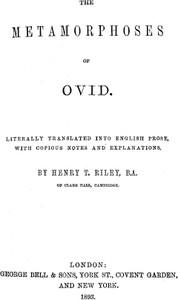
Excerpt
The Project Gutenberg eBook of The Metamorphoses of Ovid, by Publius Ovidius Naso
This eBook is for the use of anyone anywhere in the United States and
most other parts of the world at no cost and with almost no restrictions
whatsoever. You may copy it, give it away or re-use it under the terms
of the Project Gutenberg License included with this eBook or online at
www.gutenberg.org. If you are not located in the United States, you
will have to check the laws of the country where you are...
Read the Full Text
— End of The Metamorphoses of Ovid, Books I-VII —
Book Information
- Title
- The Metamorphoses of Ovid, Books I-VII
- Author(s)
- Ovid
- Language
- English
- Type
- Text
- Release Date
- June 8, 2007
- Word Count
- 128,177 words
- Library of Congress Classification
- PA
- Bookshelves
- Best Books Ever Listings, Browsing: Culture/Civilization/Society, Browsing: Literature, Browsing: Poetry
- Rights
- Public domain in the USA.
Related Books

Crito: Een dialoog van Plato
by Plato
Dutch
274 hours read
Amores: elegías amatorias
by Ovid
Spanish
490h 39m read

El arte de amar
by Ovid
Spanish
427h 20m read

Virgil & Lucretius - Passages translated by William Stebbing
by Virgil, Lucretius Carus, Titus
English
420h 32m read

Metamorfóseos o Transformaciones (4 de 4)
by Ovid
Spanish
827h 34m read

Metamorfóseos o Transformaciones (3 de 4)
by Ovid
Spanish
792h 40m read