THE PAN-GERMAN PROGRAMME
This eBook is for the use of anyone anywhere at no cost and with almost
no restrictions whatsoever. You may copy it, give it away or re-use it
under the terms of the Project Gutenberg License included with this
eBook or online at http://www.gutenberg.org/license.
Title: The Pan-German Programme
The Petition of the Six Associations and the Manifesto of the
Intellectuals
Author: Various
Release Date: July 04, 2014 [EBook #46192]
Language: English
Character set encoding: UTF-8
*** START OF THIS PROJECT GUTENBERG EBOOK THE PAN-GERMAN PROGRAMME ***
Produced by Al Haines.
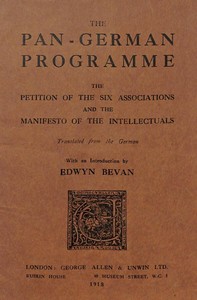
THE
PAN-GERMAN
PROGRAMME
THE
PETITION OF THE SIX ASSOCIATIONS
AND THE
MANIFESTO OF THE INTELLECTUALS
_Translated from the German_
With an Introduction by
EDWYN BEVAN
LONDON: GEORGE ALLEN & UNWIN LTD.
RUSKIN HOUSE 40 MUSEUM STREET, W.C. 1
1918
*THE PAN-GERMAN PROGRAMME.*
*INTRODUCTORY.*
The two documents presented in this pamphlet are the fullest statement
of the programme of the Pan-German party in Germany. They were both
drawn up in the earlier months of 1915. After the series of rapid
German successes in the West, with which the war opened, had seemed to
come to a check, and month after month went by without the expected
advance on Paris being resumed, it was felt to be necessary that the
German people should get some more precise idea of what it was fighting
for, what it had to obtain before it could consider that the war had
attained its end.
In March, 1915, the rumour got about that the German Government was
contemplating a peace of compromise, and Pan-German circles took alarm.
Pan-Germanism was not strong in the working class and many of the
Radical Intellectuals disapproved of it. But it was very strong among
the country landowners, _i.e._ the class called _Junkers_, and the rich
manufacturers, especially the great ironmasters of the
Rhenish-Westphalian country, who wanted to get hold of the French
iron-districts of Briey and Longwy. These interests were organised in a
number of powerful Associations.
If there was danger of the Government under Bethmann Hollweg’s direction
weakening, it appeared necessary that pressure should be brought to bear
upon it in time. Five Associations in March drew up a Memorandum to be
presented privately to the Chancellor. They were afterwards joined by a
sixth, and the Memorandum in its final form was laid before the
Chancellor on May 20, 1915. This is the first of the two documents here
translated.
The second is the so-called "Manifesto of the Intellectuals." It was
read on June 20, 1915, to a great gathering of professors, diplomats,
and high Government officials in the Artists’ Hall (_Künstlerhaus_) in
Berlin. It was not published, but circulated as a "strictly
confidential manuscript," and was submitted to the Chancellor on July 8.
When 1341 signatures had been appended to it the Government stepped in
and forbade further canvassing. It is therefore claimed that the 1341
do not represent the amount of the support which the manifesto would
have got in the country had it been allowed free course.
The Intellectuals’ Manifesto has a more extensive programme than that of
the Six Associations. It includes, not only the demands of the
Associations, but the scheme commonly designated by the term
_Mittel-Europa_, with its appendix, the control of the Turkish Empire by
Germany, implying a great belt of German power across the world from the
North Sea to the Persian Gulf—about which the Six Associations said
nothing. Again, whereas the Six Associations say only in general terms
that they demand the possession of "a colonial empire adequate to
satisfy Germany’s manifold economic interests," the Intellectuals state
more specifically that this means an empire in Central Africa, and
more—endorsing, therefore, the scheme labelled _Mittel-Afrika_.
These two documents will always be two of the most important documents
of the Great War for students of history. Although they were not
published in Germany till long after they had begun to circulate
privately, their contents became rapidly known and they became main
objects of attack for Radical and Socialist circles. Much has happened
since they were drawn up. It has become clear to a much larger number
of people in Germany that such schemes are unrealisable.
In July, 1917, the majority of the Reichstag passed a resolution in
favour of a peace on the basis of the _status quo ante_. But we should
guard against the error of supposing that, because the largest body of
opinion in the country last summer was against annexations, all danger
from German ambitions has passed away. We must take into account two
things:
(1) The Pan-German opinion, even if that of a minority, is that of a
very strong and desperately energetic minority. It has recently taken
body in the _Vaterlandspartei_, which may be rendered "National Party."
It carries on a vigorous propaganda backed by vast funds, and has on its
side many men of influence upon the Government. It shows what the
majority of the Germans would desire, if weakness on our side gave them
any hope of getting it. And hopes seem to have risen again since the
collapse of Russia and the repulse of Italy. The Reichstag majority
which passed the "peace resolution" last July seems no longer solid. It
is highly improbable that the majority of the Reichstag would now demand
a peace "without annexations."
(2) Even those who oppose the Pan-Germans and stand for a "peace without
annexations" cherish the design of laying a foundation for German power
within the sphere of Germany and its allies, upon which _later on_ a
more ambitious structure of power could be reared. The trouble with
"these gentlemen of the _Vaterlandspartei_," one Socialist writer
explained, was not that they asked for too much but that they asked for
it all at once. If Germany could strengthen its grip upon Central
Europe, Bulgaria, and the restored Turkish Empire, one of the great
schemes contained in the Intellectuals’ Manifesto could be realised
_without annexations_. It may be that when the German Government
ultimately state their minimum requirements they will seem modest,
compared with the Pan-German programme. Even so they will require
careful scrutiny lest there should be more in them of the Pan-German
spirit than appears on the outside, more than is compatible with the
safety of the world.
EDWYN BEVAN,
_January_, 1918.
*I.*
*THE PETITION OF THE SIX ASSOCIATIONS.*
The following is the full text of the Petitions addressed to the German
Chancellor, Dr. von Bethmann Hollweg, and to the Governments of the
various Federated States of the German Empire, on March 10 and May 20,
1915, by the League of Agriculturists (_Bund der Landwirte_), the German
Peasants’ League (_Deutscher Bauernbund_), the Christian German
Peasants’ Unions (_die christlichen deutschen Bauernvereine_), the
Central Association of German Manufacturers (_Centralverband deutscher
Industrieller_), the Manufacturers’ League (_Bund der Industriellen_)
and the League of Middle-Class Citizens in the German Empire
(_Reichsdeutscher Mittelstandsverband_):—
Together with the whole German people, those occupied in business
pursuits, whether in agriculture or manufacture, in handicrafts or
trade, are determined to endure to the end, notwithstanding every
sacrifice, in this struggle for life and death which has been forced
upon Germany, in order that Germany may emerge stronger in its external
relations, assured of a lasting peace, and thus also assured of further
national, economic, and cultural development at home.
Since the whole German people recognises these aims as its own, and has
given tangible proof of its willingness to make sacrifices for their
achievement, the rumours recently circulating in town and country were
bound to be most disquieting. These rumours (confirmed, apparently, by
certain announcements in the Press) were to the effect that preliminary
steps were being taken to prepare the way for peace negotiations, and,
in particular, for a separate peace with England, based on certain
English wishes and demands.
Hence universal satisfaction has been caused by the declaration of the
_Norddeutsche Allgemeine Zeitung_, that no competent judge would dream
of sacrificing Germany’s favourable military position in order to
conclude a premature peace with any one of her enemies.
Even if the military situation were more unfavourable, or more doubtful,
this ought to make no difference to our determination—unless, indeed, we
are to lose sight of the aims in home and foreign policy which His
Majesty the Emperor has himself proclaimed. These aims can only be
attained by achieving a peace which will bring us better security for
our frontiers in East and West, an extension of the foundations of our
sea power, and the possibility of an unchecked and strong development of
our economic resources; in short, those extensions of power, alike in
politics, in the army, in the navy, and in our economic life, which will
guarantee to us a stronger position in the world.
Any peace which does not bring us these results will make a speedy
renewal of the struggle inevitable under circumstances essentially less
favourable to Germany. Therefore no premature peace! For from a
premature peace we could not hope for a sufficient prize of victory.
But also no half-hearted peace, no peace which does not include complete
political exploitation of those ultimate military successes which we
expect to obtain!
For it must be realised that, not only the security of our future
international position, but also our power to utilise the present
self-sacrificing spirit of the German people for the settlement of those
questions of domestic policy, which will arise on the return of peace,
both equally presuppose the complete exploitation of our military
position so as to increase Germany’s power abroad. Assuredly our people
would understand any concessions which were wrung from them by a
military situation so desperate as to oppose insuperable obstacles to
any resistance, however determined and however self-sacrificing; but
they would not tolerate any weak concessions at the conclusion of peace
which were not justified and necessitated by the military situation.
Concessions of this kind would be fraught with the most fatal
consequences for the domestic peace of our Fatherland, since they might
lead to the same result as a premature withdrawal from the conflict, and
our soldiers would discover, on returning home, that the only reward for
their splendid endurance was a crushing burden of taxation. Hundreds of
thousands have given their lives: the prize of victory must correspond
to the sacrifice.
_The following Memorandum was drawn up on March_ 10 _of this year_ and
addressed to your Excellency by the League of Agriculturists, the German
Peasants’ League, the Central Association of German Manufacturers, the
Manufacturers’ League, and the League of Middle-Class Citizens in the
German Empire. The Memorandum, to which the Christian German Peasants’
Unions, who are also signatories to the present Petition, have given
their adhesion, explains in detail the requirements which—the necessary
military successes being assumed—must in the opinion of the undersigned
Associations be fulfilled, in order to secure for Germany that
political, military, and economic position which would enable her to
look forward with confidence to all possibilities of the future.
The Memorandum was as follows:
The undersigned Corporations have carefully considered what
measures are required to give practical effect to the formula,
which has so often been heard during the last few months, viz.,
that this war must be followed by an honourable peace,
corresponding to the sacrifices which have been made and
containing in itself a guarantee for its continuance.
In answering this question, it must never be forgotten that our
enemies continue to announce that Germany is to be annihilated
and struck out of the rank of the Great Powers. Against such
aims treaties will afford us no protection; for treaties, when
the fitting moment comes, would once more be trodden under foot.
We can only look for safety in a serious economic and military
weakening of our enemies, sufficient to ensure peace for as long
a time as can be foreseen.
We must demand a colonial Empire adequate to satisfy Germany’s
manifold economic interests, we must safeguard our future policy
in matters of customs and commerce, and we must secure a war
indemnity to be paid in a form suitable to our requirements: but
our chief end in the struggle which has been forced upon us is,
in our opinion, to strengthen and improve the foundations on
which Germany’s position in Europe rests, in the following
directions:
In order to provide the necessary security for our influence at
sea and in order to secure our future military and economic
position as against England, _Belgium_, owing to the close
connexion of Belgian territory (which is economically of such
importance) with our main manufacturing districts, must be
subjected to German Imperial legislation, both in military and
tariff matters, and also in regard to currency, banking, and
postal arrangements. Railways and canals must be incorporated in
our transport system. In general, the government and
administration of the country must be so managed that _the
inhabitants obtain no influence on the political fortunes of the
German Empire_; there must be separation of the Walloon and of
the predominantly Flemish territory, and _all economic and
industrial undertakings and real estate, which are so vital for
the government of the country, must be transferred into German
hands_.
We must consider the question of _French_ territory from the
same point of view, _i.e._ so far as it affects our position
towards England. Hence we must regard it as a matter of vital
importance, in the interests of our future influence at sea,
that _we should hold the French coastal districts from the
Belgian frontier approximately as far as the Somme_. and thus
secure access to the Atlantic Ocean. _The Hinterland, which must
be acquired with them_, must be so delimited as to secure to us
the complete economic and strategic exploitation of those
Channel-ports which we gain. Any further acquisitions of French
territory, apart from the necessary annexation of the iron-ore
district of Briey, must be determined solely by military and
strategic considerations. After the experiences of this war, it
may be regarded as self-evident that we cannot in the future
leave our frontiers at the mercy of hostile invasion by allowing
our opponents to retain those fortified positions which threaten
us, in particular Verdun and Belfort and the Western slopes of
the Vosges which lie between them. _The acquisition of the line
of the Meuse and the French Channel-coast would carry with it
the possession, not only of the iron-ore district of Briey
mentioned above, but also of the coal-country in the department
of the Nord and the Pas-de-Calais_. These annexations also—as
is self-evident, after our experiences in Alsace-Lorraine—must
be so arranged that the population of the annexed districts
shall be precluded from exercising political influence on the
fortunes of the German Empire; and all the economic resources of
these districts, including both large and medium-sized estates,
must be transferred to German hands on such terms that France
shall compensate and take over their owners.
_As to the East_, the determining consideration must be that the
great addition to our manufacturing resources, which we
anticipate in the West, must be counterbalanced by an equivalent
annexation of agricultural territory in the East. The present
economic structure of Germany has shown itself so fortunate in
this war, that it is hardly too much to say that every German is
convinced of the necessity for maintaining it for as long a time
as we can foresee.
The necessity of strengthening the sound agricultural basis of
our economic system, of making possible a German agricultural
colonisation on a large scale, of restoring the German peasants
who are living abroad—especially those settled in Russia and at
present deprived of their rights—to the territory of the Empire,
so that they may take part in the economic life of Germany, and,
lastly, the necessity of greatly increasing the numbers of our
population capable of bearing arms, implies _a considerable
extension of the Imperial and Prussian frontiers in the East by
annexation of at least parts of the Baltic Provinces and of
those territories which lie to the south of them, whilst at the
same time we must keep in mind, the object of making our Eastern
German frontier capable of military defence_.
The restoration of East Prussia requires a better safeguarding
of its frontiers by placing in front of them other districts,
nor must West Prussia, Posen and Silesia remain frontier marches
exposed to danger as they now are.
With regard to the granting of political rights to the
inhabitants of the new districts and the safeguarding of German
economic influence, what has already been said about France
applies here too. The war indemnity to be paid by Russia will
have to consist to a large extent in the cession of land.
Of course these demands depend on the hypothesis that military
results will enable them to be carried out. But in view of what
we have already achieved, we confidently rely on our army and
its leaders to gain a victory which will guarantee the
attainment of these ends. We must pursue these ends, not from a
policy of conquest, but because it is only by attaining them
that we can secure that lasting peace which all classes of the
German people expect in return for their sacrifices. Moreover,
in our opinion, a voluntary surrender of hostile territories, in
which so much German blood has been spilt and so many of our
best and noblest have found a grave, would do violence to the
sentiments of our people and to their conception of an
honourable peace.
In the future as in the past, the want of harbours directly on
the Channel would strangle our activity beyond the seas. An
independent Belgium would continue to be a _tête de pont_ to
England, a point from which to attack us. If the natural line
of fortifications of France were left in the hands of the
French, there would be a permanent menace to our frontiers; and
Russia, if she emerged from the war without loss of territory,
would underestimate our ability and power to prevent her doing
injury to our interests, while, on the other hand, the failure
to win new agricultural territories on our Eastern frontier
would diminish the possibility of strengthening the defensive
power of Germany against Russia by a sufficient increase of the
German population.
We have the honour to draw Your Excellency’s attention to the
views expressed above, which are not confined to the undersigned
Corporations, but are widely held—possibly with occasional
variations in detail—in many German circles which have not as
yet publicly expressed them, and at the same time to inform you
that we have simultaneously communicated this petition to the
Ministries of the various Federated States.
As a supplement to this Memorandum, we must here lay special stress on
the fact that the political, military and economic objects, which the
German people must strive after in the interests of the security of
their future, are inseparably connected with one another. It is clear,
to start with, that the attainment of our great political objects
depends on the offensive power and the successes of our army. But
precisely our experiences in this war prove, beyond any doubt, that our
military successes, particularly in a long war, and their further
exploitation depend to a large extent upon the economic strength and
ability of our people. If German agriculture had not been in a position
to secure the food of the people despite all the efforts of our enemies,
and if German manufacturers, German inventive genius and German
technical skill had not been able to render us independent of foreign
countries in the most different spheres, then, notwithstanding the
brilliant successes of our victorious troops, we should have had to give
way eventually in the struggle which has been forced upon us, if indeed
we should not have been defeated already.
Hence it follows that even those demands, which seem at first sight to
possess a purely economic significance, must be viewed in the light of
the urgent necessity for the greatest possible increase of our national
strength, and also from a military standpoint.
This applies with special force to the demands, which are set forth in
the Memorandum, both (a) for the acquisition of territory suitable for
agricultural settlement and (b) for the appropriation of the iron-ore
district of the Meurthe and Moselle, of the French coaling districts in
the Departments of the Nord and the Pas-de-Calais, and also of the
Belgian coalfields.
The acquisition of sufficient territory suitable for agricultural
settlement is indispensable—(a) in order to broaden the agricultural
basis of our national resources, and thus to maintain that happy balance
in our whole economic life which has been recognised as so necessary in
the present war; (b) in order to strengthen our military power by
safeguarding the sources of our national strength, which depend upon a
vigorous agricultural policy, and more especially by assuring the
increase of our population.
In the same way, acquisitions, such as that of the iron ore and coal
districts mentioned above, are demanded by our military necessities, and
not by any means only in the interests of our manufacturing development.
This is clear from the following facts and figures:—
The monthly production of pig-iron in Germany has risen once more, since
August 1914, to nearly 1,000,000 tons; that is, it has nearly doubled.
The monthly output of steel has risen to more than 1,000,000 tons.
There is, however, no excess of pig-iron or steel; on the contrary,
there is a deficiency in Germany, and an even greater deficiency in
neutral countries.
The output of shells calls for both iron and steel, in quantities of
which only a few persons originally had any conception. For cast-iron
shells alone—the inferior substitute for drawn and cast steel shells—at
least 4000 tons of pig-iron have been used daily during the last few
months. The exact figures are not for the moment before us; but this
much is certain, that, unless the output of iron and steel had been
doubled since the month of August, a continuation of the war would have
been impossible.
As a raw material for the production of these quantities of pig-iron and
steel, minette is being employed more and more, for this ore alone can
be obtained in this country in greatly increasing quantities.
The output of the other iron-ore districts of Germany is very limited,
and the overseas imports, even of the Swedish ores, are so difficult to
procure that in many places, in addition to Luxemburg and Lorraine,
minette at the present time covers 60 to 80 per cent. of the output of
steel and pig-iron. It the output of minette were interrupted, the war
would be as good as lost.
But how do matters stand as regards the supply of minette in this or in
a future war?
If the fortress of Longwy, with the numerous surrounding French
blast-furnaces, were given back, then in another war, with a few
long-range guns, the following works in Germany and Luxemburg could be
ruined in a few hours:
Rodingen ....... 7 }
Differdingen ... 10 }
Esch ........... 16−17 } kilometres from Longwy.
Oettingen ...... 21 }
Rümelingen ..... 21 }
Düdelingen ..... 25 }
By this destruction alone it may be estimated that 20 per cent. of the
German output of pig-iron and steel would be lost.
But a glance at the map shows us further that, _e.g._, Jarny (the
"Phoenix" minette pits) lies at a distance of 13 to 15 kilometres from
Verdun, and that the western mining concessions near Landres and
Conflans are not more than 26 kilometres at most from Verdun. To-day we
are bombarding Dunkirk from a distance of 38 kilometres. Does anyone
believe that the French, in the next war, would neglect to place
long-range guns in Longwy and Verdun, and allow us to continue the
extraction of ore and the production of pig-iron?
Incidentally it may be remarked that the extensive production of steel
from minette offers at the same time the one and only possibility of
providing German agriculture with the necessary phosphoric acid for the
manufacture of the now excluded phosphates.
_Hence the security of the German Empire in a future war imperatively
demands the possession of the whole minette-bearing district of
Luxemburg and Lorraine, together with the fortifications of Longwy and
Verdun, without which this district cannot be held_.
The possession of larger supplies of coal—and, in particular, of coal
rich in bitumen, which is found in great quantities in the basin of
Northern France—is at least as decisive for the result of this war as
the possession of iron-ore.
Belgium and North France together produce over forty million tons.
Even to-day, as the British prohibition of coal exports (enacted on the
15th of May) shows us, coal is one of the decisive means of political
influence. The neutral manufacturing States must do the bidding of that
belligerent who can guarantee a supply of coal. We cannot do this at
present in a sufficient degree, and are to-day already compelled to fall
back upon the Belgian coal supply, in order not to let our neutral
neighbours become entirely dependent upon England.
It is quite probable that the systematic increase of the Belgian coal
output, even during the present war, will prove a weighty factor in
determining various neighbour States to remain neutral.
That coal, which produces coke and gas, at the same time supplies the
bases of our most important explosives, is presumably well known, as
also is the importance of coal in the production of ammonia.
In benzol, moreover, it offers the only substitute for petrol, of which
we are short; and, finally, it supplies coal-tar, which yields (_a_) the
oil fuel so indispensable for the Navy, (_b_) anthracite oil, the most
serviceable substitute as yet obtainable at home for lubricating oil,
and (_c_) naphthaline, the probable base of synthetic petroleum.
It may in this connection be remarked that we should probably be unable
to develop our destroyer and submarine warfare to the requisite
intensity without an abundance of liquid fuel. The course of the war
has so clearly proved the superiority of oil fuel over ordinary
coal-firing in torpedo-boats, that we should be guilty of unpardonable
folly if we failed to base our future conduct on this experience.
If our hostile neighbours secure the possession of the oil wells,
Germany must take care to secure for herself the necessary supplies of
gas-producing and bituminous coal, and must in time of peace develop
these until they constitute inexhaustible sources of oil, benzol,
toluol, ammonia, and naphthaline; and that, not merely in order to
increase our prosperity in time of peace, but as an indispensable part
of our equipment for war.
To recapitulate: The realisation of the war-aims, which are proposed
above with a view to our permanent economic security, will also
guarantee our military strength, and consequently our political
independence and power: moreover, we shall thus secure an extended field
for our economic activity, which will afford and guarantee increased
opportunities for work, and thus benefit our working classes as a whole.
"The Six Associations," states Grumbach, in his _Annexationist Germany_,
"did not confine themselves to presenting their Petitions to the
Government, but printed them and circulated them in the form of a
confidential pamphlet amongst their members, who are domiciled in all
parts of Germany. The anti-annexationist league, _Neues Vaterland_ (New
Fatherland), which got to know of it, kindly circulated the Petitions
amongst its own members in the form of a confidential report, thus
bringing them to the notice of a fresh public. Nevertheless, the great
majority of the German people has, to this day, no accurate knowledge of
the annexationist desires set forth in the Petitions, since the German
newspapers were forbidden to reproduce them. In foreign countries the
complete text of the Petitions was first published in the Parisian
Socialist newspaper, Humanité, for August 11, 1915, after the Socialist
_Berner Tagwacht_ had published an abridged version on June 22, 1915."
*II.*
*THE MANIFESTO OF THE INTELLECTUALS.*
The following is the full text of the Petition agreed on by a number of
German professors, diplomatists, and superior Government officials, at a
meeting held on June 20, 1915, in the _Künstlerhaus_, Berlin, for the
purpose of its being presented to the German Imperial Chancellor:—
The German people and their Emperor have preserved peace for forty-four
years, preserved it until its further maintenance was incompatible with
national honour and security. Despite her increase in strength and
population, Germany never thought of transgressing the narrow bounds of
her possessions on the European Continent with a view to conquest. Upon
the world’s markets alone was she forced to make an entry, so as to
ensure her economic existence by peacefully competing with other
nations.
To our enemies, however, even these narrow limits and a share of the
world’s trade necessary to our existence seemed too much, and they
formed plans which aimed at the very annihilation of the German Empire.
Then we Germans rose as one man, from the highest to the meanest,
realising that we must defend not only our physical existence but also
our inner, spiritual, and moral life—in short, defend German and
European civilisation (_Kultur_) against barbarian hordes from the east,
and lust for vengeance and domination from the west. With God’s help,
hand in hand with our trusty allies, we have been able to maintain
ourselves victoriously against half a world of enemies.
Now however, although another foe has arisen, in Italy, it is no longer
sufficient for us merely to defend ourselves. Our foes have forced the
sword into our hands and have compelled us to make enormous sacrifices
of blood and treasure. Henceforth our aim is to protect ourselves with
all our might against a repetition of such an attack from every
side—against a whole succession of wars which we might have to wage
against enemies who had again become strong. Moreover, we are
determined to extend our territory and to establish ourselves so firmly
and so securely upon it that our independent existence shall be
guaranteed for generations to come.
As to these main objects, the nation is unanimous in its determination.
The plain truth, which is supported by evidence from all sides, is
this:—In all classes of the people there is only one single fear, which
is most prevalent and deep-seated in the most simple-minded sections,
viz. the fear that illusory ideas of reconciliation, or even perhaps a
nervous impatience, might lead to the conclusion of a premature and
consequently patched-up peace which could never be lasting; and that, as
happened a hundred years ago, the pen of the diplomats might ruin what
the sword has victoriously won, and this perhaps in the most fateful
hour of German history, when popular feeling has attained an intensity
and unanimity, which were never known in the past and will not so easily
recur in the future.
Let there be no mistake. We do not wish to dominate the world, but to
have a standing in it fully corresponding to our great position as a
civilised Power and to our economic and military strength. It may be
that, owing to the numerical superiority of our enemies, we cannot
obtain at a single stroke all that is required in order thus to ensure
our national position; but the military results of this war, obtained by
such great sacrifices, must be utilised to the very utmost possible
extent. This, we repeat, is the firm determination of the German
people.
To give clear expression to this resolute popular determination, so that
it may be at the service of the Government and may afford it strong
support in its difficult task of enforcing Germany’s necessary claims
against a few faint-hearted individuals at home as well as against
stubborn enemies abroad, is the duty and right of those whose education
and position raise them to the level of intellectual leaders and
protagonists of public opinion. We appeal to them to fulfil this duty.
Being well aware that a distinction must be drawn between the objects of
the war and the final conditions of peace, that everything of necessity
depends on the final success of our arms, and that it cannot be our
business to discuss Austria-Hungary’s and Turkey’s military objects, we
have drawn up the following brief statement of what, according to our
conviction, constitutes for Germany the guarantee of a lasting peace and
the goal to which the blood-stained roads of this war must lead:
1. FRANCE.—After being threatened by France for centuries, and after
hearing the cry of _revanche_ from 1815 till 1870, and from 1871 till
1915, we wish to have done with the French menace once for all. All
classes of our people are imbued with this desire. There must be no
misplaced attempts at reconciliation, which have always been opposed by
France with the utmost fanaticism; and as regards this we would utter a
most urgent warning to Germans not to deceive themselves. Even after
the terrible lesson of this unsuccessful war of vengeance, France will
still thirst for _revanche_, in so far as her strength permits. For the
sake of our own existence we must ruthlessly weaken her both politically
and economically, and must improve our military and strategic position
with regard to her. For this purpose, in our opinion, it is necessary to
effect a thorough rectification of our whole Western frontier from
Belfort to the coast. Part of the North French Channel-coast we must
acquire, if possible, in order to be strategically safer as regards
England and to secure better access to the ocean.
Special measures must be taken, in order that the German Empire may not
suffer any internal injury owing to this enlargement of its frontiers
and addition to its territory. In order not to have conditions such as
those in Alsace-Lorraine, the most important business undertakings and
estates must be transferred from anti-German ownership to German hands,
France taking over and compensating the former owners. Such portion of
the population as is taken over by us must be allowed absolutely no
influence in the Empire.
Furthermore, we must have no mercy upon France, however terrible the
financial losses her own folly and British self-seeking have already
brought upon her. We must impose upon her a heavy war indemnity (of
which more hereafter), and indeed upon France before our other enemies.
We must also not forget that she has disproportionately large colonial
possessions, and that, should circumstances arise, England could
indemnify herself out of these, if we do not help ourselves to them.
2. BELGIUM.—On Belgium, in the acquisition of which so much of the best
German blood has been shed, we must keep a firm hold, political,
military, and economic, despite any arguments which may be urged to the
contrary. On no point is public opinion so unanimous. The German
people consider it an absolutely unquestionable matter of honour to keep
a firm hold of Belgium.
From the political and military standpoints it is obvious that, were
this not done, Belgium would be neither more nor less than a basis from
which England could attack and most dangerously menace Germany—in short,
a shield behind which our foes would again assemble against us.
Economically Belgium means a prodigious increase of power to us.
Belgium may also bring us a considerable addition to our population, if
in course of time the Flemish element, which is so closely allied to us,
becomes emancipated from the artificial grip of French culture and
remembers its Teutonic affinities.
As to the problems which we shall have to solve, once we possess
Belgium, we would here confine ourselves to emphasising the following
principles:—(1) The inhabitants must be precluded from exercising any
political influence whatever in the Empire; and (2) the most important
business undertakings and estates (as in the districts to be ceded by
France) must be transferred from anti-German ownership to German hands.
3. RUSSIA.—On our Eastern frontier the population of the Russian Empire
is increasing on an enormous scale—about 2-½ to 3 millions yearly.
Within a generation a population of 250 millions will be attained.
Against this overwhelming pressure of numbers on our eastern flank,
undoubtedly the greatest danger to the German and European future,
Germany can hold her ground only—(_a_) if a strong boundary-wall be
erected both against the advancing tide of Russification, which
encroaches imperceptibly in times of peace, and also against the menace
of an aggressive war; and (_b_) if we adopt all possible measures to
maintain the past healthy increase of our population. But the
realisation of both these conditions demands land, which Russia must
cede to us. It must be agricultural land for colonisation—land which
will yield us healthy peasants, the rejuvenating source of all national
and political energy; land which can take up part of the increase of our
population, and offer to the returning German emigrants, who wish to
turn their backs on hostile foreign countries, a new home in their own
country; land which will increase Germany’s economic independence of
foreign countries, by developing her own possibilities of
food-production, which will constitute the necessary counterpoise to the
advancing industrialisation of our people and the increase of
town-dwellers, thus conserving that equilibrium of our economic
resources, whose inestimable value has been proved during the war, and
saving us from the dangerous one-sidedness of the English economic
system; land which will arrest the decline of the birth-rate, check
emigration, and alleviate the dearth of dwelling-houses; land whose
re-settlement and Germanisation will provide new possibilities of
livelihood for the professional classes also. Such land for our
physical, moral, and intellectual health is to be found above all in the
East.
The measure in which our Eastern frontier is to be advanced will depend
on the military situation, and in particular also it should be
determined by strategic considerations. As far as the rectification of
the eastern frontier of Posen and Silesia and the southern frontier of
East Prussia is concerned, a frontier zone, accessible to German
colonisation and as far as possible free of private ownership, must be
created. This German frontier zone will protect the Prussian Poles
against the direct and excessive influence of Russian Poland, which will
perhaps attain its independence. Moreover, in this connection, we have
no hesitation whatever in drawing special attention to that ancient
territory in the Russian Baltic Provinces, which has been cultivated by
Germans for the last 700 years. It is sparsely populated, its soil is
fruitful, and it therefore promises to have a great future as a field
for colonisation, whilst its Lithuanian, Lettish, and Esthonian
population is derived from a stock alien to the Russians, which may
prove a reliable source of that supply of journeyman-labour which we so
urgently need.
We based our demand for land for colonisation from Russia on two
grounds—the need for erecting a "boundary-wall" and the need for
maintaining the increase of our population. But, in the third place,
land is the form in which Russia’s war-indemnity ought to be paid to us.
To obtain an indemnity from Russia in cash or in securities will
probably be just as impossible after this war as it proved after the
Russo-Japanese war. On the other hand, Russia can easily pay an
indemnity in kind. Russia is excessively rich in territory, and we
demand that the territory which Russia is to surrender to us in lieu of
a war-indemnity shall be delivered to us for the most part free of
private ownership. This is by no means an outrageous demand, if we bear
in mind Russian administrative methods. The Russian population is not so
firmly rooted in the soil as that of Western and Central Europe. Again
and again, right up to the early days of the present war, Russia has
transplanted parts of her population on an enormous scale and settled
them in far distant provinces. The possibilities of the scheme here
proposed must not be judged in accordance with the modest standards of
German civilisation (_Kultur_). If the acquisition of political control
over territory is to bring with it that increase of power which we so
urgently need for our future, we must also obtain economic control and
have in the main free disposition over it. To conclude peace with
Russia without ensuring the diminution of Russian preponderance, and
without acquiring those territorial acquisitions which Germany needs,
would be to lose a great opportunity for promoting Germany’s political,
economic, and social regeneration, and to impose upon future generations
the burden of the final settlement with Russia—in other words, Germany
and European civilisation would be confronted with the certainty of a
renewal of their life-and-death struggle.
4. ENGLAND, THE EAST, COLONIES, AND OVERSEA TRADE.—The war between us
and Russia has been waged with extraordinary violence, and has led to a
glorious success for our arms; and we must never forget the menace to
our future presented by the enormous Russian mass encamped on our
Eastern frontier, if we should fail to disintegrate it. Nevertheless, we
must never for one moment lose sight of the fact that this war is, in
its ultimate origin, England’s war upon the foreign trade, the naval
power, and the world-prestige of Germany.
Since this is the motive of England’s hostility and war against us, our
war-aims against England are clear. We must wrest a free field for our
foreign trade, we must enforce the recognition of our naval power and
our world-prestige in spite of England.
We admit that England has taught us one lesson by her blockade, which
has compelled Germany to reorganise herself for the duration of this war
as a self-contained industrial state; for we have learned that, before
and above all, we must win and secure a wider territorial basis in
Europe (as is explained in detail above), in order that we may stand
before the world in the utmost possible political, military and economic
independence. And we must also create on the Continent the widest
possible sphere of economic interest, directly contiguous with our
country’s frontiers (_i.e._ avoiding sea-routes), so as to free
ourselves as far as possible from dependence upon the good pleasure of
England and of the other world-empires, whose self-sufficiency and
exclusiveness are constantly increasing. In this respect our political
friendship with Austria-Hungary and Turkey, which is bound to throw open
the Balkans and Western Asia to us, is of the first importance. It is
therefore necessary that Austria-Hungary, the Balkans, Turkey, and
Western Asia, down to the Persian Gulf, should be permanently secured
against the covetousness of Russia and England. Commercial relations
with our political friends must be furthered by all available means.
But, in the second place, it must be our aim to re-enter the world’s
oversea markets, in spite of England, and even though we have already
safeguarded our foundations on the Continent. Undoubtedly it will be
necessary to change the direction of a considerable part of our oversea
trade; but we shall also have to conquer anew our old trade and shipping
connections. Herein we shall in future stand upon our own feet, and
shall, _e.g._, eliminate the hitherto customary mediation of English
bankers and brokers, English arbitrage and exchange business, and the
preponderance of English marine insurance companies. England has
wantonly destroyed in us the trust and confidence which all such
transactions require, and must pay the penalty by losing the profits
which she has hitherto derived from them at the expense of German trade.
In Africa our aim must be to rebuild our Colonial Empire, making it more
self-contained and stronger than before. Central Africa alone would, it
is true, give us a great extent of territory, but the value of the
colonial products which it contains does not correspond to its size. We
must therefore look to other quarters of the globe also, if we are to
secure adequate acquisitions. From this point of view the importance of
a permanent connection with the world of Islam and the vital necessity
of a safe ocean highway are once more plainly evident. Those,
therefore, who insist upon colonies at the sacrifice of our security
against England’s naval tyranny over the Channel—those who insist upon
colonies in return for, and subject to, our surrender of Belgium—not
only fail to realise that the acquisition of an extended European basis
for our Fatherland is far more important than all colonial possessions;
they are also guilty of the grave political blunder of aspiring to
colonial possessions without securing their maritime communications,
_i.e._ colonial possessions which will once more be dependent on
England’s arbitrary will.
We must have the freedom of the seas. For this—which is to benefit all
peoples alike—we are wrestling with England. And if we are to enforce
it, the first requisite is to establish ourselves firmly upon the
Channel, facing England. As we have already explained above, _we must
retain a firm hold upon Belgium, and we must, if possible, conquer part
of the Channel-coast of Northern France in addition_. Further, we must
break the chain of England’s naval bases, which encircles the globe, or
weaken it by a corresponding acquisition of German bases. But Egypt,
which connects English possessions in Africa with those in Asia and
converts the Indian Ocean into an English sea with Australia for its
distant opposite shore; Egypt, which forms the connecting link between
the mother country and all her Eastern colonies:—Egypt is, as Bismarck
said, the neck of the British Empire, the vice in which England holds
East and West in subjection. _There_ a blow may be dealt at England’s
vital nerve. If it is successful, the international trade route of the
Suez Canal must be freed from the domination of a single Power, and the
ancient rights of Turkey be protected as far as possible.
But England’s power is also essentially based upon the overwhelming
influence which she exercises on the Governments and the Press of the
whole world. In order to remedy this state of affairs and to secure
counter-influence for Germany, it is vitally necessary to destroy
England’s monopoly of the cable-service and press-agencies. Our best
ally in our fight against England’s influence over the world’s public
opinion is freedom—freedom which we shall bring to all nations by
fighting for our own liberation from the yoke imposed by England upon
the world. We must not strive to dominate and exploit the world, like
the English: our aim should be to safeguard our own special needs, and
then to act as pathmakers and leaders of Europe, respecting and securing
the free self-development of the peoples.
5. INDEMNITY FOR THE WAR.—Finally, as regards indemnity for the war, we
naturally desire such an indemnity as will, so far as possible, cover
the public cost of the war, make restoration possible in East Prussia
and Alsace, guarantee the establishment of a pension fund for cripples,
widows, and orphans, indemnify private individuals for losses inflicted
on them contrary to international law, and provide for the renewal and
further development of our armaments.
But we are aware that these matters depend not only upon the extent of
our military successes but also upon the financial capacity of our
enemies. If we found ourselves in a position to impose a war-indemnity
upon England—England, which has always been so niggardly in sacrificing
the lives of its own citizens—no sum in money could be great enough.
England has set the whole world against us, and chiefly by her money.
The purse is the sensitive spot in this nation of shopkeepers. If we
have the power, we must strike at her purse above all else and without
any consideration whatever. In all probability, however, we shall have
to look to France (primarily, if not exclusively) for our financial
indemnification. And we ought not, from a mistaken idea of generosity,
to hesitate to impose upon France the heaviest indemnity. Let France
turn to her ally across the Channel for the alleviation of this enforced
burden. If England refuses to fulfil her financial obligations towards
her ally, we shall have secured an incidental political advantage with
which we may be well contented.
But we are primarily concerned to insist that, important as it is to
adopt retrospective measures for the mitigation of the injuries we have
already suffered, it is still more vitally important to secure such
terms of peace as will throw open to our people new paths for a vigorous
future development; and in proportion as a financial indemnity is
unobtainable, increased political and moral justification attaches to
all the demands set forth above for the acquisition of territory, for an
additional supply of productive labour for our manufactures, and for
colonies. If we win in this titanic struggle, we must not emerge from
it with losses. Otherwise, despite all our victories, posterity will
view us as the conquered party.
We refrain from expressing any decided opinion on the weighty question
of the mode of payment, but we would draw attention to the following
point. It would be greatly to our interest, if a considerable part of
the indemnity were paid in the form of foreign securities of such a kind
that their possession would strengthen our economic position in the
countries of our political friends, whilst freeing the latter from the
preponderant influence of England and France.
6. A POLICY OF CIVILISATION (KULTURPOLITIK) CAN ONLY BE BASED ON A
POLICY OF POWER.—If the signatories of this Petition—particularly the
men of science, the artists, and ecclesiastics—are reproached, on the
ground that the demands which they put forward are solely to promote
Germany’s political and economic power, and perhaps also to satisfy some
of her social requirements, whilst the purely spiritual tasks of
Germany’s future have been forgotten, our answer is as follows:—
Care for the development of the German Mind and Genius (_die Sorge um
den deutschen Geist_) cannot be made a war-aim or a condition of peace.
If, nevertheless, we are to say a few words on this subject, our
position is briefly this. The German Mind is, in our opinion, beyond
all doubt our one supremely valuable asset. It is the one priceless
possession amongst all our possessions. It alone justifies our people’s
existence and their impulse to maintain and assert themselves in the
world; and to it they owe their superiority over all other peoples.
But, in the first place, we must emphatically insist that, if Germany is
to be free to pursue her spiritual vocation, she must first of all
secure her political and economic independence. And, secondly, to those
who advocate the so-called Policy of Civilisation (_Kulturpolitik_)
alone, to those whose watchword is "The German Mind without the Policy
of Power," we reply: "We have no use for a ’German Mind’ which is in
danger of becoming, as it were, an uprooted national spirit, in danger
of being itself disintegrated and the cause of disintegration in others.
We have no use for a Mind which, having no healthy national body of its
own, is driven to seek vainly in every country for a home and to become
’all things to all men’—a Mind which is forced to be untrue to its own
character and a spurious imitation of the character of the nation that
is its host. If the demands which we have formulated are satisfied, we
shall create the necessary healthy body for the German Mind. The
expansion of the national body which we have demanded will do the German
Mind no injury, provided the precautions upon which we have also
insisted are observed. On the contrary, subject to those precautions,
such an expansion will strengthen the German Mind by providing it with
wider opportunities."
We are well aware that the aims which we have proposed are great, and
that their attainment is impossible without a spirit of resolute
self-sacrifice and the most energetic skill in negotiation. But we
appeal to a sentence of Bismarck’s: "It is palpably true in Politics, if
it is true anywhere, that ’faith removes mountains,’ that Courage and
Victory are not cause and effect, but identical with one another."
"Amongst the signatories to the above Petition," states Grumbach, in his
_Annexationist Germany_, "were Dr. E. Kirdorf, engineer and general
director of the Gelsenkirchener Mining Company, Ltd.; Herm. Schumacher,
Professor of Political Economy; von Reichenau, Imperial Ambassador
(retired); von Schwerin, President of the Government Board
(_Regierungs-Präsident_) at Frankfort (retired); Reinh. Seeberg,
Professor of Theology, Berlin; Dietr. Schafer, Professor of History,
Berlin. In a controversy with Professor Delbrück in the _Tägliche
Rundschau_, Professor Seeberg announced that the document contains 1,341
signatures in all, including those of 352 professors of universities and
colleges; 158 schoolmasters and clergymen; 145 superior administrative
officials, mayors, and town-councillors; 148 judges, magistrates, and
lawyers; 40 members of the _Reichstag_ and the _Landtag_; 18 retired
admirals and generals; 182 manufacturers, business men, and bankers; 52
agriculturists; 252 artists, authors, and publishers."
_Printed in Great Britain by_ THE FIELD & QUEEN (HORACE COX) LTD.
_Bream’s Buildings, London, E.C._ 4.
*** END OF THIS PROJECT GUTENBERG EBOOK THE PAN-GERMAN PROGRAMME ***
A Word from Project Gutenberg
We will update this book if we find any errors.
This book can be found under: http://www.gutenberg.org/ebooks/46192
Creating the works from public domain print editions means that no one
owns a United States copyright in these works, so the Foundation (and
you!) can copy and distribute it in the United States without permission
and without paying copyright royalties. Special rules, set forth in the
General Terms of Use part of this license, apply to copying and
distributing Project Gutenberg™ electronic works to protect the Project
Gutenberg™ concept and trademark. Project Gutenberg is a registered
trademark, and may not be used if you charge for the eBooks, unless you
receive specific permission. If you do not charge anything for copies of
this eBook, complying with the rules is very easy. You may use this
eBook for nearly any purpose such as creation of derivative works,
reports, performances and research. They may be modified and printed and
given away – you may do practically _anything_ with public domain
eBooks. Redistribution is subject to the trademark license, especially
commercial redistribution.
The Full Project Gutenberg License
_Please read this before you distribute or use this work._
To protect the Project Gutenberg™ mission of promoting the free
distribution of electronic works, by using or distributing this work (or
any other work associated in any way with the phrase “Project
Gutenberg”), you agree to comply with all the terms of the Full Project
Gutenberg™ License available with this file or online at
http://www.gutenberg.org/license.
Section 1. General Terms of Use & Redistributing Project Gutenberg™
electronic works
*1.A.* By reading or using any part of this Project Gutenberg™
electronic work, you indicate that you have read, understand, agree to
and accept all the terms of this license and intellectual property
(trademark/copyright) agreement. If you do not agree to abide by all the
terms of this agreement, you must cease using and return or destroy all
copies of Project Gutenberg™ electronic works in your possession. If you
paid a fee for obtaining a copy of or access to a Project Gutenberg™
electronic work and you do not agree to be bound by the terms of this
agreement, you may obtain a refund from the person or entity to whom you
paid the fee as set forth in paragraph 1.E.8.
*1.B.* “Project Gutenberg” is a registered trademark. It may only be
used on or associated in any way with an electronic work by people who
agree to be bound by the terms of this agreement. There are a few things
that you can do with most Project Gutenberg™ electronic works even
without complying with the full terms of this agreement. See paragraph
1.C below. There are a lot of things you can do with Project Gutenberg™
electronic works if you follow the terms of this agreement and help
preserve free future access to Project Gutenberg™ electronic works. See
paragraph 1.E below.
*1.C.* The Project Gutenberg Literary Archive Foundation (“the
Foundation” or PGLAF), owns a compilation copyright in the collection of
Project Gutenberg™ electronic works. Nearly all the individual works in
the collection are in the public domain in the United States. If an
individual work is in the public domain in the United States and you are
located in the United States, we do not claim a right to prevent you
from copying, distributing, performing, displaying or creating
derivative works based on the work as long as all references to Project
Gutenberg are removed. Of course, we hope that you will support the
Project Gutenberg™ mission of promoting free access to electronic works
by freely sharing Project Gutenberg™ works in compliance with the terms
of this agreement for keeping the Project Gutenberg™ name associated
with the work. You can easily comply with the terms of this agreement by
keeping this work in the same format with its attached full Project
Gutenberg™ License when you share it without charge with others.
*1.D.* The copyright laws of the place where you are located also govern
what you can do with this work. Copyright laws in most countries are in
a constant state of change. If you are outside the United States, check
the laws of your country in addition to the terms of this agreement
before downloading, copying, displaying, performing, distributing or
creating derivative works based on this work or any other Project
Gutenberg™ work. The Foundation makes no representations concerning the
copyright status of any work in any country outside the United States.
*1.E.* Unless you have removed all references to Project Gutenberg:
*1.E.1.* The following sentence, with active links to, or other
immediate access to, the full Project Gutenberg™ License must appear
prominently whenever any copy of a Project Gutenberg™ work (any work on
which the phrase “Project Gutenberg” appears, or with which the phrase
“Project Gutenberg” is associated) is accessed, displayed, performed,
viewed, copied or distributed:
This eBook is for the use of anyone anywhere at no cost and with
almost no restrictions whatsoever. You may copy it, give it away
or re-use it under the terms of the Project Gutenberg License
included with this eBook or online at http://www.gutenberg.org
*1.E.2.* If an individual Project Gutenberg™ electronic work is derived
from the public domain (does not contain a notice indicating that it is
posted with permission of the copyright holder), the work can be copied
and distributed to anyone in the United States without paying any fees
or charges. If you are redistributing or providing access to a work with
the phrase “Project Gutenberg” associated with or appearing on the work,
you must comply either with the requirements of paragraphs 1.E.1 through
1.E.7 or obtain permission for the use of the work and the Project
Gutenberg™ trademark as set forth in paragraphs 1.E.8 or 1.E.9.
*1.E.3.* If an individual Project Gutenberg™ electronic work is posted
with the permission of the copyright holder, your use and distribution
must comply with both paragraphs 1.E.1 through 1.E.7 and any additional
terms imposed by the copyright holder. Additional terms will be linked
to the Project Gutenberg™ License for all works posted with the
permission of the copyright holder found at the beginning of this work.
*1.E.4.* Do not unlink or detach or remove the full Project Gutenberg™
License terms from this work, or any files containing a part of this
work or any other work associated with Project Gutenberg™.
*1.E.5.* Do not copy, display, perform, distribute or redistribute this
electronic work, or any part of this electronic work, without
prominently displaying the sentence set forth in paragraph 1.E.1 with
active links or immediate access to the full terms of the Project
Gutenberg™ License.
*1.E.6.* You may convert to and distribute this work in any binary,
compressed, marked up, nonproprietary or proprietary form, including any
word processing or hypertext form. However, if you provide access to or
distribute copies of a Project Gutenberg™ work in a format other than
“Plain Vanilla ASCII” or other format used in the official version
posted on the official Project Gutenberg™ web site
(http://www.gutenberg.org), you must, at no additional cost, fee or
expense to the user, provide a copy, a means of exporting a copy, or a
means of obtaining a copy upon request, of the work in its original
“Plain Vanilla ASCII” or other form. Any alternate format must include
the full Project Gutenberg™ License as specified in paragraph 1.E.1.
*1.E.7.* Do not charge a fee for access to, viewing, displaying,
performing, copying or distributing any Project Gutenberg™ works unless
you comply with paragraph 1.E.8 or 1.E.9.
*1.E.8.* You may charge a reasonable fee for copies of or providing
access to or distributing Project Gutenberg™ electronic works provided
that
- You pay a royalty fee of 20% of the gross profits you derive from
the use of Project Gutenberg™ works calculated using the method you
already use to calculate your applicable taxes. The fee is owed to
the owner of the Project Gutenberg™ trademark, but he has agreed to
donate royalties under this paragraph to the Project Gutenberg
Literary Archive Foundation. Royalty payments must be paid within 60
days following each date on which you prepare (or are legally
required to prepare) your periodic tax returns. Royalty payments
should be clearly marked as such and sent to the Project Gutenberg
Literary Archive Foundation at the address specified in Section 4,
“Information about donations to the Project Gutenberg Literary
Archive Foundation.”
- You provide a full refund of any money paid by a user who notifies
you in writing (or by e-mail) within 30 days of receipt that s/he
does not agree to the terms of the full Project Gutenberg™ License.
You must require such a user to return or destroy all copies of the
works possessed in a physical medium and discontinue all use of and
all access to other copies of Project Gutenberg™ works.
- You provide, in accordance with paragraph 1.F.3, a full refund of
any money paid for a work or a replacement copy, if a defect in the
electronic work is discovered and reported to you within 90 days of
receipt of the work.
- You comply with all other terms of this agreement for free
distribution of Project Gutenberg™ works.
*1.E.9.* If you wish to charge a fee or distribute a Project Gutenberg™
electronic work or group of works on different terms than are set forth
in this agreement, you must obtain permission in writing from both the
Project Gutenberg Literary Archive Foundation and Michael Hart, the
owner of the Project Gutenberg™ trademark. Contact the Foundation as set
forth in Section 3. below.
*1.F.*
*1.F.1.* Project Gutenberg volunteers and employees expend considerable
effort to identify, do copyright research on, transcribe and proofread
public domain works in creating the Project Gutenberg™ collection.
Despite these efforts, Project Gutenberg™ electronic works, and the
medium on which they may be stored, may contain “Defects,” such as, but
not limited to, incomplete, inaccurate or corrupt data, transcription
errors, a copyright or other intellectual property infringement, a
defective or damaged disk or other medium, a computer virus, or computer
codes that damage or cannot be read by your equipment.
*1.F.2.* LIMITED WARRANTY, DISCLAIMER OF DAMAGES – Except for the “Right
of Replacement or Refund” described in paragraph 1.F.3, the Project
Gutenberg Literary Archive Foundation, the owner of the Project
Gutenberg™ trademark, and any other party distributing a Project
Gutenberg™ electronic work under this agreement, disclaim all liability
to you for damages, costs and expenses, including legal fees. YOU AGREE
THAT YOU HAVE NO REMEDIES FOR NEGLIGENCE, STRICT LIABILITY, BREACH OF
WARRANTY OR BREACH OF CONTRACT EXCEPT THOSE PROVIDED IN PARAGRAPH 1.F.3.
YOU AGREE THAT THE FOUNDATION, THE TRADEMARK OWNER, AND ANY DISTRIBUTOR
UNDER THIS AGREEMENT WILL NOT BE LIABLE TO YOU FOR ACTUAL, DIRECT,
INDIRECT, CONSEQUENTIAL, PUNITIVE OR INCIDENTAL DAMAGES EVEN IF YOU GIVE
NOTICE OF THE POSSIBILITY OF SUCH DAMAGE.
*1.F.3.* LIMITED RIGHT OF REPLACEMENT OR REFUND – If you discover a
defect in this electronic work within 90 days of receiving it, you can
receive a refund of the money (if any) you paid for it by sending a
written explanation to the person you received the work from. If you
received the work on a physical medium, you must return the medium with
your written explanation. The person or entity that provided you with
the defective work may elect to provide a replacement copy in lieu of a
refund. If you received the work electronically, the person or entity
providing it to you may choose to give you a second opportunity to
receive the work electronically in lieu of a refund. If the second copy
is also defective, you may demand a refund in writing without further
opportunities to fix the problem.
*1.F.4.* Except for the limited right of replacement or refund set forth
in paragraph 1.F.3, this work is provided to you ‘AS-IS,’ WITH NO OTHER
WARRANTIES OF ANY KIND, EXPRESS OR IMPLIED, INCLUDING BUT NOT LIMITED TO
WARRANTIES OF MERCHANTABILITY OR FITNESS FOR ANY PURPOSE.
*1.F.5.* Some states do not allow disclaimers of certain implied
warranties or the exclusion or limitation of certain types of damages.
If any disclaimer or limitation set forth in this agreement violates the
law of the state applicable to this agreement, the agreement shall be
interpreted to make the maximum disclaimer or limitation permitted by
the applicable state law. The invalidity or unenforceability of any
provision of this agreement shall not void the remaining provisions.
*1.F.6.* INDEMNITY – You agree to indemnify and hold the Foundation, the
trademark owner, any agent or employee of the Foundation, anyone
providing copies of Project Gutenberg™ electronic works in accordance
with this agreement, and any volunteers associated with the production,
promotion and distribution of Project Gutenberg™ electronic works,
harmless from all liability, costs and expenses, including legal fees,
that arise directly or indirectly from any of the following which you do
or cause to occur: (a) distribution of this or any Project Gutenberg™
work, (b) alteration, modification, or additions or deletions to any
Project Gutenberg™ work, and (c) any Defect you cause.
Section 2. Information about the Mission of Project Gutenberg™
Project Gutenberg™ is synonymous with the free distribution of
electronic works in formats readable by the widest variety of computers
including obsolete, old, middle-aged and new computers. It exists
because of the efforts of hundreds of volunteers and donations from
people in all walks of life.
Volunteers and financial support to provide volunteers with the
assistance they need, is critical to reaching Project Gutenberg™’s goals
and ensuring that the Project Gutenberg™ collection will remain freely
available for generations to come. In 2001, the Project Gutenberg
Literary Archive Foundation was created to provide a secure and
permanent future for Project Gutenberg™ and future generations. To learn
more about the Project Gutenberg Literary Archive Foundation and how
your efforts and donations can help, see Sections 3 and 4 and the
Foundation web page at http://www.pglaf.org .
Section 3. Information about the Project Gutenberg Literary Archive
Foundation
The Project Gutenberg Literary Archive Foundation is a non profit
501(c)(3) educational corporation organized under the laws of the state
of Mississippi and granted tax exempt status by the Internal Revenue
Service. The Foundation’s EIN or federal tax identification number is
64-6221541. Its 501(c)(3) letter is posted at
http://www.gutenberg.org/fundraising/pglaf . Contributions to the
Project Gutenberg Literary Archive Foundation are tax deductible to the
full extent permitted by U.S. federal laws and your state’s laws.
The Foundation’s principal office is located at 4557 Melan Dr.
S. Fairbanks, AK, 99712., but its volunteers and employees are scattered
throughout numerous locations. Its business office is located at 809
North 1500 West, Salt Lake City, UT 84116, (801) 596-1887, email
[email protected]. Email contact links and up to date contact
information can be found at the Foundation’s web site and official page
at http://www.pglaf.org
For additional contact information:
Dr. Gregory B. Newby
Chief Executive and Director
[email protected]
Section 4. Information about Donations to the Project Gutenberg Literary
Archive Foundation
Project Gutenberg™ depends upon and cannot survive without wide spread
public support and donations to carry out its mission of increasing the
number of public domain and licensed works that can be freely
distributed in machine readable form accessible by the widest array of
equipment including outdated equipment. Many small donations ($1 to
$5,000) are particularly important to maintaining tax exempt status with
the IRS.
The Foundation is committed to complying with the laws regulating
charities and charitable donations in all 50 states of the United
States. Compliance requirements are not uniform and it takes a
considerable effort, much paperwork and many fees to meet and keep up
with these requirements. We do not solicit donations in locations where
we have not received written confirmation of compliance. To SEND
DONATIONS or determine the status of compliance for any particular state
visit http://www.gutenberg.org/fundraising/donate
While we cannot and do not solicit contributions from states where we
have not met the solicitation requirements, we know of no prohibition
against accepting unsolicited donations from donors in such states who
approach us with offers to donate.
International donations are gratefully accepted, but we cannot make any
statements concerning tax treatment of donations received from outside
the United States. U.S. laws alone swamp our small staff.
Please check the Project Gutenberg Web pages for current donation
methods and addresses. Donations are accepted in a number of other ways
including checks, online payments and credit card donations. To donate,
please visit: http://www.gutenberg.org/fundraising/donate
Section 5. General Information About Project Gutenberg™ electronic
works.
Professor Michael S. Hart is the originator of the Project Gutenberg™
concept of a library of electronic works that could be freely shared
with anyone. For thirty years, he produced and distributed Project
Gutenberg™ eBooks with only a loose network of volunteer support.
Project Gutenberg™ eBooks are often created from several printed
editions, all of which are confirmed as Public Domain in the U.S. unless
a copyright notice is included. Thus, we do not necessarily keep eBooks
in compliance with any particular paper edition.
Each eBook is in a subdirectory of the same number as the eBook’s eBook
number, often in several formats including plain vanilla ASCII,
compressed (zipped), HTML and others.
Corrected _editions_ of our eBooks replace the old file and take over
the old filename and etext number. The replaced older file is renamed.
_Versions_ based on separate sources are treated as new eBooks receiving
new filenames and etext numbers.
Most people start at our Web site which has the main PG search facility:
http://www.gutenberg.org
This Web site includes information about Project Gutenberg™, including
how to make donations to the Project Gutenberg Literary Archive
Foundation, how to help produce our new eBooks, and how to subscribe to
our email newsletter to hear about new eBooks.
The Pan-German Programme - The Petition of the Six Associations and the Manifesto of the Intellectuals
Subjects:
Download Formats:
Excerpt
This eBook is for the use of anyone anywhere at no cost and with almost
no restrictions whatsoever. You may copy it, give it away or re-use it
under the terms of the Project Gutenberg License included with this
eBook or online at http://www.gutenberg.org/license.
Title: The Pan-German Programme
The Petition of the Six Associations and the Manifesto of the
Intellectuals
Author: Various
Release Date: July 04, 2014 [EBook #46192]
Language: English
Character set encoding:...
Read the Full Text
— End of The Pan-German Programme - The Petition of the Six Associations and the Manifesto of the Intellectuals —
Book Information
- Title
- The Pan-German Programme - The Petition of the Six Associations and the Manifesto of the Intellectuals
- Language
- English
- Type
- Text
- Release Date
- July 4, 2014
- Word Count
- 11,813 words
- Library of Congress Classification
- D501
- Bookshelves
- World War I, Browsing: History - General, Browsing: History - Warfare
- Rights
- Public domain in the USA.
Related Books
Towards an enduring peace
English
1526h 58m read
Ten years after
by Gibbs, Philip
English
754h 37m read
Pan-Germany
by Chéradame, André
English
530h 33m read
A nagy katasztrófa: 1914-1920
by Wells, H. G. (Herbert George)
Hungarian
794h 54m read
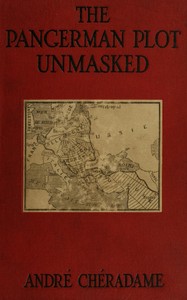
The PanGerman Plot Unmasked: Berlin's formidable peace-trap of "the drawn war"
by Chéradame, André
English
1159h 51m read
German Atrocities: Their Nature and Philosophy
by Hillis, Newell Dwight
English
479h 45m read