The Project Gutenberg EBook of The Pocket Lavater, by Unknown Author
This eBook is for the use of anyone anywhere at no cost and with
almost no restrictions whatsoever. You may copy it, give it away or
re-use it under the terms of the Project Gutenberg License included
with this eBook or online at www.gutenberg.org/license
Title: The Pocket Lavater
or, The science of physiognomy
Author: Unknown Author
Release Date: April 23, 2018 [EBook #57030]
Language: English
Character set encoding: UTF-8
*** START OF THIS PROJECT GUTENBERG EBOOK THE POCKET LAVATER ***
Produced by Chris Curnow, Chuck Greif and the Online
Distributed Proofreading Team at http://www.pgdp.net (This
file was produced from images generously made available
by The Internet Archive)
[Illustration: T. G. LAVATER.]
THE
POCKET LAVATER,
OR,
THE SCIENCE OF PHYSIOGNOMY:
TO WHICH IS ADDED,
AN INQUIRY
INTO THE
ANALOGY EXISTING BETWEEN BRUTE AND HUMAN PHYSIOGNOMY,
FROM THE ITALIAN OF PORTA.
Embellished with 44 Copperplate heads.
_NEW-YORK_:
Published by Van Winkle & Wiley.
1817.
_Southern District of New-York, ss._
BE IT REMEMBERED, that on the first day of May, in the forty-first year
of the Independence of the United States of America, VAN WINKLE & WILEY,
of the said district, have deposited in this office the title of a book,
the right whereof they claim as proprietors, in the words and figures
following, to wit:
“The Pocket Lavater, or, the Science of Physiognomy. To which is added,
An Inquiry into the Analogy existing between Brute and Human
Physiognomy, from the Italian of Porta. Embellished with 14 Copperplate
heads.”
IN CONFORMITY to the act of Congress of the United States, entitled, “An
act for the encouragement of learning, by securing the copies of maps,
charts, and books, to the authors and proprietors of such copies, during
the times therein mentioned,” and also, to an act entitled, “An act,
supplementary to an act, entitled, an act for the encouragement of
learning, by securing the copies of maps, charts, and books, to the
authors and proprietors of such copies, during the times therein
mentioned, and extending the benefits thereof to the arts of designing,
engraving and etching historical and other prints.”
THERON RUDD.
Clerk of the Southern District of New-York.
ADVERTISEMENT.
The public are here presented with a translation from the French of the
“Pocket Lavater,” a work which has become highly popular in France, and
which has run through successive and repeated editions.
The attention which the French have, of late, paid to Physiognomy, may
be ascribed not only to the infatuating nature, and intrinsic excellence
of that science, but, also, to adventitious circumstances. France, or,
more properly, its metropolis, has, within a few years, become, as it
were, the immense stage on which all the varieties of human aspect and
action have been exhibited. Their painters, at present, employ the
pencil, not on pieces of ancient history or mythological fiction, but in
designating the various national physiognomies, costumes, and
conformation of body, which Paris now presents, assembled from all
Europe, and from some parts of Asia. The Physiognomist has there an
ample scope for the study and enlargement of his Science: the Briton
melancholy amidst success--the Frenchman happy amidst adversity--the
phlegmatic German, the choleric Russian, the proud Spaniard, the vain
Pole, and the grave and jealous Turk; these parading her streets and
gardens, or thronging her Caffées, must present a group, whose motley
and various character mocks both narrative and description. All of these
are distinguished from each other by a difference of countenance,
language, dress, habits, customs, and manners; yet the philosopher
observes in all these but one being under different modifications.
This edition is enriched by an ingenious inquiry into the existing
analogy between brute and human physiognomy, from the Italian of Porta,
whose observations on national character, although written three
centuries ago, are found correct at the present day.
The plates which accompany this work, are designed, and faithfully
executed, after those which accompany the Paris edition.
The Publishers, in submitting this work to the public, will be
influenced by its success to the publication of the “Female Lavater,” a
work of established merit, and which forms a counterpart to the present
volume.
PREFACE.
Nothing is more common than to hear the study of physiognomy condemned
as being calculated to mislead men in their judgments of each other, and
the impossibility of its being reduced to a science; yet, nothing is
more universally prevalent, in all classes of society, than forming
judgments from the appearances of the face. How often do we hear these
observations--“He has an open countenance”--“His countenance is
forbidding”--“That man has an honest face”--“His looks are enough for
me”--“Rogue is depicted in his countenance,” “That bewitching
eye”--“That stupid face,” and many other expressions of the kind. This
proves that, although differences of opinion may be entertained
respecting physiognomy, all men are, in the true signification of the
term, physiognomists. We shall here proceed to point out some of its
advantages.
Whether a more certain, more accurate, more extensive, and thereby, a
more perfect knowledge of man, be, or be not profitable; whether it be,
or be not, advantageous to gain a knowledge of internal qualities from
external form and feature, is certainly a question deserving of inquiry.
It may be asked, Is knowledge, its extension and increase, of
consequence to man? This question, it is presumed, can receive but one
answer from all unprejudiced persons: for, as certainly as man is
possessed of corporeal strength, so certain is it that to exercise
strength is necessary. As certainly as he has the faculties, power, and
will, to love, so certain is it that it is necessary he should love.
Equally certain is it, that if man has the faculties, power, and will,
to obtain wisdom, that he should exercise those faculties for the
attainment of wisdom.
Mutual intercourse is the thing of most consequence to mankind, who are
destined to live in society. The knowledge of man is the soul of this
intercourse--that which imparts to it animation, pleasure, and profit.
This knowledge is, in some degree, inseparable from, because necessary
to, all men. And how shall we, with greater ease and certainty, acquire
this knowledge than by the aid of physiognomy, understood in its most
extensive sense, since, in so many of his actions, man is
incomprehensible?
Physiognomy unites hearts, and forms the most durable, the most divine
friendships; nor can friendship discover a more solid foundation than in
the fair outlines and noble features of certain countenances.
Physiognomy is the very soul of wisdom, since it elevates the mutual
pleasures of intercourse, and whispers to the heart when it is necessary
to speak--when to be silent; when to forewarn--when to excite; when to
console--when to reprehend.
But to enumerate all the advantages that are derived from the study of
physiognomy would require a volume. We shall, therefore, conclude these
prefatory remarks by adding testimonies, from the highest authorities,
in favour of that science, which Lavater, in his essay, introduces in
the following manner:
“To support the feeble among my readers, and to furnish the strong
with such arguments as are most convenient to their disputes with
the feeble, I shall produce witnesses, of more or less importance
among the learned and wise, in the company of whom I shall deem it
an honour to be despised. They will be few, and not conclusive;
but, however, may to many appear of consequence, and be unexpected:
“The countenance of the wise sheweth wisdom, but the eyes of a fool
are in the ends of the earth.”--PROV. xvii. 24.
“Though the wicked man constrain his countenance, the wise can
distinctly discern his purpose.”--PROV. xxi. 29.
“The heart of man changeth his countenance, whether it be for good
or evil; and a merry heart maketh a cheerful countenance.”--ECCL.
xiii. 25.
“A man may be known by his look; and one that hath understanding,
by his countenance, when thou meetest him.”--ECCL. xix. 29.
“We know that nothing passes in the soul which does not produce
some change in the body; and particularly, that no desire, no act
of willing, is exerted by the soul without some corresponding
motion, at the same time, taking place in the body. All changes of
the soul originate in the soul’s essence, and all changes in the
body in the body’s essence. The body’s essence consists in the
conformation of its members; therefore, the conformation of the
body, according to its form, and the form of its constituent
members, must correspond with the essence of the soul. In like
manner must the varieties of the mind be displayed in the varieties
of the body. Hence, the body must contain something in itself, and
in its form, as well as in the form of its parts, by which an
opinion may be deduced concerning the native qualities of the mind.
I repeat, native qualities; for the question here does not concern
those qualities derived from education, or by instructive
conversation. Thus considered, the art of judging man by the form
of his members, and of his whole body, usually called physiognomy,
is well founded.
“The lines of the countenance constitute its expression; which
expression is always true when the mind is free from constraint:
these lines, therefore, must discover what the natural inclinations
are, when seen in their true and native position.”--WOLF.
“What is the fairest countenance, disfigured by the hateful vices
of lust, anger, falsehood, envy, avarice, pride, and discontent?
What can external marks of decorum effect when an ignoble and
insignificant mind is depicted in the countenance? The most certain
means of rendering the face beautiful, is to beautify the mind, and
to purify it from vice. He who would make his countenance
intelligent must so first make his mind. He who would impart to the
face its most fascinating charms, must store the mind with religion
and virtue, which will diffuse over it every expression of sublime
content.”--GILLERT.
“Where is the hand that shall grasp that which resides beneath the
skull of man? Who shall approach the surface of that now tranquil,
now tempestuous, abyss! Like as the Deity has ever been adored in
sacred groves, so is the Lebanon, the Olympus of man, that seat of
the secret power of the divinity, overshadowed. We shudder at
contemplating the powers contained in so small a circumference, by
which a world may be enlightened, or a world destroyed.
“Through those two inlets of soul, the eye and ear, how wonderful
are the worlds of light and sound, the words and images that find
entrance!
“How significant are the descending locks that shade this mountain,
this seat of the gods! their luxuriance, their partition, their
intermingling!
“The head is elevated upon the neck. Olympus resting upon an
eminence in which are united freedom and strength, compression and
elasticity, descriptive of the present and the future. The neck it
is that expresses, not what man was originally, but what he is, by
habit or accident, become; whether erect in defence of freedom,
stretched forth and curbed in token of patient suffering, rising a
Herculean pillar of fortitude, or sinking between the shoulders,
the image of degradation; still it is incontestably expressive of
character, action, and truth.
“Let us proceed to the countenance, in which shine forth mind and
divinity.
“On the front appear light and gloom, joy and anxiety, stupidity,
ignorance, and vice. On this brazen table are deeply engraved every
combination of sense and soul. I can conceive no spectator to whom
the forehead can appear uninteresting. Here all the graces revel,
or all the Cyclops thunder! Nature has left it bare, that, by it,
the countenance may be enlightened or darkened.
“At its lowest extremities, thought appears to be changed into act.
The mind here collects the powers of resistance. Here reside the
_cornua addita pauperi_. Here headlong obstinacy and wise
perseverance take up their fixed abode.
“Beneath the forehead are its beauteous confines the eyebrows; a
rainbow of promise, when benignant; and the bent bow of discord,
when enraged; alike descriptive, in each case, of interior feeling.
“I know not any thing which can give more pleasure, to an accurate
observer, than a distinct and perfectly arched eyebrow.
“The nose imparts solidity and unity to the whole countenance. It
is the mountain that shelters the fair vales beneath. How
descriptive of mind and character are its various parts; the
insertion, the ridge, the cartilage, the nostrils, through which
life is inhaled!
“The eyes, considered only as tangible objects, are by their form
the windows of the soul, the fountains of light and life. Mere
feeling would discover that their size and globular shape are not
unmeaning. The eye-bone, whether gradually sunken, or boldly
prominent, equally is worthy of attention; as likewise are the
temples, whether hollow or smooth. That region of the face which
includes the eyebrows, eye, and nose, also includes the chief
signs of soul; that is, of will, or mind, in action.
“The occult, the noble, the sublime, sense of hearing, has nature
placed sideways, and half concealed. Man ought not to listen
entirely from motives of complaisance to others, but of information
to himself; and, however perfect this organ of sensation may be, it
is devoid of ornament; or, rather, delicacy, depth, and expansion,
are its only ornaments.
“I now come to the inferior part of the face, on which nature
bestowed a mask for the male; and, in my opinion, not without
reason. Here are displayed those marks of sensuality which ought to
be hidden. All know how much the upper lip betokens the sensations
of taste, desire, appetite, and the enjoyments of love; how much it
is curved by pride and anger, drawn thin by cunning, smoothed by
benevolence, made flaccid by effeminacy; how love and desire, sighs
and kisses, cling to it, by indescribable traits. The under lip is
little more than its supporter, the rosy cushion on which the crown
of majesty reposes. If the parts of any two bodies can be
pronounced to be exactly adapted to each other, such are the lips
of man, when the mouth is closed.
“It is exceedingly necessary to observe the arrangement of the
teeth, and the circular conformation of the cheeks. The chaste and
delicate mouth is, perhaps, one of the first recommendations to be
met with in the common intercourse of life. Words are the pictures
of the mind. We judge of the host by the portal. He holds the
flaggon of truth, of love, and endearing friendship.
“The chin is formed by the under lip, and the termination of the
jaw-bones. If I may speak figuratively, it is the picture of
sensuality, in man, according as it is more or less flexible,
smooth, or carbuncled: it discovers what his rank is among his
fellows. The chin forms the oval of the countenance; and when, as
in the antique statues of the Greeks, it is neither pointed nor
indented, but smooth, and gradually diminishes, it is then the
key-stone of the super-structure. A deformity in the chin is indeed
much to be dreaded.”--HERDER.
THE POCKET LAVATER.
The various thoughts which arise in the mind, the different passions
which agitate the soul of man, are respectively connected with his
features and the external parts of his frame; and so intimate is their
correspondence, that the expression of the countenance, more rapid than
speech, betrays his sentiments and emotions, and gives to his utterance
energy and animation. The one was designed as a mirror in which we might
behold the other reflected; but the vicious study dissimulation; they
endeavour to lock their passions and vices within their own breasts,
and, by a virtuous exterior, to conceal the characteristic expression of
villany. In vain, however, does hypocrisy tender them her aid: the
outward figure and form of the man are forced to a resemblance of the
internal model, and the dispositions of the heart are almost invariably
depicted on the countenance. These facts were observed and verified, and
such was the origin of physiognomy.
Most persons are daily in the practice of this art, without a knowledge
of the principles upon which it is founded, but according to such crude
and uncertain notions as are supplied by custom and general opinion. A
man’s face displeases them: this is often a sufficient ground for
aversion. Prejudices of this nature ought to be exploded, and it
behooves the man of science and real philanthropy to remove them. Such
was the great design of Lavater, whose profound researches, guided by
the desire of being useful to his species, displayed to him the nature
of man, and taught him how far the moral character is capable of being
traced upon the visage. He has created a new art--he has traversed an
unbeaten path. Has he not, however, gone too far in attempting to
determine the character of a man by the form of his hands, ears, &c.--in
assigning to these parts an expression of which they are not
susceptible? His opinions are sometimes rash, especially when resting
upon such foundations; but these are venial faults, and the inquirer
after truth will always adopt Lavater as his guide.
This subject has already been handled by celebrated men of antiquity,
such as Galen, Aristotle, Polemo, Adamantius, and many others; but their
systems were bottomed upon very weak grounds; and they assumed as the
basis of their opinions, the shape of the limbs, and other vague
criteria. Their whole doctrine was like those old empirical recipes, in
which were absurdly compounded a thousand drugs, each destroying the
effect of the other: it would be just as safe to rely upon such remedies
for the cure of a patient, as to trust to the remarks of those authors;
at whose erroneous ideas we may justly be surprised, since they were
generally endowed with a spirit of observation.
The ancient physiological system has been superseded by another scheme,
no less ridiculous and visionary, which rests its decisions upon certain
projections and cavities of the cranium, invisible to every eye, and
existing nowhere but in the brain of the inventor of this whimsical
doctrine.
But let us return from this digression to a subject of greater utility.
We shall now proceed to an analysis of the various parts which compose
the human visage, and shall endeavour to lay down such positions only as
are supported by reasons deduced from physical science: there are,
however, physiological phenomena which are inexplicable; yet, having
been confirmed by a cautious and scrutinizing observation, they could
not be passed over in silence, without subjecting ourselves to the
reproach of skepticism.
ANALYSIS.
OF THE HEAD.
A large head, with a small triangular forehead, denotes a total want of
understanding.
If the skull be loaded with fat and flesh, this is usually an indication
of a shallow mind: much more if, at the same time, it be small and
round; it then denotes stupidity.
Where the occiput, that is, the back part of the skull, is compressed,
or, rather, where it exhibits a cavity, it is a sign of a weak mind,
sometimes stubborn, and always contracted. (See _pl. V_.)
OF THE FOREHEAD.
It is by the shape and size of the forehead that we are to judge of the
extent of a man’s understanding.
A gently arched forehead, without a single angle, evinces a mild
disposition; and often, that the mind is destitute of energy. (See _pl.
XXIV_.)
A smooth, open forehead, indicates peace of mind; when it is wrinkled
and furrowed, it announces stormy passions, perturbation of mind, and
old age: but in the latter instance, the wrinkles are more regular,
less broken, and do not approach so near the eyes.
The upper part of the forehead only being wrinkled, gives to the visage
a look of amazement, which sometimes approaches to folly.
Perpendicular wrinkles on the forehead give promise of great energy and
application; but the contrary when they are cut transversely by others.
A forehead full of irregular protuberances is characteristic of a
choleric temperament. (See _pl. XXII_.)
When we meet with horizontal lines at the junction of the nose and
forehead, we may expect a harsh and unfeeling disposition. (See _pl.
VIII_.)
Deep perpendicular incisions between the eyebrows, are evidence of
strength of mind, provided they be not counterbalanced by other
indications of a positively contrary import.
When the frontal vein appears distinctly in the midst of a forehead,
open, uniform, and regularly arched, it announces extraordinary talent.
When the forehead is perfectly perpendicular, from the hair to the
eyebrows, it denotes an utter deficiency of understanding. (See _pl.
V_.)
But if it be, at the same time, arched toward the summit, it furnishes
an indication of a profound, reflecting, cool mind. (See _pl. XV_.)
When the forehead is rounded and projecting, as is the case with the
generality of infants, it evinces a weak mind; if it project very much,
then it betrays the utmost degree of stupidity.
If it is rounding toward the summit, with a slight projection, and then
descending in a straight line, it shows great judgment, an irritable
disposition, but a heart of ice; a forehead of this description is
frequently characteristic of melancholy.
A narrow forehead is usually the sign of a froward disposition.
If it incline backward, we may then anticipate rashness and want of
reflection, especially if there be no very remarkable jutting of the
bones of the eyes. (See _pl. XXV_.)
A high forehead is a mark of capriciousness.
Should the bone of the eye be projecting and plainly marked, this
designates aptness for mental exertion.
OF THE EYEBROWS.
Small eyebrows always accompany a phlegmatic temperament. (See _pl.
XIII_.)
If horizontal, they betoken a masculine and vigorous character. (See
_pl. VII_.)
When they are partly horizontal, and partly curved, they denote energy
and ingenuity.
If situated very high, they almost always evince a person incapable of
reflection.
A wide space between the two eyebrows, designates a quick apprehension,
a calm and tranquil soul.
The nearer they approach the eyes, the stronger is the assurance they
give of solidity and reflection.
Angular, discontinuous eyebrows, mark an inventive genius.
When uneven and disordered, they are proofs of great vivacity.
Full, compact, well-disposed, and symmetrical eyebrows, are almost
always indicative of solidity of judgment, and of clear sound sense.
OF THE EYES.
It is peculiarly the province of the eyes to declare the emotions of the
soul, and to exhibit the workings of sentiment and passion.
Blue eyes are frequently found in persons of phlegmatic character; they
are often indications of feebleness and effeminacy.
Black eyes portend energy.
If gray, they often mark a choleric disposition; in such case, the lids
are red, drawn back, and sunken. (See _pl. XXII_.)
Hazel, or brown eyes, indicate vivacity and affability.
When the extremity near the nose is acute, it denotes cunning and
finesse.
If the upper eyelid cross diametrically the ball of the eye, it is a
sign of subtlety and cunning.
OF THE NOSE.
The nose is not a feature capable of conveying much expression; yet its
form and relative position, in respect of other parts of the face,
furnish some characteristics.
An aquiline nose designates an imperious temper, and ardent passions.
(See _pl. XXV_.)
A nose, the ridge of which is large, denotes a mind endowed with
qualities of a high order. (See _pl. VII_.)
When the sides of the nose are flexible, and perfectly disconnected, it
betrays a proneness to sensuality.
A nose curved at the root, announces a personage born to command, firm
in his purposes, and ardent in the pursuit. (See _pl. XI_.)
Small nostrils disclose timidity of soul.
A sharp pointed nose is characteristic of a passionate man. (See _pl.
XXII_.)
OF THE MOUTH.
The mouth is the most expressive feature of the face; it is peculiarly
the index to the discovery of character, and almost always represents
the nature and disposition of the man; so delicate are the shades and
varieties of which it is susceptible, that it would be impossible to
describe them with perfect precision.
If the lips are thick and fleshy, this is a sign of sensuality and of
slothfulness; it is always a characteristic of a phlegmatic temper. (See
_pl. XIII_.)
A mouth frequently shut, lips closed, and strongly marked, appertain to
the avaricious. (See _pl. XIX_.)
When the lower lip projects beyond the upper, it denotes negative
goodness. (See _pl. XIV_.)
A closed mouth, concealing the edge of the lips, betokens a person of
application, and inclined to regularity and neatness.
But if, at the same time, it turns up at the extremities, then it
expresses affectation, arrogance, vanity, and malignity.
A large interval between the mouth and nose indicates want of prudence.
Full, distinct, and well-proportioned lips, designate a character
hostile to falsehood, villany, and baseness, but with a propensity to
pleasure.
OF THE CHIN.
An advancing, projecting chin is always a declaration of energy. (See
_pl. XX_.) When pointed, it often denotes craft. (See _pl. I_.)
Should it, on the other hand, recede, it then indicates a character
destitute of firmness.
When it is angular, it betokens a sensible mind, and a benevolent heart.
A flat chin announces coolness of temper. (See _pl. XXVII_.)
A smooth, fleshy, double chin, is indicative of sensuality.
A small chin is characteristic of timidity.
A round, dimpled chin, is a sign of good nature.
OF THE CHEEKS.
Fleshy cheeks denote a proneness to sensuality.
Should we discover in them a certain triangular hollow, it is an
infallible sign of envy and jealousy.
Large and coarse furrows bear the impression of ill nature and
brutality.
OF THE HAIR.
Short, black, coarse, curly hair, evinces a character somewhat
irritable, and often shows it to be devoid of sensibility.
But light, soft hair, is evidence of a contrary disposition, and almost
always denotes gentleness.
A striking contrast between the colour of a man’s hair and his eyebrows
should excite suspicion.
OF THE NECK.
A long neck is declaratory of gentleness.
When short and thick, especially if the veins should be very
conspicuous, it is an indication of a passionate man. (See _pl. XXII_.)
* * * * *
We will now conclude our discussion of the peculiar expression of the
several features, and proceed to connect precept and example, by
exhibiting a variety of physiognomies, and pointing out the different
expressions of character which they display.
[Illustration: 1]
PHYSIOGNOMIES.
No. I.
In this face we may search in vain for a single expression of frankness;
this slightly-projecting chin, when accompanied with small, penetrating
eyes, denotes the absence of sincerity. There is no display of
benevolence in this oblique mouth; and avarice reveals itself in these
close-locked lips. Combine all these features, and they result in a
cunning, deceitful, avaricious, and not merely firm, but stubborn, old
fellow.
Such a man moves quick, and speaks slowly and circumspectly; for
suspicion is the mainspring of his character.
[Illustration: 2]
No. II.
Here is the head of a man well calculated for business; the upper part
of his head has great elevation, which is an unerring characteristic of
a calculating, deep-thinking mind; his _forte_ lies in those sciences
which demand precision, profundity, and unwearied application; he may be
a good geometrician, but not a poet--never can he rise to sublimity; his
features, however, do not represent the firmness and severity which are
so obvious in a subsequent head; (No. XV.;) a sanguine temperament
predominates, and hints at a propensity for pleasure, so powerful as
often to withdraw his attention from serious affairs.
[Illustration: 3]
No. III.
We are struck, at the first glance, with the air of probity which is
observable in this face; the mouth expresses, at once, kindness,
delicacy, and experience; the chin, gently projecting, and triangular,
marks a mind firm without obstinacy, and a benevolent heart. Although
the forehead and nose give no assurance of greatness, (for there is too
deep a cavity between them,) still they denote understanding: a mouth
which, like this, has a straight aperture, almost concealing the edge
of the lips, always designates a man of application, and one fond of
regularity and neatness.
[Illustration: 4]
No. IV.
Here we may behold the characteristics of love of order, and attention
to method; in this mouth, closely shut, and hiding the edge of the lips,
are depicted application and regularity. The lower part of the face
recedes a little: this is an indication of a man of discretion, modesty,
gravity, and reserve. He is not pleased with a book unless it is written
clearly and methodically: he never rises to poetic invention, or
overleaps the boundaries of scrupulous exactness.
The hand-writing of a man of this description will be small and regular;
his gait leisurely and solemn, and his conversation not brilliant, but
clear, concise, and sensible.
[Illustration: 5]
No. V.
Here are indelibly depicted a dull and narrow intellect, self-conceit,
and the grossest ignorance. We may observe that a nose of this form, in
connexion with thick lips, is always a prognostic of obstinacy; still
more if the forehead be also perpendicular; and, above all, if the
occiput, instead of being arched, is concave. And here we may apply this
general rule, _that every remarkable concavity denotes a defect in the
corresponding organ_.
[Illustration: 6]
No. VI.
This countenance has been disfigured by intemperance, as is apparent
from every feature; nature never formed a nose like this; these lips,
these wrinkles, are all expressive of insatiable thirst; the glance of
the eye has lost its native energy.
The nose and cheeks of a person addicted to intoxication are almost
always red, and the edges of the eyelids are often tinged with the same
colour; in general, the skin, especially under the chin, is flaccid and
wrinkled.
[Illustration: 7]
No. VII.
The original of this portrait is one who knows how to enjoy life like a
wise man; if he is not nice in his pleasures, he, at least, does not
carry them to excess. The cast of his mind presupposes gentleness,
rather than harshness--dignity, rather than elevation--firmness of
character, rather than violence of passion--transient irritation, rather
than continued resentment. The eyebrow fully expresses the decree to
which a choleric temperament prevails, and the eye is a compound of the
melancholic and phlegmatic characters; the same mixture is again
apparent in the contour of the face from the ear to the chin; but the
whole profile, taken in connexion, exhibits a sanguine ground, relieved
with a choleric tint. (_Extract from Lavatory._)
[Illustration: 8]
No. VIII.
Sternness is engraven upon these features; the wrinkles in the vicinity
of the eyes, and, particularly, those at the root of the nose, the
salient angle formed by the lower part of the cheeks near the mouth--all
announce harshness and insensibility; the elevation of the chin
designates a certain degree of energy, and the shape of the forehead
denotes coolness and reflection, but it gives no indication of
docility.
Melancholy evidently predominates in this physiognomy.
[Illustration: 9]
No. IX.
This animated eye, this voluptuous mouth, and these eyebrows gently
arched, characterize a sanguine man; an expressive countenance, eyes
often blue, and always quick, usually indicate this character. He is
easily moved; slight circumstances agitate him, but he is soon composed.
As his features always express his feelings, it is difficult for him to
deceive. He is not vindictive, but is susceptible of the soft emotions
of pity. Love rules him with despotic sway, though he may sometimes be
accused of inconstancy.
[Illustration: 10]
No. X.
This forehead indicates both genius and folly--this, at the first
glance, may appear a contradiction; but the termination of the _frontal
sinus_ in a point--an almost infallible mark of folly--renders the
position less paradoxical.
A man of such a countenance speaks quickly, talks incoherently, and is
often absent, or in a deep reverie.
[Illustration: 11]
No. XI.
Here we see a countenance that evinces a capacity for great
achievements--in which patriotism and heroic virtue, worthy of ancient
Rome, are distinguishable; but it must be observed, that although it
promises fair, still it marks the man to be liable to the failings of
humanity, and often subject to be hurried by violence of passion, and
false notions of honour, beyond the bounds of reason.
This aquiline nose, curved at the root, is indicative of an imperious
and fiery temper; the cavity at the base of the forehead is not
sufficiently large, and there is too slight a projection of the bone of
the eye;--hence we may predict, that if the person of whom we are
speaking takes to improper courses, it will be difficult to restore him
to the path of rectitude.
[Illustration: 12]
No. XII.
This is a head in which the observer will recognise a philosopher; but
he may search in vain for indications of courage--still less for that
heroic boldness which is the parent of brilliant achievement; the
outline of the nose, which is without swell or compass, and the sinking
at its root, which is too wide and deep, forbid such an inference. There
is, however, observable in this face, a delicacy of sentiment easy to be
wounded, and it indicates a mind qualified for profound and philosophic
researches.
[Illustration: 13]
No. XIII.
Phlegmatic people are generally distinguishable by the following
signs:--the contour of their features is plump and round, but neither
bold nor prominent; their eyebrows are small and elevated, and their
lips soft and thick; these characteristics are always accompanied with
blue and vacant eyes: the head, in persons of this description, is often
round; and the skin almost white and colourless; their hair is generally
of a light or chesnut colour, and curls spontaneously; their convex
forehead proclaims them incapable of energy; and they are very
frequently stout, tall, and plump: it would seem as though nature had
been beneficent to the body at the expense of the mind, so sluggishly
does the latter perform its functions; and yet the exertions of the
former are equally dull and spiritless.
[Illustration: 14]
No. XIV.
This broad, square forehead, betokens a strong memory, and a fund of
good sense; but its perpendicular form denotes a degree of inflexibility
which may degenerate into obstinacy; the slight projection of the lower
lip, and the flatness of the chin, are indicative of good nature.
This is the visage of a prudent, discerning man; of one devoid of poetic
genius, and whose writings will never attain to sublimity; but,
persevering and resolute, he can turn his mind to every subject, and
may render himself conspicuous in a deliberative assembly; he is
peculiarly calculated for profound and laborious investigation.
[Illustration: 15]
No. XV.
This is the physiognomy of one designed by nature to be a man of
business; he does not possess the forehead of a poet, nor of one whose
impetuous imagination transcends the barriers of cold reason; but its
elevation and roundness at the summit, are proofs of a sedate, cool, and
reflecting mind. The nose announces firmness--benevolence is imprinted
on the mouth; but the bold shape of the lips betrays a slight
disposition to choler. This chin denotes a man incapable of violating a
trust, or betraying the confidence reposed in him, and it would seem as
if he had been formed to be essentially useful: as a man of business, a
lawyer, or a merchant, his probity and integrity will always render him
respectable.
[Illustration: 16]
No. XVI.
Firmness, judgment, and profundity, are the most striking
characteristics of this countenance. The bony formation of the head
shows that this person possesses a constancy of mind not easy to be
shaken: what he has once grasped will never escape him, and he will
always advance straight forward to the point. His materials will be
disposed with diligence and reflection, but without taste. His forehead,
however, is too concave, which lessens the superiority of his
character.
This phisiognomy is peculiarly appropriate to a lawyer or a
magistrate.
[Illustration: 17]
No. XVII.
Here is the phisiognomy of one who judges the actions and characters of
men with severity; he extends no indulgence to the follies of mankind,
although he yields them his commiseration when bewildered in the mist of
error. His scrutinizing look penetrates their thoughts, and his
intrepidity never suffers him to conceal from them the truth. His mouth
disclaims loquacity; on the contrary, he thinks much, and speaks little;
the shape of his forehead betokens a man of the highest intellectual
endowments: his mind, however, is methodical, and reason directs its
operations. His eyebrows designate a profound thinker, and the irregular
shape of the face holds forth the promise of originality of genius.
[Illustration: 18]
No. XVIII.
Benevolence and probity are depicted on this countenance, which is not
that of a man of the world, nor of one subservient to the punctilios of
etiquette, and the rules of politeness: for the face, bearing, as it
does, the stamp of frankness, seems rather to have the air of a person
of inferior rank; and its component features exhibit a kind of muscular
strength which is rarely discoverable in the wealthy inhabitants of a
great city. This proves that the face of a mechanic may display the
noblest qualities as unequivocally as the visage of a man of the most
exalted rank; and although not susceptible of the same delicacy of
sentiment, and of that nice attention to others, the deficiency is
supplied by open and cordial good nature. His features, collectively,
proclaim him possessed of intrepidity and calmness.
[Illustration: 19]
No. XIX.
The following particulars are combined in the hateful character of the
miser: Egotistical, hard-hearted, and mistrustful, the slightest loss
afflicts him; and to confer a benefit upon him, is throwing it away;
care is ever brooding in his heart, and every look is fraught with
suspicion; his propensity cannot lie concealed; he cannot move, he
cannot walk a step, without betraying it. Persons of this description
often have small and sunken eyes; their lips are strongly made out, and
compressed against one another.
We may observe, that they almost always write badly, which is by no
means surprising, since a greater degree of attention would distract
their minds from their grand object--the amassing of wealth.
[Illustration: 20]
No. XX.
Here are indications of extraordinary genius. The features of this face,
the outlines of which are neither too angular nor too rigid, decisively
evince great energy; the nose alone is indicative of an exalted mind:
the position of the eyebrows, and the gentle projection and jutting of
the chin, are characteristic of resolution; and the perfectly happy
formation of the forehead displays genius, and designates a character in
which reflection and activity are at once combined: he, whose features
unite so many marks of greatness, can be no other than a hero.
[Illustration: 21]
No. XXI.
This countenance is thoroughly good, but it is difficult to discover its
constitution. The soundest reason, devoid of what may strictly be called
genius, a tender sensibility without affectation, wisdom profiting by
every lesson of experience, clearness of perception, elevation of
language, calmness, yet not without vigour when called upon to act, and
modesty without pusillanimity, are here all collected. The forehead
unites the phlegmatic and sanguine; the eye and nose, the choleric and
sanguine; the mouth, the sanguine and melancholic; the lower part of the
face, the phlegmatic and sanguine temperaments. (_Extract from
Lavater._)
[Illustration: 22]
No. XXII.
The features which characterise a choleric man are strongly marked; his
eye-brows are almost always thick, the end of his nose acute, his eyes
very often gray, and always lively, with red lids, and the ball of the
eye, starting, as it were, from the head, the upper eyelid rising high,
and almost totally disappearing. His nostrils are wide, which show
strong respiration; his forehead is covered with irregular
protuberances; his blood-vessels are very perceptible, and the colour
of his skin varies from yellow to red. The neck of a choleric man is
almost always extremely short; and this is the most unequivocal standard
by which to determine his character.
[Illustration: 23]
No. XXIII.
It would be useless to search in this physiognomy for signs of genius:
we can only find patience, coldness, and obstinacy; firmness of
character difficult to manage; an understanding correct enough, but of
little penetration; benevolence without warmth, and fidelity without
tenderness; or, rather, that kind of faithful adherence which proceeds
more from the mind than the heart.
The convexity of the forehead presumes patience; but the inconsiderable
space between the eye and nose forbids perspicuity.
[Illustration: 24]
No. XXIV.
Here is a candid, ingenuous, frank, and honest countenance, without the
slightest vestige of vice, passion, or intrigue. Great talents are not
to be expected, for the shape of the forehead, although it does not deny
intelligence, yet evinces no energy, but is indicative of gentleness;
the chin betrays a degree of timidity, and the mouth betokens
tranquillity of mind, and love of order.
[Illustration: 25]
No. XXV.
A receding forehead, eyes black, and full of fire, their shape, the form
of the upper eyelid, an aquiline nose, and a large and projecting chin,
are here characteristic of a passionate man. The chin designates an
enterprising character, the nose denotes an ardent imagination, and
lively passions, beyond the control of reason, and the forehead affords
no inference of a reflecting mind.
Where there is no excavation between the bones of the eyes, or, in
other words, should they form no observable projection, we may
anticipate a headstrong and thoughtless character.
[Illustration: 26]
No. XXVI.
This face presents a most hateful character; craft, sordid avarice, and
hardened villany, have disfigured it, and distorted the eyes and mouth.
None of its muscles or features is expressive of benevolence or
sensibility; the scoundrel might always be recognised in these
lineaments; however sedulously he may endeavour to hide his soul behind
the mask of hypocrisy; however he may attempt to soften his lips into a
smile, still his countenance will infallibly belie him.
[Illustration: 27]
No. XXVII.
In the physiognomy of this person we may remark a degree of self-love
which has degenerated into dogmatism, an arrogant disposition, and a
certain irritability which years cannot allay, and which is strongly
manifested wherever his self-love is touched. Good sense and correct
judgment are, however, perceivable, and the shape of the forehead is by
no means incompatible with understanding; but the eyes, the nostrils,
and the mouth, denote a disputatious and dogmatical character.
[Illustration: 28]
No. XXVIII.
In this countenance we may recognise a rogue; the size and shape of the
forehead are declaratory, however, of a reflecting, and even of a
profound mind. The salient angle of the nose, the projection and
sharpness of the chin, indicate an astute, enterprising, and crafty
character. On the whole, these features, collectively, make up a
countenance which we cannot regard without repugnance, and in which it
is impossible to confide.
[Illustration: 29]
No. XXIX.
In this physiognomy we distinguish taste, acuteness and sensibility.
Should a man of this description become an author, his style will be
florid, and he will describe the beauties of nature and the pleasures of
friendship; but he will avoid the discussion of scientific subjects, and
sometimes turn away from philosophical argument as dry and insipid.
The shape of his lips would seem to indicate a genius for poetry, and
the projection of the bone of the eye shows great aptness for mental
exertion. The chin denotes a character possessed of firmness and energy;
in fine, we may conclude that a man who bears a physiognomy like this is
highly gifted; it distinctly presents the impress of genius.
[Illustration: 30]
No. XXX.
A downcast look, longitudinal wrinkles on the cheeks, compressed lips,
and dull eyes, are all symptomatic of a melancholy man; his mouth is
often drawn in, his complexion bilious, and his skin dry. It is
observable that persons of this character have almost always defective
teeth; their eyes are seldom blue, but very frequently dark; their hair
is generally long and sleek, and the mouth is usually kept shut, to
which the badness of their teeth may be attributed.
[Illustration: 31]
No. XXXI.
In this head we may recognise the face of a gay and sprightly man;
repartee and epigram are his arms, and he is capable of wielding them
with spirit and effect. The mouth, with a little hollow in the middle of
the under lip, is almost always an indication of such a character, which
is also discoverable by the interval between the two eyes.
We must not confound a person of this description with the man that
scoffs and jeers; the cheeks of the latter assume a convex form, and
approach near to the eyes.
[Illustration: 32]
No. XXXII.
Here are collected the features of a character of extraordinary
melancholy, in which a discontented and sluggish disposition is
perceptible. The blue eyes and small eyebrows, and the thickness of the
lips, mark the intermixture of a phlegmatic tint; the elongation of the
nose, as well as the forehead, declare no want of judgment, and it is
that which particularly characterizes this physiognomy, and gives it its
pensive air. The features of this face, taken in connexion, exhibit a
tranquil mind, fond of regularity, and especially of quiet, and to which
the functions of an ecclesiastic would be most appropriate.
COMPARISON
OF
MAN WITH OTHER ANIMALS.
COMPARISON, &c.
John Baptiste Porta, an Italian, published, about three hundred years
ago, a treatise on Physiognomy, from which the extracts in the following
pages are translated. Although Lavater has ridiculed the system of
Porta, he is, nevertheless, indebted to him for many of his best ideas
on the subject.
In this treatise Porta says, that Ptolemy Maternusa, Vitruvius, and
others, describe all known nations as follows: viz. “The Scythians are
cruel, the Italians noble, the Gauls merry and inconsiderate, the Greeks
fickle, Africans deceitful, Syrians covetous, Asiatics lecherous,
Sicilians cunning, Spaniards haughty, proud, and vain of their courage,
Egyptians wise, Babylonians prudent.”
It was the opinion of Plato, that the variety of manners and
constitution observable in the inhabitants of different countries is to
be attributed solely to the difference of climate.
Aristotle thus writes to Alexander, respecting the character of man.
Nature has formed him more perfect than all other animals, and still he
possesses all the different characters of the latter. He is as bold as
the lion, timid as the hare; he can be compared to the cock for his
pride and liberality, to the dog for his avarice; he is harsh and
austere as the crow, gentle as the turtle-dove, domestic as the pigeon,
fickle as the roebuck, passionate as the leopard, lazy as the bear,
affectionate as the elephant, stupid as the ass, vain as the peacock,
industrious as the bee, ungovernable as the bull, cross as the mule,
mute as a fish; his malice renders him equal to the lioness, his cunning
to the fox, his meekness to the lamb, his love of roving to the kid. The
reason with which he is endowed renders him worthy of being compared to
angels; he is given to lust as the swine, is wicked as the owl, useful
as the horse, and hurtful as the rat. In short, there is no vegetable,
mineral, or other substance in the world, but what possesses some
quality that can be referred to man. Adamantius says that we may judge
of the manners and tempers of all animals by their looks. For instance,
it is natural for the lion to be strong and easily provoked, which can
be perceived by his form and looks. The leopard is pretty and delicate,
but is, nevertheless, subject to anger, to lying in ambush, to
treachery, and is at once timid and bold, which exactly corresponds with
his external appearance; and so it is with all other animals. The bear
is cruel, deceitful, unsocial and savage; the wild boar has a fearless
fury, to which he gives himself up; the ox is severe and simple; the
horse is proud and desirous of glory; the fox is cunning, and lies in
wait; the monkey is jocose and dissembling; the sheep is plain and dull;
the goat is lazy; the hog is filthy and gluttonous. The same thing holds
good with respect to birds and reptiles. If, then, it happens that a man
possesses a member or feature which resembles that of an animal or bird,
it is by that resemblance he must be judged. For if his eyes are of a
tawny colour, and a little concave, you must remember that they are
similar to that of the lion; if very much concave, they denote bad
manners, and agree with those of the monkey; if level, they resemble
those of the bull; if they seem to start from his head, and are very
prominent, stupid, and disagreeable to the sight, they have some
likeness to those of the ass.
Man, that master-piece, formed by the Creator in his own image, and
impressed with the brilliancy of his character--in short, that earthly
divinity, was endowed with a strong and loud voice, a large body, and a
slow gait. With respect to his manners and disposition, he has a
generous and fearless heart, is equitable, candid, desirous of glory,
and eager of success in all his undertakings.
[Illustration: _Fig. 1._]
[Illustration: _Fig. 2._]
FIG. I.
According to Aristotle’s opinion on Physiognomy, he whose nose is curved
from the root of the forehead, and strongly marked like the beak of an
eagle, must be a brave man. It was also observed by Polemon and
Adamantius, that such a nose denotes courage; and Albert, upon the
authority of Loxus, conveys the same idea. Noses thus formed are
commonly distinguished by the term Aquiline, or Roman, and seem to bear
the character of something royal or majestic; for the eagle, whose bill
is so formed, is the king of birds: from this it may be inferred that
an aquiline nose denotes a dignified mind, capable of magnificent
conceptions. Cyrus, according to Xenophon and Plutarch, possessed such a
nose, and the Persians held them in such high estimation, that they
granted royal honours to none but those possessed of aquiline noses, and
to that custom they still adhere. They loved Cyrus above all other
princes, and admired his magnanimity and courage. I have noticed on a
medal, in the collection of my brother Porta, the antiquarian, that
Artaxerxes, the descendant of Cyrus, and a king of Persia, had a very
crooked and prominent nose. This prince proved the greatness of his
mind on many occasions, insomuch that for a trifling present, or some
inconsiderable service which he had received from some peasants, he not
only gave a great quantity of gold and silver, but cities, and even
whole provinces, as a compensation. Demetrius, son of a Syrian king, was
surnamed Grypus, by the Greeks, on account of his nose, as is mentioned
by Justin. Dares, the Phrygian, says, that Neoptolemus, son of Achilles,
had a nose of the same shape. According to Suetoneus, that of Sergius
Galba, (who is represented as a very liberal and magnificent prince) was
curved in the same manner. Plato relates, in his Eutyphron, that Miletus
Pittheus had a Roman nose with an elevation on the centre, and it was
he that displayed such wonderful generosity respecting an accusation to
which he was summoned to appear. George Scanderbeg, whose physiognomy
indicated a matchless hero, and who stood unrivalled in courage and
liberality, had a gentle and agreeable eminence on his aquiline nose.
Junius says, that the great Sforza’s was elevated on its centre, and he
was invincible in courage. It is believed that Mahomet, the second
emperor of the Turks, who was a great warrior, had a nose so curved that
it seemed to touch his upper lip. John Assimbe, surnamed Ussumcassam,
had an aquiline nose, large eyes, and a gay countenance; he was very
liberal and merciful, possessed an heroic generosity in war, and a great
desire of glory. It is certain, that Ishmael Sophy, king of Persia, had
a nose of the above description, with eyes remarkably quick and
brilliant, and his manners exhibited the greatest liberality, courage
and ambition. His greatest delight was to be amid the dangers and
chances of war, where his invincible courage and noble heroism were
always conspicuous and successful. Selim, the son of Bajazet, who for
liberality could vie with Alexander the Great, had an arched nose.
Lastly, the face of Soliman, the son of Selim, who was a great warrior,
and beloved by all his subjects for his munificence, had a Roman nose.
We have here represented the head of the eagle, whose curved bill can be
compared to the nose of Sergius Galba, being both of the same shape.
FIG. II.
This head, which was copied from a marble statue in the collection of my
uncle Adrian Spatafore, represents Vitellius, one of the Cæsars, whose
enormous head can be compared to that of the owl.
Polemon and Adamantius say, that those whose heads are large, beyond
proportion, are stupid, and naturally stubborn. Albert says, that the
head which is so large as to lean on the shoulder for support, is
destitute of sense and wit; and it was Aristotle’s opinion, that when a
man’s head is unreasonably large, and out of proportion with the rest
of his body, he is of a dull and sluggish disposition. For my part, I
compare them to the ass, as being lazy, timid, and impertinent. They may
also be compared to owls, whose heads are very large, and who come from
their holes or resting-places feet foremost; on which account Ovid thus
describes the transformation of Ascalaphus, who was changed into that
stupid bird by Proserpine.
“In Phlegeton’s black stream her hand she dips,
Sprinkles his head, and wets his babbling lips;
Soon on his face, bedropt with magic dew,
A change appear’d, and gaudy feathers grew;
A crooked beak the place of nose supplies,
Rounder his head, and larger are his eyes;
His arm and body waste, but are supplied
With yellow pinions, flagging on each side;
His nails grow crooked, and are turned to claws,
And lazily along his heavy wings he draws;
Ill-omened in his form, the unlucky fowl
Abhorred by men, and called a screeching owl.”
No bird has a larger head than the owl, which is a bird of night. If he
shows himself in the day, all other birds attack him without mercy.
Falcons that have large heads are not esteemed. Aristotle mentions a
fish which has a very large head, and is for that reason called
_cephale_ in greek, and _capito_ in Latin, which signify big-headed. He
has a very ridiculous custom of hiding his head when frightened, and
then he thinks himself in safety. He is considered as the most silly and
cowardly of all the finny race. From this we may infer, that those whose
heads are uncommonly large, are cowardly, rude, and ungovernable;
defective in imagination, and capable of understanding little or
nothing. We often hear the old proverb repeated--“Great head and little
wit.” The emperor Vitellius had an uncommon large head, as can be seen
from the pictures which have been made of him, and the deformity no
doubt proceeded from his rude and clownish disposition.
[Illustration: _Fig. 3._]
[Illustration: _Fig. 4._]
FIG. III.
This figure represents the striking similitude between man and the ass.
A round and convex forehead, says Aristotle, is a sign of stupidity.
Polemon and Adamantius say, that the high and round forehead denotes
stupidity and impudence, the true characteristics of a clown. Albert and
Conciliator were also of opinion that such a forehead denotes dullness.
Long ears are a sign that their possessor is extremely foppish, both in
language and action; but indicate, also, a good memory. According to
Aristotle, such ears denote a disposition like that of the ass. Polemon
and Adamantius say, they denote a dull disposition. Albert, having
borrowed his idea from Loxus, assures us that long ears denote stupidity
and impudence. Rhases says they are a sign of foolishness and longevity,
which was also the opinion of Pliny.
According to the opinion of Rhases and Conciliator, he whose face is
long is slow and lazy. Albert says, that such a one is cowardly and
sensual, slow in his motions, lazy, and sometimes stubborn.
The under lip, when it advances more than the upper, is a sign that the
possessor thinks about a great many vain things, and cherishes vulgar
or unpolished ideas: such was the opinion of Polemon and Adamantius.
Albert says it does not express a malicious spirit, but impudence and
simplicity. I maintain that it is a mark of imprudence. Albert further
adds, (from Loxus,) that when it happens in a small mouth, it denotes a
thirst for praise and honour.
We have united all these signs in the same head, (Figure 3,) which will
be found to correspond exactly with that of the _ass_, to which it may
be compared.
Aristotle does not approve of those eyes that are very prominent, and
seem almost to start from the head; and he writes to Alexander, that he
whose eyes are similar to those of the ass is destitute of sense. Galen
was of a similar opinion. Polemon and Adamantius do not think that such
eyes betray a laudable disposition, and Rhases says, that they denote
one shameless, dull, and loquacious. Pliny asserts that they are the
signs by which a dunce may be known.
FIG. IV.
_Resemblance between Man and the Monkey._
Aristotle disapproved of very small eyes. Galen says that very small
eyes, such as monkeys have, are a sure mark of pusillanimity, which may
be readily discovered in the manners of the possessor. Polemon and
Adamantius represent the miser with such eyes. Turtles have small eyes,
and are extremely sly and cunning.
He who has a flat nose, says Aristotle to Alexander, is impetuous; but
the ancient translation from that author is incorrect: it should have
been rendered _lascivious_: otherwise, he has contradicted himself; for
in his treatise on Physiognomy he compares the man with a flat nose to
the stag, which has one similar, and this animal is so lustful, that in
the time of rutting he becomes crazy. A nose both short and flat, says
Polemon, denotes a thievish disposition.
Small ears, according to Aristotle, are common to such men as are
naturally dull, and addicted to thieving, as is the monkey. Polemon and
Adamantius are of opinion, that they are peculiar to the cunning and
malignant man; and according to Albert, they generally belong to the
thief.
Adamantius asserts that a small face designates the sly and flattering
man; to which Rhases and Conciliator add timorous and covetous.
[Illustration: _Fig. 5._]
[Illustration: _Fig. 6._]
FIG. V.
This eye, and round nose with a great eminence like the bill of a cock,
are incontestible proofs that the owner, like that spirited little
animal, is vigilant, brave, and voluptuous.
FIG. VI.
Polemon says that a man whose mouth is very wide is of an uncouth, rude,
and impious disposition. According to Adamantius, such a mouth denotes
ignorance and greediness. Albert is of opinion that a mouth unreasonably
extended, points out the cruel, impious, warlike, and gluttonous man.
Polemon and Adamantius represent the _Wicked Fool_ with a mouth split
almost from ear to ear. Sea monsters, and all voracious animals, have
such mouths. I can assure you, says Porta, that my farmer has a mouth
not much smaller, and he is stupid as an ass, and greedy as a dog.
Those who have large round eyeballs are generally subject to bad habits.
But Adamantius justly observes, that foolish persons have large
eyeballs, and so have all giddy animals, such as the bull, sheep, &c.
HANDSOME FACES.
The beauty of the face denotes good manners, and those amiable mental
qualities from which true politeness proceeds. If it does not entirely
satisfy the eye, it has the power, at least, of attracting attention.
Beauty is followed by virtue, and repels vice. It is said that Achilles
had a handsome visage, and that he was liberal and noble-minded; in war,
generous, quick, and merciful. Patroclus was distinguished for his
stature, and was strong and prudent. Priam, king of Troy, who was
endowed with uncommon beauty of face, was highly virtuous. Troilus, who
was remarkably handsome, was very generous, and an admirer of virtue.
Hecuba was uncommonly beautiful, just, pious, and possessed of a
masculine spirit. Andromache, who was possessed of bright eyes, fair
complexion, and an elegant figure, was modest, wise, gentle, and chaste.
Polyxena was fair, beautiful, and well proportioned, and surpassed all
the other princesses in beauty. According to Dares, the Phrygian, she
was elegant and liberal, and thought little of life. Diogenes says that
Pythagoras was so extremely beautiful, that his disciples looked upon
him as an Apollo, who came from the northward. He was the first real
philosopher in Italy, where he not only professed the greatest sciences,
but even invented several. Cyrus was extremely well proportioned, and
was a lover of the fine arts and of honour. In the pursuit of glory, he
willingly submitted to all manner of fatigue, and encountered the
greatest dangers. Xenophon speaks of the virtue and warlike
achievements of this truly great man. Plutarch relates that Darius was
the handsomest and finest looking man of his time, insomuch that
Alexander could easily distinguish him in battle. Evagoras’s face
expressed honesty; he was so noble minded, brave, temperate, wise, and
just, that some thought him to be a genius under the human form.
Democles, on account of his personal beauty, surnamed the beautiful, was
courageous and very prodigal. To escape the violence of Demetrius, who
surprised him naked, and going to bathe, he leaped into a reservoir of
boiling water. History mentions a young man, named Galetes, who was
much beloved by Ptolemy, on account of his uncommon beauty, and the
noble sentiments of his mind. The latter used to exclaim, “O thou dear
and amiable youth! thou hast never caused any harm, but the sight of
thee has afforded pleasure to many.” Scipio Africanus was graced with a
matchless beauty, and surpassed all other men in the faculties of his
mind, in eloquence, benignity, magnificence, and continence. He was well
acquainted with the sciences and liberal arts; he was a valiant captain,
and, by his heroic deeds, excelled not only the greatest princes of his
time, but those of former ages. During battle he always displayed an
invincible courage, and his clemency in victory was never equalled.
Augustus preserved his beauty through life, and was admired for his
eloquence, and the exercise of the fine and military arts. He was the
most fortunate of all the Cæsars. Macrobius testifies, in his writings,
that as Publius Syrus was extremely handsome, so the faculties of his
mind were uncommonly brilliant, which enabled him to give that sharpness
to his jests for which he was so celebrated. Lucretia, so celebrated
among the Romans, owed her celebrity to her beauty and chastity.
Galeatius surpassed all his cotemporaries in virtue and magnificence, as
well as in beauty. He established a college, and a library, in which he
placed the best professors and the choicest books. Saladin, emperor of
the Turks, was handsome and generous. John Pic Mirandula, possessed
great beauty of face, symmetry of shape, and elegance of figure. His
imagination was brilliant, his behaviour frank, and his eloquence
irresistible; for which virtues he was justly called the Phœnix of his
age.
UGLY FACE.
Homer represents Thersites as having a very long head, a deformed face,
and low stature, to which his manners appears to have corresponded.
Leteus Metellus was so small, and his face so deformed, that he appeared
ridiculous to all. Cicero reproached Piso for the deformity of his face,
and the shameful profligacy of his manners. Sallust remarks, that the
pale and deformed visage of Cataline was more like that of a corpse than
of a living man; he was profane, cruel, and capable of the blackest
crimes. Xenocrates had a disagreeable and hideous aspect, for which
reason he often sacrificed to the graces, that they might give him some
beauty; his mind was stupid and dull, and he used to say that “he wanted
spurs to be roused to action.”
INDEX.
PAGE.
Advertisement, 5
Preface, 7
Introductory remarks, 13
Analysis of the head, 19
of the forehead, 20
of the eyebrows, 24
of the eyes, 26
of the nose, 27
of the mouth, 28
of the chin, 30
of the cheeks, 31
of the hair, 32
of the neck, 33
Plate No. I. Cunning, deceit, avarice, 35
II. Precision, application, 37
III. Benevolence, probity, neatness, 39
IV. Modesty, gravity, 41
V. Self-conceit, ignorance, obstinacy, 43
VI. Intemperance, 45
VII. Firmness, occasional irritation, compound of
phlegmatic and melancholic, 47
VIII. Reflection, energy, insensibility, 49
IX. Love, sanguinity, 51
X. Incoherence, genius, folly, 53
XI. Violent passion, heroism, 55
XII. Philosophy, timidity, 57
XIII. Want of energy, 59
XIV. Strong memory, good sense, deliberative, perseverance, 61
XV. Integrity, sedateness, choler, 63
XVI. Profundity, constancy, 65
XVII. Severity, taciturnity, original genius, 67
XVIII. Frankness, intrepidity, good nature, 69
XIX. Egotism, suspicion, treachery, avarice, corroding care, 71
XX. Resolution, activity, genius, 73
XXI. Goodness, clearness of perception, 75
XXII. Choler, 77
XXIII. Dulness, obstinacy, 79
XXIV. Candour, frankness, honesty, 81
XXV. Enterprise, imagination, uncontrollable passions, 83
XXVI. Craft, sordidness, villany, 85
XXVII. Self-love, arrogance, irritability, 87
XXVIII. Craft, enterprise, 89
XXIX. Poetic genius, firmness, 91
XXX. Melancholy, 93
XXXI. Gayety, sprightliness, 95
XXXII. Love of quiet, pensiveness, 97
Comparison of Man with other Animals., 101
End of the Project Gutenberg EBook of The Pocket Lavater, by Unknown Author
*** END OF THIS PROJECT GUTENBERG EBOOK THE POCKET LAVATER ***
***** This file should be named 57030-0.txt or 57030-0.zip *****
This and all associated files of various formats will be found in:
http://www.gutenberg.org/5/7/0/3/57030/
Produced by Chris Curnow, Chuck Greif and the Online
Distributed Proofreading Team at http://www.pgdp.net (This
file was produced from images generously made available
by The Internet Archive)
Updated editions will replace the previous one--the old editions
will be renamed.
Creating the works from public domain print editions means that no
one owns a United States copyright in these works, so the Foundation
(and you!) can copy and distribute it in the United States without
permission and without paying copyright royalties. Special rules,
set forth in the General Terms of Use part of this license, apply to
copying and distributing Project Gutenberg-tm electronic works to
protect the PROJECT GUTENBERG-tm concept and trademark. Project
Gutenberg is a registered trademark, and may not be used if you
charge for the eBooks, unless you receive specific permission. If you
do not charge anything for copies of this eBook, complying with the
rules is very easy. You may use this eBook for nearly any purpose
such as creation of derivative works, reports, performances and
research. They may be modified and printed and given away--you may do
practically ANYTHING with public domain eBooks. Redistribution is
subject to the trademark license, especially commercial
redistribution.
*** START: FULL LICENSE ***
THE FULL PROJECT GUTENBERG LICENSE
PLEASE READ THIS BEFORE YOU DISTRIBUTE OR USE THIS WORK
To protect the Project Gutenberg-tm mission of promoting the free
distribution of electronic works, by using or distributing this work
(or any other work associated in any way with the phrase "Project
Gutenberg"), you agree to comply with all the terms of the Full Project
Gutenberg-tm License (available with this file or online at
http://gutenberg.org/license).
Section 1. General Terms of Use and Redistributing Project Gutenberg-tm
electronic works
1.A. By reading or using any part of this Project Gutenberg-tm
electronic work, you indicate that you have read, understand, agree to
and accept all the terms of this license and intellectual property
(trademark/copyright) agreement. If you do not agree to abide by all
the terms of this agreement, you must cease using and return or destroy
all copies of Project Gutenberg-tm electronic works in your possession.
If you paid a fee for obtaining a copy of or access to a Project
Gutenberg-tm electronic work and you do not agree to be bound by the
terms of this agreement, you may obtain a refund from the person or
entity to whom you paid the fee as set forth in paragraph 1.E.8.
1.B. "Project Gutenberg" is a registered trademark. It may only be
used on or associated in any way with an electronic work by people who
agree to be bound by the terms of this agreement. There are a few
things that you can do with most Project Gutenberg-tm electronic works
even without complying with the full terms of this agreement. See
paragraph 1.C below. There are a lot of things you can do with Project
Gutenberg-tm electronic works if you follow the terms of this agreement
and help preserve free future access to Project Gutenberg-tm electronic
works. See paragraph 1.E below.
1.C. The Project Gutenberg Literary Archive Foundation ("the Foundation"
or PGLAF), owns a compilation copyright in the collection of Project
Gutenberg-tm electronic works. Nearly all the individual works in the
collection are in the public domain in the United States. If an
individual work is in the public domain in the United States and you are
located in the United States, we do not claim a right to prevent you from
copying, distributing, performing, displaying or creating derivative
works based on the work as long as all references to Project Gutenberg
are removed. Of course, we hope that you will support the Project
Gutenberg-tm mission of promoting free access to electronic works by
freely sharing Project Gutenberg-tm works in compliance with the terms of
this agreement for keeping the Project Gutenberg-tm name associated with
the work. You can easily comply with the terms of this agreement by
keeping this work in the same format with its attached full Project
Gutenberg-tm License when you share it without charge with others.
1.D. The copyright laws of the place where you are located also govern
what you can do with this work. Copyright laws in most countries are in
a constant state of change. If you are outside the United States, check
the laws of your country in addition to the terms of this agreement
before downloading, copying, displaying, performing, distributing or
creating derivative works based on this work or any other Project
Gutenberg-tm work. The Foundation makes no representations concerning
the copyright status of any work in any country outside the United
States.
1.E. Unless you have removed all references to Project Gutenberg:
1.E.1. The following sentence, with active links to, or other immediate
access to, the full Project Gutenberg-tm License must appear prominently
whenever any copy of a Project Gutenberg-tm work (any work on which the
phrase "Project Gutenberg" appears, or with which the phrase "Project
Gutenberg" is associated) is accessed, displayed, performed, viewed,
copied or distributed:
This eBook is for the use of anyone anywhere at no cost and with
almost no restrictions whatsoever. You may copy it, give it away or
re-use it under the terms of the Project Gutenberg License included
with this eBook or online at www.gutenberg.org/license
1.E.2. If an individual Project Gutenberg-tm electronic work is derived
from the public domain (does not contain a notice indicating that it is
posted with permission of the copyright holder), the work can be copied
and distributed to anyone in the United States without paying any fees
or charges. If you are redistributing or providing access to a work
with the phrase "Project Gutenberg" associated with or appearing on the
work, you must comply either with the requirements of paragraphs 1.E.1
through 1.E.7 or obtain permission for the use of the work and the
Project Gutenberg-tm trademark as set forth in paragraphs 1.E.8 or
1.E.9.
1.E.3. If an individual Project Gutenberg-tm electronic work is posted
with the permission of the copyright holder, your use and distribution
must comply with both paragraphs 1.E.1 through 1.E.7 and any additional
terms imposed by the copyright holder. Additional terms will be linked
to the Project Gutenberg-tm License for all works posted with the
permission of the copyright holder found at the beginning of this work.
1.E.4. Do not unlink or detach or remove the full Project Gutenberg-tm
License terms from this work, or any files containing a part of this
work or any other work associated with Project Gutenberg-tm.
1.E.5. Do not copy, display, perform, distribute or redistribute this
electronic work, or any part of this electronic work, without
prominently displaying the sentence set forth in paragraph 1.E.1 with
active links or immediate access to the full terms of the Project
Gutenberg-tm License.
1.E.6. You may convert to and distribute this work in any binary,
compressed, marked up, nonproprietary or proprietary form, including any
word processing or hypertext form. However, if you provide access to or
distribute copies of a Project Gutenberg-tm work in a format other than
"Plain Vanilla ASCII" or other format used in the official version
posted on the official Project Gutenberg-tm web site (www.gutenberg.org),
you must, at no additional cost, fee or expense to the user, provide a
copy, a means of exporting a copy, or a means of obtaining a copy upon
request, of the work in its original "Plain Vanilla ASCII" or other
form. Any alternate format must include the full Project Gutenberg-tm
License as specified in paragraph 1.E.1.
1.E.7. Do not charge a fee for access to, viewing, displaying,
performing, copying or distributing any Project Gutenberg-tm works
unless you comply with paragraph 1.E.8 or 1.E.9.
1.E.8. You may charge a reasonable fee for copies of or providing
access to or distributing Project Gutenberg-tm electronic works provided
that
- You pay a royalty fee of 20% of the gross profits you derive from
the use of Project Gutenberg-tm works calculated using the method
you already use to calculate your applicable taxes. The fee is
owed to the owner of the Project Gutenberg-tm trademark, but he
has agreed to donate royalties under this paragraph to the
Project Gutenberg Literary Archive Foundation. Royalty payments
must be paid within 60 days following each date on which you
prepare (or are legally required to prepare) your periodic tax
returns. Royalty payments should be clearly marked as such and
sent to the Project Gutenberg Literary Archive Foundation at the
address specified in Section 4, "Information about donations to
the Project Gutenberg Literary Archive Foundation."
- You provide a full refund of any money paid by a user who notifies
you in writing (or by e-mail) within 30 days of receipt that s/he
does not agree to the terms of the full Project Gutenberg-tm
License. You must require such a user to return or
destroy all copies of the works possessed in a physical medium
and discontinue all use of and all access to other copies of
Project Gutenberg-tm works.
- You provide, in accordance with paragraph 1.F.3, a full refund of any
money paid for a work or a replacement copy, if a defect in the
electronic work is discovered and reported to you within 90 days
of receipt of the work.
- You comply with all other terms of this agreement for free
distribution of Project Gutenberg-tm works.
1.E.9. If you wish to charge a fee or distribute a Project Gutenberg-tm
electronic work or group of works on different terms than are set
forth in this agreement, you must obtain permission in writing from
both the Project Gutenberg Literary Archive Foundation and Michael
Hart, the owner of the Project Gutenberg-tm trademark. Contact the
Foundation as set forth in Section 3 below.
1.F.
1.F.1. Project Gutenberg volunteers and employees expend considerable
effort to identify, do copyright research on, transcribe and proofread
public domain works in creating the Project Gutenberg-tm
collection. Despite these efforts, Project Gutenberg-tm electronic
works, and the medium on which they may be stored, may contain
"Defects," such as, but not limited to, incomplete, inaccurate or
corrupt data, transcription errors, a copyright or other intellectual
property infringement, a defective or damaged disk or other medium, a
computer virus, or computer codes that damage or cannot be read by
your equipment.
1.F.2. LIMITED WARRANTY, DISCLAIMER OF DAMAGES - Except for the "Right
of Replacement or Refund" described in paragraph 1.F.3, the Project
Gutenberg Literary Archive Foundation, the owner of the Project
Gutenberg-tm trademark, and any other party distributing a Project
Gutenberg-tm electronic work under this agreement, disclaim all
liability to you for damages, costs and expenses, including legal
fees. YOU AGREE THAT YOU HAVE NO REMEDIES FOR NEGLIGENCE, STRICT
LIABILITY, BREACH OF WARRANTY OR BREACH OF CONTRACT EXCEPT THOSE
PROVIDED IN PARAGRAPH 1.F.3. YOU AGREE THAT THE FOUNDATION, THE
TRADEMARK OWNER, AND ANY DISTRIBUTOR UNDER THIS AGREEMENT WILL NOT BE
LIABLE TO YOU FOR ACTUAL, DIRECT, INDIRECT, CONSEQUENTIAL, PUNITIVE OR
INCIDENTAL DAMAGES EVEN IF YOU GIVE NOTICE OF THE POSSIBILITY OF SUCH
DAMAGE.
1.F.3. LIMITED RIGHT OF REPLACEMENT OR REFUND - If you discover a
defect in this electronic work within 90 days of receiving it, you can
receive a refund of the money (if any) you paid for it by sending a
written explanation to the person you received the work from. If you
received the work on a physical medium, you must return the medium with
your written explanation. The person or entity that provided you with
the defective work may elect to provide a replacement copy in lieu of a
refund. If you received the work electronically, the person or entity
providing it to you may choose to give you a second opportunity to
receive the work electronically in lieu of a refund. If the second copy
is also defective, you may demand a refund in writing without further
opportunities to fix the problem.
1.F.4. Except for the limited right of replacement or refund set forth
in paragraph 1.F.3, this work is provided to you 'AS-IS' WITH NO OTHER
WARRANTIES OF ANY KIND, EXPRESS OR IMPLIED, INCLUDING BUT NOT LIMITED TO
WARRANTIES OF MERCHANTABILITY OR FITNESS FOR ANY PURPOSE.
1.F.5. Some states do not allow disclaimers of certain implied
warranties or the exclusion or limitation of certain types of damages.
If any disclaimer or limitation set forth in this agreement violates the
law of the state applicable to this agreement, the agreement shall be
interpreted to make the maximum disclaimer or limitation permitted by
the applicable state law. The invalidity or unenforceability of any
provision of this agreement shall not void the remaining provisions.
1.F.6. INDEMNITY - You agree to indemnify and hold the Foundation, the
trademark owner, any agent or employee of the Foundation, anyone
providing copies of Project Gutenberg-tm electronic works in accordance
with this agreement, and any volunteers associated with the production,
promotion and distribution of Project Gutenberg-tm electronic works,
harmless from all liability, costs and expenses, including legal fees,
that arise directly or indirectly from any of the following which you do
or cause to occur: (a) distribution of this or any Project Gutenberg-tm
work, (b) alteration, modification, or additions or deletions to any
Project Gutenberg-tm work, and (c) any Defect you cause.
Section 2. Information about the Mission of Project Gutenberg-tm
Project Gutenberg-tm is synonymous with the free distribution of
electronic works in formats readable by the widest variety of computers
including obsolete, old, middle-aged and new computers. It exists
because of the efforts of hundreds of volunteers and donations from
people in all walks of life.
Volunteers and financial support to provide volunteers with the
assistance they need, are critical to reaching Project Gutenberg-tm's
goals and ensuring that the Project Gutenberg-tm collection will
remain freely available for generations to come. In 2001, the Project
Gutenberg Literary Archive Foundation was created to provide a secure
and permanent future for Project Gutenberg-tm and future generations.
To learn more about the Project Gutenberg Literary Archive Foundation
and how your efforts and donations can help, see Sections 3 and 4
and the Foundation web page at http://www.pglaf.org.
Section 3. Information about the Project Gutenberg Literary Archive
Foundation
The Project Gutenberg Literary Archive Foundation is a non profit
501(c)(3) educational corporation organized under the laws of the
state of Mississippi and granted tax exempt status by the Internal
Revenue Service. The Foundation's EIN or federal tax identification
number is 64-6221541. Its 501(c)(3) letter is posted at
http://pglaf.org/fundraising. Contributions to the Project Gutenberg
Literary Archive Foundation are tax deductible to the full extent
permitted by U.S. federal laws and your state's laws.
The Foundation's principal office is located at 4557 Melan Dr. S.
Fairbanks, AK, 99712., but its volunteers and employees are scattered
throughout numerous locations. Its business office is located at
809 North 1500 West, Salt Lake City, UT 84116, (801) 596-1887, email
[email protected]. Email contact links and up to date contact
information can be found at the Foundation's web site and official
page at http://pglaf.org
For additional contact information:
Dr. Gregory B. Newby
Chief Executive and Director
[email protected]
Section 4. Information about Donations to the Project Gutenberg
Literary Archive Foundation
Project Gutenberg-tm depends upon and cannot survive without wide
spread public support and donations to carry out its mission of
increasing the number of public domain and licensed works that can be
freely distributed in machine readable form accessible by the widest
array of equipment including outdated equipment. Many small donations
($1 to $5,000) are particularly important to maintaining tax exempt
status with the IRS.
The Foundation is committed to complying with the laws regulating
charities and charitable donations in all 50 states of the United
States. Compliance requirements are not uniform and it takes a
considerable effort, much paperwork and many fees to meet and keep up
with these requirements. We do not solicit donations in locations
where we have not received written confirmation of compliance. To
SEND DONATIONS or determine the status of compliance for any
particular state visit http://pglaf.org
While we cannot and do not solicit contributions from states where we
have not met the solicitation requirements, we know of no prohibition
against accepting unsolicited donations from donors in such states who
approach us with offers to donate.
International donations are gratefully accepted, but we cannot make
any statements concerning tax treatment of donations received from
outside the United States. U.S. laws alone swamp our small staff.
Please check the Project Gutenberg Web pages for current donation
methods and addresses. Donations are accepted in a number of other
ways including checks, online payments and credit card donations.
To donate, please visit: http://pglaf.org/donate
Section 5. General Information About Project Gutenberg-tm electronic
works.
Professor Michael S. Hart is the originator of the Project Gutenberg-tm
concept of a library of electronic works that could be freely shared
with anyone. For thirty years, he produced and distributed Project
Gutenberg-tm eBooks with only a loose network of volunteer support.
Project Gutenberg-tm eBooks are often created from several printed
editions, all of which are confirmed as Public Domain in the U.S.
unless a copyright notice is included. Thus, we do not necessarily
keep eBooks in compliance with any particular paper edition.
Most people start at our Web site which has the main PG search facility:
http://www.gutenberg.org
This Web site includes information about Project Gutenberg-tm,
including how to make donations to the Project Gutenberg Literary
Archive Foundation, how to help produce our new eBooks, and how to
subscribe to our email newsletter to hear about new eBooks.
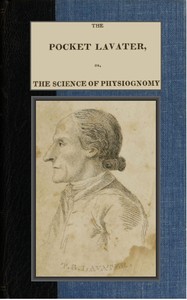
The Pocket Lavater; or, The Science of Physiognomy - To which is added an inquiry into the analogy existing between brute and human physiognomy
Subjects:
Download Formats:
Excerpt
The Project Gutenberg EBook of The Pocket Lavater, by Unknown Author
This eBook is for the use of anyone anywhere at no cost and with
almost no restrictions whatsoever. You may copy it, give it away or
re-use it under the terms of the Project Gutenberg License included
with this eBook or online at www.gutenberg.org/license
Title: The Pocket Lavater
or, The science of physiognomy
Read the Full Text
— End of The Pocket Lavater; or, The Science of Physiognomy - To which is added an inquiry into the analogy existing between brute and human physiognomy —
Book Information
- Title
- The Pocket Lavater; or, The Science of Physiognomy - To which is added an inquiry into the analogy existing between brute and human physiognomy
- Author(s)
- Porta, Giambattista della, Lavater, Johann Caspar
- Language
- English
- Type
- Text
- Release Date
- April 23, 2018
- Word Count
- 13,882 words
- Library of Congress Classification
- BF
- Bookshelves
- Browsing: Philosophy & Ethics, Browsing: Psychiatry/Psychology
- Rights
- Public domain in the USA.
Related Books
Notes on Noses
by Warwick, Eden
English
865h 20m read
The Juvenile Lavater; or, A Familiar Explanation of the Passions of Le Brun - Calculated for the Instruction & Entertainment of Young Persons; Interspersed with Moral and Amusing Tales
by Brewer, George
English
374h 50m read
J. C. Lavater's Sittenbüchlein für das Gesinde
by Lavater, Johann Caspar
German
86h 52m read
The influence of the stars
by Baughan, Rosa
English
791h 24m read
How to Read Human Nature: Its Inner States and Outer Forms
by Atkinson, William Walker
English
490h 27m read

La fantesca
by Porta, Giambattista della
Italian
575h 22m read