*** START OF THE PROJECT GUTENBERG EBOOK 55287 ***
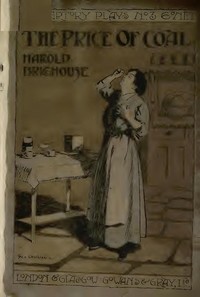
THE PRICE OF COAL
By Harold Brighouse
Gowans & Gray, Ltd., London
1911
FOREWORD: BY THE DIRECTOR OF THE
SCOTTISH REPERTORY THEATRE
“The Price of Coal” came from a
Manchester author; it was in Lancashire
dialect, but was freely translated into
that of Lanarkshire, before its first
production on Monday, November 15th,
1909. The whole week was foggy, dense,
yellow and stinking, but the audience
(whose scantiness, thanks to the fog,
was unregarded by the players),
enthusiastic outside the Theatre, as
they were within, bruited its
excellence, and the many and urgent
requests for its speedy revival were
complied with.
It has been performed by the Repertory
Company at Carlisle, Edinburgh and
Perth, while a number of performances
have been successfully given by
amateurs.
A. W.
Glasgow, March, 1911.
[EXTRACT FROM THE REPERTORY THEATRE
PROGRAMME November 1909]
THE PRICE OF COAL
A play in one act By Harold Brighouse
Mary Brown, Jack Brown, Ellen Brown,
Polly Walker,
Miss Agnes Bartholomew. Mr. R. B.
Drysdale.
Miss Elspeth Dudgeon. Miss Lola Duncan.
The Scene is laid in a Lanarkshire
Colliery Village.
Modern industrialism has evolved its
special types, and the Lanarkshire
collier is small and wiry. He swings a
pickaxe for hours on end crouched in an
impossibly small space in heated
atmosphere, and physique on the grand
scale is unsuited to such conditions. He
takes tremendous risks as part of his
daily routine. His recreations are, to a
fastidious taste, coarse. He works hard
under ground and plays hard above
ground. Constrained attitude is so much
his second nature that he sits in
perfect comfort on his haunches, in the
pictured pose of the mild Hindoo, his
back to a wall, discussing, amongst
expectoration—a long row of him—,
football, dogs, his last spree and his
next, the police reports, women.
Altogether a most unpleasant person,
this undersized, foul-mouthed, sporting
hewer of coal-until you come to know him
better, to discover his simplicity of
soul, his directness, his matter-of-fact
self-sacrifice, the unconscious heroism
of his life: and to lose sight of his
superficial frailties in your admiration
for his finer qualities.
The womenkind of the colliers are marked
by the life of the pits no less than the
men. They are rough, capable housewives,
dressing with more care for durability
than effect, tolerant of their menfolks’
weaknesses, and, above all, stamped with
the pit-side stoicism apt to be mistaken
for callousness. The sudden death of
their breadwinner is an everyday hazard,
accepted without complaint and without
concealment as part of their life. Like
their husbands, they exist from hand to
mouth on the brink of eternity. Thrift,
when any day’s work may be your last,
seems a misplaced virtue. Lean fare
approaches as pay day recedes, and
illness, meagrely provided for by
membership of a “sick” society, is tided
over in the main by the unfailing
generosity of neighbours whose own table
suffers by the charity.
SCENE
The scene represents the living room of
a collier’s cottage in Lanarkshire. The
room has three doors, one to the right
and one to the left, which lead to the
sleeping rooms, and one in the centre
which opens on to the village street. A
fireplace with a cooking stove set in it
is at the right. A holland blind is
drawn down at the window, but it does
not completely shut out the night, which
is now dissolving into a grey, cold
dawn, for the cheap German alarm clock
that ticks loudly on the mantleshelf
marks the hour five-thirty. When the
curtain rises the room is in darkness
save for the glint of bluish-grey light
that shows at the window. Then Mary
Brown enters from the door on the right,
she strikes a match and lights a lamp,
when you see she is a girl of about
twenty; she does not look her best, her
hair has been hurriedly screwed up, her
print blouse, murky with toil, has not
yet been fastened, she wears a draggle-
tailed skirt of sombre colour and list
slippers are on her feet.
A small spirit-lamp is on the hob and a
little tin kettle near by; she lights
the lamp, puts the kettle on it, then
crosses to the door on the left and
knocks.
MARY
Are ye up, Jock?
JOCK
(within)
Aw richt, A’ll be there in a meenit.
Mary takes a plain and fairly clean
apron from a hook by the dresser and
puts it on briskly; she then takes a cup
and saucer from the rack, putting them
on the dresser, from the cupboard of
which she takes a cocoa-tin and puts a
spoonful of cocoa in the cup. Then she
takes bread and meat from the cupboard
and makes a couple of huge sandwiches.
These she puts on a tin plate, and
covering them with another tin plate,
she ties the whole in a large red
handkerchief with the ends looped for
carrying. A tin can with a screw top is
placed near by. Then, from the door at
the left, enters Jock Brown, Mary’s
cousin.
He is dressed in his working or “black”
clothes, which may have been coloured
once but are now blackened with coal
dust. He wears no collar, but a muffler,
which, because it is doffed in the pit,
still preserves something of its
original hue, which was a bright red.
JOCK
A wis hardly expectin’ tae see you this
mornin’, Mary.
MARY
(apparently unmoved, proceeds with her
operations at the stove)
An’ why no’, bless ye. Mebbe ye’d
raither A dragged yer mither oot o’ her
bed an’ her bad wi’ her rheumatics, tae.
JOCK
A could a’ dune fur masel’ for wan
mornin’.
MARY
Ye’d a’ made a bonnie mess o’ the job.
JOCK
Aw, A’m no’ a wean.
MARY
A can jist see ye daein’t, an’ gettin’
doon tae the pit ahint time, tae. We
huvnae quarrell’t, huv we?
JOCK
Naw: no’ that A ken.
MARY
Then whit wey should A no’ get up and
dae fur ye jist the same as A’ve dune
near’s lang’s A can mind?
JOCK
A donno.
MARY
Naw, nor naebody else either.
JOCK
(disconcerted and apologetic)Weel, ye
see, A thocht mebbe that efter whit we
were sayin’ last nicht ye widnae want
tae see me this mornin’.
MARY
Naw, there wis naethin’ in that tae pit
us aff the usual.
JOCK
(with eagerness)Then, wull ye tell me——
MARY
(cutting him short and putting the cocoa
on the table) There’s yer cocoa. Ye’ll
better drink it when it’s hot.
JOCK
(tasting)Aye. It’s hot anough onyway.
MARY
It’s a cauld mornin’ tae be gaun oot.
Ye’ll be nane the waur o’ somethin’ hot
this weather.
JOCK
Aye. A dare say it’s cauld anough, bit
the weather can wait. A’ve got somethin’
else tae talk tae ye aboot besides the
weather.
MARY
Mebbe ye huv, ma boy, but ye’ll huv tae
wait till the richt time comes.
JOCK
Mary, lassie, will A huv tae wait till
the nicht fur ma answer?
MARY
Play fair noo, Jock. Ye gien me a day
frae last nicht tae think aboot it.
JOCK
A ken A did. That’s richt anough. Only
it’s no’ sae easy tae wait as A thocht
it wis when it comes tae daein’t.
MARY
Mebbe no’. But ye’ll jist huv tae pit up
wi’t. It wis you that said wait. A never
mentioned it.
JOCK
Ye shouldnae be sae hard on a chap,
Mary. A’m wantin’ ye that bad. A’m on
needles and peens till A ken whit road
the cat’ll jump. Ye never ken, Mary,
what’ll happen doon a pit. Jist think. A
micht never come up again and ye’d be
sick and sorry if A wis blown tae
kingdom come an’ no’ huv the consolation
o’ kennin’ that ye meant tae huv me.
MARY
It’s nae use, ma boy. Ye’ll no’ frichten
me that wey. A’m no’ pit born like you,
but A’ve stayed aside pits a bit ower
lang fur that. An’ ye ken weel anough
it’s no’ richt tae talk aboot they
things. A tell’t ye A’d gie ye yer
answer the nicht an’ ye’ll huv tae wait
till the nicht fur it. A’m no’ gaun back
on ma word.
JOCK
Bit if ye ken whit ye’re gaun tae say
whit wey wull ye no’ say it noo and pit
me oot o’ misery?
MARY
Aye, an’ huv ye gaun aboot tellin’
everybody that aw ye hud tae dae wis
whistle an’ A rushed intae yer airms.
Naw, ma boy, A’m a single wumman yit and
A’m no promised tae nae man. A’ll tak’
ma ain time tae tell ye whether A’m gaun
tae chinge ma name or no’. (Breaking off
and looking at the clock.) It’s time ye
were flittin’. Ye’ll be late if ye don’t
hurry up.
JOCK
A don’t care if A am.
MARY
Aw, but ye dae. Don’t be a silly. Ye ken
ye’ve never missed bein’ in the first
cage doon since ye startet workin’ an’ A
‘ll no’ hae folk saying ye startet
missin’ it ower me. Hae ye finished yer
cocoa?
JOCK
Aye. Ye’re terrible hard on a chap,
Mary.
MARY
Awa’ wi ye. If ye hud a’ been as keen on
mairryin’ me as ye think ye are, ye wud
mebbe huv plucked up courage tae ask me
shuner.
JOCK
A only waitet till ma mind wis med up
fur sure. A wisnae long o’ askin’ ye
whin it wis.
MARY
Then ye’ll jist hae tae wait till mine
is med up. Whit’s sauce fur the goose is
sauce fur the gander, ye ken.
JOCK
Ye couldnae gie me sae much’s a hint?
Only a lick an’ a promise like?
MARY
Naw, A’m no’ makin’ no promises till A’m
ready. Ye’re only wastin’ yer time, man,
an riskin’ bein’ late tae.
JOCK
Aw, weel, if A huv tae wait, A’ll jist
huv tae. MARY
It’ll be stoppin’ time afore ye know it.
JOCK
(he goes towards the door, lifting his
cap from a peg on the way)
Oh aye. It’s easy talkin’. Ye’re only
keepin’ me in suspense, ye teasin’
buddy. Its mebbe fun to you, but there’s
no’ much fun tae me wi’ you cairryin’ on
like that.
MARY
Ye’ll be late for yer work. That’ll be
the end o’t.
JOCK
Aw richt. (He puts his cap on.) A’m
gaun. Whaur’s ma piece?
MARY
Here ye are.
[She hands him the handkerchief of food
and the can, which he slings over his
shoulder by a short strap.
JOCK
Huv ye tied it up weel?
MARY
Aye. Why?
JOCK
Rats wur busy at it yesterday whin A
cam’ to pit my pick doon an look fur ma
dinner. Bit ye cannae help rats in a pit
an mebbe they’re as hungry as A am.
MARY
Weel, its tied as ticht as A can mak’
it. Noo look sherp or ye’ll be late.
Ye’re forgettin’ yer lamp. Dear kens
whit a fix ye’d be in if A wisnae up tae
look efter ye.
JOCK
It’s wi’ thinkin’ o’ you, lass.
[He takes up his lamp.
MARY
Time anough fur that when yer work’s
dune.
JOCK
(as he opens the door slowly, morn has
broken fully, and a hard grey light
enters the room)
A’ll be hame pretty quick so ye’ll
better be ready.
MARY
A’ll be ready richt anough.
JOCK
A’ richt. Then we’ll leave it at that.
MARY
Aye.
[Jock goes out, closing the door quietly
after him. Mary, left alone, begins to
tidy up and prepare the house for the
use of the day. Soon the door at the
right opens, and Ellen Brown, Jock’s
mother, enters. She is an old woman, but
not so old as she looks; her spare
figure bears all the marks of a life
that is one continuous struggle against
a hard fate. She is dressed plainly in
black, with an apron; her head is
covered with a shawl. Mary, who is at
the window rolling up the broken blind,
starts and turns to her in surprise.
MARY
Why, auntie, ye’re up airly.
ELLEN
Aye. Is the lad awa’ yit?
MARY
He’s jist awa’. Is onythin’ wrang?
ELLEN
Naw, lass, naw. A wid a’ liket to a’
seen him afore he went.
MARY
Will A rin efter im? He’s jist this
meenit awa’. ELLEN
An’ mak’ ‘im late? Naw, we musnae dae
that. It wis only a fancy. A thocht A
micht catch ‘im, but A widnae chance
makin’ ‘im late. He tak’s a pride in
bein’ at the pithead regular for the
first cage gaun doon; he’d be rare an’
mad wi’ me if A brung him back fur
naethin’.
MARY
Why did ye no’ shout on us frae yer
room?
ELLEN
A didnae think o’ that.
MARY
(puzzled by her appearance, decides to
be consoling) Weel, A’m sorry ye left
yer bed fur naethin’, before the room’s
aired tae.
ELLEN
Ach, that’s naethin’, lass.
MARY
Weel, sit doon while A mak’ a fire an
get the breakfast ready. Room’ll soon be
warm.
ELLEN
Aye, lass.
[She moves listlessly to the rocking-
chair, in which she sits passively,
while Mary takes some sticks and paper
from the oven and kneels, making a fire.
MARY
It’s a wee sherp this mornin’ too. (She
looks up to see Ellen furtively dabbing
her eyes with a clean handkerchief .)
Auntie, whit’s up wi’ ye? Wull ye no
tell me whit’s the maitter?
ELLEN
Naethin’, lass, naethin’.
MARY
(as she rises and stands by the chair)
Bit there must be somethin’. Whit wey
did ye get up sae airly? Ye were soon’
anough asleep when A left ye.
ELLEN
Sleepin’? Aye, A wis sleepin’ richt
anough, an’ would to God A hidnae been.
MARY
Whit dae ye mean?
ELLEN
Only an auld wife’s fancy, lass.
MARY
Naw, ye must tell me whit it is.
ELLEN
It wis a dream that made me rise, lass.
MARY
A dream?
ELLEN
Aye. A dream’t A wis gaun in a field an’
the grass wis green, greener than life,
an’ there wis coos in it and sheep-no’
dirty, blackened beasts like whit’s
here, bit whit ye wid fancy they wid be
some place whaur there isnae always
smoke. An’ A walked in the field an’ the
sun wis shinin’ an’ it cam’ dark suddent
an’ A couldnae see the coos nae mair.
There wis thunder an’ it frichtened me
an’ whin A cam’ tae look up again, it
wis rainin’ bluid on ma heid, naethin’
bit bluid, an’ the field ran rid wi’ it.
Bluid everywhaur, naethin’ bit bluid.
MARY
An’ it frichtened ye? Aye, the
nichtmare’s no pleasant fur ony yin. Ye
ett pretty hearty last nicht. Weel,
never mind. It’s a’ past noo. Ye’ll feel
better efter a cup o’ tea. A’ll shune
huv breakfast on the table noo.
ELLEN
A’ve dream’t yon dream afore, an’ the
last time A dream’t it wis the nicht
afore the big fire in the pit whin
Jock’s faither got ‘imself kill’t. A’ve
niver dream’t it since that nicht an’
noo it’s come again an’ ma boy’s gaun
oot tae his work an’ me too late to stop
‘im.
MARY
(moves towards the door)
Mebbe it’s no’ too late.
ELLEN
Come back, lass. Look at the clock. The
first cage ‘ull be gaun doon lang afore
ye could get there and oor Jock’ll be
in’t. He’s aye in the first cage, is oor
Jock. Best timekeeper on the pit.
MARY
Oh, why did ye no’ tell me at first?
He’ll be kill’t; he’ll be kill’t.
ELLEN
It’s nae use worryin’ like that. Jock’s
in God’s hand, lass, same as he is every
day whether A dream or no’. An’ mebbe
there’s naethin’ to worry ower. They do
say that there’s naethin’ in dreams. A
doot it’s gaun against the Almighty tae
tak’ notice o’ a dream. If He hud meaned
it fur a warnin’ He’d likely have sent
it shuner so as A could a’ kept Jock
frae gaun oot. Aye, he’s in God’s
keepin’. We can dae naethin’. Get the
kettle filled.
MARY
Yes, Auntie.
ELLEN
A’ll see tae the table.
MARY
Aw richt.
ELLEN
(as she takes a coarse white cloth from
a drawer, spreads it and proceeds to lay
breakfast.)
Ye’ll hardly mind an accident here will
ye, Mary?
MARY
Naw.
ELLEN
Naw, A thocht no’. (She has now come to
the fireplace, where she sits in an arm-
chair.) It’s mony a year sin’ we hud yin
tae speak o’. A don’t mind o’ hearin’
the alarm bell ringin’ mair than yince,
or mebbe twict since yer uncle wis
kill’t. That wis somethin’ like a do.
There wis mair than twinty kill’t that
time an’ mebbe forty or mair that wis
hurt. A’ve heard folks say there his
been bigger accidents in America, but A
don’t tak’ ower much notice o’ they
newspaper tales masel’. Eh, it micht a’
been yesterday.
MARY
Tell me aboot it, Auntie. Ye’ve never
tell’t me hoo it happen’t.
ELLEN
Eh? Bless the lass, whit’s the use o’
that! Seems to me we’re baith o’ us a
bit cracket the day. We’ve got accident
on the brain.
MARY
They ay ring the bell don’t they,
Auntie, when onythin’ gaes wrang?
ELLEN
No! fur an odd man an’ ‘is laddie nipped
in a roof fall, jist if it’s a big
thing. Look here, lass, if ye cannae
talk o’ naethin’ bit accidents, ye’d
better shut up. (She rises from her
chair.) Whit wi’ ma dream an’ your
worryin’ A don’t know where A am.
MARY
A wis jist askin’. Ye never can ken wi’
a coal-pit whin its gaun tae git nesty
an’ a man cannae ay mind whaur he is
whin he’s doon.
ELLEN
They’re watched shairper gaun doon
nooadays an the men ken better nor tae
take risks theirsel’s, the way they
use’t tae in the auld days.
MARY
Aye, but a man that forgets yinst ‘ll
forget yinst too often.
ELLEN
A’ve tell’t ye tae quit bletherin’.
Folks ‘ud think ye hudnae lived aside
pits mair nor a week tae hear ye talk
daft like that. There’s ay danger and
naebody but a born fool wid say there
wis’nt, but it’ll no’ mend it tae go
thinkin’ aboot it. There’s coal there
an’ it’s got tae be got and that’s the
first an’ last o’t. Hae ye pit tea in
the pot?
MARY
Naw.
ELLEN
Ye’d better dae it then.
[Mary puts tea in the tea-pot from a
canister on the mantelshelf As she does
so, a heavy bell rings clangorously.
MARY
Whit’s that?
ELLEN
(quietly and slowly bending her head as
if to a physical blow)
God’s wull be dune.
MARY
Is it——?
ELLEN
Aye. (Then, as Mary makes for the door.)
Whaur are ye gaun, lass?
MARY
A’m gaun tae the pit tae see whit’s up.
ELLEN
Naw. Ye’re no’. A’ll want ye here.
MARY
Why no’?
ELLEN
There’ll be plenty fills o’ wimmen there
seein’ whit’s up and keepin’ the men
frae their wark, withoot you gaun an’
helpin’ them tae dae it.
MARY
But we——
ELLEN
Look here ma lass, if oor Jock’s hurt,
oor job’s tae get ‘im weel again.
Rushin’ oot tae the pit-heid ‘ll dae ‘im
nae guid. It’s only wimmen that huvnae
got husbands and sons doon in the pit
that gaes staunin’ roon faintin’ and
whit nut an’ makin’ a nuisance o’
theirsel’s. The ithers stays at hame an’
gets things ready.
MARY
We dinnae ken whit tae get ready fur.
ELLEN
We ken anough.
MARY
Jock ‘ll mebbe no’ be hurt.
ELLEN
Then we’ll hae wastet oor wark.
MARY
Whit’ll A dae i
ELLEN
A donno that there’s sae much when aw’s
dune. We’ll mebbe need hot watter.
MARY
Fur——
ELLEN
Hoo dae A ken whit fur? Yon kettleful
‘ll dae an’ oor tea will huv tae wait.
MARY
Bit whit can we dae? Gie me somethin’
tae dae fur mercy’s sake. A’ll go mad if
A don’t dae somethin’. A cannae sit
still and wait, and wait, and wait.
ELLEN
Ye’d best be makin’ his bed.
MARY
Yes, auntie.
ELLEN
Whit are ye greetin’ fur, lass? We ken
naethin’ yit, an’ if we did, greetin’
‘ll no’ mend it. It’ll dae Jock nae
guid, nae maitter hoo he is, to see ye
slobberin’ whin he comes in. (Mary dries
her eyes and begins to clear the table.)
Whit are ye daein’ that fur?
MARY
A don’t know. A thocht——
ELLEN
A body mun eat. Let things be. A tell’t
ye tae gang tae the room and mak’ his
bed.
MARY
Aw richt, auntie.
[Mary goes to the bedroom, closing the
door behind her. Ellen looks to see it
is shut, and moves rapidly and
purposefully to the door to the street.
It is now daylight. The confused murmur
of a distant crowd is heard. She stands
on the threshold and looks out.
Presently she speaks to some one
approaching but not yet visible.
ELLEN
Whit is’t, Polly?
A middle-aged woman in a drab skirt and
blouse with a shawl thrown over her head
appears breathless at the door; it is a
neighbour, Polly Walker.
POLLY
Ropes slipped and the cage fell doon the
shaft.
Is your’s oot at his wark.
ELLEN
First cage doon?
POLLY
Aye.
ELLEN
Mine’s is in’t.
POLLY
We’ll shune ken the warst. They wis
riggin’ tackle whin A come away. They’ll
huv them up in nae time.
ELLEN
A’ll be ready. Whaur’s yours?
POLLY (who has come into the room)
Mine’s aw richt-safe in their beds-
sleepin’ aff last nicht’s drink, thank
the Lord.
ELLEN
They must bring him here, Polly, nae
maitter whit he’s like.
POLLY
Aye. A body likes tae dae fur her ain.
Whaur’s the lass? Awa’ tae the piti.
ELLEN
Makin’ his bed in case its needet.
POLLY
That’s richt. Don’t let her oot.
ELLEN
No’ if A can help it. She wantet tae go,
but A widnae huv it. Ye’ll see things at
a pit-heid efter an accident that’s no
fit fur a young yin. Waste her life fur
her to be there whin they’re brung up.
POLLY
Aye. A’m no’ gaun back. A’ve seen
anough, never nae mair if A can help it.
ELLEN
Come in, wull ye?
POLLY
Aye. A’d best shut the door, tac, an’
keep oot the row or she’ll be wantin’
tae go.
[She closes the door and takes a chair
at the table.
ELLEN
Aye. They cannae sit quiet when they’re
young.
POLLY
That’s a fact. A mind the day when the
pit wis on fire. A wis only a wee lassie
then, bit ma mither had nae mair sense
nor tae let me oot tae the pit—heid tae
see the bodies brung up. A’ll never
forget that sicht. A dream aboot it tae
this day.
ELLEN
Sit doon, Polly. A bit o’ comp’ny comes
handy at a time like this.
POLLY (sitting)
Thenk ye.
ELLEN
Aye. It’s a thing ye cannae forget.
Seems as if it wis only the ither day A
heard the bell ringin’ an’ saw ma man
brung up. He wis that charred A only
kent him by the earrin’s he wore because
his eyes wis weak. They tell’t me efter
that a rabbit had crossed his road on
the wey tae the pit, but he always wis
obstinate, wis ma Joe an’ he widnae tak’
warnin’ and noo the cage has slipped wi’
ma son in her and A’ll hae nae menfolk
noo.
[The door from the bedroom has been
opening slowly, and Mary listens. The
others do not see her.
POLLY
Ye never ken. Mebbe he’ll no’ be kill’t.
ELLEN
A dream’t the same dream last nicht as
when his faither went.
POLLY
In the midst o’ life we are in death.
There’s no’ a truer word nor that.
ELLEN
No’ when ye live aff coal. There’s
wimmen keepin’ hoose in the places the
coal goes that pay fur their coal wi’
brass. We pay a sicht heavier fur it
here. We pay wi’ the lives o’ men.
POLLY
But it’s a comfort tae think he’ll no’
be burnt. A cannae staun’ a corp that’s
burnt.
ELLEN
Aye, better broken than burnt.
POLLY
An’ ye’ll huv money in the funeral
Society.
ELLEN
Oh, aye. A can gie him a decent burial.
POLLY
That’s ay a comfort. Ye don’t seem tae
care sae much some wey, when ye ken he’s
hud a decent burial. He’s bin a guid son
tae ye, tae.
ELLEN
Oh aye, he’s a good lad. He’s mebbe had
his shillin’ on a horse noo and then an’
whiles gone rattin’ on a Sunday mornin’,
but that’s only tae say he’s a man an’
no’ an angel in breeks.
POLLY
It’s mair than A can say about ma lot.
Lazy, drunken, good-for-nothings they
are, faither an’ sons tae. Come tae
mention’t, it’s a funny thing.
Providence works in its ain way. If mine
hadnae been on the spree last nicht,
they’d as like as no huv been in the
cage alang wi your boy.
MARY (comes forward into the room)
A’ll awa’ tae the pit noo, auntie.
ELLEN
Tak’ yer hurry, lass.
MARY
A cannae wait, A must ken.
ELLEN
Sit doon.
MARY
A cannae sit doon an’ listen tae you twa
talkin’ that way. First ye’ve got ‘im
kill’t an’ then ye bury ‘im, an’ next
ye’ll be argying whit’s tae go on his
grave-stane an’ aw the time ye don’t sae
much as ken if he’s hurt.
POLLY
Sit still, lassie. Ye’d better wait.
MARY.
Oh, A don’t know whit ye’re made o’-you
twa. Ye sit there quiet an’ calm as if
there wis naethin’ the maitter.
ELLEN
We’re auld enough tae ken we cannae dae
nae guid. Hae ye made the bed?
Aye,
ELLEN
Weel, there’s a bottle o’ brandy in the
room-press. We micht need it.
Aye. It’s harder when ye’re young tae
haud yersel’ in. It disnae come natural
tae her, no’ bein’ born tae pits like
us. Her mither mairret a weaver chap in
Dundee an’ brought her up tae mills. It
tak’s mair than a year or twa tae git
intae the wey o’ pits when ye’re born
strange tae them.
POLLY
Aye. We’re used tae the thocht o’ losin’
oor men suddent.
ELLEN
But she’ll no gae tae the pit-heid if A
can stop her. We’ll hae tae keep her
mind aff it. Can ye mind o’ onything
else we micht want?
POLLY
Naw naethin’.
ELLEN
We micht need linen fur tyin’ up
MARY
A’ll get it.
[Mary goes to the bedroom again.
POLLY
She’s gettin’ restless.
ELLEN
Aye.
POLLY
Naw, ye’ll no’. The doctors were there
afore A come away, and ambulance men tae
wi’ aw they’ll need. But we’ll huv tae
keep her here whether she likes it or
no’.
ELLEN
Aye. (She looks towards the street-door.
Polly catches her meaning.) Wull ye? A
don’t move sae easy as A used.
POLLY
The door?
ELLEN
Aye.
POLLY
Aye. That’s richt. (She goes to the
street-door.) Better let her think we’re
ill usin’ her than let her oot tae see
them sichts.
[She turns the key and gives it to Ellen
as she resumes her seat.
ELLEN
Thenk ye, Polly. (She pockets the key)
Help me tae mak’ talk noo and keep her
mind aff it.
MARY (enters with a bottle)
There’s the brandy.
ELLEN
That’s richt. (A slight pause; the older
women try to make conversation. First
Polly bobs forward as if about to speak,
but leans back without saying anything;
Ellen does the same. Mary moves to the
door as Ellen, glancing round for a
subject, lets her eye fall on the brandy
bottle and fires off her remark in time
to arrest Mary’s progress towards the
door.) A thocht there wis mair nor that
in the bottle, aw the same.
POLLY
It’s a handy thing tae huv aboot the
hoose.
ELLEN
Aye. Rare stuff fur the jaw-ache.
POLLY
It is that. Goes weel wi’ a cup o’ tea,
tae, on a cauld mornin’.
MARY
Is there onything else?
ELLEN
Eh? Naw, A don’t think there is, Mary.
Let me think. Naw. That’s aw A can mind.
MARY
A’ll awa’, thin.
ELLEN
Naw, ye’ll no’.
MARY
Why no’?
ELLEN
Because ye’ll no’. Ye’ll stay whaur ye
are.
MARY
Let me go. A must go. A cannae stay
here.
POLLY
Dae whit yer auntie tells ye, lassie.
Young folks is that smert nooadays,
there’s nae use tellin’ them onythin’.
MARY
Oh, ye don’t understand. A must go. A
must. (She goes to the door; tries to
open it.) Door’s locked. This door’s
locked. Whaur’s the key? Whit huv ye
dune wi’ the key?
ELLEN
Look here, lass, A tell’t ye ye widnae
go, an’ A’ve made sure o’t. Come noo.
Come an’ sit quiet, ravin’ aboot as if
ye were mad. Ye’ll huv the haunel aff
the door.
MARY
Let me go tae him.
ELLEN
No.
MARY
A must go. A must. A love him. A love
him.
ELLEN
D’ye think A don’t love him, lassie? Aye
and a sicht better than a bit wean like
you could love him. A’m his mither.
MARY
Oh, huv mercy. Ye don’t know. A sent ‘im
oot. He wisnae for gaun till A’d said
the word. A widnae tell ‘im. A made him
wait till the nicht. A sent him tae his
death.
ELLEN
The lassie’s ravin’.
MARY
Let me go.
ELLEN
No.
MARY
Ye won’t?
POLLY
Haud yer wheish, lass. It’s fur yer ain
guid.
MARY
Why huv ye locked thon door? Ye’re
cheatin’ me. Ye’re cruel. A can dae nae
guid here. Let me go tae ‘im. A must go.
A wull. [The two women have now faced
each other; there is a violent knocking
at the door.
MARY
Whit’s that? Oh, ma God, whit’s that?
[Ellen takes the key from her pocket
moves slowly to the door, unlocks it,
and throws it open. Jock stands on the
threshold, very pale, with his coat
buttoned at the bottom, and only his
right arm thrust into the sleeve.
ELLEN
Ma boy!
[She tries to embrace him.
JOCK
Steady, mither. Watch ma airm.
ELLEN
Is it broken?
JOCK
Aye, the doctor’ll be roon’ tae set it
shune. They’ve anough tae dae first,
though. There’s plenty worse nor me.
ELLEN
Thank God!
JOCK
Naw, mither. It’s aw by. There’s
naethin’ tae greet fur, and no’ sae much
in a broken airm tae thank God fur,
neither.
MARY
Oh, Jock!
JOCK
Is that aw ye’ve got tae say tae me? The
shift’s ower, ma lass. Mebbe it’s ower
afore it startet, but that disnae
maitter. A’ve come fur ma answer, Mary.
MARY
Ye’re an old fraud. Ye kent aw the time.
Oh, Jock, Jock, A thocht ye wis kill’t.
JOCK
Ye thocht wrang. A’m no the deein’ kin’.
So ye’ll huv me?
MARY
Aye.
JOCK
A’ll awa roon’ an’ see the meenister
aboot pittin’ up the banns when ma
airm’s set. A’ll be huvin’ some time on
ma hauns. A think gettin’ mairrit ‘ll
fill in the time beautiful.
CURTAIN
Glasgow: Printed at the University Press
by Robert MacLehose and Co. Ltd. The
Repertory Theatre was founded between
January and April, 1909, as a direct
effort of Scotsmen in general, and
Glasgow men in particular, to throw off
London’s despotic rule in things
dramatic.
In its first season it produced nine
plays (three altogether new), including
John Galsworthy’s play, “Strife,” which
had just been produced in London.
The second season commenced on September
5th. In it thirteen plays were produced,
including the first production in
English of a play by the Russian
dramatist, Anton Tchekhov, “The
Seagull,” and six entirely new plays.
In the Spring season, 1910, “Justice,”
produced simultaneously in London,
created an unique record in the history
of the British stage, while astonishing
success attended the production of John
Masefield’s masterpiece, “The Tragedy of
Nan.” In all, seven entirely new plays
were produced.
The Summer season of lighter fare added
six more plays to the record, including
two new ones. In the fifth season ten
plays were produced, four entirely new.
In the sixth season, Spring, 1911,
fifteen plays were produced, seven
entirely new. In all seventy-three plays
have been produced, of which about
fifty-five would never have been seen
but for the energies of this Theatre.
End of the Project Gutenberg EBook of The Price of Coal, by Harold Brighouse
*** END OF THE PROJECT GUTENBERG EBOOK 55287 ***
The Price of Coal - A Play
Download Formats:
Excerpt
FOREWORD: BY THE DIRECTOR OF THE
SCOTTISH REPERTORY THEATRE
“The Price of Coal” came from a
Manchester author; it was in Lancashire
dialect, but was freely translated into
that of Lanarkshire, before its first
production on Monday, November 15th,
1909. The whole week was foggy, dense,
yellow and stinking, but the audience
(whose scantiness, thanks to the fog,
was unregarded by the players),...
Read the Full Text
— End of The Price of Coal - A Play —
Book Information
- Title
- The Price of Coal - A Play
- Author(s)
- Brighouse, Harold
- Language
- English
- Type
- Text
- Release Date
- August 7, 2017
- Word Count
- 5,744 words
- Library of Congress Classification
- PR
- Bookshelves
- Browsing: Literature, Browsing: Fiction
- Rights
- Public domain in the USA.
Related Books
The painted swan
by Bibesco, Elizabeth
English
284h 23m read
In the name of Time
by Field, Michael
English
287h 20m read
The Chinese lantern
by Housman, Laurence
English
368h 11m read
The snow man
by Housman, Laurence
English
150h 12m read
Tannhäuser
by Crowley, Aleister
English
377h 42m read
Bird in hand
by Housman, Laurence
English
162h 30m read