*** START OF THE PROJECT GUTENBERG EBOOK 75219 ***
Transcriber’s Note
Italic text displayed as: _italic_
COPYRIGHT, 1924, BY AGNES REPPLIER
ALL RIGHTS RESERVED
The Riverside Press
CAMBRIDGE · MASSACHUSETTS
PRINTED IN THE U.S.A.
THE PROMISE OF THE BELL
Christmas in Philadelphia
By
Agnes Repplier
With Illustrations by
John Wolcott Adams
[Illustration: Bell]
BOSTON AND NEW YORK
HOUGHTON MIFFLIN COMPANY
The Riverside Press Cambridge
1924
[Illustration:
JWA
THE OLD TOWER OF INDEPENDENCE HALL WHERE RANG THE LIBERTY BELL]
THE
PROMISE OF THE BELL
Christmas in Philadelphia
When from the wooden steeple of the Philadelphia State House (the
Nation’s birthplace, and the most sacred spot on American soil) the
Liberty Bell rang out its message of freedom “throughout the land,” it
did more than proclaim the Declaration of Independence, and it did more
than summon the colonists to defend that independence with their lives.
It promised them in a beautiful and borrowed phrase the reward of their
valour. It affirmed their inalienable right to “life, liberty, and the
pursuit of happiness”; thus linking with bare existence two things
which give it worth, thus striving to ennoble and embellish the length
of years which lie between man’s cradle and his grave.
Never was phrase more profoundly English or more profoundly Greek in
its rational conception of values. It means a vast deal more than the
privilege of casting a ballot, which privilege has been always praised
and glorified beyond its deserts. “The liberty to discover and pursue
a natural happiness,” says Santayana, “the liberty to grow wise, and
live in friendship with the gods and with one another, was the liberty
vindicated by the martyrdom of Thermopylæ, and by the victory of
Salamis.” It is also the liberty which England has always prized and
cherished, and which has promoted the thoroughly English qualities of
“solidity and sense, independence of judgment, and idiosyncrasy of
temperament.” To the colonists it opened a fair vista, a widening of
their somewhat restricted horizon, a very definite and shining goal,
well worth their resolute endeavour.
When on the 23d of October, 1781, three hours before sunrise, a
watchman called through the quiet streets of Philadelphia, “Past three
o’clock, and Lord Cornwallis is taken,” the city awoke to a refreshing
sense of safety and exhilaration. The war was not over; but victory was
assured, and, with it, life and liberty. There remained the pursuit
of happiness, and it was undertaken in good faith, and without undue
delay. A sober and sedate community, kept in order by Quaker dominance,
Philadelphians had always shown a singular capacity for enjoying
themselves when they had the chance. They had danced twelve hours at
the Mischianza,—a notable achievement. They had promoted horse-racing,
condoned bull-baiting, and had been “decently drunk” from time to time
at punch parties on the river. Now, deeming pleasure to be one approach
to happiness, they opened the old Southwark theatre, which had led a
life of sore vicissitudes, rechristened it cautiously the Academy of
Polite Science, and gave a performance of Beaumarchais’s “Eugénie,” in
honour of Washington, who graced the occasion with his presence. He
was escorted to his box by attendants bearing wax candles in silver
candlesticks, a deferential courtesy which made him distinctly and
desirably visible to the audience in the dimly lit theatre.
[Illustration: Soldier]
Nothing in the way of entertainment came amiss to people whose hearts
were at ease, and who were unspoiled by wealth or poverty. They went to
Washington’s rigidly formal receptions. They danced as gaily, if not as
long, at the Assembly balls, and at the less august tradesmen’s balls,
as they had danced at the Mischianza and at the Fête du Dauphin. They
dined well with such hosts as Robert Morris and William Bingham. They
opened hospitable doors to strangers, who sometimes thought them dull;
“the men grave, the women serious,” wrote Brissot de Warville in 1788.
They feasted on Christmas Day, and they built bonfires on the Fourth of
July. They rode to hounds. They began the long career of parades and
processions which have always been dear to the city’s heart, and which
the famous New Year Mummers have by now carried to the wonder point of
gaiety, brilliancy, and burlesque.
Eating and drinking were the fundamentals of enjoyment in the Quaker
town, as they have been in all cities and in all ages of the world. But
it was eating and drinking relished “as the sane and exhilarating basis
of everything else”; and its most precious asset was companionship.
When the Chevalier de Luzerne drank twelve cups of tea during the
course of a winter afternoon call upon Mrs. Robert Morris, it was not
because he doted on the beverage. No Frenchman has ever shared Dr.
Johnson’s passion for tea. It was for love of the warm brightly lit
rooms (warm rooms were no everyday indulgence in the era of open fires
and Franklin stoves), and for love of his agreeable hostess, and of the
animated and purposeful conversation. When John Adams “drank Madeira
at a great rate” at the house of Chief Justice Chew, “and found no
inconvenience in it,” it was not because he was a tippler; but because
the generous wine quieted his anxious thoughts, and stimulated him to
match mind with mind in the sympathetic society of his friends.
Indeed, the drinking of Madeira was in the nature of a ceremonial rite.
Even in the days of Penn no serious business was enacted, no compact
sealed, no social gathering complete without this glass of wine.
It signified good-fellowship and good-will; and when Penn returned
to England for the last time, he left his little store of wine in
the cellar of the Letitia House “for the use and entertainment of
strangers,” which was a gracious thing to do.
According to Dr. Weir Mitchell, Philadelphia was famous for its
Madeira, which, being a temperamental wine, throve best in that serene
atmosphere, and in the careful hands of Philadelphians. It was kept by
preference in demijohns, and lived in moderate darkness under the roof,
where it “accumulated virtues like a hermit.” For seventy years—the
allotted years of man—it could be trusted to acquire merit. After that
period, it began—like man—to deteriorate. When its owner was compelled
by circumstance to house it in the cellar, it was suffered to rest and
revive for a day or two in a warm room on its way to the dining-table;
and the bottles were carried with infinite tenderness lest the wine be
bruised in the transit. A crust of bread was placed by every glass to
“clean the palate” before drinking. Elizabeth Robins Pennell tells us
that, in her grandfather’s old-fashioned household, Madeira was the
wine of ceremony, dedicated to the rites of hospitality, sacred to the
stranger, to whom it was offered like the bread and salt of the Arab,
and with whom it established (if the stranger knew anything about wine)
a bond of sympathy and understanding.
When in the winter of 1799 the directors of the Mutual or “Green Tree”
Assurance Company were holding their annual dinner, word was brought
them of Washington’s death. They charged their glasses, rose to their
feet, and gravely drank to his memory. In the century and a quarter
which have intervened since then, the rite has been yearly repeated.
Even to-day, though the toast may no longer be drunk, the diners rise,
the words are spoken, and the dead leader is honoured by the living.
[Illustration: People eating at a table]
How cordial, how dignified, how intelligent was this hospitality
practised by men who were pursuing happiness along tranquil and
rational lines! How immaculately free from the grossness of Georgian
drunkenness, and from the grossness of Victorian gluttony! It is true
that boned turkey and terrapin were making their way to tables where
wild ducks and venison had always been plentiful, and where dairy
products, made perfect by practice, were admittedly the finest in the
land. But it was companionship and conversation, “the liberty to grow
wise and live in friendship with one another,” which citizens prized,
and which strangers recognized and remembered. Philadelphia, said the
poet Moore, was the only American city in which he felt tempted to
linger. It was the silver talk, alternating with golden silence, which
made the nights speed by when friend met friend, and the wreckage of
years was forgotten.
“_And the men that were boys when I was a boy
Shall sit and drink with me._”
The Wistar parties were born naturally into a world where social
intercourse was pleasant and esteemed. First a few friends dropped
casually in upon Dr. Caspar Wistar, and sat by his fire on winter
nights. Then he asked a few more. By 1811 the custom was an established
one, and every Saturday night Dr. Wistar entertained his guests,
among them any foreigners of distinction who chanced to be visiting
Philadelphia. His house at Fourth and Prune Streets was spacious; the
supper he provided was simple and sufficient. In 1818 he died, and
his friends wisely resolved to perpetuate his name by perpetuating
his hospitality. A hundred years is a respectable age for any social
observance to reach in the United States; but Philadelphians reckon
such things by centuries. Their tenacity in clinging to old customs,
and maintaining them unchanged, is a valiant and poignant protest
against the ills done to their town by modernity.
For more than any other American city, Philadelphia has suffered the
loss of her comeliness, a comeliness that was very dear to those
who first heard the promise of the Bell. “After our cares for the
necessities of life are over,” said the wise Franklin, “we shall
come to think of its embellishments.” In the pursuit of a rational
happiness, Philadelphians devoted time, thought, and money to the
embellishment of their daily lives. They had an unerring taste in
architecture and decoration. Their portraits were painted by good
artists, Peale and Stuart and Sully. Trim gardens lent brilliancy of
colour to their handsome, sober homes. They made of “Faire Mount” hill
a thing of beauty, a little spot of classic grace and charm, which
artists loved, and politicians ruthlessly destroyed—perhaps because
it was the only thing in the nature of an eminence to break the level
surface on which Penn laid out his checkerboard town.
To the casual visitor of to-day, Philadelphia seems an ugly and shabby
city, set in the fields of Paradise. Surroundings of exceptional
loveliness have lured the town-dweller from his narrow streets, from
soot and grime and perpetual racket, to pursue happiness in the clean
and composed life of the country. And as more and more citizens seek
every year this method of escape, the abandoned city grows more and
more downcast and forlorn. It is to be forever regretted that its
oldest streets, lined with houses of unsurpassable dignity, should have
degenerated into filthy slums, where an alien population violates every
tradition of reticence and propriety. Christ Church, Gloria Dei, and
Saint Peter’s still stand inviolate, keeping their dirty neighbours
at arm’s length with green churchyards and cherished slips of lawn.
Indeed, churchyards, which were once in disfavour, have come to be
highly commended. They interpose their undesecrated neatness between
many an ancient place of worship and its elbowing associates.
To the visitor who is not casual, to a few careful observers like
Mrs. Pennell and Christopher Morley, and to those Philadelphians who
love her pavements better than turf, and her brick walls better than
trees, Penn’s city has a charm which enterprise and immigrant are
equally powerless to destroy. It is a beauty faded with years, and
dimmed by neglect, and it lies hidden away in quiet nooks and corners;
but none the less is it apparent to the eye of the artist and the
antiquarian. The Bell, the joyous, old Liberty Bell, is, indeed, housed
with appropriate splendour. It has been carried over the country in
a series of triumphant processions, and many thousands of Americans
have greeted it with reverence. But the deepening fissure in its side
now calls imperatively for rest; and Independence Hall—a remarkably
agreeable example of colonial architecture—is the Mecca of patriotic
pilgrims. All the year round they come to look upon the room where the
Declaration of Independence was signed, and upon the Bell which rang
its message to the land.
[Illustration: Fancy old-fashioned party]
To-day that message rings the knell of the past, and the deathless
promise of the future:
“_Tho’ much is taken, much abides._”
Life, though it is beset by greater perils; liberty, though it is
restricted by an excess of legislation; and the pursuit of happiness,
though it is turned into new, and possibly nobler, channels. The old
society “in which men looked up without envy or malice, and even found
life richer from the thought that there were degrees of excellency and
honour,” has been replaced by a society in which perpetual change has
bred dissatisfaction and insecurity. But more clearly than before the
note of a real Democracy, of a sense of comradeship, of a natural,
cheerful, irresponsible interest in one another, has been struck
in what was once the City of Brotherly Love. It gives to Christmas
something which earlier Christmases never knew; a coming-together of
people whose lives are, by force of circumstance, apart, a closing-in
of circles which are commonly and necessarily remote.
For a week before the feast, the great pioneer department store of
America sets aside a half-hour in the morning and a half-hour at
dusk for community singing of Christmas hymns and carols. The rush
of business is suspended, the giant organ peals forth the familiar
strains, and men, women, and children, crowded into every inch of
available space, sing with all their might, “God Rest Ye Merry,
Gentlemen,” “Come, All Ye Faithful,” and “While Shepherds Watch’d Their
Flocks by Night.” Nobody claims the sounds they make are beautiful; but
nobody denies they are inspiriting.
“_If unmelodious was the song,
It was a hearty note, and strong._”
People who surge around counters to do their Christmas shopping are
indifferent, not to say inimical, to one another; but people who stand
shoulder to shoulder singing the same words are impelled by the force
of crowd psychology to good feeling and mutual understanding.
Charity is an old, old virtue, and Christmas has always been its
sacred season; but it is not charity which now makes the householder
put Christmas candles in his windows, to give the passer-by a sense
of recognition and intimacy. It is not charity which rears the great
municipal Christmas Tree for all the town to see, or provides the great
municipal concert on Christmas Eve for all the town to hear—and join in
if it pleases. It is not charity which lights the “Community Christmas
Trees” on country roads, and leaves them shining softly in the darkness
as a reminder of good-will. It is not charity which sends little groups
of men and women, accompanied by a sober deaconess to sing carols in
the few quiet streets which Philadelphia has preserved unspoiled. These
singers ask for no recompense. They are forging a link in the bond
of healthy human emotions. They are adding their share to the little
intimacies of the world.
“Life, liberty, and the pursuit of happiness.” “Inalienable rights” the
Signers termed them, which yet have never been without assailants. What
strange vicissitudes the Bell has witnessed, and what strange meanings
have been read into its message! But its promise still holds good. If
we never grow wise as the Greeks grew wise, if we never lay hold of
the “natural happiness” which is the birthright of Englishmen, we may
yet surpass Greece and England in the grace of friendship. It will
be something different from friendship with our friends; it will be
friendship with our neighbours. It will be—I hope—disunited from duty,
and composed of simple, durable materials,—tolerance, good-nature, and
a sweet reasonableness of approach. It will read a generous meaning
into qualities which are common to all of us, displeasing to most of
us, and intelligible only to the wide-eyed few who interpret the heart
of humanity.
*** END OF THE PROJECT GUTENBERG EBOOK 75219 ***
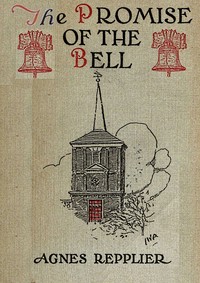
The promise of the bell
Download Formats:
Excerpt
Transcriber’s Note
Italic text displayed as: _italic_
The Riverside Press
CAMBRIDGE · MASSACHUSETTS
PRINTED IN THE U.S.A.
THE PROMISE OF THE BELL
Christmas in Philadelphia
BOSTON AND NEW YORK
HOUGHTON MIFFLIN COMPANY
The Riverside Press Cambridge
1924
THE OLD TOWER OF INDEPENDENCE HALL WHERE RANG THE LIBERTY BELL]
When from the wooden steeple of the Philadelphia State House (the
Nation’s birthplace, and the most sacred spot on American soil) the
Liberty Bell...
Read the Full Text
— End of The promise of the bell —
Book Information
- Title
- The promise of the bell
- Author(s)
- Repplier, Agnes
- Language
- English
- Type
- Text
- Release Date
- January 26, 2025
- Word Count
- 2,719 words
- Library of Congress Classification
- F106
- Bookshelves
- Browsing: Culture/Civilization/Society, Browsing: History - American
- Rights
- Public domain in the USA.
Related Books
Books and men
by Repplier, Agnes
English
718h 50m read
Essays in miniature
by Repplier, Agnes
English
654h 6m read

Compromises
by Repplier, Agnes
English
842h 43m read
Points of friction
by Repplier, Agnes
English
692h 11m read
Varia
by Repplier, Agnes
English
735h 26m read
Under dispute
by Repplier, Agnes
English
880h 17m read