*** START OF THE PROJECT GUTENBERG EBOOK 73746 ***
[Illustration]
THE
PROUD GIRL HUMBLED,
OR THE
TWO SCHOOL-MATES;
FOR
LITTLE BOYS AND LITTLE GIRLS.
BY
MRS. HUGHS,
AUTHOR OF “FRANK WORTHY,” “MAY MORNING,” ETC. ETC.
PHILADELPHIA:
LINDSAY AND BLAKISTON.
1849.
Entered, according to the Act of Congress, in the year 1849, by
LINDSAY & BLAKISTON,
in the Clerk’s Office of the District Court of the United States, for
the Eastern District of Pennsylvania.
STEREOTYPED BY J. FAGAN.
PRINTED BY C. SHERMAN.
PREFACE.
_Dear Readers_:
This little story has been written, to show you how often we are the
cause of our own unhappiness by selfish conduct. To be happy, we should
act kindly towards all who are worthy, (knowing good conduct more
frequently commands respect than riches,) and not permit ourselves to
feel envious of those who excel us in any way; but should rather strive
to imitate their good actions, that we may thus, by correcting our
faults, gain the love of those around us; ever bearing in mind, that
“to be happy, we must be good.”
THE PROUD GIRL HUMBLED.
“I suppose you will be at Miss Rosalba Pearson’s party to-morrow
night,” said Isabella Ingersol to Matilda Hamilton, as they sat on
the first resting-place of the steps leading up to the reservoir at
Fairmount.
“No, I shall not be there,” returned Matilda in a contemptuous tone;
“Rosalba Pearson is no acquaintance of mine.”
“I thought you went to the same school together.”
“So we do; but that is no reason that we should be acquainted. I never
spoke to her in my life, except in such a manner as one is obliged,
sometimes, to speak to a girl that is in the same class.”
“She seems, in general, to be a great favourite in the school,” said
Isabella; “I have often heard her spoken of with much affection by many
of the girls.”
“Perhaps so,” replied her companion; “but however good and sweet she
may be, she is certainly not a proper acquaintance for me.”
“Why not? what is there amiss about her? I never heard any one say
anything against her. On the contrary, she is universally loved and
admired.”
“Ma is very particular about the acquaintances I form at school; for
she says, it would be a very awkward thing to have to shake them off as
I grow up.”
“But if you find them amiable and pleasant acquaintances, I cannot see
why you need shake them off. For my part, I should be delighted to
think that the friendships I form while a girl would last me through
life.”
“That would be pleasant enough, provided they were suitable. But how
would you feel if in a public assembly you were accosted familiarly by
the daughter of a storekeeper?”
“If she were one that I admired and esteemed, I should not care what
her father was,” replied Isabella with energy.
“So you think at present, because you find it very pleasant to go
to Rosalba’s party; but wait a year or two, and see if you do not
acknowledge that you are sorry your mother allowed you to form an
acquaintance with girls who did not belong to the first circles.”
“I have heard Papa say, he considered Mr. Pearson equal to any man in
Philadelphia, for integrity, benevolence, and information.”
“That may be very true; but still he never can belong to the first
circles, you know.”
“Is there any thing that ought to be placed higher than virtue and
knowledge?” asked Isabella with great simplicity. “I have always been
taught to think that these were the criterion by which we ought to
judge our friends.”
“We may respect a person or otherwise, in proportion as he possesses
these qualities; but that is no reason that we should admit him as an
intimate friend. People of an inferior class, Mamma says, are so much
disposed to take advantage of any little kindness that is shown them,
that it is difficult to keep them at a proper distance.”
“Has Rosalba Pearson ever shown any disposition to obtrude herself upon
you?”
“No, not at all. I must do her the justice to say, that she has always
behaved as if she knew her place.”
“Or that she had no wish to force herself into the first circles
unsolicited;” said Isabella dryly. A slight flush passed over her
companion’s cheek; for she had too much sense not to understand what
Isabella meant.
“Both Ma and Pa have always been very particular in cautioning me
against allowing myself to be drawn into low company,” said she, as if
wishing to offer an excuse for what she could not vindicate.
“My parents have been equally particular,” returned her companion. “But
perhaps your parents and mine do not agree as to what is low company.
Some people judge of individuals according to their standing in the
world; others by their manners and information, and consider them low
or high in proportion to their excellence in these respects. But it is
a subject on which it is folly for us to pretend to dispute. All that I
know” she continued playfully, “is, that unless we sink a little lower
by going down these steps pretty quickly, we shall be in danger of
having to walk, instead of riding, home; for I see your Mamma and my
Aunt Harriet going towards the carriage.”
So saying, Isabella, evidently desirous of putting a stop to a
conversation in which she saw plainly they could not agree, began to
run down the steps at a rapid rate.
“Oh, do stop, Isabella; don’t run so fast, I beg of you! It’s so vulgar
to run!” exclaimed Matilda, following as rapidly as her dignity would
permit.
“If I were in Chestnut street, it might be so,” replied Isabella,
stopping for a moment at one of the landings; “but here in the country,
I may surely indulge myself; and I do, in my heart, like a good run;”
and away she flew again, nor stopped an instant till she had reached
the carriage, where, with her sweet face glowing and her bosom heaving
with the exercise she had taken, she waited for the arrival of her more
dignified companion.
“It’s a pity but you could keep that colour captive, Isabella until
to-morrow evening,” said her Aunt as she looked with pleasure on the
bright face of her niece. “You would need little else to prepare you
for the party.”
“What party is she going to?” asked Mrs. Hamilton, rather surprised
that there was anything of the kind going on, without her daughter
receiving an invitation.
“Rosalba Pearson’s,” replied the lady interrogated.
“Oh!” returned Mrs. Hamilton, in a tone that said as plainly as words
could have spoken it, “she is welcome to all such parties.”
“Did you ever spend a more delightful evening than we had at
Rosalba’s?” asked the occupant of the desk immediately behind
Matilda’s, to the companion who shared it with her, the morning but one
after the conversation we have recorded.
“No, never. Everything went off so pleasantly! I never saw a party
better conducted. And yet it was very large.”
“No doubt,” thought Matilda, as she commented in her own mind upon
what she heard; “for amongst the set that was likely to be there, a
party is too great an event, for them not to flock to it.”
“Didn’t Charles Lisle and Rosalba dance the polka beautifully
together?” resumed the first speaker.
“Charles Lisle!” thought Matilda, “is it possible he could condescend
to go there! But I suppose Rosalba’s brother goes to the same school.
Besides, it is not of so much consequence for a boy to form such
acquaintances. Men can associate with whom they please, without
compromising their dignity, Ma says.”
Again her ears were arrested, for the one who had been first addressed,
said in reply; “I don’t think Henrietta Lisle danced so well as Rosalba
did, though she certainly had a splendid partner. Did you ever see a
handsomer boy than Edd Wharton? And didn’t his sister look lovely too?”
Matilda was thunder-struck! Henrietta Lisle at a party given by
Rosalba Pearson! a storekeeper’s daughter! And Edd Wharton, too, her
paragon of all that was genteel and elegant, both as regarded person,
fortune, and family, and his beautiful sister, to be there!
She was sur-prised and shocked beyond measure. “But Ma says, people
have latterly got some very strange notions into their heads about
equality,” thought she; and at this moment, to her no small relief, she
heard her class called up; for all that had been said of this party
was gall and bitterness to her.
As the season was nearly over, all who wished to see their friends
were anxious to do so before the weather became too warm for such
amusements. Of this number was Isabella Ingersol; and Matilda, of
course, received a card of invitation. Though delighted at the thought
of the visit, her pleasure was somewhat damped, when she recollected
that Rosalba Pearson must of course be one of the party. It is true
she had no reason to fear that Rosalba would in any way force herself
upon her notice; but still there was a something about this girl that
she half feared, half envied. That this was so, she certainly would
not have acknowledged, though she frequently found herself arguing
against it, as if it was a fact that she could not wholy deny. That she
should ever for a moment look upon Rosalba as a rival, was altogether
unaccountable. It was true they were school-mates, and might be said to
be of the same age, for they were both in their thirteenth year; but
then Rosalba was much smaller, and much more childish looking. And as
to beauty, there could not be any comparison, for she had never heard
that young lady’s warmest admirers pretend to say she was handsome,
though all declared she had a remarkably sweet countenance; whilst on
the other hand it required no great stretch of vanity, in her, to say
she knew herself to be so; for the fact had been acknowledged by those
with whom she was well assured she was not a favourite. Neither could
Rosalba cope with her in respect to acquirements; for every teacher she
had declared her to be his best scholar.
Why then should she feel anything like rivalry towards this young girl,
whose unassuming manners she could not herself refuse to acknowledge?
Mr. Pearson was not only a storekeeper, but had never testified any
desire to step beyond his calling, and had often been heard to say,
that he was determined to give his children the best education he
could, as that would be the chief thing they would have to depend
upon, and as it was a fortune that could not be taken away from them,
he considered it the best investment for his money. How different,
then, was a girl so situated from herself, the only child of one of
the richest men in the city, whose wealth had descended to him by
inheritance, and who of course belonged to one of the oldest families
in the State!
Still, after all this arguing, Matilda was conscious that there
was something about Rosalba Pearson of which she was afraid; and
consequently, on entering her friend Isabella’s ballroom, felt extreme
mortification, when the first object that met her view was Edd Wharton
promenading, with Henrietta Lisle holding by one arm and Rosalba
Pearson the other. It was to no purpose that she was received by
Isabella and her mother with the utmost cordiality and kindness, the
former not leaving her side till she saw her engaged with a number
of her particular friends: the cankerworm of jealousy had found its
way into the unhappy girl’s heart, and poisoned every better feeling.
In vain she compared her own splendid dress, and the costly jewelry
with which she was adorned, with the simple but conspicuously graceful
attire of her unconscious rival, who, in all the innocent simplicity of
her heart, sent her merry laugh to the ears of the writhing Matilda.
At length, the musicians took their places, and the dancing commenced.
Charles Lisle had already engaged her for the first set, and at any
other time Matilda would have been highly satisfied with her partner;
but in the same quadrille, opposite to her, stood Rosalba by the
side of Edd Wharton, who talked and laughed with her with the utmost
cordiality. This was sufficient to destroy all Matilda’s enjoyment, and
she moved through the dance with even less than her usual animation,
though she was always careful to avoid any appearance of enjoying
herself, as being altogether unfashionable and vulgar. Rosalba, on the
contrary, danced as if she did so for the pleasure of the thing; and
though her movements were at all times easy and graceful, she evidently
thought of the amusement alone, and allowed herself to be happy without
considering how she looked whilst she was so.
A succession of partners, such as Matilda could not find the slightest
fault with, engaged her for each succeeding dance, so that she had not
the least cause to complain of being neglected; but the only one that
she had set her heart upon dancing with, never came to ask her. Edmund
Wharton not only belonged to what Matilda termed the first circles, but
he was the oldest and by much the handsomest boy in the room. She knew
also that his talents were far beyond the ordinary standard, and that
he was remarkably intelligent and manly for his age. On these accounts
she deemed herself the most fitting companion to whom he could have
attached himself for the evening. But instead of such a selection,
he had only noticed her when they had met in the first dance, with a
familiar “How d’ye do, Tilly?” without evincing the least disposition
to come near her afterwards, whilst he frequently joined the various
groups of which Rosalba Pearson formed a part.
At length, the musicians retired for a time, and refreshments were
brought in, after which the piano was opened, and Isabella led the way
for other more skilful performers, by playing a simple piece, which
having done she called upon Matilda to take her place. After some few
objections, Matilda complied, and played a sonata of considerable
difficulty, with great neatness and execution; but her touch was
hard, and her style altogether was skilful but cold. As she rose from
the instrument, all expressed admiration at the ease with which she
executed exceedingly difficult passages; but no one seemed to be
anxious to retain her at her place.
In a minute or two afterwards, she heard Rosalba, who stood near,
say, as if in reply to some request that young Wharton had made, “Oh,
I could not think of it, after the music we have just been listening
to;” and being convinced by the tone of her voice that Rosalba was
really alarmed at the idea of playing after her, Matilda immediately
determined that she should do so, and for the first time that evening
felt something like pleasure, when she thought of the difference that
Edmund, who was himself a good musician, would discover between their
performances.
“I should not have ventured to sit down to the instrument,” said she,
“if I had not hoped by that means to secure the pleasure of hearing
Miss Pearson play.”
“Oh, you know I don’t pretend to be anything of a musician,” said
Rosalba, with unaffected earnestness.
“You only want to surprise us;” said the haughty girl, endeavouring for
once to put on a condescending and encouraging look. “You cannot but
know that I shall prove a most excellent foil.”
“Oh! you ought not to talk so,” remonstrated Rosalba, “for you know Mr.
H---- invariably pronounces you to be his best scholar.”
“Your performance will prove how much his opinion is to be depended
upon,” returned Matilda in the same graciously condescending tone;
“and as I have gained the right to call upon you, I must beg leave to
do so, however it may turn out to my own disadvantage.”
“There is nothing for you but to play, Rosalba,” said Wharton, who
had stood by, listening to the dispute; “so come, I will fix the
stool for you,” he added significantly turning the music-seat as he
spoke, to raise it a little higher; “you are one of the lower class,
you know, and we therefore must try to elevate you.” As he said this,
his eye sought that of his friend Charles Lisle, who stood near, and
who evidently understood it. Matilda, too, observed his look, and was
as little at a loss to comprehend its meaning, and her bosom swelled
almost to bursting.
Rosalba, finding that she was expected to play, took her seat at
the instrument without any further hesitation, and selecting a
beautiful, but far from difficult piece of music, began it in an
easy and unaffected style. She was far from having the execution of
which Matilda was mistress, but her touch was peculiarly sweet, and
being keenly sensible of the charms of music herself, she touched the
feelings, though she did not excite the wonder of those who listened to
her. Edmund Wharton stood by her side, ready to turn over the leaves
for her, and almost as much absorbed by the tones she drew forth as
herself.
As she finished, and was about to rise, the words “Oh don’t leave
the instrument yet!” “Do, pray, let us have some more!” “Oh, I wish
you would play that piece over again!” resounded from those who were
standing about her, and Edmund said with a look of exultation, “Miss
Hamilton must feel proud at hearing her judgment so fully confirmed by
the general voice.”
“I was sure that Miss Pearson knew how to take her hearers by
surprise,” returned Matilda.
“She is indeed quite an artist,” said Edmund. “I had no expectation of
finding her so much so.”
“You are not yet aware how great an artist she is,” replied the jealous
girl, whose splenetic feelings had now got beyond her control; “for she
possesses the art of not appearing to have any.”
Rosalba turned round to Matilda with a look of extreme surprise, at
this ungenerous and unprovoked attack, and a flush of indignation
reddened her cheek; but it disappeared the next instant, and with a
gentle dignity that even Matilda could not be blind to, she put her
arm through that of a young lady near her, and walked quietly to the
further end of the room.
Matilda felt the humiliation that she had intended for another, recoil
upon herself; but she tried to believe that it was either not observed,
or not understood by Edmund, who, without making any comment upon what
had passed, engaged himself in adjusting the stool, and fixing the
music for other performers; and as several songs were sung, and sonatas
played, by various individuals, though none of them had reached beyond
a school-girl’s style of performance, Matilda had time to compose her
angry and mortified feelings. She however very soon relapsed again,
for on Isabella’s coming to say that she was sent by several of the
company to beg that she would play once more for them, she found that
she was allowed to screw the stool down for herself, though Edmund
Wharton was standing close to her at the time. And even this was not
all that she had to encounter, for having either by accident or
design, let the piece of music drop from her fingers, just as she was
about to place it on the desk, she was permitted to stoop to pick it
up without any effort being made by him to prevent her. This, we are
sorry to say, would not have been very extraordinary with many boys
of Edward Wharton’s age, but with him it was an unequivocal mark of
contempt; for he had ever been so remarkable for his polite attention
to those about him, that when he failed in it, the circumstance could
only be attributed to design. If Matilda, however, had entertained any
doubt of that being the case, it would immediately have been dispelled
when Charles Lisle said in a sort of whisper, but loud enough for her
to hear, “Why, Wharton, how could you allow Miss Hamilton to pick her
music up herself?”
“Because I thought it would do her good to stoop a little,” replied the
other, laughing.--“She will have to practise a good deal before she
becomes tolerable.” Not a word of this was lost upon Matilda.
She even fancied that it was intended she should hear it, and she shook
so with passion that she had to turn over the music, as if in search of
something she wanted, a considerable time before she dared to trust her
trembling fingers to touch the keys; and when she did, she played with
so unsteady a hand, that she rose from the piano when she had finished,
still more humbled and mortified.
At length the dancing was renewed, and continued until all seemed
anxious to rest, when Isabella proposed a game at Magical Music, which
was agreed to by all hands; and many a merry peal of laughter resounded
at the various mistakes that were made.
Then there were the forfeits to be worked for, and songs were sung,
pas seuls danced, and various other penances performed, for their
recovery. At length it was Edmund Wharton’s lot to redeem his pledge,
by repeating some poetry. After turning it over for some time in his
mind, he said, “I never was a good hand at remembering poetry, but a
few lines have just come into my head, of which, however, I neither
know the author, nor am I sure I am quite correct in the words: the
sense is the only thing I can answer for, and will give it you, as well
as I can.”
He then repeated with much distinctness, and with great effect, the
following well-known lines:
“What is the finest tincture of the skin,
To peace of mind and harmony within?
What the bright sparkling of the finest eye,
To the sweet soothings of a mild reply?
Can comeliness of form or shape or air
With comeliness of looks and words compare?
Those for a while may the affections gain,
But these, these only, can the heart retain.”
“Miss Hamilton’s carriage!” called out a waiter, just as Edmund had
uttered the last words; and Matilda rose, delighted to be released
from the purgatory in which she had sat. On arriving home, she found
only the old housekeeper sitting up for her, and she hastened to her
chamber, glad to think she was at length to be alone. As she entered
the room, her own figure, reflected at full length in the large
dressing-glass, met her view; and she was startled at the contrast
between her splendid attire and the mental wretchedness displayed in
her countenance. Should the artist we have employed to depict her as
she stood before her truthful mirror, succeed in giving expression to
the feelings of mortification, shame, and humiliation, which rankled at
that moment in her breast, we are sure that it cannot fail to present
a striking lesson to our young readers.
How insufficient did she find the wealth, splendour, and consequence
on which she had hitherto prided herself, to restore her self-respect,
or blind her to the superiority of one whom she had treated with such
undeserved contempt!
“Oh, Rosalba!” she exclaimed in a tone of deep feeling, “what would
I not give, to exchange situations with you at this moment! How much
do I envy you the respect and affection that all seem so anxious to
testify towards you! and how happy should I be, could I learn your art
of winning it!”
“Shall I tell you how you may gain it, Matilda?” asked a voice behind
her, that made her start; and looking round, she saw an old lady--a
distant relative of the family, who was, at the time, on a visit to
Mrs. Hamilton, and, having heard Matilda come in, and concluding that
she was much fatigued, had come to offer her assistance in undressing,
and had by that means become an unintentional listener to the young
girl’s soliloquy. Never was offer of assistance more à propos; for
Matilda’s proud spirit was humbled, and in a right frame to receive
admonition. Throwing herself therefore, on the neck of her friend, she
exclaimed, “Yes, dear Aunt, advise, reprove, and assist me, for I am
wretched.”
“Reproof, my child,” said the old lady, as she pressed the now weeping
girl to her bosom, “you have little need of, for I understand the
kind of an evening you have spent, and am persuaded you are already
sufficiently punished. Neither do you need any other assistance than
that of your own natural good sense. Let me therefore advise you
to call it into action, and accustom yourself to remember that the
advantages of birth and fortune are altogether adventitious, and though
they may obtain for you a cold and distant respect, they never will
gain the love of a single being. But seek to learn the law of love, and
above all, accustom yourself to practise that divine rule of doing
as you would be done unto, and you will soon find yourself surrounded
by affectionate hearts, and feel that peace within, which no external
circumstances can supply.”
With many tears, Matilda promised to lay this gentle admonition to
heart, and after a little more conversation she laid her head upon her
pillow, with a mind composed and tranquillized by good resolutions, in
regard to her future conduct.
“Did you ever see so altered a girl as Matilda Hamilton is?” said
Edmund Wharton to his friend Lisle, one day, about a year after
Isabella Ingersol’s ball. “I declare she is grown quite handsome.”
“She always was that,” returned the other, “I never saw a finer
complexion, nor a more regular set of features, in my life.”
“That is true, and yet, heretofore, I never could see any beauty in
her: her haughty, supercilious manners destroyed it all. But she is
become so gentle and amiable, and treats every one with such kind
courtesy, that it actually makes her look beautiful; and I now take as
much pains to meet as I used to take to avoid her.”
[Illustration: _FINIS_]
TRANSCRIBER’S NOTES:
Italicized text is surrounded by underscores: _italics_.
Obvious typographical errors have been corrected.
Inconsistencies in hyphenation have been standardized.
Archaic or variant spelling has been retained.
*** END OF THE PROJECT GUTENBERG EBOOK 73746 ***
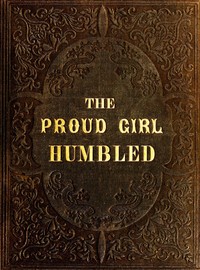
The proud girl humbled, or the two school-mates
Download Formats:
Excerpt
THE
PROUD GIRL HUMBLED,
OR THE
TWO SCHOOL-MATES;
AUTHOR OF “FRANK WORTHY,” “MAY MORNING,” ETC. ETC.
Entered, according to the Act of Congress, in the year 1849, by
LINDSAY & BLAKISTON,
in the Clerk’s Office of the District Court of the United States, for
the Eastern District of Pennsylvania.
STEREOTYPED BY J. FAGAN.
PRINTED BY C. SHERMAN.
This little story has been written, to show you how often we are the
cause of our own unhappiness by selfish conduct. To...
Read the Full Text
— End of The proud girl humbled, or the two school-mates —
Book Information
- Title
- The proud girl humbled, or the two school-mates
- Author(s)
- Hughs, Mrs. (Mary)
- Language
- English
- Type
- Text
- Release Date
- June 1, 2024
- Word Count
- 4,499 words
- Library of Congress Classification
- PZ
- Bookshelves
- Browsing: Children & Young Adult Reading, Browsing: Fiction
- Rights
- Public domain in the USA.
Related Books
Dimple Dallas
by Blanchard, Amy Ella
English
588h 4m read
The heiress of McGregor
by Guernsey, Lucy Ellen
English
1487h 44m read

Elizabeth, Betsy, and Bess—schoolmates
by Blanchard, Amy Ella
English
992h 19m read
Straight forward; or, walking in the light
by Guernsey, Lucy Ellen
English
976h 42m read
Little "Why-because"
by Giberne, Agnes
English
489h 51m read
Her own way
by Thorne, Eglanton
English
1288h 54m read