*** START OF THE PROJECT GUTENBERG EBOOK 74339 ***
[Illustration: _Hah-Tse-Yalti, the talking God._]
THE SONS OF KAI
_The Story the Indian Told_
By
Henry Beston
New York
THE MACMILLAN COMPANY
1927
_All rights reserved_
COPYRIGHT, 1926,
BY THE MACMILLAN COMPANY.
Set up and electrotyped.
Published November, 1926.
_Printed in the United States of America by_
J. J. LITTLE AND IVES COMPANY, NEW YORK
To
MISS MARY CABOT WHEELWRIGHT
_Because those who love the Southwest and
its peoples owe to her courage, her discernment,
and her venturing spirit
more than they can repay._
ILLUSTRATIONS
HAH-TSE-YALTI, THE TALKING GOD. _Frontispiece_
PAGE
THE TWIN SONS OF KAI. _facing_ 6
THE BUFFALOES AND THE BUFFALO CALVES. _facing_ 12
THEY SWAM AND THRASHED ABOUT IN THE POOLS. 15
“WHERE ARE YOUR SONS?” 23
THERE WERE FLASHES OF LIGHTNING THROUGH THE TUMBLING WATERS. 27
THE TWINS LEARNED THE USE OF BOW AND ARROW. _facing_ 30
“HERE ARE THREE GIFTS TO HELP YOU WIN THEM.” 33
HOMEWARD TO THE CANYON OF THEIR CHILDHOOD. 53
THE SONS OF KAI
The country of the Navahos lies south and west of the Rocky Mountains
on a great tableland lifted up into the sky. It is a country of canyons
and deserts, mountains and wild pasture lands arched over by the bluest
sky in all the world. The sun there seems bigger than our northern sun,
and he treads the sky each day like a proud Indian god in a feather
headdress of gold and fire.
When a Navaho falls ill, or has recovered from an illness, his friends
and the friends of his friends meet together by night to dance the
sacred fire dance. In the open land by some lonely settlement in the
ancient hills, they kindle great fires under the starry sky, and dance
the sacred dance round and about the flames. The old men sing, the
drums resound, and the tread of the dancers shakes the earth till the
fires sink and die in the glow of the mountain dawn.
The song which the old men sing at the dance is very beautiful and very
old. It is called the Song of Healing. This is the story the Navahos
tell about the song.
[Illustration]
Once upon a time, say the Navahos, an Indian people lived in a cliff
dwelling in the south wall of the Canyon de Chelly.[A] The huge,
arched-over hollow in which their town was built was more than halfway
up the side of the reddish-pink canyon wall, and to get to it, the
people had to climb ladders and follow narrow paths cut in the stone.
Looking from the canyon up to the cliff, one could see the little
square houses nestling under the huge arch, a watch tower, and a
granary. At one end of the arch, a ribbon of water, gliding down the
cliff, marked the overflow of a fine spring which never failed.
The people of the cliff village lived by farming. A river flowed
through the canyon, and along its banks were peach orchards, and
meadows, and fields of melons, squashes, beans and tasselled corn. All
day long, as they went back and forth between their fields and the
town, the Indians could be seen climbing up and down the cliff.
At night, the ladders were pulled up so that no enemy or climbing
animal could reach the town. Then the great arch filled with stars,
little cooking fires began to twinkle in front of the houses, and the
barking of coyotes was to be heard, now near, now ever so faint and far
away.
The silversmith of the town was named Pesh-li-kai, which, in the Navaho
tongue, means the Silver Man. He had a little forge, a bellows of goat
skin, and an anvil which he held between his knees. Now Pesh-li-kai, so
the Navahos say, had a daughter, and she was quite the handsomest of
all the Indian girls. So gracefully and prettily did she move that the
people called her Kai, which is The Willow.
One spring morning, Kai went down the ladders to weed in the young
corn. Suddenly she heard a pleasant voice call her by name.
The maiden dropped her weeding stick, rose to her feet, and looked
about. No one was near, and no one answered her when she called.
A few days later the girl again went down to weed in the corn. A little
breeze was blowing thin clouds down the canyon sky, and brought to the
girl’s ears the faint voices of other villagers working along the
valley. Suddenly Kai heard, from near at hand, the pleasant voice again
calling her by name.
Once more, the daughter of Pesh-li-kai looked about, and once more
could not discover who had called.
On a third morning, however, when the same unknown voice had spoken
a third time, there was a rustling of leaves in bushes by the river,
and a young Indian man stepped out of them, and walked towards Kai. He
was tall, his features were grave and handsome, and he was clothed in
a splendid garment of soft, snow-white buckskin beautifully decorated
with beadwork figures in the old Indian way. Upon his head was an
Indian bonnet of eagle plumes.
This tall young man was Hah-Tse-Yalti or the Talking God. He had seen
the daughter of Pesh-li-kai and fallen in love with her. So that
morning, in the spring sunlight of the canyon, the Talking God asked
the girl to marry him, and this she did.
Of this marriage, twin boys were born whose strange adventures you
shall hear.
[Illustration: _The twin sons of Kai._]
The daughter of Pesh-li-kai brought up her sons in the cliff dwelling.
Their father, Hah-Tse-Yalti, had returned to the country of the gods.
Because the twins were fatherless, or seemingly so, all the villagers
were kind to them. The war chief of the village, who was a nephew of
Pesh-li-kai, taught them the use of the bow and arrow; the peace chief
of the tribe taught them the Indian lore of animals. Their mother Kai
taught them the ancient prayer to the gods and to the new day which the
Navahos still say when the sun comes over the mountains.
[Illustration: _The twins learned the use of bow and arrow._]
They hunted, they fished in the river, they swam and thrashed about in
the pools.
[Illustration: _They swam and thrashed about in the pools._]
Every summer buffalo hunters left the village to go buffalo hunting
on the plains, and before they went, the men and boys of the village
danced the buffalo dance.
In the year that the boys were ten years old, the dance took place at
night. As the houses of the town were built against the back wall and
the sides of the open hollow, there was a fine open space in front
under the overhanging arch, and there the Indians built a great fire.
The pine branches crackled and burnt fiercely, the yellow flames leaped
at the roof, darkening the soot-smudge already there, and a fragrant
smoke full of red sparks curled out the arch and poured up into the sky.
Then drums began to sound, stately drums, and the older men of the
village came out beating the drums and singing the deep-voiced buffalo
song.
Then came the younger men, the dancers, climbing one by one from their
council-chamber underground. The dancers wore moccasins of hide and
turquoise beadwork trimmed with the black and white of skunk fur,
their lean, strong legs were washed over with reddish brown paint, a
broad band of white cloth encircled them from the waist to just above
the knees, and their bare upper bodies and arms were painted like
their legs. They wore turquoise and silver necklaces, and round their
foreheads, bands of brilliant cloth.
Ten of the dancers were supposed to be buffaloes. You could not see
their human heads at all, for they were hidden in real buffalo heads
with hollow wooden frames. These dancers looked just like buffaloes
with painted human bodies. Two little buffalo calves followed behind
the grown-up dancers. When the older buffaloes pretended to be real
buffaloes, and looked about and at the ground as if they were looking
for grass, the two buffalo calves did the same thing.
[Illustration: _The buffaloes and the buffalo calves...._]
The buffalo calves were the twin sons of the Talking God and Kai. They
were proud beyond words to be in the dance. Their thick, straight,
black hair had just the gloss of a blackbird’s wing in the sun, their
eyes were a deep black-brown, and they were strongly made and of
pleasant countenance, even as the Talking God, their father.
[Illustration]
A day or two after the dance, the mother of the twins went down into
the canyon to look for certain roots used in making a dye. As she was
scanning the ground, she saw a ground owl sitting at the mouth of its
burrow playing cat’s cradle with a thin buckskin thong. The Navahos say
that the spider taught the owl this game, and that the owl taught it to
men.
“Daughter of Pesh-li-kai,” said the ground owl, “where are your sons?”
[Illustration: “_Where are your sons?_”]
“In the village,” replied the mother of the twins.
For a moment or two after this, the owl said nothing whatever, but
continued with his “cat’s cradle” game. Then suddenly he fixed his
round yellow eyes on Kai, and said slowly, “If I were you, I would
hide them there a while. The god whom we call the Mischief Maker is in
the land, and if he finds the twins, he may do them harm. Keep them at
home, Daughter of Pesh-li-kai.”
At these words the frightened mother dropped the little bundle of dye
roots she had already gathered, and ran as fast as she could back to
the village. When she reached her house, her heart almost stopped
beating, for the boys were not there. She did find them, however, at
their grandfather’s. They were seated on the ground near the tiny
forge, watching Pesh-li-kai melting silver in a cup.
Calling the twins to her, their mother told them of the ground owl’s
warning, and forbade them to leave the village even for a moment. She
then gave them a buckskin cord to play cat’s cradle with, and went
down the ladders to continue her search for the roots. As these were
small and not very plentiful, she had to search the ground for them
slowly and carefully.
About the middle of the afternoon, the mother became aware of a sound
of the sighing of wind, a sound that did not die away, but grew louder
and louder and louder till all the little pinyon pines in the canyon,
rustling and moaning together, made a sound like the sea. Kai knew
instantly that a cloud-burst was at hand. She had hardly gathered her
roots together before the sky grew pitchy dark.
Great whirling billows of dust now swept up the black canyon; whirls
of dust swept off the canyon rim into the tumult of the upper air; the
whole world seemed to dissolve in a great, trembling, roaring sound
of wind and rushing rain. With a peal of thunder that echoed and
re-echoed from the canyon walls, the cloud-burst reached the valley.
Roaring rain of the southwest country, rain of the giant drops, rain
that in the twinkling of an eye turns little rivers to deep streams.
The thunder bird rode the wild dark, the wind, and the sheets of rain,
the arrows of lightning fell from the bows of the thunder spirits.
Seeing the cloud-burst coming, the Indians working in the fields
dropped their sticks and hoes and ran as fast as they could for the
ladders. Kai ran pell-mell with the rest. The instant she reached the
town she looked about for her sons.
They were nowhere to be found.
[Illustration]
Presently a neighbor remembered seeing them going down the ladders
carrying their bows and arrows. Another neighbor was sure that they had
gone to hunt wild turkeys in the waste land back of the canyon rim.
The twins had forgotten their mother’s warning, and were out somewhere
in the storm.
The water which had fallen on the uplands now began to tumble over
the canyon rim in wild cascades, and as the storm increased, the arch
through which the village looked out upon the world was curtained over
by a giant waterfall. Now and then, at one edge of the arch, there were
flashes of lightning through the tumbling waters.
[Illustration: _There were flashes of lightning through the tumbling
waters._]
In the shelter of its rocky hollow, the town stood snug and dry. But it
was very dark, and the darkness was full of the hiss and roaring of the
fall.
The Indians built a fire and gathered about the flames.
All night long, the daughter of Pesh-li-kai fed the great fire with
fresh branches. All night long, sitting alone, she watched the play
of the flames on the plunging foam of the fall, and listened to the
thunder mingle its wild sound with the tumult of the waters.
When the morning came, and the great fall had thinned to half a dozen
little ones, the mother was still there waiting by the embers of the
fire.
The boys had not returned.
The Mischievous God had found them, and shut them up in a cave.
[Illustration]
For three days the twins remained in the cave. It was darker than the
darkest night within, and fearing to lose each other, the boys clung
together as they felt their way about. On the second day, one of the
boys fell heavily over a stone, and rose from the ground crippled and
lame.
On the morning of the third day, they heard a heavy sound. The stones
with which the Mischievous God had blocked the mouth of the cave had
fallen down. A ray of light appeared, and the boys went towards the
sparkling gleam. When they had emerged into the sunshine, one of the
twins said to his brother,
“Where is the light of which you spoke? I cannot see it.” And he felt
about as if he were still in the cave.
Then the other twin looked into his brother’s eyes, and saw that during
the three days in the cave his brother had become blind.
Leading his blind brother by the hand, the lame boy led off into the
empty country. Far, far away, rising blue and beautiful through blue
air, one of the four sacred mountains of the Indian people lifted its
snow-capped head. The twins were in a strange desert country many days
journey from their canyon home.
After wandering thirstily about for a whole day, they came to a
little river, and upon its bank they rested for the night.
The next morning, when the rosy desert dawn began to blossom in the
sky, and the long dawn shadows of the cactuses and the desert shrubs
lay gray and cool upon the lifeless ground, the twins stood up, and
said the old Indian prayer to the sun and the new-born day. Then down
the stream they hobbled forlorn towards reddish desert mountains at the
far edge of earth and sky.
The river, as it approached the mountains, grew larger, and presently
plunged into a canyon much narrower and deeper than the canyon in which
the boys were born. Now following along a little bank, now climbing
over great boulders in the river bed, the boys struggled on into the
gorge. Suddenly the river turned a sharp corner, and following it, the
twins found themselves in a wild and magnificent valley whose slopes
were green with trees.
From the eastern wall of this valley, a huge cliff with a broad flat
top thrust itself forth like the prow of a giant ship built to sail
through the stars. Fires were burning on its summit, and columns of
pale smoke wavered and scurried away in the wind on the heights. At the
foot of the cliff, the river churned in a great foaming pool, and this
pool was full of huge logs washed down the hillsides by cloud-bursts
and the floods of spring.
This rock was Tse-intyel, “The Broad Rock of the Gods,” and the pool
was “The Place of the Whirling Logs.” The Gods dwelt there.
Just before the twilight deepened and died, the lame boy managed to
kindle a tiny fire. The blind twin sat beside it, listening to the
deep thunder of the churning pool. Every now and then some log would
strike some other log a dull, booming blow.
Suddenly the blind lad heard the faintest sound of distant footsteps,
and caught his lame twin by the arm. Looking up startled, the lame boy
saw a tall man coming towards them, his face grave and sorrowful.
The visitor was Hah-Tse-Yalti, the Talking God. An eagle had told him
of the plight of his twin sons. So that night the Talking God consoled
his unhappy children, and told them what they must do to be healed.
“You must visit the four sacred mountains,” said the Talking God.
“First you must go to the Mountain of the North, then to the Mountain
of the East, then to the Mountain of the South, and lastly to the
Mountain of the West. The tribes of the Sacred Mountains will receive
you in friendship, and at the Mountain of the West, the Chief of the
People will teach you the Healing Song.”
So the lame boy and the blind boy went north and east and south and
west to the four sacred mountains and learned the healing song. Their
father Hah-Tse-Yalti watched over them, and every night while they
slept, placed a bowl of food at their side.
When the twins had learned the healing song, they made their way again
to the Broad Rock and sang the song before the Gods.
“But where are your gifts?” said the Gods. “You must bring us the three
sacred stones before you can be healed.”
In the dark of the night Hah-Tse-Yalti came with the bowl of food, and
woke his sons.
“The three sacred stones,” said the God, “are Turquoise, Silver, and
Shell. The Hopi people guard them. Here are three gifts to help you win
them. In this buckskin pouch of white beads is the Frost, the enemy of
the young corn.
“In this buckskin pouch of green beads is the Cutworm, the devourer.
“In this buckskin pouch of blue beads is the Hail that strikes the
grown corn to the ground.”
[Illustration: “_Here are three gifts to help you win them._”]
Down the river paths, and across the desert and the mountains, the
boys went to work for the Hopis who guarded the Sacred Stones.
[Illustration]
The boys found the Hopi people living in the desert on the same mesas
they occupy today. The Hopis, so the Navahos say, mocked at the
brothers.
“Ho! Ho! Ho!” they said, “so you have come to work for us, have you?
What can you do, you lame boy, and what can you do, blind boy? And what
wage do you ask of us?”
“At the end of the spring, our wage shall be the Sacred Silver Stone,”
said the boys. “At the midsummer, our wage shall be the Sacred
Turquoise Stone, and at the time of the harvest, you shall pay us the
last sacred stone of gleaming purple shell. Will you make this bargain
with us, people of the Hopi?”
“Yes,” said the Hopi people mockingly, never dreaming that the twins
meant what they said. And they gave the twins an almost roofless room
in an old part of their pueblo, and told them to go and work in the
fields.
All the early spring, the lame boy and the blind boy worked hard
helping the Hopis plant their corn. The corn of the Pueblo Indians is
not straw-yellow like ours, but of all colors; it is orange, it is
orange-gold, it is garnet-red, it is purple like the grape.
When the spring was at end, and the young corn was well started in the
fields below the mesa, the twins asked for the Sacred Silver Stone.
“We have kept you alive, and that is enough,” said the Hopis angrily.
“Do you suppose we should ever part with the Sacred Silver Stone?”
The twins said little, but remembered the frost magic which their
father had given them in the first buckskin bag. In the middle of the
night, when the stars were shining on the desert, and everybody in the
pueblo was asleep, the twins opened the bag. The cold that crept out of
the pouch nipped and numbed their fingers, and through the broken roof,
they could see the stars veiling over.
For three days, the twins left the pouch open, for three days it was
cold in the Hopi country, and for three nights there were frosts which
damaged the growing corn. The Hopis presently held a council to see
what could be done.
After the Hopis had talked and talked, and everybody in the pueblo had
been asked for his advice, an old man chanced to say:
“We have not yet asked the lame boy and the blind boy. Suppose we ask
them to the council, too. They may be able to give us some advice.”
At this many laughed, but the twins were sent for, after all. The lame
lad hobbled to the council ground with his blind brother clinging to
his sleeve.
Then the lame lad leaned upon his brother and told the Hopis that he
and his twin could work magic to stop the frost and save the corn, but
that for doing this, the Hopis must give them the promised sacred stone.
Unwilling to lose their corn and live half starved during the next
winter, the Hopis promised faithfully to give the boys the sacred
stone. So the boys closed the first buckskin bag, and the corn began to
grow again.
[Illustration]
By the midsummer, the tasseled corn was growing splendidly. The twins,
who had worked hard, then asked for the second sacred stone. But the
Hopis were unwilling to pay the promised wage.
That night the twins let the cutworm out of the second bag, and before
the morning he had worked a world of mischief in the corn. Once again
the Hopis held a council, and once again they called in the brothers.
“Yes,” said the boys. “We have magic strong enough to clear the cutworm
from the corn, but you must promise us the second sacred stone.”
So the Hopis promised faithfully to give the brothers the Stone of
Turquoise, and the boys then closed the bag from which the cutworm had
crept. The instant they did so the cutworm vanished from the corn.
At harvest time, the tall stalks of corn were more beautiful than
ever. The brothers now asked for the three sacred stones--the Stone of
Silver, the Stone of Turquoise and the Stone of Purple Shell.
“Be off!” said the Hopis. “You shall not have the stones.” And they
threatened the boys that they would send them away from the mesa.
Returning to their room, the boys opened the last of the buckskin bags.
The sky grew dark; the wind began to howl over the mesa; the corn
stalks shuddered, and tossed their ripening leaves. Suddenly huge hail
stones began to tumble down.
The hearts of the Hopis grew cold with fear, for they knew that the
hail would beat down the corn, and that the ears would rot rather than
ripen.
“Stop the hail with your magic!” they cried to the boys. But the boys
paid no heed till the Hopis put the sacred stones into their hands.
Then the hail stopped, the storm cleared away as swiftly as it had
gathered, and the brothers left the mesa carrying the stones for which
the Gods had asked. On the rocky stairs leading from the pueblo to the
ground, the magic hail stones were shining and melting in the sun.
[Illustration]
Tse-intyel, the home of the Gods, was far away beyond the deserts
and the mountains, but the brothers made the long journey safely.
Hah-Tse-Yalti, their father, though unseen by them, protected them and
brought them food.
After spending a night by the Pool of the Whirling Logs, the boys
climbed the Broad Rock of the Gods. They began their climb long before
the dawn, and arrived at the top just as the sun appeared at the far
rim of the earth.
From the flat top of Tse-intyel, the Gods could see all the wide Indian
world,--the deserts, the waste lands, the river pastures, the dark
canyons with the sun silvering their western rim, the lonely little
hills, the snowy mountains, and the great plains where the buffalo
herds moved like slow cloud shadows over the immense and tawny land.
Then Hah-Tse-Yalti took his sons by the hand, and led them before
the Gods. The chief of the Gods was he whom the Navahos call “The
God-Who-Is-Stronger-Than-Fear.” The brothers then gave the Gods the
three sacred stones, and sang the Healing Song.
When they had finished, the God-Who-Is-Stronger-Than-Fear touched the
blind boy upon the eyes, and the lame boy upon the knee. And the blind
boy saw again, and the lame boy limped no more.
So the brothers gave thanks to the Gods, and rejoiced at their healing,
and Hah-Tse-Yalti rejoiced with his sons. When the time came for the
boys to go, Hah-Tse-Yalti led them to the eastern edge of Tse-intyel,
showed them their canyon home, and told them of the trail of the
Gods which led to it.
[Illustration]
Homeward to the canyon of their childhood went the boys, homeward to
the cliff dwelling and to Kai their mother.
[Illustration: Homeward to the canyon of their childhood.]
And the Navahos say that the twins became great heroes, and taught the
Indian peoples the Healing Song they sing to this very day.
[Illustration]
[Illustration]
Footnote
[A] Pronounced “chay.”
Transcriber’s Notes
Perceived typographical errors have been silently corrected.
Illustrations have been moved nearer to the text to which they refer.
As a result, the page numbers listed in the Illustrations table may be
incorrect.
*** END OF THE PROJECT GUTENBERG EBOOK 74339 ***
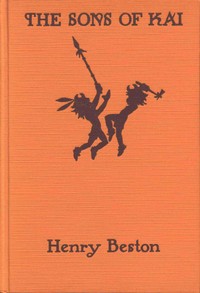
The sons of Kai
Download Formats:
Excerpt
New York
THE MACMILLAN COMPANY
1927
COPYRIGHT, 1926,
BY THE MACMILLAN COMPANY.
Set up and electrotyped.
Published November, 1926.
_Printed in the United States of America by_
J. J. LITTLE AND IVES COMPANY, NEW YORK
To
MISS MARY CABOT WHEELWRIGHT
_Because those who love the Southwest and
its peoples owe to her courage,...
Read the Full Text
— End of The sons of Kai —
Book Information
- Title
- The sons of Kai
- Author(s)
- Beston, Henry
- Language
- English
- Type
- Text
- Release Date
- August 31, 2024
- Word Count
- 4,403 words
- Library of Congress Classification
- PZ
- Bookshelves
- Browsing: Children & Young Adult Reading, Browsing: Fiction
- Rights
- Public domain in the USA.
Related Books
The Wardens of Cape Cod
by Beston, Henry
English
89h 31m read
The outermost house
by Beston, Henry
English
794h 40m read
Indian Nature Myths
by Cowles, Julia Darrow
English
378h 41m read

The Book of Gallant Vagabonds
by Beston, Henry
English
641h 42m read
The Starlight Wonder Book
by Beston, Henry
English
705h 52m read
The Lost Giant, and Other American Indian Tales Retold
by Higgins, Violet Moore
English
120h 5m read