*** START OF THE PROJECT GUTENBERG EBOOK 74140 ***
THE STRIKE AT TOO DRY
By Willis Brindley
Young Percival came out of the East to a Montana ranch, and
a pleasant time was not had by all--though the reader will
be much diverted.
The postmaster at Too Dry poked his head out of the door of the shack
which served as combination of post office, real-estate office and
residence, spat generously into the dusty road and yelled to the big man
who had drawn up at what might in a city have been called the curb.
“Letter for you, Dog.”
“Who? Me?”
“I guess it’s for you. Came yesterday. It’s in a thick envelope and the
address is Percival John Bigelow, Too Dry, Montana.”
“That’s me,” agreed Dog, and added mournfully: “Well, if that don’t beat
the scratch. That’s two letters I got so far this year. If this keeps
up, I’ll have to hire me a secretary. Bring it out to the car, Steve.
What did she say?”
But the postmaster had returned, with the popping suddenness of a
prairie-dog, to his hole of an office, and Dog saw that he must follow
or do without his letter.
“You tote your own in this town,” he grumbled to the little man beside
him. “You stay here, Ducky, till I come back, and don’t go wandering off
anywhere. We gotta be traveling. It’ll be dark as the ace of spades,
time we get home, as it is.”
“Don’t we meet the stage or nothin’?” whined Ducky.
“No, we don’t meet the stage or nothin’,” answered Dog, pushing back his
wide hat and swinging a booted foot over the edge of the coverless Ford.
A stranger would have known at once why he who had been named Percival
John was known to his fellows as “Dog.” He looked like a dog--very much
like a bench bull, with his button nose, his underslung chin, his sharp
little eyes and forehead that was almost no forehead at all. As for his
partner, he came quite readily by his nickname--not through any facial
resemblance to a duck, but because, with his short bowlegs, he walked
like one. A preacher in a day long past had baptized him Elbert Spence.
* * * * *
Minutes passed, during which Ducky dozed, slumped low in the front seat,
and when Dog finally came and climbed over into his place slowly, the
face which Ducky opened his eyes on, was drawn and sober.
“You remember that I had a sister,” Dog said at last. “I don’t often
speak of her.”
“Uh-huh!”
“Married an artist guy.”
“They’re never no good.”
“Not generally, but this one wasn’t so bad, take him altogether. Used to
draw waterfalls and such, but he gave it up. Now he makes pretty
pictures for toothpowder ads.”
“Uh-huh! What about it?”
“Well, they had a son, named after me--Percival Bigelow James. I got a
letter from my sister. Seems he’s turned out bad.”
“That so?” Ducky roused himself into a sitting position. This was
better. “Rob a bank or something?”
Dog shook his head.
“Nope. Turned poet.”
“Good gosh!” Ducky slumped again. Dog went on with it.
“He must be about twenty-five or -six years old now. You remember when
we were in Klondike we got a letter from my sister about her having a
kid, and I made him a nugget watchchain.”
“Oh, yes. You bummed most of those nuggets off me. But what about it?
Ten minutes ago you were in a tooting hurry to get home, and now you sit
here drooling like a new calf.”
“I’m breaking it to you gently,” said Dog. “Fact is, Ducky, this letter
says the boy’s health aint been any too good. Threatened with T.B., I
reckon, though she don’t come right out with it. My sister wants this
Percival to come out and pay us a visit.”
“Huh?”
“Yea-ah. I’ll read you the finish of it.” He pulled the letter from the
pocket of his shirt, shucked the many closely written leaves from the
envelope and read the concluding sentences. “‘And so, because I know
that you would refuse, yet dare not give you an opportunity to refuse, I
have arranged for Percy to start West on the day after mailing this
letter, and of course you will arrange to meet him; and while your life
must be rude and living-quarters of the roughest, we are sure that the
change will be just what he needs. We have bought his ticket and berth
and shall furnish him with funds to pay for meals and incidentals, but
he must work and earn and stay with you until he has earned enough to
bring him home again. This is part of our plan--a return to health, and
the necessary discipline to make a man of him.’”
“Good gosh!” Ducky sat bolt upright now. “This letter came yesterday.
That means he’ll be here on today’s stage?”
“That’s it,” said Dog. There was nothing more to be said. When things
happen to people, things happen to them, and that’s all there is to it.
* * * * *
They summoned courage, finally, to discuss details. He could sleep in
the loft--up there with Spud Dugan, the man-of-all-work about the place.
Spud wouldn’t like it, and the boy wouldn’t care for Spud’s snoring, but
they would have to put up with one another. He probably smoked
tailor-made cigarettes. Ducky went to get a carton. He probably would be
one of those fellows that’s always got to be washing himself. Dog went
to buy some white soap, and then, remembering something, bought a dozen
cakes of laundry soap as well. Time for the stage any time now, and
presently it came, in an enveloping swirl of gray dust--a big truck,
with an extra seat crosswise behind the driver, and the back end filled
with freight.
“Here he is,” bawled Duke Envers, the driver, and added to the slim
youngster at his side: “There’s your uncle over there, him with the face
like a bench bull.”
The young man climbed down, stiffly. He wore a flappy hat that had been
pearl-colored, tweed knickerbockers, and boots of that golden yellow
shade peculiar to New York outfitting shops.
“He’s got a couple of bags that was made from a cow apiece,” added Duke,
“and they’s a crate of mail-order stuff for you, Dog.”
Percival stepped forward, blinking in the strong light. Dog, swallowing
hard, strode toward him and shook hands with a heartiness at which the
visitor cried out.
“My partner, Ducky Spence,” said Dog. Percy nodded, his right hand
safely behind his back. Ducky went for the bags, and presently returned,
staggering.
“Don’t forget that mail-order stuff,” Duke Envers bawled to Dog,
climbing back over the freight. “It’s here in the hind end. I’ll hand it
down. Looks like a washing-machine to me.”
He handed it down, and Dog carried it to the Ford, lifted it over the
side and snugged it in, between the back and front seats, on top of
sundry supplies. The stranger and Ducky followed, Ducky swaying under
the grips, his legs moving with that strange waddle which had given him
his moniker. Dog lifted the grips, plunking them down on the back seat,
which they completely filled.
“Maybe we better eat first,” he suggested. “It’s a good forty mile, and
the road’s a bit rough in spots. What do you say?” This last to nephew
Percival.
“What does it matter? What does anything matter?” squeaked Percival.
Dog looked at him, looked at Ducky. Ducky looked at Percival, looked at
Dog. It was worse than they had feared.
“Well, if you don’t want to eat, what do you want to do?” Dog asked.
“I want to go back.”
Dog grabbed him by the arm. “That’s the one place you don’t go. We eat.”
He lead the Easterner across the street to the Ideal Cafe, Ducky
following, sundry acquaintances staring. They mounted stools at the
counter.
“Ducky and I are having ham and eggs. How about you?”
Percival shivered,--perhaps shuddered,--gazing straight into the
fly-specked mirror of the back bar.
“I think I shall just have some thin toast, without butter, some
bar-le-duc jelly and a pot of oolong tea, very weak.”
Red Leonard, cook and waiter, treated himself to half a snigger. The
second half died at the look Dog gave him.
“That makes three ham and eggs, Red,” Dog said, “with some fried
potatoes and a slab of pie and plenty of coffee. If you’ve got any
comparatively modern eggs, we’d like to be favored with ’em. And snap
out of it. This is my nephew. Going up to our place for a while with
Ducky and me, to pay a visit to Spud Dugan.”
He grinned, and Red grinned back.
“Spud Dugan is our cook,” Dog told Percival, by way of conversation.
“Used to wash dishes for Red, here, but we got him to come up to the
ranch and work for us. Ducky likes to cook, but he can’t, and I’m a good
cook, but I wont, so we figured we’d better get in a neutral party.”
They ate, then, with that whole-souled attention to food which makes
conversation impossible, Percival nibbling at first, but getting in some
pretty fair work himself toward the finish, for he had not broken fast
since morning. Observing this, Dog felt encouraged, very slightly, but
his courage fell when he attempted to draw Percival into conversation on
the long ride home, while the lad sat beside him, with Ducky perched
precariously on the luggage in the rear.
“This is a fine country,” he hazarded. “Gets a bit dry at times, of
course.”
“I don’t like it,” said Percival.
“You will, all right. Probably the name sort of prejudiced you--Too
Dry.”
“What does a name matter?”
Dog stuck to it.
“Of course you heard about the big Too Dry Gulch Dam. I imagine they
talk about that a lot back East.”
“No.”
“We had a project to dam the creek in Too Dry Gulch, above our place.
Wasn’t going to cost only thirty million dollars, but that no-account
Congressman of ours fumbled the cards somehow and fell down on the
appropriation. Steve Martin, that runs the post office, he come out here
to go into the real-estate business, and he did too, and he’s in it yet,
but the boys kind of schemed around to get him made postmaster so he
wouldn’t starve to death while he was waiting for the real-estate boom
to start. You ever interested in real-estate?”
“No.”
* * * * *
Dog gave it up for a while. He was pretty busy, anyway. Driving a Ford
that has no front bushings, on a road that is composed chiefly of ruts
with a generous sprinkling of crags that must be leaped, is a man-sized
job by itself. When he finally resumed, it was via a third party. He
addressed his remarks to Ducky, hollering them from the side of his
mouth.
“You didn’t know I was getting a washing-machine, did you?”
“No, and I don’t care for it any,” came a jolted answer. “Seems to me
we’re getting all-fired civilized lately. Next thing I know you’ll be
sending away for a woman.”
Dog laughed. Percival suddenly sat up straight and looked at him
anxiously.
“Are there no women?”
This was, of course, as funny a thing as he could have said. Dog and
Ducky laughed noisily, and the Ford, unattended for a split second,
leaped into a ditch, and then, in answer to a savage jerk, hopped back
onto the road, quivering from her nose to the place where her tail-light
once was.
“Well, I wouldn’t go so far as to say that,” said Dog. “There’s a nester
in beyond about twenty miles that’s got a woman. He got her off the
reservation near Parma, summer before last. They say she’s a pretty good
cook for a squaw. We could go over and see her some time if you want
to.”
He looked at the lad by his side, but the lad was looking straight
ahead, tight-lipped, silent and unutterably sad. Dog gave it up, and
they made the last twelve miles, which, incidentally were the worst, in
a silence broken only by the never-stopping rattle of the Ford. The Ford
had lights, of a sort, but after darkness set in, Dog made small use of
them, driving by a sixth sense that enabled him to steer the crazy
vehicle in its rock-strewn course. Twice the car broke loose and dived
down dry watercourses, and Ducky had to get out and push to help get it
back onto the track that Western courtesy called a road.
* * * * *
But all things, even bad roads, come to an end, and finally they
arrived, and Spud Dugan, a sour wisp of a man with a bald head and
fierce mustaches, met them with a lantern and helped tote things in.
“What’s this?” he demanded abruptly, when Dog lifted out the heavy,
crated washing-machine.
“Little present for you. I’ll open it up when we get into the house.”
They went in, Percival Bigelow James following, carrying nothing. It was
a house of goodly size, made of native Montana timber such as is found
along stream-beds, with a kitchen and bedroom on the first floor, and a
loft above, reached by a ladder nailed to a side wall. Percival dropped
onto a bench in the kitchen. Spud set about putting away stores in a
cupboard. Dog found a hatchet and tore the crate from the
washing-machine.
“What-in-the-hell-is-it?” demanded Spud testily.
“Washing-machine,” Dog told him. “Genuine Old Faithful, twenty-four
fifty, F. O. B. factory. She’s a peach. Swishes the clothes back and
forth, and the dirt settles in the bottom.”
“Hump. What’s this thing?”
“That’s the handle you work it by. Just pull the handle back and forth,
and the wheels go round, and the clothes get washed in no time and all
the dirt falls to the bottom. You’ll like it.”
Spud shook his head.
“Not me. Take her outside. I pull no handles. We wash in the creek like
always--what washing we do, which aint much; and I might add that your
little friend here does his own or it don’t get done, and that’s that.”
Apparently that was that. Dog, mustering a grin, set the machine
outside, under the leanto-porch, and suggested that they all turn in.
“Where?” asked Percival in a dead voice.
Dog told him, upstairs, in a fine comfortable bunk with a buffalo robe
to throw over him if it got cold. Percival still sat on the bench which
he had found upon entering the house.
“I want three hundred dollars,” he said suddenly. “I must have three
hundred dollars. You let me have three hundred dollars and take me back
to where I can get a train for New York. Mother’ll pay you back.”
Dog shook his head.
“You get no three hundred dollars from me. Your mother gave me positive
instructions. You’ll like it fine here after you get used to it, and
you’ll get strong and hearty. Why, in a month, you wont want to go back,
not never.”
“I want to go back now,” whined Percival.
“Aw shut up,” said Ducky suddenly. “You make me sick. It’s going to be
hard enough on us to have you around here at best, and if you’re going
to yowl around all the time, it’ll be a lot worse. Get up to bed and
sleep off your grouch.”
“Ducky’s right,” added Dog, picking up the big grips, which he carried
to the foot of the ladder. Leaving them on the floor, he climbed
halfway, and at a signal Ducky handed them up one at a time, and he
boosted them through the ceiling hole onto the floor above. Percival
watched this performance, but made no move to help.
Out of deference to company, Spud Dugan lighted a lantern and carried it
up into the loft, and still Percival sat. Finally, Dog took him by the
arm, led him to the ladder, and pushed him up. Just before his head
disappeared through the hole, he turned and spoke:
“I’ll bet I’ll make you give me three hundred dollars.”
“You lose your bet,” said Dog sullenly. “Good night.”
* * * * *
Percival was not up when Dog and Ducky left next morning on a long trip
to the North Cañon country. Returning, dog-tired, at dark, they found
him on the bench in the kitchen, sitting perfectly still, eyes straight
ahead, looking at nothing.
Spud Dugan whispered to Dog:
“Just like that all day. Wont do nothing.”
“Let him alone,” answered Dog.
The next day, as reported by Spud, was just about the same, and the next
no better. The third day was, in fact, slightly worse, because Percival
had brought to his bench a book bound in limp leather. Books always
irritated Spud.
“He’ll die on you, sure. Remember that dog the nester’s squaw brought
with her from over by Parma. Just sat around and died. Same with him.”
“Aw, dry up,” Dog told him. But he was worried, and next morning he made
excuse to stay at the house, and determined to have a talk with
Percival. He drew up a backless kitchen chair and filled a cob pipe.
“Montana’s not such a bad country, son,” he began.
No answer.
“I’ve seen lots of places--Texas, New York, Klondike, and for just plain
satisfaction, Montana beats ’em all.”
No answer.
“Take it, now, down around Bozeman and Belgrade--there’s as fine
irrigated land as there is in the world. And the Gallatin Valley. Then
we’ve got oil, some places, and lots of mining around Butte and
Anaconda.”
The boy on the bench lifted his head.
“I want to go home, and if I had three hundred dollars, I’d go.”
It was pretty tough.
“Come on outside a minute,” Dog said finally, and Percival reluctantly
rose and followed.
“Now, if you’re a poet, take a look at that valley. Ever see anything
prettier than that? That’s why we’re here--this valley. Cattle graze in
the free range, and there’s always water in the creek.”
The boy looked up at him.
“If there was three hundred dollars in that creek, I’d care for it.
Otherwise not.”
He turned and dragged himself back toward the house. An idea came to
Dog, who had racked his brain for three days for one--came with that
suddenness that is characteristic of ideas. Anything was better than the
present situation. He called the boy back, spoke to him in hushed tones.
“There might be.”
“Might be what?”
“Three hundred dollars in that creek. I’m not saying there is, but I’ll
say that it looks an awful lot like a creek that Ducky and I took thirty
thousand dollars out of in the Klondike, and I might add--”
“How do you get gold out of a creek?”
Hooray! There might be a chance yet. Get the lad interested in any kind
of outdoor work, and give the good old Montana ozone a chance on him.
“I’ll show you.”
He ran to the house, dived into a cupboard and returned with a deep
pie-pan. It was not shaped just right, but it would answer. He picked up
a shovel from where it leaned against the corner of the house, and led
Percival up the creek and showed him how to wash gravel. And the third
pan showed color--just a trace, but enough to show. Of course, Percival
did not know that color and gold in paying quantities are things often
as far apart as Montana is from New York. But Dog knew that the sight of
color will edge a chechahco, rouse lust within his soul, stir him to
feats of physical endurance undreamed of. He sneaked away and joined
Ducky in a fence-mending job.
* * * * *
That night a very tired Percival, but a Percival with a real appetite,
joined them at dinner, stoked himself with beans and fried pork, and
retired immediately afterward to the loft.
“He’s gone cuckoo now,” Spud Dugan told Dog and Ducky, jerking his bald
head toward the ceiling hole. “Been out up the creek all day, panning
for gold.”
“You let him alone,” said Dog.
“Don’t worry.” Spud stacked a precarious load of dishes in the nightly
chore of clearing off. “Letting him alone is what suits me best.”
“You’d better salt that creek some,” Ducky suggested. “Long about ten
o’clock tomorrow morning, that kid’ll get tired of mining. We got
three-four old Klondike nuggets somewhere, aint we?”
Dog nodded, grinning. He went to an old trunk in a far corner of the
sleeping-room, rummaged in it profanely and finally came back with a
small chamois sack which, upended, spewed forth five pieces of rough
gold, each about as big as a shriveled pea.
“We gave away too many souvenirs,” he commented, “but I’ll plant one of
these tomorrow, maybe two the next day, and that’ll leave two for the
day after, and he might just happen to pick up one or two on his own
account.”
“Fat chance, on that creek! You gotta salt it. Get up there first thing,
and put one in the gravel where he’s left his shovel stuck in. A man
always pans that shovelful.”
* * * * *
It worked beautifully. Next evening, Percival was hungry again, tired,
but there was about him an air of elation, elaborately concealed. Dog,
getting an early start again, planted two more nuggets, and on the
following day, the final two from the pouch. At the close of each day
upon which a planting had been made, Percival was hungry, tired but
elated, and elaborately concealing his elation.
Ducky had another idea, an idea unique for sheer craziness. He led
Percival, with elaborate caution, onto the side porch, and pointed to
the washing-machine.
“I understand you’ve been digging up the creek,” he whispered.
“A little,” admitted Percival.
“Get much?”
“Not much.”
“Thought so. I’ve got an idea. Your method is too slow--you don’t get
over enough dirt in a day. We’ll start in the morning, early, just you
and me, and we’ll take this washing-machine up the creek a bit and plant
her solid, and shovel dirt and gravel into her. She’s rigged, you see,
so that the dirt from the clothes will settle in this place at the
bottom. Well, now, suppose we take a saw and make some slits in her
sides--get me? No? Why, the idea is simple enough, and practical. The
water and dirt and little rocks slip out of the slits in the side, but
the gold settles in the bottom, where the dirt is supposed to settle
when you use the rig for washing clothes. How’s that?”
Percival nodded, and for the first time since coming to Too Dry, he
smiled.
“Don’t tell anybody. Nobody’s interested in this washing-machine and it
wont be missed. You slide in now, and up to bed and get a big sleep, and
I’ll call you at daybreak and we’ll eat a cold bite for breakfast and
sneak up the creek before Dog and Spud are stirring.”
When the boy had gone, he told Dog.
“The scheme is crazy, of course, but it’ll keep him interested a few
days longer, and if he once gets used to this country, and gets a little
flesh on him, he’ll be a man, and we’re going to need a man bad before
long to help in the branding.”
Dog nodded. The scheme was good--for what it was meant to accomplish.
“We need a little more salt, though,” he added. “Wait a minute.”
Again he went to the trunk and engaged in profane search, returning at
last with a nugget mounted on a pin.
“Forgot this one,” he said, and wrenched the pin from where it was
soldered to the back of the nugget. “Take this and plant it.”
* * * * *
The washing-machine rocking device kept Percival happy all next day, and
his eye was lighted by a particularly bright gleam of elation as he
settled to the fried pork and beans at dinner next night.
“If we just had about one more piece of salt,” mourned Ducky, after
Percival had climbed the ladder, but Dog shook his head. The stick-pin
had cleaned the place of nuggets.
“We’ve done all we can,” he said. “I wish he’d find something of his
own.”
But Ducky shook his head at this. No chance. And yet, come dinner time
next night, here sits Percival again, looking as cocky as a cat that’s
eaten a canary. Throughout the meal Dog and Ducky cast anxious eyes at
him. Percival finished, pushed his plate toward the center of the table,
got up, thrust his hand deep into his right-hand trouser pocket and
brought forth something wrapped in a bit of paper. He unwrapped the
paper and held out for inspection a nugget twice as large as any that
the conspirators had planted for him.
“I worked in new ground today, farther up the creek. Good night.”
They watched him, fascinated, as he climbed the ladder to the loft.
“Suffering crawfish!” hissed Ducky, after he had safely gone.
Dog said nothing at all for a full minute, and then:
“You remember that Swede at Dawson that took a million dollars out of
the place we gave up as no good.”
“I remember,” said Ducky. “Probably nothing to this.”
“Probably not,” agreed Dog, but without conviction. “We’ll see what he
brings home tomorrow night.”
* * * * *
Next night Percival stoked as usual, pushed back his plate, got up,
fished into his right-hand trouser pocket and produced two nuggets about
the size of the one he had displayed the night before.
Dog cleared his throat and spoke with elaborate casualty.
“Just where are you working now?”
“Up the creek. Around that second bend. Good night.”
Again they watched him climb the ladder. Ducky spoke first.
“That takes him out of our land, onto the free range. All he’s got to do
is stake his claim.”
“I know it. Let’s wait one more day.”
At the end of the day that followed, Percival again ate his dinner,
pushed back his plate and dug into his right-hand trouser pocket,
producing this time three nuggets.
“Getting better,” he said, and started toward the ladder, but this time
Dog called to him.
“Of course a nugget now and then don’t really mean anything.”
“They’re good for money,” said Percival calmly. “After I get enough of
them, I can trade them for three hundred dollars, and that’s what I need
to get back to New York.”
Dog looked at Ducky, and Ducky at Dog. Dog spoke.
“That’s all you want, is it? Three hundred dollars?”
“That’s all.”
“Well--” Dog seemed to hesitate. “If that’s really all you want, maybe
Ducky and I could scrape it up between us.”
“All right. Take me to town tomorrow, and give me three hundred dollars.
Good night.”
Again he started for the ladder, and this time they let him go. Dog
looked at Ducky, and Ducky looked at Dog. Spud Dugan, who had been
standing by, put in an oar.
“You’re going to put this over on him, are you?”
“It’s his own proposition,” said Dog decisively.
“Looks raw to me,” answered Spud. “All I got to say is that money or
anything else that’s come by through sharp practice don’t ever do nobody
no good. I hope you never find a thing after that kid’s gone.”
“Oh, dry up,” said Dog. “What does a poet want with money, anyhow?”
* * * * *
They got an early start for town, to catch the stage, and made it. Dog
and Ducky held brief but effective converse with old man Kellifer at the
store, who always had money, and came out of the conference with a roll
of bills, which Dog handed to Percival, just as the stage was ready to
start. Percival gave brief thanks, ran across to the Ideal Cafe for a
moment, then climbed aboard the stage, while Ducky heaved his big bags
into the freight compartment. Duke Envers, the driver, cranked the big
truck, and the engine burst into a violent coughing. Envers got aboard
and started his stage, and Dog and Ducky watched it, until all that was
visible was a fine swirl of dust in the far distance.
“Well, that’s that!” said Dog. “He’s gone, and gone for good. Couldn’t
call him back if we wanted to. Couldn’t catch him.”
“Well, let’s not worry,” answered Ducky. “All I want to do now is to get
back to that creek and find out what we’ve got. How rich do you suppose
it is?”
Dog shook his head.
“Hard telling. The blamed fool didn’t bother to save anything but big
nuggets. No telling how much fine stuff there is.”
Red Leonard stuck his head out of the Ideal Cafe and called:
“Oh, Dog.”
* * * * *
Dog went over, Ducky trailing. Red Leonard handed Dog an envelope,
addressed in a fair hand to Mr. Percival John Bigelow, kindness of
restaurant man.
“That sissy kid left it with me, to hand to you after he’d gone.”
Dog tore open the letter, Ducky crowding for a look. They read:
Dear Uncle:
I had to have three hundred dollars. At first, I thought
there really was gold in the creek, although it seemed
strange that I found a nugget or more in the first shovelful
and nothing after that all day. Of course, when I found that
stick-pin nugget, with solder on the back of it, then I
knew. So I broke up the nugget chain you gave me when I was
a baby, and found nuggets for myself, just as easy. I had to
have three hundred dollars.
Percival.
“What does he say?” yelled Red Leonard from the doorway.
Dog tore the letter, viciously, into very small pieces and heaved them
into the wind. Then he steadied himself for an appropriate reply to Red
Leonard.
“He says that he thanks Mr. Spence and me for the nice entertainment we
provided for him during his stay in Montana, and when he gets back to
New York, he’s going to tell all the folks there what a wonderful State
Montana is.”
[Transcriber’s Note: This story appeared in the January 1925 issue
of Blue Book magazine.]
*** END OF THE PROJECT GUTENBERG EBOOK 74140 ***
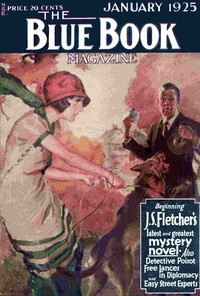
The strike at Too Dry
Subjects:
Download Formats:
Excerpt
Young Percival came out of the East to a Montana ranch, and
a pleasant time was not had by all--though the reader will
be much diverted.
The postmaster at Too Dry poked his head out of the door of the shack
which served as combination of post office, real-estate office and
residence, spat generously into the dusty road and yelled to the big man
who had drawn up at what might in a city have been called the curb.
“I guess it’s for you. Came yesterday. It’s in a thick envelope...
Read the Full Text
— End of The strike at Too Dry —
Book Information
- Title
- The strike at Too Dry
- Author(s)
- Brindley, Willis
- Language
- English
- Type
- Text
- Release Date
- July 27, 2024
- Word Count
- 5,188 words
- Library of Congress Classification
- PS
- Bookshelves
- Browsing: Humour, Browsing: Fiction
- Rights
- Public domain in the USA.
Related Books
Famous stories from foreign countries
English
494h 26m read
The Desert Moon mystery
by Strahan, Kay Cleaver
English
1486h 49m read
The incredible slingshot bombs
by Williams, Robert Moore
English
96h 4m read
The eater of souls
by Kuttner, Henry
English
22h 19m read

Sun Dog loot
by Tuttle, W. C. (Wilbur C.)
English
769h 16m read
Henry goes prehistoric
by Tuttle, W. C. (Wilbur C.)
English
249h 1m read