*** START OF THE PROJECT GUTENBERG EBOOK 61601 ***
Transcriber’s Note: Italic text is denoted by _underscores_ .
[Illustration: SCENE OF THE RIOT.]
ACCOUNT
OF THE
TERRIFIC AND FATAL RIOT
AT THE
New York Astor Place Opera House,
_On the night of May 10th, 1849;_
WITH THE
QUARRELS OF FORREST AND MACREADY,
INCLUDING ALL THE CAUSES WHICH LED TO THAT
AWFUL TRAGEDY!
Wherein an infuriated mob was quelled by the Public Authorities and
Military,
with its mournful termination in the
Sudden Death or Mutilation of more than Fifty Citizens,
WITH FULL AND AUTHENTIC PARTICULARS.
“LET JUSTICE BE DONE THOUGH THE HEAVENS FALL!”
_NEW YORK_:
PUBLISHED BY H. M. RANNEY.
1849.
Entered, according to Act of Congress, in the year 1849,
BY H. M. RANNEY,
In the Clerk’s office of the District Court of the United States, in
and for the Southern District of New York.
THE RIOT.
CHAPTER FIRST.
THE NIGHT OF THE 10TH OF MAY.
On the night of the 10th of May, 1849, the Empire City, the great
metropolis of the Union, was the scene of one of those horrors of
civilization, which for a time make the great heart of humanity stop
in its beatings. In the darkness of night, thousands of citizens were
gathered in a central square of the most aristocratic quarter of New
York—gathered around one of its most conspicuous and magnificent
edifices, the Astor-Place Opera House.
This Opera House was built expressly for the performance of the Italian
Opera, but has been used at intervals for the legitimate drama, for
vaudevilles, and for balls and concerts. It is fitted up and decorated
with taste and magnificence, and in the opera seasons has been attended
by the most wealthy and fashionable people, who have made extravagant
displays of luxurious adornment. While the private boxes were taken by
the season, by those who wished to enjoy the music, liked the display,
and could afford the expenditure, the other seats were let at a dollar
admission, and the upper tier or amphitheatre was reserved for people
of humbler means or more modest pretensions, at twenty-five cents a
ticket.
Around this edifice, we say, a vast crowd was gathered. On the stage
the English actor Macready was trying to play the part of _Macbeth_,
in which he was interrupted by hisses and hootings, and encouraged by
the cheers of a large audience, who had crowded the house to sustain
him. On the outside a mob was gathering, trying to force an entrance
into the house, and throwing volleys of stones at the barricaded
windows. In the house the police were arresting those who made the
disturbance—outside they were driven back by volleys of paving-stones.
In the midst of this scene of clamor and outrage, was heard the clatter
of a troop of horse approaching the scene. “The military—the military
are coming!” was the exclamation of the crowd. Further on was heard the
quick tramp of companies of infantry, and there was seen the gleam of
bayonets. A cry of rage burst from the mob. The appearance of an armed
force seemed to inspire them with a sudden fury. They ceased storming
the Opera House, and turned their volleys against the horsemen. Amid
piercing yells and execrations, men were knocked from their horses, the
untrained animals were frightened, and the force was speedily routed,
and could not afterwards be rallied to perform any efficient service.
Now came the turn of the infantry. They marched down the sidewalk in a
solid column; but had no sooner taken up a position for the protection
of the house, than they were assailed with volleys of missals. Soldiers
were knocked down and carried off wounded. Officers were disabled. An
attempt to charge with the bayonet was frustrated by the dense crowd
seizing the muskets, and attempting to wrest them from the hands of
the soldiers. At last the awful word was given to fire—there was a
gleam of sulphurous light, a sharp quick rattle, and here and there in
the crowd a man sank upon the pavement with a deep groan or a death
rattle. Then came a more furious attack, and a wild yell of vengeance!
Then the rattle of another death-dealing volley, far more fatal than
the first. The ground was covered with killed and wounded—the pavement
was stained with blood. A panic seized the multitude, which broke and
scattered in every direction. In the darkness of the night yells of
rage, screams of agony, and dying groans were mingled together. Groups
of men took up the wounded and the dead, and conveyed them to the
neighboring apothecary shops, station-houses, and the hospital.
The horrors of that night can never be described. We looked over the
scene that misty midnight. The military, resting from their work of
death, in stern silence were grimly guarding the Opera House. Its
interior was a rendezvous and a hospital for the wounded military
and police. Here and there around the building, and at the corners
of the streets were crowds of men talking in deep and earnest tones
of indignation. There were little processions moving off with the
dead or mutilated bodies of their friends and relations. A husband,
uttering frenzied curses, followed his mortally wounded wife to the
hospital. An aged mother found her only son, the sole support of her
declining years, in the agonies of death. Many a wife sat watching at
home, in terror and alarm for her absent husband. It was an evening of
dread—and it became a night of horror, which on the morrow, when the
awful tragedy became more widely known, settled down upon the city like
a funeral pall.
The result of that night’s work was the death of twenty-two victims,
either shot dead upon the spot or mortally wounded, so that they died
within a few days; and the wounding of some thirty more, many of whom
will be maimed for life. Into the causes which led to a result so
fatal, and all the circumstances attending it, it will now be our duty
to inquire.
CHAPTER SECOND.
FORREST AND MACREADY.
MR. EDWIN FORREST, the American Tragedian, was born, some forty-five
years ago, in the city of Philadelphia. He was born in humble life, and
worked his way up from poverty and obscurity to wealth and fame, by the
power of genius. When a boy, he made his first histrionic efforts in an
amateur company; afterwards, he made a professional tour at the west.
After various adventures, young Forrest found himself in the city of
New York, in the year 1826, when Gilfert was about to open the Bowery
Theatre. He wanted a star of powerful attraction, and his experienced
eye fell on Forrest. He was engaged—puffed in all the papers as
the _Native_ Tragedian—the patriotism of New-Yorkers was appealed
to—Forrest used his mental gifts and great personal advantages with
discretion and effect, and became a star of the first magnitude; so
that, in a short time, he demanded and received two hundred dollars a
night for his performances; and, with energy and temperate habits, has
been able to accumulate an ample fortune.
After his first successes—determined to shine alone as a star of the
first magnitude—he offered a prize of five hundred dollars for the
best tragedy—suiting his powers as the hero; and the result was, Mr.
Stone’s “Metamora.” Soon after, he secured the “Gladiator,” written by
Dr. Bird. These have been his most successful performances, and in them
he has had no competitor, nor is it likely that he would find an equal.
Mr. William C. Macready is an English actor of great eminence. He was
born in the city of Cork, (Ireland,) and must now be nearly seventy
years old. In the early part of his theatrical career, he was most
distinguished in such parts as “Virginius,” “William Tell,” “Pierre,”
“Carwin,” &c.; but of late, he has given his chief attention to the
plays of Shakspeare—in which he has shown himself a thorough artist.
In 1827—one year after the successful commencement of Mr. Forrest’s
career as a star of the first magnitude—Mr. Macready visited the
United States. In a fit of petulance, in which such actors are too
apt to indulge, Mr. Macready came near fomenting a disturbance in
Baltimore, which, but for his adroit management, might have caused him
then to have been driven from the American stage. In playing “William
Tell,” the property-man had forgotten to furnish the arrow to be
broken; and Macready was obliged to break one of his shooting arrows.
In his anger at the offending party, he said—“I can’t get such an
arrow in your country, sir!” or, as it was reported—“I can’t get wood
to make such an arrow in your country!” This was construed into an
insult to the country. Anonymous letters were sent to the newspapers;
but, as these were sent to Mr. M., he had an opportunity to make an
explanation, and avoid a row.
Macready and Forrest were starring through the country, playing
alternate engagements—but not, so far as we know, developing any
very decided feelings of rivalry. Their roles of characters, and
spheres of action, were quite apart; and when they met each other,
their intercourse—as it was many years afterward—was of the most
gentlemanly character.
About the year 1835, Mr. Forrest went to Europe, and spent some time in
travelling on the continent; after which, he returned to America for
a short time; and then went back to England, to fulfil professional
engagements—in which he was so highly successful, that on his return,
he was honored with a public dinner in Philadelphia; and about this
time, he was tendered a nomination to Congress by the Democracy of New
York—before whom he delivered a Fourth of July oration.
In 1844, Mr. Macready visited the United States. He and Mr. Forrest
had become intimate in England; and here, Mr. F. tendered him the
courtesies due to so distinguished a professional brother; but it so
happened, that in most of the cities where Macready was engaged, there
were more theatres than one—and, of consequence, rival managers. Where
one of these had secured Mr. Macready, the other was anxious to get
the best talent to be found to run against him; and there was no one
so available as Mr. Forrest—who is not the man to refuse a profitable
engagement, nor did any rule of courtesy require that he should do so.
The result was, that the constant rivalry of Forrest, though carried on
in the most friendly manner, could not fail to injure the success of
Macready. A certain degree of partizanship was everywhere excited—for
Forrest was everywhere placarded as the “_American_ Tragedian,”—and
the tour of Mr. Macready was comparatively a failure. A sensitive man
could not but feel this; and whether he made any complaint or not, his
friends saw what the difficulty was, and felt not a little chagrined
about it; and when Mr. Forrest made his next and last professional
visit to England, this feeling among the friends of Macready, in
the theatrical press and the play-going public, found its vent. The
opposition to him was, from the first, marked and fatal; and, so far as
the metropolis was concerned, his tour was a failure. It was only in
the provinces—away from London influence—that he met with any degree
of success.
There was no need of Mr. Macready taking any active part in this
matter; and there is no proof that he did so, but much to the contrary;
but Mr. Forrest hastily and indignantly, and, we doubt not, sincerely,
charged it upon Mr. Macready; and one night, when the latter was
playing in “Hamlet,” at the Theatre in Edinburgh, Mr. Forrest, who was
seated in a private box, had the bad taste, as well as bad feeling,
to hiss a portion of his performance in the most marked and offensive
manner.
The following letter from Mr. Forrest gives his own account of this
affair, which differs somewhat from the statements of Mr. Macready’s
friends, as will be seen hereafter.
_To the Editor of the London Times_,—SIR,—Having seen
in your journal of the 12th instant, an article headed
“Professional Jealousy,” a part of which originally appeared
in _The Scotsman_ published in Edinburgh, I beg leave,
through the medium of your columns, to state, that at the
time of its publication, I addressed a letter to the Editor
of _The Scotsman_ upon the subject, which, as I then was in
Dumfries, I sent to a friend in Edinburgh, requesting him to
obtain its insertion; but as I was informed, _The Scotsman_
refused to receive any communication upon the subject. I
need say nothing of the injustice of this refusal. Here then
I was disposed to let the matter rest, as upon more mature
reflection, I did not deem it worth further attention; but
now, as the matter has assumed “a questionable shape” by the
appearance of the article in your journal, I feel called
upon, although reluctantly, to answer it.
There are two legitimate modes of evincing approbation and
disapprobation in the theatre—one expressive of approbation,
by the clapping of hands, and the other by hisses to mark
dissent; and as well-timed and hearty applause, is the just
meed of the actor who deserves well, so also is hissing, a
salutary and wholesome corrective of the abuses of the stage;
and it was against one of these abuses that _my_ dissent was
expressed, and not, as was stated, “with a view of expressing
his (my) disapproval of the manner in which Mr. Macready gave
effect to a particular passage.” The truth is, Mr. Macready
thought fit to introduce a fancy dance into his performance
of “Hamlet,” which I thought, and still think, a desecration
of the scene, and at which I evinced that disapprobation, for
which the pseudo-critic is pleased to term me an “offender,”
and this was the only time during the performance that I
did so, although the writer evidently seeks, in the article
alluded to, to convey a different impression. It must be
observed also, that I was by no means “solitary” in this
expression of opinion.
That a man may manifest his pleasure or displeasure after
the recognised mode, according to the best of his judgment,
actuated by proper motives, and for justifiable ends, is a
right, which, until now, I have never once heard questioned,
and I contend, that right extends equally to an actor, in his
capacity as a spectator, as to any other man; besides, from
the nature of his studies, he is much more competent to judge
of a theatrical performance than any _soidisant_ critic, who
has never himself been an actor. The writer of the article
in _The Scotsman_, who has most unwarrantably singled me out
for public animadversion, has carefully omitted to notice
the fact, that I warmly applauded several points of Mr.
Macready’s performance; and more than once I regretted that
the audience did not second me in so doing. As to the pitiful
charge of professional jealousy preferred against me, I
dismiss it with the contempt it merits, confidently relying
upon all those of the profession with whom I have been
associated, for a refutation of this slander.
Yours, respectfully,
EDWIN FORREST.
March, 1846.—_Times, 4th of April._
CHAPTER THIRD.
THE QUARREL RECOMMENCED IN AMERICA.
MR. FORREST, chagrined by his failure in England, and maddened at what
he imagined to be the malign influence of Macready, returned to the
United States after a vain attempt to secure an engagement in Paris,
in which he supposed the same influence had defeated him. He had
publicly hissed Macready in Edinburgh, had avowed the act, and given
his reasons. His friends here felt much as the friends of Mr. Macready
had felt in England; and when the latter last year came on another
professional visit to the United States, he found that a bitter feeling
had been raised against him, which found its first expression, so far
as we know, in the following article, that appeared in the Boston Mail
on the morning of Mr. Macready’s appearance at the Howard Athenæum,
Boston, Monday, Oct. 30th, 1848.
[Boston Mail, Oct. 30th, 1848.]
_More about Macready—His abuse of Forrest in
Europe—Endeavors to put him down in Paris, London and
Edinburgh—His Intrigue with Bulwer to prevent Forrest
playing in Bulwer’s Pieces—His Abuse of Americans._
Mr. Macready has at length arrived, and next to the grand water
celebration, will create such excitement, as will emphatically mark
the present epoch in time’s calendar. He plays this evening at the
Howard Athenæum, and refuses to show himself for less than one dollar a
ticket. This was his price in New York, and with the exception of the
first night, resulted in a “beggarly account of empty boxes.” We repeat
what we said in a former article, that Mr. Pelby, the enterprising
manager of the National Theatre, deserves immortal honors for not
acceding to the dictatorial terms of this actor autocrat. Although
Macready saw fit on his opening night in New York, on being called out
by some friends, to slur a “_certain penny paper_,” that had “_dared_”
to express an opinion regarding his talents and conduct, we shall not
by any means give him the retort churlish; we only pity his ignorance
of the institutions of this country, and hope for his own credit’s sake
that he will not, when he gets home, write a black book about American
manners, &c., _a la_ Trollope and others, but if he does, that he will
spare us in the production of his brain. The reader will no doubt ask,
what fault we find with Mr. Macready. Has he not the same right as
other men have, to do as he pleases? We answer yes. He has a right to
come to this country in the exercise of his profession; he has a right
to demand a dollar from every person who witnesses his acting, and if
managers of Theatres are willing to accede to his arbitrary proposals,
he has certainly a right to make them. We complain not of any of these.
Our charges against Macready are based upon more important grounds. It
is his conduct in his own country in relation to Mr. Forrest, that we
are about investigating; _his inhospitality_, _his crushing influence_,
_his vindictive opposition_, _and his steadfast determination to ruin
the prospects of that gentleman in England_, that we bring to his door.
Let him deny them if he can. Every true American takes a pride in that
which represents his country’s interests, industry, and enterprise,
and from the smallest commodity gathered from his soil to the loftiest
labors of his genius, his ambition goes with it, and the strong arm of
his power will protect it in every clime. Mr. Edwin Forrest is titled
the American Tragedian—he is justly entitled to that honor—he has
acquired it by his own labors; from a poor boy in a circus, he has
arisen to be a man of fame and wealth, all of which he has lastingly
gained by enterprise and talent, and secured both by economy and
TEMPERANCE.
Every American-born man is willing that Mr. Forrest should wear this
title, and when he visited England they were anxiously interested in
his success. Macready had previously been in this country, and played
engagements in every city, and made a fortune. He was extolled by
the press, and treated as a gentleman by the citizens of ever place
visited. But instead of returning this kindness, he acted openly
towards Mr. Forrest as his determined foe. We speak by card, and write
upon the very best information, viz., the highest authority. In Paris
Mr. Macready and Mr. Forrest met. The latter was anxious to appear on
the French boards; but Macready threw obstacles in the way, and this
was the first time that the two parties were enemies. Mr. Mitchell, the
enterprising lessee of St. James Theatre in London, took an English
company of actors to the French capital, with Mr. Macready at the
head of the list. Macready was to be the hero—the great attraction
of Paris. He failed, however, to draw money to the treasury, and Mr.
Mitchell lost a large sum by the speculation, or rather would have
lost it, if Louis Philippe had not made him most liberal presents. Mr.
Forrest had letters of introduction to Mr. Mitchell from his friends in
London, but Macready was jealous, lest Forrest should prove to be _the_
great star, and he cautioned Mitchell not to allow Forrest to appear.
The result was that Mr. Mitchell refused to see Mr. Forrest.
The parties returned to London. The hypocrisy of Macready is apparent
in his note of invitation to Mr. Forrest to dine with him. The latter,
knowing the intrigue that had been carried on in Paris between Macready
and Mitchell, refused, as every high-minded man should, to dine with
him. This is a very different version to that recently given by some
of Macready’s friends—if friends he have—that Forrest was offended
because he was not invited to dine; as if such a man as Mr. Forrest
could take offence at such a trifle, when at the same time he was
invited to dine with many of the leading nobility of England, but
especially of Scotland, where he passed several months as their guest.
The next mean act towards Forrest, brought about through the influence
of Macready, was when Mr. F. appeared at the Princess’s Theatre
in London. Mac had been endeavoring for a long time to effect an
engagement with some London manager, but was unsuccessful. The success
of Forrest stung him, and he resolved to “put him down.” It was said
at the time that he or his friends actually hired men to visit the
theatre, and hiss Forrest off the stage, and Forrest was consequently
received with a shower of hisses before he was heard. This mean conduct
was followed up by the press, by which Forrest was most outrageously
assailed, and not Forrest alone, but his country, which is proud to own
him as one of her sons.
Forrest and Macready next met in Edinburgh, and from this city were
sent forth the grossest calumnies against Forrest. Macready was playing
at the Theatre Royal in _Hamlet_—Forrest was present. During the
beginning of the piece Mr. Forrest applauded several times, and, as
we are informed by an eyewitness, he started the applause when some
brilliant effect had been given to a passage, so that the whole house
followed him. But now comes Forrest’s great sin—that giant sin which
Mac will never forgive—the sin of hissing Macready for dancing and
throwing up his handkerchief across the stage in the _Pas de Mouchoir_.
Mr. F. not only hissed, but the whole house hissed, and yet Macready
dared to write to London, that Forrest had singly and alone attempted
to hiss him from the stage.
To show that Mr. Forrest was not alone in this matter, we are able to
state that two weeks afterwards _Hamlet_ was repeated, when the whole
house again hissed Macready’s dance across the stage.
Out of this simple incident Macready contrived to create a great deal
of sympathy for himself. He is, or was, part proprietor of the _London
Examiner_; or if not sole owner, he possesses the body and soul of its
theatrical critic, Foster, who does all kinds of dirty work for his
master. Macready gave the cue to Foster, and Forrest was denounced
by the _Examiner_ and other papers, in which Foster or Mac had any
influence. A false coloring was put on this affair, and Mac appeared to
the world as a persecuted man, whereas Forrest was the one who met with
persecution at every corner—in Paris, in London, in Edinburgh, and in
London a second time.
But Macready’s persecution did not stop here. Forrest wished to appear
in London, in Bulwer’s Lady of Lyons and Richelieu. To do this,
permission must be obtained of the author. Forrest addressed a note
to Bulwer, asking his terms for the plays. After a long delay, Bulwer
replied, that he should charge Forrest £2 per night for the use of
them, and he must play 40 nights! Such terms for plays, that had in a
great measure lost their interest, compelled Forrest to reject them. It
was ascertained that Macready and Bulwer had been much together, and
that the former had prevailed on the latter not to allow Forrest the
use of his compositions.
Forrest could not entertain any jealous feelings towards Mac, for he
drew crowded houses during his engagement at the Princess’s Theatre,
whereas Macready had very slim audiences; and on one occasion we know
that our own charming actress, Mrs. Barrett, on one of the off-nights,
at the time Mac was playing, actually drew more money to the treasury
than Macready.
We have now given a plain statement of facts, and such as cannot be
controverted. It proves that actors, like Macready, Anderson, and
others, find it very hard scratching in their own country, and much
better pickings here. It is to be hoped, however, that we Americans
will finally become awakened to the mercenary motives of such artistes,
and when we have any surplus of dollars to spend, that we will be
generous and just to our own home genius.
Here is displayed the feeling of the friends of Mr. Forrest, and to a
great extent of Mr. Forrest himself, for the writer of this article
asserts that its statements are made on the “very highest authority.”
On his part Mr. Macready unwisely alluded to this article in one
of his before-the-curtain speeches, speaking contemptuously of the
attacks of a certain penny paper. But the Bostonians are a quiet
people, and Macready and Forrest played through their engagements
without any popular demonstration. At New York Macready played at the
Opera House, and Forrest at the Broadway Theatre. There were rumors
of a disturbance, but they amounted to nothing. Both engagements were
finished in peace, and both actors went to fulfil engagements at the
rival theatres in Philadelphia.
Now Forrest had made some pretence of retiring from the stage—he
had built him a splendid castle on the banks of the Hudson, and had
achieved a splendid fortune—but here he was, following up Macready
step by step, and making no concealment of his enmity. His friends
were doubtless busy, especially in Philadelphia, his birth place. The
two actors made mouths and speeches at each other. One night Macready
alluded to the ungenerous treatment he had received from a rival actor.
This brought Forrest out in the following:—
CARD.
Mr. Macready, in his speech, last night, to the audience
assembled at the Arch Street Theatre, made allusion, I
understand, to “an American actor” who had the temerity, on
one occasion, “_openly_ to hiss him.” This is true, and by
the way, the _only_ truth which I have been enabled to gather
from the whole scope of his address. But why say “an American
actor?” Why not openly charge me with the act? for I _did_
it, and publicly avowed it in the Times newspaper of London,
and at the same time asserted my right to do so.
On the occasion alluded to, Mr. Macready introduced a fancy
dance into his performance of Hamlet, which I designated
as a _pas de mouchoir_, and which I hissed, for I thought
it a desecration of the scene, and the audience thought
so, too, for in a few nights afterwards, when Mr. Macready
repeated the part of Hamlet with the same “tom-foolery,” the
intelligent audience of Edinburgh greeted it with a universal
hiss.
Mr. Macready is stated to have said last night, that up to
the time of this act on my part, he had “never entertained
towards me a feeling of unkindness.” I unhesitatingly
pronounce this to be a wilful and unblushing falsehood.
I most solemnly aver and do believe, that Mr. Macready,
instigated by his narrow envious mind, and his selfish fears,
did _secretly_—not _openly_—suborn several writers for the
English press, to write me down. Among them was one Forster,
a “toady” of the _eminent tragedian_—one who is ever ready
to do his dirty work; and this Forster, at the bidding of his
patron, attacked me in print even before I appeared upon the
London boards, and continued his abuse at every opportunity
afterwards.
I assert, also, and solemnly believe, that Mr. Macready
connived, when his friends went to the theatre in London to
hiss me, and did hiss me, with the purpose of driving me
from the stage—and all this happened many months before
the affair at Edinburgh, to which Mr. Macready refers, and
in relation to which he jesuitically remarks, that “until
that act, he never entertained towards me a feeling of
unkindness.” Bah! Mr. Macready has no feeling of kindness for
any actor who is likely, by his talent, to stand in his way.
His whole course as manager and as actor proves this—there
is nothing in him but self—self—self—and his own
countrymen, the English actors, know this well. Mr. Macready
has a very lively imagination, and often draws upon it for
his facts. He said in a speech at New York, that there,
also, there was an “organized opposition” to him, which is
likewise false. There was no opposition manifested towards
him there—for I was in the city at the time, and was careful
to watch every movement with regard to such a matter. Many
of my friends called upon me when Mr. Macready was announced
to perform, and proposed to drive him from the stage for his
conduct towards me in London. My advice was, do nothing—let
the superannuated driveller alone—to oppose him would be
but to make him of some importance. My friends agreed with
me it was, at least, the most dignified course to pursue,
and it was immediately adopted. With regard to “an organized
opposition to him” in Boston, this is, I believe, equally
false, but perhaps in _charity_ to the poor old man, I should
impute these “chimeras dire,” rather to the disturbed state
of his guilty conscience, than to any desire on his part
wilfully to misrepresent.
EDWIN FORREST.
_Philadelphia_, Nov. 21, 1848.
This violent and vindictive, but characteristic manifesto, as may be
supposed, did not help Mr. Forrest’s cause very materially, with quiet
and well-judging people, but it probably found sympathy among heated
partizans, and those who supposed the honor and glory of the country
was at stake. Mr. Macready appears to have made up his mind at once to
sue Forrest for a libel, and accordingly he issued the following:—
CARD
TO THE PUBLIC OF PHILADELPHIA.
In a card published in the Public Ledger and other morning
papers of this day, Mr. Forrest having avowed himself the
author of the statements, which Mr. Macready has solemnly
pledged his honor to be without the least foundation, Mr.
Macready cannot be wanting in self-respect so far as to
bandy words upon the subject, but as the circulation of such
statements is manifestly calculated to prejudice Mr. Macready
in the opinion of the American Public, and affect both his
professional interests and his estimation in society, Mr.
Macready respectfully requests the public to suspend their
judgment upon the question, until the decision of a Legal
Tribunal, before which he will immediately take measures
to bring it, and before which he will prove his veracity,
hitherto unquestioned, shall place the truth beyond doubt.
Reluctant as he is to notice further Mr. Forrest’s Card,
Mr. Macready has to observe, that when Mr. Forrest appeared
at the Princess’s Theatre in London, he himself was absent
some hundred miles from that city, and was ignorant of his
engagement until after it had begun; that not one single
notice on Mr. Forrest’s acting appeared in the Examiner
during that engagement (as its files will prove.) Mr.
Forster, the distinguished Editor, whom Mr. Macready has the
honor to call his friend, having been confined to his bed
with a rheumatic fever during the whole period, and some
weeks before and after.
For the other aspersions upon Mr. Macready, published in the
Boston Mail, and now, as it is understood, avowed by Mr.
Forrest, Mr. Macready will without delay appeal for legal
redress.
JONES’S HOTEL, Nov. 22d, 1848.
Immediately after publishing the above, Mr. Macready committed to
his counsel, Messrs. Reed & Meredith, of Philadelphia, authority to
commence such legal proceedings as they might deem advisable: and,
preparatory thereto, he obtained from England the documentary evidence.
As regards the charge of suborning the English press, it will be
sufficient here to refer to the Times, Globe, Observer, Spectator,
Morning Chronicle, Morning Post, Weekly Dispatch, Britannia, &c.,
&c., of dates Dec. 13, 14, 15, 16, &c., which have indignantly and
emphatically denied the charge; many of which denials have already been
republished in the American newspapers.
It appears, however, that when Mr. Macready came to consult his legal
advisers, two eminent Philadelphia lawyers, they wisely advised him to
let the matter drop, and be satisfied with his reputation. So Macready
went South, and was feted and feasted in New Orleans to his heart’s
content, but to the grievous discontent of Mr. Forrest and his numerous
admirers.
In the meantime, Macready had written to England for evidence to prove
that the statements in Mr. Forrest’s Philadelphia card were libelous;
and when he decided to give up his law suit, he caused these documents
to be printed in a pamphlet, which however, he soon withdrew from
public circulation. There were letters from Edinburgh to prove that
Mr. Forrest was alone in hissing the “fancy dance” in Hamlet; letters
from the proprietor and theatrical critic of the London Examiner, to
show that Macready had not influenced any criticisms on Forrest in that
paper; from Sir E. Bulwer Lytton, asserting that he had offered his
plays to Mr. Forrest for a fair consideration, and had not withheld
them at the request of Mr. Macready, with other equally pertinent
documents. But what avail were these? The friends of Forrest felt sure
that he had been shamefully treated in England, by the friends of
Macready; and whether he was a party to the matter or not, they meant
to hold him responsible, and therefore it was determined that he should
never play another engagement in New York, and that determination was
enforced, but oh! at what a fearful sacrifice.
CHAPTER FOURTH.
THE PLOT THICKENS—THE ENGAGEMENT AT THE OPERA. HOUSE—MACREADY DRIVEN
FROM THE STAGE.
It must not be supposed that this was the first manifestation of
patriotic indignation on the part of the friends of Mr. Forrest, on
account of his treatment in England. It was a deep and intense feeling,
and was ready to burst out on any fitting occasion. It threatened Mr.
Anderson, and in Philadelphia an effort was made to drive him from the
stage; but a better feeling prevailed. Anderson was not charged with
any ill-will to Mr. Forrest, and the opposition to him was abandoned:
yet there were not wanting persons who contended that every English
actor ought to be driven from the American stage, in revenge for the
insult offered by England to this country, in the person of Edwin
Forrest.
But when Macready, who was charged by Forrest himself with being the
head and front of this offending, came to the United States, the flame
of hatred was ready to burst forth, and the only wonder is, that it
remained pent up so long. On his return from the South, Messrs. Niblo
and Hackett, who had taken the Opera House for that purpose, announced
that Mr. Macready would open an engagement on Monday night, May 7th.
Mr. Forrest was playing at the Broadway Theatre. Previous to the
commencement of this engagement, Mr. Macready gave a reading of a play
of Shakspeare before the teachers of the public schools of New York
and Brooklyn.
The announcement of this engagement was the signal for an outbreak of
long-smothered indignation. It was determined that Mr. Forrest should
be avenged, and that Macready should not be permitted to play before
a New York audience. There was a combination of exciting causes—the
feeling against England and Englishmen, handed down to us from the
Revolution, and kept fresh by the insults and abuse of British writers
on American manners—the injury committed against Forrest, with
Macready as its presumed cause, and this was increased by the fact of
Macready playing at the aristocratic, kidglove Opera House. Far be it
from us to justify these feelings—it is our duty simply to state the
fact of their existence.
The public and magistrates have been accustomed to look upon theatrical
disturbances, rows, and riots, as different in their character from
all others. The stage is presumed to be a correction of the manners
and morals of the public, and on the other hand the public has been
left to correct, in its own energetic way, the manners and morals
of the stage; and magistrates, looking upon it as a matter between
the actors and the audience, have generally refused to interfere,
unless there was a prospect of a violent breach of the peace, when
they have usually ordered the house to be closed. In these theatrical
disturbances, performances have been hissed, plays damned, and actors
and actresses driven from the stage, with whatever degree of force has
been necessary for their rejection. This has been the practice in the
United States, as well as in Europe, and no actor, in any free country,
has thought of acting with a posse of police at his back; much less, a
file of soldiers, or a piece of artillery, to defend his rights.
On the announcement of Mr. Macready’s engagement at the Opera House,
it was determined that there should be a pretty forcible expression of
opinion on the part of those who were indignant at the treatment of Mr.
Forrest in England, and were willing, for any reason, to revenge it on
Mr. Macready. There was, doubtless, some organization of forces, to
bring about this result, and one person, the well-known Capt. Rynders,
admits that he purchased and distributed among his friends fifty
tickets, with the understanding that those who used them were to assist
in hissing Macready from the stage. Other sums of money were given, and
when the night arrived, it was estimated, by the Chief of Police, that
not less than five hundred persons were engaged in the disturbance.
The night came—the house was crowded, and there was an ominous looking
gallery. The curtain rose, and some of the actors, who were popular
favorites, were received with obstreperous applause; but when Macready
appeared upon the stage, in the character of Macbeth, he was assailed
by a storm of hisses, yells, and a clamor that defies description. He
stood his ground firmly, and the play went on, but not a word could be
heard by the audience. It was in dumb show. The clamor rose higher and
higher, and as hisses and threats, cat-calls and yells, were not enough
to drive the obnoxious actor from the stage, less legitimate means were
resorted to. Rotten eggs were thrown, pennies, and other missiles; and
soon, still more outrageous demonstrations were made, and chairs were
thrown from the upper part of the house, so as to peril life.
The Chief of Police was present, with a number of policemen; but the
rioters boldly defied the authorities, and no arrests were attempted.
It is said, in excuse, that the rioters were in overpowering numbers,
that they were prepared to resist and rescue, and that they had even
prepared papers of gunpowder to throw into the magnificent chandelier.
A large portion of the audience consisted of ladies, whose lives might
have been endangered, and there was nothing to do but to stop the
performance. The curtain went down; cheers were given for Forrest, and
groans for Macready, and the crowd dispersed.
Mr. Macready supposed that his engagement was terminated. He had no
idea of ever making a second appearance; but his friends and the
enemies of Forrest insisted upon a different course. He was assured
that the public would sustain him, and the managers did not wish to
lose the profits of his engagement. Mr. Hackett is a personal enemy
of Forrest, and he was determined to play Macready against him at all
hazards. Finally, a number of influential citizens, men of wealth and
standing, with Washington Irving at their head, wrote a formal request
to Mr. Macready that he should play out his engagement, and pledging
themselves that the public should sustain him; and it was determined
and announced that he should appear on Thursday evening, May 10th.
This announcement, as may be supposed, excited the indignation of
those who had driven him from the stage. It was a combination of the
aristocracy against the people, and in support of English arrogance,
and it was determined that Macready should not play, and that he and
his supporters should be put down at all hazards. The lessees of
the Theatre were informed that the re-opening of the Theatre with
Mr. Macready, would be the signal for riot; the magistrates of the
city were informed of it, and were implored to avert the calamity by
refusing to allow the house to be opened—for as the city authorities
have the right to regulate Theatres, and to make them pay five hundred
dollars a year for a license, it was presumed that they had also the
right to close them. So thought the Mayor, and so he wished to act;
but the lessees insisted upon their legal rights, and demanded the
protection of the authorities, and the fatal decision was made which
made New York, a few hours afterward, one wide scene of horror.
CHAPTER FIFTH.
THE COMBAT DEEPENS.
The announcement that Mr. Macready would appear at the Opera House in
_Macbeth_ on Thursday evening produced a varied excitement throughout
the community. Those who thought the city disgraced by the scenes of
Monday night were anxious to have that disgrace atoned for by his
successful re-appearance, while those who sympathized with the mob
that drove him from the stage, looked upon his re-appearance as a new
insult, and the manner in which it was brought about was as irritating
to them as the act itself.
A riot was anticipated by all who were acquainted with the
circumstances, except, perhaps the object of popular indignation. Mr.
Macready was assured that there would be no difficulty, and he seems
to have believed it—but those who so assured him well understood that
those who had triumphantly driven him from the stage on Monday were not
likely to submit quietly to his re-appearance.
Thursday morning, the leaders on both sides were active. The friends
of Forrest were gathering their forces, and distributing tickets
for the night’s performance, while the lessees of the Opera House
applied to the mayor and other authorities of New York for protection.
Inflammatory handbills had been posted upon the walls of the city,
calculated to increase the excitement. In the mayor’s office, the
recorder, the chief of police, the sheriff, Major General Sandford,
and Brigadier General Hall, were assembled to consult on the means of
protecting the Opera House, and enabling Mr. Macready to play _Macbeth_.
The mayor, Mr. Woodhull, advised Niblo and Hackett to close the house,
and to avoid a riot, and the probable destruction of property and life;
but these gentlemen were determined to stand upon their rights, and the
city authorities decided, after consulting together, to sustain them,
if necessary, with all the force at their disposal. Mr. Matsell, the
chief of police, was asked if the civil force at his disposal would be
sufficient for the preservation of the peace, and though he had nine
hundred salaried policemen at his disposal, and the power of calling in
specials at discretion, he gave it as his opinion that this force was
not sufficient. It was thought necessary to call out the military.
It has been boldly questioned whether all these extraordinary
preparations would have been made to protect the legal rights of humble
citizens. Rich and influential men had invited Mr. Macready to play at
the aristocratic Opera House. Suppose it had been some third-rate actor
at the Chatham; suppose the request for him to play had come from the
patrons of that establishment. The abstract question of right would
have been the same; but there are many who would doubt whether the city
authorities would have taken the extraordinary measure of calling out
the military—and this was probably the first time such a thing was
ever done under any but the most despotic governments.
The fact of the chief of police declaring that his force was not
sufficient to preserve the peace—the fact that General Sandford was
ordered to call out a military force sufficient for the emergency,
proves that the nature and extent of the approaching riot was well
understood by the authorities, and still no means were used to prevent
it. It seems to have been their policy to let it gather, and come to a
head, when, one would suppose, it might easily have been scattered. Had
the police arrested a few of the leaders, and kept a close watch on the
rioters—had they taken possession of the vicinity of the Opera House
in force, and prevented the gathering of a crowd around it, it seems
probable that the peace of the city, and the rights of Mr. Macready
might have been maintained at a trifling sacrifice. But a different
course was decided upon, and the preparations of the military and
police were made accordingly. The chief detached two hundred policemen,
to be stationed inside the Opera House. He also placed a detachment in
the stable of Mr. Langdon, on the opposite side of Astor-Place, and
another body in a yard near by. General Sandford ordered out companies
from several regiments, as will be more particularly stated hereafter.
And now the news spread all over the city that there was to be a riot.
The warning out of large bodies of military, was alone sufficient to
excite curiosity; and yet, in all this excitement and anticipation of
outrage, the mayor issued no warning proclamation. There was no one
to tell hot-headed and misguided men, that it would be at the peril
of their lives, if they disturbed the peace. It is evident that they
thought they had a right to prevent Macready from playing. They were
doing no more by him than the English had done by Forrest, and they
looked upon it as a piece of retributive justice.
It must not be forgotten, that New York, for many years, has been a
very quiet city. For ten years, there had not been one serious riot.
The principles of law and order are habitually acknowledged, and have
seldom been violated. While Philadelphia has been, for years, the scene
of the most disgraceful outrages, New York has not known a more serious
disturbance than could be controlled by a few policemen. But in this
case, every body rushed into a fatal riot, with a mad precipitation.
The calling out of the military sent thousands to the scene of
conflict, who would not otherwise have gone, swelled the crowd,
encouraged the rioters, and contributed to the fatal result.
It is easy to say, people had no business there; they ought to have
kept away. It would be hard to show that those who were outside the
house had not as good a right to gratify their curiosity as those
within. But, right or wrong, we know very well what people will do in
such a case. Let it be given out that there is to be a disturbance at
any place, and that the military have been called out to put it down,
and the consequence will be a gathering crowd, and, if there is the
slightest seeming cause, a formidable riot. It seems that all the means
used on the tenth of May, to preserve the peace, only helped to bring
about the terrible catastrophe.
Mr. Forrest has been charged with actively fomenting these
disturbances. Such a charge was made in the _Courier & Enquirer_, but
it was promptly retracted, under threat of prosecution for libel, from
Mr. Sedgwick, Forrest’s legal counsel. It does not appear that he moved
at all in the matter. He stood passive, and let the affair shape itself
as it might, as there is reason to suppose Mr. Macready had done, in
England. On the night of the riot, Forrest played to a full house at
the Broadway Theatre.
It would seem, after the publication of the card, signed by Washington
Irving, Charles King, and about fifty others, denouncing the outrages
of Monday night, and pledging themselves to sustain Macready, that the
contest took on a new character. Macready was a subordinate personage,
and he was to be put down less on his own account, than to spite his
aristocratic supporters. The question became not only a national, but a
social one. It was the rich against the poor—the aristocracy against
the people; and this hatred of wealth and privilege is increasing over
the world, and ready to burst out whenever there is the slightest
occasion. The rich and well-bred are too apt to despise the poor and
ignorant, and they must not think it strange if they are hated in
return.
CHAPTER SIXTH.
THE SCENES OF THE FATAL NIGHT.
As the hour for the opening of the Opera House approached, excited
crowds began to gather from all parts of the city. Hundreds of men were
seen walking rapidly up Broadway. There was a great rush for tickets,
and at an early hour the house was declared full, and the sale of
tickets suspended. Among the audience in the house were seven ladies.
The police were at their stations, and the doors and windows were
strongly barricaded.
It should here be stated that the Opera House is situated midway
between Broadway and the Bowery, one side fronting on Eighth Street,
the other on Astor-Place. The end toward Broadway is covered by
buildings, but there is an open space to the Bowery.
While the crowd was gathering outside, and endeavoring to force an
entrance, in which they were prevented by the police, the curtain
rose, and the mock tragedy commenced. Mr. Clark, an American actor,
was vociferously applauded in the part of _Macduff_. The entrance
of Mr. Macready in the third scene was the signal for a storm of
cheers, groans, hisses, and yells. The whole audience rose, and the
greatest part, who were friendly to Macready, cheered and waved their
hats and handkerchiefs; but when these cheers were spent, the noise
had not subsided. A large body in the parquette, and another in the
amphitheatre hissed and groaned, and the contest was kept up until a
placard was displayed on the stage, on which was written—“The friends
of order will remain quiet.” The friends of disorder, however, kept
up their noise through the first act, when the recorder and chief of
police decided to quell the tumult; and in a few moments the noisiest
of the rioters were arrested, and conveyed to a room in the basement,
and the play went on in comparative quietness.
But by the time the tumult was suppressed in the house, it had gained
its height on the outside. A vast crowd numbering ten or fifteen
thousand, had gathered around the building, chiefly in Astor-Place,
and by the time the arrests were made in the house, and probably in
consequence of some communication between the rioters in the theatre
and their friends outside, the house began to be assailed with large
paving-stones, of which, owing to the digging of a sewer near by, there
was a large supply. The stones crashed against the windows, and in some
instances broke through the barricades. After the tragedy was over,
the farce commenced, but it was brought to an end by the firing of the
military; and the alarmed and excited audience left the theatre by the
entrance in Eighth Street, under the cover of the military, while Mr.
Macready got away in the disguise of an officer; and mounting a horse,
escorted by a party of his friends, he left the city, and the next day
took the cars for Boston, whence a few days afterward he sailed to
Europe. Before leaving he expressed the deepest regret that he had not
refused to appear again, in accordance with his first intention.
From the testimony of the actors and spectators of the terrible scenes
which occurred that night, we have selected four accounts—that of
SIDNEY H. STEWART, Esq. Clerk of the Police, a man of observation and
experience in that department; that of MAJOR GENERAL SANDFORD, the
Commander-in-Chief of the military; that of STEPHEN W. GAINES, Esq.
and THOMAS J. BELVIN, Esq. disinterested spectators. From the sworn
testimony of these four witnesses, may be gathered a pretty correct
idea of the action of the public authorities, the police, the military,
the rioters, and the spectators.
TESTIMONY OF SIDNEY H. STEWART.
SIDNEY H. STEWART, Clerk of the Police, states what he saw
and heard before the arrival of the military: “I left the
Tombs that evening in company with Justice McGrath, and
arrived at the Astor Theatre about 7 o’clock; soon after the
doors were opened, the audience were assembling; on entering
the house, I found the theatre filled with people and a large
body of the police; most of the police magistrates were
there; Judge Edmonds was there also; the understanding with
the magistrates, Judge Edmonds, and the Chief of Police, and
Recorder, was that no arrests should be made in the house,
unless some overt act was committed, tending absolutely to a
breach of the peace; the usual indulgence was to be allowed
as to the hissing and applauding; that rule was observed.
In the course of the evening, demonstrations were made by
several in the parquette, by shaking their fists at Macready,
threatening him with violence, by twelve or fifteen persons,
certainly not to exceed twenty; an application was made at
this time to the Chief of Police to arrest them, and remove
them from the house; he delayed the order for some time,
and finally sent for the Recorder to consult with him on
the propriety of making arrests; after a consultation, it
was concluded to make the arrests, which was done; in less
than five minutes they were taken into custody, and order
comparatively restored; about this time a great deal of
hissing was heard in the amphitheatre, and loud applauding;
the play was still going on; several arrests were made in the
amphitheatre, by order of the Chief of Police and Recorder;
about this time, the first breach of peace on the house was
a large paving-stone which came through the window into the
house; the house continued to be assailed from those without;
an alarm was given that a fire was below under the dress
circle; it was soon extinguished; large stones were thrown at
the doors on Eighth street, smashing in the panels, and doing
other damage; the police were ordered into Eighth street,
say fifteen men; on my going into the street, I saw a large
concourse of people, but those near the door of the theatre
were mostly boys, who were apparently throwing stones;
several of them were arrested by the police and brought in;
I cannot say how many were aiding in the disturbance, but
certainly a very small proportion to the crowd collected; the
policemen arrested some six or ten of them, and the attack
on the door in Eighth street ceased; the attack then, after
these arrests, was made with more violence on the front of
the theatre in Astor-Place; a very large crowd was collected,
yet I could pass in and out with ease, comparatively; this
crowd did not appear to be very turbulent; a very large
number appeared to be citizens looking on, and not aiding
in the disturbance; the majority of those throwing stones
were boys from the ages of 12 to 18 years; several of the
policemen at this time complained of being struck with stones
and badly hurt; the policemen kept making arrests, and
bringing them in; I cannot say how many; the crowd appeared
to be increasing and more dense; the mob appeared to be
determined to accomplish some particular act; there seemed to
be a strong determination, although they only threw stones;
the force of policemen on Astor-Place amounted to from fifty
to seventy-five; the mob then continued to throw stones; the
military then came.”
TESTIMONY OF MAJOR GENERAL SANDFORD.
I am Major General commanding the military forces of this
county. On Thursday last, I received a message from the
Mayor, requesting me to come to his office. I went there, and
found the magistrates named by the Mayor assembled. The Mayor
informed me of the object of my being sent for. The Mayor has
stated correctly my reply, when I was asked in relation to
the expediency of issuing an order to call out the Military.
After it was decided to issue the order, it was understood by
the Magistrates present, that the effort should be first made
by the civil authority to preserve the peace, and that the
Military should not be called out until that effort failed.
I left the Mayor’s office after this understanding, and then
received this order:
MAYOR’S OFFICE, City Hall, May 10, 1849.
Having reason to apprehend a serious riot this evening,
which will require more force to preserve the peace than is
possessed by the police, Major General Sandford is requested
to hold a sufficient military force in readiness to meet the
apprehended emergency.
C. S. WOODHULL, Mayor.
After receiving this order, I ordered one Regiment—the
7th—of Infantry to assemble at the Artillery drill rooms,
and one troop of Light Artillery with two 6 pound field
pieces, to muster at the Arsenal. I directed a small
detachment of Infantry to protect the pieces. The regiment,
when assembled, on account of the shortness of the notice,
consisted of but little over two hundred men. The regiment
is known to the citizens by the title of the National Guard.
I went myself, in the evening, to the Artillery drill rooms,
and informed the Magistrate that I would remain there to
await orders. I understood there was to be a large Police
force at the Theatre. Many of the Magistrates thought this
force would be sufficient without the military. The regiment
was under the command of Col. Duryea. There are eight
Captains in the regiment. I cannot say they were all present.
Capts. Shumway, Underhill, Pond and Price, were present. We
remained there until a verbal message came to me from the
sheriff, the purport of which was, that a mob had attacked
the house and driven in the Police force, and were assailing
the building; this was between 8 and 9 o’clock, as well as I
can remember. On receiving this notice, I immediately ordered
the Regiment to get ready for marching, and to distribute
their ammunition, which consisted of one thousand rounds of
ball cartridges; I sent at the same time an order to the
Arsenal yard for the horse belonging to the Regiment to come
up immediately to the drill rooms, and march with us to the
grounds. The horsemen carried only their sabres; the troops
were put on the march, and moved rapidly up Broadway to
Astor-Place; the field pieces were Left at the Arsenal; no
order was given to the artillery. I was not aware, until I
got to the ground, of the extent of the mob; I thought the
force I had with me, in connection with the Police force,
would be sufficient to preserve the peace. Before getting
on the ground, I mounted my horse, and took charge of the
cavalry, directing the Infantry to follow close after us. The
horsemen, on entering Astor-Place, were formed ten ahead,
and advanced in that order until we got nearly opposite the
corner of the Opera House; at this place, we were assailed
with a shower of stones and brick bats, by which almost every
man was hurt, and the horses rendered almost unmanageable;
the men pushed rapidly through Astor-Place, and through the
whole distance were assailed with a shower of stones; the
infantry followed them. The mob extended from Astor-Place
to the Bowery; the mounted men, being conspicuous marks,
received most of the stones, and were driven off the ground.
I dismounted, returned through the mob, and took charge
of the Infantry. They were halted in line across the open
space beyond the theatre, with a dense mob on both sides of
them, who were assailing them with all sorts of opprobrious
epithets, and frequent volleys of stones. I ordered Col.
Duryea to form a column of division for the purpose of
clearing the ground in the rear of the theatre, intending
afterward to go to the front. The columns were formed
promptly, and moved forward through the mob, until stopped by
an excavation in the ground, which I had not previously seen,
on account of the darkness of the night. We filed around
this broken ground, and cleared the rear of the theatre,
the mob retreating before us as we advanced. Two bodies of
troops were stationed at each end of the theatre, extending
across the street. I then sent in for the Sheriff and Chief
of Police. Mr. Matsell furnished sufficient of the police
to take the place of the two lines of military, and the
whole were then put under march; passed through Eighth-st.
to Broadway, and around into Astor-Place, the Sheriff at
my request accompanied us. We moved down Astor-Place until
we got a little past the centre of the theatre. The mob
partially retreated to the middle and opposite side of the
street; they commenced an attack on the military by throwing
paving-stones. The paving in this vicinity had been taken
up for the purpose, as I was informed, of laying down water
pipes and building a sewer. I ordered the regiment to be
divided and to form in two lines across the street; the
right wing advanced toward the Bowery, and the left toward
Broadway, with the view of driving the mob each way from
the front of the theatre; during this period, the men were
constantly assailed with showers of stones and brickbats,
and many were seriously hurt; a number of men near by and
Gen. Hall were struck with stones, and dangerously injured.
After giving this order, I advanced toward the middle of the
street to Captain Shumway, who led the first company, with
Col. Duryea by his side, being outside myself next the mob;
the Sheriff was behind me; at this time, we were assailed by
a volley of stones, by which about eight out of eleven of the
first platoon were more or less injured. Myself, Col. Duryea,
and Capt. Shumway were injured. At this time, a pistol was
fired by some man in the mob, by which Capt. Shumway was
wounded in the leg, and, as I believe, Gen. Hall in the face.
Previous to this, the crowd had been repeatedly notified
by Gen. Hall and myself, and by other persons whose voices
I did not recognise, that they must disperse or they would
be fired upon. I was at this time partly knocked down, and
when I arose, I found three or four of the front rank partly
down, and the head of the column forced back toward the Opera
House, the shower of stones at this time being incessant;
orders were then given by myself and repeated by Col. Duryea,
to charge bayonet; the attempt was made, but the crowd was so
close upon the troops that there was no room for the troops
to charge, and some of the men had their muskets seized by
the crowd; the troops by this time were forced back to the
sidewalk; I stated to the Sheriff that it was impossible to
maintain our position without firing. I several times called
out to the crowd that they must fall back or we would fire;
after this the Sheriff gave the order to fire. Gen. Hall, who
was a short distance from me, made an exclamation to fire
over their heads; the order to fire was repeated by myself
and Col. Duryea, and the men fired once over the heads of
the crowd, against Mrs. Langdon’s house. A shout then came
from the mob, “They have only blank cartridges, give it to
them again,” and another volley of stones came instantly;
the troops were then ordered to fire again; I think the
order was given by myself and Gen. Hall; Gen. Hall said,
“fire low;” then, for the first time, the mob began to give
way; the troops then moved forward, crossing the street,
and driving the crowd before them until the troops got near
the corner of Lafayette-Place. The mob here rallied at the
corner of Lafayette-Place, on one side, and at the corner of
the theatre and the broken ground, on the other side, and
advanced, throwing volleys of stones; several of the troops
were hurt severely, and orders were given for the troops to
fire—one half obliquely to the right, the other half to the
left upon these two bodies of men; this was done, and the
crowd fell back into Lafayette-Place, and the broken ground
behind the theatre. There was no firing after this; the mob
kept a constant attack upon the troops for some time with
stones and brickbats. The whole number of military engaged in
the conflict was 210, one half of the line toward Broadway,
and the other toward Bowery; the mob has been variously
estimated from ten to twenty thousand. Previously to leaving
Eighth-st. to go around to the front of the theatre with the
troops, I sent up the Light Artillery and the portions of the
Sixth Regiment that was to support it. They arrived after
the firing had ceased. One gun was placed toward the Bowery,
and the other toward Broadway. The Infantry were stationed,
and the mob were again told that unless they left, they
would be fired upon, and the Artillery used, if necessary.
The mob dispersed, and the firing ceased. Upwards of 50 men
of this small detachment of 210 men, were injured, chiefly
before the firing commenced. I do not believe that the troops
could have withdrawn in safety when the order was given to
fire, and that they could not have maintained their position
without firing. During a period of thirty-five years of
military service, I have never seen a mob so violent as the
one on that evening. I never before had occasion to give the
order to fire.
TESTIMONY OF STEPHEN W. GAINES.
STEPHEN W. GAINES, sworn, says:—I am a counsellor at law,
residing at No. 180 East Broadway; on Thursday evening last,
I was at the corner of Astor-Place and Lafayette-Place; I
stood upon a pile of boards; I stood there from half-past
eight o’clock until after the last discharge of musketry;
from the place where I stood, I had a fair view of the Opera
House; when I first got there, the space between us and the
theatre was filled with people, but not densely crowded at
that time; I saw persons throwing stones at the principal
entrance, and at the windows of the Opera House; they were
nearly in front of the Opera House; sometimes a single stone,
and at other times a volley; about fifty feet in front of the
house was the principal scene of action; the street toward
the Bowery was filled with people; there were no stones
thrown from the quarter where I stood, and there were so few
actually stoning the house, that it was a surprise to those
witnessing it why the police did not stop it; the first I
saw of the military was the horse, and then followed the
infantry; they came from Broadway, passed the Opera House in
Astor-Place, and took their stand near the 4th avenue; I saw
no opposition; in about half an hour I saw the horse troops
pass up Astor-Place, towards Broadway; I should have left
upon the arrival of the military, but so many coming upon the
sidewalk, I could not get out; within a short time after,
the infantry passed up in front of the house; I saw the fire
from the discharge of the muskets as it left the barrels, as
the lamps were out; some of them were fired perpendicular,
some on an inclined plane towards the house of Mrs. Langdon,
and others horizontally; this was the first discharge; we
had no intimation of firing where I stood, until I saw the
flash; several other volleys were discharged immediately;
previous to firing the last volley, the street was nearly
cleared; most of the people had left the enclosure where I
was; there were, perhaps, half a dozen on the sidewalk in
front of where I was; I was still standing on the board,
when the last discharge took place up Astor-Place towards
the Bowery; between me and the soldiers the space was clear;
there was a small number of persons on the corner opposite
Mrs. Langdon’s house; they were out of the range of the fire;
this fire was nearly in the range of where I was standing;
I stepped back a pace or two, to bring myself out of the
direct line; immediately another discharge took place, that
being part of the previous discharge; upon the discharge, a
man fell upon the sidewalk in front of us; there were but a
few persons near him at the time; after he fell, he remained
on the ground half a minute, some supposed he was shamming
being shot; on picking him up, a wound was discovered in his
back, by the blood running; we took the wounded man down to
the drug store corner Fourth and Wooster street; on examining
the body, we found a wound in the lower part of his stomach;
his name was Henry Otten, residing at the corner of Hester
and Orchard streets; he was standing on the sidewalk at the
time he was shot, taking no part in the disturbance; after
leaving him, I learned that others had been shot; I have been
informed that he has since died.
TESTIMONY OF THOMAS J. BELVIN.
THOMAS J. BELVIN, residing at No. 133 King street,
boatman:—On Thursday evening last, I was at the disturbance
at the Astor-Place Opera House; I stood on the corner of
Lafayette-Place, by Mrs. Langdon’s house; when I got there,
about half-past-six o’clock, I saw a lot of half-grown boys
throwing stones at the Astor Opera House; I passed on the
opposite corner, and was talking to two Philadelphians; they
were saying how trifling this was to some of their riots;
I stayed there until the horse soldiers came, and then the
infantry; then there was a rush with the boys, and we
started back, and then returned again to see how the military
operated; I was standing on the corner of Mrs. Langdon’s
house when the first firing took place; when the military
left, the boys went back and commenced throwing stones again;
I stood there when the first discharge took place; a man
fell; I laughed, and so did others, as we thought that it
was only blank cartridges to scare them; I heard a man say,
“my God, look at this; he’s shot;” this was at the first
discharge of musketry; I heard no notice given to disperse;
they might have done so; after this I started and ran down to
the church on the corner of 4th street, and there I stood;
I don’t know how long I stood there, I was so frightened; I
stood there until I heard another banging of muskets, and
then I started and ran home as quick as I could; I should not
have gone there, if I had known they were going to use lead;
I went to see what was going on, like many others; I don’t
know how long I stood at the church before I heard the second
firing; I was glad to get there; I jumped over several people
in making my way to the church.
It is to be observed that the above accounts vary according to the
position of the witnesses. Mr. Stewart confines his attention chiefly
to the operations of the police; Gen. Sandford to those of the
military; while others may be supposed to represent the views and
feelings of the mere spectators.
On the examination of Mr. Stewart, he was asked, if, in his opinion,
the riot could have been prevented or suppressed by the action of
the police, without calling on the military. Though loth to give an
opinion, which might be construed into a censure of the authorities,
he stated his belief that the whole affair might have been differently
managed.
The scene which followed the firing of the military, beggars all
description. The wounded, the dying, and the dead, were scattered in
every direction. There were groans of agony, cries for help, and oaths
of vengeance. The dead and the wounded were borne to the drug stores at
the corners of Eighth street and Broadway, and Third Avenue, and others
in the vicinity, and surgeons were summoned to attend them. Some were
conveyed by the police to the Fifteenth Ward Station-House, and a few
carried to the City Hospital. Some of the dead and wounded were laid
out upon the billiard tables of Vauxhall Saloon, a large crowd gathered
around, and speeches were made by excited orators.
Had none but those actively engaged in the riot been shot by the
military, these details would have been sufficiently melancholy. But
even then, we are to consider that the men who composed the mob, may
have acted, under ordinary circumstances, like honest and respectable
citizens. A mob is composed of the same men in a state of temporary
insanity, and they should be treated accordingly. Sober and quiet
citizens, acting under such a temporary excitement, have committed
the greatest outrages. They should be restrained, but not sacrificed,
unless under the most imperative necessity.
But in this case, very few of the active rioters were injured—the
greater part of the killed and wounded being either spectators, or
persons passing by the scene. Thus, Bridget Fagan was walking with
her husband along the Bowery, shot through the leg, and died at the
Hospital. Mr. Stuart, an old retired merchant, was severely wounded in
the neck, while standing in the Bowery; and Mr. Collins was shot dead
while getting out of a car of the Harlem Rail Road. Wm. C. Russell, a
lawyer, had his arm shattered while passing around the corner of the
Bowery. Mr. Livingston, standing in St. Mark’s place, two blocks off,
was severely wounded. There were many more such cases.
Of those who were shot down in the immediate vicinity of the Opera
House, the greater portion were taking no part in the affair. Mr.
George W. Gedney, a broker in Wall-street, who had a wife, to whom he
had been married but little more than a year, and one child, was shot
instantly dead, as he was standing inside the railing by the Langdon
mansion. At the first volley, a ball pierced his brain. His wife knew
he had gone to see the riot, and she had had a presentiment of some
disaster. She sat watching and waiting for her husband, for it was the
first time he had been out at night, without her, since their marriage.
She waited until four o’clock in the morning in an agony of terror,
when, unable to endure the suspense any longer, she rushed into the
street, went to the house of one of her husband’s friends, roused him
from his slumber, and begged him to go and seek for her husband. The
man went, and found poor Gedney a cold corpse. Mrs. Gedney was sitting
at the window when he returned, and motioned for him to come to her,
but he shook his head mournfully, and passed by in silence. She knew
that her beloved husband was no more. Her neighbor, who had not the
courage to tell her the awful tidings, sent his wife to comfort her.
This is but one of many such cases of domestic affliction, produced by
the events of that night of terror.
CHAPTER SEVENTH.
THE DAY AFTER THE RIOT—POPULAR EXCITEMENT—CORONER’S INQUEST—LIST OF
THE KILLED AND WOUNDED.
The morning of the eleventh of May was one of sad excitement in the
city of New York. The extent of the calamity, the number of the dead
and wounded, made a deep and solemn impression. Public opinion was very
much divided. The more excitable breathed threats of vengeance, and the
military were kept under arms during that and the succeeding day. A
meeting was called in the Park, of “Citizens opposed to the destruction
of Human Life.” Several thousands assembled, and resolutions were
passed, thoroughly condemning the authorities for not exhausting the
civil power before calling out the military, and characterizing the
sacrifice of life as “the most wanton, unprovoked and murderous outrage
ever perpetrated in the civilized world;” and calling upon the Grand
Jury to indict the Mayor, Recorder and Sheriff, for ordering the
military to fire on the citizens. Exciting and inflammatory speeches
were made by Edward Strahan, Isaiah Rynders, and Mike Walsh, but the
meeting separated without disturbance.
That night, all eyes were turned toward the Opera House, for though
it had been closed by the lessees, and though Macready was in Boston,
it had been given out that it should be destroyed. The most efficient
measures had been taken by the authorities, and a proclamation issued
by the Mayor. Gen. Sandford called out four troops of horse artillery,
one squadron of cavalry, four regiments of infantry, including the
fifth brigade, and a detachment of the veteran artillery, with a 24
pound howitzer. The artillery was planted so as to sweep the streets
around the building, and the infantry and cavalry stationed at a
convenient distance. The artillery was furnished with grape, and the
infantry with ball cartridge.
At dark, an immense crowd filled the streets around the Opera House,
but the military took possession of the ground, dispersed the mob, and
barricaded the approaches to the scene. The mob, most violent at first
in Broadway, having been driven from that position, made an attack
upon the troops in the Bowery, and severely injured several of the
soldiers; but the police, aided by the military, arrested or dispersed
the offenders. At about 9 o’clock, the mob erected a barricade across
9th street, near the Bowery, to defend themselves from the cavalry, but
it was stormed by the police. At one time, the attack upon the City
Guard was so severe, that they were ordered to load, and the Recorder
proclaimed that another shower of stones would bring one of lead in
return; but fortunately the volleys ceased. Bonfires were kindled, but
these only made the leaders of the riot conspicuous, and aided the
police to arrest them. About thirty arrests were made, the mob driven
off in all directions, and at midnight order was restored. Half this
efficiency the previous night, would have saved all bloodshed. Order
was restored, and though it was reported that a large number of persons
had come from Philadelphia, expressly to take part in a riot, the peace
of the city was not again disturbed.
On Saturday morning, the Coroner assembled a jury, who proceeded in
carriages, to view the bodies of those who were killed. After viewing
them, and witnessing a surgical examination of each, the inquest was
continued at the Hall of the Court of Sessions. The Mayor, Recorder,
Sheriff, Chief of Police, and several military officers and citizens
were examined. We have given some of the most important of the
testimony.
The Jury retired at half-past six o’clock, on Sunday evening, and after
being out a short time, returned the following verdict:
We believe that Geo. A. Curtis, John McDonald, Thos. Aylwood,
George Lincoln, Timothy Burns, Henry Otten, George W. Brown,
Wm. Butler, George W. Taylor, Owen Burns, Thos. Belman, Neil
Gray Mellis, Asa F. Collins, Wm. Harmer, Thos. Keirnan,
Mathew Cahill, Geo. N. Gedney, came to their deaths by gun
shot wounds, from balls fired by the Military during the riot
before the Opera House, on Thursday evening, 10th May inst.,
by order of the civil authorities of the city of New York;
and that the circumstances existing at the time justified
the authorities in giving the order to fire upon the mob. We
further believe that if a larger number of the Police had
been ordered out, the necessity of a resort to the use of
Military might have been avoided.
NEW YORK, May 14, 1849. JAMES H. PERKINS, Foreman.
O. H. WILSON, WM. BANTA,
LEONARD H. HEGAR, J. C. BALDWIN,
JAMES CROPSY, LEANDER M. SAMMIS,
SAMUEL RAYNOR, EDWARD C. ROBINSON,
JOSEPH B. BREWSTER, WM. S. SMITH,
GEO. W. DAWSON, THOS. S. MILLER,
WILLIAM BALLAGH.
Five other persons, in a few days afterwards, died of their wounds.
The following is believed to be a complete list of all the killed and
wounded:
LIST OF THE KILLED.
GEORGE A. CURTIS,
Aged 22 years, born in Chautauque Co., printer; shot through
the lungs.
JOHN McDONALD,
Aged fifteen years, born in Ireland, shot through the breast.
GEORGE LINCOLN,
Aged 35 years, appeared to be a sailor; shot in the abdomen.
THOMAS AYLWOOD,
Aged 19, born in Halifax, a clerk; shot in the thigh: died
after amputation of the limb.
TIMOTHY BURNS,
16 years, a printer; shot through the right lung.
HENRY OTTEN,
22 years; grocer; shot through the breast. He died in the
15th Ward Station-House, in presence of his aged mother.
GEORGE W. BROWN,
From Boston; clerk; ball passed through left lung.
WILLIAM BUTLER,
24 years; ship joiner; shot through the head.
GEORGE W. TAYLOR,
21 years; house carpenter; shot through the head.
OWEN BURNS,
24 years; born in Ireland; a cartman; shot through the head.
THOMAS BELMAN,
17 years; born in Ireland; laborer; shot through the neck.
NEIL GRAY MELLIS,
27 years; the musket-ball passed directly through the heart;
left a wife and one child. The deceased was a nephew to
ex-Alderman Neil Gray of the 10th Ward.
ASA F. COLLINS,
45 years; born in this State; business a house agent. The
deceased received a ball in the neck, as he was descending
from the railroad car.
WILLIAM HARMER,
16 years; a butcher; was brought to the Bellevue Hospital
early on Friday morning, having received a ball in the
abdomen; he lingered until four o’clock in the afternoon,
when death relieved his earthly suffering. He was a native of
St. John’s, New Brunswick.
THOMAS KEIRNAN,
21 years; born in Ireland; a waiter; shot in the right cheek,
the ball passing into the brain.
MATHEW CAHILL,
26 years; born in Ireland; laborer; widower; shot through the
right breast; one child.
TIMOTHY McGUINN,
19 years; laborer. The deceased was residing with his mother,
in the rear of No. 107 West Thirteenth-street, and died soon
after being brought home.
GEORGE W. GEDNEY,
34 years; born in New York; a broker; resided at No. 82
Seventh-street. The deceased received a musket-ball directly
through the brain.
JOHN DALZELL,
Was wounded in the hip, and died after amputation of the hip
joint.
ROBERT MACLEURGEON,
Aged 20, a native of New York, received a wound while passing
through Lafayette-Place; and died at his mother’s residence
on Monday.
JOHN McKINSLEY,
Shot through the lungs, died on Sunday night.
HENRY BURGUIST,
Known as “Harry Bluff,” lived at 410 Pearl-street. Ball
grazed the neck, went into the right shoulder, coming out
behind the right arm. Died of his wounds at the hospital.
BRIDGET FAGAN,
Irish; 30 years old; shot in the leg, just below the knee.
She was two blocks off, walking with her husband on their way
home, and fell into his arms. Died after amputation.
Thus TWENTY-THREE PERSONS were either killed on the spot, or died of
their wounds shortly after.
LIST OF THE WOUNDED.
The following list is probably incomplete, as many who were not
seriously wounded have not been publicly reported:
EDWARD MCCORMICK, 135 First Avenue; 19 years old; worked at
200 Mulberry-street. Shot through the side.
CONRAD BECKER, 27 Hudson-street; worked for Mahoney and
Thompson, Upholsterers, Chatham-street. Ball went through the
right thigh.
GEORGE N. KAY, 28 years of age; merchant; boarded at 107
Chambers-street. Ball in the right breast, going entirely
through.
FREDERICK GILLESPIE, a boy; shot through the foot.
A SON OF J. IRWIN, 243 Tenth-street; ball through his leg.
B. M. SEIXAS, jr.,
MATTHEW CARHART, residence First Av., corner of Twelfth-st.;
shot through the breast and neck.
Mr. STEWART, of the late firm of Coley, Stewart, and Co., Mobile,
retired merchant; while standing in the Bowery was shot in the neck.
Mr. PHILLIP LIVINGSTON, a young man, who was standing in St. Mark’s
Place, was badly wounded, the shot entering the fore arm,
and coming out near the thumb.
Lieut. J. BROWN; son of Prof. Brown; residence 42
Crosby-street; was shot as he came out of the Amphitheatre
door.
Deacon A. M. COLLINS; of the Allen-street Church; was also
shot.
WILLIAM SELLECK; 23 years of age; residence 227
Seventh-street; dangerously wounded by a shot; a spectator.
A young Philadelphian; name not ascertained; badly shot
through the thigh.
Mr. BRAISTED; of the firm of Secor & Co.; spectator; shot
through the knees.
WM. C. RUSSELL, Esq.; a lawyer of Wall-street; left his
residence in Fourth-avenue, about half-past 10, and while
passing the corner of Lafayette-Place, had his left arm
shattered by a ball.
Mr. MARSHALL LEFFERTS; of the firm of Messrs. Geo. B.
Moorewood & Co. 14 and 16 Beaver-street; while on duty as an
officer, was knocked from his horse by a stone, and seriously
wounded.
One of the National Guards had his jaw-bone broken by a
paving-stone.
LORENZO D. SNELL, of Philadelphia; 49 Bayard-street; was shot
through the thigh.
Mrs. BRENNAN, house-keeper for Mr. Kernachan, corner of
Second-avenue and Ninth-street; while passing up the Bowery,
on her way home, leaning upon the arm of a man, was struck
by a ball in her left thigh, which passed through the fleshy
part of this and the right thigh, without injuring the large
vessels or the bones.
STEPHEN KEHOE.
Mr. VANDERPOOL; was wounded with a ball at the corner of the
eye.
A boy, by the name of STONE.
An instance of heroism is related of one of the wounded, who, when the
surgeon was about to examine his case, said, “Never mind me now, but
look round and see if there is not some one who needs you more than I
do!” The speech was worthy of Sir Philip Sidney. The lives of such men
ought not to be lightly sacrificed.
Of the military and police, a large number were wounded, some of them
severely, by paving-stones. Capt. Shumway received a flesh wound with a
pistol shot.
The military performed their duty, generally, with commendable
coolness. Some, it is said, laid down their arms, rather than fire, and
others fired into the air; but on the whole, they did quite sufficient
execution, especially on those who were not actively engaged in the
riot.
CHAPTER NINTH.
WHERE LIES THE BLAME?
The dead are sleeping in their quiet graves. Day by day, time brings
its consolations to the afflicted; but has society no lesson to learn
from the horrors of which we have given as full a description as could
be given, by looking at the mere surface of things? We have shown the
causes which produced this dreadful sacrifice of human life—this
massacre of innocent and unoffending citizens, for many of the killed
were truly such. Let us endeavor to turn the terrible lesson to some
useful account.
Those who were actively engaged in the scenes we have described,
experience different feelings in regard to it. The mob was made up
mainly of well-meaning, but ignorant, rash, and misguided men. The best
feelings of our nature, when they are perverted, may produce the worst
consequences. In this case, a feeling of patriotism, and a sense of
justice, were the ruling motives of those who violated the laws, broke
the peace of the community, defied the constituted authorities, and
caused the death of twenty-three human beings. They acted in all good
conscience, but an unenlightened or misguided conscience is no security
against wrong. Some of the worst deeds that were ever committed, were
done “in all good conscience.” Thus Christ was crucified by a Jewish
mob, and said, “Father, forgive them, they know not what they do.”
Thus, in all ages, the worst acts have been committed from the best of
motives.
The authorities are probably satisfied with having maintained law
and order, though at a terrible sacrifice, and the press has almost
unanimously sustained them. But it should be remembered that almost
all men are liable to temporary excitements. Mobs are affected with a
kind of insanity. The madness of a crowd seems to be infectious. These
rioters may, in their calm moments, be good and quiet citizens. We have
seen some of the most sober and moral communities excited into a fury
of passion. At any rate, they are brethren, and should be dealt with in
love and kindness.
But law and order must be maintained; very true—it must be done at all
hazards, but it should be done prudently, and with the least possible
sacrifice. Humanity has its claims as well as law; and it may not
be necessary to the maintenance of public order, that ignorant and
misguided men, laboring under a temporary madness should be shot down
like dogs, if they can be controlled by means more gentle.
The military acted naturally, under the circumstances. They were placed
in an ugly position by the authorities, suffered severely for it, and
obeyed their orders. No doubt, they regretted the fatal necessity. Some
idea of the probable feelings of those who fired the fatal volleys,
may be judged of from the fact that a brother of Mr. Gedney, who was
shot dead at the first fire, was a member of one of the companies that
fired the volleys. All men are brethren—but here was brother against
brother, in a sense that the most unfeeling can appreciate.
A distinguished clergyman of this city, preaching on the subject of
the riot, says of Macready and his right to act—“Though he had been
the meanest of his kind, he should have been protected here to the
conclusion of his announced engagement, if an army of ten thousand
men had been required to wait upon his movements, and a ship of war
chartered to convey him to his native land. We have done something to
vindicate order and law, and we ought to have done more.”
A zeal for the rights of Mr. Macready and his friends, and for the
cause of law and order is commendable—but it must not be forgotten
that other rights must have been violated, or this riot could never
have taken place. Those ignorant men had a right to education, and to
such conditions of cultivation, as would have made them intelligent men
and good citizens. They would never have raised their hands against
society, had society done its duty to them. Before they committed this
wrong, they had been most deeply wronged themselves; and it would be
better to provide ten thousand schoolmasters to instruct people, than
ten thousand soldiers to prevent the result of their ignorance.
Men can be zealous and indignant about the rights of play actors, or
their patrons—and we have no disposition to deny their rights, or to
interfere with the lawful exercise of them—but they forget in how many
ways the rights of our brethren are violated, and not a word is said in
their behalf. Give every man the natural and social rights that belong
to him and we should have few crimes and outrages to complain of, and
law and order could be maintained without standing armies or ships of
war.
When we go deep into the investigation of social wrongs, we shall
find that society brings upon itself the very evils it attempts to
subdue. Society, by an unjust distribution of the avails of industry,
enables a few men to become rich, and consigns a great mass to
hopeless poverty, with all its deprivations and degradations. This
poverty produces ignorance, the sense of injustice, grovelling tastes,
and a loss of all high ambition. The only wonder is that under such
circumstances of wrong and outrage, men are so forbearing, so honest,
and so orderly. The only wonder is that more crimes are not committed
against both property and life. Thousands of poor people know that they
are robbed and plundered every day of their lives—they feel bitterly
the hardships and injustice of their lot; but how calmly do they wait
God’s justice to set them right! How few of them comparatively attempt
to right their own wrongs, and to seize upon a portion of what society
withholds from them!
This terrible tragedy is a lesson to us all. None can escape its
warning. We are all responsible, all guilty; for we make a part of
a society that has permitted thousands of its members to grow up in
poverty and ignorance, and exposed to the temptations of vice and
crime. This mob is but a symptom of our social condition, and it points
out a disease to which we should lose no time in applying a proper
remedy.
THE END.
TRANSCRIBER’S NOTES.
1. Silently corrected simple spelling, grammar, and typographical
errors.
2. Retained anachronistic and non-standard spellings as printed.
3. There is no “CHAPTER EIGHTH” in the original book.
End of the Project Gutenberg EBook of Account of the Terrific and Fatal Riot
at the New-York Astor Place Opera Hous, by Anonymous
*** END OF THE PROJECT GUTENBERG EBOOK 61601 ***
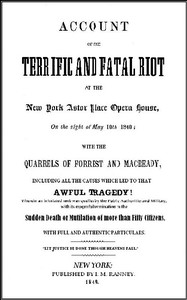
Account of the Terrific and Fatal Riot at the New-York Astor Place Opera House on the Night of May 10th, 1849 - With the Quarrels of Forrest and Macready Including All the Causes which Led to that Awful Tragedy Wherein an Infuriated Mob was Quelled by the Public Authorities and Military, with its Mournful Termination in the Sudden Death or Mutilation of more than Fifty Citizens, with Full and Authentic Particulars
by
Anonymous
Subjects:
Download Formats:
Excerpt
Transcriber’s Note: Italic text is denoted by _underscores_ .
Wherein an infuriated mob was quelled by the Public Authorities and
Military,
Sudden Death or Mutilation of more than Fifty Citizens,
“LET JUSTICE BE DONE THOUGH THE HEAVENS FALL!”
_NEW YORK_:
PUBLISHED BY H. M. RANNEY.
1849.
Entered, according to Act of Congress, in the year 1849,
In the Clerk’s office of the District Court of the United States, in
and for the Southern District of New York.
On the night of...
Read the Full Text
— End of Account of the Terrific and Fatal Riot at the New-York Astor Place Opera House on the Night of May 10th, 1849 - With the Quarrels of Forrest and Macready Including All the Causes which Led to that Awful Tragedy Wherein an Infuriated Mob was Quelled by the Public Authorities and Military, with its Mournful Termination in the Sudden Death or Mutilation of more than Fifty Citizens, with Full and Authentic Particulars —
Book Information
- Title
- Account of the Terrific and Fatal Riot at the New-York Astor Place Opera House on the Night of May 10th, 1849 - With the Quarrels of Forrest and Macready Including All the Causes which Led to that Awful Tragedy Wherein an Infuriated Mob was Quelled by the Public Authorities and Military, with its Mournful Termination in the Sudden Death or Mutilation of more than Fifty Citizens, with Full and Authentic Particulars
- Author(s)
- Anonymous
- Language
- English
- Type
- Text
- Release Date
- March 11, 2020
- Word Count
- 15,820 words
- Library of Congress Classification
- F106
- Bookshelves
- Browsing: Culture/Civilization/Society, Browsing: History - American
- Rights
- Public domain in the USA.
Related Books
Wreck of the "London."
by Anonymous
English
479h 16m read
A day in Mary Carrow's school
by Anonymous
English
88h 8m read
La conqueste du chasteau d'amours conquestee par l'umilité du beau doulx
by Anonymous
French
126h 36m read
The war record of the Fifth Company, New England Regiment, Second Plattsburg Training Camp
by Anonymous
English
205h 3m read

Talon-Pojan Sää- eli Ilma-Kirja
by Anonymous
Finnish
39h 34m read

A brief history of the 3rd Battalion, 1st Punjab Regiment
by Anonymous
English
220h 40m read