The Project Gutenberg eBook of The first church's Christmas barrel,
by Caroline Abbot Stanley
This eBook is for the use of anyone anywhere in the United States and
most other parts of the world at no cost and with almost no restrictions
whatsoever. You may copy it, give it away or re-use it under the terms
of the Project Gutenberg License included with this eBook or online at
www.gutenberg.org. If you are not located in the United States, you
will have to check the laws of the country where you are located before
using this eBook.
Title: The first church's Christmas barrel
Author: Caroline Abbot Stanley
Illustrator: Gayle Porter Hoskins
Release Date: March 15, 2023 [eBook #70294]
Language: English
Produced by: David Edwards, PrimeNumber and the Online Distributed
Proofreading Team at https://www.pgdp.net (This book was
produced from images made available by the HathiTrust
Digital Library.)
*** START OF THE PROJECT GUTENBERG EBOOK THE FIRST CHURCH'S CHRISTMAS
BARREL ***
The First Church’s Christmas Barrel
[Illustration: _See page 50._
“‘HE THAT HATH PITY UPON THE POOR LENDETH UNTO THE LORD.’”]
THE FIRST CHURCH’S
CHRISTMAS BARREL
BY
CAROLINE ABBOT STANLEY
AUTHOR OF “A MODERN MADONNA,”
“ORDER NO. 11,” ETC.
_ILLUSTRATIONS BY
GAYLE PORTER HOSKINS_
NEW YORK
THOMAS Y. CROWELL COMPANY
PUBLISHERS
COPYRIGHT, 1910,
BY CURTIS PUBLISHING COMPANY.
COPYRIGHT, 1912,
BY THOMAS Y. CROWELL COMPANY.
_Published September, 1912._
Illustrations
“‘He that hath pity upon the poor lendeth
unto the Lord’” _Frontispiece_
Opp. Page
“‘Dead, John?--or only half?’” 10
“An old white Leghorn covered with faded
flowers” 28
The First Church’s Christmas Barrel
The First Church’s Christmas Barrel
I
Those who like a “white Christmas” should see one out on the Western
plains, where old Mother Earth lies down for her winter sleep under a
coverlet so white that from horizon to horizon there is hardly enough
gray to outline her form. The winds play tricks with her in scandalous
style out there, making roundness where no roundness is and doing their
best to lay bare her very bones. “These winds don’t care a cuss fer
clothes,” said Job Tolaver, the stage driver, once; and John Haloran
on his hard missionary rides had thought of it a thousand times since.
He was saying it to himself numbly now as with stiffening fingers and
head lowered against the gale he drove along the faint track of a road.
His wife threw open the door as he drove up, and a stream of light fell
athwart the wagon. There was a barrel in the back.
“Dead, John?--or only half?” Her eager eyes searched his face. She knew
the whole pitiful story without a word. The draft had not come. Then,
because she knew, she went on gayly, “Or have you gone to peddling?
What’s in your barrel?”
[Illustration: “‘DEAD, JOHN?--OR ONLY HALF?’”]
“I don’t know yet,” he said heavily, twisting it into the room. “We’ll
see when I’ve fed Daisy.”
When he was gone she eyed the barrel curiously, tilting it and reading
aloud:
+-------------------------+
| |
| REV. JOHN F. HALORAN, |
| BLUE LICK, WYOMING. |
| |
+-------------------------+
“It’s not potatoes. It isn’t heavy enough for that.” Then she struck
an attitude with clasped hands. “I never saw one before--never! But my
prophetic soul tells me this is a missionary barrel. And just two days
before Christmas! Well, in the language of my first-born, ‘Hooray!’”
When the minister came in there was a comfortable old coat warmed and
waiting for him, and a smoking supper set out on a little table drawn
up before the stove.
“Sit down, John. I am going to let you eat here in peace away from the
children.” He glanced up questioningly as a roar came from the kitchen,
with snarls and growls in various keys. “It’s all right. They are wild
animals in a cage and I am the keeper. They are having no end of fun.
You had a cold drive.”
“Bitter.”
“You need an ulster with a storm collar.” She glanced involuntarily
at the barrel. “Aren’t these potatoes good, John? So mealy one hardly
needs butter. Lucky thing, too! You didn’t know I skimped the family
out of a pound of butter, did you? Yes, sir, it went into the candy
money.” She meant it as a pleasantry, but somehow it failed, and she
hurried on. “I wish there were more of the potatoes. Those boys do eat
so! But never mind! After Christmas the hens will begin. Funny how
hens can tell the time of the year, isn’t it?” She chattered on about
anything and everything except the draft.
“This certainly is comfort,” he said at last, relaxing under the genial
influence of food and warmth and companionship. “That’s a cold stretch
coming out from town.”
“Didn’t you stop anywhere?”
“Yes. At Joe Henderson’s. Mary--his wife died!”
“John!”
“Yes. Died last night. I never felt so sorry for anybody in my life.
They think the baby will live; and the poor fellow doesn’t know what to
do with it nor where to turn.”
“Oh, John! If only our cow weren’t going dry I would----”
“You shouldn’t do it, anyway,” he said savagely. “You have enough care
now for three women!--Mary, the draft didn’t come.”
“I know,” she said quietly. “But, John, we’ll get along some way. It
can’t last forever. The draft may come next week. And I was joking
about the potatoes. We’ve a lot left.”
“It isn’t just the money,” he said, shaking his head despondently;
“it’s the feeling of aloneness in the work. If I felt that the church
back of us was doing all it could, it would not be so hard--this ‘hope
deferred that maketh the heart sick.’ But sometimes I think--they don’t
care.”
“They do, John--they do! Don’t allow yourself to think that. Why,
look at this barrel! I know this is from some missionary society, and
would any church send us this unless they knew about our work and were
thinking of us? Why, of course not! Tell me about the barrel.”
“Well, I went to the post-office the first thing to get the draft. I
found instead a letter from this First Church, saying they had sent us
a barrel. I went over to the freight office and there it was. I didn’t
have enough--”
“How providential that it came before Christmas!” she interrupted. “I’m
crazy to see what’s in it! Aren’t you?”
He did not answer the question directly, being far from feeling her
jubilance about it. “We’ll open it after a while,” he said evasively.
In his heart he was protesting, “No! I don’t want their barrel! I want
my money!”
“But not until the children are off. There will be Christmas things in
it that they mustn’t see.... You got the candy, John? But of course you
did.”
Her question was unanswered, but she did not notice it.
“Now I really think the animals will have to come in,” she said gayly.
“You can be trainer for an hour while this keeper clears up the dishes.”
And with a whoop they were upon him--lion, tiger, kangaroo, and baby
bear.
* * * * *
When the children were asleep they brought out the barrel--“our charity
box,” the minister called it, half bitterly.
“I can’t help it, John. It may show an impoverished state of the
blood--or of the spirit, I don’t know which--but when I think of all
the things these children need I am glad of this box. I _am_--‘charity’
though you call it! I am almost sorry you spent the money for candy,
for of course there will be a lot of it in here. Well, they will have
enough for once in their lives! And they are so starved for candy.”
Again he started to speak, but she swept on in full tide of happy talk:
“Before we open it I want to show you the things I already have for
them. Of course they will be poor by comparison, so I’ll exhibit them
first. This overcoat is Paul’s, made out of that old, old one of yours
with the plaid flannel lining. I turned the fuzzy side out. He thinks
it’s fine. And with a new one for Paul every overcoat in the line drops
a peg and lands on the next younger--so everybody has a change! Then,
from the pieces of plaid flannel left I made three good mufflers to
tie over their little headies when they scud across the prairies to
school.... And here are three pairs of mittens cut from the scraps of
the coat. I am so proud of myself over those mittens! I had enough yarn
to knit Davie’s, but----”
“There isn’t one woman in a hundred that could have managed so well.”
She snuggled up to him. “That pays me--if I needed pay, which I don’t.
It was a work of love and--well, maybe a little necessity. You told me
once that I had a genius for poverty.”
“And God knows it has had no chance to lie dormant,” he said bitterly.
“I don’t want it to lie dormant. I want every power I possess brought
out to the utmost. I truly have enjoyed concocting these things out of
nothing. There’s nothing that makes a woman feel so virtuous, unless it
is getting off a lot of neglected letters.... Oh, yes, here are their
handkerchiefs--lovely ones made from an old petticoat! But it will make
one thing more for the stockings. Isn’t it glorious that no matter how
much or how little children have at Christmas, they enjoy it just the
same? That is, if they have candy. That is the one indispensable....
And here are the scrapbooks. I’ve been saving pictures all year; the
blank pages are for ‘our special artist’--that’s you. I wish I had
some colored crayons. Oh, they would love colored crayons! And just
think!--only ten cents!”
She was sorry the moment she said it, for a shadow fell upon his face.
“But never mind, John,” she said quickly. “Life isn’t made up of pinks
and greens, and neither is happiness. You can have a whole lot of
happiness in this world in gray--if you only know how; and I’m going to
teach these children the secret. Now look at my eatables. It is great
fun to make a cookie menagerie with one cutter, and that a rabbit.
You see, I stick on a trunk, pull down his ears, round him up a bit,
and behold an elephant! Then when I want a camel I give Br’er Rabbit
two humps, stretch out his jaws, give him a jab almost anywhere--and
there’s your camel! And look at my dachshund. I laughed till I cried
over that. Poor Davie was _so_ distressed when I stretched him out.
“And here’s a nice red apple for each one. Poor Mary Henderson gave
them to me the last time I was over there and I’ve been saving them
ever since. They are a little specked, but I think they will hold out.
I did want the oranges, but ... no, of course you couldn’t when the
draft didn’t come. Anyway, with the candy they won’t miss other things.
I have the bags all ready--red tarlatan from a peach basket--see?
“There’s just one thing I can’t get around. I do want something to
give the house a Christmas look. I miss that. And there’s not a thing
here but sagebrush. At home, in Maryland, we had such quantities of
holly; and we always made wreaths for the windows and had mistletoe for
the chandeliers, and a roaring fire in the open fireplace, and--I can
see those parlors now. Those are the memories that cling to us always,
I think. I am so sorry that our children can never have them. I hate to
think of their lives being utterly devoid of beauty. The East has more
than its share.”
She was talking more to herself than to him, being momentarily carried
off her feet, so to speak, by the flood of recollection sweeping over
her of the old home with its mighty oaks, its giant elms, and the
hills beyond where Christmas trees could be had for the cutting. The
sight of his face brought her back to the present.
“But fortunately Christmas is not dependent upon holly and mistletoe,”
she said brightly. “They are only the ‘outward, visible sign.’ We will
garnish our home with love and good cheer and contentment. After all,
they are the ‘inward, spiritual grace.’”
She threw up her head with a gesture habitual to her as if defying
fate and its limitations, and his eyes followed her as she moved
about the room putting things to rights. What a glorious creature she
was!--accepting poverty and bareness as her portion and yet rising
above them regally; throwing herself into his work, her own round of
toil, her children’s pleasures, the neighborhood sorrows--all with the
same exuberance of interest and prodigality of self! What would he have
been in his work without her, his “missionary coadjutor,” as he called
her? She was so overflowing with vitality, so undaunted, so alive! A
thrill passed through him at the word _alive_.... Poor Joe Henderson!
Suppose--He covered his eyes and his lips moved.
She was on her knees beside him in an instant.
“John, what is it? What are you saying?”
He took her face between his hands and looked into her eyes. “I was
saying: ‘Bless the Lord, O my soul; and forget not all His benefits.’”
“I knew you would come to it, John. Now let’s open the barrel.”
* * * * *
The first thing to come out was a woman’s hat-box--a generous one. For
years Mary Haloran had worn a small brown felt, trimmed modestly (as
became a missionary’s wife) with two quills and a knot of velvet. The
quills were placed at varying angles from year to year, and the velvet
was steamed annually. When it got past that it was placed under the
family iron and “mirrored.” It always looked respectable, but when Mrs.
Haloran saw that spacious box, a swift vision of a black velvet hat
with black plumes and a jet buckle--all new at the same time--rose
before her.
“I am glad the first thing is for you,” John Haloran said. “You deserve
it.”
They laughed at her efforts to untie it; her fingers were clumsy in her
excitement. But it was open at last. She held up to view an old white
Leghorn covered with faded flowers. For one moment neither of them
spoke. Then her sense of humor came to the rescue and she burst into
hysterical laughter.
Putting on the hat she bowed low. “The Reverend Mrs. Haloran,
missionary coadjutor! Well, let’s see if we can’t find something to go
with it!”
She found it. And again her ringing laughter pealed out while the
minister stood by, the embodiment of outraged dignity. To him there was
nothing amusing in this sight. Somebody has said that “for taking us
over a trying place a sense of humor is better than the grace of God.”
Humor was but rudimentary in John Haloran at best, and to-day it was
absolutely lacking.
“It is an outrage!” he said.
“It _is_ an outrage, John. I grant it. But it’s funny!”
It is not our purpose to give here the contents of that barrel. It is
sufficient to say that after the first few garments hope died.
[Illustration: “AN OLD WHITE LEGHORN COVERED WITH FADED FLOWERS.”]
“That is all,” said Mrs. Haloran at last. “No, here is a dear little
suit, just right for Davie. And, John, read this note: ‘It was my
little boy’s that is gone.’” Her overwrought nerves gave way then. “Oh,
John,” she cried, her head on his breast, his arms around her, “we have
Davie, anyway, if we haven’t the clothes for him. Poor, poor mother!”
A moment later she was putting the garments back.
“It is a disappointment,” she said, “but we certainly will not let it
spoil our Christmas. We are no worse off, at any rate, than we were
before. The things I have will insure the children’s good time. The
candy alone would do that.... John, get me the candy! I’m going to fill
the bags now--to take away the bad taste of this barrel.”
The moment which John Haloran had been dreading was upon him.
“Mary, I didn’t get the candy.”
“Didn’t get it?” she echoed blankly.
“No. I used the money to finish paying freight on this barrel.”
“John Haloran! You _didn’t_!”
“There was no other way. I hadn’t enough without.”
“The children’s candy money!” she said slowly. “Money that I have been
hoarding up, five cents at a time, for months!... Why, John, Davie has
been praying for candy!”
“What could I do, Mary? They wouldn’t let me have it at the
freight office without the money. I barely had enough as it was.
And I supposed, of course, there would be things in it for the
children--never dreamed of anything else.”
“For fifty cents,” she said as if to herself, not heeding him, “they
could have got enough candy to satisfy these children--and they didn’t
do it! And for one dollar they could have given them a Christmas that
they would never have forgotten. They _could_! One dollar at the
ten-cent store would have got them a book and a toy apiece, and two
pounds of ten cent candy. And our children would have thought that was
a glorious Christmas--poor little tads!”
She had been speaking slowly and in a low voice. Now she said with
sudden anger: “I know the kind of women that sent these things. They
are the kind that go up and down fashionable city streets saying to
every acquaintance they meet: ‘Do tell me what to get for my boy! He
has everything in the world you can think of now!’... And I would be
satisfied with one dollar for my four! Then after Christmas they groan:
‘What _shall_ I do with all these things?’... And I would be glad to
pick up after mine all Christmas week if they only had something to
throw around! There’s nothing right nor fair about it! Now!”
This mood was so new to her that her husband was speechless before it.
“Well! this barrel is going back to them--to-morrow. To think of their
expecting us to pay freight on the wretched thing!”
“Mary! You wouldn’t do that!”
“I would--and shall! I’m going to give these people one lesson in
giving that they won’t forget! A Christmas box for a lot of children
out on the plains and no candy in it! And Davie praying for candy!...
Well! he’s going to have it. I’ll take this barrel back to town
to-morrow myself; and when I come back I shall have the candy.”
“Wife, you know I would be only too glad to give you the money if I
had it. But I have only two cents left in my pocket until the draft
comes!... Are you going to ask credit?” Asking credit was the one
humiliation they had spared themselves.
“No. I am going to pay money for it--good money--but I am going to have
it!”
In all their life together he had never seen her like this. He watched
her with fascinated eyes. Going to the mantel, she took down a box with
a slit in the top. It was their missionary bank and was held as sacred
from profaning touch as the ark of the Lord. She was tearing it open.
“Mary!” he cried, aghast. “Not the missionary money! You wouldn’t take
that! ‘Will a man rob God?’”
“I’d rob anybody!” she said, turning upon him like a lioness defending
her young. “I’m going to have a Christmas for my children with candy
in it if the heathen go--to perdition!”
He saw then that she was past talking to.
II
It was about two weeks after this that the pastor of the First Church
called a meeting of the ladies of the congregation to take action about
a missionary box.
“Another!” groaned several ladies who never contributed.
He went on to explain that a barrel sent from the church a few weeks
before had been returned, and then--not scorning to make appeal to any
God-given attribute of the female mind--added: “Perhaps I should say
that this barrel has been not only returned but refused. Since it was
sent from the church it is a matter in which you are all interested.
The president of the Missionary Society requests a full attendance.”
Naturally she got it. Seldom in the annals of the First Church had
there been such a meeting.
“Ladies,”--the president’s tap broke upon a lively hum,--“we are
called upon to face a most unprecedented state of affairs. As the
meeting to-day is so much larger than the usual attendance at our
Missionary Society--so very much in excess of the one that launched
this enterprise”--there was marked irony in the implication--“I feel
called upon to explain. At our October meeting it was decided to send
a box to a poor minister’s family in the West, and you were all urged
to contribute as liberally as possible. You will remember that the call
was one given from the pulpit to the entire church. How you responded
to that call we shall soon see.”
There was a startled movement, quickly controlled, in several quarters.
“I was called from the city in November and placed the packing of the
box in the hands of another.”
There was a slight stir in the second row, but Mrs. McArthur raised a
protesting hand.
“One moment, please. The barrel was sent out as a Christmas offering
from the First Church--not the Missionary Society, mind you, but our
wealthy First Church. It was returned immediately. With it came this
letter, which I will now read, since it concerns you all.”
The president of the Missionary Society was generously sharing honors
with the church.
“This is from the wife of the missionary to whom the box was sent--Mrs.
Mary C. Haloran. I do not know Mrs. Haloran personally, but I am
told by a lady of this congregation at whose suggestion the box was
sent that she is a cultivated Christian _lady_. They have a family
of four boys, ranging in age from five to eleven. This I ascertained
definitely, in order that there might be no haphazard, misfit giving. I
left that paper with one of our members.”
She looked the assemblage over interrogatively and a lady rose with
evident reluctance.
“Madam President--I am ashamed to acknowledge it, but that paper was
never sent to the Society. I simply forgot it.”
The president shook her head sadly. “It has placed us in a mortifying
position. I am sure Mrs. Woodley will pardon me for saying that it
exemplifies the truth of the old saying:
“Evil is wrought by want of thought
As well as by want of heart.”
Mrs. Woodley sat down with a very red face.
“The evil in this case you will see from Mrs. Haloran’s letter, which I
will now read:
“DEAR MADAM:
“The barrel so generously sent by the First Church is received
and its contents are carefully noted. I find after prayerful
consideration of our wardrobes that we really are not in need of
the articles contained in it, and I return it thus promptly that it
may be used in discharging the obligations of the First Church to
some of its other missionaries. If sent to the right place--say to
a self-respecting minister with a wife whose spirit has not been
entirely crushed out by the burdens of frontier life--I should think
it might be used several times for this purpose.
“I add a small contribution in the shape of Scripture texts, which
will enhance the value of your gifts. The home missionary is so
accustomed to subsisting on the Word of God that he may be able to
feed on these and be filled. Likewise, they may have the effect to
clothe him with the garment of praise. It is perhaps not too much to
hope that they may also do good (incidentally) to them that are of
the household of faith in the First Church. To this end I will ask
that they be read to the ladies of your Society while an inventory of
the barrel is taken.
“Very sincerely yours,
“MARY C. HALORAN.”
“That’s a spicy letter,” whispered one woman to another with a sparkle
of appreciation. “The woman’s no fool--if she _did_ go into Home
Mission work.”
“Madam President,” said one a little more obtuse, “that is a very
singular communication. It doesn’t tell us at all why the barrel was
returned.”
“The barrel will explain itself,” returned the president, grimly, “and
will also interpret the letter. We will do exactly as Mrs. Haloran
requests--take an inventory and listen to the Scripture messages. The
secretary will read.”
Then a most unprecedented thing (for a Missionary meeting) occurred.
The ladies in the back part of the room came forward.
The president drew from the barrel the same promising hat-box that we
have seen, and the women craned their necks. Black velvet and plumes
flitted through their brains too, as for one blissful moment they had
through the mind of the woman on the plains. Mrs. McArthur handed a
slip of paper to her assistant and held up to the astonished gaze of
her audience--the old Leghorn.
“‘God loveth a cheerful giver,’” read Mrs. Wellman.
There was a burst of laughter in which the donor joined--but with dry
lips.
A second box was drawn forth. It elicited another laugh, somewhat less
spontaneous than the first, for it was a child’s summer hat trimmed
with forget-me-nots.
“‘He that hath pity upon the poor lendeth unto the Lord,’” read Mrs.
Wellman, adding sarcastically: “How many loans the Lord needs, ladies,
of this particular variety, I don’t know. Not many, I should think.”
“There are others,” said the president, unconsciously lapsing into
slang, and holding up in each hand a man’s dust-grimed straw hat. The
secretary read tellingly:
“‘And the Levite that is within thy gates; thou shalt not forsake him.’”
There were those who could not resist the grim satire of this, but more
faces were indignant than smiling now, and whispers of, “Who on earth
sent those things?” passed from one to another.
“Sh!” said one. “Look at that, will you?”
It was a relic of the past, a faded pink cloth opera cloak with a
border of moth-eaten swan’s-down which sent out over them a feathery
cloud at the president’s deft manipulation.
“‘Lay up for yourselves treasures in Heaven,’” read Mrs. Wellman, when
the coughing incident to floating down had subsided, “‘where neither
moth nor rust doth corrupt, and where thieves do not break through nor
steal.’”
They laughed. It was not in unsanctified human nature not to laugh at
that. But a seal-clad woman in the fourth row, with a face aflame,
looked neither to right nor left, but straight at the garment. She had
thought when she sent it in: “It is a nice piece of cloth, anyway, and
people like that always know how to dye things. Or she can use it for a
baby cloak.” It seemed monstrous to her now.
“Madam President,” said an indignant voice, “is there nothing in that
barrel fit to wear?”
The president held up two beautiful little winter dresses. “Yes. There
are these. And some really nice baby clothes--for Mrs. Haloran’s boys!
The need of a missionary census, ladies, before sending out a box is
self-evident.”
She looked in the direction of the recreant Mrs. Woodley, who murmured,
“‘Whereas I was blind, now I see!’”
“The next is a contribution to the minister himself.” She handed a
paper to Mrs. Wellman, who read:
“‘If there be a poor man of one of thy brethren ... thou shalt open
thine hand wide unto him and shalt surely lend him sufficient for his
need.’”
“It ought to be a whole suit for that,” came a stage whisper. The
president held up the offering which was to be sufficient for the poor
man’s needs. It was a vest!
“Old vests!” came an outraged protest.
There was a disposition to lapse into mirth when another vest was
elevated, but it died away as Malachi’s burning words fell upon their
unstopped ears:
“‘Ye offer polluted bread upon mine altar; and ye say, Wherein have we
polluted thee? In that ye say, The table of the Lord is contemptible.’”
Before they had fairly caught their breath after this there came
another broadside from the same plain-speaking prophet. It was brought
forth by a cloth skirt of good material and not much worn, but so
spotted and soiled that Mary Haloran, with one longing look at its
texture, had hurled it back into the barrel.
“‘Ye said also, Behold, what a weariness is it! and ye have snuffed at
it, saith the Lord of hosts; and ye brought that which was torn, and
the lame, and the sick; thus ye brought an offering: should I accept
this at your hand? saith the Lord.’”
All amusement was now submerged in a rising tide of indignation. The
First Church was beginning to realize that it had placed itself in
the position of giving a gratuitous insult; which was a shock, for
the First Church was well bred, if lacking in missionary zeal. And it
was an insult that could not be laid on the narrow shoulders of the
Missionary Society. The barrel had been sent from the whole church.
That it so poorly represented them they began to see was their own
fault.
The enormity of the insult grew with each new disclosure. The packing
had been done at a time when closets were being cleared out for
the winter, and their surplus contents had been neatly bundled and
dumped into the church barrel. From its depths were now brought forth
indeed the lame, the halt, and the blind; and with them came texts
of Scripture that elucidated the law of sacrifice with startling
clearness. It is safe to say that never in the whole reputable life of
the First Church had it listened to so pregnant a sermon delivered in
so few words. And never, _never_ had its understanding been so open to
receive with meekness the engrafted word.
“‘And if ye offer the blind for sacrifice, is it not evil?’” sounded
the accusing voice; “‘and if ye offer the lame and the sick, is it not
evil? Offer it now unto thy governor; will he be pleased with thee, or
accept thy person? saith the Lord of hosts.’”
“Why, did you know that all those things were in the Bible?” whispered
one astounded woman to another.
“No. But there are a lot of things in the Bible that we never know
about till the time comes that we need them. I have found that out....
Listen!” For the president was speaking again.
“Ladies, I am glad to say that the text I hold in my hand is the last.
I will read it myself. Mrs. Haloran says: “I send this final word
from the Mosaic Law, and I beg that the First Church may take it as a
message from all its representatives in the mission field, and from Him
we serve:
“‘Thou shalt not oppress an hired servant that is poor and needy....
At his day thou shalt give him his hire, neither shall the sun go down
upon it.” Deuteronomy xxiv. 14, 15.
Before Mrs. McArthur had ended the reading the treasurer was on her
feet.
“At last, ladies, in my judgment, we have got at the root of the
matter. You will find that this minister’s salary has not been paid
him; now mark my words! And his wife is smarting under a sense of
injustice that we should try to supply that deficiency with a barrel of
rags.”
“Well, I should like to know why it hasn’t been paid,” said a
well-groomed woman, with some severity. “What do we have a Board for
if it isn’t to attend to such things?”
“The Board,” explained the treasurer with alarming succinctness, “is
our agent for disbursing the funds of this church--and others. It
cannot honestly pay out what we have not paid in. If you really want
to know why this man’s salary has not been paid, I will read the
delinquent list of this church. Is there a call?”
There was none.
The president tapped. “Ladies, I have not finished the note. Mrs.
Haloran continues:
“‘I return the barrel as it was sent, with one exception. In it I found
a little half-worn suit with these words pinned to it:’”--a sad-eyed
woman in black, who had been listening with strained attention,
dropped her face in her hands--“‘It was my little boy’s that is gone.’
I cried over that little suit. I knew what it cost her to send it.
And I accept it as from a sister of the blood. May God bless her and
comfort her sad heart.’”
A tearful silence fell upon them then, for, however callous women’s
hearts may be, there is always one string that vibrates at the thought
of the little suit no longer needed.
“Ladies, I have here another letter from Mrs. Haloran, written the next
day. She says:
“MY DEAR MADAM:
“After a night of self-abasement I write to tell you how deeply I
regret my action of yesterday and how gladly I would recall it if I
could. I cannot yet bring myself to feel that I should have kept the
things, but this was an ignoble use to make of the blessed Word of
God, and I am filled with sorrow that I should have done it. I will
only say in palliation that my husband’s salary has been so long
overdue--’”
“That’s it!” exclaimed the treasurer. “I thought so!”
“‘--that we have not been able to spend anything this fall for
clothing, for we will not go in debt. We needed everything that is
warm, for it is bitter cold out here. You can imagine how like a
mockery the barrel seemed to me. We had even used the children’s
candy money to finish paying the freight.’”
From all over the house came shocked exclamations of “O-h! O-h!” “The
children’s candy money!” “Shame!”
“‘What I did was against my husband’s earnest wishes and entreaties.
I know now that he was right and I was wrong; but oh, if the church
at home could only be brought to see that what we need is not charity
but honest pay!
“Yours for the cause,
“MARY C. HALORAN.”
The president laid the letter down. “Ladies, I never was so humiliated
in all my life! That our First Church----”
“Madam President,” interrupted an incisive voice, “I should like to
know who packed that barrel.”
A woman in the second row turned upon her.
“_I_ packed that barrel.” It was as categorical as question and answer
anent Cock Robin. “I am willing to take my share of the blame--_and no
more_. I put into that barrel exactly what was sent in, and--as our
treasurer has most justly remarked--a disbursing agent can do no more.”
“I haven’t said that she might not do less,” interpolated the
treasurer. “If I had been attending to that job I should have packed
most of those things into the furnace--or back to the owners.”
All parliamentary procedure was now cast to the winds. They talked when
and to whom they pleased.
“I had no right to do anything of the kind,” defended the packer. “And
I had no reason to assume that you would send me trash to pack.”
“That’s right, too!” came a voice from the back.
“I will give a word of explanation, Madam President, and then I am
through--with this barrel and all others.”
“Oh, no!” soothed the president; “you’ll pack another one for us
sometime and we will do better.”
“Indeed I won’t! I am through!... Well, as I say, I left my Christmas
work while the rest of you were doing yours, and came down here to pack
this barrel--simply because I had promised the president, in a weak
moment, that I would do it. I was in a great hurry, and when I saw all
these boxes and neat-looking packages I put them in without undoing
anything. It was not my business to pass judgment on the things you had
sent in.” Then in answer to numerous disclaimers: “You didn’t send them
in? Well, somebody did! Who it was I don’t know and _nobody else does_.
The sexton doesn’t, for I asked him.” There was a settling down from
strained positions in various parts of the room. “When I sent off the
barrel I considered that my part was done.”
“As it certainly was,” said the president. “Our thanks are due Mrs.
Hall for her work, at any rate. I feel this particularly, since I
induced her, much against her will, to undertake it. But the thing
that I most deeply deplore, and cannot at all understand, is that this
barrel should have been sent out with freight unpaid. We never do that.
It is a cardinal point with Missionary Societies that all boxes must be
prepaid. I gave my personal check--a blank one to be filled out as was
necessary--for this very purpose. That was my contribution.”
“And I have just returned it to you,” said Mrs. Hall. “It is in that
envelope on the table. The truth of the matter is that I forgot I had
the check until after the barrel was gone. Anyway, it seemed to me
(being new to the work as I am) that they ought to be willing to pay
freight on a valuable box such as I supposed this was.”
“Do you send off your own Christmas gifts that way?” asked the
plain-spoken treasurer.
Mrs. Hall sat down indignantly.
“We’ll have to get another treasurer,” whispered one missionary worker
to another. “Mrs. Outcault is too blunt for any use.”
“She always hits the nail on the head, though.”
“Yes, but she splits the wood in doing it! I am going to Mrs. Hall’s
relief.... Madam President, I think the lady who did our packing has
entirely vindicated herself. We may as well own up to the truth. We
were so full of our own selfish concerns that we gave no heed to the
call for this missionary barrel in any intelligent way. I, for one,
never thought of it once.”
The lady who had forgotten to send in the description of the minister’s
family rose with elaboration.
“I should like to call the lady’s attention to the fact that
“Evil is wrought by want of thought
As well as by want of heart.”
This sally brought forth a general laugh, which is as good as a barrel
of oil for troubled waters.
“Well, ladies, what will you do with the situation--and the barrel?”
“Madam President,”--a lady was recognized who seldom spoke, but always
to the point,--“out of the mouth of this barrel we stand convicted of
selfish indifference to a cause we are in duty bound to uphold, and of
base desertion of those we have sent to the front and have promised,
as Christians, to stand by. I move that we send to this family a box,
a real one, that shall be worthy of this church and commensurate with
their needs.”
There were a dozen seconders.
“I am not sure that they would accept it,” suggested the chair.
“Tell them this was intended for a rummage sale,” came from the right.
“Or the Salvation Army,” from the left.
“Madam President,”--it was the dignified lady whose cheeks had flamed
at sight of the opera cloak,--“I feel that I, for one, have been taught
a lesson in giving that will last me the rest of my life. I should like
to say as much to this brave woman in a note tucked in the pocket of a
warm new cloak for herself. I think I can make that acknowledgment so
humbly that she will accept the gift.”
There was a soft clapping of hands as she sat down.
“That’s the right spirit, Madam President,” said the lady who had made
the motion. “Let us frankly own up to this spirited woman that we see
this thing as we never saw it before, and that we are debtors to her
for the awakening.”
“Madam President,”--this was the donor of one of the vests, who was
under an abiding sense of gratitude that nobody knew it,--“I will
add to the cloak which Mrs. Caffrey has so generously donated a new
overcoat for the minister. I give it as a thank-offering.” This lady’s
husband had recently recovered from a severe illness and this was
erroneously taken as a touching allusion to that fact.
The bidding was lively now. The spirit of giving had taken possession
of the First Church, and a burning desire to set themselves right. The
secretary was kept busy taking down the items, for it was to be no
haphazard work this time.
“Madam President,”--it was the treasurer’s voice,--“as you know, I
don’t believe in missionary boxes--they are too often substitutes for
the salaries we owe and haven’t paid--and I have said that I would
never contribute to one; but I’ve got to put in five pounds of candy
for those children if my principles go to smash.”
There was loud and prolonged applause from all present.
“Now, ladies,” said the chair, when the shower of books, toys, sleds,
skates, etc., precipitated by this offer had subsided, “who will
volunteer to pack this box? I foresee that it will be quite a task.”
Then up rose the lady who had packed the barrel.
“I’ll pack the box. I said I wouldn’t, but I will. If Mrs. Outcault’s
principles have gone to smash, it isn’t worth while for me to
try to hold on to mine! And--I will pay the freight myself--as a
trespass-offering.... No, Madam President, I don’t want your check.”
When the merriment had subsided the treasurer took the floor.
“Madam President and Ladies,--I want to give a word of warning. We will
all feel very self-righteous when we go home; and there’s danger in it.
This box is going to be sent out in a spasm of generosity as the barrel
was sent in a spasm of indifference. But let me tell you that _nothing
worth living can be supported on spasms_! If any of you see now that
the time has come to pay dollars instead of duds, and are willing to
live up to your knowledge, hold up your pocket-books!”
From all over the house went up purses and bags of silver, leather, and
filigree.
“Thank the Lord! your conversion is genuine!” cried the treasurer. “But
_give me your checks before you go_!”
The beaming president rose.
“You have disposed of the situation beautifully, ladies. But the barrel
remains. What shall we do with the barrel?”
“Madam President----”
“Mrs. Hall.”
“We have had our thank-offering, our trespass-offering, and any
number of free-will-offerings. I move that we make of the barrel a
burnt-offering!”
It was carried by a rising vote amid wild applause.
TRANSCRIBER’S NOTE:
1. Enclosed italics font in _underscores_.
*** END OF THE PROJECT GUTENBERG EBOOK THE FIRST CHURCH'S CHRISTMAS
BARREL ***
Updated editions will replace the previous one--the old editions will
be renamed.
Creating the works from print editions not protected by U.S. copyright
law means that no one owns a United States copyright in these works,
so the Foundation (and you!) can copy and distribute it in the
United States without permission and without paying copyright
royalties. Special rules, set forth in the General Terms of Use part
of this license, apply to copying and distributing Project
Gutenberg™ electronic works to protect the PROJECT GUTENBERG™
concept and trademark. Project Gutenberg is a registered trademark,
and may not be used if you charge for an eBook, except by following
the terms of the trademark license, including paying royalties for use
of the Project Gutenberg trademark. If you do not charge anything for
copies of this eBook, complying with the trademark license is very
easy. You may use this eBook for nearly any purpose such as creation
of derivative works, reports, performances and research. Project
Gutenberg eBooks may be modified and printed and given away--you may
do practically ANYTHING in the United States with eBooks not protected
by U.S. copyright law. Redistribution is subject to the trademark
license, especially commercial redistribution.
START: FULL LICENSE
THE FULL PROJECT GUTENBERG LICENSE
PLEASE READ THIS BEFORE YOU DISTRIBUTE OR USE THIS WORK
To protect the Project Gutenberg™ mission of promoting the free
distribution of electronic works, by using or distributing this work
(or any other work associated in any way with the phrase “Project
Gutenberg”), you agree to comply with all the terms of the Full
Project Gutenberg™ License available with this file or online at
www.gutenberg.org/license.
Section 1. General Terms of Use and Redistributing Project
Gutenberg™ electronic works
1.A. By reading or using any part of this Project Gutenberg™
electronic work, you indicate that you have read, understand, agree to
and accept all the terms of this license and intellectual property
(trademark/copyright) agreement. If you do not agree to abide by all
the terms of this agreement, you must cease using and return or
destroy all copies of Project Gutenberg™ electronic works in your
possession. If you paid a fee for obtaining a copy of or access to a
Project Gutenberg™ electronic work and you do not agree to be bound
by the terms of this agreement, you may obtain a refund from the
person or entity to whom you paid the fee as set forth in paragraph
1.E.8.
1.B. “Project Gutenberg” is a registered trademark. It may only be
used on or associated in any way with an electronic work by people who
agree to be bound by the terms of this agreement. There are a few
things that you can do with most Project Gutenberg™ electronic works
even without complying with the full terms of this agreement. See
paragraph 1.C below. There are a lot of things you can do with Project
Gutenberg™ electronic works if you follow the terms of this
agreement and help preserve free future access to Project Gutenberg™
electronic works. See paragraph 1.E below.
1.C. The Project Gutenberg Literary Archive Foundation (“the
Foundation” or PGLAF), owns a compilation copyright in the collection
of Project Gutenberg™ electronic works. Nearly all the individual
works in the collection are in the public domain in the United
States. If an individual work is unprotected by copyright law in the
United States and you are located in the United States, we do not
claim a right to prevent you from copying, distributing, performing,
displaying or creating derivative works based on the work as long as
all references to Project Gutenberg are removed. Of course, we hope
that you will support the Project Gutenberg™ mission of promoting
free access to electronic works by freely sharing Project Gutenberg™
works in compliance with the terms of this agreement for keeping the
Project Gutenberg™ name associated with the work. You can easily
comply with the terms of this agreement by keeping this work in the
same format with its attached full Project Gutenberg™ License when
you share it without charge with others.
1.D. The copyright laws of the place where you are located also govern
what you can do with this work. Copyright laws in most countries are
in a constant state of change. If you are outside the United States,
check the laws of your country in addition to the terms of this
agreement before downloading, copying, displaying, performing,
distributing or creating derivative works based on this work or any
other Project Gutenberg™ work. The Foundation makes no
representations concerning the copyright status of any work in any
country other than the United States.
1.E. Unless you have removed all references to Project Gutenberg:
1.E.1. The following sentence, with active links to, or other
immediate access to, the full Project Gutenberg™ License must appear
prominently whenever any copy of a Project Gutenberg™ work (any work
on which the phrase “Project Gutenberg” appears, or with which the
phrase “Project Gutenberg” is associated) is accessed, displayed,
performed, viewed, copied or distributed:
This eBook is for the use of anyone anywhere in the United States and
most other parts of the world at no cost and with almost no
restrictions whatsoever. You may copy it, give it away or re-use it
under the terms of the Project Gutenberg License included with this
eBook or online at www.gutenberg.org. If you are not located in the
United States, you will have to check the laws of the country where
you are located before using this eBook.
1.E.2. If an individual Project Gutenberg™ electronic work is
derived from texts not protected by U.S. copyright law (does not
contain a notice indicating that it is posted with permission of the
copyright holder), the work can be copied and distributed to anyone in
the United States without paying any fees or charges. If you are
redistributing or providing access to a work with the phrase “Project
Gutenberg” associated with or appearing on the work, you must comply
either with the requirements of paragraphs 1.E.1 through 1.E.7 or
obtain permission for the use of the work and the Project Gutenberg™
trademark as set forth in paragraphs 1.E.8 or 1.E.9.
1.E.3. If an individual Project Gutenberg™ electronic work is posted
with the permission of the copyright holder, your use and distribution
must comply with both paragraphs 1.E.1 through 1.E.7 and any
additional terms imposed by the copyright holder. Additional terms
will be linked to the Project Gutenberg™ License for all works
posted with the permission of the copyright holder found at the
beginning of this work.
1.E.4. Do not unlink or detach or remove the full Project Gutenberg™
License terms from this work, or any files containing a part of this
work or any other work associated with Project Gutenberg™.
1.E.5. Do not copy, display, perform, distribute or redistribute this
electronic work, or any part of this electronic work, without
prominently displaying the sentence set forth in paragraph 1.E.1 with
active links or immediate access to the full terms of the Project
Gutenberg™ License.
1.E.6. You may convert to and distribute this work in any binary,
compressed, marked up, nonproprietary or proprietary form, including
any word processing or hypertext form. However, if you provide access
to or distribute copies of a Project Gutenberg™ work in a format
other than “Plain Vanilla ASCII” or other format used in the official
version posted on the official Project Gutenberg™ website
(www.gutenberg.org), you must, at no additional cost, fee or expense
to the user, provide a copy, a means of exporting a copy, or a means
of obtaining a copy upon request, of the work in its original “Plain
Vanilla ASCII” or other form. Any alternate format must include the
full Project Gutenberg™ License as specified in paragraph 1.E.1.
1.E.7. Do not charge a fee for access to, viewing, displaying,
performing, copying or distributing any Project Gutenberg™ works
unless you comply with paragraph 1.E.8 or 1.E.9.
1.E.8. You may charge a reasonable fee for copies of or providing
access to or distributing Project Gutenberg™ electronic works
provided that:
• You pay a royalty fee of 20% of the gross profits you derive from
the use of Project Gutenberg™ works calculated using the method
you already use to calculate your applicable taxes. The fee is owed
to the owner of the Project Gutenberg™ trademark, but he has
agreed to donate royalties under this paragraph to the Project
Gutenberg Literary Archive Foundation. Royalty payments must be paid
within 60 days following each date on which you prepare (or are
legally required to prepare) your periodic tax returns. Royalty
payments should be clearly marked as such and sent to the Project
Gutenberg Literary Archive Foundation at the address specified in
Section 4, “Information about donations to the Project Gutenberg
Literary Archive Foundation.”
• You provide a full refund of any money paid by a user who notifies
you in writing (or by e-mail) within 30 days of receipt that s/he
does not agree to the terms of the full Project Gutenberg™
License. You must require such a user to return or destroy all
copies of the works possessed in a physical medium and discontinue
all use of and all access to other copies of Project Gutenberg™
works.
• You provide, in accordance with paragraph 1.F.3, a full refund of
any money paid for a work or a replacement copy, if a defect in the
electronic work is discovered and reported to you within 90 days of
receipt of the work.
• You comply with all other terms of this agreement for free
distribution of Project Gutenberg™ works.
1.E.9. If you wish to charge a fee or distribute a Project
Gutenberg™ electronic work or group of works on different terms than
are set forth in this agreement, you must obtain permission in writing
from the Project Gutenberg Literary Archive Foundation, the manager of
the Project Gutenberg™ trademark. Contact the Foundation as set
forth in Section 3 below.
1.F.
1.F.1. Project Gutenberg volunteers and employees expend considerable
effort to identify, do copyright research on, transcribe and proofread
works not protected by U.S. copyright law in creating the Project
Gutenberg™ collection. Despite these efforts, Project Gutenberg™
electronic works, and the medium on which they may be stored, may
contain “Defects,” such as, but not limited to, incomplete, inaccurate
or corrupt data, transcription errors, a copyright or other
intellectual property infringement, a defective or damaged disk or
other medium, a computer virus, or computer codes that damage or
cannot be read by your equipment.
1.F.2. LIMITED WARRANTY, DISCLAIMER OF DAMAGES - Except for the “Right
of Replacement or Refund” described in paragraph 1.F.3, the Project
Gutenberg Literary Archive Foundation, the owner of the Project
Gutenberg™ trademark, and any other party distributing a Project
Gutenberg™ electronic work under this agreement, disclaim all
liability to you for damages, costs and expenses, including legal
fees. YOU AGREE THAT YOU HAVE NO REMEDIES FOR NEGLIGENCE, STRICT
LIABILITY, BREACH OF WARRANTY OR BREACH OF CONTRACT EXCEPT THOSE
PROVIDED IN PARAGRAPH 1.F.3. YOU AGREE THAT THE FOUNDATION, THE
TRADEMARK OWNER, AND ANY DISTRIBUTOR UNDER THIS AGREEMENT WILL NOT BE
LIABLE TO YOU FOR ACTUAL, DIRECT, INDIRECT, CONSEQUENTIAL, PUNITIVE OR
INCIDENTAL DAMAGES EVEN IF YOU GIVE NOTICE OF THE POSSIBILITY OF SUCH
DAMAGE.
1.F.3. LIMITED RIGHT OF REPLACEMENT OR REFUND - If you discover a
defect in this electronic work within 90 days of receiving it, you can
receive a refund of the money (if any) you paid for it by sending a
written explanation to the person you received the work from. If you
received the work on a physical medium, you must return the medium
with your written explanation. The person or entity that provided you
with the defective work may elect to provide a replacement copy in
lieu of a refund. If you received the work electronically, the person
or entity providing it to you may choose to give you a second
opportunity to receive the work electronically in lieu of a refund. If
the second copy is also defective, you may demand a refund in writing
without further opportunities to fix the problem.
1.F.4. Except for the limited right of replacement or refund set forth
in paragraph 1.F.3, this work is provided to you “AS-IS”, WITH NO
OTHER WARRANTIES OF ANY KIND, EXPRESS OR IMPLIED, INCLUDING BUT NOT
LIMITED TO WARRANTIES OF MERCHANTABILITY OR FITNESS FOR ANY PURPOSE.
1.F.5. Some states do not allow disclaimers of certain implied
warranties or the exclusion or limitation of certain types of
damages. If any disclaimer or limitation set forth in this agreement
violates the law of the state applicable to this agreement, the
agreement shall be interpreted to make the maximum disclaimer or
limitation permitted by the applicable state law. The invalidity or
unenforceability of any provision of this agreement shall not void the
remaining provisions.
1.F.6. INDEMNITY - You agree to indemnify and hold the Foundation, the
trademark owner, any agent or employee of the Foundation, anyone
providing copies of Project Gutenberg™ electronic works in
accordance with this agreement, and any volunteers associated with the
production, promotion and distribution of Project Gutenberg™
electronic works, harmless from all liability, costs and expenses,
including legal fees, that arise directly or indirectly from any of
the following which you do or cause to occur: (a) distribution of this
or any Project Gutenberg™ work, (b) alteration, modification, or
additions or deletions to any Project Gutenberg™ work, and (c) any
Defect you cause.
Section 2. Information about the Mission of Project Gutenberg™
Project Gutenberg™ is synonymous with the free distribution of
electronic works in formats readable by the widest variety of
computers including obsolete, old, middle-aged and new computers. It
exists because of the efforts of hundreds of volunteers and donations
from people in all walks of life.
Volunteers and financial support to provide volunteers with the
assistance they need are critical to reaching Project Gutenberg™'s
goals and ensuring that the Project Gutenberg™ collection will
remain freely available for generations to come. In 2001, the Project
Gutenberg Literary Archive Foundation was created to provide a secure
and permanent future for Project Gutenberg™ and future
generations. To learn more about the Project Gutenberg Literary
Archive Foundation and how your efforts and donations can help, see
Sections 3 and 4 and the Foundation information page at
www.gutenberg.org
Section 3. Information about the Project Gutenberg Literary
Archive Foundation
The Project Gutenberg Literary Archive Foundation is a non-profit
501(c)(3) educational corporation organized under the laws of the
state of Mississippi and granted tax exempt status by the Internal
Revenue Service. The Foundation's EIN or federal tax identification
number is 64-6221541. Contributions to the Project Gutenberg Literary
Archive Foundation are tax deductible to the full extent permitted by
U.S. federal laws and your state's laws.
The Foundation's business office is located at 809 North 1500 West,
Salt Lake City, UT 84116, (801) 596-1887. Email contact links and up
to date contact information can be found at the Foundation's website
and official page at www.gutenberg.org/contact
Section 4. Information about Donations to the Project Gutenberg
Literary Archive Foundation
Project Gutenberg™ depends upon and cannot survive without
widespread public support and donations to carry out its mission of
increasing the number of public domain and licensed works that can be
freely distributed in machine-readable form accessible by the widest
array of equipment including outdated equipment. Many small donations
($1 to $5,000) are particularly important to maintaining tax exempt
status with the IRS.
The Foundation is committed to complying with the laws regulating
charities and charitable donations in all 50 states of the United
States. Compliance requirements are not uniform and it takes a
considerable effort, much paperwork and many fees to meet and keep up
with these requirements. We do not solicit donations in locations
where we have not received written confirmation of compliance. To SEND
DONATIONS or determine the status of compliance for any particular
state visit www.gutenberg.org/donate
While we cannot and do not solicit contributions from states where we
have not met the solicitation requirements, we know of no prohibition
against accepting unsolicited donations from donors in such states who
approach us with offers to donate.
International donations are gratefully accepted, but we cannot make
any statements concerning tax treatment of donations received from
outside the United States. U.S. laws alone swamp our small staff.
Please check the Project Gutenberg web pages for current donation
methods and addresses. Donations are accepted in a number of other
ways including checks, online payments and credit card donations. To
donate, please visit: www.gutenberg.org/donate
Section 5. General Information About Project Gutenberg™ electronic works
Professor Michael S. Hart was the originator of the Project
Gutenberg™ concept of a library of electronic works that could be
freely shared with anyone. For forty years, he produced and
distributed Project Gutenberg™ eBooks with only a loose network of
volunteer support.
Project Gutenberg™ eBooks are often created from several printed
editions, all of which are confirmed as not protected by copyright in
the U.S. unless a copyright notice is included. Thus, we do not
necessarily keep eBooks in compliance with any particular paper
edition.
Most people start at our website which has the main PG search
facility: www.gutenberg.org
This website includes information about Project Gutenberg™,
including how to make donations to the Project Gutenberg Literary
Archive Foundation, how to help produce our new eBooks, and how to
subscribe to our email newsletter to hear about new eBooks.
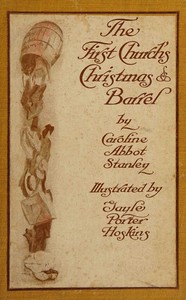
The First Church's Christmas barrel
Download Formats:
Excerpt
The Project Gutenberg eBook of The first church's Christmas barrel,
by Caroline Abbot Stanley
This eBook is for the use of anyone anywhere in the United States and
most other parts of the world at no cost and with almost no restrictions
whatsoever. You may copy it, give it away or re-use it under the terms
of the Project Gutenberg License included with this eBook or online at
www.gutenberg.org. If you are not located in the United States, you
will have to check the laws of the country...
Read the Full Text
— End of The First Church's Christmas barrel —
Book Information
- Title
- The First Church's Christmas barrel
- Author(s)
- Stanley, Caroline Abbot
- Language
- English
- Type
- Text
- Release Date
- March 15, 2023
- Word Count
- 10,291 words
- Library of Congress Classification
- PS
- Bookshelves
- Browsing: Culture/Civilization/Society, Browsing: Literature, Browsing: Fiction
- Rights
- Public domain in the USA.
Related Books
Maisie's merry Christmas
by Rhoades, Nina
English
1006h 44m read

Christmas under three flags
by Wilcox, Mary Emily Donelson
English
196h 56m read

Flying down a rainbow
by Gordon, Homer King
English
88h 39m read
The catspaw of Piperock
by Tuttle, W. C. (Wilbur C.)
English
159h 36m read
Corrie
by Lynn, Ruth, active approximately 1876-1880
English
434h 43m read
Elsie
by Kielland, Alexander Lange
English
393h 5m read